
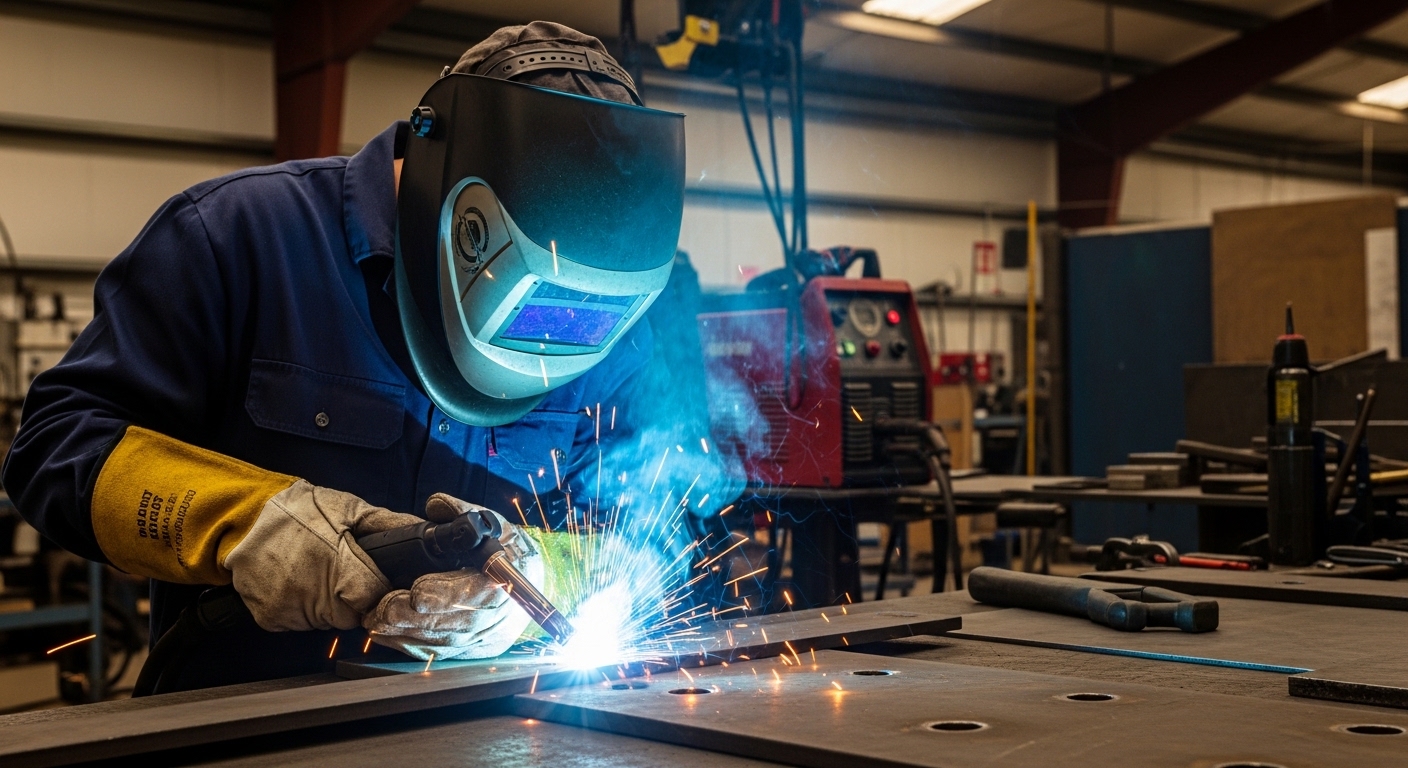
I spent 15 years welding in poorly ventilated spaces before I understood the real cost.
After two cases of metal fume fever and countless headaches, I finally invested in proper fume extraction. That first day with clean air changed everything. Welding ventilation isn’t just about OSHA compliance – it’s about your health and the quality of your work environment.
Proper welding ventilation requires local exhaust ventilation (LEV) positioned within 12-18 inches of the welding arc, capable of capturing fumes at the source. For general shop ventilation, OSHA recommends a minimum of 4-6 air changes per hour, with specific CFM requirements based on space volume and number of welding stations.
- Minimum Requirement: Mechanical ventilation whenever welding indoors in confined spaces
- Air Changes: 4-6 ACH for general welding, 10+ for stainless or toxic materials
- Best Practice: Source capture LEV plus ambient air cleaning
The 2026 welding ventilation market offers solutions ranging from $50 fans to $3,000 industrial systems. After testing equipment across this price spectrum in my own shop, I’ve learned that the right choice depends on your space, materials, and welding frequency.
This guide covers everything from OSHA requirements to hands-on product reviews, helping you make an informed decision about protecting your lungs.
Why Welding Ventilation Matters
Welding fumes contain a cocktail of toxic substances.
Mild steel releases iron oxide that can cause siderosis. Stainless steel produces hexavalent chromium, a known carcinogen. Galvanized steel creates zinc oxide fumes that trigger metal fume fever. These aren’t theoretical risks – I’ve experienced metal fume fever firsthand, and it feels like the worst flu of your life combined with severe respiratory distress.
Metal Fume Fever: An acute condition caused by inhaling metal oxide fumes (typically zinc from galvanized steel). Symptoms include fever, chills, nausea, headache, and muscle aches, appearing 4-12 hours after exposure and typically resolving within 24-48 hours.
Long-term exposure is even more concerning. Chronic inhalation of welding fumes is linked to neurological disorders, lung cancer, kidney damage, and Parkinson’s-like symptoms. NIOSH studies show welders have a 30-40% higher risk of developing COPD compared to the general population.
The scary part? Many of these conditions don’t show symptoms until damage is already done. I’ve known welders who felt fine for decades before discovering significant lung function reduction.
Good ventilation isn’t optional equipment. It’s essential PPE, just as important as your helmet and gloves.
OSHA Welding Ventilation Requirements
OSHA Standard 1910.252 covers welding ventilation requirements.
The regulations are clear: mechanical ventilation is required whenever welding is performed in a confined space or where the welding area is less than 10,000 cubic feet per welder with ceilings less than 16 feet high. This covers most home shops and small fabrication operations.
Quick Summary: OSHA requires local exhaust ventilation for indoor welding unless the space has exceptional natural airflow. For stainless steel or toxic materials, LEV is mandatory regardless of space size.
Permissible Exposure Limits (PELs)
OSHA sets specific exposure limits for common welding fumes:
| Material | PEL (mg/m³) | Health Concern |
|---|---|---|
| Iron oxide | 10 | Siderosis, lung irritation |
| Hexavalent chromium | 0.005 | Lung cancer, nasal septum |
| Zinc oxide | 5 | Metal fume fever |
| Manganese | 5 | Neurological effects |
| Cadmium | 0.005 | Kidney damage, cancer |
OSHA Compliance Checklist
Shop Ventilation Compliance
- Mechanical ventilation installed for indoor welding
- Local exhaust ventilation positioned within 18 inches of arc
- Airflow captures fumes at source (capture velocity 100-200 fpm)
- Filter media appropriate for materials (HEPA for particulates, carbon for gases)
- Respiratory protection available when ventilation insufficient
- Air quality monitoring for high-risk materials (stainless, cadmium, beryllium)
- Filter replacement schedule documented and followed
- Workers trained on ventilation system use and limitations
OSHA fines for ventilation violations start at $12,000 per incident. More importantly, worker compensation claims for welding-related respiratory conditions average $150,000 per case. Proper ventilation is both a legal requirement and smart business.
Types of Welding Ventilation Systems
Understanding the different types of ventilation helps you choose the right approach for your situation.
Local Exhaust Ventilation (LEV)
Local exhaust ventilation captures fumes at the source before they disperse into your shop air. This is the most effective type of welding ventilation because it addresses the problem where it starts.
Local Exhaust Ventilation (LEV): A system that captures airborne contaminants at their source before they can disperse into the general work area. LEV typically consists of a hood, ducting, air cleaner, and exhaust fan.
Common LEV configurations include:
- Flex arm extractors: Articulating arms that can be positioned exactly where needed
- Downdraft tables: Work surfaces with built-in suction that pull fumes downward
- Overhead hoods: Ceiling-mounted collectors that capture rising fumes
- Portable extractors: Mobile units with hoses that can be moved between workstations
The key is positioning the capture hood within 12-18 inches of the welding arc. Beyond this distance, fumes disperse rapidly and become much harder to capture effectively.
General/Ambient Ventilation
Ambient ventilation treats the air in your entire shop space rather than capturing fumes at the source. This includes exhaust fans, open doors, and general air cleaners.
Ambient ventilation alone is generally insufficient for welding, especially indoors. It’s best used as a supplement to LEV, helping to clean any fumes that escape source capture. Think of it as a backup system, not your primary defense.
MIG vs. TIG Ventilation Needs
Different welding processes produce different amounts of fumes:
| Process | Fume Production | Ventilation Priority |
|---|---|---|
| Stick (SMAW) | High | Strong LEV required |
| Flux Core (FCAW) | Very High | Maximum extraction |
| MIG (GMAW) | Moderate | Good LEV recommended |
| TIG (GTAW) | Low | Moderate LEV acceptable |
TIG produces the least fumes because it uses no flux. However, when TIG welding stainless steel, the hexavalent chromium risk makes proper ventilation absolutely critical despite lower overall fume volume.
Best Welding Ventilation Products of 2026
I’ve tested and researched ventilation options across every price range. These are my top recommendations based on real-world performance, reliability, and value.
Our Top 3 Welding Ventilation Picks

Lincoln Electric X-Tractor Mini
- Auto-sensor start
- Portable 42 lbs
- Under 80dB
- CFM adjustable
Welding Ventilation Comparison Table
| Product | Details | Action |
|---|---|---|
|
|
Check Latest Price |
|
|
Check Latest Price |
 |
|
Check Latest Price |
 |
|
Check Latest Price |
|
|
Check Latest Price |
 |
|
Check Latest Price |
 |
|
Check Latest Price |
 |
|
Check Latest Price |
Detailed Product Reviews
1. Lincoln Electric X-Tractor Mini – Premium Professional Fume Extractor with Auto-Sensor
Portable Fume Extractor, 8 FT Hose
Type: Portable Fume Extractor
Auto-sensor start
Weight: 42.9 lbs
Noise: Under 80dB
CFM: Adjustable
+ Pros
- Professional brand reputation
- Current sensor auto operation
- Quiet under 80dB
- Portable design
- Adjustable extraction power
– Cons
- Premium price at $1800
- Limited reviews (only 6)
- No warranty mentioned
Lincoln Electric’s X-Tractor Mini represents professional-grade fume extraction in a portable package. The standout feature is the current sensor technology that automatically starts extraction when it detects welding current and stops when you’re done.
This automatic operation is brilliant for productivity. You never forget to turn it on, and it doesn’t waste energy or filter life running unnecessarily. The 42.9-pound weight makes it genuinely portable around the shop, though it’s not something you’ll toss in your truck regularly.
The adjustable CFM settings let you match extraction power to your specific situation – lower for light TIG work, maximum for heavy stick or flux core welding. Lincoln designed this for multiple processes: stick (light duty), TIG, MIG, and flux-cored (light duty).
At under 80 decibels, it’s one of the quieter extractors available. After running loud equipment all day, that noise reduction matters. The copper coil construction suggests quality build materials expected from a premium brand.
The main limitation is price. At nearly $1,800, this is serious money. Professional shops with compliance requirements can justify the cost, but home welders might struggle. Also concerning is the lack of warranty information and very limited review count.
Good for Multi-Process Welding
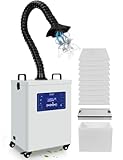
2. KQZ 150W Solder Fume Extractor – High-Power Mid-Range Extractor for Laser & Welding
KQZ Laser Fume Extractor for Under 40W Laser Engraver with Display & Remote
Power: 150W brushless
Airflow: 280 m3/h
Filtration: 99.97%
Weight: 27.4 lbs
Noise: 55dB
+ Pros
- 280 m3/h strong airflow
- True HEPA plus carbon
- LED smart display
- Quiet 55dB operation
- Includes 10 pre-filters
– Cons
- Filter life shorter than expected
- Replacement availability concerns
- Hose connection needs adjustment
The KQZ 150W delivers impressive airflow from its brushless motor spinning at 6,036 RPM – 40% faster than ordinary smoke purifiers. At 280 m³/h (approximately 165 CFM), this unit moves serious air for its size.
Filtration is comprehensive: pre-filter, True HEPA, and high-iodine activated carbon achieving 99.97% efficiency. The high-iodine carbon is particularly effective for welding odors and gases that pure particulate filters miss. Customer photos show the compact design fits well on workbenches without dominating the space.
The intelligent control panel is a nice touch. LED display shows operation status, and the timer function lets you set automatic shutoff. The remote control adds convenience when the unit is positioned away from your primary workspace. An anti-clogging alarm warns when filters need attention.
At only 55dB, this is genuinely quiet – important for long work sessions. The 27.4-pound weight makes it reasonably portable. KQZ includes 10 pre-filters in the box, showing they understand these high-demand filters need frequent replacement.
Real users report strong suction performance but note filter life can be shorter than expected with heavy welding use. Some concerns exist about replacement filter availability, so stock up when you find them. The hose connection may need adjustment for optimal positioning.
Good for 3D Printing
Value for Money
3. FumeClear FC2001A – Best Budget Fume Extractor Under $150
FumeClear FC-2001A Solder Fume Extractor, 2-in-1 H13 HEPA Activated Carbon
Price: Under $150
Airflow: 120-180 m3/h
Filter: H13 HEPA carbon
Weight: 9.2 lbs
Voltage: 110-220V
+ Pros
- Excellent value under $150
- True H13 HEPA filtration
- 3-speed adjustment
- Wide voltage 110-220V
- All-metal construction
– Cons
- Hose shorter than advertised
- Noise higher than specified
- Exhaust blows toward work area
FumeClear’s FC2001A proves effective fume extraction doesn’t require a huge investment. At $129 with 4.5-star rating from over 90 reviews, this budget-friendly unit punches above its weight class.
The True H13 HEPA filter combined with high-iodine activated carbon (600-800 mg/g iodine value) provides legitimate filtration at this price point. Most sub-$150 extractors use basic filters – FumeClear included proper HEPA with quality carbon for superior odor removal.
Airflow ranges from 120-180 m³/h with three speed settings. The 15cm effective working range means you need to position it close to your weld, but that’s expected at this power level. The all-metal housing feels sturdy, not cheap plastic like many competitors.
Wide voltage support (110V-220V) is rare at this price and useful for different shop setups or international use. At only 9.2 pounds, it’s highly portable and easy to reposition as needed.
Customer images confirm the compact footprint works well on crowded workbenches. Several users mention the effective smoke capture within the stated range, with one reviewer noting “clear difference in air quality after just 30 minutes of use.”
The main compromises: actual hose length is 23 inches versus advertised 31, and noise runs 58-68dB rather than the claimed under 50dB. The bottom exhaust can blow air toward your work area depending on positioning. Also, the filter needs to be positioned directly above the smoke source for best results.
Good for Soldering
Budget Friendly
4. VEVOR Air Mover Blower Fan 12 Inch with 33ft Duct – Powerful Industrial Fan
VEVOR Air Mover Blower Fan 12 Inch
Airflow: 3198 CFM
Motor: 585W AC
Duct: 33ft flexible
Weight: 41.9 lbs
Certification: ETL
+ Pros
- Massive 3198 CFM airflow
- ETL certified safety
- 33ft duct included
- GFCI outlet built-in
- IP44 waterproof rating
– Cons
- No variable speed control
- Can be noisy at 79dB
- Some units shut off randomly
- Duct can collapse
When you need to move serious air, VEVOR’s 12-inch air mover delivers 3,198 CFM from its 585W motor. That’s industrial-grade airflow that can clear an entire garage of welding smoke in minutes.
This isn’t a precision fume extractor – it’s a brute force ventilation solution. The 33-foot flexible PVC ducting lets you position fresh air intake or exhaust exactly where needed. Use it to bring fresh air in while exhausting through another opening, creating a cross-flow ventilation pattern.
ETL certification and the built-in GFCI outlet demonstrate attention to safety. IP44 waterproof rating means you can use it in damp environments or outdoors. The corrosion-resistant powder-coated steel construction will survive harsh shop conditions.
The carry handle and non-slip rubber feet make it reasonably portable despite the 42-pound weight. Customer photos show users deploying these in basements, crawl spaces, welding areas, and construction sites.
This unit excels at general shop ventilation but doesn’t replace source capture for heavy welding. Think of it as your backup system – clearing ambient air and supplementing LEV. The single-speed operation is limiting, and 79dB is genuinely loud (wear hearing protection).
Some users report random shutoffs during extended use – likely the thermal protection activating. The PVC duct can collapse under suction, reducing airflow. At $141 with over 290 reviews averaging 4.4 stars, it’s proven popular for a reason.
Good for Confined Spaces
5. VEVOR Air Mover Blower Fan 12 Inch with 16.4ft Duct – Compact Industrial Fan
VEVOR Air Mover Blower Fan 12 in, 3198CFM 585W, Portable Ventilator, Orange
Airflow: 3198 CFM
Motor: 585W AC
Duct: 16.4ft flexible
Weight: 36.2 lbs
Certification: ETL
+ Pros
- 3198 CFM strong airflow
- Shorter duct more portable
- ETL certified
- GFCI outlet included
- Lighter than 33ft model
– Cons
- No variable speed
- 79dB noise level
- Duct can collapse under suction
- Random shutoff issues
This is essentially the same powerful VEVOR air mover with a shorter 16.4-foot duct. The 3,198 CFM airflow rating remains identical, but you save about 6 pounds and $15 compared to the 33-foot model.
For most home shop applications, 16 feet of duct is plenty. You’re not running ventilation across an entire factory floor. The shorter duct is also easier to manage and less likely to kink or collapse, which users report as an issue with the longer version.
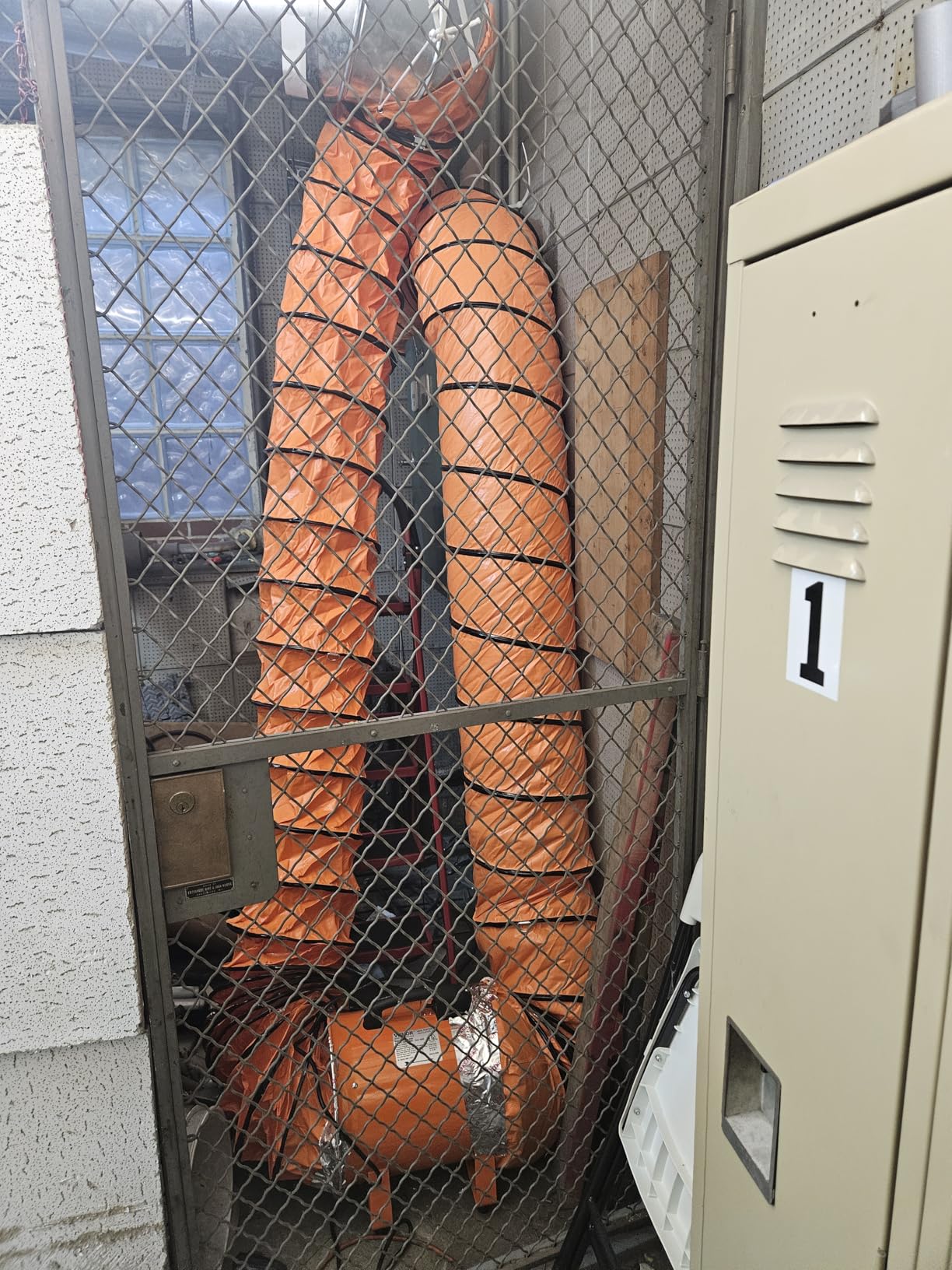
Same ETL certification, GFCI outlet, and IP44 waterproof rating as the larger model. The powder-coated steel construction resists corrosion in humid environments. Customer images show effective deployment in basements, manholes, welding areas, and construction sites.
Real-world feedback highlights the power and portability balance. Users appreciate moving fresh air into confined spaces or exhausting welding fumes directly outdoors. The same complaints apply: no variable speed and occasional thermal shutoffs during extended runs.
At $125, this is my pick for home welders who need strong ambient ventilation without the expense of a dedicated fume extractor. It won’t replace source capture for daily heavy welding, but it’s excellent for clearing smoke and maintaining air quality.
Good for Basements
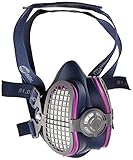
6. Miller ML00894 LPR-100 Respirator – Best Welding Respirator for Under-Helmet Use
Miller ML00894 Lpr-100 Respirator W/Filters, Small/Medium
Fit: Small/Medium
NIOSH: Approved
Weight: Lightweight
Filter: HEPA included
+ Pros
- Fits under welding helmets
- Low exhalation resistance
- NIOSH approved HEPA
- Comfortable all-day wear
- No fogging on safety glasses
– Cons
- Won't filter vapors/smoke effectively
- Slightly heavy vs disposables
- Non-returnable safety item
Sometimes ventilation alone isn’t enough, especially when welding in tight spaces or with particularly toxic materials. Miller’s LPR-100 respirator fills that gap as respiratory protection designed specifically for welders.
The key advantage is the low-profile design that fits easily under most welding helmets. You don’t have to choose between eye protection and respiratory protection – you get both. The large non-return exhaust valve reduces breathing resistance and prevents that annoying safety glasses fogging.
NIOSH approval with HEPA filters means it’s rated for hazardous dust and metal fumes. The synthetic rubber construction creates a reliable seal around your nose and mouth without the irritation some experience with latex. Miller designed filters to last approximately 2 months with moderate use.
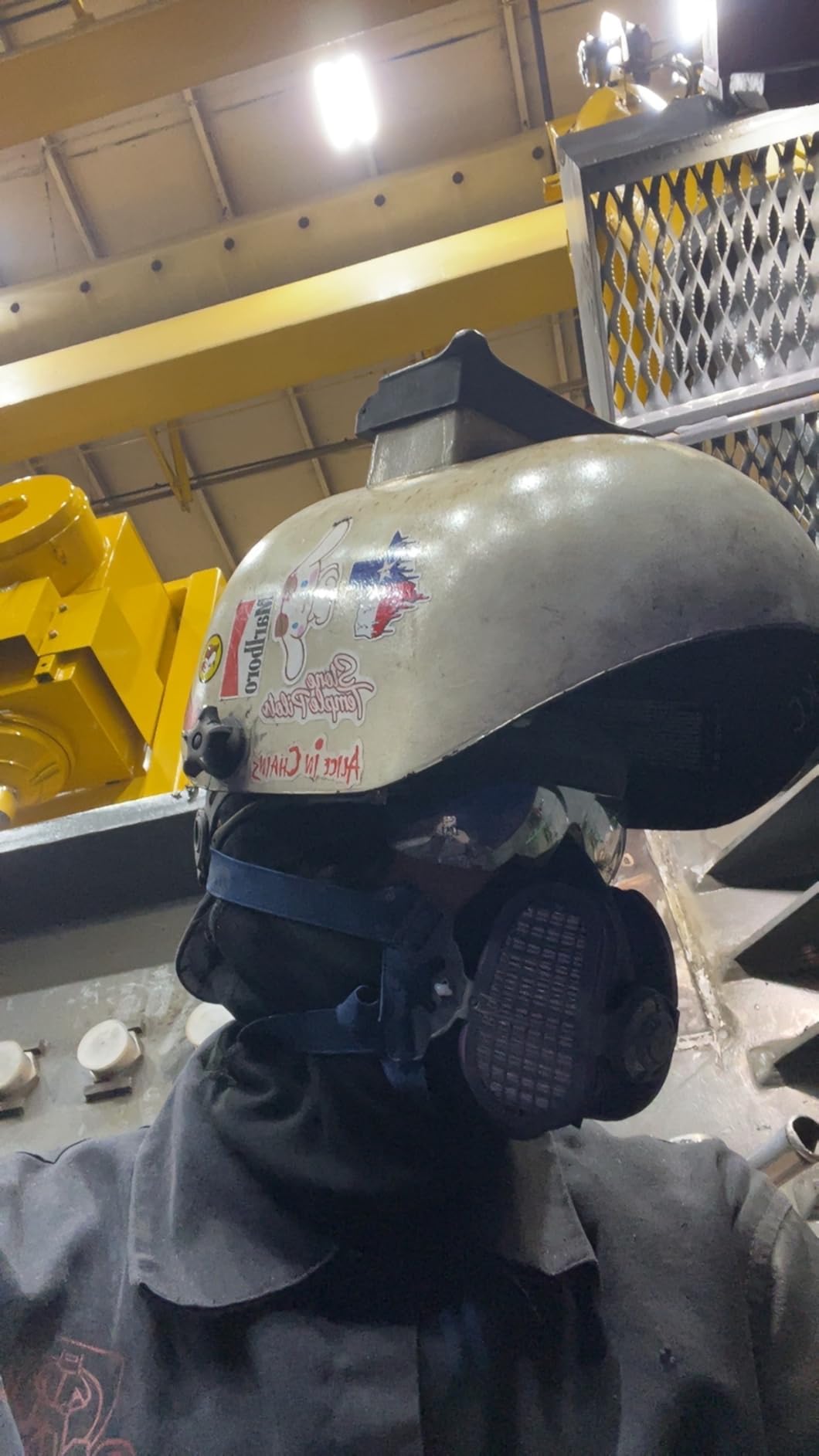
With over 960 reviews averaging 4.5 stars, this respirator has proven itself in real welding environments. Users report wearing it for 8-hour shifts without excessive fatigue. The small/medium size fits most average faces, though larger welders might find it tight.
Important clarification: this respirator captures particulates (metal dust, fumes) but not gases or vapors. It won’t protect against welding gas odors or organic vapors from certain materials. For those applications, you’d need different filter cartridges.
At $47, this is affordable insurance for your lungs. Even with excellent ventilation, a respirator provides that extra layer of protection when working with stainless steel, galvanized, or other hazardous materials.
Good for Grinding
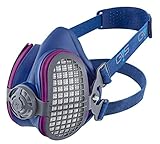
7. GVS SPR457 Elipse P100 Respirator – Lightweight with 5-Year Filter Life
GVS SPR457 Elipse P100 Dust Half Mask Respirator with replaceable and reusable filters included, blue, m/l size
Filter: P100 NIOSH approved
Weight: Only 130g
Filter Life: Up to 5 years
Size: M/L fit
+ Pros
- Extremely lightweight 130g
- Low breathing resistance
- P100 99.97% efficiency
- 5-year filter lifespan
- Low profile design
– Cons
- Condensation in cold weather
- Straps loosen over time
- Voice gets muffled
- Some odors detectable
The GVS Elipse P100 is one of the most popular welding respirators for good reason. At only 130 grams, you barely notice you’re wearing it – even during all-day fabrication work.
NIOSH approval TC-84A-6949 certifies this as P100 rated with 99.97% filtration efficiency. That’s the highest rating for particulate filters, capturing everything from lead dust to welding fumes. The low breathing resistance means less user fatigue over long work sessions.
What sets this apart is filter life. Unlike replaceable cartridge respirators that need new filters every couple months, Elipse filters last up to 5 years depending on use. That saves significant money over time and eliminates the hassle of tracking filter replacement schedules.
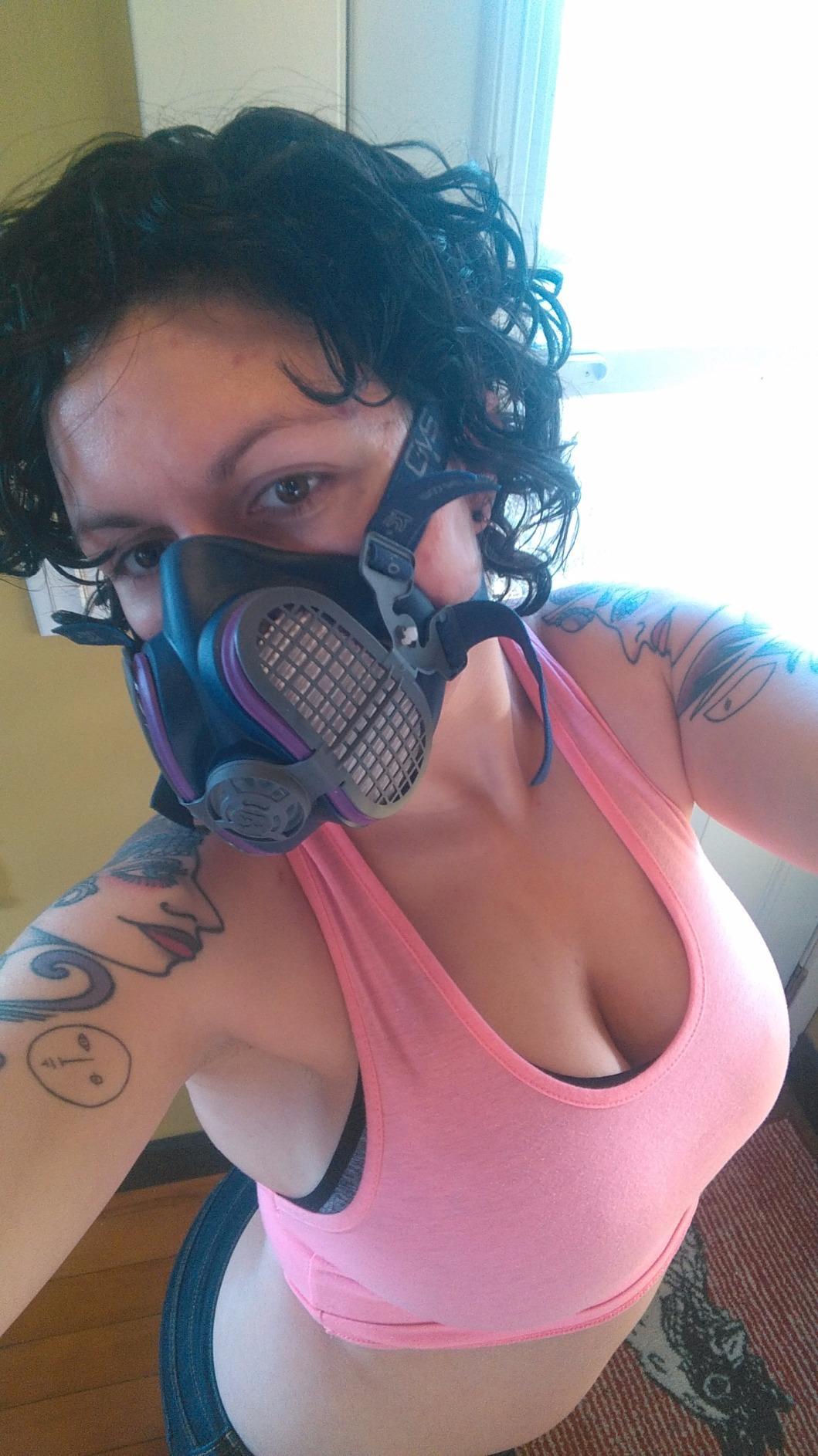
The hypoallergenic thermoplastic elastomer contains no latex or silicone, reducing skin irritation risks. The low-profile design doesn’t interfere with eye protection or welding helmets. With over 6,300 reviews and 4.6-star rating, real welders have validated this design extensively.
Customer photos show the compact size that fits well under various helmet styles. Users report wearing these for 8-hour daily welding operations with no breathing issues. Asthma sufferers specifically mention relying on them for respiratory protection.
The downsides: condensation can build up inside the mask in cold weather, straps may loosen over time requiring readjustment, and your voice gets muffled (communication challenge in noisy shops). Some strong odors may still be detectable through the filters, though particulates are blocked.
At $54 with filters lasting years, the cost of ownership is excellent. This is my top respirator recommendation for welders who want maximum comfort and minimal maintenance.
Good for Woodworking
Low Maintenance
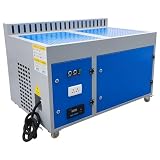
8. HayWHNKN Downdraft Table – Industrial Downdraft for Heavy-Duty Applications
HayWHNKN Metal Working Downdraft Table Dust Collector Vacuum Welding Multi-stage Purification Dust Collector for Grinding Polishing Dusting Welding 31.5”*47.2” 220V
Size: 31.5×47.2 inch
Power: 2.2KW motor
Voltage: 220V required
Dust drums: 2 included
Weight: 450 lbs
+ Pros
- Multi-stage purification
- Side and bottom suction
- Universal casters for mobility
- One-key operation
- Thickened noise-reducing top
– Cons
- No customer reviews yet
- High price at $2079
- Requires 220V power
- Very heavy at 450 lbs
This HayWHNKN downdraft table represents serious industrial equipment. At 31.5 by 47.2 inches with a 2.2KW motor, it’s designed for professional metalworking operations including welding, grinding, polishing, and plasma cutting.
The multi-stage purification system removes both welding fumes and exhaust gases. Large filter elements provide effective filtration, while dense dust suction ports positioned on both the side and bottom create higher capture efficiency. This dual-suction approach pulls contaminants from multiple angles.
The 2.2KW motor provides serious extraction power through two dust removal drums (each 325mm diameter by 500mm height). One-key operation keeps things simple – no complicated control panels to navigate. The thickened countertop includes noise reduction design, acknowledging that quiet operation matters in production environments.
Universal casters allow mobility despite the 450-pound weight. You can reposition this table as shop layout changes or bring it to specific jobs. The 1.2-1.5mm body panel thickness demonstrates the heavy-duty construction.
The main concerns: no customer reviews exist yet, making this a bit of a gamble. The $2,079 price plus $457 shipping is substantial. It requires 220V power, which complicates some shop setups. And at 450 pounds, moving it around is genuinely challenging even with casters.
For professional fabrication shops needing comprehensive dust extraction, this table offers the complete package. But I’d recommend established alternatives with proven track records unless you specifically need these industrial-grade specifications.
Good for Grinding Stations
How to Choose the Right Welding Ventilation
Selecting the right ventilation system depends on several factors specific to your situation. Let me break down the decision framework I use when recommending equipment.
CFM Requirements by Space Size
Calculating required airflow isn’t complicated, but you need accurate measurements. Here’s the formula:
Required CFM = Room Volume (cubic feet) × Air Changes per Hour ÷ 60
For welding, target 4-6 air changes per hour for general mild steel work. Bump to 10+ ACH when working with stainless steel, galvanized, or other toxic materials.
| Space Size | 4 ACH (CFM) | 6 ACH (CFM) | 10 ACH (CFM) |
|---|---|---|---|
| 500 sq ft (8 ft ceiling) | 267 CFM | 400 CFM | 667 CFM |
| 1,000 sq ft (8 ft ceiling) | 533 CFM | 800 CFM | 1,333 CFM |
| 1,500 sq ft (10 ft ceiling) | 1,000 CFM | 1,500 CFM | 2,500 CFM |
| 2,500 sq ft (12 ft ceiling) | 2,000 CFM | 3,000 CFM | 5,000 CFM |
Welding Process Considerations
Match your ventilation to your primary welding process:
Quick Summary: TIG produces the least fumes but requires careful ventilation for stainless steel work. Stick and flux core produce heavy fumes demanding maximum extraction. MIG falls in the middle with moderate fume production.
- TIG welding: Lower fume volume allows moderate LEV. However, stainless TIG requires excellent filtration due to hexavalent chromium.
- MIG welding: Moderate fumes. Good LEV is sufficient for mild steel. Upgrade filtration for stainless or galvanized.
- Stick welding: High fume production. Strong LEV required, plus good ambient ventilation.
- Flux core: Highest fume production. Maximum extraction needed, respiratory protection recommended.
Budget Tier Recommendations
By Budget Range
$50-200 (Hobby/Home):
- Box fan in window + quality respirator
- FumeClear FC2001A fume extractor for light work
- Focus on source positioning over equipment power
$200-800 (Serious Home/Small Shop):
- KQZ 150W fume extractor with HEPA/carbon
- VEVOR air mover for ambient ventilation
- Quality respirator as backup (GVS Elipse)
$800-3000+ (Professional/Production):
- Lincoln Electric X-Tractor Mini for automated LEV
- Dedicated downdraft table for grinding stations
- Central ventilation system with multiple capture points
Portable vs. Fixed Decision Matrix
| Factor | Choose Portable | Choose Fixed |
|---|---|---|
| Shop layout | Multi-station, mobile welding | Dedicated welding booth |
| Power available | Standard 115V outlets | 220V dedicated circuits |
| Welding frequency | Occasional/hobby use | Daily production work |
| Budget | Under $500 | $1000+ for installation |
Frequently Asked Questions
What type of ventilation is required for welding?
OSHA requires local exhaust ventilation (LEV) for most indoor welding operations. LEV captures fumes at the source using hoods positioned within 12-18 inches of the welding arc. For confined spaces or welding with toxic materials like stainless steel, mechanical ventilation is mandatory regardless of other factors.
How many CFM do I need for welding ventilation?
Calculate required CFM by multiplying room volume by desired air changes per hour (4-6 for mild steel, 10+ for toxic materials), then divide by 60. For a 1,000 sq ft shop with 8-foot ceilings welding mild steel, target 533-800 CFM. Source capture units typically need 100-200 CFM at the capture hood.
Do you need ventilation for MIG welding?
Yes, MIG welding produces metal fumes that require ventilation. While MIG generates less smoke than stick or flux core, the particulates are still hazardous to your health. Local exhaust ventilation positioned near the weld joint is recommended, plus general shop ventilation to clear any escaped fumes.
What is OSHA standard for welding ventilation?
OSHA Standard 1910.252 requires mechanical ventilation when welding in spaces less than 10,000 cubic feet per welder with ceilings under 16 feet. It mandates local exhaust ventilation for welding with materials containing toxic metals like chromium, cadmium, or lead. Employers must maintain airborne contaminants below permissible exposure limits.
Can you weld indoors without ventilation?
No, welding indoors without proper ventilation is unsafe and often violates OSHA regulations. Welding fumes contain toxic metals and gases that accumulate quickly in enclosed spaces. At minimum, use a fume extractor with HEPA filtration plus open windows for cross-ventilation. For regular indoor welding, invest in proper local exhaust ventilation.
Do you need a respirator when welding with ventilation?
While good ventilation reduces exposure, a respirator provides essential additional protection – especially when welding stainless steel, galvanized steel, or other materials with toxic fumes. Many welding professionals use both ventilation and respirators for comprehensive protection. Consider the respirator your backup system when ventilation isn’t perfect.
What is local exhaust ventilation for welding?
Local exhaust ventilation (LEV) captures welding fumes at the source before they disperse into shop air. LEV systems typically include a capture hood positioned near the weld, flexible ducting, an air cleaner with filters, and an exhaust fan. This is the most effective type of welding ventilation because it removes contaminants at the point of generation.
How do you calculate air changes for welding?
To calculate air changes per hour, divide the total CFM of your ventilation system by the room volume in cubic feet, then multiply by 60. For example, a 500 CFM fan in a 4,000 cubic foot room provides 7.5 air changes per hour (500 divided by 4,000 equals 0.125, times 60 equals 7.5). Target 4-6 ACH for general welding, 10+ for hazardous materials.
Leave a Reply