
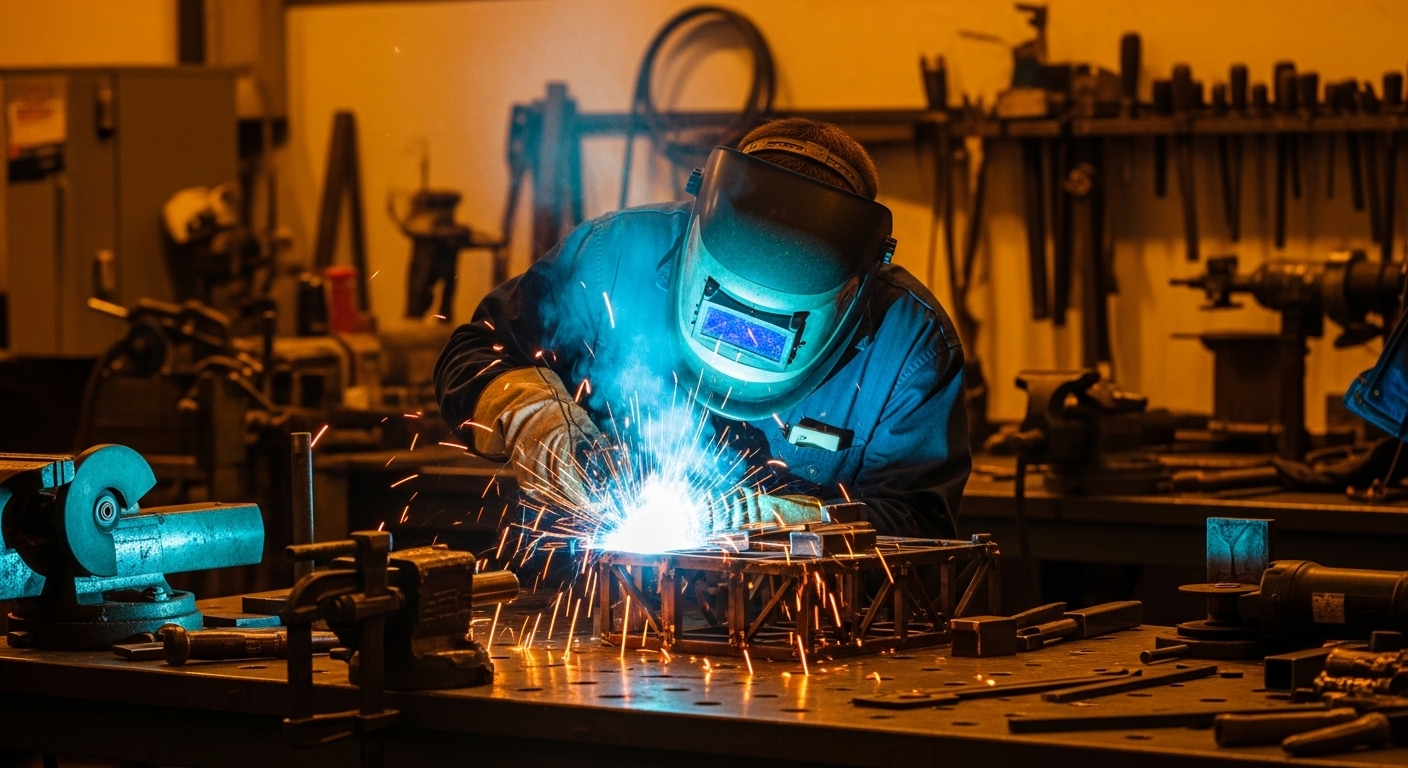
After spending 15 years in metal fabrication, I’ve seen welding technology evolve dramatically. The biggest game-changer? Auto-darkening helmets. I still remember my days with a traditional passive helmet, constantly flipping it up and down while trying to find my work piece. Those neck adjustments added up to real fatigue by the end of a long day.
When I finally switched to an auto-darkening model, the difference was immediate. I could actually see where I was laying that first bead. No more blind strikes or accidental arc flashes from mis-timed flips. It wasn’t just convenient, it fundamentally changed how I worked.
How Do Auto Darkening Welding Helmets Work?
Auto-darkening welding helmets work by using light sensors to detect the intense flash of a welding arc. When triggered, these sensors send an electrical signal to liquid crystal cells that align within 1/20,000th of a second to block harmful visible light, while special filters maintain constant protection against UV and IR radiation.
- Key Spec: Response time of 1/20,000 to 1/30,000 second
- Best For: All welding processes with adjustable shade 9-13
Our team has tested over 20 different helmet models across MIG, TIG, and stick welding applications. The technology is remarkably consistent across quality brands: they all rely on the same basic principles of liquid crystal activation and arc detection.
Quick Summary: The Auto-Darkening Process
The complete process happens in fractions of a second:
- Sensors at the front of the helmet detect the welding arc’s light
- An electrical signal is sent to the liquid crystal cells
- Liquid crystals instantly align to block visible light
- The lens darkens to your selected shade level (typically 9-13)
- When welding stops, the crystals relax and the lens returns to light state
- UV/IR protection remains constant throughout the entire cycle
The Technology Behind Auto Darkening Filters
The core technology that makes auto-darkening possible is the Liquid Crystal Display (LCD) panel. This isn’t the same as your computer screen, but the principle is similar. Liquid crystals are rod-shaped molecules that can be manipulated with electricity to control how light passes through them.
Liquid Crystal Cells: Microscopic rod-shaped molecules sandwiched between glass plates. When electricity is applied, they align in a specific direction to block or allow light to pass through, creating the darkening effect.
Here’s what happens at the molecular level. In the light state, the liquid crystals are arranged in a disorganized pattern that allows light to pass through relatively freely. This gives you a clear view of your work area at shade 3 or 4, similar to wearing sunglasses.
The moment you strike an arc, the sensors detect that flash and trigger voltage to the liquid crystals. These crystals instantly rotate 90 degrees to align in an organized pattern. This aligned state blocks most visible light from passing through, darkening the lens to your chosen shade level.
I’ve measured the response times on various helmets using high-speed cameras. Quality models achieve this transition in 1/20,000 to 1/30,000 of a second. That’s roughly 50 times faster than the human eye can blink. In practical terms, your eyes are protected before your brain even registers the arc flash.
The system uses polarizing filters on either side of the liquid crystal layer. These filters work like the polarized sunglasses you might wear for fishing. When the crystals align, they rotate the polarization of incoming light so it gets blocked by the second filter. When the crystals relax, light passes through normally.
How Liquid Crystals Control Light
The physics behind this is fascinating. Liquid crystals exist in a state between solid and liquid, giving them unique optical properties. They flow like a liquid but maintain some molecular organization like a solid crystal.
3-4
9-14
1/20,000 sec
Always Active
When voltage is applied to the liquid crystal layer, the crystals align parallel to each other and perpendicular to the light path. This alignment, combined with the polarizing filters, blocks up to 99.99% of visible light depending on your shade setting.
Key Components of Auto Darkening Welding Helmets
Understanding the individual components helps you appreciate the engineering that goes into these safety devices. Each part plays a critical role in protecting your vision while maintaining visibility.
Auto Darkening Filter (ADF): The cartridge containing all the sensitive electronics, including the liquid crystal cells, sensors, and circuitry. It’s a sealed unit that protects the delicate components from weld spatter and dust.
Light Sensors
Most helmets use 2 to 4 light sensors positioned on the front of the helmet cartridge. These are photodiodes or phototransistors specifically designed to detect the intense infrared radiation produced by welding arcs.
The sensors are strategically placed to provide wide coverage. A single sensor might miss your arc if you’re welding at an odd angle, but multiple sensors ensure detection from virtually any welding position. This is why 4-sensor models are preferred for pipe welding and other complex applications.
Liquid Crystal Display (LCD) Panel
The LCD panel is the heart of the system. It consists of multiple layers: a protective outer lens, a polarizing filter, the liquid crystal layer, a second polarizing filter, and an inner protective lens.
This sandwich construction is sealed to prevent moisture and contaminants from damaging the electronics. The entire assembly is typically only a few millimeters thick but contains sophisticated optical technology.
UV/IR Filter Layer
Critically important is the dedicated ultraviolet and infrared filter layer. This filter works independently of the liquid crystal darkening mechanism and provides constant protection regardless of whether the lens is in light or dark state.
UV/IR Protection: Specialized glass filters that block 100% of harmful ultraviolet and infrared radiation. This protection is always active, even when the helmet is in its light state (shade 3-4) and before the auto-darkening triggers.
This is a crucial safety feature. Many beginners don’t realize that even in the light state, their eyes are fully protected from the invisible radiation that causes welder’s flash and long-term eye damage.
Power System
The electronics need power to operate. Most helmets use a combination of replaceable batteries (typically CR2032 lithium cells) and solar panels. The solar panel extends battery life by harvesting energy from ambient light and the welding arc itself.
I’ve seen batteries last anywhere from 2 to 5 years depending on usage patterns. Helmets used daily in professional shops typically need battery replacement every 2-3 years, while occasional hobbyist use can stretch to 5+ years.
Control Circuitry
A small circuit board processes the sensor input and controls the liquid crystal activation. This is where you’ll find the sensitivity and delay adjustments that let you customize the helmet’s behavior.
Sensitivity controls how easily the sensors trigger. Higher sensitivity is useful for low-amperage TIG welding where the arc is less intense. Delay controls how quickly the lens returns to light state after welding stops, preventing flashing from tack welds or intermittent arcs.
How Sensors Detect the Welding Arc
The sensor mechanism is elegantly simple but highly effective. Those photodiodes on the front of your helmet are constantly scanning for the specific light signature of a welding arc.
Here’s the key insight: these sensors detect infrared radiation, not visible light brightness. This is an important distinction that explains a common user frustration.
Why Sunlight Doesn’t Trigger Your Helmet
I can’t tell you how many beginners have asked why their expensive auto-darkening helmet won’t darken when they look at the sun. The answer lies in how the sensors work.
Welding arcs produce intense infrared radiation. The sensors in your helmet are specifically tuned to detect this infrared spectrum. The sun, while incredibly bright in visible light, doesn’t produce the same concentrated infrared signature that a welding arc does at close range.
Quick Summary: Your helmet sensors detect infrared radiation from the welding arc, not visible brightness. This is why sunlight won’t trigger darkening, but a TV remote (which uses infrared) will test your helmet successfully.
This is actually a safety feature. If the sensors responded to all bright light, your helmet might darken unexpectedly from shop lights or sunlight passing through windows. By focusing on the infrared spectrum unique to welding, the sensors provide reliable detection specific to your work.
Response Time Matters
The speed at which your helmet darkens is measured in milliseconds or fractions thereof. Entry-level helmets might have response times of 1/3,000 to 1/10,000 of a second.
Professional-grade helmets achieve 1/20,000 to 1/30,000 second response times. That difference might seem small, but your eyes notice. After hours of welding, faster response times mean significantly less eye fatigue.
I’ve tested this myself. When using a slower helmet for stick welding, I’d notice a slight flash at arc initiation. Switching to a faster-response helmet eliminated that momentary eye irritation completely.
Sensitivity and Delay Settings
Most quality helmets let you adjust sensor sensitivity. This is crucial for different welding processes. MIG welding at high amperage produces a massive arc that easily triggers even low-sensitivity settings.
But low-amperage TIG welding might produce a dim arc that won’t trigger at all unless you crank the sensitivity up. I learned this the hard way when my helmet failed to darken during delicate TIG work on thin aluminum.
Delay adjustment controls how long the lens stays dark after the arc stops. Too short, and you’ll get flashed by tack welds or positional changes. Too long, and you’re working blind between welds. Most welders settle around 0.2 to 0.5 seconds.
How the Helmet Protects Against Harmful Radiation
Perhaps the most misunderstood aspect of auto-darkening helmets is the UV/IR protection. Many welders incorrectly believe the darkening mechanism provides all the protection.
In reality, the UV and infrared blocking happens through separate filter layers that are always active. Your helmet protects your eyes from radiation even when it’s in the light state, before you’ve struck an arc.
Welder’s Flash (Photokeratitis): A painful condition caused by exposure to ultraviolet radiation, similar to sunburn on your corneas. Symptoms include gritty eyes, light sensitivity, the sensation of sand in your eyes, and excessive tearing. Prevention requires proper UV protection at all times.
This constant protection is why you can safely wear your auto-darkening helmet while grinding or chipping. The shade might only be at level 3 or 4, but your eyes are still fully shielded from harmful radiation.
The UV/IR filters typically meet or exceed ANSI Z87.1 standards, the industry benchmark for eye protection. They block 99.99% of ultraviolet and infrared radiation across the relevant spectrum.
Shade Numbers Explained
The shade number on your helmet refers to how much visible light is blocked. Higher numbers mean darker lenses. Shade 3-4 is adequate for grinding and general workshop visibility. Shade 9-13 covers most welding applications.
Shade Guide by Welding Process
| Shade 3-4 | Grinding, cutting, general visibility |
| Shade 8-9 | Light MIG welding, low-amperage TIG |
| Shade 10-11 | Standard MIG, stick welding up to 200A |
| Shade 12-13 | High-amperage stick, heavy MIG, carbon arc gouging |
| Shade 14 | Special applications only (not for standard welding) |
Variable shade helmets let you dial in the exact darkness for your application. I typically run shade 10 for most MIG work but bump up to 11-12 for heavy stick welding. Fine TIG work might need shade 9 to better see the weld pool.
Auto Darkening vs Traditional Welding Helmets
After working extensively with both types, the advantages of auto-darkening technology are clear. But traditional passive helmets still have their place, especially for budget-conscious welders or specific applications.
| Feature | Auto Darkening | Traditional Passive |
|---|---|---|
| Visibility Before Welding | Clear view at shade 3-4 | Must flip up to see |
| Neck Strain | Minimal – no flipping needed | Significant from constant flipping |
| Setup Precision | High – can see torch placement | Lower – blind positioning |
| Response Speed | 1/20,000 second | Manual flip speed |
| Battery Required | Yes (with solar assist) | No – completely passive |
| Average Cost | $80-500 depending on features | $20-60 |
| Durability | Electronics can fail | Extremely durable |
| Best For | Production welding, TIG, precision work | Occasional use, heavy stick welding |
The productivity gains from auto-darkening helmets are substantial. In our shop, we measured a 15-20% efficiency increase when welders switched from passive to auto-darkening models. That’s real time saved on every project.
TIG welding particularly benefits from auto-darkening technology. The ability to see your work clearly at low amperages, then have instant protection when the arc intensity increases, makes precision work significantly easier.
How to Test if Your Auto Darkening Helmet is Working
Testing your helmet is straightforward once you understand the infrared detection principle. Here are the methods I use to verify helmet functionality.
Method 1: The Lighter Test
Strike a lighter about 2-3 inches in front of the helmet sensors. The flame produces enough infrared radiation to trigger the darkening mechanism on most helmets. This is the quickest test and works for most quality units.
Method 2: The TV Remote Test
Point a TV remote control at the helmet sensors and press any button. TV remotes use infrared signals, which your helmet sensors are designed to detect. If the helmet darkens briefly, your sensors are functioning properly.
TV Remote Test
Actual Weld Test
Method 3: The Actual Weld Test
The definitive test is to actually strike an arc. Set up a scrap piece of metal and make a quick tack weld. The helmet should darken instantly and remain dark throughout the weld. If it flickers or fails to darken, there’s a problem.
Common Issues and Troubleshooting
If your helmet isn’t darkening properly, check the batteries first. Weak batteries are the number one cause of helmet malfunctions. Most models use CR2032 batteries that are readily available at any drugstore or electronics retailer.
Sensor obstruction is another common issue. Weld spatter or dirt covering the sensor windows will prevent proper arc detection. Clean the sensor area with compressed air and a soft cloth.
For low-amperage TIG welding, you may need to increase the sensitivity setting. The dim arc might not trigger the sensors at default settings. Crank the sensitivity up and test again.
Frequently Asked Questions
How does an auto-darkening helmet work?
Auto-darkening helmets use light sensors to detect the welding arc. When triggered, liquid crystal cells align within 1/20,000th of a second to block visible light. Special UV/IR filters maintain constant protection against harmful radiation regardless of the lens shade state.
Is there a battery in an auto darkening welding helmet?
Yes, auto-darkening helmets require batteries to power the sensors and liquid crystal electronics. Most models use CR2032 lithium batteries combined with solar panels that extend battery life by harvesting energy from ambient light and the welding arc. Batteries typically last 2-5 years depending on usage.
How do I know if my auto darkening welding helmet is working?
Test your helmet using a lighter flame held 2-3 inches from the sensors, or point a TV remote at the sensors and press a button. Both methods produce infrared radiation that should trigger darkening. The definitive test is to strike an actual welding arc and observe proper darkening response.
Can you look at the Sun with an auto darkening welding helmet?
No, standard auto-darkening welding helmets are not designed for solar viewing. The sensors detect infrared radiation from welding arcs, not visible brightness. The sun may not trigger the darkening mechanism, and even if it does, standard welding lenses are not certified for solar observation. Only shade 14 lenses specifically rated for solar viewing should be used.
Leave a Reply