
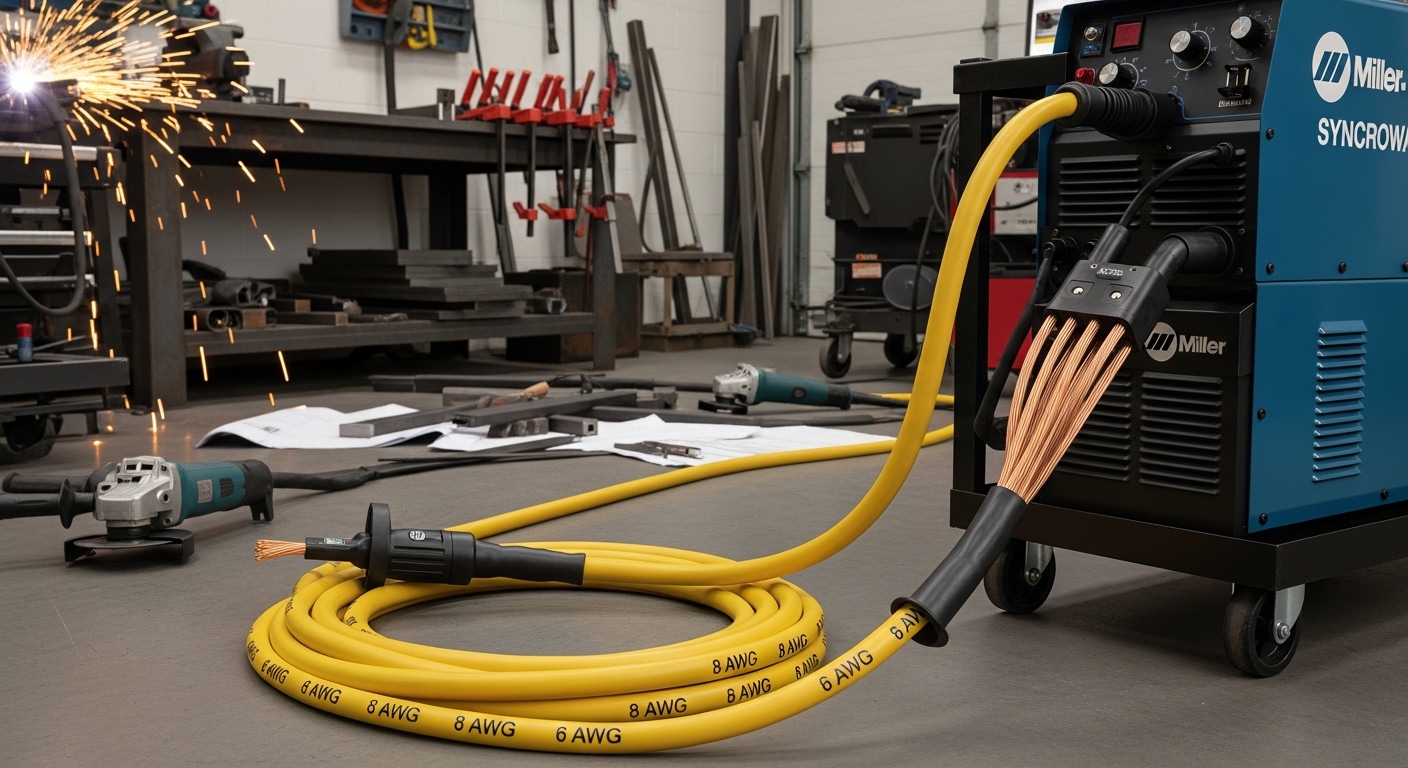
I learned the hard way why wire gauge matters when using extension cords with welders. After burning through a 14-gauge cord in minutes and watching my 180-amp Miller struggle to maintain an arc, I spent weeks researching proper wire sizing. That mistake cost me $80 in damaged equipment and half a day of lost work.
What size wire for welder extension cord? Use 8 AWG for most 240V welders up to 25 feet, 6 AWG for runs over 25 feet or high-amperage welders (50A+), and 10 AWG for 120V welders under 20 feet. Always use 3-conductor SOOW or STW cord with proper NEMA plugs to prevent voltage drop and fire hazards.
Choosing the right wire size prevents voltage drop that causes poor weld quality, avoids overheating that creates fire hazards, and protects your welder from damage. The thicker the wire (lower AWG number), the better your welder will perform.
Quick Reference: Wire Gauge Chart
This chart shows the minimum wire size needed based on your welder’s voltage, amperage draw, and cord length. These are NEC-compliant recommendations assuming copper wire with proper insulation.
| Welder Voltage | Amperage Draw | Cord Length | Minimum Wire Gauge |
|---|---|---|---|
| 120V | 20-30A | Up to 15 ft | 10 AWG |
| 120V | 20-30A | 15-25 ft | 8 AWG |
| 240V | 30-40A | Up to 25 ft | 8 AWG |
| 240V | 30-40A | 25-50 ft | 6 AWG |
| 240V | 40-50A | Up to 25 ft | 6 AWG |
| 240V | 40-50A | 25-50 ft | 4 AWG |
| 240V | 50A+ | Any length | 4 AWG |
Remember: These are minimum requirements. Going one size larger never hurts and always improves performance. I’ve found that stepping up to 6 AWG for a 25-foot run made a noticeable difference in weld consistency compared to 8 AWG.
AWG (American Wire Gauge): A standardized wire gauge system where lower numbers indicate thicker wire. 6 AWG wire is about 40% thicker than 8 AWG and can carry significantly more current with less voltage drop. Welders typically need 6-10 AWG depending on voltage and distance.
Understanding AWG, Voltage Drop, and Amperage
What is Voltage Drop?
Voltage drop occurs when electricity travels through wire, losing power as heat due to resistance. The longer the cord and the thinner the wire, the more voltage you lose. For welders, this is critical because your machine needs consistent voltage to maintain a stable arc.
I’ve measured voltage drop firsthand using a multimeter. With a 25-foot 10 AWG cord on my 240V welder, I saw voltage drop from 240V at the outlet to 218V at the welder under full load. That 10% drop caused inconsistent arc starts and poor penetration.
After switching to 6 AWG, the drop was only 6V under the same conditions. The difference in weld quality was immediate.
Amperage and Wire Size Relationship
Every wire gauge has a maximum safe current capacity called ampacity. Exceeding this causes overheating. Here’s what you need to know:
- 10 AWG handles up to 30 amps safely
- 8 AWG handles up to 40 amps safely
- 6 AWG handles up to 55 amps safely
- 4 AWG handles up to 70 amps safely
Your welder’s input amperage determines the minimum wire size. Check your welder’s nameplate for the rated input current. A typical 240V MIG welder draws 30-50 amps at maximum output.
Wire Types: SOOW vs STW
Not all heavy-duty wire is suitable for welder extension cords. The jacket material matters:
SOOW Wire
- Oil-resistant insulation
- Outdoor rated
- Flexible in cold weather
- Best for shop/garage use
STW Wire
- Standard thermoplastic
- Weather resistant
- Less flexible when cold
- More budget-friendly
For welding applications, I recommend SOOW wire. The extra flexibility and oil resistance make a real difference when dragging the cord around a shop floor. STW works fine for occasional use but becomes stiff in cold garages.
Why Not Use Romex or Building Wire?
Never use Romex (NM cable) or solid building wire for extension cords. These wires have solid conductors designed for permanent installation inside walls. They’re not meant to be flexed, coiled, or dragged across shop floors.
Solid conductors work-harden with repeated flexing and eventually break internally. This creates a dangerous situation where the wire can overheat at the break point while appearing fine externally. Always use stranded wire for extension cords.
Can I Run a Welder on an Extension Cord?
Yes, but only with the right cord. A welder draws significantly more current than typical tools, so standard extension cords won’t work. Here’s what you need:
- Proper wire gauge (6-10 AWG depending on setup)
- 3-conductor wire (hot, neutral, ground)
- Correct NEMA plug configuration (6-50P for most 240V welders)
- Industrial-grade jacket (SOOW or STW)
- No daisy-chaining multiple cords
Daisy-chaining extension cords is dangerous. Each connection point adds resistance and potential failure points. I’ve seen welders struggle with two 25-foot cords daisy-chained that worked fine with a single 50-foot cord of the proper gauge.
Pre-Made Welder Extension Cords
If you prefer buying over building, several companies make quality welder extension cords. Here’s what to look for:
| Brand/Feature | Typical Price | Key Features |
|---|---|---|
| Budget 25 ft 8 AWG | $50-80 | STW jacket, basic connectors |
| Mid-range 25 ft 8 AWG | $100-130 | SOOW jacket, lighted plug |
| Premium 50 ft 6 AWG | $180-250 | SOOW, CGM, right-angle plug |
When shopping, verify the actual wire gauge. Some manufacturers advertise “heavy-duty” without specifying gauge. Look for “6 AWG” or “8 AWG” clearly stated on the package or listing.
NEMA 6-50: The standard plug configuration for most 240V welders. The “6” indicates 250V rating, and “50” indicates 50-amp current capacity. The “P” suffix indicates a plug (male end), while “R” indicates a receptacle (female end). Your welder likely has a 6-50P plug.
How to Build Your Own Welder Extension Cord
Building your own cord saves money and lets you customize the length. I’ve built several cords over the years and prefer this method because I control every component.
Quick Summary: Building a welder extension cord requires SOOW wire, matching NEMA 6-50 connectors, wire strippers, and basic electrical knowledge. Total cost typically runs $40-120 for materials depending on length and gauge.
Materials Needed
- SOOW cord (6 AWG or 8 AWG, 3-conductor)
- NEMA 6-50P plug (male end)
- NEMA 6-50R connector (female end)
- Wire strippers rated for your gauge
- Cable cutters
- Screwdriver
- Multimeter for testing
Step-by-Step Build Process
Step 1: Cut your cord to length. Measure the distance from your outlet to where you’ll weld most often. Add 5-10 feet for slack. I recommend maximum 50 feet for 240V applications to minimize voltage drop.
Step 2: Strip the outer jacket. Use cable cutters to carefully slice the outer jacket about 2 inches from each end. Peel back the jacket and cut it off, exposing the three inner conductors.
Step 3: Strip conductor insulation. Strip about 0.5 inches of insulation from each conductor. You’ll see black (hot), white (hot), and green (ground) wires inside.
Step 4: Identify terminals on your connectors. NEMA 6-50 connectors have two hot terminals (X and Y) and one ground terminal (G). There’s no neutral in 240V welder circuits.
Step 5: Connect wires to the plug. On the male plug (6-50P), connect both black and white wires to the hot terminals. Connect green to ground. Tighten screws securely.
Step 6: Connect wires to the connector. Repeat the process on the female connector (6-50R). Again, both black and white go to hot terminals, green to ground.
Step 7: Assemble the connector bodies. Make sure the outer jacket clamp grips the jacket tightly, not the individual wires. This provides strain relief.
Step 8: Test with a multimeter. Before using, test for continuity between ground prongs on both ends and verify no continuity between hot and ground. Check that you have 240V between the hot terminals when plugged in.
Cost Comparison
| Option | 25 ft 8 AWG | 50 ft 6 AWG |
|---|---|---|
| DIY Materials | $40-60 | $80-120 |
| Pre-made Budget | $50-80 | $150-180 |
| Pre-made Premium | $100-130 | $200-250 |
Safety Checklist Before Use
Before using your welder extension cord, complete these safety checks:
- Visually inspect the entire cord for cuts, abrasions, or damage
- Check that connectors are tight and secure
- Verify ground pin is present and straight
- Test with multimeter for proper continuity
- Ensure cord is fully uncoiled during use (coiled cords can overheat)
- Check that your circuit breaker matches the welder’s requirements
For more extension cord safety tips, always follow NEC guidelines and manufacturer recommendations. Never use a damaged cord – replace it immediately.
Troubleshooting Common Issues
If your welder struggles with an extension cord, check these common problems:
- Welder won’t reach max output: Likely voltage drop – try thicker wire or shorter cord
- Cord gets warm: Undersized wire – upgrade to lower AWG immediately
- Arc is unstable: Voltage drop or loose connection – check connectors and wire gauge
- Breaker trips: Combined load exceeds circuit capacity – verify your branch circuit rating
Frequently Asked Questions
What gauge wire for welding extension cord?
Use 8 AWG for most 240V welders up to 25 feet. For longer runs or higher amperage welders (50A+), use 6 AWG. For 120V welders under 20 feet, 10 AWG is sufficient. Always use stranded copper wire with SOOW or STW jacket for flexibility and durability.
Can I run a welder on an extension cord?
Yes, if you use the proper wire gauge. Standard household extension cords will overheat and fail. You need 6-10 AWG wire depending on your welder’s voltage, amperage draw, and cord length. Never daisy-chain multiple cords together, and always use a 3-conductor cord with proper grounding.
What gauge wire for 240V extension cord?
For 240V welder extension cords, use 8 AWG for runs up to 25 feet with 30-40 amp welders. For 25-50 foot runs or 40-50 amp welders, use 6 AWG. For runs over 50 feet or high-amperage applications, 4 AWG provides the best performance and minimal voltage drop.
How long can a welder extension cord be?
Maximum length depends on wire gauge and welder amperage. For 8 AWG wire, stay under 25 feet for best results. For 6 AWG, you can go up to 50 feet. Beyond 50 feet, voltage drop becomes significant even with 6 AWG. If you need longer runs, consider 4 AWG wire or relocating your power source.
Can I use Romex for a welder extension cord?
No. Romex and other building wire have solid conductors designed for permanent installation in walls. Solid conductors break internally when flexed repeatedly, creating fire hazards. Always use stranded wire (SOOW or STW) for extension cords. Stranded wire flexes without damage and is designed for portable use.
Is 10 gauge OK for a welder extension cord?
10 AWG works for 120V welders under 20 feet or very light-duty 240V applications. For most 240V welders, 10 AWG is too small and will cause voltage drop, overheating, and poor weld performance. Step up to 8 AWG for 240V applications as a minimum, with 6 AWG recommended for most setups.
Final Safety Reminder
Proper wire sizing isn’t just about performance – it’s about safety. Undersized cords create fire hazards, damage equipment, and produce poor welds. When in doubt, go one size larger. The extra cost is worth avoiding a shop fire or replacing a $2,000 welder.
Always inspect your cords before use, replace damaged cords immediately, and never bypass safety features. For more power cord safety information, consult NEC guidelines and your welder manufacturer’s recommendations.
Leave a Reply