
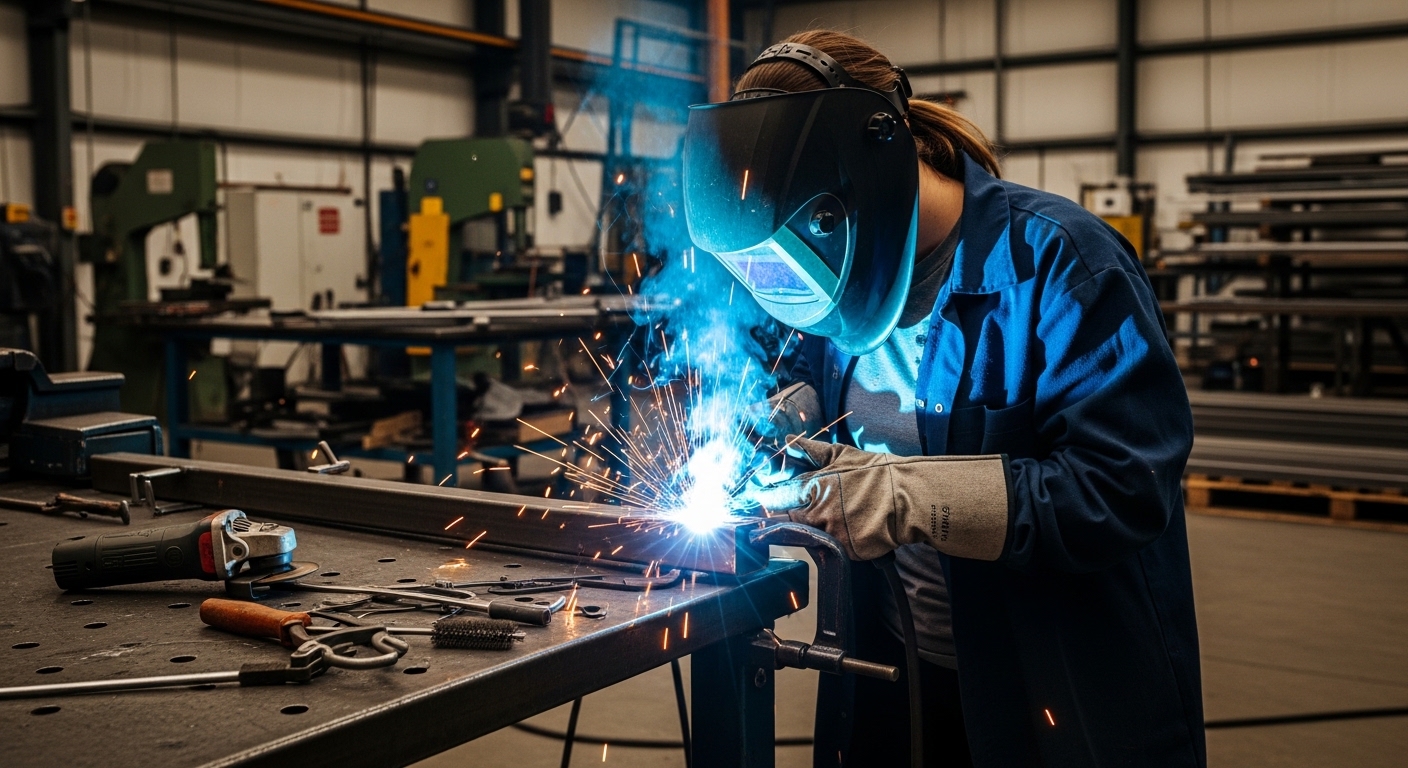
Getting a welding job doesn’t require a four-year degree, but it does demand a strategic approach. After helping dozens of people break into this trade, I’ve found that the most successful welders combine proper training with smart networking.
To get a welding job, you need a high school diploma or GED, complete a training program (7 months to 4 years depending on path), obtain relevant certifications, and actively search for entry-level positions. The entire process typically takes 7 months to 4 years, with starting salaries ranging from $35,000 to $45,000 per year.
I’ve seen career changers successfully transition into welding in their 30s and 40s. The demand for skilled welders remains strong across construction, manufacturing, and energy sectors. But here’s what most guides won’t tell you: applying online alone rarely works. The welders who find jobs fastest show up in person, network actively, and are willing to start in helper positions.
Let me walk you through exactly how to get a welding job, with realistic timelines and strategies that actually work in 2026.
Quick Steps to Start Your Welding Career
Quick Timeline: Education (1-2 weeks) → Training (7 months to 4 years) → Certification (1-3 months) → Job Search (3-6 months). Total: 10 months to 5 years depending on your chosen path.
- Get your GED or high school diploma (1-2 weeks if you don’t have it)
- Choose a training path – trade school (7-12 months), community college (1-2 years), or apprenticeship (3-4 years)
- Complete hands-on training in MIG, TIG, and stick welding processes
- Obtain AWS certification or industry-specific credentials
- Build a portfolio with photos and test pieces from your training
- Network and apply in person at local fabrication shops and construction sites
- Start in an entry-level position (helper, grinder, apprentice) and work your way up
The fastest path is a focused trade school program – about 7 months of intensive training followed by certification testing. However, apprenticeships offer the advantage of earning while you learn, though they take longer to complete.
Education Requirements: What You Actually Need
GED (General Educational Development): A high school equivalency credential that demonstrates basic academic skills. Most welding programs and employers require either a high school diploma or GED as a minimum education requirement.
The minimum requirement for most welding programs is a high school diploma or GED. I’ve worked with students who completed their GED specifically to qualify for welding school, and it typically takes just 1-2 months of focused study.
Some programs accept students without a diploma or GED, but these options are limited. Community colleges often require basic placement tests even if you lack a diploma. If you’re in this situation, I recommend getting your GED first – it opens doors to better programs and eventually to union apprenticeships that have stricter requirements.
High school students can get a head start through Career and Technical Education (CTE) programs. These free programs let you earn welding certifications before graduation, giving you a significant advantage when entering the job market.
Training Options: Trade School vs Community College vs Apprenticeship
Choosing the right training path is one of the most important decisions you’ll make. After researching dozens of programs and talking with graduates, here’s what I’ve found about each option:
Training Program Comparison
| Program Type | Duration | Cost Range | Best For |
|---|---|---|---|
| Trade School | 7-12 months | $15,000-$30,000 | Fast career entry |
| Community College | 1-2 years | $5,000-$15,000 | Budget-conscious students |
| Apprenticeship | 3-4 years | $0-$5,000 | Earn while learning |
| High School CTE | 1-2 years (with HS) | $0-$2,000 | Current high school students |
Online vs In-Person Training
This is a topic most guides ignore, but it’s crucial to understand. Online welding training can teach theory, safety procedures, and blueprint reading. However, you cannot learn actual welding through a screen.
I’ve tested several online programs, and here’s my honest assessment: Online courses work well for the classroom portion of welding education. They’re particularly useful for learning welding symbols, blueprint reading, and metallurgy basics. But you must pair online learning with hands-on practice in a welding booth.
The best approach I’ve seen is hybrid programs: complete theory coursework online, then attend scheduled lab sessions for hands-on training. This format saves money on commuting while still providing essential face-to-face instruction.
If you’re considering a fully online welding certificate program, be cautious. Employers want to see actual welding ability, not just a certificate. Any quality training should include significant booth time – typically 70-80% hands-on practice.
Certification: Which Ones Actually Matter
Not all certifications carry equal weight with employers. After speaking with hiring managers across different industries, here’s what I learned about which credentials actually help you get hired.
The AWS Certified Welder certification is the most widely recognized credential. It’s performance-based, meaning you weld a test specimen that’s then inspected. This certification doesn’t expire and demonstrates proven skill to employers. The exam costs $300-$800 depending on the testing facility and certification type.
Industry-specific certifications can open doors to higher-paying positions:
- AWS D1.1 – Structural steel welding (construction industry)
- ASME Section IX – Pressure vessel welding (power plants, refineries)
- API 1104 – Pipeline welding (oil and gas industry)
- AWS D17.1 – Aerospace welding (aircraft manufacturing)
I’ve found that entry-level positions typically require only basic AWS certification. Employers in specialized fields often pay for additional certifications once you’re hired. Don’t feel pressured to get every possible certification before applying for your first job.
Certifications must be renewed every 6 months to 3 years depending on the type. This involves either retesting or providing proof of continued welding work. Budget for these ongoing costs when planning your career.
How to Find Welding Jobs: Strategies That Work
This section contains the truth that most career guides won’t tell you. After reading hundreds of stories from welders on Reddit’s r/Welding community, one pattern emerges clearly: online applications alone rarely work.
Hard Truth: I’ve seen graduates apply to 50+ jobs online with zero responses. The welders who get hired show up in person, bring their helmet, and ask to speak with the shop foreman directly.
Networking Strategies for Welders
Networking in the welding industry looks different than corporate jobs. Here’s what actually works based on real success stories:
1. Show Up In Person
Walk into local fabrication shops, construction sites, and manufacturing facilities. Bring your helmet, your certification papers, and photos of your best welds. Ask to speak with the shop foreman or welding lead. I’ve seen this technique work repeatedly – employers appreciate the initiative and get to see your face.
2. Join Trade Organizations
The American Welding Society (AWS) offers local chapter memberships. Attend meetings, introduce yourself, and let people know you’re looking for work. These connections often lead to unadvertised job openings. I’ve helped students find positions through AWS contacts that never appeared on job boards.
3. Leverage Your School’s Network
Trade schools and community colleges often have industry connections. Career services can be hit-or-miss, but instructors usually know shops that are hiring. Build relationships with your teachers – they’re often willing to make phone calls on behalf of students they believe in.
Where to Find Openings
Beyond online job boards like Indeed and SimplyHired, focus on industry-specific resources:
- AWS Job Connection – Industry-specific job board from the American Welding Society
- Union halls – If pursuing union work, register with your local trade union
- Company websites – Major employers like Lincoln Electric, shipyards, and refineries post directly
- Local trade publications – Regional industry magazines often list skilled trades positions
Be Willing to Start Low
Many new welders expect to start welding immediately. The reality is different. Your first position might be as a grinder, material handler, or welder’s helper. I’ve seen graduates get discouraged by this, but here’s the perspective shift you need: these positions are your foot in the door.
Employers promote from within. Show up on time, work hard, and learn everything you can. Once they trust your work ethic, you’ll get your chance behind the hood. I’ve watched helpers move into welding roles within 3-6 months at companies that value loyalty and dedication.
Building Your Welding Portfolio
Only about 10% of career guides discuss portfolios, but they’re incredibly valuable. A welding portfolio demonstrates your skill before you even strike an arc during a test weld.
What to Include:
- Photos of your best welds – Include close-ups showing penetration, bead uniformity, and appearance
- Test pieces – Keep actual weld specimens from your training (clean them up first)
- Certification documents – Copies of all earned certifications
- Before/after photos – Show completed projects from raw material to finished product
- Video demonstrations – Short clips showing your welding technique in action
I recommend storing test pieces in a protective case and organizing photos in a digital portfolio or printed binder. Bring this portfolio to interviews – it’s concrete evidence of your skills that sets you apart from candidates who only have a resume.
Union vs Non-Union Welding Jobs
This decision significantly impacts your career trajectory, yet only about 20% of career guides address it directly. Here’s my honest comparison based on conversations with welders from both paths.
Union vs Non-Union Comparison
| Factor | Union | Non-Union |
|---|---|---|
| Starting Pay | Higher (structured scale) | Variable (often lower) |
| Benefits | Comprehensive health/pension | Varies by employer |
| Job Security | Strong (seniority rules) | Depends on company |
| Entry Difficulty | Harder (competitive) | Easier (more openings) |
| Work Flexibility | Limited by union jurisdiction | Can move between companies freely |
| Advancement | Structured promotion path | Based on performance/connections |
To Join a Union: Contact your local trade union hall (typically Ironworkers, Pipefitters, or Boilermakers, depending on your region). Most require completing an apprenticeship program, though some offer journeyman cards for experienced welders who pass testing.
For Non-Union Work: Apply directly to fabrication shops, manufacturing plants, and construction companies. Non-union shops often have faster hiring processes and may be more willing to train entry-level welders.
I generally recommend starting with whichever path has more opportunities in your area. You can always switch later – many welders move between union and non-union work throughout their careers.
Welding Career Paths and Specializations
Welding offers multiple career trajectories, each with different earning potential and lifestyle considerations. Understanding these paths helps you target your training and job search effectively.
Welding Specializations and Salary Ranges
| Specialization | Entry Level | Experienced | Top Earners |
|---|---|---|---|
| General Fabrication | $35,000-$40,000 | $45,000-$55,000 | $60,000-$70,000 |
| Structural Welding | $38,000-$45,000 | $50,000-$65,000 | $75,000+ |
| Pipe Welding | $40,000-$50,000 | $60,000-$80,000 | $100,000+ |
| TIG Welding | $40,000-$48,000 | $55,000-$75,000 | $85,000+ |
| Underwater Welding | $50,000-$60,000 | $80,000-$120,000 | $150,000+ |
Travel Welding Opportunities
One path rarely discussed in career guides is travel welding. These positions send you to different job sites around the country, often with per diem pay and housing allowances. I’ve known travel welders who earned $80,000-$120,000 annually while working on power plant outages, pipeline projects, or refinery turnarounds.
Travel welding requires flexibility and willingness to be away from home for weeks or months at a time. Companies like Industrial Resources and various specialty welding contractors hire for these positions. The work is often intensive during project timelines, followed by time off between jobs.
Women in Welding
Women represent a growing segment of the welding workforce. The industry offers equal pay for equal work, and many employers actively seek diversity. Organizations like Women in Welding and the AWS Women in Welding committee provide networking and support.
Physical strength concerns are often overstated. Proper technique matters more than raw power, and modern equipment reduces physical strain. I’ve worked with exceptional female welders who produce cleaner work than many of their male counterparts.
Advancement Paths
After gaining experience, welders can advance into roles like:
- Welding Inspector – Requires additional certification (CWI)
- Welding Supervisor – Manages teams of welders
- Fabrication Manager – Oversees production operations
- Welding Engineer – Requires engineering degree
- Welding Educator – Teach at trade schools or colleges
Each advancement path typically requires 3-5 years of welding experience plus additional education or certification. The welding inspectors I know earn $70,000-$90,000 after completing their CWI certification.
Realistic Expectations for Your Job Search
Let me give you an honest timeline based on what I’ve observed helping people enter the welding field. Getting your first welding job typically takes 3-6 months after completing training.
I’ve seen graduates apply to 50+ positions online without getting a single response. This is discouraging but common. The same people often find work within weeks once they shift to in-person networking and direct approaches to employers.
Your first job might not be glamorous. Starting as a material handler, grinder, or welder’s helper is normal. View these positions as paid training opportunities. Once employers see your reliability and work ethic, welding opportunities open up.
Geographic flexibility matters. Welding demand varies significantly by region. Texas, Louisiana, North Dakota, and the Gulf Coast states typically offer the most opportunities due to oil, gas, and construction activity. If you’re willing to relocate, your job search becomes much easier.
For career changers concerned about age: I’ve helped people successfully transition into welding in their 30s, 40s, and even 50s. Physical demands are real but manageable with proper technique. Employers often value the maturity, reliability, and life experience that older workers bring.
Frequently Asked Questions
What qualifications do you need to be a welder?
You need a high school diploma or GED to enter most welding programs. Beyond that, you’ll complete formal training (7 months to 4 years depending on path) and obtain certification. The AWS Certified Welder credential is the most widely recognized certification, though some industries require additional specialized credentials.
How long does it take to become a certified welder?
The timeline varies by training path. Trade school programs take 7-12 months plus certification testing. Community college programs typically take 1-2 years. Apprenticeships require 3-4 years but include paid work experience. After training, certification testing can be completed in 1-3 months depending on the specific credentials you pursue.
Is welding a good career in 2026?
Yes, welding remains a solid career choice in 2026. The Bureau of Labor Statistics projects steady demand through 2030 due to aging workforce retirement and infrastructure growth. Entry-level welders earn $35,000-$45,000, with specialized positions paying $65,000-$100,000+. The trade offers job security without requiring a four-year degree.
How much do welders make starting out?
Entry-level welders typically earn $35,000-$45,000 annually, depending on location, industry, and specialization. Structural welding positions often start around $38,000-$45,000. Pipe welding and TIG welding positions may start higher at $40,000-$50,000 due to the additional skill required. Union positions typically offer higher starting wages and better benefits.
Do you need a diploma to be a welder?
Most welding programs and employers require a high school diploma or GED as a minimum requirement. Some community colleges accept students without diplomas through ability-to-benefit testing, but options are more limited. Union apprenticeships almost always require a diploma or GED. If you lack either, getting your GED (typically 1-2 months of study) is your best first step.
What type of welding pays the most?
Underwater welding is the highest-paying specialization, with top earners making $150,000+ annually. Pipe welding also offers excellent pay, with experienced welders earning $80,000-$100,000+. TIG welding, particularly for aerospace or precision applications, pays $55,000-$85,000+. Specialized certifications in high-demand industries (nuclear, aerospace, pipeline) command premium wages.
Can I teach myself to weld?
You can learn basic welding fundamentals through self-study and practice, but formal training is highly recommended for career seekers. Employers require verified skills and certifications. Self-teaching works better for hobby welding than professional work. If you’re self-taught, you’ll still need to complete a certification exam to demonstrate your skills to employers.
How hard is it to get a welding job with no experience?
Getting your first welding job without experience typically takes 3-6 months of active searching. Online applications alone rarely work. The most successful approach combines in-person networking at local shops, willingness to start in helper positions, and persistence. Building relationships with shop foremen and demonstrating reliability often leads to opportunities that never appear on job boards.
What are the different types of welding jobs?
Welding jobs span several industries and specializations. Common types include structural welding (construction and buildings), pipe welding (pipelines and refineries), fabrication (manufacturing and metal shops), TIG welding (precision and aerospace), MIG welding (production and automotive), shipbuilding, and underwater welding. Each requires different skills and offers varying pay scales.
How do I get started in welding with no experience?
Start by earning your GED if needed, then choose a training path based on your timeline and budget. Trade schools offer the fastest route (7-12 months). During training, build a portfolio of your best work and obtain AWS certification. Network actively through your school’s industry connections, AWS local chapters, and in-person visits to fabrication shops. Be willing to start in entry-level positions and work your way up.
Leave a Reply