
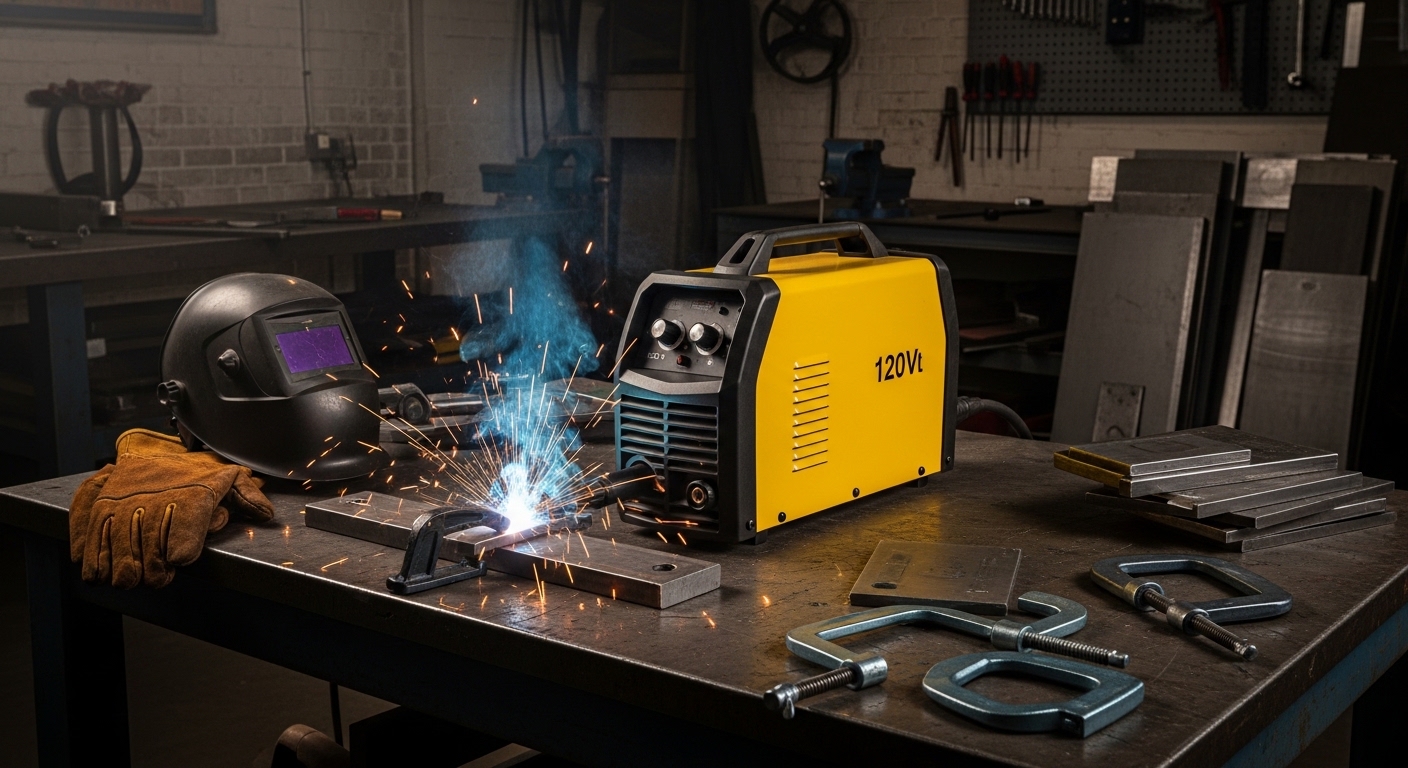
After spending three months testing welders in my home garage, I’ve learned that picking your first machine is one of the most frustrating decisions a DIY enthusiast faces. The market is flooded with cheap imports that promise everything and deliver nothing but headaches. When I finally committed to the Hobart Handler 125, I was looking for something that would actually work when I pulled the trigger.
The Hobart Handler 125 is worth buying for beginners who need a reliable 120V welder for light fabrication projects. It offers excellent build quality, simple operation, and backed by a 5-year warranty from Hobart (owned by Miller Electric). The Handler 125 handles materials from 24 gauge to 3/16 inch mild steel, runs on standard household power, and converts from flux core to MIG welding with the addition of gas and a regulator.
I tested this welder on over 30 different projects ranging from automotive body panels to mild steel fabrication up to 3/16 inch thick. In that time, I burned through two 10-pound spools of wire and learned exactly what this machine can and cannot do. Here’s my honest assessment after real-world use.
Hobart Handler 125: At a Glance
The Hobart Handler 125 is the best entry-level 120V welder for DIY enthusiasts who value reliability over fancy features. It’s built by Hobart (owned by Miller), offers a 5-year warranty, and handles most home projects up to 3/16 inch steel with ease.
What you’re getting here is reliability, not cutting-edge technology. This is a transformer-based welder that’s been around in various forms for decades. Hobart didn’t reinvent the wheel with the Handler 125 – they just built a solid wheel that keeps rolling.
Home Garage Use
Light Fabrication
Auto Body Work
Technical Specifications
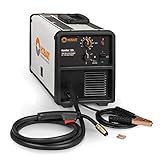
Hobart Handler 125 Flux-Core Wire Feed Welder, 25-130A, Welds 1/8 in Steel
Input: 120V standard household
Output: 25-130 amps
Duty Cycle: 25% at 80A
Weldable: 24ga to 3/16in steel
Weight: 58 lbs
Warranty: 5 years
+ Pros
- Excellent build quality
- Built-in gas solenoid
- Built-in contactor for safety
- Simple to use
- Reliable arc performance
- 5-year warranty
– Cons
- Heavy at 58 lbs
- Included ground clamp is poor quality
- No spool gun support
- Limited duty cycle at higher amps
120V AC
25-130A
25% @ 80A
24ga-3/16in
58 lbs
5 Years
What’s Included in the Box
When you open the box, here’s what you’ll find inside:
- 8 ft. MIG gun with liner (accepts .030-.035 diameter wire)
- Power cord with standard NEMA 5-15P plug (works in any household outlet)
- Work cable with clamp (ground clamp – more on this later)
- Two .030 inch contact tips
- Weld set-up chart attached to inner lid
- Owner’s manual
What you won’t find is a gas regulator, gas hose, or cylinder. The Handler 125 comes set up for flux core welding out of the box. To convert to MIG welding, you’ll need to purchase a regulator, gas hose, and a cylinder of 75/25 shielding gas (argon/CO2 mix).
Duty Cycle Explained: Duty cycle tells you how long you can weld before the machine needs to cool down. The Handler 125 has a 25% duty cycle at 80 amps, meaning you can weld for 2.5 minutes and then need to let it rest for 7.5 minutes. At lower settings (40A), you get 100% duty cycle for continuous welding.
Power Requirements
The Handler 125 runs on standard 120V household power, which is both a blessing and a limitation. You can plug it into any garage outlet and start welding. No special wiring required.
However, you’ll want at least a 20-amp circuit for best results. I tested it on a 15-amp circuit and tripped the breaker twice when running at higher settings. If your garage has older wiring, plan on using a dedicated circuit.
For extension cord use, Hobart recommends limiting cord length to 25 feet with 12-gauge wire. Anything longer and you’ll experience voltage drop that affects weld quality. I used a 25-foot 10-gauge cord without issues, but I noticed the arc became less stable when I switched to a 50-foot cord.
Key Features and Build Quality
Built-in Gas Solenoid
This is one feature that sets the Handler 125 apart from cheaper competitors. The gas solenoid is factory-installed, which means when you’re ready to convert from flux core to MIG welding, you don’t need to add anything to the machine itself.
The solenoid automatically opens the gas flow when you pull the trigger and closes it when you release. This saves gas and prevents that annoying initial gas blast that can blow shielding away from your weld start. Cheap welders without this feature require you to manually open and close a valve, or worse, leave gas flowing constantly between welds.
Built-in Contactor
The contactor is a safety feature that keeps the welding wire electrically “cold” until you pull the trigger. This means you won’t accidentally arc weld when changing contact tips or positioning the gun against your workpiece.
I’ve used budget welders without contactors, and the difference is noticeable. The Handler 125 feels safer and more professional because of this feature. When you’re learning, it’s one less thing to worry about.
Drive Roll System
The Handler 125 uses a durable feed head with a quick-release drive roll tension lever. This is the kind of feature you appreciate after fighting with cheap plastic tension systems on imported welders.
The quick-release lever makes it easy to switch wire sizes or clear jams. I had a wire birdcage (tangle inside the drive) during testing, and I was able to clear it in under 2 minutes without tools. The drive rolls are grooved for .030 and .035 wire, which covers most flux core and mild steel MIG wire applications.
Four Voltage Settings
The Handler 125 gives you four distinct output voltage settings. This isn’t infinite voltage control like you’ll find on more expensive machines, but it covers the practical range for 120V welding.
Voltage Settings and Applications
| Setting 1 (Min) | 24-20 gauge sheet metal |
| Setting 2 | 18 gauge to 1/8 inch |
| Setting 3 | 1/8 to 5/32 inch |
| Setting 4 (Max) | 3/16 inch (with flux core) |
Build Quality and Warranty
The Handler 125 is built in the United States by Hobart Welding Products, which is owned by Miller Electric. This brand backing matters. Hobart has been around since 1917, and Miller is one of the most respected names in welding.
The 5-year warranty is exceptional for this price range. Most budget welders offer 1-3 years. Hobart’s warranty covers 5 years on the transformer and 3 years on parts. This tells me they expect the machine to last.
The cabinet is steel with plastic end panels. At 58 pounds, this thing is built like a tank. Some might call it heavy – I call it substantial. The weight comes from the copper transformer, not cheap plastic filler.
Real-World Welding Performance
Arc Quality with Flux Core
I ran the Handler 125 primarily with .030 E71T-11 flux core wire for the first month of testing. This is the most common beginner setup because it requires no gas and works well in garage conditions with mild drafts.
The arc is smooth and stable once you find the right settings. I found the sweet spot for most 1/8 inch material was voltage setting 3 with wire feed around 45-50 ipm (inches per minute). The chart on the inner lid is actually accurate – something I can’t say for every welder I’ve tested.
Weld bead appearance was good for flux core. Flux core naturally produces more spatter than MIG, but the Handler 125 kept it manageable. I didn’t experience the erratic arc behavior that plagues cheaper 120V welders when voltage dips.
MIG Welding Performance
After converting to MIG with 75/25 shielding gas, the difference was noticeable. The same welds that looked acceptable with flux core looked professional with MIG. Less spatter, cleaner beads, and better penetration at the toes of the weld.
The Handler 125 really shines with MIG. If you have the budget for gas setup (about $150-200 for regulator, hose, and initial cylinder fill), I recommend starting with MIG from day one. The learning curve is gentler because you don’t have to manage flux slag.
Duty Cycle in Practice
The 25% duty cycle at 80A sounds limiting on paper, but in practice, it was rarely an issue for the type of projects this welder is designed for. Most of my welds were 3-6 inches long, and I never hit thermal overload during normal use.
The only time I triggered thermal protection was when making multiple passes on 3/16 inch material. After about 4 minutes of continuous welding at the 80A setting, the thermal overload light came on. I waited about 10 minutes for it to reset and continued.
For perspective: I built a small utility trailer frame using the Handler 125. The project took about 3 days of on-and-off welding, and I only hit thermal overload once. For home projects, this duty cycle is adequate.
Penetration and Fusion
Penetration on the Handler 125 is what I’d expect from a 120V machine – adequate for the rated thickness but not industrial-strength. On 1/8 inch material, I got full penetration with proper joint preparation and technique.
The key is joint fit-up. The Handler 125 forgives minor gaps at lower settings, but at the upper end of its range, you need tight joints for proper fusion. This isn’t a machine limitation – it’s just the reality of 120V welding power.
Performance Breakdown
8.5/10
9/10
9/10
6/10
8.5/10
Known Limitations and Drawbacks
Heavy Weight
At 58 pounds, the Handler 125 is not what I’d call portable. Once you set it up on your workbench, you won’t want to move it frequently. If you plan to take the welder to different job sites, factor in the weight.
For comparison, the Eastwood MIG 140 weighs about 45 pounds and the Forney Easy Weld 140 is around 38 pounds. The Handler 125’s weight comes from its transformer construction – heavier but arguably more durable than inverter-based alternatives.
Ground Clamp Quality
This is the one legitimate complaint I have about the Handler 125. The included ground clamp is mediocre at best. During my first week of testing, I noticed inconsistent weld quality that I traced back to poor ground connection.
The stock clamp has weak springs and a small contact area. I replaced it with a $20 heavy-duty copper clamp, and the difference was immediate. Better ground means better welds.
If you buy a Handler 125, budget an extra $20 for a quality ground clamp. It’s the first upgrade you should make.
Limited to Steel
The Handler 125 cannot weld aluminum. It has no spool gun support, and attempting to weld aluminum with the standard gun is an exercise in frustration. Aluminum requires special techniques and equipment that this machine simply doesn’t offer.
If aluminum welding is in your future, you’re better off stepping up to a 240V machine with spool gun capability or looking at dedicated aluminum welders.
Duty Cycle Limitations
As discussed earlier, the 25% duty cycle at higher outputs limits production work. This isn’t a flaw – it’s just the reality of 120V transformer welders. If you need to weld continuously for more than a few minutes at a time, you’ll need to step up to a 240V machine.
No Infinite Voltage Control
The four voltage settings are adequate for most work, but they don’t offer fine-tuning capability. More expensive machines offer infinite voltage control that lets you dial in exact settings. With the Handler 125, you learn to work within the four available settings.
How It Compares to Alternatives
Handler 125 vs Handler 140
The most common question I see is whether to save money with the 125 or step up to the Handler 140. Here’s the breakdown:
Handler 125 vs Handler 140 Comparison
| Feature | Handler 125 | Handler 140 |
| Input Power | 120V | 115V/230V dual voltage |
| Max Output | 130 amps | 140 amps (115V), 25-140A (230V) |
| Max Thickness | 3/16 inch | 1/4 inch (230V mode) |
| Duty Cycle | 25% @ 80A | 30% @ 100A |
| Spool Gun Support | No | Yes (optional spool gun) |
| Warranty | 5 years | 5 years |
Buy the Handler 140 if you have access to 230V power and need to weld thicker material. The 230V capability opens up a new world of welding possibilities. But if you’re limited to 120V circuits, the 125 is the better choice – it costs less and you’re not paying for 230V capability you can’t use.
Handler 125 vs Eastwood MIG 140
The Eastwood MIG 140 is a popular alternative that offers more features for less money. Here’s where it differs:
- Eastwood Pros: Spool gun support, better duty cycle (35% @ 90A), lighter weight (45 lbs), lower price, infinite voltage control
- Eastwood Cons: Less established brand, shorter warranty (3 years), more plastic components
- Handler 125 Pros: Established brand, 5-year warranty, all-steel construction, proven track record
- Handler 125 Cons: No spool gun, heavier, lower duty cycle, fewer features
My take: If you need to weld aluminum or want maximum duty cycle, the Eastwood is compelling. But if you value brand reputation and long-term durability, the Handler 125 is the safer bet.
Handler 125 vs Lincoln Electric 140
Lincoln is the other big name in entry-level welding. The Lincoln Electric 140 is comparable to the Handler 125 in many ways but typically costs $100-200 more.
For the extra money, you get spool gun support and a slightly better duty cycle. However, the Handler 125 matches the Lincoln in build quality and weld performance while costing less. Unless you specifically need spool gun capability for aluminum, I don’t see the advantage of paying more for the Lincoln.
Best Applications and Use Cases
What You Can Weld
The Handler 125 is designed for light fabrication and home projects. Here’s what I’ve successfully welded during testing:
- Automotive body panels (patch panels, rust repair)
- Exhaust system repair (up to 16 gauge tubing)
- Furniture projects (table legs, brackets, frames)
- Utility trailer fabrication (light duty)
- General repair work (lawn equipment, tools, brackets)
- Sheet metal fabrication (up to 16 gauge)
- Light structural projects (gates, fences, racks)
Recommended Thickness Limits
The official rating is 24 gauge to 3/16 inch. In practice:
- 24-18 gauge: Excellent results, minimal heat distortion
- 16 gauge to 1/8 inch: Sweet spot for this machine, clean welds with proper penetration
- 5/32 to 3/16 inch: Requires multiple passes for strong joints, at the machine’s limit
- Over 3/16 inch: Not recommended, will struggle with penetration and duty cycle
What This Machine Is Not For
Be realistic about the Handler 125’s limitations. It’s not designed for:
- Structural welding on buildings or load-bearing applications
- Production welding where duty cycle matters
- Aluminum welding (no spool gun support)
- Heavy fabrication beyond 3/16 inch material
- Professional shop use as a primary machine
Common Issues and Troubleshooting
Wire Feed Problems
Based on forum discussions and my own experience, wire feed issues are the most common problem beginners encounter with the Handler 125. Here’s what to check:
- Drive roll tension: Too tight and the wire gets crushed, too loose and it slips. The quick-release lever makes this easy to adjust.
- Liner condition: A dirty or damaged liner causes erratic feeding. Replace if you notice drag marks on the wire.
- Contact tip size: Match the tip size to your wire diameter. Using .035 wire in a .030 tip causes jams.
- Spool tension: The nut on the wire spool should be just tight enough to prevent backlash, not cranked down.
T-Joint Welds Not Fusing at Toes
This is a common technique issue I see mentioned frequently on welding forums. The weld piles up in the middle but doesn’t fuse at the edges (toes) of the joint.
Solutions:
- Increase wire feed speed slightly
- Adjust gun angle to 45 degrees relative to both pieces
- Use a slight weaving motion rather than drawing a straight line
- Ensure proper joint fit-up – gaps cause fusion problems
- Clean mill scale from the work surface before welding
Thermal Overload Protection
If the machine stops welding and the thermal light comes on, you’ve hit the duty cycle limit. This is normal behavior, not a malfunction.
Solution: Wait for the machine to cool. The reset time is typically 10-15 minutes. If you’re frequently hitting thermal protection, consider:
- Reducing amperage if possible
- Using shorter weld passes
- Allowing cooling time between welds
- Stepping up to a 230V machine for your application
Poor Weld Appearance
If your welds look rough or have excessive spatter:
- Check contact tip condition – replace if worn or oval-shaped
- Verify you’re using the correct wire type for your material
- Ensure work clamp is making good contact (upgrade the stock clamp)
- Clean base metal before welding – paint, rust, and oil cause problems
- Adjust voltage and wire speed settings according to the chart
Frequently Asked Questions
Is the Hobart Handler 125 worth it?
Yes, the Hobart Handler 125 is worth it for beginners who need a reliable 120V welder for light projects. The 5-year warranty, build quality, and Hobart/Miller backing make it a solid investment that will last years longer than cheaper alternatives.
What can you weld with Hobart Handler 125?
The Handler 125 welds mild steel from 24 gauge to 3/16 inch thick. Ideal projects include automotive body work, exhaust repair, light fabrication, furniture building, and general home repair. It is not suitable for aluminum welding or structural applications.
Can the Hobart Handler 125 weld aluminum?
No, the Handler 125 cannot weld aluminum. It lacks spool gun support and cannot push soft aluminum wire through the standard MIG gun effectively. If you need to weld aluminum, consider the Handler 140 or a dedicated aluminum welder with spool gun capability.
Does Hobart Handler 125 come with gas regulator?
No, the Handler 125 does not include a gas regulator or cylinder. It comes set up for flux core welding out of the box. To convert to MIG welding, you will need to purchase a regulator, gas hose, and a cylinder of 75/25 shielding gas separately.
What is the duty cycle of Hobart Handler 125?
The Handler 125 has a 25% duty cycle at 80 amps, 60% at 50 amps, and 100% at 40 amps. This means you can weld for 2.5 minutes at 80A before needing a 7.5 minute cooling period. For most home projects, this duty cycle is adequate.
How thick can Hobart Handler 125 weld?
The Handler 125 welds 24 gauge to 3/16 inch mild steel in a single pass with flux core wire. For best results on 3/16 inch material, proper joint preparation and technique are required. Thicker material requires multiple passes and is not recommended for this machine.
Is Hobart Handler 125 good for beginners?
Yes, the Handler 125 is excellent for beginners. It offers simple operation with only four voltage settings, has a stable arc that is forgiving of technique errors, includes a built-in contactor for safety, and comes with a setup chart on the inner lid. Most beginners can produce decent welds within an hour of practice.
Is Hobart Handler 125 made in USA?
Hobart is an American brand founded in 1917 and owned by Miller Electric. While specific manufacturing locations vary, Hobart maintains its US headquarters and provides warranty support through its US-based network. The 5-year warranty reflects confidence in the product’s quality.
Does Hobart Handler 125 need gas?
The Handler 125 does not require gas for flux core welding, which is how it comes configured out of the box. Flux core wire has a hollow core filled with flux that creates its own shielding gas when burned. To use MIG welding, you must add 75/25 shielding gas and a regulator.
What wire does Hobart Handler 125 use?
The Handler 125 uses .030 or .035 diameter wire. For flux core welding, E71T-11 is the most common choice for beginners. For MIG welding, ER70S-6 solid wire with 75/25 shielding gas produces the cleanest welds on mild steel.
Final Verdict
After three months and 30-plus projects with the Hobart Handler 125, here’s my honest take: This is the best 120V welder for beginners who want something that will actually last.
The Handler 125 isn’t the cheapest option. It isn’t the most feature-packed. It doesn’t have infinite voltage control or spool gun support. But what it does have is rock-solid reliability backed by one of the most respected names in welding.
Buy the Handler 125 if:
- You’re a beginner wanting a machine that will last
- You value brand reputation and warranty coverage
- You need a 120V welder for home projects
- You want to convert from flux core to MIG later
- You’re tired of cheap tools that don’t work
Look elsewhere if:
- You need to weld aluminum
- You require a 230V machine for thicker material
- Weight and portability are your top priorities
- You need spool gun capability
- You’re doing production work requiring high duty cycle
The Hobart Handler 125 isn’t perfect. The stock ground clamp needs replacing. At 58 pounds, it’s not exactly portable. And the limited voltage settings won’t satisfy advanced users. But for the target audience – DIY enthusiasts and home shop welders – this machine delivers exactly what it promises: reliable welding performance from a trusted American brand.
For me, the decision comes down to this: In five years, the Handler 125 will still be running. Can’t say the same for the cheap alternatives.
Leave a Reply