
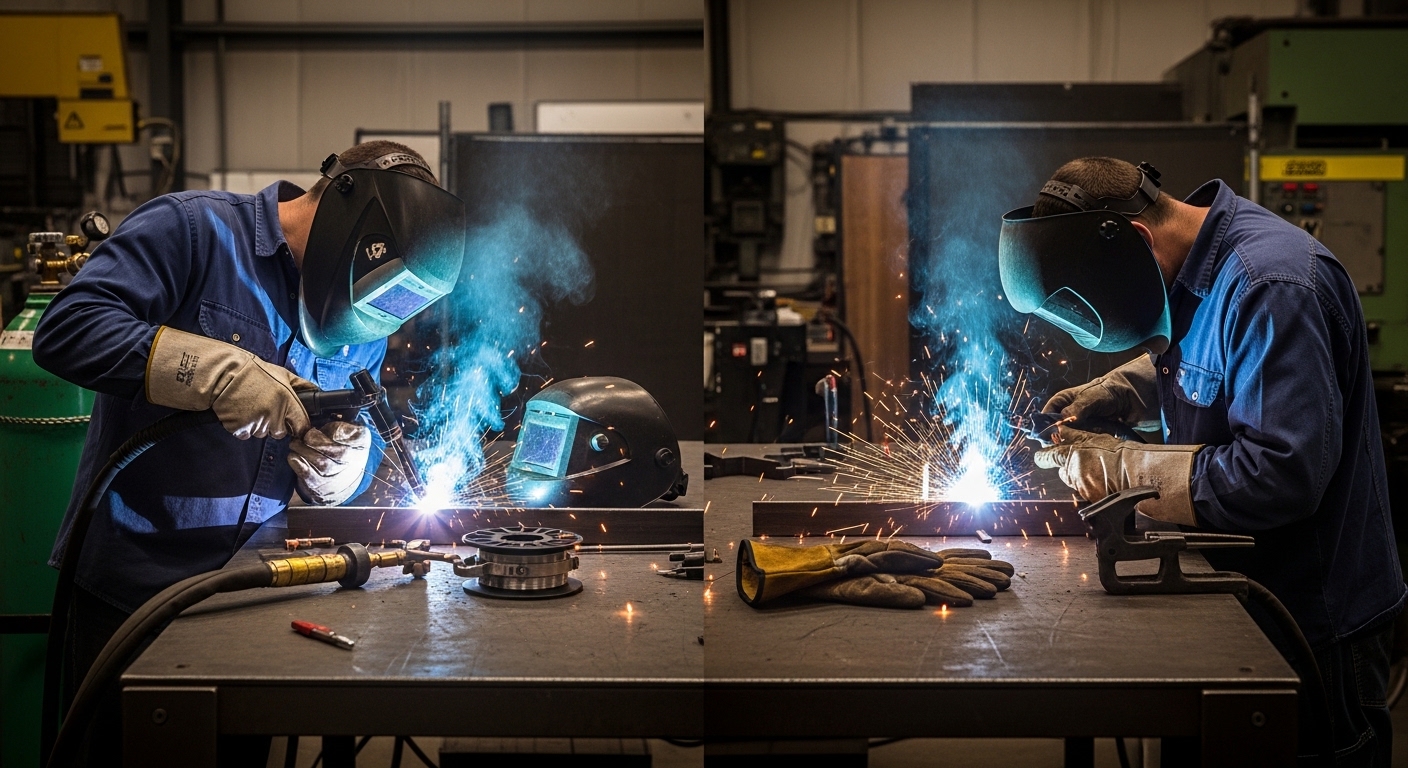
I’ve spent 15 years welding in fabrication shops, on construction sites, and in my home garage. I’ve built trailer frames, repaired farm equipment, and restored classic cars using both MIG and stick welders.
Over that time, I’ve probably burned through 50 pounds of MIG wire and twice that in stick electrodes. I’ve made plenty of mistakes, learned what each process excels at, and developed strong opinions about when to use which method.
When beginners ask me about MIG vs stick welding, I always start with the same answer: MIG is easier to learn and produces cleaner welds indoors, while stick welding is more versatile for outdoor work and handles dirty or thick metal better. Neither is universally “better” – they’re different tools for different jobs.
Quick Answer: MIG welding uses a continuously fed wire electrode with shielding gas for clean, fast welds on thin to medium thickness metals indoors. Stick welding uses flux-coated electrode rods that work outdoors, on dirty/rusty metal, and penetrate deeper into thick materials. Choose MIG for auto body work and DIY projects; choose stick for farm repairs, construction, and outdoor fabrication.
Let me break down exactly what that means in practical terms, so you can choose the right welding method for your projects.
What is MIG Welding?
MIG Welding (GMAW): Metal Inert Gas welding, also called Gas Metal Arc Welding (GMAW). It uses a continuously fed wire electrode that melts into the weld joint while external shielding gas protects the molten metal from contamination.
MIG welding is the go-to choice for most fabrication shops and auto body workers. The wire feeds automatically from a spool through a gun-like torch, making it possible to lay down long, continuous welds without stopping.
I remember my first MIG welder – a basic 120-volt unit I bought for my home garage. Within an hour of opening the box, I was making decent welds on 16-gauge steel. That’s the beauty of MIG: the learning curve is remarkably gentle compared to other welding processes.
The shielding gas (typically 75% argon, 25% CO2 for steel) flows through the gun to protect the weld pool from atmospheric contamination. This gas requirement is both MIG’s strength and its weakness – it produces clean welds but limits outdoor use.
MIG Welding Pros
- Easier to learn: Most beginners produce acceptable welds within 1-2 hours of practice
- Clean weld appearance: Minimal spatter and no slag to chip away
- Faster welding speed: Wire feeds continuously, no stopping to change electrodes
- Works on thin metal: Can weld sheet metal as thin as 24 gauge without burn-through
- One-handed operation: The gun trigger controls everything, leaving your other hand free
MIG Welding Cons
- Poor outdoor performance: Wind blows away shielding gas, causing porosity
- Requires clean metal: Rust, paint, or dirt cause weld defects
- Higher equipment cost: Requires wire feeder, gas regulator, and gas bottle
- Less portable: Moving gas cylinders and wire feeders is cumbersome
- Limited penetration on thick metal: Smaller MIG units struggle with material over 3/8 inch
What is Stick Welding?
Stick Welding (SMAW): Shielded Metal Arc Welding uses a consumable electrode rod coated in flux. As you weld, the flux coating melts to create shielding gas and slag, protecting the weld pool without external gas.
Stick welding is the old reliable of the welding world. It’s been around since the 1880s, and there’s a reason it’s still going strong: it works just about anywhere, in just about any conditions.
My grandfather taught me stick welding on his farm in rural Iowa. We welded a broken tractor axle in the middle of a field, with dirt blowing around us and the metal surface covered in rust and grease. The stick welder didn’t care – it burned right through the contamination and laid down a solid weld.
That’s stick welding’s superpower: versatility. The electrode rod is consumed as you weld, creating its own shielding gas from the burning flux coating. No external gas needed, no wire feeder to jam, and you can weld through surface contamination that would make a MIG welder quit in frustration.
Stick Welding Pros
- Excellent for outdoor use: No shielding gas to be affected by wind
- Welds through contamination: Can weld rusty, painted, or dirty metal
- Deep penetration: Creates strong welds on thick materials
- Portable equipment: Just the welder and electrode holder – no gas bottles
- Lower initial cost: Entry-level stick welders are cheaper than MIG units
- Works on painted or rusty surfaces: The flux burns through contamination
Stick Welding Cons
- Steeper learning curve: Maintaining proper arc length takes practice
- Slower welding speed: Must stop and replace electrodes frequently
- Slag removal required: Each weld leaves slag that must be chipped away
- More spatter: Produces sparks that require additional cleanup
- Difficult on thin metal: High amperage causes burn-through on material under 1/8 inch
- Less aesthetic welds: Welds are generally rougher in appearance
MIG vs Stick: Head-to-Head Comparison
| Factor | MIG Welding | Stick Welding |
|---|---|---|
| Learning Curve | Easy – 1-2 hours to basics | Moderate – 5-10 hours practice |
| Welding Speed | Fast – continuous wire feed | Slower – frequent electrode changes |
| Outdoor Use | Poor – gas blows away in wind | Excellent – no external gas needed |
| Metal Preparation | Must be clean – no rust/paint | Forgiving – welds through contamination |
| Thin Metal (under 1/8″) | Excellent – minimal burn-through | Poor – high heat causes burn-through |
| Thick Metal (over 3/8″) | Limited – requires large machine | Excellent – deep penetration |
| Equipment Cost | Higher – $500-1500+ for setup | Lower – $300-800 for welder |
| Portability | Poor – gas bottle and feeder | Excellent – just welder and cables |
| Weld Appearance | Clean – minimal cleanup | Rough – slag removal required |
| Operating Cost | Moderate – wire + gas refills | Low – electrode rods only |
Metal Thickness Comparison
The thickness of metal you’re welding is often the deciding factor between MIG and stick. I learned this the hard way when I tried to weld 1/2-inch plate with my 140-amp MIG welder – it just wasn’t happening.
MIG welding excels on thin to medium materials: 24 gauge up to about 3/8 inch. For auto body work, exhaust systems, and thin sheet metal projects, MIG is unmatched. The low heat input prevents warping and burn-through on materials that would be nightmares to weld with stick.
Stick welding dominates on thick materials: 1/8 inch and up, especially beyond 3/8 inch. The penetrating arc of a stick welder burns deep into thick plate, creating strong structural welds. When I’m building trailer frames or welding structural steel, stick is my go-to every time.
Indoor vs Outdoor Performance
This is where the two processes really show their different personalities. In my shop, with the doors closed and fans off, MIG welding is pure pleasure. Smooth, clean welds with minimal cleanup.
But step outside into even a light breeze, and MIG becomes frustrating. The shielding gas blows away before it can protect the weld pool, leaving porous, weak welds. I’ve wasted hours trying to weld outdoors with MIG, building windbreaks out of tarps and welding blankets.
Stick welding doesn’t care about wind. The flux coating creates its own protective atmosphere as it burns. I’ve welded fence posts in 20-mph winds with stick, and the welds turned out fine. For field work, construction sites, and farm repairs, stick welding is virtually irreplaceable.
Which is Easier to Learn?
MIG welding is significantly easier to learn than stick welding – there’s no debate among experienced welders on this point.
When I teach beginners to weld, I start them on MIG. Here’s why: you pull the trigger, the wire feeds, you maintain a steady distance from the workpiece, and you move the gun. That’s it. Most students are making acceptable welds within their first hour of practice.
Stick welding requires developing “feel.” You need to learn to maintain the correct arc length (about 1/8 inch between the rod and work), adjust your hand speed as the rod consumes, and coordinate your movements with the constant shortening of the electrode.
I’ve seen confident beginners switch from MIG to stick and suddenly feel completely defeated. The arc is erratic, the rod sticks to the workpiece, and every weld requires chipping away slag to see what went wrong.
Realistically, expect 1-2 hours of practice to become competent with MIG welding. Budget 5-10 hours of stick welding practice before you’re consistently producing good welds. The gap narrows with experience, but MIG always has the advantage for absolute beginners.
Cost Comparison: MIG vs Stick
Cost matters, especially if you’re setting up a home shop or buying equipment for occasional use. Let me break down the real costs from my experience owning both types of equipment.
Initial Equipment Cost
Stick welder setup: $300-800 for a quality 140-225 amp unit. That includes the welder, electrode holder, ground clamp, and basic helmet. You can start welding immediately with just the welder and a pack of electrodes.
MIG welder setup: $500-1500+ depending on amperage and features. Beyond the welder itself, you need a gas cylinder ($50-150 for the bottle, plus refill fees), gas regulator ($75-150), and you’ll want a proper auto-darkening helmet. It’s a bigger investment upfront.
Operating Costs
Over time, the costs shift. Stick electrodes run $2-5 per pound, and a typical 1/8 inch rod weighs about 3.5 ounces. That’s roughly 50-100 rods per pound, or roughly 5-10 cents per rod. A typical project might use 5-10 rods, costing less than a dollar in consumables.
MIG wire runs $50-80 for a 10-pound spool of mild steel wire. That spool will last through hundreds of feet of weld. The real ongoing cost is shielding gas – a standard 80-cubic-foot cylinder costs $30-50 to refill and might last through 20-30 hours of welding depending on your gas flow rate.
For heavy production use, MIG welding is actually cheaper per foot of weld. But for occasional hobby welding, stick electrodes are more economical since there’s no gas to go stale or cylinders to rent.
Which Should You Choose?
After welding with both processes for 15 years, I can tell you that serious fabricators eventually own both. But if you’re starting out and can only afford one welder, here’s my decision framework:
Choose MIG Welding If:
- You’re primarily working indoors in a shop or garage
- Your projects involve auto body work, exhaust, or thin sheet metal
- You want the easiest learning curve as a beginner
- Clean weld appearance matters for your projects
- You’ll be doing production-style welding where speed matters
- You’re welding stainless steel or aluminum (requires different gas/wire but uses MIG process)
Choose Stick Welding If:
- You need to weld outdoors in windy conditions
- You’re working on farm equipment, construction sites, or field repairs
- Your materials are thick structural steel or heavy plate
- The metal you’re welding is rusty, painted, or dirty
- Portability is important – you need to move the welder to the work
- Budget is a concern and you want the lowest initial investment
Best Welding Type for Beginners
If you’re a complete beginner deciding between MIG and stick, I recommend starting with MIG welding in 2026. The learning curve is gentler, you’ll see results faster, and the immediate positive feedback helps build confidence.
That said, don’t completely ignore stick welding. Once you’ve mastered MIG basics, learning stick will make you a more versatile welder. Many professionals I know started with MIG and added stick later – there’s no shame in building your skills gradually.
For home hobbyists doing general fabrication, auto repair, or DIY projects, MIG handles about 80% of what you’ll encounter. Stick fills the gaps for heavy outdoor repairs, but you can often rent a stick welder for those occasional needs.
Is Stick Welding Obsolete?
Absolutely not. I’ve seen this question pop up on forums, and it always makes experienced welders laugh. Stick welding is alive and well because no other process matches its versatility for outdoor and field work.
Walk onto any construction site, through any fabrication shop that does structural work, or onto any farm in America, and you’ll find stick welders in use. The process has remained fundamentally unchanged for decades because it works.
MIG has certainly gained popularity, especially for indoor fabrication and production work. But stick welding isn’t going anywhere – it’s simply too useful for too many applications. If anything, the rise of inverter-based stick welders has made the process more relevant than ever by improving portability and performance.
Frequently Asked Questions
Is MIG welding as good as stick welding?
Both processes produce structurally sound welds when done correctly. MIG produces cleaner, more aesthetic welds with less cleanup, making it better for visible work. Stick welding produces stronger penetration on thick materials and works in conditions where MIG can’t function. Neither is universally better – they’re different tools for different applications.
Is stick or MIG welding easier to learn?
MIG welding is significantly easier for beginners. Most people can produce acceptable MIG welds within 1-2 hours of practice. Stick welding typically requires 5-10 hours of practice to develop the necessary feel for arc length and travel speed. The MIG wire feed system and continuous operation make it more forgiving for new welders learning basics.
What is a disadvantage of MIG welding?
MIG welding has several key disadvantages: it performs poorly outdoors due to wind blowing away shielding gas, requires clean metal free of rust and paint, has higher equipment costs due to gas systems, and struggles to penetrate thick materials beyond 3/8 inch. The need for external shielding gas makes MIG impractical for field work and windy conditions.
What is the best type of welding for beginners?
MIG welding is the best choice for beginners in 2026. The learning curve is much shorter than stick welding, with most new welders producing acceptable results within their first practice session. MIG’s continuous wire feed eliminates the need to maintain consistent arc length manually, and the clean welds provide immediate positive feedback that builds confidence and skills quickly.
Is stick welding becoming obsolete?
No, stick welding is not obsolete and remains essential for many applications. Construction sites, farm repair, outdoor fabrication, and structural welding all rely heavily on stick welding because it works in conditions where MIG cannot. The process continues to evolve with inverter technology, and its ability to weld through contamination and in any weather ensures stick welding will remain relevant indefinitely.
Is stick welding stronger than MIG?
Stick welding often produces deeper penetration than MIG welding, which can result in stronger welds on thick materials. However, a properly executed MIG weld is equally strong for most applications. The welder’s skill and proper technique matter more than the process itself. For structural welding on thick steel, stick’s deep penetration makes it preferable, but both processes create strong welds when done correctly.
What are the downsides of MIG welding?
MIG welding downsides include: poor outdoor performance due to shielding gas sensitivity to wind, expensive equipment costs for welder and gas system, metal must be clean and free of contamination, limited penetration on thick materials, and less portability due to gas cylinders. The process also requires regular maintenance of wire feeder components and gas system troubleshooting.
Final Thoughts
After 15 years of welding, I own both MIG and stick welders, and I use both regularly. They’re not competitors – they’re complementary tools in a well-equipped shop.
If you’re just starting out and can only choose one, buy a MIG welder. You’ll progress faster, produce better results initially, and handle most home fabrication and auto repair projects with ease. As your skills grow and your projects expand, you can add a stick welder for those heavy outdoor repairs that MIG simply can’t handle.
The best welder is the one that matches your specific needs. Consider where you’ll weld, what materials you’ll work with, and your budget. Choose accordingly, and don’t be afraid to add the other process later when your projects demand it.
Leave a Reply