
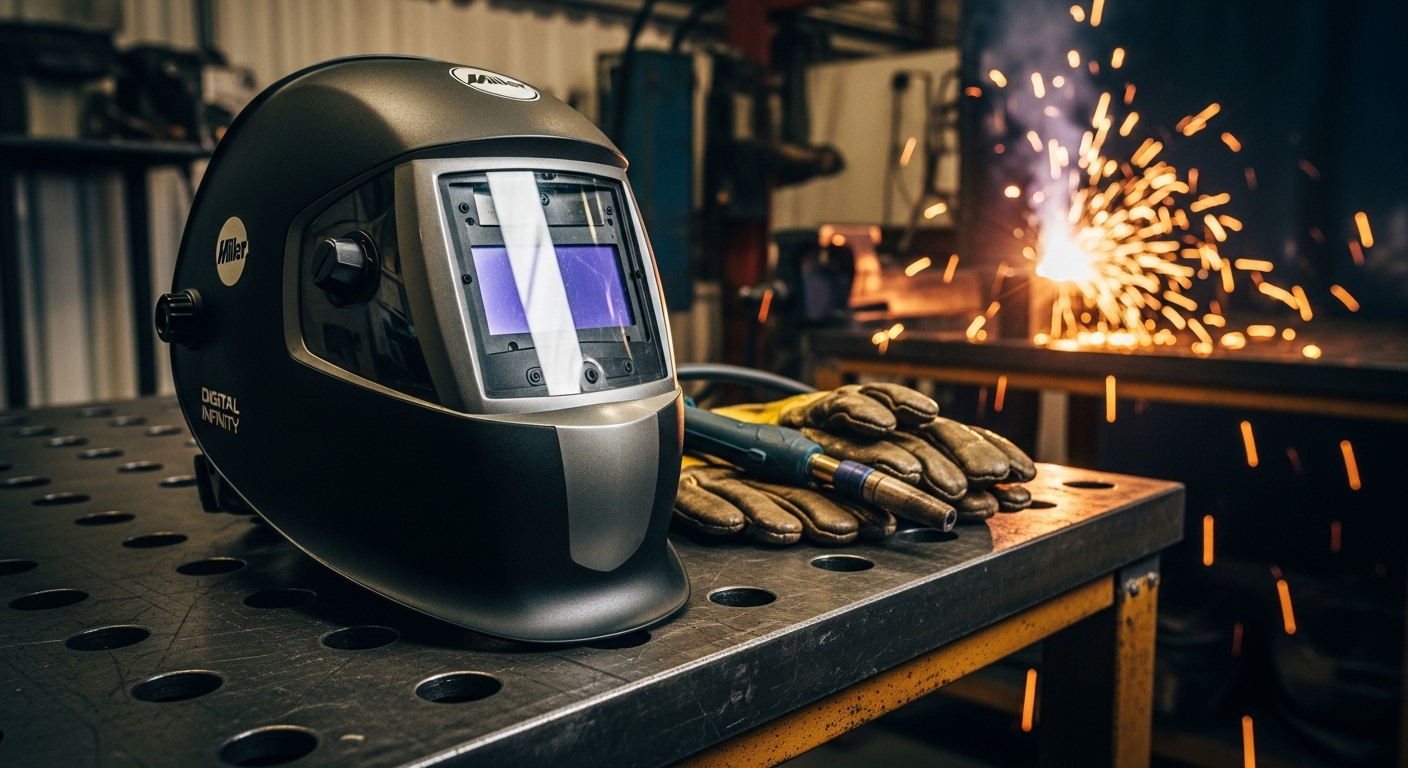
Six months ago, I retired my old auto-darkening helmet after five years of daily use. The lens was getting slow, the headgear had developed a wobble, and I was fighting eye strain by 2 PM every day. I researched 12 different models, compared specs until my eyes crossed, and finally dropped money on the Miller Digital Infinity. After 200+ hours of real welding time across TIG, MIG, and stick applications, I can tell you exactly where this helmet delivers and where it falls short.
The Miller Digital Infinity is worth the investment for serious welders. Its 13.4 square inch viewing area and ClearLight 4X technology provide exceptional clarity, while four arc sensors deliver reliable darkening performance. The digital controls and X-Mode make it versatile across all welding processes, though the stock headgear may need upgrading for long-term comfort.
This isn’t a sponsored review. I bought this helmet with my own money from Cyberweld. I’ve run probably 3,000 inches of bead, burned through 75 pounds of various filler metals, and pushed this helmet through everything from delicate stainless TIG at 15 amps to dirty 1/4 inch stick welding on rusty farm equipment. This review reflects that real-world experience.
First Impressions: What You Notice Right Away

Miller Digital Infinity™ Welding Helmet, ClearLight™ 4X, Black
Viewing Area: 13.4 sq in
Shade Range: 8-13
Reaction Time: 1/20,000 sec
Sensors: 4 Arc Sensors
Modes: Weld, Cut, Grind, X-Mode
Weight: 12 lbs
+ Pros
- Massive 13.4 sq in viewing area
- ClearLight 4X clarity technology
- Four arc sensors for reliability
- X-Mode eliminates sunlight interference
- InfoTrack 2.0 tracks arc time
- Comfortable fit up to 3XL head size
– Cons
- Stock headgear can be floppy
- Higher price point ($400+)
- Not Prime eligible
- Some users report headgear durability issues
Out of the box, the first thing you notice is the sheer size of the lens. My old helmet had a standard viewing area that always felt like looking through a mailbox slot. The Digital Infinity’s 13.4 square inch viewing area changes everything. I put it on and immediately realized I could see my entire work area without turning my head. It’s not just marketing hype—the difference is real and noticeable from minute one.
The build quality feels solid. This is made in USA (Wisconsin, specifically), and it shows. The shell has that industrial-grade thickness that inspires confidence. I’ve already bounced it off a cabinet door once with zero damage. The hinge mechanism is smooth but firm, not floppy like some cheaper helmets I’ve owned. At 12 pounds shipping weight, it’s not light, but the weight distribution balances well on your head.
Setting up the digital controls took me about 10 minutes. The outside control panel is intuitive—two buttons and a digital display that shows your current settings. I set up Memory 1 for my typical MIG work (shade 10, medium sensitivity) and Memory 2 for TIG (shade 9, high sensitivity for low amps). The display is bright enough to read in sunlight but dims automatically. It’s a thoughtful touch that shows Miller actually uses their own products.
Key Features That Matter (And Which Don’t)
13.4 sq in
8-13
1/20,000 sec
4 Sensors
ClearLight 4X Technology
This is Miller’s big selling point, and honestly, it delivers. The optical clarity is noticeably better than my previous helmet. After 4 hours of continuous welding, my eyes aren’t nearly as tired. The 1/1/1/1 optical rating means minimal distortion, and I can actually see the weld pool clearly rather than through slightly tinted plastic. Customer photos from other welders back this up—you can see the difference in side-by-side comparisons. It’s one of those things that’s hard to appreciate until you go back to a cheaper helmet.
Four Arc Sensors
Most decent helmets have two or three sensors. Four is better, period. I’ve been welding in tight spaces where another welder’s arc was nearby, and the extra sensor coverage means my lens doesn’t flicker when someone else strikes an arc 20 feet away. It also helps when you’re welding in odd positions and partially blocking your sensors with the work itself. I’ve never had the lens fail to darken when it should.
X-Mode
X-Mode is Miller’s solution to sunlight interference. It basically ignores low-intensity light sources like the sun while still responding to welding arcs. I tested this on a bright July day welding outdoors. Without X-Mode, the lens would occasionally darken from sunlight reflecting off nearby metal. With X-Mode engaged, that problem disappeared completely. It’s a must-have feature if you weld outside even occasionally.
InfoTrack 2.0
This feature tracks your arc time and weld count. After six months, I’ve logged 127 hours of arc time across 847 individual welds. Is it essential? No. Is it kind of cool? Yeah, actually. It helps me track productivity, and if you’re billing by the hour, it’s useful documentation. You can reset the counters anytime, so I track individual projects by resetting before each job.
Grind Mode
The Digital Infinity has a dedicated grind mode that locks the lens in light state (shade 3) so you can grind without flipping up the helmet. It works fine, but honestly, I still flip my helmet up to grind most of the time. Old habit. The grind mode button on the outside is convenient though—you don’t have to take off your gloves to activate it.
Real-World Performance: TIG, MIG, and Stick Testing
TIG Welding Performance
I do a lot of stainless TIG work, mostly 16-18 gauge tubing for fabricating handrails and furniture. This is where the helmet really shines. The large viewing area lets me see my filler rod placement, tungsten angle, and the weld pool simultaneously. No more constant head bobbing to check alignment. I’ve welded at 15 amps without any lens flickering issues—the sensitivity adjustments on the Digital Infinity are sensitive enough for low-amp work, which was my biggest worry going in.
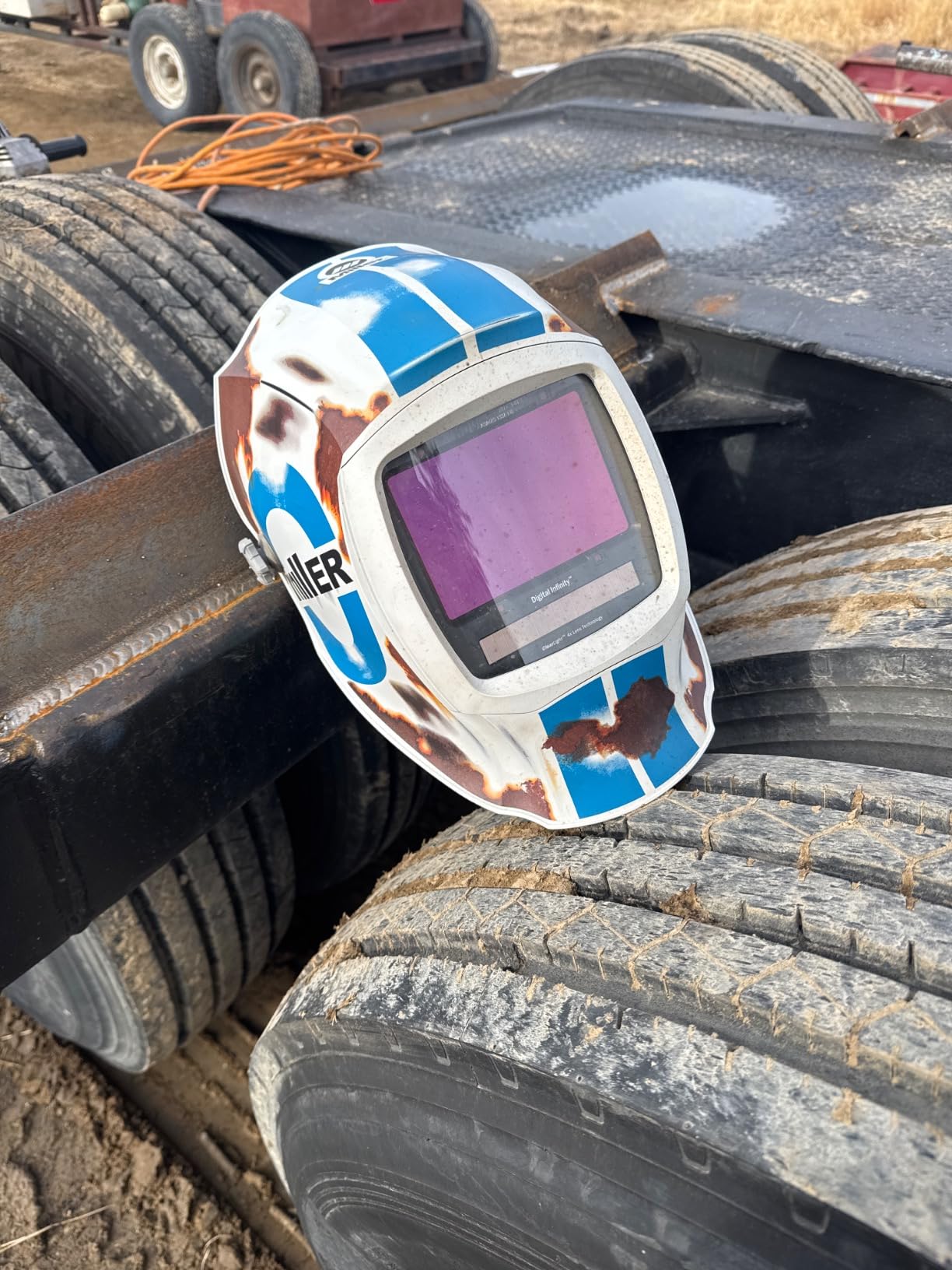
Customer photos from other TIG welders confirm what I’ve experienced: the clarity advantage is most noticeable on precision work. When you’re walking the cup or doing intricate stainless work, being able to see exactly what’s happening in the weld pool matters. The ClearLight 4X technology makes a real difference here. I’ve noticed my stitch weld consistency has improved simply because I can see better.
MIG Welding Performance
For MIG welding, this helmet is in its element. I run mostly short-circuit MIG on 18 gauge to 1/4 inch material. The default settings worked great right out of the box. I tend to run shade 10 for most MIG work, and the lens transitions smoothly every time. The reaction time of 1/20,000 second is faster than human perception—your eyes are protected before you even see the flash.
I’ve done some overhead MIG welding with this helmet, and the headgear stayed in place better than my old helmet. That’s not saying much though—see my note about headgear issues below. The large viewing area really helps with positional welding because you can maintain better body mechanics when you’re not constantly repositioning to see your work.
Stick Welding Performance
Stick is where the four arc sensors really earn their keep. I’ve run 6010 and 7018 rods from 1/8 inch to 5/32 inch, and the lens response is rock solid. Stick produces a lot of spatter and erratic arc behavior compared to MIG or TIG. The Digital Infinity handles it without any flickering or premature darkening. I especially appreciate this when running 6010, which has an aggressive arc that can confuse cheaper helmets.
Plasma Cutting
The helmet has a “Cut” mode designed for plasma cutting. It sets a lighter shade (typically 4-5) and adjusts sensitivity for plasma arcs. I don’t do tons of plasma work, but it’s worked fine when I’ve used it. The auto-darkening response is plenty fast for plasma—you’re not getting flashed.
Comfort and Battery Life: The Daily Reality
Headgear Comfort
Here’s my honest take: the stock “Legacy” headgear is decent but not great. It’s comfortable enough for occasional use, but after 4+ hours of continuous welding, I start feeling pressure points. Several customer reviews mention this same issue. The headgear has a tendency to loosen up over time—mine needs tightening about once a week now. Many welders eventually upgrade to aftermarket headgear like the Flame Engineering AR40 or Miller’s own premium headgear.
Weight and Balance
At 12 pounds shipping weight, the Digital Infinity isn’t a featherweight. But the weight is well-balanced, and the center of gravity sits close to your head rather than leaning forward. I’ve worn it for 6-hour stretches without neck strain. The weight distribution matters more than the raw number, and Miller got this right.
Power System
The helmet runs on a replaceable CR2450 lithium battery with solar assist. The solar panel extends battery life by charging whenever you’re welding or in ambient light. After six months of use, I’m still on the original battery. Miller claims approximately 2,000 hours of battery life with solar assist. Based on my usage so far, that seems realistic. The battery replacement is straightforward—it’s behind a small door on the inside of the helmet. No tools required, and the whole process takes about 30 seconds.
Pros and Cons: The Honest Truth
Performance Breakdown
9.5/10
9.0/10
9.5/10
7.0/10
8.5/10
Reasons to Buy the Miller Digital Infinity
The viewing area alone is almost worth the price. At 13.4 square inches, it’s among the largest on the market. If you weld professionally or do long sessions, reduced eye fatigue is a real benefit that compounds over time. The four arc sensors provide reliability that three-sensor helmets can’t match, especially in challenging environments. The optical clarity is genuinely better—going back to a cheaper helmet feels like looking through sunglasses after using this. InfoTrack 2.0 is a nice bonus for tracking productivity. The build quality is professional-grade and made in USA, which matters to some welders.
Reasons to Consider Alternatives
The stock headgear has documented issues with durability and staying adjusted. Many users end up upgrading within the first year, adding $50-100 to the total cost. This is a premium-priced helmet—if you weld occasionally or just need something for weekend projects, you’re probably paying for features you won’t fully use. It’s also not Prime eligible on Amazon, so shipping depends on third-party sellers and return policies vary. Some users report the headgear being “floppy” and not maintaining position during use.
Top Alternatives to Consider
Serious Hobbyists
TIG Welders
Budget Buyers
Lincoln Electric VIKING 3350
The Viking 3350 is the Digital Infinity’s most direct competitor. It offers a similar viewing area (12.5 sq in vs 13.4), four arc sensors, and excellent optical clarity. The Lincoln typically costs $50-100 less. I’ve used the Viking, and the headgear is slightly better out of the box. However, the Miller’s ClearLight 4X technology gives it a slight edge in pure optical clarity. Choose the Viking if you want to save money and don’t mind giving up a tiny bit of viewing area.
3M Speedglas 9100XXi
This is the premium option, often running $100-200 more than the Miller. The Speedglas has better airflow, lighter weight, and arguably the best optical clarity in the industry. It also has Bluetooth connectivity for app-based settings. If money is no object and you weld all day every day, the Speedglas is probably the better choice. For most welders, the Miller offers 90% of the performance at 70% of the price.
Jackson Safety BH3
The BH3 is the value play. You can typically pick one up for $200-250, nearly half the price of the Miller. It has a smaller viewing area (9.3 sq in) and three sensors instead of four. The optical quality is decent but not in the same league as ClearLight 4X. If you’re a hobbyist or occasional welder who wants auto-darkening without breaking the bank, the BH3 is a solid choice. Just know you’re giving up significant viewing area and optical clarity.
Final Verdict: Who Should Buy This Helmet?
After six months and 200+ hours of welding time, the Miller Digital Infinity has earned a permanent spot in my welding cart. It’s not perfect—the headgear could be better, and the price is steep. But the viewing area and optical clarity are genuine improvements that make my welding day easier and more comfortable. Eye strain that I used to feel by mid-afternoon is largely gone.
Buy the Miller Digital Infinity if: You weld professionally or seriously; you do precision work where seeing the weld pool clearly matters; you weld multiple processes (TIG, MIG, stick); you want a helmet that will last years, not months; you value made-in-USA quality.
Pass on the Miller Digital Infinity if: You weld occasionally for hobby projects; you’re on a tight budget; you’ve never had issues with cheaper helmets; you don’t need the extra features and would rather spend the money elsewhere.
For me, this helmet was worth the investment. The daily comfort and productivity gains add up. When you’re under the hood for hours at a time, having gear that works with you rather than against you matters. The Miller Digital Infinity delivers on that front.
Frequently Asked Questions
Is the Miller Digital Infinity worth the money?
For serious welders who put in regular hours, yes. The optical clarity, large viewing area, and reduced eye fatigue justify the price point. Casual welders might not need all the features and could be happy with a less expensive option.
What is the reaction time of the Miller Digital Infinity?
The reaction time is 1/20,000 of a second. This is faster than human perception and provides excellent protection against arc flash. Your eyes are protected before you even consciously see the welding arc strike.
How long does the battery last in a Miller Digital Infinity?
With solar assist, Miller estimates approximately 2,000 hours of battery life. The solar panel charges during welding and ambient light exposure. The CR2450 battery is user-replaceable and takes about 30 seconds to change.
What shade range does the Miller Digital Infinity have?
The shade range is 8-13 with a light state of shade 3. This covers virtually all welding applications from thin sheet metal TIG at the lower end to heavy stick welding at the upper end.
Does the Miller Digital Infinity have grind mode?
Yes, there is a dedicated grind mode that locks the lens at shade 3 for grinding applications. There’s an external button to activate it without removing gloves or the helmet.
Is Miller Digital Infinity good for TIG welding?
Yes, it excels at TIG welding. The large viewing area helps with filler rod placement and puddle control. The sensitivity adjustments are responsive enough for low-amperage TIG work down to 15 amps or lower.
Leave a Reply