
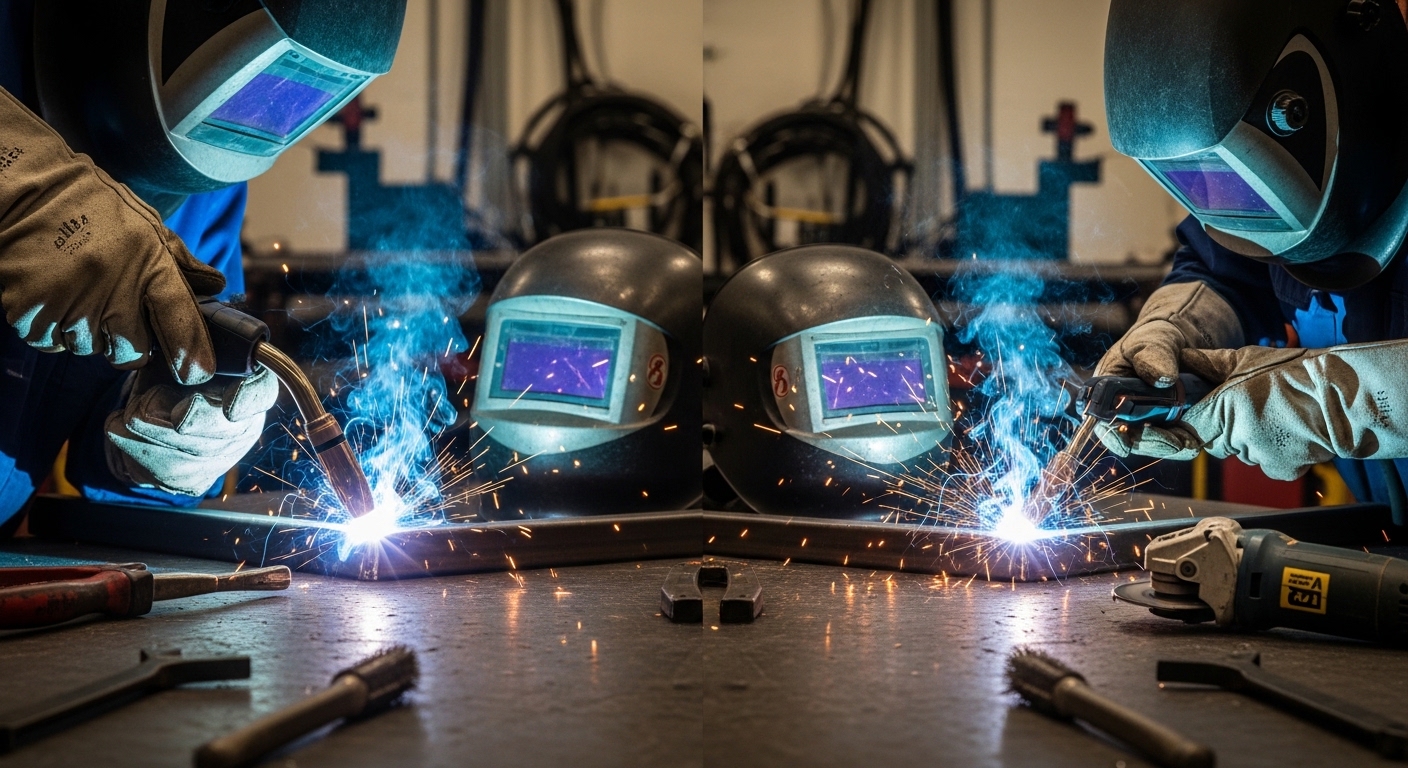
The main difference between flux-core and MIG welding is that flux-core welding uses a hollow wire filled with flux that creates its own shielding gas when burned, while MIG welding uses solid wire with external shielding gas from a tank. This makes flux-core welding more portable and better for outdoor conditions, while MIG welding produces cleaner welds with less cleanup.
I’ve spent the last 15 years switching between these two processes in my shop, and the choice matters more than most beginners realize. When I first started welding, I wasted months fighting with flux-core wire on projects that begged for MIG, and vice versa.
After running hundreds of feet of bead with both processes and spending thousands on equipment and consumables, I’ve learned that neither is universally better. The right choice depends entirely on where you weld, what you weld, and how clean you need the final result to be.
Quick Overview: Flux Core vs MIG at a Glance
Flux core welding (FCAW) is a wire-feed process that uses a tubular wire filled with flux compounds. When the arc strikes, the flux vaporizes to create shielding gas around the weld pool, protecting it from atmospheric contamination.
MIG welding (GMAW) also feeds wire continuously, but uses a solid wire electrode with external shielding gas delivered from a separate tank. The gas typically consists of carbon dioxide and argon blends that shield the molten metal as you weld.
Both processes use similar wire feed welders, can weld similar materials, and appeal to beginners due to their relatively short learning curves compared to stick welding. But the similarities largely end there.
Flux Core vs MIG Welding: Complete Comparison Table
| Feature | Flux Core Welding | MIG Welding |
|---|---|---|
| Shielding Method | Internal flux in wire | External gas tank |
| Polarity | DCEN (Electrode Negative) | DCEP (Electrode Positive) |
| Penetration | Deep penetration | Moderate penetration |
| Outdoor Capability | Excellent – works in wind | Poor – gas blows away |
| Surface Preparation | Forgiving – can weld through rust/paint | Requires clean metal |
| Weld Appearance | Rough, requires cleanup | Clean, smooth bead |
| Post-Weld Cleanup | Slag must be chipped | Minimal cleanup needed |
| Portability | High – no gas tank | Lower – requires gas tank |
| Initial Equipment Cost | Lower | Higher (gas regulator/tank) |
| Operating Cost | Higher (flux wire costs more) | Lower (solid wire is cheaper) |
| Spatter | Significant spatter | Minimal spatter with proper settings |
| Thin Metal (22 gauge+) | Challenging – burns through easily | Excellent with proper settings |
| Thick Metal (1/4″+) | Excellent – deep penetration | Good, may require multiple passes |
| Aluminum Welding | Not suitable | Possible with spool gun |
| Cast Iron | Possible with specialized wire | Not recommended |
| Learning Curve | Moderate | Easier for beginners |
| Smoke/Fumes | Heavy smoke from flux | Less smoke with proper gas |
Understanding Flux-Cored Wire Welding (FCAW)
Flux-cored arc welding was developed in the 1950s as an alternative to stick welding that combined the convenience of wire feed with the portability of self-shielded electrodes. The flux inside the wire serves multiple purposes: it creates shielding gas, deoxidizes the weld pool, and forms slag that protects the cooling metal.
How Flux Core Welding Works
When you pull the trigger on a flux-core welder, the drive motor pushes the hollow wire through the contact tip. Unlike MIG welding, flux core typically uses DCEN polarity – meaning the electrode is connected to the negative terminal and the workpiece is positive.
This polarity reversal (compared to MIG) causes about two-thirds of the heat to concentrate on the wire rather than the workpiece. This deeper penetration is one reason flux core excels on thicker materials.
As the wire melts, the flux compounds vaporize into a protective gas cloud that surrounds the arc. Simultaneously, molten slag floats to the surface of the weld pool, protecting it from oxygen and nitrogen contamination.
Types of Flux Core Wire
Self-shielded flux core wire requires no external gas – the flux does all the work. This is what most people mean when they say “flux core welding.” It’s the go-to choice for outdoor work, farm repairs, and construction sites where dragging a gas tank isn’t practical.
Gas-shielded flux core (dual shield) uses both internal flux AND external shielding gas. This process delivers the penetration of flux core with the cleaner weld appearance of MIG, but requires gas equipment. It’s popular in industrial fabrication but rare in home shops.
The Slag Factor
Every flux core weld leaves behind a layer of slag – a glassy coating that must be removed. This requires chipping and wire brushing after each weld. On a large project, this cleanup time adds up quickly.
The slag does have benefits though. It acts like a blanket, keeping the weld metal hot longer and allowing gases to escape before the metal freezes. This reduces porosity in the final weld.
Understanding MIG Welding with Solid Wire (GMAW)
MIG welding (Metal Inert Gas) technically called GMAW (Gas Metal Arc Welding), emerged in the 1940s and revolutionized fabrication by offering a clean, fast process that was relatively easy to learn. The solid wire electrode provides the filler metal while an external gas supply handles the shielding.
How MIG Welding Works
MIG welding uses DCEP polarity – the reverse of flux core. This means the electrode is positive and the workpiece negative. About two-thirds of the heat concentrates on the base metal rather than the wire, resulting in shallower penetration but a flatter, smoother weld bead.
The shielding gas flows through the gun liner and out the nozzle tip at a rate typically between 25-35 cubic feet per hour. This constant gas envelope protects the molten metal from atmospheric contamination.
Shielding Gas Mixes: C75 (75% argon, 25% CO2) is the most common all-purpose blend for mild steel. Straight CO2 provides deeper penetration but more spatter. Tri-mix (90% argon, 7.5% CO2, 2.5% oxygen) is used for stainless steel. Pure argon is required for aluminum.
The Short-Circuit Transfer
Most beginner MIG welding uses short-circuit transfer – the wire actually touches the base metal, shorts out, melts back, and repeats this cycle 90-200 times per second. This rapid pulsing creates that distinctive “bacon frying” sound and keeps heat low enough to weld thin sheet metal without burning through.
Clean Welds, Less Cleanup
Because there’s no flux involved, MIG welds don’t produce slag. The weld bead emerges smooth and clean, requiring minimal post-weld cleanup. This makes MIG ideal for appearance-critical work like auto body panels and furniture where you don’t want to see hammer marks from slag removal.
What Flux Core and MIG Welding Have in Common
Despite their differences, these processes share enough DNA that many modern welders can switch between them with minor adjustments. Both use wire feed systems that push consumable electrode through a liner to the gun tip.
Both processes require similar basic equipment: a constant voltage power source, a wire drive unit, a welding gun with contact tip and nozzle, and a ground clamp. Many entry-level welders are sold as “MIG capable” units that can run flux core wire with a simple polarity switch and roller change.
The techniques for both processes share fundamentals. You still need to maintain proper gun angle (typically 10-15 degrees from perpendicular), keep a consistent stick-out distance, and travel at the right speed. Your weld quality depends on the same factors: voltage, wire speed, travel speed, and gun technique.
Both processes are forgiving enough that beginners can produce decent welds within a few hours of practice – far less time than it takes to become competent with stick welding or TIG.
Key Differences Between Flux Core and MIG
Shielding Method: Internal vs External
The fundamental difference comes down to how each process protects the weld pool from oxygen and nitrogen in the air. Flux core carries its protection inside the wire, while MIG relies on a separate gas cylinder.
This single difference cascades into nearly every other distinction between the processes. The self-contained nature of flux core enables outdoor welding, eliminates gas equipment costs, and creates the slag that requires cleanup.
Polarity: DCEN vs DCEP
The polarity requirement is purely technical but has real-world implications. Flux core wants DCEN (negative electrode), MIG wants DCEP (positive electrode). Most welders have a simple switch or plug configuration to change polarity.
I’ve forgotten this switch more times than I care to admit. The symptom is unmistakable – a wildly unstable arc with massive spatter that won’t settle down no matter how you adjust settings. If you’re switching between processes, make the polarity swap your first step.
Penetration Depth
Flux core penetrates deeper into the base metal. This is why it’s the go-to choice for thick structural steel, heavy equipment repair, and root passes on pipe. The deep penetration means you can weld thicker material in fewer passes.
MIG’s shallower penetration is actually an advantage on thin materials. It reduces the risk of burn-through on sheet metal as thin as 22-24 gauge. For auto body work or thin gauge fabrication, MIG’s controlled penetration is superior.
Outdoor Performance
Any wind over 5 MPH will blow away the shielding gas from MIG welding, causing porosity and weak welds. I’ve tried MIG welding in mild breeze and ended up with Swiss cheese welds that had to be ground out and redone.
Flux core laughs at wind. Since the flux vaporizes right at the arc, the shielding is generated inches from where it’s needed. I’ve welded fence sections in 20 MPH gusts with flux core – not ideal, but the welds held.
Surface Preparation Tolerance
MIG welding demands clean metal. Rust, paint, mill scale, or oil will contaminate the weld and cause defects. For thorough MIG preparation, I typically grind to bare metal within an inch of either side of the weld joint.
Flux core is far more forgiving. The deoxidizers in the flux can burn through light rust and paint. On farm equipment repairs where I didn’t have time for perfect prep, flux core saved the day. This doesn’t mean you can weld through dirt, but flux core tolerates imperfect conditions better than MIG.
Appearance and Cleanup
MIG produces attractive welds right out of the gun. With proper settings, you get smooth, evenly rippled beads that look professional with minimal post-weld work. A quick wire brush to remove light discoloration is often all that’s needed.
Flux core requires more work. The slag must be chipped away (usually with a slag hammer or needle scaler) and then wire brushed. The bead itself tends to be taller and rougher. For structural welding where appearance doesn’t matter, this is fine. For visible work, you’ll spend extra time grinding and finishing.
Smoke and Fumes
Flux core generates significantly more smoke. The vaporizing flux creates a plume that can fill a poorly ventilated shop quickly. After a day of flux core welding, your nose will tell the difference.
MIG welding produces less smoke, though it still creates metal fumes that require ventilation. The difference is noticeable enough that I always run my shop fan on high when using flux core.
Flux Core vs MIG: Which is Better for Your Needs?
Strength Comparison
Is flux core as strong as MIG? Yes, when properly executed, both processes produce welds with equivalent strength. The American Welding Society specifies procedures for both that yield the same mechanical properties. A properly made flux core weld is every bit as strong as a properly made MIG weld.
That said, flux core’s deeper penetration can make it easier to achieve full penetration on thick materials without edge preparation. For thick plate welding (1/4 inch and up), flux core often delivers more consistent strength without multiple passes.
Cost Analysis
The economics favor different processes depending on your usage. MIG requires higher upfront investment: you need a gas cylinder (around $150-200 new, $80-120 refilled), regulator ($50-100), and possibly a gas hose.
Flux core wire costs more per pound than solid MIG wire – roughly 30-50% more. For heavy users, this cost difference adds up. In my shop, doing production welding, the cheaper solid wire quickly offset the initial gas equipment expense.
For occasional users welding a few hours per month, flux core often wins on total cost. The wire premium matters less than avoiding the gas equipment purchase.
Material Compatibility
For mild steel, both processes work well. The choice depends on thickness, location, and appearance requirements rather than material capability.
For aluminum, MIG is the clear winner. There’s no practical flux core wire for aluminum in standard sizes. You’ll need a spool gun and pure argon gas, but MIG handles aluminum beautifully once set up correctly.
For cast iron, flux core has the advantage with specialized nickel-based flux core wires. These aren’t perfect – cast iron always remains challenging to weld – but flux core gives you options that MIG doesn’t.
For galvanized steel, flux core handles the zinc coating better. The extra deoxidizers in the flux help manage the zinc vapor that causes porosity in MIG welds on galvanized material.
Thickness Considerations
For thin sheet metal (under 20 gauge), MIG is superior. The short-circuit transfer process deposits small droplets with minimal heat input. I’ve welded auto body panels with MIG that would have been impossible with flux core without burning through.
For thick materials (1/4 inch and up), flux core shines. The deep penetration means fewer passes and less edge preparation. When I built a trailer frame from 3/16-inch steel, flux core let me make full-penetration welds in single passes.
Which Welding Process is Best for Beginners?
MIG welding is generally easier for beginners to learn. The immediate visual feedback helps you adjust settings in real time. You can see the arc, watch the puddle, and correct mistakes before they become defects.
The absence of slag removal means you can focus on welding technique rather than cleanup. When teaching friends to weld, I always start them on MIG with C75 gas and 0.030 wire. Within two hours, they’re running decent beads.
Flux core has a steeper initial learning curve. The heavier smoke obscures your view of the weld pool, making it harder to see what’s happening. The slag hides your results until after you chip it away. You can’t correct problems mid-weld because you can’t see them until it’s too late.
However, flux core offers more forgiveness on preparation mistakes. If you’re welding rusty farm equipment or painted projects where thorough prep isn’t practical, flux core’s tolerance for dirty metal might make it the better beginner choice despite the visibility issues.
Project-Based Recommendations
Auto Body: MIG
Fence/Gate: Flux Core
Table/Furniture: MIG
Trailer Frame: Flux Core
Art Projects: MIG
For Outdoor Projects
Fence repairs, gate fabrication, and outdoor equipment maintenance all favor flux core. The wind resistance alone makes it the practical choice. I built my entire backyard fence using flux core because I didn’t want to deal with wind blowing my shielding gas around.
For Automotive Work
Auto body repair demands MIG welding. The thin sheet metal, appearance requirements, and indoor environment all point to MIG. When I replaced quarter panels on my project car, MIG let me make welds that were virtually invisible after grinding and painting.
For Structural Fabrication
Heavy structural work like trailer frames, mezzanines, and equipment stands benefits from flux core’s penetration. The appearance doesn’t matter, but strength and single-pass capability do. The 1/4-inch steel I used for my shop mezzanine welded cleanly with flux core in single passes.
For Indoor Shop Projects
Furniture, art projects, and general shop fabrication typically favor MIG. The cleaner appearance and lack of slag removal make for more pleasant work. The indoor environment eliminates flux core’s wind advantage.
Machine Compatibility and Switching Between Processes
Can Any MIG Welder Use Flux Core?
Most wire-feed welders labeled as “MIG welders” can run flux core wire with a few modifications. The primary requirement is the ability to switch polarity from DCEP to DCEN. Entry-level machines typically have a switch or require moving internal connectors to change polarity.
You’ll also need to change the drive rollers. Solid MIG wire uses V-groove rollers, while flux core wire (being softer) requires knurled rollers that grip without crushing the hollow wire. Most welder packages include both roller types.
Switching Process
When switching from MIG to flux core on a compatible machine, I follow this sequence: first, switch polarity at the machine. Next, swap the drive rollers. Then, change the contact tip (flux core wire often requires one size larger tip than solid wire of the same diameter). Finally, adjust your voltage and wire speed settings – flux core typically runs hotter.
The reverse process applies when switching from flux core back to MIG. Don’t forget to switch the polarity back to DCEP, or your MIG welds will suffer from poor arc characteristics and excessive spatter.
Gas-Shielded Considerations
If you’re running gas-shielded flux core (dual shield), you’ll need your gas equipment set up similar to MIG. The polarity remains DCEN, distinguishing it from standard MIG. Dual shield is a specialized process that delivers excellent results but adds complexity.
Frequently Asked Questions
What’s the main difference between flux core and MIG welding?
The main difference is the shielding method. Flux core uses a hollow wire filled with flux that creates its own shielding gas when burned, while MIG uses solid wire with external shielding gas from a tank.
Is flux core as strong as MIG welding?
Yes, both processes produce welds with equivalent strength when properly executed. Flux core often achieves better penetration on thick materials, which can result in stronger welds without multiple passes.
Can any MIG welder use flux core wire?
Most MIG welders can run flux core wire if they have polarity switching capability. You\’ll need to change from DCEP to DCEN polarity, swap to knurled drive rollers, and possibly use a larger contact tip.
Which welding process is better for beginners?
MIG welding is generally easier for beginners. The clean arc visibility lets you watch the weld pool and adjust in real time. Flux core\’s heavy smoke obscures your view, and the slag hides results until you chip it away.
Can you weld aluminum with flux core?
No, flux core welding is not suitable for aluminum. Aluminum requires MIG welding with a spool gun and pure argon shielding gas. There are no practical flux core wires available for aluminum welding.
Why does flux core welding produce more spatter than MIG?
Flux core\’s aggressive arc and higher amperage requirements create more spatter. The flux vaporization process is inherently messier than the clean gas shielding of MIG. Proper technique and anti-spatter spray help minimize the issue.
Leave a Reply