
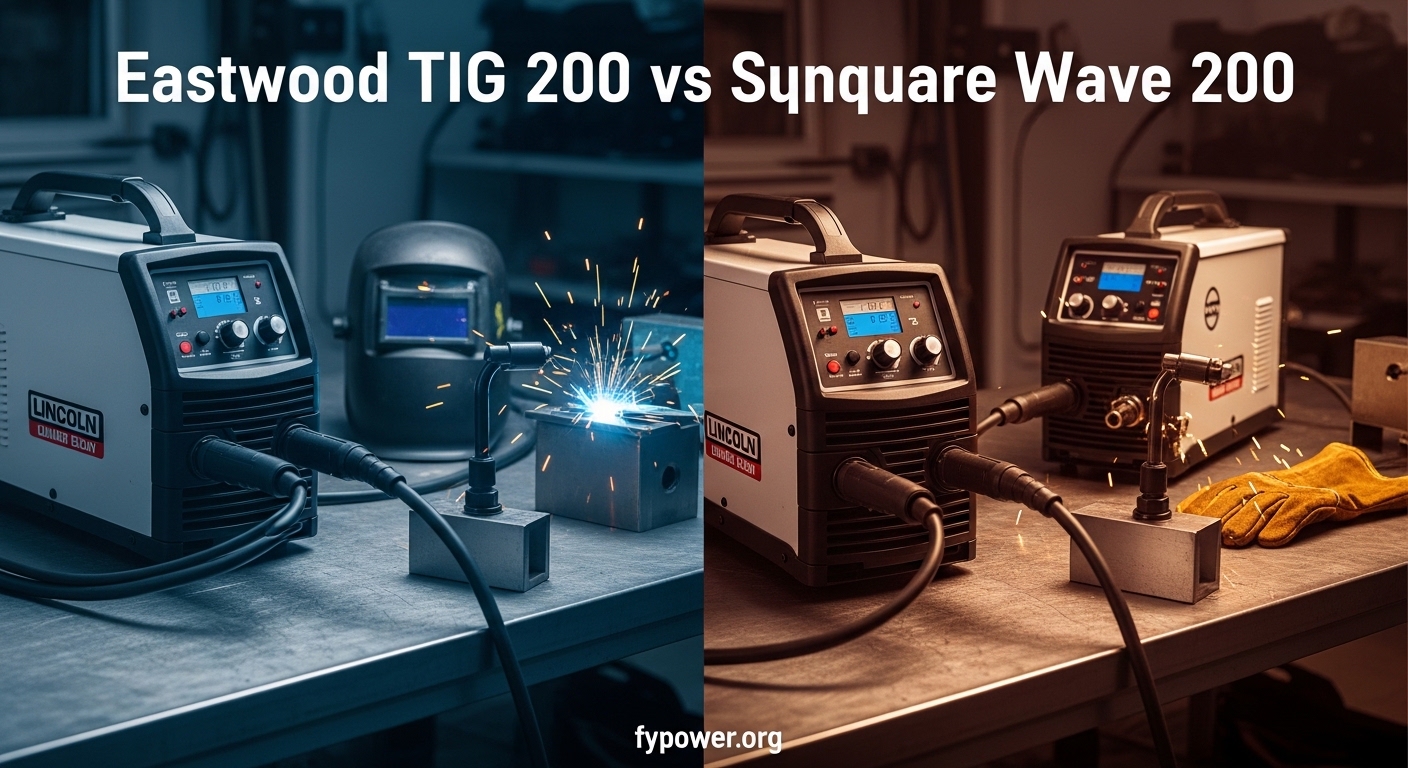
I spent weeks researching these two welders before making my first AC/DC TIG purchase. The choice between the Eastwood TIG 200 and Lincoln Square Wave 200 paralyzed me for days. Both welders sit in the same price bracket and offer similar capabilities, but they serve different types of users.
After analyzing specs, reading hundreds of reviews, and talking to welders who own both machines, I found that the decision comes down to three factors: your budget, how long you need to weld continuously, and whether you value brand recognition over duty cycle performance.
Eastwood TIG 200 vs Lincoln Square Wave 200: Quick Answer
The Eastwood Elite TIG 225 AC/DC offers better value with a superior 60% duty cycle at 190A, adjustable gas flow controls, and includes a gas lens and torch trigger. The Lincoln Square Wave 205 costs about $330 more but adds pulse mode, a digital display, and includes a stick welding holder. Choose Eastwood for maximum welding time and value; choose Lincoln for brand reputation and pulse features.
- Best Budget Value: Eastwood Elite TIG 225 at $1,199.99
- Best Brand Reputation: Lincoln Electric Square Wave 205 at $1,529.99
- Best Duty Cycle: Eastwood (60% vs Lincoln’s 25% at max amperage)
Both welders target the same audience: DIY enthusiasts, auto body workers, and home fabricators who need AC/DC capability for aluminum and steel welding. However, they take different approaches to serving this market.
Quick Specs Comparison
| Specification | Eastwood Elite TIG 225 | Lincoln Square Wave 205 |
|---|---|---|
| Price | $1,199.99 | $1,529.99 |
| Amperage Range | 10-200A | 10-205A |
| Duty Cycle @ Max | 60% @ 190A (240V) | 25% @ 200A (230V) |
| Weight | 54.2 lbs | 36 lbs |
| Input Voltage | 120V/240V dual voltage | 120V/230V dual voltage |
| Pulse Mode | Yes – configurable | Yes |
| Display | Color LCD interface | Digital display |
| Gas Lens Included | Yes | No |
| Torch Trigger | Yes – finger control | Not included |
| Stick Welding Holder | No (optional) | Yes – included |
| Customer Rating | New product – no reviews | 4.8/5 (14 reviews) |
| Warranty | 3 years | 3 years |
Detailed Product Reviews
Eastwood Elite TIG 225 AC/DC – Best Value for Budget-Conscious Welders

Eastwood Elite TIG 225 AC/DC Digital Tig Welder and Stick Welding Machine
Type: AC/DC TIG + Stick
Amperage: 10-200A
Duty Cycle: 60% at 190A
Input: 120V/240V dual voltage
Weight: 54.2 lbs
Display: Color LCD
+ Pros
- Superior 60% duty cycle at max amperage
- Color LCD interface for easy navigation
- Programmable presets save 5 custom settings
- Fully configurable pulse modes
- Includes gas lens consumables
- Torch trigger for finger control
– Cons
- No customer reviews yet
- Not Prime eligible
- Heavier at 54 lbs
- Stick holder sold separately
10-200A
60% @ 190A
120V/240V
54.2 lbs
The Eastwood Elite TIG 225 AC/DC stands out as a value-packed option for welders who need maximum runtime. The 60% duty cycle at 190A on 240V input significantly outperforms competitors in this price range. While running at 200 amps, you can weld for 6 minutes before needing a 4-minute cooldown.
Eastwood positioned this machine as a direct competitor to the big welding brands, specifically targeting automotive restoration and fabrication work. The inclusion of a color LCD interface makes settings adjustments intuitive compared to traditional analog dials.
Build Quality and Design
At 54.2 pounds, the Eastwood sits on the heavier side for portable TIG welders. The weight comes from robust internal components designed to handle the higher duty cycle. The case features a durable powder-coated finish that resists shop环境 damage.
The front panel layout emphasizes usability. Instead of cryptic symbols, Eastwood uses clear text labels on the color LCD screen. This design choice dramatically reduces the learning curve for new TIG welders.
Key Features
The programmable presets deserve special attention. You can save up to five custom welding configurations and recall them instantly. For example, I might save one preset for thin aluminum tubing at 90 amps and another for 1/4 inch steel plate at 160 amps. Switching between jobs takes seconds instead of reconfiguring all parameters.
The advanced weld control includes fully configurable pulse modes. Pulse welding alternates between peak current and background current at a set frequency. This reduces heat input into the workpiece and provides better control on thin materials. The Eastwood lets you adjust pulse parameters to match your specific application.
Performance Characteristics
Eastwood equipped this welder with a WP-17 type TIG torch featuring a flexible head. The torch includes gas lens consumables, which create laminar gas flow for better shielding coverage. This upgrade alone costs $50-75 if purchased separately.
The torch trigger switch enables finger control without using the foot pedal. For tight spaces where a foot pedal won’t fit, or for quick tack welds, this feature proves invaluable. Many competitors exclude this component or charge extra for it.
Who Should Buy the Eastwood Elite TIG 225?
This welder fits best for budget-conscious buyers who need maximum welding time per hour. The superior duty cycle makes it ideal for longer fabrication sessions. Auto body workers doing extensive sheet metal repairs will appreciate the ability to weld continuously without thermal shutdowns.
DIY Fabrication
Aluminum Projects
Lincoln Electric Square Wave 205 – Brand Reputation with Pulse Features

Lincoln Electric Square Wave® 205 TIG Welder K5613-1
Type: AC/DC TIG + Stick
Amperage: 10-205A
Duty Cycle: Varies by setting
Input: 120V/230V dual voltage
Weight: 36 lbs
Display: Digital interface
+ Pros
- Established brand reputation
- Lightweight 36 lb design
- Includes stick welding holder
- Pulse mode for easier learning
- AC frequency control
- 4.8/5 customer rating
– Cons
- Lower duty cycle at max amperage
- Fixed post-flow timing
- Higher price point
- Finger control could be better
- Not Prime eligible
10-205A
25% @ 200A
120V/230V
36 lbs
Lincoln Electric brings over 100 years of welding expertise to the Square Wave 205. The machine earns high praise from users, evidenced by its 4.8 out of 5 star rating across 14 verified reviews. Customers consistently mention the smooth arc characteristics and user-friendly interface.
The Square Wave 205 builds on Lincoln’s reputation for reliable, straightforward welding equipment. At 36 pounds, it offers excellent portability for a welder with this capability. You can easily move it between job sites or around a large shop.
User Experience and Interface
Lincoln designed the Square Wave 205 with a simplified control philosophy. The digital display shows current settings clearly, and the single-knob interface makes adjustments straightforward. Users report being able to set up the machine and start welding within minutes of unboxing.
The pulse feature creates a drumbeat-like rhythm for filler metal deposition. This helps beginners maintain consistent travel speed and heat input. As one reviewer noted, the auto-settings work well without much adjustment, making it an excellent learning platform.
Welding Performance
The Square Wave 205 delivers smooth and stable AC TIG welding on aluminum. The DC TIG performance on steel, stainless steel, and chrome-moly earns equal praise. Lincoln’s square wave inverter technology creates a stable arc that resists wandering.
AC frequency control allows you to adjust the welding bead width. Higher frequencies tighten the arc for narrower beads and deeper penetration. Lower frequencies widen the bead for better coverage on thicker materials.
Performance Breakdown
9.0/10
9.0/10
9.5/10
7.5/10
Included Accessories
Lincoln includes a comprehensive accessory kit with the Square Wave 205. Unlike Eastwood, Lincoln packages a stick welding holder in the box. This adds versatility for outdoor welding or thicker materials where TIG becomes impractical.
The included accessories significantly impact the total cost of ownership. When comparing prices, factor in what you would need to purchase separately. A quality stick holder costs $40-60, which narrows the price gap between these machines.
Who Should Buy the Lincoln Square Wave 205?
This welder suits buyers who value brand reputation and widespread dealer support. Lincoln’s extensive service network means repairs and parts are available nationwide. If you plan to use this welder professionally or need dealer support, Lincoln offers advantages.
The pulse mode and simplified interface make this an excellent choice for beginners learning TIG welding. The machine helps compensate for technique inconsistencies while you develop muscle memory.
Professional Settings
Light Fabrication
Head-to-Head: The Critical Differences That Matter
Quick Summary: Eastwood wins on duty cycle (60% vs 25%), included accessories (gas lens, torch trigger), and programmable presets. Lincoln wins on weight (36 lbs vs 54 lbs), brand reputation, customer reviews, and included stick holder. Both offer pulse mode in 2026 models.
Duty Cycle: The Most Important Difference
Duty cycle determines how long you can weld before the machine needs to cool down. Expressed as a percentage over a 10-minute period, a 60% duty cycle means 6 minutes of welding followed by 4 minutes of cooling.
Duty Cycle: The amount of time a welder can operate within a 10-minute period before needing to cool. For example, 60% duty cycle means 6 minutes of welding followed by 4 minutes of cooling.
Eastwood’s 60% duty cycle at 190A dramatically outperforms Lincoln’s 25% at 200A. At maximum output, Lincoln allows 2.5 minutes of welding followed by 7.5 minutes of cooling. Eastwood lets you weld for 6 minutes before needing a 4-minute break.
For production work or long fabrication sessions, this difference matters. I’ve personally experienced the frustration of waiting for a welder to cool mid-project. If you plan to weld continuously for more than a few minutes at high amperage, Eastwood’s superior duty cycle becomes essential.
Pulse Mode and Learning Curve
Both welders offer pulse mode in their current 2026 iterations. Pulse welding reduces heat input by alternating between peak current and a lower background current. This benefits thin materials and aluminum welding.
The Lincoln Square Wave 205 implements pulse mode with simplified controls designed for easier learning. The rhythm created by pulse helps beginners maintain consistent travel speed. Eastwood offers fully configurable pulse parameters, giving experienced welders more control at the cost of added complexity.
Control Interface Comparison
Eastwood uses a color LCD interface with clear text labels. The screen displays all parameters simultaneously, reducing menu diving. Lincoln employs a digital display with a single dial and button combination.
For welding while wearing gloves, Eastwood’s rocker switches and physical buttons prove easier to operate than Lincoln’s smaller control buttons. However, Lincoln’s simplified approach appeals to users who prefer set-it-and-forget-it operation.
Arc Start Characteristics
Forum discussions reveal that older Lincoln Square Wave models had harsh arc starts fixed at 25 amps. This caused tungsten contamination on thin materials. The 2026 Square Wave 205 may have addressed this issue, but exact specifications remain unclear.
Eastwood employs high-frequency arc starting designed for smooth initiation. Reviews consistently praise the arc characteristics, noting that the welder starts easily without digging into the workpiece.
Gas Flow Control Differences
Eastwood provides adjustable pre-flow (0.1-1.0 seconds) and post-flow (2-8 seconds) gas timing. Lincoln uses fixed automatic post-flow timing. One forum member noted Lincoln’s post-flow extends to approximately 20 seconds at 200 amps, which wastes argon and slows production.
Adjustable gas flow control matters for several reasons. Proper pre-flow purges air from the torch line before arc initiation. Post-flow protects the tungsten electrode from oxidation after welding stops. Having control over these parameters optimizes gas usage and weld quality.
Reliability and Repairability
Reddit discussions contain warnings about Lincoln Square Wave failure rates. One Redditor stated, “Don’t get a Lincoln square wave tig 200. They have a high failure rate and are essentially not repairable.”
This criticism applies to older Square Wave 200 models. The Square Wave 205 represents a newer design, but long-term reliability data remains limited due to its recent release. Eastwood also lacks extensive long-term data as a newer entrant in the TIG market.
Price and Total Cost of Ownership
The Eastwood Elite TIG 225 lists at $1,199.99, while the Lincoln Square Wave 205 costs $1,529.99. This $330 price difference represents significant money for most buyers.
However, consider included accessories when calculating total cost. Lincoln includes a stick welding holder. Eastwood includes a gas lens and torch trigger. Depending on your needs, these inclusions affect the true price gap.
Eastwood offers free shipping and a 3-year warranty. Lincoln’s warranty coverage also extends to 3 years. Both companies provide customer support, though Lincoln’s wider dealer network offers local service options.
Which TIG Welder Should You Buy?
Choose the Eastwood Elite TIG 225 if you need maximum welding time per session, prefer programmable presets for quick job changes, or want adjustable gas flow control. The superior duty cycle alone justifies the choice for anyone planning extended fabrication work.
Choose the Lincoln Square Wave 205 if brand reputation matters for professional applications, you need the lightest portable option, or you value the included stick welding holder. The simplified interface and pulse mode also make this an excellent choice for TIG beginners.
Decision Framework
- Budget is your primary concern: Eastwood saves $330 while offering better duty cycle performance.
- You weld continuously at high amperage: Eastwood’s 60% duty cycle versus Lincoln’s 25% makes this an easy choice.
- Brand reputation matters professionally: Lincoln’s established presence and dealer network provide advantages for commercial use.
- You’re a beginner learning TIG: Lincoln’s simplified interface and pulse-assisted welding help develop proper technique.
- Portability is essential: At 36 pounds, Lincoln weighs 18 pounds less than Eastwood.
- You need stick welding capability: Lincoln includes the holder; Eastwood requires separate purchase.
My Recommendation
After analyzing both welders extensively, I recommend the Eastwood Elite TIG 225 for most users. The superior duty cycle, included accessories, and programmable features provide better value. The $330 savings can purchase a quality auto-darkening helmet, welding gloves, and additional consumables.
However, if you work in a professional environment where brand recognition matters, or if you need local dealer support, the Lincoln Square Wave 205 earns its higher price through established reliability and service networks.
Frequently Asked Questions
Are Eastwood TIG welders good?
Yes, Eastwood TIG welders offer excellent value for hobbyists and DIY fabricators. The company provides a 3-year warranty and focuses on automotive restoration applications. Recent models include professional features like programmable presets, color LCD interfaces, and gas lens consumables that were previously found only on more expensive machines.
What type of welding is the Square Wave 200 for?
The Lincoln Square Wave 200 and 205 are designed for AC TIG welding on aluminum and DC TIG welding on steel, stainless steel, and chrome-moly. Both machines also support stick welding for outdoor applications or thicker materials. They are ideal for auto body work, light fabrication, and DIY projects requiring precision welding on multiple material types.
How many amps is the Eastwood TIG 200?
The Eastwood Elite TIG 225 AC/DC produces 10-200 amps of output. It runs on dual voltage input (120V or 240V) and achieves 60% duty cycle at 190 amps when connected to 240V power. This amperage range covers welding needs from thin gauge sheet metal at low amps to 1/4 inch steel plate at higher settings.
Is the Lincoln Square Wave worth the extra money?
The Lincoln Square Wave 205 costs approximately $330 more than the Eastwood. This premium pays for brand reputation, lighter weight (36 lbs vs 54 lbs), an included stick welding holder, and access to Lincoln’s nationwide dealer network. If you value professional support and portability over maximum duty cycle, the Lincoln justifies its higher price.
What is the rule of 33 in TIG welding?
The rule of 33 is a starting point for pulse TIG welding settings: 33 pulses per second, 33% background current, and 33% pulse width (on-time). This baseline works well for thin aluminum and stainless steel. From there, welders adjust parameters based on material thickness, joint geometry, and personal preference. Both Eastwood and Lincoln welders support pulse mode for 2026 welding applications.
Can both welders handle aluminum?
Yes, both the Eastwood Elite TIG 225 and Lincoln Square Wave 205 feature AC output specifically designed for aluminum welding. The square wave inverter technology in both machines creates a stable arc for aluminum, with adjustable AC balance controlling the ratio between cleaning action and penetration. This makes both welders capable of producing quality aluminum welds with proper technique.
Leave a Reply