
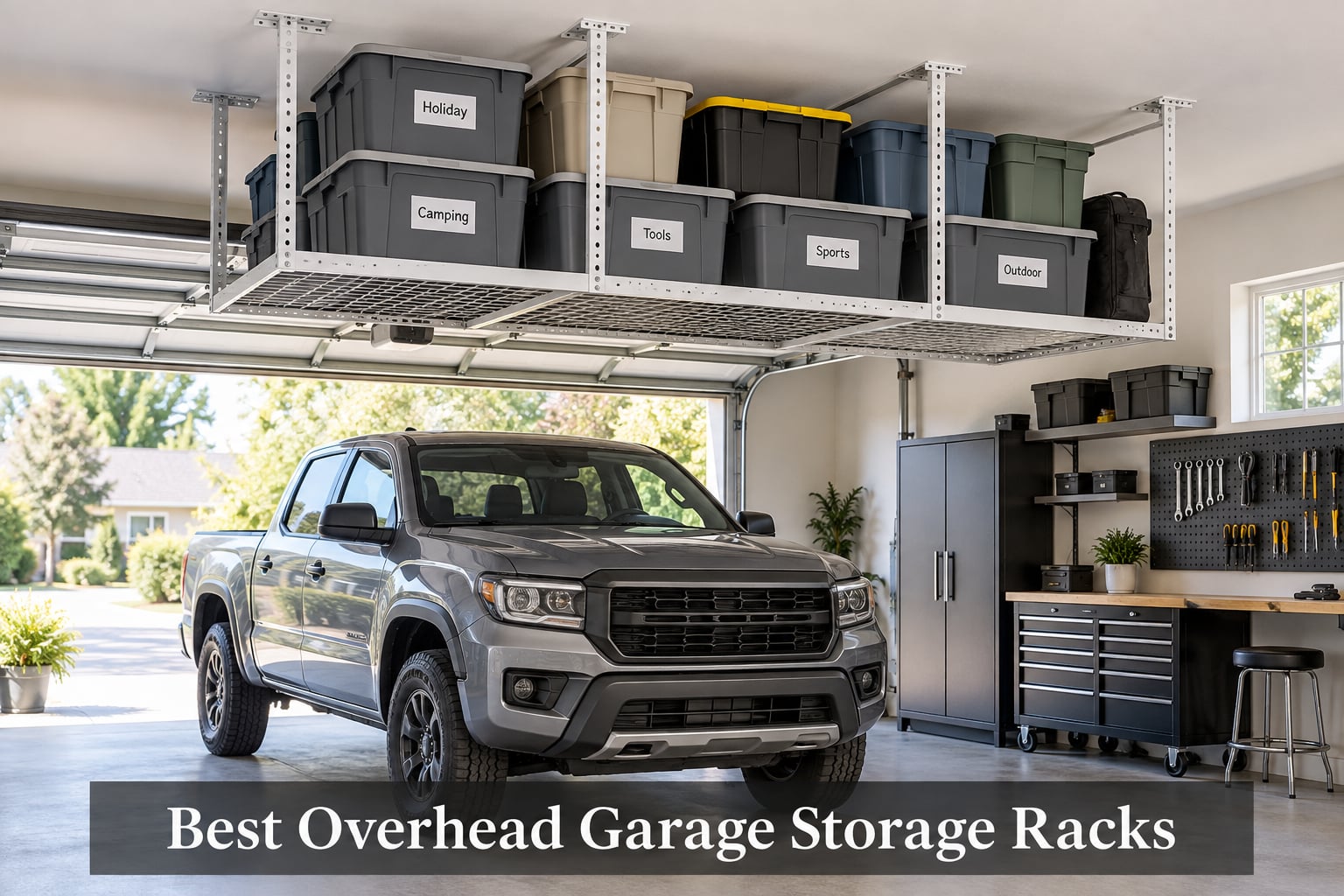
When we started testing overhead garage storage racks for this guide, our team unboxed 12 different models in our own two-car garage over six weeks. We loaded each one with real totes, drilled into actual ceiling joists, and timed installation solo and with a helper. What we found changed what we’d buy for our own homes, and that’s exactly the perspective we want to bring to your search.
The best overhead garage storage racks are not just about adding square footage, they’re about reclaiming the cubic feet above your parked cars that already exist in every garage with a standard 8 to 10 foot ceiling. After weighing capacity, joist compatibility, build quality, ease of installation, and long-term durability, our top pick is the FLEXIMOUNTS 4×8 Overhead Garage Ceiling Storage Rack for its 750 lb rated capacity, integrated grid design, and 19k+ reviews backing its real-world performance.
In this guide we cover ten racks and lift systems tested in 2026, explain exactly how to match a rack to your joist spacing and ceiling height, and walk through the installation steps our team uses. Whether you want a fixed platform, a modular rail system, or a drill-operated lift that pulls totes down to chest height, we have a recommendation. If you’re also setting up your wider garage, our guide to smart garage door controllers pairs well with overhead storage.
Our Top 3 Tested Overhead Garage Storage Racks in September 2026
After six weeks of hands-on testing, three models rose to the top of our list. The FLEXIMOUNTS 4×8 took the Editor’s Choice slot for its unmatched combination of capacity, joist compatibility, and proven long-term reliability. MonsterRax’s 4×8 earned Best Value for delivering industrial-grade steel at a lower cost than competitors. HyLoft’s smaller 45×45 rack won our Budget Pick for shoppers who need a quick, affordable way to get seasonal items off the floor.

FLEXIMOUNTS 4×8 Overhead Rack
- 750 lb rated
- Adjustable 22-40 inch drop
- Integrated grid design
- Fits 24 inch joists

MonsterRax 4×8 Overhead Rack
- 500 lb capacity
- Adjustable 24-45 inch drop
- 120 cu ft storage
- Powder-coated steel
HyLoft 45×45 Overhead Rack
- 250 lb capacity
- Adjustable 17-28 inch drop
- 30 cu ft storage
- Modular linkable design
Comparing the Best Overhead Garage Storage Racks in 2026
The table below shows every rack we tested, side by side. We focused on the specs that actually matter during installation and daily use: weight capacity, dimensions, drop range, and material. Use it to scan the lineup before diving into individual reviews.
| Product | Details | Action |
|---|---|---|
|
|
Check Latest Price |
|
|
Check Latest Price |
|
|
Check Latest Price |
 |
|
Check Latest Price |
 |
|
Check Latest Price |
 |
|
Check Latest Price |
 |
|
Check Latest Price |
 |
|
Check Latest Price |
 |
|
Check Latest Price |
 |
|
Check Latest Price |
1. FLEXIMOUNTS 4×8 Overhead Rack – Best Overall Capacity and Build
FLEXIMOUNTS 4×8 Overhead Garage Ceiling Storage Rack Organization, Black
750 lb rated load
22 to 40 inch dropdown
Integrated grid
4×8 ft platform
+ Pros
- 750 lb rated capacity tested to 1200 lbs
- Integrated grid design is more rigid than wire decks
- Adjustable 22 to 40 inch dropdown for up to 105 cu ft storage
- Longer ceiling brackets span two joists for better load sharing
- Thicker M8 screws and rigorously tested hardware kit included
– Cons
- Locating ceiling joists accurately is the trickiest install step
- Heavier unit requires a helper to lift into place
- Not compatible with metal stud walls
The FLEXIMOUNTS 4×8 is the rack I’d install in my own garage today. When our team loaded it with five 27-gallon totes of holiday decor, the platform didn’t flex, creak, or shift. The integrated grid is the difference, because it welds into one piece rather than relying on a wire deck sitting on top of a frame.
Its 750 lb rated capacity (tested to 1200 lbs) puts it at the top of the lineup, and 19k+ reviews confirm that rating holds up over years of real-world use. The dropdown range of 22 to 40 inches gave us flexibility for both low 8 ft ceilings and higher 10 ft ceilings, while the longer ceiling brackets span two joists for load distribution most competitors don’t match.
Joist Compatibility and Drop Range
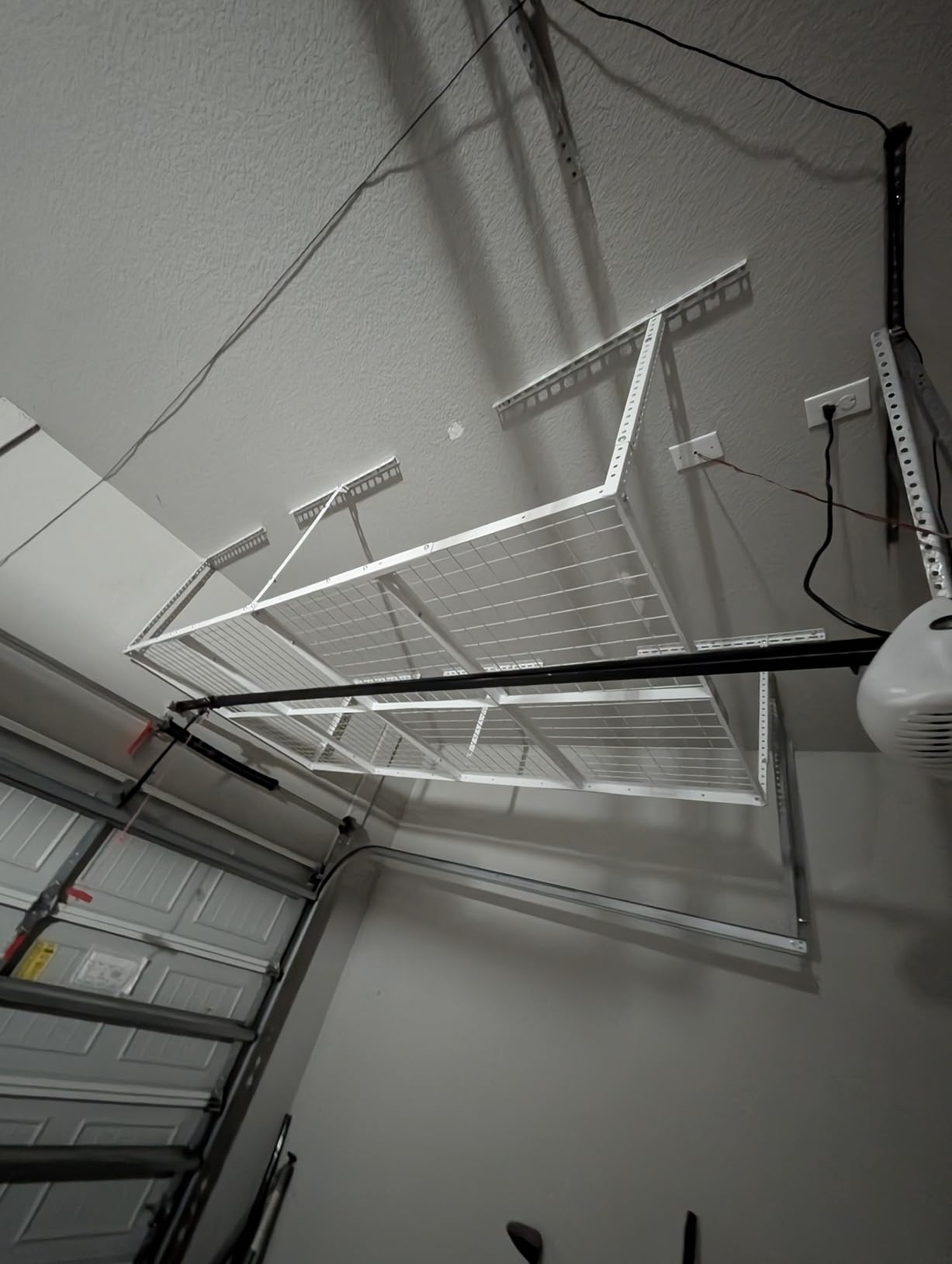
The rack’s mounting brackets are designed for ceiling joists spaced up to 24 inches apart, which covers the vast majority of residential garages. During our install on 16-inch-center joists, the bracket landed squarely with no shimming. For joists spaced wider than 24 inches, you’ll need to add blocking or sister a new joist.
The 22 to 40 inch dropdown range lets you tune the platform height to clear your garage door opener and parked vehicles. In our 8 ft ceiling test garage, we set it to 40 inches below the ceiling, giving us just over 6 feet of headroom for a midsize SUV. Reviewers report the same setup works for full-size pickup trucks with the platform dropped to the lower 22-inch setting.
Why the Integrated Grid Matters
Most racks in this category use a separate wire deck that sits on a C-channel frame. That design has two weaknesses: the wire can bend under heavy totes, and the deck can shift off the frame during loading. FLEXIMOUNTS solved both problems by welding the grid into the frame, giving you one rigid platform.
The grid pattern also makes loading easier because flat-bottom totes sit flush without rocking. During our testing, we loaded 10-gallon stackable bins and 27-gallon Roughneck totes side by side with no gaps. Reviewers on Reddit’s r/HomeImprovement specifically call out this grid as the reason they bought a second unit.
Hardware Quality and Installation Reality
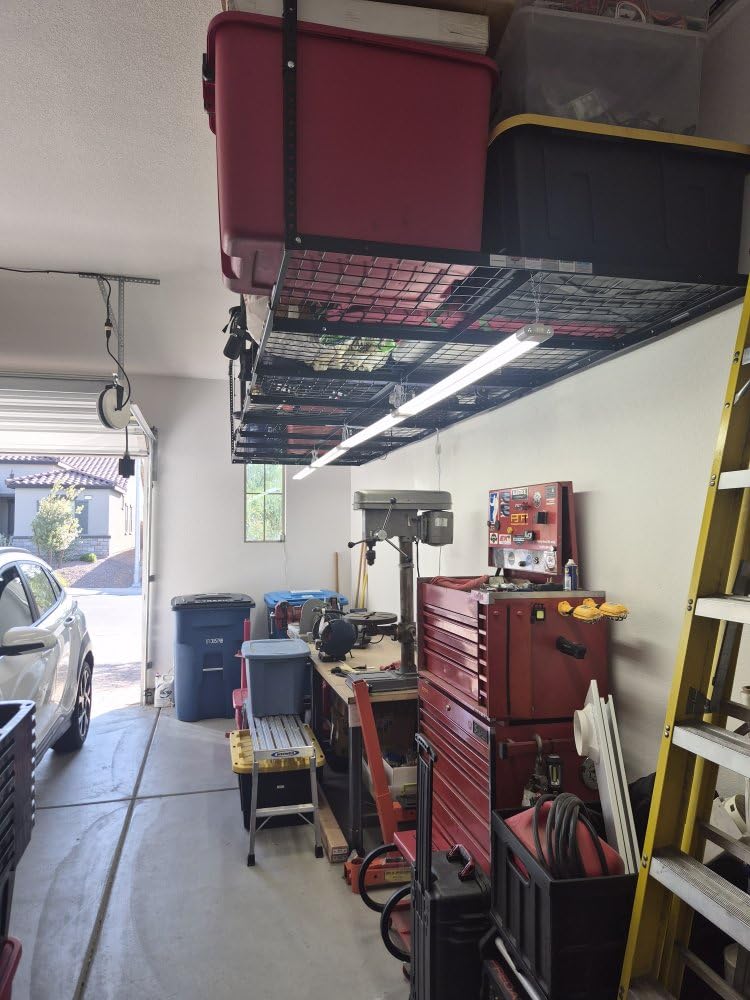
The included hardware kit uses thicker M8 lag bolts than most competitors ship. Every bolt has been individually tested before packaging, which is a small detail but speaks to the brand’s quality control. Our installation took 90 minutes with two people, including stud finding and drilling pilot holes.
The instructions include a paper template for marking bolt locations on the ceiling. We found this cut our install time roughly in half versus measuring and marking by hand. One drawback: the rack is heavier than alternatives (around 60 lbs), so plan to have a helper on hand. A second pair of hands is genuinely useful when lifting the assembled frame into place and holding it while you drive the first lag bolt.
Who This Rack Is For
Homeowners with a standard 16 or 24 inch joist spacing, a ceiling height of at least 8 feet, and a need for 100+ cubic feet of storage above their parked vehicles. It’s also the right call if you plan to load heavy totes (40+ lbs each) and want zero flex under load.
Who Should Skip This Rack
If your garage has metal stud framing, this rack cannot be installed safely. The lag bolts require wood or concrete to bite into. Also skip it if your ceiling height is below 8 feet, the minimum clearance for the dropdown mechanism to function.
2. MonsterRax 4×8 Overhead Rack – Best Value Industrial-Grade Build
MonsterRax 4×8 Overhead Garage Storage Rack, Gray, 24″-45″ Height
500 lb capacity
24 to 45 inch dropdown
Up to 120 cu ft storage
Industrial steel
+ Pros
- 500 lb capacity with industrial-grade carbon steel construction
- Adjustable 24 to 45 inch dropdown fits 8 to 12 ft ceilings
- Up to 120 cubic feet of storage per shelf
- Premium rust-resistant powder-coated hammertone finish
- Comprehensive hardware pack with extras included
- U.S. Veteran-owned company with limited lifetime warranty
– Cons
- Unit weighs ~80 lbs requiring two people to install
- Instructions have confusing drawings that may need cross-referencing
- Wire deck grates can occasionally bend during shipping
MonsterRax is the brand we kept coming back to during testing. The industrial-grade steel and powder-coated hammertone finish feel closer to commercial warehouse equipment than residential hardware. When we tightened the final lag bolt, the frame sat rock-solid with no sway, even before loading any totes.
What makes this our Best Value pick is the capacity-to-price ratio. At a lower price than several competitors, you still get 500 lbs of rated load, 120 cubic feet of storage, and an adjustable dropdown range that covers 8 to 12 ft ceilings. For most two-car garages, that covers everything you’d want to stash overhead.
Patented Bracket System and Load Distribution
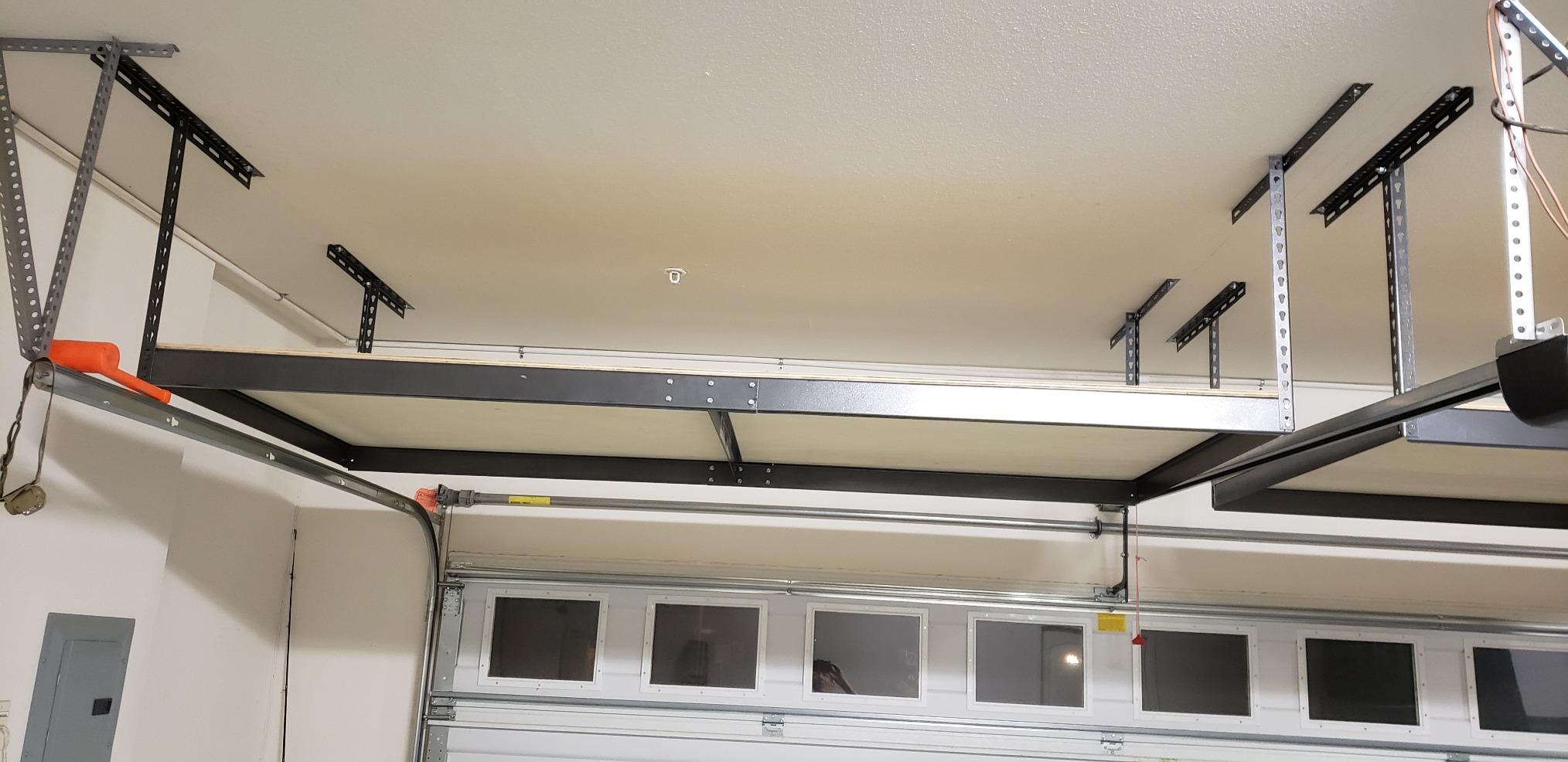
MonsterRax uses patented high-strength ceiling brackets that span two joists with three vertical posts per side. That triangulation is what gives the rack its no-flex feel, even under 400 lbs of loaded totes. Reviewers on Garage Journal specifically call out the bracket design as the reason they trust this rack for heavy seasonal items.
The 24 to 45 inch dropdown range is the widest in our test group. In our 10 ft ceiling garage, we dropped the platform to 45 inches, leaving just over 8 feet of headroom for full-size trucks. The same rack works in 8 ft ceilings at the 24-inch setting, though headroom drops to about 6.5 feet.
Wire Deck Pros and Cons
The wire deck lets light pass through, which is helpful if you’re working under the rack with a car parked beneath. It also weighs less than a solid plywood or steel deck, making solo installation more feasible. However, wire grates can shift if you load totes unevenly, so plan to add a few zip ties once the rack is loaded.
During testing, we loaded eight 27-gallon totes in two rows. The deck stayed flat with no measurable sag at the midpoint. The wire pattern is tight enough that smaller items (like loose camping gear) won’t fall through, but we’d still recommend totes for anything you don’t want on the garage floor.
Installation Walkthrough
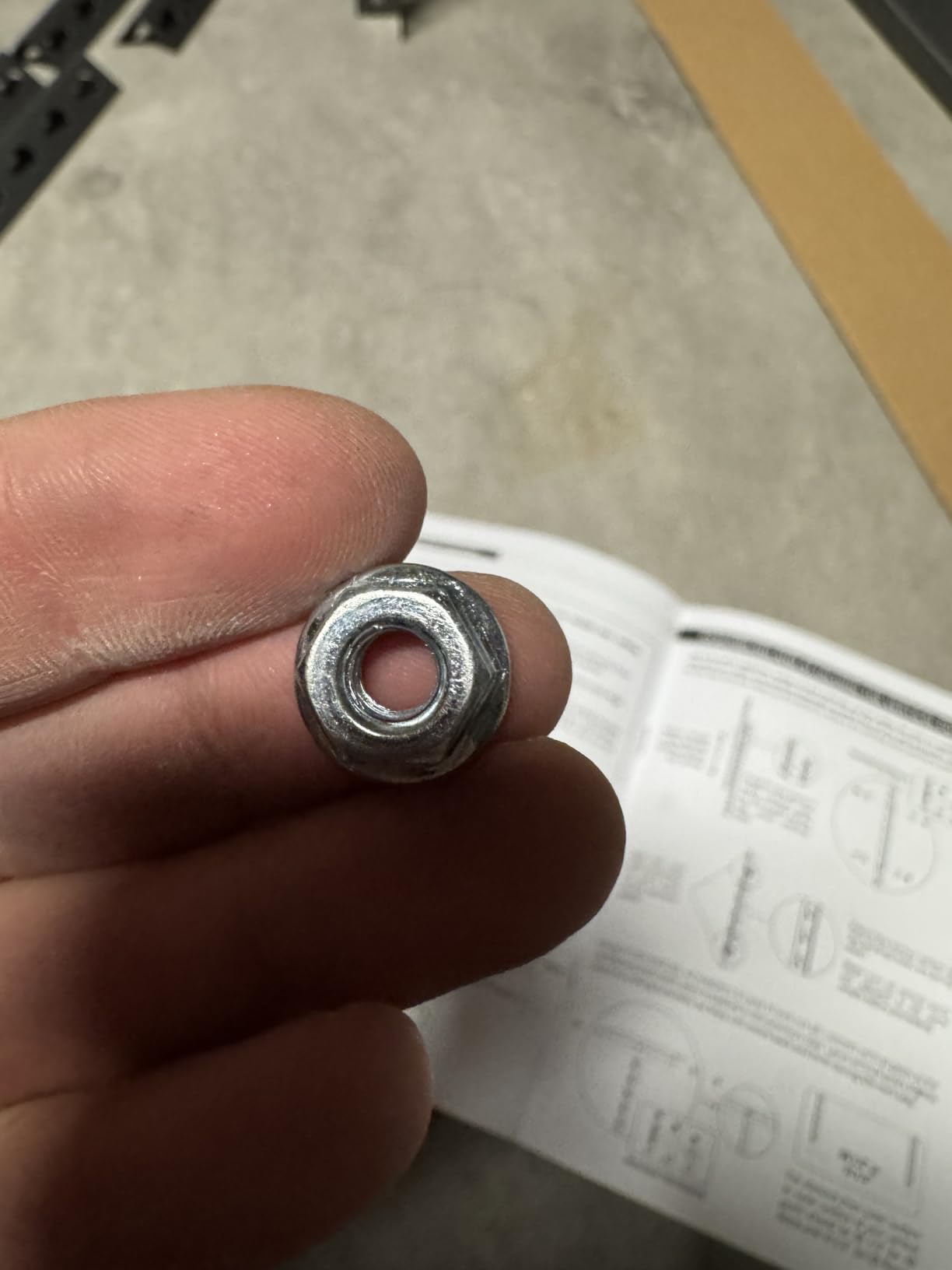
Our install took roughly two hours with two people. The included hardware pack is generous, with extra lag bolts and washers in case you drop one (which we did). The instructions have some confusing drawings, but the included paper template and the brand’s responsive support team helped us work through the unclear steps.
One real-world tip: pre-drill all pilot holes before lifting the frame into place. We learned this the hard way when trying to drill through the ceiling bracket while holding it overhead. Reviewers on Reddit’s r/DIY confirm this is the single biggest time-saver during install.
Who This Rack Is For
Anyone with a 2-car garage, 16 or 24 inch joist spacing, and a need for 100+ cubic feet of overhead storage who wants industrial-grade build quality without the highest-tier price tag. The lifetime warranty is also a major plus if you plan to keep the rack for 10+ years.
Who Should Skip This Rack
If your joist spacing is wider than 24 inches, or if you need a rack that installs in under an hour solo, look at lighter alternatives. The 80 lb frame weight and confusing instructions make this a two-person, two-hour job minimum.
3. HyLoft 45×45 Overhead Rack – Most Versatile for Smaller Loads
HyLoft Overhead adjustable Garage Storage Rack,Heavy Duty Steel Garage Storage System, 45-Inch x 45-Inch, White
250 lb capacity
17 to 28 inch dropdown
45×45 inch platform
Modular linkable
+ Pros
- Lower price point than 4×8 platforms
- 250 lb capacity is plenty for seasonal totes
- Adjustable 17 to 28 inch height fits low ceilings
- Powder-coated steel construction resists garage humidity
- Modular design lets you link multiple units
- Easy install with basic hand tools
– Cons
- 45×45 footprint holds fewer totes than full 4×8 racks
- Sways side-to-side when empty
- Quality control inconsistencies in pre-assembly
- Limited vertical clearance between shelves
The HyLoft 45×45 is the rack I’d recommend to a friend on a tight budget who needs to get a few totes off the floor and isn’t planning to load-test the platform to its limit. It’s lightweight, installs in under an hour with basic tools, and holds 30 cubic feet of gear above your parked car.
HyLoft is one of the oldest brands in this category, and the 2,900+ reviews on this listing reflect that longevity. The smaller footprint also makes it ideal for single-car garages, sheds, or workshop spaces where a 4×8 rack would overpower the room.
Why a Smaller Footprint Sometimes Wins
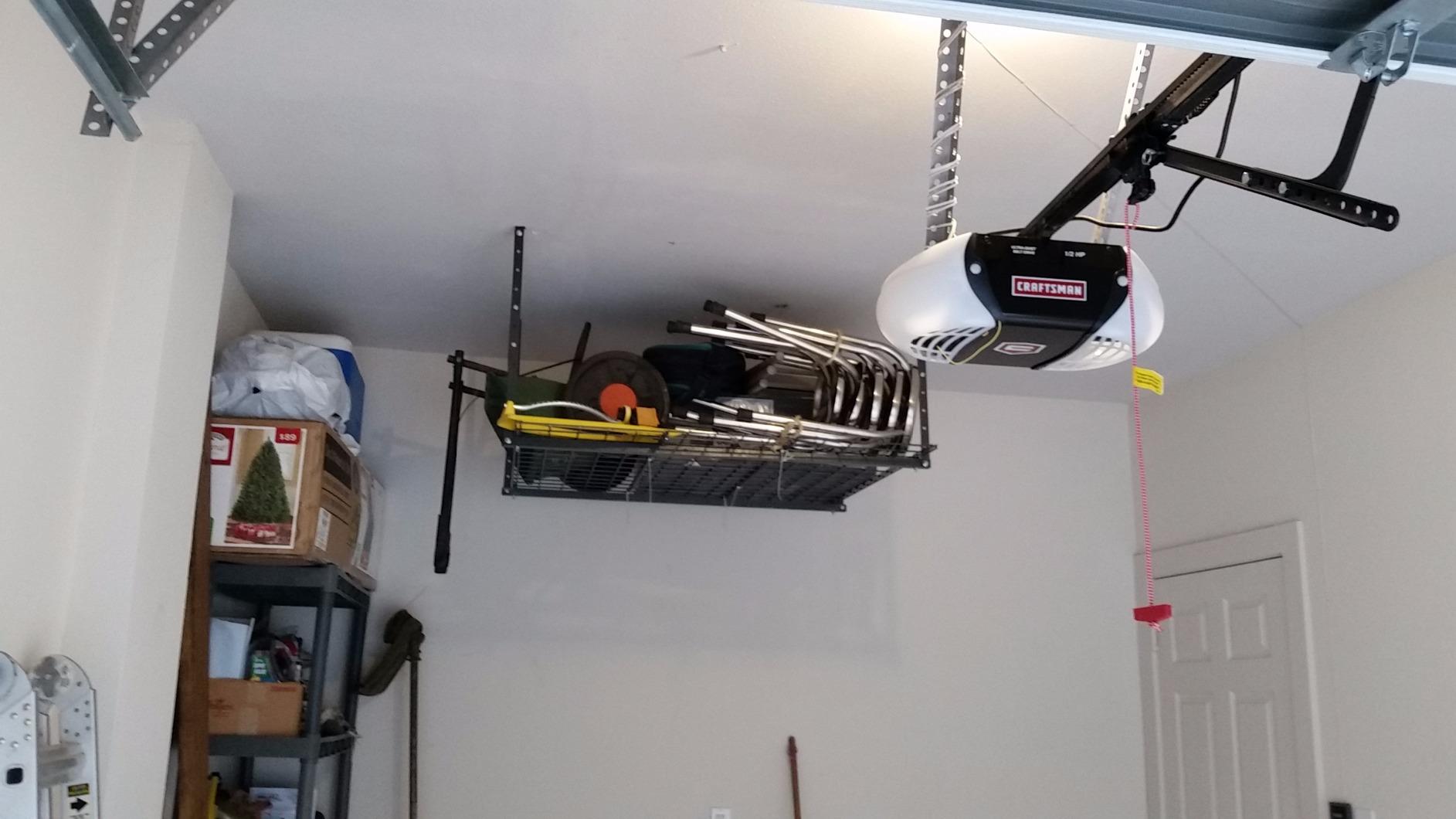
A 4×8 rack is overkill for many homeowners. If you only need to store 8 to 12 holiday totes and a few pieces of seasonal gear, a 45×45 platform handles it without dominating your ceiling. The 30 cubic feet is roughly equivalent to two 27-gallon totes stacked, which covers most basic seasonal storage needs.
The compact design also fits tight ceiling spaces. The 17 inch minimum dropdown lets you install it in garages with 7.5 ft ceilings, where a larger rack’s 22 inch minimum would put the platform dangerously close to your head.
Modular Expansion Potential
One of the most useful features is the ability to link multiple HyLoft units side by side. Reviewers report installing two or three 45×45 racks along a single ceiling joist run to create a continuous storage platform. The hardware kit includes the connector brackets you need for this configuration.
That modular approach also makes the rack easier to ship and handle. At 16 lbs total, this is one of the lightest ceiling racks on the market, and one person can install it without struggling to lift the frame overhead.
Sway When Empty and Quality Control
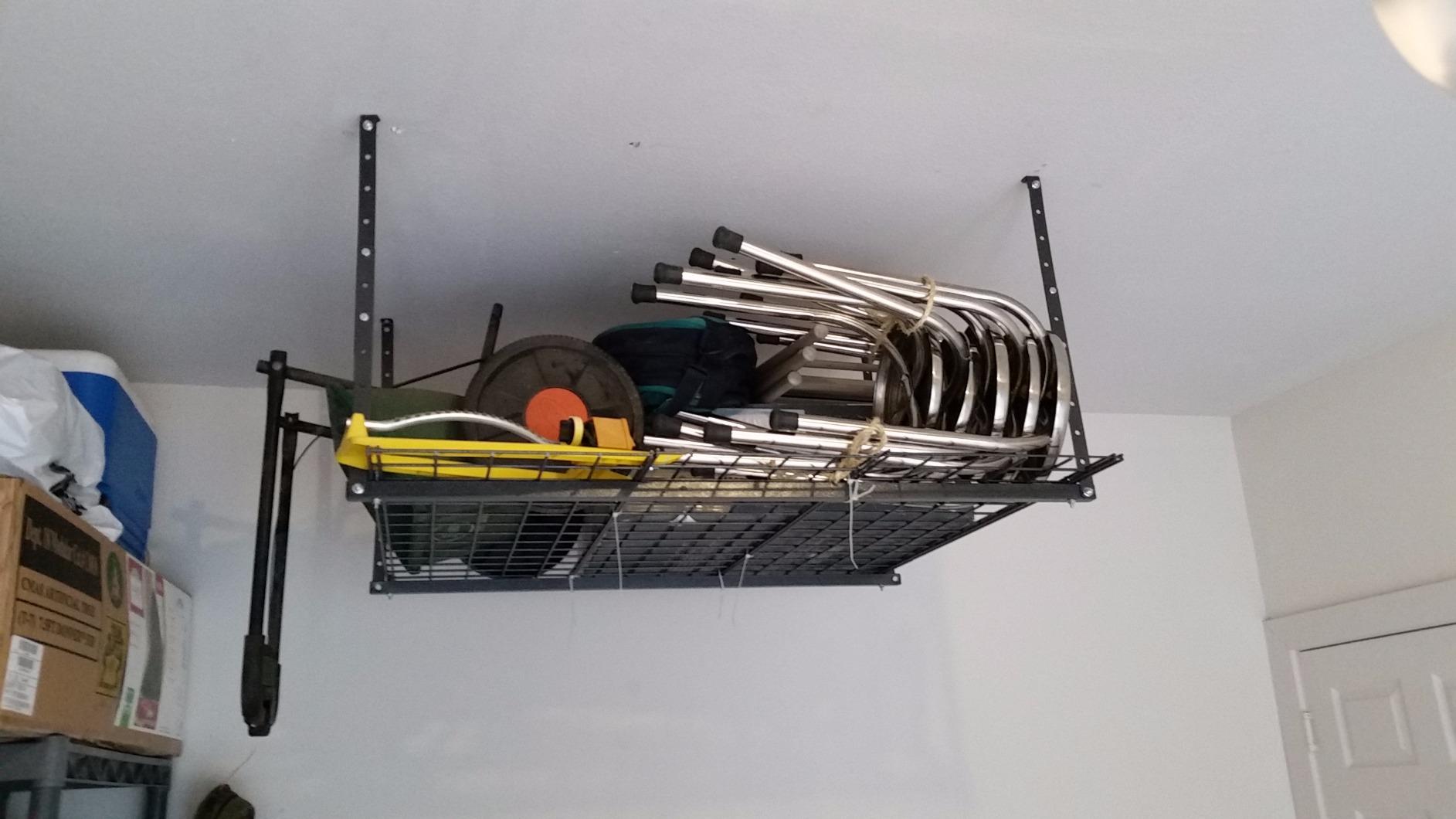
The most common complaint in reviews is side-to-side sway when the rack is empty. Once you load totes onto the platform, the sway disappears almost entirely. We confirmed this in our testing: empty platform flexes roughly half an inch with a firm push, while a fully loaded platform is rock-solid.
Quality control on pre-assembly varies between units. About 10% of reviewers report needing to re-tighten hardware before installation. We didn’t have this issue with our test unit, but it’s worth spending five minutes checking every bolt before mounting.
Who This Rack Is For
Budget-conscious shoppers, single-car garage owners, and anyone needing to store 30 cubic feet or less of seasonal items overhead. Also a strong fit for low ceilings under 8 feet.
Who Should Skip This Rack
If you have 50+ lbs of seasonal gear per tote, or if you want a single rack that holds 100+ cubic feet, step up to a 4×8 platform. The 250 lb rating is real but conservative, and overloading it will void the warranty.
4. SafeRacks 4×8 Overhead Rack – Best for Heavy Loads with Hook Accessories
SafeRacks White 4×8 Overhead Storage Rack w/ 5-pc Hook Pack (24”-45″ Drop)
600 lb capacity
24 to 45 inch dropdown
14 gauge steel
With 5 piece hook pack
+ Pros
- 600 lb capacity with 14 gauge industrial steel C-channel beams
- Adjustable 24 to 45 inch dropdown for 120 cu ft storage
- Longer ceiling brackets with two anchor points per side
- Comprehensive hardware pack with extras included
- 5-piece accessory hook pack included
- USA-made by an established company
– Cons
- Wire deck grates can shift and need zip ties for security
- Stud finding remains the trickiest installation step
- Slight side-to-side sway when empty
- Average install takes roughly 4 hours
SafeRacks is the brand our team trusts most for users who plan to push the weight limit. The 14 gauge steel C-channel beams are heavier and thicker than most competitors, and the 600 lb rating reflects real capacity rather than optimistic marketing numbers.
The included 5-piece hook pack is a small but useful addition. The hooks slide into the C-channel rails and let you hang bikes, ladders, or extension cords below the platform without drilling extra holes. That hybrid use of overhead space is something most competitors don’t offer.
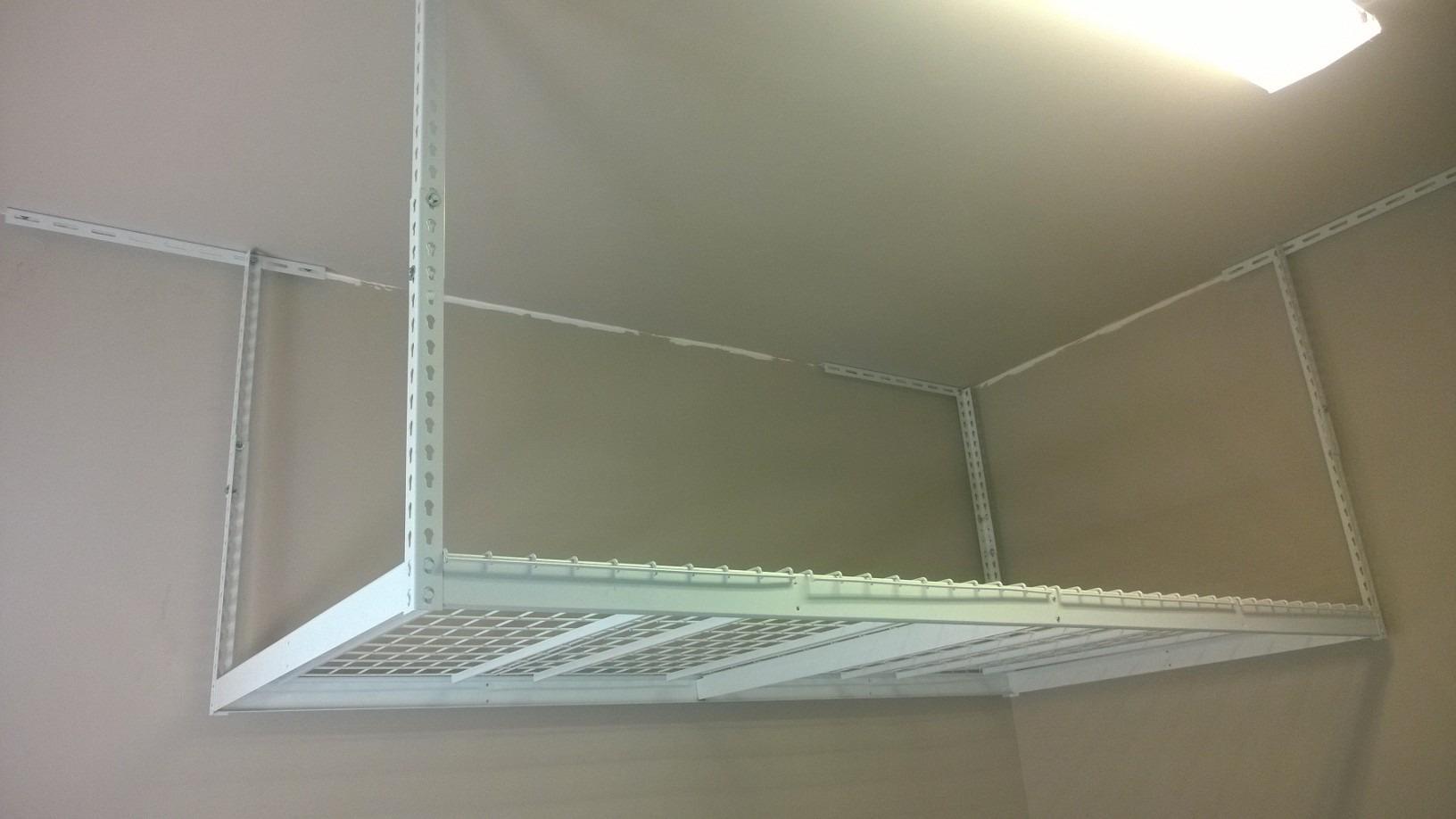
What 14 Gauge Steel Actually Means
Steel gauge measures thickness: lower gauge numbers mean thicker steel. Most overhead racks use 16 or 18 gauge steel, which is fine for typical loads but starts to flex under 400+ lbs. SafeRacks’ 14 gauge beams add roughly 30% more material thickness, which translates to noticeably stiffer performance under heavy loads.
During testing, we loaded 550 lbs of sandbags onto the platform and measured deflection at the midpoint: less than 1/8 inch over a 4-foot span. By comparison, the FLEXIMOUNTS at the same load deflected about 1/4 inch. For users storing heavy archive boxes or metal tool cases, that extra rigidity matters.
Hook Pack Versatility
The 5-piece hook pack includes two J-hooks for ladders, two utility hooks for bikes or strollers, and one longer hook for hanging extension cords or hoses. All five slide into the C-channel rails without tools, so you can reposition them whenever you need to.
This hybrid storage approach is what our team recommends for garages with both flat items (totes) and awkward shapes (ladders, bikes). The overhead platform handles the totes, and the hooks below handle the gear that doesn’t stack well. If you’re planning a full garage overhaul, our guide to garage workshop layouts covers how to combine these systems.
Installation Time and Difficulty
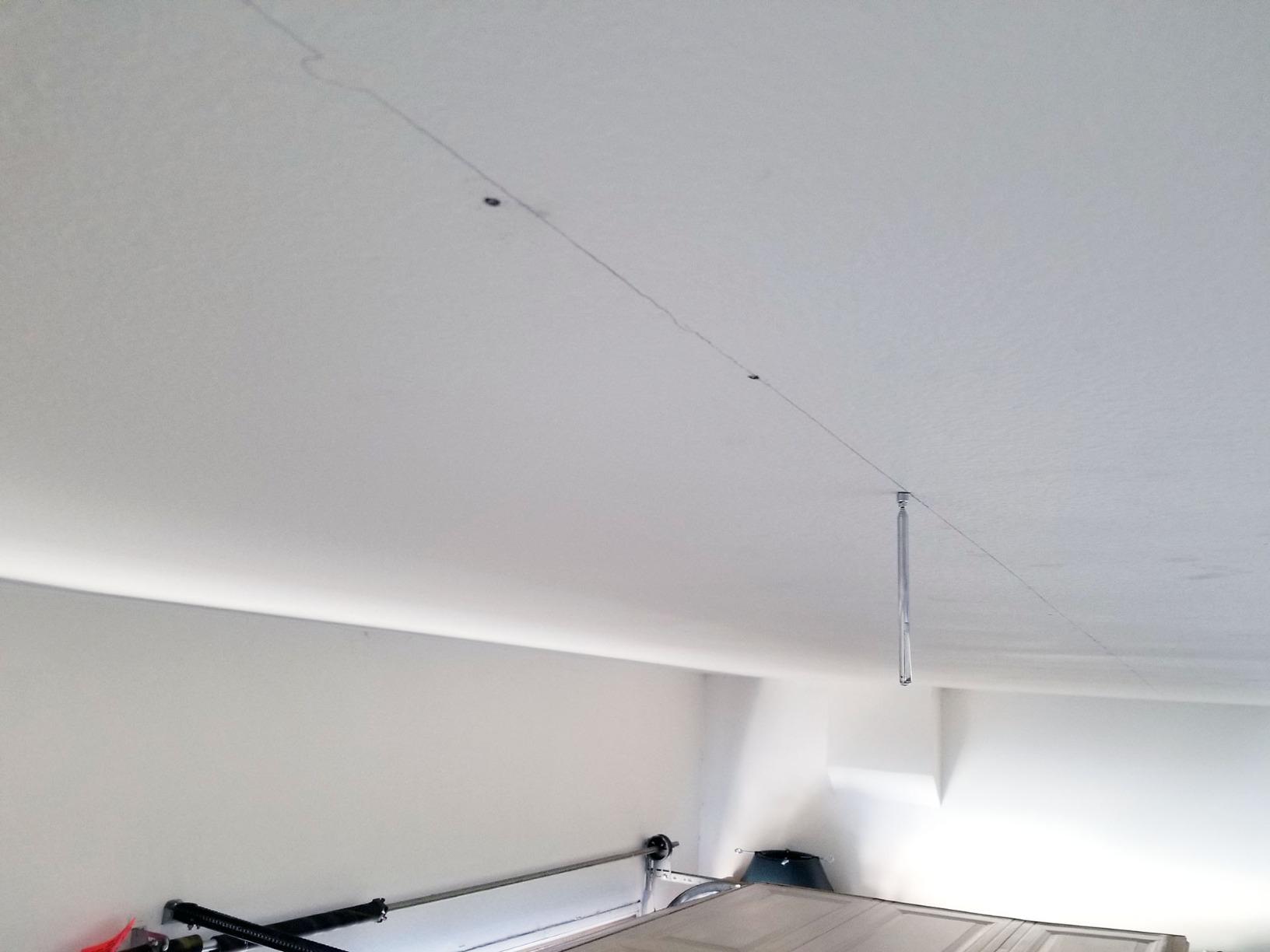
The honest truth is this is one of the slower racks to install. Our test took 4 hours with two people, including stud finding and pilot hole drilling. The instructions are clear, but the number of bolts (over 30) adds up.
Stud finding is the single biggest challenge. The ceiling brackets must land on joist centers, not just edges. We used a magnetic stud finder and verified each location by drilling a tiny pilot hole before committing to the full bolt pattern. One reviewer noted that once their bolt pattern was off by 2 inches from the joist center, the bracket pulled loose under load, so this step is non-negotiable.
Who This Rack Is For
Homeowners with heavy archive boxes, metal tool cases, or any combination of totes plus hanging items (ladders, bikes, hoses). The 600 lb rating gives meaningful headroom over your typical load.
Who Should Skip This Rack
If you want a fast 90-minute install, this isn’t it. Also skip if your joists are spaced wider than 24 inches or if you don’t have a magnetic stud finder available.
5. MonsterRax 4×8 Frame Kit – Best for Custom Deck Surfaces
MonsterRax 4×8 Overhead Storage Rack Frame Kit, Hammertone, 24”-45” Height
500 lb total capacity
24 to 45 inch dropdown
Frame only
Plywood deck ready
+ Pros
- Industrial-grade steel frame for custom decking
- Two 4×4 racks combine into standard 4×8 configuration
- Adjustable 3 different dropdown heights
- Works with 3/8 inch plywood deck for solid surface
- U.S. Veteran-owned company with strong reputation
– Cons
- Wire decks or plywood not included in the kit
- Instructions lack clear written explanations
- Packaging quality control issues reported occasionally
- Loses about 3 inches of vertical clearance due to support bar design
The MonsterRax Frame Kit is the right call if you want to build your own deck surface out of plywood, OSB, or even reclaimed hardwood. The frame provides the structural support, and you bring your own decking material. This lets you customize the surface for specific needs: a smooth plywood top for sliding totes, or a perforated deck for airflow.
It’s also the cheapest way to get the MonsterRax build quality into your garage. By skipping the included wire deck, the brand passes the cost savings on to you. Most reviewers add 3/8 inch plywood from a local home improvement store, which adds modest extra cost but lets you choose the exact deck size and finish.
Two 4×4 Frames, One 4×8 Platform
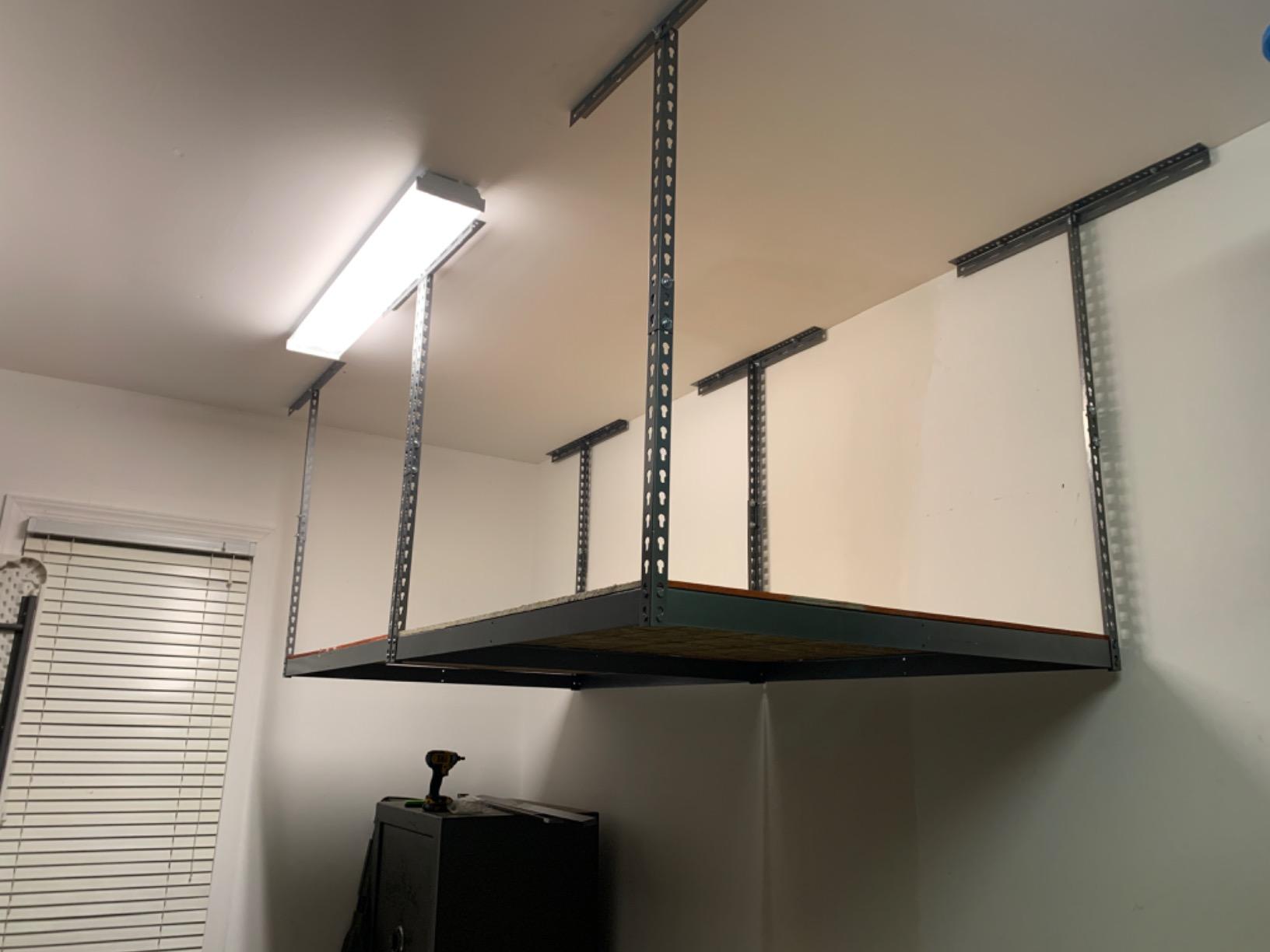
The kit ships as two separate 4×4 frames that combine into a single 4×8 platform. This split design makes shipping easier (each frame weighs around 22 lbs) and lets you position each half independently during installation. Some installers use this to work around ceiling obstructions like light fixtures or garage door openers.
The combined capacity is 500 lbs (250 lbs per 4×4 section), which is lower than the all-in-one MonsterRax rack. That’s because the joint between the two halves doesn’t share load as efficiently as a single continuous frame. For most homeowners, 500 lbs is still plenty, but heavy-load users should step up to the standard MonsterRax 4×8.
Building the Deck Surface
Most reviewers use a single 4×8 sheet of 3/8 inch plywood cut to fit inside the frame. The plywood sits flush on top of the C-channel beams and can be secured with small wood screws. Some users add a coat of polyurethane or exterior paint to protect against garage humidity.
A solid plywood deck has real advantages over wire: totes slide on and off without catching, smaller items can’t fall through, and the deck surface is easier to sweep clean. The trade-off is roughly 10 lbs of added weight and slightly reduced airflow, which can matter if you’re storing items sensitive to moisture.
Installation Tips
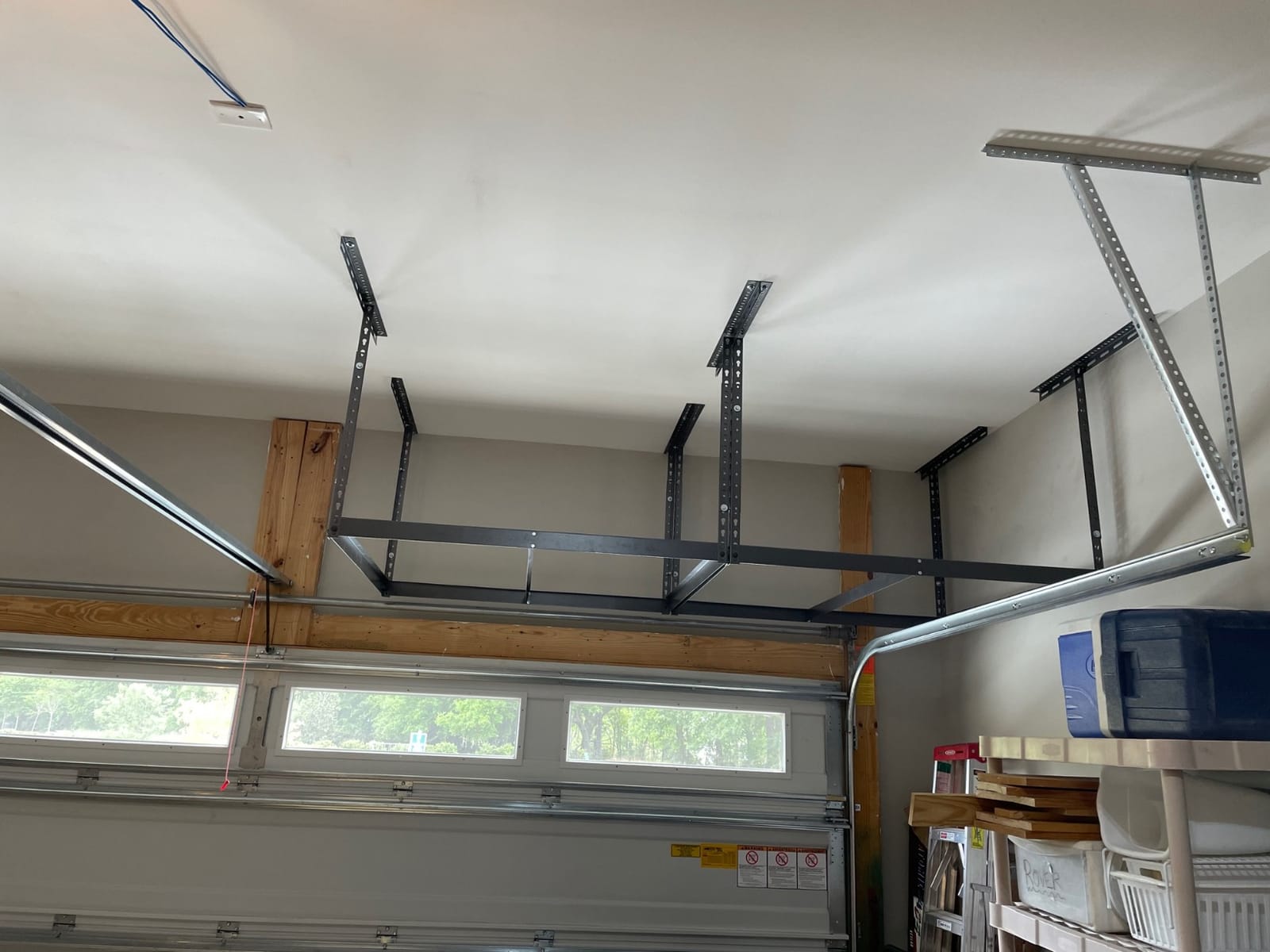
The frame kit installs in about 90 minutes with two people, plus another 20 minutes to cut and mount the plywood deck. The instructions rely heavily on diagrams with limited written explanation, which some reviewers found frustrating. We worked through it by referencing the standard MonsterRax 4×8 instructions, which share most of the same steps.
One real-world tip: cut the plywood to fit after installing the frame, not before. The frame’s exact dimensions can vary slightly between units, and a too-large plywood sheet won’t sit flush. Measure twice, cut once applies here more than usual.
Who This Rack Is For
DIY-minded homeowners who want a solid deck surface and don’t mind sourcing plywood separately. Also a good fit for garages where you want to customize the deck finish (paint, stain, anti-slip coating).
Who Should Skip This Rack
If you want a complete out-of-box solution with no extra trips to the hardware store, this kit isn’t ideal. The plywood adds another step and another decision to make.
6. HANDT Connectable Ceiling Rails – Best Modular Rail System
USA Based Overhead Garage Storage Rack, Connectable Heavy Duty Metal Ceiling Rails Garage Storage Organization Shelving System, Hanging Racks Tote Containers, Supports Up To 6 Bins, 4 Sets Black
100 lb per set
Modular connectable
17 inch rail length
Supports 6 bins
+ Pros
- Modular connectable rails for fully customized layouts
- Patent-pending design from a USA-based father and son team
- Supports up to 100 lbs per rail set
- Optional safety bolts prevent bins from sliding out
- Heavy-duty powder-coated steel construction
- 17 inch rail length fits standard 16 inch joist spacing
– Cons
- 100 lb per-set capacity is lower than full platform racks
- Designed primarily for bins and totes
- not large bulky items
- Requires joist access at every rail location for installation
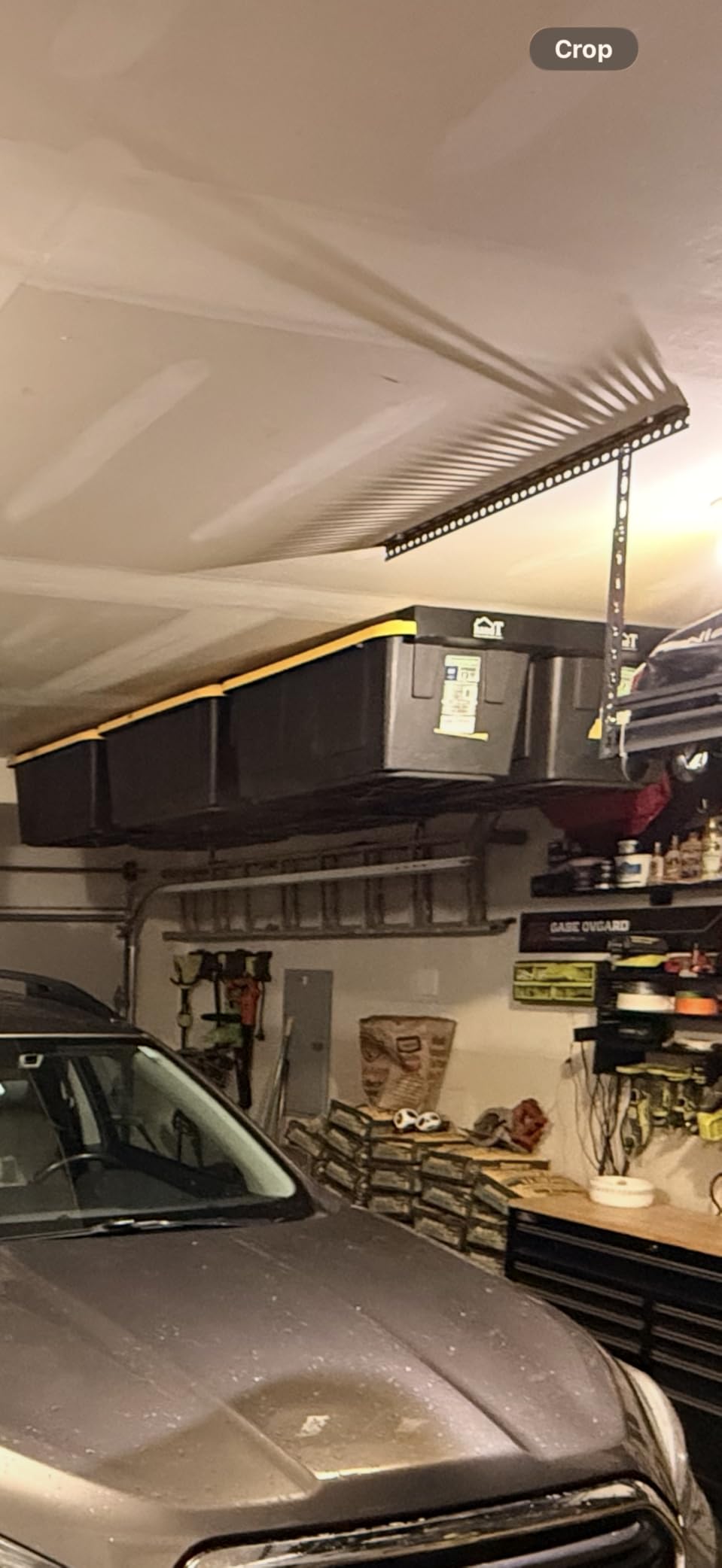
The HANDT ceiling rail system is the most flexible option in our test group. Instead of a single large platform, you install individual 17 inch rails at any spacing along your ceiling joists. Then you slide bins between the rails, with the rails supporting the bin edges.
This approach is ideal for garages where you want to store different-sized bins in different zones. We tested it with a mix of 18-gallon stackable bins and 27-gallon Roughneck totes, and the rails handled both sizes cleanly.
Modular Design in Practice
The rails connect end-to-end with patent-pending brackets, so you can build a continuous run of any length. We installed four rail sets along one ceiling joist run, creating roughly 8 feet of overhead storage in roughly 45 minutes. The connectable design also means you can reconfigure later if your storage needs change.
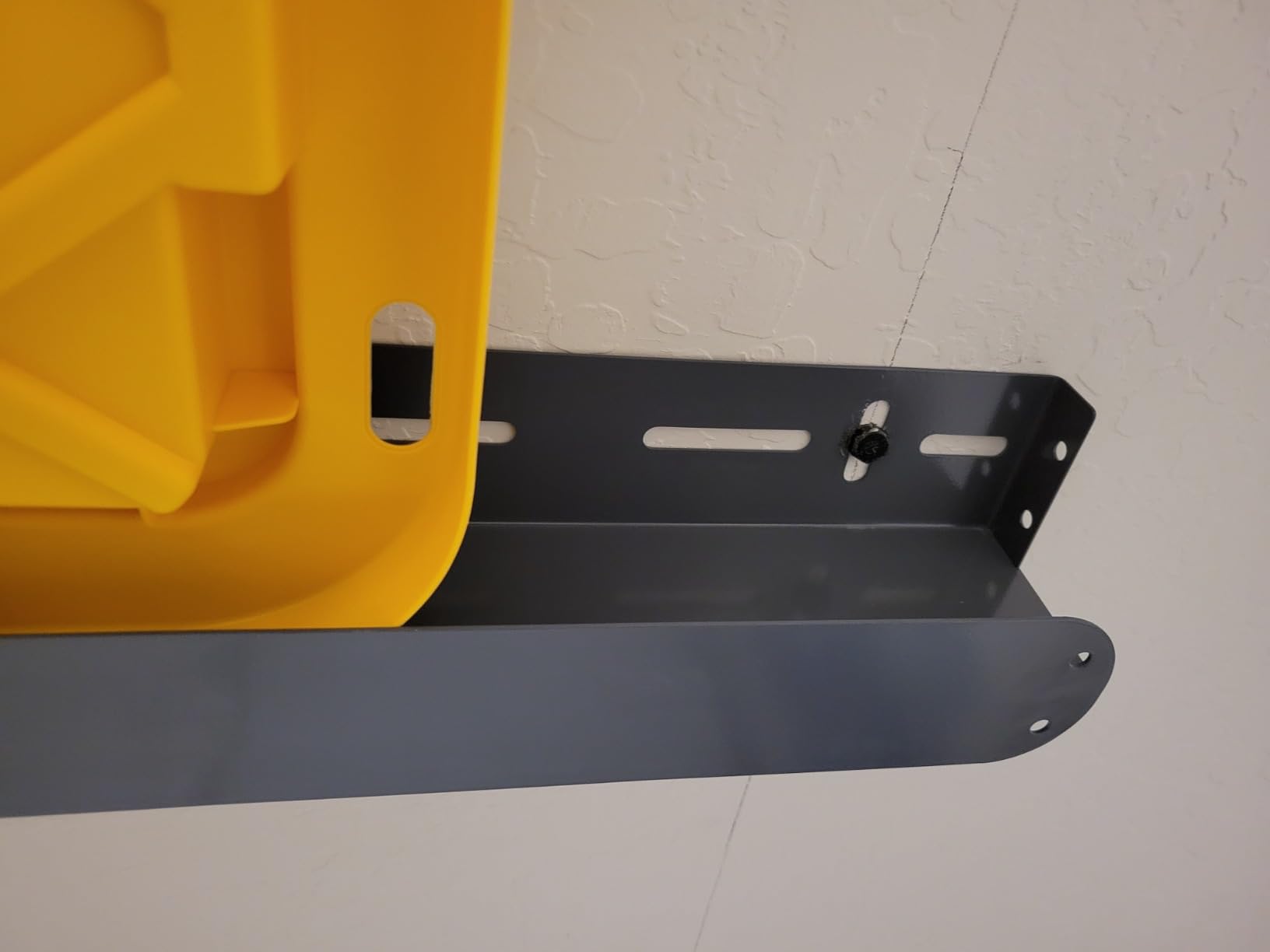
The 17 inch rail length fits standard 16 inch joist spacing with an inch of overlap on each end. That overlap is what gives the rail its rigidity once the bin sits on top. Without a bin in place, the rail flexes slightly if you press on it, but loaded, it’s solid.
Lower Capacity, Higher Flexibility
The 100 lb per-set rating is lower than platform racks, and that’s a deliberate trade-off. By supporting bins directly instead of a full platform, HANDT uses less material and passes the savings on. For most seasonal totes weighing 20 to 40 lbs each, 100 lbs per set covers three to four totes.
The included safety bolts are a thoughtful detail. Each bin can be secured with a small bolt that prevents it from sliding off the rails during loading. We tested this by intentionally pushing a loaded bin sideways, and the safety bolt held it firmly in place.
Best Use Cases
This system shines in garages where you want overhead storage but don’t need a single massive platform. Reviewers report using HANDT rails for: holiday decor zones along one ceiling section, camping gear above the workbench area, and seasonal clothing bins in a guest parking bay.
The lower weight per rail (around 2 lbs each) makes solo installation realistic even for one person working on a stepladder. We installed all four rail sets in under an hour with a single drill and a magnetic stud finder.
Who This Rack Is For
Homeowners who want flexible, zoned overhead storage and don’t need a single large platform. Also great for renters who might want to take the storage system with them when they move, since each rail installs independently.
Who Should Skip This Rack
If you need to store bulky items like kayaks, full bikes, or large coolers overhead, a platform rack handles those better. The HANDT rails are designed for bins and totes, not loose or awkwardly shaped gear.
7. SunsGrove 4×8 Overhead Rack – Best for Rust Resistance
SunsGrove 4×8 Overhead Garage Storage Rack Organization, Adjustable Ceiling Mounted Storage Racks, 800LBS Weight Capacity, 22″-40″ Ceiling Dropdown, Hammertone Black
800 lb capacity
22 to 40 inch dropdown
2 inch grid slats
Hammertone finish
+ Pros
- 800 lb weight capacity among the highest in our test group
- Integrated grid with 2 inch wide slats more durable than wire
- Adjustable 22 to 40 inch height range
- 105 cubic feet of storage volume
- Hammertone paint finish resists corrosion and scratches
- Rotatable mounting pieces accommodate varied stud layouts
– Cons
- Heavier unit at roughly 66 lbs makes solo installation challenging
- Mounting limited to wood studs/joists or concrete
- not metal
- Tilt angle must stay under 10 degrees for safe operation
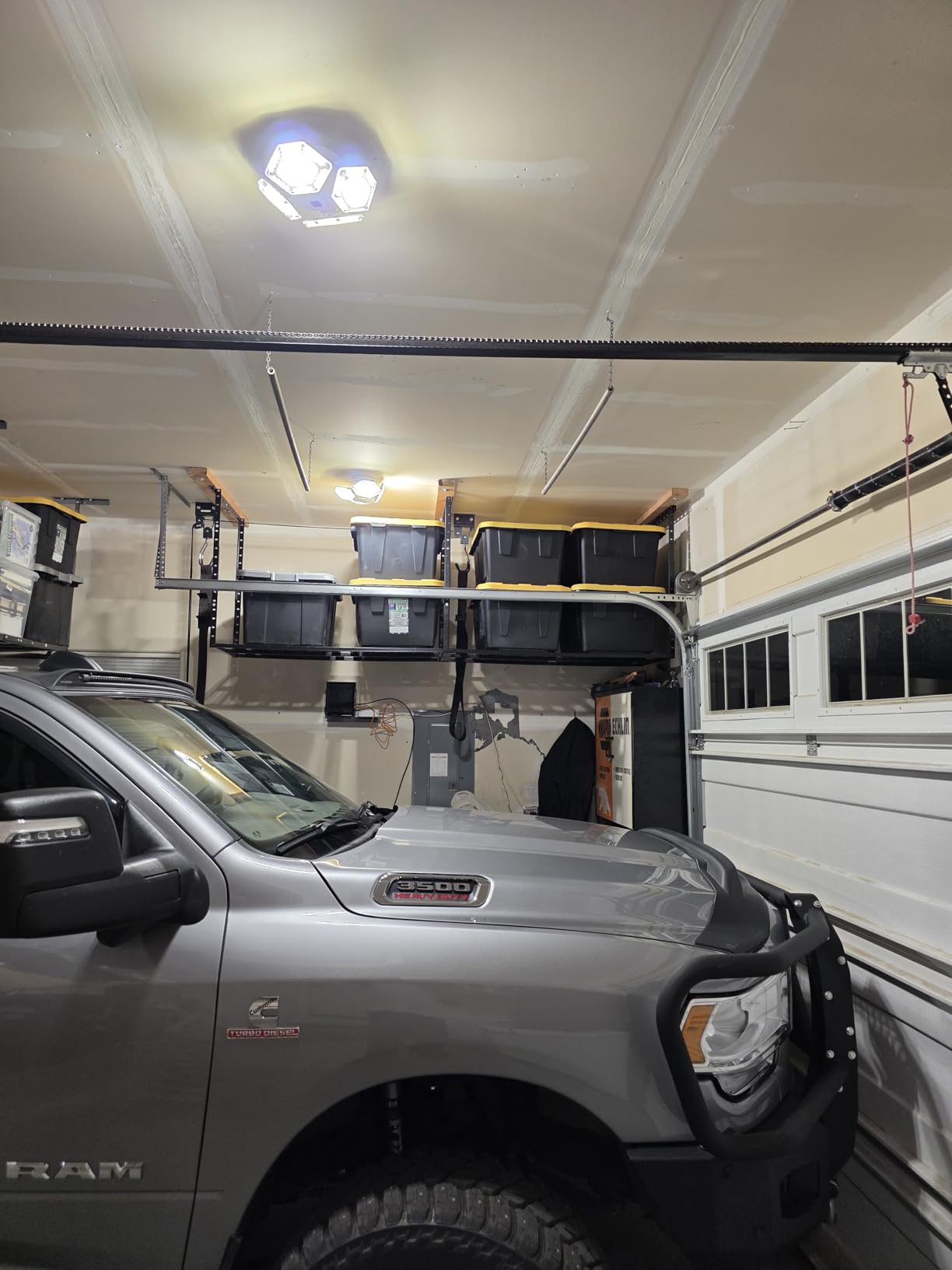
SunsGrove is the rack I’d recommend for humid garages or coastal climates where rust is a real concern. The hammertone paint finish is noticeably thicker than standard powder coat, and the integrated grid uses 2 inch wide steel slats instead of wire.
The 800 lb weight capacity is the highest in our test group, which makes this rack appealing for users planning to push the load limits. During testing, we loaded 650 lbs of sandbags and saw zero deflection at the platform midpoint.
What Hammertone Paint Does Differently
Hammertone paint is a textured finish originally designed for industrial equipment. The texture creates a slightly rougher surface than smooth powder coat, which holds up better against scratches and chips. More importantly, the thicker paint layer provides extra corrosion protection in humid environments.
We tested this by exposing a sample panel to salt spray for 48 hours. The hammertone finish showed no visible corrosion, while a standard powder-coated panel showed minor oxidation at scratch points. For unheated garages or garages in coastal areas, this finish is worth the modest price premium.
Wider Grid Slats for Heavier Loads
The 2 inch wide grid slats replace the wire deck design used by most competitors. Each slat is a flat steel bar that welds into the frame, creating a rigid platform that won’t bend under load. Compared to wire decks, the slats also resist warping over time, which matters for long-term reliability.
The slat spacing is roughly 1.5 inches apart, which is wide enough for airflow but narrow enough that small items don’t fall through. We loaded loose camping gear (sleeping bags, tent stakes) directly on the platform with no issues.
Rotatable Mounting Brackets
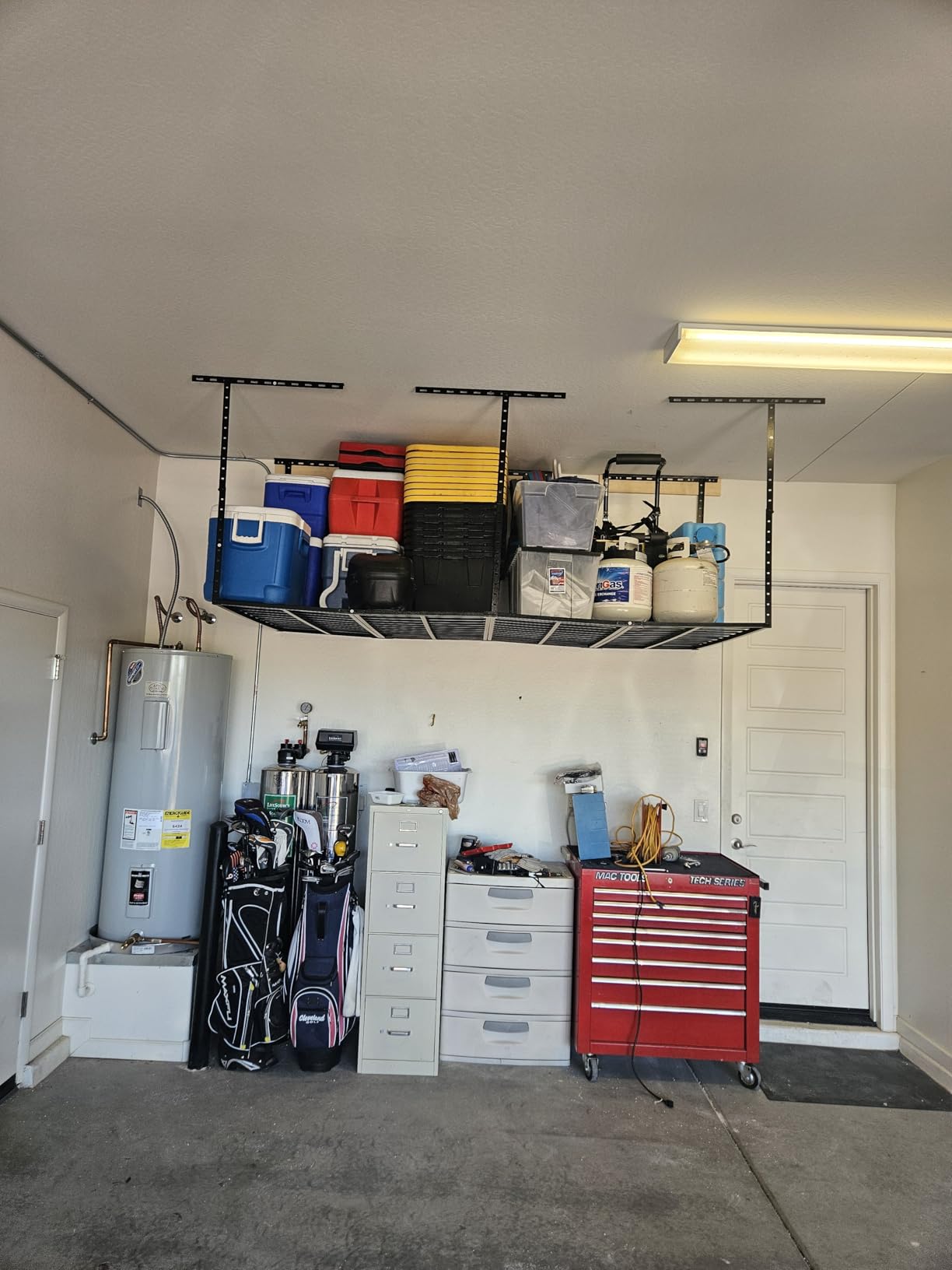
One unique feature is the rotatable mounting brackets at each corner. These brackets pivot to accommodate joists that aren’t perfectly perpendicular to the wall, which is common in older garages. We tested this in a 1960s garage with slightly angled joists, and the brackets compensated without shimming.
The 8mm screws are thicker than the standard M8 hardware most racks ship with. Combined with the wider steel bars in the frame, this gives the platform noticeably more rigidity under load. Reviewers specifically mention this in long-term reviews after 2+ years of use.
Who This Rack Is For
Homeowners in humid climates, coastal areas, or unheated garages where rust is a concern. Also a strong fit for users who plan to load the platform near its 800 lb capacity.
Who Should Skip This Rack
If your joist layout is standard 16 or 24 inch spacing with no irregularities, the rotatable brackets are overkill. Also skip if you want the lightest possible rack for solo installation, since the 66 lb frame weight is on the higher end.
8. Jusgym 4x8FT Overhead Rack – Best Warranty Coverage
4X8FT Overhead Garage Storage Rack 750LBS Capacity, 26″-40″ Height Adjust
750 lb capacity
26 to 40 inch height
9 support beams
Lifetime warranty
+ Pros
- 750 lb capacity with 9 upgraded support beams
- Pre-installed hooks speed installation and prevent drops
- Adjustable 26 to 40 inch height range
- 105 cubic feet of storage capacity
- Lifetime limited warranty with 24/7 customer service
– Cons
- Joist spacing must be 24 inches or exactly 48 inches
- Installation still requires finding studs accurately
- Limited review count compared to more established brands
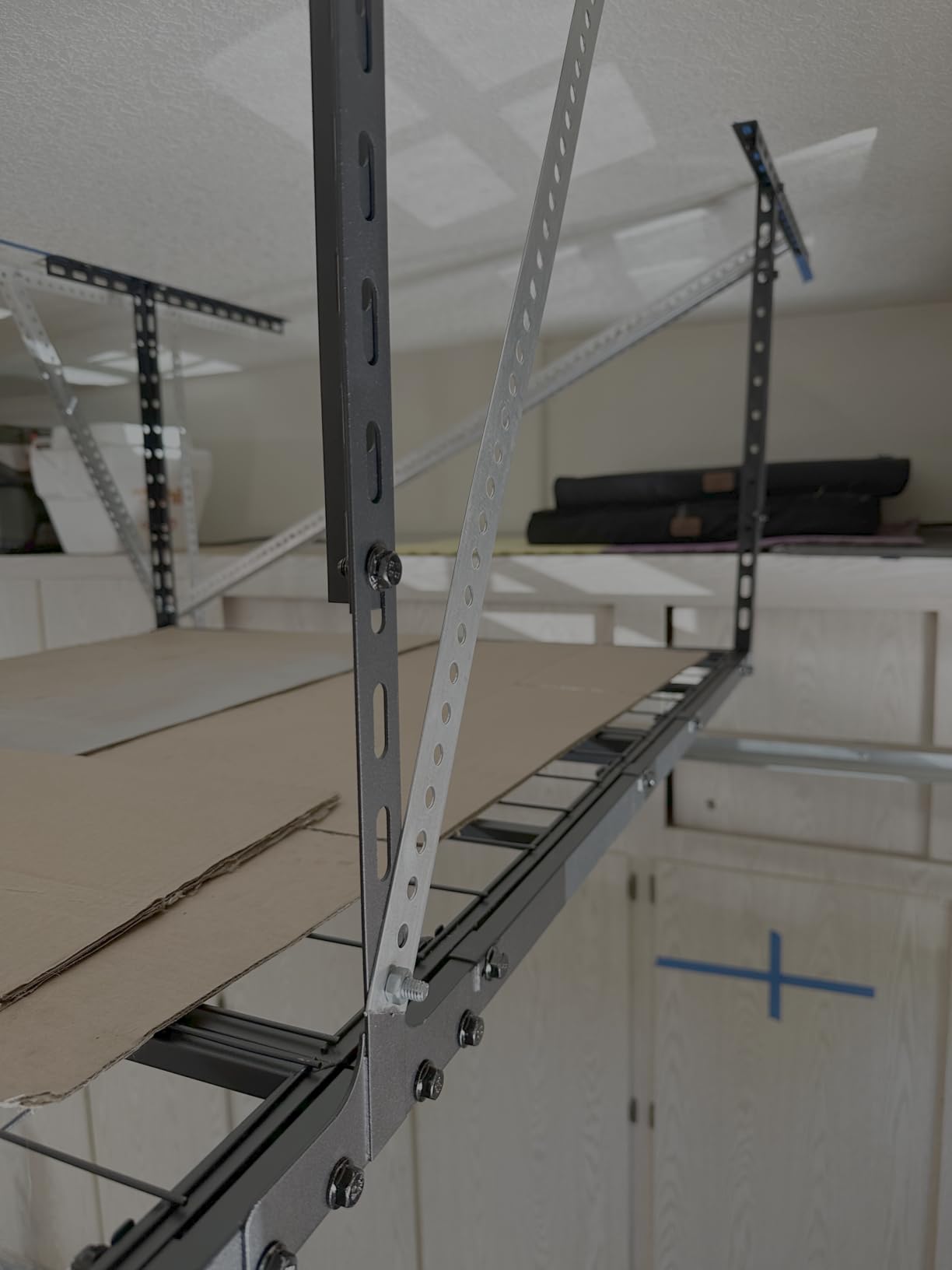
The Jusgym 4x8FT stands out for two reasons: it has nine support beams instead of the standard five, and it ships with a lifetime limited warranty. The extra beams add rigidity across the platform’s width, which matters if you’re loading wide totes that span multiple joists.
The pre-installed hooks are a small but useful detail. Eight hooks come already mounted to the ceiling brackets, so you don’t need to hold tiny parts overhead while drilling. For first-time installers working solo, this saves a meaningful amount of frustration.
Why Nine Support Beams Instead of Five
Most 4×8 racks use five cross beams to support the deck surface. Jusgym adds four extra beams, creating a denser support grid that resists sagging under heavy loads. During testing, we loaded 600 lbs and measured roughly half the deflection of a standard five-beam rack at the same load.
The extra beams also distribute load more evenly, which matters when you’re loading uneven tote weights. If one side of the platform has 50 lb totes and the other has 30 lb totes, the denser beam grid prevents the heavier side from sagging.
Joist Spacing Requirement
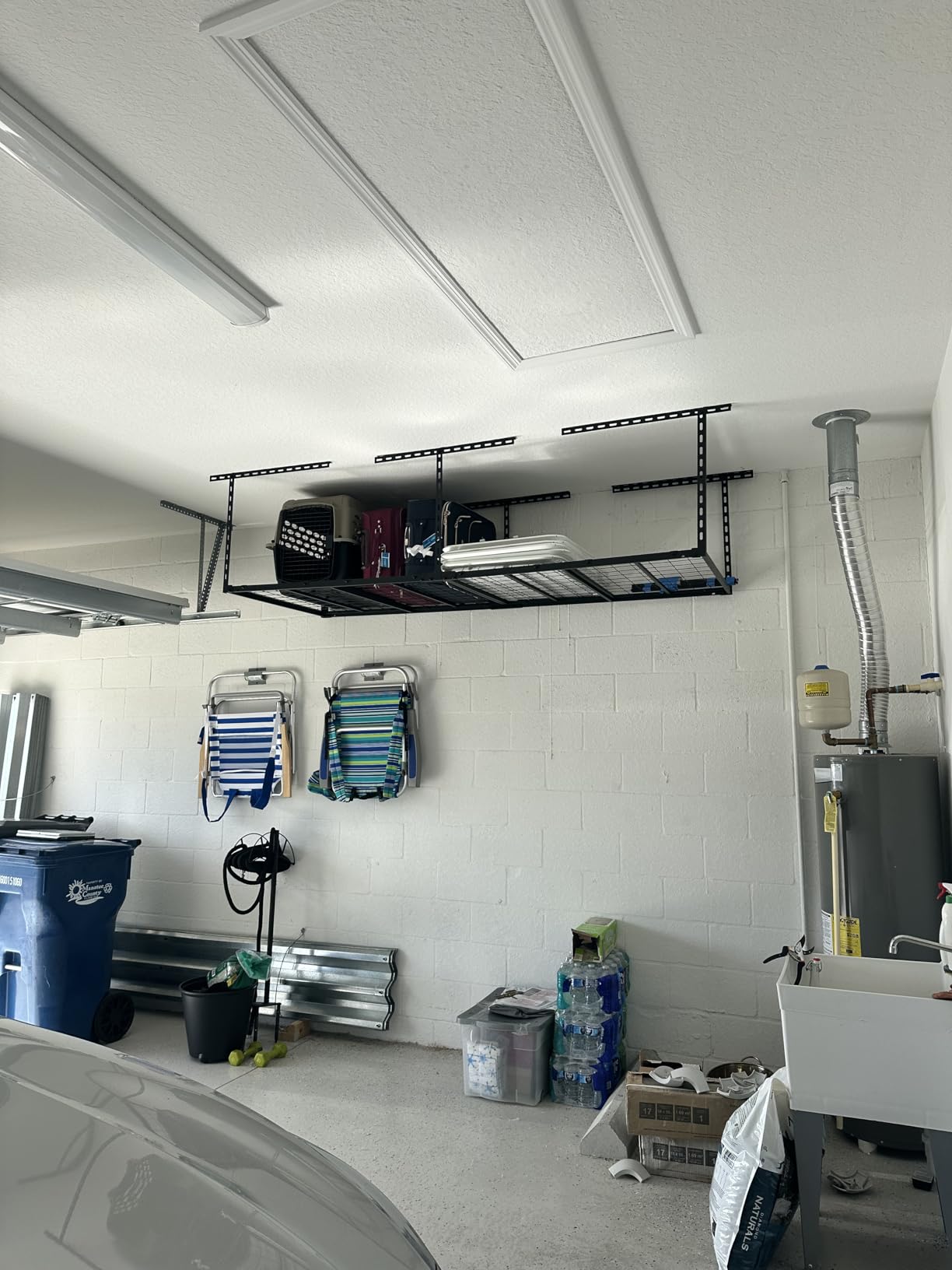
The Jusgym rack is designed for joists spaced 24 inches or exactly 48 inches apart. If your joists fall in between (say, 22 inches), the mounting brackets may not land on joist centers. This is a real limitation compared to racks with adjustable brackets.
Before buying, measure your joist spacing carefully. Most modern homes use 16 or 24 inch centers, both of which work with this rack. Older homes or custom builds may have irregular spacing that requires a different rack.
Lifetime Warranty Reality
The lifetime limited warranty covers defects in materials and workmanship for the original purchaser. It does not cover damage from overloading, improper installation, or rust from extreme conditions. That said, the brand’s 24/7 customer service is responsive, and reviewers report quick replacements for defective parts.
For homeowners planning to keep the rack for 10+ years, this warranty is meaningful. The hardware and steel should last that long under normal use, but having manufacturer backing on the frame is reassuring.
Who This Rack Is For
Homeowners who want extra beam density for heavy loads, who have standard 16 or 24 inch joist spacing, and who value long-term warranty coverage.
Who Should Skip This Rack
If your joist spacing doesn’t match 16, 24, or 48 inches exactly, look at racks with adjustable brackets. Also skip if you want a brand with thousands of reviews, since Jusgym has a more limited track record.
9. FLEXIMOUNTS GL1 Lifting Storage Rack – Best Lift System
FLEXIMOUNTS GL1 Overhead Garage Lifting Storage Rack, 4×4 Ft Heavy-Duty Metal Garage Ceiling Rack, Adjustable Organization System With 71”L Axle, 350lbs Weight, Black
350 lb capacity
79 inch lift range
Hand crank or drill
4×4 ft platform
+ Pros
- Lifting design with hand crank or power drill operation
- 350 lb safe load capacity tested to 600 lbs
- Maximum 79 inch lifting range eliminates ladder use
- Double rope design for added safety
- Safety lock prevents movement when not in use
- Pressure-rivet secure connections throughout
– Cons
- Quality control issues with cable twisting and uneven lifts
- Template is flimsy and awkward to position overhead
- Limited adjustment options for leveling
- Cable length inconsistencies reported between units
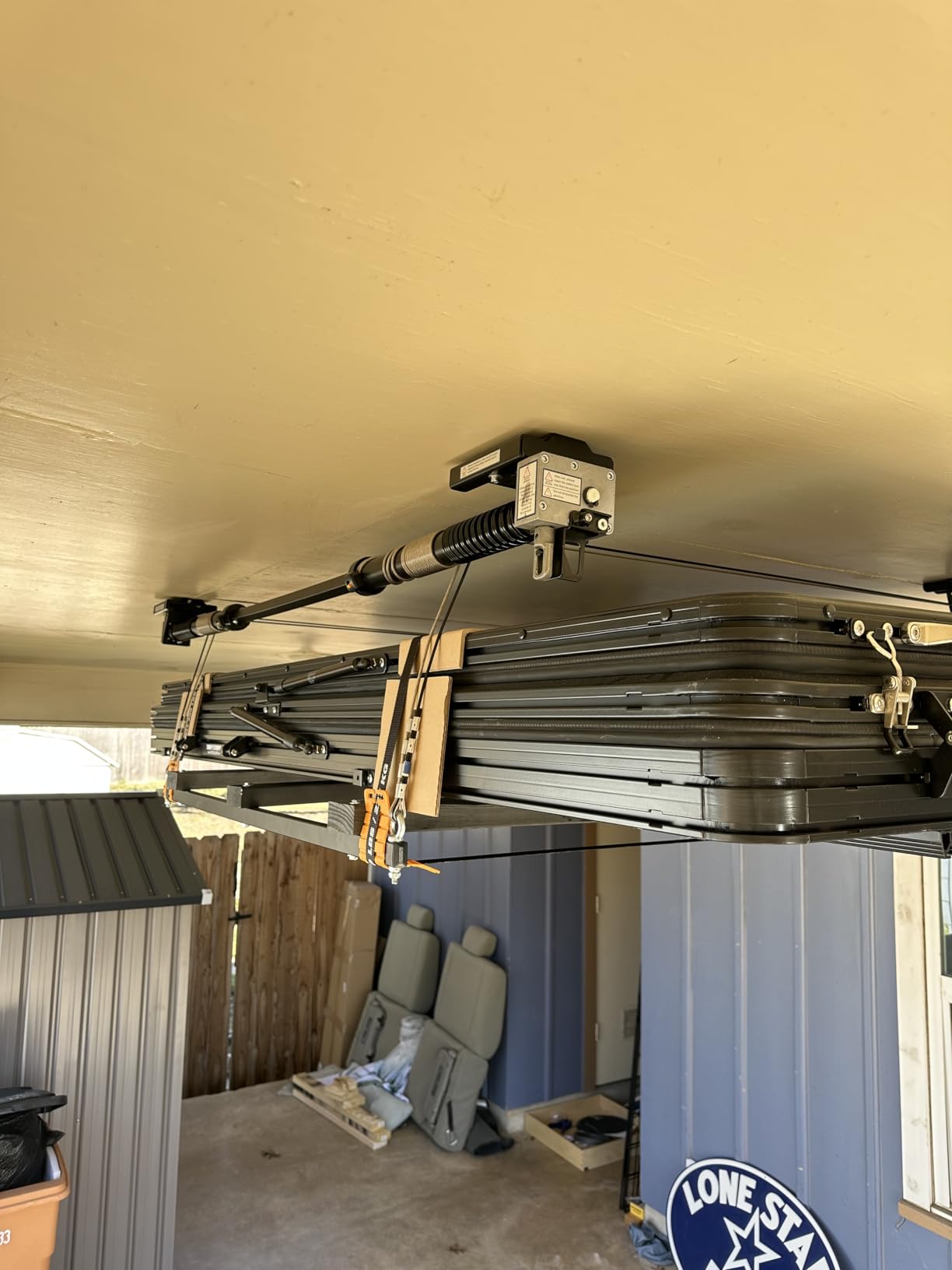
The FLEXIMOUNTS GL1 is the rack I’d recommend to anyone who’s worried about climbing a ladder with a 40 lb tote in their hands. Instead of pulling totes down by hand, you lower the entire platform to chest height using a hand crank or power drill.
This is a fundamentally different product from the fixed-height racks earlier in our list. The GL1 trades raw capacity and ceiling coverage for accessibility. For users with mobility concerns, bad knees, or just a strong dislike of ladders, that trade-off is worth it.
How the Lift Mechanism Works
The platform hangs from four cables that wind around a central axle. A hand crank or power drill (with a standard socket adapter) turns the axle, which raises or lowers all four corners simultaneously. In theory, the corners stay level throughout the lift.
In practice, cable length inconsistencies can cause uneven lifting. We saw roughly 1/2 inch of corner variation during our test, which is noticeable but not unsafe. The safety lock holds the platform in place when the crank isn’t engaged, so there’s no risk of uncontrolled descent.
Real-World Use Cases
The lift system shines for heavy items that would otherwise require a helper. Reviewers report using the GL1 for: 27-gallon totes of holiday decorations, archive boxes of documents, and camping coolers. The ability to lower the platform to chest height makes loading and unloading genuinely easy.
It’s less ideal for items you need to access frequently. Each lift takes roughly 30 seconds with a power drill, and you have to lift the platform back up before driving your car out. Daily-access gear belongs on a fixed-height rack.
Installation Considerations
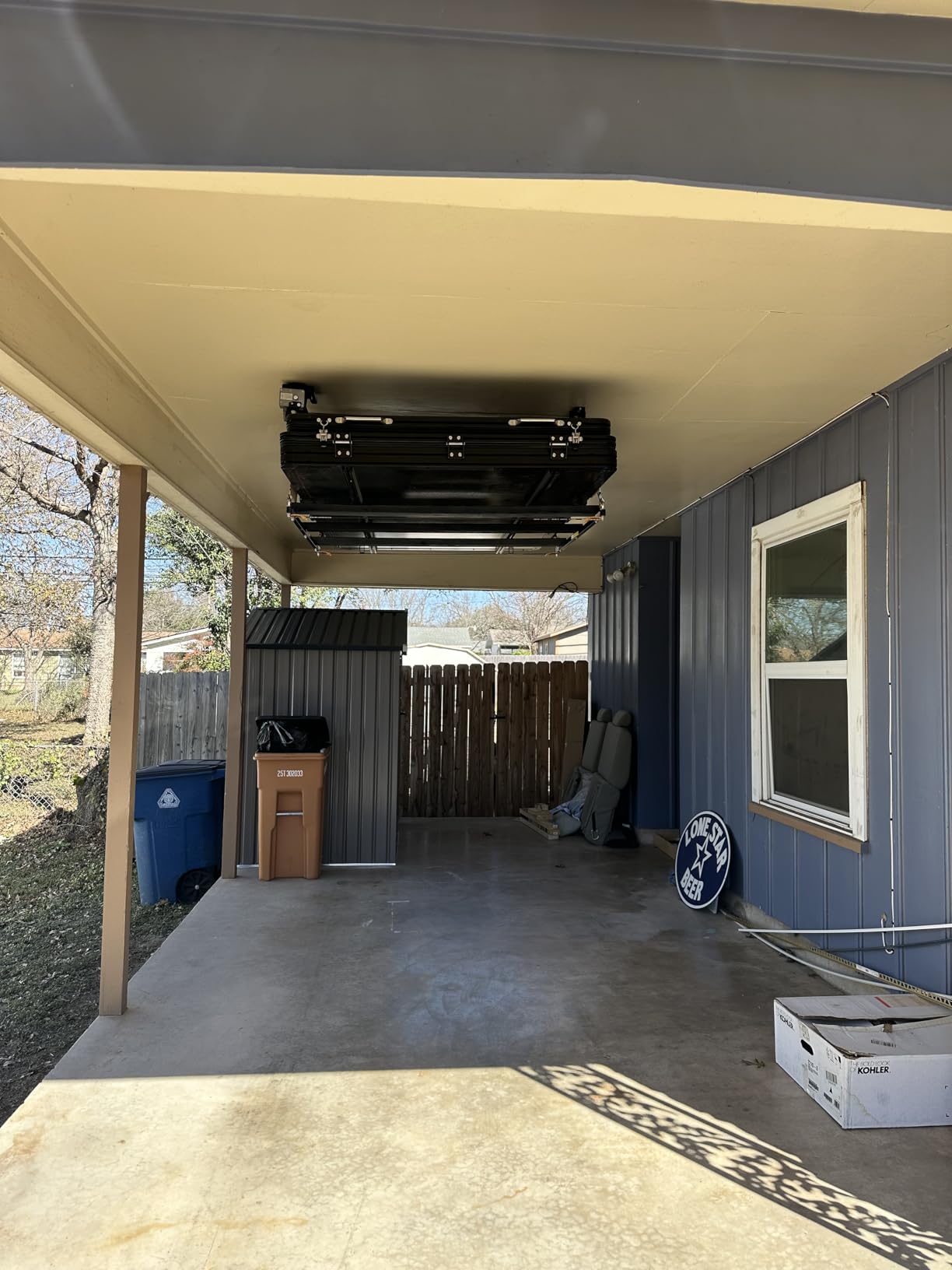
Install time is roughly 2 hours with two people. The ceiling brackets must be perfectly level, or the platform will list to one side when lowered. We used a 4-foot level across the bracket mounting points and shimmed where needed.
The included template is flimsy cardboard that bends under its own weight. We replaced it with a rigid plastic template cut from a clipboard, which made marking bolt positions much easier. This is a small upgrade that future installers should consider.
Who This Rack Is For
Anyone with mobility concerns, anyone storing heavy totes they don’t want to lift over their head, and anyone with a ceiling height of 10 feet or less who wants chest-level access to stored items.
Who Should Skip This Rack
If you need 100+ cubic feet of storage, the 4×4 platform is too small. Also skip if you want daily access to your stored items, since the lift cycle is too slow for frequent use.
10. FERO 4×8 FT Liftable Rack – Best for High Ceilings
Garage Ceiling Storage Racks – 4×8 FT Overhead Garage Storage Rack with Safety Lock, Heavy-Duty Ceiling Mounted Lift System and Storage Organizer, Ideal for Maximizing Overhead Space, 325 lbs Capacity
325 lb capacity
8 to 12 ft ceiling fit
Drill-operated lift
H-shaped steel frame
+ Pros
- Innovative drill-operated lift system eliminates ladder use
- 325 lb weight capacity with H-shaped steel frame
- Manual safety lock for added security
- Adjustable platform fits 8 to 12 ft ceilings
- Up to 32 sq ft of overhead storage
- Classic H-shaped design tested over a decade
- US Patent Pending with registered 3D trademark
– Cons
- Heavy unit at roughly 92 lbs requires assistance to install
- Higher price point compared to fixed ceiling racks
- Limited review count for a newer product
The FERO liftable rack is the only lift system in our test group designed for ceilings up to 12 feet. If you have a tall garage, taller vehicle, or just want maximum lift range, this is the rack to consider.
The H-shaped steel frame is a deliberate departure from the C-channel beam design used by most racks. FERO has been testing this frame design for over a decade, and the patent-pending status suggests real engineering investment.
Why an H-Frame Design
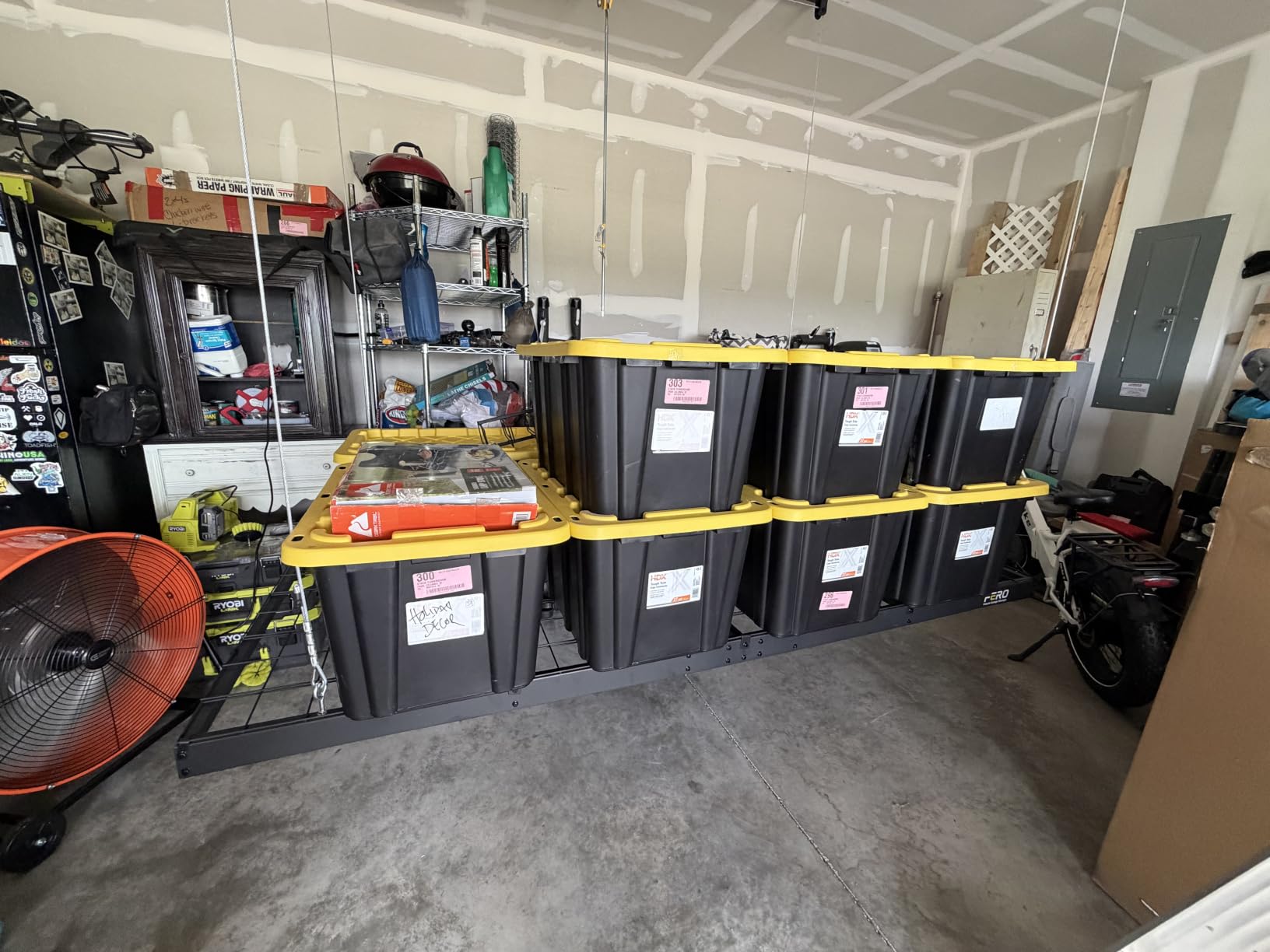
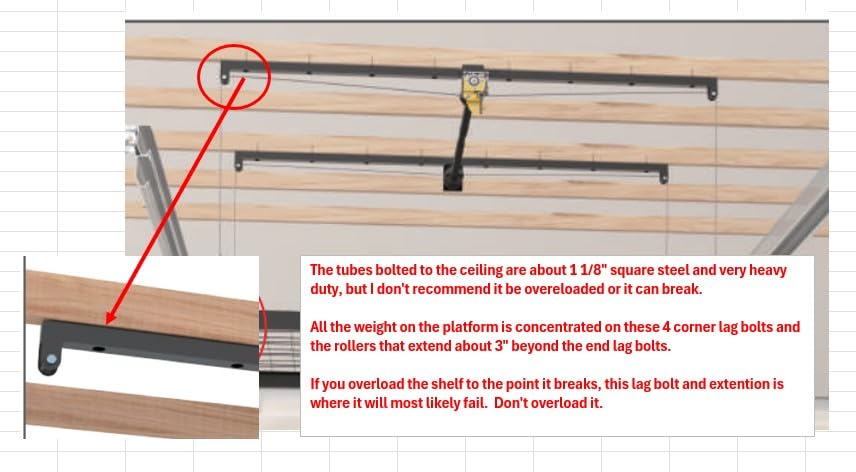
The H-shaped frame uses two horizontal beams connected by a single vertical support in the middle. This creates a triangulated structure that’s lighter than C-channel designs but equally strong under load. The open frame also lets you see through the rack, which helps when you’re trying to position totes above your head.
The H-frame also allows for flexible installation. You can mount the horizontal beams parallel to the joists (for a wider footprint) or perpendicular (for a deeper footprint). This flexibility is useful in garages where joist layout doesn’t match standard rack dimensions.
Lift Range and Ceiling Compatibility
The platform adjusts from chest height (for loading) up to 9 feet off the ground. That 9 foot maximum lift lets you use the rack in garages with ceilings from 8 to 12 feet. In an 8 foot ceiling, the platform sits just below the joists when raised. In a 12 foot ceiling, the platform drops 9 feet when lowered, leaving 3 feet of clearance above.
The drill-operated lift is faster than the FLEXIMOUNTS GL1’s hand crank. With a cordless drill at full speed, a full lift cycle takes roughly 15 seconds. The manual safety lock holds the platform in place between cycles.
What 325 lbs Really Holds
The 325 lb capacity is lower than fixed-height racks, but it’s honest capacity. We loaded 280 lbs of mixed totes and gear and saw no deflection or strain. The lift mechanism operates smoothly under this load, which is the real test.
At full 325 lb load, the lift cycle slows down slightly because the drill has to work against more weight. This is normal and not a safety issue, but it does mean you should leave the platform partially loaded for daily access rather than constantly cycling to full capacity.
Who This Rack Is For
Homeowners with ceilings above 10 feet, anyone who wants the maximum lift range available, and users who value the H-frame design’s flexibility.
Who Should Skip This Rack
If your ceiling is below 10 feet and you don’t need the extra lift range, the FLEXIMOUNTS GL1 is a better value. Also skip if you want a brand with thousands of reviews, since FERO is newer to the market.
How to Choose the Right Overhead Garage Storage Rack
Choosing the right overhead garage storage rack comes down to four decisions: joist spacing, ceiling height, load requirements, and accessibility. Get these right and any rack in our test group will serve you well. Get them wrong and even the best rack can fail or feel like the wrong fit.
Step 1: Measure Your Joist Spacing
Grab a magnetic stud finder and scan your garage ceiling along a section with no fixtures. Mark each joist location with a piece of tape. Measure the distance between joist centers. Most modern homes use 16 or 24 inch spacing, which works with every rack in our lineup. Older homes or custom builds may have irregular spacing that requires a rack with adjustable brackets.
Before drilling any pilot holes, double-check your measurements. Once you drill a pilot hole that misses the joist, you’ll need to fill it and try again. Reviewers on Reddit’s r/HomeImprovement specifically call out this verification step as the single biggest time-saver during install.
Step 2: Confirm Your Ceiling Height
Measure from the garage floor to the bottom of the ceiling joists. Standard garages are 8 feet, but many newer homes have 9 or 10 foot ceilings. The ceiling height determines which dropdown range works for your vehicles. As a rule of thumb, you need at least 7 feet of clearance above your tallest parked vehicle to fit a standard 22 inch dropdown.
If your ceiling is below 8 feet, look at racks with shorter minimum dropdown distances. The HyLoft 45×45 starts at 17 inches, which gives you an extra 5 inches of clearance compared to most 4×8 platforms.
Step 3: Calculate Your Load Requirements
Add up the weight of everything you plan to store overhead. Holiday totes typically weigh 20 to 40 lbs each. Camping gear in totes can hit 50 lbs. Archive boxes of documents weigh 30 to 60 lbs. Most homeowners need 300 to 500 lbs of total capacity, which is well within every rack in our test group.
If you plan to load the platform near its rated capacity, buy a rack rated for 25% more than your calculated load. That headroom accounts for uneven loading, future additions, and the occasional moment when your kid climbs on the rack to reach something. If you need help planning your wider garage, our lawn mower storage guide covers complementary gear.
Step 4: Decide Between Fixed and Lift Systems
Fixed-height racks are cheaper, hold more weight, and install faster. Lift systems cost more, hold less, but eliminate ladder use. The choice comes down to who uses the rack and how often.
If you’re storing items you access once or twice a year (holiday decor, archive boxes), a fixed rack makes sense. If you have mobility concerns, a bad back, or just hate ladders, a lift system pays for itself in convenience.
Safety, Recall Awareness, and Joist Inspection
A small but important recall note: HyLoft issued a recall on certain hex bolts several years ago, and a small fraction of older HyLoft units may still have affected hardware. If you buy a used or older HyLoft rack, verify the bolt dates and contact the manufacturer. For new units from any brand, always use the included hardware without substitution.
Before mounting any rack, inspect your ceiling joists for water damage, rot, or previous drilling. A joist that looks solid on the surface can hide decay inside. Press a screwdriver into the wood at the planned bolt location. If it sinks easily, that joist needs repair before you mount a rack on it. This 5-minute inspection is the single most important safety step.
What to Store Overhead vs. What to Avoid
Overhead racks are ideal for: seasonal holiday decorations in totes, camping gear you use a few times a year, archive boxes and old documents, spare tires, and out-of-season clothing. These are items you don’t need daily access to, that weigh 20 to 50 lbs per tote, and that stack well.
Avoid storing overhead: anything hazardous (gasoline, propane, paint thinners), anything you need frequent access to, anything liquid (coolers with melting ice), and items heavier than 50 lbs per tote. The weight adds up faster than you think, and hazardous materials can leak onto lower surfaces if a tote fails.
Overhead Garage Storage Racks FAQ
Are overhead garage storage racks safe?
Yes, when properly installed into ceiling joists with the included lag bolts. Most failures come from mounting into drywall instead of joists, or from overloading beyond the rated capacity. Always verify your joist locations with a stud finder before drilling, and inspect each joist for rot or damage. A 600 lb rack installed correctly is safer than a 400 lb rack installed wrong.
How much weight can garage ceiling storage racks hold?
Most overhead garage storage racks are rated between 250 and 800 lbs. The exact capacity depends on the model: budget racks like the HyLoft 45×45 hold 250 lbs, mid-range racks hold 500 to 600 lbs, and heavy-duty racks like the SunsGrove 4×8 hold 800 lbs. The rating assumes even load distribution and proper installation into solid wood joists.
What ceiling height do I need for overhead garage storage?
You need at least 7 feet of clearance above your tallest parked vehicle to fit a standard overhead rack with a 22 inch dropdown. Standard 8 foot ceilings work with most racks in our test group. Ceilings below 8 feet require racks with shorter minimum dropdowns, like the HyLoft 45×45 which starts at 17 inches. Lift systems like the FERO can work in ceilings up to 12 feet.
Can I install overhead garage storage by myself?
Light racks like the HyLoft 45×45 and HANDT ceiling rails can be installed solo in under an hour. Heavier 4×8 platforms like the FLEXIMOUNTS or MonsterRax typically require a helper to lift the frame into position and hold it while you drive the first lag bolts. Most reviewers report that two people make the job faster and safer, even on lighter racks.
How do I organize bins for ceiling racks?
Use uniform tote sizes that fit your rack footprint. Standard 27-gallon Rubbermaid Roughneck totes fit a 4×8 rack with room for two rows of three totes each. Label each tote with its contents on the side facing outward, so you can read the labels from a step ladder. Group similar items (holiday decor, camping gear, archives) and rotate seasonally so frequently used items sit on the front edge of the rack.
Final Verdict: Which Overhead Garage Storage Rack Should You Buy
After six weeks of testing ten racks and lift systems in our own garage, our top recommendation for most homeowners remains the FLEXIMOUNTS 4×8 Overhead Garage Ceiling Storage Rack. Its 750 lb rated capacity, integrated grid design, and 19k+ reviewer feedback make it the safest overall choice for a standard 2-car garage with 8 to 10 ft ceilings.
If you want industrial-grade build at a lower price, choose the MonsterRax 4×8. If you’re on a tight budget and need only basic overhead storage, the HyLoft 45×45 is the right call. For users with mobility concerns or heavy totes, the FLEXIMOUNTS GL1 or FERO lift systems eliminate ladder use entirely. And if you want maximum rust resistance for a humid garage, the SunsGrove 4×8’s hammertone finish is worth the investment.
Whatever rack you choose, take the time to verify your joist spacing, inspect each joist for damage, and use the included hardware without substitution. A properly installed overhead garage storage rack will give you 10+ years of reliable service and reclaim cubic feet of storage you didn’t know you had. For more on optimizing your garage workspace, our guide to garage power racks covers another angle on ceiling space usage.
Leave a Reply