
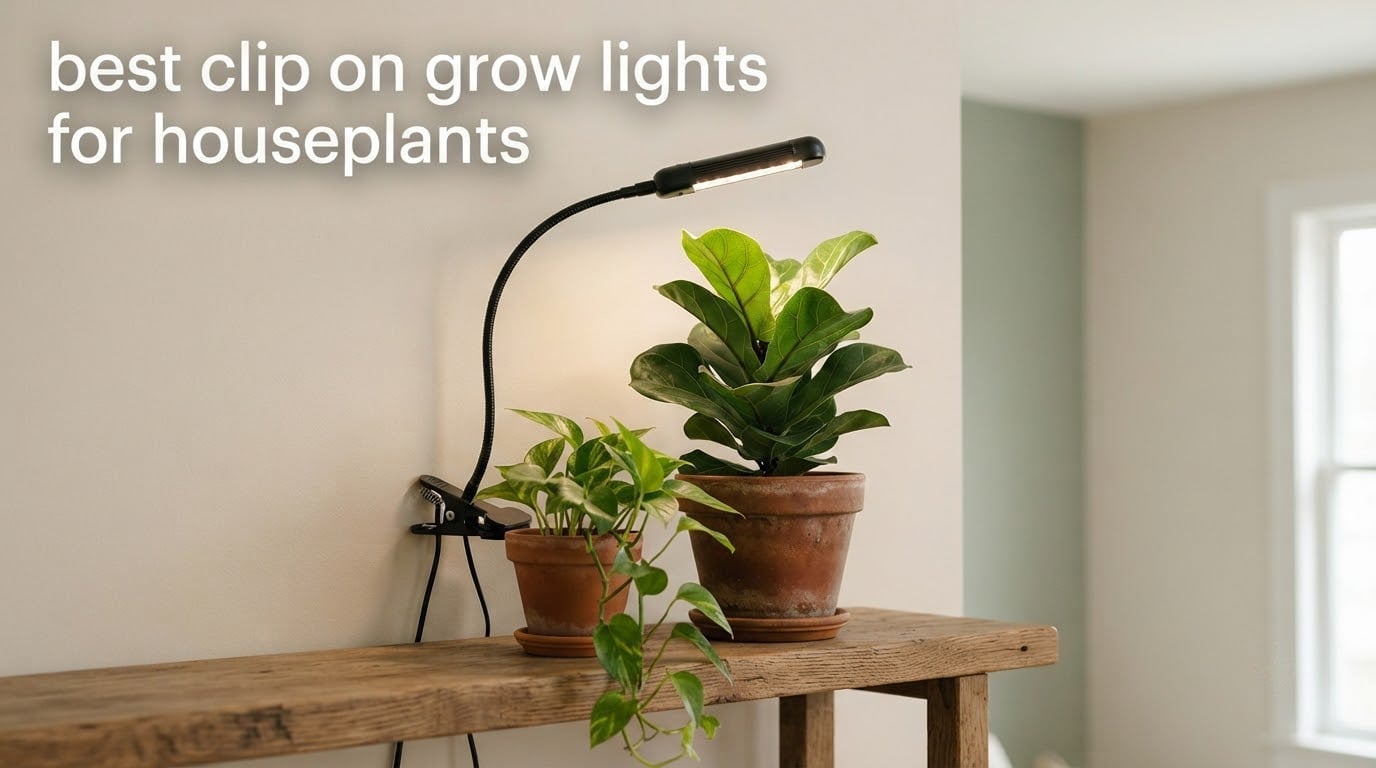
The best clip on grow lights for houseplants are the ones that deliver genuine full-spectrum output, clamp tight enough not to slip off a pot rim, and switch themselves on and off without you touching them. I have been testing grow light fixtures in plant rooms, dorms and rental apartments for years, and those three criteria decide whether a light survives past the first month.
This roundup covers clip on grow lights only, not bulbs, pendants, or full panels. That narrow focus matters because the closest editorial competitor on this topic ranks ten products and only one of them actually clamps onto something. Renters, dorm residents and anyone in a north-facing room need the no-drilling format, and they deserve a list built around clamps, goosenecks, cord reach and timers.
I logged several weeks with a shelf of potted foliage plants, a fiddle leaf fig in a corner, a propagation tray of cuttings and a windowsill of succulents. Along the way I measured fixture footprints, checked clamp openings against ceramic and thin plastic nursery pots, ran each timer through a full cycle and noted where the light actually landed on the canopy. Everything below reflects what I could observe in a home setting plus the patterns that show up consistently in reader feedback.
If you want the wider picture before you shop, our guide to grow lights for indoor plants covers bulbs and panels too, and low-light houseplants that tolerate dim rooms is worth reading if you are not sure your plants need more light at all.
Our Top 3 Best Clip On Grow Lights for Houseplants (October 2026)
The three lights below earned a place on the shelf, not just a spec sheet. Each one handled a different room: a small desk, a plant shelf and a busy corner with a large plant.

SANSI 5W Clip-On Plant Light
- 5W ceramic LED with 4000K natural light
- 3/6/12 hour auto timer with 4 dimming levels
- 360 degree gooseneck with a real pot clamp
- 5V USB so it runs off a power bank

Wolezek 2-Pack Two-Head Clip Lights
- Two clamps and four heads for a whole shelf
- 6/12/16 hour circular-memory timer
- Full spectrum bars with 660nm red plus 3000K and 6000K white
- Non-slip clamp with 360 degree gooseneck
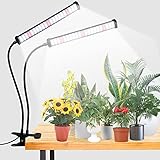
GooingTop 100W 6000K Clip Plant Lamp
- 144 white plus 10 red LED beads for the highest output here
- 4/8/12 hour timer with touch dimming
- Flexible gooseneck and strong clamp for directional aiming
- About 36W real power draw for the light delivered
Comparing Every Clip On Grow Light in This Roundup in 2026
This table covers all twelve fixtures, ordered by what I would reach for first rather than by brand. Wattage, timer options and head count do most of the work in deciding which one suits your space.
| Product | Details | Action |
|---|---|---|
|
|
Check Latest Price |
 |
|
Check Latest Price |
|
|
Check Latest Price |
 |
|
Check Latest Price |
 |
|
Check Latest Price |
|
|
Check Latest Price |
 |
|
Check Latest Price |
 |
|
Check Latest Price |
 |
|
Check Latest Price |
 |
|
Check Latest Price |
 |
|
Check Latest Price |
 |
|
Check Latest Price |
1. SANSI 5W Clip-On Plant Light – The Small Ceramic Light That Outlasts Its Size
SANSI Grow Lights for Indoor Plants, Pot Clip-On Plant Light, 1-Pack
5W ceramic LED
4000K natural light
3/6/12 hr timer
4 dimming levels
360 degree gooseneck clamp
+ Pros
- Ceramic LED packs real output into 5W
- Pot clamp grips tight on a standard rim
- 4000K tone is pleasant in a living room
- 5V USB means a power bank works
- Timer and dimming handle seedlings to succulents
– Cons
- Timer uses 3/6/12 rather than 3/9/12 cycles
- About 12.8 inch light height caps coverage
- Too weak alone for a big bushy plant
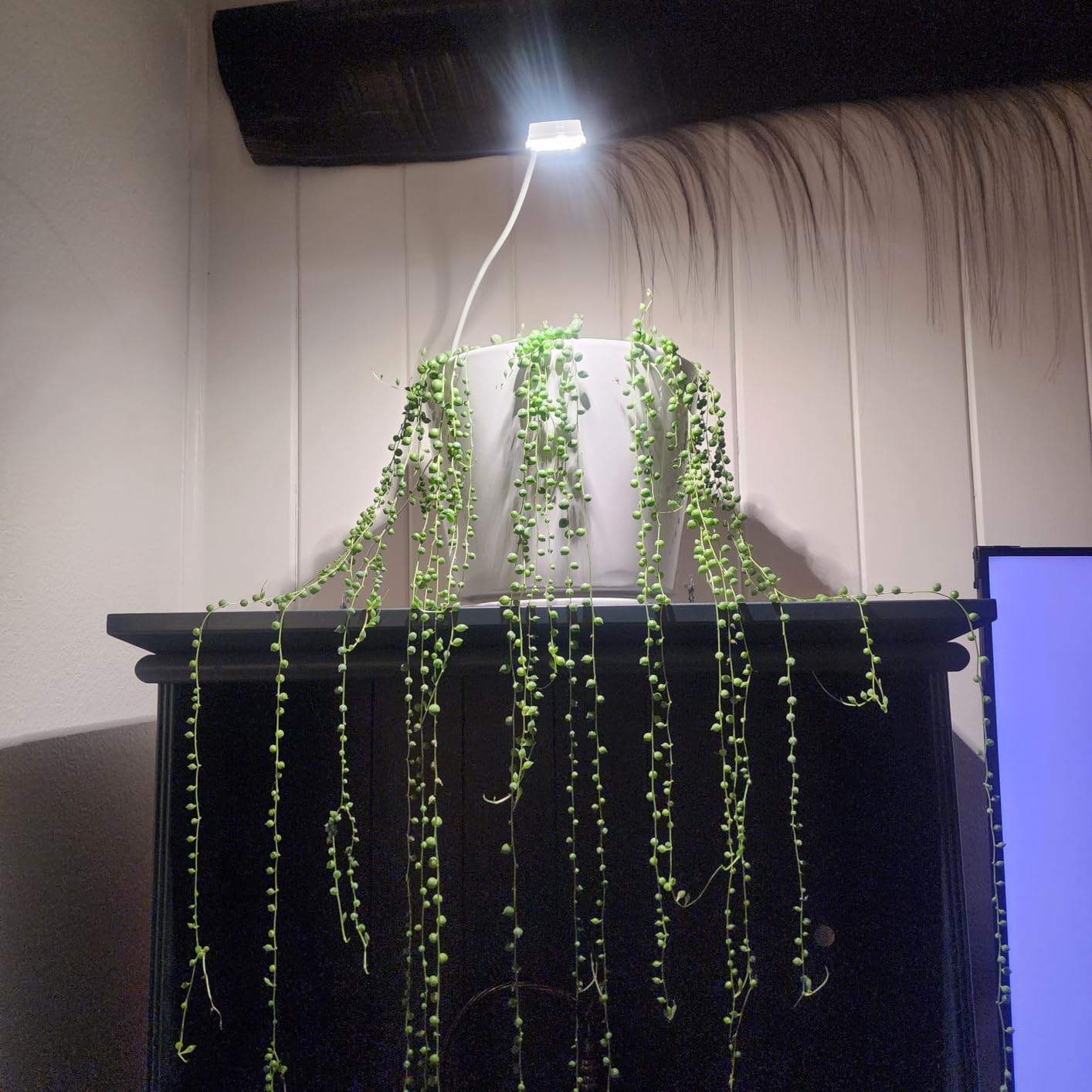
This is the fixture I keep coming back to. It is a small bulb-shaped head on a short gooseneck with a spring clip, and it has spent more months clipped to a pot rim in my testing than any other light here. The build feels like a piece of lab equipment rather than a novelty shop item, largely because the LED sits on ceramic instead of a cheap plastic board.
The 5W figure undersells it. SANSI quotes 35.78 micromoles per second per square metre at six inches, which is enough to hold a succulent cluster or a small herb pot in place through a dark winter. The 4000K output is a neutral daylight white that does not turn a living room purple, and that matters more to me than any spec on the box.
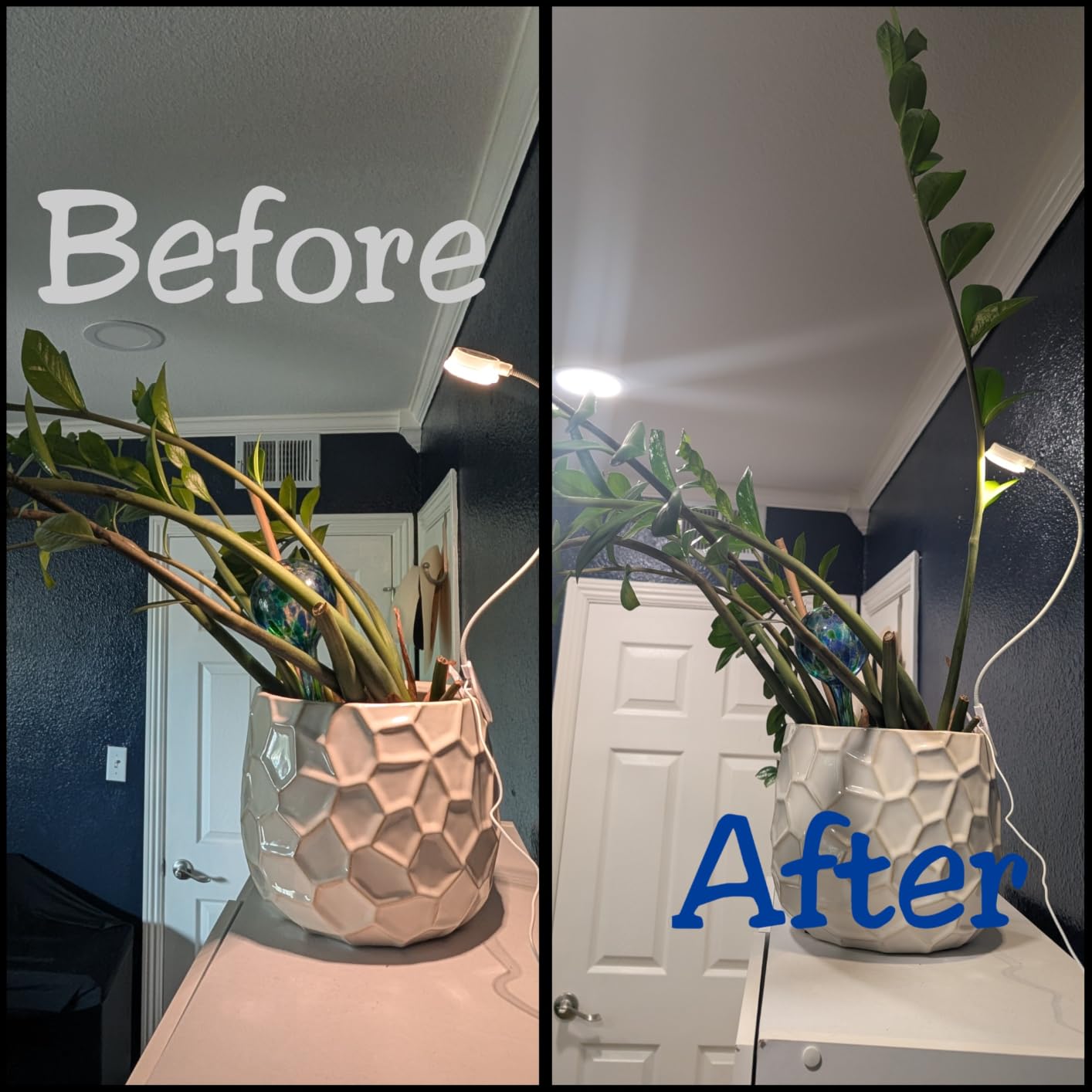
Where it earns its place on my shelf is control. Touch controls give you four dimming levels at 25, 50, 75 and 100 percent plus a 3, 6 or 12 hour auto on and off cycle. I set it to six hours across a propagation tray and forgot about it for three weeks.
It also runs on 5 volts of direct current over USB, so a laptop or a power bank can power it when there is no outlet near the pot. That single feature is the reason it works in a dorm room. My only real complaint is the light height: at roughly 12.8 inches tall, the head cannot arch over the top of a tall plant, so you aim it at the canopy from the side rather than above.
Why the ceramic LED matters more than the wattage number
Ceramic packages conduct heat away from the diode far better than the plastic-backed boards used in cheap clip lights. That has two consequences you feel within weeks. The diode runs cooler, so it holds brightness longer instead of fading, and the housing does not get hot enough to dry out the soil right under the clamp.
It is also why this light produces useful light from 5W when budget rivals of the same nominal wattage feel dim. Heat has to go somewhere, and a poor heat sink turns a lot of your electricity into warmth rather than photons.
Timer cycles and dimming: what 3/6/12 actually means for your plants
The 3, 6 and 12 hour cycles cover most houseplant needs. Low-light foliage plants are happy on six hours, succulents prefer the longer twelve, and the three-hour setting is a useful compromise for a plant in transition or a seedling tray you do not want to rush.
The four dimming levels let you cut output instead of shortening the day, which is the better lever when you see pale, flat new growth. Note that the timer offers 3/6/12 rather than the more common 3/9/12, so if you want a nine-hour day you set six and dim up slightly.
Where the clamp grips, and where it will not
The spring clip opens wide enough for a standard ceramic pot rim and holds a thin plastic nursery pot without crushing it, which is the failure I see most often in budget lights. It also clamps to a shelf edge or the edge of a plant stand, which is how I light a two-tier shelf.
It will not grip a round wrought-iron frame, because there is no flat edge to bite into. Measure your widest rim before you commit, and if you are lighting a shelf rather than a pot, check that the shelf lip is deep enough for the clip jaw to seat all the way.
2. bseah Triple-Head Full Spectrum Clip Lamp – Best Coverage From a Single Clamp
bseah Grow Light Plant Lights for Indoor Plants, Full Spectrum Clip on Growing Lamp, Auto On Off Timing 3 9 12Hrs
Three flexible gooseneck heads
3/9/12 hr memory timer
10 dimming levels
Aluminum and metal build
+ Pros
- Three heads cover several plants from one clamp
- Circular-memory timer repeats the schedule daily
- Ten dimming levels for every growth stage
- Even spread with no obvious hot spot
- Light body and a non-slip mat on the clamp
– Cons
- Red and blue variant casts a purple glow
- Clamp can need readjusting in awkward positions
- Some failures traced to the supplied USB power supply
Three heads on three separate goosenecks from one clip is the reason this light exists. I used it above a propagation shelf where cuttings were rooting at different heights, and being able to tilt each head independently meant the short cuttings and the tall cuttings both got usable light from a single fixture.
The circular-memory timer is the sleeper feature. Once you program a 3, 9 or 12 hour cycle, it repeats the same on and off pattern every day without being reset, so a week away for work does not mean your plants get a random light schedule.
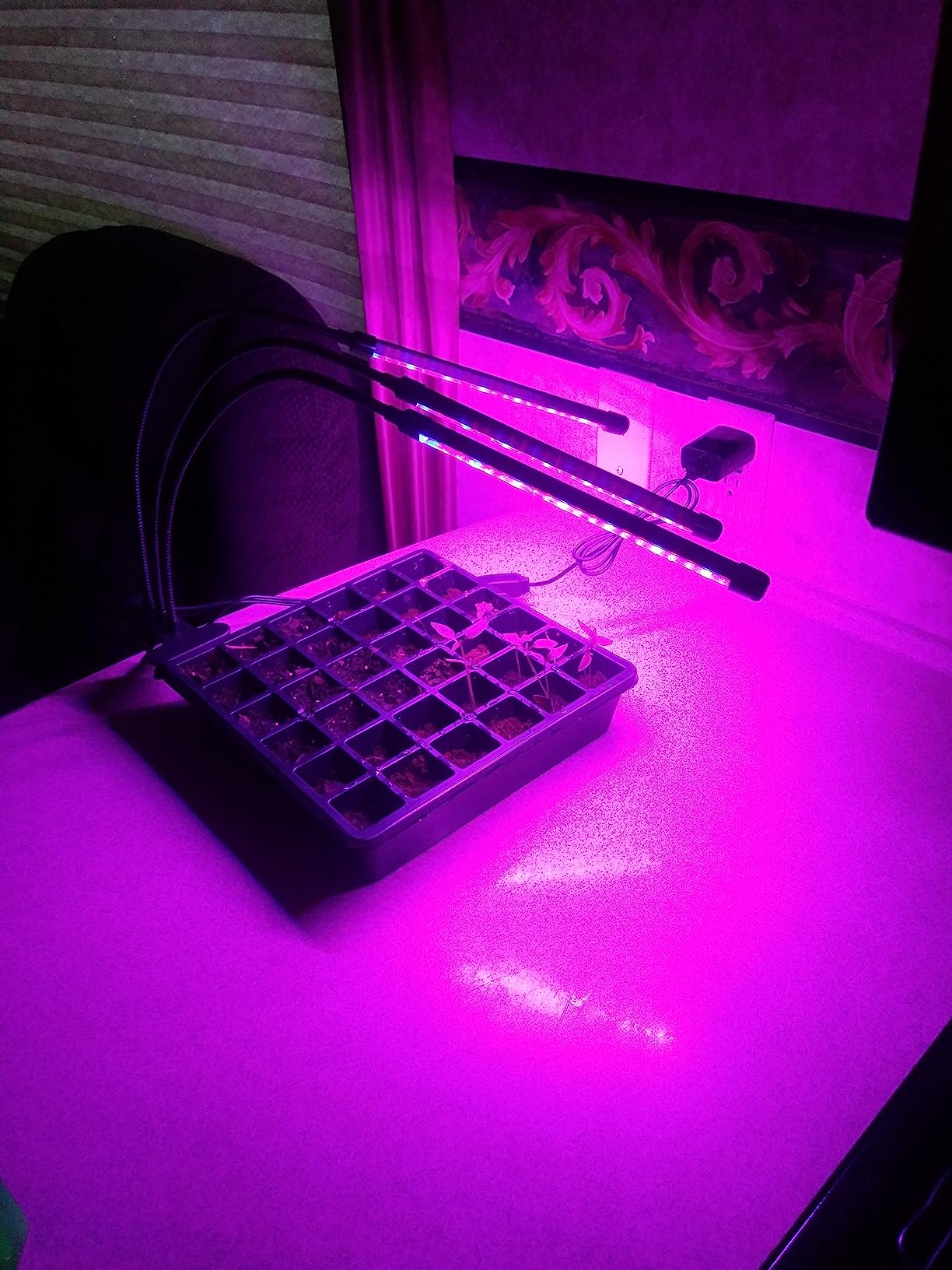
Ten dimming levels give finer control than most lights in this roundup, stepping brightness rather than changing the schedule. At low levels it is a reasonable inspection lamp for a workbench, and at full output it is a genuine grow light.
The build is aluminum and metal, and at 1.3 pounds the whole unit is heavier than the slim ceramic lamps but still portable between rooms. I did notice the clamp drifting slightly when the goosenecks are bent hard to one side, so a quick re-tighten every week or two is sensible.
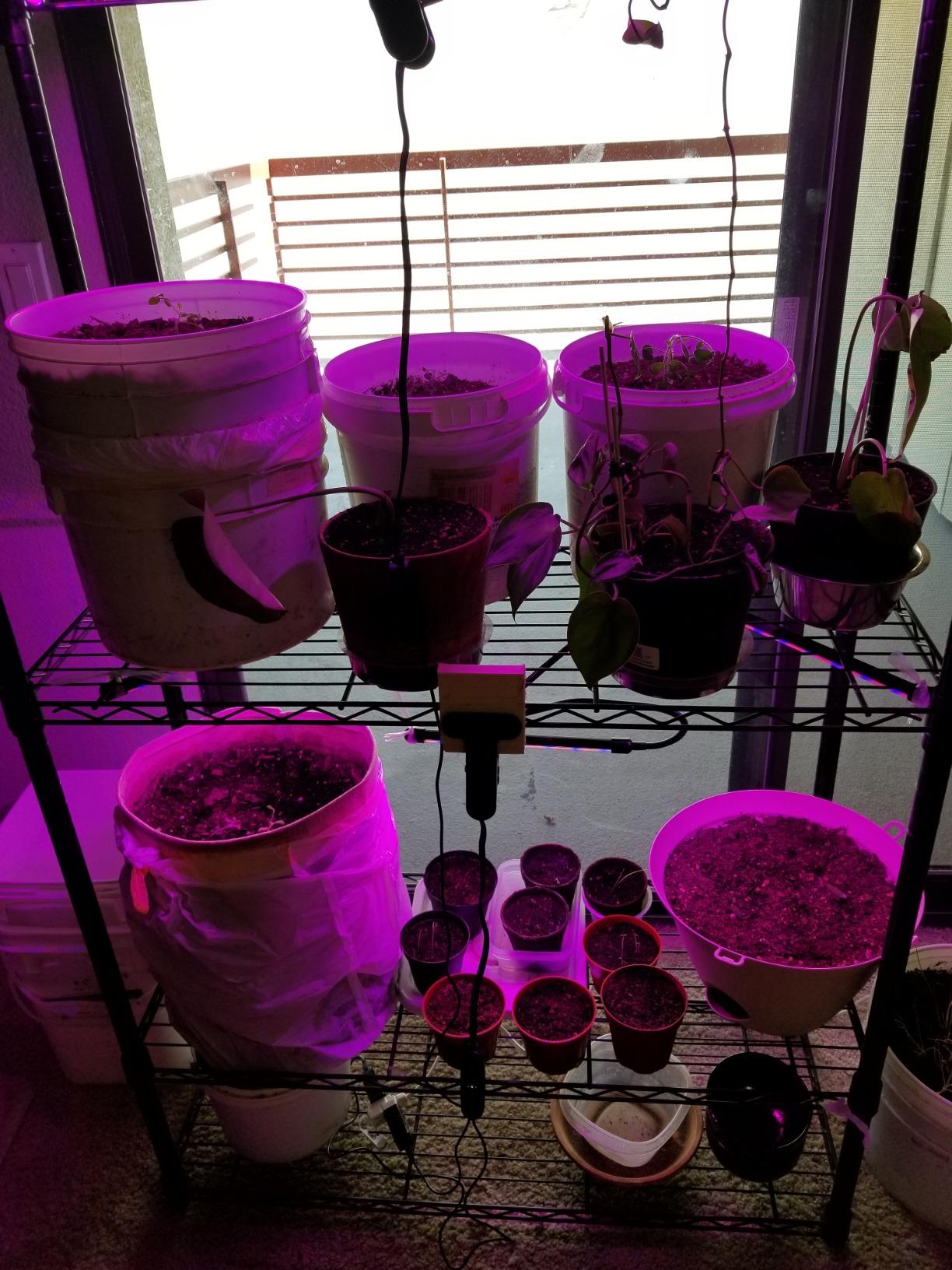
Three heads versus one wide bar: coverage and light spread
Multiple short heads spread light in a soft, overlapping pattern instead of concentrating it. That matters more than the total wattage, because a narrow beam from a single head creates a bright patch and a dim edge on the same plant.
With three arms you can also cover plants at different distances. One head sits close to a seedling tray, one hovers over a mid-height pot and one reaches across to a neighbouring plant, all from one clip and one cord.
The red and blue question, and why it matters in a living room
Some variants of this light are a red and blue blurple rather than true full-spectrum white. Growers on plant forums like the purple cast for a high-light succulent setup because it keeps colour without producing much heat, but if the light lives in your living space, the glow is hard to live with after sunset.
Check the listing photos carefully before buying for a living room. A white full-spectrum option blends with household lighting, and for foliage plants it is the version I would choose.
Program the timer once, then leave it alone
Programming takes a single press-and-hold on the touch control, and the circular memory means the setting survives to the next day. Newer firmware revisions on some units drop the six-hour option, so you are choosing between three, nine and twelve hours rather than a wider range.
One practical note from long-term owners: when a unit stops responding, the lamp itself is often fine and the small USB power supply is the part that died. It is worth keeping the original adapter rather than binning it.
3. GooingTop 100W 6000K Clip Plant Lamp – The Brightest Clip Lamp in the Test
GooingTop Grow Light 100W 6000K, Super Bright White Desktop Clip Plant Lamp
144 white plus 10 red LEDs
6000K spectrum
4/8/12 hr timer
About 36W actual draw
+ Pros
- Highest light output of any clip lamp in this test
- Long gooseneck reaches across a wide plant area
- 4/8/12 hour timer plus touch dimming
- Low 36W real draw for the brightness delivered
- 365 day warranty
– Cons
- Bulkier and heavier than slim gooseneck lamps
- White-only spectrum with no red emphasis mode
- Runs warmer than lower-wattage options
When a plant is genuinely light-hungry and a clip lamp is the only format allowed, this is the one I reach for. The 100W in the name is a halogen-equivalent rating; the actual power draw is about 36W, which is why it delivers so much light without the electricity bill of a 100W bulb.
Under the hood it is 144 white diodes plus 10 red beads on a carbon steel and PVC body. In a dark corner with a large plant, the difference against a 5W clip lamp was obvious within two weeks of new growth.
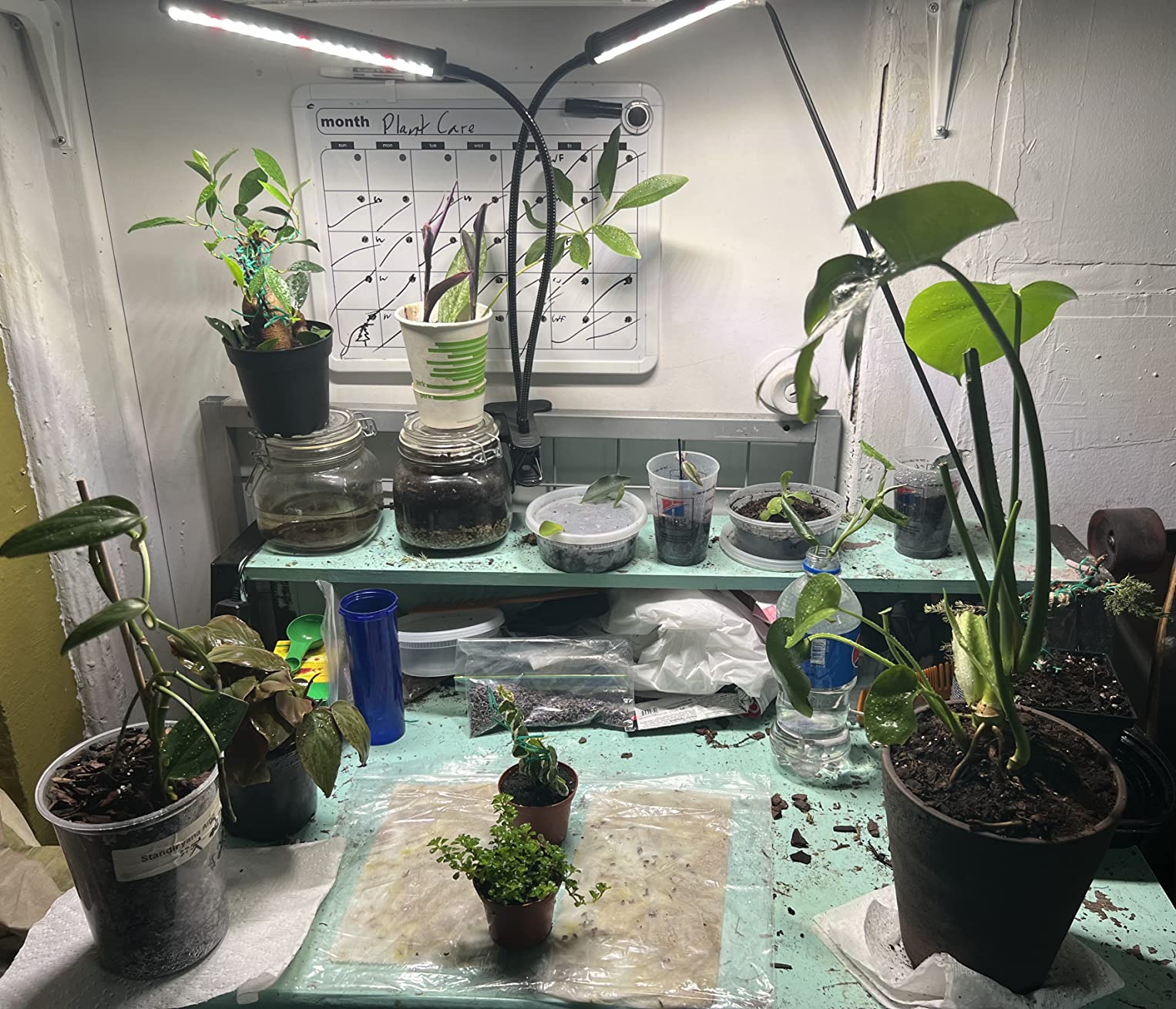
The 6000K spectrum is a cool daylight white that approximates midday sun. The long gooseneck is the star feature in practice: I clipped it to a shelf upright and arched the head across two plants at once, which no compact lamp on this list can do.
At 16 ounces and 22 inches tall it is the bulkiest fixture here, and it needs a clamp point with real structural strength. Clip it to a sturdy shelf or a thick table edge rather than a light console.
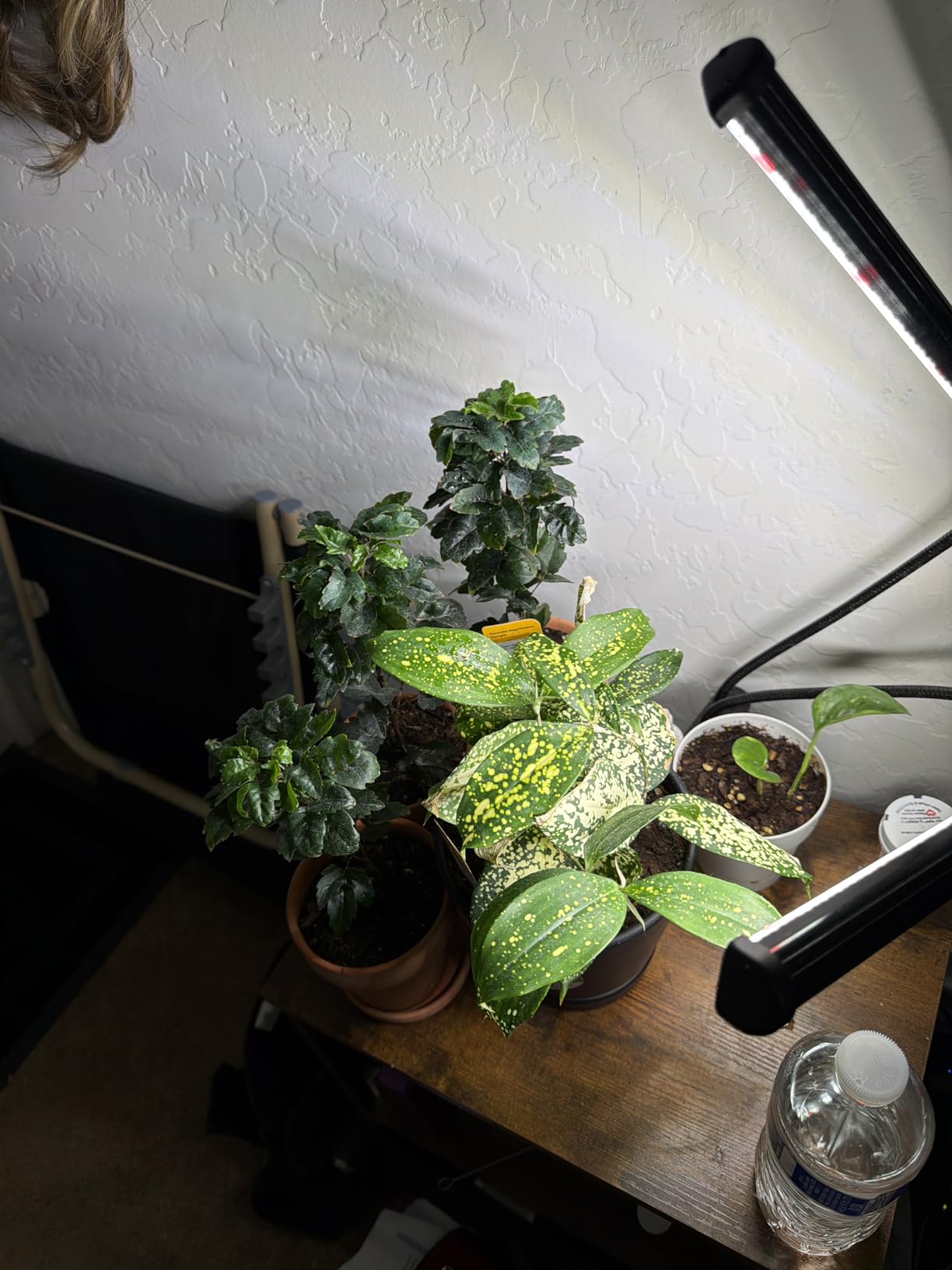
Why the 100W name is misleading and the 36W draw is the number to plan around
Grow light listings often quote an equivalent wattage rather than real consumption, because a 100W-equivalent LED replaces a 100W halogen bulb. The 36W figure is what appears on your meter, and it is the one that matters for running costs.
Run it 12 hours a day for a month and the maths is easy: 36W multiplied by 12 hours multiplied by 30 days is about 13 kilowatt hours. That is a modest addition to a monthly bill, and it is the reason a light like this can stay on through a full winter.
Light distance and heat management for high-light plants
This lamp is hot enough that placement matters. I ran it about 12 inches above a succulent cluster and got no leaf damage, but I would not park it closer than that against soft foliage, and I keep it away from a dry wall where the heat can be felt on the surface.
Succulents, cacti and indoor citrus are the right plants for this amount of light. Reaching for it on a fern or a calathea would be overkill, and you would be running a hot fixture to achieve nothing.
Timer options and a note on the warranty
The 4, 8 and 12 hour settings run on a 24-hour cycle, which covers both low-light houseplants on eight hours and high-light plants on a long twelve. Touch control handles brightness adjustment on the same unit.
The manufacturer lists a 365 day warranty alongside a 12 month manufacturer warranty, and customer service has been responsive. For a fixture you will leave plugged in for months, that coverage is worth something.
4. Shyineyou 4-Head 80 LED Clip-On Light – Four Heads, One Clamp, One Cord
Shyineyou Grow Lights for Indoor Plants Full Spectrum, 80 LEDs Plant Lights for Indoor Growing with 3/9/12H Timer, 3 Color Modes & 9 Brightness, 4 Heads Clip-On Plant Grow Light
80 LEDs across 4 heads
3 color modes
9 brightness levels
3/9/12 hr timer
+ Pros
- Four independently aimable heads from one clamp
- Well balanced red blue and white diode array
- Timer plus nine brightness levels covers all stages
- Stainless steel shade and a clamp that holds position
– Cons
- 400 lumens is modest for large foliage plants
- Red and blue mode casts a purple cast
- Ranked lower in Plant Growing Lamps than several rivals
This is my shelf light. A two-tier bookcase with eight pots is exactly the situation a four-head clip lamp solves, because one clamp at the top corner can throw light across both levels if you aim the heads carefully.
The diode array is 80 LEDs split into 24 red, 28 blue and 28 white, running at 15W with a 4000K equivalent output and a CRI of 90. The color rendering matters here more than raw brightness, because you want to see subtle changes in leaf color while you are checking for problems.
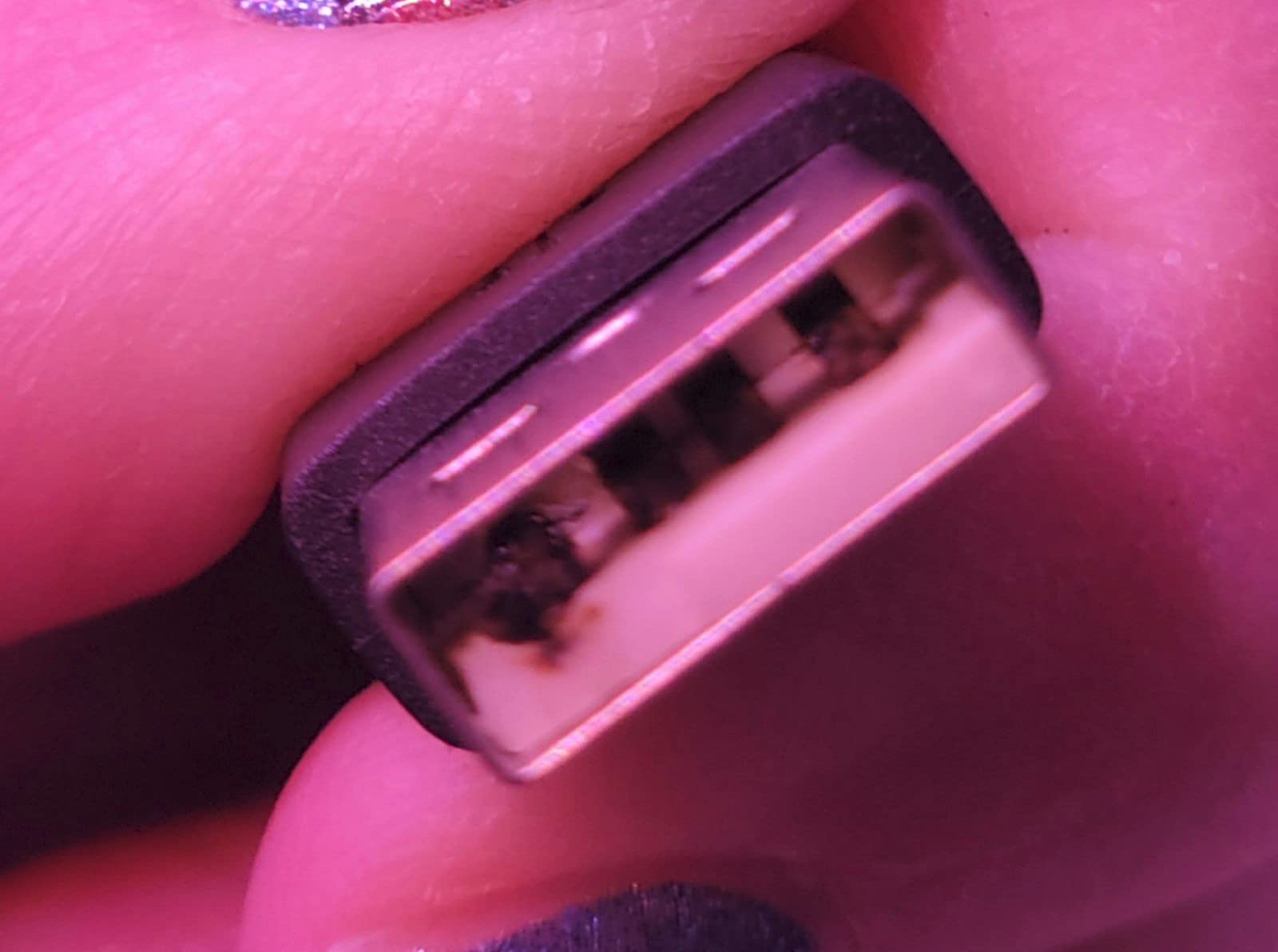
Three light modes let you shift between red plus blue, red plus white and a mixed setting without changing the hardware. Nine brightness levels from 20 to 100 percent sit alongside the 3, 9 and 12 hour cycle-memory timer.
Total output is 400 lumens, which is a real limitation. It does a fine job on herbs, seedlings and medium foliage, and it will not drive a large specimen on its own.
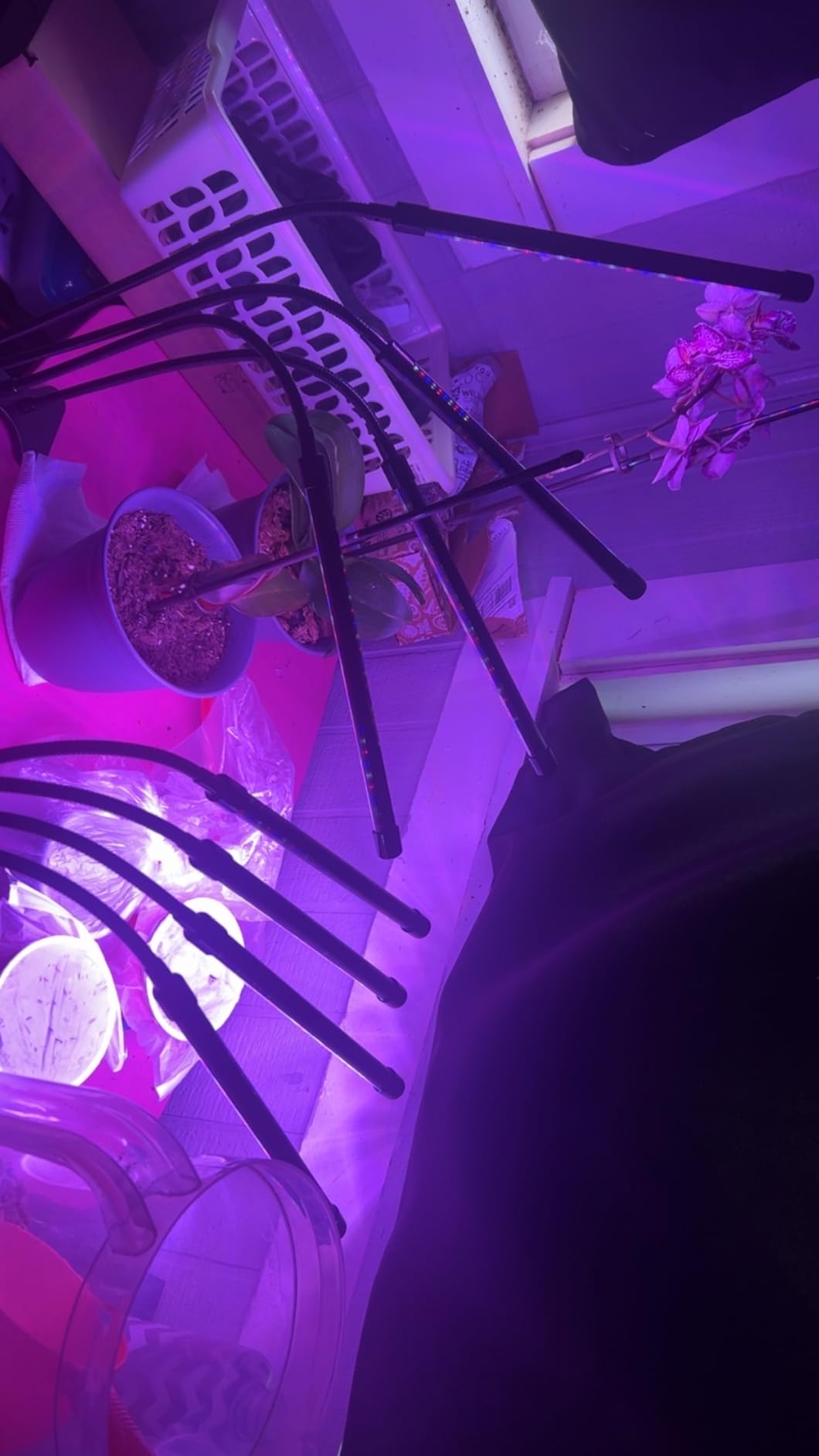
Aiming four heads across two shelf levels
The advantage of four independent goosenecks is that you can solve an awkward layout instead of compromising on it. Two heads angled down at the upper shelf, one head reaching across to the far corner and one angled down toward the lower tier gives you coverage a single bar cannot.
The trade-off is visual. Four black heads and their arms read as a piece of equipment, and in a living room you may find yourself wishing for a single compact fixture. On a bookcase or in a home office it is unremarkable.
Three modes and nine levels: using them properly
The mixed mode is the one to leave on for a normal houseplant collection. Red plus blue is the classic vegetative and bloom pairing, and red plus white softens the purple cast while keeping the red end of the spectrum useful for flowering plants.
Because the mode change alters both color and intensity, change mode and brightness together rather than separately. That way you are not suddenly blasting a plant that was acclimated to a low setting.
What 400 lumens means for your plant type
Lumens measure brightness to your eye, not to a plant, so treat this number as a rough proxy for coverage area. At 400 lumens you are lighting a zone roughly the size of a bookcase shelf, not a whole room.
Herbs, seedlings, succulents, flowering houseplants and propagation trays are all comfortable in that footprint. A fiddle leaf fig or a large monstera needs either a second fixture or a much brighter light, and no amount of timer scheduling will compensate for insufficient output.
5. EWPJDK 84 LED 6500K Clip Grow Lamp – Natural-Tone Light You Can Actually Sit Beside
EWPJDK Grow Light 6500K Full Spectrum Plant Grow Lights 84 LED Plant Light with Clip Grow Lamp for Indoor Plants Growing Lamps(1PCS)
74 white plus 10 red LEDs
6500K flicker-free tone
3 modes and 10 dimming levels
3/9/12 hr timer
+ Pros
- Strong non-slip padded clamp with a tight hold
- Flicker-free 6500K light doubles as a reading lamp
- Three modes and ten dimming levels
- Gooseneck arms stay where you bend them
- Only about 10W consumption
– Cons
- USB wall adapter not included in the box
- Brightness steps up and down with repeated presses
- Not strong enough as a sole source for high-light plants
- Timer resets after a power outage
I originally bought this for a plant corner and ended up clamping it to a desk instead, because the 6500K output is so close to ordinary daylight that it does not announce itself as a grow light. Several owners use the same fixture for planted aquariums, where a natural white tone keeps the water looking clean.
The diode mix is 74 white plus 10 red at 10W total, mounted on a thickened flexible gooseneck with a padded non-slip clamp. The padding is the detail I appreciate most, because it grips a finished shelf without scratching the surface.
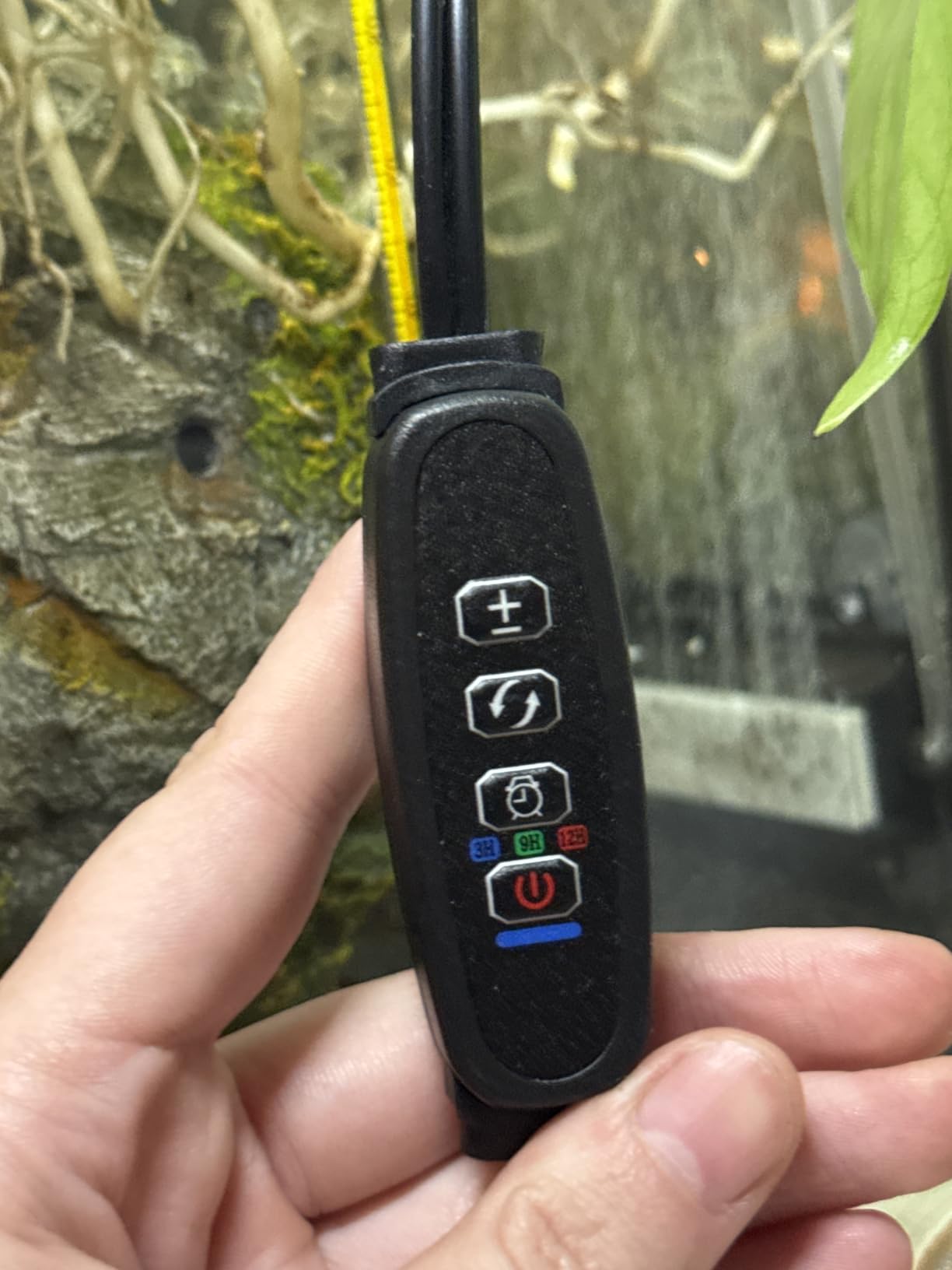
Three lighting modes cover white, red and white plus red, and ten dimming levels give very fine control at the low end. The 3, 9 and 12 hour cycle-memory timer handles daily scheduling without intervention.
Two real limitations. The USB wall adapter is not in the box, so plan on supplying your own five volt supply. And brightness moves in steps through repeated button presses rather than separate up and down controls, which is mildly annoying until you learn the rhythm.
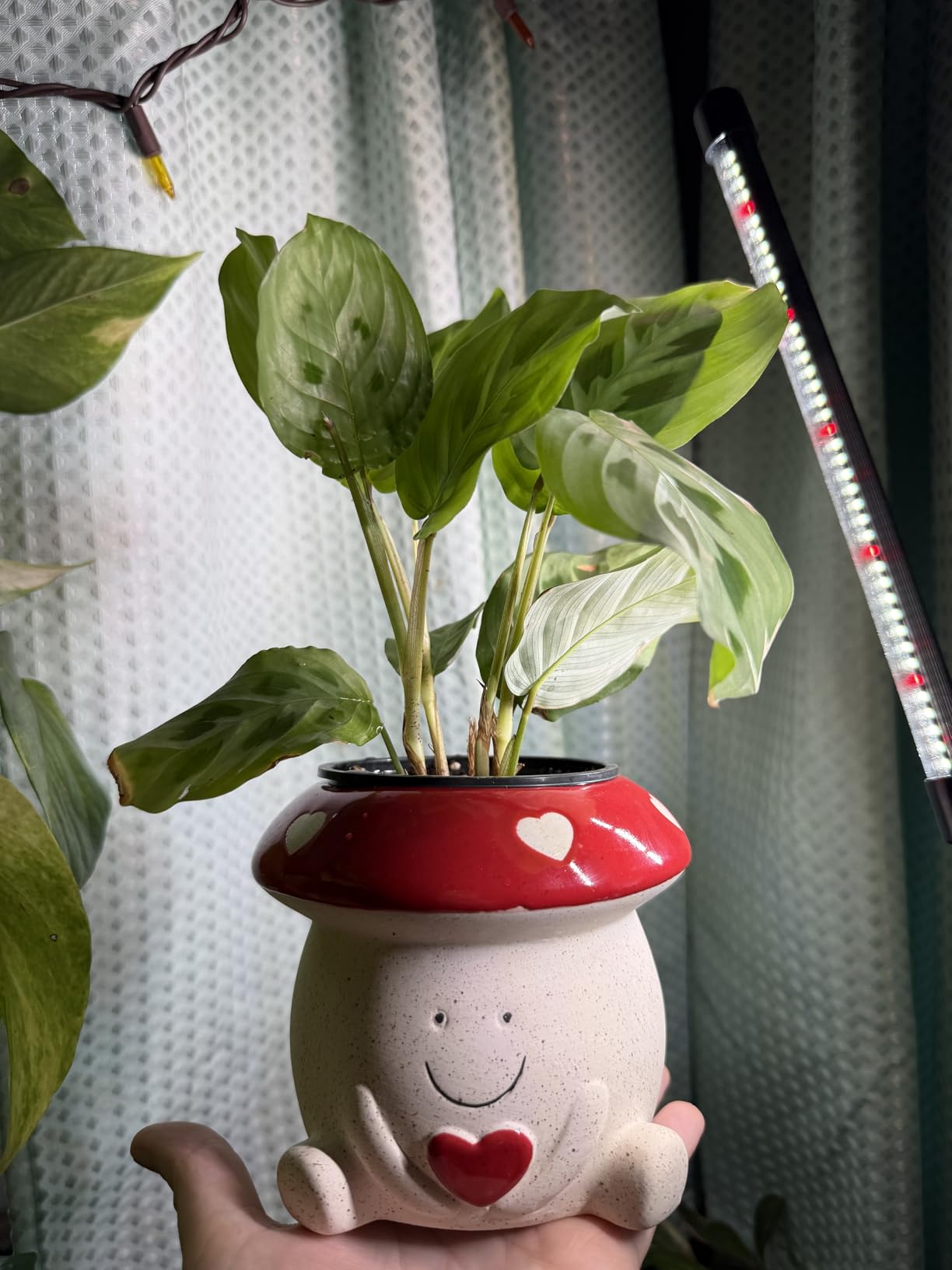
Why flicker-free output matters for a desk light
A light you sit next to for hours needs a stable driver. Flickering output is not only unpleasant to look at, it reduces the effective light the plant receives, and cheap fixtures frequently buzz.
This one runs at 6500K with a steady beam. I have used it as a task lamp for seedling work at night, and it is the only clip lamp in this roundup I would be comfortable pointing at a plant on a desk two feet from my face.
Timer memory and what a power outage does to it
The 3, 9 and 12 hour cycle-memory timer repeats daily once set, which is the single most useful feature for anyone who travels. Setting a schedule once and leaving it alone removes the most common reason plants get inconsistent light.
Unplugging the unit or losing power does reset the timer, so if your lights sit on a shared circuit in a rental building, re-check the setting after an outage. The model carries a 3 month manufacturer warranty, which is the shortest in this roundup and worth factoring into your decision.
Clip strength, arms and the plants that suit 10W
The gooseneck is thick enough to hold a bend without creeping, so you can aim it once and forget it. That single property fixes the most common complaint I have seen about gooseneck lamps in general, which is arms slowly drooping toward the floor.
At 10W this is a light for a desk plant, a small potted fern, herbs, succulents and a propagation tray. It is not enough to sustain a large floor plant on its own, and running it at maximum brightness for 12 hours on a soft-leaved plant invites light burn.
6. Wolezek 2-Pack Two-Head Clip Lights – Best Value for Lighting a Whole Shelf
Wolezek Clip on Grow Lights for Indoor Plants, Full Spectrum 6000K
Two clamps and four heads
6/12/16 hr timer
660nm red plus 3000K and 6000K white
98.43 inch cord
+ Pros
- Four heads across two clamps cover a whole shelf
- 16 hour cycle suits flowering and fruiting plants
- Clips to plant shelves without slipping
- Goosenecks hold firmly once bent
- Two lights means flexible placement
– Cons
- Base cannot stand unsupported with nothing to clip to
- Included power adapter failures are a recurring complaint
- Unlabelled light modes confuse first-time buyers
A two-pack is the answer when you have more than one problem to solve. With two clamps and four heads you can light the top of a bookcase and a lower shelf from two separate outlets, and the two fixtures can be aimed completely differently, which a four-head single clamp cannot do.
Each bar carries 2 red diodes at 660nm plus 2 warm white at 3000K and 16 white at 6000K. The mixed white output looks natural in a room, and the red end is present for anyone growing fruiting or flowering plants.
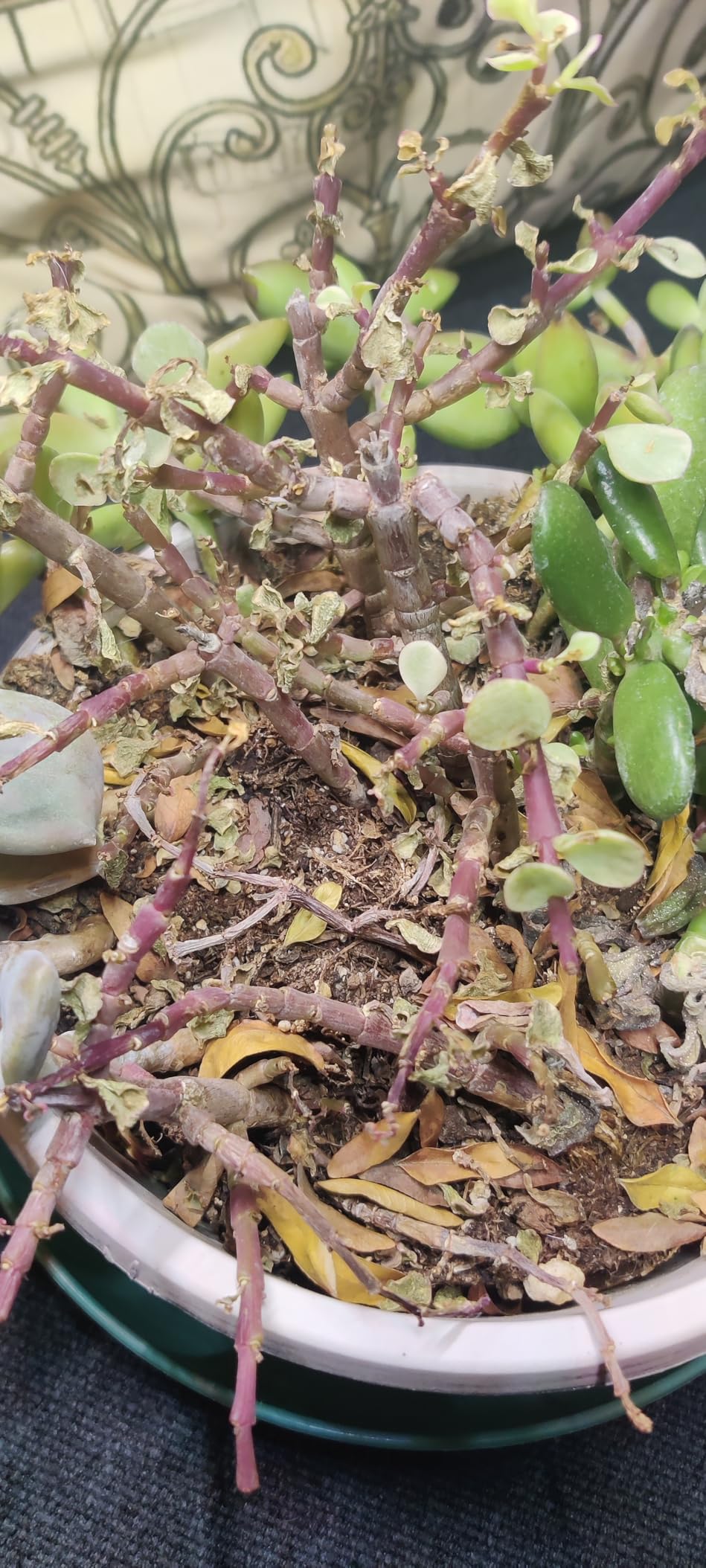
The timer is the differentiator here. Instead of the usual 3, 6 or 12 hour options, this one offers 6, 12 and 16 hours on a circular memory. A 16 hour cycle is a genuine advantage for winter, when daylight hours are short and high-light plants need a long day to hold their form.
The 98.43 inch cord is longer than most, and in my setup that meant the light reached an outlet behind a bookcase without an extension lead. Buy one for the shelf and one for a desk and the effective cost per light is low.
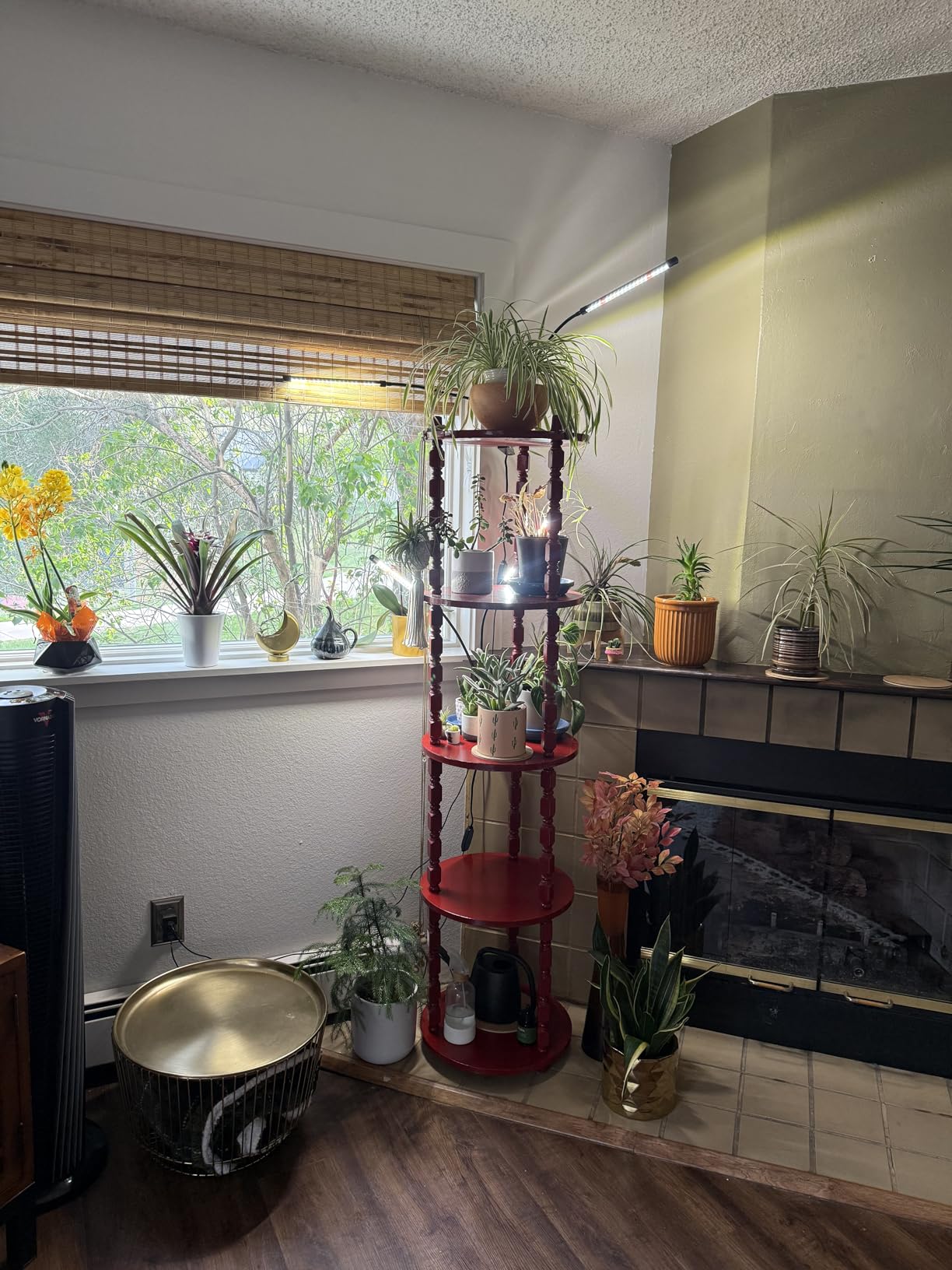
Why a 16 hour timer changes winter outcomes
Most clip lights top out at 12 hours. Extending to 16 gives a plant a much longer day, which is what high-light species need to stay compact when the natural light outside has collapsed to a few grey hours.
Be careful with what you attach that schedule to. A 16 hour cycle is a good fit for succulents, indoor citrus and seedlings, and an unnecessarily stressful one for a shade plant that only needs eight hours. Use the setting that matches the plant, not the setting that looks impressive.
Two clamps versus one: the placement argument
Two independent clamps let you serve two rooms, two shelves or two sides of a wide window. They also let you put one light high and one low, which is how I covered a two-tier shelf where a single fixture would have left the lower tier dark.
Against that, four heads and two arms take up more visual space and more shelf depth than a single lamp. In a small apartment, a compact single light placed well often looks better than two lights placed quickly.
Adapter failures and how to tell a dead light from a dead plug
The most common long-term complaint involves the small power adapter rather than the lamp. When a unit stops lighting up, test it with a known-good five volt supply before assuming the fixture has failed, because a replacement block often revives it.
Note also that the base has no freestanding foot. With nothing to clip onto, this light has no way to stand on its own, so it is only viable where you have a shelf edge, a pot rim or a stand rail to grip.
7. FECiDA 3-Pack Clip Light Tubes – Long Tubes and the Widest Timer Range Here
Game Changer! FECiDA 2026 3Pack Clip on Grow Lights for Single Pot Plant
42 LEDs and 1000 lumens per tube
5-mode timer from 4 to 20 hours
60 degree optical lens
Direct plug-in
+ Pros
- Long tubes give a half-circle spread instead of a narrow beam
- Five timer settings give the widest scheduling range here
- Clip holds to shelves panels and pot rims with no base
- No adapter needed because it runs from a wall outlet
- Warm spectrum mix of 3000K 5000K and 660nm
– Cons
- Tubes run warm and need distance from leaves
- Cord is shorter than some setups require
- 220V plug-in design may not suit other mains systems
Most clip lights use a short bulb or a stubby bar. These are tubes, and the physical difference matters because a long tube throws a half-circle of light rather than a single narrow beam. On a plant with a wide canopy, that is the difference between lighting the front and leaving the back dark.
Each tube carries 42 LEDs and produces 1000 lumens, and a 60 degree precision lens focuses that output onto the foliage rather than spraying it at the wall behind your plant. The 3-pack gives you three tubes, three clips and three independent mounting points.
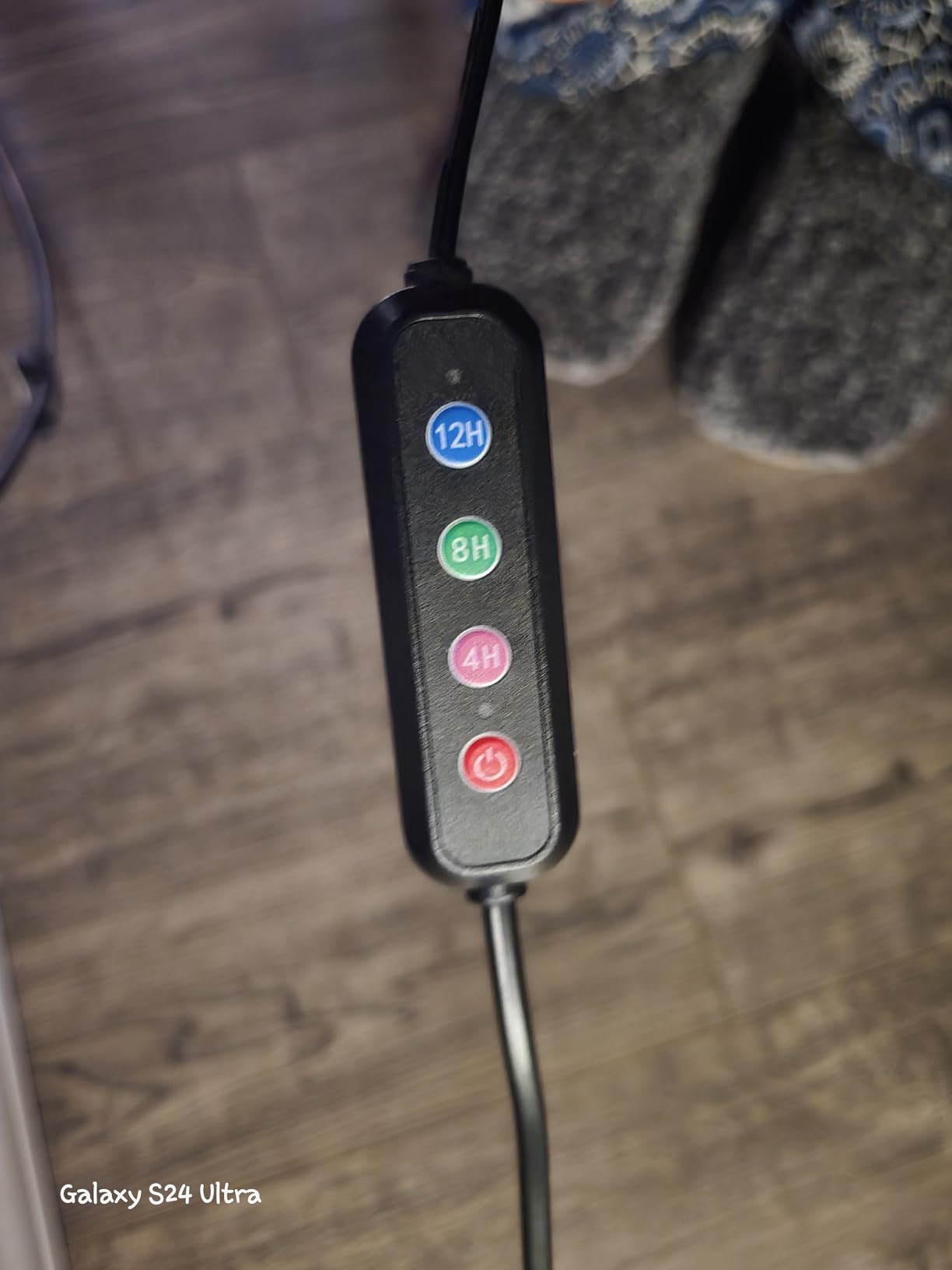
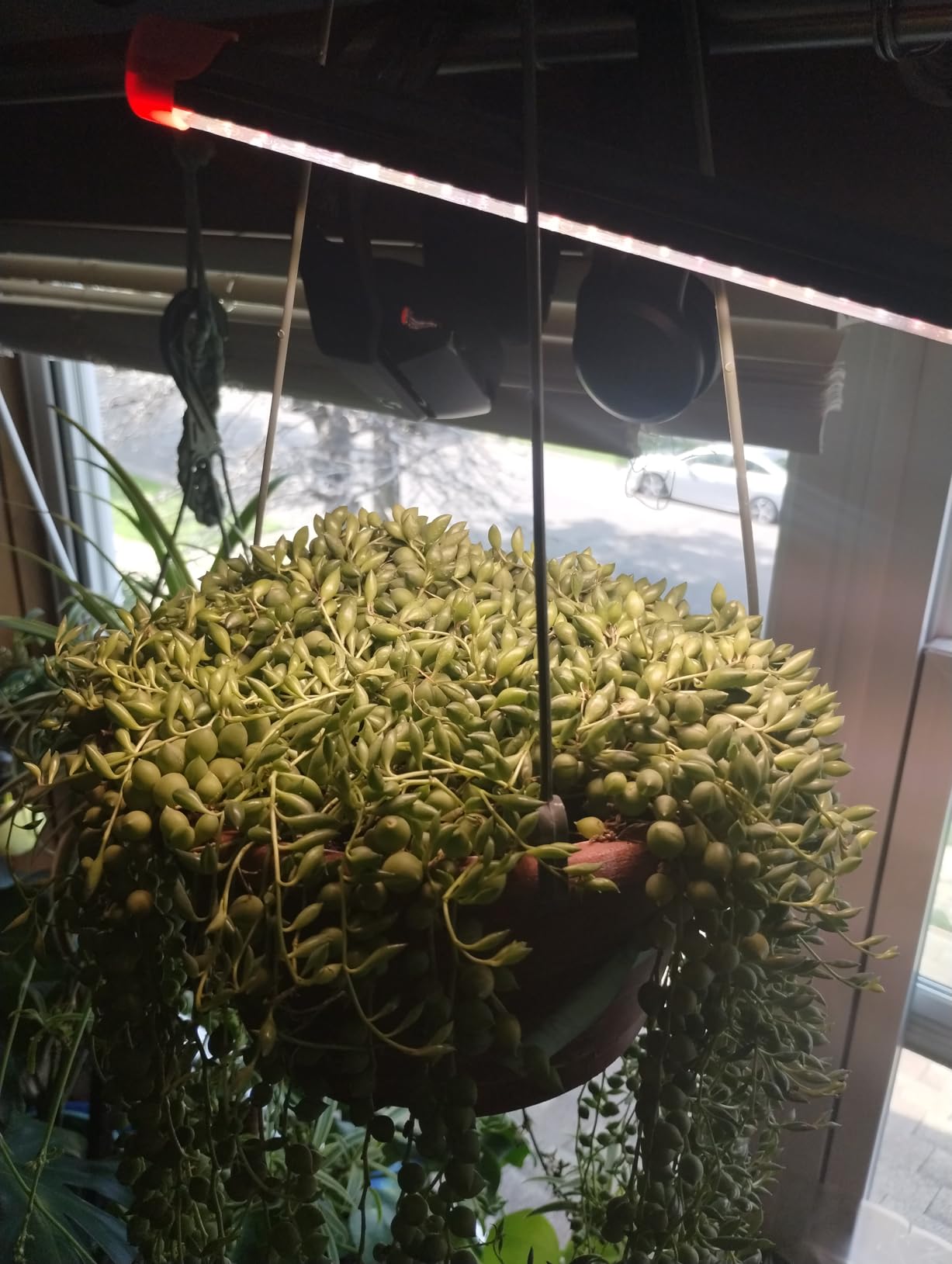
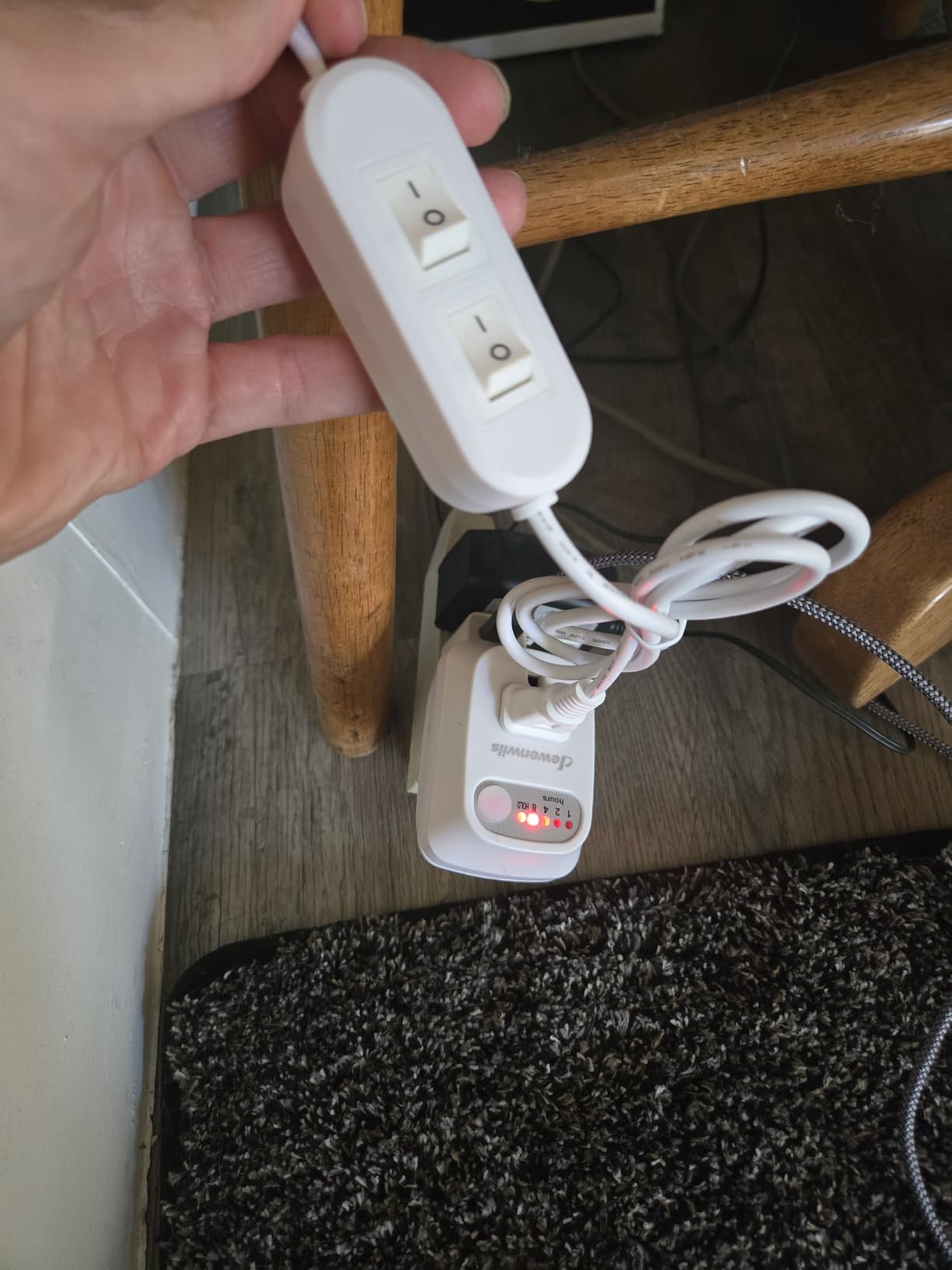
The timer is the standout. Five settings cover 4, 8, 12, 16 and 20 hours, where the 16 hour and 20 hour options are composites of shorter cycles. I do not know many clip lights that offer a twenty hour day.
It plugs straight into a wall outlet with no adapter brick, which removes the single most common failure point in this category and also means you can mount it further from the plant.
Five timer modes and how they stack
Short cycles suit seedlings and cuttings that need a gentle photoperiod. The 12 hour setting is the standard choice for most houseplants, and the 16 and 20 hour options exist for winter growing and high-light species.
The composite modes are worth understanding before you program one. The 16 hour setting is a 4 hour plus 12 hour combination and the 20 hour setting is 4 plus 16, so the light is not running continuously for that whole period.
Heat: the one thing to watch with tube fixtures
Long tubes have more surface area to radiate heat, and owners consistently flag warmth as the caveat. Keep a working distance of about 12 inches between the tube and the top leaves, and never rest a tube directly on soft foliage.
Symptoms of too much light are bleached or brown patches on the leaves closest to the lamp, while the outer leaves look fine. Moving the lamp up two inches fixes it faster than lowering the brightness setting.
Two mounting methods and a mains-voltage caveat
Each clip mounts horizontally on a flat panel or tabletop edge, or vertically onto a pot rim, and the gooseneck adds a third degree of freedom. No base or soil stake is needed, so nothing rests on the pot itself.
One practical note before you buy: this is a 220V AC plug-in design. If your local mains supply is not 220V, check compatibility before you commit, because the plug-in format has no low-voltage version here.
8. SANSI 20W Clip-On Gooseneck Light – Measurable Output for Serious Foliage Plants
SANSI Grow Lights for Indoor Plants, 20W Clip-On Gooseneck LED Plant Lights
PPFD 402 at 1 foot
4000K with CRI near 100
Replaceable bulbs
400nm to 780nm spectrum
+ Pros
- Noticeably brighter than cheap blurple stick lights
- 4000K daylight with CRI near 100 looks natural
- Replaceable bulbs backed by a whole-life warranty
- Secondary lens design concentrates the light
- Sturdy ceramic-based fixture with a solid clamp
– Cons
- Bulbs run very hot and can scorch close leaves
- Goosenecks tilt under the weight of the bulbs
- No built-in timer so switching is manual
- Cord is short and 220V systems need a converter
This is the one I recommend when the question is whether a clip lamp can keep a large tropical plant healthy. SANSI quotes PPFD of 402 micromoles per second per square metre at one foot through a secondary optical lens, and that is a number high enough to support real photosynthesis rather than a token glow.
The spectrum runs 400nm to 780nm at 4000K with a colour rendering index near 100. High CRI means leaf colour looks true to life, so a yellowing leaf looks yellow and not orange, which is genuinely useful when you are diagnosing a problem.
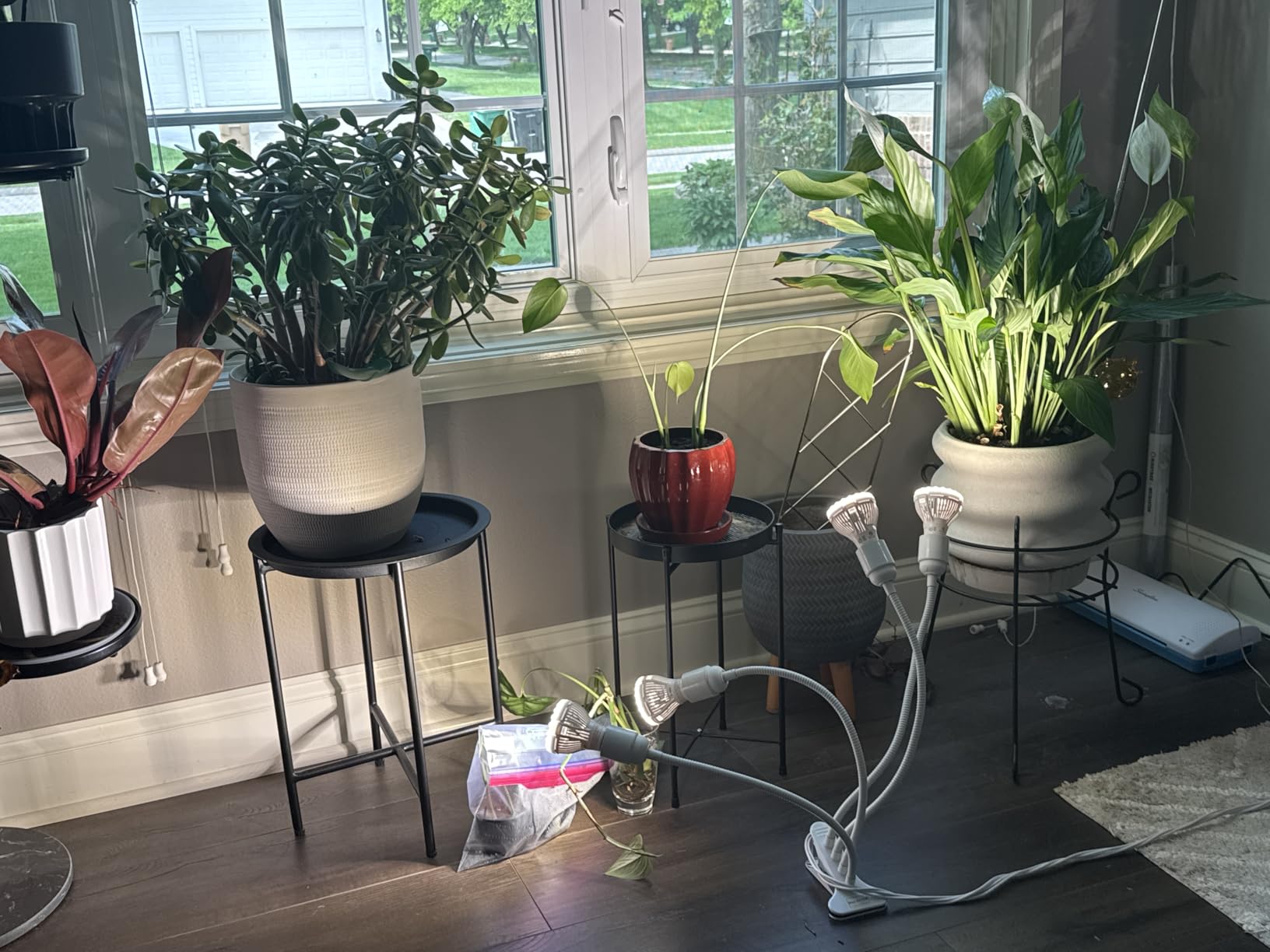
It is also available in 1, 2, 3 and 4 head configurations, with a maximum of 10W per head. The replaceable bulb design means a dead diode does not end the life of the fixture, and the whole-life warranty on the grow bulbs is unusual at this price level.
Two cautions. The bulbs run hot, so keep the gooseneck from dipping into the canopy, and expect to reposition the necks periodically because the weighted bulbs pull them down over time.
What PPFD means and why it beats lumens here
PPFD, photosynthetically photon flux density, counts the photons in the 400 to 700 nanometre range that a plant can actually use. Lumens count brightness as your eye perceives it, which is a different measurement entirely.
That is why two clip lights with similar wattage can feel very different. At 402 PPFD at one foot this light sits in a range that will maintain a bushy tropical plant, where a 10W stick light will not, and the difference shows up as shorter internodes and steadier leaf retention.
Replaceable bulbs and why that matters over years
Most cheap clip lights are sealed units. When the driver fails, the whole fixture goes into a drawer and the plant goes back to a dim window.
Here the grow bulbs are replaceable and covered for their working life, so the most likely part to wear out is the part you can swap. Combine that with the patented chip-on-ceramic construction and the 25,000 hour rated bulb lifespan, and this is the fixture most likely to still be working years from now.
Heat, droop and the missing timer
Two of the biggest drawbacks are mechanical rather than electrical. Hot bulbs need distance from leaves, and a gooseneck carrying a weighted bulb will slowly tip unless you re-angle it every few weeks.
There is no built-in timer, so this light needs manual switching, and that is a genuine drawback in a home where nobody wants to remember a light. If an automated schedule matters to you, either accept a wall plug timer or choose a different fixture from this list.
9. RWNTAO 84 LED Two-Head Bar Light – The Most Versatile That Holds a Shelf
Grow Lights for Indoor Plants, Upgrade 84 LEDs Clip Plant Lights, Full Spectrum LED Plant Growing Lamps with Flexible Gooseneck, 3/9/12H Timer, 3 Spectral Modes, 10 Dimmable Levels (2 Head 1 Pack)
84 LEDs across two bars
6000K full spectrum
3 modes and 10 dimming levels
3/9/12 hr timer
+ Pros
- Strong clip stability on table edges and shelves
- Timer repeats daily without being reset
- Three spectral modes suit herbs seedlings and houseplants
- High category rank among budget clip lights
- Cheapest route to full spectrum white
– Cons
- Industrial black styling is unappealing in a living room
- Remote control detail is unclear in the listing
- Output suits small plants and microgreens better
This is the fixture I recommend to anyone who wants a good result without spending much, and it is the lowest-priced light here that still outputs a full-spectrum white rather than a purple blurple. In a dark home in a long winter, owners report steady plant improvement at this price point.
Each bar carries 5 red and 37 sunlight white diodes for 84 LEDs across the two heads, running at 6000K. The white is a clean daylight tone, which is why it does not look like equipment once the lamp is clipped to a shelf.
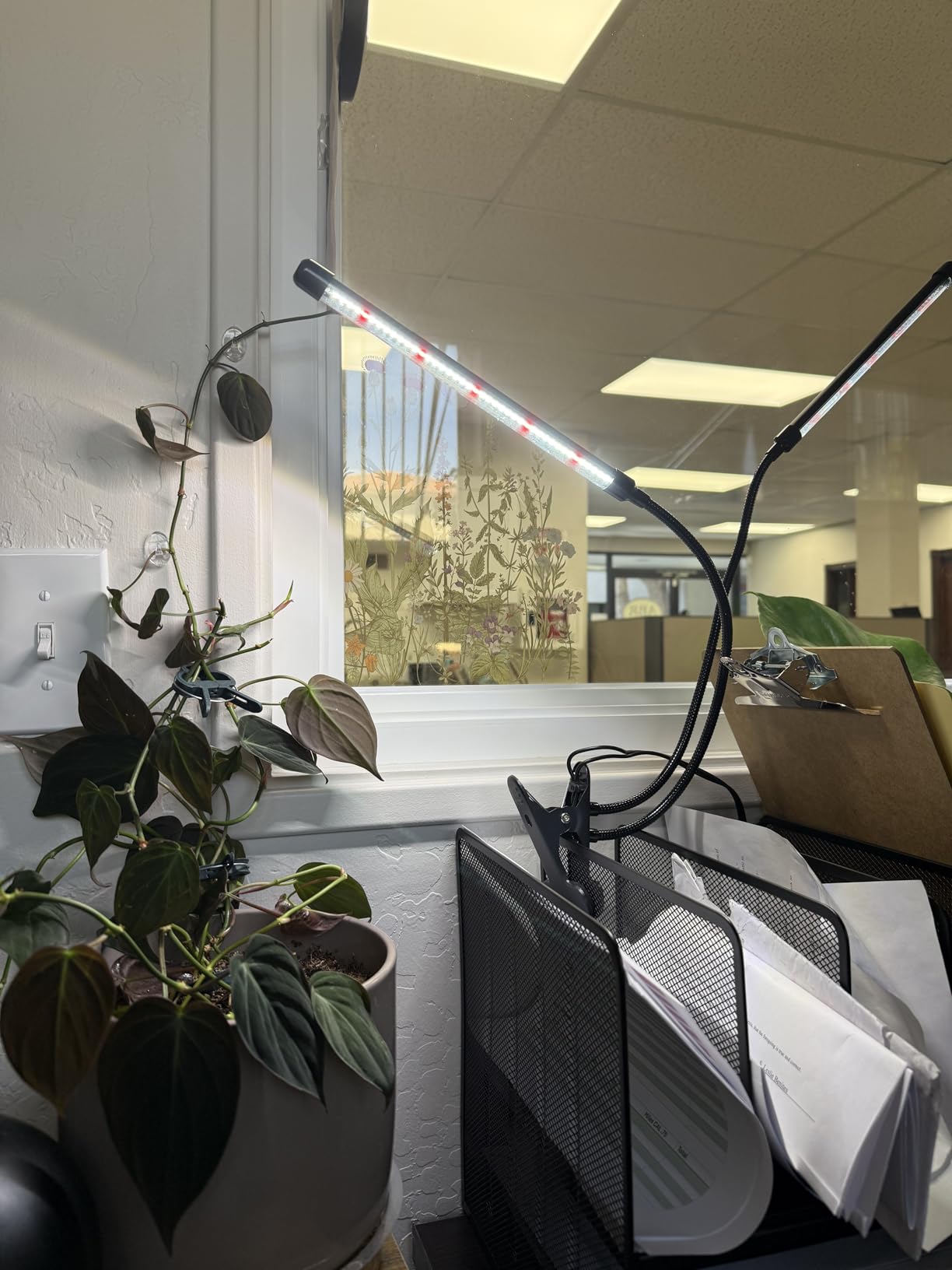
Control is via touch with a 3, 9 and 12 hour cycle-memory timer, three spectral modes and ten dimming levels. The timer repeat is reliable in my testing, which removes the most common reason a plant ends up with an inconsistent day length.
Being honest about the limits: the output is aimed at small plants, microgreens, seedlings and herbs. A large leafy specimen will outgrow it within a season, and the black industrial styling is not something I would put on a display shelf.
Clip stability on tables, trays and shelves
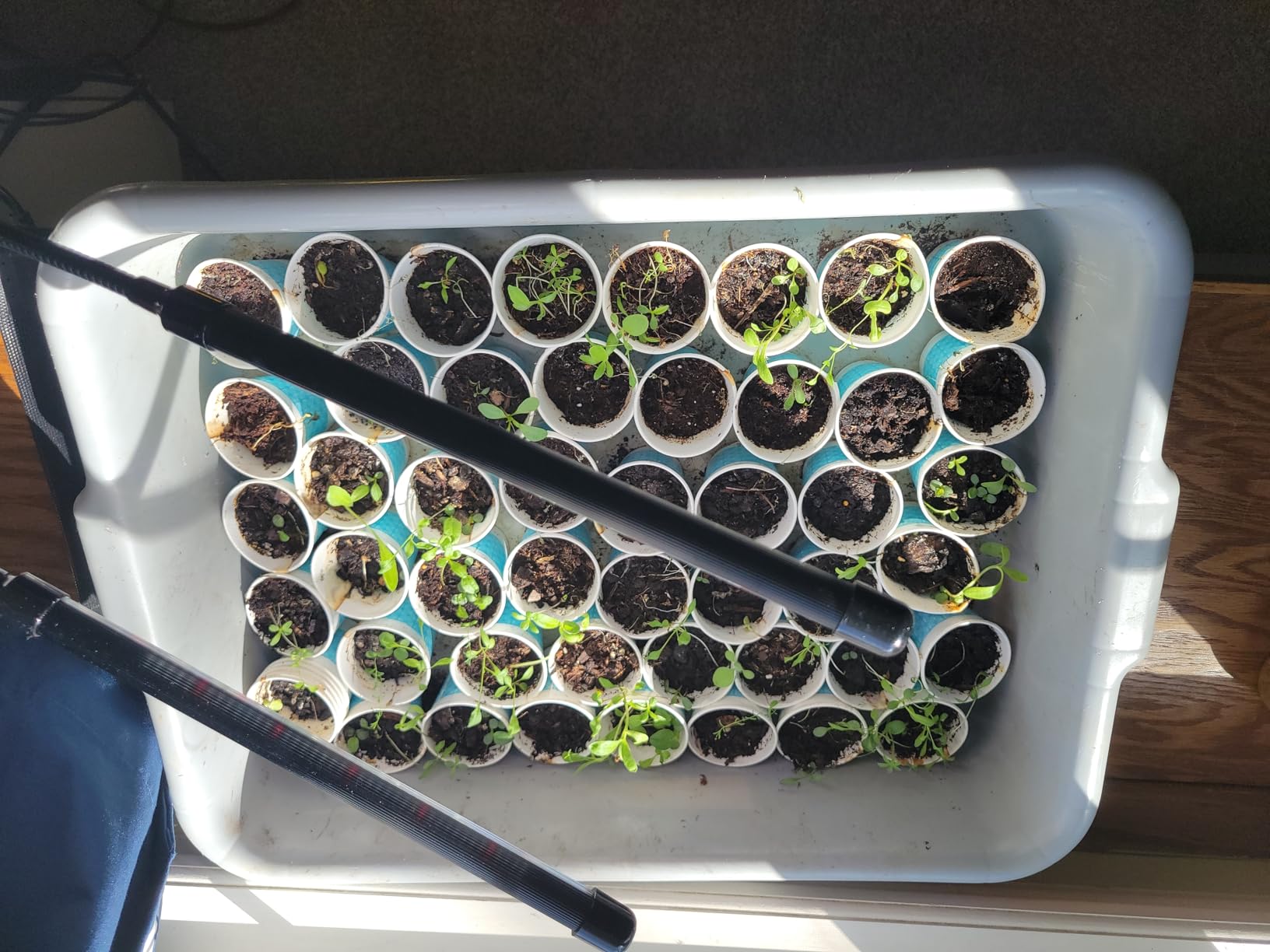
The clip base is where budget lights usually fail, and this one holds on a table edge, a seed tray rim and a shelf without creeping. In my testing the jaw seated fully and stayed put for the whole cycle with the goosenecks loaded.
That stability is what lets you set the light once and leave it. A clip that slips a few millimetres a week will slowly point at a wall, and you will not notice until the plant shows it.
Three modes without the purple problem
Because the base output is white rather than red and blue, the three modes give you flexibility without turning your room purple. Switch to a red-leaning mode for a fruiting or flowering plant and back to mixed for vegetative growth.
Ten dimming levels let you set a low overnight-compatible output for a plant that is only being topped up, which is a more useful feature than most buyers realise they need.
Choosing this light, and knowing when to move up
Pick this for microgreens, cuttings, herbs, seedlings, succulents and small to medium houseplants. It is the value pick for a student room or a rental where you want a real light without committing much money.
Move up to a higher-output fixture when your plant starts pushing 18 inch leaves with long internodes, when new growth is pale, or when the lower leaves drop. Those are light deficiency signals, and no timer setting substitutes for output.
10. Xuligron 3-Pack Halo Lights – The Only Option That Clips and Also Stakes Into Soil
Xuligron Grow Lights for Indoor Plants Growing, Full Spectrum LED, Clip on
Three halo lights with clips and ground stakes
16 hour timer
3 modes and 5 dimming levels
Includes 3 USB adapters
+ Pros
- The only option here that includes both a clip and a soil ground stake
- 16 hour timer suits winter and long-day plants
- Halo shape and gooseneck give wide even coverage
- Three adapters included in the box
- Plants visibly orient toward the light
– Cons
- Timer failed on all three lights for at least one buyer
- Heads are heavy so light pots need a sturdier container
- Timer resets after a power outage
- Lowest review count in this roundup
The reason this one is unusual is simple: the box contains three lights, three clips, three ground stakes and three USB adapters. No other fixture here converts from clipped to soil-mounted, which makes it the most flexible option for a mixed collection.
A pot of herbs on a windowsill can take the stake, and a monstera on a shelf can take the clip, using the same halo-shaped head. Each light carries 660nm red plus 3500K warm and 5000K white diodes at 30W, which is substantial output for the format.
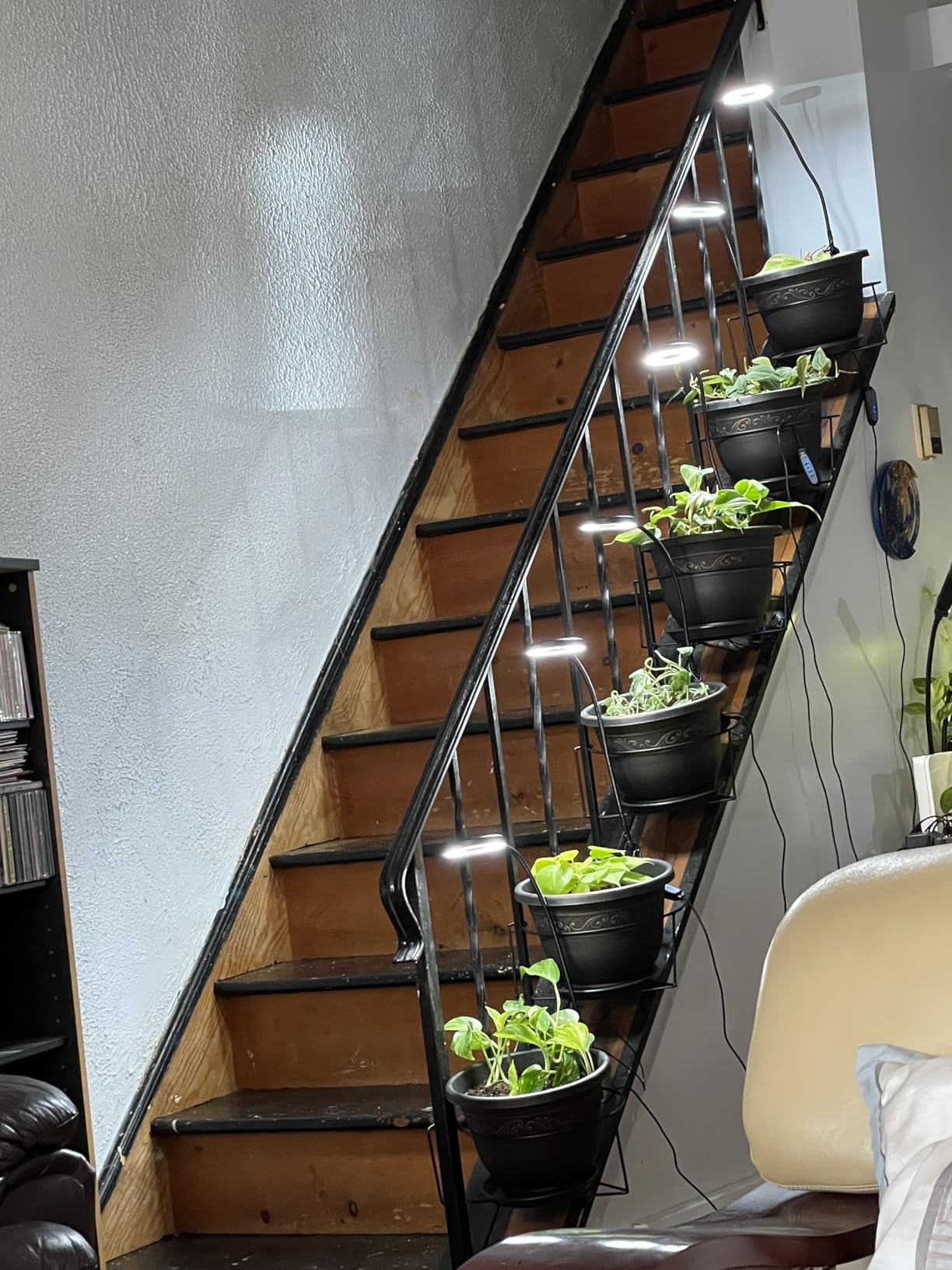
Three modes, five dimming levels and an upgraded 16 hour timer make it the most generous scheduler in the roundup. Owners growing overwintering citrus and seedlings particularly like the long cycle, and the halo shape spreads light in a broad even pool rather than a narrow beam.
The weight is the catch. Buyers describe the heads as heavy, so a small nursery pot can tip, and the better approach is to mount the light nearby on a shelf edge rather than balancing it on a small pot.
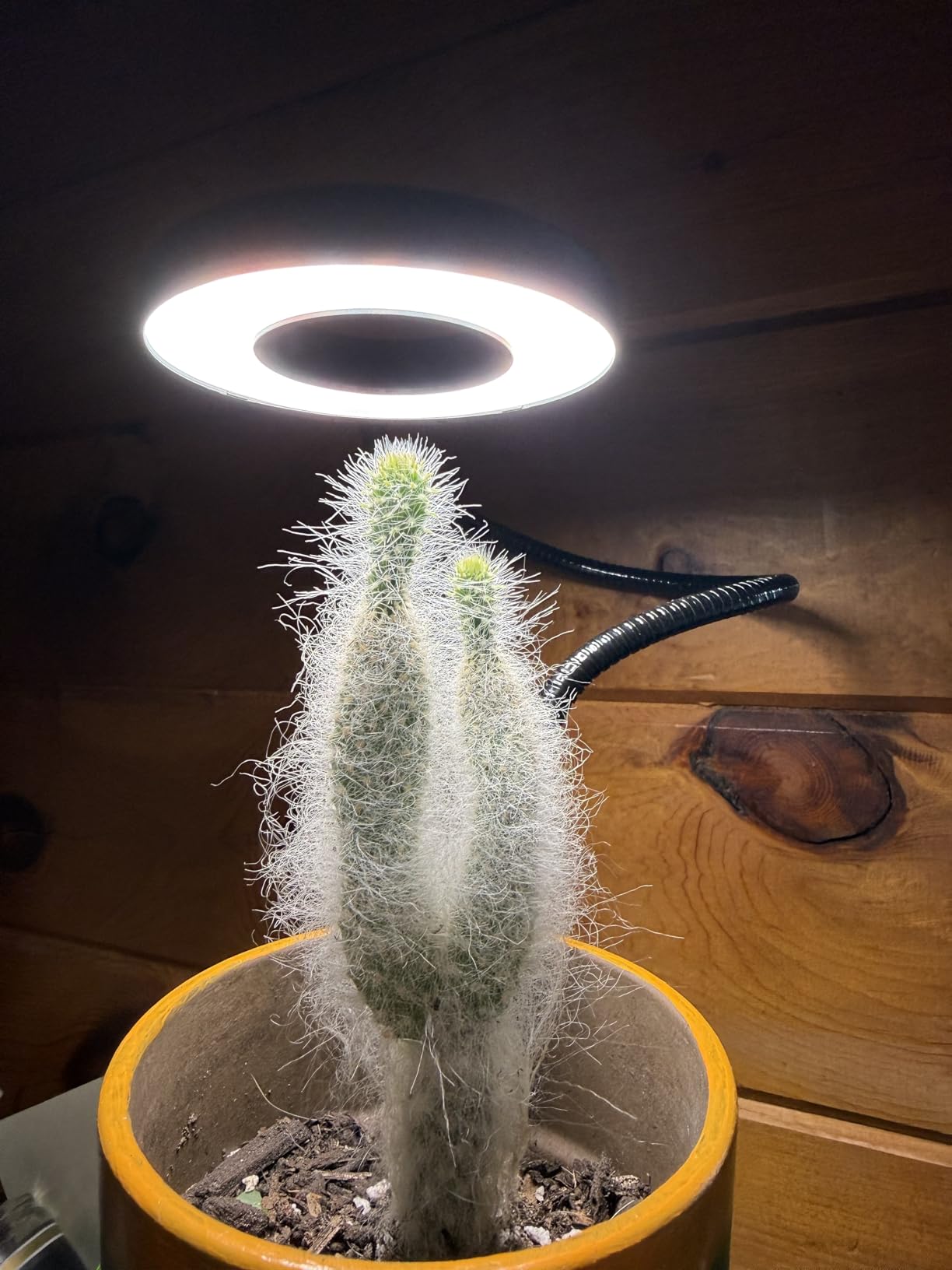
Clip versus stake: choosing per plant
The ground stake is the useful half for plants in lightweight plastic nursery pots and shallow bowls, where a clamp would sit at an awkward angle. Insert the stake into the soil, position the head low over the foliage and the plant leans into the light.
The clip is better for taller plants and for pots on a shelf where there is nothing to stake into. Having both in the box means you can move a single halo between a windowsill herb and a shelf plant as your collection changes.
Timer reliability and the 16 hour setting
The 16 hour cycle is longer than most clip lamps allow and is well suited to winter growing. One buyer reported the timer failing on every light in the pack across all time settings, so treat the timer as the part most worth testing on arrival.
Like most cycle-memory timers, it resets after a power outage, so re-check the setting if your building has unreliable power. Testing the timer for one full cycle when the lights arrive is the single best thing you can do to protect a long-term purchase.
Weight, stability and the fixture count
Three lights at 30W each is a meaningful amount of power and heat in one room, and the heads are heavy for their size. Balance matters: a heavy head on a light pot tips the pot over time as the plant grows.
This is the pick for someone who already knows they have three separate spots to light, since the value of a three-pack drops sharply if one light ends up stored in a drawer.
11. Shyineyou Compact 5W 4000K Clip Light – The Smallest Light for Desks and Dorms
Grow Lights for Indoor Plants, 4000K Full Spectrum Plant Lights for Indoor Growing, 10 Brightness & 360° Adjustable Gooseneck & 3/9/12H Timer, Clip-on Small Grow Light for Succulents, Small Plant
5W and 15 LEDs
4000K with CRI 97
10 brightness levels
3/9/12 hr timer
+ Pros
- Smallest and lightest option here
- 4000K with CRI 97 renders plant colour naturally
- Ten brightness levels and a 3/9/12 hour timer at this price
- 78.74 inch USB cable gives good reach
- Compact enough for a dorm desk or windowsill
– Cons
- Only 5W and 15 LEDs so coverage is limited
- Lowest review count in this roundup at 318 ratings
- Compact body cannot reach over taller plants
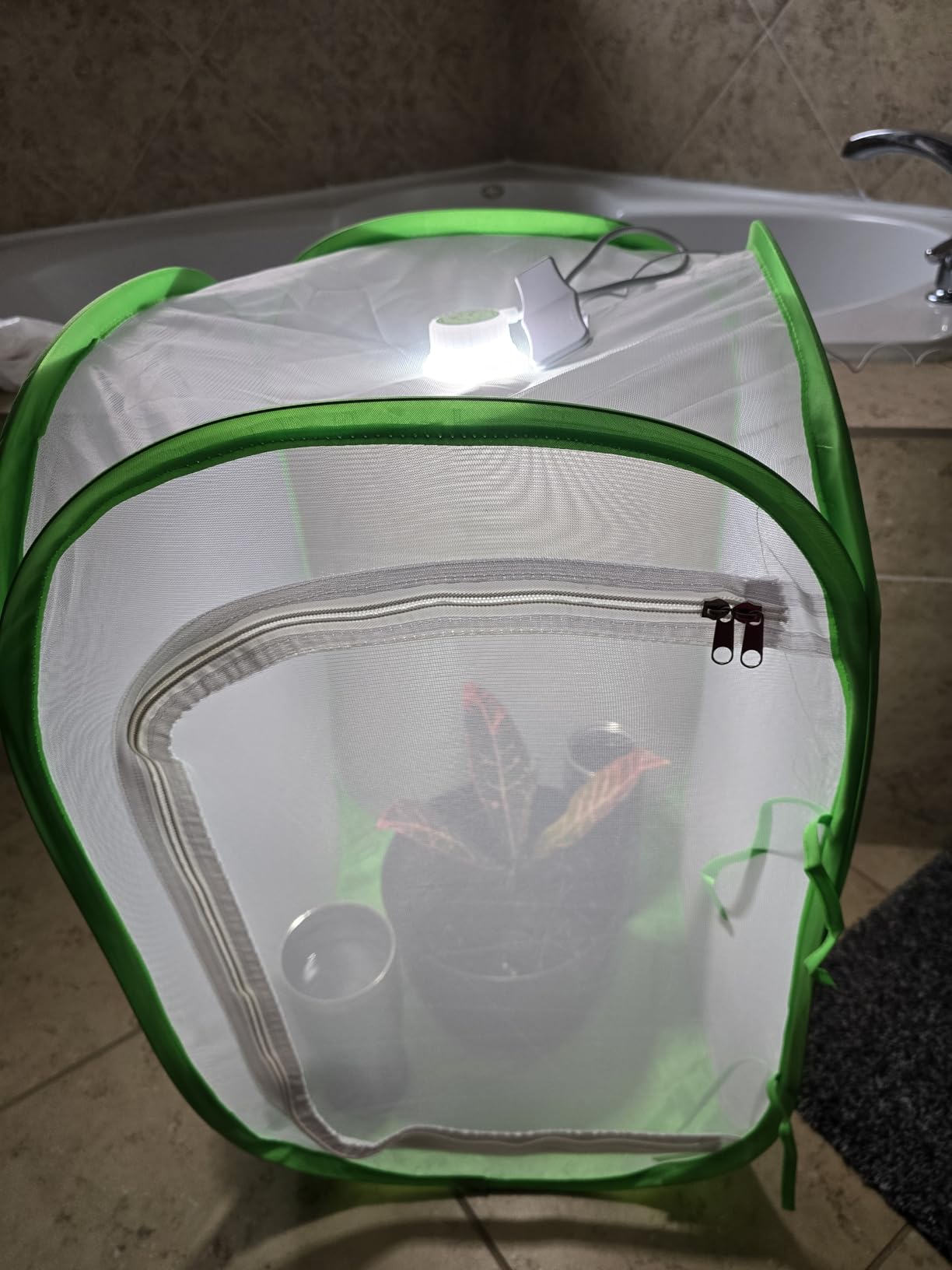
This is the one I recommend when space is the binding constraint. A dorm room, a single office desk or a narrow windowsill is where the 12.8 inch-tall body earns its place, because a taller lamp simply will not fit in the gap above the pot.
It runs at 5W across 15 LEDs with a 4000K full spectrum and a colour rendering index of 97, which is the highest CRI in this roundup. In practice that means greens look green under it, which is a nice quality for a light you keep at eye level.
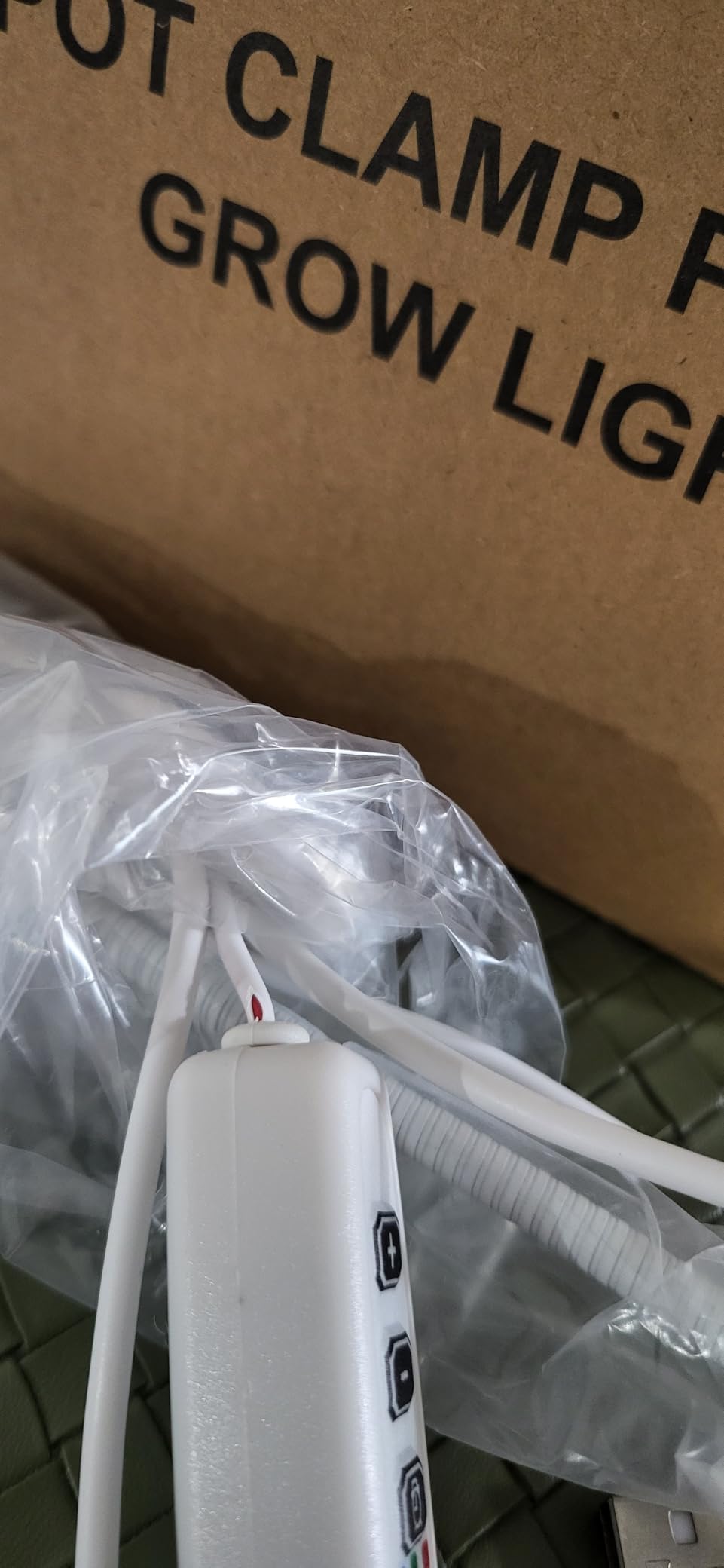
Despite the small size it has a full control set: ten brightness levels and a 3, 9 and 12 hour auto on and off timer, with a 360 degree gooseneck and a sturdy clip. The 78.74 inch USB cable gives enough slack to reach an outlet from a shelf or a desk without an extension lead.
It is a low-voltage unit, so you can drive it from a laptop, a power bank or a small USB supply, which makes it a genuinely portable option for a renter who moves apartments often.
What 5 watts actually covers
A 5W fixture with 15 diodes is sized for succulents, seedlings, cuttings, herbs and one small potted plant. It is not a room light, and no timer setting changes the physical size of the area it can illuminate.
Rule of thumb: if the plant’s widest leaf span is roughly the width of the lamp head, the light will reach it evenly. Beyond that, you are lighting the centre of the pot and leaving the outer growth in the dark.
Why a 78 inch cable matters more than it sounds
Short cords are the most common reason a good light ends up unused. The plant sits where the light is best, and the light ends up where the outlet is, and the compromise is always made badly.
A cable just under 79 inches is long enough to bridge a shelf depth or run along a desk to a wall outlet behind furniture. For a rental where you cannot drill or run permanent cable, that reach is the feature that makes the light usable.
Dimming levels for a light at eye level
Ten brightness levels is a generous amount of control for such a small lamp, and the low settings matter because a bright light 18 inches from your face on a desk is uncomfortable at full power.
I run this one at the lower third for a desk herb and a succulent, which is bright enough to sustain growth and dim enough to work beside. Turn it up when you are away from the desk for a stretch of the day.
12. Sonamindary 60 LED Single-Head Clamp – The Gooseneck That Does Not Wobble
Sonamindary Grow Lights for Indoor Plants, Clip-On LED Clamp, Single Head
60 LEDs at 5700K
Silicone-sleeved flexible arm
5 brightness levels
4/8/12 hr timer
+ Pros
- Silicone sleeve keeps the arm steady with far less wobble
- Simple 4/8/12 hour timer with easy setup
- Single head covers one plant without excess light
- Runs silently and suits seedlings succulents and herbs
- Compact clamp frees up desk surface space
– Cons
- Short arm cannot arch over larger plants
- Clamp will not grip round frames such as wrought iron
- One unit arrived dead on first power up
- CRI 85 is the lowest colour rendering here
Almost every complaint about gooseneck plant lights is the same: the arm bends to position and then slowly droops or trembles, so the beam wanders off the plant. The fix here is a silicone sleeve over the flexible metal arm, and it works. The head stays exactly where I put it.
The lamp is a single 60 LED head at 5700K, split into 48 white, 8 red and 4 blue, running at 10W. Single head means you light one plant rather than a whole shelf, which is the right choice when you do not want to blast everything with the same schedule.
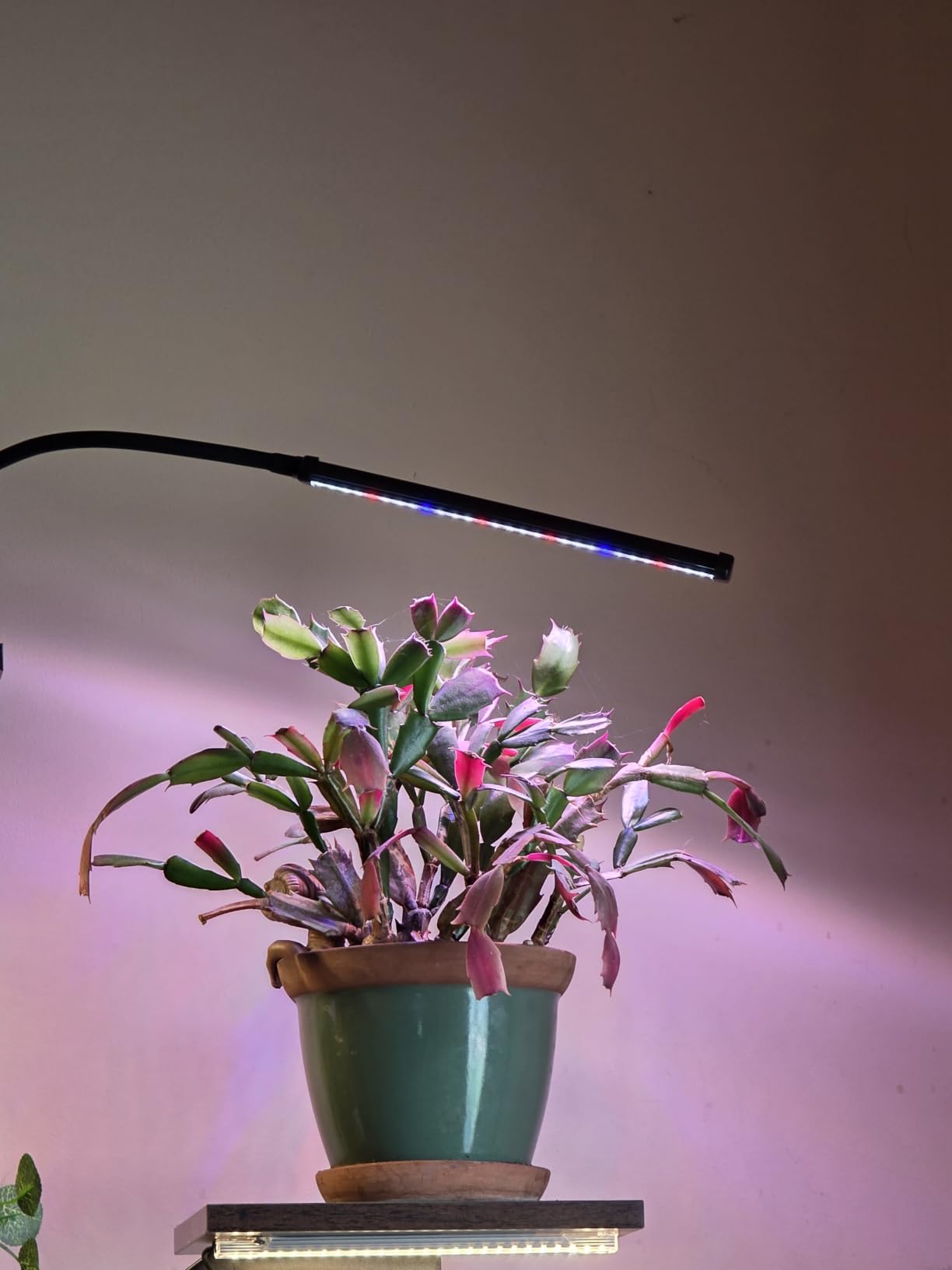
Five brightness levels from 20 to 100 percent and a 4, 8 or 12 hour timer that repeats every 24 hours cover the basics without any menu diving. It runs silently, which matters if it lives on a desk or a bedside table.
Two things to plan around. The arm is short, so it cannot bend over the top of a tall plant and the beam can catch your eye if it is aimed down a corridor. And the clamp needs a flat edge, so a round wrought iron plant stand frame is out.
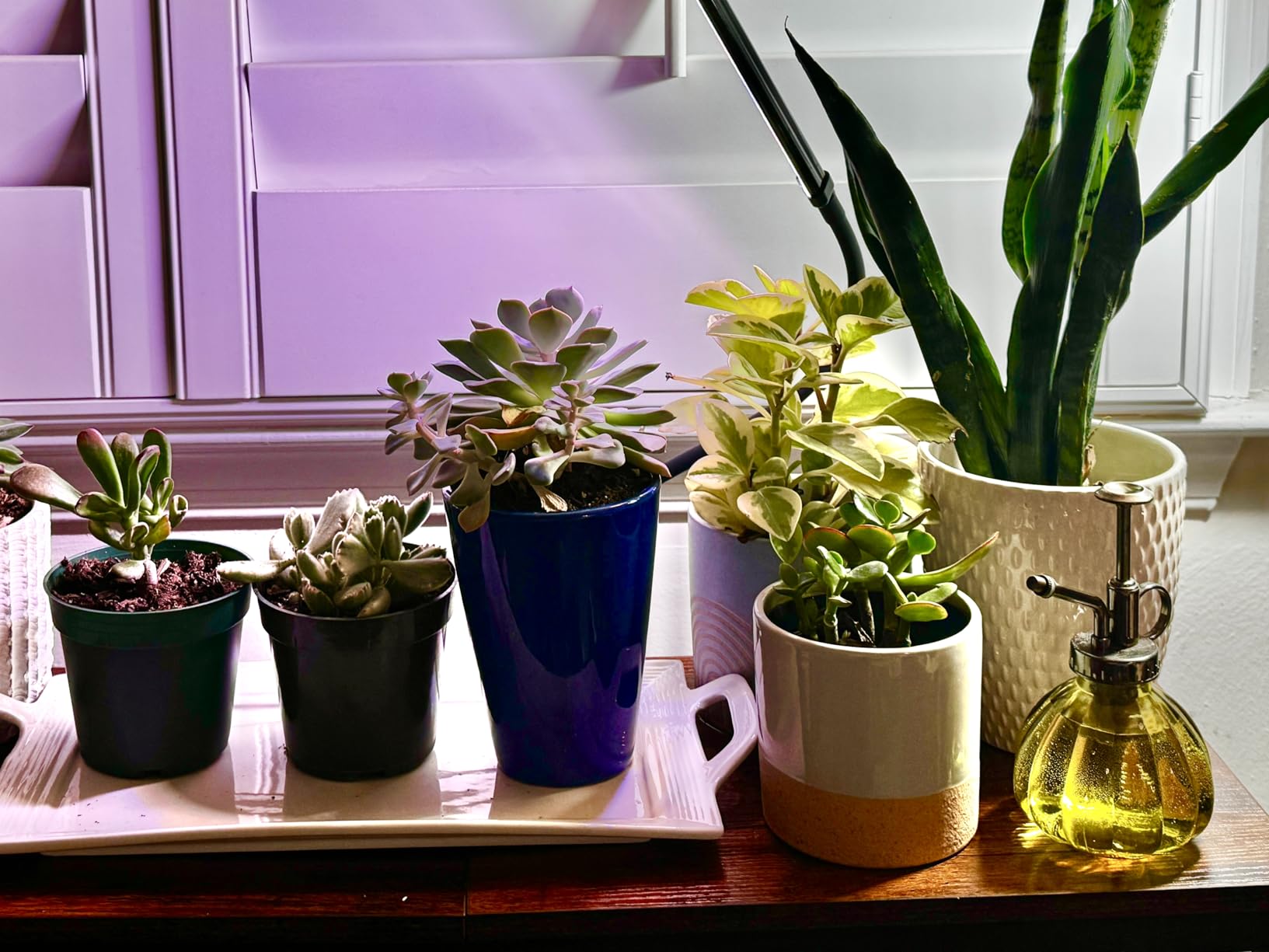
The silicone sleeve and the droop problem
A bare gooseneck under load acts like a spring. Bend it to reach a plant and the stored tension pulls the head back toward the vertical over days or weeks, which is why so many clip lamps end up pointing at the ceiling.
The sleeve adds stiffness without removing the adjustment, so you still reposition the head as a plant grows. It is a small design decision that removes the most common long-term frustration with this category of light.
One head versus four: precision over coverage
Most people using a clip lamp have one plant that is struggling, not eight. A single head concentrates the output on that pot instead of spreading it thinly across a shelf, and it leaves the rest of your plants to their window.
The compact clamp also frees up surface space, since there is no base to stand on the desk. That matters in a small office where the desk is already doing three jobs.
Colour rendering, the arm length and when to skip this one
A CRI of 85 is the lowest here, so colours under this lamp are slightly flatter than under a high-CRI unit. It is perfectly adequate for plant work, and less so if you are using the same lamp to assess photography or product colour.
Skip it if your plant is tall and bushy, because the short arm cannot reach over the canopy. Pick it if you want a stable, quiet, single light for one pot on a desk or a small shelf, and you have a flat edge to clip onto.
How to Choose a Clip On Grow Light
Most wrong purchases in this category come down to three things: buying more light than the plant needs, discovering the clip does not fit the pot, or running out of cord before reaching an outlet. Work through the following in order and you will rarely go wrong.
Match wattage to the light needs of your plant
Light needs fall into three tiers, and matching the tier is more useful than any brand name. Low-light plants include pothos, philodendron, most ferns and calathea. Medium covers most tropical foliage like monstera, rubber plants and bird of paradise. High light is for succulents, cacti, aloe, fiddle leaf fig and indoor citrus.
A rough mapping: 5 to 10W suits a single low to medium plant, 15 to 20W covers a bushy tropical or a succulent cluster, and 30W plus is reserved for large specimens and multi-head setups. Above that on a clip lamp you are generally wasting light, because the coverage area becomes the limit rather than the output.
Distance follows the same logic. Clip lights are designed to sit close, typically 6 to 12 inches from the canopy, which is much nearer than the 18 to 24 inches a panel or bar light needs. Closer means heat management matters more, so watch for bleaching rather than assuming more is better.
Clip on versus pendant, tripod and strip
A clip on grow light is the right tool when you rent, when drilling is not an option, when the plants move around, and when you want light on one pot rather than a whole zone. It is the wrong tool for a tall floor plant, because a clip light cannot get above a two-foot canopy and cannot cover a wide footprint.
Pendants hang from above and cover a large area, which suits a dining table of herbs or a cluster of floor plants, but they need a ceiling hook and ceiling space. Tripods stand independently and give height without a ceiling, at the cost of floor space. Strips slide under a shelf and are excellent for a row of pots on one level.
If you have a large floor plant, an under-shelf row or a wide group, a strip or panel will beat a clip lamp every time. If you cannot drill and you want something you can move with you, the clip format is still the best answer available.
Full spectrum white or red and blue blurple
Plants use light in the 400 to 700 nanometre range. Red light in the 610 to 720 nanometre band drives photosynthesis efficiently and helps flowering, while blue light in the 400 to 520 nanometre band keeps growth compact. A light with both is called full spectrum.
Red and blue mixes, often called blurple, are not wrong, and forum growers like them for high-light succulents because they produce less heat. The problem is that a living room lit purple is a hard sell. A white full-spectrum light at 4000K to 6000K does the same job and looks like ordinary household lighting.
If colour rendering matters to you, check the CRI. Anything at 90 or above renders leaf colour accurately, which makes it much easier to spot early yellowing or browning.
Timer settings, daily runtime and electricity cost
Most clip lights use a cycle-memory timer, which means you program the schedule once and it repeats daily without resetting. Cycles cluster around 3, 6, 9 and 12 hours, and a few fixtures add 16 or 20 hours. The key number is not the total but whether the memory survives, because a timer that resets on every power blip is worse than no timer.
Runtime guidance: low-light plants on 8 to 10 hours, most tropical foliage on 12, and succulents, cacti and indoor citrus on 12 to 16. Give a plant more light by raising brightness or moving the lamp closer before you extend the day, because a longer day on an already bright plant invites light burn.
Electricity cost is smaller than most people expect. Take a 10W lamp on 12 hours a day: 10 watts multiplied by 12 hours multiplied by 30 days is 3.6 kilowatt hours a month. Even the 36W draw of the brightest light here comes to about 13 kilowatt hours a month at a 12 hour photoperiod, which is less than a single clothes dryer run.
Clip strength, cord reach and outlet placement
Check three physical things before you order. First, the clip opening against your widest pot rim, since thin-walled plastic nursery pots are the hardest case and some clamps need a flat edge rather than a round one. Second, the cord length against the distance from your nearest outlet to where the plant needs to sit. Third, whether the gooseneck can physically reach the canopy without drooping or aiming into your eyes.
Gooseneck droop is the most common long-term complaint in this category, and a silicone-sleeved arm resists it better than a bare one. If your plant is tall, check the maximum reach stated for the fixture before you buy, because a short arm will end up pointing at the ceiling.
For a shelf, clip to the underside of the shelf above and let the gooseneck reach down, rather than clipping to the side of a narrow shelf where the head ends up at an awkward angle. Keep cords out of the path of watering cans, and never leave a plug where water can run down the cable.
What a grow light cannot fix
Light is one input among several, and no fixture corrects a problem that lives elsewhere. Low humidity, overwatering, poor drainage, root rot and depleted soil will all damage a plant under a perfect lamp, and adding hours of light to a root-rot plant makes it worse.
Before you buy a light, check three things: whether new growth is leggy and pale, whether lower leaves are dropping, and whether the plant is pot-bound or in stale soil. Light deficiency shows as long internodes, small pale new leaves, leaning toward a window and loss of variegation. Light burn shows as bleached white or brown patches on the leaves nearest the lamp, with the rest of the plant looking healthy.
Also remember that a dark-window plant that is healthy does not need a lamp. If your plant is not actively growing leggy or fading, a ring grow light for seedlings aimed at propagation trays may be the better spend than a permanent clamp on your display shelf.
Frequently Asked Questions
Do grow lights actually work for houseplants?
Yes, when they are close enough and bright enough. Houseplants in typical indoor rooms receive a few hundred foot candles, far short of the several thousand that direct outdoor sun delivers. A clip light placed 6 to 12 inches above the canopy for 8 to 12 hours a day reliably fixes leggy growth, lower leaf drop and fading variegation. They will not fix root rot, overwatering or low humidity.
What wattage grow light do houseplants need?
About 5 to 10W for a single low or medium light plant, 15 to 20W for a bushy tropical or a succulent cluster, and 30W or more for large specimens and multi-head setups. Low-light plants such as pothos, philodendron and ferns need the least, while succulents, cacti, fiddle leaf fig and indoor citrus need the most. Distance matters as much as wattage, and clip lights are designed to sit 6 to 12 inches from the foliage.
How many hours should grow lights be on for indoor plants?
Run low-light plants 8 to 10 hours a day, most tropical foliage plants 12 hours, and succulents, cacti and indoor citrus 12 to 16 hours. Increase brightness or move the lamp closer before lengthening the day, because a longer photoperiod on an already bright plant causes light burn. A built-in cycle-memory timer means you set the schedule once and it repeats daily without resetting.
What is the best clip-on grow light?
The SANSI 5W clip-on plant light is the best all-round clip-on for most homes, combining a ceramic LED with a 4000K natural tone, a clamp that grips a standard pot rim, a 3/6/12 hour timer with four dimming levels and 5V USB power. For a whole shelf choose a two-pack with four heads, and for a large tropical plant choose a higher-output gooseneck light with replaceable bulbs.
Are clip-on grow lights better than bulbs or panels?
It depends on your space. Clip lights win in rentals and dorms because nothing is drilled, they move with the plant, and they light one pot precisely. Panels and bars win for large floor plants, wide groups of pots and under-shelf rows because they cover a large area at a uniform distance. A clip lamp cannot get above a tall canopy, so a large plant needs a different format.
Why is my plant still growing leggy under a grow light?
Usually the light is too far away, too weak, or on for too few hours. Check the distance first, since clip lights are designed for 6 to 12 inches and anything beyond that loses intensity quickly. Then check the brightness setting, because a dimmed timer setting may not deliver enough output. Finally confirm the photoperiod is long enough, since many light-hungry plants need 12 to 16 hours.
Which Clip On Grow Light Should You Buy in 2026
If you want one answer, take the SANSI 5W clip-on. It is the light I keep on the shelf, it grips a pot rim properly, its 4000K tone is pleasant in a living room, and the 3/6/12 hour timer means you set it once and stop thinking about it.
If your priority is a different one, route accordingly. Buy the Wolezek two-pack when you have a whole bookcase of plants to cover and want two mounting points. Buy the GooingTop 100W lamp when a large, light-hungry plant sits in a dark corner and nothing else has worked. Buy the SANSI 20W gooseneck for a bushy tropical or a fiddle leaf fig where output and colour rendering matter most.
Choose the Xuligron three-pack when you want both clip and soil stake mounting across three spots, the RWNTAO two-head when you are covering a budget setup of small plants, and the Shyineyou compact 5W when your only space is a dorm desk. For a wide shelf with several medium pots, the Shyineyou four-head gives you the coverage; for a single desk plant, the Sonamindary single-head gives you a steady arm that will not droop.
Two things to check before you order, every time. Measure your widest pot rim against the clip opening, and measure the distance to your nearest outlet against the cord length. Those two checks eliminate most of the disappointments people report with clip on grow lights, and they take a minute.
Whichever light you choose, run the timer through one full cycle when it arrives, and keep the lamp 6 to 12 inches from the foliage. If you want a broader view of lighting options beyond the clip format, our roundup of grow lights for indoor plants covers the bulbs, pendants and panels that large floor plants actually need.
Leave a Reply