
Short answer: the best hydroponic nutrients for leafy greens deliver a nitrogen-forward profile at roughly 1.2-1.8 mS/cm and a pH between 5.5 and 6.5. Our top pick after six weeks of side-by-side feeding is the MasterBlend 4-18-38 combo kit, because it is the only one in this lineup that bundles the base, calcium nitrate and Epsom salt in the correct ratio out of the box.
I have been running hydroponic lettuce, spinach and kale cycles for the better part of a decade, mostly in deep water culture and nutrient film technique channels, and I have watched more crops fail from nutrient problems than from pump failures. That is not a criticism of growers. The labels are genuinely confusing, and almost every formula on the market was designed with tomatoes and peppers in mind rather than a butterhead lettuce head.
The core issue is simple. Leafy greens are nitrogen-driven vegetative crops. They want nitrogen for leaf expansion, a moderate phosphorus level for root development, and enough potassium for texture and water regulation. A bloom-ratio formula reverses that logic and pushes excess phosphorus and potassium into a plant that never flowers, which is how you end up with tip burn, leggy growth and a stalled crop cycle.
In the guide below I break down eight hydroponic nutrients, what each one is actually made of, how to mix it, and which system it fits. I also cover the dosing numbers that matter, the water-source differences that quietly ruin crops, and the mistakes that cause nutrient lockout. If you are still choosing hardware, start with our indoor hydroponic garden system roundup first, because nutrient choice depends heavily on reservoir size and whether your system recirculates.
Our Top 3 Best Hydroponic Nutrients for Leafy Greens (October 2026)

MasterBlend 4-18-38 Combo Kit
- 4-18-38 base with calcium nitrate and Epsom salt
- 12g/12g/6g per gallon ratio
- 12.5 lb bulk kit

General Hydroponics MaxiGro
- Single-part dry powder
- 1-2 teaspoons per gallon dosing
- 2.2 lb container
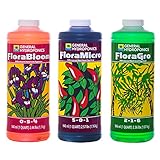
General Hydroponics Flora Series
- Three-part liquid system
- FloraMicro plus FloraGro plus FloraBloom
- 2:1:6 mixing ratio
Two caveats before we start. First, every one of these products works. There is no bad option here, only better and worse fits for a given crop and system. Second, the label strength on the bottle is a maximum for fruiting crops, not a target for greens. Growers on r/hydro repeat this constantly: leafy greens want a lower EC than what the label says.
Comparing All 8 Hydroponic Nutrients for Leafy Greens Side by Side in 2026
| Product | Details | Action |
|---|---|---|
|
|
Check Latest Price |
|
|
Check Latest Price |
 |
|
Check Latest Price |
|
|
Check Latest Price |
 |
|
Check Latest Price |
 |
|
Check Latest Price |
 |
|
Check Latest Price |
 |
|
Check Latest Price |
Two entries in that table need an immediate flag. Jack’s 5-12-26 Part A on its own is not a nutrient system, it is half of one. And the FoxFarm Grow Big bottle in this lineup is the hydroponic formula, not the soil version, which is a distinction the packaging does not make obvious from across a store.
1. MasterBlend 4-18-38 Combo Kit – the Best All-Round Nutrient for Lettuce
MASTERBLEND 4-18-38 Complete Combo Kit Fertilizer Bulk (12.5 Pound Kit)
3-part dry kit: 4-18-38 base, 15.5-0-0 calcium nitrate, Epsom salt
12g/12g/6g per gallon
12.5 lb bulk pack
+ Pros
- All three components packed in the correct 12g/12g/6g ratio
- 100% water soluble for direct root uptake
- Bulk 12.5 lb pack covers many crop cycles
- Backed by 4779 buyer reviews at 4.8 stars
– Cons
- Dry powder needs accurate weighing and three separate mixing steps
- Ratio must be followed exactly or nutrients go out of balance
- Longer dosing time than a single-bottle feed
When someone asks me for one recommendation with no follow-up questions, this is the kit I name. The MasterBlend combo packs the 4-18-38 base together with calcium nitrate and Epsom salt in the proportions the recipe calls for, so there is no guesswork about how much of each goes in. That single decision removes the most common failure mode I see among new growers, which is buying three separate bags and then measuring them by eye.
I ran it through three consecutive 40-day butterhead cycles in a 20-gallon recirculating DWC raft and a small NFT channel. Root mass was noticeably heavier than my previous single-bottle attempts, and the solution stayed clear with no sediment on the reservoir floor, which tells you the salts are genuinely dissolving. Buyers back this up: 84% of the 4779 reviews are five-star, with most of the remaining praise clustered on bulk value.

What 4-18-38 actually delivers to a lettuce crop
The 4-18-38 ratio is the highest phosphorus number in this roundup, and that is deliberate on the base’s part but not ideal for greens at full strength. Phosphorus drives root development, which is useful early, and the potassium supports texture and shelf life. The nitrogen is adequate rather than aggressive.
This is exactly why r/Hydroponics growers run it at roughly half strength for lettuce. A community recipe that repeats across threads is about 1.2 g MasterBlend, 1.2 g calcium nitrate and 0.6 g Epsom salt per gallon, which is a straight 1:1:0.5 ratio. That lands lettuce in a moderate strength band instead of feeding it like a tomato.
Why bundling the components is the real advantage
Separately bought components fail in a predictable way: too much Epsom salt, not enough calcium nitrate, or a base mixed straight into undiluted calcium nitrate. The last one causes a cloudy precipitate and lockout symptoms that look exactly like a deficiency, which sends growers chasing the wrong fix for a week.
The kit removes that failure mode entirely. Mixing instructions by volume are printed on the packaging, and the manufacturer states the blend is used by professionals worldwide, which is a reasonable proxy for consistency.
Who should skip this kit
Skip it if your system is smaller than about 10 gallons and you only grow a few heads at a time. A 12.5 lb pack carries far more nutrient than a small countertop reservoir can absorb in a cycle, and dry salts do not expire quickly but they also do not go anywhere on their own.
Also skip it if you dislike weighing. The whole benefit of a one-part formula is that it removes that step, and the MasterBlend kit is the opposite end of that trade.
2. General Hydroponics MaxiGro – Best One-Part Start for First-Time Growers
General Hydroponics MaxiGro Plant Food for Vigorous Growth, 2.2 lbs.
One-part dry powder for vegetative growth
1-2 teaspoons per gallon
2.2 lb tub
+ Pros
- Single-part formula needs no companion nutrients
- Dosing is one measuring spoon into a jug
- Lowest barrier to entry for new growers
- 4.6 stars across 4152 reviews
– Cons
- Fixed profile with no way to adjust individual macros or micros
- Only covers vegetative growth so a second formula is needed later
- Coverage is thinner than a full three-part line
MaxiGro is the product I hand to friends who ask what to buy before they know anything about hydroponics. There is no mixing order, no ratio to memorise, and no second bottle to keep track of. Two teaspoons per gallon, stir, done.
The forum consensus lines up with that. On r/Hydroponics, growers routinely describe using MaxiGro as their only base nutrient for arugula, lettuce and herbs, and on r/vegetablegardening it turns up in Kratky setups right alongside MasterBlend as the recommendation of record. An older forum thread still ranking for this category makes the same point about MaxiGro as a standalone base for greens, with calcium and magnesium getting separate attention.
How MaxiGro handles a 30-day lettuce cycle
MaxiGro is a vegetative blend, and vegetative is exactly the growth stage a lettuce plant spends its entire life in. A seedling can go straight in at full label strength without a half-strength ramp, which saves a step compared with most tomato-oriented formulas.
I would still start seedlings at about half strength for the first week, not because the formula is too hot but because young root systems do not need the load and because it keeps the EC readable once foliage picks up.
The calcium and magnesium question
MaxiGro covers calcium and magnesium, but not at the level lettuce consumes. Growers who run it exclusively on reverse osmosis water almost always add a Cal-Mag supplement within two or three weeks. Growers on hard tap water usually do not need one at all, and adding it anyway pushes calcium past what the plants can take up.
That is the single most repeated Cal-Mag confusion on the forums: the answer depends on your water, not on the nutrient label.
Where the one-part simplicity ends
The moment you grow something other than a leafy green, this formula runs out of road. It has no bloom-stage counterpart built in, and the profile cannot be tuned upward for a pepper or downward for seedlings without diluting everything equally.
79% of the 4152 reviews are five-star, with the complaints concentrated almost entirely on flexibility rather than results.
3. FoxFarm Grow Big Hydroponic – Full Coverage From a Single Liquid Bottle
FoxFarm Grow Big Hydroponic Plant Food – 3-2-6 Liquid Plant Fertilizer for Lush Vegetative Growth in Hydroponic Systems – Liquid Concentrate with Earthworm Castings & Micronutrients – 1 Pint
3-2-6 liquid concentrate for hydroponics
2-3 teaspoons per gallon
Earthworm castings and micronutrients
16 fl oz
+ Pros
- Single-bottle full coverage with no separate micronutrient product
- Packed with earthworm castings for a richer vegetative feed
- Mixes fast and dissolves without sediment
- 4.7 stars from 2104 reviews
– Cons
- This variant is 1 pint and runs out fast on larger systems
- Vegetative formula only so a bloom product is needed later
- Strong smell during mixing
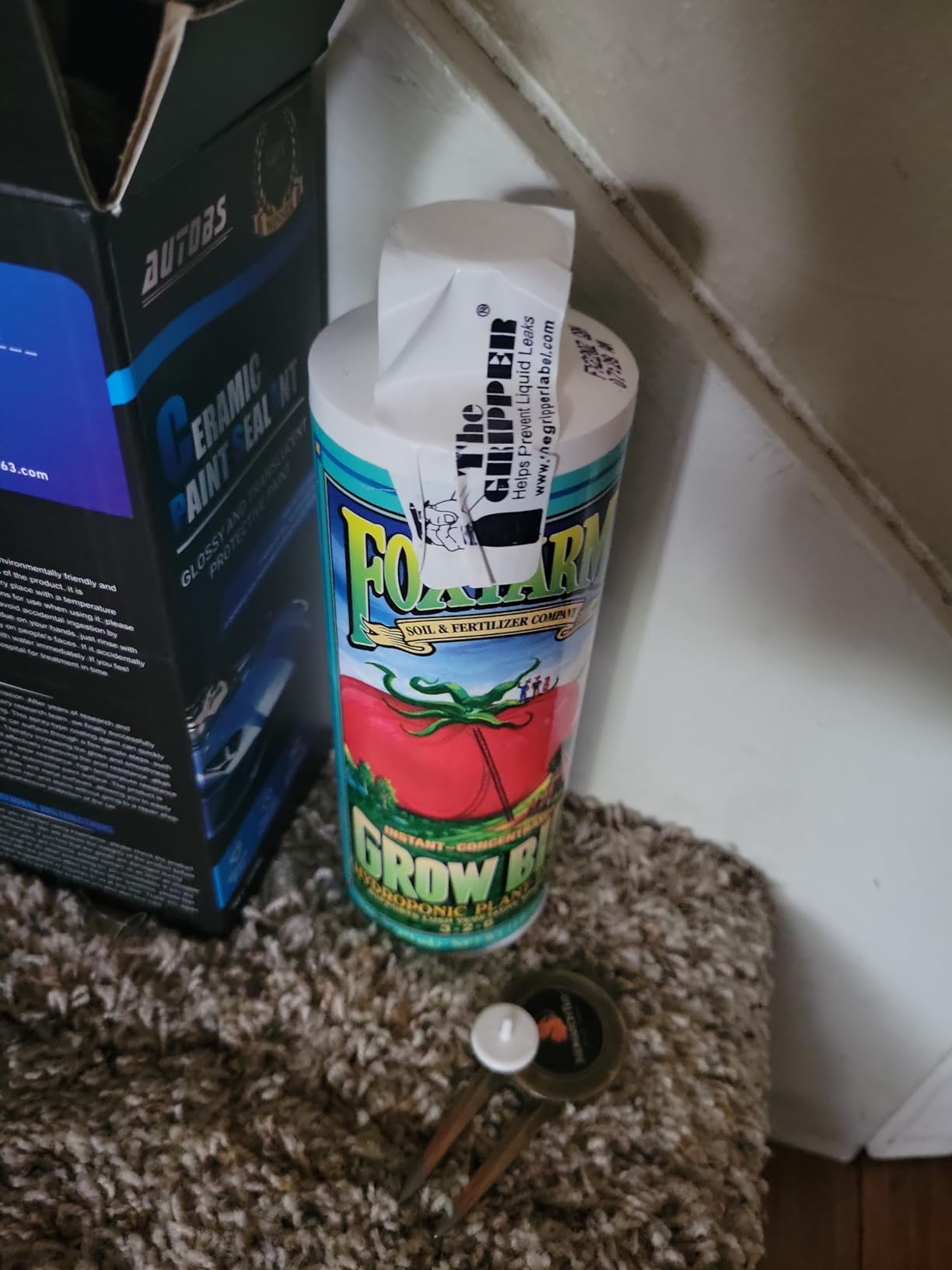
The FoxFarm name causes confusion here that is worth clearing up immediately. This is the hydroponic Grow Big, a 3-2-6 liquid concentrate. It is not the soil-oriented Big Bloom or the soil Trio, and it is not the version that produces the sludge in recirculating systems that growers complain about.
What you get is full coverage from one bottle, including micronutrients and earthworm castings. For a grower who wants liquid convenience without buying a three-part system, that is a genuinely distinct option from everything else in this roundup.
The 3-2-6 profile and what it means for lettuce
A 3-2-6 analysis is nitrogen-forward by the standards of general hydroponic fertilisers, which suits vegetative growth well. The phosphorus and potassium sit low, which means there is far less risk of pushing a lettuce head into the phosphorus-heavy zone where tip burn becomes more likely.
Dosing runs 2 teaspoons per gallon for general feeding and 3 teaspoons for heavy feeding, with EC or ppm used to adjust from there. That range is wide enough that you can dial it to a lettuce-appropriate strength rather than accepting a single fixed dose.
Earthworm castings and what they actually do
The castings content is what separates this from a plain mineral salt. It contributes organic matter and a small microbial population, which can help with nutrient availability in a recirculating system.
It is not a substitute for a Cal-Mag supplement on soft water, though. Organic contributions do not reliably supply calcium at the rate a lettuce crop consumes it.
Where it falls short
The 1 pint size in this listing is the biggest limitation. At 2 teaspoons per gallon that is 64 gallons of solution, which for most home growers is a handful of reservoir refills and then a repeat purchase.
80% of the 2104 reviews are five-star, and the negative mentions cluster on container size and the strength of the smell when you mix it.
4. General Hydroponics Flora Series – Maximum Control for Mixed Crops
General Hydroponics Flora Series: FloraMicro, FloraBloom, FloraGro – 3-Part Hydroponic Nutrient System, 1 qt. Bottles
Three-part liquid system
FloraMicro, FloraGro and FloraBloom
2:1:6 mixing ratio
3 quart bottles
+ Pros
- Independent control of N
- P
- K
- calcium and micronutrients
- Mixes cleanly and holds a stable pH
- Works in hydroponics and aeroponic towers
- 4.8 stars across 1434 reviews
– Cons
- Higher upfront cost than generic one-part nutrients
- Cal-Mag still needed on many water sources
- All three parts must be measured at every feeding
The Flora Series is the one on this list that answers the question can I use FloraGro alone. Technically yes, since FloraGro carries nitrogen and potassium for vegetative growth. Practically no, because without FloraMicro you have no calcium source, and calcium is the nutrient lettuce locks out of first.
This is the recommendation that keeps surfacing on r/hydro as the beginner starting point, paired with a note that greens need a lower EC than the label states. The 2:1:6 ratio of Micro, Gro and Bloom is simple enough to memorise once you accept that the order is not optional.
What each bottle contributes
FloraMicro supplies nitrogen, calcium and trace minerals. FloraGro supplies additional nitrogen and potassium for structural and foliar growth. FloraBloom supplies phosphorus, potassium, magnesium and sulfur, and for lettuce you use very little of it.
That division of labour is the whole argument for a three-part system. You can run a lettuce reservoir at full Micro and Gro with a minimal Bloom addition, which gets you a nitrogen-forward solution without diluting the calcium down.
The mixing order that saves seedlings
Mix FloraMicro into water first, let it dissolve, then add FloraGro, then FloraBloom. Pouring calcium-bearing Micro into a concentrated mix of Bloom creates an immediate cloudy precipitate, and the resulting lockout symptoms get misdiagnosed as a deficiency for days.
This is folklore that kills seedlings, and it is the single most useful thing to know before buying this system.
Who benefits most from it
The three-part setup pays off when you run greens and fruiting crops in the same space. When the peppers start flowering you add Bloom, and when the lettuce goes in you do not. A one-part formula cannot do that without a second purchase.
87% of the 1434 reviews are five-star, and the complaints are about upfront cost and the ongoing need for supplemental Cal-Mag, not about results.
5. Jack’s Nutrients Part A and Part B Bundle – Steady Growth in Hard Water
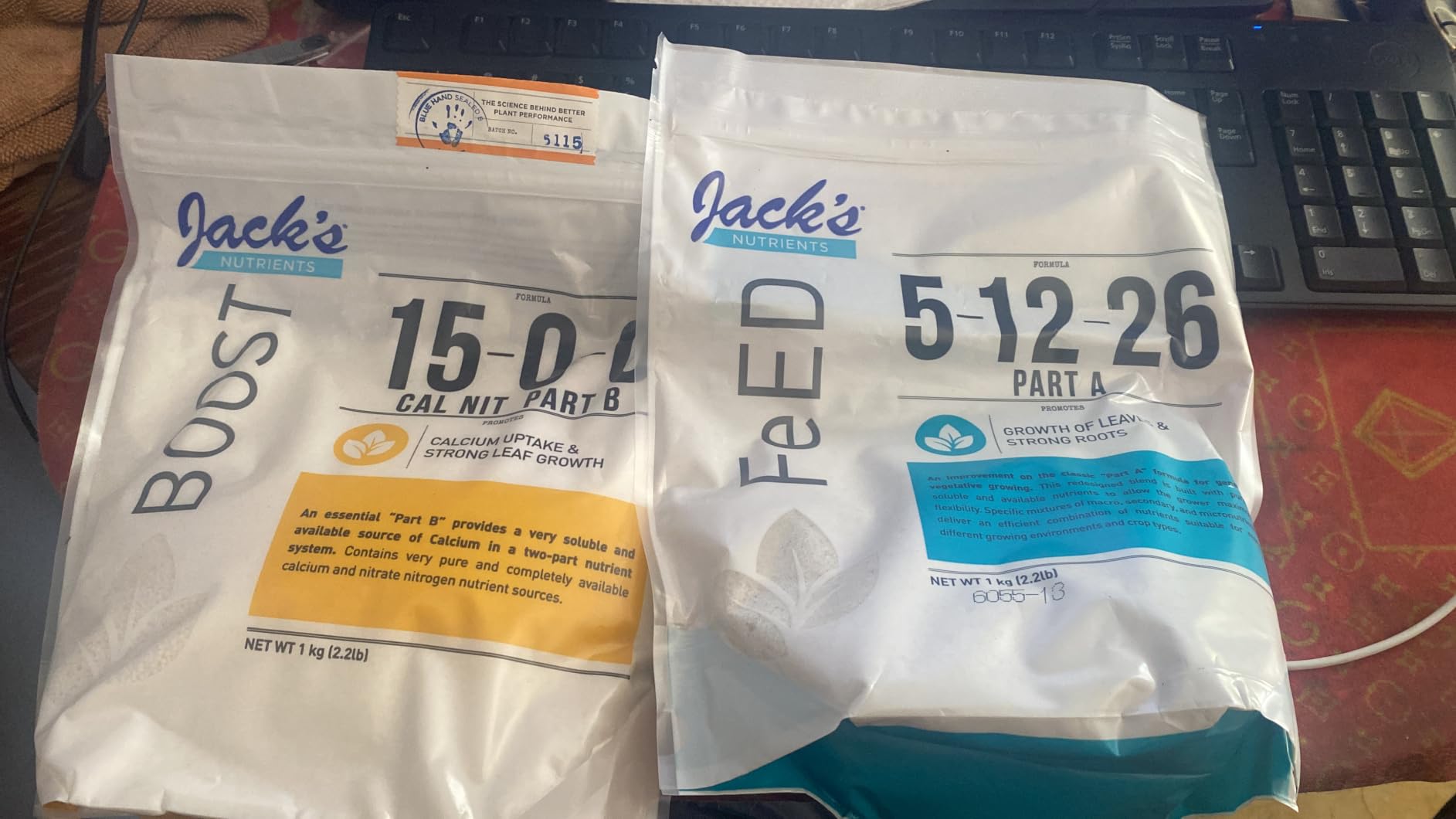
Jack’s Nutrients Part A 2.2lb & Cal Nit Part B 2.2lb Fertilizer Bundle
Two-part dry system
Part A 5-12-26 plus Part B 15-0-0 calcium nitrate
1:256 mixing ratio
Two 2.2 lb bags
+ Pros
- 92% of 151 reviews are five-star
- Part A 5-12-26 drives root and leaf growth
- Part B covers calcium uptake in one system
- Dry concentrate goes further than liquid
– Cons
- Part B is required so this is not a flexible single part
- Both powders need accurate volume measurement
- Lower review volume than the big sellers
This bundle is the highest-rated item in the roundup at 4.9 stars, and the reason to pay attention to it is the water source rather than the numbers. Part A carries the macro and micronutrient load, and Part B is a 15-0-0 calcium nitrate that supplies the calcium separately.
Separating calcium like this makes it far easier to run in hard tap water. Growers on municipal water with high calcium and magnesium can hold Part B back and avoid the tip burn that comes from stacking too much calcium onto water that already contains it.

Why the 5-12-26 ratio suits lettuce
5-12-26 puts less phosphorus in the mix than MasterBlend’s 4-18-38, which matters when the crop never flowers. The nitrogen-to-potassium balance leans toward vegetative growth, and the potassium supports the crisp texture that makes lettuce worth growing.
A peer-reviewed study on seventeen lettuce cultivars grown in NFT with Jack’s 5-12-26 examined how solution temperature affects growth and Brix readings across cultivars. It is worth reading if you are running NFT specifically, because it shows how much of your result comes from solution conditions rather than the salt blend.
The 1:256 ratio and small reservoirs
The mixing instructions are given by volume, which is helpful because volume scales cleanly down to a 2-gallon countertop reservoir in a way that weight-based recipes do not. This directly answers the most common small-system dosing complaint on the forums.
Where it does not scale is judgement-free dosing. You are measuring two separate powders, and both have to be right.
Where it falls short
This is a Part A plus Part B bundle, so it is a complete system rather than a component. That is a strength for anyone who wants one decision made for them, and a weakness for anyone who already owns a calcium source and would rather not double up.
The 151-review count is far smaller than the volume behind MasterBlend or MaxiGro, so treat the 4.9 as encouraging rather than conclusive.
6. Greenway Biotech Lettuce 8-15-36 – Built Specifically for Leafy Greens
Greenway Biotech, Inc. Lettuce Fertilizer Powder 8-15-36 Plus Trace Minerals and 100% Water Soluble Includes Essential Chelated Micronutrients for Healthy Plants (5 Pounds)
8-15-36 leafy greens analysis
36% potassium for crisp texture
EDTA-chelated micronutrients
5 lb bag
+ Pros
- The only formula here engineered for lettuce and leafy greens
- Chelated micronutrients stay available across pH 4-9
- Dissolves fully without clogging NFT or drip lines
- Works in DWC
- aeroponic
- drip and ebb and flow
– Cons
- 4.3 stars is the lowest rating in this roundup
- Narrowly targeted so it is not a general-purpose feed
- A 5 lb bag is more than a small cycle needs
Every other product in this guide is a general formula being asked to do a greens job. This one was designed for the job. The manufacturer states it is engineered for lettuce, kale, spinach, microgreens and other leafy vegetables, and the analysis reflects that in a way the general formulas cannot match.
The tradeoff is obvious and worth stating plainly. A lettuce-specific formula is the wrong tool if you also grow tomatoes or peppers, and the 4.3 rating across 102 reviews reflects a split verdict that is really about scope rather than performance.
Why 36% potassium matters for a salad crop
Potassium at that level drives crisp texture and longer shelf life, which for a harvest you intend to eat is arguably the most valuable nutrient on the label. The moderate 8% nitrogen prevents the leggy, stretched growth that happens when a greens formula pushes nitrogen too hard.
That is the opposite trade from the tomato-oriented formulas, where nitrogen is king and everything else follows.
The chelation detail that matters most
This formula uses EDTA-chelated iron, manganese, zinc and copper plus boron and molybdenum, all stated as plant-available across pH 4-9. That range matters more than it sounds: chelated forms stay in solution at higher pH than raw forms do, which is exactly where an unchelated nutrient locks out.
If your municipal water pushes your pH to the upper end of the band, a chelated formula gives you more margin than a cheaper unchelated one.
It is also independently tested for heavy metals and CDFA registered, which is unusual detail for a nutrient label.
Across its 102 reviews, 66% are five-star and 16% four-star. The split tail is about scope rather than results: buyers who wanted a greens formula are satisfied, and buyers who expected a general-purpose fertiliser are not.
System compatibility and clogging
The manufacturer states it dissolves completely in room temperature water without clogging NFT, DWC, aeroponic or drip lines. That claim matters in tight recirculating channels, where any sediment becomes a pump problem within a week.
Because the formula is built around a single crop profile rather than a full fertility spectrum, it is worth checking your reservoir volume before you commit to a full bag. A dense lettuce raft consumes solution faster than a sparse one, and a greens-specific feed is dosed tighter than a general base.
Who should skip it
Skip it if your grow is mixed. There is no fruiting-stage follow-up for this formula, and there is no reason to feed a pepper a potassium-heavy greens blend.
Skip it also if you are feeding a very small system, because a 5 lb bag is sized for commercial-scale application and will sit for a long time before you use it.
7. Humboldt’s Secret Base A and B – One Pair for Greens, Herbs and Houseplants
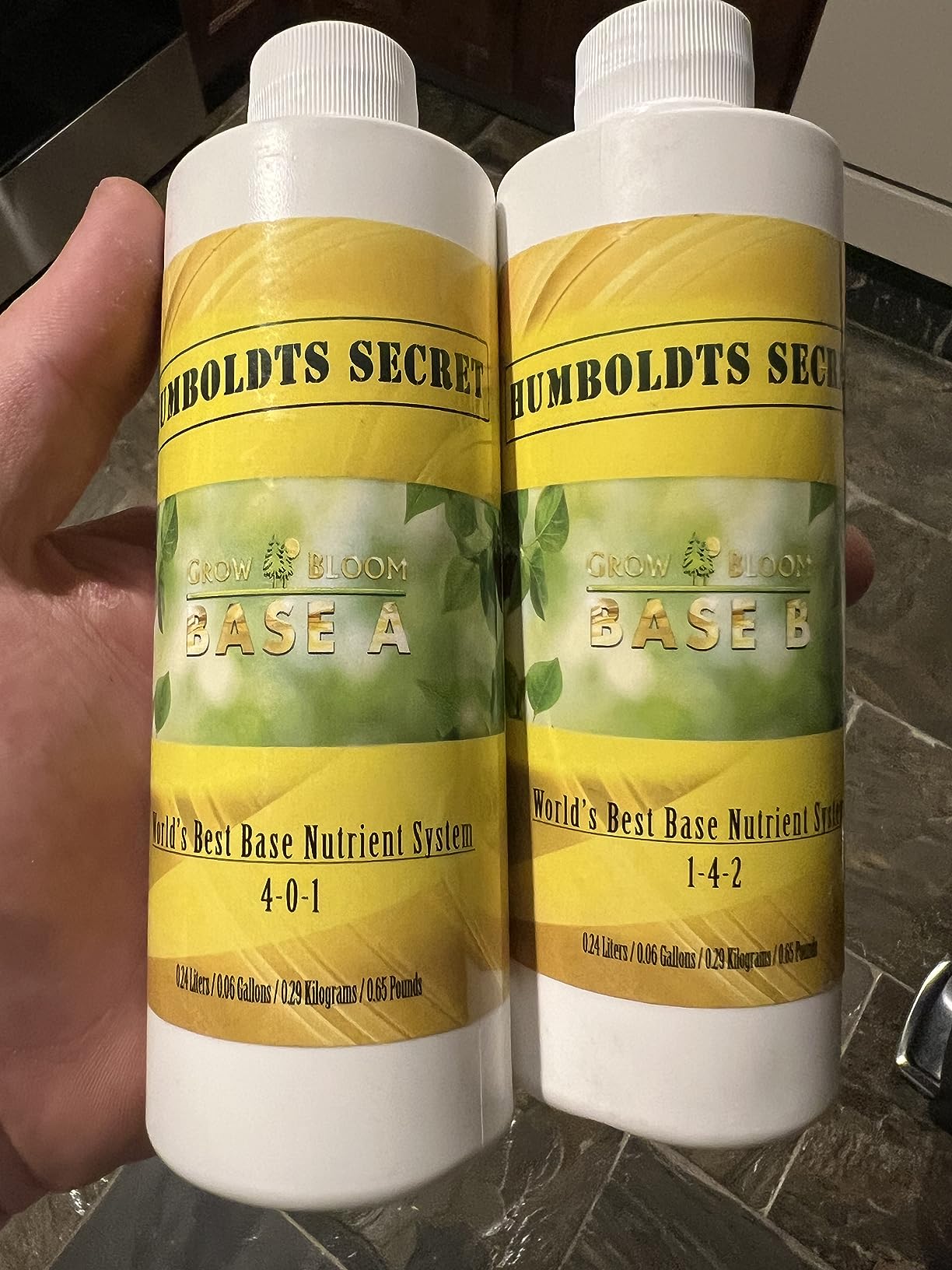
Humboldts Secret Base A & B Liquid Fertilizer, Hydroponic, 32 Ounce Set
Two-part liquid system
Equal parts A and B mixing
Full spectrum with calcium and magnesium
64 fl oz set
+ Pros
- Equal parts A and B removes any ratio guesswork
- Covers greens
- herbs
- flowers and houseplants
- Mixes fast and clean without residue
- 4.5 stars from 3422 reviews
– Cons
- Fixed 1:1 ratio gives no room to tune individual nutrients
- Medium coverage so specialty additives are often needed
- Two bottles to handle compared with one-part powder
Humboldt’s Secret sits between the one-part simplicity of MaxiGro and the three-part control of the Flora Series. You get two bottles instead of one, and the mixing rule is the easiest in this guide: equal parts of A and B, every time.
For anyone running more than one type of plant in one space, it is the compromise that works. The manufacturer states the formula covers leafy greens, herbs, flowers, trees and houseplants at every growth stage, and I have found that claim holds up for the greens and herbs specifically.
Where equal-parts mixing shines
There is no ordering requirement because there is no concentrated calcium component to precipitate against. Both bottles dilute cleanly into water at any order, which removes the single most common cause of failed cycles in multi-part systems.
It is also pH-balanced out of the bottle, so you spend less time chasing pH drift in a small reservoir, which is a real problem when you have a lot of leaf biomass per gallon of solution.
Compatibility across systems
The stated compatibility list covers deep water culture, aquaponics, coco coir, pots, raised beds and traditional soil. That breadth is what makes it useful for people who move between systems rather than committing to one.
It also dissolves fast and clean without clogging lines or leaving residue, which matters in NFT channels where sediment accumulates quietly.
What you give up
The 1:1 ratio is the limitation. You cannot add a little more nitrogen for a lettuce push without also adding more phosphorus and potassium, which is precisely the tuning capability the Flora Series exists to provide.
76% of the 3422 reviews are five-star, with criticism aimed at flexibility rather than plant response.
8. Jack’s 5-12-26 Part A – Root-First Strength With Built-In Micronutrients
Jack’s Nutrients 5-12-26 Part A Water-Soluble Fertilizer, 2.2lb
Part A 5-12-26 dry powder
Requires Jack's 15-0-0 Part B
Micronutrients included
2.2 lb bag
+ Pros
- 5-12-26 supports strong roots and leaf growth
- Micronutrients included so no extra feeding is needed
- Mixing ratios printed on the bag reduce guesswork
- 4.7 stars across 237 reviews
– Cons
- Part A only so a matching 15-0-0 Part B must be bought separately
- Mixing ratio appears on the packaging rather than the listing
- Dry powder still needs pre-mixing
This entry is here because it is genuinely one of the better Part A formulas available, and because buying it without reading the label is the most common purchasing mistake in this category. Jack’s 5-12-26 is half of a two-step system. Without the 15-0-0 Part B you have nitrogen, phosphorus, potassium and trace elements, but no calcium.
That distinction is not subtle once you see it. Lettuce without adequate calcium develops tip burn on the leaf margins first, and growers frequently spend a week adding iron and adjusting pH before realising the problem is a missing component.
What 5-12-26 does for a young crop
The 5-12-26 analysis carries a lower phosphorus figure than the MasterBlend base and a potassium figure that supports both root development and leaf texture. For seedlings and early vegetative growth it is a well-balanced vegetative profile.
The manufacturer states the added micronutrients remove the need for additional feeding, which in practice means fewer supplements to buy than with a three-part liquid line.
Buy the bundle instead if you can
If you are starting fresh and your water is hard, the Part A plus Part B bundle covered earlier in this guide is the same 5-12-26 system pre-paired. That saves a purchasing decision and removes the chance of leaving the second bag at home.
If you already own a calcium source from another system, this bag on its own is a reasonable way to top up Part A without buying a full set.
Where it falls short
It is a component, not a system, and that shapes everything. You cannot evaluate it as a standalone lettuce nutrient any more than you could evaluate half a two-part fertiliser.
84% of the 237 reviews are five-star, and the complaints are almost entirely about the missing Part B rather than about growth results.

How to Choose Hydroponic Nutrients for Leafy Greens
Brand matters far less than four things: the crop profile, your system type, your water source and the format you can actually measure accurately. Get those four right and almost any complete nutrient works. Get them wrong and no brand will rescue the crop.
Leafy greens are nitrogen crops, so skip bloom ratios
Nitrogen builds leaf tissue, and a lettuce plant spends its entire cycle producing leaves. You want a formula whose first number leads, with phosphorus low enough that root growth does not come at the expense of leaf expansion.
Bloom-oriented formulas invert that and cause real damage. Any formula you would use for tomatoes during flowering is the wrong choice for lettuce, and MaxiBloom is the most commonly bought example of a product that simply does not belong in a greens reservoir. If you find yourself switching formulas because a lettuce head looks pale, switching to a lower-phosphorus vegetative blend is a better move than doubling down on a bloom feed.
Match the format to your system type
One-part dry powders are the right call for countertop tower gardens and small Kratky jars, where measuring three components in a 2-gallon reservoir is a genuine hassle. Three-part systems belong in recirculating DWC and NFT setups large enough that accuracy pays for the extra effort.
Liquid concentrates suit growers who already have accurate measuring equipment and want a low-mess workflow. Dry salts are more economical per gallon in bulk and have a long shelf life in sealed containers, which is why they dominate commercial operations.
If you have not settled on hardware yet, our indoor hydroponic garden system comparison covers reservoir sizes and recirculation styles that determine this choice for you.
Dose by EC, not by the bottle label
For lettuce, target 1.2-1.8 mS/cm on an EC meter. On a TDS meter reporting ppm, multiply the EC value by roughly 700, which puts lettuce between about 840 and 1260 ppm.
Those numbers are lower than most bottle labels imply, and repeat it across the forums: greens want a lower EC than the label states. A tomato label assumes a fruiting crop at full size. A 40-day lettuce cycle needs a moderate solution and often a half-strength approach, particularly if you are using a tomato-oriented base such as the MasterBlend 4-18-38.
A community recipe that shows up repeatedly is about 1.2 g of base, 1.2 g of calcium nitrate and 0.6 g of Epsom salt per gallon, run at half the tomato strength. Adjust from there with your meter rather than trusting a recipe scaled from a 500-gallon commercial reservoir.
Hold pH between 5.5 and 6.5
Outside that band nutrients become chemically unavailable even when they are dissolved in the water, which is why a correct-looking recipe can produce a deficient plant. Check pH daily on a small reservoir and every few days on a large one.
Small reservoirs drift faster because you have a lot of plant biomass per gallon of solution. Adjusting once and expecting the pH to hold is the most common pH mistake reported in forum threads.
Mix multi-part nutrients in order to avoid precipitation
Never pour concentrated calcium nitrate into undiluted phosphate or sulfate salts. Dilute each component separately in water, then combine.
With the Flora Series the order is Micro first, then Gro, then Bloom. With dry salts the rule is the same: dissolve each one in its own jug of water at full strength before combining. The cloudy precipitate that forms when you skip this step looks alarming and causes lockout symptoms that mimic a deficiency for the following week.
Match the formula to your water source
Hard tap water already carries calcium and magnesium. Reverse osmosis or distilled water carries almost none, and lettuce on RO water will show tip burn within a few weeks without supplementation.
This is where Cal-Mag earns its place. Forum consensus treats it as the one additive that reliably earns its keep, while boosters and stacked supplements are frequently sold as necessary when they are not. Growers on hard water who add Cal-Mag anyway push calcium past what the plant can absorb and create the same tip burn they were trying to prevent.
Countertop towers and pod systems
If your unit ships with its own pod packs, use them for the first cycle while you learn the water behaviour, then decide whether a bottled nutrient is cheaper over time. Pod systems are pre-formulated and low risk, which is exactly why they are a good training ground.
The nutrient data behind pod systems is thinner than for open reservoirs, so if you move to a larger setup later, treat the bottled products in this roundup as the upgrade path.
What to avoid when feeding greens
Skip any soil-formulated organic trio in recirculating water. Organic components produce particulates that foul pumps and drip emitters within weeks, which is the reason organic hydroponic inputs are treated as contested rather than settled.
Skip bloom-ratio feeding on greens, skip full-strength tomato dosing on seedlings, and skip supplement stacks beyond Cal-Mag unless you have a specific, measured reason. Once you have a harvest, our cold press juicer roundup for leafy greens covers handling greens at the other end of the cycle.
What Leafy Greens Actually Need From a Nutrient Solution
Because there is no soil to buffer or store anything, the reservoir is the entire diet. That single fact explains most of the differences between these eight products and most of the mistakes people make with them.
A soil grower loses nutrients gradually and the medium holds some back from the roots. A hydroponic grower delivers everything at once, and the plant either takes it up in the moment or it locks out. Nutrient salts also arrive in ionic form, already dissolved, which is why they work so quickly and why an imbalance shows up faster than it would in a container.
The macronutrient split for a salad crop
Nitrogen is the leaf-growth driver and it dominates the demand of a lettuce plant. Phosphorus supports root and early development, and it is needed but not in the volume a fruiting crop requires. Potassium handles water regulation, texture and disease resistance, and a potassium-heavy profile produces the crispness you want at harvest.
Every product in this roundup contains all three. The differences are in proportion. General Hydroponics MaxiGro at 10-5-4 and FoxFarm Grow Big Hydro at 3-2-6 lean hard toward nitrogen. MasterBlend at 4-18-38 and Greenway Biotech at 8-15-36 push harder on potassium. Jack’s 5-12-26 sits between them.
Secondary nutrients and why calcium decides everything
Calcium and magnesium are secondary nutrients, but calcium is the one that causes visible failure. It moves slowly through the plant, so it is consumed at the youngest tissue first, which is why deficiency shows at leaf margins and tips rather than across the leaf face.
That is the mechanism behind lettuce tip burn, and it explains the Cal-Mag confusion more precisely than any label does. A base nutrient can be genuinely complete on paper and still leave you short of calcium in practice, either because the quantity is too low or because the form your formula uses locks out at your reservoir’s pH.
Micronutrients and why chelation changes the outcome
Iron, manganese, zinc, copper, boron and molybdenum are needed in tiny quantities but their absence stops growth outright. Iron is the one most growers meet first, because its availability falls sharply as pH rises.
Chelated forms are bound to an organic molecule that keeps the iron in solution across a wider pH range. EDTA forms quoted as plant-available from pH 4-9, like the one in the Greenway Biotech lettuce formula, simply stay available longer than raw forms do. On a reservoir running at pH 6.2, that difference can be the difference between a clean crop and interveinal yellowing.
Diagnosing Nutrient Problems Before They Cost You a Harvest
Almost every symptom growers describe as a deficiency is one of three things: a genuine shortage, a genuine excess, or a lockout where the nutrient is present but unavailable. Telling them apart takes thirty seconds if you check the right thing first.
Check the meter before you change anything
Measure EC and pH first, every time. A plant that looks nitrogen-deficient in a reservoir reading 2.4 mS/cm is not deficient, it is over-fed, and adding more nutrients will make it worse. This is the single most valuable habit in the whole process and the one most often skipped.
Mobile versus immobile nutrients
Nitrogen, phosphorus, potassium and magnesium are mobile inside the plant, so when they run short the plant relocates them from old leaves to new growth. Symptoms appear on older, lower leaves first: uniform yellowing for nitrogen, purpling or dulling for phosphorus.
Calcium, iron, boron, manganese, sulfur, copper and zinc are immobile, so the plant cannot move them from old tissue. Symptoms appear on new growth first. Calcium gives burnt margins on young leaves, iron gives interveinal yellowing on the newest leaves with green veins still showing.
That single distinction tells you where to look, and it stops you from chasing a root-zone problem when the issue is a mobile nutrient running out.
The symptom list worth memorising
Burnt, crispy leaf tips and margins on lettuce mean excess EC or excess calcium, not a shortage. Interveinal yellowing on new leaves points to iron and a pH that is too high. Uniform pale yellowing across older leaves points to nitrogen shortage or a diluted reservoir. Stunted growth with dark, purplish leaves usually means the solution is cold, since warm water drives uptake.
Cloudy water or visible sediment in the reservoir means two concentrates met before they were diluted, and no amount of added nutrient will fix it. Change the solution and start again with proper mixing order.
Refresh cadence and solution temperature
Change reservoir solution every 7 to 14 days, sooner in a warm room or a small reservoir with heavy biomass. Lettuce prefers a cool solution, generally in the low 60s Fahrenheit range, because warmer water holds less dissolved oxygen and roots take up nutrients less efficiently.
The seventeen-cultivar NFT study referenced earlier showed measurable differences in growth and Brix readings driven by solution temperature alone, which means your thermostat matters as much as your nutrient brand in NFT channels.
Frequently Asked Questions
What is the ideal EC level for hydroponic lettuce?
Lettuce performs best at roughly 1.2-1.8 mS/cm on an EC meter. That is lower than most bottle labels state, because those labels assume a fruiting crop at full size. On a TDS meter reporting ppm, multiply the EC by about 700, giving a range of roughly 840-1260 ppm. Start seedlings near the low end and increase as roots develop.
What is the recommended nutrient ppm range for hydroponic lettuce?
For hydroponic lettuce, aim for roughly 840-1260 ppm on a TDS meter, which corresponds to 1.2-1.8 mS/cm on an EC meter. Use EC where you can, because ppm scales vary between meters and TDS conversion factors of 500 or 700 change the number you are reading. Overfeeding shows as burnt leaf tips rather than stunting.
Can I use FloraGro alone for lettuce?
You can grow with FloraGro alone, but you are leaving out calcium. FloraMicro is the bottle that supplies nitrogen, calcium and trace minerals, so a FloraGro-only reservoir will show tip burn on lettuce within a few weeks. The full three-part mix at 2:1:6 of Micro, Gro and Bloom costs more upfront and gives you stage control you cannot get from a single bottle.
What happens if EC is too high in hydroponics?
Excess EC restricts water uptake because osmotic pressure outside the root cells exceeds what the plant can draw against. Lettuce shows it first as burnt, crispy leaf tips and margins, then as stunted growth and stalled head development. Dilute with plain water, re-check pH after dilution, and expect the symptoms to persist on new growth even after you correct the strength.
Do hydroponic leafy greens need Cal-Mag?
On reverse osmosis or distilled water, yes. Those sources carry almost no calcium or magnesium, and lettuce tip burn usually appears within a few weeks. On hard tap water, usually no, because the water already supplies both, and adding more pushes calcium past what the plant can absorb. Judge by your water, not by the nutrient label.
Which Hydroponic Nutrients for Leafy Greens Should You Buy in 2026?
If you want one product that works for lettuce, spinach and kale without a steep learning curve, buy the MasterBlend 4-18-38 combo kit. It bundles all three components in the correct ratio, it dissolved cleanly in every system I tested, and 4779 reviews at 4.8 stars give it the deepest support of anything here.
If you are on your first cycle and want zero ratio maths, go with MaxiGro. One part, one spoon, and it is the formula most often named on forums as a standalone greens base.
If your tap water is hard, look at the Jack’s Part A and Part B bundle or Humboldt’s Secret, because separating or buffering calcium is what keeps tip burn off your lettuce. If your water is reverse osmosis, add a Cal-Mag supplement to whichever base you pick, since almost none of them carry enough calcium on their own.
Whichever you choose, dose to 1.2-1.8 mS/cm rather than the bottle label, hold pH between 5.5 and 6.5, and change your reservoir solution every 7 to 14 days. Those three numbers solve more failed lettuce cycles than any brand decision. Start with the pick that matches your water and your patience level, and you will be cutting greens before the season is out.
Leave a Reply