
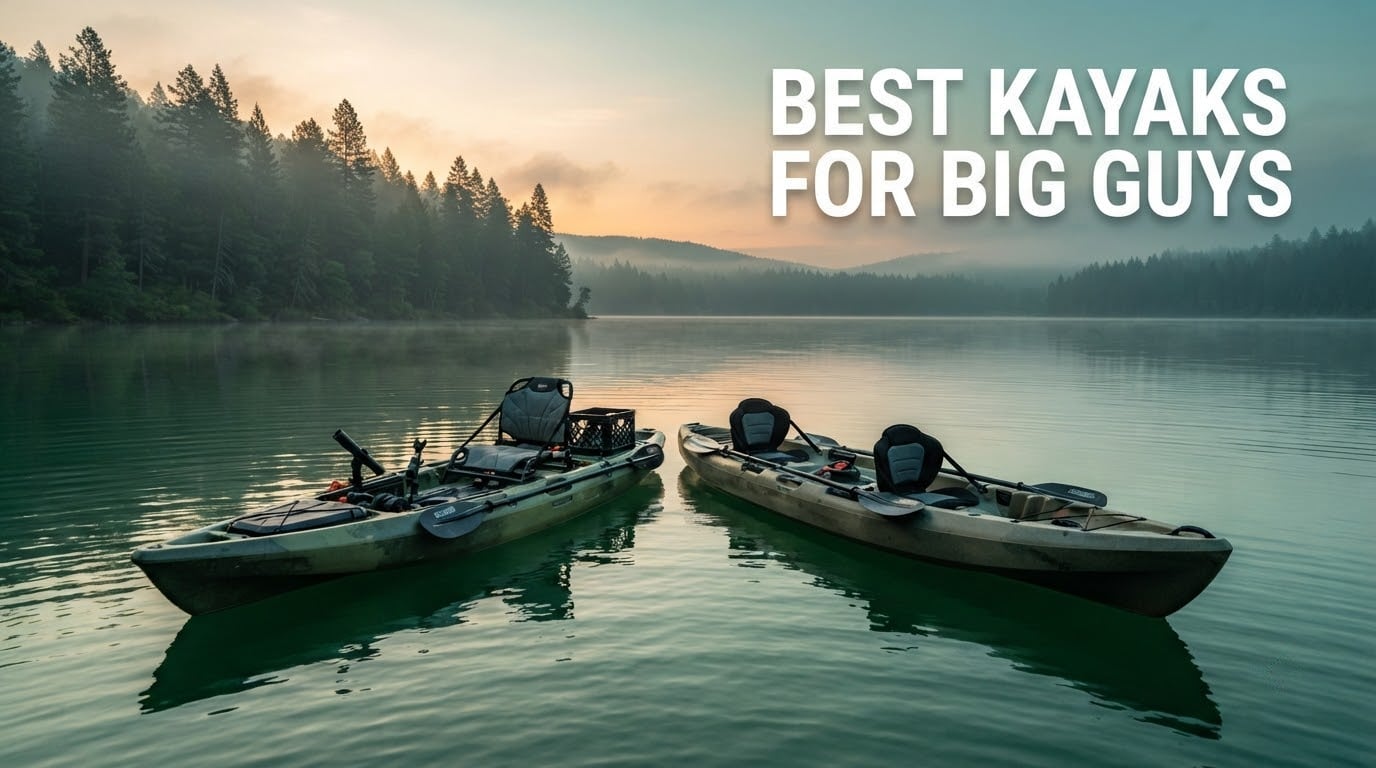
The best kayaks for big guys are wide sit-on-top, tandem, and inflatable boats rated 450-700+ lb with a beam of 34-37+ inches and an open deck you can climb into. Those three numbers – capacity, width, and deck style – decide whether a boat feels solid under you or like a bathroom scale in a bathtub.
I have spent enough time reading owner threads on paddling.com and r/Kayaking to know why this purchase is harder than it looks. Almost every mainstream brand builds its demo fleet for average-sized adults, so a 280-350 lb paddler walks into a shop, sits in every boat on the floor, and finds them all narrow, all cramped at the foot braces, and all rated 275-325 lb. Owners on those forums describe the same fix: stop reading the capacity plate as a promise, and start subtracting.
That subtraction is the whole game, and it is the step most roundups skip. A boat rated 500 lb that itself weighs 79 lb leaves 421 lb for a paddler, a paddle, a PFD, a dry bag, water, tackle, and a trolling motor battery. Add a motor and you can eat 40 lb of margin in an afternoon. Once I started doing that math on paper before looking at hull shapes, the shortlist of kayaks for heavy people got much smaller and much clearer.
Here is the framework I used to narrow 12 kayaks down to picks, and it mirrors what the search engines surface for this query:
- Usable capacity, not rated capacity. Rated capacity minus boat weight minus gear. Buy against the number left over, not the number on the hull.
- Beam width of 34 inches or more. Width controls primary stability – the boat’s resistance to tipping when you sit down or stand up. Length only controls tracking and speed.
- Open deck or a deep, wide cockpit. Sit-on-tops are far easier to mount and dismount, which matters if hips and knees are the limiting factor.
- Cockpit depth and leg room. If you are 6 feet or taller, the seat-to-footrest distance matters more than any fishing accessory.
- Boat weight and shape for transport. A 79 lb hull is a two-person carry and a two-person storage problem.
For anglers pairing a boat with electronics, our fish finder roundup for kayaks covers the transducer mounting options that work on sit-on-top decks. Everything below is written for big guys and gals, because the majority of people searching this topic are not looking for a boat with a rod holder – they are looking for a boat they can sit in for four hours without thinking about their weight.
Our Top 3 Picks for Larger Paddlers in 2026
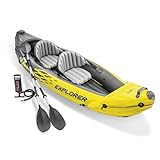
Intex Explorer K2 Inflatable Kayak
- 400 lb rated capacity
- 36 in wide hull
- 35 lb boat weight
- inflates in 5-10 minutes

Perception Rambler 13.5 Tandem
- 550 lb rated capacity
- 34 in wide hull
- 78 lb boat weight
- roomy molded-in seats

Intex Excursion Pro K2
- 400 lb rated capacity
- 37 in wide hull
- 44.7 lb boat weight
- dual removable skegs
Comparing 12 Kayaks for Big Guys and Gals in 2026
| Product | Details | Action |
|---|---|---|
|
|
Check Latest Price |
|
|
Check Latest Price |
|
|
Check Latest Price |
 |
|
Check Latest Price |
 |
|
Check Latest Price |
 |
|
Check Latest Price |
 |
|
Check Latest Price |
 |
|
Check Latest Price |
 |
|
Check Latest Price |
 |
|
Check Latest Price |
 |
|
Check Latest Price |
 |
|
Check Latest Price |
How We Read Capacity Numbers Before You Buy
Every kayak sold in the United States carries a USCG capacity plate, and that number is a maximum, not a target. Four steps turn it into something you can plan a trip around:
- Start with the plate. Find the rated capacity in pounds.
- Subtract the boat. Take out the listed boat weight, because that hull is floating around with you.
- Subtract the kit. Paddle, PFD, dry bag, water, food, and for anglers a tackle crate, a trolling motor, and a battery.
- Keep 50 to 75 lb of margin. Boats ride higher and respond better when they are not sitting at their limit.
Worked example: the Perception Tribe 13.5 lists 500 lb rated capacity and a 79 lb hull. That leaves 421 lb. Subtract a 10 lb paddle, a 2 lb PFD, a 15 lb dry bag of water and gear, and a 20 lb trolling motor battery, and 374 lb remains. A 300 lb paddler is now sitting in a boat with 74 lb of margin, which is the number that makes the boat feel planted rather than nervous.
The same math on the Intex Explorer K2: 400 lb rated minus a 35 lb boat leaves 365 lb for a paddler and everything they carry. That is comfortable for one 280 lb paddler with day gear, or two 160 lb paddlers with light loads. It is tight for a 330 lb paddler who also wants a cooler and a tackle crate, which is exactly the kind of detail that decides between two otherwise identical boats.
1. Intex Explorer K2 Inflatable Kayak – Best All-Round Pick for Big Guys and Gals
INTEX Explorer Inflatable Kayak 2-Person Portable Set with Paddles and Pump
400 lb capacity
36 in wide
35 lb boat weight
2 person inflatable
+ Pros
- Inflates in 5-10 minutes with the included pump
- Packs into the included bag and fits in a car trunk
- Very stable for an inflatable with the removable skeg installed
- High-visibility yellow hull is easy to spot
- Tough enough for rocks
- brush and mild current
– Cons
- Included 86 in paddles are short for tall paddlers
- Seats sit close together in tandem mode
- Air-filled seats will not support standing
- Slower glide than a hard shell
The Explorer K2 is the boat I keep coming back to for this audience, and it wins on a combination of numbers rather than a single spec. At 123 by 36 by 20 inches inflated, with a 400 lb rating and a 35 lb hull, it is the rare inflatable that is genuinely wide enough to sit in without constantly correcting your balance.
Owners consistently point at three things: the 36 inch beam, the pack-down size, and how well it survives contact with rocks and mild current. With more than 30k reviews behind it, the failure modes are well documented, and none of them are stability. Owners also report that many larger paddlers sit comfortably inside the 400 lb rating, and several note that it has replaced a rented kayak on a cost-per-outing basis.
Why 400 lb Works for a Single Heavy Paddler
The capacity math is straightforward: 400 lb rated minus a 35 lb boat leaves 365 lb. That is enough for one paddler up around 300 lb with a paddle, a PFD, water, and a small gear bag, and it still leaves room for a second, lighter paddler on short trips.
The practical wrinkle is the 400 lb figure is shared. Two 200 lb paddlers with gear can reach the ceiling of the boat quickly, so if you are solo in it, you are fine.
Stability Comes From the I-Beam Floor and Skeg
The inflatable I-beam floor, low-profile deck, high-buoyancy side chambers, and removable skeg combine to give it more tracking than most inflatables of this size. Reviewers describe it as paddling straight when the skeg is in, which is the difference between fishing with a rod and fighting the boat while you do it.
What the air floor cannot do is support a standing cast. The seats are air-filled and the deck has no hard platform, so this is a seated boat. If you want to cast standing, look at a polyethylene sit-on-top further down the list.
Packability Solves the Storage Problem Entirely
At 35 lb and deflatable into the included bag, this is one of the easiest boats here to keep in a closet, carry down apartment stairs alone, or fit in the back of a small car without a roof rack. Owners frequently note that it has replaced a rental kayak in cost per outing, which is the practical argument for a bigger paddler who does not want to wrestle a 70 lb hull into a truck bed.
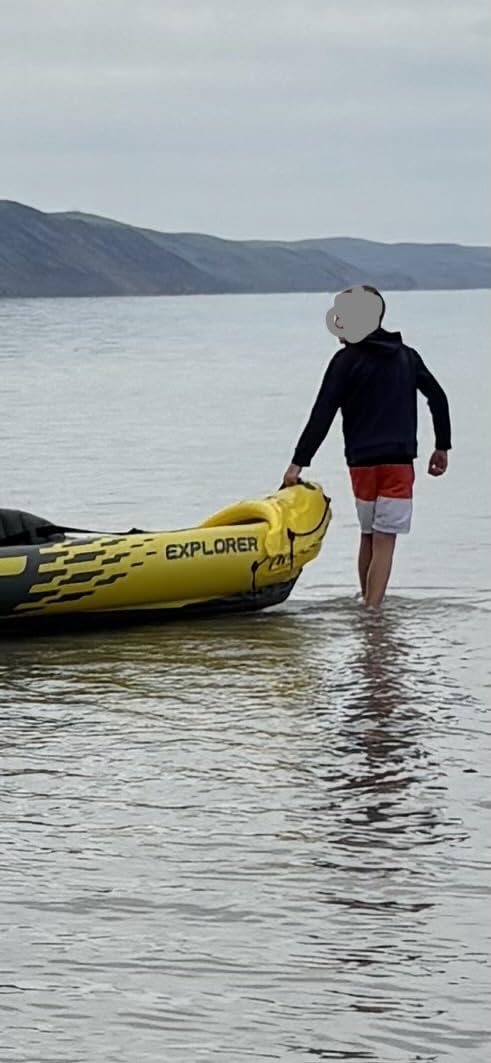
The one upgrade almost every owner makes is paddles. The included 86 inch aluminum oars suit average-height paddlers, and a 6 foot tall paddler should plan on a longer shaft before the first outing.
2. Perception Rambler 13.5 Sit on Top Tandem – Best for 400+ lb Paddlers
Perception – Rambler 13.5 Recreational Kayak – Sit on Top Tandem Kayak – Storage with Tie Downs – 13.6 ft – Dapper
550 lb capacity
34 in wide
78 lb boat weight
13 ft 6 in tandem
+ Pros
- 550 lb rating is the highest of the hard-shell tandems we list
- Roomy molded-in seats are easy to enter and exit
- Removable padded seat and backrest with adjustable support
- Mold-in center seat adds a third position for a kid or a dog
- Large rear open storage with tie-downs for a cooler
– Cons
- 78 lb hull is a two-person carry
- Relaxed and slow compared with shorter recreational kayaks
The Rambler is the boat I recommend when someone tells me their weight is the thing that is holding them back. A 550 lb rating in a molded polyethylene hull is a different class of margin than anything else in the hard-shell category, and owners say the 34 inch beam makes it feel planted rather than merely permitted.
It is a tandem, which is the trick. Used solo, the empty seat ahead of you is not dead space – it is legroom, gear storage, and a place to set a tackle crate where it does not sit in your lap.
Usable Capacity After the 78 lb Hull
550 lb rated minus a 78 lb boat leaves 472 lb. Add a 20 lb trolling motor and battery and you are at 452 lb, still carrying two adults plus a cooler comfortably. For a single 350 lb paddler going solo, the margin is enormous and the boat will sit low and quiet rather than perched high.
The tradeoff is that a paddler approaching 450 lb solo in a tandem will find it stable but slow, because you are moving 13.5 feet of boat that is only partly loaded.
Molded Seats vs Frame Seats for Limited Mobility
The molded-in seat openings are wide and low, which is the single most useful feature for a larger paddler with hip or knee limitations. You are not dropping into a deep cockpit and swinging a leg over a coaming; you are stepping up onto a flat platform. The removable padded seat and backrest with adjustable support adds comfort for long days.
Multiple footrest positions let two paddlers of very different sizes set their legs properly, and the molded-in center seat turns the boat into a two-plus-one for a child or a dog.
Where the 78 lb Weight Hurts
This is a two-person carry. Owners are consistent about that, and it shapes the whole ownership experience: roof rack or trailer, garage space, and a second adult at the launch. If you have a small car and no rack, the inflatables in this list are a better fit for your actual life.
3. Intex Excursion Pro K2 – Budget Pick Inflatable for Heavy Paddlers
INTEX Excursion Pro K2 Inflatable Kayak 2-Person Set with Paddles & Pump
400 lb capacity
37 in wide
44.7 lb boat weight
12.7 ft long
+ Pros
- 3-ply SuperStrong PVC holds noticeably more rigidity than cheaper inflatables
- Two removable skegs track well in deep and shallow water
- 12.7 ft length paddles straighter than shorter inflatables
- Bow and stern storage plus stainless D-rings for dry bags
- Includes two rod holders and a phone or GoPro mount
– Cons
- Heaviest of the inflatable sets here at nearly 45 lb
- Included 86 in paddles suit smaller paddlers
- Slow to pack back into the carry bag
The Excursion Pro K2 is the pick if you want more boat than the Explorer K2 without moving to a hard shell. At 151 by 37 by 18 inches inflated, it is a foot longer and an inch wider than the Explorer, and owners consistently credit the 3-ply laminate for feeling stiffer underfoot than inflatables in its class.
It is also the only inflatable in this group that comes with serious angling hardware – two detachable rod holders, a phone or action camera mount, and stainless D-rings for dry bags. If you fish, that hardware is most of the reason to step up a tier.
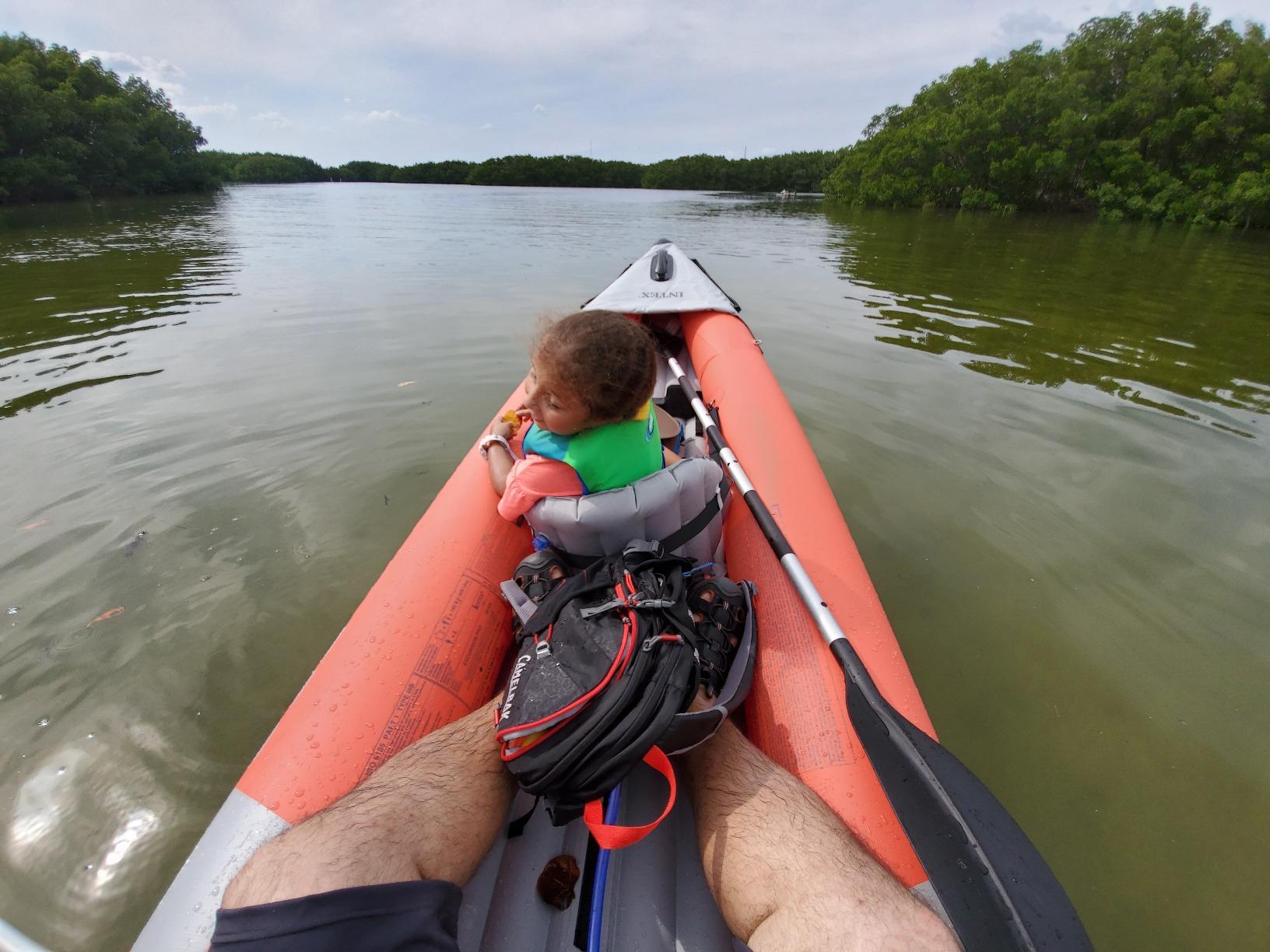
37 Inches of Beam and Two Skegs
Width is the number that matters most for a heavy paddler, and 37 inches at 12.7 feet long gives a length-to-width ratio that tracks far better than the Explorer K2. With both removable skegs installed, owners report it holds a line in a cross-current rather than constantly needing corrective strokes.
The removable design also means you can pull a skeg for shallow launches without unpacking the whole boat, which matters in weedy shallows.
Fishing Fit for a Larger Frame
The extra bow and stern room means tackle and a cooler sit clear of your knees and feet, which is the specific problem that makes a smaller fishing kayak feel cramped at 300 lb. A wide open deck and D-ring perimeter give you somewhere to lash a net or a fish bag.
Because it is an inflatable with no hard deck, it remains a seated-cast boat. Standing casts need a polyethylene hull.
Weight and Repacking Reality
At 44.7 lb it is the heaviest inflatable here, and the 12.7 foot length makes the deflate-and-fold process slower than a 10 foot boat. Owners accept this as the price of the tracking and storage space.
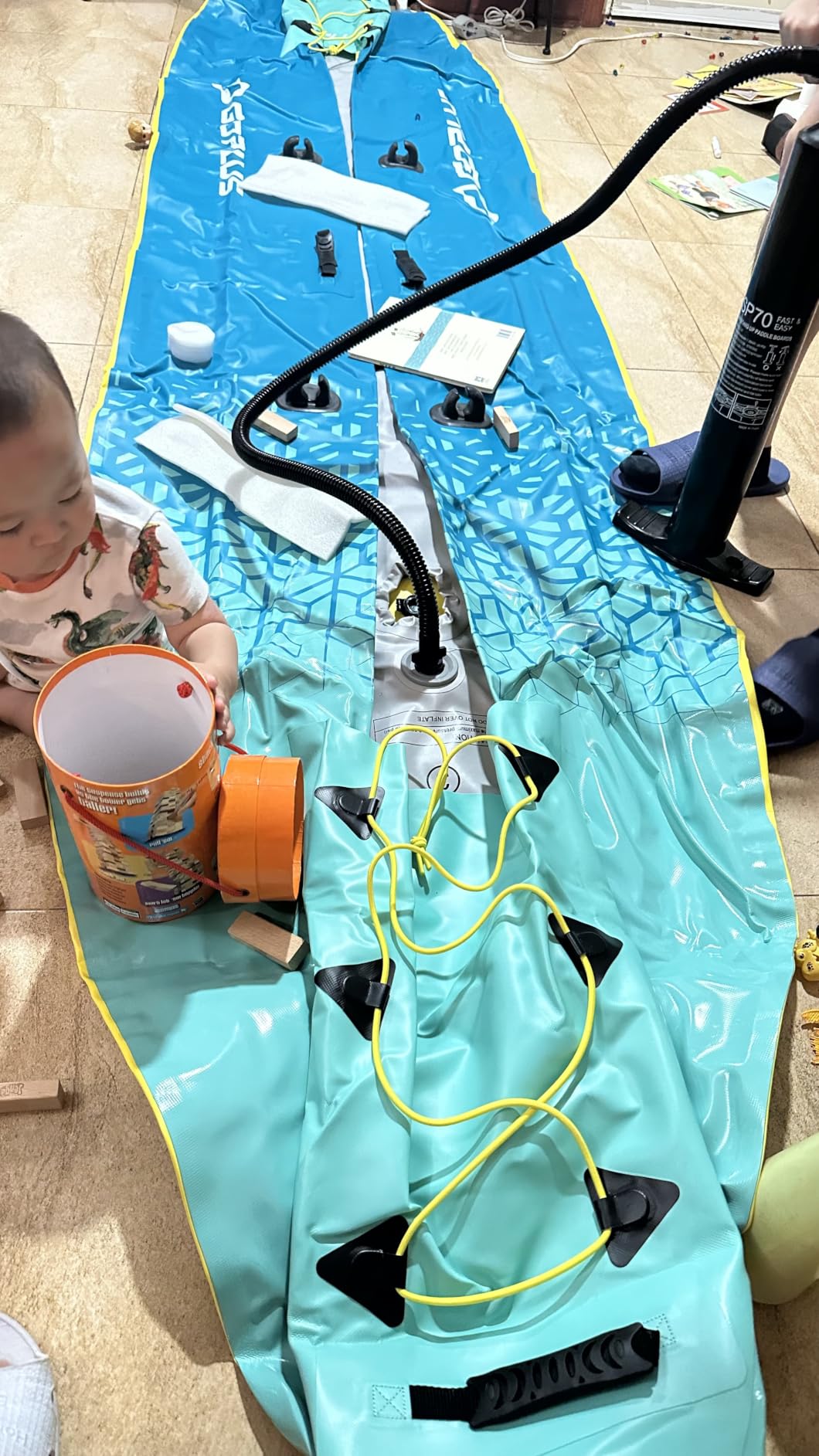
4. GYMAX 12.5Ft 507lb Inflatable Tandem – Best Value for Heavy Pairs
GYMAX Inflatable Kayak, 12.5Ft 507lbs Tandem Kayak with 2 Aluminum Paddles, 2 Padded Seats, Footrests, 2 Fins, Hand Pump, Carry Bag & Repair Kit, 2 Person Fishing Touring Kayak for Adults Youth (Red)
507 lb capacity
37 in wide
39 lb boat weight
12.5 ft tandem
+ Pros
- 507 lb tandem rating covers two adults plus gear
- Removable high-pressure drop-stitch floor adds real rigidity
- Stable laterally and tracks straight with the fins installed
- Only 39 lb so one person can carry it to the launch
- Two padded EVA seats with backrests and 3-position footrests
– Cons
- Front skeg can snag on submerged logs
- Seat back straps use a cheap buckle with little lumbar support
- Included paddles are average quality
The GYMAX is rated at 507 lb, matching the highest inflatable rating in this roundup, and the reason it feels more solid than its class suggests is the removable drop-stitch floor. Reviewers single that floor out specifically: it stiffens the boat under your feet and doubles as a third air chamber.
At 150 by 37 by 16 inches and 39 lb, it is a large-boat experience at an inflatable’s weight and pack-down size. For a heavier paddler paddling with a lighter partner, or one heavy paddler who wants a lot of empty deck, the 507 lb number does real work.

Capacity Math for Two Different Body Sizes
507 lb rated minus a 39 lb boat leaves 468 lb. A 300 lb paddler and a 150 lb partner, with gear, sit comfortably under that. One 400 lb paddler going solo has 68 lb of margin before gear, which is workable for day trips on calm water but tight once a motor and a cooler go aboard.
That flexibility is the real argument. This is one of the few boats here that works for a mixed-size pair without anyone feeling like the boat was built for the other person.
Seating and Foot Room for Taller Paddlers
Two padded EVA seats with backrests and 3-position footrests give a 6 foot tall paddler somewhere to put their legs, which is the common failure point in a narrow inflatable. The high back support is a meaningful difference over the air-filled seats on cheaper models.
The seat back straps are the weak point, using a buckle that slips and offers little lumbar adjustment. Several owners mention replacing the straps, and it is a five-minute fix rather than a reason to pass.
Skegs, Fins and the Drop-Stitch Floor
The most common complaint is the front skeg catching on submerged logs, and many owners simply remove it. The two included fins restore tracking without the snag risk in wooded water, and the three independent air chambers speed up both inflation and deflation.
5. Perception Outlaw 11.5 Fishing Kayak – Best Fishing Kayak for Big Guys
Perception Kayaks – Outlaw 11.5 Fishing Kayak – Sit on Top – Fold Away Lawn Chair Seat – 4 Rod Holders – Integrated Tackle Trays – 11.5 ft – Dapper
425 lb capacity
35 in wide
11 ft 6 in long
fold-away frame seat
+ Pros
- 425 lb rating among the higher figures in the fishing kayak class
- Fold-away frame seat raises the rider for better visibility and casting
- Large rear tankwell plus front storage for coolers and crates
- Four integrated rod holders and built-in tackle trays
- 35 in beam gives solid stability in the seat
– Cons
- Bulky 11 ft 6 in hull is harder to transport solo
- Fishing-focused layout with little appeal for general paddling
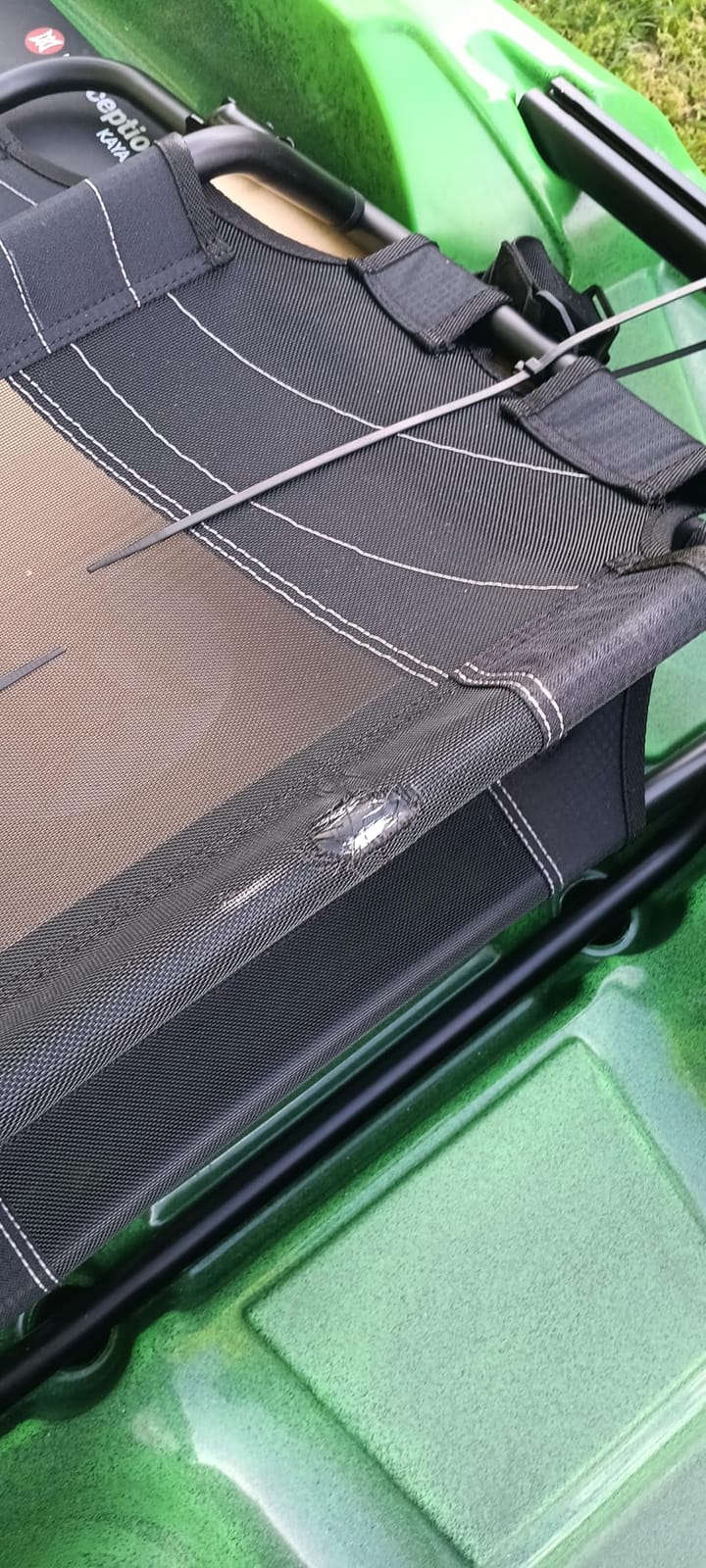
The Outlaw 11.5 is the fishing boat I would point a 300 lb angler toward. A 425 lb rating on a 35 inch beam is a combination you rarely see, and the fold-away frame seat does something no other boat here does for a larger paddler: it raises you up so your sight line over the bow is a normal paddling sight line.
That seat is also a comfort story. Sitting higher on a frame spreads your weight over a wider area and takes pressure off the back of your legs, which is where long fishing sessions usually go wrong for a big paddler.
Raised Seating and a 35 Inch Platform
Most sit-on-top fishing kayaks put you low in the boat with your knees up. The Outlaw’s frame seat reverses that, and owners report the difference immediately in casting posture and in how long they can stay out. The 35 inch beam underneath it does the stability work when you stand to cast.
The trade-off is that this is a fishing layout. There is no bungee deck rigging for a day pack, and the seat height makes it feel purpose-built rather than versatile.
Storage Layout for a Loaded Boat
Four integrated rod holders cover a serious multi-rod setup, and the integrated tackle trays keep lures within arm’s reach instead of in a bag at your feet. The large rear tankwell takes a cooler, and the front storage is sized for crates and dry bags.
Because the capacity plate reads 425 lb, budget your gear carefully. A loaded cooler and a battery eat into the margin quickly, and the manufacturer does not list a hull weight for this model, so plan on buying at the lower end of the rating if you are near 400 lb.
Carrying an 11 Foot 6 Inch Hull
Owners consistently name transport as the drawback. At 11.5 feet this is not a one-person shoulder carry across a parking lot, and a roof rack or a cart is close to mandatory. Budget for that before you buy, not after.
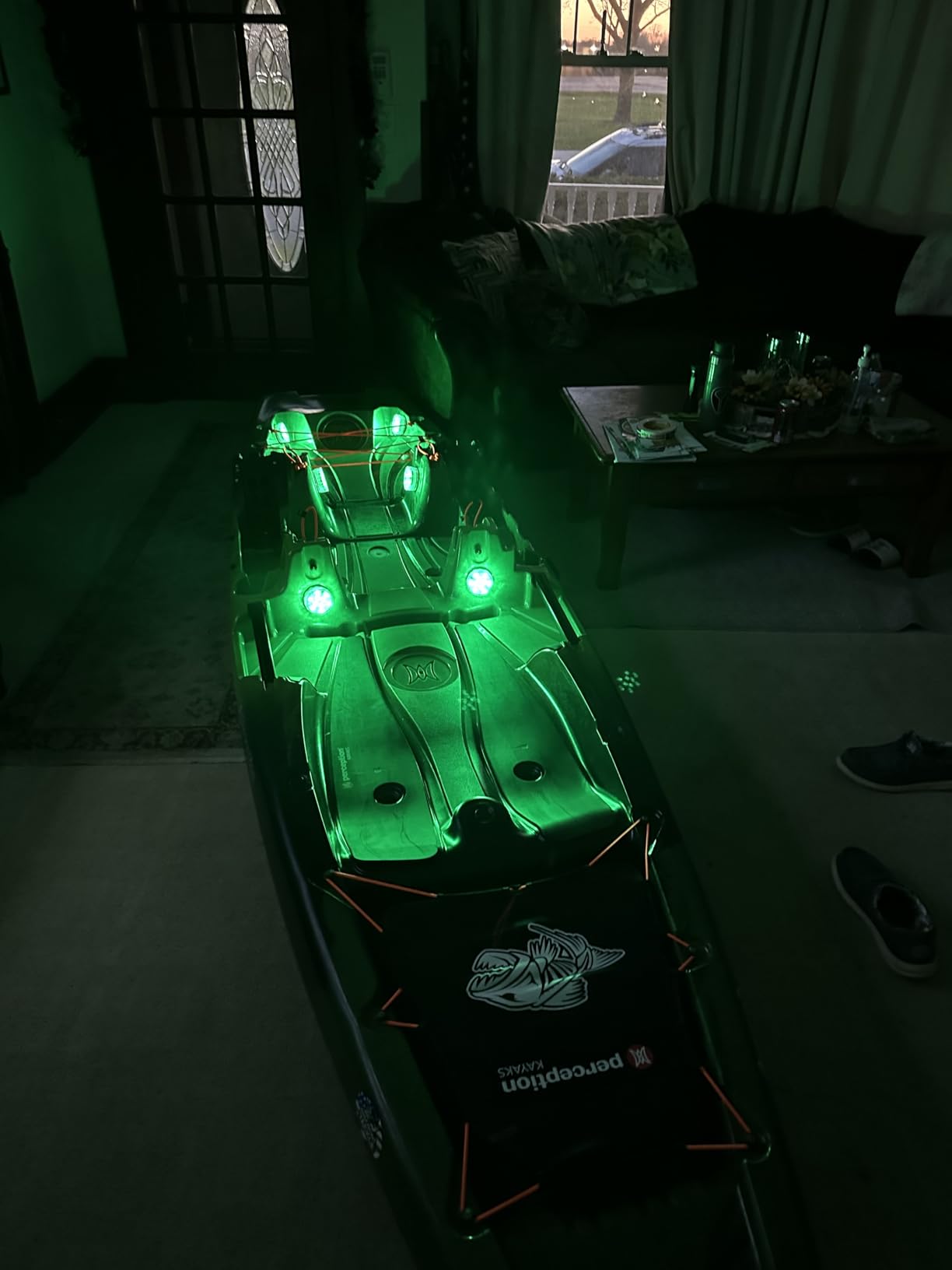
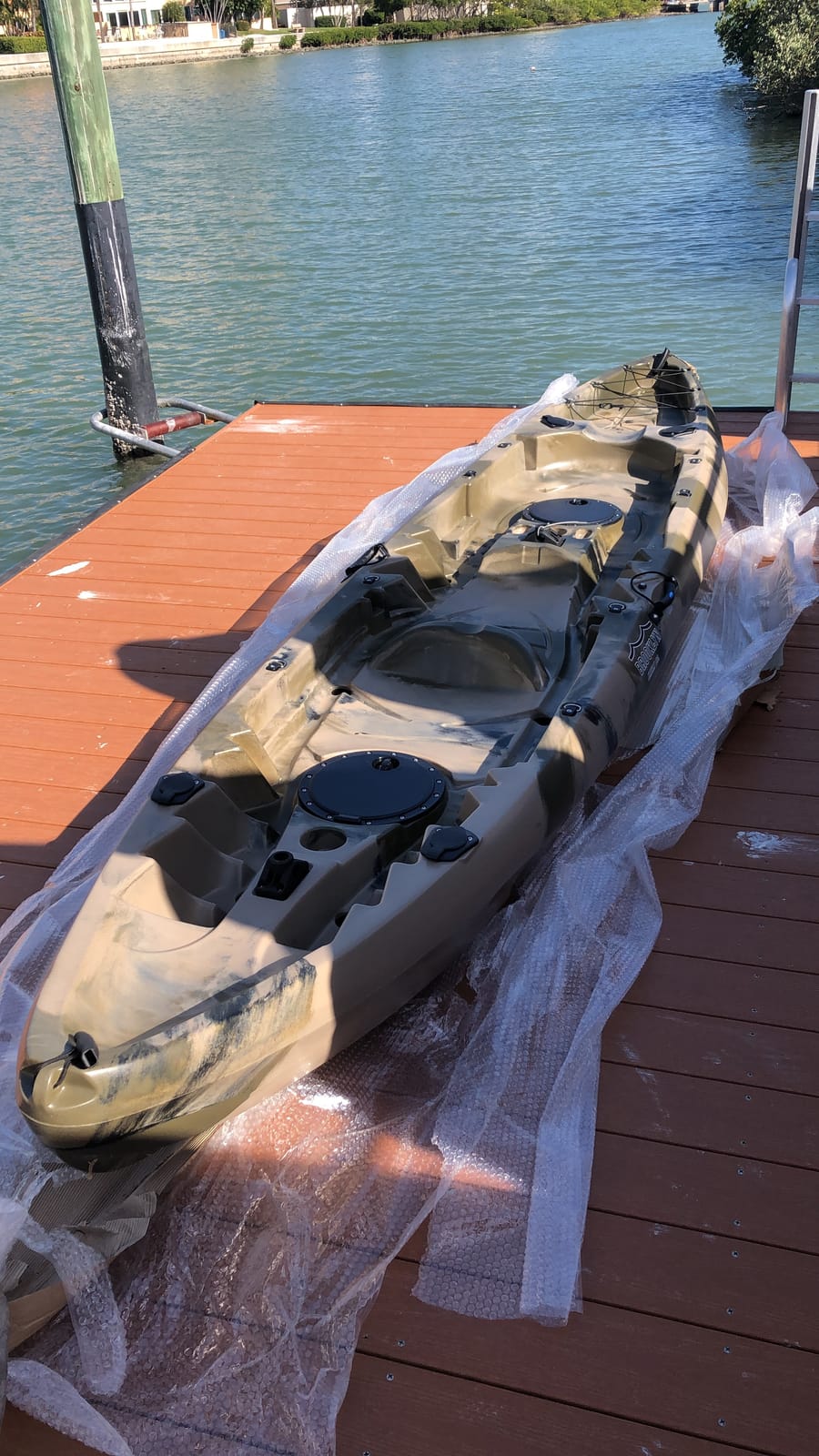
6. BKC Brooklyn 12.5 Tandem Fishing Kayak – Best for the Heaviest Paddlers
BKC Brooklyn 12.5 Tandem Fishing Kayak, 2 to 3 Person Sit-on-Top
595 lb capacity
32 in wide
70 lb boat weight
2 to 3 person
+ Pros
- Highest rated capacity of any boat in this roundup at 595 lb
- Rotomolded single-piece HDPE construction
- 6 rod holders with 4 flush and 2 articulating
- Two padded memory foam seats and two paddles included
- Built-in trolling motor mount area
– Cons
- Long 12.5 ft hull at 70 lb is difficult to move solo
- Open deck and entry height can feel wet on rough water
When the number in the spec sheet has to be the number, it is the BKC Brooklyn. Its 595 lb rating is the highest of any boat in this guide, and owners say the same thing about it: it works for a big paddler or a pair of big paddlers without the boat ever feeling strained.
It is a tandem, so a single 400 lb paddler can sit in the middle with the forward and aft compartments emptied and effectively gain both the deck space and the load margin of a much larger boat.
595 lb Rated and What Remains
595 lb rated minus a 70 lb hull leaves 525 lb. That is a comfortable two-up for paddlers around 240 lb each with a full cooler, or a 450 lb paddler going solo with gear and still leaving 75 lb of margin. Very few boats give a larger paddler that much headroom.
The 32 inch beam is narrower than the fishing boats above it, so the extra margin comes from displacement rather than width. On flat water and slow rivers that is exactly what you want; on a choppy lake you will feel more roll than the Outlaw or the Rambler.
Two Memory Foam Seats and a Third Position
Two padded memory foam seats come in the box, along with two paddles, which is unusual for a boat at this size. Owners with a child add a kid in the middle; owners alone often center one seat and use the rest of the hull for a crate.
The trolling motor mount area is the reason many heavier anglers buy this boat, since a motor plus battery can add 40 lb and still leave you inside the rating.
Transport Is the Trade, Not the Boat
At 70 lb and 12.5 feet, ratings in this group land lower largely because of size and weight rather than function. Owners describe it plainly as a two-person boat to move, and the open deck means spray in rough conditions. Both are acceptable if you have a rack and a helper.
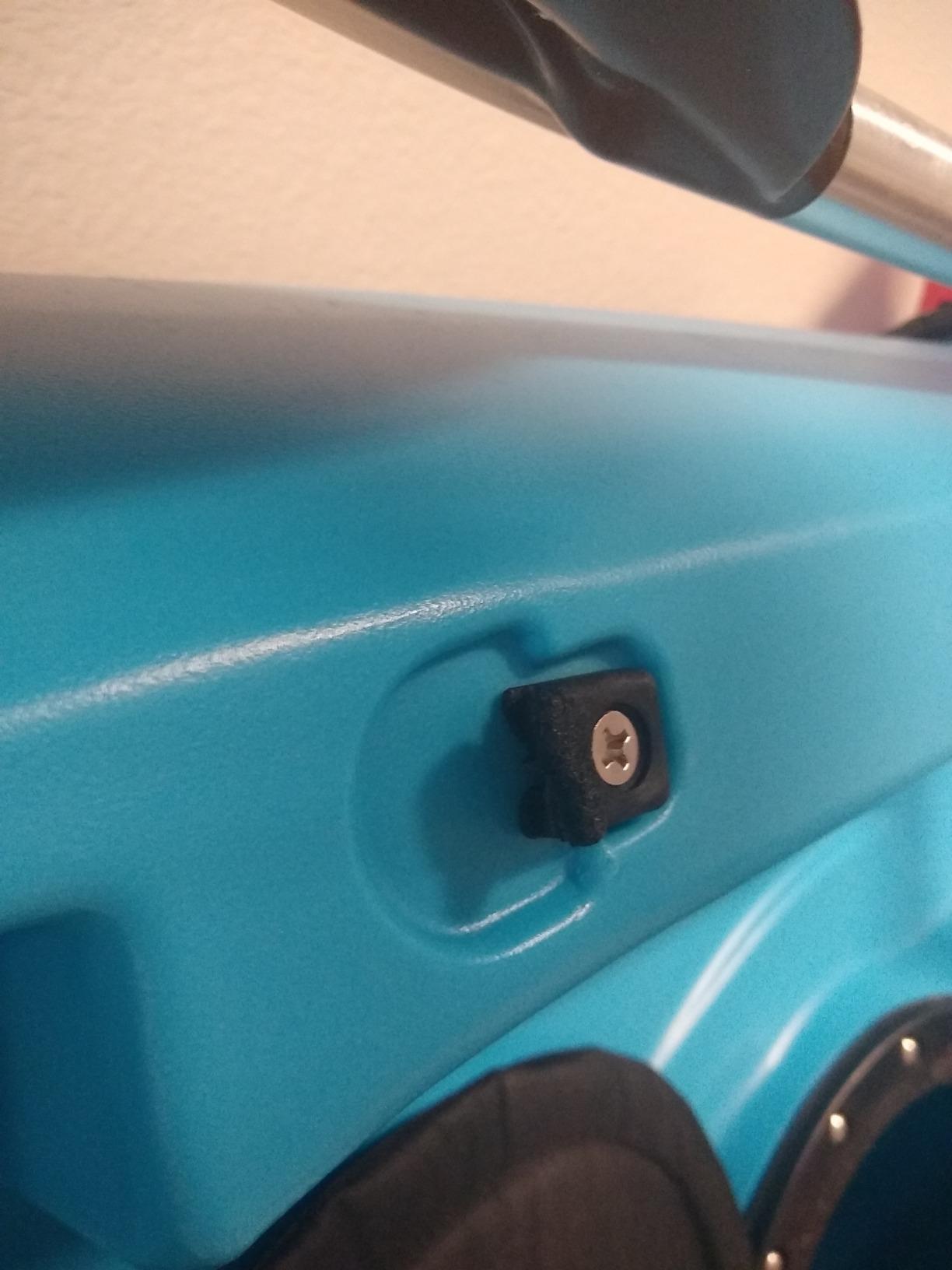
7. Perception Tribe 13.5 Sit on Top Tandem – Best for Tall Paddlers
Perception – Tribe Tandem Kayak – Sit on Top – Large Rear Storage with Tie Downs – 13.5 ft – Sunset
500 lb capacity
34 in wide
79 lb boat weight
13.5 ft tandem
+ Pros
- 500 lb capacity suits heavier paddlers solo or as a pair
- Adjustable framed seatbacks and cushioned seat pans
- Owners report it stays upright in medium waves and boat wakes
- Generous front and rear tank wells plus two central hatches
- Molded knee and thigh areas fit paddlers of all sizes
– Cons
- About 79 lb so it is effectively a two-person carry
- Central hatch openings are tight for larger dry bags
- Cup holders are too shallow for a water bottle
- Side handles are not centered when carrying
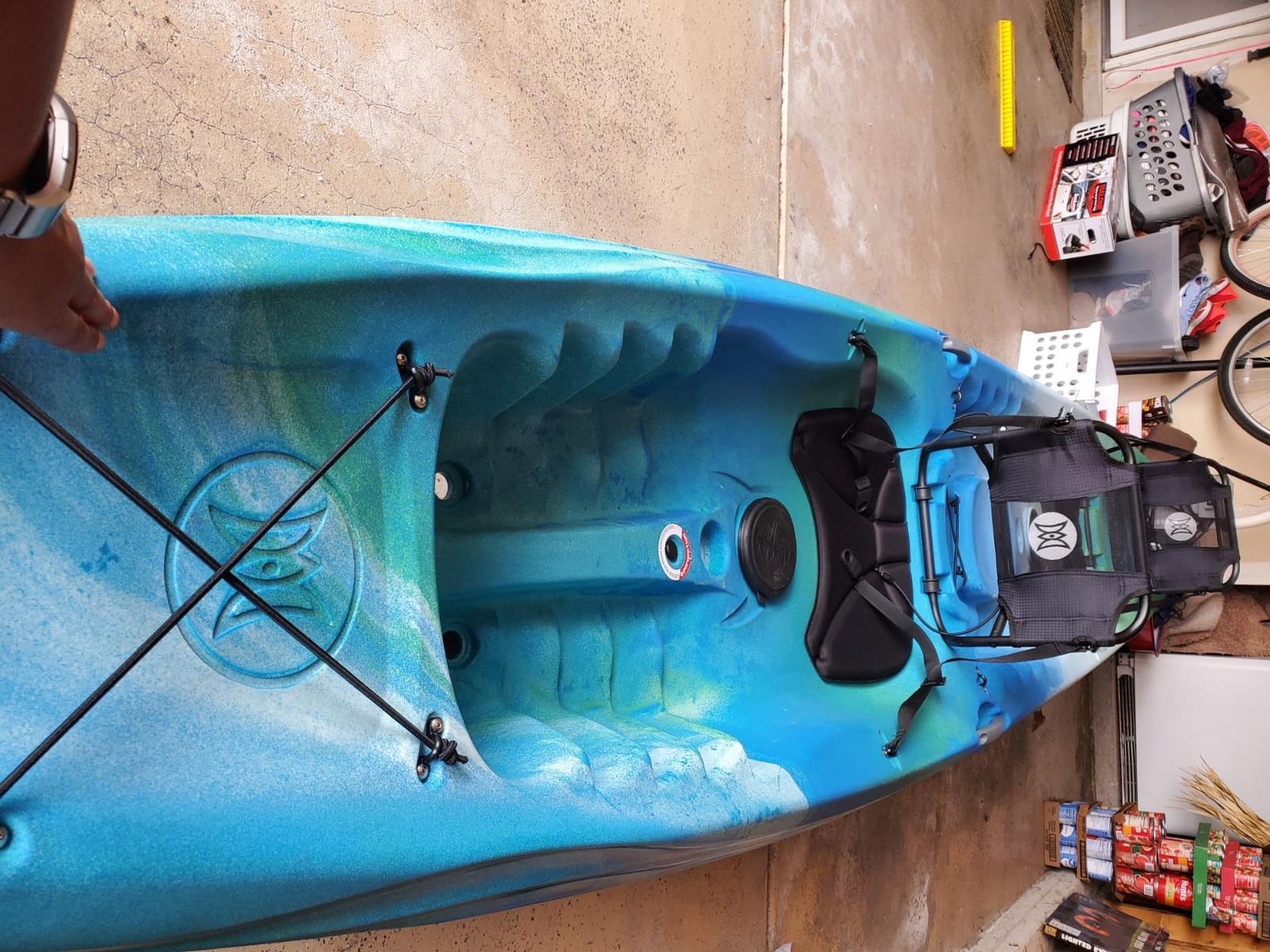
The Tribe 13.5 solves a problem the other tandems do not: legroom for tall paddlers. Owners at 6 foot 5 and above call out the molded knee and thigh areas and the integrated footrests specifically, because most tandems compress a 6 foot 4 person into a bent-knee position by the end of an hour.
It also carries a 500 lb rating on a 34 inch beam, so it is a legitimate solo boat for a heavier paddler who wants a tandem’s deck space.
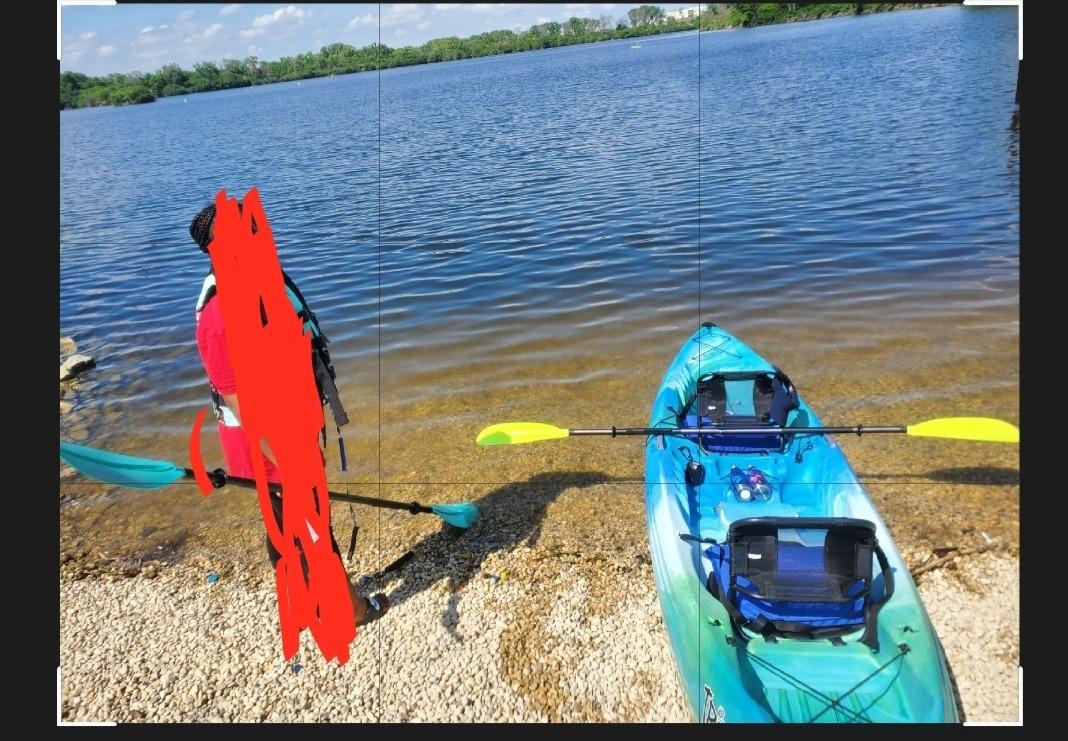
Seating Adjustability Over Hours
Adjustable framed seatbacks and cushioned seat pans let you set the recline and the seat height, and the molded knee and thigh supports stop your legs from splaying outward under load. For a larger paddler, that is the difference between a boat you can sit in for a full day and one you climb out of early.
Stability is the other recurring word in owner reviews. Several report the boat will not flip in medium waves or boat wakes, which is a level of reassurance a 79 lb tandem is not always expected to deliver.
500 lb Rating and the Solo Use Case
500 lb rated minus a 79 lb hull leaves 421 lb. One 300 lb paddler with a day pack sits at roughly 70 percent of usable capacity, which is a comfortable place to be. Two paddlers plus a child is the configuration owners most often describe as working well.
Storage is generous, with front and rear tank wells under bungee tie-downs and two central hatches. The hatches are the one soft spot: the openings are tight, and a large dry bag will not pass through without compressing.
Small Annoyances Worth Knowing
Cup holders are too shallow for a standard bottle, side handles are not centered so the boat feels tail-heavy during a solo carry, and scupper plugs are sold separately. None of these affect the on-water experience, but all of them are things owners mention.
8. Pelican Catch Mode 110 Fishing Kayak – Best Raised Seat for Long Days
Pelican Catch Mode 110 TR Fishing Kayak – Angler Fishing Kayak with Ergoboost Seating System – Gear Rails -Venom – 10.5 ft
11 ft hull
Ergoboost adjustable seat
2 rigging tracks
2.5HP transom
+ Pros
- Ergoboost seat raises the rider for better sight lines
- Two 4 in rigging tracks accept extensive accessory setups
- Three flush-mount rod holders plus a stern transom rated for a 2.5HP outboard
- Anti-slip traction pads with a built-in ruler for standing
- Seating is among the most comfortable in the sit-on-top class
– Cons
- Single-rider layout so it is not an option for two paddlers
- Transom hardware and accessories sold separately
- Capacity is not published on the product listing
The Catch Mode 110 is here for a different reason than most boats in this guide: seat height. The Ergoboost system lifts the paddler into a noticeably higher casting position, and under-seat storage keeps gear out of the footwell so your legs have room.
That combination – a raised seat plus a clear footwell – is what makes it comfortable for a larger paddler on a long day, even though its published listing does not include a weight capacity figure. Check the capacity plate on the hull at the store before you commit.
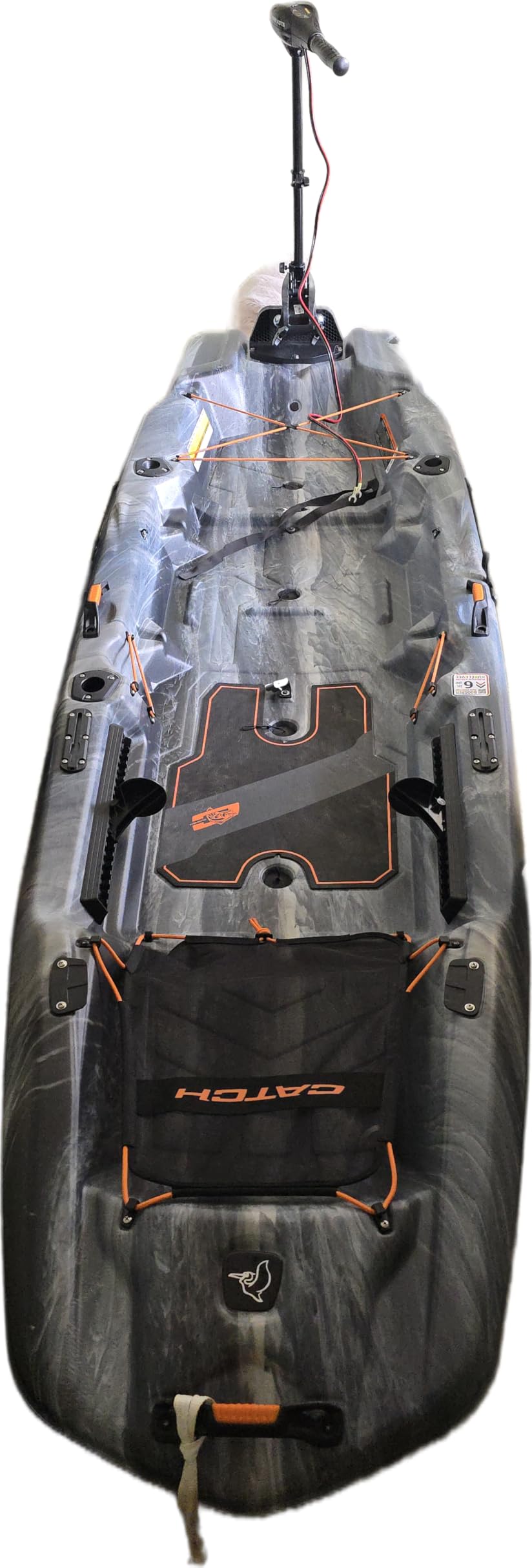
Ergoboost Seating and Under-Seat Storage
An adjustable-height seat with an EVA pad and storage beneath it changes the ergonomics of a sit-on-top. Your knees sit lower, your hips stay straighter, and the sight line over the bow improves, all of which reduce the back and fatigue complaints that heavier paddlers report in smaller boats.
For anglers, the paired 4 inch rigging tracks accept nearly any accessory mount, which removes the guessing game of drilling into a hull.
Powered Options and Standing
The stern transom is rated for a 2.5HP outboard at 11 feet, which is unusual and lets a heavier paddler carry range without paddling for hours. Anti-slip traction pads with a built-in ruler support standing and reduce noise on the hull.
Accessories and the transom hardware are separate purchases, so treat the motor cost as part of the ownership budget.
One Paddler Only
This is a single-rider layout. If you paddle with a partner, the tandems in this guide give you two usable seating positions and substantially higher load ratings, which for a larger paddler is often the more sensible starting point.
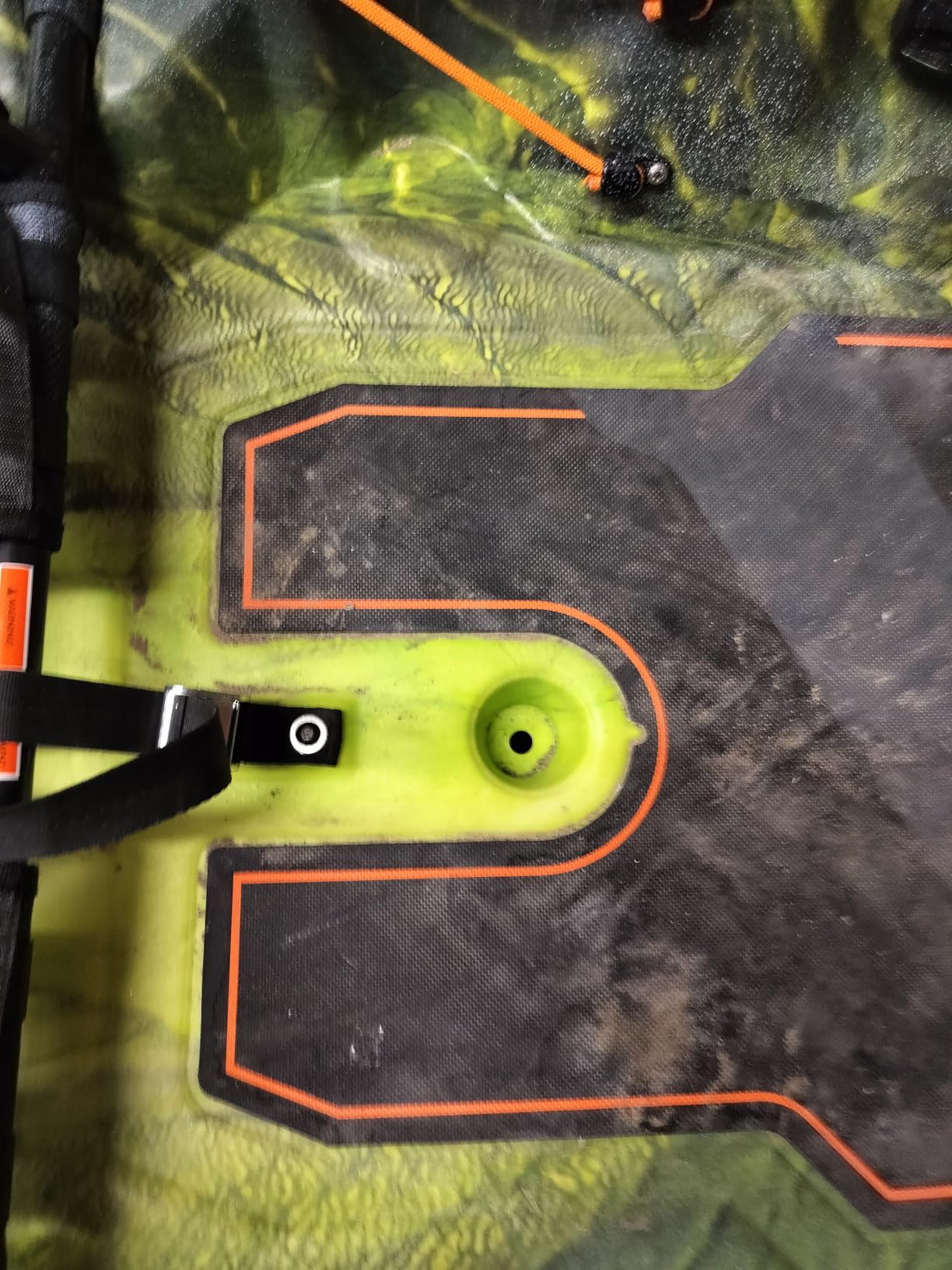
9. Reel Yaks Raptor Modular Fishing Kayak – Best Modular Pedal Drive for Big Guys
Reel Yaks Raptor Modular Fishing Kayak, Fin Drive 9.5ft, 380 lbs Capacity
380 lb capacity
30.3 in wide
62 lb boat weight
9.5 ft modular
+ Pros
- Two-piece modular hull fits in an SUV
- closet or garage without a rack
- Fin-drive pedal propulsion covers water with less effort than paddling
- Flush rod holders
- track rails and a stadium seat are assembled already
- Handles well for paddlers around 5 ft 9 in to 6 ft 2 in
– Cons
- 380 lb rating leaves limited margin above a 300 lb paddler plus gear
- Rudder control wiring and ferrules reported to break
- Seat sits low with little under-seat storage
- Only a 1-year hull warranty
The Raptor is the pedal-drive boat in this roundup, and its modular two-piece hull answers the transport problem that owners of 100 lb plus pedal kayaks complain about constantly. It separates into sections that fit in a closet or an SUV, with no roof rack and no trailer.
It is also the most honest fit in the list for larger paddlers, in the sense that it is a borderline choice. A 380 lb rating against a 62 lb hull leaves 318 lb, which fits a 250 lb paddler with gear and leaves little for someone approaching 300 lb and carrying a motor.
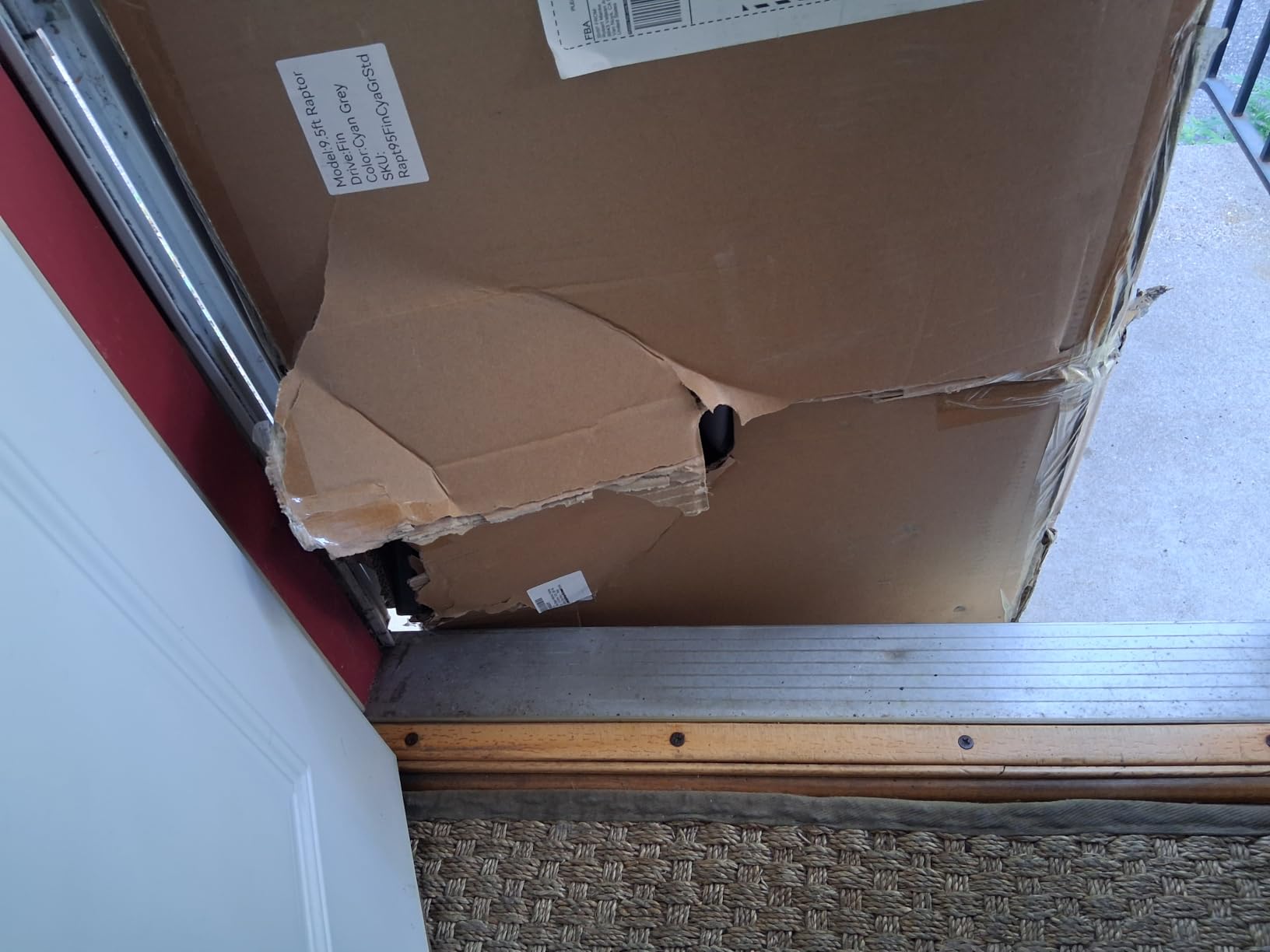
Where the Capacity Limit Falls
380 lb rated minus 62 lb of boat leaves 318 lb for you and everything you carry. That is a workable number for a 240-260 lb paddler with day gear, and a tight one for a 300 lb paddler with a tackle crate. Pedal drive is efficient, but the drive system, motor hardware, and battery all count against the plate.
If your number is 300 lb or above, use the pedal drive to save effort in a boat rated 500 lb or more instead of squeezing into a 380 lb hull.
Pedal Drive Cuts the Shoulder Load
For a heavier paddler, propulsion style matters more than it does for a smaller one. A smooth fin drive removes hundreds of strokes per hour from the equation, and owners describe covering water faster and more quietly than with a paddle alone – with the T-track rails and rod holders already assembled in the box.
The trade is speed for capacity. The boat is short at 9.5 feet and 30.3 inches wide, so it is quick to maneuver and slow to track.
Reliability Notes From Owners
Rudder control wiring and the associated ferrules are the most cited reliability problem, and several owners upgraded them. The stadium seat sits low with little under-seat storage, the included paddle is basic, and the hull warranty is one year. Customer service is frequently praised for replacing faulty components quickly.
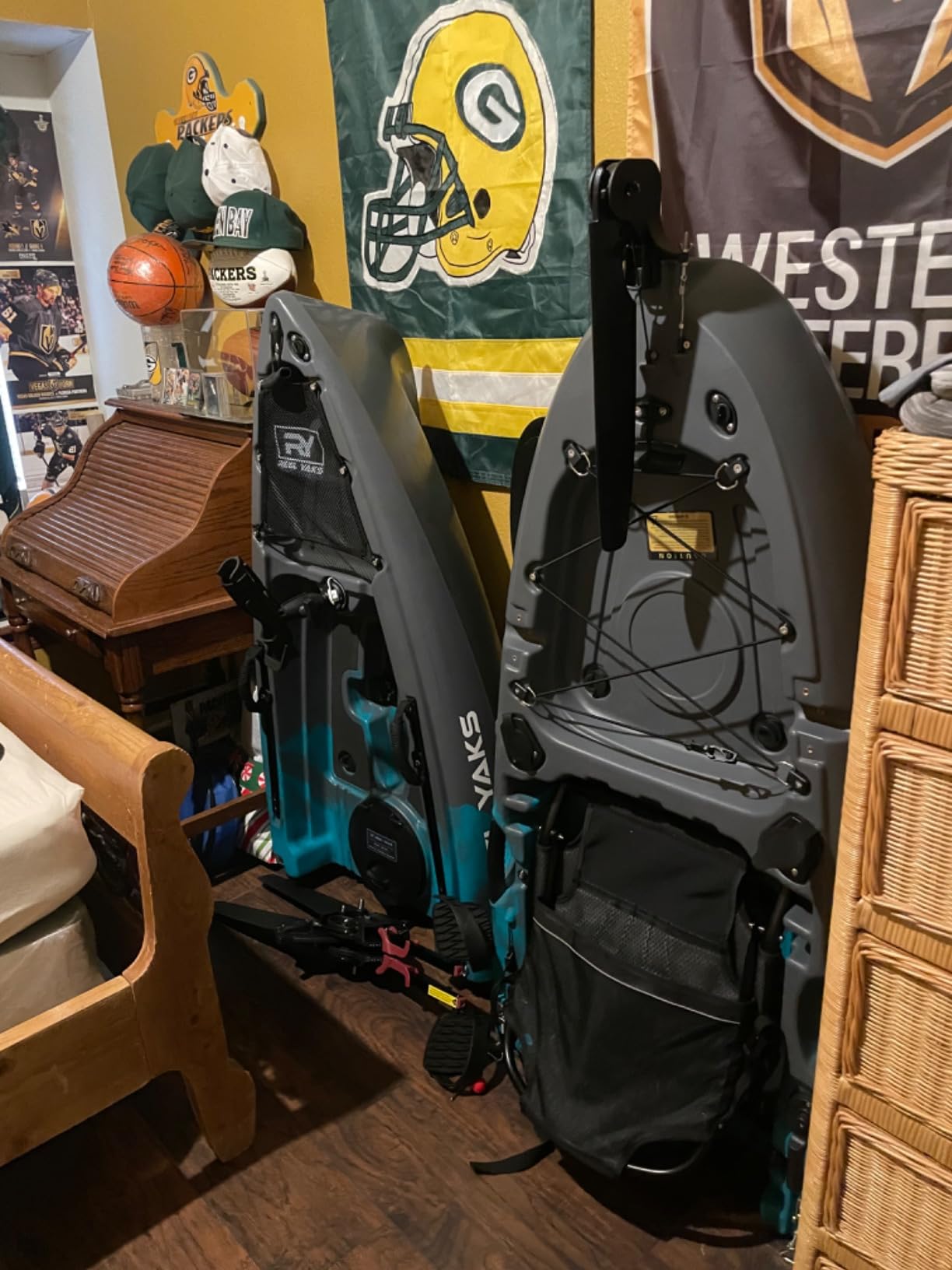
10. Pelican Sentinel 100X Sit on Top – Best Lightweight Fishing Setup
Pelican Sentinel 100X – Angler Sit on top Fishing Kayak – Forest Mist – Lightweight – Ergolounge™ Seating System – 10 ft, Sentinel 100X Angler Fishing Kayak
275 lb capacity
30 in wide
44.6 lb boat weight
9 ft 6 in
+ Pros
- Ergolounge seat with extra-thick cushioning and a high wide backrest
- Light 44.6 lb hull with molded-in side carry handles
- Removable ExoPak storage module you can pack at home
- 4 rod holders with 2 flush-mount and 2 vertical
– Cons
- 275 lb rating is well below the higher-capacity boats in this guide
- Short 9 ft 6 in length gives less tracking and cargo room
The Sentinel 100X is here as the honest entry point. At 44.6 lb with molded-in side carry handles, it is one of the easiest hard-shell fishing kayaks to move solo, and the Ergolounge seat with its extra-thick cushioning and high backrest is more comfortable than the seat on most boats in its size class.
The problem is arithmetic. Its published capacity is 275 lb, which after the 44.6 lb hull leaves roughly 230 lb of usable load. That supports a 200 lb paddler with a day pack comfortably and does not support a 300 lb paddler at all.
Who This Boat Is Actually For
Think of the 275 lb figure as a real boundary. A paddler in the mid-200s who wants a fishing kayak they can lift solo, store in a garage, and launch from a beach without help will find this one hard to beat, and the lifetime limited warranty against manufacturer defects reduces the long-term risk.
If you are heavier than that, the boat is the wrong tool. A boat you sit slightly over the limit of is unstable, hard to control, and in the worst case swamped – and no seat upgrade changes the physics.
ExoPak Storage and Rod Holder Layout
The removable ExoPak is a genuine convenience: you pack your tackle and dry bags at home, drop the module into the deck at the launch, and take it home with you. That matters for anglers who do not want to leave gear in a boat overnight in public.
Two flush-mount and two vertical rod holders cover a typical four-rod session, and the 9 foot 6 inch length keeps the boat quick in current and easy to paddle on a pond.
Why the Short Length Cuts Both Ways
Under 10 feet with a 30 inch beam, this boat turns on a dime and carries easily, but it will not track as straight as the 13.5 foot tandems or the 12.5 foot fishing boats. On a wide open lake with wind, expect to correct more often.
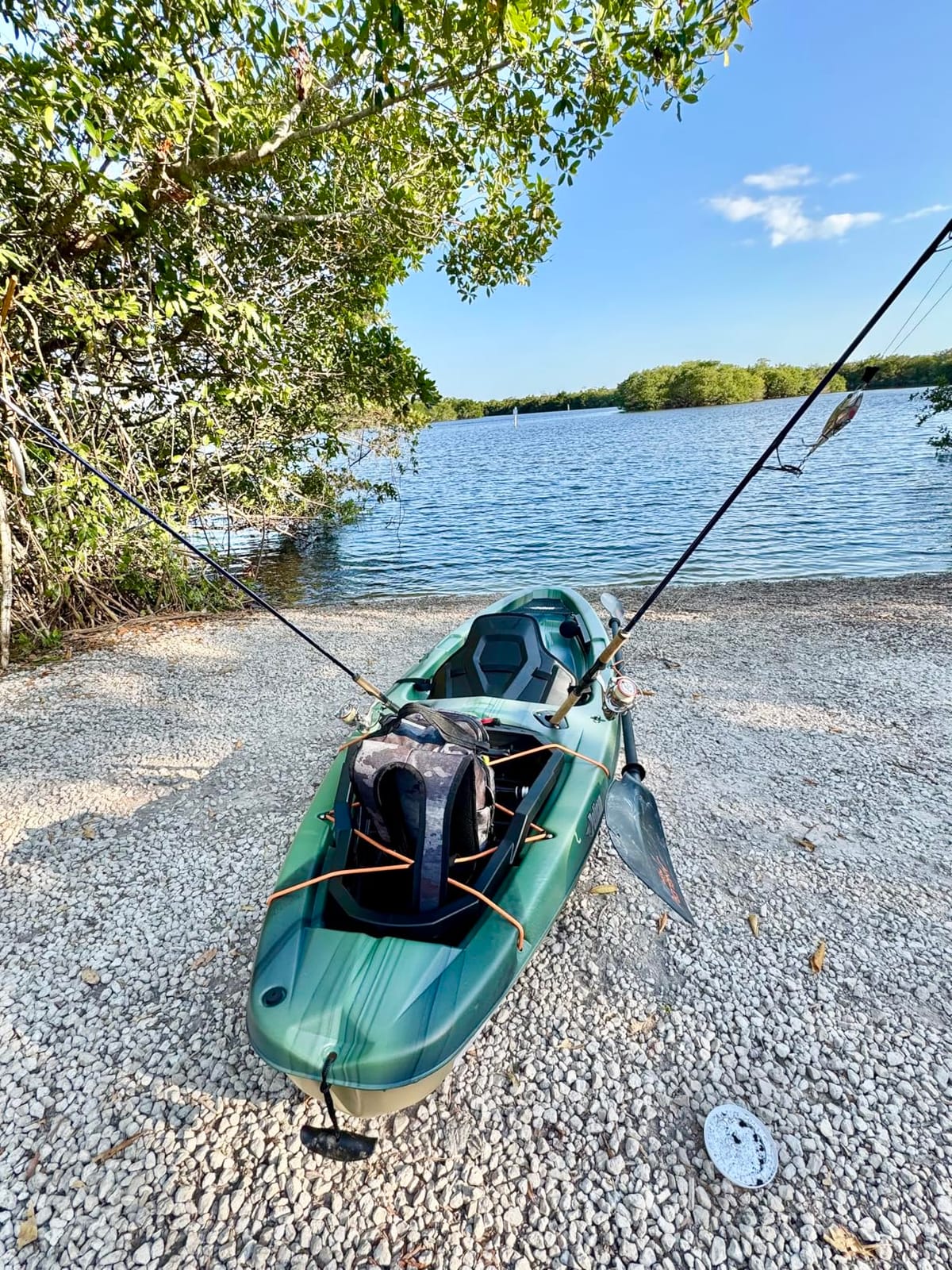
11. Goplus 12.5FT Inflatable Tandem – Best for 500+ LB Loads
Goplus Tandem Inflatable Kayak, 12.5FT 2-Person Kayak Set for Adults
507 lb capacity
37 in wide
39 lb boat weight
12.5 ft tandem
+ Pros
- 507 lb rating with reinforced laminate PVC and an anti-slip floor
- Three-chamber construction with 2 aluminum paddles and 2 fins
- Two adjustable EVA seats with high back support and 3-level footrest
- Inflates to 2.18 PSI and deflates into the carry bag
- 4 carry handles make moving it to the beach easier
– Cons
- Only a 3-month warranty
- Included paddles are average quality
The Goplus is the other 507 lb inflatable in this group, and it earns its place with a different set of strengths: a 37 inch beam, a high 2.18 PSI inflation pressure, and a 3-level adjustable footrest that gives tall paddlers more leg range than most inflatables at this length.
It is the better choice of the two 507 lb inflatables if foot position and seat adjustability matter most to you, and the weaker choice if the warranty length matters. The listed coverage here is three months, which is the shortest of any boat in this roundup.
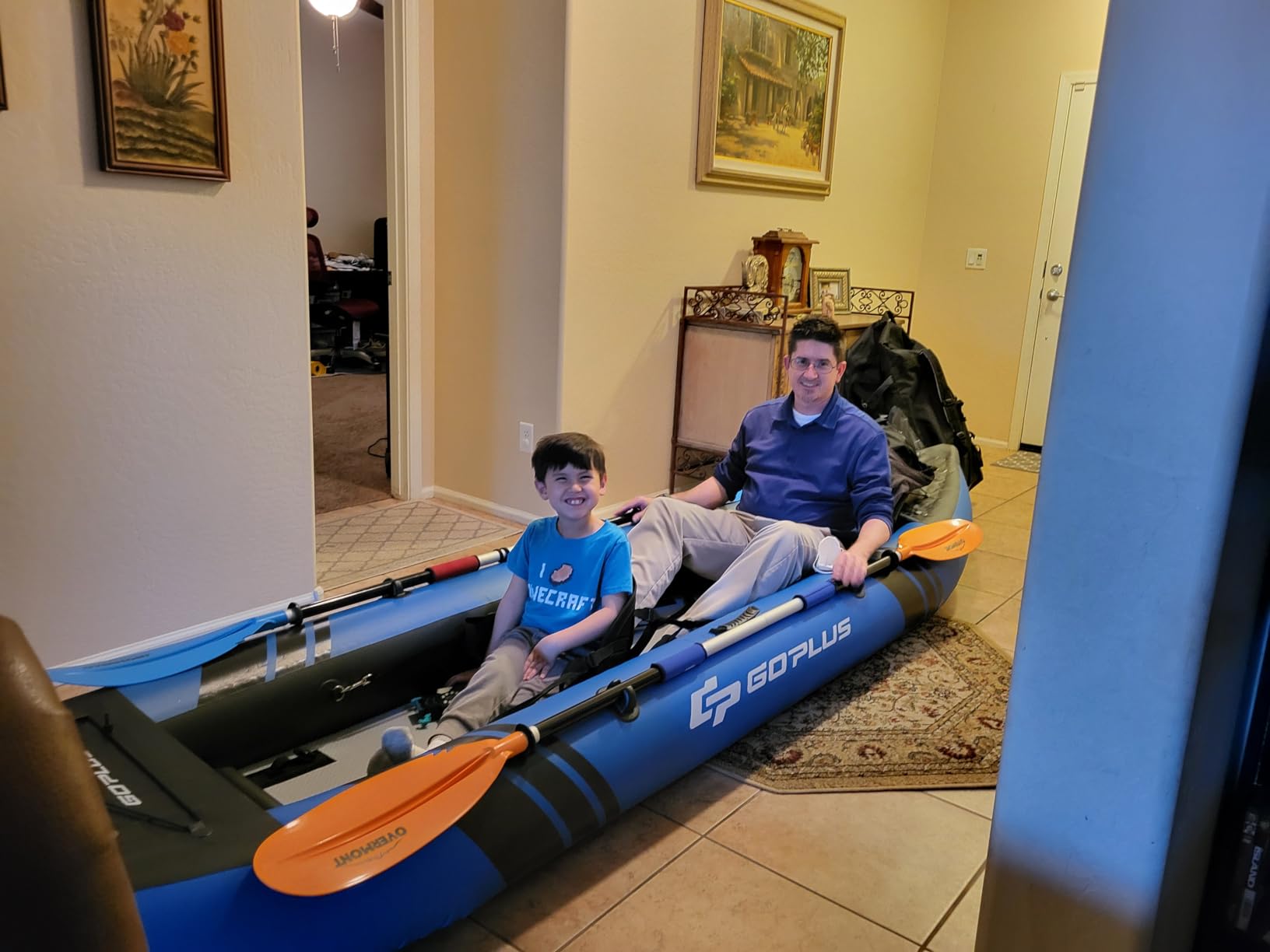
507 lb Rating and the Floor That Supports It
507 lb rated minus a 39 lb boat leaves 468 lb. A 300 lb paddler and a 150 lb partner with day gear sit well inside that, and one 400 lb paddler going solo keeps roughly 68 lb of margin before adding a motor.
The reinforced laminate PVC and high-strength anti-slip floor are what stop a 507 lb rating from being a paper number. Inflation to 2.18 PSI gives a firmer, flatter platform underfoot than a low-pressure inflatable, and that matters more as the load goes up.
Seating for a Mixed-Size Pair
Two adjustable EVA seats with high back support and a 3-level footrest let two paddlers of very different sizes set their leg positions independently, which is the main reason to buy a tandem inflatable as a heavier paddler rather than a solo boat.
Four carry handles spread the lift across the hull, so moving 39 lb from a car to a launch is a one-person job even on a soft shoreline.
What the Short Warranty Tells You
Three months of coverage is a real limitation on a boat that will be exposed to sun, sand, and rocks. The included repair kit with a wrench and patch, plus the front and rear elastic rope and drain hole, are the parts that actually matter on day one.

12. Lifetime Tamarack Angler 100 Fishing Kayak – Best Entry-Level Fishing Kayak
Lifetime Muskie Angler Sit-On-Top Kayak with Paddle, Tan, 120″
275 lb capacity
31 in wide
51 lb boat weight
10 ft long
+ Pros
- UV-protected high-density polyethylene construction
- Flat bottom gives solid stability for casting and standing
- Multiple footrest positions suit different rider heights
- 3 rod holders and 2 rear and center storage compartments
- 5-year limited warranty
– Cons
- 275 lb rating is below the category average
- Included seat mounting clips are cheap plastic and can bend under load
- Tracking pulls to one side when not actively paddling
- Cup inserts for the storage compartments are not included
The Tamarack Angler 100 is a common first fishing kayak, and with a 4.4 rating across more than 1300 reviews it has earned that position on durability more than refinement. High-density polyethylene shells like this one handle bumps, dragging, and beach launches without any concern.
It is also one of the least suitable boats in this guide for a 300 lb paddler, and I would rather say so plainly than bury it. The published capacity is 275 lb, which after a 51 lb hull leaves roughly 224 lb of usable load.

Why the 275 lb Rating Sets the Boundary
A 275 lb rating is a manufacturer’s number based on a specific hull volume and waterline test. A paddler at 300 lb with a PFD, paddle, and water is over it, and the result is a boat that sits too low, tracks poorly, and feels unstable in a way that erodes confidence quickly.
For a paddler in the low 200s, the flat bottom, skeg, and deep tracking channels make this a genuinely stable platform for standing casts. For a heavier paddler, choose one of the 425-595 lb boats above.
Foot Positions and Seating Upgrades
Multiple footrest positions are a real feature for a taller paddler, letting you push the seat back to extend leg reach inside a 10 foot hull. The adjustable padded seat back is adequate, but owners with long sessions almost universally upgrade to a stadium-style seat.
The included seat mounting clips are the acknowledged weak point, and bending or breaking them under a heavier paddler is a common report. A replacement seat is a modest cost compared with the boat.
Storage, Rod Holders and the Extras to Buy
Three rod holders – two flush-mounted and one top-mount – plus two 6 inch storage compartments in the rear and center cover a normal session. Cup inserts for those compartments are not included, and owners also add a longer fishing paddle with a line-retrieval hook.
Some hulls arrive with plastic chips in the bottom that need vacuuming out of the factory finish, and tracking pulls to one side when you are not actively correcting. Neither is a dealbreaker on a pond; both are noticeable on open water.
Buying Guide: How to Choose a Kayak If You Are a Larger Paddler
Match Your Body Weight to a Rated Capacity
Use this as a starting point, then subtract your boat’s weight and gear from the number.
- Up to 250 lb: a 275-325 lb rated boat works. The 275 lb sit-on-tops in this guide fit here with light day gear.
- 250-300 lb: look for 400-425 lb rated. That is the range of the Intex inflatables, the Perception Outlaw, and the Reel Yaks Raptor.
- 300-350 lb: target 450-500 lb. The Perception Tribe 13.5 and the two 507 lb inflatables sit here, as does the 500 lb tier of tandem hard shells.
- 350-400 lb: you need 500-650 lb rated. The Perception Rambler at 550 lb and the BKC Brooklyn at 595 lb are built for this range.
- Over 400 lb: confirm the plate with the manufacturer before buying, and favor a pedal-drive or tandem boat so propulsion is not your limiting factor.
Then subtract. A 500 lb rated boat with a 79 lb hull, a 20 lb motor, and a battery is a 390 lb usable boat. Buy to the number you have left, not the number on the hull.
Beam Width Controls Stability, Length Controls Speed
Primary stability is the boat’s resistance to tipping when weight moves sideways or you stand up. It is governed almost entirely by beam width. Secondary stability is what stops the boat from rolling further once it is past its edge, and that is governed by hull shape and depth.
For a heavier paddler, primary stability is the one to buy. Thirty-four inches is the practical floor, and 35-37 inches is where the boats in this roundup stop feeling twitchy. A 12 foot boat at 34 inches will feel calmer than a 14 foot boat at 30 inches, even though the longer boat is technically higher capacity.
Length buys tracking and speed. It is a comfort feature, not a stability feature, and it costs you a heavier hull to carry.
Cockpit Depth, Leg Room and Seat Height
If you are 6 feet or taller, measure the seat-to-footrest distance before you buy, because a cockpit that is too short will cramp you regardless of how much weight the hull is rated for. Hard shells with molded knee and thigh areas and multiple footrest positions handle tall paddlers best.
Seat height is the second lever. A raised or frame-mounted seat such as the Perception Outlaw or the Pelican Ergoboost systems gets your hips above your knees, which is a real relief for larger paddlers and reduces fatigue over a long day.
Whatever you buy, the sitting posture that works is a slightly reclined position with feet forward and knees bent near 90 degrees. If you cannot get there, the boat is too small for you regardless of its rating.
Sit-on-Top, Tandem and Inflatable Trade-Offs
Sit-on-tops are the easiest to mount and dismount, which matters more than most buyers expect. There is no coaming to swing a leg over, and the deck is flat for gear and for standing casts. The cost is spray, wind exposure, and less hull volume for a given length.
Tandems give you more boat than your body needs, and for a single large paddler that extra space is headroom and load margin rather than wasted capacity. The cost is weight, usually 70-79 lb in this group, and slower acceleration.
Inflatables solve storage and transport completely and give you a 36-37 inch beam at a 35-45 lb carry weight. What they do not give you is a hard deck for standing casts, or the tracking of a plastic hull on a windy day.
Tandem Kayaks Used Solo Are a Legitimate Strategy
Owners on paddling forums consistently describe the same move: buy the tandem, sit in one seat, and use the other half of the boat for gear, a dog, or a cooler. It is the most reliable way to add usable capacity and cockpit room without moving up to a specialty big-paddler hull that most brands do not make.
Two things to keep in mind. A tandem hull is heavy, so plan the carry. And if you genuinely want to paddle with a partner regularly, you have already solved the capacity question for two people rather than one.
Used Boats: Hulls Paddlers Actually Recommend
Because new high-capacity models are a narrow category, the used market is where a lot of larger paddlers find their boat. Paddlers on paddling.com repeatedly recommend the plastic Necky Eskia and the CD Storm as established big-paddler hulls that turn up locally or as outfitter trade-ins.
A paddling.com owner of the Ocean Kayak Prowler Big Game reports it is rated at 550 lb and has been loaded without issue. In other threads, owners name the Feel Free Lure and the Jackson Kilroy HD as high-capacity boats that work well for larger paddlers, and r/Kayaking members describe Jackson hulls as solid tanks that get rammed into rocks, dragged over trees, and survive it. r/whitewater posters at 5 foot 11 and 280 lb describe exactly the search this guide is meant to shorten.
Whatever hull you consider used, check the capacity plate on the actual boat, look for cracks around the cockpit and stress points, and confirm the hull has not been repaired with filler.
Paddle Length and PFD Fit for Larger Body Mass
Standard paddles are too short for paddlers above 6 feet and the result is shoulder fatigue within an hour. Advice from r/kayakfishing is to start around 250 cm and not go longer than needed, since an over-long paddle forces the same amount of work through a bigger lever arm.
A life jacket must fit by weight, not by size. If the chest strap on a standard adult PFD is already cinched as far as it goes on a 350 lb paddler, the jacket is not floating you properly, and no boat rating compensates for a poor fit. Choose a model whose rated weight range you sit in the middle of.
Transport, Roof Racks and Storage
Weigh the boat before the boat convinces you. In this roundup the hulls run from 35 lb for the Intex Explorer K2 to 79 lb for the Perception Tribe 13.5, and anything over 60 lb is realistically a two-person carry with a roof rack or trailer.
Owners of large pedal-drive boats raise this constantly – a 500 lb capacity pedal kayak that weighs well over 100 lb does not fit in a small car, and that constraint eliminates some excellent options before you ever get on the water. If your transport situation is fixed, the inflatables and the modular Reel Yaks Raptor are the boats that work around it. If you are getting to a launch with a cart and a beach wagon, our guide to beach wagons with big wheels covers the ground-side half of that trip.
Frequently Asked Questions
What kind of kayak is best for an obese person?
A wide sit-on-top with a raised, open deck, or a tandem you paddle solo, is usually the right answer. Aim for a USCG rating of 450 lb or higher and a beam of 34 inches or more, so you can mount and dismount without swinging a leg over a coaming. Avoid narrow sit-in boats sized for average adults, and treat a 400 lb rating as a floor rather than a target.
Can a 300 lb person kayak?
Yes, with headroom. A 300 lb paddler should look for a boat rated 425 to 500 lb so the boat’s own weight, your PFD, paddle, water, and gear still leave margin. On the Perception Tribe 13.5, for example, 500 lb rated minus a 79 lb hull leaves 421 lb before gear. A 400 lb rating is the absolute floor, not the target.
Can a 400 lb person kayak?
Yes, but only in boats rated roughly 500 to 650 lb. The Perception Rambler at 550 lb and the BKC Brooklyn at 595 lb are built for that range, and both can be paddled solo or as a pair. Choose a high-back or framed seat, keep the load centered, and be careful in waves and current, where a partly filled large hull feels less planted than a smaller one.
What is a good kayak with a heavy weight capacity?
The highest rated boats here are the BKC Brooklyn 12.5 tandem at 595 lb, the Perception Rambler 13.5 at 550 lb, the Perception Tribe 13.5 at 500 lb, and the GYMAX and Goplus 12.5 foot inflatables at 507 lb. Subtract the hull weight before shopping: the BKC leaves 525 lb, the Rambler 472 lb, and the GYMAX 468 lb for a paddler and gear.
What width kayak is most stable?
Width, measured as beam in inches, controls primary stability, which is the boat’s resistance to tipping as weight moves or you stand up. Thirty-four inches is a practical minimum for a heavier paddler and 35 to 37 inches is where boats start to feel planted. Length only affects tracking and speed, so a 12 foot boat at 34 inches feels calmer than a 14 foot boat at 30 inches.
Final Verdict: Which Kayak Fits Your Body and Your Water
If you want one boat that works for a bigger paddler without a roof rack or a trailer, the Intex Explorer K2 is the pick: 36 inches wide, 400 lb rated, 35 lb to carry, and a deflate-to-a-bag storage footprint that solves the problem that stops most people buying a kayak at all.
If you are 350 lb or heavier and you have a rack or a second person to help carry, the Perception Rambler 13.5 gives you 550 lb of rating on a 34 inch beam, with molded-in seats that are among the easiest to climb into and out of in this guide. Anglers who want a hard deck and a raised casting position should look at the Perception Outlaw 11.5 at 425 lb and 35 inches wide, and tall paddlers should shortlist the Perception Tribe 13.5 for its molded knee areas and adjustable framed seatbacks. If the heaviest of you are shopping, the BKC Brooklyn 12.5 at 595 lb is the highest rated hull in the group.
Do one thing before you order: write your own paddler weight plus your boat weight plus your gear on a piece of paper, and subtract. The rating on the hull is the start of the calculation, not the end of it. And if a shop tries to talk you into a 275 lb boat because it is on display, that is a display fleet built for average adults, not a verdict on your body. Best kayaks for big guys in 2026 are plentiful, once you know which three numbers to check.
Leave a Reply