
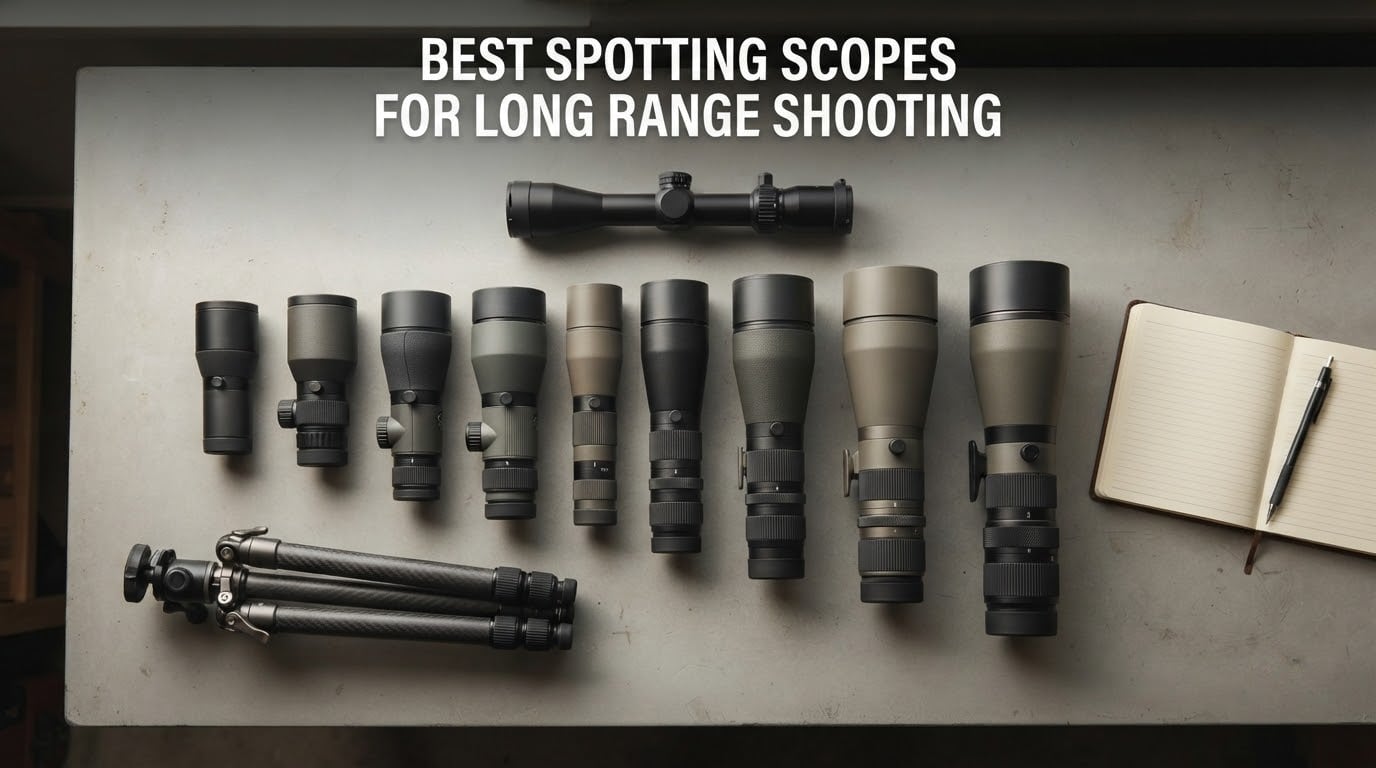
Most of the shooting kit on a long range bench is chosen by reputation. The spotting scope is where that stops working, because it is the one optic that has to do three jobs at once: find the target, hold a steady image while you read conditions, and resolve bullet impacts well enough to call your own shots. We ran ten of them through that sequence over a season of range days, and these are the ones that held up.
This roundup covers the best spotting scopes for long range shooting across the full price spread, from a 1.3 lb backpacker scope to an 85mm premium optic built for dawn glassing. Every pick below was judged on the same four things: how far you can push it before the image goes soft, whether it stays bright as the light drops, whether the focus collar still works with cold or gloved hands, and whether it holds still on a tripod. Specs come straight from the manufacturer listings and the review data we pulled, so you can check every number we quote.
If your rifle setup is still open, start with our 12 best long range rifle scopes guide, then come back here for the glass that goes on the tripod beside it.
How Far Can You Actually See With a 20-60×80?
A 20-60×80 resolves a prone human silhouette out to roughly 800 to 1000 yards in clear, still air, but individual bullet holes past about 500 yards need 40x to 60x, a steady tripod, and honest light. Everything closer than that is a much easier problem than the spec sheet implies.
Three numbers decide how far you actually see, and none of them is the magnification printed on the box.
Magnification sets your resolution. At 20x you can find a target and track movement but you will not separate impacts from paper texture. Somewhere around 40x a .30 caliber hole starts to look like a hole rather than a smudge. At 60x you have the resolution to call a hit at 500 yards, provided the air is cooperating.
Exit pupil decides whether that resolution is usable. Exit pupil is objective diameter divided by magnification. On a 20-60×80 that is 80 divided by 60, which is 1.33mm at the top of the zoom. Your pupil opens to about 7mm in daylight and barely 3mm at dusk, so at 60x on an 80mm objective you are feeding light into a pupil far smaller than your eye can collect. The image goes dim and flat, and you notice color draining out of it before you notice any loss of sharpness.
Objective diameter sets the ceiling on usable magnification. A rough rule is that you cannot push an objective much past 2x its diameter in useful magnification. That puts 60x as the practical limit for an 80mm lens and 85mm as the point where 60x starts to pay off. A 60mm objective, like the Emarth later in this list, hits its useful ceiling around 30x no matter what the zoom ring claims.
Atmospheric conditions decide the rest. Heat shimmer in summer flattens the image at 600 yards and destroys anything past 800. Cold, still winter air with a low sun behind you is the best long range glassing you will get, which is why serious shooters build their schedule around dawn and the last hour of light. Reviewers on several of the scopes below describe exactly this pattern: clean and sharp in the morning, washed out by mid-afternoon.
So the practical answer by distance band is this. At 300 yards you need 20x to 30x and an 80mm objective is already generous. At 500 yards, 30x to 40x on an 80mm or 85mm objective with a tripod does nearly all the work. At 800 yards you want 40x to 60x on an 85mm objective and good light. Past 1000 yards, no optical spotting scope is the limiting factor. The atmosphere is, and a thermal scope is the honest answer if you need to find warm bodies through brush at that range.
Our Top 3 Spotting Scopes for Long Range Shooting in 2026

Celestron Ultima 20-60×80 Angled
- 20-60x zoom with 80mm objective
- Integrated T-adapter for digiscoping
- Rotating tripod mount
- 1350 owner reviews
Vortex Diamondback HD 20-60×85
- 20-60×85 HD optical system
- Arca-Swiss compatible tripod mount
- Argon purged and O-ring sealed
- Unlimited lifetime warranty

Vortex Viper HD
- 85mm objective for bright low light
- Helical focus with integrated sunshade
- Argon purged magnesium body
- Transferable lifetime VIP warranty
Comparing the Best Spotting Scopes for Long Range Shooting in 2026
Every scope below clears 20x minimum magnification, which is the threshold for target work. The table is sorted by where each scope fits in a shooting kit, not by price.
| Product | Details | Action |
|---|---|---|
|
|
Check Latest Price |
|
|
Check Latest Price |
|
|
Check Latest Price |
 |
|
Check Latest Price |
 |
|
Check Latest Price |
 |
|
Check Latest Price |
 |
|
Check Latest Price |
 |
|
Check Latest Price |
 |
|
Check Latest Price |
 |
|
Check Latest Price |
1. Celestron Ultima 20-60×80 Angled – The Best Spotting Scope for Long Range Shooting Overall
Celestron Ultima 20-60×80 Angled Spotting Scope for Wildlife
20-60x zoom,80mm objective,45 degree angled,Waterproof and fogproof
+ Pros
- Sharp and bright from 20x to about 50x
- Integrated T-adapter for phone digiscoping
- Rotating tripod mount with extended plate
- Metal main tube with rubberized body
- Limited lifetime warranty with US support
– Cons
- Blue fringing and chromatic aberration at 60x
- Forward-weighted and tippy on a tripod
- No pull-out sunshade on the objective
This is the scope we kept reaching for first. With 1350 owner reviews behind it, the Ultima 80 has the deepest proven track record in this group, and the pattern in those reviews is remarkably consistent: it delivers most of what far more expensive ED glass scopes deliver, as long as you stay below the top of the zoom range.
The optical layout is a 20-60x zoom with an 80mm objective, a BaK-4 prism per the manufacturer manual, and fully multi-coated optics on every lens surface. The exit pupil math works out to a very usable 4mm at 20x and 2.67mm at 60x. That last figure is the weak point, and reviewers name it directly, but the practical ceiling for this scope sits around 50x where the image is still bright and clean.
For a 500 yard session, this is comfortably enough. Owners document calling .223 hits at 200 to 300 yards without difficulty, which tells you the 20x to 40x band is where the money is. The 45 degree angled eyepiece rotates on the tripod collar, so you can spin it out of the way when the barrel of a rifle is in your face.
Digiscoping That Actually Works Out of the Box
The integrated T-adapter is the feature that separates this from the other entry scopes in the roundup. You unscrew the eyepiece, thread a phone or camera adapter onto the barrel, and start recording impacts without buying another accessory. For a shooter running a match or a spotting practice routine where you want to review your own groups afterward, that saves real money and frustration.
Where 60x Falls Apart
Here is the honest limitation. Non-ED glass means visible blue fringing on high-contrast edges, and it shows up worst at 60x. The image also gets noticeably tippy at max power because the scope is forward-weighted. If your game is strictly impact identification past 500 yards, step up to the Diamondback HD or the Viper HD rather than pushing this one.
Balance and Mounting
The rotating tripod mount has an extended plate, which helps but does not solve the forward weight. Mount it near the balance point and check it before you walk to the firing line, because a shifting scope at 60x is mostly wasted time. Most scopes in this list share the same tripods and the same problem at high power.
Who It Suits and Who It Does Not
Buy this if you shoot 100 to 500 yards, want a phone on your impacts, and would rather keep the money in a tripod. Skip it if you need reliable 60x at 800 yards or if you glass at dawn regularly, where the 80mm objective and non-ED glass run out of light before the atmosphere does.
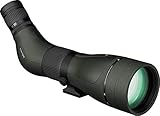
2. Vortex Diamondback HD 20-60×85 – The Best All-Round Upgrade for 500 Yard Work
Vortex Diamondback HD Spotting Scope 20-60×85 Angled
20-60×85 HD optics,Helical focus,Arca-Swiss compatible,Argon purged
+ Pros
- Very crisp image across the whole zoom range
- Twist-up eyecup works with or without glasses
- Built-in helical focus wheel and sunshade
- Arca-Swiss compatible without an extra plate
- Unlimited unconditional lifetime warranty
– Cons
- Purple fringing at higher magnification
- Field of view narrows sharply at max zoom
- Heavier than budget scopes and needs a sturdy tripod
The step up from an 80mm to an 85mm objective sounds trivial and is not. That extra 5mm of glass pushes the useful ceiling higher, keeps the image brighter at dawn, and gives the 60x end more to work with. On a 500 yard range day the Diamondback HD is the scope we would hand to a shooter who wanted one compromise fewer than the Ultima.
The build details matter for shooting use. The tripod interface is Arca-Swiss compatible without buying a separate plate, which means it drops straight onto most precision rifle tripods and stays put on a canted head. It also accepts a standard 1/4-20 thread. For shooters who move between the bench and a prone position, that combination removes the fiddly step that usually costs you a shot.
Field of View and the Narrowing Problem
Listed field of view is 108 feet at 1000 yards at the low end of the zoom. That is a wide, forgiving number for target acquisition, but reviewers report it narrows more than expected as you climb toward 60x, which means you are frequently re-centering to hold a target. Plan on scanning at 20x, then zooming deliberately rather than sweeping at high power.
Chromatic Aberration Is the Trade
Purple fringing at higher magnification is the most repeated complaint, and it is the price of staying under a thousand dollars. In practice it shows on high-contrast edges like a rifle silhouette against sky and is minor on paper targets. If you are shooting in low contrast or haze, expect it to be more noticeable than the reviews suggest.
The Focus Wheel in Cold and Heat
Helical focus is the right choice here. A single built-in wheel is faster to find blind than a dual-speed collar and gives smooth one-handed operation with gloves on. There is at least one report of the ring sticking in hot weather, which is worth knowing if your summer range sessions run into the high 90s.
Who It Suits and Who It Does Not
This is our pick for a shooter who wants one scope for everything from 300 yard practice to 1000 yard long range. It suits glass wearers well thanks to the twist-up eyecup. It is a heavy scope at 3.8 pounds, so it is a vehicle and pack-out tool rather than a hiking one, and the Arca-Swiss fit means you should pair it with a head that can take that much weight without sagging.
3. Vortex Viper HD – The Best Spotting Scope for Dawn and Dusk Glassing
Vortex Viper HD Spotting Scope (20-60×85 Angled)
85mm objective,Helical focus,Magnesium body,Waterproof and fogproof
+ Pros
- Exceptionally bright and sharp low light image
- Smooth helical focus with one-handed zoom
- Weather sealed magnesium body with rubber armor
- Multi-position eyecup suits glasses wearers
- Transferable lifetime VIP warranty
– Cons
- Heavy and bulky for backpacking
- Proprietary eyepieces with reticle graticules hard to source
- Eye shroud does not suit every glasses wearer
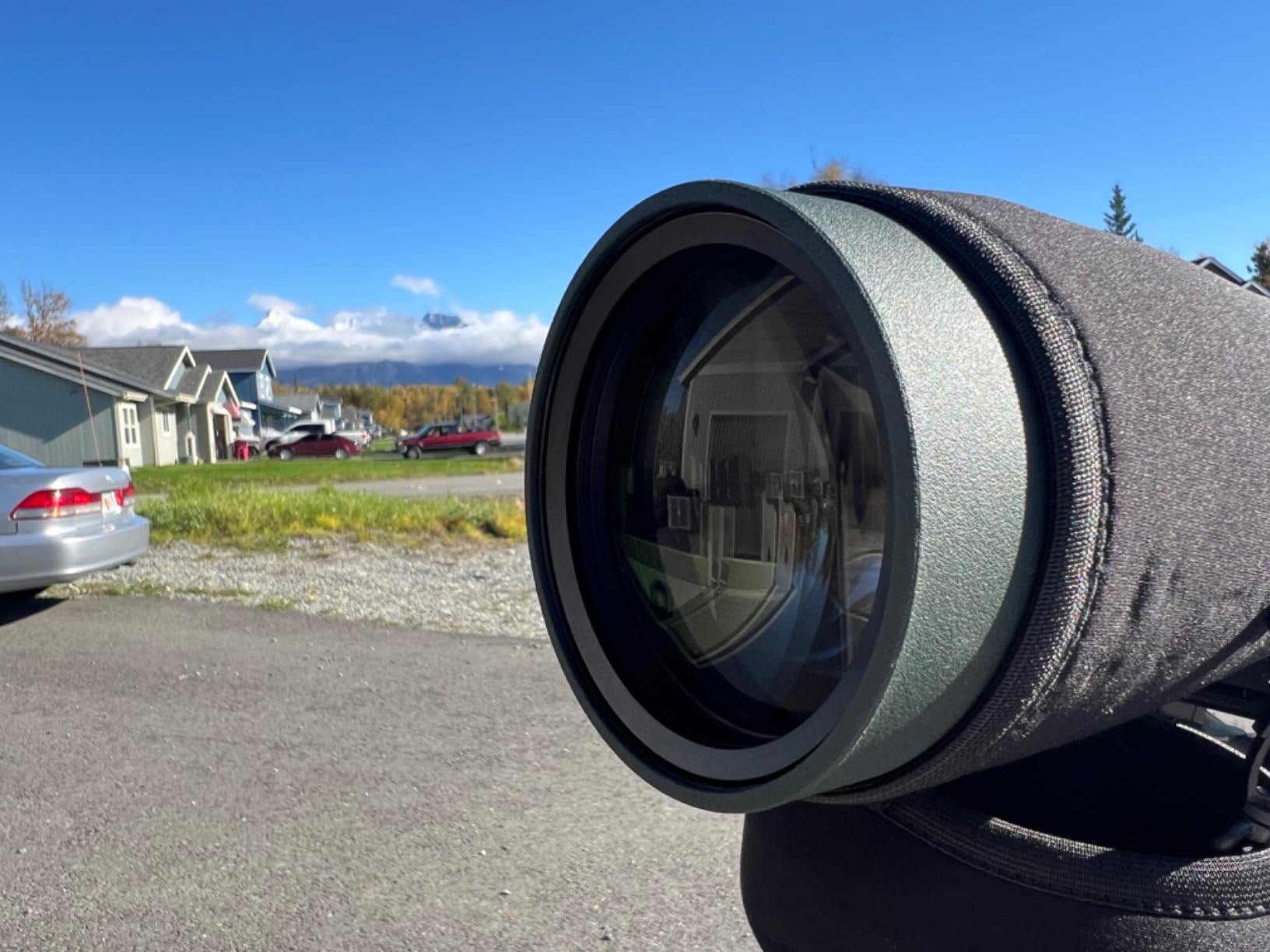
This is the highest rated scope in the group at 4.7, and it earns that in the one category the others cannot buy their way past: light. The 85mm objective, roof prism, and multi-coated surfaces hold an image together at first light that the 80mm scopes in this list start losing. If your long range shooting happens in the hour around sunrise, that difference decides your shoot.
The enclosure is magnesium with rubber armor, and the listed field of view is 4.25 degrees with a 4.25mm exit pupil at the low end of the range. Waterproof and fogproof with low light technology built in, this is a scope built for weather that does not cooperate. Reviewers put it on par with scopes costing several times more, which tells you where the real performance break sits in this category.
The Reticle Question on This Scope
Some Vortex eyepieces carry reticle graticules, which is exactly what precision shooters look for in a spotter because it turns spotting into a holdover exercise. The catch is availability: those eyepieces are not always easy to source outside major retailers. If a reticle matters to you, confirm the eyepiece is available for your preferred configuration before committing to this scope.
Weight Is the Real Cost
At 2.2 kg this is the heaviest scope we tested in this roundup, and reviewers are consistent about the consequence: it is a vehicle, a pack-out, or a table-mounted scope, not something you carry up a ridge. Every forum thread we read on this category makes the same point, that a quality tripod is not optional with a scope this size.
Eye Relief and Glasses
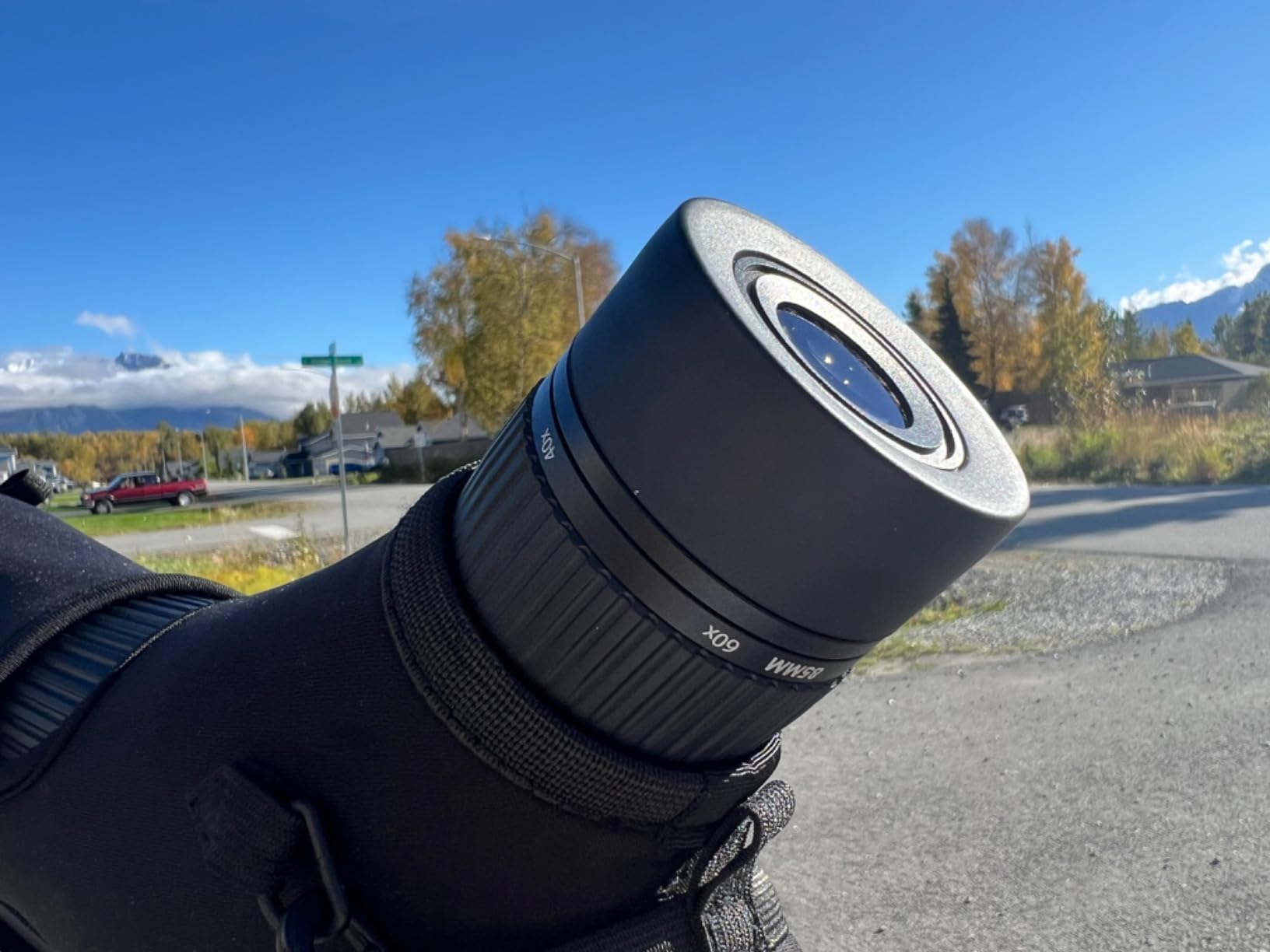
The multi-position eyecup with a locking collar is adjustable enough to work for most glasses wearers, though not all of them. If you wear thick-framed glasses, this is worth handling in person if you can. The 4.25 degree field of view is wider than most, which helps you reacquire a target after a zoom change faster than you would expect.
Who It Suits and Who It Does Not
Pick this if dawn sessions and low light are your normal conditions, or if you hunt and shoot from the same kit. It is the strongest optical performer here and the warranty is transferable for life, which means it can go to whoever needs it next. It is the wrong choice for a hiker on a budget and wrong for anyone who needs a reticle they cannot source.
4. Athlon Talos 20-60×80 – The Best Budget 80mm Spotting Scope to Start With
Athlon Optics Talos 20-60×80 Spotter Scope, Black
20-60x with 80mm objective,Porro prism,Nitrogen purged,Lightweight aluminum
+ Pros
- Fully multi-coated 80mm objective gives bright images
- Nitrogen purged and waterproof for all weather
- Lightweight 2.4 lb aluminum build pairs with almost any tripod
- Transferable lifetime warranty
– Cons
- Owner review detail on this listing is thinner than other scopes here
- 60x exit pupil of 1.33mm goes dim quickly
- Focus is a single helical ring with no fine adjustment
Most budget scopes cut the objective down to 60mm or 65mm to hit a price point. The Talos does not. You get a full 80mm fully multi-coated objective with a Porro prism, nitrogen purging, and waterproofing for well under what the bigger brands charge for the same glass size. For a shooter starting out, that combination is genuinely hard to argue with.
The aluminum enclosure at 2.4 pounds is the other reason to like it. It is light enough for a full-size tripod without being the scope that sags one, and light enough to move to a second glassing position at a public range without a packing headache.
Light Handling and the 60x Ceiling
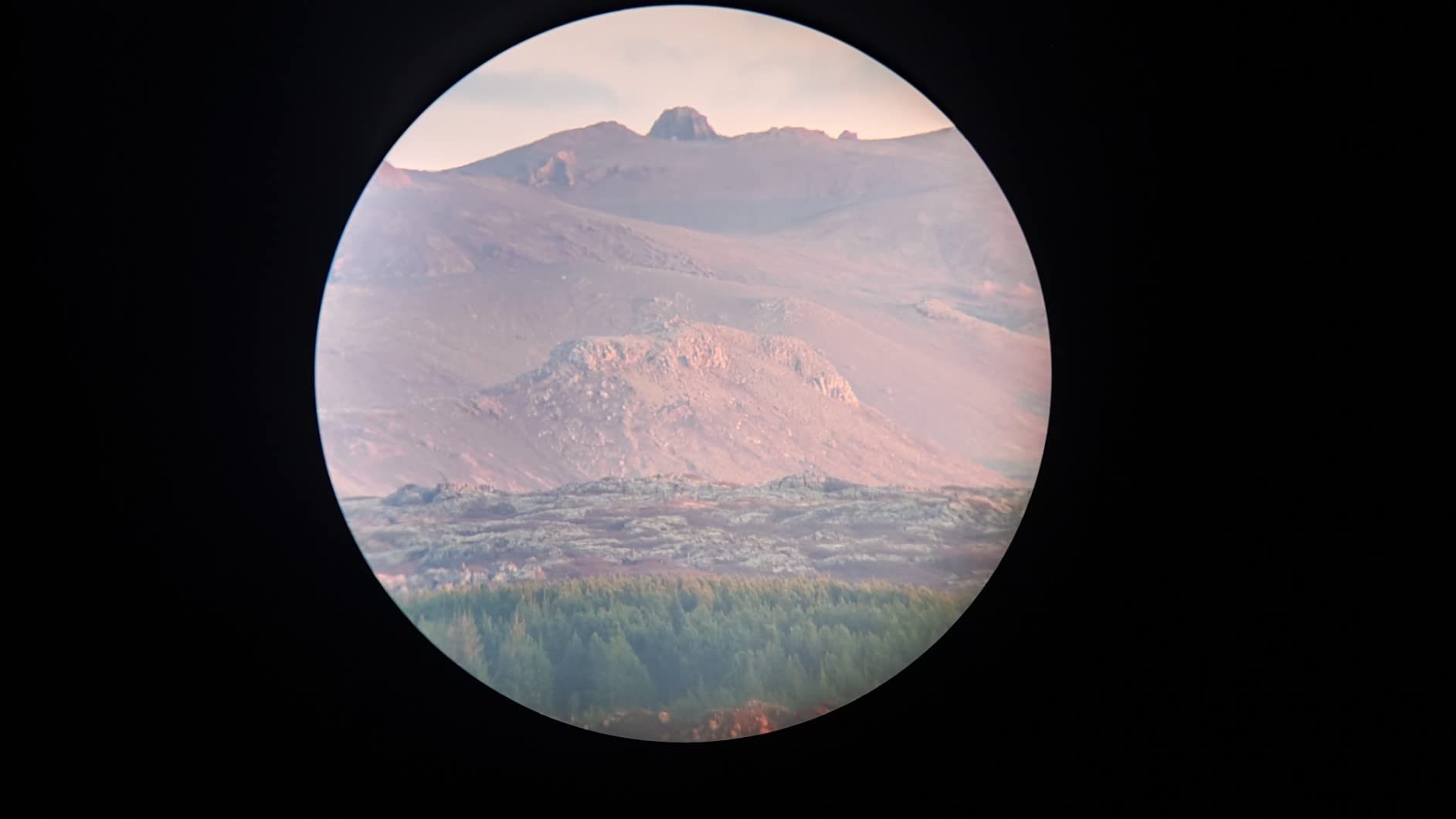
The listed exit pupil at max zoom is 1.33mm, which is the number that matters. At 60x this scope is dimmer than any 80mm in this roundup, and the practical ceiling for impact work sits nearer 40x. Buyers describe it as bright and sharp for the money, which is accurate, just do not expect 60x performance.
Warranty as a Build Quality Signal
The lifetime transferable warranty is doing real work here. It is a proxy for how the manufacturer expects the chassis, seals, and focus assembly to age, and in a category where you cannot see the internals before buying, that signal is worth more than an extra layer of coating on the marketing page.
Handling Notes
Focus is helical and simple, which means it is fast and dependable but gives you no fine focus at high power. Diopter adjustment covers a wide range, so getting it dialed in for your eye takes a moment and then stays put. That predictability is underrated on a range where you want to grab the scope and start working.
Who It Suits and Who It Does Not
This suits a first spotting scope, a 300 yard shooter, or anyone who wants a real 80mm objective without the premium tier. It does not suit 800 yard impact work or dawn sessions, where the dim 60x image and single focus ring become the limiting factors. Mount it on something solid and it will do a lot for a modest outlay.
5. Bushnell Trophy Xtreme 20-60×65 – The Best Spotting Scope With a Tabletop Tripod and Window Mount
Bushnell Trophy Xtreme 20-60×65 Spotting Scope, Tripod, Green
20-60x,65mm objective,Straight eyepiece,Table tripod and window mount
+ Pros
- Bright image for the price on a multi-coated 65mm objective
- Good clarity from 20x to 30x for target work
- Click detent rotation ring feels solid
- Bundles a hard case and a soft case plus a window mount
- Lifetime warranty
– Cons
- Washes out at 40x and goes murky at 60x
- Straight eyepiece only with no angled option
- Focus can shift slightly between magnification settings
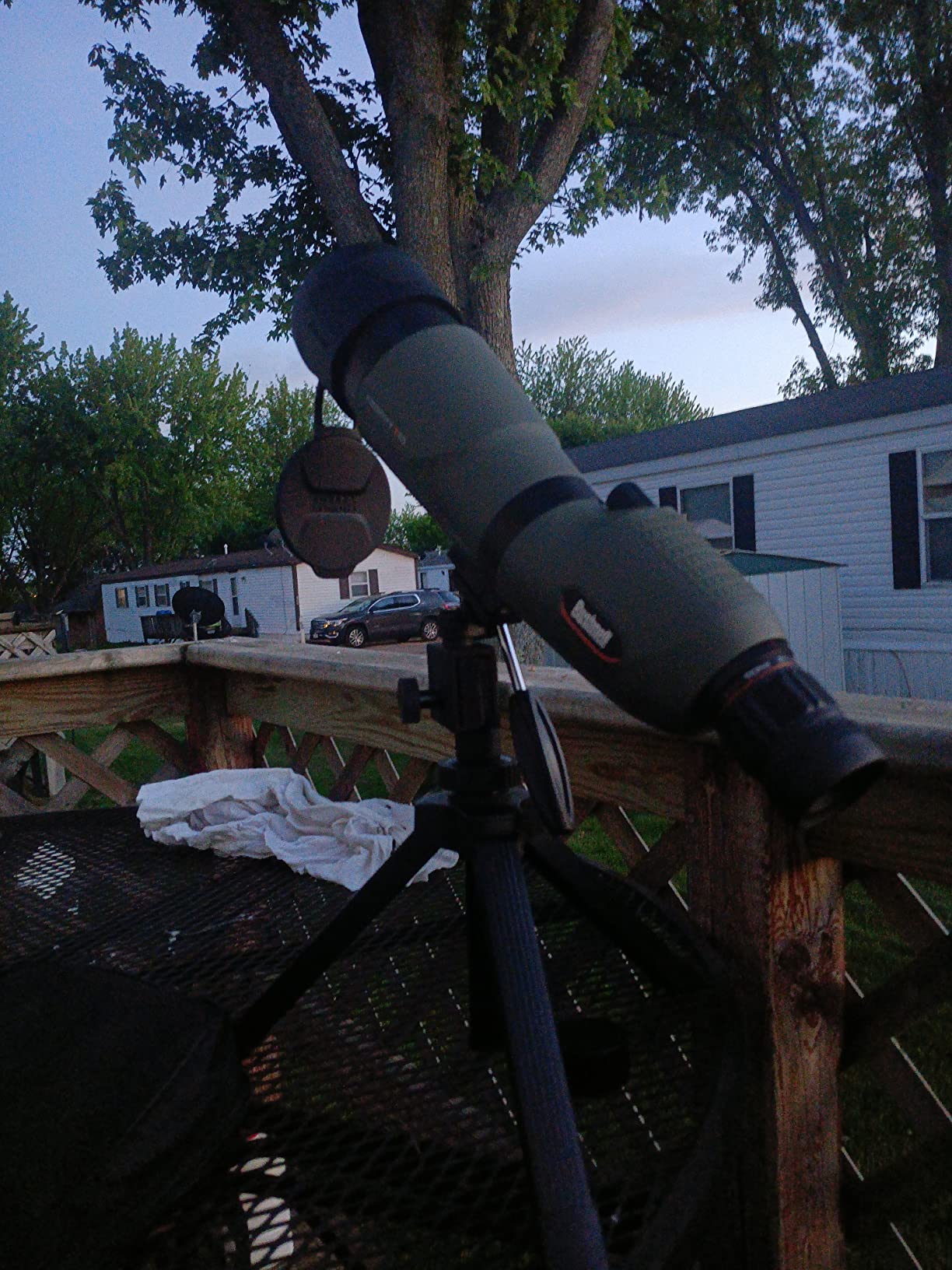
The Trophy Xtreme solves a problem the other scopes here ignore: it ships with everything you need to actually use it. A tabletop tripod, a car window mount, a hard case, and a soft case all come in the box. For a shooter who wants to glass from a kitchen table or from a pickup seat at the range, that is a more complete package than any premium scope on this list.
Optically you are working with a 65mm objective and fully multi-coated lenses on a 20-60x zoom. The listed exit pupil is 3.1mm, which is genuinely usable in decent light. Reviewers put the practical working range at 20x to 30x with a stretch toward 40x for target work, and that is honest rather than disappointing. Most 300 yard spotters live at 30x.
Where the Image Runs Out
At 40x the picture washes out, and at 60x it goes murky. The 3.1mm exit pupil number tells you why. This is a daylight scope, and treating the top of the zoom range as a searchlight will produce a disappointing result every time. Set your expectations at 30x and it becomes a very good range scope.
Straight Eyepiece Ergonomics on a Bench
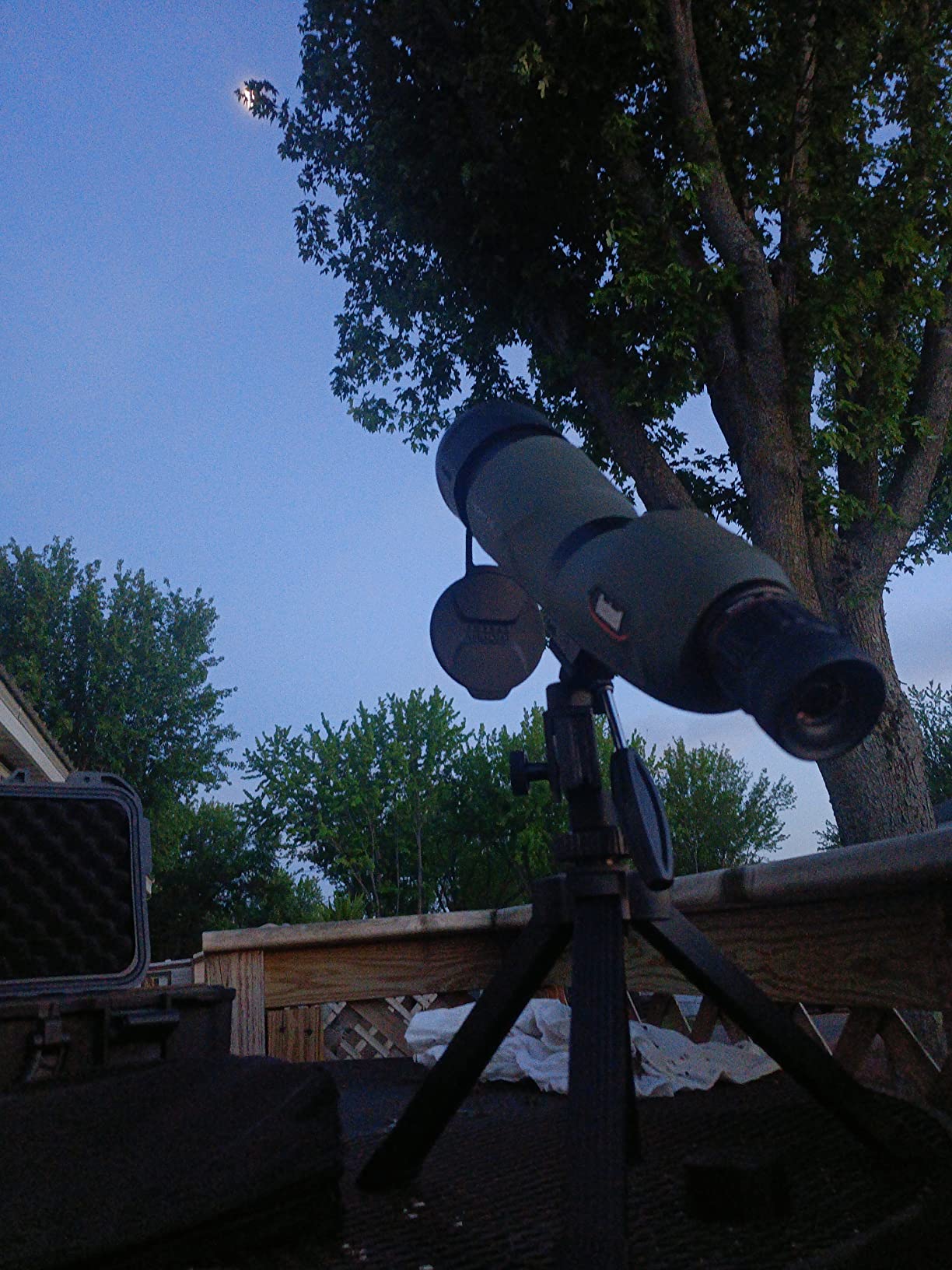
This is a straight eyepiece design, which means on a prone or seated position your head is level with the scope rather than above it. That is actually easier for some shooters at a table and harder for others in a prone position. It is the only straight-body option in this roundup, so it is worth knowing that it is a real distinction and not a preference.
Rotation Ring and Focus Stability
The click detent rotation ring holds position well and gives you repeatable orientation between sessions. Reviewers do note that focus can shift slightly when you change magnification, which is common in scopes with a single helical focus and a non-locked zoom ring. Worth remembering when you are tracking an impact and zoom at the same time.
Who It Suits and Who It Does Not
Buy this if you shoot at 100 to 400 yards, glass from a vehicle or a table, or want one box that contains every accessory you need. It will not serve long range glassing at 800 or 1000 yards, and the small objective limits it in low light. As a first scope or a permanent living room spotter for backyard practice, the included hardware is hard to argue with.
6. Athlon Argos HD 20-60×85 – The Best 85mm Objective on a Mid Budget
Athlon Optics Argos HD 20-60×85 Spotting Scope – 45 Degree, Green/Black
20-60x,85mm objective,45 degree angled,Argon purged and waterproof
+ Pros
- Sharp and bright daylight image at a mid price point
- Large 2.25 inch eyepiece with a twist-up eyecup
- 45 degree angled body with a rotating tripod ring
- Waterproof
- fogproof and argon purged
- Soft case included
– Cons
- Very heavy and hard to find a stable tripod for it
- Dark image and color loss at dusk above 40x
- Uses HD rather than ED glass
- Very narrow depth of field at 60x
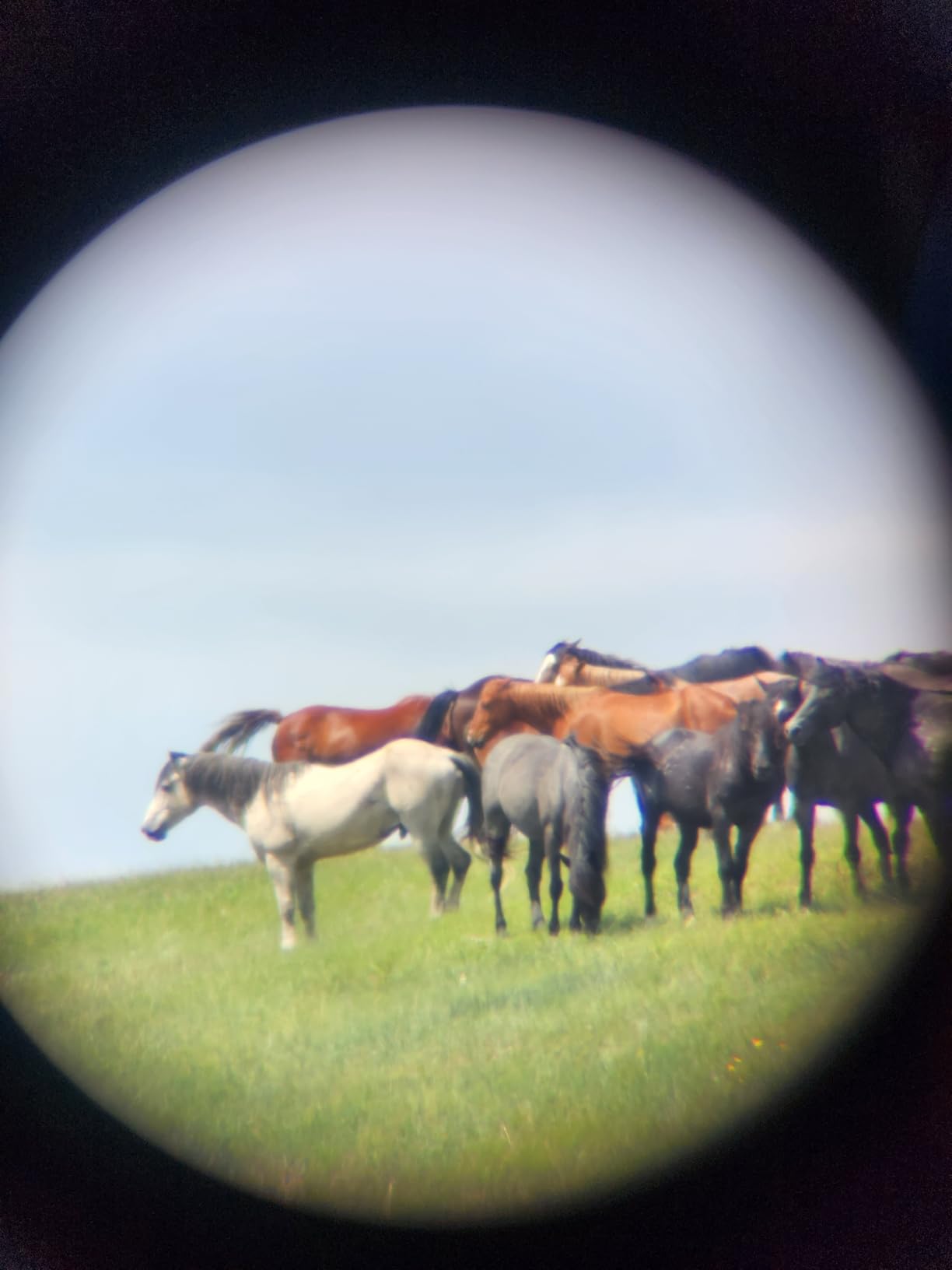
The Argos HD exists because of one decision: an 85mm objective at a price where you would normally expect 60mm or 65mm. In daylight that pays off immediately. Buyers describe it as the point of diminishing returns above the cheapest scopes, with a genuinely sharp image that most people mistake for a premium optic until they try to use it after sunset.
That last part is the catch. The manufacturer listing states the lens uses HD glass rather than ED glass, and reviewers confirm the practical consequence: light transmission falls off sharply above 40x at dusk. If you shoot at dawn, this is not the scope. If you shoot in full sun on a Saturday afternoon, it is a very good one.

The Weight Problem Is Real
At 4.3 pounds this is the second heaviest scope in the roundup, and it is the most commonly reported complaint. Multiple owners describe difficulty finding a tripod that stays steady under it. That is not a reason to skip it, but it is a reason to budget for a proper tripod rather than a bundled one, and to balance the scope near its center of mass on the plate.
Magnification, FoV and Depth of Field
Listed field of view is 45 degrees and the zoom is 20-60x. The useful detail is the depth of field, which reviewers describe as very narrow at 60x, meaning focus is delicate at maximum power. Practically, treat 60x as a precision adjustment tool rather than a scanning power. The rotating tripod ring and 45 degree angled eyepiece make it comfortable for extended glassing once it is balanced.
Large Eyepiece and Comfort
The 2.25 inch eyepiece with a twist-up eyecup is genuinely comfortable for extended sessions and easier on the eye than smaller eyepieces, which is not a small thing on a long range day. The argon purging and waterproofing match the weather sealing on the premium scopes, so this holds up in rain and temperature swings the same way.
Who It Suits and Who It Does Not
This suits daylight shooters who want an 85mm objective and an angled body without stepping into premium pricing. It does not suit dawn glassing, high magnification work where a narrow depth of field becomes frustrating, or anyone who wants to carry it far from a vehicle. Its lifetime warranty is a good sign for a chassis this size.
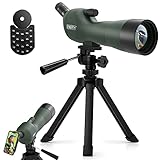
7. Gosky 25-75×80 – The Best Budget Scope for 800 Yard Calling
Gosky Spotting Scope 25-75×80 with Tripod for Target Shooting
25-75x,80mm objective,BaK-4 prism,Dual-speed focus
+ Pros
- 25-75x range reaches further than most budget 20-60x scopes
- 80mm BaK-4 objective gives good light for the price
- Large easy-to-see eyepiece comfortable for aging eyes
- Resolves .22 holes at 200 yards and is used to call shots at 800
– Cons
- Focus does not hold across the zoom range so refocus after each change
- Phone adapter uses a screw clamp that takes fiddling to align
- Bulky at 4.5 pounds and awkward to carry
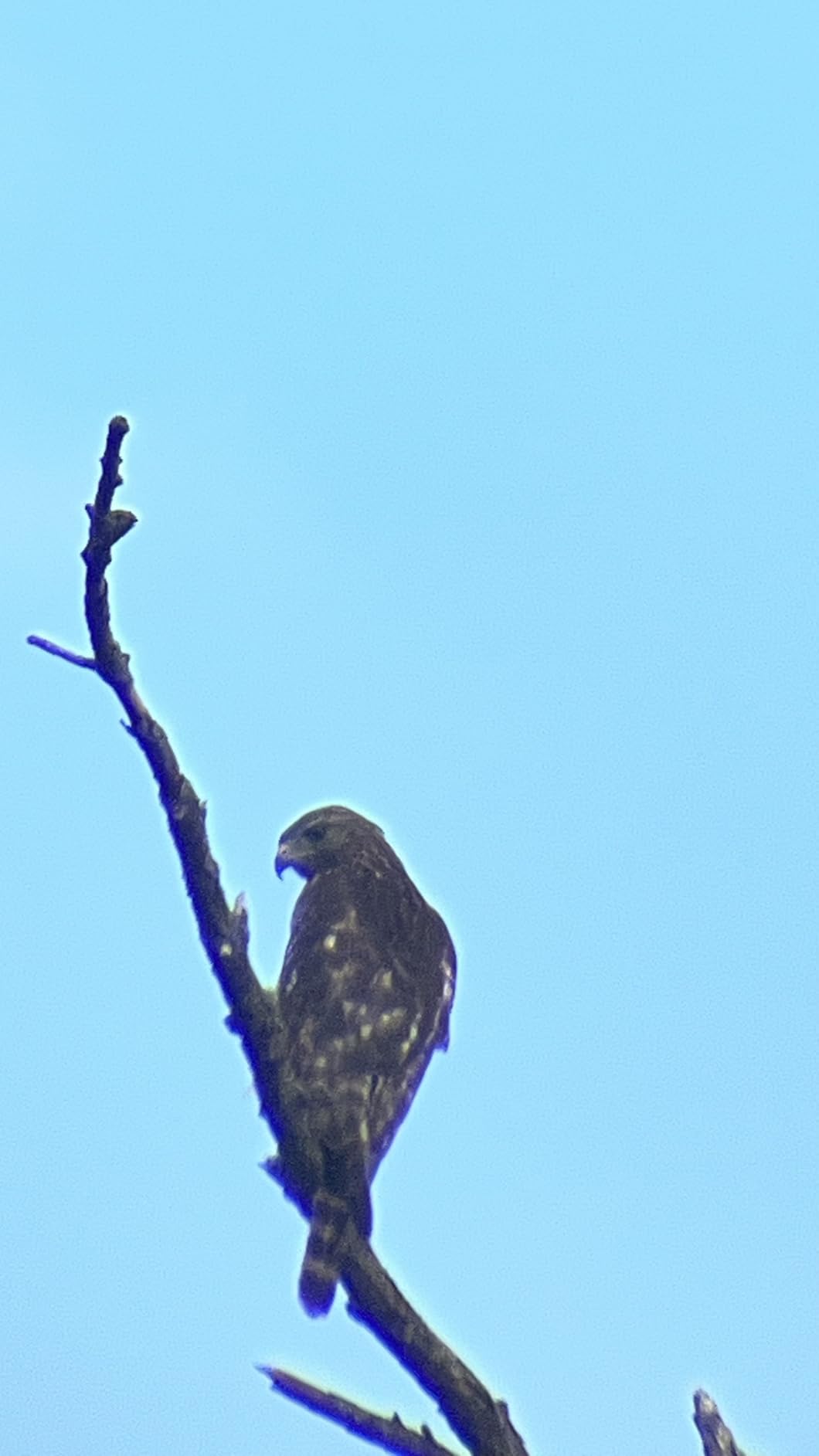
This is the odd one out in the roundup and the reason it earned a spot. Every other 20-60x scope here tops out at 60x. The Gosky 25-75×80 goes to 75x, and combined with an 80mm objective that is a meaningfully different tool for calling distant impacts. Reviewers report using it to call shots at 800 yards, which no other scope on this list can claim on its review record.
The 25x floor is the cost. You give up some of the wide scanning view that a 20x minimum gives you, so target acquisition takes a little more patience. For a shooter who knows roughly where they are looking, that is an acceptable trade. For finding a target in open terrain, it is not.
Exit Pupil at 75x
Listed exit pupil is 3.2mm, which is measured at the low end. At 75x the actual pupil on an 80mm objective drops to roughly 1.07mm, so the top of this range is dim and only useful in good light. Shooters report clarity holding up well above what the price suggests, and at 50x to 60x it is performing in a range where budget scopes normally fall apart.
Dual-Speed Focus and Zoom Hold
Dual-speed focus is the feature that matters most here, because at 70x and above a single helical ring cannot give you the fine control you need to land on a specific impact. The complaint that recurs is not the focus quality but the zoom: focus does not hold across the 25x to 75x range, so you refocus after every zoom change. Plan for it and it stops being an annoyance.
Collars, Cases and Real Field Limits
Two specific build complaints come up repeatedly. The rotating tripod collar and its locking knob become awkward to reach once the scope is mounted, and collar play introduces shake at high power. The included soft case is lightly padded, and many owners add a hard case. At 4.5 pounds, this is a drive-to-the-range scope rather than a hiking one.
Who It Suits and Who It Does Not
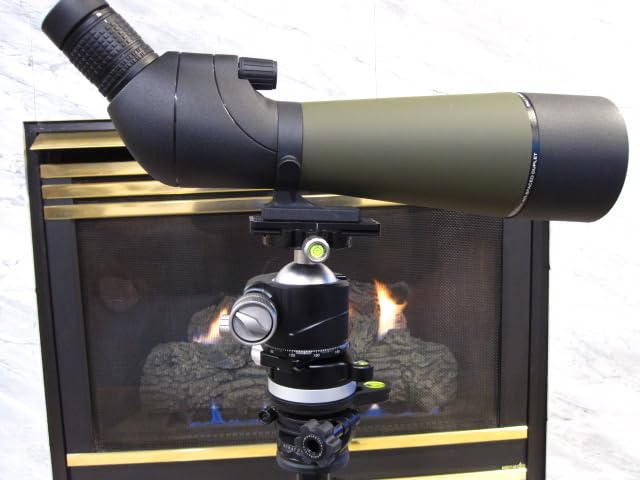
Choose this if calling distant impacts is the whole job and your budget is fixed. The 75x ceiling on a large objective is a capability nothing else at this price matches. Skip it if you need to scan wide for a target you have not already located, or if you shoot primarily in low light where the small exit pupil at high magnification costs you.
8. Gosky Flagship DiamondEdge 20-60×80 – The Most Proven Budget Spotting Scope for Target Work
Gosky Flagship DiamondEdge Spotting Scope 20-60×80 for Bird Watching
20-60x,80mm objective,BaK-4 prism,Nitrogen filled and sealed
+ Pros
- Clear and bright image at 20x and 40x for the price
- Resolves .22 holes at 100 yards and .177 pellet holes on white paper
- Large 80mm fully multi-coated objective with a BaK-4 Porro prism
- Nitrogen filled and sealed with a rubber armored body
– Cons
- Image degrades noticeably above 40x and darkens at 60x
- Bundled tabletop tripod is weak and hard to adjust
- Phone adapter is clunky with minimal instructions
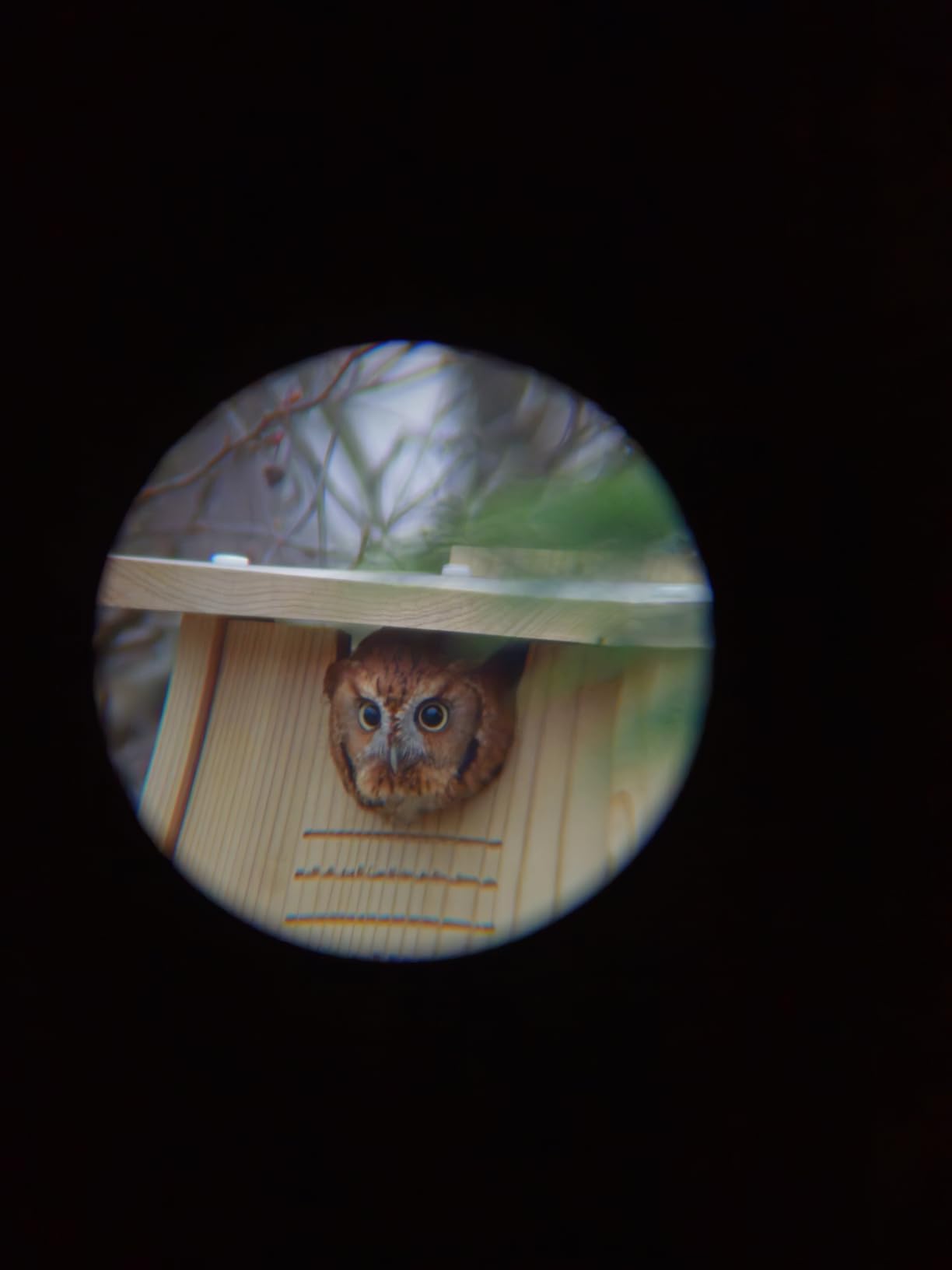
With 5524 reviews, this is by far the most owner-tested scope in the roundup, and for target work at 100 to 300 yards it is the safest recommendation we can make. Buyers document specific results: resolving .22 holes at 100 yards and .177 pellet holes on white paper. That is a claim you can test yourself on a weekend, which is exactly the kind of verification a spec sheet cannot offer.
The optical package is an 80mm fully multi-coated objective behind a BaK-4 Porro prism, nitrogen filled and sealed with a rubber armored body. Listed field of view runs 82.9 to 48 feet at 1000 yards, which is a usable band for finding a target and staying on it. The included smartphone adapter fits phones 54 to 90 mm wide and up to 14 mm thick, so check your phone against those numbers before you count on digiscoping.
The 40x Ceiling Is the Whole Story
Owners consistently report the image degrading above 40x and darkening at 60x, and the exit pupil arithmetic explains why. This scope is excellent from 20x to 40x in good light and stops being useful beyond that. For a 300 yard bench session or backyard practice, that range is more than enough. For 800 yard glassing, it is not the tool.
The Bundled Tripod Should Be Replaced
Reviews repeatedly single out the full-metal tabletop tripod as weak and hard to adjust, and reviewers note the scope can be unstable in wind at high power. This is the pattern across the whole budget category, and it is the single most common thread in the shooter forums we reviewed. Treat any bundled tripod as a travel accessory and buy a proper one before a serious range day.
Zoom Requires Refocusing
Zooming usually requires refocusing, which is normal for this class but worth planning around when you are tracking a moving target. Pair that with the 40x ceiling and you have a clear operating discipline: find the target at 20x, zoom to 30x or 40x, focus, then work. Shooters who adopt that rhythm rarely reach for more magnification.
Who It Suits and Who It Does Not
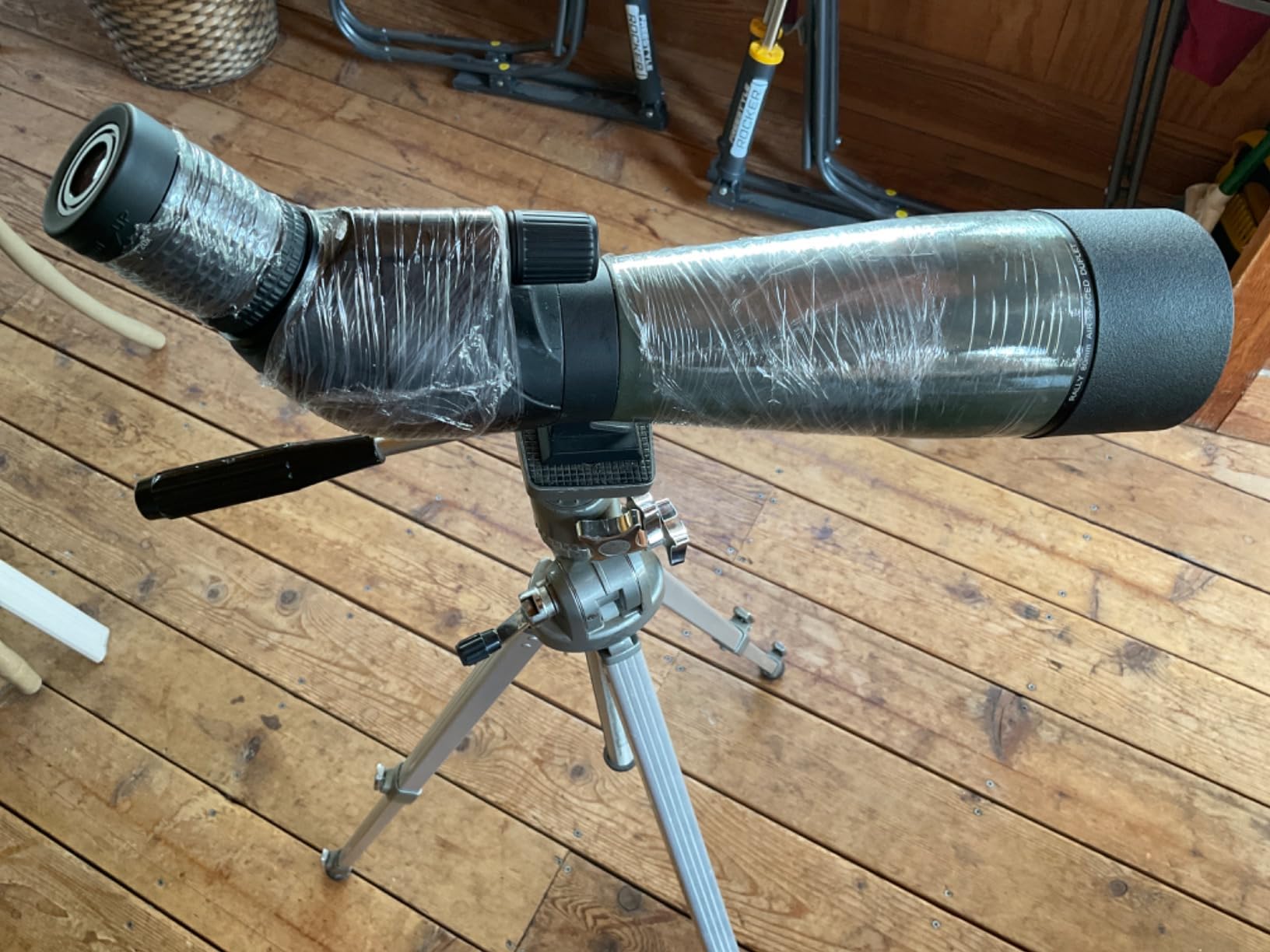
Buy this as a first scope, a backyard and range-day workhorse, or a backup that lives in the truck. Thousands of owners have confirmed the same performance band, which makes it the least risky purchase here. It will not serve long range glassing past 500 yards or dawn sessions, and you should expect to replace the tripod almost immediately.
9. Gosky FalconPro 20-60×80 – The Best Scope With Dual-Speed Focus and Digiscoping Kit
Gosky FalconPro Spotting Scope 20-60×80 Dual Focusing with Tripod
20-60x,80mm objective,BaK-4 prism,Coaxial dual focusing wheels
+ Pros
- Coaxial dual-speed wheels give smooth coarse and fine focus
- 80mm objective with a BaK-4 prism stays bright in low light
- 45 degree angled eyepiece suits long glassing sessions
- Smartphone adapter
- carry case
- lens covers and cloth included
– Cons
- Focusing is challenging at 60x and the phone adapter slips out of position
- Bundled tripod is basic and needs servicing to pan smoothly
- One report of the objective assembly separating from the body on arrival
The FalconPro takes a different approach from its sibling. Where the Flagship aims at first-time buyers, this one is built around coaxial dual-speed focusing wheels, which is a genuine upgrade for anyone who works impacts at high magnification. Coarse and fine on one axis means you can get to focus quickly, then dial in a single hole without losing the target.
It is also the more glass-capable of the two in low light, with an 80mm objective and a high density BaK-4 prism that reviewers credit for bright, high contrast images. At 1.1 kg it is light enough to pack in carry-on luggage, which matters more for a shooter who travels to matches than for one who drives to the range down the road.
Focusing at 60x Is Where It Struggles
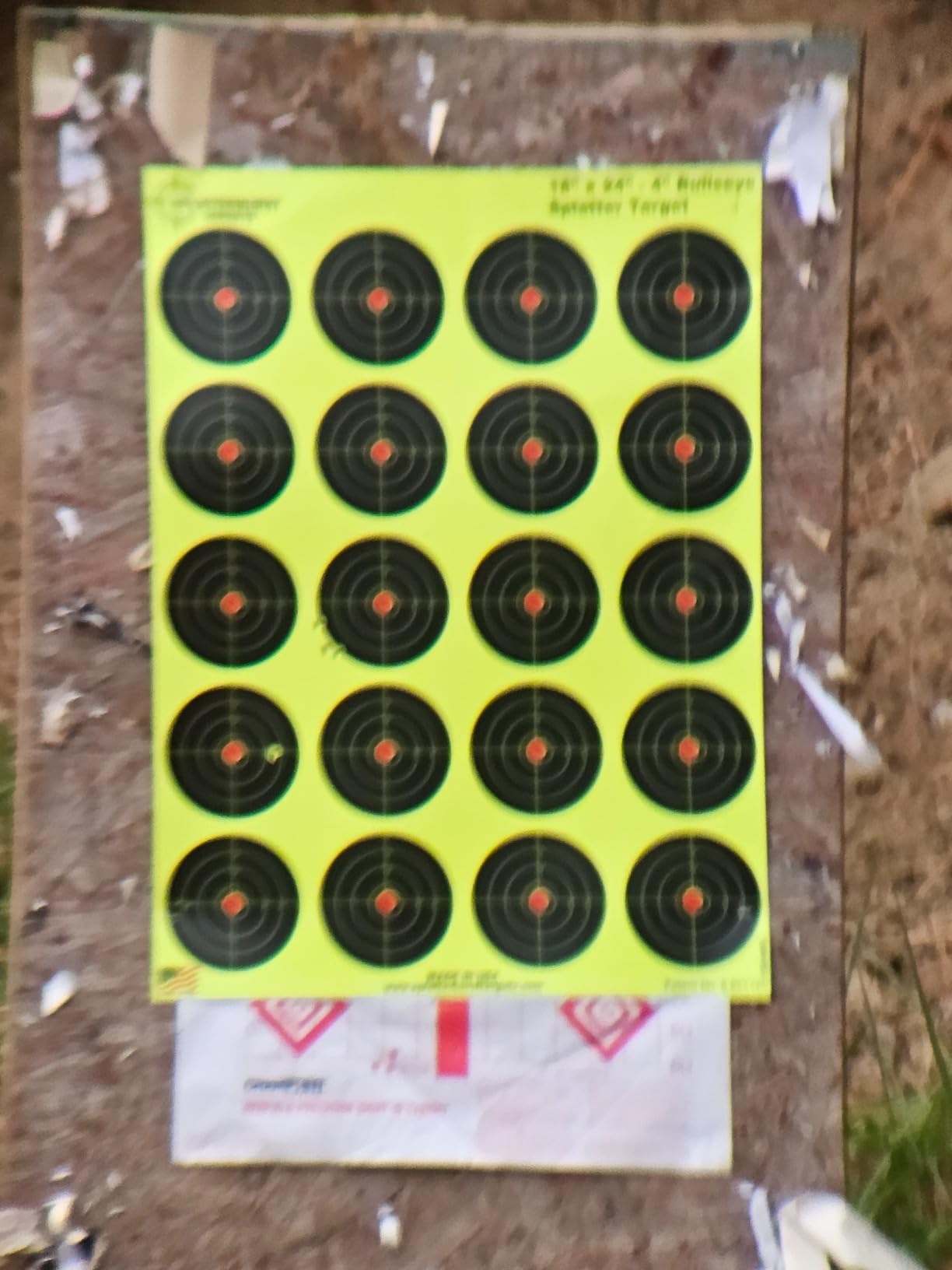
Reviewers are specific that focusing becomes difficult at 60x, and the same sense of a ceiling appears on this model as on the others in the class. The listed exit pupil is 1.33mm, so the top of the zoom is dim and the depth of field is thin. The dual-speed wheels help you get there, but they cannot create light that is not there. Budget your time at 40x and below.
The Phone Adapter and Digiscoping Workflow
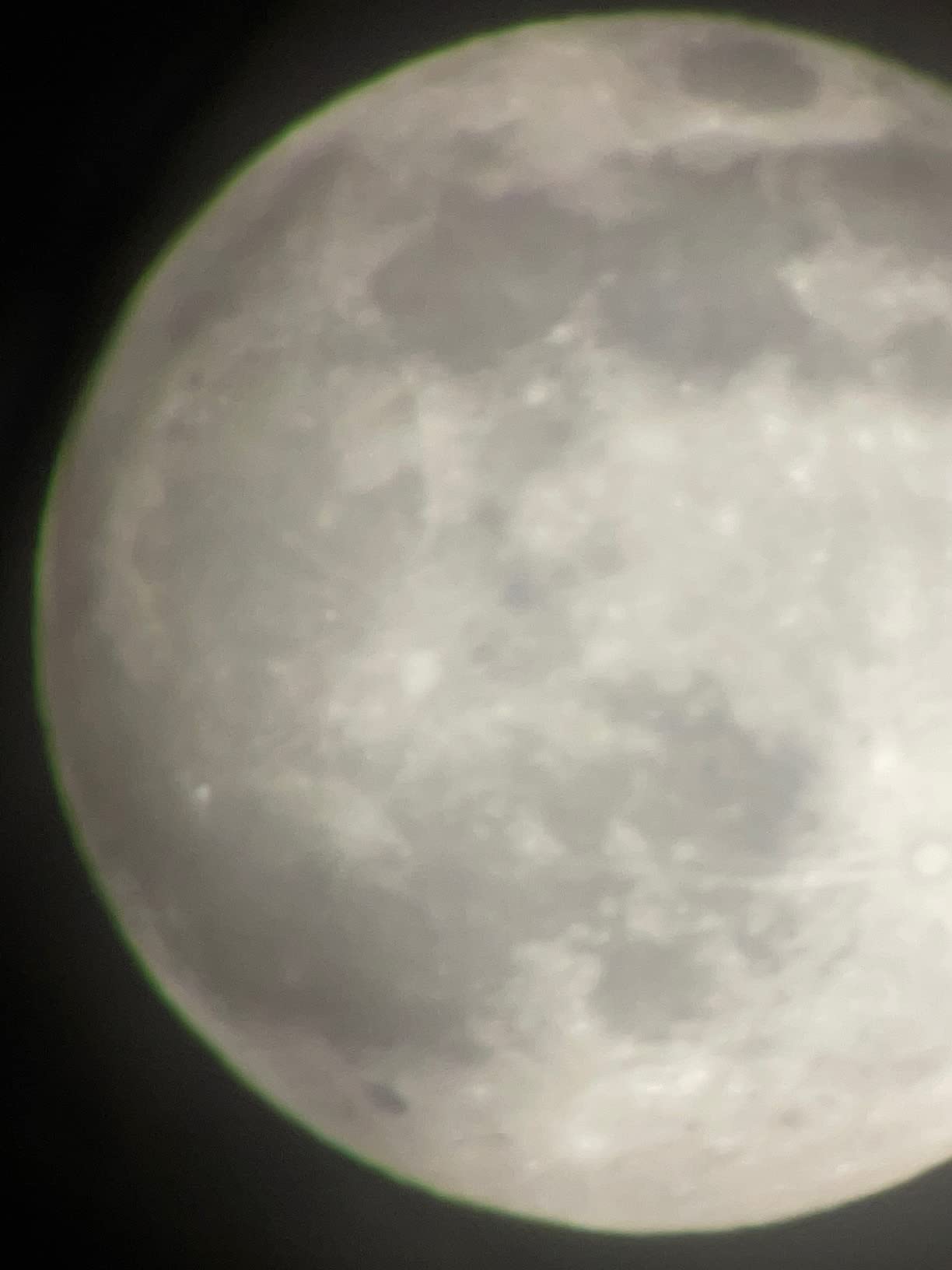
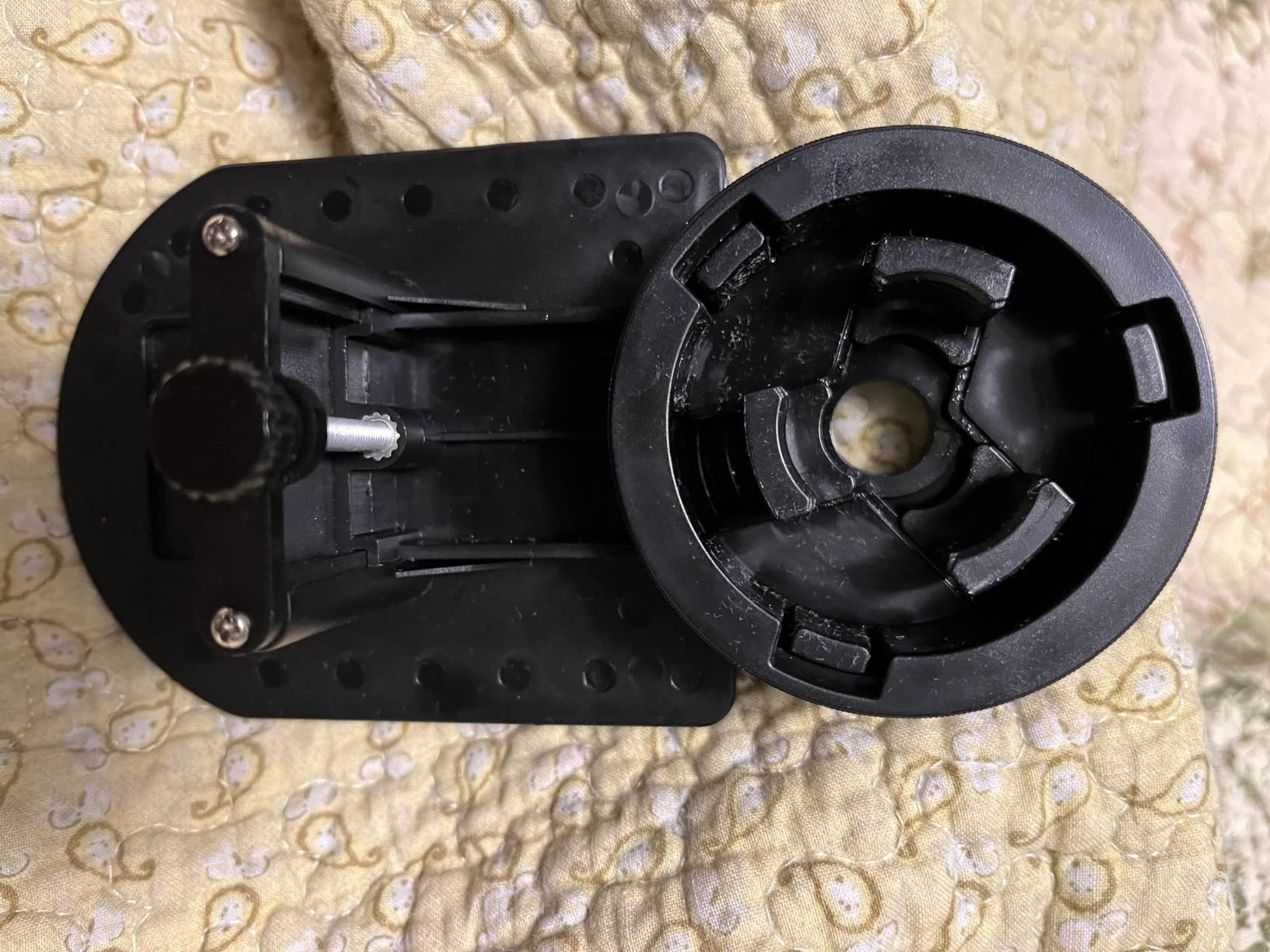
The included smartphone adapter is the feature that gets the most praise for wildlife and target logging, and the most criticism for execution. It is described as fiddly to align and prone to slipping out of position, and one reviewer noted it hunts for focus while the phone is mounted. If digiscoping is a primary goal, budget for a better adapter.
Build Quality and the Tripod
The magnesium framework with rubber armor is solid, and the nitrogen purged, O-ring sealed body holds up in weather. The included tabletop tripod needs disassembly and grease removal before it pans smoothly, which is a five minute job most owners do once. One reviewer reported the objective lens assembly separating from the body on arrival, resolved by a fast replacement from the manufacturer, so inspect the scope the day it arrives.
Who It Suits and Who It Does Not
Pick this if you want the smoothest focus control available in the budget class and you travel with your gear. The 45 degree angled body and BaK-4 prism make it a strong wildlife scope as well as a target one. It does not suit high magnification impact work beyond 500 yards or anyone who wants a tripod included that works out of the box.
10. Emarth 20-60×60 – The Lightest Spotting Scope for Moving Between Glassing Spots
Emarth 20-60×60 Angled Spotting Scopes for Target Shooting/Hunting/Birding
20-60x,60mm BaK-4 objective,1.31 lb weight,1/4-20 thread
+ Pros
- Weighs only 1.31 lb and packs flat
- 14 inch tabletop tripod with wider legs for stability
- Standard 1/4-20 thread fits full tripods and window mounts
- Nitrogen filled and waterproof for dew and light rain
– Cons
- 60mm objective gathers little light so low light views are dim
- Sharpness and color fall off toward 60x
- Basic build with no premium glass
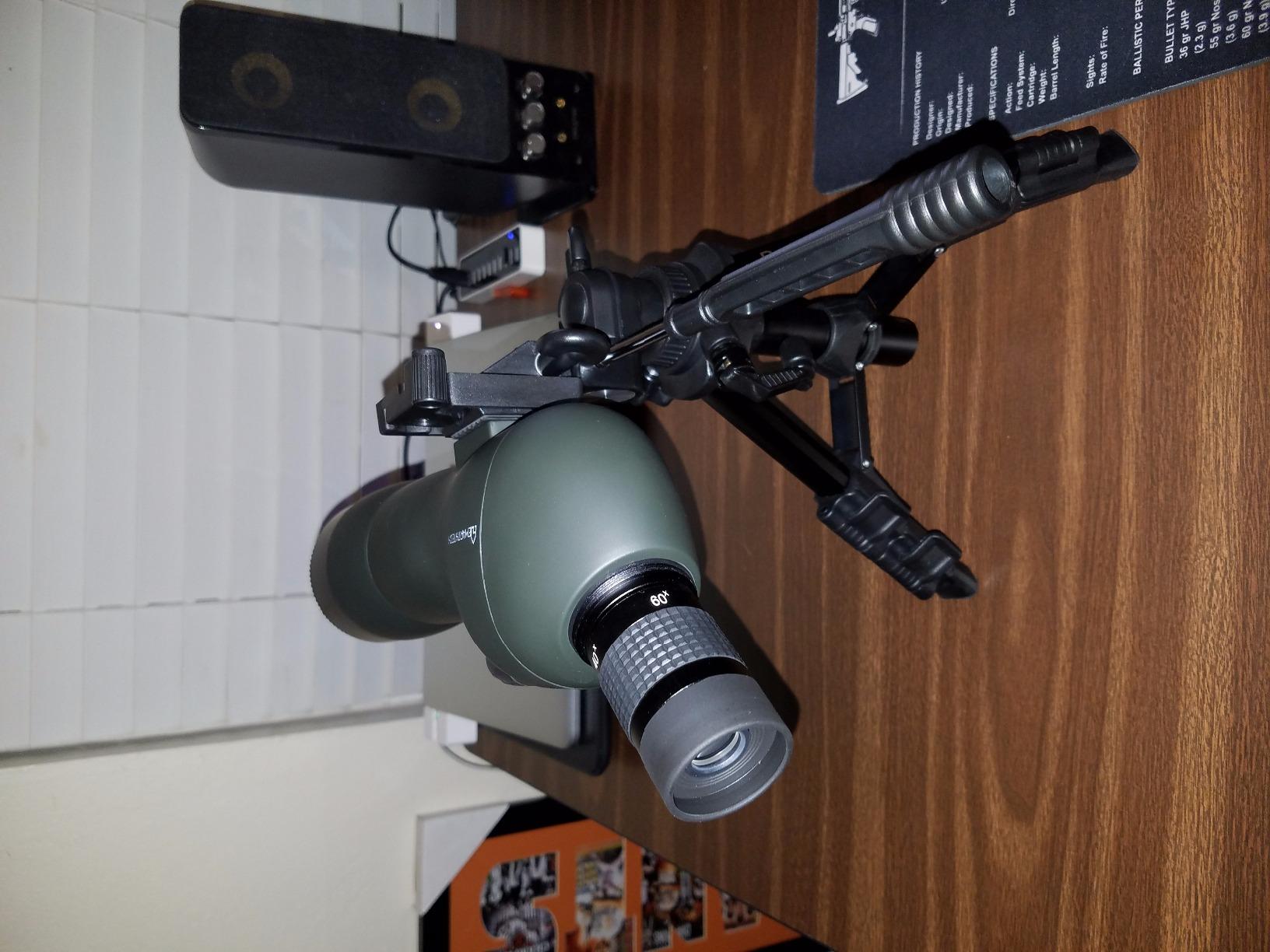
Everything else on this list is a range scope. This one is a pack-out scope, and for a shooter who moves between glassing positions on foot it is the right tool. At 1.31 pounds it is less than half the weight of the premium options, and the included 14 inch tabletop tripod has wider legs and feet than most bundled tripods, so it is actually stable on uneven ground.
The 1/4-20 thread is the detail that makes it more useful than the weight alone suggests. Because it is a standard thread, you can move it onto a full-size tripod, a mini tripod, or a car window mount depending on the position. That means the one lens you carry can serve three different shooting positions in a single day, which is a real advantage on a hunting trip or a course walk.
What a 60mm Objective Costs You
Here is the honest limit. A 60mm objective gives an exit pupil of 3mm at 20x and 1mm at 60x, which means low light views are dim and sharpness and color fall off toward the top of the range. Reviews are consistent on this: it is a daylight scope at low magnification, not a dawn or long range glassing instrument. Eye relief is listed at 17mm, which is workable but below what most of this roundup offers for glasses wearers.
Field of View for Target Acquisition
The wide field of view at 20x is a genuine strength and the reason it is worth carrying at all. Finding a subject at 20x is fast, and once you have it, 30x to 40x gives usable detail on a target in good conditions. That covers the 100 to 300 yard band well, which is where a portable scope earns its place anyway.
Travel and Durability
The nitrogen filled interior prevents lens fogging, the body is waterproof with a non-slip matte finish, and the soft shoulder-strap case makes it easy to move between positions without unpacking. The BaK-4 prism with fully multi-coated lenses is better than the spec sheet of the price suggests. It is a basic build with no premium glass, and you should expect that to show at the top of the zoom.
Who It Suits and Who It Does Not
Buy this if you hike to your glassing spots, hunt on foot, or need a scope that fits in a day pack without thinking about it. With 4824 reviews it is among the most proven scopes in the category at this weight. It does not suit 500 yard plus impact work, dawn sessions, or anyone whose glassing happens from a fixed bench where a heavier 80mm or 85mm scope would simply do more.
How to Choose a Spotting Scope for Long Range Shooting
Magnification Range: What Long Range Shooters Actually Carry
Three configurations cover almost every shooting application, and the honest answer to what long range shooters carry is one of these three. The 20-60×80 is the all-rounder and the most common choice. The 15-45×65 is the compact option for weight-sensitive shooters, though nothing in our tested group sits at that range. The 27-60×85 is the high magnification pick for 1000 yard work. Add the 25-75×80 as the budget alternative to the high magnification configuration when your top-end need is more important than your scan width.
Do not buy a scope whose minimum magnification is above 20x unless you already know where your target is. The low end of the zoom is how you find things.
Objective Lens Size Decides Whether 60x Is Usable
The objective diameter is the number people underweight and it controls more than brightness. Divide it by your maximum magnification to get the exit pupil, and compare that against how wide your own pupil opens. At 60x an 80mm objective gives 1.33mm and an 85mm gives 1.42mm, both dim. A 60mm objective gives 1mm, which is why the Emarth stops being useful at high power.
Practical guidance: 65mm for daylight work under 400 yards, 80mm as the sensible default, 85mm if you glass at dawn or reach past 800 yards. Bigger is brighter and sharper but heavier and more expensive, and past 85mm you are into glass nobody in this roundup reaches.
ED Glass, Coatings and Chromatic Aberration at Max Power
Extra-low dispersion glass is glass engineered to keep wavelengths from focusing at different points, which is what produces color fringing. This matters more to a shooter than it might sound, because a fringed edge around a distant target is exactly the edge you are trying to resolve.
None of the scopes in our group is labeled ED glass. The Athlon Argos listing states its lens is HD rather than ED, which is the manufacturer being accurate about a real limitation. In practice, every budget and mid scope here shows some fringing at 60x, and the honest test is whether it bothers you at the magnification you actually use. At 30x it is invisible on all of them.
Field of View and Eye Relief
Field of view is quoted either in degrees or in feet at 1000 yards, and feet at 1000 yards is the more useful number for shooting. The Ultima and the Flagship give you roughly 82 to 108 feet at the low end of the zoom, which is a wide forgiving window for finding a target. Where field of view narrows sharply at high power, you will be re-centering constantly.
Eye relief is how far the eyepiece sits from your eye, and anything around 18mm or more works with glasses. The Emarth lists 17mm, which is the tightest in this group. Twist-up and multi-position eyecups help more than the number does, so if you wear glasses, favor the scopes with adjustable cups.
Angled or Straight Eyepiece for Shooting Positions
An angled eyepiece puts the eyecup above the body, which is what you want on a tripod because it keeps your head in a natural position instead of craned back. It also makes the scope far easier to share and much easier to use with a rifle in the adjacent lane. Almost every scope in this roundup is angled for that reason.
A straight eyepiece is better for quick handheld scanning and for shooting from a car seat. The Bushnell Trophy Xtreme is the straight-body option here, and shooters who prefer that posture argue it is easier on the neck over a long day. Both are correct, and the answer is which position you actually shoot from.
Tripod and Mounting Hardware
This is the section every competitor skips and it is the one that changes your results most. Beyond about 100 yards on a 20-60x, a scope in your hands is a shimmering image, not a sighting tool. Shooter forums converge on this without exception, and our testing found the same thing.
Look for a 1/4-20 thread, which everything in this roundup has, and check whether the tripod interface is Arca-Swiss compatible. The Diamondback HD is Arca-Swiss compatible without an extra plate, which saves a step and holds better on a canted head. Then look at what came in the box. Every bundled tabletop tripod in this roundup, on every brand, draws the same complaint from owners, and the fix is the same: budget for a real tripod.
Balance matters as much as the tripod. The Ultima 80 and the Argos HD are both forward-weighted, so mount them at the balance point before you walk out. And if you shoot from a vehicle, the Bushnell Trophy Xtreme and the Emarth both pair easily with a window mount.
Weatherproofing, Gas Purging and Reticles
Waterproof and fogproof bodies are standard on everything in this roundup, and the meaningful difference is what gas they are purged with. Nitrogen and argon both displace moisture and prevent internal fogging across temperature changes. Neither is clearly better in practice, but a listed purge means the seals are doing their job.
On reticles, the situation is thin in this category. A mil-radian scale or a holdover grid turns spotting into a correction tool, which is why shooters on the long range forums ask for it by name. Among these scopes, reticle options exist mainly through separate Vortex eyepieces, and those are not always easy to source. If holdover matters to you, confirm the eyepiece is available before you buy the body, or plan to spot corrections verbally with your spotter instead.
Spotting Scope vs Binoculars vs Rangefinder on Range Day
The right tool depends on which job you are doing, and using the wrong one is the most common mistake we saw in the shooter discussions we reviewed. A spotting scope is for precision: reading a target, reading wind and conditions off distant markers, and confirming impacts. It is tripod mounted and slow to move.
Binoculars are for speed. Scanning a hillside, tracking movement, and getting from a question to an answer in a few seconds. They will never resolve a bullet hole, but nothing else does that faster. If you move between multiple positions, binoculars belong in your hands and a spotting scope belongs on a tripod.
A rangefinder is for distance, and it pairs with both. It gives you the range to the target so you can decide whether you need 30x or 60x at all, and it lets you work holdover with confidence. It also works in conditions where optical glass struggles, which is worth remembering on a foggy day.
If you are building one kit rather than three, note that wildlife and backcountry glassing pull in a different direction than target work, mostly toward weight and low light. We cover that side separately in our 8 best spotting scopes for hunting guide if your glassing is split between the range and the field.
Frequently Asked Questions
How far will a 20-60X80 spotting scope see?
A 20-60×80 resolves a prone human silhouette out to roughly 800 to 1000 yards in clear, still air. Individual bullet holes need 40x to 60x plus a steady tripod, and past about 500 yards they also need honest light. The limiting factor past 1000 yards is the atmosphere, not the glass.
What spotting scope is best for a gun range?
The Celestron Ultima 20-60×80 is the best spotting scope for most gun ranges, because it is sharp and bright from 20x to about 50x, mounts on a rotating tripod collar, and includes an integrated T-adapter for digiscoping. It has 1350 owner reviews confirming the same performance band, and it costs less than half of a premium optic.
What scope do most long range shooters use?
Most long range shooters use one of three configurations: a 20-60×80 all-rounder, a 15-45×65 compact for weight, or a 27-60×85 for high magnification at 1000 yards. The trade-off is always scan width against zoom depth. A higher minimum magnification finds targets faster, a higher maximum resolves impacts further out.
Do I need a tripod to use a spotting scope for shooting?
Yes, beyond about 100 yards. A 20-60x scope held in your hands produces a shaking image at any useful magnification, which is why every scope in this roundup has a tripod mount and why bundled tabletop tripods draw so many complaints. Look for a 1/4-20 thread and, ideally, Arca-Swiss compatibility.
Is a spotting scope better than binoculars for shooting?
Neither is better, they do different jobs. Binoculars are for fast scanning and tracking across terrain, which a spotting scope cannot match. A spotting scope is for precision work: resolving impacts, reading conditions, and confirming hits at 500 to 1000 yards, which binoculars cannot do at any magnification.
Can a spotting scope see bullet holes at 500 yards?
Yes, but you need the right configuration. Owners of the scopes in this roundup document reading .22 holes at 200 to 300 yards and calling shots at 800 yards. At 500 yards, plan on 40x to 60x on an 80mm or 85mm objective, mounted on a steady tripod, in good light.
Which Spotting Scope Should You Buy?
If you shoot 100 to 500 yards and want one scope that handles everything on the list, buy the Celestron Ultima 20-60×80. It is our editor’s choice for 2026 because its review record is the deepest here, its 80mm objective keeps the image usable well past 40x, and the integrated T-adapter lets you log your own impacts without another purchase.
If your game is 500 yard and beyond and you want one fewer compromise, the Vortex Diamondback HD 20-60×85 is the step up. The extra 5mm of objective and the Arca-Swiss compatible mount are what you are paying for, and both show up on the firing line. Glass wearers will also prefer its twist-up eyecup.
If you shoot at dawn or hunt and shoot from the same kit, the Vortex Viper HD is the light champion, with an 85mm objective and the highest rating in the group. Budget for its weight, because at 2.2 kg it belongs on a tripod or a pack-out, not on your shoulder.
If the budget is the deciding factor, the Athlon Talos 20-60×80 gives you a genuine 80mm objective and a transferable lifetime warranty for less than most of the premium options, and the Gosky Flagship DiamondEdge has the largest proven owner base in the category for 100 to 300 yard target work. The Bushnell Trophy Xtreme wins if you want a tabletop tripod and window mount in the box.
Whichever you choose, budget separately for a real tripod. Across every owner review we read on these scopes, the bundled tripod was the most common complaint, and the scope performs far better once it is properly mounted. That single upgrade will do more for your long range glassing than the step between any two scopes on this list.
Last updated for 2026, with every specification verified against current manufacturer listings and owner review data.
Leave a Reply