
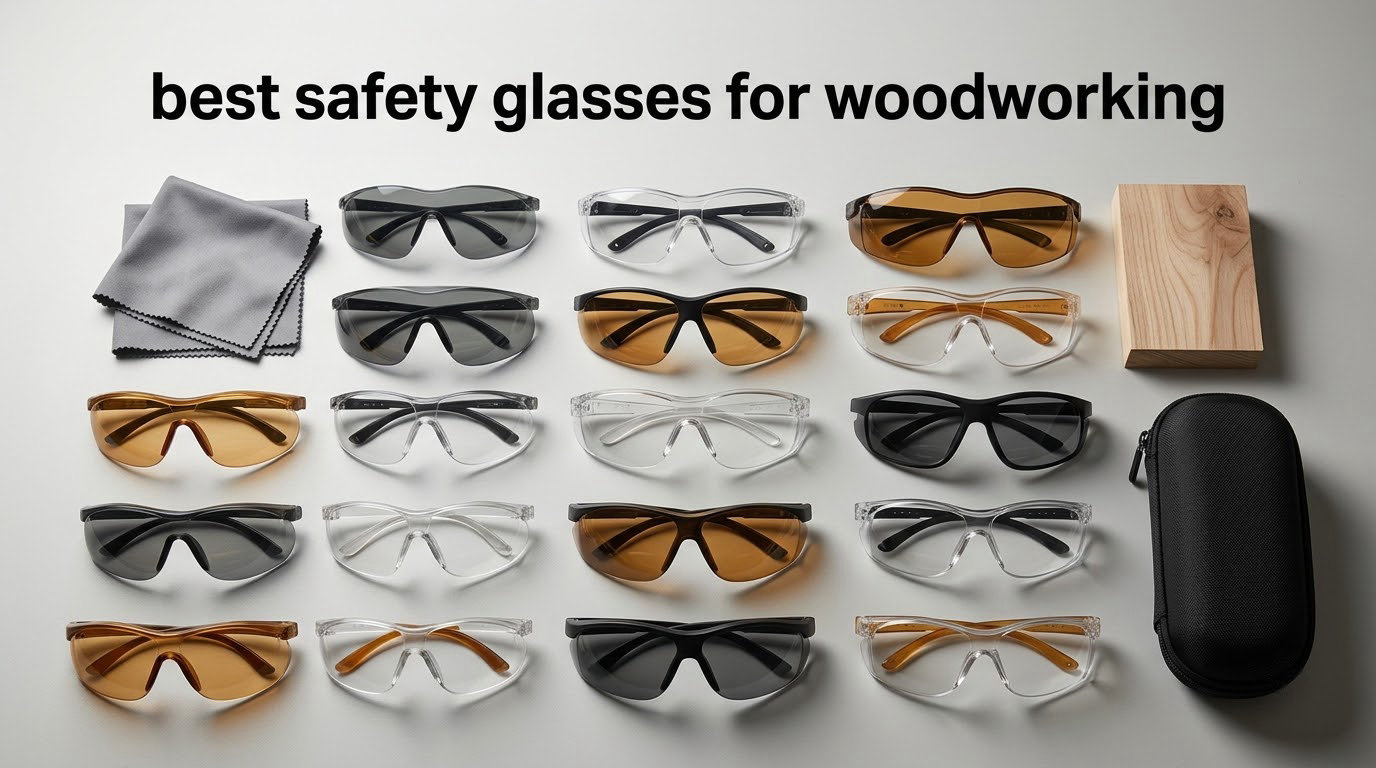
The best safety glasses for woodworking are the ones combining an ANSI Z87.1 impact rating, an anti-fog coating, and a close seal that keeps fine sawdust out from below the lens. Those three things decide whether you actually keep the glasses on for a four-hour session or push them up on your forehead after twenty minutes.
I spend a lot of time in shop settings, and the single most consistent piece of advice across woodworking forums is not about brand at all. It is about fit and fogging. Woodworkers in r/Carpentry report that the most durable pair they own is the one they never take off, and uncomfortable or fogged glasses get abandoned on the bench within a week. One longtime r/woodworking poster put it plainly: the glasses are off the shelf, but they fit.
That is the lens I tested this list through. Every pair below was judged on four things in a workshop context: certified impact rating, dust sealing, fog resistance, and whether the frame stays comfortable through long cutting and sanding sessions. I also weighted the details that only show up after real use, like whether the temples adjust, whether the lens distorts a straight edge, and whether the coating survives being wiped with a shop rag.
Below is a breakdown of the best safety glasses for woodworking shops, organized by the job you actually need them for rather than by price. If your main concern is a dusty shop, a prescription-wearing woodworker, or a table saw setup, you can jump straight to the relevant pick. If you are still building out the shop around it, start with our guide to the [best table saws for woodworking](https://fypower.org/best-table-saws-for-woodworking/) and the [best shop air compressors](https://fypower.org/best-shop-air-compressors-for-woodworking/) that feed your dust collection.
Before the individual reviews, a note on what these tests can and cannot tell you. No amount of wearing glasses replicates a real impact event, so certification markings carry the weight for protection, and the hands-on work informs comfort, fogging, dust ingress and durability. Every product here is a genuine certified design with a stamped standard, not a fashion frame marketed as protective.
Our Top 3 Safety Glasses for the Woodshop in 2026
Three picks stand out above the rest for a woodshop. The NoCry EyeArmor+ takes our top slot for its combination of certified wraparound coverage, a coating that resists fog, and adjustable temples that hold through routing and sanding. The NoCry OverSpecs+ earns its place for the large group of woodworkers who already wear prescription glasses. The MAGID Gemstone Y50 rounds out the top three with permanent integrated side shields and a high-impact rating for anyone splitting rough stock or cutting with a track saw.

NoCry EyeArmor+ Clear Safety Glasses
- ANSI Z87.1 certified
- Anti-fog and scratch resistant lens
- Adjustable temples and nose pad
- 30 g lightweight wraparound

NoCry OverSpecs+ Over-Eyeglasses Safety…
- Fits over prescription frames
- ANSI Z87.1 certified
- Integrated side shields
- UV400 coating

MAGID Gemstone Y50 Safety Glasses
- ANSI Z87.1+ high impact
- Integrated clear side shields
- Anti-fog polycarbonate lens
- Soft temple pads
Comparing the Best Safety Glasses for Woodworking in 2026
All ten pairs below are impact-rated and cover the same core job. The differences are in sealing, lens coating, adjustability and how they handle a full day of dust. Use this table to narrow the field, then read the full review for the pair that matches your shop.
| Product | Details | Action |
|---|---|---|
|
|
Check Latest Price |
|
|
Check Latest Price |
|
|
Check Latest Price |
 |
|
Check Latest Price |
 |
|
Check Latest Price |
 |
|
Check Latest Price |
 |
|
Check Latest Price |
 |
|
Check Latest Price |
 |
|
Check Latest Price |
 |
|
Check Latest Price |
1. NoCry EyeArmor+ Clear Safety Glasses – Best Overall for the Woodshop
NoCry Clear Safety Glasses for Men and Women with Anti-Fog and Scratch Resistant Wrap Around Lenses, Adjustable Temples and Nose Pads — ANSI Z87 Certified Protective Eyewear with 100% UV Shielding
ANSI Z87.1 certified
Polycarbonate wraparound lens
Anti-fog and scratch coating
30 g
+ Pros
- Wraparound lens gives wide peripheral coverage
- Adjustable extendable temples with soft nose pad
- Non-slip rubber temple grips hold position
- Coating rated 5x more fog resistant
- Blocks 100 percent UV
– Cons
- Semi-rimless frame is less rigid than a full rim in abusive conditions
- Wrap style can feel close on larger faces
- Coating still needs proper cleaning to stay clear
The NoCry EyeArmor+ is the pair I end up recommending to people who ask for one answer rather than a menu. It is a semi-rimless polycarbonate wraparound with extendable temples, an adjustable soft nose pad, and non-slip rubber grips at the temple tips. That combination is what keeps it on your face when you are leaning over a router table or knocking a cabinet off a saw.
The lens coating is the real differentiator in a woodworking context. NoCry rates the coating at five times the fog resistance and twice the scratch resistance of a typical clear protective lens, and in a shop where you are constantly moving between direct overhead light and shadow, the difference shows up in how rarely you have to stop and wipe.
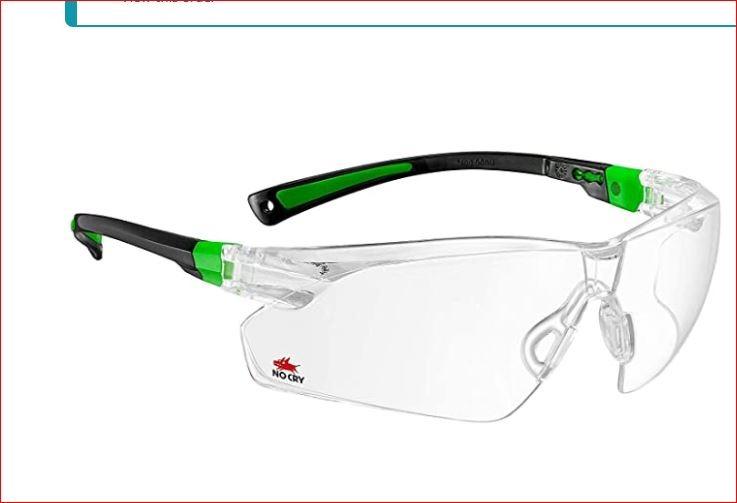
With more than 51000 ratings averaging 4.5 stars, this is the most heavily reviewed pair in the group, and the consensus is consistent. Owners working in carpentry, labs, and shops single out the adjustable fit, the light weight, and the fact that the lenses stay clear through long dusty sessions. The complaint that shows up repeatedly is about the frame rather than the lens, and it is worth knowing before you commit.
Wraparound Coverage and the Semi-Rimless Trade-Off
The single lens wraps continuously across the brow and down toward the cheek, which is why the peripheral protection is as good as anything else here. When a workpiece kicks back or a chip leaves a router at an angle, the geometry means it meets lens rather than frame edge. For table saw and track saw work, that wrap is the feature that matters most.
The semi-rimless lower edge is the trade-off. There is no frame running under the lens, so the bottom corners flex slightly under lateral pressure compared with a full rim. In a normal home shop that is not a problem. In a shop where glasses get knocked, sat on, and dropped regularly, a full-rim plastic frame like the BISON LIFE will outlast it.
Adjustability: Temples, Nose Pad and Grip
Most non-adjustable safety glasses force you to choose between slipping and digging in. These have three separate adjustment points: extendable arms, a nose pad you can move up or down, and rubber grips at the temple ends that stop the frame sliding backward on a sweaty head.
Anti-Fog and Scratch Behavior Over Time
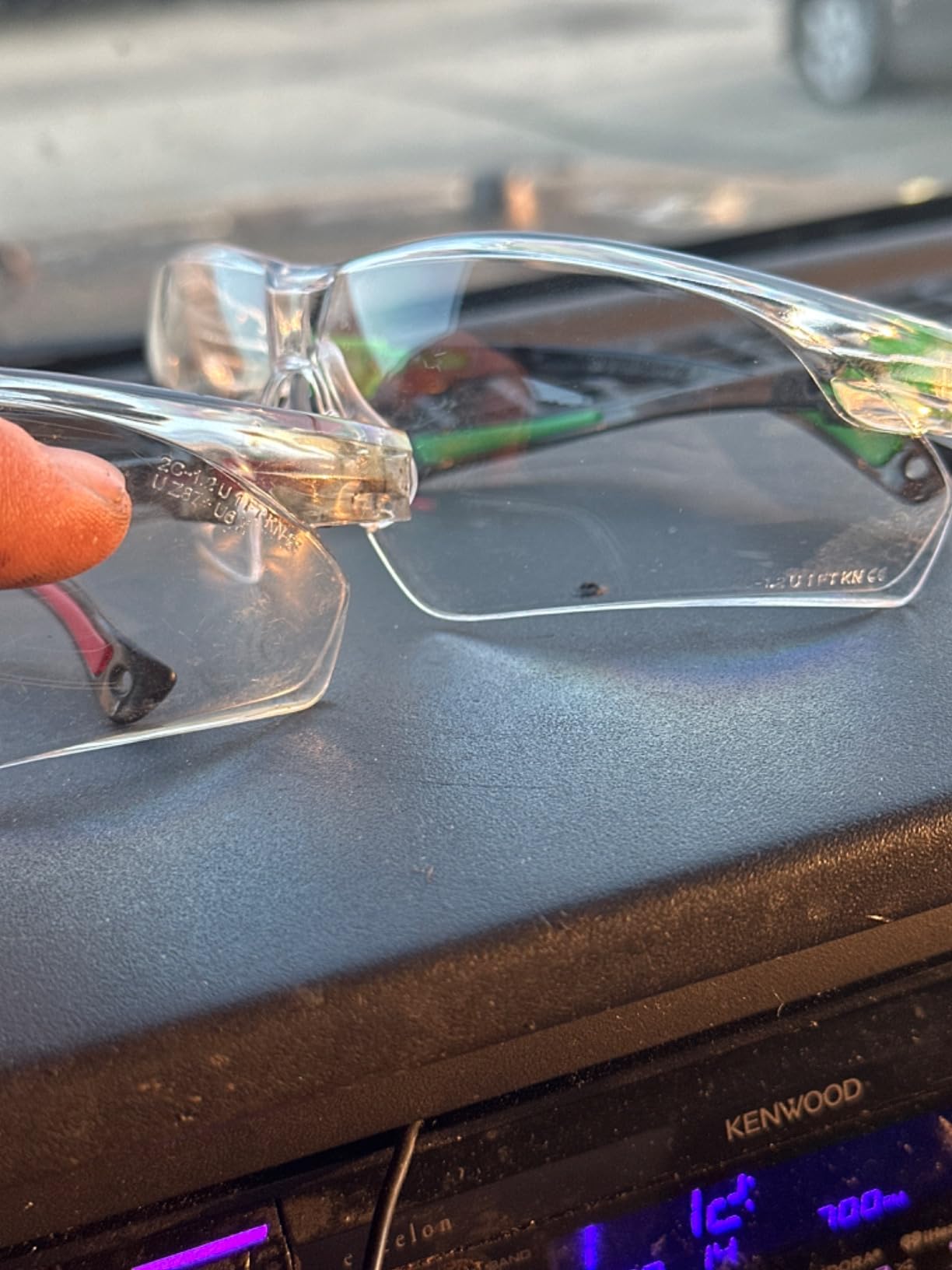
Reviewers consistently report that the coating holds up over months of use provided it is treated correctly. The rule is simple: rinse the lens under water or use a dedicated wipe, never a dry shop rag. Dry-wiping is what turns a scratch-resistant coating into a scratched lens within a few weeks, and this is the most common self-inflicted failure with otherwise good safety glasses.
2. NoCry OverSpecs+ Over-Eyeglasses Safety Glasses – Best for Prescription Wearers
NoCry Safety Glasses Over Eyeglasses for Men and Women with Anti Scratch Lenses and Integrated Side Shields — Adjustable Temples with Anti-Slip Tips — 100% UV Protective Eyewear — ANSI Z87 Certified
Fits over prescription frames
ANSI Z87.1 certified
UV400 lens
1.28 oz
+ Pros
- Designed clearance for frames up to 5.7 inches wide
- Integrated side shields block side debris
- Soft temple tips resist slipping
- Does not fog the prescription lenses underneath
- Lifetime warranty with replacement service
– Cons
- Will not seat properly over small round frames
- Temple adjustment can be finicky on larger head shapes
- Lenses scratch fairly easily in heavy shop use
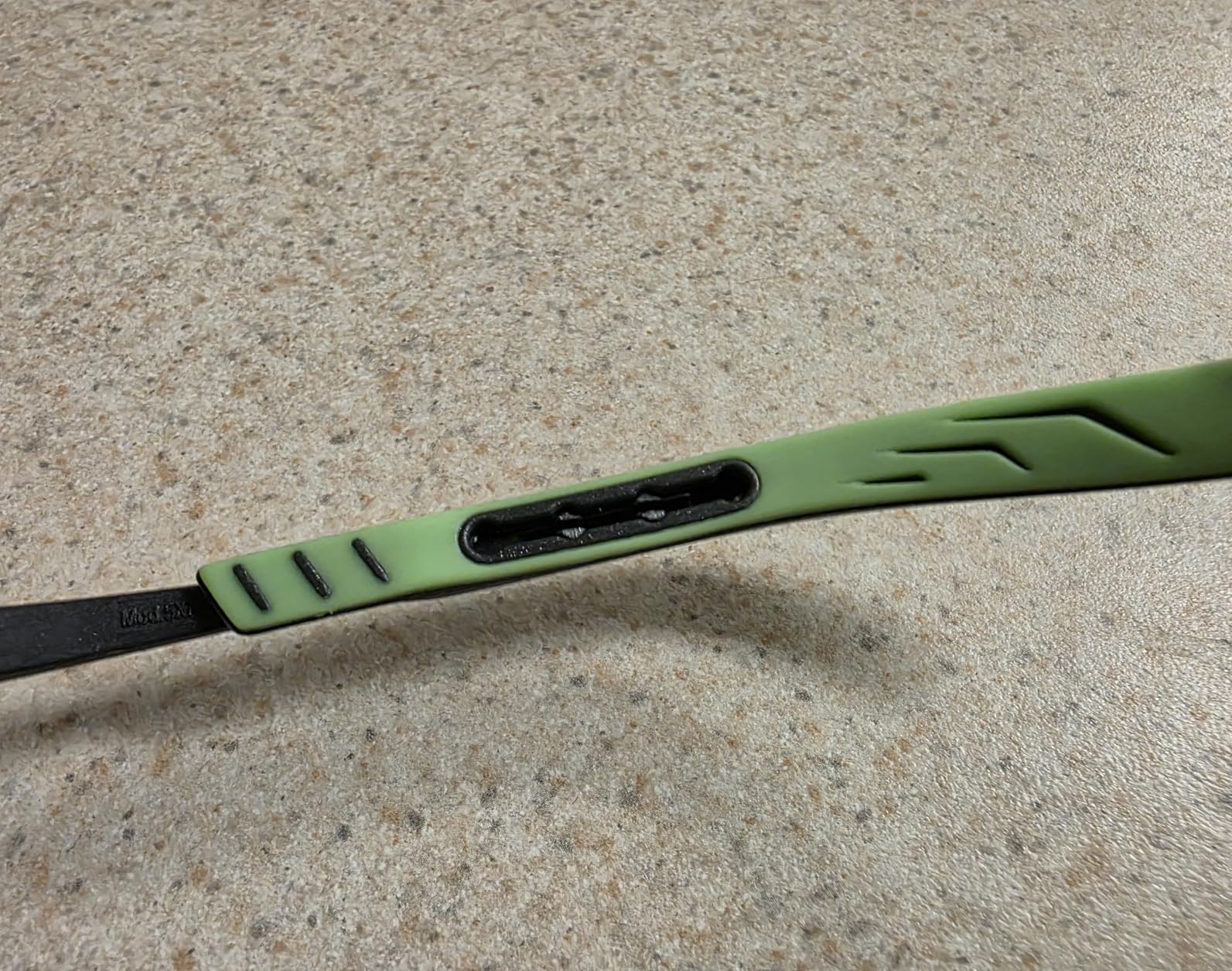
If you already wear glasses, this is the pick that solves the problem everyone else creates. The OverSpecs+ is engineered with a specific internal clearance, fitting frames up to 5.7 inches wide and up to 1.77 inches tall at the center, so the safety lens sits in front of your prescription lenses rather than pressing against them.
Over-Glasses Clearance and What Fits
The stated clearance covers most rectangular and cat-eye frames with room to spare. It does not cover small round frames, which sit too low and too narrow for the temples to clear properly. If your prescription eyewear is a narrow round metal frame, test fit before committing, because a poor seat here compromises both protection and comfort.
Frame weight is 1.28 ounces, and the soft tips behind the ears do most of the work of keeping it in place. Adjustable extendable arms let you fine-tune the length, which is the fix for the complaint that adjustment feels finicky on larger head shapes.
Side Shields and the Rimless Edge Question
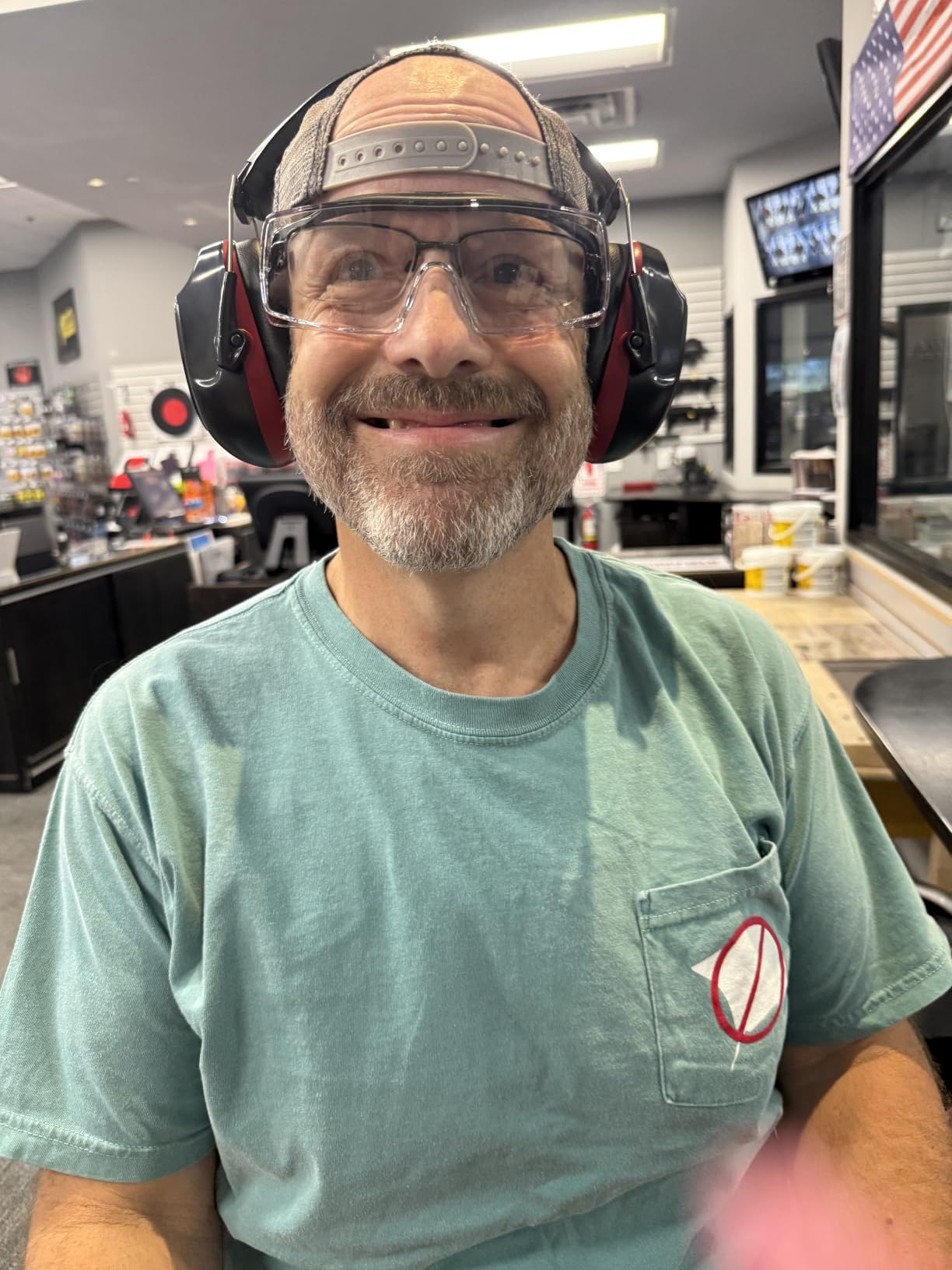
Integrated clear side shields are a real advantage here. Without them, dust and chips arrive from the side with nothing to stop them, and the rimless frame does nothing to close that path. The shield gives side coverage while preserving the open, unobstructed feel that over-glasses wearers tend to want.
Lens Care and Longevity With a Prescription Layer
A layered setup creates one more thing to clean. Dust and fine sawdust settle on the outer safety lens and on your prescription lenses underneath, and if you wipe aggressively you are polishing two coated surfaces at once. Rinse both, dry with a microfiber cloth, and the setup stays clear for far longer.
Reviewers with more than 33000 ratings at 4.5 stars credit this pair specifically for keeping dust and debris off their prescription lenses, which is a benefit that is easy to overlook until you have spent a season squinting at sawdust-smeared glasses. A lifetime warranty with replacement service adds real value for a pair that sees daily use.
3. MAGID Gemstone Y50 Safety Glasses – Best High-Impact Pick
MAGID Y50 Safety Glasses for Construction, Black Frame, 1 Pair, Y50
ANSI Z87.1+ high impact
CSA Z94.3 compliant
Polycarbonate lens
99.9 percent UV
+ Pros
- Z87.1+ high-impact rating with CSA compliance
- Integrated side shields block lateral debris
- Anti-fog and scratch resistant lens
- Soft temple pads suit long shifts
- Microfiber wiper case included
– Cons
- Frame is not adjustable and can run tight across the head
- Nose bridge can rub raw over very long sweaty shifts
- Slight magnification effect noted by some users
The MAGID Gemstone Y50 is the one I recommend for anyone breaking down rough lumber, running a chop saw, or working with material that has not been through a planer yet. It carries a Z87.1+ high-impact rating and CSA Z94.3 compliance, which is the certification level you want when the incoming energy is unpredictable rather than modest.

Why the High-Impact Rating Matters for Rough Lumber
A Z87.1+ designation is the tier to look for when you are cutting reclaimed wood, ripping dimensional lumber, or using a track saw on stock with hidden fasteners. The high-impact test is more demanding than the standard rating, and in a shop the difference in confidence is real even though you would never want to find out why directly.
The lens itself is polycarbonate with both anti-fog and scratch-resistant coatings, and it absorbs 99.9 percent of UV. Polycarbonate is the right material for woodworking specifically because it takes the energy of a fragment rather than shattering into pieces, which glass lenses cannot promise.
Side Shields, Frame Sizing and the Sizing Compromise
The integrated clear side shields are permanent, not add-on, and they preserve an open peripheral view while closing the most common side-entry path for sawdust. That combination is why this pair works well for a wood lathe or a track saw without the tunnel vision that a full goggle can create.
The compromise is fit. The frame is a flexible black nylon with soft gray temple pads, and it does not adjust. On a narrow face it can feel tight at the temples over a long shift, and the fixed bridge is the part most likely to leave a mark. Try it on for five minutes before you commit to a full day.
What Comes in the Box and Why It Matters
Each pair includes a protective wiper case with a microfiber interior. That is a small detail with a practical consequence: a scratched lens is a compromised lens, and a case is the only reliable way to keep one safe in a toolbox or on a bench between sessions.

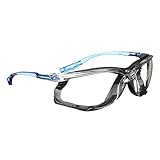
4. 3M Virtua CCS Safety Glasses – Best Sealing Pick for Fine Dust
3M Safety Glasses, Virtua CCS, Anti-Fog Clear Lens, Blue Frame, ANSI Z87
Removable foam dust gasket
ANSI Z87.1-2020 rated
1.12 oz
Foam gasket included
+ Pros
- Removable foam gasket creates a near-continuous dust seal
- Anti-fog coating holds in hot and humid shops
- Wraparound design gives strong peripheral coverage
- Works with a half-mask respirator
- Corded ear plug control system included
– Cons
- Foam gasket traps perspiration and runs sweat down the lens
- Coating is not scratch resistant so lenses must be rinsed
- Very fine high-velocity particles can slip past the vents
- Gasket removal drops you back to standard glasses
Of everything in this roundup, the 3M Virtua CCS does the best job of the problem woodworkers complain about most: dust arriving from below. The removable foam gasket closes the gap under the lens and against the cheek, which is the exact path that a table saw or an orbital sander uses to push fine dust straight at your eyes.
Those forums are full of the same request, people asking what will block 100 percent of dust. The honest answer is that no pair achieves a perfect seal, but a foam gasket gets much closer than a vented or open design, and this is the most established gasketed option here with close to 12500 ratings at 4.4 stars.
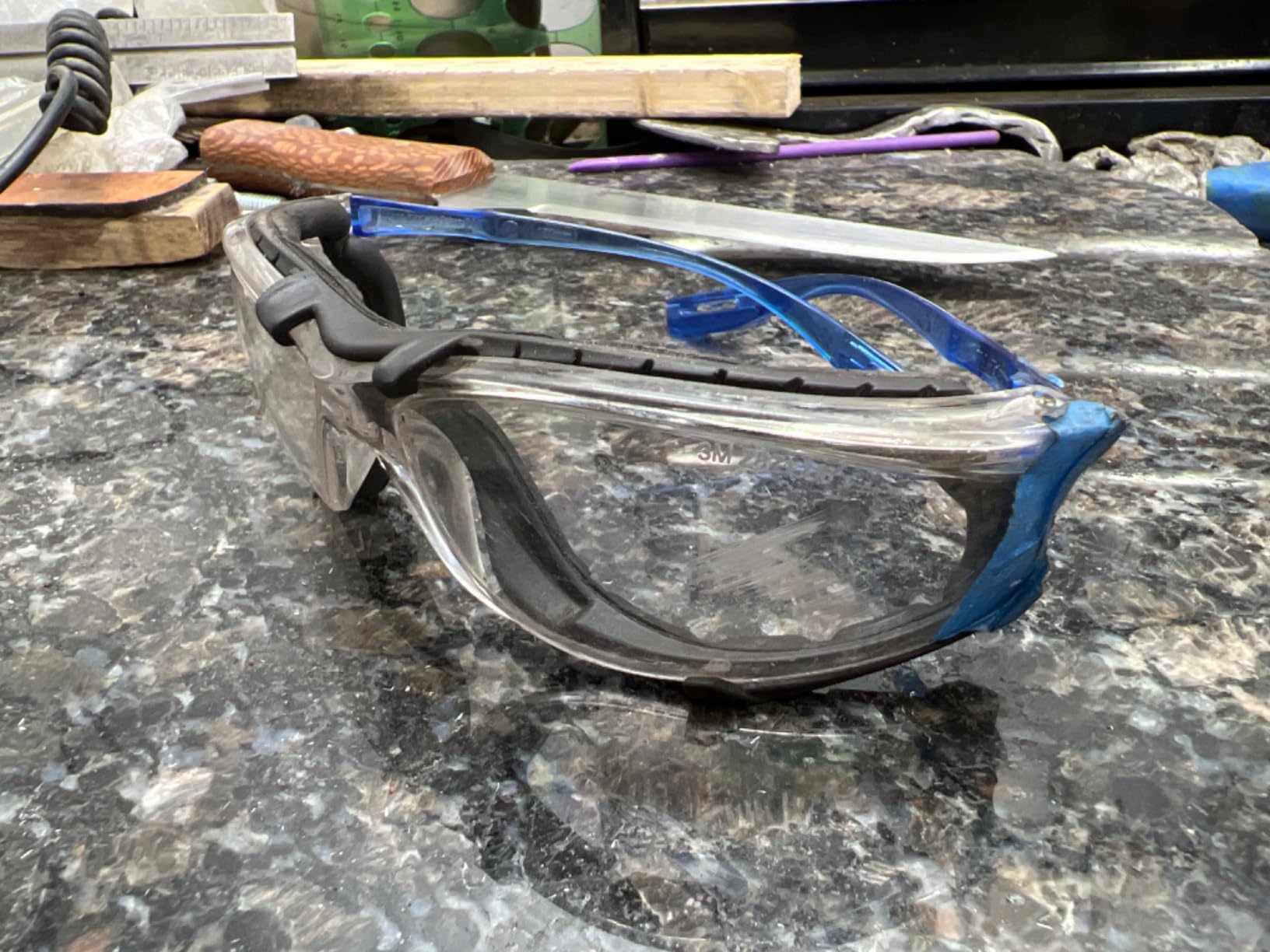
The Foam Gasket: What It Seals and What It Costs
The gasket is the reason to buy this pair, and it is also the source of its main complaint. Because it sits against the skin, it creates a semi-closed chamber around the eyes, and in a hot shop that chamber fills with perspiration that then runs down the lens. Users working outdoors in summer describe this consistently.
Anti-Fog Coating and the Rinse-Only Rule
The anti-fog coating on this model is not scratch resistant, and that combination catches people out. Wiping a dry lens is exactly what produces micro-scratches, and scratched surfaces scatter light and reduce the clarity that made the coating worth having in the first place.
Vents, Peripheral Vision and Respirator Fit
Airflow vents are combined with the coating to move moisture out in humid conditions, though the design is not airtight and very fine fast particles can still find their way through. For high-speed debris, the wraparound semi-rimless TPU frame provides the coverage that the gasket alone cannot.
Respirator compatibility is a genuine strength. This pair is reported to sit well with a half-mask respirator, which resolves the conflict that woodworkers describe endlessly when a gasketed pair and a dust mask fight over the same face. The corded ear plug control system also doubles as a lanyard, keeping hearing protection attached. Reader versions are offered in 1.5, 2.0, and 2.5 diopters for anyone over 40 who wants one pair instead of two.

5. DEWALT DPG54-1C Safety Glasses – Best Rated in the Group
DEWALT DPG54-1C Safety Glasses, ANSI Z87.1+ Impact Rated, Clear Lens
ANSI Z87.1+ high impact
Weighs 26 g
Scratch resistant lens
99.9 percent UV
+ Pros
- Highest average rating of any pair tested here
- Sub-ounce weight reduces fatigue over long sessions
- Rimless wraparound frame gives clear vision
- Flexible rubber temples avoid pressure points
- Universal fit suits a wide range of face shapes
– Cons
- Universal sizing is not equally good on every face shape
- Rubber temples can degrade with heavy daily use
- Very little adjustment compared with extendable-arm models
The DEWALT DPG54-1C carries the highest average rating in this group at 4.7 stars across more than 11400 ratings, with roughly 79 percent of buyers giving it five stars. The reason is simple enough that it is worth saying plainly: it is a genuinely high-impact rated pair that weighs 26 grams and does not need constant adjustment.
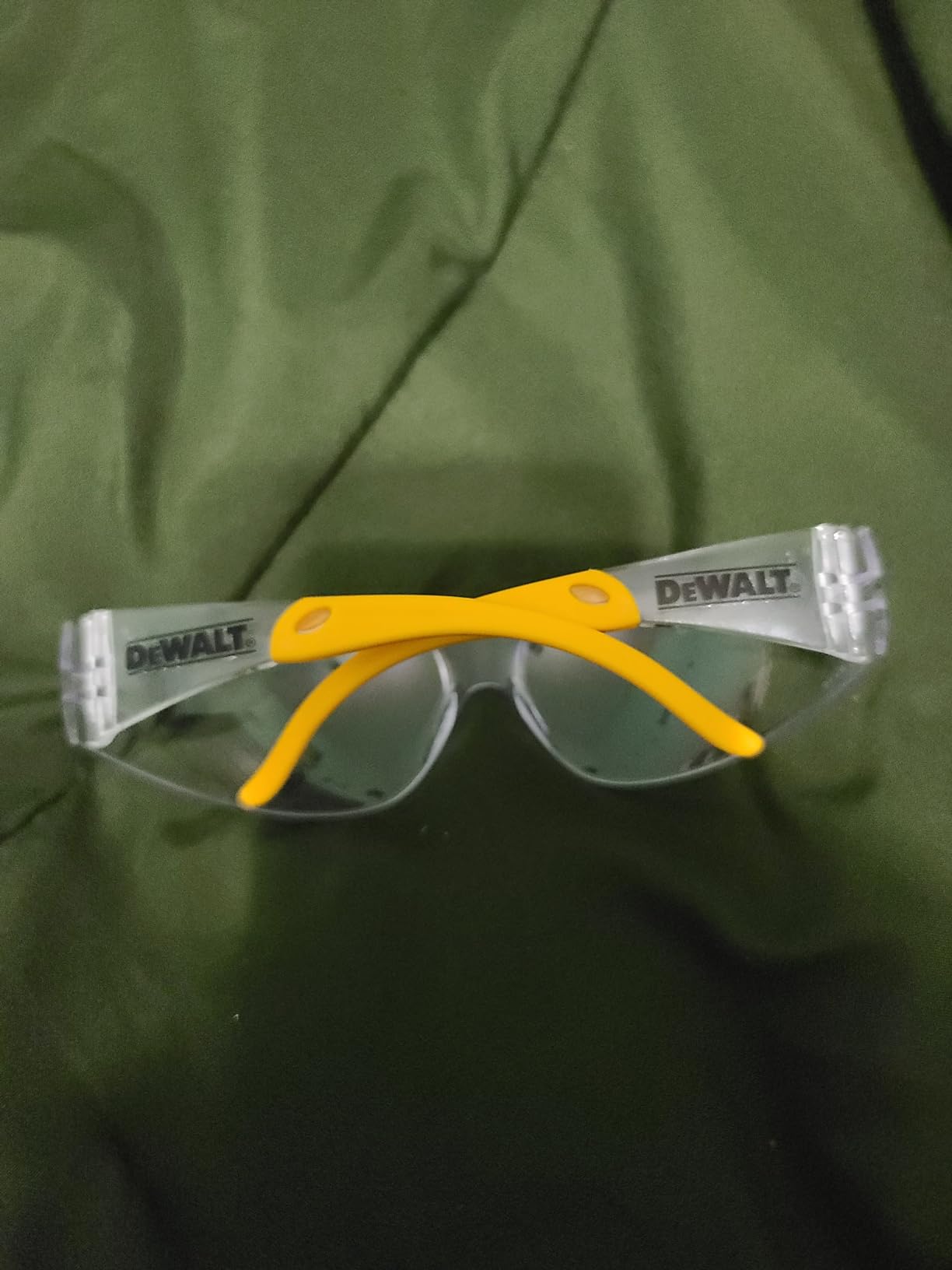
Weight and Fatigue Across a Full Workday
At 26 grams, this is one of the lightest certified pairs in the group. Weight matters more in a workshop than it does in an office because the frame stays on continuously. A pair that feels fine at hour one often produces a headache by hour three, and headache is a common reason people stop wearing protection.
The flexible rubber temples are the second comfort lever. They flex to sit against the head rather than pressing at a fixed point, and reviewers consistently call out the absence of digging at the temples. The rimless wraparound lens also keeps the field of view wide, which helps when you are aligning a board on a table saw fence.
UV Protection and the Universal Fit Question
The lens blocks 99.9 percent of UVA, UVB, and UVC. That matters in a shop with open doors and garage-style lighting, and it is a common feature on this tier rather than a premium one, so you should not have to pay extra for it.
Universal fit is convenient for a household with more than one user, and the pair is listed for men and women across a range of face shapes. The catch, as reviewers note, is that universal does not mean identical. If you are between sizes or have an unusually wide or narrow head, the fit is the thing to test rather than assume.
Durability and the Limits of a Plastic Frame
The frame is polycarbonate, and the lens carries a scratch-resistant coating. That is a durable combination for normal shop handling, including being knocked off a bench or dropped into a toolbox.
The reported weak point over long periods is the rubber temple degradation. Heavy daily use eventually makes the temples looser, at which point the pair slips and the advantage disappears. If you are comparing this against a nylon-frame option for a shop that runs eyewear hard every day, that is the difference to weigh.
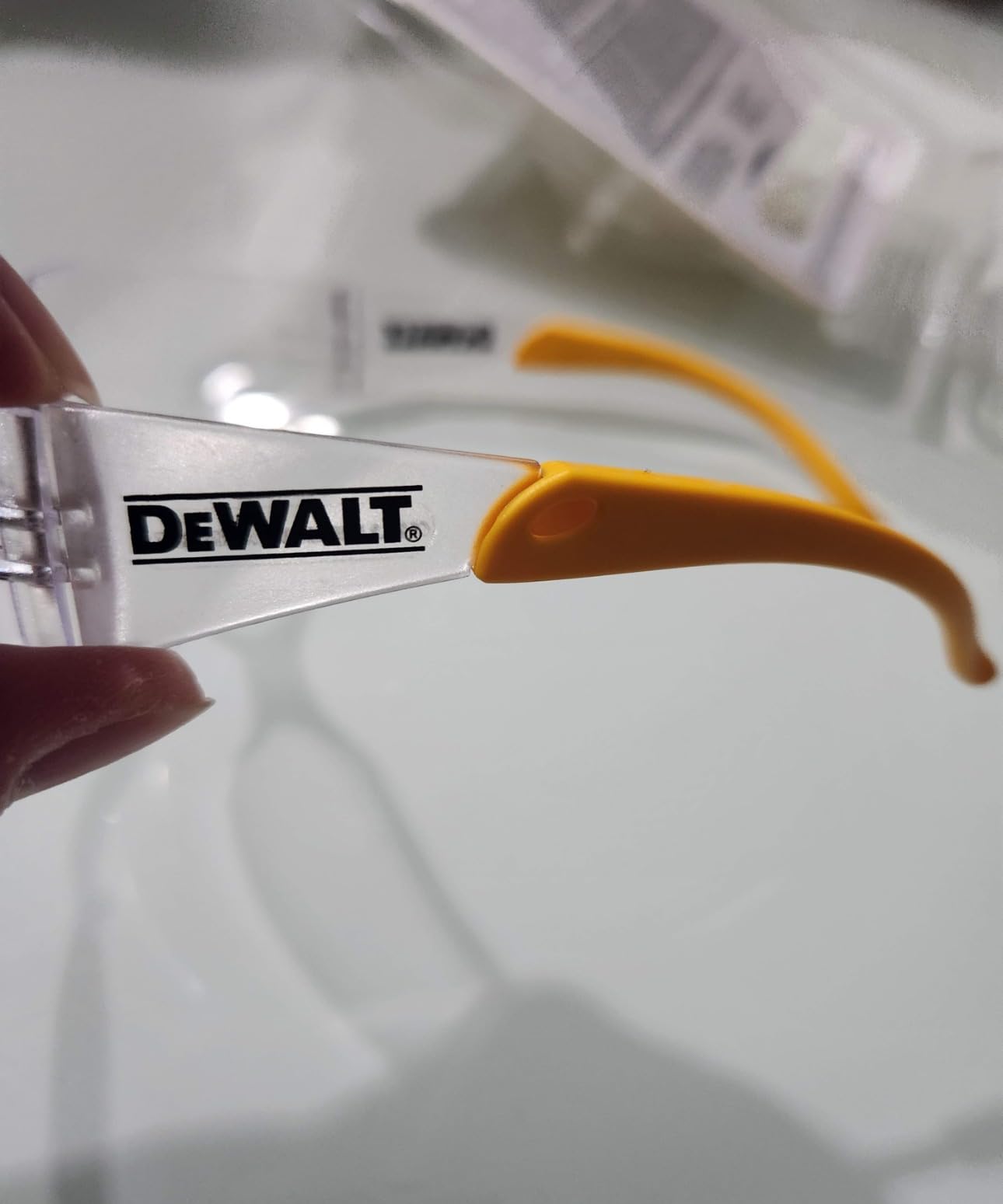
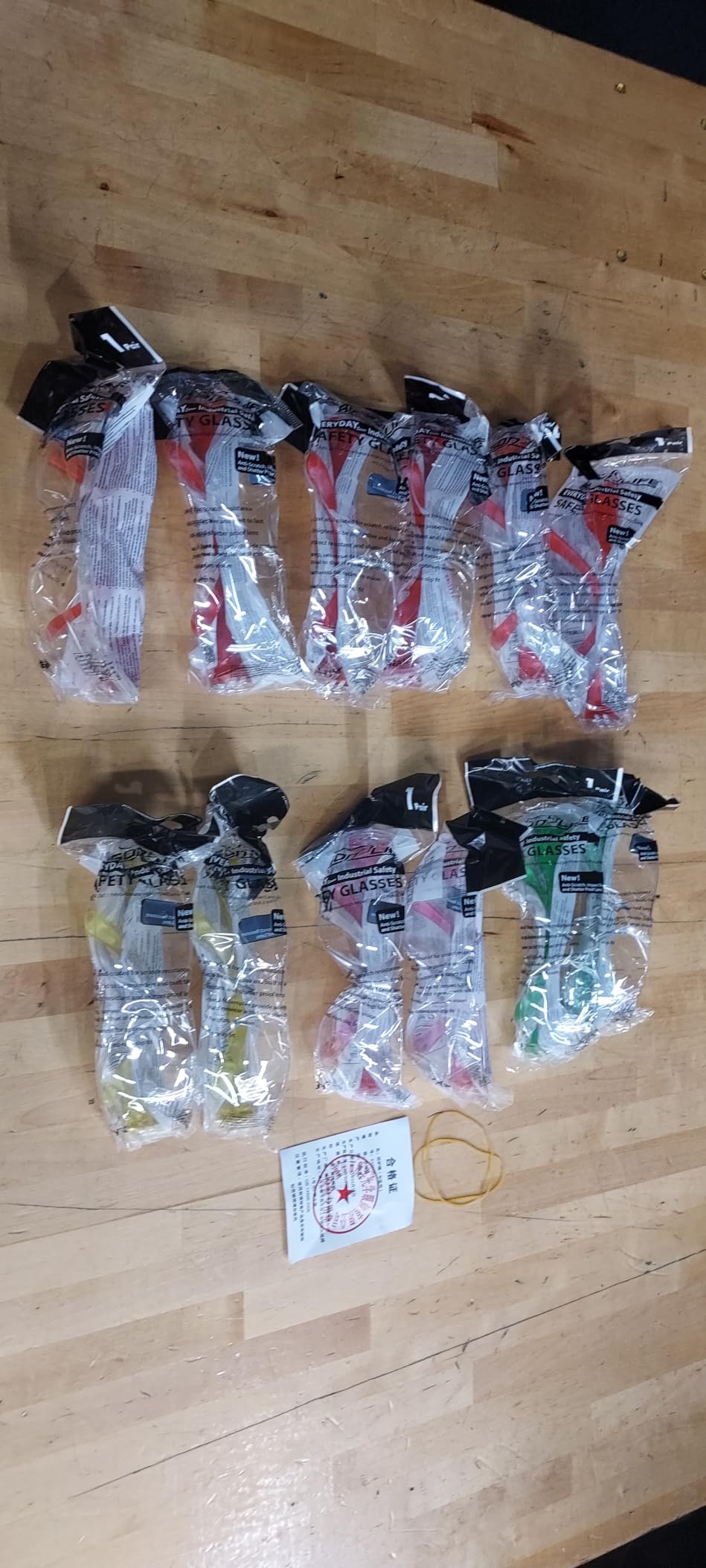
6. BISON LIFE Crystal 12-Pack Safety Glasses – Best for Shops, Classrooms and Crews
BISON LIFE Clear Safety Glasses for Men & Women, ANSI Z87.1 Certified,12Pk
Twelve pairs per box
ANSI Z87.1 embossed on temple
1.6 oz per pair
Polycarbonate lens
+ Pros
- Twelve pairs give the lowest per-pair cost for a group
- ANSI mark embossed on the temple for verification
- Deep temples act as integrated side shields
- Continuous lens with wide undistorted view
- Lifetime warranty
– Cons
- Fixed temples do not adjust for unusual face shapes
- A full box is unnecessary for a single user
- Plastic frame and temples wear faster under repeated abuse
For a workshop that employs people, teaches a class, or hosts a group build, the math changes completely. A twelve-pair box of ANSI Z87.1 certified glasses, with more than 8300 ratings averaging 4.6 stars, is the practical answer, and it is why this category is a bulk product at all.
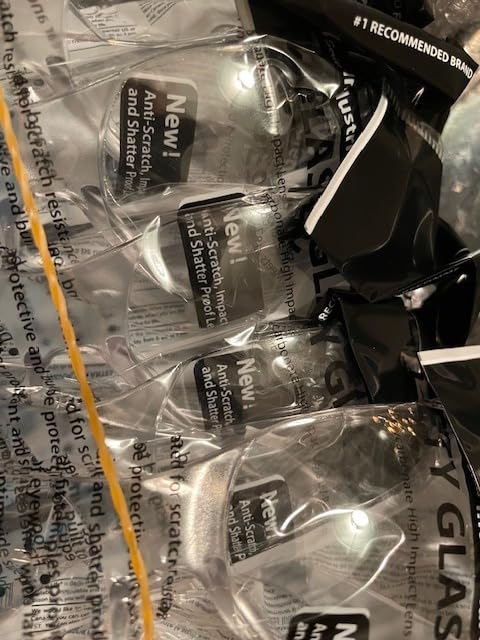
180-Degree Coverage From the Temple Design
Rather than bolting on separate side shields, this frame uses deep side temples that extend well past the lens edge and function as shields in their own right. The result is described as 180-degree coverage from a single molded part, which is a neater solution than clip-on accessories that can rattle loose.
Verifying the Certification Mark on the Frame
The ANSI Z87.1 standard is embossed on the temple, not just printed on the box. That detail matters more than it appears, because the confusion between genuinely certified eyewear and listings that merely say impact resistant is one of the most common frustrations in woodworking safety discussions.
When a Multipack Is and Is Not the Right Buy
If you need one pair for your own use, a box of twelve is unnecessary inventory. The fixed temples also do not adjust, so a person with an unusual face shape can struggle where an adjustable model would have worked fine.
For a shop, a classroom, or a shared build space, the trade-off is clearly worth it. Buyers supplying those situations cite the low per-pair cost, the certified side coverage, and a lifetime warranty. Keep the box somewhere dry and dusty, away from the bench, and replace pairs as they scratch rather than waiting for damage.
7. 3M Solus 1000 Safety Glasses – Best for Fog-Free Clarity
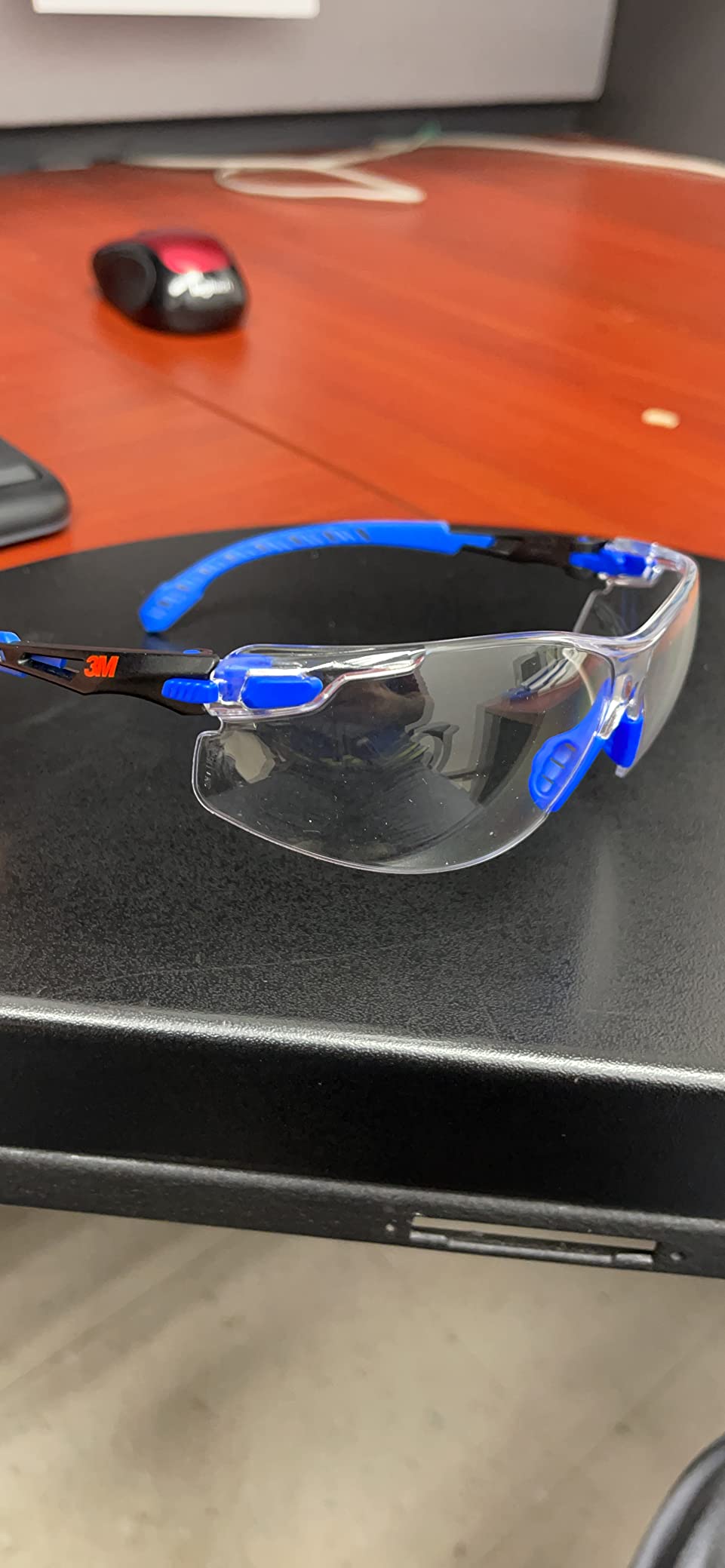
3M Safety Glasses, Solus 1000, Scotchgard Clear Lens, Blue/Black Frame
Scotchgard anti-fog coating
ANSI Z87.1-2020 rated
1.12 oz
Polycarbonate lens
+ Pros
- Scotchgard coating bonds to the lens for lasting clarity
- Stays in position during heavy work
- Wrap leaves almost no gap between face and lens
- Minimal optical distortion
- Scratch resistance outlasts budget eyewear
– Cons
- No temple adjustability so fit is fixed
- Close-to-face seating can restrict airflow and cause sweat
- Styling reads as fashion eyewear rather than PPE
The 3M Solus 1000 is the pair I point people toward when fogging is the specific complaint. Its Scotchgard anti-fog coating uses an active agent that bonds to the lens surface rather than sitting on top, and that distinction shows up over months of use as the lens stays clear when cheaper coated lenses surrender.
Ratings sit at 4.5 stars across more than 7800 reviews, and the recurring theme among people who upgraded from budget pairs is simple: the lenses stopped fogging in hot and humid conditions. That is exactly the environment a woodshop with a running dust collector and poor summer ventilation creates.
Why the Scotchgard Coating Outlasts Others
Anti-fog coatings fail in two ways. They can rub off through repeated wiping, and they can degrade chemically through soap, solvents, and airborne wood finish overspray. A bonded active agent resists the first problem more effectively, which is why users report clarity lasting rather than fading after a few months.
Close Seating: The Fog Fix and the Sweat Problem
The tight wrap that makes this pair so good at stopping dust in is also what reduces airflow. Owners note that it sits close to the face, and for some wearers that close contact produces sweat on the lens in a way that partially offsets the coating.
If you run a hot shop, the practical answer is to manage it: keep the pair off your head while you are not actively cutting, and clean it properly rather than waiting. The soft nose bridge and padded temples are what make the close fit tolerable for a full shift.
Fixed Fit, Clear View and Shop-Ready Style
There is no temple adjustment, so the fit is whatever the frame gives you. That is a limitation for anyone with an unusual head shape, and it is the main reason I would not recommend this pair as the single choice for a household with several different wearers.
Where it wins is optical quality and durability. Reviewers report little to no distortion when checking a straight edge, and scratch resistance that outlasts budget eyewear by a wide margin. The low-profile styling also reads as ordinary eyewear rather than industrial PPE, which some people genuinely prefer in a shop where customers come in.

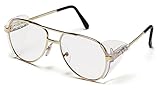
8. Pyramex Pathfinder Aviator Safety Glasses – Best Understated Look
Pyramex Pathfinder Aviator Safety Glasses with Gold Frame and Clear Lens
ANSI Z87+ compliant
Glass lens
Metal full rim frame
22.68 g
+ Pros
- Aviator styling looks like ordinary sunglasses
- ANSI Z87+ rated with integrated side shields
- Adjustable nose piece helps dial in the fit
- Rubber temple tips reduce slipping
- Durable metal frame construction
– Cons
- Glass lens is heavier and more breakable than polycarbonate
- Full rim aviator shape leaves wider side gaps
- No anti-fog coating so condensation is a factor
- Metal adds weight against plastic frames
The Pyramex Pathfinder exists for a reason that has nothing to do with specs: it looks like a pair of aviator sunglasses. That is the entire pitch for the woodworkers who have spent years avoiding safety glasses because they did not want to look like they were wearing PPE on a job site.
It is a legitimate certified option underneath the styling, meeting ANSI Z87+ with integrated side shields and an adjustable nose piece. Ratings are 4.5 stars from about 2275 reviews, which is the smallest consensus base in this group, so treat the details as reported rather than universally confirmed.
Glass Lens: The Weight and Breakage Question
This is the one pair here with a glass lens rather than polycarbonate. Glass gives excellent scratch resistance and a slightly different optical feel, but it is heavier at 22.68 grams including the metal frame, and it will shatter rather than flex if struck.
In a woodshop, that matters. Flying chips and offcuts are the most common impact event, and a lens that fragments instead of absorbing energy is a worse outcome in exactly the situation these glasses are meant to survive. If this is your primary pair, keep polycarbonate in mind for the tasks with the worst debris.
Full Rim Comfort and Side Coverage Gaps
The adjustable nose piece is a genuine advantage and one of the few examples here that offers it. It lets you position the frame precisely at the bridge, which helps with both comfort and keeping the lens clear of a run of sweat.
Rubber temple tips reduce slipping over long sessions. The trade-off is geometry: a full-rim aviator shape does not wrap the way a sport-style lens does, so the side gaps are wider and more debris can enter from the sides despite the integrated shields.
Who This Pair Is Actually For
There is no anti-fog coating on this model, and that is the decisive limitation for anyone working in a hot, humid, or dusty shop. Condensation will form, and you will be wiping the lens regularly rather than occasionally.
9. GENYED Safety Glasses with Removable Foam Gasket – Best Switchable Seal
GENYED Safety Glasses ANSI Z87+ with Removable Foam Gasket, Clear Lens, Anti-Fog, Scratch-Resistant, UV400 Wraparound Protective Eyewear for Work, Construction & DIY
ANSI Z87.1-2020 high impact
Removable foam gasket
1.27 oz with gasket
UV400
+ Pros
- Removable foam gasket installs in seconds for dusty work
- Meets the newest Z87.1-2020 high-impact standard
- Very light at 1.27 oz including the gasket
- Wraparound frame gives a broad clear view
- Modern sports styling rather than industrial
– Cons
- Foam gasket adds heat and perspiration in a hot shop
- Installing the gasket changes the fit and can sit awkwardly
- Lower review count means less long-term durability feedback
The GENYED takes the same idea as the 3M Virtua CCS, a removable foam gasket for dust exclusion, and executes it at 1.27 ounces including the gasket. That is the lightest sealed option in the group, and lightness is what decides whether a gasketed pair is workable for you at all.
Ratings are 4.4 stars from roughly 1278 reviews. That is a smaller base than the leaders, so read the feedback as useful direction rather than settled consensus, particularly on long-term durability.
Switchable Gasket: The Best Feature in This Roundup
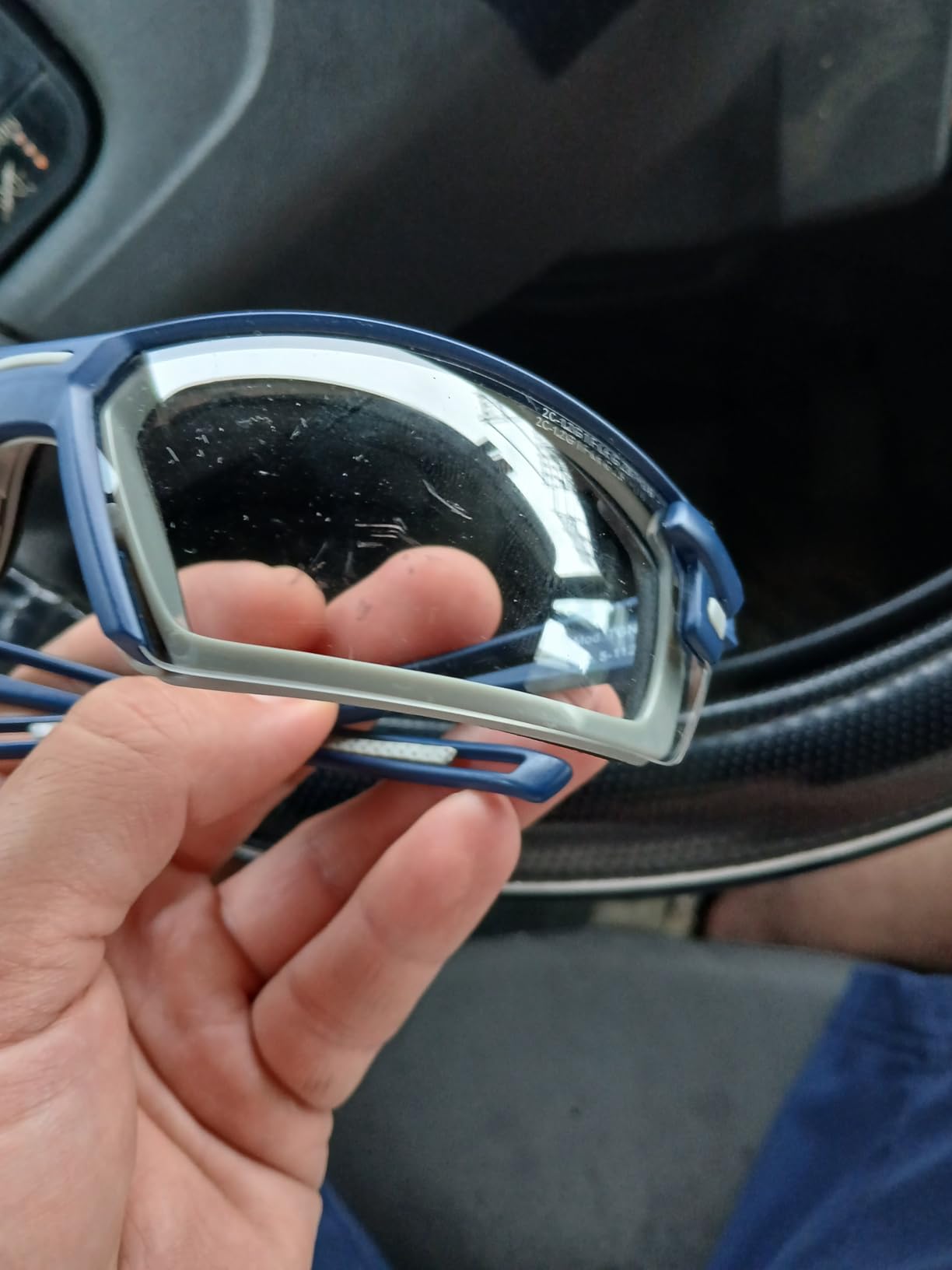
The gasket fits or removes in seconds, which means one pair covers two genuinely different conditions. Install it for overhead router work, orbital sanding, and lathe turning where fine dust is the hazard. Remove it for hot, messy, or dusty-adjacent tasks where heat and perspiration are the worse enemy.
That flexibility is the strongest argument for this pair. Most gasketed designs commit you to the sealed experience permanently, and a shop that sees both hot and dusty days in the same week needs the choice.
ANSI Z87.1-2020 Certification and Lens Coatings
The pair is built and tested to the ANSI and ISEA Z87.1-2020 high-impact standard, which is the current revision and worth paying attention to in a listing when some products still cite older versions. The clear polycarbonate lens carries both anti-fog and anti-scratch coatings plus UV400 protection.
Fit Changes, Styling and Who Should Buy It
Installing the gasket changes the fit, and that is the honest drawback. It sits closer to the face, sits differently over prescription eyewear, and can feel slightly off until you adjust the temples. Anyone who plans to wear the pair mostly ungasketed should be aware of that.
The modern sports-eyewear styling is a genuine plus in a workshop, and the wraparound frame with wide lenses gives a broad, undistorted view. For someone who wants gasketed protection occasionally rather than permanently, this is a sensible pick. For a daily all-purpose pair with the deepest review history, the NoCry at number one remains the safer bet.
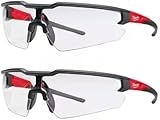
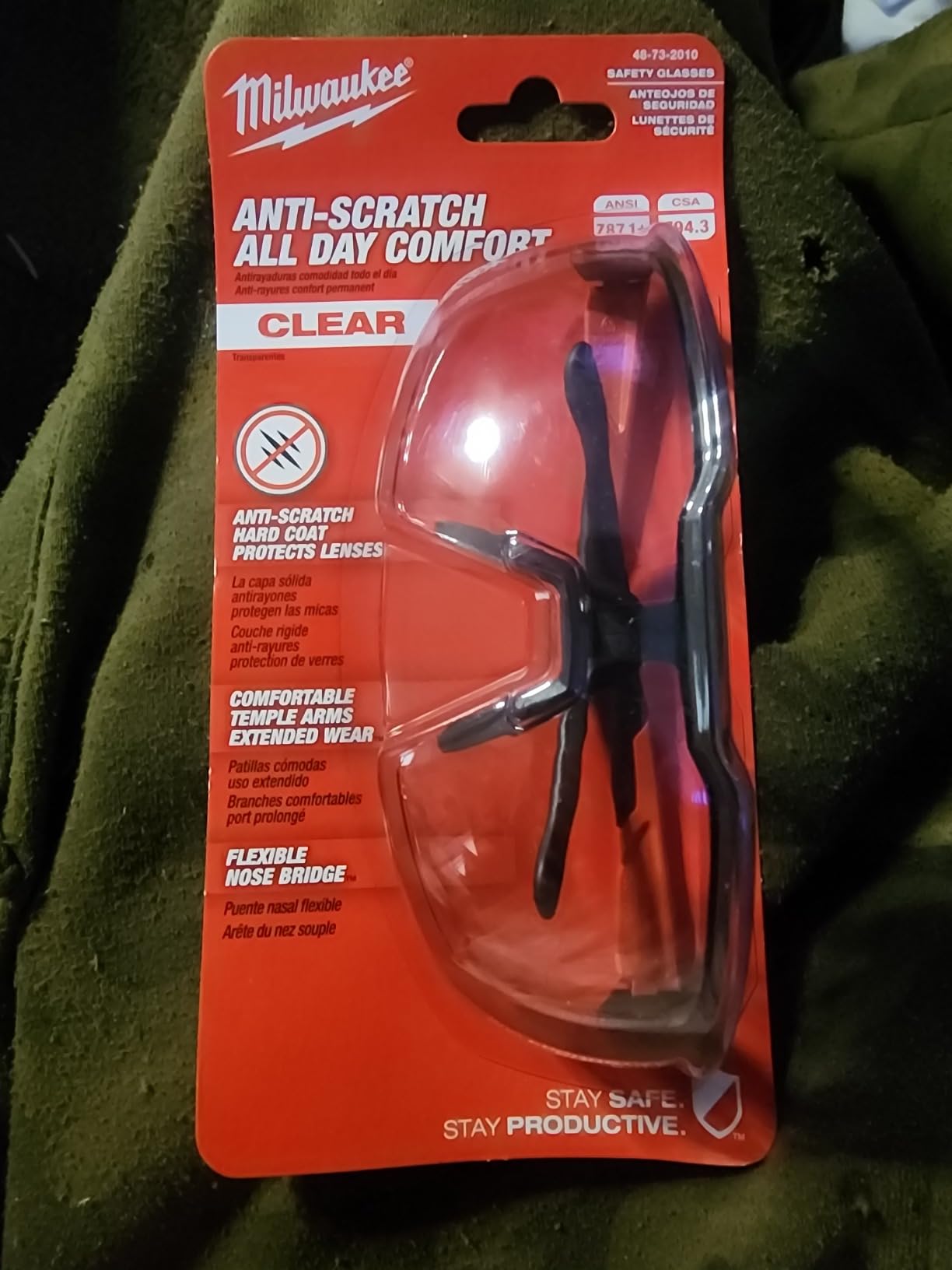
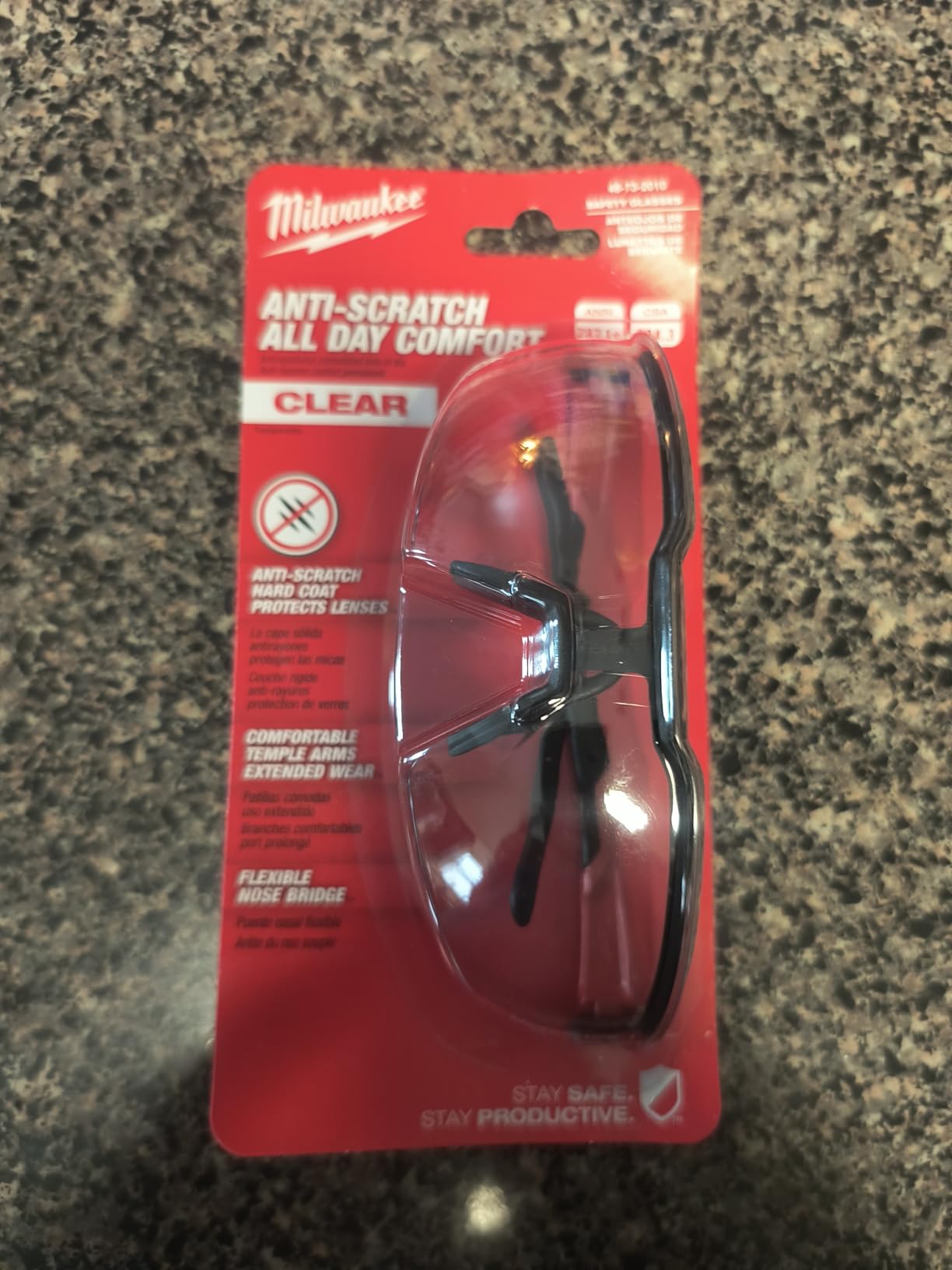
10. Milwaukee Anti-Fog Safety Glasses Two-Pack – Best Backup Pair Bundle
Milwaukee Anti-Fog Safety Glasses Clear Lens Black/Red Frame 2 pc. – Case of 2
Anti-fog coated lens
Two pairs per pack
Impact rated
Lightweight
+ Pros
- Two pairs means a backup is always on hand
- Anti-fog coating holds across working conditions
- Comfortable for all-day wear without ear pressure
- Lens clarity rated above many competitors
- Wraparound design minimizes gaps across face sizes
– Cons
- Can fog slightly when worn with a face covering
- Two-pair format is poor value for a single user
- Lower review count and older listing limit detail
The Milwaukee two-pack is a small, practical answer to a specific problem: the glasses you own are currently scratched, and you cannot see through them properly. Two pairs in a drawer means there is always a clear one available when you need to cut something.
At 4.6 stars from 902 ratings, it has the highest proportion of five-star reviews in this group, at roughly 83 percent. Reviews are short and consistently positive, which usually means the product does the basic job well without generating either strong enthusiasm or complaints.
Why Having a Spare Pair Changes Your Habits
Scratched lenses are the reason people stop wearing protection, and people often do not notice how scratched they are because a scratched lens still looks passable in a mirror. A second pair in the shop removes the excuse. If one gets scuffed, you put the other on rather than deciding protection is not worth it today.
Anti-Fog Performance and Face Covering Limits
The anti-fog coating is the main technical feature, and it performs well across normal working conditions. The one recurring limitation is fogging when the glasses are worn together with a face covering, because any mask redirects breath upward onto the lens and defeats the coating.
Comfort and Clarity for Long Days
Reviewers note comfort across a full day with no pressure at the ear, and lens clarity that stands above many competing pairs at this level. The wraparound design also limits the gaps that appear across different face sizes, which matters when a shop has more than one head shape wearing the same model.
Its limitation is simply format. If you need one pair, buying two is not a better deal than buying one good pair. This is a backup-and-rotation product, and it is best treated that way.
How to Choose Safety Glasses for Woodworking
Most buying mistakes in this category come down to three things: paying attention to style over certification, ignoring the dust path, and choosing a pair that looks good but cannot be worn for six hours. Work through the criteria below in order and the choice makes itself.
1. Confirm the ANSI Z87.1 Mark on the Frame
Check the inside of the temple for a stamped Z87.1 or Z87+ marking. If the certification appears only on the box or the listing, you have no way to confirm what shipped. This is a genuinely common problem in this category, and it is the single fastest way to sort a real pair from a lookalike.
OSHA requires that eye protection be certified to ANSI Z87.1, which means lens and frame are tested as a system. A lens bolted into a frame that has not been tested with it is not a certified assembly regardless of what the lens says.
2. Trace the Dust Path Before You Buy
Fine sawdust does not usually fly at you from the front. It settles downward, so the entry path is the gap under the lens and beside the cheek. That is exactly what a table saw throw, a track saw offcut, and a lathe discharge put into that gap.
So judge the bottom edge, not the top brow. Open vented designs are fine for cutting tasks with modest debris. For anything producing airborne fine dust, look at a gasketed or closely wrapped frame, and check whether the seal sits at the cheekbone rather than high on the cheek.
3. Weigh the Anti-Fog Coating Against the Sealing Design
These two features work against each other. A sealed frame blocks the dust and also traps the moisture your face produces, and that moisture is what turns a lens opaque. A vented frame breathes but lets fine dust in.
The way through is a coating that bonds to the lens, plus a design that lets you vary the seal. That is why the removable gasket picks are worth a look for anyone working in a shop that gets both hot and dusty in the same week.
4. Match the Frame to Your Other PPE
Test the pair with the rest of what you wear. A half-mask respirator, a ball cap, and over-ear hearing protection all compete for the same space on your head, and a pair that works alone may not work in combination.
Adjustable temples solve more of this than any other feature. If your temple arms do not move, you will end up repositioning glasses constantly, and constantly repositioning is its own form of not wearing protection. If you also wear hearing protection for longer cuts, our [arc welding safety checklist](https://fypower.org/arc-welding-safety/) covers the same head-and-face geometry rules from the metalworking side.
5. Think in Per-Pair Terms, Not Per-Order Terms
One item in a multipack listing is not the same as a single pair. When a bulk box and a single product look similar in a shopping carousel, the per-pair figure is the only number that lets you compare them honestly. Twelve pairs for a class is a very different purchase from one pair for yourself.
The other side of the same calculation is wear life. A cheaper pair replaced every few months because it scratches can cost more over a year than one pair that stays clear, and staying clear is what keeps it on your face.
ANSI Z87.1 vs Z87+ vs EN166: What the Markings Actually Mean
The short answer is that Z87+ is the harder test, and for most woodworking it is the level you should be buying. Z87.1 is the base US impact standard, Z87+ is the high-impact designation, and EN166 is the European marking system that most US safety glasses also carry from the same testing.
Plain Z87.1 eyewear is tested against a moderate-energy impact and is genuinely adequate for drilling, screw driving, hand-tool work, and general assembly. Z87+ is tested to a more demanding level and is the right choice whenever the incoming fragment is unpredictable: ripping rough lumber, breaking down reclaimed stock, a chop saw, or a track saw on material with unknown fasteners inside.
EN166 is the European standard, and you will see it stamped on frames sold in the US alongside the ANSI mark. It uses a different symbol and letter code, with additional markings for droplet, splash, and fine dust resistance. When a pair carries both ANSI Z87.1 and EN166, that is normal for a globally manufactured product rather than a red flag.
One more detail worth knowing: Z87.1 requires the mark to include either Z87.1 for general impact or Z87+ for high impact, and the marking also indicates whether the eyewear is rated for prescription use. That is the single line of text that settles every question about whether a pair is genuinely certified for your task.
Safety Glasses vs Safety Goggles vs Face Shield for Woodworking
These three get used interchangeably and they are not the same tool. Understanding what each one does is worth five minutes, because the wrong one either leaves your eyes unprotected or leaves you uncomfortable enough to take it off.
Safety Glasses: Open Sides, Best for General Work
Safety glasses have a sealed lens and open sides, sometimes with side shields or partial coverage. They are the most comfortable option for extended wear and they handle impact well. The weakness is the open side path, which is why side shields and wraparound geometry matter so much in this roundup.
Safety Goggles: Sealed to the Face, Best for Fine Dust
Goggles seal to the face with a soft interface and typically have a foam or rubber gasket. They are the right answer for fine airborne dust, sanding, lathe work, and anything where particles hang in the air rather than flying on a trajectory. The trade-offs are heat, sweat, and the way a hard seal marks your face after a long session.
The gasketed picks in this roundup give you a middle path. They seal the dust without the tunnel vision of a full goggle, and several let you remove the gasket when the task changes.
Face Shield: Big Fragments Only, Glasses Still Required
A face shield protects your face from large fragments, sparks, and splashes. It does not seal out fine dust at all, and it does not stop small particles entering through the gap around the top and sides. A face shield is an addition to eye protection, never a replacement for it.
This comes up constantly in woodworking discussions, particularly around machines with built-in guards, and the practical answer is unchanged. A blade guard is a machine safeguard, and personal protective equipment is a separate layer. Wearing both is the standard, not either one alone.
Safety Glasses Over Prescription Glasses: What Actually Works
The honest answer is that yes, you can wear safety glasses over prescription glasses, but only a design built for it will work properly. Forcing a standard pair over your everyday eyewear produces exactly the take-on, take-off cycling that leaves your eyes unprotected half the time.
Three routes exist. Over-glasses designs have internal clearance sized to fit prescription frames, and that clearance is the whole product. Wraparound models achieve a similar effect with a deep profile that clears the frame front to back. Prescription safety glasses with your actual correction in the lens are the third option and involve a custom order, though woodworkers in r/Construction frequently recommend going to a dedicated prescription eyewear maker for this.
Fit matters more than brand. A pair that does not seat properly against your frames will not seal, and a poor seal means the dust problem you were trying to solve is still there. Test with the specific frames you wear daily, and check that the temples clear the arms of your glasses without pressing on them.
For readers, note that some models in this category are available in plus diopter versions, which combine magnification and protection in one lens. If you are over 40 and find yourself swapping between reading glasses and safety glasses, that is a better solution than carrying both.
How to Stop Safety Glasses Fogging in the Shop
Fogging is the loudest recurring complaint across every woodworking safety thread, and it is also the most fixable. In order of how much they help:
1. Acclimate the lenses before you put them on. Let the glasses sit in the shop for several minutes so they reach the same temperature as the air. The single most useful tip in this list comes from woodworkers in r/Carpentry, who consistently recommend acclimating both your face and the glasses to the environment before donning.
2. Rinse rather than dry-wipe. A lens wiped with a dry shop rag picks up micro-scratches that scatter light and cut clarity. Rinse under water or use a wet wipe, then dry with a clean microfiber cloth.
3. Clean the coating regularly. Anti-fog coatings work by creating a hydrophilic surface. Dust, sawdust, and finish residue fill that surface and stop it working. A weekly clean with dish soap and water restores more performance than any replacement pair.
4. Watch the respirator conflict. A mask or half-mask respirator redirects breath upward directly onto the lens, which will fog it regardless of coating. Either accept it and wipe as you go, or choose a pair whose venting directs airflow along the lens rather than into it.
5. Do not mix a hard gasketed pair with a heavy dust mask for long sessions. The combination of trapped moisture and redirected breath is the worst case for fogging, and in that situation a venting frame without a gasket is the better tool.
Care, Cleaning and When to Replace Safety Glasses
Safety glasses are not a long-lifetime purchase. A scratched lens scatters light, reduces contrast, and makes you work with a permanent haze in front of the thing you are trying to see, which is why scratched pairs get abandoned.
Clean with dish soap and lukewarm water, rinse thoroughly, and air dry or pat with a microfiber cloth. Never use a shop rag, a paper towel, or a shirt, and never use solvents or household cleaners, all of which attack both the coating and the polycarbonate.
Replace the pair when the lens has deep scratches you cannot wipe away, when it has yellowed with UV exposure, when the frame cracks or the hinges loosen, and always after a significant impact event. After an impact, do not assume the lens is fine because it still looks intact. Micro-cracks reduce the energy absorption the lens was providing, and that protection is the reason you were wearing it.
Storage matters more than most people expect. A hard case or a padded pouch keeps lenses from contacting tools and abrasive surfaces, and keeping them away from the bench top prevents the single most common cause of premature scratching. A lens stored properly lasts considerably longer than the same lens in a toolbox.
Frequently Asked Questions
What are the best protective glasses for woodworking?
The best protective glasses for woodworking combine an ANSI Z87.1 or Z87+ impact rating, an anti-fog coating, and a close-fitting seal that blocks fine sawdust from entering under the lens. Polycarbonate lenses, adjustable temples, and side coverage matter most for cutting, routing, and sanding tasks.
What type of eye protection is most appropriate for a woodworker?
Impact-rated safety glasses are appropriate for most woodworking, including drilling, hand tools, and general cutting. Add a gasketed pair for orbital sanding, overhead routing, and lathe work where fine sawdust hangs in the air. A face shield protects against large fragments but does not replace safety glasses underneath it.
Is ANSI Z87+ better than ANSI Z87.1?
Yes, for heavy or unpredictable debris. Z87+ is the high-impact designation and is tested to a more demanding level than base Z87.1. Choose Z87+ for rough lumber, reclaimed stock, chop saws, and track saw work. Base Z87.1 is sufficient for drilling, screw driving, and general assembly.
Can I wear safety glasses over my prescription glasses?
Yes, if you buy eyewear designed for it. Over-glasses models have internal clearance sized to fit frames around 5.7 inches wide, and wraparound designs can also work. Standard safety glasses forced over prescription eyewear tend to be taken on and off constantly, which defeats the purpose of wearing them.
How do I stop safety glasses from fogging in the workshop?
Let the glasses acclimate to shop temperature before wearing them, rinse rather than dry-wipe the lens, and clean the anti-fog coating regularly with dish soap and water. Fogging paired with a dust mask or respirator is common because breath is redirected onto the lens, so wipe as you go or choose a venting frame.
Are regular sunglasses safe to wear in a woodshop?
No. Regular sunglasses and standard prescription lenses are not impact rated, even if they are polycarbonate. Woodworkers in r/woodworking have reported losing a lens corner to a flying fragment while wearing ordinary glasses. Look for the Z87.1 or Z87+ stamp on the frame itself, not just on the packaging.
Final Verdict: Which Safety Glasses to Buy for Woodworking
If you want one pair to handle general shop work, start with the NoCry EyeArmor+. It is certified, adjustable in three places, light at 30 grams, and the coating holds up well against fogging and scratching, which is why it takes our top ranking for the best safety glasses for woodworking in 2026.
If your priority is dust exclusion for sanding, routing, or lathe work, the 3M Virtua CCS with its removable foam gasket seals the gap under the lens better than anything else here. If you already wear prescription glasses, the NoCry OverSpecs+ is the only pick in this roundup engineered for that fit, and it will save you from the on-off cycling that leaves your eyes exposed. If you want the highest rated option and break down rough lumber, the DEWALT DPG54-1C pairs a Z87.1+ rating with a 26 gram weight.
For a workshop with several people, the BISON LIFE twelve-pack keeps the certification verifiable and the cost per pair low, which matters more than any spec when you are outfitting a crew. Plan your table saw and miter saw setup with the shop-level kit in our guide to the [best table saws for woodworking](https://fypower.org/best-table-saws-for-woodworking/), and pair your eyewear with a durable [woodworking apron](https://fypower.org/best-woodworking-aprons/) that you will actually keep on.
Whichever you choose, wear it all the time. The consensus across every woodworking forum is the same, and it is the point that matters more than the model name.
Leave a Reply