
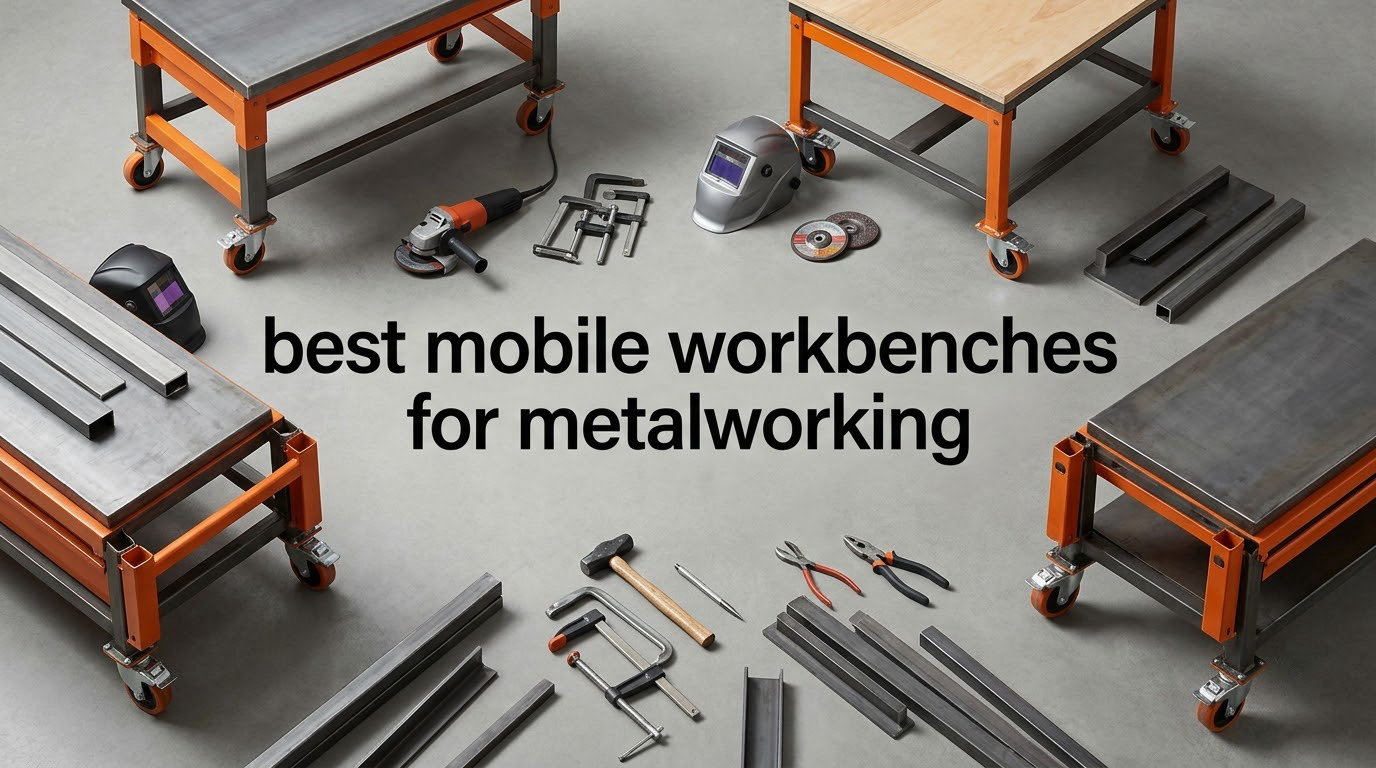
A good mobile workbench for metalworking is a steel-topped bench on locking casters that can take heat, weld spatter, heavy material and a mounted vise, so the work comes to you instead of you dragging plate across the concrete. That is the entire test we applied to the ten tables below.
Most benches in this category look identical in a product photo, which is exactly why the spec sheet matters more than the styling. I spent weeks reading owner reviews, cross-checking steel thickness against stated load ratings, and working through the complaint patterns that show up again and again in fabrication forums: centre-span flex when a heavy part is clamped in the middle, thin tops that bow under a grinder, casters that will not hold a loaded bench level, and tilt-locking hardware that cracks the first time it is tightened properly.
Who this roundup is for: home-shop hobbyists who want a vise and a grinder within arm’s reach, small production and repair shops that weld daily but cannot give up fixed floor space, and field technicians who need a self-contained welding and assembly station that travels with the job. If you only fit brackets together, the simplest table here will serve you. If you hang a machinist vise on the edge, the heavier plates in this list are worth the extra effort to move.
Our Top 3 Best Mobile Workbenches for Metalworking in October 2026
Three tables stand out. The VEVOR 36 by 18 inch is our top pick because it pairs a 1200 lb rating with a carbon steel frame and dual-sided tool tray, and it carries by far the deepest review history in the group at 513 reviews. The DEWALT 46 inch folding table takes the premium slot for anyone who needs to move between seated and standing work. The CAMMOO 36 by 18 inch holds the highest average rating of the ten and assembles without tools, which makes it the least frustrating first bench.

VEVOR 36×18 Welding Table
- 1200 lb capacity carbon steel top
- 94 5/8 inch fixture holes
- Locking casters and pull handle
- Dual-sided tool tray

DEWALT 46×18 Folding Table
- 1000 lb load capacity
- Seated to standing height
- Folding legs with safety pins
- 3 year limited warranty

CAMMOO 1200 lb Welding Table
- Highest rating in the group
- Black oxide heat-resistant top
- Locking casters plus fixed glides
- Assembles in about five minutes
Comparing the Best Mobile Workbenches for Metalworking in 2026
All ten tables, with the specification that decides each one’s use case. Load capacity is the manufacturer’s stated figure, not a load test we performed.
| Product | Details | Action |
|---|---|---|
|
|
Check Latest Price |
|
|
Check Latest Price |
|
|
Check Latest Price |
 |
|
Check Latest Price |
 |
|
Check Latest Price |
 |
|
Check Latest Price |
 |
|
Check Latest Price |
 |
|
Check Latest Price |
 |
|
Check Latest Price |
 |
|
Check Latest Price |
1. VEVOR 36-Inch Welding Table – The Heavy-Duty Rolling Bench That Holds Its Own
VEVOR Welding Table 36″x18″, 1200lbs Load Capacity Steel Welding Workbench Table on Wheels, Portable Work Bench with Braking Lockable Casters, 4 Tool Slots, 5/8-inch Fixture Holes, Tool Tray
1200 lb capacity
36×18 carbon steel top
94 fixture holes, 4 tool slots
57 lb with locking casters
+ Pros
- Genuinely stiff carbon steel frame
- Handles heavy loads such as a motorcycle engine
- Assembles in roughly 15 to 60 minutes with all hardware included
- Locking casters keep it stable mid-weld
- Compact footprint that stows in a small garage
– Cons
- Pull handle is the flimsiest part of the table
- Slotted fixture holes can loosen bolts without washers
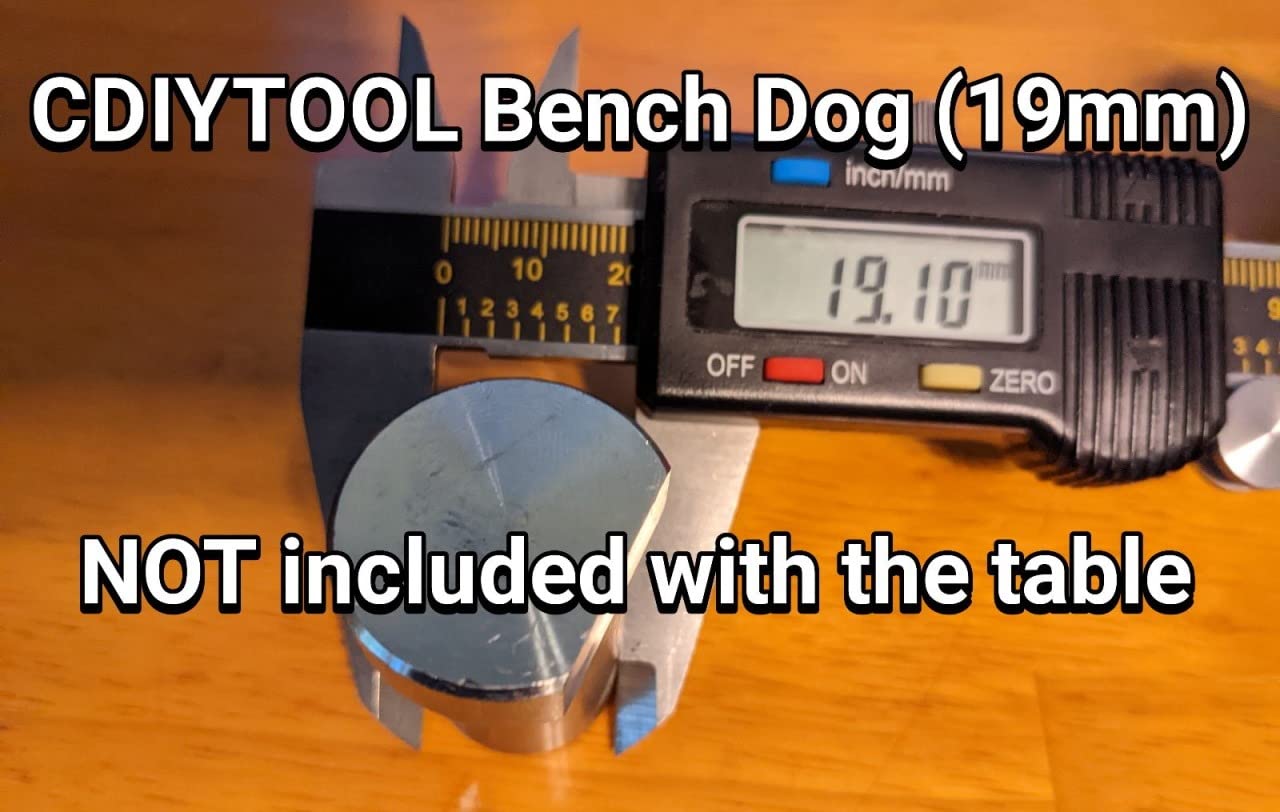
- 5/8 inch holes in a 3mm top may not accept standard dog pins
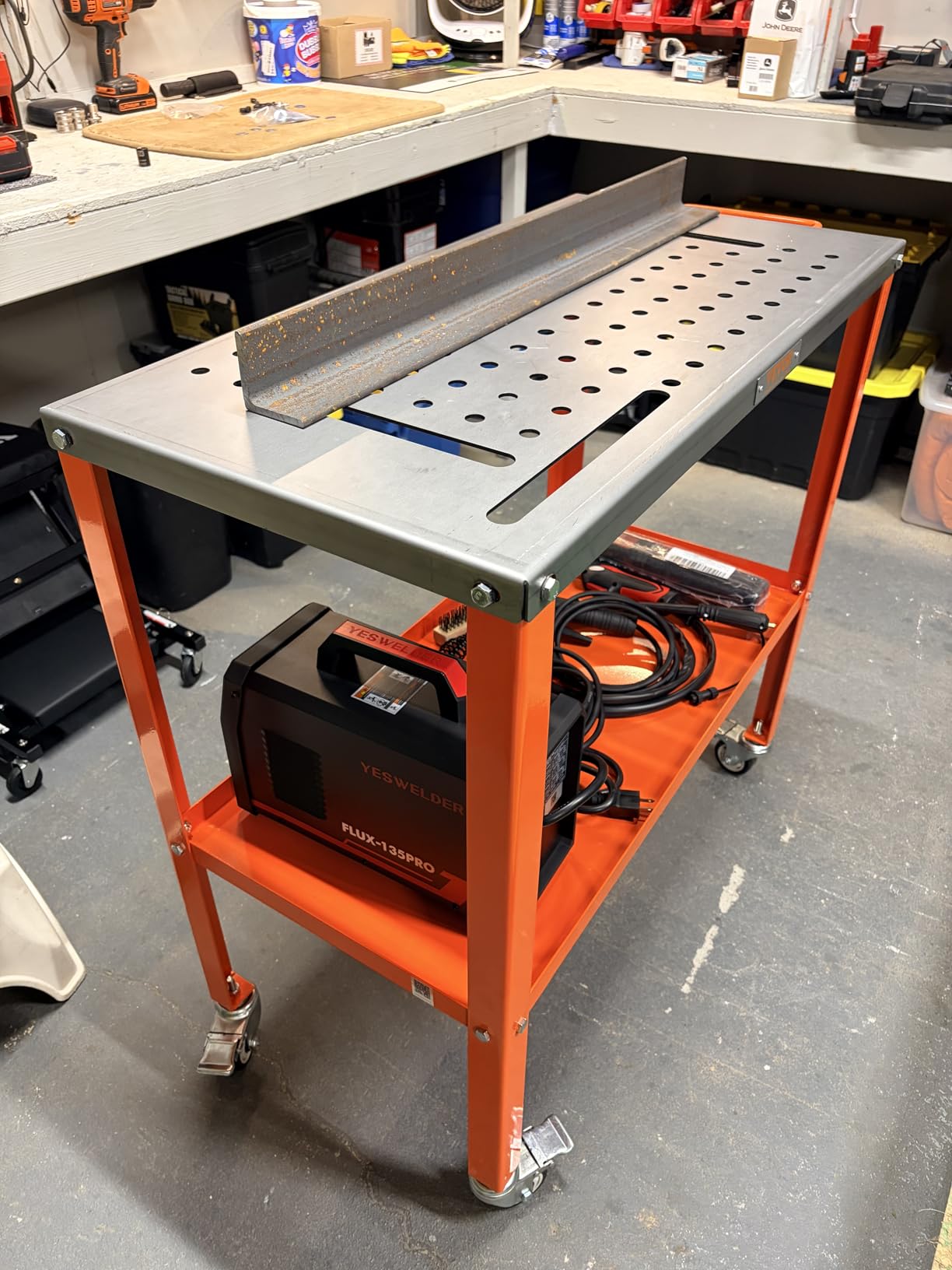
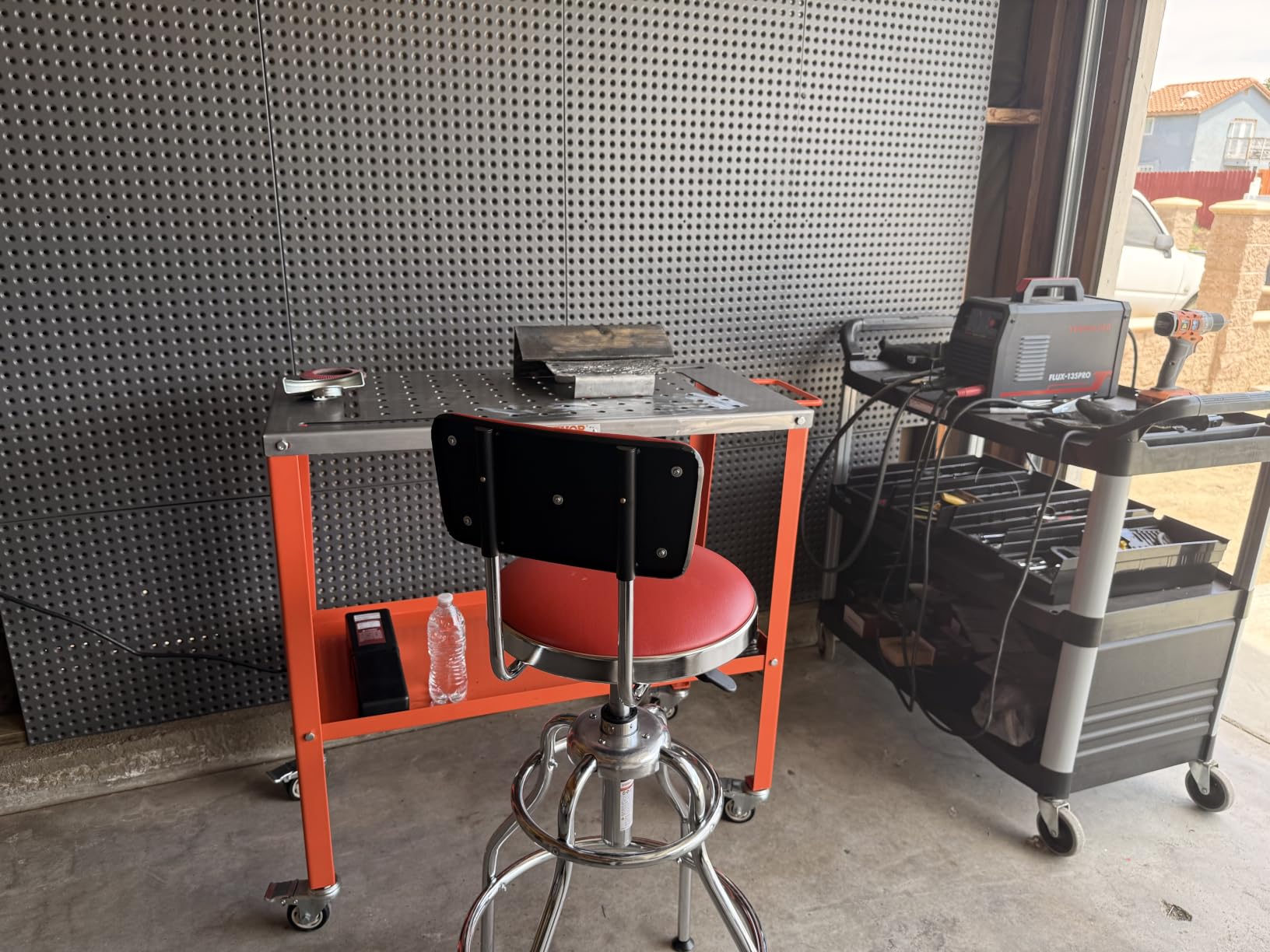
This is the table I keep coming back to, because it does the two things a shop bench needs most: it stays rigid when you lean on it, and it does not wander across the floor while you have an arc lit. Owners regularly mention loading it with heavy items, including a motorcycle engine, without complaint, and 79 percent of reviews are five-star.
The build is straightforward carbon steel on a wheeled base, with a dual-sided tool tray underneath for rods, pliers and clamps. That tray is the quiet feature – on a bench this size, anything you can keep off the top is surface you can actually work on.
Load Capacity and What 1200 lb Actually Means on This Top
The 1200 lb figure is tied for the highest rating in the group, and it matters most for a specific case: hanging a machinist vise off the edge. A heavy bench vise is not a small object, and it is exactly the kind of point load that makes a thin top bow.
The frame is carbon steel rather than the lighter-gauge sheet used by several budget folding tables in this list, and the difference shows when you push a plate off-centre. If your heaviest part will sit in the middle of the table, this is the one I would trust.
Fixture Holes, Tool Slots and the Bolt-Loosening Trap
Ninety-four 5/8-inch fixture holes plus four tool slots give you room to clamp material anywhere, which is the reason a fixture-hole table beats a plain steel top for fit-up work. Just be aware of a quirk owners mention: the holes are slotted, so a plain bolt can rotate and loosen under clamping pressure.
Use flanged bolts or add washers and you will never think about it again. If you plan to run standard dog pins into the holes, check the 3mm top thickness first – it is on the thinner side for pin work.
Moving It and Living With the Handle
Braking lockable casters and an integrated handle make this easy to reposition, and the locking brakes genuinely hold it still for welding. The handle is the most-criticised part of the whole table, described as the flimsiest component in an otherwise solid piece.
It is a fair complaint and an easy one to work around: lift by the frame rather than pulling on the handle when the bench is fully loaded. At 57 lb it is heavy enough that you will be doing that anyway.
Who This Bench Is Not For
If you need a tilting top, this is not it – it is a flat, fixed-height surface. If your shop floor is badly uneven, the four-caster base has no built-in levelling, so plan to shim it or use fixed feet. And if your work is assembly only with no heat involved, you are paying for steel you will never need.
2. DEWALT 46-Inch Adjustable Folding Welding Table – Best for Seated to Standing Work
DEWALT 46 in. x 18 in. Adjustable Height Portable Folding Steel Welding Table and Workbench DXMF4618WT
1000 lb capacity
46×18 folding alloy steel top
Adjustable legs
3 year limited warranty
+ Pros
- Level
- wobble-free surface with a flat top
- Individually adjustable legs for seated or standing work
- Folds down fast and can sit on top of a fixed bench
- Reinforced carry handle makes pickup loading easy
- Per-leg safety pins add deployment security
– Cons
- 3/4 inch holes instead of the common 5/8 inch
- Included cord minders are a gimmick and a toe hazard
- Top is only about 1/16 inch thick
- Narrower footprint than most competing tables
The DEWALT is the pick for anyone who works at two heights in one session – grinding low on one end, fitting and welding standing on the other. The individually adjustable legs are the whole idea, and 79 percent of its reviews are five-star.
It also folds down to something you can load into a pickup or store against a wall, then set up on top of a permanent bench. That dual role is rare in this category.
Height Adjustment and the Safety Pin Detail
The legs adjust from a low seated position up to full standing height, and each leg moves on its own, which is genuinely useful when your floor is flat but your work habits are not. Per-leg lock and safety pins store in holes in the table edge when the table is folded, so they are not lost in a drawer.
Those pins matter more than they sound. A folding table that folds mid-weld because a knob backed off is a burn risk, and the safety pins are the cheap insurance against it.
The 3/4 Inch Hole Problem and How to Work Around It
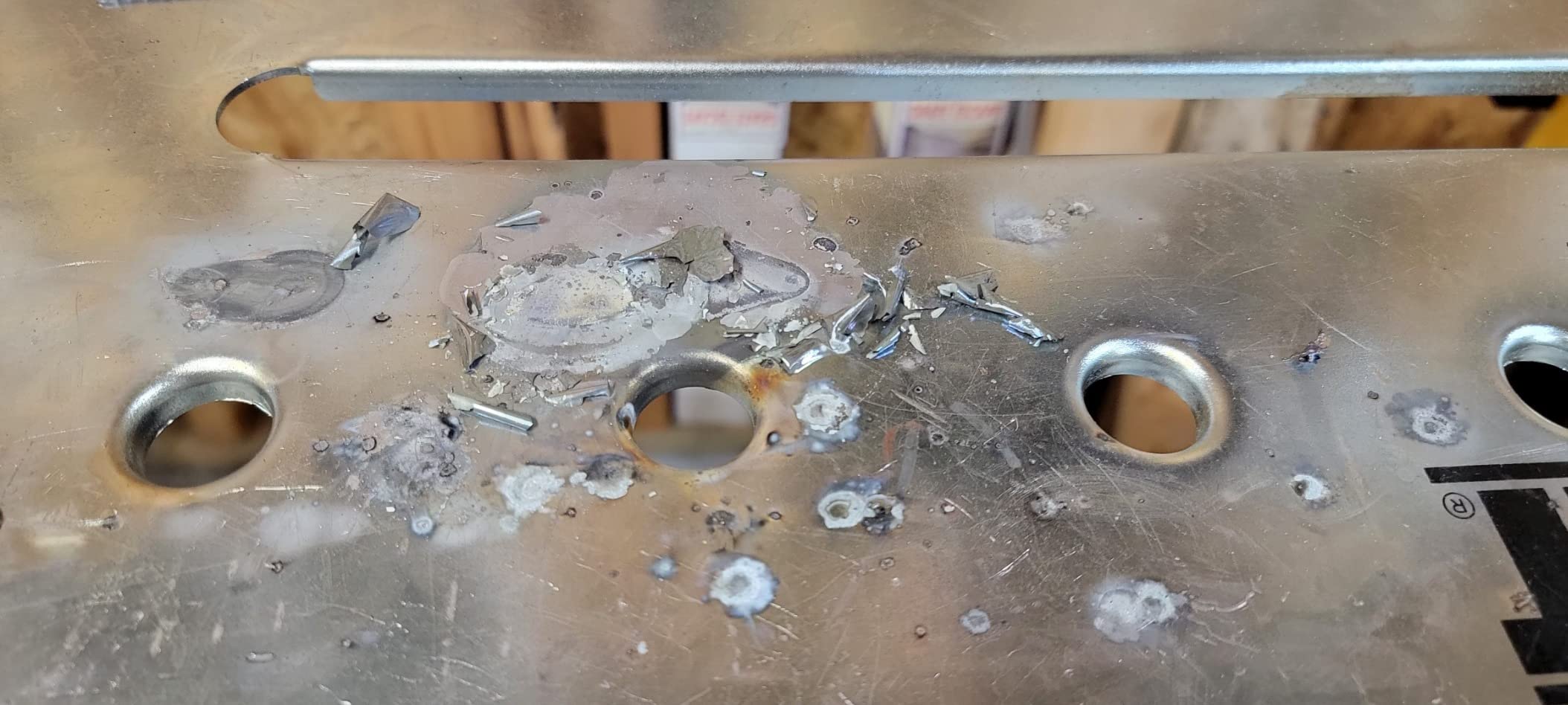
This is the single most-documented complaint in the reviews, and it is worth understanding before you buy. The hole pattern is 3/4 inch spaced 3 inches apart, not the 5/8 inch that most clamps, dogs and vises are built around, so standard fixture hardware simply will not drop in.
Owners who plan for this in advance tend to be happy; owners who discover it mid-project are not.
Top Thickness and What It Rules Out
The top measures roughly 1/16 inch, which is fine for fit-up, assembly and light welding, but it is the limiting factor for this table. It is not a bench for hammering, heavy grinding abuse or machining.
Worth noting alongside that: the included cord minder components are widely described as a gimmick, and several owners point out they create a toe-catch hazard when the table stands deployed. I would skip installing them.
Portability as the Deciding Feature
The reinforced carry handle is comfortable enough that a single person can load the 40 lb table into a truck, which is the feature that separates it from every fixed-base bench in this roundup. A 3 year limited warranty also backs it, and few competitors in the metalworking table category offer anything close to that.
3. CAMMOO 1200 lb Welding Table – The Highest Rated of the Group
CAMMOO 1200LBS Welding Table, 36″x18″ Portable Welding Table, for Garage & Workshop
1200 lb capacity
36×18 black oxide top
3.5mm legs, 2.8mm desktop
Locking casters plus glides
+ Pros
- Tool-free setup with pre-installed wheels
- Locking casters with fixed glides for precision work
- Black oxide top resists heat and rust
- Dual-sided tool tray within reach
- 2 year manufacturer warranty
– Cons
- 2.8mm desktop is thinner than a heavy fixture bench
- Pre-installed wheels limit the base to a fixed pattern
- Black oxide finish needs care to keep from scuffing
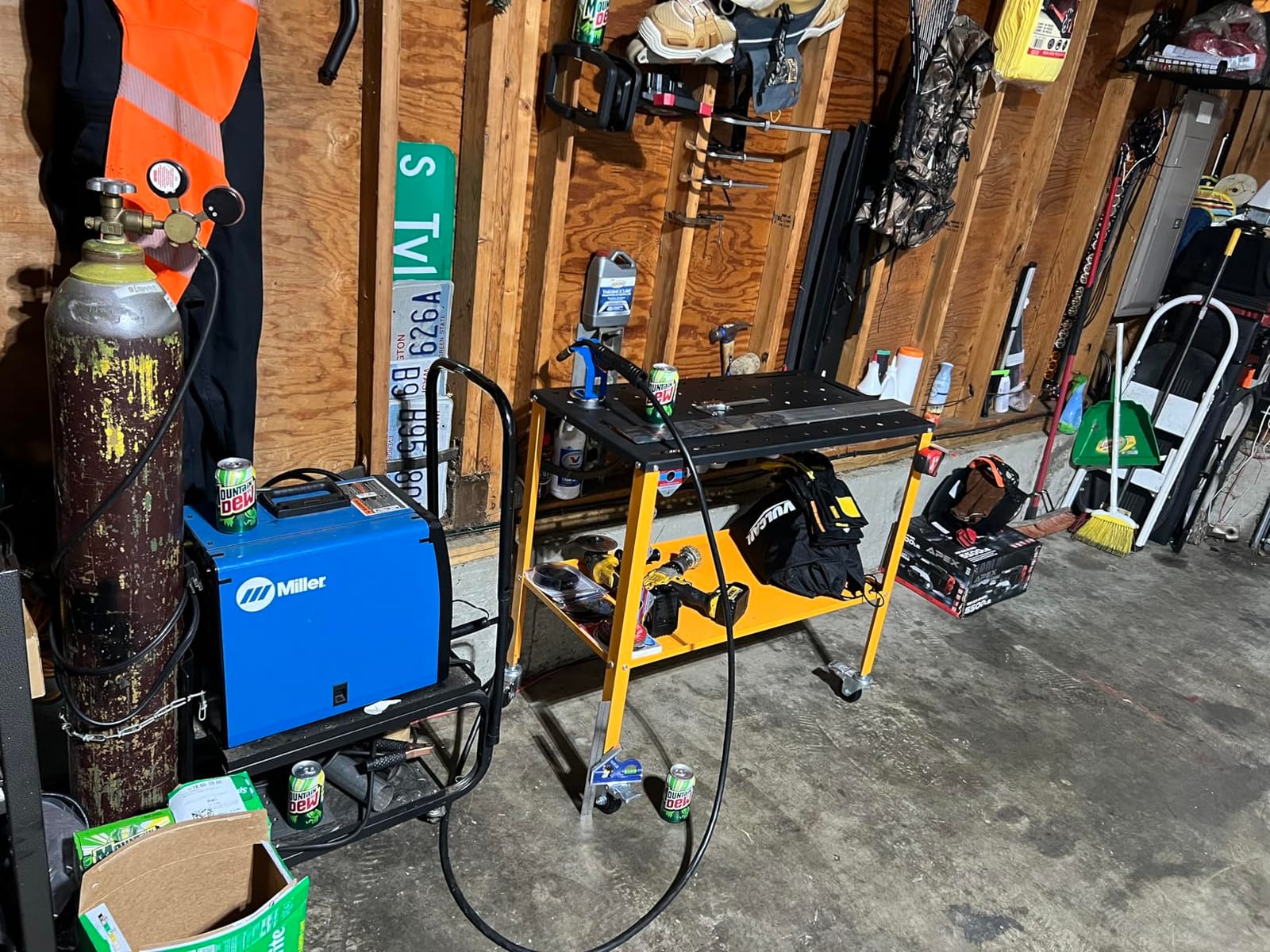
This table holds a 4.7 average across 202 reviews, the best score in the roundup, with 81 percent five-star. The reason is simple: it asks the least of you at assembly time. Pre-installed wheels mean you are bolting on a handle, four legs and a shelf, and owners put that at about five minutes of work.
The cold-rolled steel top carries a black oxide finish with anti-rust coating, which is a better surface for hot work than a painted or powder-coated top because it does not blister and spit when you land spatter on it. For a hobbyist buying their first bench, that combination of rating and setup ease is the strongest case in this list.
Casters Plus Fixed Glides: A Two-Mode Base
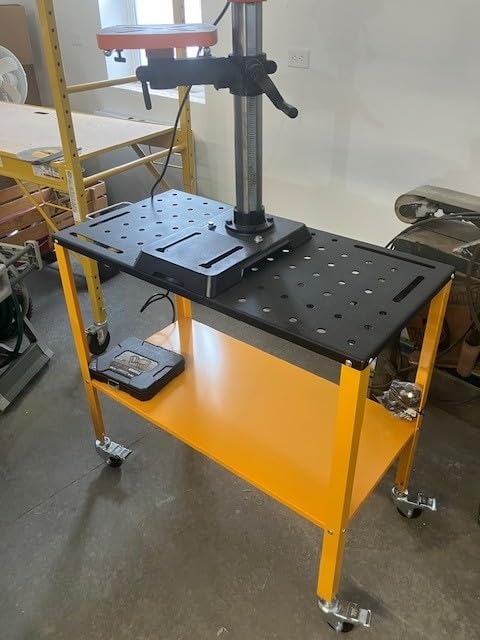
Most portable tables give you either wheels or feet. This one includes four 3-inch locking swivel casters and four fixed glides, so you can roll the bench to the job and then swap the wheels for the glides when you need a genuinely rigid surface for a weld or a layout operation.
That is a smarter answer than it first appears. Centre-span movement while fitting is the complaint that comes up most across the whole category, and a fixed glide takes the wheels out of the equation entirely when precision matters more than mobility.
Steel Thickness: Where It Holds Up and Where It Stops
Legs are 3.5mm steel and the desktop is 2.8mm, which is a sensible mid-point – stiffer than the folding tables here, lighter than a 4mm fixture bench. The 1200 lb rating on those dimensions puts it in the same class as the VEVOR top pick.
What the thinner desktop does mean is that this is not a hammering bench. Concentrated impact work and heavy machining want a thicker plate, and if that is your day, the Klutch in slot 7 is the heavier answer.
Fixture Holes and the Under-Table Tray
Ninety-four pre-drilled 5/8-inch mounting holes plus four tool slots mean standard dogs and clamps drop straight in, which puts it ahead of the DEWALT on fixturing. The dual-sided under-table tool tray keeps consumables off the top and within reach.
At 43.1 lb, this is one of the lighter 1200 lb-rated tables in the group, which is a real practical advantage when you are moving it across a shop floor by yourself.
What Owners Have Not Reported
There is a reason this one scores highest: the reviews raise very few problems. The realistic limitations are structural rather than reported – the fixed four-wheel base, the desktop thickness for heavy impact work, and a 2 year warranty that is shorter than the DEWALT’s three years.
4. JEGS Adjustable Welding Table – Best Tilt Angles and Edge Guides
JEGS Adjustable Welding Table [350 lb. Capacity]
350 lb capacity
30×20 zinc-plated top
Five tilt positions
Retractable edge guides
+ Pros
- Zinc-plated top resists rust and conducts for ground clamps
- Tilt positions include 0
- 30 and 80 degrees
- Edge guides double as a fence for holding workpieces
- Folds flat for tight workshop storage
- Several units can be linked into a larger surface
– Cons
- Plastic tilt-locking knobs crack under tightening
- Yellow chromate plating needs sanding before welding
- Sharp unfinished edges need deburring
- 350 lb capacity is well below heavy steel tables
The JEGS is the one to buy if your work is at an angle more often than it is flat. Five tilt positions including 0, 30 and 80 degrees cover pipe, tube and awkward joints, and the retractable edge guides act as a fence so a workpiece cannot slide while you set up.
There is a second trick worth knowing: multiple tables of this design can be joined together to make one larger surface. For layout work on a long part, that is often more useful than a bigger single top.
![JEGS Adjustable Welding Table [350 lb. Capacity] customer photo 1](https://fypower.org/wp-content/uploads/2026/09/B082P86Q2K_customer_1.jpg)
The 350 lb Rating and When It Is Enough
Three hundred and fifty pounds is roughly a third of what the heavy tables here carry, and you should not pretend otherwise. It is entirely adequate for hose clamps, small tube frames, sheet metal and light plumbing work. It is not adequate for a heavy engine, a stack of plate or an aggressive vise.
Judged against its 37.3 lb weight, the rating is honest rather than inflated, and it folds to a 30-inch collapsed length, so this is a bench you bring to the job rather than a bench you load up.
Grounding and the Zinc-Plated Surface
The zinc-plated top resists rust and is electrically conductive, which means a ground clamp can attach to the table and take the return path away from the workpiece itself. That is a genuine welding advantage over a painted top, and it is the feature that makes grounding a mobile bench simple rather than a puzzle.
The catch is the finish. Owners recommend sanding the yellow chromate plating down before you weld on it, both to remove the coating and to knock back the sharp edges. Budget fifteen minutes for that before first use.
The Plastic Knob Problem Is Real
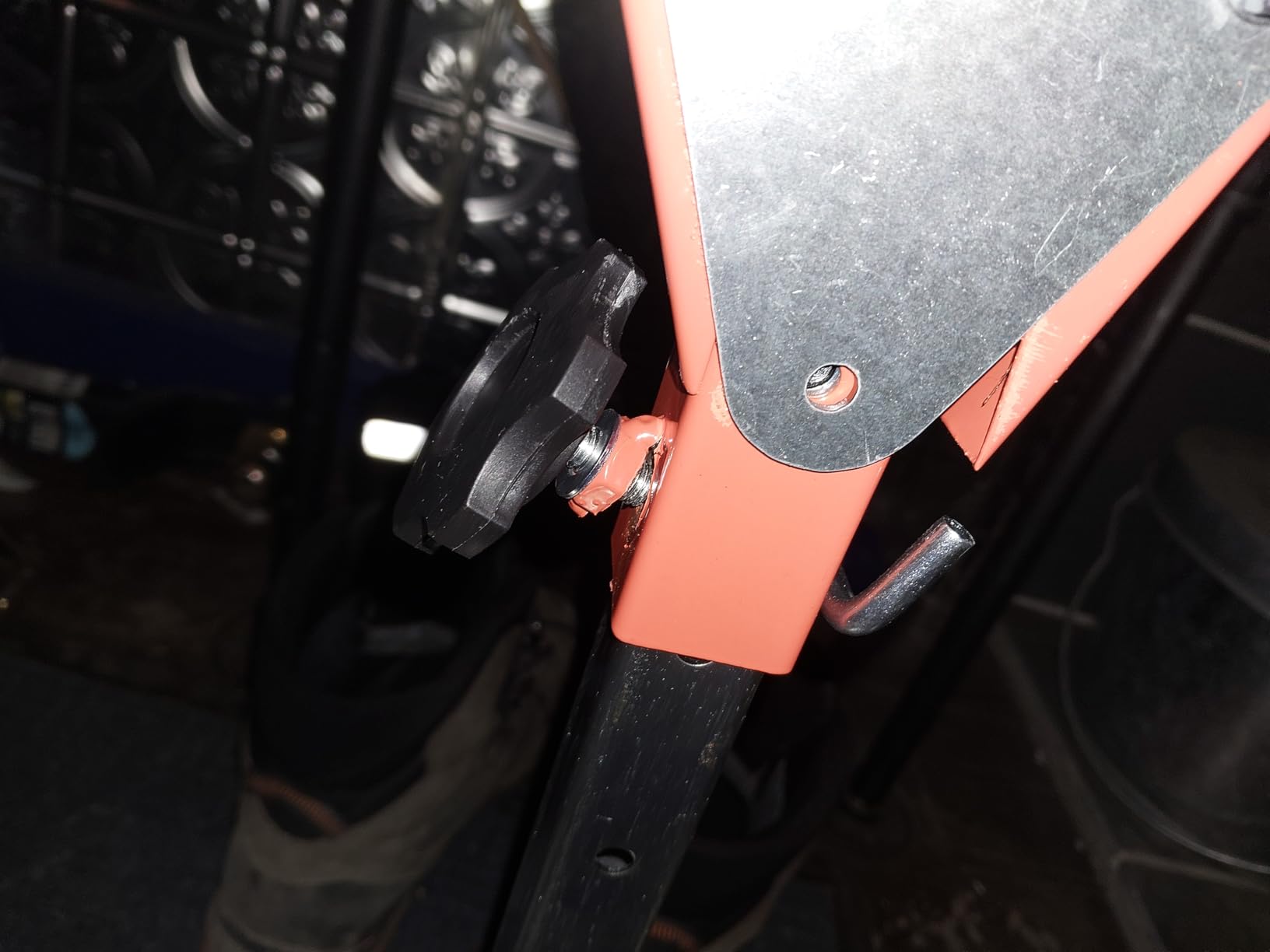
Several buyers report the plastic tilt-locking knobs cracking under tightening pressure, and this is the most common complaint across the JEGS reviews. It is a fixable problem – replace them with metal thumbscrews or a small clamp – but do it before you need it.
Also deburr the unfinished edges during the same pass. Sharp raw steel edges are the other recurring note, and they are a cut hazard during setup, which is when your hands are closest to the frame.
Best For Small-Space Shops
Level height is 32.59 inches on a 30 by 20 inch top, and the whole unit folds flat for storage. In a small shop where floor space is the constraint, that combination of tilt options and fold-away storage is worth more than raw load capacity.
![JEGS Adjustable Welding Table [350 lb. Capacity] customer photo 2](https://fypower.org/wp-content/uploads/2026/09/B082P86Q2K_customer_2.jpg)
5. Olympia Tools Adjustable Welding Table – Best Value Tilting Table
Olympia Tools Adjustable Welding Table with Wheels Portable Steel Stand Workbench 30 in. x 20 in.
350 lb capacity
30×20 zinc-plated top
Tilting top with height adjustment
Wheels and carry handle
+ Pros
- Stable with no flex or shake during welding
- Wheels and carry handle move it with tools still on the tray
- Top conductivity keeps the ground clamp off the workpiece
- Clearer assembly instructions than most at this tier
- Tilting top and height adjustment cover varied setups
– Cons
- Pre-drilled hole sizes may not fit common clamps
- Plastic tilt-handle bolts can loosen and fail
- Poor assembly instructions on some units
- Maximum height still means leaning over for small parts
Owners consistently report that this table does not flex or shake during welding, which for a portable tilting design is the central achievement. It also rolls with your tools still loaded on the under-table tray, so you reposition the whole workstation in one move rather than unloading it first.
The comparison with the JEGS is close. The Olympia wins on wheel-and-handle mobility, the JEGS wins on the number of tilt positions and the ability to link two tables together. Both share the 350 lb class and the same 30 by 20 inch footprint.
Grounding: The Quiet Strength Here
The zinc-plated top conducts well, and owners specifically call out that it lets the ground clamp attach away from the workpiece. When you are fitting a small part and do not want a clamp mark on the finished face, having a conductive table to bite onto is a real time saver.
Adjustable height starts at 29 inches and the top tilts, so you can set up a comfortable angle for a tube joint rather than working over a flat plate at an awkward reach.
Quality Control Gaps Are the Main Complaint
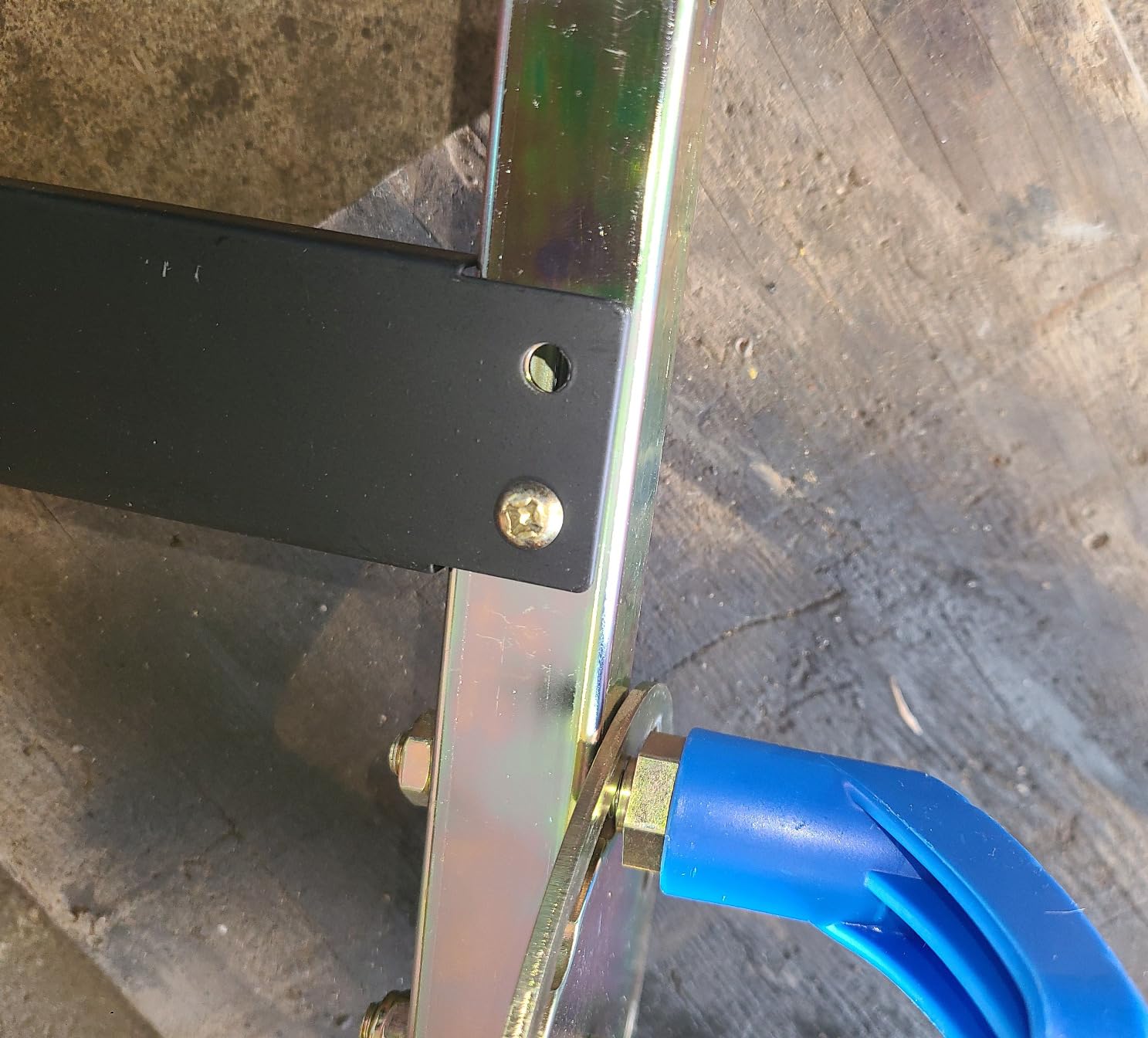
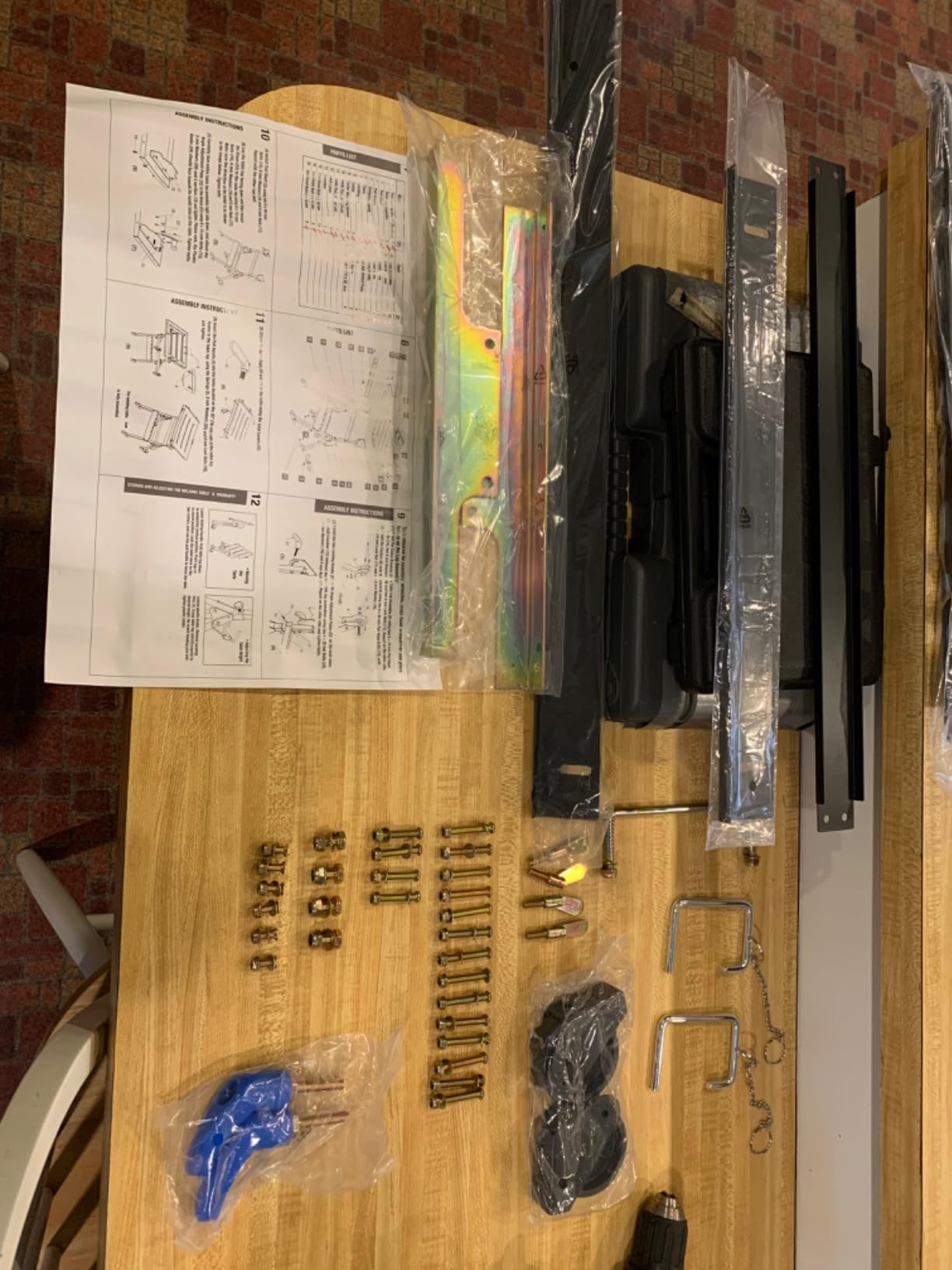
This is where the honest criticism sits: quality control. Owners report misaligned welded nuts, a missing wing nut on one unit, and pre-drilled holes that do not match standard clamp sizes, which means drilling your own holes before the bench is useful for fixturing.
Assembly instructions are also described as poor by some buyers, though others found them clear enough to complete in about 45 minutes. Check the full parts list against the manual before you start, because a missing fastener on a tilting frame is annoying to chase later.
When the Plastic Tilt Hardware Should Worry You
The plastic handles on the tilt-locking bolts can loosen and fail. Since a tilting top is a moving part under load, replace those with metal hardware early – it is the same fifteen-minute fix as the JEGS, and it removes the most likely failure point.
On the ergonomic side, several owners note that even at maximum height they still lean over for small pieces. If your work is mostly small-part fitting, pair this with a taller stool rather than assuming the table will do the job.
6. VEVOR 30-Inch Foldable Welding Table – Best for Very Small Shops
VEVOR Welding Table Foldable 30″x20″, Welding Workbench Table 400lbs Load Capacity Steel on Wheels, Work Bench Adjustable Height with 3 Tilt Angles, Three 1.1″ Slot, Retractable Guide Rails
400 lb capacity
30×20 carbon steel top
Three tilt angles, three slots
Adjusts 25 to 32 inches
+ Pros
- Sturdy and heavy duty for a folding table in this class
- Wheels let you reposition and rotate it
- Top conducts well so the ground clamp stays off the part
- Tilting and height adjustment work smoothly
- Folds for small shops and service trucks
– Cons
- Thin sheet metal bends under side pressure and the top goes out of flat
- Sparse and out of date instructions
- Missing hardware reported by several buyers
- Wing nuts on tilt pivots are not sturdy
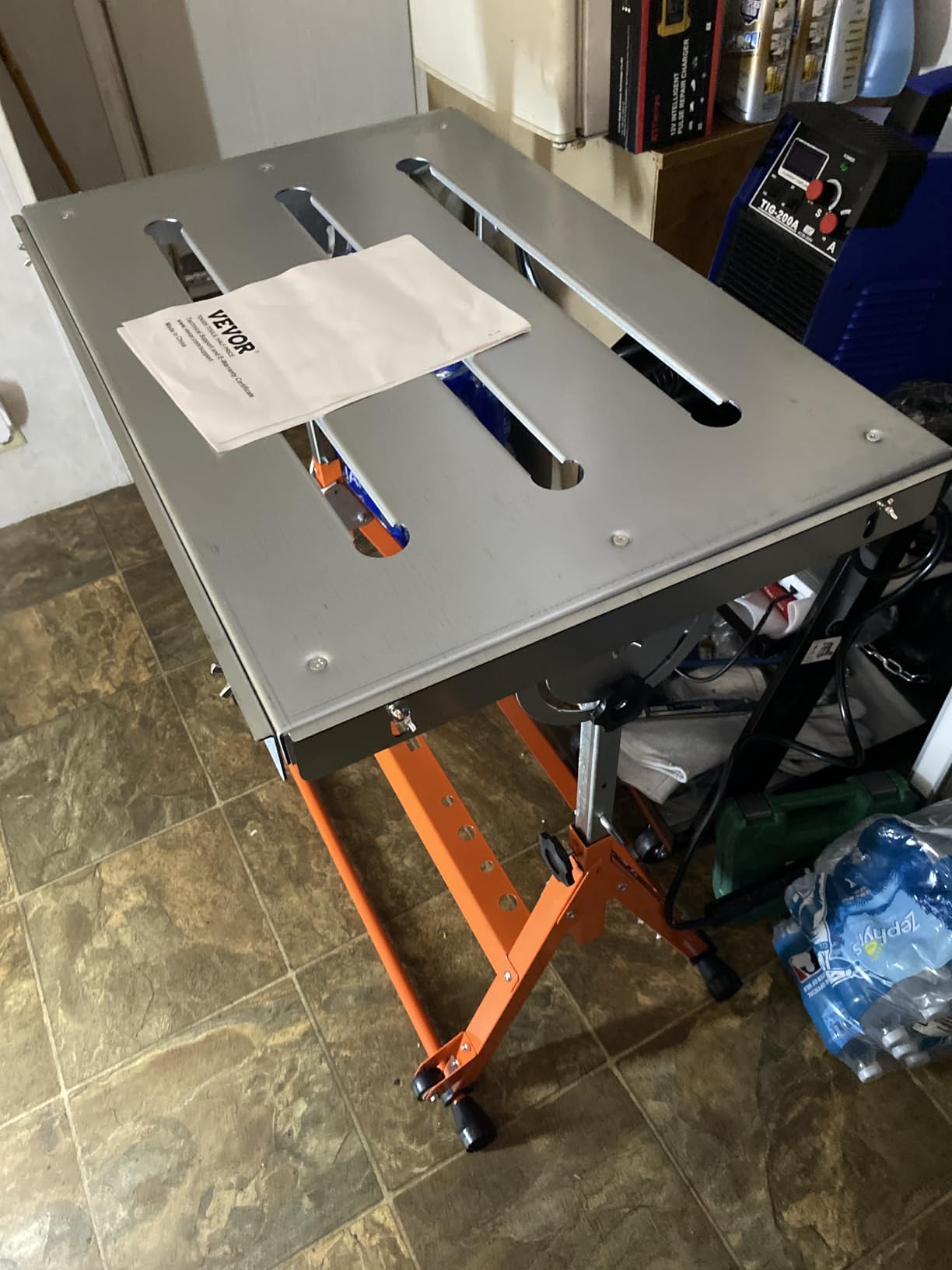
At 30 by 20 inches, this matches the two tilting tables above it for the smallest footprint in the roundup, and for a one-car garage that is the point. It also has three retractable vertical guide rails that work as edge guides, stops or clamp supports, which is more fixturing hardware than most tables of this size offer.
It is also the lowest-rated VEVOR in this group at 4.0, with a rating distribution that is noticeably flatter than the others – 54 percent five-star against a 13 percent three-star and 8 percent one-star share. The build is fine; the finishing and assembly are inconsistent.
Centre-Span Flex: The Complaint That Decides It
Thin sheet metal can bend under side pressure and the top does not stay flat, which is the exact failure mode that makes a bench feel cheap. The 400 lb rating applies to a centred load; a part hanging off the edge with a clamp on it is a different test.
If you know that is your pattern – clamping a long part at one end, or hanging a vise – go up to the WORKESS or the Klutch instead. This table is at its best for smaller material and short workpieces.
Tilt Angles, Slots and Guide Rails
Three tilt positions at 0, 30 and 90 degrees plus three 1.1 by 22-inch slots give you genuine fixturing options, and height adjusts from 25 to 32 inches. The top conducts well, so the ground clamp can live on the table rather than the workpiece.
The catch owners mention: the wheels only touch the floor at a very low table angle, so rolling it while tilted is not something you can rely on. Set it down flat before you move it.
Assembly: Budget Real Time for It
Instructions are sparse, out of date and reportedly not updated after redesigns, and several buyers report missing hardware. Some tables arrive with hardware organised in labelled bags, which makes the job far easier when it is done right.
Spot-welded nuts on the legs can also snap off. Replace the wing nuts on the tilt pivots with hex bolts while you are there, and check every nut before you tighten anything down. Fifteen minutes of prep turns this from an assembly problem into a fine table.
Where It Earns Its Place
It folds flat for storage and transport, weighs 39.2 lb, and is small enough to move around a cramped shop. In a space where a 42 inch top will not fit, that is a legitimate reason to choose it over everything else in this list.
7. Klutch Mobile Welding Workstation – Best for Heavy Plate and Vise Mounting
Klutch Mobile Welding Workstation, 26-Pc. Fit-Up Kit, 600-Lb. Capacity
600 lb capacity
40×24 top in four 20×12 boards
4mm steel plate, 16mm holes
113 lb with stabilizer feet
+ Pros
- Top built from genuinely heavy 4mm steel plate
- Standard 16mm holes on 2 inch centers match common fixture hardware
- Four separate top boards let several projects run at once
- Four 3-inch swivel casters plus firm-grip handle move the 113 lb unit
- Built-in stabilizer feet keep the surface steady for fit-up
– Cons
- At 113 lb it is one of the heaviest tables in this group to move
- Sold as a kit so the included tool set must be accounted for
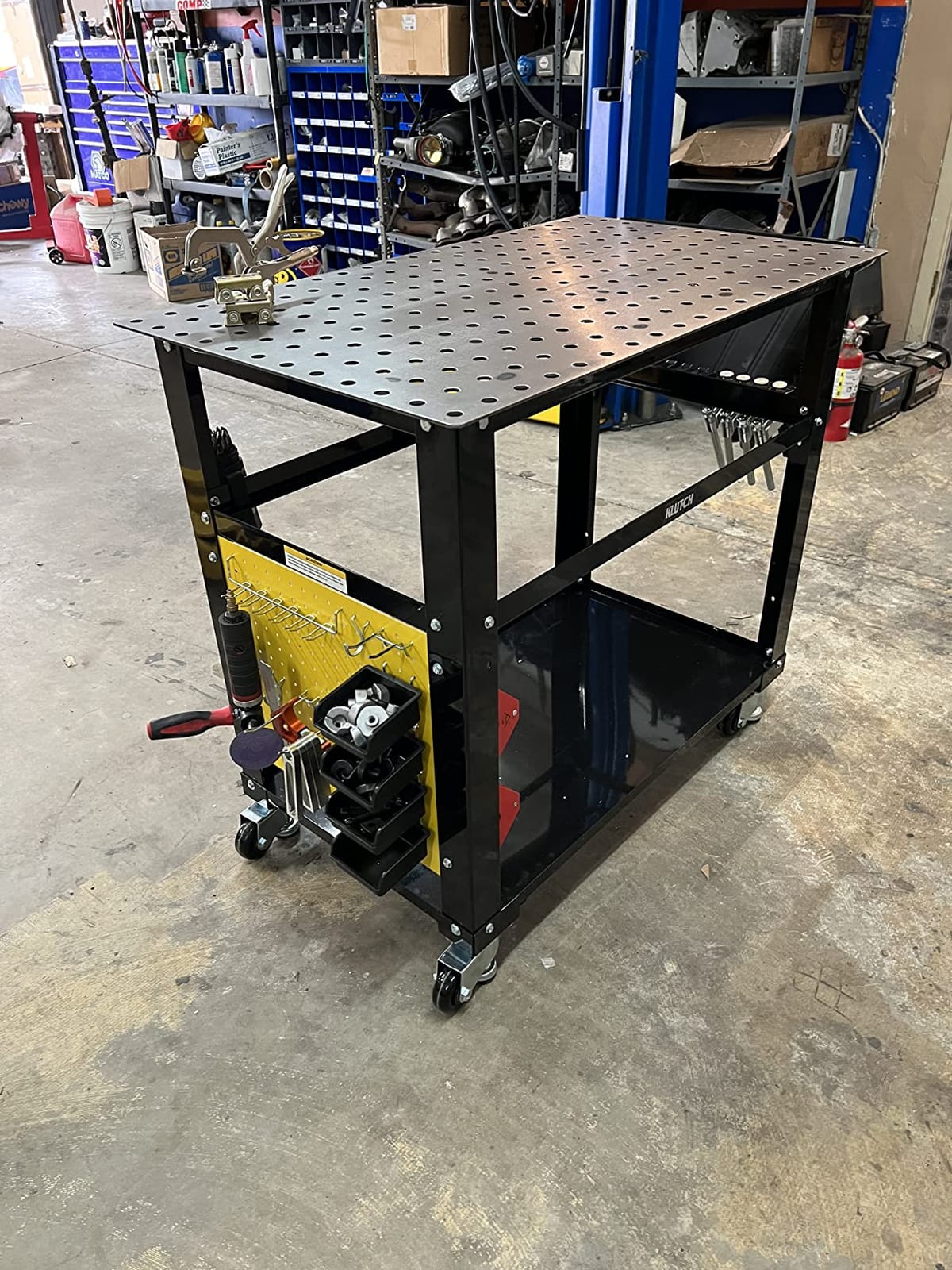
This is the answer to the most-asked question in this category, which is where to mount a vise on a rolling bench. The 40 by 24 inch top is 4mm steel plate, split into four 20 by 12 inch boards, and it carries 600 lb. That is a plate you can bolt a machinist vise to and then clamp hard on.
It is also the only table here with standard 16mm fixture holes on 2-inch centres, which is the pattern most professional fixture hardware is built around. Owners single this out as the reason it feels different from the lighter, flimsier tables.
Why 4mm Plate and Standard Holes Matter
Centre-span flex is the complaint that surfaces most across owner reviews of portable benches, and it happens when heavy material is centred or a vise is hung on the edge. A 4mm plate resists that far better than the 2.8mm and 2mm desktops elsewhere in this list.
The 16mm hole pattern is the other half of the advantage. If you already own dogs, clamps or a fixture subplate, they will most likely fit straight in – no drilling, no adapters, no wondering why your bolt will not go through.
Four Top Boards and Multiple Projects
The top divides into four separate 20 by 12 inch boards. That sounds like a detail until you are running two jobs at once, or one job at two stages, and you do not want to clear and re-clamp between them.
Owners consistently report that the 26-piece metal fit-up kit included with the table is a real part of the value here – toggle clamps, alignment aids and the like that you would otherwise buy separately.
Stabilizer Feet: The Underrated Feature
Built-in stabilizer feet let you take the weight off the casters and get a firm working surface. On a heavy steel table this is the difference between a stable fit-up surface and one that rocks when you push a part into position.
Four heavy-duty 3-inch swivel casters and a firm-grip handle make a 113 lb unit movable, and that is the real trade-off to consider – you get the most rigid bench here and pay for it in mass.
Who Should Look Elsewhere
If you need to carry this up stairs, into a van every day, or work in a space where 113 lb is a problem, this is the wrong pick. It suits a shop with floor space and a job that needs a proper fixture table more than it suits a hobbyist in a small garage.
8. WORKESS 42-Inch Folding Welding Table – Best for Field Work and Uneven Ground
WORKESS Metal Welding Table Folding 1000 lbs Load Capacity Heavy Duty Steel Construction Workbench for Welding Adjustable 7 Level Height
1000 lb capacity
42×21 14-gauge galvanised top
Seven height levels
Folds to 3.7 inches
+ Pros
- Folds to 3.7 inches and stands on its own
- saving floor space
- Seven height levels for seated or standing work
- Sturdy and rigid with no reported wobble
- Grounding bolt on the side keeps the ground off the workpiece
- Legs adjust individually for uneven outdoor surfaces
– Cons
- Top feels thin and is not for hammering or heavy fab work
- Legs must be at their lowest setting to fold
- Round holes do not accept every vise or clamp style
- Leg locking hooks need more fumbling
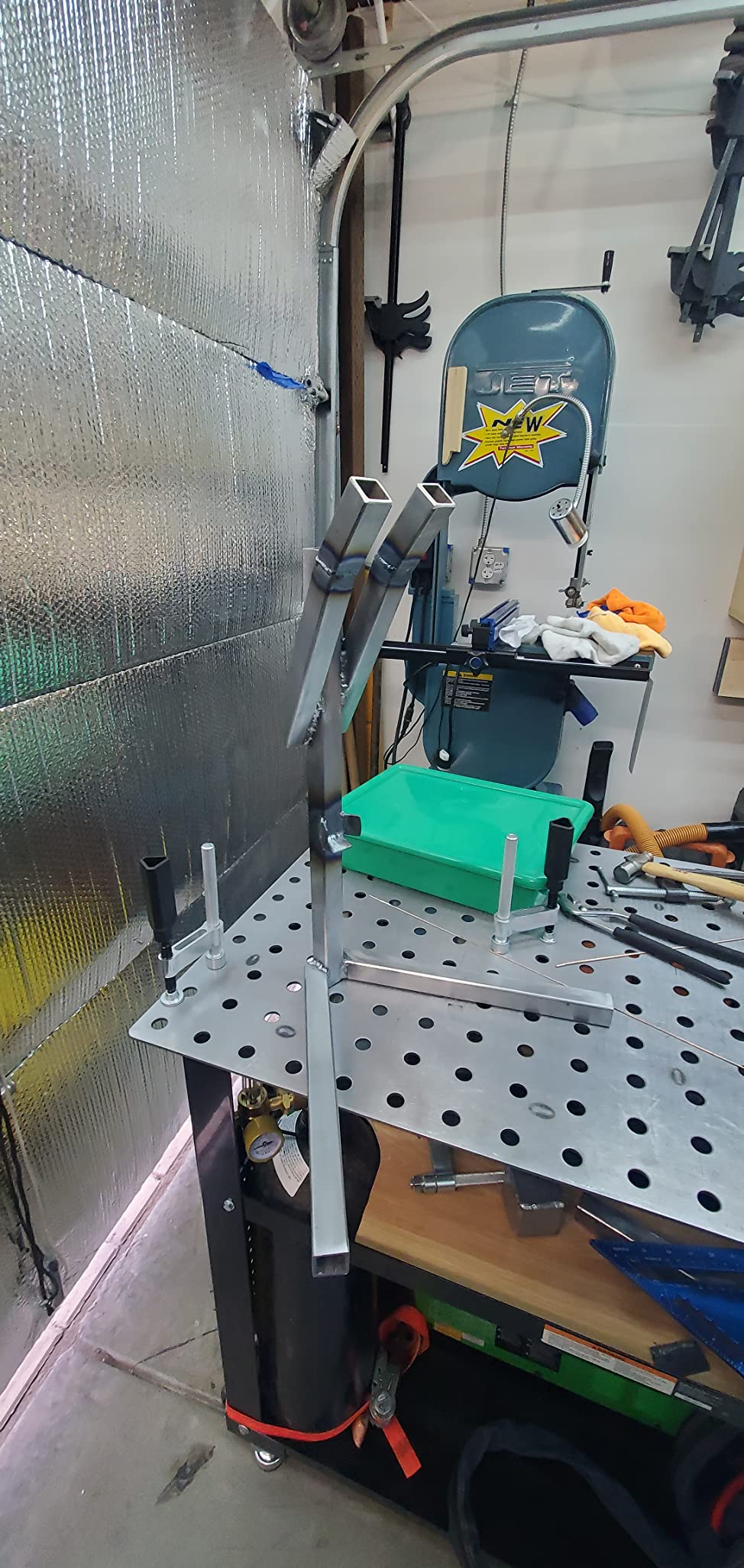
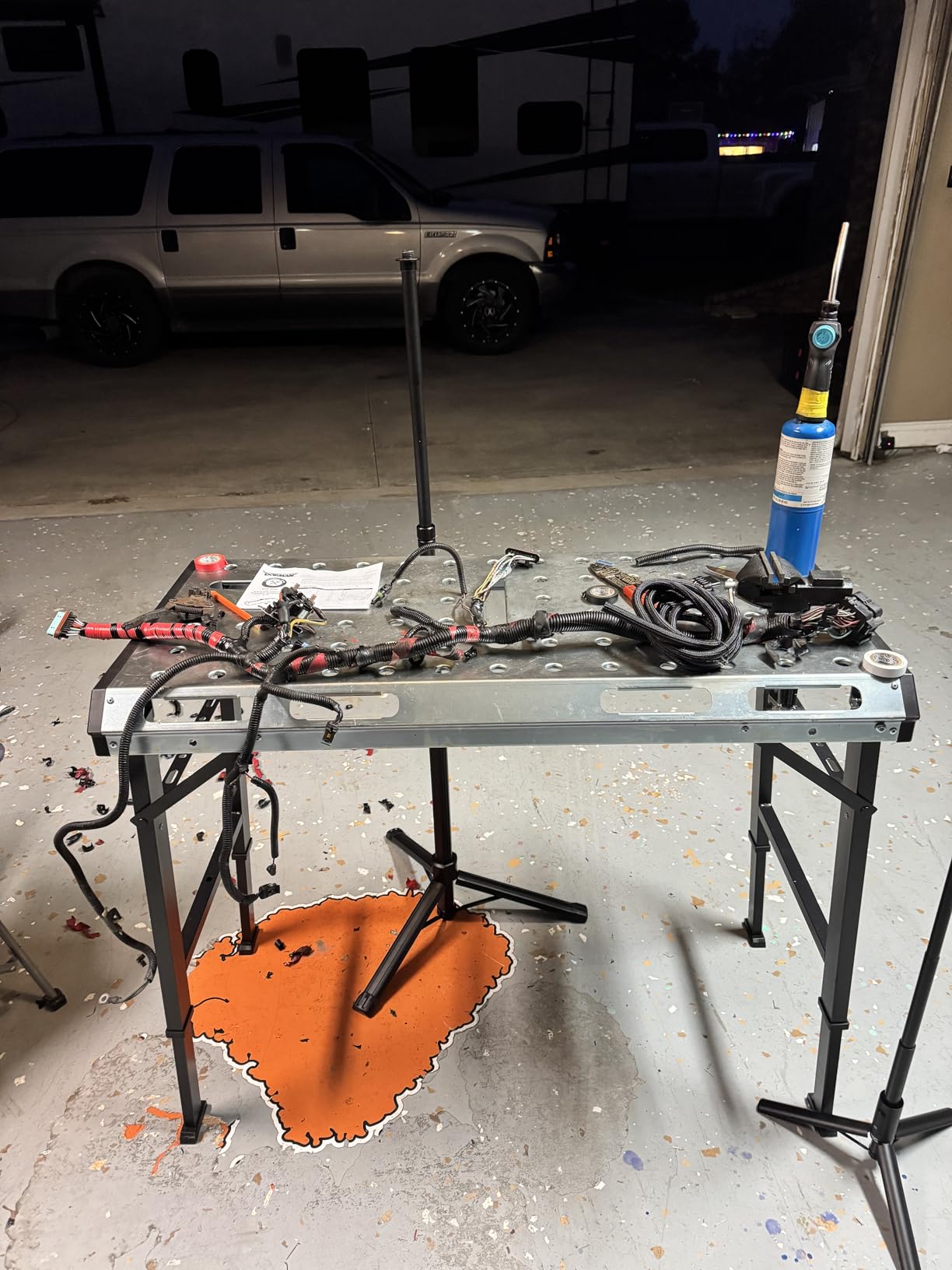
A 42 by 21 inch top sits at the large end of the folding tables here, and it is the only one that folds down to a 3.7 inch freestanding unit you can walk over or store against a wall. For job-site work where the bench lives in a van between jobs, that is the feature that matters most.
Legs adjust independently across seven levels from 27.7 to 36.6 inches, so it can be levelled on grass, gravel or a sloping driveway – something no fixed-base bench in this list can do. Owners report it as sturdy and rigid with no wobble.
14-Gauge Steel: Where the Limits Are
Fourteen-gauge galvanised steel with a powder-coated frame gives a 1000 lb rating, and the number is on the generous side for this class. But owners are clear that the top feels thin, and that it is built for assembly and light fabrication rather than hammering or heavy fab work.
Understand the trade before you buy. The 1000 lb figure tells you about the frame; the 14-gauge top tells you how you should use it.
Levelling on Uneven Ground
Independent leg adjustment is what separates this from a standard folding table. Seven levels per leg means you can compensate for a floor that is not flat, which stops the bench rocking mid-weld and stops a ground clamp from making the workpiece your return path.
There is a catch worth planning around: the legs must be at their lowest setting to fold, so height has to be reset every time you set up. Not a defect, just something to build into the routine.
Grounding Bolt and Fixture Holes
A grounding bolt mounted to the side is a nicer solution than clamping to a painted top, because it gives a dedicated, low-resistance return point that does not depend on the top’s finish. Fixture holes are 0.8 inch round, plus multiple slots across the top.
The round holes are the main limitation – they do not accept every vise or clamp style, and slotted or threaded alternatives are worth checking against your hardware before you commit.
Storage and Transport
Four locking hooks hold the folded frame, and carry handles are integrated for transport. Folding to 3.7 inches while keeping a 42 inch working surface means one bench can serve a van, a garage and a customer site without needing a second one.
9. VEVOR 44-Inch Foldable Welding Table – Best Large Top on a Budget
VEVOR Foldable Welding Table 44″ x 21″, 500LBS Capacity Welding Workbench with 4-Level Adjustable Height, Carbon Steel Work Bench with 6 Tool Slots & 0.63″ Fixture Holes for Welding Assembly Repair
500 lb capacity
44×21 carbon steel top
Four height levels
0.63 inch fixture holes
+ Pros
- 44 by 21 inch surface is bigger than most at this tier
- Simple setup – bolt on four folding legs
- Height adjustment covers sitting and standing
- Folds flat for truck transport and tight storage
- Top is thicker than rivals costing far more
– Cons
- Top is bowed about half an inch out of flat
- Leg knobs are hard to tighten enough to stop folding
- No locking pins on deployed legs
- Rubber feet detach easily
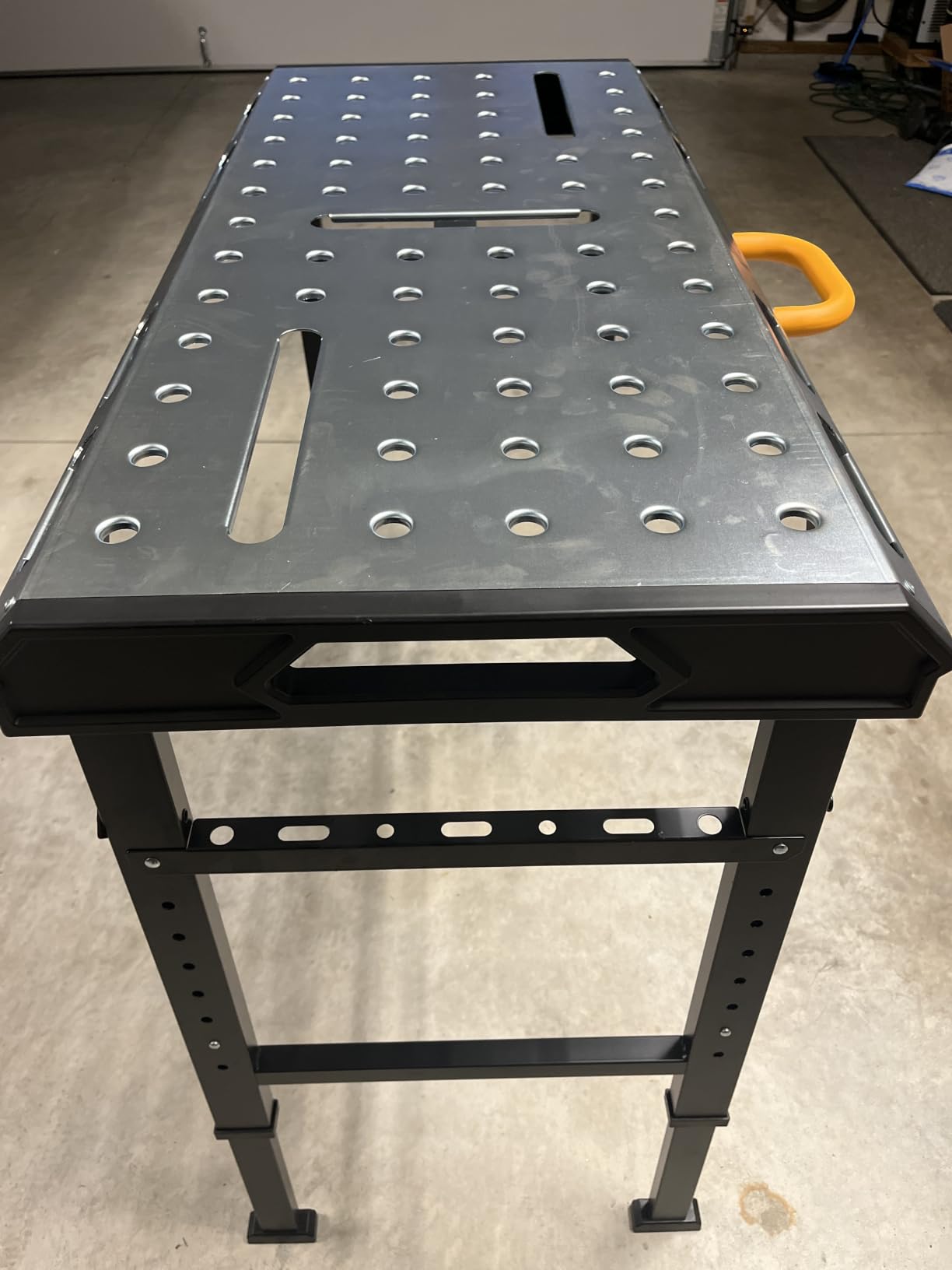
Forty-four by 21 inches is a lot of surface for this tier, and buyers point that out as the main reason to buy it. The 2mm top is thicker than several competitors that cost considerably more, and four height levels from 29.5 to 36.5 inches cover comfortable sitting and standing.
Setup is minimal – the tabletop and legs are pre-installed, so you are bolting four legs on. It folds flat for truck transport, and 60 percent of reviews are five-star with an 18 percent four-star share.
The Bowed Top Is the Deal-Breaker to Check
The most common criticism is that the top is bowed, roughly half an inch out of flat in the middle. That matters far more than a 500 lb rating suggests, because a bowed top is exactly where a plate rocks while you mark it or a part shifts while you clamp it.
Check flatness with a straightedge across the middle as soon as it arrives. Some units are fine, some are not, and you cannot fix a bow after the fact.
Leg Locking: The Weak Point
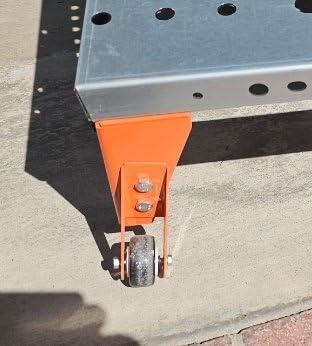
Leg knobs are difficult to tighten enough to stop the legs folding, and there are no locking pins on the deployed legs – unlike the DEWALT, which has per-leg safety pins for exactly this reason. Treat that as a modification to make, not a feature to rely on.
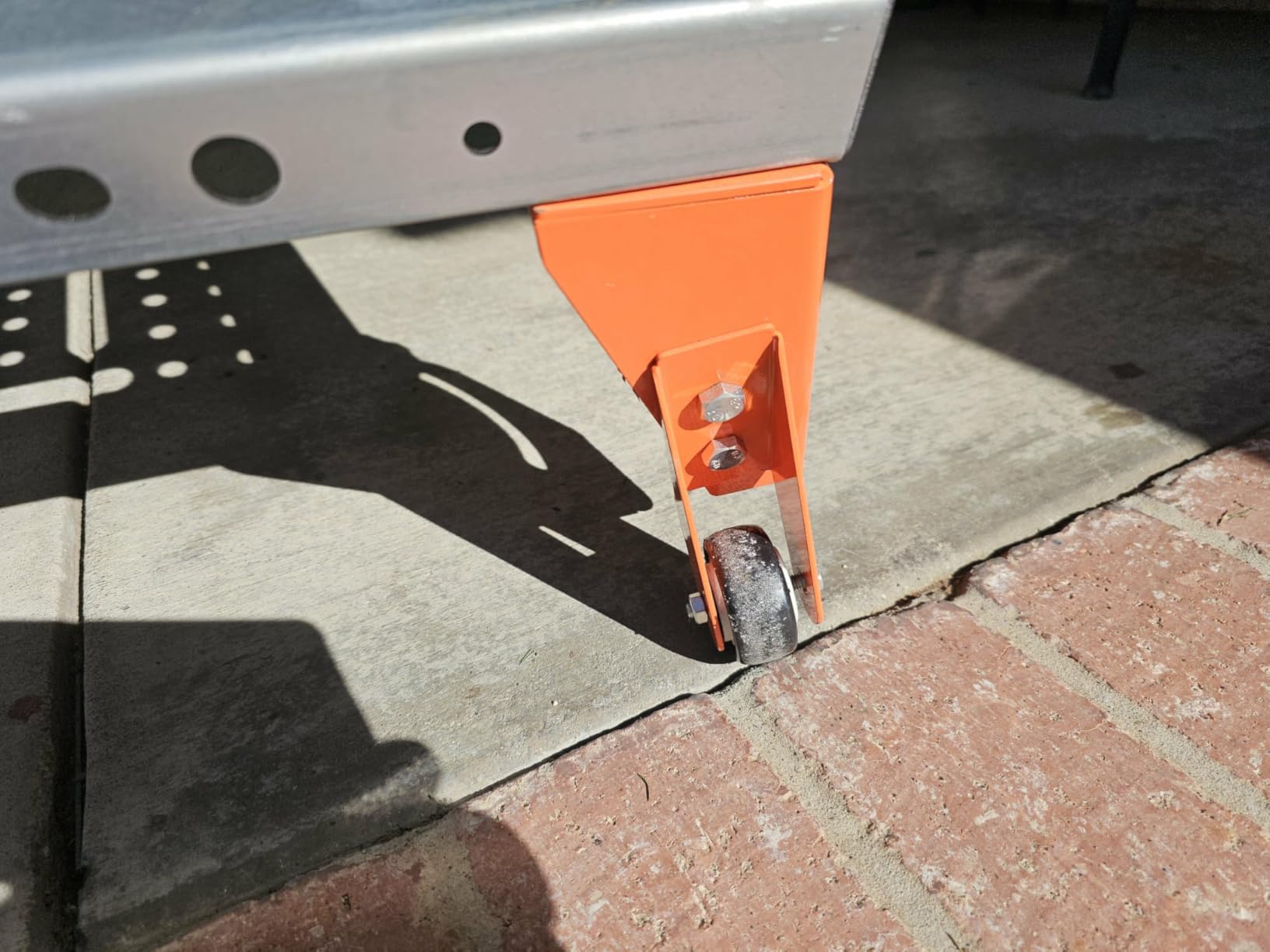
Rubber feet that detach easily and lightweight wheels with angled mounting brackets that need alignment are the other reported issues. All are ten-minute fixes with basic tools.
Fixture Holes at 0.63 Inch
Fixture holes are 0.63 inch on 2-inch centres, plus six tool slots. That is close to the 5/8 inch common standard but not identical, so dog pins designed for 5/8 inch may need a light reamer or a slightly different pin.
Plenty of clamp holes and lead parking slots is genuinely useful – parking your welding lead and ground lead off the top keeps the working area clear.
When It Is the Right Call
If your work is field assembly, repair and light welding, and you need maximum surface area per dollar, this is a sensible pick. If you want a permanent shop fixture, owners are direct: it is not heavy or rigid enough for that role.
10. Eltean 55-Inch Rolling Workbench – Best for Tool Storage and Organisation
Eltean 55″ W Rolling Workbench with 6 Drawers and Storage Cabinet,1000 LB Capacity Heavy Duty Work Bench with Pegboard and Adjustable Shelf,Garage Workbench with Wheels for Repair Shop/Workshop
1000 lb capacity
55 inch rolling bench
Six drawers plus two-door cabinet
Pegboards and four wheels
+ Pros
- Six drawers plus a cabinet with adjustable shelf
- 1000 lb capacity on thick powder-coated sheet steel
- Braked casters keep the bench from rolling while you work
- Pegboards on both sides add tool storage and airflow
- Rubber mat protects the top and stops tools sliding
– Cons
- Top is a general work surface
- not a welding fixture-hole table
- At 108 lb it is heavy to move despite the casters
- Fixed 37.5 inch height with no adjustment
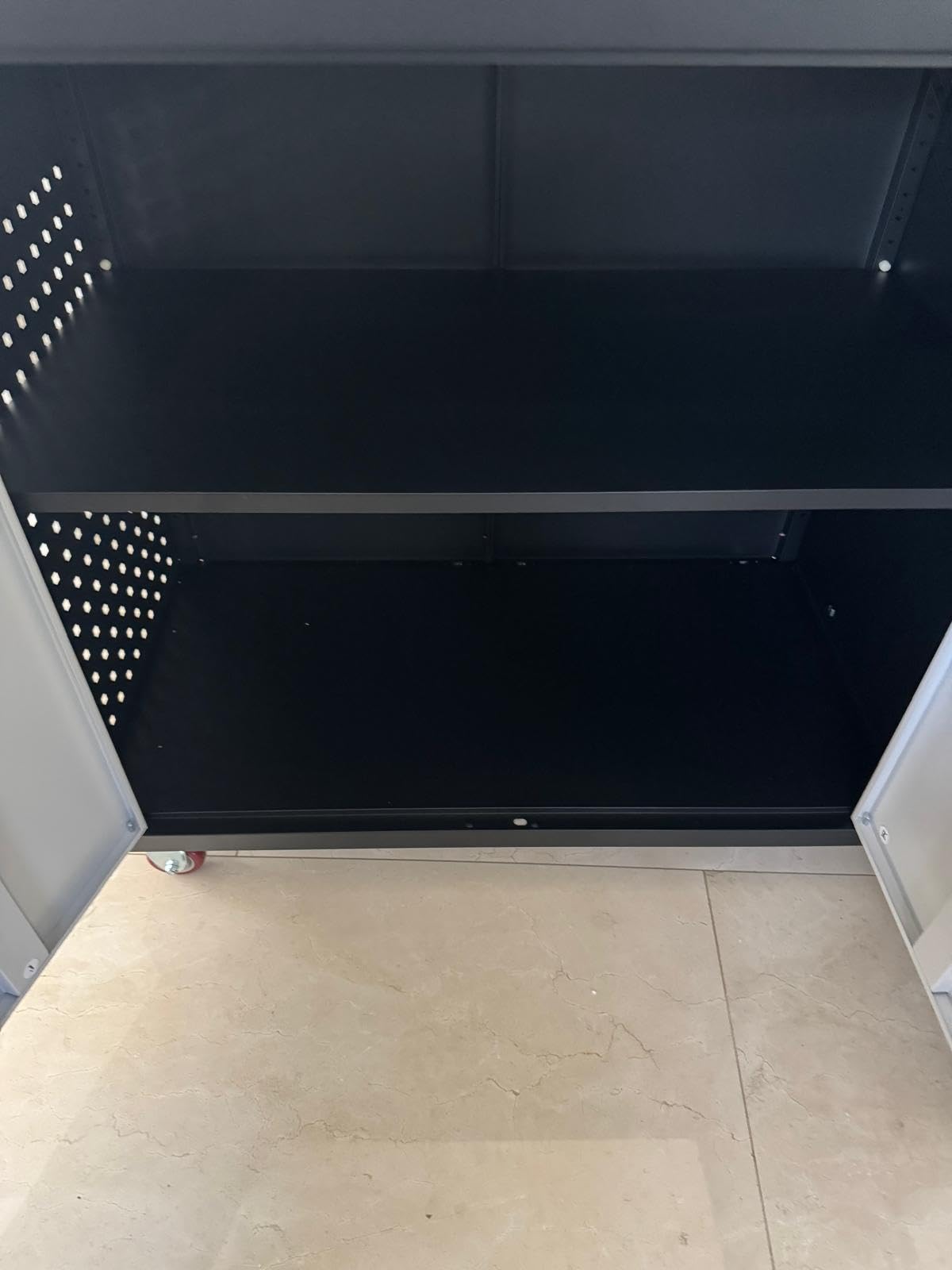
Everything else in this roundup is a welding fixture table. This one is a mobile storage bench for the metalworking shop – 55 inches wide, six drawers, a two-door cabinet with an adjustable shelf, and pegboards on both sides for hanging hand tools.
It is rated to 1000 lb on thick powder-coated sheet steel, with four heavy-duty rubber wheels, two of them braked, and a non-slip rubber mat across the top. For assembly, fitting and repair work where tools are the bottleneck, that storage is worth more than fixture holes.
What You Get for Storage
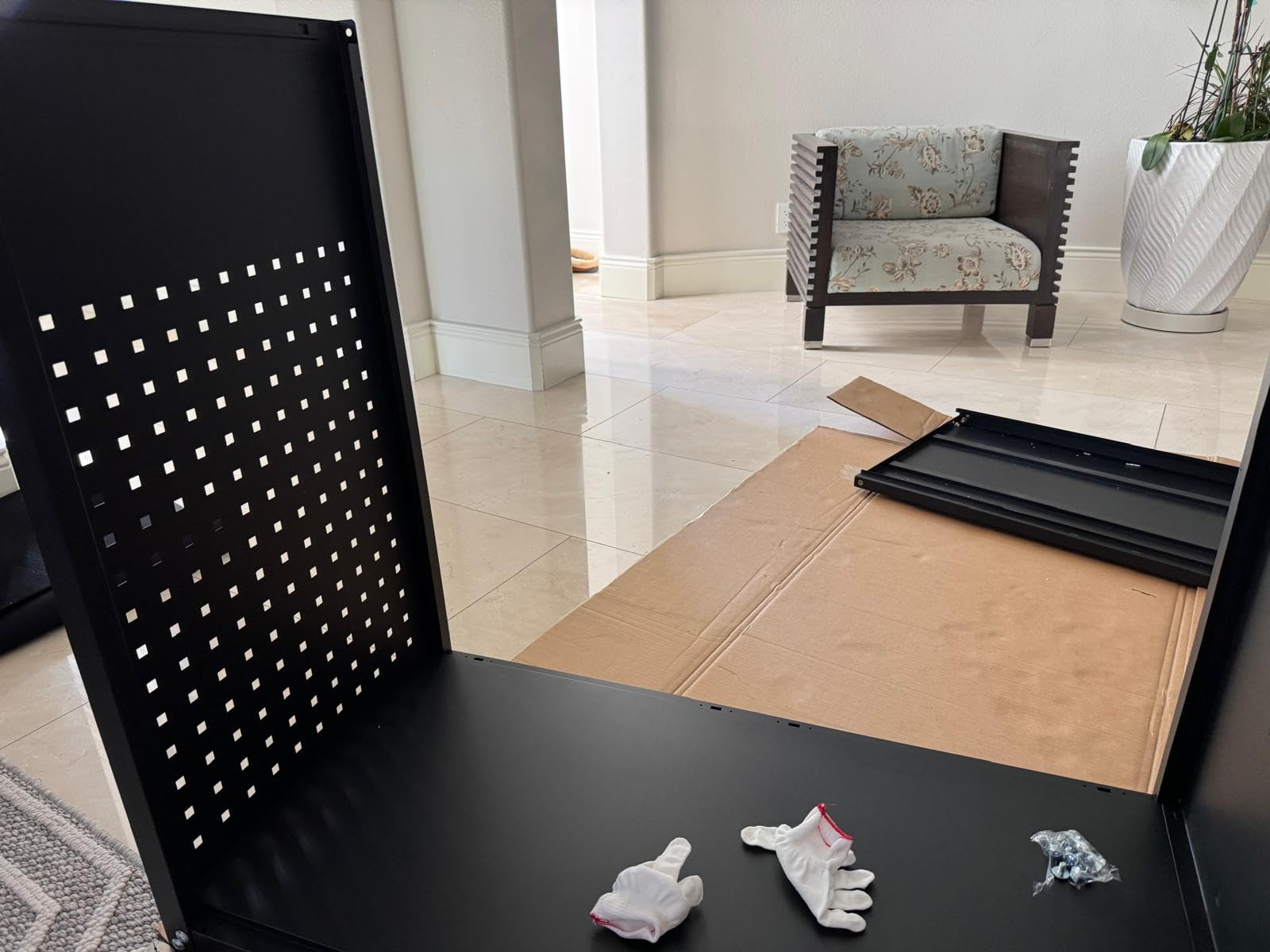
Six drawers – four narrow and two wide – run on smooth-gliding slides, and the two-door cabinet has an adjustable shelf and key magnetic locks. Pegboards on both sides add hanging storage and airflow, and the handles have holes for 13 screwdrivers.
At 37.5 inches high, that is a standing working height, and the 55-inch width means a long part can lie across the top with the tools you need already inside the bench.
Why It Is Not a Welding Table
Be clear-eyed about this one. The top is a general work surface rather than a welding-specific fixture-hole table, and powder-coated sheet steel is not the right surface for hot work or spatter. Use it for assembly, fitting, repair and tool organisation.
The rated 1000 lb capacity applies to the steel structure. What limits it is the sheet top and the fixed height, not the frame.
Mobility and Weight
Two braked casters keep it from rolling while you work, and a metal side handle helps you steer it. At 108 lb it is still a heavy piece of kit – heavy enough that the casters matter, but heavy enough that you will want two people to move it across a shop.
Assembly is supported by numbered parts, printed instructions and a video, which matters for a bench with this many components. The 4.0 rating is the flattest in the group, with 18 percent three-star reviews, mostly reflecting assembly effort and the fixed height.
How It Fits Into a Metalworking Shop
The best use for this bench is pairing it with one of the welding tables earlier in this list. Put the welding table where the work happens, roll this one alongside it, and every tool, consumable and part is at standing height and one drawer away.
How to Choose a Mobile Workbench for Metalworking
Get these six decisions right and the rest is preference. Get them wrong and you will be back looking at a bench that bows, rocks or will not take your clamps.
Load Capacity: How to Read the Number
Load capacity is the maximum weight the manufacturer states the bench can carry. Treat it as a ceiling on a centred load, not a guarantee for any load. A vise on the edge is a point load; a stack of plate in the middle is a distributed load that the frame handles far better.
Match the number to your actual heaviest job. Under 400 lb covers hose clamps, small tube and sheet work. Around 600 lb with a 4mm plate is where vise mounting becomes realistic. Above 1000 lb you are buying a structure for parts handling, not just a welding surface.
Top Material and Steel Gauge Matter More Than the Rating
Steel thickness is the real quality signal here, and it is worth more attention than the capacity number. A 4mm plate resists centre-span flex that will ruin a 2mm top, and flex is the single most common owner complaint in this category.
Finish matters too. A conductive surface – black oxide or zinc plating – lets you ground clamp the table itself instead of the workpiece, which avoids clamp marks on finished parts. Painted and powder-coated tops are fine for grinding and assembly but need a dedicated ground lug if you weld on them.
Centre-span flex, the bowing of a top when weight sits in the middle of the span, is what tells you a bench is under-built. Spec around it by choosing a thicker top or a shorter span.
Caster Geometry Decides Whether a Loaded Bench Moves
A swivel caster rolls in any direction and self-aligns, which makes a bench easy to position but slightly less precise in a straight line. A plain rear wheel on a fixed axle is more stable in a line and rolls better over thresholds and debris, but it will not turn in place.
Whatever the type, check for brakes. A bench that rolls mid-weld is a burn risk, and braked casters are the difference between safe and annoying. If your work needs a genuinely rigid surface occasionally, look for a bench that swaps casters for fixed glides, as the CAMMOO does.
Also check wheel diameter against load. Small casters under a heavy steel top are the wobble complaints that show up repeatedly, and they get worse on uneven concrete.
Height: Hand Tool, Power Tool and Welding Heights
Bench height should match the work. Hand-tool and fitting work sits well in the low 30-inch range; welding and standing assembly work wants closer to 36 inches so you are not bending over the arc.
Adjustable height is worth paying for if more than one person uses the bench, or if you alternate between seated grinding and standing fitting. Individual leg adjustment is even better on uneven floors, since it lets you level the top rather than shim it.
One-sided versus two-sided access matters more than people expect. If you can only stand on one side, a 44-inch top is effectively a 22-inch top. Check your working clearance before committing to a wide surface.
Fixture Holes, Slots and Mounting a Vise
Fixture holes let you clamp stock directly to the table instead of relying on the workpiece holding itself. The most useful standard is 5/8 inch for general fixturing, and 16mm – which is close to 5/8 inch – on 2-inch centres is what most professional fixture hardware uses.
To mount a machinist vise, you need somewhere solid at the edge. Look for a top of at least 3mm, ideally 4mm, and a frame that puts a leg or brace near the mounting point. Drill and tap your own holes only if the existing pattern does not reach where you need it, and use flanged bolts so clamping pressure cannot spin them loose.
Never mount a heavy vise to a thin folding table without checking the top’s local thickness, and add a backing plate underneath if you can reach it.
Build vs Buy: When Welding Your Own Bench Wins
Buying wins when you need a bench this week, when you want a warranty, or when you need lockable storage and casters already working. Building wins when you need a specific height, a specific top thickness, or a footprint that no catalogue covers.
The common DIY route is steel saw horses carrying a steel plate, or a frame welded from 3/16 inch wall tubing with a support beam or mid shelf added specifically to stop the wobble. Practitioners are consistent on one point: adding a mid shelf or centre brace is what separates a welded bench that does not shake from one that does.
Build vs buy is genuinely a case of what the job is. For brackets finished today, buy. For a bench you will weld on for a decade, building one to your own dimensions is usually worth it.
Maintenance and Safety Habits Worth Building Into the Routine
Start with spatter. Knock off solidified spatter regularly, especially from fixture holes, because spatter in a hole makes bolts impossible to remove and can block a clamping dog. A chipping hammer and a wire brush handle most of it.
Clean solvents are useful but respect the hazard. Acetone and similar solvents are flammable, so keep them off the bench, keep them away from hot work, and use them in a ventilated space rather than spraying a torch-lit surface.
Keep wheels clear of spatter and off the floor’s problem areas. A caster embedded with welding slag rolls badly, and a bench that will not roll is a bench you will stop moving – which defeats the whole point. Check brakes periodically, and treat any combustible material near the bench with the fire watch discipline your process requires.
Finally, run power to a mobile bench from a proper supply rather than daisy-chaining extensions across a floor. Keep leads off the walking path, and hang the work lead and ground lead on the tool slots or a lead park so they stay off the top and off your feet.
Frequently Asked Questions
Who makes the best mobile workbench for metalworking?
The VEVOR 36 by 18 inch welding table is the strongest all-round pick, pairing a 1200 lb rating with a carbon steel frame, 94 5/8 inch fixture holes and lockable casters. For heavy plate and vise mounting specifically, the Klutch mobile welding workstation is the one to look at, because its 4mm steel top and standard 16mm fixture holes are built for that job.
Which is the best portable workbench for welding?
For pure portability, the DEWALT 46 inch adjustable folding table is the pick – it folds down, carries by a reinforced handle, and adjusts from seated to standing height on 1000 lb capacity. The WORKESS 42 by 21 inch folding table is the alternative if your floor is uneven, because its legs adjust independently across seven levels.
Is it cheaper to buy or build a workbench for metalworking?
Buying wins when you need a bench quickly, want a warranty, or need working casters and locks. Building wins when you need a specific height, a thicker top than catalogue models offer, or a footprint nothing else covers. The most common DIY build is steel saw horses under a steel plate, or a frame welded from 3/16 inch wall tubing with a mid shelf added to stop the wobble.
How much weight can a mobile workbench hold?
It depends entirely on the bench. Folding tables in this roundup are rated from 350 to 500 lb, mid-size models sit at 1000 to 1200 lb, and the heavy fixture table is rated at 600 lb but uses 4mm steel plate. Treat the figure as a ceiling on a centred load, and remember that a vise on the edge is a point load that bends thinner tops.
Should my workbench be steel or wood, and does it need to be grounded?
Steel, for anything involving heat. A wood or plastic top is a fire risk next to a torch and cannot take spatter. Grounding matters too: a conductive top such as black oxide or zinc plating lets your ground clamp attach to the table rather than the workpiece, and a painted or coated top needs a dedicated grounding bolt or lug on the frame.
Which Mobile Workbench Should You Buy?
If you want one bench that handles the most jobs, the VEVOR 36 by 18 inch is the pick – a 1200 lb carbon steel frame, a deep fixture hole pattern and the strongest review history here. If you need to mount a machinist vise and work heavy plate, choose the Klutch for its 4mm top and standard 16mm holes. If you need to move between seated and standing work, the DEWALT is the one.
For a tilting top on a smaller budget, the JEGS has the most angle positions and edge guides. For a very small shop or uneven ground, look at the VEVOR 30 inch folding table or the WORKESS. If your bottleneck is tools rather than steel, the Eltean rolling bench pairs well with any of them.
Whichever you choose in 2026, check the top thickness and the fixture hole pattern against the hardware you already own before you order. Those two details cause more returns than anything else in this category.
Leave a Reply