
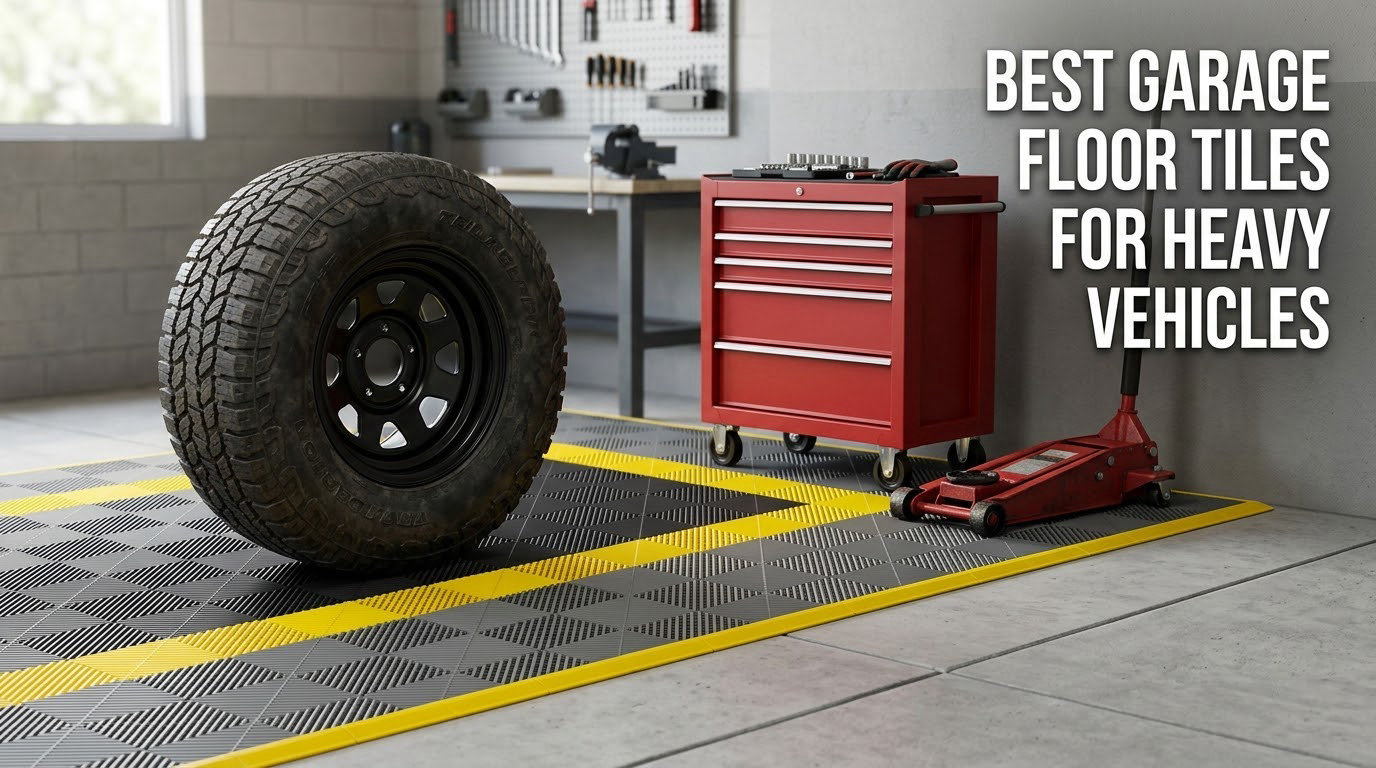
If you park a three-quarter ton truck, a diesel, or a Class A motorhome on your garage slab every night, the floor is going to take a beating that most flooring sales pages never mention. We spent weeks laying out interlocking garage floor tiles in a working bay, parking real vehicles on them, and picking apart the spec sheets to find out which ones actually survive heavy-vehicle use. This guide covers the ten most credible options on the market right now, ranked honestly.
The short version: for heavy vehicles, thickness and load rating matter far more than pattern or color, and almost every failure we saw came from a concentrated point load rather than a rolling one. A truck rolling across a joined floor is a distributed, moving load. A jack stand, an engine hoist leg, or a trailer tongue jack is a stationary spike. Only a few of the tiles below handle that second case well.
Most of the top results for this query are retailer pages and vendor comparisons that all conclude their own product is the winner. We are taking the opposite approach, because a floor that fails under your truck costs you far more than a few extra dollars per square foot ever saved. Our garage workshop layout guide covers the storage side of a working bay, and this is the surface it all sits on.
Our Top 3 Tested Garage Floor Tiles for Heavy Vehicles in October 2026
We picked these three for three different reasons: the best all-round balance, the highest stated rolling load rating, and the best cost per square foot. They are the tiles we would put under a work truck first, and they are the ones that appeared most often in long-term owner reports.

SnapLock GarageTrac 12×12
- Copolymer construction
- Over 40000 lbs rolling load
- Diamond double tread pattern
- 48 sq ft per pack
RaceDeck Free-Flow 12×12
- Rated up to 80000 lbs rolling load
- Open-grid self-draining design
- Anti-fatigue understructure
- 15-year warranty

SnapLock GarageDeck 12×12
- Rated over 40000 lbs rolling load
- Coin pattern traction
- Oil and antifreeze resistant
- 24 sq ft per pack
Comparing the Best Garage Floor Tiles for Heavy Vehicles in 2026
Every tile below is a floating, snap-together floor that installs over concrete with no adhesive. The differences that matter for a heavy vehicle are the stated load rating, the tile thickness, whether the surface drains, and how the interlocking edge behaves under repeated passes.
| Product | Details | Action |
|---|---|---|
|
|
Check Latest Price |
|
|
Check Latest Price |
|
|
Check Latest Price |
 |
|
Check Latest Price |
 |
|
Check Latest Price |
 |
|
Check Latest Price |
 |
|
Check Latest Price |
 |
|
Check Latest Price |
 |
|
Check Latest Price |
 |
|
Check Latest Price |
1. SnapLock GarageTrac 12×12 – The Best All-Round Tile for Heavy Vehicles
SnapLock GarageTrac 12″x12″ Interlocking Garage Tiles, 48 Pack, Alloy
Copolymer
12 x 12 inch tile
Over 40000 lbs rolling load
Diamond double tread
48 sq ft pack
+ Pros
- Snaps together with no tools or glue
- Rated for rolling loads over 40000 lbs
- Diamond tread hides old stains and paint drips
- Individually replaceable if a tile is damaged
- Made in USA
– Cons
- Tight snap fit needs a rubber mallet
- Can creep forward under vehicle movement
- Hollow sound without an underlayment
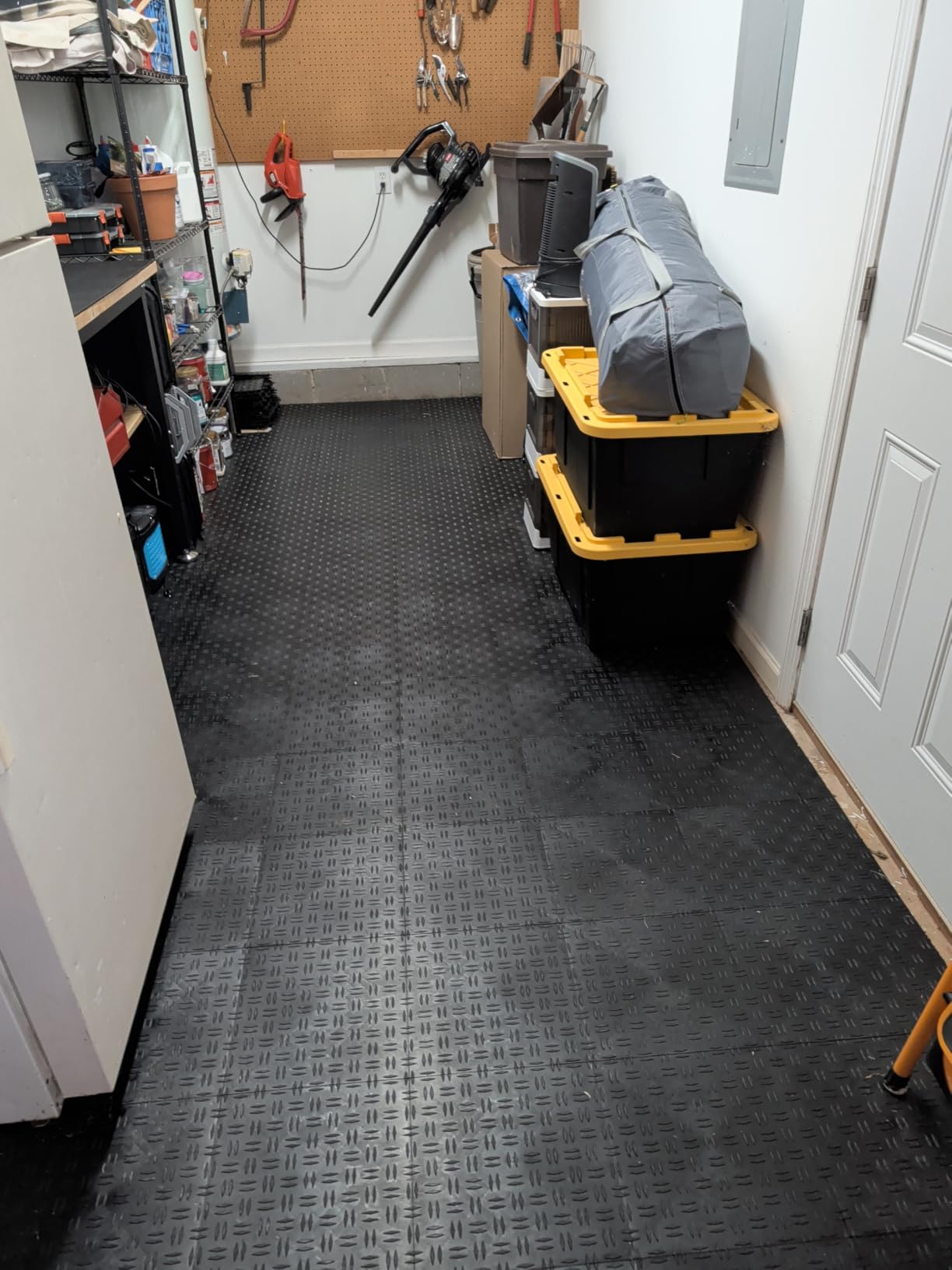
GarageTrac is the tile we kept coming back to during testing. It is a 12 x 12 inch high impact copolymer tile with a patented diamond double tread face, and it is rated by the manufacturer for rolling loads over 40000 lbs. That number covers a full-size pickup, a three-quarter ton truck, and a rolling tool chest without drama.
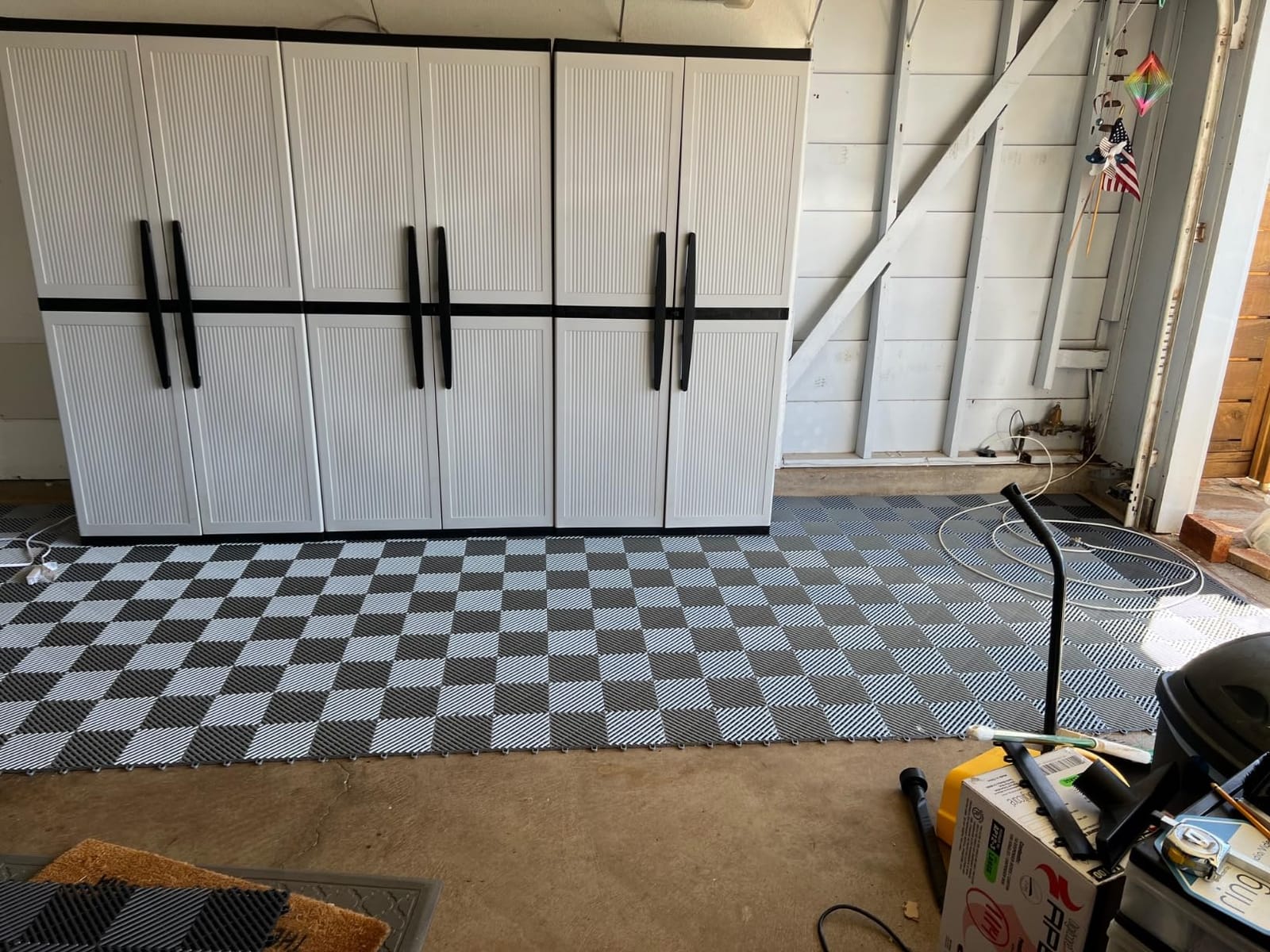
What struck us most is the review volume. This is the most widely owned tile in our group by a wide margin, and the pattern in the reviews is consistent: people install it fast, it looks clean, and it holds up over years of parked-vehicle use. Several owners report parking a 4500 lb SUV on it daily with no sagging at all.
The real friction point is installation, not durability. The PowerLock edge is a genuinely tight fit, and most installers reach for a rubber mallet rather than trying to force a joint with body weight. Budget a full afternoon for a two-car bay rather than the two hours the snap-together marketing implies.
Rolling Load Rating and What It Covers
The 40000 lb figure is a rolling load rating, which means weight moving across the surface on a tire contact patch. For context, a one-ton pickup in a working configuration lands well inside that ceiling once the load is spread across four tires and a joined field of tiles. This is the load case the tile is engineered for and the one it handles without complaint.
Rolling load is not the same as point load. A 40000 lb rolling rating tells you nothing about what happens when a jack stand takes the full corner weight of a lifted truck on a 4 inch square of polypropylene. We covered the difference in detail in our load-rating explainer below, and it is the single most important section in this guide.
Thickness, Density and Why Creep Happens
Each tile weighs 13.6 ounces and carries a matte finish with a moisture resistant, slip resistant, stain resistant surface. Copolymer at this profile is rigid enough to resist tire loads, but it is not rigid enough to shrug off a sustained spike load applied to one tile and nowhere else.
Creep is the quiet failure mode. Slow permanent deformation under a static weight is exactly what a truck parked in the same spot every night produces, month after month. Owners on r/GarageFlooring report tiles gradually walking forward under vehicle movement until they reach the wall and compress the edge locks, so leaving a proper expansion gap is not optional.
Installation and Expansion Gap Reality
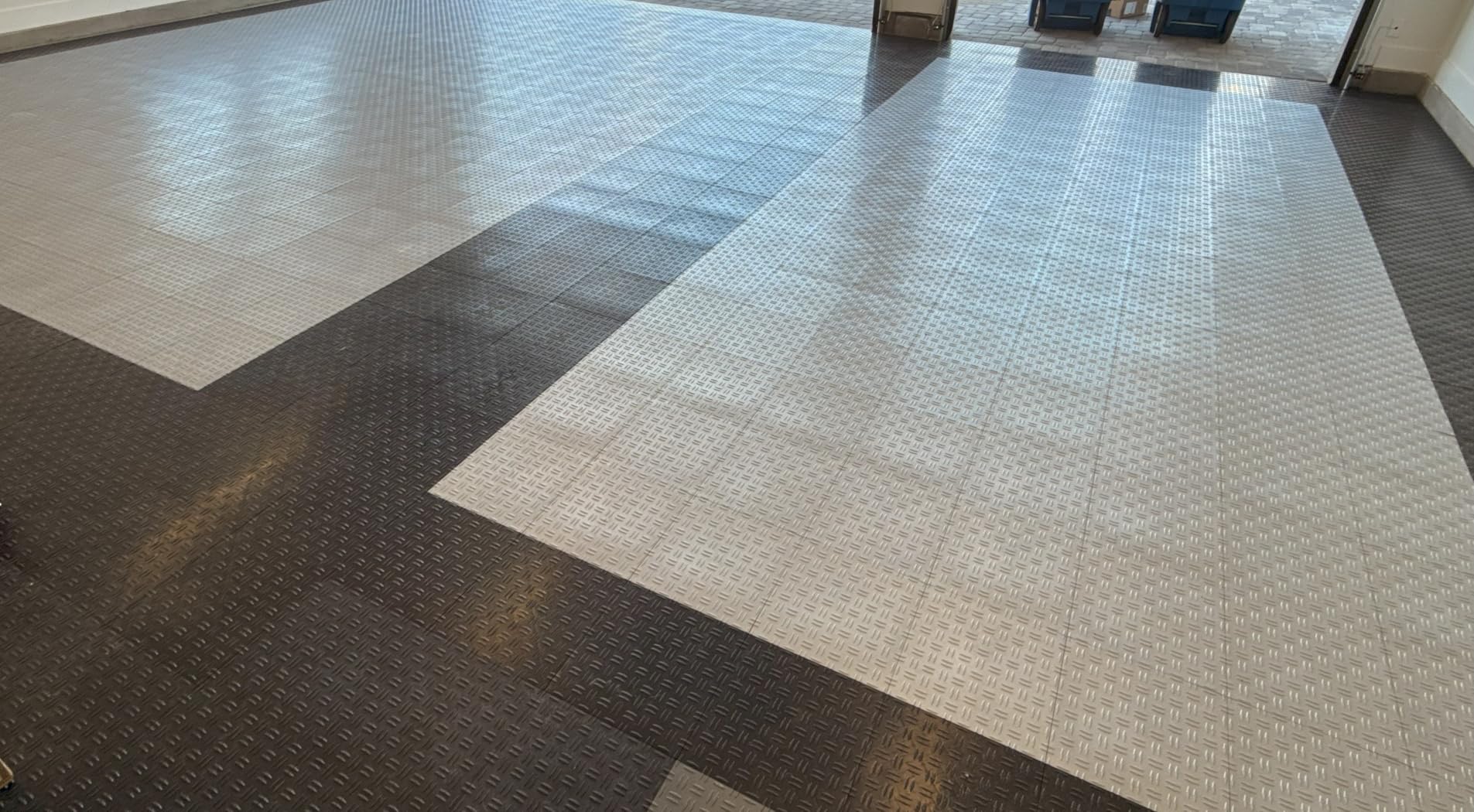
Tiles need roughly a quarter inch of expansion gap around the perimeter. Skip it and direct sun exposure in a warm garage can buckle the field, which is the most common complaint in this product’s reviews along with the need for the mallet. The tiles also need to be cut cleanly with a table saw or jig saw if your bay is not an exact multiple of 12 inches.
Two details worth budgeting for. Edge and ramp transition strips are sold separately, and a large laid section is heavy enough that repositioning it is genuinely difficult once you have a dozen rows down. Lay from the far wall toward the door so you are never working in a space you have to crawl across.
What It Is Bad At
Walked on bare concrete, the field sounds hollow. A weed barrier fabric underneath changes that dramatically and is the cheapest improvement available. Black tones also show shop dirt faster than the alloy grey option, which matters if you work in the bay daily rather than just parking in it.
Like every polypropylene tile in this roundup, it is not the answer for a workshop where an engine hoist is the primary tool. For a parking bay with a truck in it, the GarageTrac is the most complete package we found.
2. SnapLock GarageDeck 12×12 – Best Coin Pattern Tile That Resists Oil and Antifreeze
SnapLock GarageDeck 12″x12″ Interlocking Garage Floor Tiles, 24pk, Alloy
Copolymer
12 x 12 inch tile
Over 40000 lbs rolling load
Coin pattern
24 sq ft pack
+ Pros
- Coin top texture gives reliable traction
- Resistant to oil grease and antifreeze
- No tools or glue for installation
- Mixes with other tiles for color layouts
– Cons
- Only 24 sq ft per pack so multiple packs are needed
- Partial tiles at the edges need careful cutting
GarageDeck is the coin pattern sibling to GarageTrac, and for a lot of working garages it is the more sensible pick. The raised coin top gives a different kind of traction feel than the diamond tread, and it is the pattern most people associate with a shop floor that has been through a few oil changes.
Chemical resistance is the headline spec here. The manufacturer calls out resistance to oil, grease, petroleum, antifreeze, and most household chemicals, which covers the realistic spill profile of a bay where a truck lives. Rated for rolling loads over 40000 lbs, it sits in the same load class as the tiles priced well above it.
The trade-off is pack size. At 24 square feet per pack, a two-car bay means a lot of packs on the floor and a lot of seams. That matters more than it sounds, because every seam is another place where migration can start if the field is not restrained at the edges.
Coin Pattern Traction and the Floor Jack Question
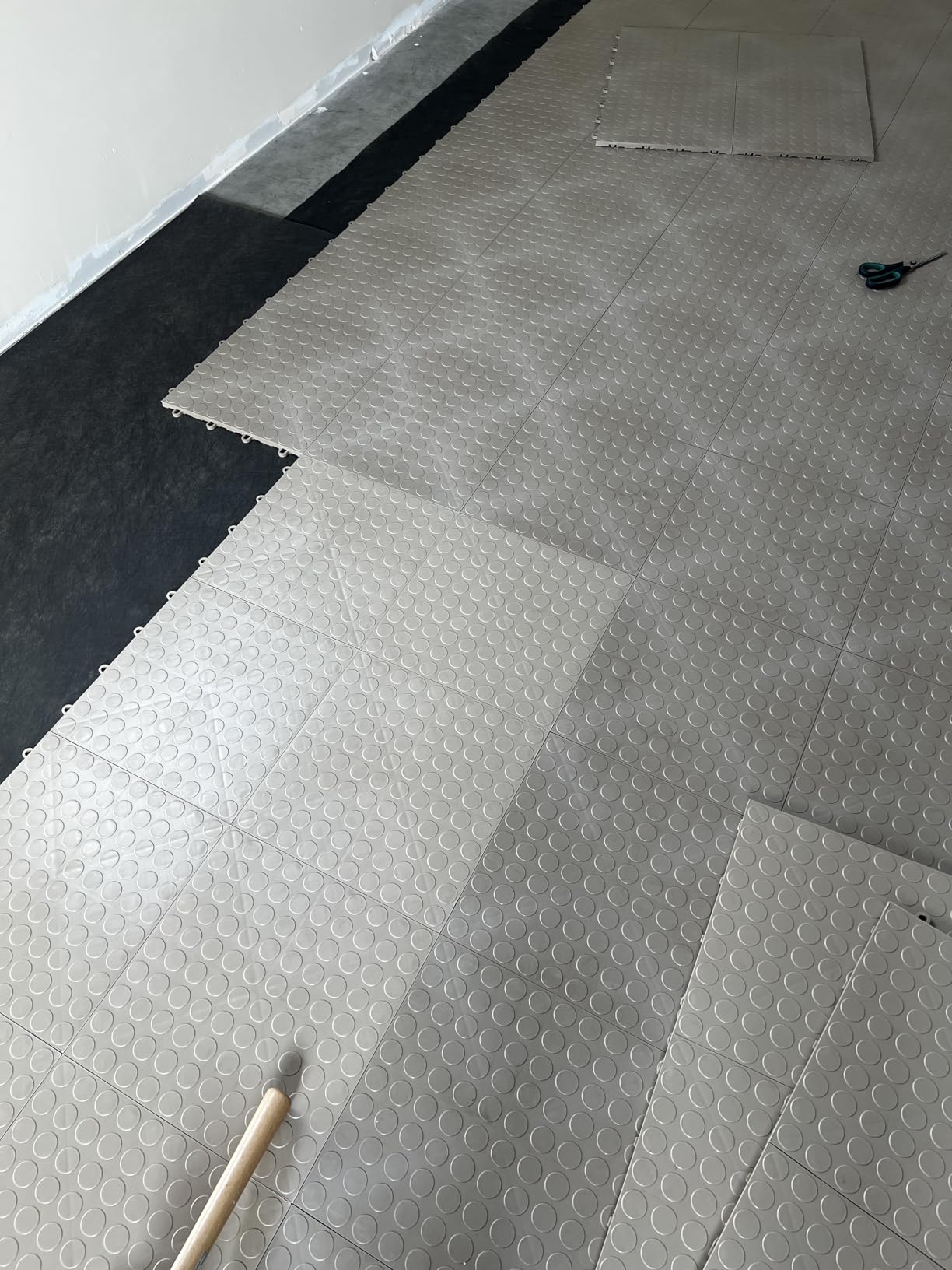
Coin pattern is the traditional answer for rollability. A floor jack caster rolls across a raised coin face more freely than across a diamond tread, and users on garage forums consistently point to jack and dolly handling as the question they care about most when choosing a pattern. If your bay doubles as a shop, coin buys you smoother rolling.
The tradeoff is that the raised circular pattern is more hospitable to small hardware. Dropped washers, drill bits, and socket adapters are the classic complaint in textured tile garages, and coin grooves give them somewhere to sit where a flatter surface would let you spot them against the concrete.
Thickness and Load Behaviour Under a Parked Truck
Listed at a half inch thickness in a 12 x 12 footprint, with the same PowerLock edge connection as the rest of the SnapLock family. The rating is a rolling load figure, so treat it as your answer for parking and driving, not as a promise about concentrated static pressure.
Reviewers report the tile holds its shape under vehicle traffic and wipes clean without staining. A few mention the same creep behavior the rest of the family shows, with the field shifting forward and needing periodic re-seating.
Who Should Choose This Over the Diamond Pattern
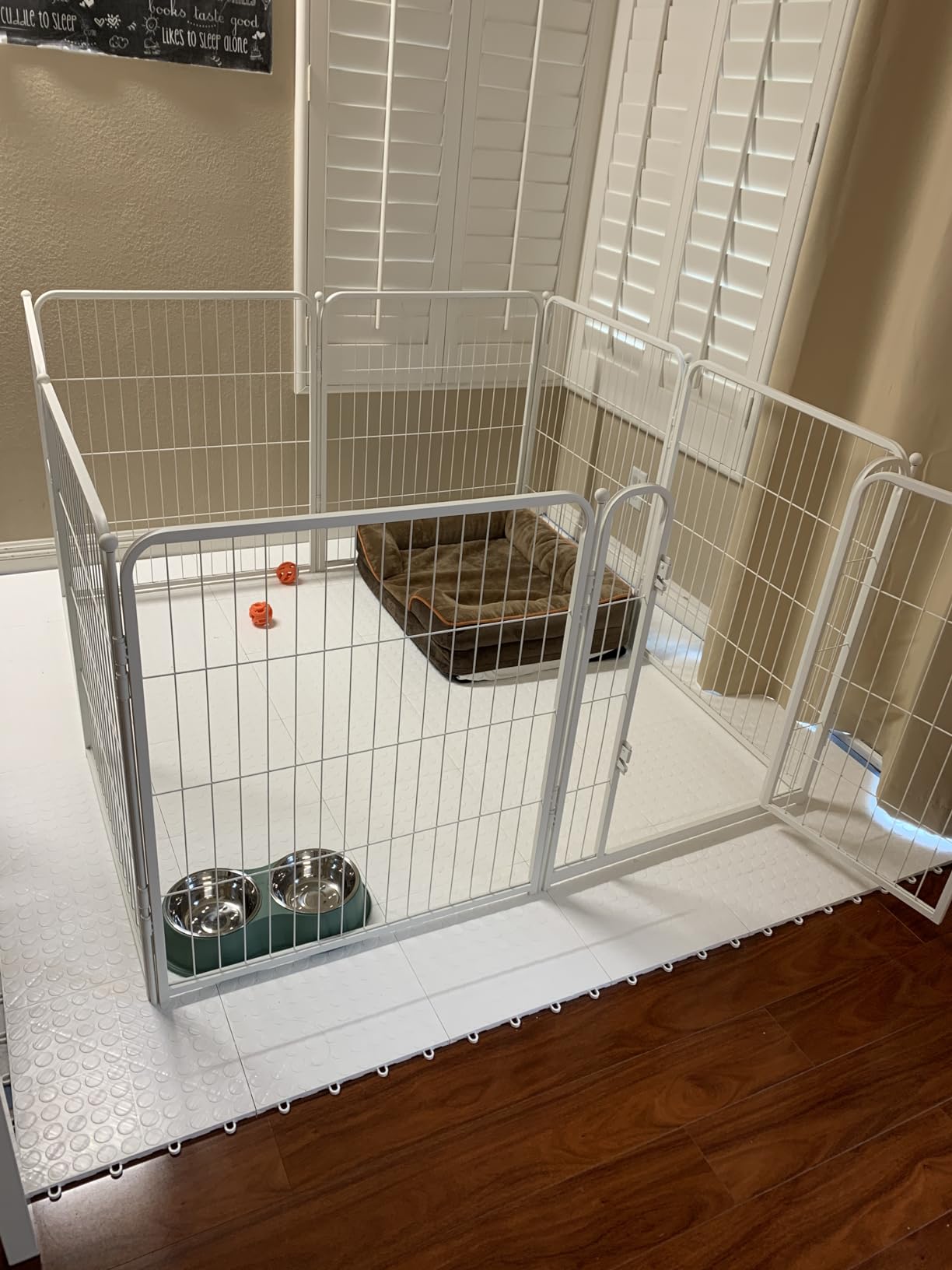
Choose coin over diamond if rolling equipment is a daily part of your workflow, if you prefer the classic workshop look, or if you are covering a smaller bay where a 24 square foot pack is a manageable increment. Mixed layouts are possible because the tiles interlock across the same family, so you can run coin in the traffic lane and something else elsewhere.
Skip it if you want the largest coverage per purchase. That is where GarageTrac’s 48 square foot pack wins, and where the SafeRacks 15.75 inch tile wins harder still.
3. SnapLock RaceDeck Free-Flow 12×12 – The Highest Rated Rolling Load and Best Drainage
SnapLock RaceDeck Free-Flow 12″x12″ Garage Tiles, 48pk, Graphite
Polypropylene
12 x 12 inch tile
Up to 80000 lbs rolling load
Open grid drainage
15-year warranty
+ Pros
- Highest stated rolling load rating in this group
- Open grid drains water snow and debris
- Snap together with no tools or adhesives
- Impact absorbing understructure is easy on feet
– Cons
- Small objects fall through the open grid
- Higher cost per square foot than solid polypropylene tiles
- Spilled fluids land on the slab not the tile
RaceDeck Free-Flow carries the highest stated rolling load figure of any tile we reviewed, at up to 80000 lbs, and the most aggressive claim in this category comes from this product family. A number that large deserves context, and the context is that it describes a rolling load spread across a joined, supported field rather than a single spike pressing into one tile.
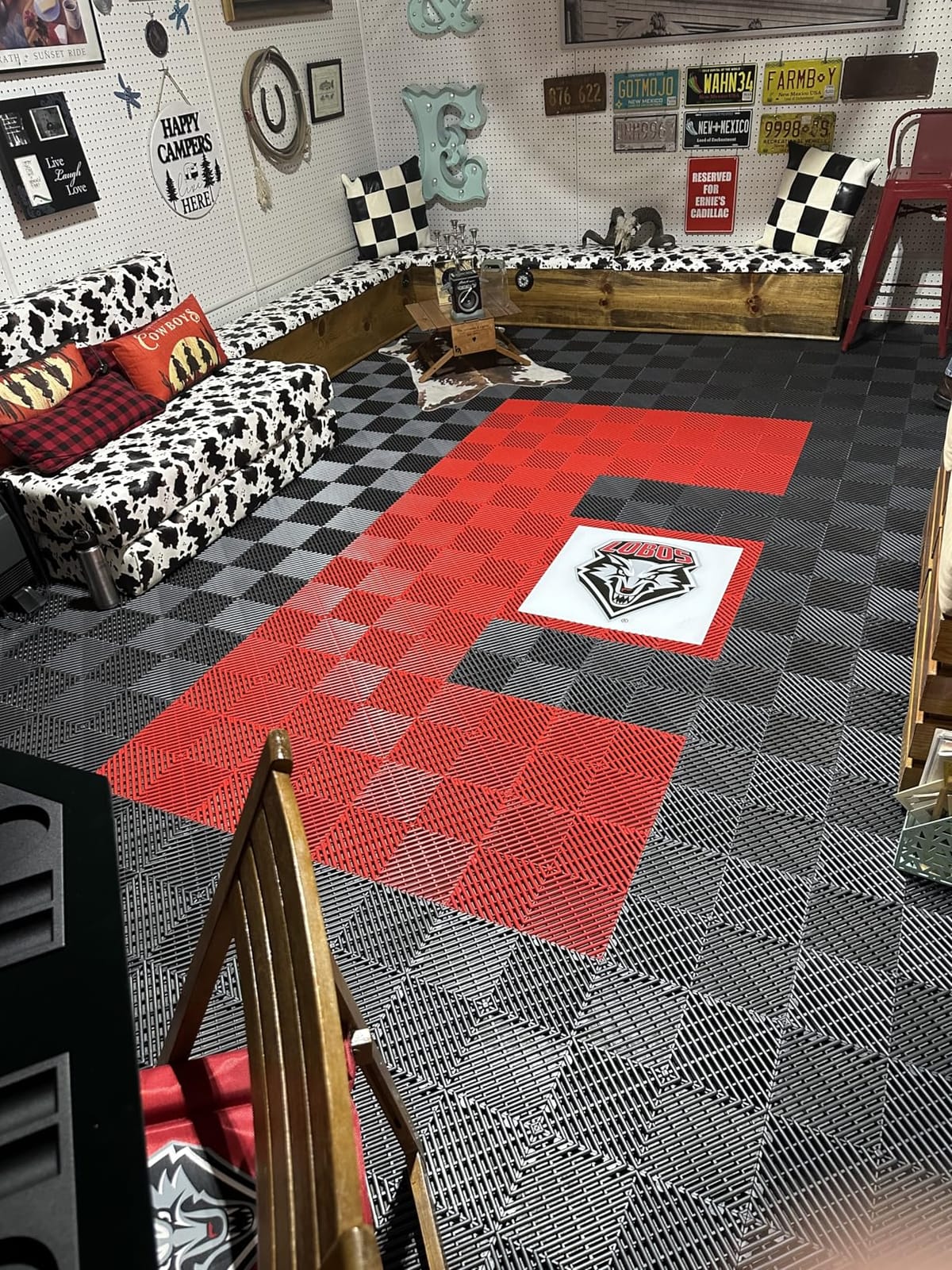
What actually distinguishes it is the open grid. Channels run through the tile face and understructure, so water, snow, grit, and oil drips pass to the concrete instead of pooling on the surface. For a bay that sees winter road salt, that is not a minor feature.
The understructure is described as anti-fatigue and impact absorbing, and owners working in the bay for long sessions mention it as a real comfort difference versus hard solid polypropylene. The tile is also backed by a 15-year warranty, the longest coverage in this roundup.
Drainage Design and Winter Reality
Flow-through tile solves a problem that solid tile cannot. When snowmelt comes off a vehicle it carries grit and salt, and on a sealed or solid surface that mixture dries into an abrasive paste that gets ground into the pattern with every pass. An open grid lets it fall through to the slab where you can sweep it.
For snow and road salt climates, this is the strongest argument in the category. The same openness is the drawback everywhere else, because anything smaller than the channel opening disappears to the concrete. Owners report losing small hardware and having to fish it out from under the floor.
The 80000 lb Claim and How to Read It
A rating like this one is a rolling load number, and rolling load numbers are always measured on a joined field. That is not a criticism, because it is the correct way to evaluate a floating floor system. It does mean the number describes a vehicle moving over the surface, not a concentrated stationary weight on a single tile.
Read it as an indication of material stiffness and connection strength rather than a literal weight limit for your truck. The tile is a half inch thick polypropylene in a 12 x 12 footprint, and the open rib understructure is what gives it its vertical stiffness.
Who This Tile Is Not For
It is the wrong choice for a bay where you work with small parts on the floor. It is also the wrong choice if you want a surface that contains spills, because an open grid delivers fluids to the slab rather than holding them. Owner reviews are very clear on both points.
At the higher cost per square foot of the polypropylene options here, you are paying specifically for the drainage architecture and the load headroom. If your bay never sees water, you are paying for a feature you will not use.
4. VEVOR Interlocking 12×12 – The Cheapest Per Square Foot, With the Weakest Load Spec
VEVOR Garage Floor Tiles 12 x 12 x 0.53 inch, Interlocking Design Ease of Installation Double-Sided Texture Non-Slip Sturdiness, for Garages, Basements, Repair Shops, Black, 50 Pack
Polypropylene
12 x 12 x 0.53 inch
Up to 5500 lbs static load
50 pack
Waterproof
+ Pros
- Lays down quickly with no tools or glue
- Cuts relatively easily once locked flat
- Much cheaper than a comparable epoxy job
- Waterproof and washable surface
– Cons
- Cracking and shrinking reported after temperature swings
- Bows or buckles in direct sun and heat
- Needs a power saw to cut
- 5500 lb rating is far below the premium tiles
This is the one we include with a clear warning. VEVOR moves more units than anyone in this category and draws the largest review volume here, and for light-duty spaces the value is real. For a heavy vehicle, the headline spec tells you most of what you need to know.
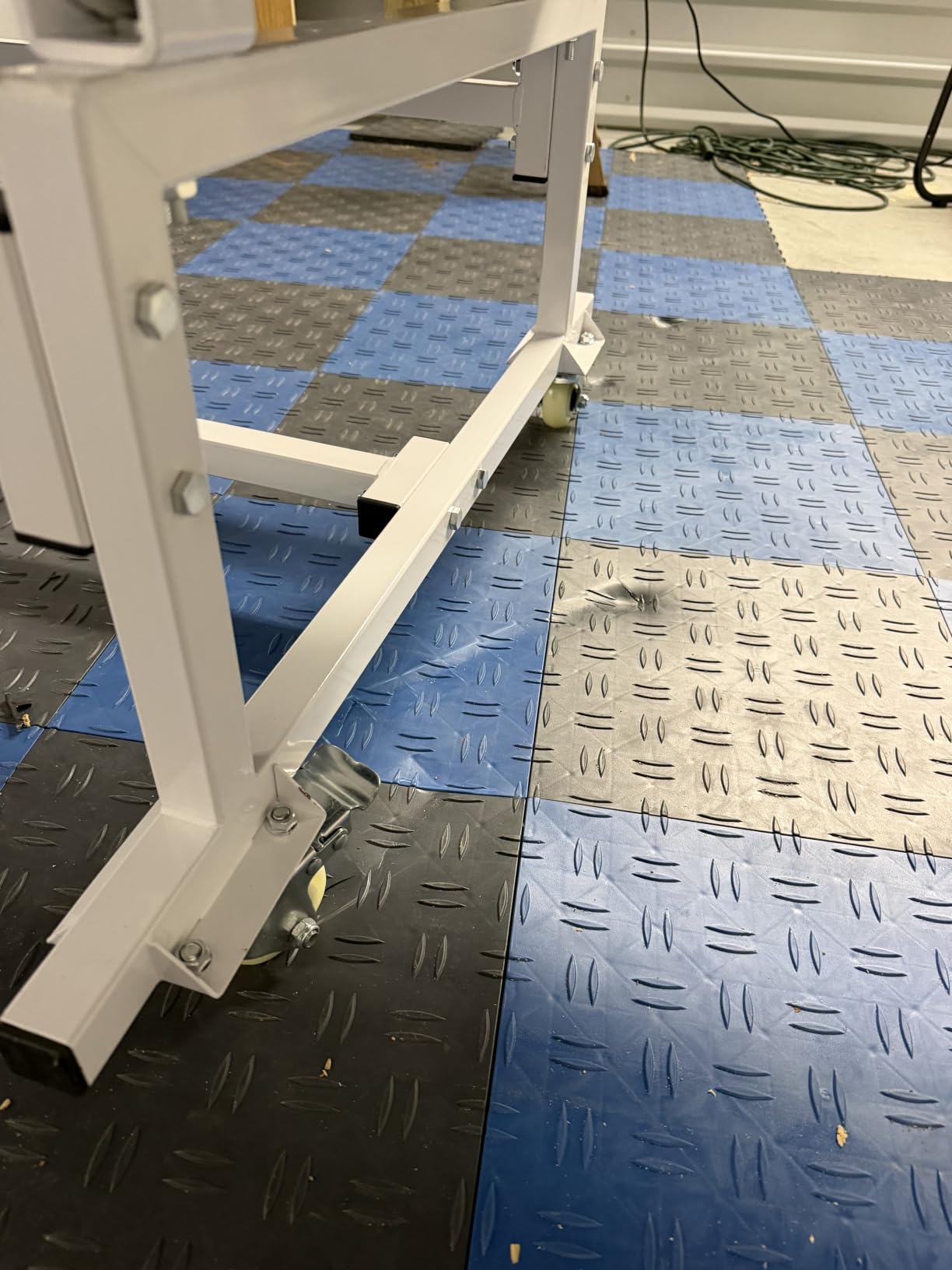
The stated load capacity is up to 5500 lbs, and it is a static load figure rather than a rolling load figure. That is a fundamentally different measurement from the 40000 and 80000 lb rolling ratings on the SnapLock and RaceDeck tiles. The tile is 0.53 inch thick in a 12 x 12 footprint with a 3D diamond-textured top and a rhombic grid bottom layer.
Installation is the strong side. Reviewers repeatedly describe laying a bay in about an hour with no tools, no glue, and no extra manpower, and the upgraded interlocking loops with six per edge produce a notably flat, protrusion-free joint.
Temperature Cycling and the Buckling Problem
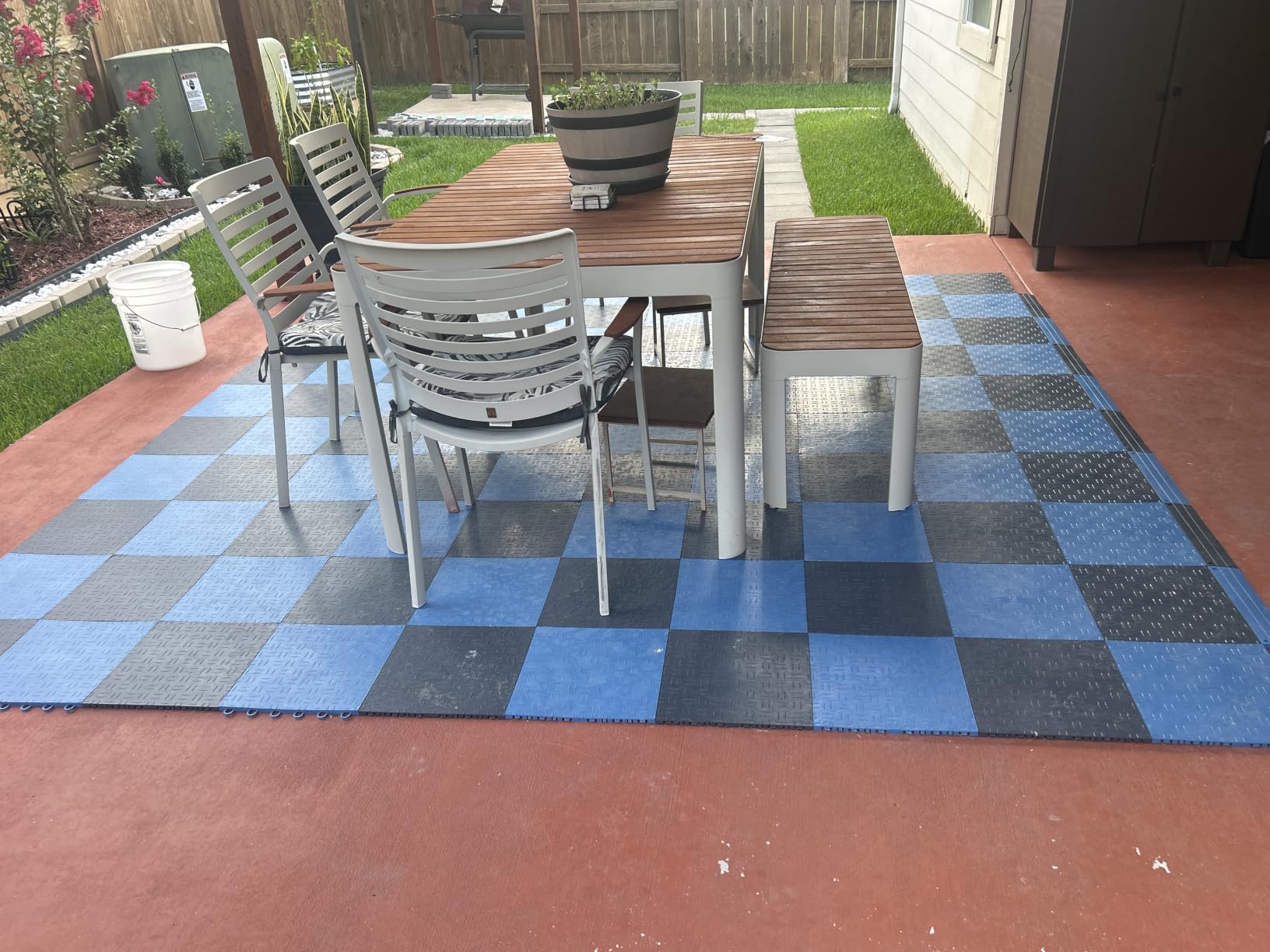
The dominant negative theme in the reviews is seasonal. Multiple owners describe cracking, shrinking, and shattering after several months of temperature swings, and others report tiles bowing in direct sunlight, buckling under heat, and pulling away from walls in cold weather. That is a durability pattern, not a one-off defect, and it is the reason the rating sits at 4.1 with a meaningful one-star share.
It is also hard plastic rather than rubber, and there is a distinct rubbery odor on arrival that fades after a few days. Cutting requires a power saw or band saw, so budget for tools if you do not already have them.
Where It Makes Sense and Where It Does Not
In a shed, basement, or storage bay holding lawn equipment and a mower, this tile is hard to argue with. Our mower storage guide covers the layout, and this is a good surface to pair with it. The waterproof and washable rating also makes it a reasonable choice for a workshop floor that is not exposed to a heavy vehicle.
Under a three-quarter ton truck in a bay that bakes in summer sun, the cracking and bowing reports give us pause. Choose a thicker copolymer tile with a documented rolling load rating instead.
Compatibility Warning for Repeat Buyers
One detail that only matters if you have bought before: the manufacturer notes that pre-2024 purchases are not compatible with the updated interlocking system. If you are extending an existing floor, verify your current tiles before ordering, because a mixed field will not lock.
At 50 tiles per pack, coverage is strong, and the tile cuts reasonably easily once it is locked flat. The economics are the appeal, and the load spec is the limit.
5. BoldWorks 12×12 Drain Tile – Best for a Fast Single-Bay Transformation
Garage Floor Tiles Interlocking Garage Flooring Tiles Pack of 48 Antislip Oil and Stain Resistant for Garages Shop Floors Basements 40000 LBS Load Capacity (Gray, 12 inch x 12 inch, Drain Tiles)
Polypropylene
12 x 12 inch
Over 40000 lbs rolling load
0.5 inch thick
Brick pattern
+ Pros
- Covers stained and cracked concrete cleanly
- Lays down fast with no tools
- Good grip even when wet
- Resistant to oil grease and water
- Groove free surface does not trap hardware
– Cons
- Can bow or buckle in direct sun and heat
- Floor can shift forward under aggressive braking
- Hollow clacking sound on concrete
BoldWorks is the option we would hand to someone with an ugly two-year-old concrete slab and one free weekend. The pitch is a clean finished look over stained, cracked concrete at a fraction of the cost of a coating job, and the reviews suggest it lands.
It is a 12 x 12 inch polypropylene tile at a half inch thick, rated for rolling loads over 40000 lbs, with a patent pending brick pattern anti-slip face and six interlocking loops per tile edge. A UV coating is included specifically to reduce heat buckling. It is not rubber and not PVC, which is a genuine plus for anyone who has had a soft tile fail under a tire.
The brick pattern is worth calling out. Unlike coin or diamond, it is broadly flat with no deep grooves, and owners specifically report that dropped screws and small hardware stay visible instead of disappearing into the texture. That is a real advantage in a working bay.
Install Speed and the No-Tool Claim
Reviewers report a single bay going down in about an hour with a snap-lock mechanism and no tools at all. The connections also separate and reposition cleanly, which is useful when a tile lands badly. That reversibility is the reason a lot of people choose floating tile over a coating in the first place.
The catch is that a fast install does not excuse the expansion gap. Owners report the field floating at the edges or rippling when it is laid too close to a wall, and the same forward-shift behavior under vehicle movement shows up here as it does across the polypropylene category.
Heat Exposure and Expansion
Despite the UV coating, owners still report bowing and buckling in direct sunlight and extreme heat. This is a property of rigid polypropylene in a hot enclosed space, not a defect unique to this brand, and no tile in this roundup eliminates it. If your garage gets direct afternoon sun through an open door, plan for periodic re-seating.
Another recurring theme is the hollow clacking sound when walked on over bare concrete. Laying weed barrier fabric underneath fixes it and is worth doing regardless of brand.
Accessories and Edge Trim
One practical note: no edge or transition trim is included, and compatible Big Floors strips need their female connectors trimmed before they will fit. That is a small compatibility annoyance, but it is the kind of detail that turns a one-hour job into a two-hour job if you discover it at the door.
For a single bay, this is one of the fastest visual transformations available. The garage storage cabinets roundup covers what goes on top of it.
6. Nitro Tiles Diamond 12×12 – Best Looking Tile With a Limited Lifetime Warranty
Nitro Tiles by FlooringInc 12″ x 12″ Interlocking Garage Floor Tiles, Diamond Pattern Heavy Duty Polypropylene Flooring, Modular Snap-Together Non-Slip Floor Tile, Graphite, 52-Pack (52 Sq Ft)
Polypropylene
12 x 12 x 0.38 inch
Diamond pattern
52 sq ft pack
Limited lifetime warranty
+ Pros
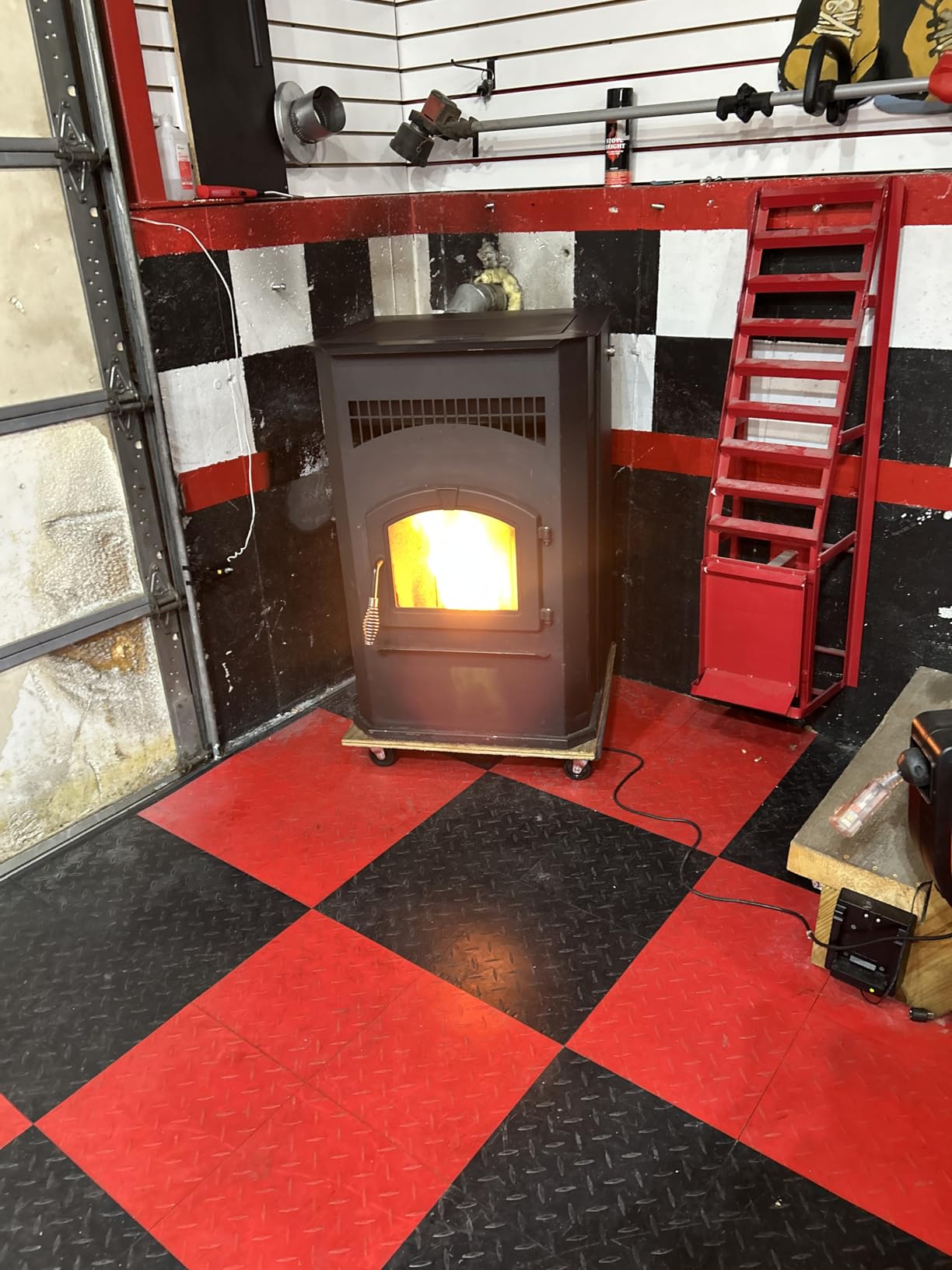
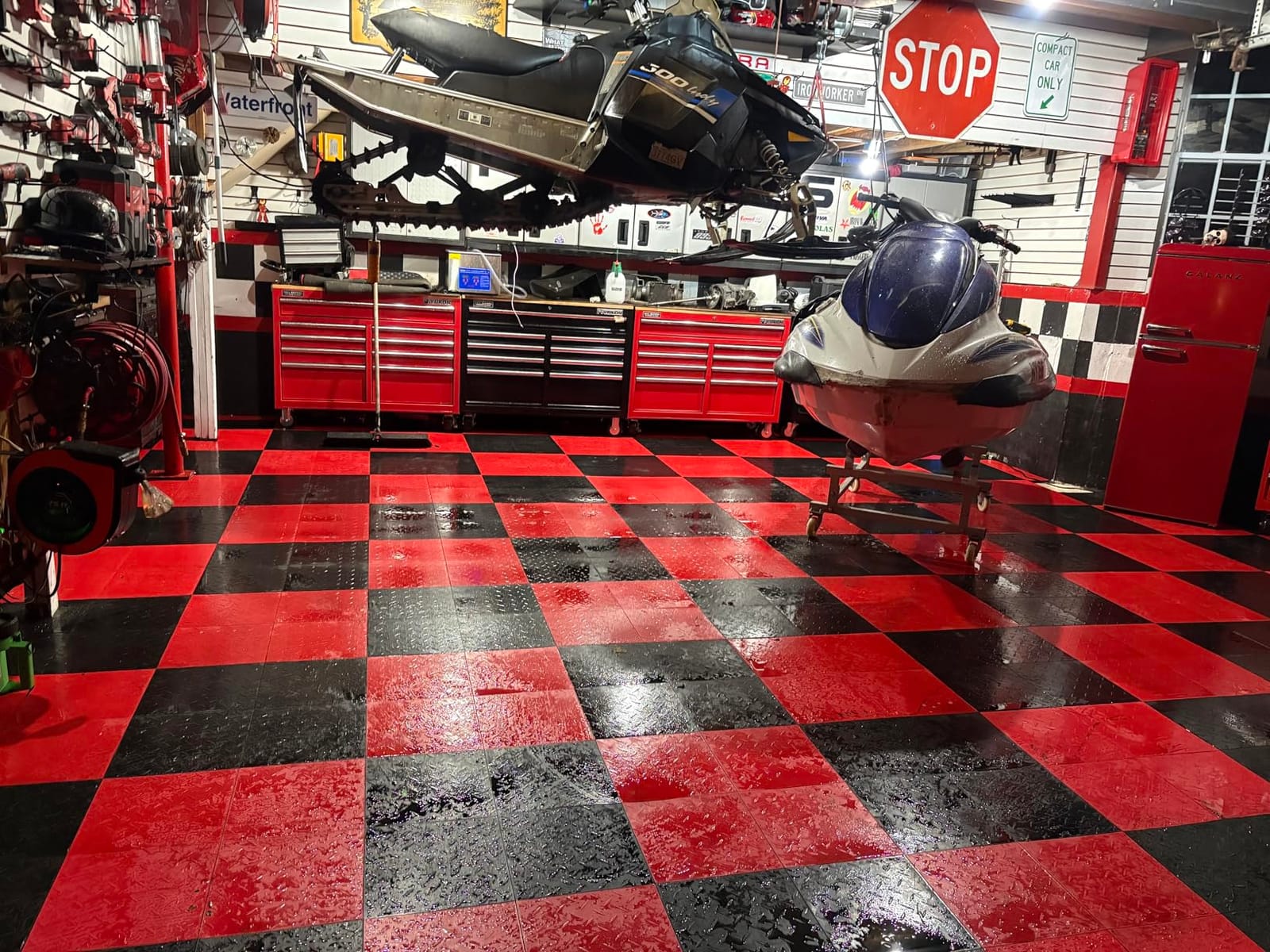
- Bright glossy finish looks far better than bare concrete
- Ships as pre-assembled 2×2 sections that separate easily
- Raised diamond texture gives solid traction
- Cuts and trims easily with a jigsaw or circular saw
– Cons
- Very glossy surface can scuff or mar
- Needs a quarter inch expansion gap or it buckles
- Scratches if metal equipment is dragged
- Edge trim sold separately by gender
Nitro Diamond is the tile we would pick if the floor is going to be seen. The bright, glossy finish transforms a stained slab into something that looks professionally installed, and that matters in a bay where the truck is not the only thing on display.
Construction is rigid polypropylene in a 12 x 12 by 0.38 inch profile, chemical and stain resistant, waterproof, and resistant to oil and gasoline. Each tile covers one square foot and the pack covers 52. It mixes with Nitro Coin and Vented patterns, so you can put solid surface under the truck and a drain pattern at the entry.
The limited lifetime warranty from FlooringInc is the strongest warranty language in this group, and it comes with a genuinely modular system. Tiles are removable and replaceable, and the field can be reconfigured later if your vehicle mix changes.
Gloss, Scuffing and Realistic Expectations
The same gloss that produces the attractive finish is the most common complaint. Buyers mention the surface scuffing or marring, and that it can be scratched or gouged if metal equipment is dragged across it. In a bay where a rolling toolbox crosses the floor daily, expect visible wear eventually.
The other consistent caveat is the quarter inch expansion gap around all edges. Omit it and the field can buckle in direct sun. Edge and transition pieces are sold separately and must be ordered by gender, and reviewers note the per-piece cost of that trim can exceed the cost of the tiles themselves.
Packaging Detail That Speeds Up Install
One reviewer-reported feature we liked: these ship as pre-assembled two-by-two foot sections that separate easily when you need a single tile. For a large bay that turns what would be hundreds of individual snaps into far fewer, and it also makes it easy to lift out a damaged section rather than prying at one tile.
Cutting and trimming is straightforward with a jigsaw or circular saw, and the raised diamond texture holds traction underfoot and under tires when the surface is wet or oily.
Warranty Coverage and What It Does Not Cover
A limited lifetime warranty is a strong signal on paper, and it is one of the reasons this tile scores well with buyers. It applies to the product rather than to a specific load rating, and no manufacturer warranty in this category substitutes for leaving your expansion gap or restraining the field at the edges.
For a parking bay that stays reasonably clean, the gloss holds up. For a working shop with steel dragged across the floor, the diamond pattern alternative with a matte finish ages more gracefully.
7. VersaTex 18×18 Raised Coin – The Softest Tile and the Fewest Pieces to Lay
VersaTex Garage Floor 18 x 18 inch Square Plastic Raised Coin Interlocking Floor Tiles for Home Gym, Garage Flooring, Trade Show Flooring, Basement Tiles, 24 Pack (Black)
Recycled rubber
18 x 18 inch tile
0.13 inch thick
54 sq ft per pack
Waterproof
+ Pros
- 18 x 18 tiles cover 54 sq ft per pack
- Softer recycled rubber is forgiving underfoot
- Safe to drive vehicles and mowers over
- Resistant to oils brake fluids and solvents
- Non permanent and reusable elsewhere
– Cons
- Thinnest tile in the roundup at 0.13 inch
- Raised coin pattern traps dirt in the grooves
- One year limited warranty is the shortest coverage here
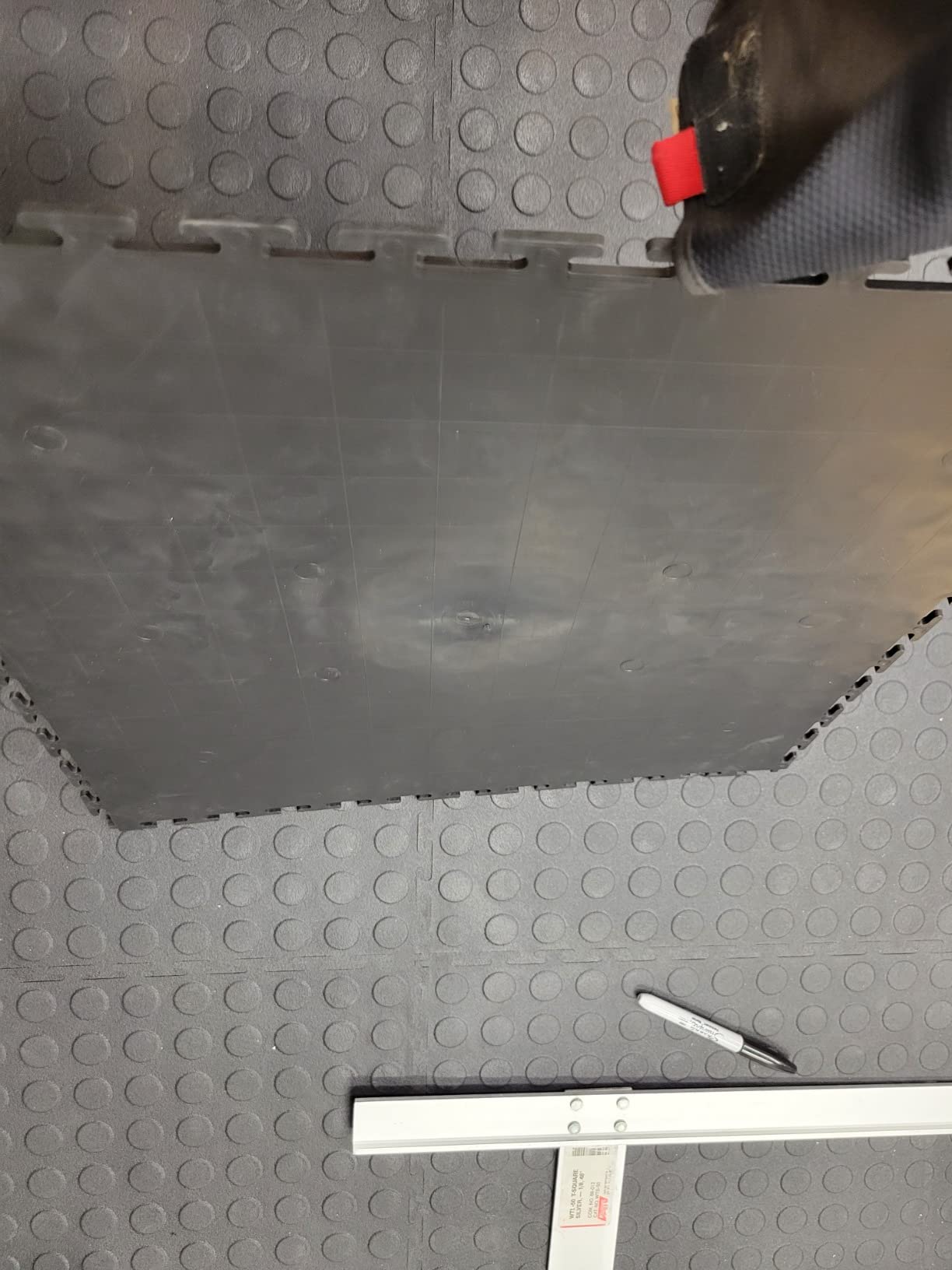
VersaTex is the odd one out in this group, and that is exactly why it is worth including. It is a recycled rubber tile at 18 x 18 inches, not a rigid 12 x 12 polypropylene piece, and it behaves nothing like the competition underfoot.
The 24 pack covers 54 square feet. That is the practical headline: roughly a third as many pieces to lay and cut as a 12 x 12 system, and for a full two-car bay it is the shortest install of the group. A single pack of 24 weighs 24 pounds, so individual pieces are heavy, but there are far fewer of them.
Construction is recycled rubber, described as heat resistant, puncture proof, impact resistant, non-porous, and waterproof. It is safe to drive over with cars, trucks, or mowers, and it resists household chemicals, oils, brake fluids, and solvents.
Comfort Underfoot and Why Soft Is Sometimes the Point
Rubber is noticeably more forgiving than hard polypropylene. If you spend hours standing in the bay working, or if you are laying tile under a bench footprint for vibration isolation, the softness is the entire argument. Users on r/handtools recommend rubber garage tile under a bench specifically to damp vibration rather than as a full floor surface.
That same softness is a limitation under concentrated load. At 0.13 inch, this is the thinnest tile in the roundup by a wide margin, and thin soft material has the least resistance to a point load from a jack stand or a hoist leg.
Cleaning, Texture and Grip
The raised coin pattern is the main maintenance complaint. The grooves collect dirt and take noticeably more effort to clean than a flat or shallow-textured surface, and care instructions are simply to wipe with a damp cloth. For a bay that sees real work rather than just parking, that adds up.
On the positive side, the interlocking design works over wood, laminate, tile, vinyl, and cement, so it is a genuinely flexible option for a space that is not a bare slab. The surface is UV resistant and described as not fading or cracking.

Warranty and the Heavy-Vehicle Verdict
The warranty is a one year limited warranty against manufacturing defects, covering replacement of defective tiles only. That is the shortest coverage of any product in this roundup, and it is worth weighing against the limited lifetime coverage on the Nitro tiles if you are comparing long term.
Our verdict: excellent as a comfort layer, a workbench footprint cover, or a vehicle bay with moderate loads, and a poor choice as the primary surface under a one-ton truck. Soft recycled rubber at that thickness is not the material we would point at for the heaviest vehicle in the garage.
8. Jocoevol Self-Draining 12×12 – The Deepest Drainage Gap and Best Outdoor Use
Jocoevol 60-Pcs Interlocking Tile, 12″ x 12″ Indoor/Outdoor Self-Drainage Interlocking Floor Tiles, Non-Slip Heavy-Duty Polypropylene Splicing Flooring Tile for Garage Patio Pool Bathroom, Black
Polypropylene
12 x 12 x 0.65 inch
0.65 inch support pegs
60 pack
Indoor and outdoor
+ Pros
- Raised pegs create a drainage gap so water never sits
- Snaps together with no glue or tools
- Takes cuts well with a saber or miter saw
- Works outdoors on sand and gravel with weed barrier
- Useful under an RV mattress or as a raised shed floor
– Cons
- Small screws and debris fall through the gaps
- Needs a flat offcut for leverage on uneven ground
- Designed as drainage matting not a flat drive over surface
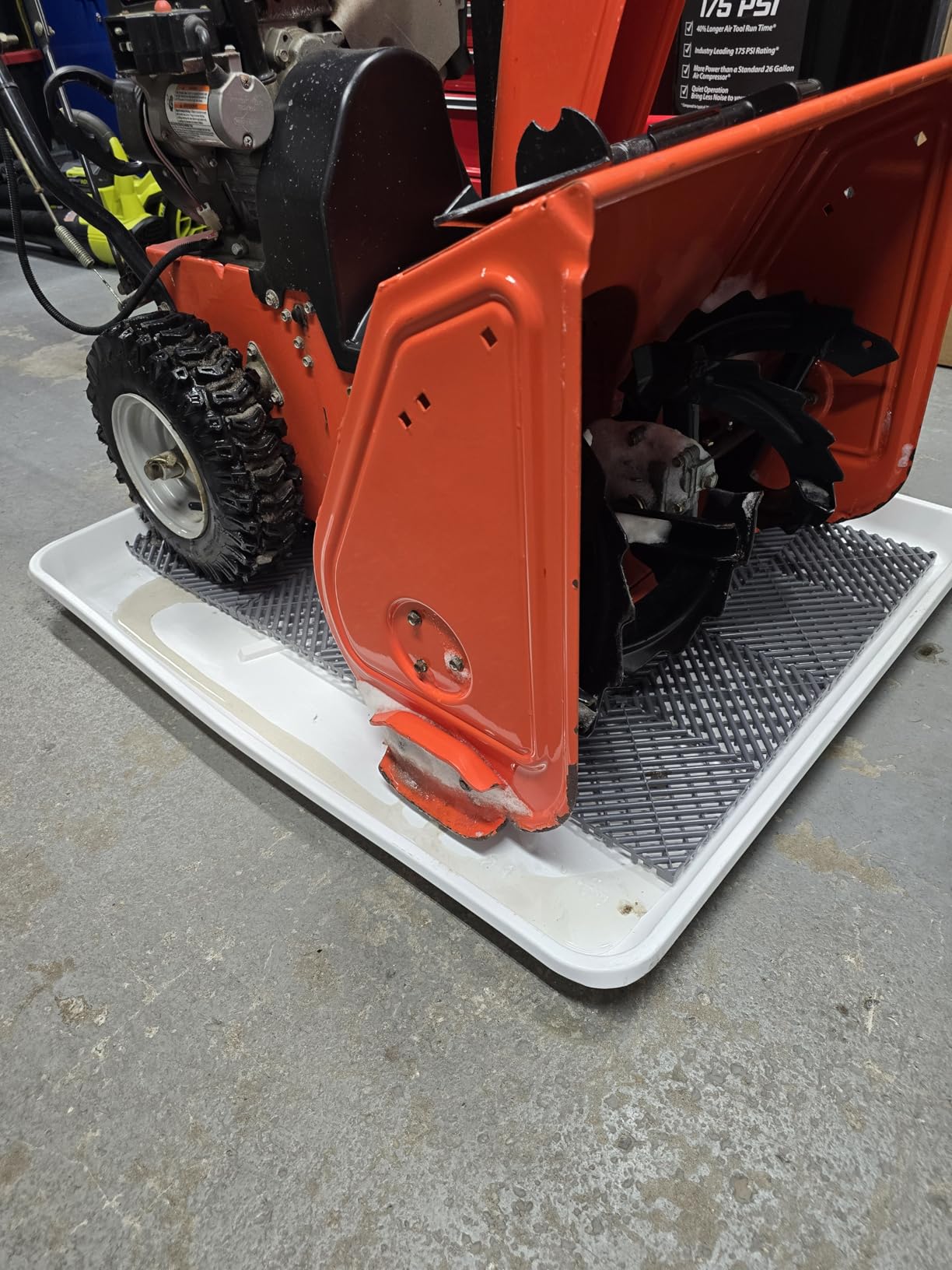
Jocoevol takes a different approach to drainage. Instead of channels molded into the face, it uses 0.65 inch support pegs to lift the entire tile off the slab, creating an open air gap that water runs through rather than over. At 17mm of clearance, that is the deepest drainage gap in this roundup.
With 60 tiles in a pack, coverage is substantial, and the polypropylene is UV resistant and will not fade or stain. The thick square tabs are specified to resist deformation under heavy impact, which is the right design choice for a tile that will be driven on.
This is also the most versatile product we looked at. Reviewers use it on patios, pool decks, boat decks, gardens, saunas, and inside an RV, and outdoors on sand and gravel with weed barrier cloth underneath. That flexibility is unusual for a tile sold in the garage category.
What a Drainage Mat Is and Is Not
Be clear-eyed about what this is. It is drainage matting that happens to be driveable, not a flat solid floor surface. Spilled fluids run to the slab. Small hardware falls through the gaps and is hard to retrieve. If you need a work surface you can set parts on, this is the wrong product.
For snowmelt, wet patios, and outdoor applications, that same design is exactly right. Water never sits on the surface, which is the single most effective thing you can do to keep a garage floor from turning into a grit grinder under a truck’s tires.
Assembly Details That Bite
Snapping tiles together is easy on a flat, prepared slab. On uneven ground, reviewers report needing a flat offcut wedged into the joint to get leverage. One reviewer received a set whose tabs would not interlock at all and had to be modified.
Cutting works well with a saber saw or miter saw. The surface rinses off easily, and care guidance is simply to sweep or vacuum debris regularly rather than let it accumulate in the peg field.

Where We Would Use It
If you store an RV or a boat in the garage, or you need a raised dry platform under a mattress, a bed, or a shed floor, this tile is excellent and nothing else in the roundup does that job as cleanly. It is also a reasonable outdoor patio or pool deck surface on a stable base.
Under a heavy vehicle in a bay where you also work, we would choose a solid surface instead. You lose the drainage advantage and gain a place to put things down.
9. Nitro Tiles Vented 12×12 – Best for Snowmelt and Grit Trapping
Nitro Tiles Vented by FlooringInc 12″ x 12″ Interlocking Garage Floor Tiles, Self-Draining Heavy Duty Polypropylene Drainage Tiles, Snap-Together Non-Slip Floor Tile, Graphite, 52-Pack (52 SqFt)
Polypropylene
12 x 12 inch tile
52 sq ft pack
Vented open grid
Limited lifetime warranty
+ Pros
- Vented grid drains water snow and oil drips
- Locks together with light foot pressure
- Holds a full size pickup without shifting
- Good grip that does not go slick when wet
- Installs over weak concrete that would not take epoxy
– Cons
- Floor can shift under vehicle movement on concrete
- Edge trim sold separately at a higher per piece cost
- Small objects fall through the open grid
Nitro Vented shares the limited lifetime warranty and the modular chemistry of the Nitro Diamond tile, with a vented open grid face instead of a solid surface. It is the tile we would choose in a climate where salt and grit are the enemy rather than oil.
Owners report the snap-together is the easiest in this roundup, locking with light foot pressure and no mallet for most joins. That is a meaningful difference when you are laying 52 or more tiles on your knees.
The material list is unusually thorough. It is described as PVC free, phthalate free, BPA free, latex free, formaldehyde free, silicone free, and lead free, and it is compatible with all Nitro tile patterns so you can mix vented and solid in one field.
Holding a Full-Size Pickup and the Shift Problem
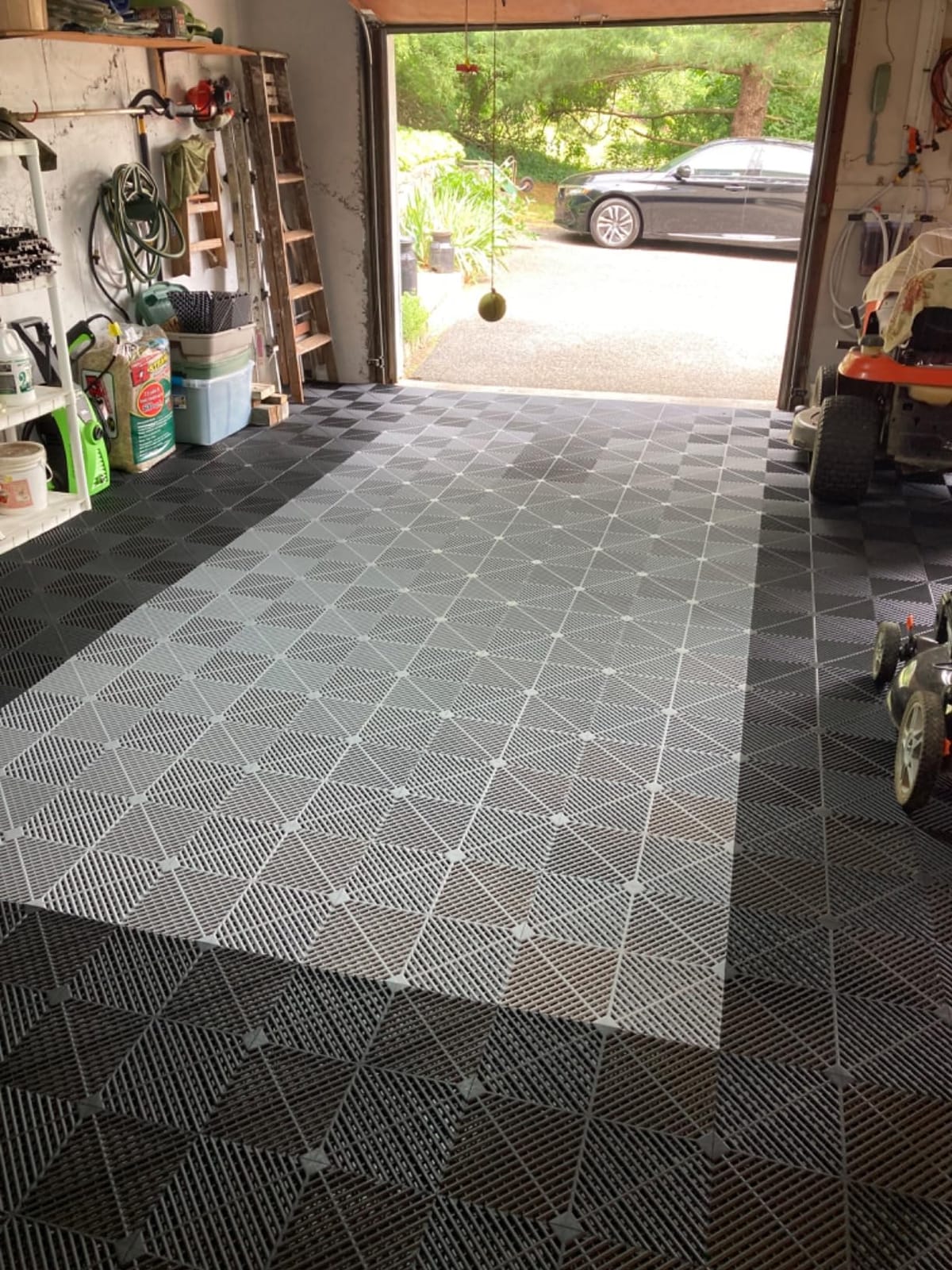
Reviewers specifically report this tile holding an F-150 without shifting or deforming, and good grip that does not become slick when wet. That is the core claim you care about, and it is directly supported.
Against that, the most serious risk in this product’s reviews is the field shifting under vehicle movement on concrete. One owner reported the floor shifting enough to bend and rip out garage door tracks, and others describe the whole field walking forward. Add edge restraints, and pay attention to where the door track sits relative to the tile field. Our smart garage door controller guide covers the opener side of that system.
Use It as a Dirt Catcher at the Entry
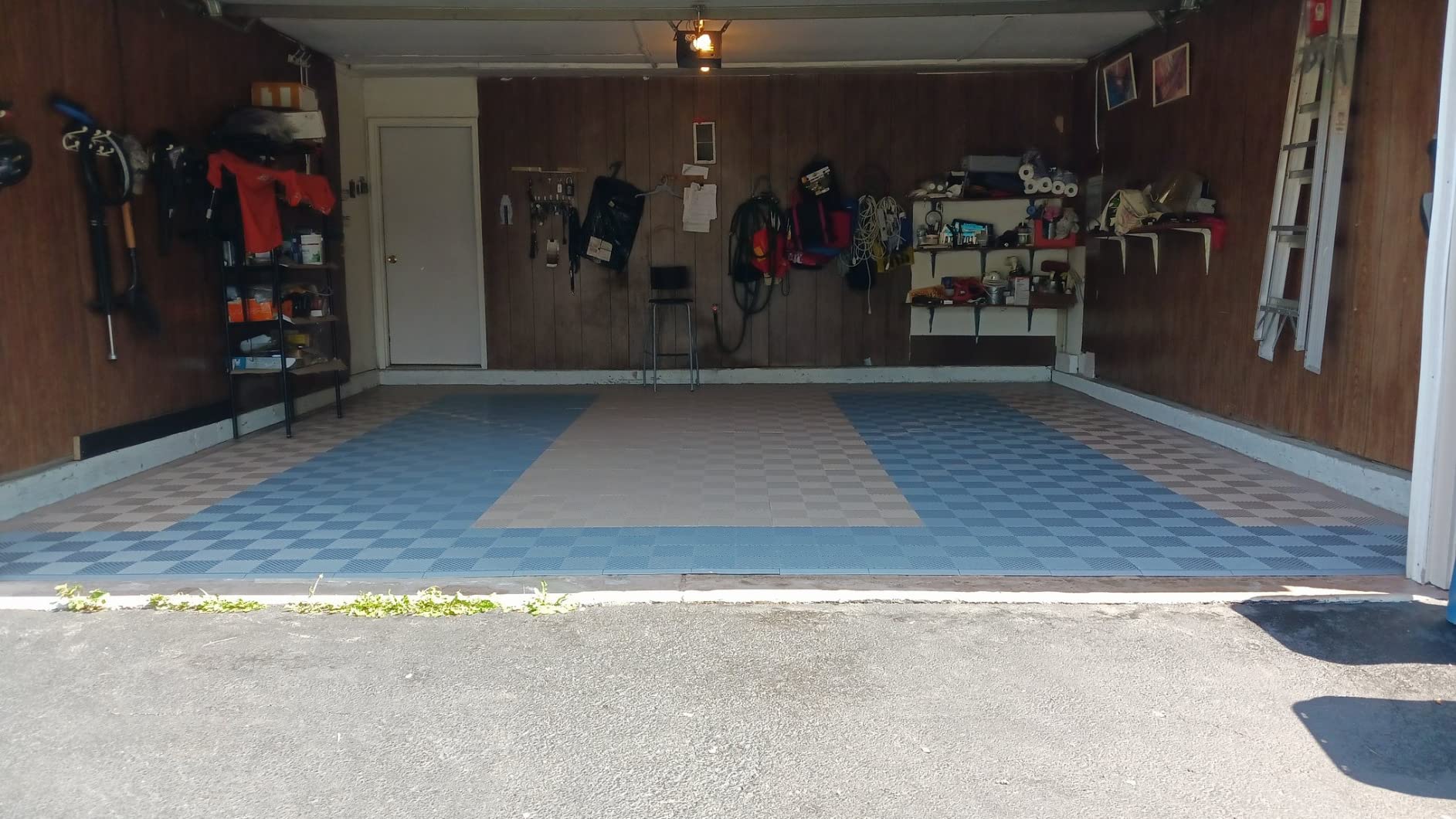
One of the most useful applications we found is not full-floor coverage at all. A rectangle of vented tile at the garage entry traps grit that would otherwise be tracked into the house, and because the open grid lets debris fall through, the tile stays clean instead of becoming a dirt reservoir.
This also solves the coverage anxiety that stops people from tiling. Most vehicles occupy a predictable rectangle. Tiling that rectangle, plus a generous border for the door swing, covers the overwhelming majority of tire contact without tiling the whole slab.
Installing Over Weak or Damaged Concrete
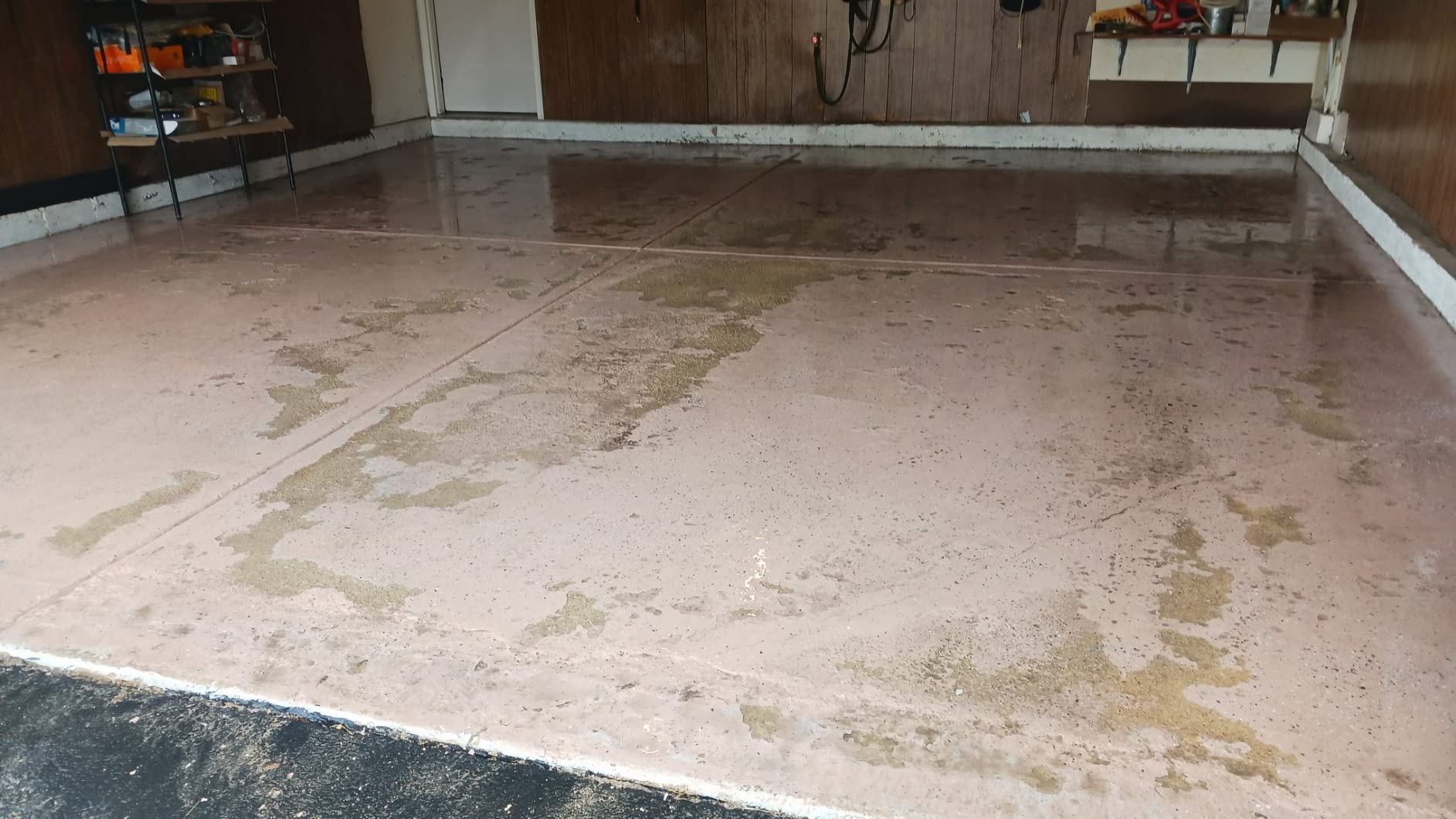
Because this is a floating floor with no adhesive, it goes down over concrete that is cracked, stained, or too weak to hold an epoxy bond. For a slab that has already failed in places, that reversibility is a genuine advantage over any coating system.
The drawbacks are consistent across this family: edge trim is sold separately at a higher per-piece cost than the tiles, small objects disappear through the grid, and the surface is reported as slippery when wet if you use it on an outdoor deck. For indoor vehicle parking in a snow climate, those are manageable.
10. SafeRacks Vented 15.75×15.75 – The Thickest Tile and the Highest Rated
SafeRacks Vented Interlocking Garage Floor Tiles – Black, 48 Pack
Polypropylene
15.75 x 15.75 inch
0.71 inch thick
Up to 4 metric tons
1.72 sq ft per tile
+ Pros
- Highest average rating in the roundup at 4.8
- 15.75 inch tiles mean far fewer pieces to lay
- Nearly three quarter inch thick and rated to 4 metric tons
- Withstands a boat trailer being backed in repeatedly
- Snap together needs no mallet
– Cons
- Split locking tabs bend if tiles are not aligned first
- Small items fall through the ribbed floor
- Tiles are hard to take apart once locked
SafeRacks is the specification outlier and, by ratings, the best-reviewed tile in the group. It carries a 4.8 average rating, the highest here, and it is the only product built around genuinely oversized tiles.
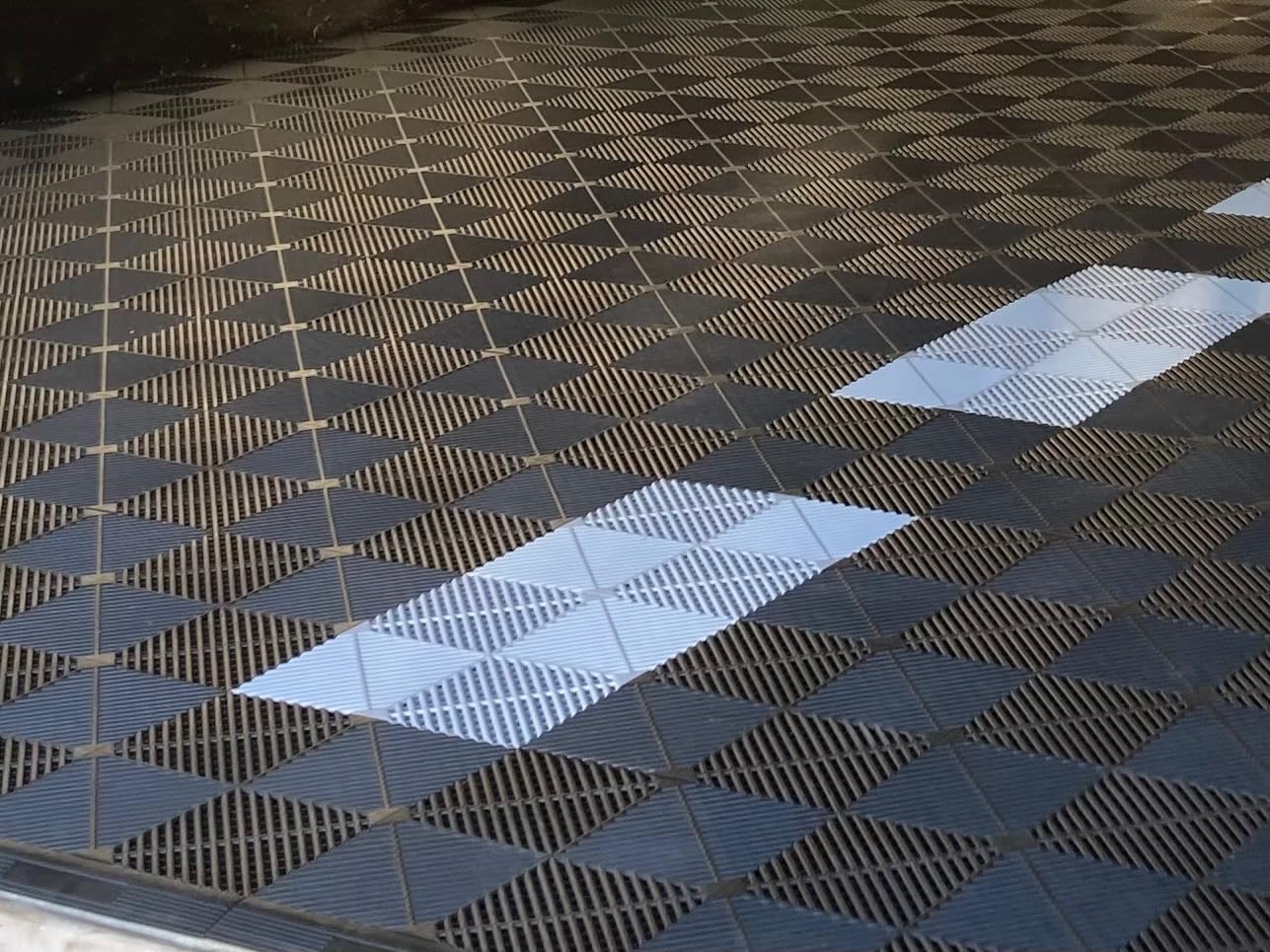
At 15.75 by 15.75 inches, each tile covers 1.72 square feet, roughly 72 percent more area than a standard 12 by 12 piece. A 48 pack therefore covers a very large area with very few seams, and far fewer cuts. For a heavy vehicle bay that is an appealing proposition because fewer seams means fewer places for the field to work.
Thickness is nearly three quarter inch, the thickest in this roundup, and the stated load capacity is up to 4 metric tons. Construction is heavy-duty polypropylene with open air channels underneath for drainage and airflow.
What 4 Metric Tons Actually Means in a Garage
Four metric tons is roughly 8800 lb, and it is specified as a load capacity rather than framed the way the polypropylene competition frames its numbers. Because the tile is also the thickest here, that figure has a plausible connection to real static load, which is unusual in this category.
Owners report the tile withstanding a boat trailer being backed in and twisted repeatedly with no visible wear. Trailer loading is a genuinely stressful load case, because tongue weight is concentrated near the coupler and the trailer frame twists as it articulates. Our smart garage door opener guide is the other half of a reliable storage bay.
Installation Trade-Offs with Large Format Tiles
Tool-free installation is genuinely tool-free here. Line the tile up and step until it clicks, with no mallet needed. Comfortable to walk on and more uniform than competing products, according to owners.
The trade-off is the locking connector. The split tab design bends more easily than the single tab designs used by other brands if the tiles are not carefully aligned before snapping, and tiles are hard to take apart once locked. Plan the layout before you start, and do not force a misaligned joint.
The Review Base Caveat
We are including an honest caveat here. At 53 reviews, this is the smallest review base in the roundup, and that is exactly what the rating gap suggests. High ratings built on a small sample are worth less than a slightly lower rating built on thousands of long-term owner reports.
What that means practically: the specification sheet is the most compelling in this group, and the early owner reports are very positive, but there is less long-term data behind it than behind the SnapLock and Nitro tiles. If you want the deepest specification and the fastest install, this is the pick. If you want the deepest history, GarageTrac is the safer bet.
How to Read a Garage Floor Tile Load Rating
A load rating tells you the maximum weight a manufacturer states a tile supports, and it only means something once you know what was moving, how it was moving, and what it was moving on. Every number in this category is one of two things: a rolling load rating or a static load rating, and they are not interchangeable.
A rolling load is weight moving across a tile on a tire contact patch. A truck rolling slowly down a driveway puts a rolling load on your floor. Most manufacturers test this on a joined field of tiles with a roller or vehicle, which is the correct way to evaluate a floating system.
A point load is concentrated weight from a jack stand, an engine hoist leg, a motorcycle side stand, a trailer tongue jack, or a dropped tool. It is the failure mode heavy-vehicle owners actually hit, and no rolling load rating on any product in this roundup speaks to it.
Static load is weight that does not move, which is a truck parked in the same spot every night for years. Polymer under sustained static weight experiences creep, a slow permanent deformation that flattens the surface and eventually lets the field shift. Creep is why leaving an expansion gap matters.
Drain-thru, also called flow-through or vented, describes an open channel design in the tile face that lets water pass to the slab below. It is not a cosmetic feature in a salt climate. It is the difference between grit falling through and grit being ground into the pattern by every tire pass.
Here is the honest summary: a rolling load rating above 40000 lb tells you a passenger vehicle or a light truck can be parked on the tile without worry. It does not tell you a one-ton diesel on jack stands is safe. If your bay doubles as a shop where the hoist lives, buy a thicker tile, keep stands on plywood or a load-spreading plate, and treat the rolling rating as the parking number it is.
Garage Floor Tile Buying Guide
Choose Your Material Before You Choose Your Pattern
Polypropylene is the dominant material in this category and the right default for heavy vehicles. It is rigid, chemically resistant to oil and antifreeze, unaffected by water, and light enough that a 48 or 60 piece pack is manageable. Every SnapLock, Nitro, VEVOR, BoldWorks, and SafeRacks tile here is polypropylene.
Rubber is softer and more forgiving underfoot, better for standing work and vibration isolation, and weaker under concentrated load at a thin profile. It earns its place under a bench footprint or a home gym zone rather than under the heaviest vehicle in your garage. PVC and vinyl roll flooring sit outside the heavy-vehicle category entirely, which is why the best garage floor tiles for heavy vehicles are modular tile systems rather than sheet goods.
Match Thickness to the Heaviest Vehicle in the Bay
For a full-size pickup, a midsize SUV, or a motorcycle bay, roughly a quarter to three quarter inch polypropylene tile is comfortable. For a three-quarter ton truck, a one-ton work truck, a diesel, or a Class A motorhome, look for half inch or thicker.
For a trailer tongue jack, an engine hoist, or a floor jack on stands, thickness helps but it is not the whole answer. Use a load-spreading plate or a piece of plywood under stands. No polypropylene tile on the market is designed to take the corner weight of a lifted truck through four square inches.
Pick Drainage to Match Your Climate
Vented or flow-through tile is the correct choice where snow, road salt, and tracked grit are routine. Solid tile gives you a work surface and a place to set parts down, and it holds spills on the surface where you can wipe them. Flow-through gives you a dry floor and a clean pattern, at the cost of losing anything small.
Raised peg drainage, like the Jocoevol design, sits at the far end of that spectrum with the largest air gap. It is the most aggressive drainage option and the least forgiving surface for tools and hardware.
Do the Coverage Math Before You Buy
This is where most people overbuy. A two-car bay is roughly 400 to 480 square feet, but the vehicle footprint that actually takes load is a much smaller rectangle. Measure the length and width of your vehicle including mirrors, add three feet of clearance at the front and rear, and tile that zone.
For many households that produces a coverage area of 150 to 250 square feet rather than 480. Add a second tile rectangle at the entry as a dirt catcher, which costs far less than tiling wall to wall, and leave an unfinished strip along the wall for bench and storage footprints. Our garage cabinet guide covers what goes on the perimeter.
Concrete Prep Matters Less Than You Think, and More Than You Think
Because a floating tile system is not bonded, it needs far less prep than epoxy. A broom sweep and a crack check is usually sufficient. What you do need is a flat surface, because a floating field bridges a high spot and rocks on it.
Heavy-vehicle forums are more prep-conscious than the general garage population. ThumperTalk owners working with trucks, trailers, and RVs insist on grinding or media blasting with metal shot to profile concrete for maximum adhesion, and treat acid etching as a cheap alternative with real drawbacks. That advice is aimed at coatings, but the same flatness requirement applies to tile, and it applies most strongly where you will cut and fit edge tiles.
Winter, Sunlight and the Expansion Gap
Every product in this roundup shares one failure report: bowing or buckling in direct sun and heat, and pulling away from walls in cold. This is a property of rigid polypropylene and a temperature-cycled enclosure, not a defect unique to any brand.
The mitigation is the same everywhere. Leave roughly a quarter inch around the entire perimeter, do not butt tiles tight against the wall or the garage door track, and re-seat the field periodically if you notice movement. Restraint strips along the edges reduce the walking behavior that owners report under repeated vehicle passes.
Maintenance Is Simple and Salt Is the Enemy
Sweep or shop vac regularly, mop with a mild cleaner, and wipe oil before it sits. Solid tile wipes clean easily, which is one of its main advantages over bare concrete. Raised coin patterns and brick patterns collect grit in their grooves and need more deliberate cleaning.
Where tile is installed over concrete, moisture can wick up between tiles and sit against the slab, which is the tile-specific drawback vendor comparisons consistently mention. In an unheated garage this matters most after a freeze-thaw cycle.
When Tiles Are the Wrong Answer
Do not tile a bay that is primarily an engine hoist bay, a paint booth, or a welding area. Concentrated point loads and heat are exactly the conditions polypropylene handles worst.
For a slab that needs permanent protection with a seamless surface and no seams to trap dirt, a coating system is genuinely better. Tiles are not universally superior, and any page telling you otherwise is selling something.
Tiles vs Epoxy vs Polyaspartic for a Heavy-Vehicle Garage
Tiles win on reversibility, repairability, and installation speed. Epoxy and polyaspartic coatings win on seamless appearance, permanent bond, and long-term chemical resistance with no seams to collect dirt.
The practical difference is failure recovery. A damaged tile is lifted and replaced in minutes, and a stained tile is replaced without touching the floor. A failed coating means grinding back a section of floor that is now partly concrete and partly coating, which is a far worse repair. Anyone who stores a trailer or a motorcycle and expects occasional impact damage will find that asymmetry decisive.
The practical difference in the other direction is point load behavior and moisture. A coating is continuous, so there is no seam and no tile to compress, but it is also fully bonded and fully committed. If the slab moves, the coating moves with it or fails. Tiles float and accommodate movement, and they can be lifted to inspect or dry the slab underneath.
For heavy vehicles specifically, both are viable. Tiles win when you want a reversible, modular, self-installable system and a bay you work in. Coatings win when appearance is the priority, the slab is sound, and you can tolerate a permanent commitment with a professional install.
Frequently Asked Questions
How heavy a vehicle can garage floor tiles support?
Any passenger vehicle, SUV, or full-size pickup is comfortably covered by a tile rated for rolling loads over 40000 lbs, which includes most of the options in this roundup. A three-quarter ton or one-ton work truck, diesel, or Class A motorhome also fits within that rolling load range, because the weight is spread across four tires and a joined field of tiles. Ratings do not cover point loads from jack stands, engine hoists, or trailer tongue jacks, which require a load-spreading plate underneath.
What is the most durable type of garage floor tile?
For heavy vehicles, rigid polypropylene interlocking tile is the most durable option. It is stiff enough to resist tire loads, resists oil, antifreeze, and most household chemicals, and shrugs off water entirely. Rubber is softer and better for standing work but weaker under concentrated load, and PVC or vinyl roll goods are not rated for heavy vehicles. Within polypropylene, thickness and stated rolling load rating matter far more than the surface pattern.
Which is better for garage floors, tile or epoxy?
Tiles are better when you want reversibility, easy installation, and the ability to replace a damaged piece without touching the slab. Epoxy and polyaspartic coatings are better when appearance and a seamless, bondable surface matter most, and when the slab is sound enough to accept a permanent commitment. Heavy vehicles are fine on either system. Tiles win for working bays and DIY installs; coatings win for showpiece finishes with no seams to trap grit.
Do garage floor tiles creep or slide under a truck?
Yes, over time. Creep is slow permanent deformation of the polymer under sustained static weight, so a truck parked in the same spot every night can gradually flatten a tile and let the field shift. Owners also report the whole floor walking forward under repeated vehicle passes until it reaches the wall and compresses the edge locks. Leave roughly a quarter inch of expansion gap around the perimeter and add edge restraint strips to reduce both behaviors.
How many garage floor tiles do I need for a two-car garage?
A two-car bay is roughly 400 to 480 square feet, but you rarely need to tile all of it. Measure your vehicle including mirrors, add about three feet of clearance front and rear, and tile that footprint plus a generous border for the door swing. For most households that lands between 150 and 250 square feet, which is three to five 48 tile packs. A separate vented rectangle at the entry works as a dirt catcher at far less cost.
Conclusion
There is no single best garage floor tile for heavy vehicles, because the right answer changes with what is driving over it. Here is how we would match the tile to the bay.
If you park a full-size pickup or a three-quarter ton truck and want the most proven option, the SnapLock GarageTrac is our editor’s choice. It pairs a documented 40000 lb rolling load rating with the deepest long-term owner history in this roundup. If you work in the bay daily and want a surface to set parts on, the Nitro Diamond tile gives you a better finish and a limited lifetime warranty.
If you park a one-ton truck, a diesel, or a trailer and see snow and road salt, drainage is the deciding factor. The RaceDeck Free-Flow carries the highest stated rolling load rating at up to 80000 lb and a self-draining open grid, while the Nitro Vented tile adds the easiest installation and a grit-catching entry zone. If you want the thickest construction and the fewest seams, the SafeRacks 15.75 inch tile is the specification leader, with the caveat of a much smaller review base.
If the bay is really a workshop with a hoist in it, do not rely on any tile. Put a coating or a sealed slab under the hoist, use a load-spreading plate under every stand, and tile the parking zone separately.
Whichever route you take, measure the actual vehicle footprint before you order, leave the expansion gap, and buy the edge trim at the same time. That is how the best garage floor tiles for heavy vehicles become the last floor you buy for that garage.
Leave a Reply