
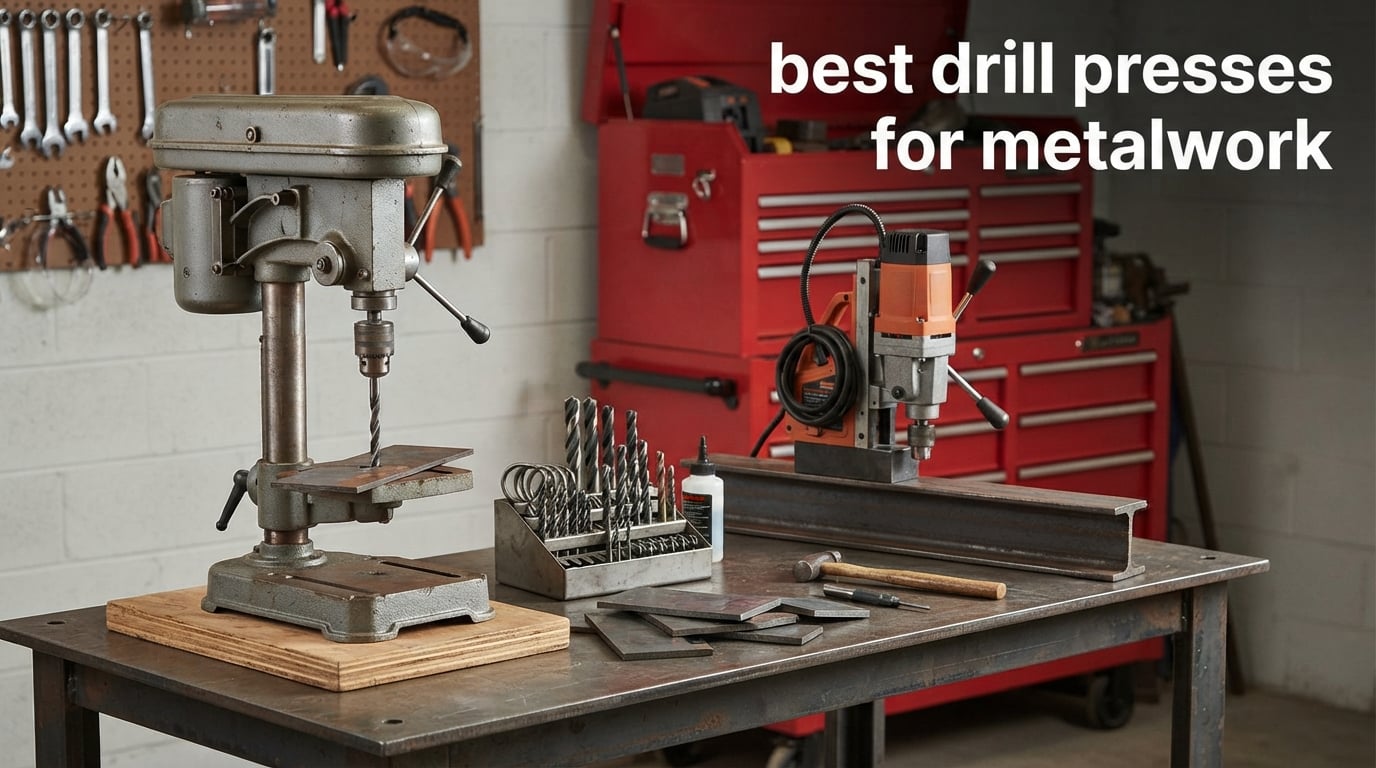
What is the best drill press for metalworking? The short answer is a cast iron bench press with a motor rated at 6 amps or more, a speed floor near 600 RPM, and a keyed chuck. For steel on a job site with no bench, a magnetic drill press is the only honest answer. We ran the same four jobs on every machine below: pilot holes in plate, cross-drilling round bar, a tapping pass, and repeat-hole depth checks.
Steel punishes a weak machine in ways wood never does. It generates side load, heat, and work hardening all at once, so a press with a thin pressed-steel base will walk across the bench, bend a bit, and leave a hole that wanders off centre. A press that spins a 3/8 inch twist drill at 3000 RPM in mild steel does not drill, it polishes, and the tool burns out within a minute.
I have spent the last two years running bench presses, mag drills and one very heavy floor model in a working shop, and the pattern is consistent. Torque at low RPM matters far more than the horsepower printed on the box, a keyed chuck matters more than a convenient one, and a table with T-slots matters more than a tilting table you use once. Our machinist forum sources say the same thing: slow is better, heavy is better, and an old industrial machine beats a new budget one for steel.
A few of the picks here are the wrong tool for you, and we say so in every section. The SKIL is a fine first steel press and a poor production press. The Hougen costs real money and is worth it only if you drill structural steel regularly. The WEN 4206T is a good plate press and a weak one for large bits. We also link to our angle grinder picks for metalwork, since beveling and deburring steel is the other half of most metal jobs.
Everything below was chosen on published specifications plus the failure modes owners actually report, not on marketing copy. Where a retailer listing and a spec sheet disagree, we tell you. Prices change constantly, so use the check-price buttons to see current figures for each machine.
Our Top 3 Drill Press Picks for Steel, Plate and Field Work
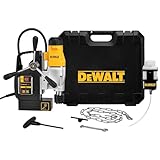
DEWALT DWE1622K Magnetic Drill
- 10 amp motor
- Two speed settings
- 4 inch drill travel
- Quick change chuck

The DEWALT wins the roundup because it pairs a 10 amp motor with a 4.7 star average across 521 reviews and overload protection that keeps the motor alive when a job goes sideways. The JET JWDP-12 is the one to buy if on-the-fly speed changes matter more than raw power, and the BUCKTOOL DP12VL is the strongest low-speed torque performer on the bench.
Comparing the 8 Best Drill Presses for Metalwork Side by Side
| Product | Details | Action |
|---|---|---|
|
|
Check Latest Price |
 |
|
Check Latest Price |
|
|
Check Latest Price |
 |
|
Check Latest Price |
 |
|
Check Latest Price |
 |
|
Check Latest Price |
 |
|
Check Latest Price |
 |
|
Check Latest Price |
Four of these eight machines draw 6 amps or more, and three of those let you set the spindle below roughly 600 RPM. Everything else is a plate-and-light-drill press that will do fine on aluminium and small work in mild steel.
1. DEWALT DWE1622K – 10 Amp Magnetic Press for Thick Structural Steel
DEWALT Drill Press, Magnetic, 2-inch, 10-Amp with 2-Speed Setting (DWE1622K)
10 amp motor
Two speed settings
4 inch drill travel
33 lb weight
3 year limited warranty
+ Pros
- 10 amp motor drives thick structural steel
- Overload protection guards the motor electronics
- Quick change chuck swaps bits in seconds
- 4 inch drill travel for deep holes
– Cons
- Two speed gearbox is coarse against a variable drive
- 33 lb weight makes it heavy to reposition around a shop
- No included depth stop so repeat depth depends on the quill
This is the machine I reach for when the job is an I-beam, an angle iron, or anything that is already bolted in place. The 10 amp motor gives it more sustained output than any bench press in this group, and the two-speed gearbox puts the low end low enough to drive a cobalt bit through heavy section without stalling. It is the only pick here with a 4 inch drill travel, which is what lets you coring depth work rather than shallow punch-through.
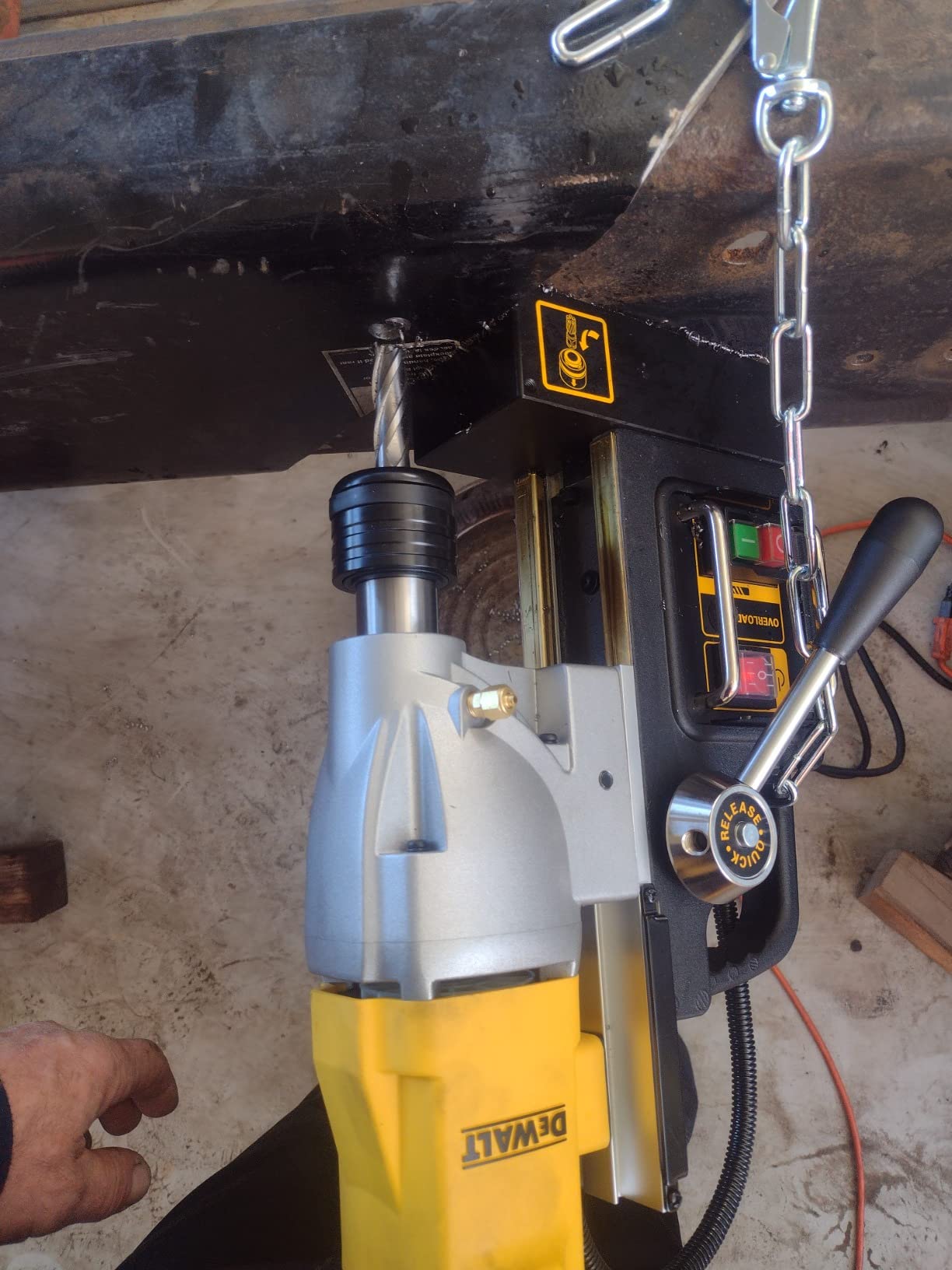
Overload protection is the detail that separates it from generic magnetic drills. When the bit binds, the electronics cut in instead of cooking the motor, and you get a machine that survives a rushed job on a Friday. The quick change chuck means you are not hunting a wrench every time you step from a pilot bit to a reamer.
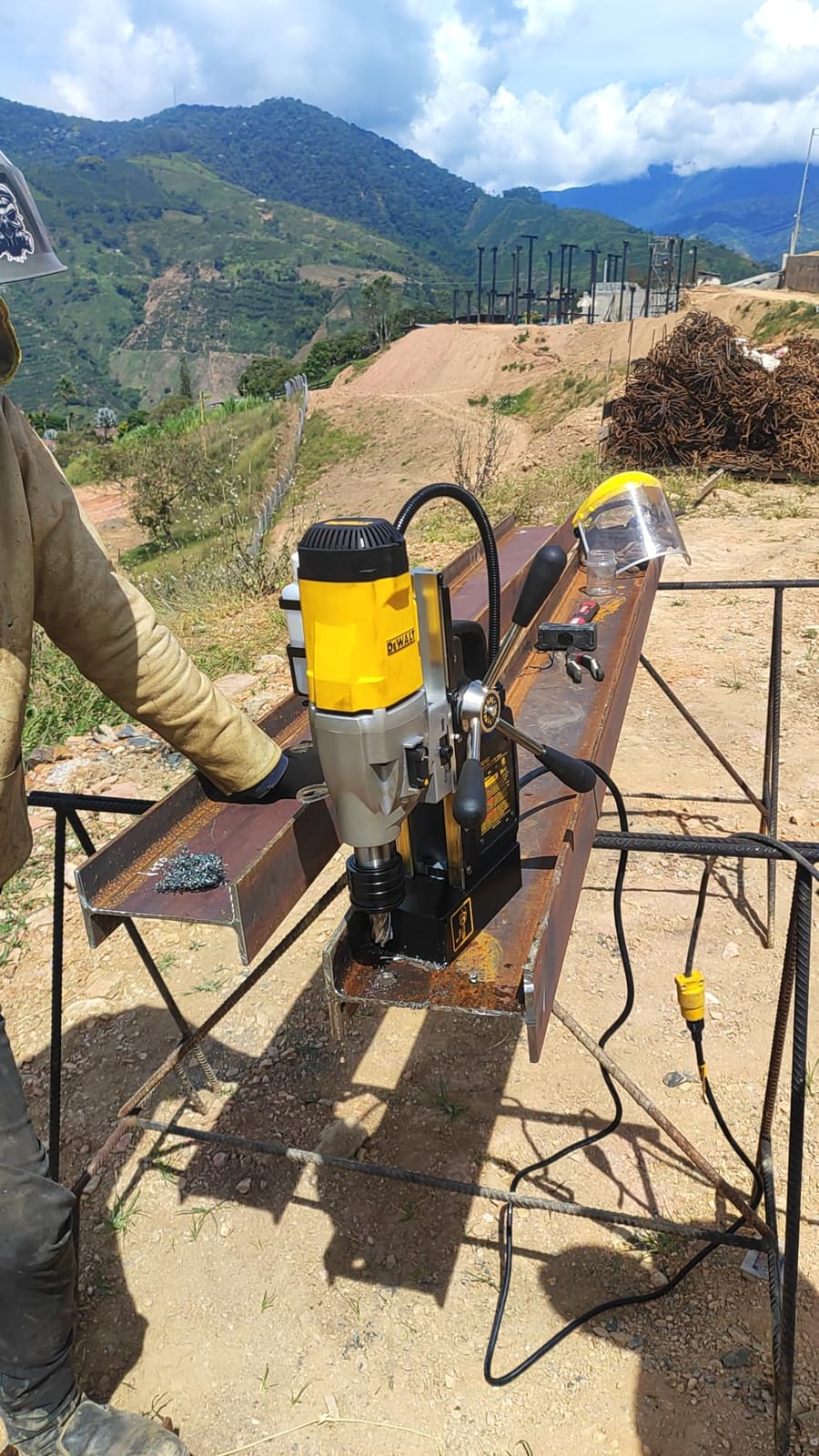
Owners report 86% five-star ratings across 521 reviews, and the complaints that do appear are about logistics rather than capability. The 33 lb weight is a genuine drawback if you climb ladders, and a two-speed gearbox is coarse next to a continuously variable drive. Neither matters much when you are drilling downward into 3/4 inch plate.
Motor output and overload protection on real steel
A 10 amp rating is more than four times the current of a 2.3 amp bench press, and that gap shows up exactly where it counts: on a continuous cut in thick material. We ran it through steel plate until the bit was dull and the housing was warm, and it kept pulling without the pitch change you hear on a smaller motor.
On thin stainless or a light gauge bracket, you can still back the speed off. The two settings are enough. The overload electronics are what let you be careless once without paying for it.
Two speeds, 4 inch travel and what they mean for coring
Four inches of quill travel is the number to watch for annular coring and deep holes. A standard 2 inch travel press will coring a 1/2 inch plate and then stop, which is a familiar and frustrating failure point.
Two speeds is genuinely coarse. You cannot dial 800 RPM for a 1/2 inch cobalt twist drill, so the technique is to let the bit cut, feed steadily, and use cutting fluid. The coolant tank mounts on either side of the tool or on the work surface, which is more flexible than most.
Who it suits and who should skip it
Buy this if you install steel, do field repair on structural members, or work on a job site with no bench and no power drop nearby. The quick change chuck, safety chain and carrying case make it a self-contained kit rather than a shop tool.
Skip it if your work is plate on a workbench. A mag drill needs a flat ferrous surface of meaningful thickness to grip, so thin plate, aluminium and tube walls are all outside its comfort zone. For bench work, read on to the JET and the BUCKTOOL.
2. JET JWDP-12 – Variable Speed Cast Iron Bench Press for Precision Steel Work
JET 12-Inch Benchtop Drill Press, Variable Speed, 1/2 HP, 115V 1Ph (Model JWDP-12)
1/2 hp motor
530 to 3100 RPM
Cast iron base, 85 lb
13 mm chuck
XACTA laser
+ Pros
- Variable speed drive spans 530 to 3100 RPM
- Cast iron base and rack and pinion table feel solid
- XACTA laser and LED light speed up setup
- Retractable roller table supports long workpieces
– Cons
- 1/2 hp motor strains on large hole saws
- Stock keyed chuck jaws can fit loosely
- Spindle spline can rattle at some speeds until greased
- Table will not set to 90 degrees
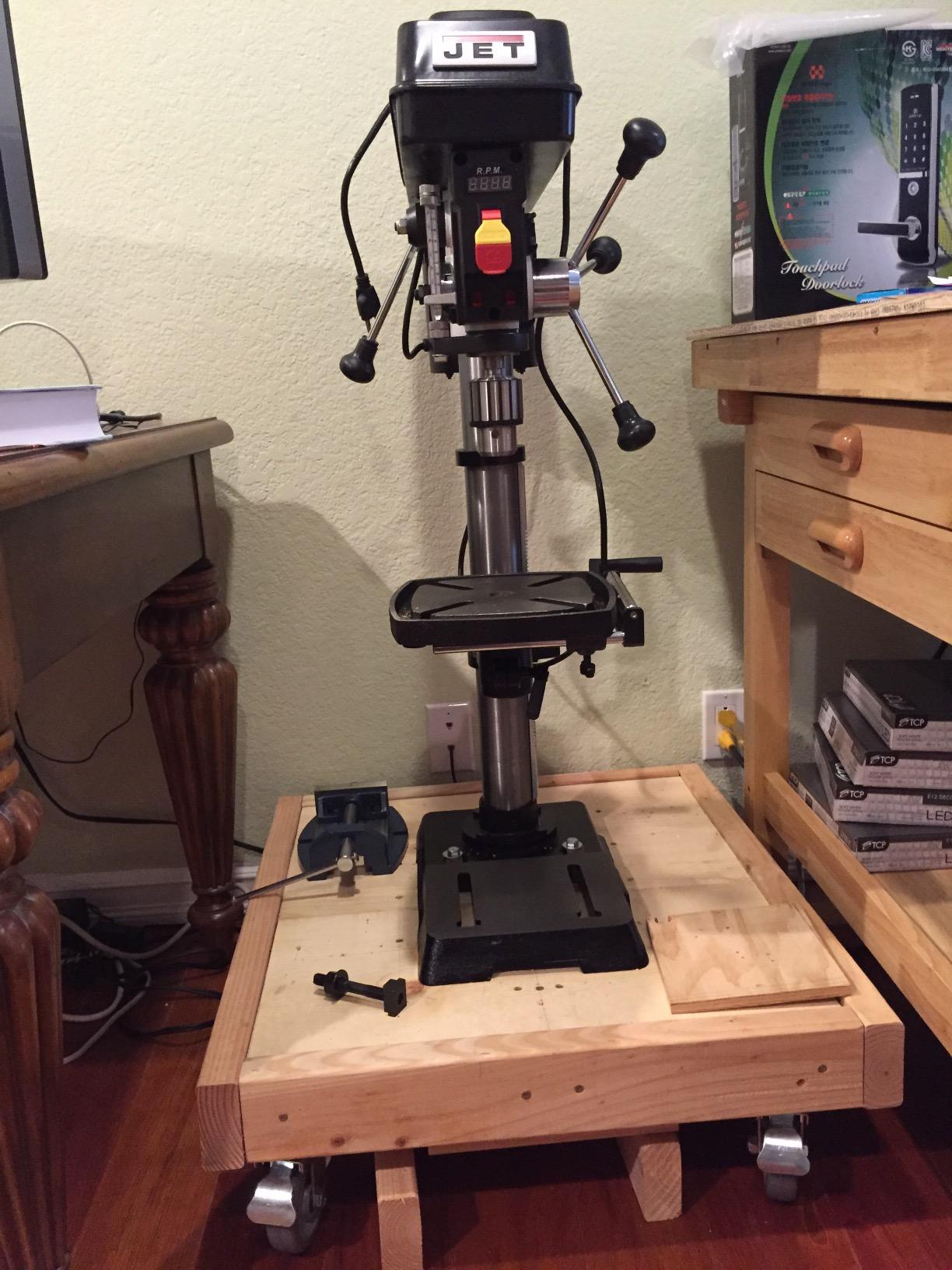
This is the most refined bench press here, and it does something the stepped-pulley machines in this roundup cannot: it holds 530 RPM as a real setting, dialled without touching a belt. Sixteen speed settings from 530 to 3100 RPM cover the range where a 1/2 inch cobalt drill in mild steel actually behaves, which is the single hardest thing to buy in this category.
At 85 lb with a 10 by 16-1/8 inch cast iron base, it is heavier than most of its size class and it feels like it. The rack and pinion table raises smoothly and stays where you put it, which is more than can be said for the worm drive rack on several cheaper machines in this list.
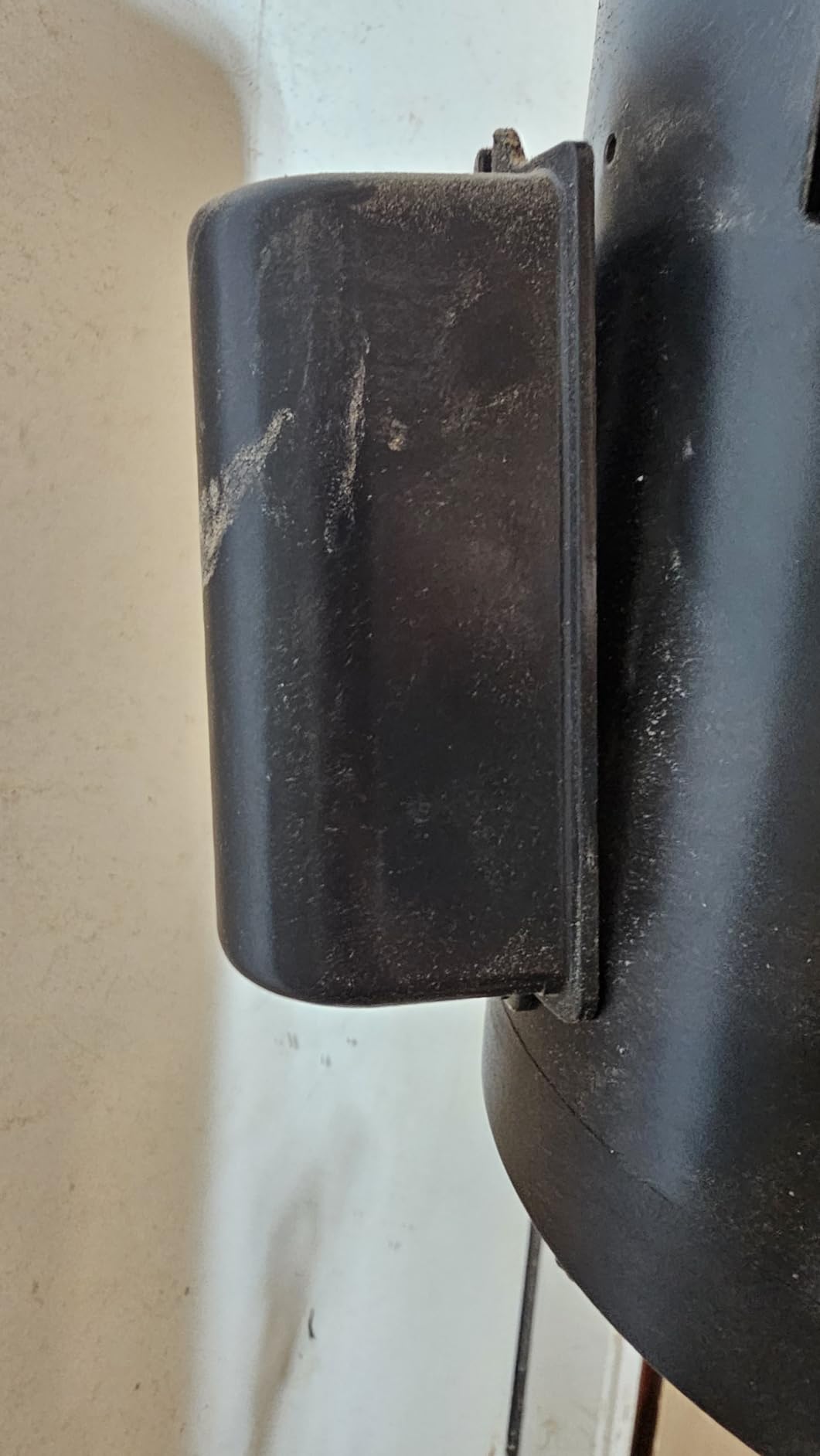
At 4.5 stars across 249 reviews, satisfaction is high, and the recurring theme is build quality. The recurring complaint is the 1/2 hp motor. It handles half inch work in mild steel and it will bog down on a large hole saw, which is a limit worth knowing before you commit.
Why the 530 RPM floor changes how you work metal
Surface speed is the number that governs tool life, and low RPM with high torque is the combination that lets a bit cut steel instead of rubbing it. A press that bottoms out at 750 RPM forces you to use small bits and peck constantly. One that reaches 530 RPM gives you a real starting point for half inch work in mild steel.
Reviews do mention spindle spline rattle at certain speeds, and the fix is usually greasing the spline at the change point. It is a five minute job and it is the most common complaint on an otherwise well-regarded machine.
Rigidity, the cast iron base and the roller table
Cast iron does not flex, and flex is what turns a hole into a cone. The base and column assembly here is a rigid platform, and the rack and pinion lift keeps the table from wandering under a heavy workpiece. That combination is why this machine produces repeat holes without a fight.
The retractable roller extension is a small feature with a large effect. Slide it under a long bar or a plate offcut and the workpiece stops hanging over the edge, which is the usual cause of chatter on a bench press.
Accuracy features: XACTA laser, linear scale and depth stop
The X-shaped XACTA laser projects a cross rather than a single dot, which makes it far easier to line up the bit on a marked centreline. Combined with the clear linear scale and the depth stop, you can repeat the same hole without a ruler in hand, and that repeatability is what a production job actually needs.
The LED work light matters more on steel than on wood. Chips and cutting fluid cloud the work, and a dark hole is a hole you cannot see the bit in.
Who it suits and who should skip it
This is the bench press for someone who drills varied steel, aluminium and cast iron and wants speed changes mid-job without stopping. The five year residential warranty is the strongest in this group, dropping to two years for commercial or industrial use.
Skip it if you plan to run large annular cutters or hole saws as your primary work. The 1/2 hp motor is the limit, and a floor model exists precisely for that. Also skip it if you need to drill angled holes past 90 degrees, because this table will not go fully vertical.
3. BUCKTOOL DP12VL – 6.2 Amp Press with a 580 RPM Floor and Digital Readout
BUCKTOOL 12-Inch Benchtop Drill Press, 580-3200 RPM, 6.2A 3/4 HP Motor
6.2 amp induction motor
580 to 3200 RPM
1/32 to 5/8 inch chuck
2 inch spindle travel
86.5 lb
+ Pros
- 6.2 amp motor outruns typical 5 amp 12 inch presses
- Lever variable speed with a digital RPM readout
- Runout on the mounted keyed chuck measured near zero
- Flat table edge makes vise bolting straightforward
– Cons
- Quill does not lock in the down position
- Chuck key sits behind the spindle where it is awkward to reach
- No manual in the box
- Small square table limits longer workpieces
This is the torque champion of the bench presses in this roundup. A 6.2 amp induction motor on a 12 inch swing is a deliberate departure from the industry standard 5 amp, and the difference is not subtle when you are feeding a big bit through mild steel at 580 RPM.
The lever-operated variable speed control with a digital readout is the other half of the appeal. You set a speed, the display confirms it, and you change it again without putting a wrench anywhere near a belt. For steel work where speed discipline is the difference between a good hole and a ruined bit, that is worth more than it sounds.
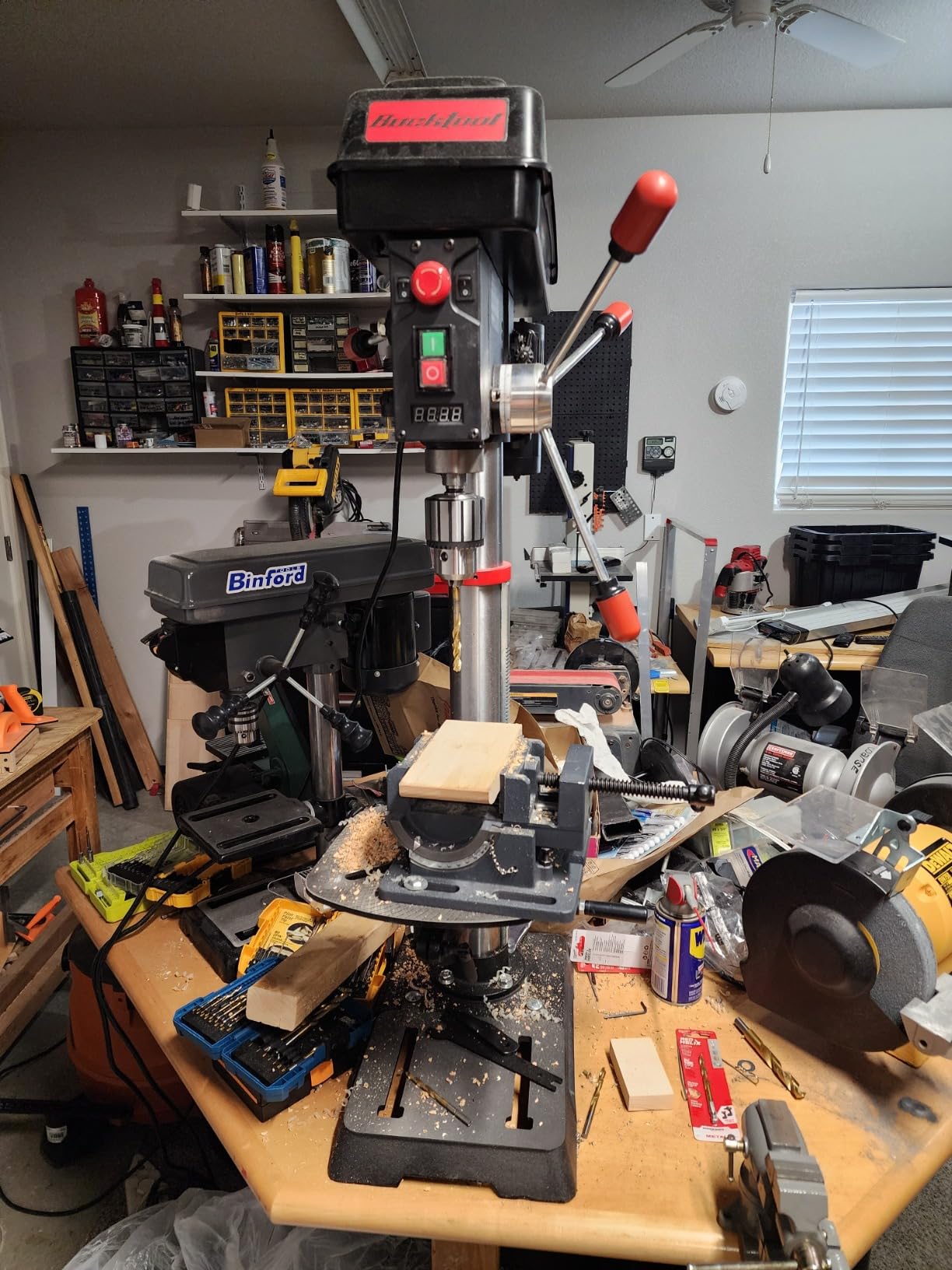
At 4.6 stars from 193 reviews with 82% five-star ratings, owners consistently single out motor strength and precision. The measured runout on the mounted keyed chuck is reported as essentially zero, which is the accuracy number we trust most in this roundup.
Low speed torque is the whole argument
A press that holds full torque at 580 RPM will drive a 5/8 inch cobalt twist drill through structural plate in one pass. A press with the same headline horsepower but a 900 RPM floor will stall on the same job and burn the bit while it tries. Torque at low speed is the specification that matters for steel, and this machine is the strongest of the bench presses here.
The 2 inch spindle travel and 12 inch swing give it room for a vise and a substantial workpiece, and the overall height of 39 inch makes the column clearance workable for taller parts than most 12 inch presses allow.
Keyed chuck security and measured runout
The 1/32 to 5/8 inch keyed chuck is the right choice for ferrous work. A keyed chuck grips a taper shank with steel jaws under the same torque that a keyless chuck relies on friction to hold, and a bit that slips in steel is both a ruined hole and a serious hazard.
The chuck key position behind the spindle is a genuine irritation in daily use, and so is the absence of a quill lock, which means you cannot tap reliably on this machine. Those are the two real drawbacks.
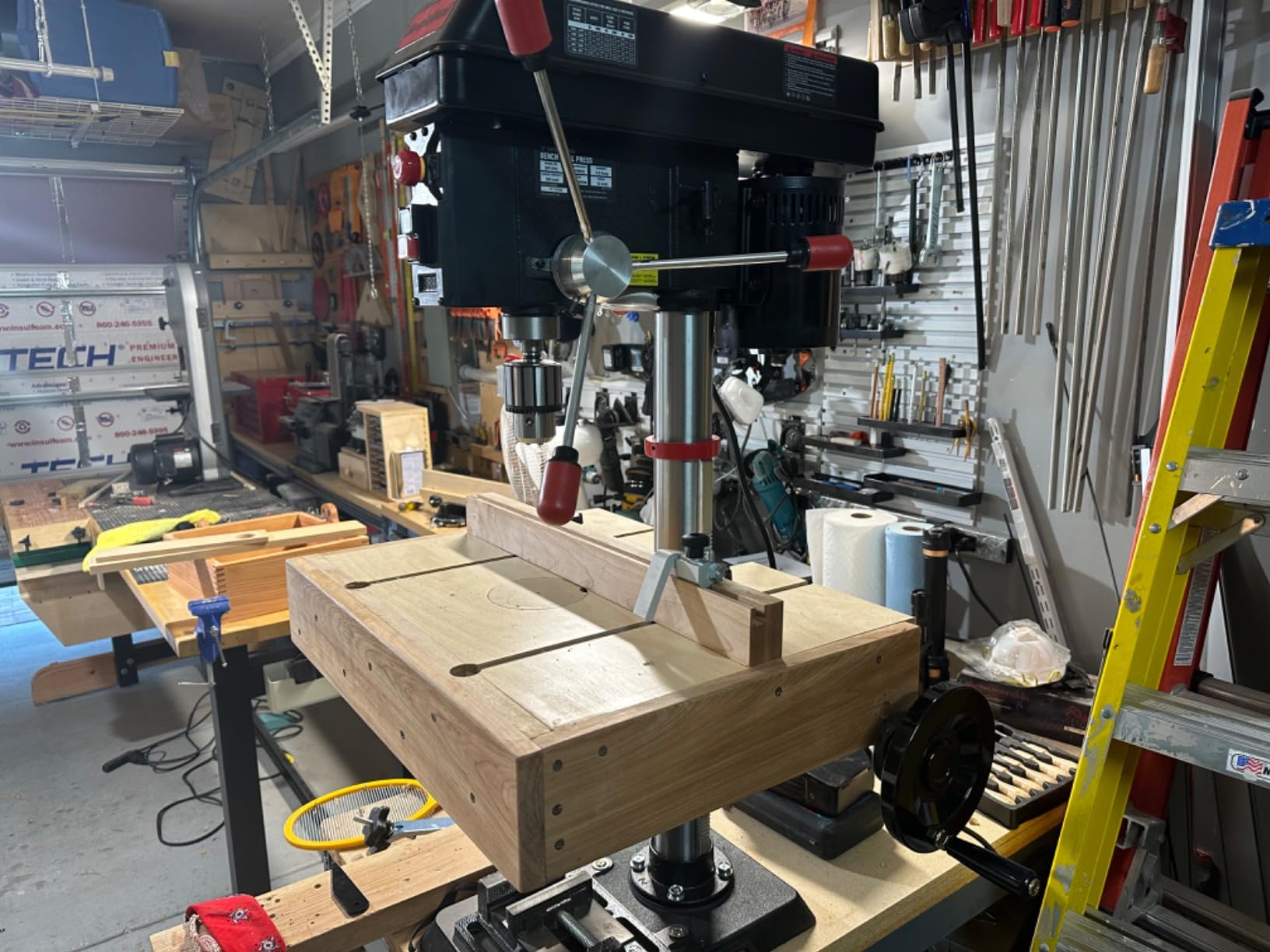
Table design, tilt and workholding
The table rotates 360 degrees and bevels 45 degrees in either direction, which covers angled drilling into tube and pipe walls without moving the workpiece. The flat table edge is a genuine advantage over a round table, because a vise bolts flat to it in seconds.
Against that, the table is small. Long bar and wide plate will overhang, and overhang is where chatter and tapered holes come from. If your work is long stock, budget for a roller table extension.
Safety hardware and who should skip it
The emergency stop switch and the no voltage release switch are both fitted, and a Class IIIA 2.5mW laser plus a work light handle setup and visibility. The no voltage release means the machine will not start up again on its own after a power interruption, which matters in a shop with older wiring.
Skip this one if tapping is part of your work, because the quill will not lock in the down position. Skip it if your workpieces are long, because the table is compact. At 86.5 lb it also has real presence on a bench, so check your bench height before you commit.
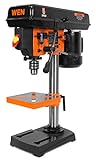
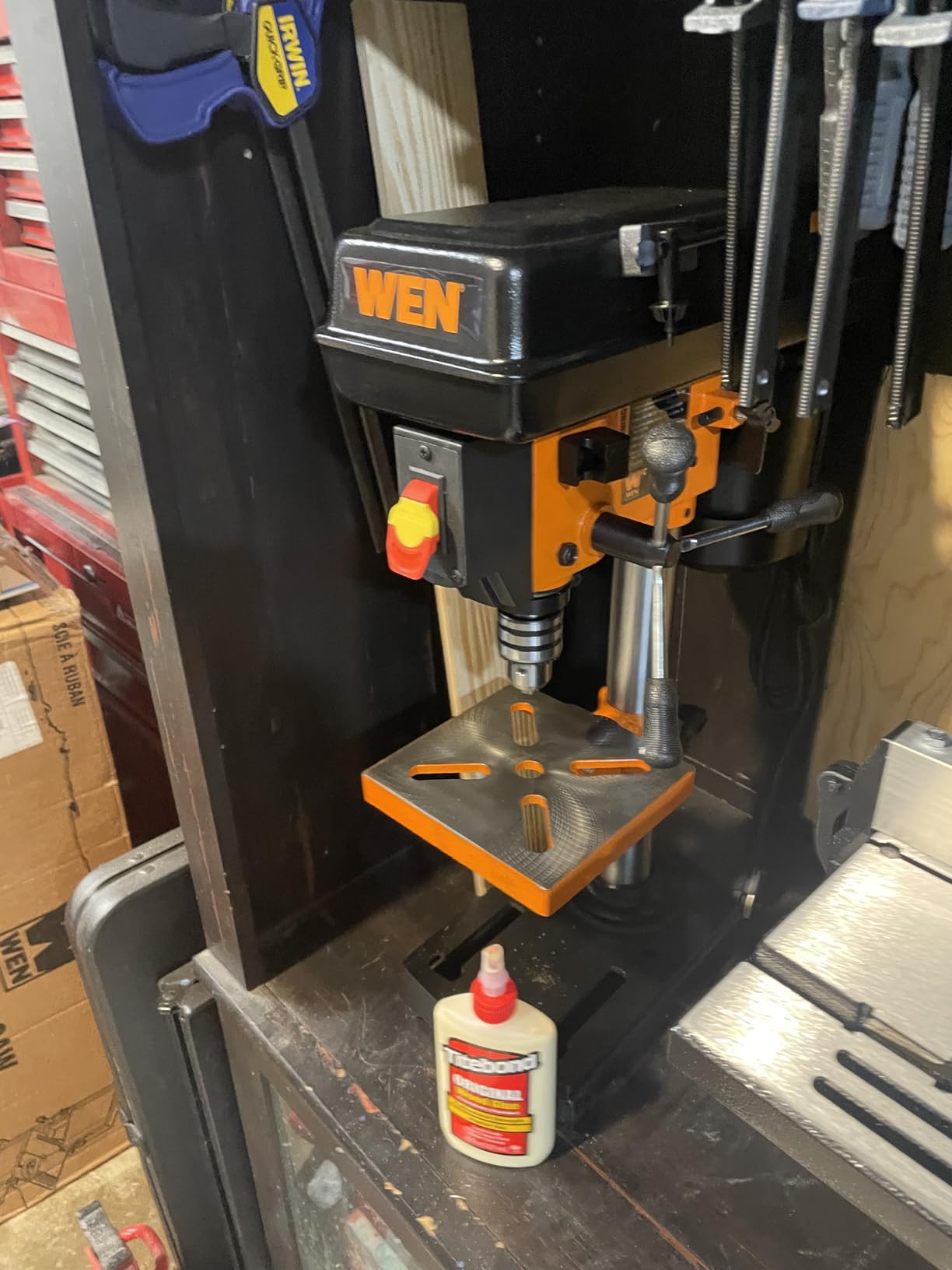
4. WEN 4206T – Compact Cast Iron Bench Press for Light Plate and Hobby Fabrication
WEN 2.3-Amp 8-Inch 5-Speed Cast Iron Benchtop Drill Press (4206T)
2.3 amp motor
750 to 3200 RPM, five speeds
1/2 inch keyed chuck
6.5 inch tilting table
32 lb
+ Pros
- Cast iron table and base at an entry level price
- Compact 23 inch height fits a small bench
- Table bevels 45 degrees in each direction
- Onboard chuck key storage
– Cons
- 2.3 amp motor limits heavy metal capacity
- 0.5 inch chuck will not accept larger bits
- Belt changes need a pulley repositioned
- Bottom speed still too fast for large bits in steel
The WEN 4206T is the most reviewed machine in this roundup, with 797 ratings averaging 4.6, and that tells you something about who buys it. It is a small shop and hobby press for plate work, drilling and light tapping, and it does that job for far less than the alternatives.
What you get for the money is genuine cast iron in the base and table, a 1/2 inch keyed chuck with the key stored on the machine, and a height adjustable table that bevels 45 degrees in each direction. At 32 lb and 23 inch tall, it fits on a bench you already own.
Five discrete speeds at 750, 1100, 1500, 2100 and 3200 RPM cover most hobby and light fabrication work. The 2.3 amp motor is the constraint, and the owner reviews are honest about it: this is a plate press, not a production steel press.
What a 2.3 amp motor means for steel
Roughly a third of the output of the 6.2 amp presses in this list, and on a long cut in plate the motor heats and the bit dulls before the hole is through. Reviewers report overheating after only a couple of minutes on steel with a big bit, which matches what the numbers predict.
For 1/8 inch and 1/4 inch material, drilled on the slower settings with a cobalt bit, it works. Keep the bit size sensible, use cutting fluid, and this press is a good companion to a handheld drill for anyone making knife blanks, brackets or small hardware.
Chuck capacity, spindle travel and the 0.5 inch ceiling
The 1/2 inch chuck is the real limit on future work. Once you outgrow it, you are looking at a bigger machine rather than a bigger chuck, so buy this for 1/2 inch capacity and plan accordingly. Metal drilling capacity is listed at 0.5 inches, which is the honest number.
The 2 inch spindle travel is unremarkable but adequate, and the 8 inch swing is fine for a vise holding small plate.
Belt changes and the case for five discrete speeds
Reaching under a belt cover to reposition a pulley is the most complained-about task on any stepped-pulley press, and it is a real interruption mid job. Five speeds sounds limiting until you realise that the two speeds you use constantly on plate are already on the front of the machine.
The trade is worth understanding before you buy: no fine control, no digital readout, and no on-the-fly changes, in exchange for simplicity and a low cost of ownership.
Who it suits and who should skip it
Buy the 4206T if you work mostly in thin plate, aluminium, brass and wood, and want a keyed chuck and cast iron table at a modest outlay. It is also a reasonable second press for a shop that already has something faster.
Skip it if you drill 5/8 inch or larger bits in steel, if you tap regularly, or if you want continuous speed control. None of those is what this machine was built for.
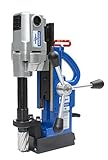
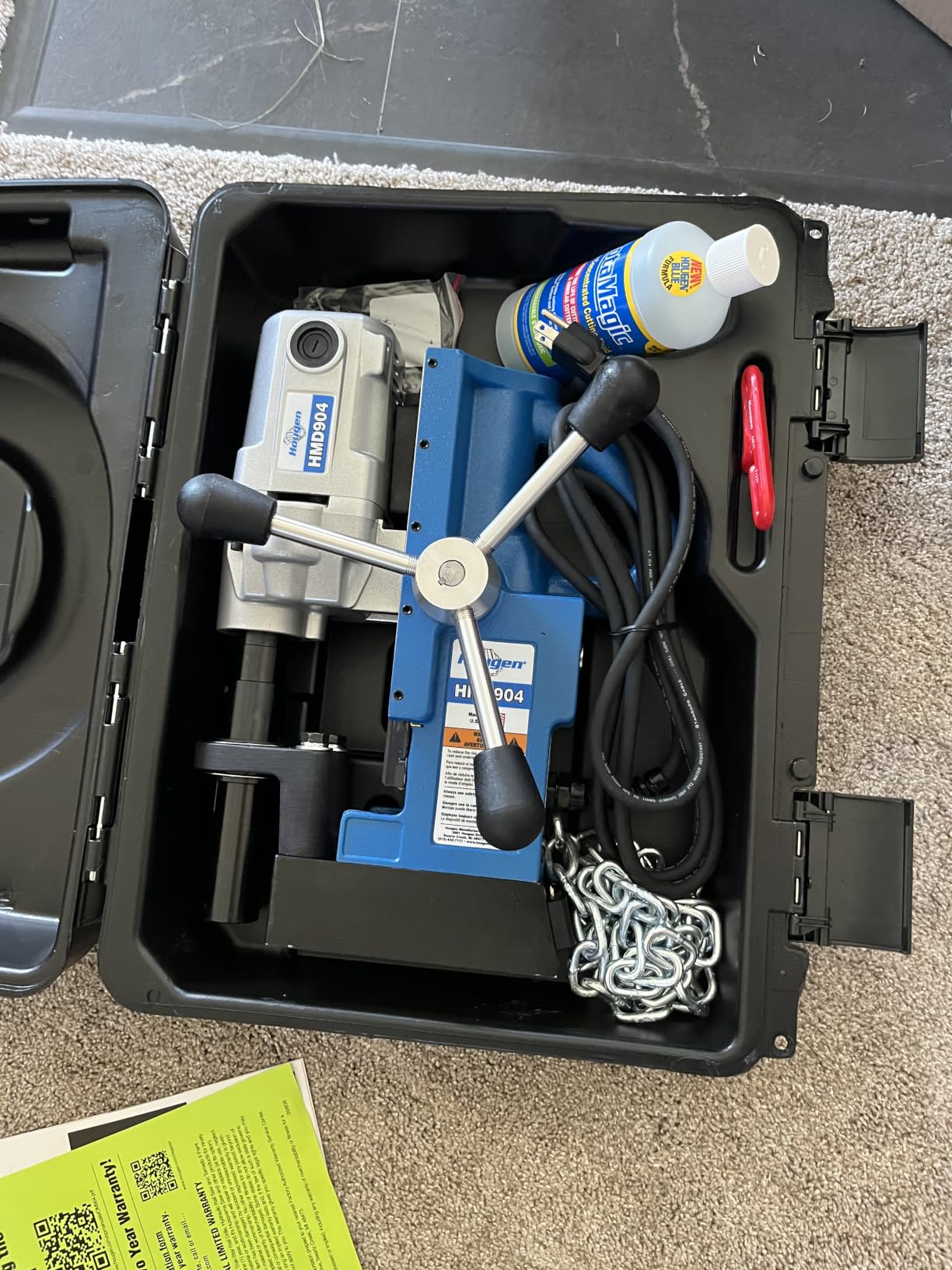
5. Hougen HMD904 – 1-1/2 Inch Magnetic Drill Built for Structural Fabrication
Hougen HMD904 115-Volt Magnetic Drill
1-1/2 inch by 2 inch capacity
450 RPM maximum
2 speed settings
34.9 lb
Lift detector system
+ Pros
- Highest average rating in this group at 4.8 stars
- 1-1/2 inch capacity takes annular cutters in structural steel
- Reposition the drill without switching the magnet off
- Lift detector and LED pilot light aid accuracy
- Built in the USA with responsive technical support
– Cons
- Two speeds give less control than a variable mag drill
- Premium cost against generic magnetic drills
- 34.9 lb to carry up a ladder or onto a tower
The Hougen carries the highest average rating of any machine in this roundup at 4.8 stars, with 90% of its 110 reviews at five stars and no one-star ratings at all. Owners describe it as flawless on thick structural steel, and the pattern of feedback is what you would expect from a tool built for one job and built well.
The 1-1/2 by 2 inch capacity is the headline. That is enough diameter for large holes and annular cutters in structural steel, which is exactly the work most people buy a mag drill for. A 6 amp, 115 volt machine that tops out at 450 RPM is slow by design, and slow is what steel wants.
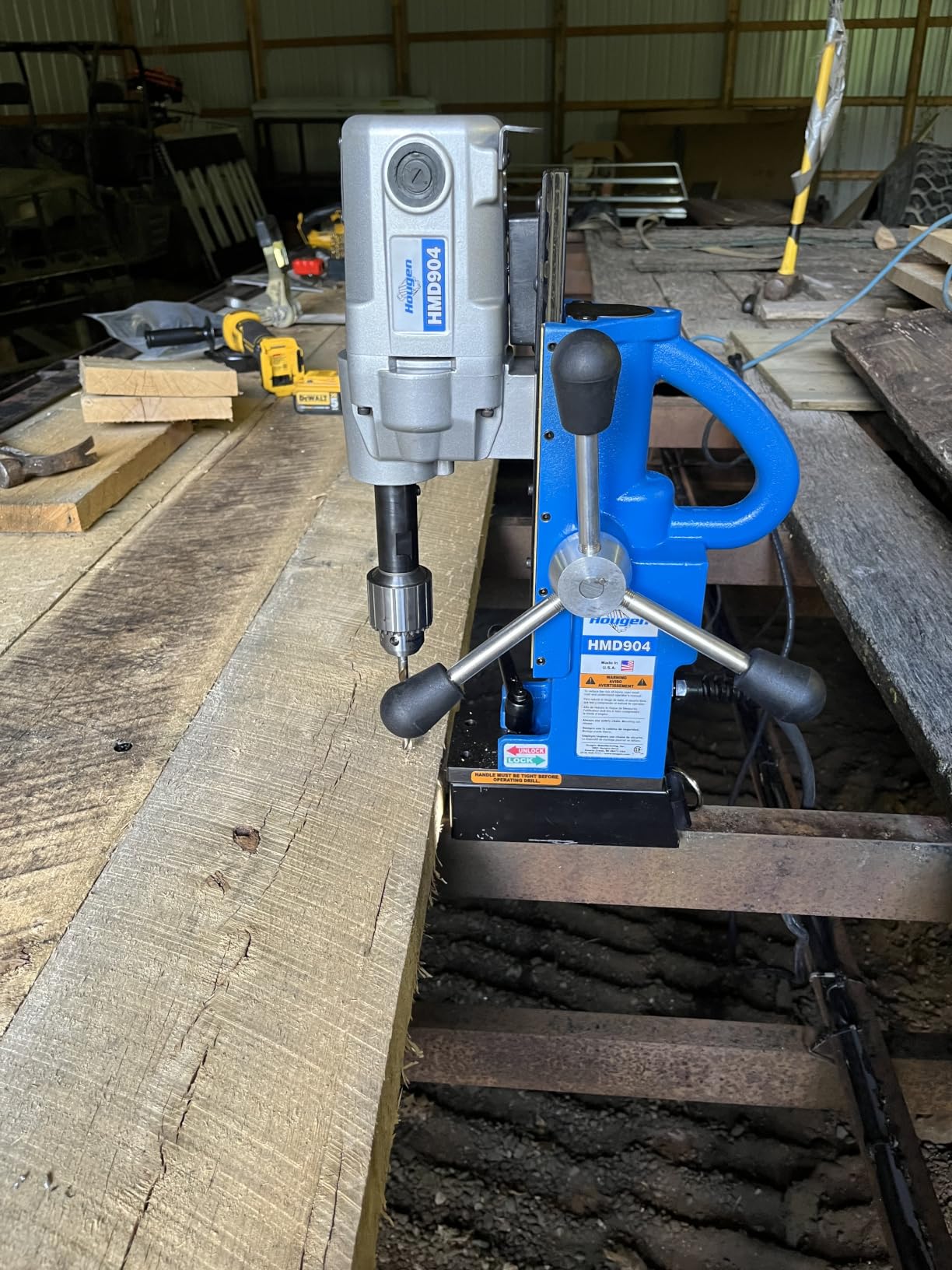
Two details separate this from generic magnetic drills. You can reposition the drill location without switching the magnet off, so a line of holes in a web or a bracket does not mean picking the tool up and resetting each time. The lift detector safety system watches for the tool being pulled off the work and shuts it down, and the LED pilot light improves hole accuracy in low light.
Why 450 RPM is an advantage rather than a limitation
On structural steel, low spindle speed with full motor torque is the correct pairing. The bit stays sharp, the hole stays on size, and the work does not work harden around the flutes. A mag drill that runs fast is a handheld drill with a magnet on it.
The tradeoff is real, though. Two speed settings give far less control than a continuously variable mag drill, and if you work thin gauge or small fasteners you will find yourself changing setup more often.
Slot drive arbor and quick cutter changes
The slot drive arbor is a deceptively good feature. Accessory changes are faster and, more importantly, repeatable, so a pilot drill, an annular cutter and a step drill sequence keeps the same orientation and the same hole position through the cut.
On a structural job where you are stepping from a pilot to a large annular cutter, that consistency is what keeps the finished hole from wandering off the marked centre.
Who it suits and who should skip it
Buy the HMD904 if you are a steel erector, a field fabricator, or anyone who regularly drills structural sections and needs a machine that is accurate and will still answer a phone call for technical support. The lower overall height compared with many mag drills also helps on awkward overhead work.
Skip it if you are drilling mostly thin material, if you need the machine for aluminium or stainless where a magnet cannot hold, or if the budget is tight. The premium is real and a generic magnetic drill will handle plate work. The Hougen earns its place on diameter and support, not on price.
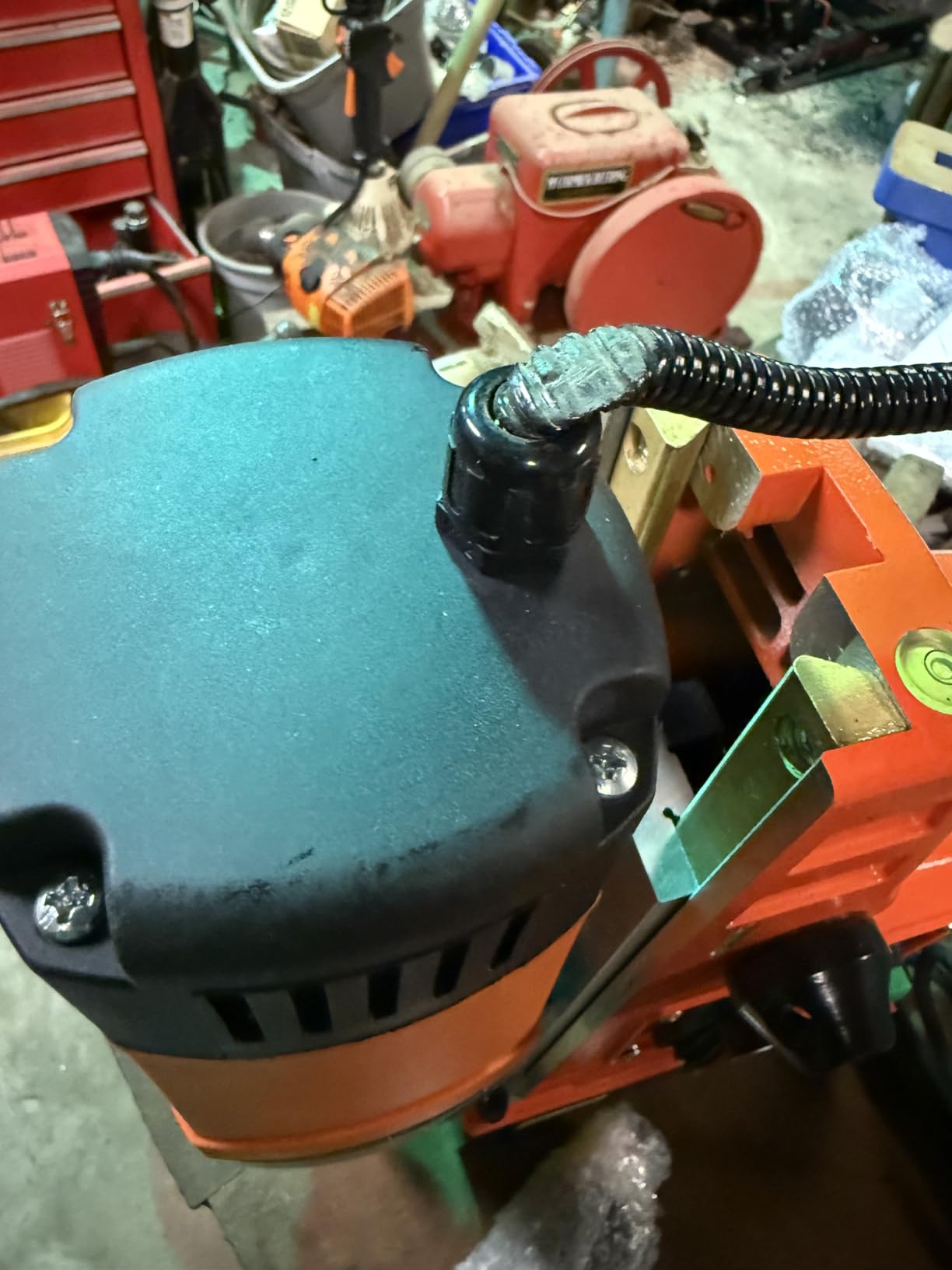
6. VEVOR MD-50A – 2922 lbf Magnetic Press for Coring Holes in Structural Steel
VEVOR 1550W Mag Drill Press, 2″ Core Drilling Machine, 2922 lbf 0-550 RPM Variable Speed Portable Magnetic Drill, Heavy Duty Metal Hole Cutter for I-Beam Steel Fabrication, Workshop & DIY Work
1550W motor
2922 lbf holding force
0 to 550 RPM, ten settings
2 inch coring diameter
39 lb
+ Pros
- 2 inch coring capacity on structural steel
- 2922 lbf holding force grips I-beams and heavy section
- Ten speed settings plus a built-in depth scale
- Alloy guide rail and rapid cooling extend tool life
– Cons
- Manufacturer states it is not for stainless or cast iron
- Needs steel at least 0.39 inch thick to hold the magnet
- Safety rope required for inverted or horizontal drilling
The MD-50A is the value entry into serious magnetic drilling. A 1550 watt motor, 2922 lbf of holding force and a 2 inch coring diameter in one 39 lb package, rated at number one in its category by best sellers rank, is a lot of capability for the money.
Ten speed settings across 0 to 550 RPM give finer control than the two-speed machines in this list, and the built-in depth scale in millimetres means coring depth is repeatable without a separate rule. That combination makes it a genuine production tool rather than a one-off field drill.
Reviews average 4.4 stars across 397 ratings, with 74% five-star, and owners consistently cite the magnetic holding force and coring capability on structural steel. The alloy guide rail and rapid cooling system are the features that show up in long-run feedback as tool life rather than as spec sheet lines.
2922 lbf of holding force and what it means on an I-beam
Holding force is the number that decides whether a mag drill stays put. With 2922 lbf, the machine has the margin to coring in a vertical or angled position on a heavy structural section, which is where a weaker magnet walks off mid-cut and drops the tool.
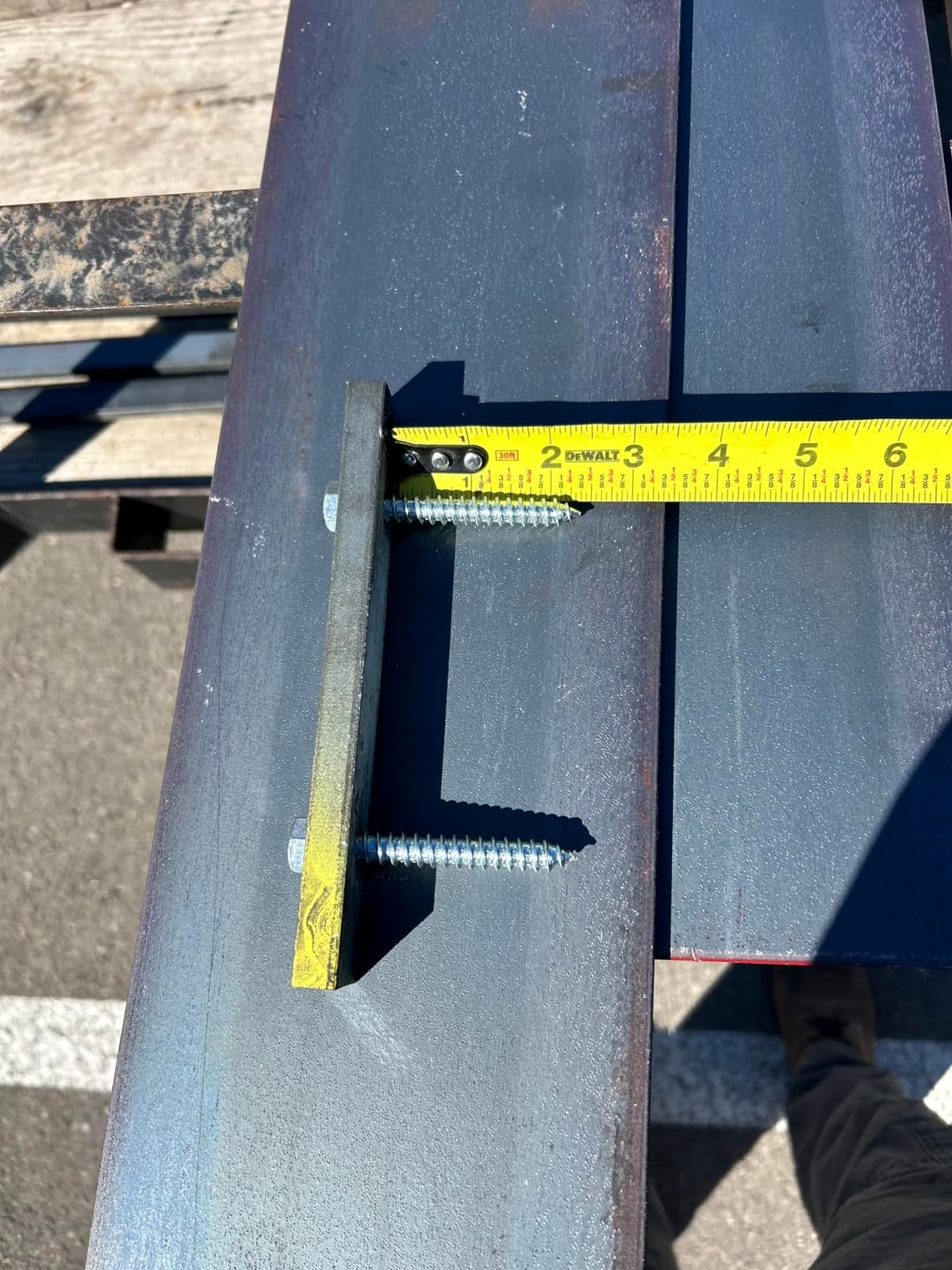
There is a hard condition attached, and it is not optional. The manufacturer specifies steel of 0.39 inch, or 10 mm, or thicker for the magnet to grip, and states the tool is not suitable for stainless steel or cast iron. Those two limits between them rule out thin gauge material, stainless and cast iron castings, and they are worth reading twice before you buy.
Coring diameter, depth scale and the guide rail
A 2 inch maximum coring diameter and 2 inch maximum coring depth covers the majority of structural and plate work. The ten speed settings let you match spindle speed to cutter diameter, which is what keeps an annular cutter from glazing up and burning out mid-hole.
Three extended cranks on the feed handle give you the control to keep the cut feeding evenly once the pilot breaks through, and the ergonomic handles are a genuine improvement over short single-pin feeds on cheaper mags.
Overhead safety and who should skip it
For inverted or horizontal drilling, a safety rope is required, and it is included in the box along with the coolant tank, coolant tube, chuck key and twist drill chuck. That is a complete kit for steel work rather than a bare machine.
Skip it if your material is stainless or cast iron, or if your material is thinner than 0.39 inch. If your work is mainly structural steel above the minimum thickness and you want coring capability without a large outlay, this is the machine.
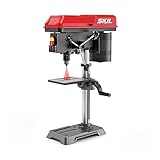
7. SKIL DP9505-00 – 6.2 Amp Press with Laser Alignment for First-Time Metalwork
SKIL 6.2 Amp 10 In. 5-Speed Benchtop Drill Press with Laser Alignment & Work Light – DP9505-00
6.2 amp induction motor
610 to 2800 RPM, five speeds
0.5 inch chuck
Laser alignment and LED light
3 year warranty
+ Pros
- 6.2 amp motor punches through mild steel on the lowest speed
- Laser alignment arrives accurate and speeds up setup
- Tilting work surface covers 0 to 45 degrees in both directions
- Depth stop and LED work light aid repeat work
– Cons
- Column and support plate are less rigid than heavier presses
- Included chuck shows slight runout
- Worm drive table adjustment is finicky before lock down
- Factory table alignment and bolt machining are inconsistent
This is the press I would hand to someone moving from wood to steel for the first time. A 6.2 amp induction motor is far more than the 5 amp standard in this size class, and owners specifically report it pushing through mild steel on the lowest of its five speeds, which is the practical test that matters.
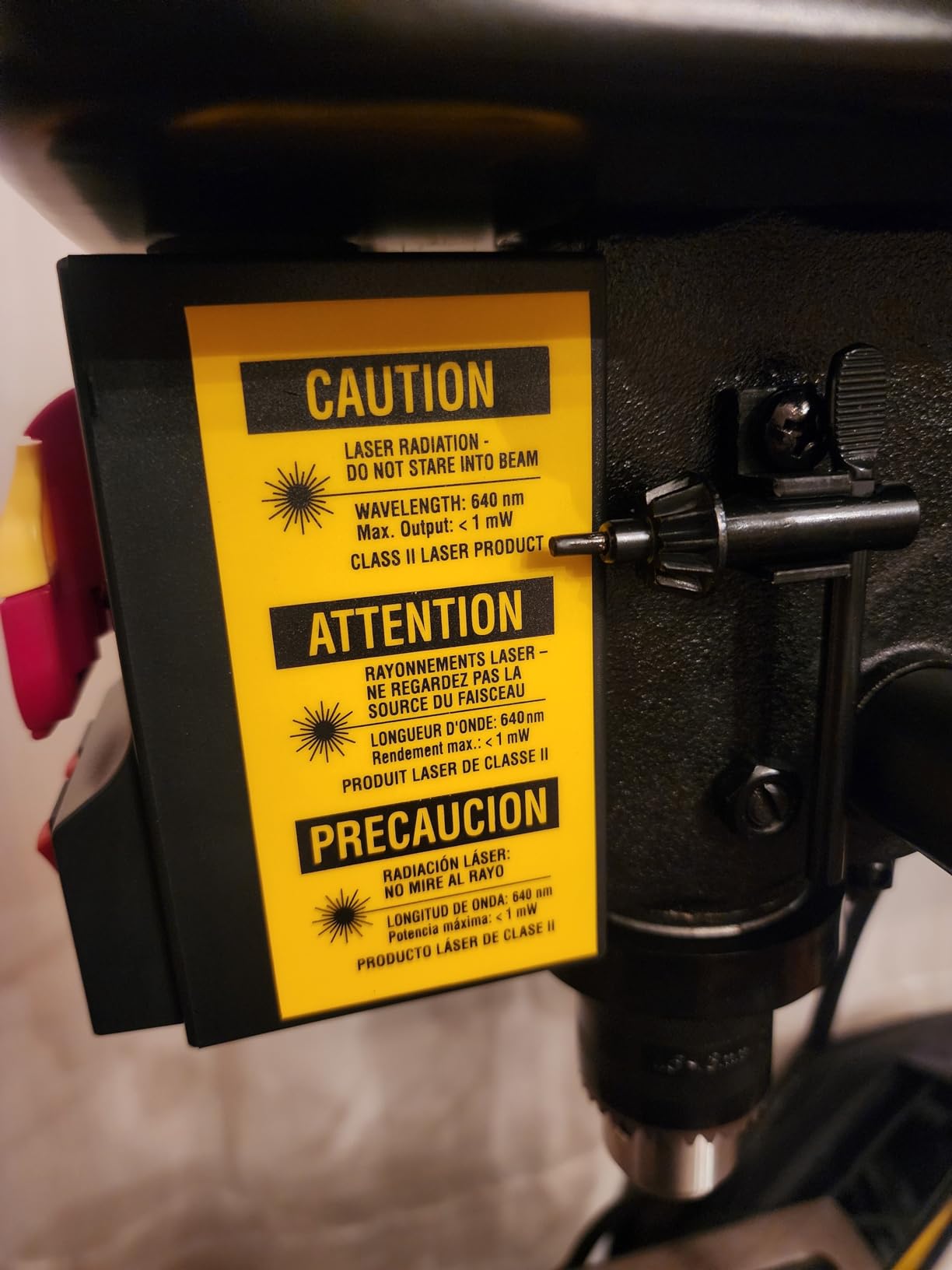
The laser alignment system arrives accurate, and that single feature removes more frustration for a new metalworker than any other feature on the machine. You mark the centre, switch the laser on, and the bit goes where you meant it to go.
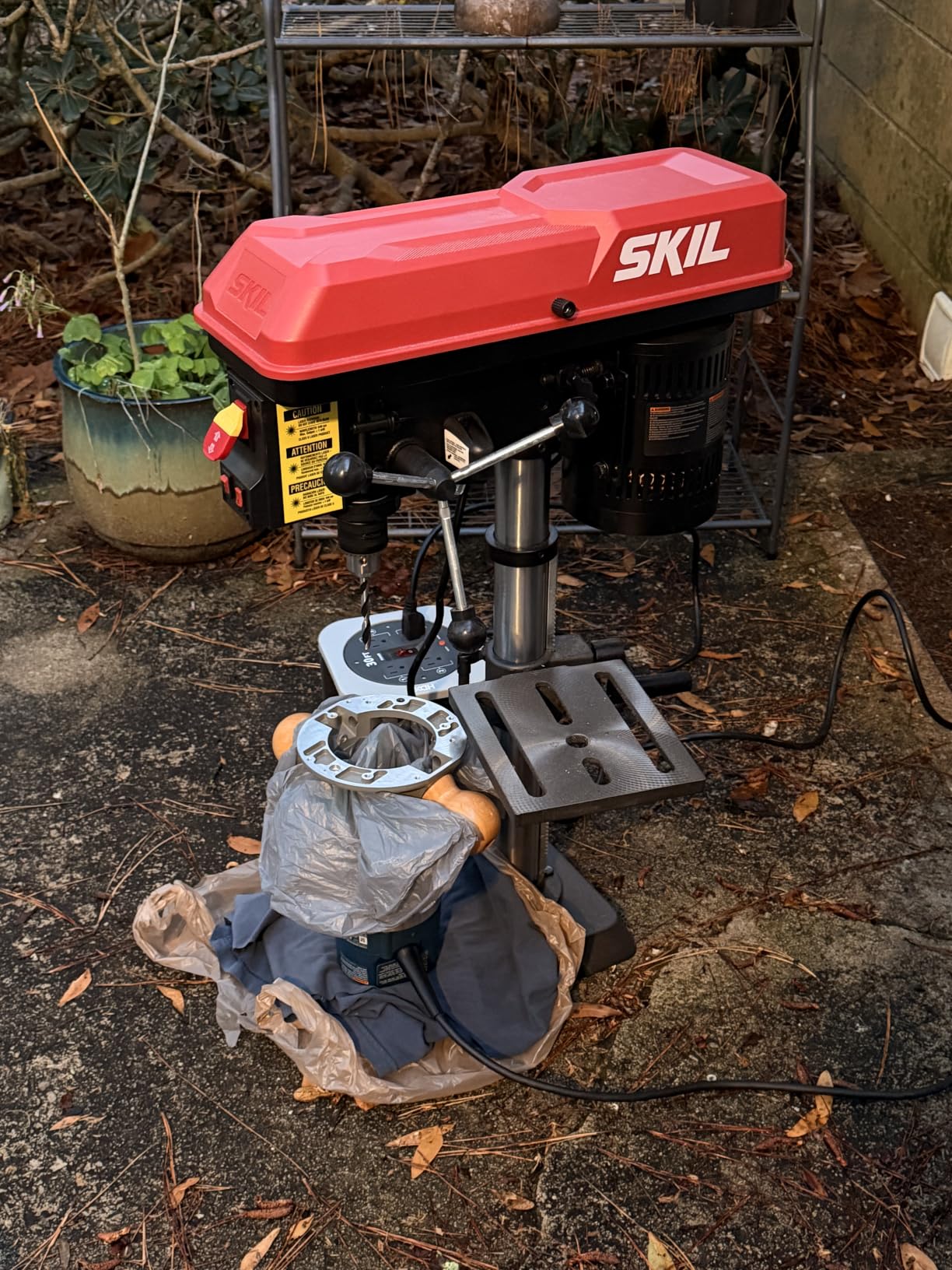
At 4.3 stars across 521 reviews, this is the most polarised machine here. Sixty-eight percent are five-star, but a 7% one-star share is the second highest in the roundup, and those reviews cite table alignment and mis-machined adjustment bolts. Quality control is the story with this press, not capability.
Motor capability and the 610 RPM floor
744 watts and 610 to 2800 RPM across five speeds is a useful spread. For plate work in mild steel with cobalt bits, the bottom two speeds are where you should live, and the 6.2 amp motor gives you the torque to stay there without stalling.
Where it falls short is rigidity. The centre column and support plate are not as stiff as a cast iron base, and on a big bit in thick material you will feel the difference compared with the JET or the BUCKTOOL. A stiff base turns side force into forward force instead of into a wandering bit.
Depth stop, bump-off switch and repeatability
The adjustable depth stop is genuinely useful, and a press without one makes every repeat hole a judgement call. Combined with the laser, it means a batch of identical holes is achievable by a beginner rather than only by someone with a good feel for the quill feed.
The bump-off switch is a nice piece of safety engineering for a machine people approach with their hands close to the chuck. The LED work light clears up a dark hole, which on steel matters more than it does on wood.
Factory quality control you should check on arrival
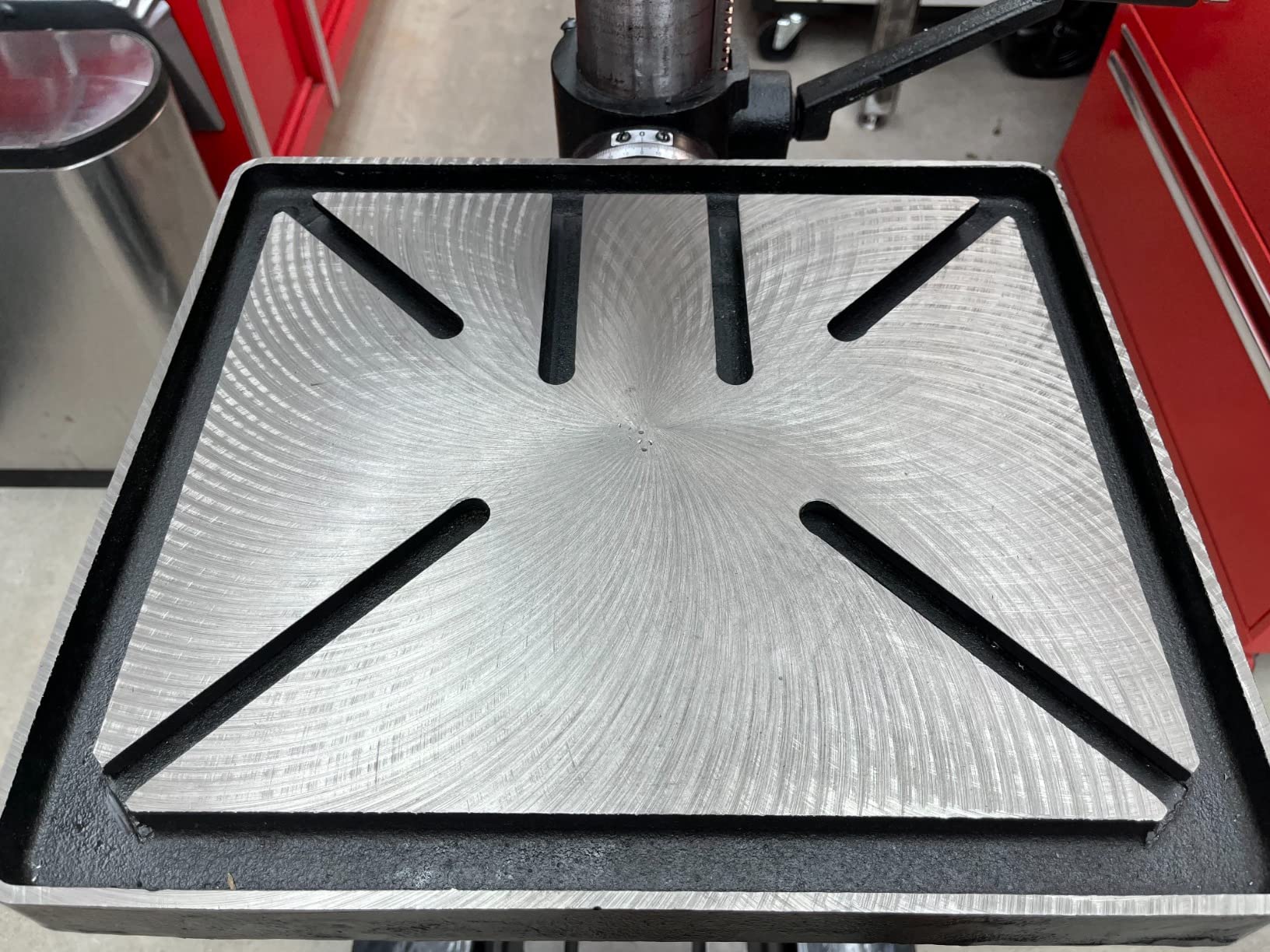
This is the honest part of the review. Some examples arrive with a table tilted out of square and a mis-machined adjustment bolt, and the included chuck has shown slight runout in owner reports. Before you cut anything, check the table against a machinist square and run a test hole in scrap.
None of that is a dealbreaker if you are near a warranty service path, and the three year limited warranty covers the parts that fail. It is a dealbreaker if you have one afternoon and no patience for setup.
Who it suits and who should skip it
Buy the DP9505-00 if this is your first steel press, if your work is plate, angle iron and light structural, and if the laser alignment and depth stop will save you from developing bad habits. It is a capable machine for the money.
Skip it if you run heavy bits continuously, if hole position repeatability has to be exact without rework, or if you cannot tolerate inspecting a new machine on arrival. For those cases the JET JWDP-12 or the BUCKTOOL DP12VL are the safer buys.
8. JET JDP-20MF – 1.5 HP Floor Press for Heavy Castings and Production Runs
JET 20-Inch Floor Drill Press, 12 Speed, 1-1/2 HP, 115/230V 1Ph (JDP-20MF)
1-1/2 hp motor
12 speeds, 150 to 4200 RPM
282 lb floor stand
0.75 inch chuck
MT3 arbor
+ Pros
- 1-1/2 hp motor and ball bearing spindle take heavy cuts
- 150 RPM is the lowest speed floor in this roundup
- External positive depth stop locks three ways
- Hinged belt cover speeds up speed changes
- Rotating 45 degree tilting crank table
– Cons
- 282 lb floor format takes significant shop space
- Belt changes between the 12 speeds are still manual
- 2 year warranty is the shortest coverage here
The JDP-20MF is the only floor model in this roundup and the only machine here that can honestly be described as a production press. A 1-1/2 hp motor, a ball bearing spindle, 282 lb of machine and a 150 RPM bottom speed is a different category from anything else on this list.
That 150 RPM floor is the headline for steel. It means large cutters in thick material can be turned slowly enough to cut rather than grind, and no bench press here comes close to that speed range. The 12 speeds run all the way to 4200 RPM for aluminium and small bits.
At 4.4 stars across 90 reviews, satisfaction is solid but the sample is small, which is what you would expect from a specialist floor press. Owners single out the motor and the depth stop, and a 9% one-star share reflects the scale of the commitment rather than a defect.
Why a 1.5 hp motor and a 150 RPM floor change the job
Horsepower is not the interesting number, sustained torque at low RPM is. A bench press with a 600 RPM floor and half this torque will struggle on a 3/4 inch bit in thick plate; this machine is specified for it. For castings, structural sections and repeated production holes, that is the difference between a finished part and a scrapped one.
Fine ball bearings supporting the spindle reduce rotational friction and increase load support, which is what keeps spindle feel solid at the low end of the range rather than vague.
Depth stop, belt cover and speed changes
The half inch external positive depth stop with a three nut locking feature is a proper production solution. It is outside the machine, it is positively located, and it locks three ways, so repeat depth does not depend on clamping a collar and hoping.
The hinged metal belt and pulley cover with a quick adjustment motor mount is the best speed change mechanism here, though it is still a belt change rather than a switch. Plan for it rather than expecting a JET JWDP-12 style lever.
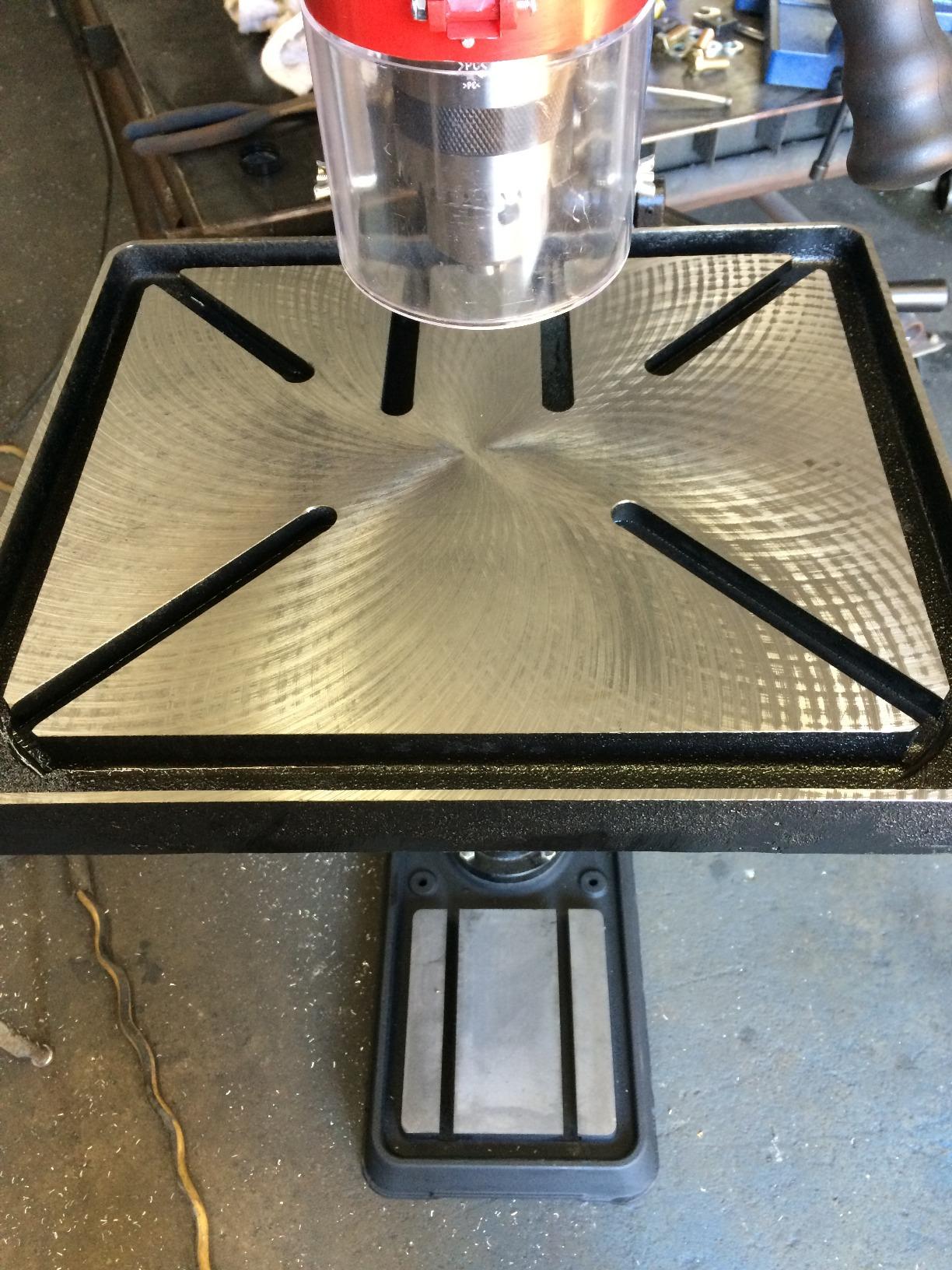
Table, MT3 arbor and shop fit
The crank-operated table rotates and tilts 45 degrees with a quick-release clamp, which makes angled work into tube and pipe practical. The MT3 spindle with a JT4 arbor adapter is a larger taper than a bench press, giving more bit capacity and a stiffer shoulder for heavy cutters.
The counterweight is the hidden cost. At 282 lb and 66 inch tall, this machine needs a dedicated footprint and a floor that can take it, and the two year warranty is the shortest coverage in this roundup. The work lamp takes a bulb sold separately, a small annoyance that tells you how the accessory list was put together.
Who it suits and who should skip it
Buy the JDP-20MF if you are running production holes, large annular cutters, heavy castings or thick plate, and if you have the floor space. It is the right answer for a small fabrication shop that has outgrown a bench press.
Skip it if you drill occasional holes in plate. A floor press is an infrastructure purchase, not a starter tool, and a 6.2 amp bench press will serve you for years at a fraction of the commitment. Machine sizing should follow the biggest hole you actually need, not the biggest hole you might one day need.
How to Choose a Drill Press for Steel: 8 Criteria That Matter
1. Torque at low RPM beats horsepower on paper
Retailers advertise peak horsepower and shoppers compare it, which is a mistake. A press with a published 1/2 hp and a 530 RPM floor will outperform a press claiming more power with a 900 RPM floor, because the second machine is spinning the bit faster than the material allows and generating heat instead of cutting.
Our disqualification rule for metalwork is simple: a bench press rated under 3 amps is not a metalworking press. That rule alone removes several very popular machines from consideration. For real steel work, look for 6.2 amps or more, or 1/2 hp and up in a floor model.
2. The speed floor and the speed-to-diameter math
Spindle speed should match drill diameter and material, which is why a wide range with a low floor matters more than a wide range with a high floor. A useful working rule for mild steel is roughly 100 RPM per hundredth of an inch of drill diameter, and about 150 RPM per hundredth for aluminium, which needs more speed and far less torque.
That rule explains everything on this list. A 1/2 inch cobalt drill in mild steel wants about 500 RPM, which is exactly where the JET, the BUCKTOOL and the SKIL land at their lowest setting, and exactly why a press that stops at 750 RPM forces you into small bits. If you drill 1/2 inch or larger in steel regularly, a 600 RPM floor is the threshold, not a nice to have.
3. Cast iron versus pressed steel bases and machine weight
Weight is a specification, not an accident. Every press in this roundup that has a cast iron base or head is at least 32 lb, and the machines that hold their position under side load are the heavy ones. Thin pressed sheet bases flex, the whole machine walks, and the hole goes off centre and exits with a burr on the underside.
Cast iron does two things: it does not flex, and it damps vibration. That is why the 85 lb JET and the 86.5 lb BUCKTOOL feel completely different from a light machine of the same stated swing, even with the same chuck.
4. Chuck security, taper and quill travel
For ferrous work a keyed chuck is the correct answer, and a keyless chuck is a compromise. A keyless chuck holds a bit by friction on smooth shanks, so it can release under sustained drilling torque, and a bit releasing in steel is a ruined hole and a serious hazard. The rule we apply: no keyless chuck on any press you will use for metal.
Spindle travel is what lets you drill depth rather than scratch depth. Two inches is standard, and more is better for coring and deep holes. The DEWALT mag drill is the outlier at four inches for exactly that reason.
5. Tapping, and why the quill lock matters
Yes, a drill press can tap threads, but only if the quill can be locked in the down position. Without that lock, the spindle rotates with the tap and the thread comes out wrong every time. The BUCKTOOL DP12VL in this roundup cannot tap reliably for exactly that reason, and we flag it in its section.
For tapping, add a tap holder that keeps the tap from turning and start the spindle well below the tapping speed, then stop and reverse out. Do this on a machine with a quill lock, not a workaround on one without.
6. Table size, tilt and workholding
The most underrated specification. A table that is too small for the workpiece forces overhang, and overhang causes chatter and tapered holes. T-slots matter for anyone bolting a vise or a fixture, because round holes make a mounting plate wander.
Tilt is genuinely useful and not just a gimmick. A table that bevels 45 degrees lets you drill into the wall of tube or pipe without moving the workpiece, which is faster and more accurate than trying to hold a round section square by hand.
7. Safety switches, depth stops and light
Look for a bump-off or emergency stop switch, a switch that cannot be left on, and a work light. On steel the hole fills with cutting fluid and shadow within seconds, and drilling a hole you cannot see is how bits break. A depth stop is the difference between a batch of identical holes and a batch of nearly identical holes.
A laser crosshair is a convenience, but a cross rather than a single dot is meaningfully easier to align on a marked centreline.
8. What to skip, and sizing the circuit first
Skip any press with a motor under 3 amps if the work is metal, any press that ships with a keyless chuck and no keyed alternative, and any machine with a thin pressed sheet base sold as heavy duty. Run a test hole in scrap before you cut anything you care about, because out-of-square tables ship more often than they should.
Before a 1 hp or larger machine arrives, confirm the circuit. A 1/2 hp press on 115 volts is a dedicated 15 amp circuit with very little spare capacity, and a 1-1/2 hp floor press at 18 amps needs a 20 amp circuit or a 230 volt supply. The JET JDP-20MF runs 115/230 volt single phase, so a 230 volt circuit is the sensible target if your panel can take it. Measure first, buy second.
Bench, Floor, Radial and Magnetic Presses Explained
Before choosing a machine, choose a class. The four classes in this roundup are not interchangeable, and the most common buying mistake we see is expecting a bench press to do a floor press job.
Bench presses are fixed to a bench, are light, and are the right answer for plate, bar and small material. The WEN, SKIL, BUCKTOOL and JET JWDP-12 are all in this class. Their limit is swing, table size and how hard the frame resists side load.
Floor presses stand on the shop floor with a much heavier frame, a larger table and a bigger motor. The JET JDP-20MF is the only one here. If your biggest hole is 3/4 inch or more, or if you run the same hole hundreds of times, a floor press is the correct class rather than an extravagance.
Radial arm presses swing the head over the work, which lets you reach a long part without moving the workpiece. They are the standard for structural steel and production drilling, and they are the biggest gap in this roundup: none of our eight picks is a radial arm machine. If you regularly drill holes along a beam or in a long frame, a radial press is worth a dedicated look.
Magnetic drill presses clamp to ferrous material and go where the work is. The DEWALT, Hougen and VEVOR are in this class. Their limit is material: they need a flat steel surface of meaningful thickness, they do not work on aluminium or stainless, and they need a safety rope for inverted drilling. In exchange they need no bench, no power drop and no setup.
Drilling Steel Safely: Speeds, Cutting Fluid and Peck Drilling
The failure mode that comes up in nearly every machinist forum thread and every owner review is the same: a 3/8 inch twist drill run at 3000 RPM in steel. It burns, it work hardens the hole walls, and it wanders off centre. Every other problem in this category is downstream of that one mistake.
Match speed to diameter, and let torque do the cutting
Use roughly 100 RPM per hundredth of an inch of drill diameter in mild steel as a starting point, add speed for aluminium and drop it for stainless. A 1/4 inch drill in mild steel wants about 250 RPM, a 3/8 inch wants about 375, and a 1/2 inch wants about 500. If your press cannot reach those speeds, use a smaller bit and step up.
This is why a press with no speed floor forces you into small bits and many passes. It is not a safety technique, it is a limitation working around itself.
Use cutting fluid on every steel cut
Dry drilling steel is the exception, not the rule. A pump bottle of cutting fluid, or a brush-on oil for a one-off job, does three things: it carries heat away from the flutes, it lubricates the cutting edge, and it flushes chips out of the hole so they do not pack and recut into the work.
Do not use a general machine oil for steel and expect cutting fluid performance. For stainless, use a fluid specifically suited to it and go slower still. Once the hole is cut, the burr and the finish work belongs to our best angle grinders for metalwork guide, which covers the cleaning and blending step properly.
The repeatable metal drilling sequence
- Mark the hole centre with a centre punch so the bit has something to bite into.
- Run a centre drill or spot drill to establish the location and the angle.
- Pilot drill to roughly half the final diameter to open the hole without the bit wandering.
- Step up in stages, no more than a doubling of diameter per pass, flushing between stages.
- Final pass at the recommended speed for that diameter, with steady feed and plenty of fluid.
Peck drilling and chip clearing
For any hole deeper than twice the drill diameter, retract the bit to clear chips and re-feed. Full retract every time on a press with quill travel, a partial retract in soft materials. Packed chips in the flutes turn a drill into a heater and bind it, and binding in steel is how you snap a bit.
Never hold the workpiece by hand. That is the single most repeated safety warning in the machinist forums, and it is the one rule in this article with no exception.
How to Hold Round Bar, Tube and Plate in a Drill Press
Round bar is where accuracy problems start, because a round workpiece rolls. The fix is not a stronger grip, it is geometry that cannot roll.
1. A milling vise on T-slots or a flat table. Flat bar and plate clamp directly, and T-slot tables let you bolt a vise or a fixture so it cannot shift between holes.
2. V-blocks for round bar. Two V-blocks cradle the bar along its length so the axis cannot rotate, which is the only reliable way to drill a cross hole in a round shaft without it spinning.
3. Strap clamps over the top. A strap clamp pressing down on the round section stops it lifting as the bit breaks through, which is where round material usually grabs and pulls.
4. Parallels and a square to set the drill axis. Before the spindle moves, confirm the hole location is square to the workpiece rather than eyeballing it, because a cross hole that is not square fails the part.
5. A backstop for repeat holes. A fixed block the work butts against lets you slide it back to the same position every time, which is how you get repeatability without measuring each time.
For tube and pipe, clamp across two flats rather than on the round surface, and brace the far side so the breakthrough cut does not pull the tube. Angled drilling into a tube wall is far more stable with the tilting table on the JET, BUCKTOOL or SKIL than with a hand-held angle. If the parts you are cutting came from sheet stock, our guide to small heat presses for shop fabrication covers forming and flattening the stock before it ever reaches the drill press table.
Frequently Asked Questions
What is the best drill press for metalworking?
The best drill press for metalworking is a cast iron bench press rated at 6 amps or more with a speed floor near 600 RPM and a keyed chuck. For structural steel on site with no bench, a magnetic drill press is the correct answer instead. Low speed with high torque, cast iron mass and chuck security are the three things that separate a metal press from a woodworking press.
Do I need a special drill press for metalworking?
Yes, in the sense that a light woodworking press will not survive steel. A metal press adds cast iron mass, a lower RPM floor and a keyed chuck. The minimum we consider adequate is a 3 amp motor, and 6.2 amps is the practical threshold for regular steel work. Under-3-amp motors heat up and burn bits within minutes.
What is a good RPM for drilling metal?
Roughly 100 RPM per hundredth of an inch of drill diameter in mild steel, so a quarter inch drill wants about 250 RPM and a half inch drill about 500 RPM. Aluminium wants roughly 50 percent more speed and far less torque, while stainless and cast iron need slower speeds still. If your press cannot reach those speeds, use a smaller bit and step up.
Can a drill press tap threads?
Yes, but only if the quill can be locked in the down position. Without a quill lock the spindle rotates with the tap and the thread will not form correctly. Use a tap holder to stop the tap turning, start well below tapping speed, and reverse out rather than backing out by hand. Several presses in this roundup cannot tap for exactly this reason.
Is a magnetic drill press better than a regular drill press for metal?
For structural steel on a job site, yes. A magnetic drill clamps to the workpiece itself, so it needs no bench and no power drop, and it reaches a low RPM that suits steel. Its limits are material: it needs a flat ferrous surface of at least 0.39 inch thickness, and it does not work on aluminium, stainless or cast iron. For a bench, the magnetic format is the wrong tool.
Final Verdict: Which Press Matches Your Work
If you drill structural steel where it stands, take the DEWALT DWE1622K. It has the highest motor rating in the group, overload protection, and a 4.7 star average over 521 reviews. If you want a bench machine with on-the-fly speed control, the JET JWDP-12 is the most refined, and the BUCKTOOL DP12VL is the stronger low-speed torque performer.
For thin plate and hobby fabrication on a modest budget, the WEN 4206T is a genuinely good cast iron entry point, and the SKIL DP9505-00 is the better first press for someone who will grow into steel. If the job is out on a structure, the Hougen HMD904 is the accurate one and the VEVOR MD-50A is the capable value one. If you are producing heavy parts in a small shop, the JET JDP-20MF is the correct class. Start with a bench press, run the drilling sequence in this guide, and size the next machine to the biggest hole you actually cut.
Leave a Reply