
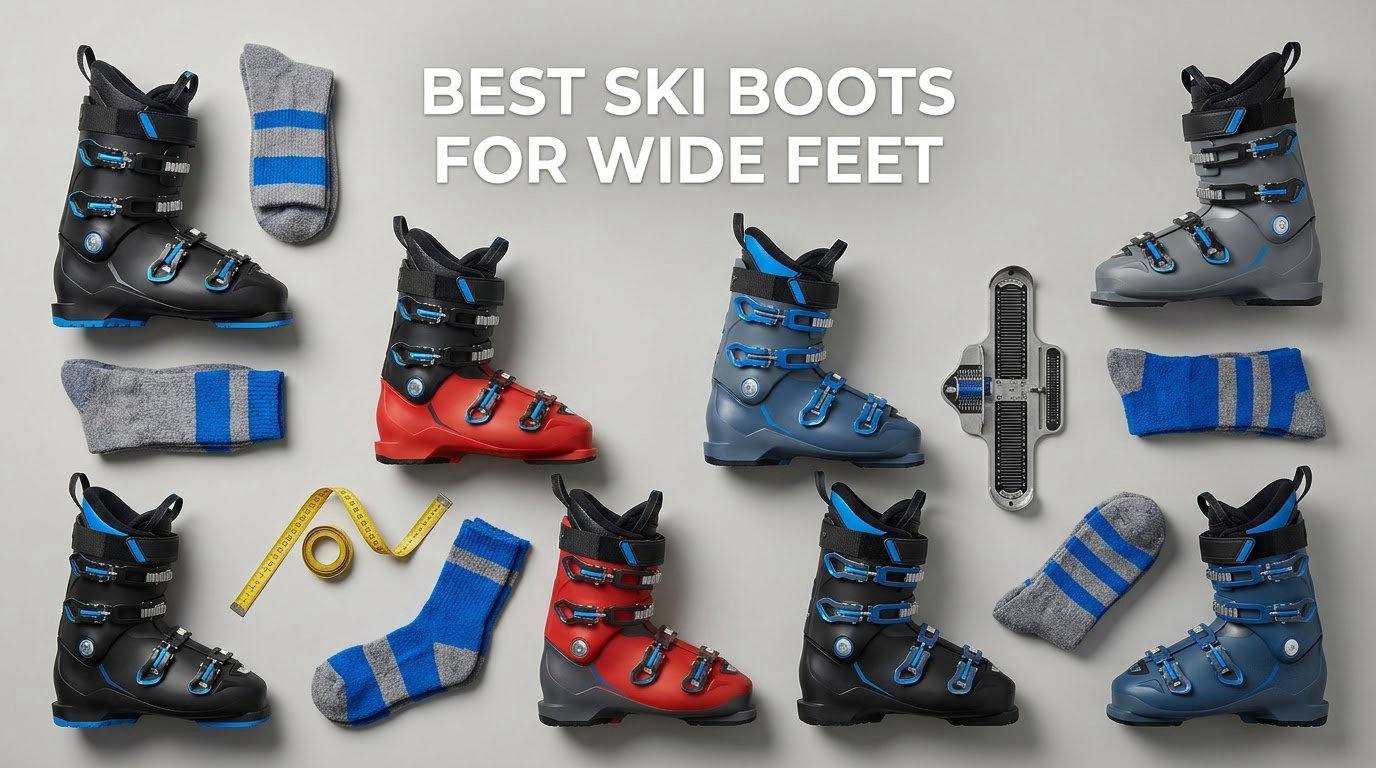
Ski boots built for a 100mm foot compress the ball of your foot until it burns, then cut circulation to your toes until they go numb. That two-hour cutoff is the single most common complaint in ski forums, and it has one main cause: the boot is too narrow across the forefoot, not too stiff, not too soft, and not the wrong flex. This guide covers the best ski boots for wide feet, ranked on published last widths in millimeters rather than marketing language, so you can match a boot to your actual foot before you spend an afternoon in a shop.
We compared ten models line by line, focusing on the four specifications that decide whether a wide foot can live in a boot all day: last width, shell volume, instep height and cuff volume. Where a listing gave a number, we used the number. Where it gave only adjectives like relaxed or high volume, we said so. A bootfitter can fix a lot, but not a shell that was cut 4mm too narrow, and that difference is worth explaining before any product talk.
One practical note first: gear is only half the setup. If you are still deciding on what to wear under the shell, our ski helmet headphone picks cover the audio side, and compression boots for recovery matter more than most people expect for feet that swell on a cold day.
Our Top 3 Best Ski Boots for Wide Feet (October 2026)
We picked these three as the strongest combination of confirmed last width, rating and review volume in the group. The Rossignol Evo 70 leads because it publishes a 104mm last and carries the highest rating of anything we reviewed, with a 73-review base that is far larger than most wide-fit listings. The Head Edge LYT RX HV is the value pick, and the Rossignol Kelia 50 is the one we send wide-calf skiers toward because the tulip cuff solves a problem the others do not.


Comparing 10 Wide-Fit Ski Boots Side by Side
Every boot below is listed with the width specification the manufacturer publishes. Read the last width column first, because a 102mm boot and a 104mm boot feel very different to a foot that measures 103mm.
| Product | Details | Action |
|---|---|---|
|
|
Check Latest Price |
|
|
Check Latest Price |
 |
|
Check Latest Price |
 |
|
Check Latest Price |
 |
|
Check Latest Price |
 |
|
Check Latest Price |
 |
|
Check Latest Price |
 |
|
Check Latest Price |
 |
|
Check Latest Price |
 |
|
Check Latest Price |
What Ski Boot Last Width Actually Means in Millimeters
Last width is the distance across the shell at the widest point of the forefoot, measured in millimeters. It is not a size. Two people with identical 27.5 mondo feet can need 99mm and 106mm, and that gap is the whole problem. The four bands below are the scale the industry actually uses.
97-98mm is narrow, built for slim feet and racers who want maximum edge-to-edge feel; wide feet should skip this band entirely. 99-101mm is the standard medium last, the most common in the world and the reason so many wide feet end up in boots that were never cut for them. 102-103mm is wide, the first band most wide-footed skiers should consider and the threshold we use for this roundup. 104mm and above is extra wide, where availability drops sharply and the mainstream shelf runs out above roughly 106mm.
Last width is also only one of five dimensions. Shell volume is the space over the instep and around the heel, and a boot can be narrow across the forefoot while still having a high-volume shell. Instep height is the vertical clearance on top of your foot, and this is the failure mode nobody warns you about: a wide toe box still crushes a high instep if the shell has no vertical room. Heel pocket depth decides whether your heel lifts when you drive the boot. Calf volume is the cuff, and it is a completely separate problem from foot width.
One more trap: the last number often shrinks in the smaller sizes. A 104mm last at mondo 27.5 may be closer to 100mm at mondo 25.5, so ask for the number in your size rather than the range.
1. Rossignol Evo 70 – The 104mm Relaxed Last With the Highest Rating in the Group
Rossignol EVO 70 HV+ – Ski Boots for Men and Women – Black
104mm relaxed last
70 flex
Sensor Matrix composite shell
Custom fit liner
+ Pros
- 104mm relaxed last gives real room across the forefoot
- Wider toe box and ankle area in the shell
- Custom fit liner with heel support
- Lightweight Sensor Matrix composite shell
– Cons
- 70 flex is soft and unsuited to aggressive skiing
- GRIPWALK soles are sold separately
- Mondo run is limited to four listed sizes
The Rossignol Evo 70 is the rare wide boot that states its last width instead of hiding behind the word relaxed. At 104mm it sits in the extra-wide band, and the spec sheet is explicit that the room runs through the forefoot, the toe box and the ankle area. That three-way approach separates it from most of the wide boots we looked at.
Reviewers back the spec up. Across 73 reviews the average sits at 4.8, the highest figure in this roundup, with a heavy five-star skew. The recurring theme is room and comfort over a full ski day, plus unusually easy entry and exit.
Where the 104mm Last Does the Work
Most pain from a narrow boot shows up at the metatarsal heads, the fat pads behind your toes, where the forefoot meets the widest part of the last. A 104mm last spreads that pressure across the whole pad instead of concentrating it on one point, and reviewers describe exactly that.
The extra ankle-area room matters more than it sounds, because a roomy forefoot paired with a tight ankle pocket just moves the problem upward.
The 70 Flex and What It Costs You
Flex 70 is genuinely soft, and that softness is the direct consequence of the roomy last: a wide shell has more material to flex. The trade is real, with less immediate edge response on firm or steep terrain and a boot that will not hold a driven position as crisply.
For a beginner or intermediate skier on groomed terrain that is a good trade. If you carve hard edges at speed, look at the stiffer wide options further down.
Liner, Shell and Sizing Details
The custom fit liner has customizable zones, heel support and softer padding through the ankle and instep, which is where a bootfitter spends most adjustment time. The Sensor Matrix composite shell keeps weight down and passes energy straight to the ski. GRIPWALK soles are a separate purchase. The published Mondo run is 24.5, 29.5, 30.5 and 33.5, so confirm your size first.
Who It Suits and Who It Does Not
Choose it if you measure around 102mm or wider, want a full day without forefoot pain, and ski recreationally. It is also a sensible first wide boot if you have never skied in a wide last.
Skip it if you ski steeps, need a boot to hold an aggressive angulation, or measure past roughly 106mm, where the shell runs out of room.
2. Head Edge LYT RX HV – High-Volume Room for a Forgiving All-Day Ski
Head Edge LYT RX HV Alpine Ski Boots, Anthracite/Black, 30.5
High Volume forefoot and instep fit
Polyurethane shell
Men's sizing
30.5 available
+ Pros
- High Volume shell adds genuine room through the forefoot and instep
- Relaxed forgiving fit for comfort-first skiing
- Strong 4.7 average across 71 reviews
- Polyurethane shell with a D width
– Cons
- High-volume shell gives less precise edge-to-edge control
- Manufacturer does not publish a last width in millimeters
- Sizes listed are 25.5 / 26.5 / 30.5
The Edge LYT RX HV is the value route into a wide fit, and its 4.7 average across 71 reviews gives it the second-largest evidence base in this roundup. Head builds it on a high-volume platform, which in practice means extra room through both the forefoot and the instep rather than a wide toe box bolted onto a standard shell.
That distinction is the reason to look at it. A boot can be wide across the ball of the foot and still press down on a high instep, which produces a burning strip across the top of your foot that no amount of forefoot room will fix. If that is your failure mode, a high-volume shell addresses it directly and a simply wide last does not.
High Volume Is Not the Same as a Wide Last
Head does not publish a millimeter figure for this model, so you are buying on the high-volume designation rather than a number. High volume describes the total interior space of the shell, and it broadly corresponds to extra room at the forefoot, the instep and around the heel. A wide last is narrower in scope, describing only the forefoot width.
That makes a high-volume boot the safer pick for a foot that is both broad and tall on top, and it also means the fit is looser overall.
Where the Response Gives Way
The consistent minority complaint is reduced precision compared with a snugger performance shell. A roomy boot has more to move before it contacts the ski, so edge-to-edge response is slower and less sharp. On groomers that barely matters; on ice or at race speed, you will feel it.
Materials, Sizing and Construction
The shell is polyurethane, listed at a D width, in anthracite and black, with a one-year limited manufacturer warranty. The published size run is 25.5, 26.5 and 30.5.
Who It Suits and Who It Does Not
This suits a recreational skier with broad feet, especially one with a high instep, who wants comfort over a long day. It is also a good first wide boot to try on, because the volume is generous enough to fit last inspection without forcing.
Do not choose it if you need fine edge-pressure transmission, if you ski a lot of ice, or if your foot measures beyond what this high-volume class provides. It is a comfort-first shell that asks you to accept softness in exchange for the space.
3. Rossignol Kelia 50 – A 104mm Last and a Tulip Cuff for Wide Calves
Rossignol Kelia 50 – Downhill Ski Boots for Women – Black/White
104mm relaxed last
Tulip-shaped cuff
Heat-moldable liner
50 flex
+ Pros
- Tulip cuff and adjustable buckles relieve shin and calf pressure
- 104mm relaxed last with a wider toe box
- Heat-moldable liners add warmth and precision
- Comfortable for shorter riders with high-set calves
– Cons
- 50 flex is the softest rating here and limits edge control
- Relaxed feel reduces feedback on firm terrain
- GRIPWALK soles sold separately
The Kelia 50 is the pick for skiers whose problem is the calf rather than the forefoot, and it is the only boot in this roundup with a cuff shape designed specifically to address that. The tulip-shaped cuff is cut so the shell flares rather than pressing straight in on the widest part of the calf, and reviewers with large calves describe it as the reason they stopped limping off the mountain.
It is also a genuinely wide boot underneath, with a relaxed 104mm last and a wider toe box. The rating is 4.6 across 47 reviews, and the dominant feedback is comfort across a full day rather than performance.
Wide Feet and Wide Calves Are Two Problems
A wide last adds room at the forefoot, the ball of the foot and the toe box. It does nothing to the cuff, which is a separate piece of plastic wrapped around the top of your calf. Someone with a 100mm forefoot and a large calf needs both, and needs them from two different systems.
This boot is one of the few here that addresses both, which is why it earns a place in the top three even though the flex is the softest in the group.
The Tulip Cuff in Practice
The tulip profile means the cuff opens outward as it rises, so pressure that a straight cuff concentrates across the shin spreads around the calf instead. The three-buckle layout adds a third adjustment point. Soft plastic wrapping the instep makes the boot easier to get into when the shell is cold and stiff.
One German-language review in the set specifically praises the upper buckle for relieving calf pressure, a detail most reviews never mention. It is the feature doing the work.
Liner, Shell and Who It Suits
The liners are customizable and heat-moldable, which matters for a wide foot because molding settles the foam into your exact shape. The Sensor Matrix composite shell keeps weight down. Published Mondo run is 22.5 through 27.5, and GRIPWALK soles are sold separately.
Choose this if calf pressure is what ends your day, if you are a beginner or intermediate skier, or if you want the most forgiving wide boot here. Pass on it if you want aggressive skiing, because a 50 flex gives up meaningful edge control and the same softness that makes it comfortable is what makes it imprecise on firm snow.
4. Head Edge LYT RX W HV – A Women’s Last Stacked Inside a High-Volume Shell
Head Edge LYT RX W HV Women’s Alpine Boots, Anthracite/Black, 26.5
Women's W last
High Volume shell
Polyurethane construction
26.5 available
+ Pros
- Combines a women's W last with a high-volume shell for very broad feet
- Extra room through both forefoot and instep
- Reduces pressure points rather than shifting them
- Intermediate flex level suits progressing skiers
– Cons
- Only 18 reviews is a thin evidence base for fit claims
- Second-highest share of one-star ratings in this group
- Sizes listed are 23.5 to 27.5
This is the only boot in the roundup that doubles up on width, pairing a women’s W last with a high-volume shell. In practice that combination is the broadest forefoot offering here for a woman who has never found a wide boot that works, because it stacks two width sources instead of relying on one.
That also speaks to a common trap. Women’s lasts run narrower than men’s equivalents in most of the industry, so a woman with a genuinely broad forefoot frequently gets pushed into a boot that was never cut for her. This model is the cleanest answer on the list without changing the fit system underfoot.
What the W Last and HV Shell Add Individually
The W last widens the forefoot. The high-volume shell adds room through the forefoot and the instep on top of that. Reviewers consistently mention fewer pressure points rather than the same pressure moved somewhere else, which matters because a wide toe box with a tight instep just relocates the pain.
The shell is polyurethane with a synthetic outer, in anthracite and black, with a one-year limited manufacturer warranty and sizes from 23.5 to 27.5. It is listed at intermediate skill level.
Reading the Review Signals Honestly
With 18 reviews at a 4.3 average, this is a smaller evidence base than the top three, and the share of one-star ratings is the second highest here. That is worth stating plainly rather than smoothing over, because 18 reviews cannot tell you reliably how a shell behaves after a full season or whether entry stays easy once the plastic is cold.
Who It Suits and Who It Does Not
This suits a woman with very broad feet who has already tried a standard wide boot and found it insufficient, and who is still at an intermediate level where extra volume costs little.
Do not choose it if you need a stiff, responsive boot, and think carefully if you are buying without trying on. If a boot this roomy is going to work for you, it is worth an in-person fit check rather than an online order.
5. Nordica HF 75 W – Rear Entry With Instep Volume Control
Nordica Women’s HF 75 W Adjustable Durable Warm Insulated Water-Resistant All-Mountain Touring Ski Boots with Instep Volume Control, Black/Dark Purple, 27.5
Wide W last
Instep Volume Control
Infrared fitting
40 degree Easy Entry shell
+ Pros
- Instep Volume Control gives real adjustment for a high instep
- Rear-entry buckle is far easier to get into than four buckles
- Infrared fitting lets a shop treat pressure points precisely
- Reviewers with wide feet and short legs report no pain after a full day
– Cons
- Rear clasp cable is a mechanical weak point
- Only one Mondo size offered in this listing
- 13 reviews is a small sample
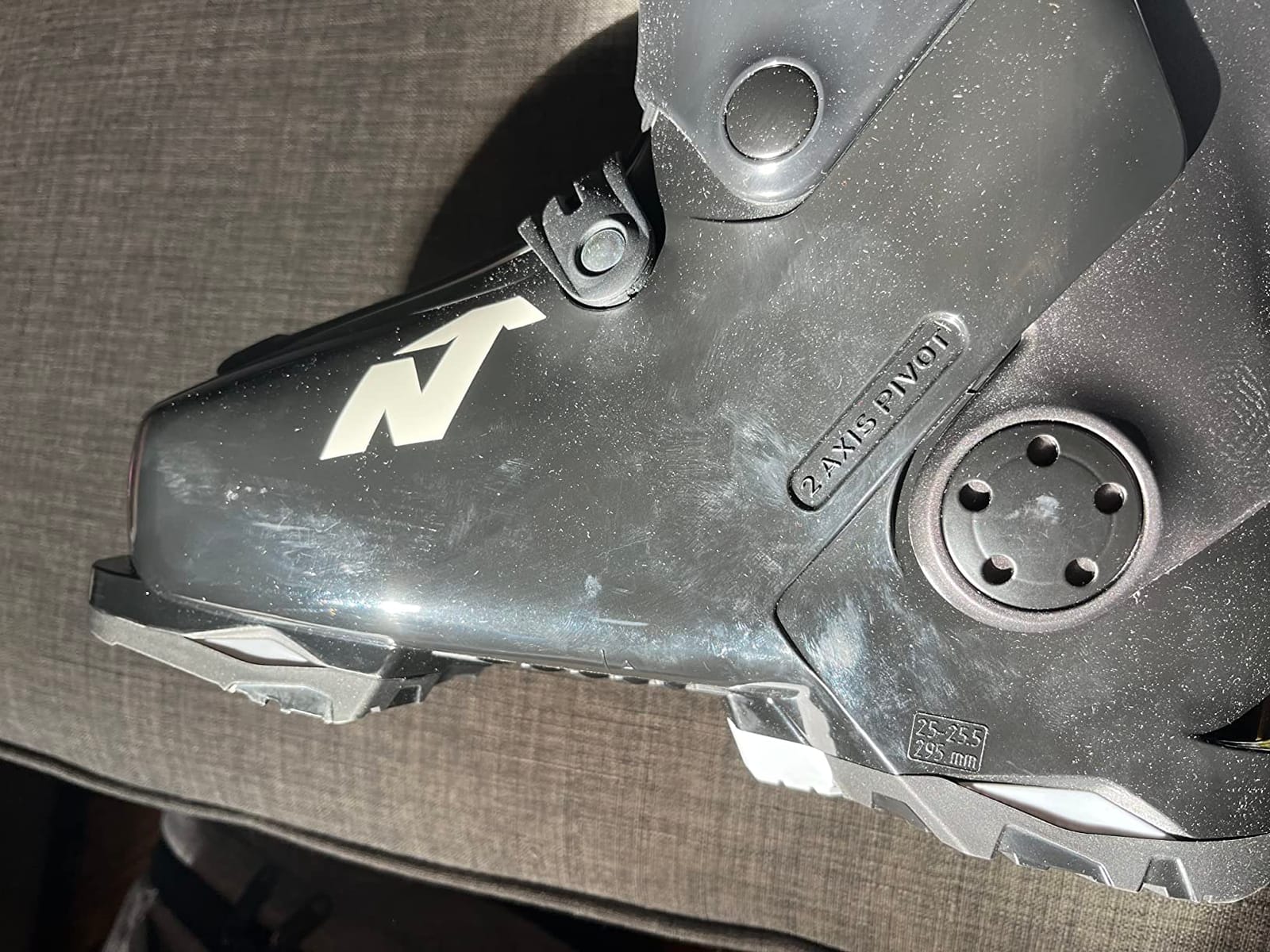
The HF 75 W solves the instep problem directly, and it is the only boot here with a dedicated, adjustable mechanism for it. The Instep Volume Control is a red insert in the heel wedge that you rotate to add or remove volume under the top of your foot. For a wide foot that is also high on top, that is a far more useful control than anything a bootfitter can do with a punch tool.
The rear-entry HF buckle is the second selling point. Instead of four front buckles you push the back lever down with your foot, and you can open it again with a ski pole while standing. For anyone who has fought a stiff four-buckle shell in the car park at minus fifteen, that is a real quality-of-life difference.
Instep Height Is the Problem Width Does Not Solve
Last width measures the shell across the forefoot. Instep height is the vertical space above your foot, and the two are independent. Buy a 104mm boot with a low instep profile and a tall foot still gets a burning strip across the top, and no amount of extra forefoot width will relieve it.
The rotating insert changes the interior geometry under the instep, so you can tune the boot at the counter. Combined with Nordica’s Infrared fitting process, where a shop heats a specific area and applies a suction cup to neutralize a pressure point, this is one of the most adjustable wide boots in the group.
Rear Entry, Insulation and the Hardware Risk
PrimaLoft insulation adds warmth and water resistance, which matters for a skier whose feet go cold rather than wide. The trade-off is hardware. Reviewers report the rear clasp cable as the weak point, with one account of a cable breaking after three days and another noting the cable does not reliably hold the heel. That is a real durability concern on a boot built around a cable mechanism.
Who It Suits and Who It Does Not
This is the boot for a wide foot with a genuinely high instep, for anyone who hates four-buckle entry, and for skiers who run cold. Reviewers with wide feet and short legs describe it as the most comfortable boots they have owned, and they note it runs true to size.
Skip it if you need a stiff boot, if you cannot tolerate a cable-driven closure, or if your Mondo size is not 27.5 in this listing. This is a comfort-first wide boot, and the mechanical risk is the price of the rear-entry convenience.
6. Nordica Sportmachine 3 75 W – 102mm Width With a Low-Profile Stance
Nordica Sportmachine 3 75 W Women’s Ski Boots, Black/Anthracite/Pink, W26.5 MY25
102mm wide last
3 Force Construction
Thermal liner insert
More neutral stance
+ Pros
- 102mm wide last gives room across the forefoot
- Plush well-made construction with many adjustment options
- Thermal liner insert appreciated by skiers with cold feet
- Customizable shell and liner for a personalized fit
– Cons
- Wide last does not help large calves or ankles
- Half-size listings are misleading because shells are made in full sizes
- 12 reviews is a small sample
The Sportmachine 3 75 W is the interesting middle of this list, because it is wide at the forefoot and deliberately low-profile elsewhere. The 102mm last is the standard entry point into a wide fit, and pairing it with a more neutral stance gives a boot that feels controlled without the wobbly, over-volumed sensation some wide shells produce.
Its real strength for a specific group is warmth. The thermal liner insert is singled out by skiers with cold feet, and the neutral stance is designed to reduce fatigue. It carries a two-year manufacturer warranty, the longest in this roundup.
Why 102mm Is the Threshold That Matters
102mm is the line we use throughout this guide, because it is the first width band that reliably clears a genuinely wide forefoot. Below that, at 99mm or 100mm, a wide foot spends the day compressed. Going to 104mm adds more room but also more softness.
This boot takes the 102mm option and makes the most of it with the 3 Force Construction spine and cuff design, which is built to transmit energy from leg to ski efficiently. The shell design is the attempt to claw back the responsiveness a wide last usually costs.
The Calf Caveat Nobody Mentions
Both negative reviews in this set came from skiers with large calves and ankles who found the boot too tight even on the loosest setting. That is the single most useful thing to know before buying a wide boot for a wide calf, and a wide last widens the foot without touching the cuff.
Also note the half-size caveat: Nordica builds these shells in full sizes with a thicker liner, so order the half size down to get a proper fit.
Customization and Who It Suits
Both shell and liner are customizable and the calf cradle is fine-tunable, which gives a bootfitter more to work with than a fixed shell would.
This suits an intermediate skier with a 102mm forefoot who wants control plus room, and it is our pick for anyone whose feet go cold rather than wide. Do not choose it to solve calf pressure, and do not expect a 104mm-plus interior. Published sizes are 22.5, 23.5, 26.5 and 27.5.
7. Nordica HF 85 W – The Only Stiff Wide Last in the Group
NORDICA Women’s HF 85 W Durable Warm Insulated Water-Resistant Easy-Entry All-Mountain Touring Ski Boots with Instep Volume Control, Black/Anthracite/Green, 27.5
Wide W last
85 flex
Instep Volume Control
PrimaLoft and 3D cork liner
+ Pros
- Only 85 flex wide last here for advanced skiers who need width
- Instep Volume Control for high insteps
- 3D Custom Cork Liner adds insulation and dryness
- Reviewers with very wide feet report skiing pain-free again
– Cons
- Rear clasp cable broke after three days in one review
- Cables do not reliably hold the heel
- Durability concerns against the premium price
Almost every wide boot we reviewed is a soft, forgiving model, and that is a real problem for advanced skiers who need precision more than comfort. The HF 85 W is the exception. At 85 flex on a wide last, it gives a strong skier the response they need without forcing them back into a narrow shell, and it is the only boot here that serves that combination.
The fit stories are the strongest in the whole set. Reviewers with very wide feet and large ankles report being able to ski pain-free after years of not being able to, and one credits the rear-entry design with eliminating the shin and ankle pain caused by rental and conventional boots.
What 85 Flex on a Wide Last Feels Like
A wide shell has more material to bend, so an 85 flex on a wide last still feels more forgiving than an 85 flex on a narrow one. What it does not do is go soft. The cuff still supports an angulated position, which is the trade a strong skier is making here: some softness conceded to the width, but precision retained.
The 3 Force spine and cuff design work alongside the wide last to move energy through to the ski, and reviewers note the boot is snug enough to hold control on black runs.
Instep Control, Liner and Closure
The Instep Volume Control insert in the heel wedge gives the same quick fit adjustment as the 75 W, and Infrared Technology lets a shop treat specific pressure points. PrimaLoft insulation and the 3D Custom Cork Liner handle warmth and dryness, the Easy Entry shell opens to 40 degrees, and published sizes are 26.5 and 27.5.
The Durability Risk You Have to Weigh
Both negative reviews concern hardware, not fit. One reports the rear clasp cable breaking after three days, stranding the wearer at the top of the mountain. Another says the cables do not reliably hold the heel. Both are the same cable-driven mechanism, and both are the direct cost of choosing rear entry at a higher flex level.
Who It Suits and Who It Does Not
Choose this if you are an advanced skier with wide feet, if you have given up on wide boots because they are all soft, or if you have a history of shin pain in four-buckle shells.
Pass if you are a beginner or intermediate, because 85 flex will feel unnecessarily stiff. Also pass if you are not willing to plan for a cable failure, because that is a scenario reported by an owner, not a hypothetical.
8. Rossignol Speed 80 HV+ – 104mm Unisex Sizing for a Whole Household
Rossignol Speed 80 HV+ – Alpine Ski Boots for Women and Men – Black
104mm HV+ last
Unisex adult sizing
80 flex
Sensor Matrix shell
+ Pros
- 104mm HV+ last gives room across toe box and midfoot and ankle
- Unisex sizing simplifies fitting for couples and families
- Forgiving flex profile suits progressing skiers
- Soft instep plastic makes entry and exit easy
– Cons
- Only 5 reviews is the thinnest feedback base in the roundup
- 23 percent three-star share signals a wide rating spread
- Unisex last is not anatomically tuned like a women's last
The Speed 80 HV+ is the most practical wide boot here for a household rather than a single skier. At 104mm it matches the Evo 70 for published width, and it is offered in unisex adult sizing, which means one wide boot can cover skiers of different sizes and backgrounds instead of forcing each person into a separate fit system.
Be aware of the evidence base. At 5 reviews and a 23% three-star share, this is the thinnest feedback in the roundup. There is not enough customer data to draw a firm conclusion on fit, so the case for it rests on the specification rather than on reported experience.
What HV+ Adds Over a Standard High-Volume Shell
HV+ is Rossignol’s highest-volume designation, and the published room runs through the forefoot, the ankle and the toe box. That three-area spec is what makes it comparable to the Evo 70 rather than merely wide at the front. The 80 flex sits in the middle of the range, forgiving enough for a progressing skier without going as soft as a beginner boot.
Soft instep plastic over the front of the shell makes entry and exit easy, which matters more than it sounds on a 104mm last, because a roomier boot is not automatically one you can get your foot into quickly.
Sizing, Shell and Practical Limits
The item is listed as unisex adult, model number RBO8050 000265, weighing 8.42 pounds. The Sensor Matrix shell reduces weight while maximising energy transfer, custom-moldable liners shape to the foot, and GRIPWALK soles are sold separately.
The real limit is the unisex tradeoff. A dedicated women’s last is shaped around female ankle and heel anatomy and typically sits several millimeters narrower, so for a skier who needs that shaping the Kelia 50 or the Head W last will serve better.
Who It Suits and Who It Does Not
This suits a family or couple where one member has wide feet and the other does not. It also suits a progressing skier who wants a 104mm interior and something softer than a performance model.
Do not choose it if you need a dedicated women’s last, and do not buy it sight unseen. With five reviews behind it, an in-person try-on is worth more here than anywhere else in this roundup.
9. Head Edge 65 W HV – 102mm Wide Fit With the Clearest Published Geometry
Head Edge 65 W HV Women’s Alpine Ski Boots (White, 25.5)
102mm W last
High Volume shell
65 flex
5 degree ramp and 12.5 degree forward lean
+ Pros
- 102mm W last combined with an HV shell for a genuine wide fit
- Soft 65 flex tuned for beginner skiers
- Publishes ramp angle and forward lean figures most brands omit
- Listed in sizes from 22.5 to 27.5
– Cons
- Only 4 reviews is the smallest feedback base here
- Soft flex and 102mm last limit performance on steeps
- Listing describes the fit as snug which reads narrow next to W and HV
This is the most transparent specification sheet in the roundup, and for a buyer who likes numbers that is worth something on its own. Head publishes the last at 102mm, the flex at 65, a ramp angle of 5 degrees, a forward lean of 12.5 degrees and an Ergo Balance alignment. Very few boots in any category publish that much geometry.
The 102mm W last combined with a high-volume shell gives a real wide forefoot, and the 65 flex is the softest in this list, which makes it a beginner boot that does not punish an imperfect stance. The 4.5 rating comes from 4 reviews, so treat it as a placeholder rather than evidence.
Why Ramp Angle and Forward Lean Matter to Wide Feet
These two numbers describe the boot’s stance geometry, and they are quietly important for wide-footed skiers. Forward lean is how far the shell tips forward, and a high lean pushes your shin into the cuff, which is painful on a wide calf; a moderate 12.5 degrees is sensible. Ramp angle is the angle of the footbed, and a steeper ramp puts more pressure under the arch and heel.
Knowing these figures in advance is what makes an in-person fitting productive. You can walk in with a target instead of trying on twenty pairs.
The Snug Fit Label and What It Means
The listing describes the fit type as snug, which sits oddly next to a W last and an HV shell in the same specification block. The physical measurements tell a clearer story: a 102mm last with a high-volume shell is a wide boot, and the label is best read as describing the closure feel rather than the forefoot width.
Who It Suits and Who It Does Not
This suits a beginner with a wide foot who wants the softest, most forgiving option in the guide, and anyone who wants to shop with published geometry instead of marketing adjectives.
Skip it on steep or firm terrain where a 65 flex will not hold, and skip it if you are buying without trying on, because four reviews cannot tell you how the closure feels after a season.
10. Fischer RC 85 – An 85 Flex With a Wider Strip and Higher Toe Box
Fischer Women’s Ski Boots RC 85 Black – Flex 85 – MP25/25.5 – Alpine Ski Boots Alpine Boots – Wide Fit & Comfort Inner Shoe – for Advanced to Good Drivers
100 mm strip width at MP25.5
Higher instep and toe box
85 flex
Easy entry flap
+ Pros
- Higher instep and higher toe box with a floating entry flap
- Stiff 85 flex gives control without a soft last penalty
- Lightweight construction makes entry and exit easy
- Targets advanced to good riders
– Cons
- 100 mm strip width is the narrowest measurement in this roundup
- Only 1 review provides almost no customer signal
- Listing is categorized under telemark ski boots
The Fischer RC 85 is the odd one out, and we include it because it solves a problem none of the others do. It is a stiff 85 flex for advanced and good riders, and instead of widening the last it raises the instep and the toe box. For a skier whose problem is vertical space rather than horizontal width, that is the correct fix.
It is also the least evidenced boot here, with a single 4-star review that tells you almost nothing about fit over time, and it is categorized under telemark ski boots, so alpine-specific fit guidance on the page is limited.
A Higher Toe Box vs a Wider Last
These are different solutions and only one of them will help you. A wider last adds horizontal room across the ball of the foot. A higher toe box adds vertical room over the toes, which is what you need if your toes press upward against the shell, which is how bunions and hallux limitus present themselves in a boot. A skier with a 100mm forefoot and high, prominent toes can fail in a 104mm last while feeling fine in this one.
The floating entry flap opens the front of the shell further so the boot goes on without fighting the toe box, which directly addresses the complaint that entry itself becomes a fight.
Measured Geometry and Flex
The published figures are specific: 100 mm strip width at MP25.5, sole length 298 mm on an ISO 5355 sole, 85 flex, a 35 mm velcro power strap with buckle closure, and rivet cuff fixation with canting. The target group is advanced to good riders, and package weight is 4 kg.
Note the honesty requirement here: 100mm is the narrowest published width in this roundup, below every Rossignol, Nordica and Head boot we listed. If your problem is forefoot width, this is the wrong boot. If your problem is instep and toe height with a stiff flex requirement, it is one of the few right answers.
Who It Suits and Who It Does Not
Choose this if you have a narrow-to-medium forefoot with a high instep or a prominent toe box, and if you ski hard enough to need an 85 flex.
Do not choose it if your issue is forefoot width, because the published strip width is the narrowest here. Treat the single review as no evidence at all, and get fitted in person before ordering.
How to Choose Wide-Fit Ski Boots: A Buyer’s Guide
Measure Your Foot Before You Read Any Boot Description
Stand on a sheet of paper with your weight fully distributed and trace around your foot. Mark the widest point of the forefoot and measure across it. That number in millimeters is your foot width, and it should drive your boot search. Measure the arch too, and note instep height by measuring from the floor to the top of your foot at the base of the toes while standing.
Measure in the evening, not the morning. Feet swell over a day and again over a season, and a boot that fits perfectly at breakfast can be a different boot by the last run. If you already own boots that hurt, take them apart and measure the shell across the forefoot to learn what you have been tolerating.
Map Your Width to the Mondo Size You Will Actually Ski
Boot sizing is done in mondo, which is the length of your foot in centimeters plus about 13cm of boot. The width you need scales with it, because longer feet are also longer across the forefoot. A skier on a 27.5 mondo commonly measures in the low 100s across the forefoot and needs a last in the 102-106mm range. A skier on a 29 mondo or larger needs 104mm at minimum and will struggle to find one.
This is the mapping no competitor publishes, and it is the fastest way to know whether your problem is solvable from a shelf. The hardest evidence comes from skiers who measure their own feet and report widths of 110mm and above on mondo sizes in the high 20s, while the widest widely available lasts in those same sizes top out near 106mm.
Which Brands Build the Widest Lasts
The recurring community answer to which brands build the widest lasts points to Atomic, Rossignol, Nordica and Head, with Rossignol and Nordica each appearing twice in this roundup. In touring, Scarpa and Scott, which acquired Garmont, are the names that come up most, and the Dynafit TLT Extra Wide is frequently cited as the widest touring boot available, though skiers also report it is too high volume for many feet.
For alpine boots the widest published lasts in this group are the Rossignol Evo 70 and the Speed 80 HV+ at 104mm, followed by the Nordica Sportmachine and Head Edge boots at 102mm. Beyond this list, Atomic’s Hawx Magna line is the most frequently named default answer in forums for wide feet, with a widely reported 102mm last and a heat-expansion process that adds a few more millimeters of give, and a common caveat that the liner packs out over time. Rossignol’s Vizion and Nordica’s HF get similar mentions.
One warning that applies to every brand: last numbers shrink in shorter sizes, so the 104mm you read in a description may not be the 104mm in your size.
The Fit Modification Ladder, From Heat Mold to Stretcher Fitting
When a boot is close but not perfect, the order of operations matters, because early steps are cheap and later ones are not. One: heat molding. A bootfitter heats the liner and shell and lets them set around your foot, settling foam and expanding moldable plastics slightly. It is the cheapest step and it should always happen first. Two: liner replacement. Most wide-fit pain in a used boot is the liner, not the shell. Liners pack out after a few seasons, and a new liner in the same boot frequently fixes a problem that looks like a shell problem. Three: punch-out work. A bootfitter stretches a localized pressure point with a punch, which works well on a single hot spot such as over a bunion. Four: manual stretch. Shell stretching with a frame or plate gives a few more millimeters across the forefoot. Five: professional stretcher fitting. A purpose-built boot stretcher pulls the shell outward while heat is applied. This is the only step that meaningfully changes a shell’s width, and skiers report it as the only real answer above roughly 110mm. The barrier is cost and travel, because the specialty fitters who own the equipment are not everywhere.
When a Custom Footbed Beats a Wider Boot
A wider last adds space around your foot. A custom footbed changes what sits under it, and the two solve different problems. If your foot measures 99mm and hurts because the arch is unsupported and the foot rolls inward, a wider boot makes the instability worse. If your foot measures 104mm and hurts because the metatarsal heads are compressed, a footbed will not fix it.
Rule of thumb: buy width for width problems and a footbed for volume and support problems. The common mistake is buying a much wider boot to solve a problem a footbed solves better, then finding the instability has doubled.
If the pain is in your feet at rest rather than only while skiing, worth ruling out a mechanical issue first with our callus removal guide. Persistent burning on the ball of the foot or tingling in the toes is also worth raising with a doctor, because prolonged compression has been linked with nerve conditions such as Morton’s neuroma, and no boot is worth that.
When Nothing Off the Shelf Fits: 110mm and Above
Some skiers measure 110mm or more across the forefoot, and there is no mainstream boot for them. That is a supply limit, not a failure of research. The widely available extra-wide lasts top out around 106mm at common mondo sizes, and the lightweight and carbon touring boots that skiers with wide feet love have been getting narrower, not wider, in recent seasons.
Your real options are professional stretcher fitting at a specialty fitter, a made-to-measure shell, or accepting a close fit with a liner and footbed built around the pressure points. Some skiers travel hours or fly to reach a fitter with the right equipment, which is the honest cost of that route. If you are in that range, skip the product shortlist and book a fitting appointment.
Frequently Asked Questions
What is the best ski boot for wide feet?
A ski boot built on a 102mm last or wider is the starting point for wide feet, because 102mm is the first width band that reliably clears a broad forefoot. Among the ten boots we reviewed, the Rossignol Evo 70 and the Rossignol Speed 80 HV+ both publish a 104mm relaxed last. If you also have a high instep, add a shell with vertical room such as the Nordica HF 75 W.
What does last 100mm mean on a ski boot?
Last width is the distance across the shell at the widest point of the forefoot, measured in millimeters, and it is not a size. A 100mm last is the middle of the standard medium band of 99 to 101mm. Most wide feet should start shopping at 102mm and above, since anything under 99mm is built for slim feet.
What is the average last width of a ski boot?
Most alpine ski boots are built on a 99 to 101mm last, which is why so many wide feet end up in boots that were never cut for them. Narrow lasts run 97 to 98mm for slim feet and racers. Wide lasts run 102 to 103mm, and 104mm or above counts as extra wide, where availability drops sharply.
Which ski boots have the widest fit?
The widest published fits in our review are the Rossignol Evo 70 and the Rossignol Speed 80 HV+, both on a 104mm relaxed last with extra room through the toe box and ankle. The Rossignol Kelia 50 is also a 104mm. In the wider market, the Dynafit TLT Extra Wide touring boot is frequently cited as the widest touring option, though some skiers find it too high volume.
What boot brand is best for wide feet?
Rossignol, Nordica and Head build the widest lasts available in alpine boots, and each appears twice in this roundup. Atomic is the most frequently named default answer in ski forums, with its Hawx Magna line reported as a 102mm last that a heat-expansion process makes forgiving. In touring boots, Scarpa and Scott are the names that come up most often.
Are Atomic ski boots good for wide feet?
Atomic is routinely cited in ski forums as one of the easiest brands on wide feet, particularly the Hawx Magna high-volume line, which is widely reported around a 102mm last with high total volume. The common caveat is that the liner packs out over time, so a boot that fit well in the first season may need a new liner by the third.
Should I get a wider ski boot or a custom footbed?
Buy width for width problems and a footbed for volume and support problems. If the pain is compression on the ball of the foot and your foot measures past 102mm, only a wider last will fix it. If your foot measures around 99mm and hurts from an unsupported arch or inward roll, a footbed solves it and a wider boot would make the instability worse.
What is ski boot syndrome?
Ski boot syndrome is the collective term for the nerve pain, numbness and burning that come from prolonged compression in badly fitting boots. The usual symptoms are hot spots on the balls of the feet, toes going numb within a couple of hours, and needing to run the lower buckles loose. It matters medically because sustained compression has been linked with nerve conditions such as Morton’s neuroma.
Which Wide-Fit Ski Boot Should You Buy
Start with width, then flex, then everything else. If you measure 102mm or wider across the forefoot, the Rossignol Evo 70 is the pick: a published 104mm relaxed last, the highest rating in this group at 4.8, and a 73-review base that gives you real evidence rather than a single opinion. If your problem is a high instep rather than forefoot width, the Nordica HF 75 W is the one, because the rotating Instep Volume Control changes the geometry under the top of your foot in a way nothing else here does. If your calves are the issue, choose the Rossignol Kelia 50 and its tulip cuff, and understand that the Nordica Sportmachine 3 75 W will not help you at all on that front despite being a wide boot. If you need stiffness and width together, the Nordica HF 85 W is the only serious answer, with the rear clasp cable as the price. If your feet are cold more than wide, the Sportmachine 3 75 W and the PrimaLoft-insulated Nordica models add the most. And if you measure past 106mm, no boot on this list will save you, so book a specialty stretcher fitting instead of ordering online.
Take your measurements, write down the number in millimeters, and hold every shop to it. Our best ski boots for wide feet picks all start at 102mm for a reason, and a bootfitter can work with you on everything else.
Leave a Reply