
When most people think of welding, they imagine sparks flying, molten metal, and intense heat. But what if I told you that some of the strongest metal bonds happen without any heat at all?
After working with various welding processes for years, I was skeptical when I first heard about cold welding. The idea seemed to defy everything I knew about joining metals. Yet this process has been used in critical applications from spacecraft to electrical connections for decades.
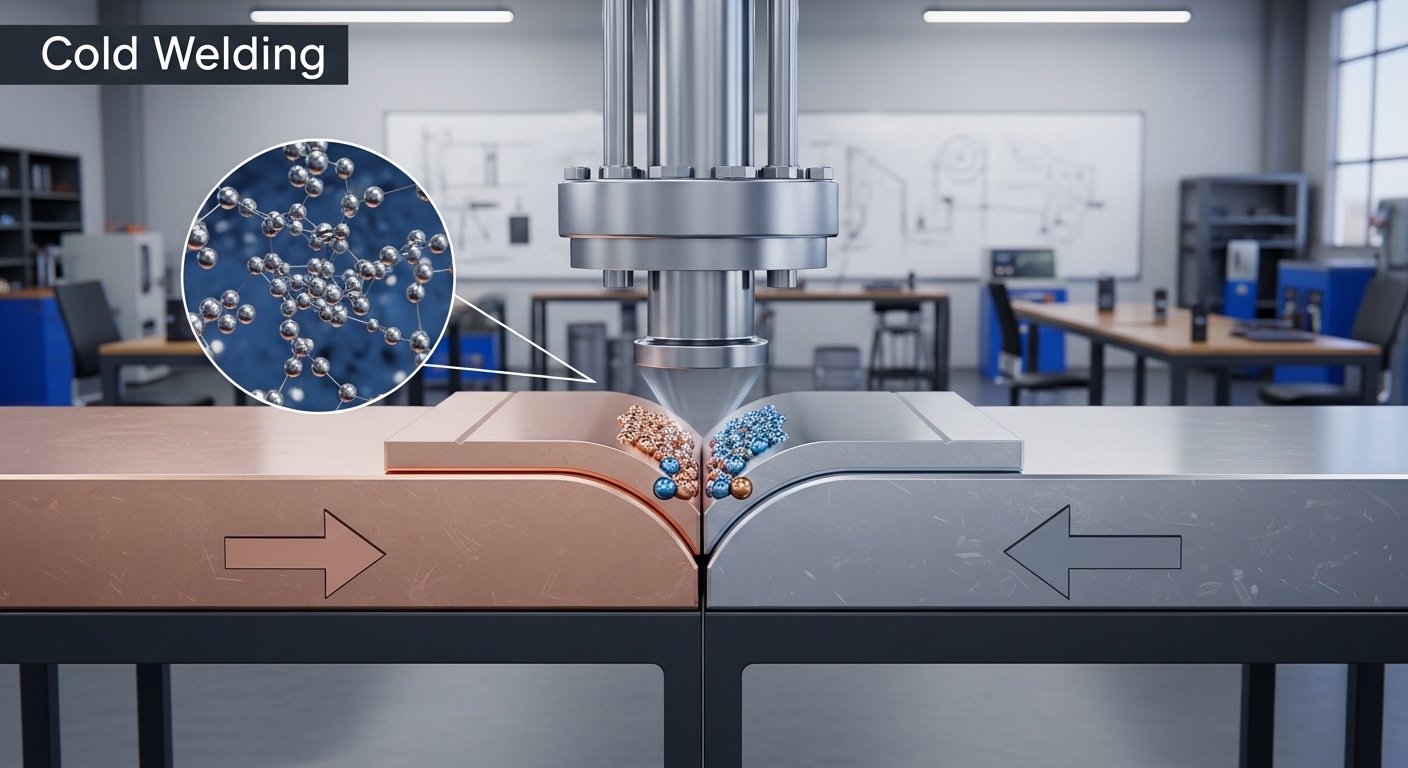
Cold welding is a solid-state welding process that joins clean metal surfaces using pressure instead of heat. No melting, no filler material, no sparks. Just two clean metal surfaces pressed together until their atoms bond at the molecular level.
This guide will explain everything you need to know about cold welding, from the science behind it to real-world applications, advantages, limitations, and how it compares to traditional welding methods.
What Is Cold Welding? The Complete Definition
Cold welding (also called contact welding) is a solid-state welding process that joins two clean, oxide-free metal surfaces together through pressure application alone. The process requires no external heat or filler material, and the resulting bond can be as strong as the parent metals themselves.
The scientific name for cold welding is cold pressure welding, and it falls under the broader category of solid-state welding processes. Unlike traditional welding that melts metal to create a joint, cold welding forces metal atoms from each surface to intermingle and bond at the atomic level.
Solid-State Welding: A group of welding processes that produce coalescence at temperatures essentially below the melting point of the base materials. No liquid metal is involved in the joining process.
The phenomenon was first documented in 1724 by Reverend John Desaguliers, who noticed that two lead balls would stick together if their surfaces were freshly cleaned and pressed together. What seemed like a parlor trick actually demonstrated a fundamental principle of metallurgy that would become vital for modern industry.
Today, cold welding is defined by the American Welding Society (AWS) as a “solid-state welding process in which joining takes place without fusion or heating at the interface of the two parts to be welded together.” The absence of heat is what makes this process unique and valuable for specific applications.
How Cold Welding Works: The Science Behind the Bond
To understand cold welding, you need to understand what happens at the atomic level when two metal surfaces meet. Every metal surface is covered by a thin layer of oxide—a result of exposure to air. This oxide layer prevents metal atoms from bonding with each other.
Cold welding works by removing this barrier and allowing the bare metal atoms to interact. When two clean, oxide-free metal surfaces are brought into contact under sufficient pressure, the metallic atoms begin to share electrons. This creates a metallic bond that is essentially the same as the bonds holding the metal together within each piece.
Atomic Bonding: The process where atoms share or transfer electrons to achieve stable electron configurations. In metals, this creates a “sea” of delocalized electrons that hold the positively charged metal ions together in a crystal lattice structure.
Quick Summary: Cold welding requires three conditions: clean metal surfaces (oxide-free), ductile materials that can deform under pressure, and sufficient force to bring atoms within bonding distance. When these conditions are met, the surfaces essentially become one piece of metal.
The 5-Step Cold Welding Process
- Surface Preparation: Metal surfaces are thoroughly cleaned to remove all dirt, grease, and most importantly, oxide layers. This is typically done with wire brushing, chemical cleaning, or abrasion.
- Surface Activation: The freshly cleaned surfaces are immediately protected from re-oxidation. In industrial settings, this might happen in a vacuum chamber or inert gas environment.
- Alignment: The two surfaces are aligned precisely. Cold welding typically uses butt joints (end-to-end) or lap joints (overlapping), and proper alignment is critical for bond strength.
- Pressure Application: The surfaces are pressed together with significant force. This pressure causes plastic deformation at the interface, breaking down any remaining barriers and bringing atoms within bonding distance.
- Bond Formation: As pressure continues, the crystal lattices of both metals merge. The interface essentially disappears, creating a continuous metallic structure across the original joint line.
The entire process happens in seconds with the right equipment, but the preparation can take much longer. The cleanliness requirement is why cold welding is often performed in controlled environments—especially when working with reactive metals like aluminum.
Why Cold Welding Is Easier in Space
One of the fascinating aspects of cold welding is its relationship with vacuum environments. In the vacuum of space, metals don’t form oxide layers because there’s no oxygen. This means any two metal surfaces that touch will naturally cold weld together.
This phenomenon was discovered accidentally during early space missions. Engineers found that mechanical components in spacecraft would sometimes seize up—metal parts had literally welded themselves together just from contact. The absence of air made cold welding happen spontaneously.
For this reason, spacecraft components are now designed with cold welding in mind. Moving parts are coated with special materials, or designed with geometries that minimize surface contact. The International Space Station uses special materials and coatings to prevent unintended cold welding of critical components.
Materials and Equipment for Cold Welding
Not all metals can be cold welded. The process requires materials that are ductile enough to deform under pressure and have the right atomic structure to form metallic bonds.
Metals Compatible with Cold Welding
| Metal | Compatibility | Common Applications |
|---|---|---|
| Aluminum | Excellent | Wire splicing, electrical connections |
| Copper | Excellent | Electrical wiring, busbars |
| Gold | Excellent | Electronics, micro-welding |
| Silver | Very Good | Electrical contacts |
| Zinc | Good | Battery terminals, coatings |
| Nickel | Good | Specialized applications |
| 70/30 Brass | Fair | Limited applications |
| Steel (Stainless) | Poor | Not recommended |
Cold Welding Equipment Types
The equipment needed for cold welding depends on the application and scale of operations:
Handheld Cold Welding Tools
For wire welding and small-scale applications, handheld tools are commonly used. These resemble pliers with specialized dies that grip, align, and compress the wires. I’ve seen these used extensively in electrical work for splicing aluminum and copper wires. They’re portable, require no power source, and can create reliable connections in seconds.
Pneumatic Cold Welding Machines
For larger applications and higher production volumes, pneumatic machines provide consistent pressure and repeatability. These use compressed air to apply the welding force and are common in manufacturing environments. The advantage is consistent pressure application—critical for quality welds.
Industrial Cold Welding Systems
Heavy-duty applications may require hydraulic or motorized systems. These can weld larger cross-sections and often incorporate vacuum chambers for reactive metals. The investment is significant, but so is the capability for production welding.
Capacitor Discharge Welders
Some applications use a hybrid approach called capacitor discharge welding. This uses a very brief, controlled electrical pulse to assist the cold welding process. The heat generated is minimal and localized, but it can help break down oxide layers. This is technically different from pure cold welding but serves similar applications.
Cold Welding Applications: Where It’s Used
Cold welding has found its niche in industries where heat would cause problems. Let me share the most common applications I’ve encountered.
Electrical Wire Connections
The most widespread use of cold welding is in electrical connections, particularly for aluminum and copper wires. When you’re splicing wires, especially smaller diameters, cold welding creates a connection with virtually no electrical resistance.
Utility companies have used cold welding for decades to splice overhead power lines. The connections remain stable for years, unaffected by thermal cycling or corrosion. The absence of heat means no annealing of the conductors—important for maintaining current-carrying capacity.
Electronics Manufacturing
In microelectronics, cold welding joins delicate wires and components. The process can bond wires thinner than human hair without damaging heat-sensitive components. This is essential for semiconductor manufacturing and fine-pitch electronics assembly.
Gold wire bonding in integrated circuits essentially uses cold welding principles. The wires are bonded to contact pads through pressure and ultrasonic vibration. This happens at room temperature, protecting temperature-sensitive silicon substrates.
Sealing and Hermetic Packaging
Containers that need airtight or hermetic seals often use cold welding. Since the weld is as strong as the parent metal with no filler material, the seal is continuous and leak-free. Food containers, medical device packaging, and aerospace components all benefit from this capability.
Aerospace Applications
Beyond the challenges of unintended cold welding in space, the aerospace industry intentionally uses the process for specific applications. Fuel lines, hydraulic systems, and structural components can be joined without heat-affected zones that might compromise material properties.
The ability to join dissimilar metals is particularly valuable in aerospace. Titanium structures can be joined to aluminum components—a combination that would be problematic with heat-based welding due to different melting points and thermal expansion coefficients.
Automotive Industry
Modern vehicles use cold welding for various applications. Battery connections in electric vehicles often use cold-welded terminals for maximum current flow. Sensor housings and electrical connectors throughout the vehicle may also be cold welded during manufacturing.
Cold Welding vs Hot Welding: Complete Comparison
The differences between cold welding and traditional (hot) welding are significant. Understanding these differences helps you choose the right process for your application.
| Characteristic | Cold Welding | Hot Welding (MIG/TIG/Stick) |
|---|---|---|
| Heat Input | None (room temperature) | High (melts base metal) |
| Metal State | Solid-state throughout | Liquid (fusion) at joint |
| Heat-Affected Zone | None | Present (weakened area) |
| Filler Material | Never required | Usually required |
| Distortion/Warping | None | Possible due to thermal cycling |
| Material Changes | None | Possible annealing/hardening |
| Dissimilar Metals | Can join many combinations | Limited by compatibility |
| Compatible Materials | Limited (ductile non-ferrous) | Most weldable metals |
| Surface Prep Required | Extremely critical | Important but less critical |
| Joint Geometry | Limited (butt, lap, spot) | Wide variety possible |
| Equipment Cost | Moderate to high | Low to moderate |
| Speed | Fast (seconds) | Variable |
| Energy Consumption | Very low | High |
Heat-Affected Zone (HAZ): The area of base metal that is not melted during welding but whose microstructure and properties are altered by the heat generated. In cold welding, there is zero HAZ because no heat is applied to the workpiece.
Advantages of Cold Welding
- No Heat-Affected Zone: The metal surrounding the weld retains its original properties. This is critical for heat-treated materials or applications where thermal distortion would cause problems.
- No Distortion or Warping: Without thermal expansion and contraction, workpieces don’t warp. Precision components maintain their dimensional accuracy.
- Joins Dissimilar Metals: You can join aluminum to copper, or other combinations that would be difficult or impossible with fusion welding. The materials don’t need to have compatible melting points.
- Clean Process: No smoke, fumes, spatter, or radiation. The process is environmentally friendly and suitable for clean room environments.
- Strong Bonds: When properly executed, a cold weld is as strong as the parent metals. The joint is essentially invisible at the atomic level.
- No Filler Material: The weld is made entirely of the parent metals, which can be important for electrical conductivity or purity requirements.
- Energy Efficient: The process requires minimal energy compared to fusion welding, making it attractive for high-volume production.
- Suitable for Thin Materials: You can cold weld extremely thin foils and wires that would burn through with traditional welding.
Disadvantages and Limitations
- Limited Material Compatibility: Only ductile, non-ferrous metals work well. Steel, cast iron, and most alloys with high carbon content cannot be cold welded effectively.
- Extreme Surface Preparation: Surfaces must be meticulously cleaned and oxide-free. Any contamination will prevent bonding. This often requires controlled environments or vacuum chambers.
- Joint Geometry Limitations: Cold welding works best with simple butt or lap joints. Complex joint configurations are difficult or impossible.
- Equipment Cost: While simple hand tools are affordable, industrial-grade cold welding equipment can be expensive compared to basic welding setups.
- Skill-Intensive: Proper surface preparation and technique are critical. The process is less forgiving than fusion welding—small mistakes lead to failed bonds.
- Size Limitations: Large cross-sections require enormous pressure. Cold welding is typically limited to smaller components and wire diameters.
- Quality Control Challenges: Visual inspection can’t confirm a good cold weld since the joint looks similar whether bonded or not. Destructive testing or specialized equipment may be needed for verification.
Is Cold Welding Possible on Earth?
This is one of the most common questions about cold welding. The short answer is yes—cold welding is absolutely possible on Earth and is used in industrial applications daily.
The confusion often comes from the space welding phenomenon. In the vacuum of space, cold welding happens spontaneously. On Earth, the atmosphere makes it more challenging because metals oxidize quickly when exposed to air. This oxide layer prevents cold welding.
However, by properly preparing surfaces and removing oxide layers, cold welding works perfectly fine on Earth. The key is creating clean, oxide-free surfaces and joining them before they can reoxidize. This might involve:
- Working in inert gas environments (argon or nitrogen)
- Using vacuum chambers for reactive metals
- Chemical cleaning immediately before welding
- Mechanical abrasion to expose fresh metal
I’ve seen cold welding performed in ordinary factory conditions without special atmospheres—just good surface preparation and fast work. Aluminum wires, for example, can be cold welded successfully with proper cleaning and the right tool.
Frequently Asked Questions
What do you mean by cold welding?
Cold welding is a solid-state welding process that joins two clean metal surfaces together using pressure instead of heat. When oxide-free metal surfaces are pressed together with sufficient force, their atoms bond at the molecular level, creating a joint as strong as the parent metal without any melting or fusion occurring.
Is cold welding possible on Earth?
Yes, cold welding is possible on Earth and is commonly used in industrial applications. The key challenge on Earth is preventing oxide layers from forming on metal surfaces. Through proper surface cleaning, chemical preparation, and sometimes controlled environments like inert gas chambers, cold welding works effectively in terrestrial conditions.
Are cold welders any good?
Cold welding tools are excellent for specific applications like electrical wire splicing and joining dissimilar metals. Their advantages include no heat-affected zones, clean processing, and strong bonds. However, they are limited to ductile metals like aluminum and copper, require meticulous surface preparation, and cannot replace traditional welding for most structural or heavy-duty applications.
What is the difference between hot welding and cold welding?
The fundamental difference is heat: hot welding melts the base metal to create fusion, while cold welding uses only pressure to bond solid metals. Cold welding produces no heat-affected zone, causes no distortion, and can join dissimilar metals, but is limited to ductile materials. Hot welding works with most weldable metals and joint types but creates thermal effects that can alter material properties.
The Bottom Line on Cold Welding
Cold welding isn’t magic—it’s physics. When you understand that metals want to bond at the atomic level and that oxide layers are the only thing preventing this, the process makes perfect sense. By removing those barriers and applying sufficient pressure, you can create bonds that are as strong as the metal itself.
For the right applications—electrical connections, electronics manufacturing, aerospace components, and any situation where heat would cause problems—cold welding is not just good, it’s often the best option. The absence of heat-affected zones and the ability to join dissimilar metals make it invaluable in specialized industries.
However, cold welding won’t replace traditional welding for most applications. The material limitations, surface preparation requirements, and joint geometry constraints keep it in its niche. But within that niche, it excels.
As manufacturing continues to push for lighter, stronger, and more efficient designs, I expect cold welding applications to grow. The aerospace industry, electric vehicles, and advanced electronics all benefit from joining methods that don’t compromise material properties through heat. Cold welding has been around for centuries, but its most important applications may still be ahead.
Leave a Reply