
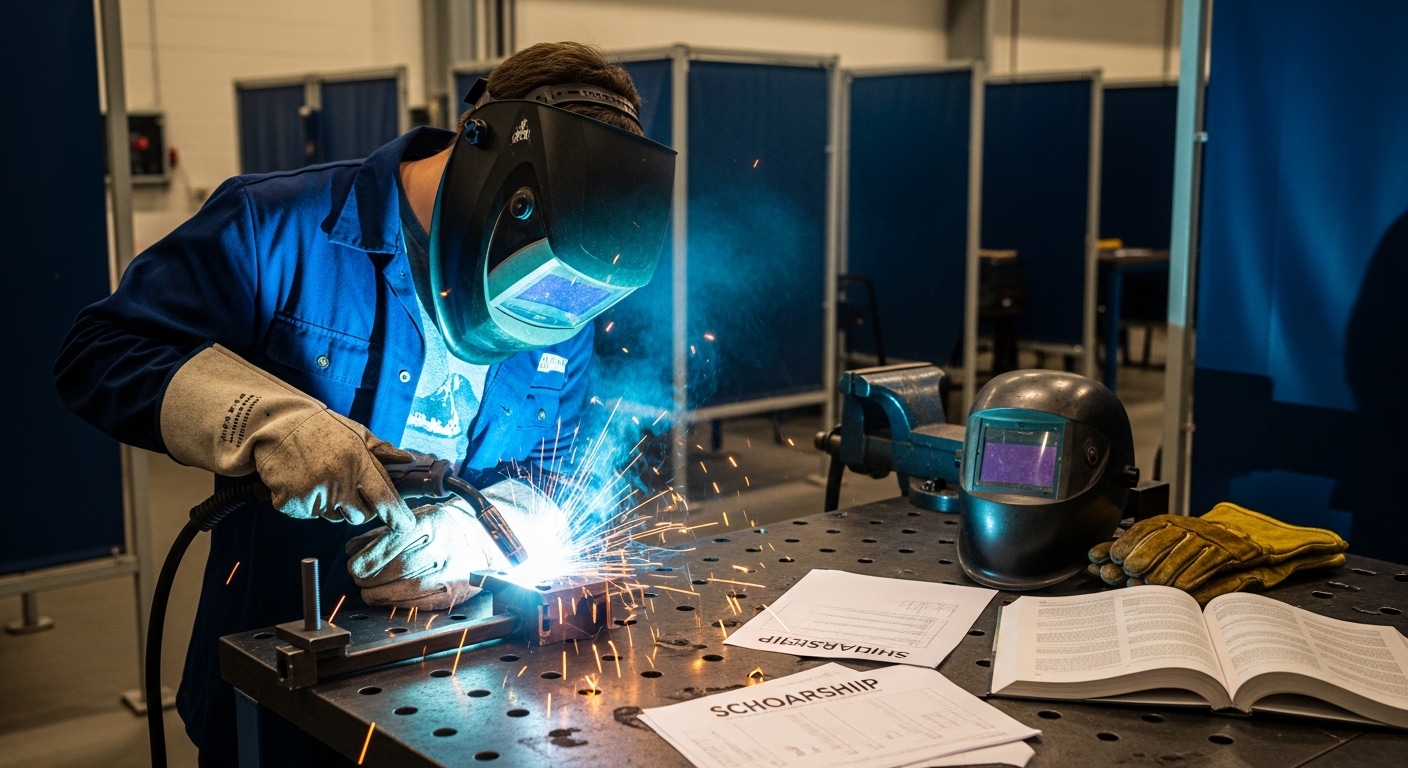
Welding school costs an average of $33,000. That’s a fraction of what you’d pay for a bachelor’s degree, but it’s still a significant investment for most people.
Welding scholarships can cover anywhere from $500 to $35,000 of your welding education costs. The American Welding Society Foundation alone offers at least $15,000 in each of its 22 districts annually, with individual awards ranging from $1,000 to $7,000.
I’ve spent years helping students navigate the financial aid landscape for trade schools.
After working with dozens of welding students, I’ve seen scholarships transform career paths.
One student I mentored secured over $12,000 in combined awards by applying strategically to multiple programs.
With 336,000 new welders needed by 2026, the industry is pouring money into education funding.
The opportunities are there if you know where to look and how to apply.
Top Welding Scholarships at a Glance
Let me give you a quick overview of the major scholarship programs available for welding students.
| Scholarship | Amount | Deadline | Eligibility |
|---|---|---|---|
| AWS District Scholarships | $1,000 – $3,000 | Varies by district | Enrolled in welding program |
| AWS National Scholarships | Up to $7,000 | March 1 | Minimum 2.0 GPA, welding major |
| Miller Electric Scholarships | Varies | Spring/Fall | Enrolled in welding program |
| DEWALT Trades Scholarship | $5,000 | March | Trade degree/certificate students |
| Mike Rowe WORKS Scholarship | Up to $2,500 | April | Trade school students, SWEAT Pledge |
| Lincoln Electric Foundation | Varies | Varies | Welding students at partner schools |
American Welding Society Foundation Scholarships
The American Welding Society Foundation is the largest provider of welding scholarships in the country.
Each of the 22 AWS districts offers at least $15,000 annually in scholarship awards.
I’ve seen students overlook district scholarships because they seem smaller than national awards.
This is a mistake.
District scholarships often have less competition, which means your odds of winning are significantly better.
The AWS National Scholarship Program offers awards up to $7,000 for students pursuing welding-related degrees or certifications.
AWS District Scholarships
Every AWS district manages its own scholarship program with unique deadlines and requirements.
District scholarships typically range from $1,000 to $3,000 per award.
Students must apply through their local district, not national AWS headquarters.
I recommend contacting your district director directly to learn about specific opportunities.
Many districts have rolling deadlines throughout the year.
This means you can apply at multiple times rather than being locked into a single annual deadline.
AWS National Scholarships
The national programs are more competitive but offer larger awards.
The flagship AWS National Scholarship requires a minimum 2.0 GPA and enrollment in an accredited welding program.
Applications are due March 1st each year.
You’ll need transcripts, letters of recommendation, and a personal statement.
The National Scholarship also considers financial need in its selection process.
How to Apply for AWS Scholarships
The application process happens entirely online through the AWS website.
You’ll create a student profile and can apply for multiple scholarships with one application.
Make sure your transcripts are official and your recommenders submit their letters before the deadline.
I’ve seen students miss out on awards simply because recommenders submitted letters late.
Follow up with your recommenders at least two weeks before the deadline.
Corporate Welding Scholarships
Major welding equipment manufacturers offer scholarship programs to support the next generation of welders.
These companies have a vested interest in building a skilled workforce.
Their scholarships are often less competitive than you might expect.
Many students don’t realize these corporate programs exist.
Miller Electric Scholarships
Miller Electric, one of the largest welding equipment manufacturers, offers multiple scholarship programs.
These scholarships support students enrolled in welding programs at accredited institutions.
Amounts vary by program and location.
Miller has a long history of supporting welding education.
They view these scholarships as an investment in the industry’s future.
Check their website annually for current opportunities and deadlines.
Lincoln Electric Foundation
Lincoln Electric offers scholarships through its foundation and partner schools.
The company has awarded millions in education support over the years.
Some scholarships are restricted to students attending specific institutions.
Others are open to any welding student meeting the criteria.
Lincoln Electric also sponsors welding competitions that include scholarship prizes.
DEWALT Trades Scholarship
DEWALT, known for power tools and equipment, offers a $5,000 Trades Scholarship.
This scholarship is open to students pursuing trade degrees or certificates.
Welding programs qualify under this umbrella.
The application typically opens in early spring with a March deadline.
DEWALT awards multiple scholarships annually.
I’ve seen welding students overlook this opportunity because it’s not exclusively for welding.
Airgas Scholarship Program
Airgas, a major welding and industrial gas supplier, offers scholarships for welding students.
The company supports workforce development through education funding.
Scholarship amounts and deadlines vary by year.
Check the Airgas website or contact local branches for current information.
Hypertherm Associates Scholarship
Hypertherm, a cutting systems manufacturer, offers scholarships for students in technical trades.
Welding and metal fabrication programs often qualify.
The company values community involvement and technical education.
Foundation and Organization Scholarships
Beyond corporate and AWS programs, several foundations support welding education.
These organizations fill gaps in funding for specific populations or career paths.
Mike Rowe WORKS Foundation Scholarship
The Mike Rowe WORKS Foundation offers the Work Ethic Scholarship Program.
Awards can reach $2,500 for trade school students.
This scholarship stands out because it focuses on attitude and work ethic rather than academic performance.
Applicants must sign the SWEAT Pledge, which emphasizes personal responsibility and work ethic.
You’ll submit a video application explaining why you deserve the award.
I’ve seen students with modest GPAs win this scholarship based on their compelling stories and determination.
The application deadline is typically in April.
Ben Bonner Memorial Scholarship
This memorial scholarship honors Ben Bonner and supports students pursuing skilled trades.
Welding programs qualify for this award.
The scholarship is available through Bold.org and other scholarship platforms.
Amounts vary but typically range from $500 to $2,000.
Uniball’s Skilled Trades Scholarship
Uniball offers a scholarship program for students entering skilled trades, including welding.
The company supports workforce development in practical fields.
Check their website or scholarship platforms for current deadlines and award amounts.
Jacob Daniel Dumas Memorial Scholarship
This memorial scholarship supports students in welding and related metalworking fields.
It’s one of several welding-specific scholarships available on major platforms like Bold.org.
Demographic-Specific Welding Scholarships
Certain scholarships target underrepresented groups in the welding industry.
Women make up only 5% of welders.
Minorities represent about 20% of the industry.
These demographics have targeted funding opportunities to increase representation.
Women in Welding Scholarships
Multiple organizations offer scholarships specifically for women pursuing welding careers.
AWS offers the Women in Welding scholarship in some districts.
Trade schools often have women-in-trades scholarships for welding programs.
I’ve worked with female welders who received multiple awards because the applicant pool for women-specific scholarships is smaller.
If you’re a woman considering welding, these scholarships can significantly reduce your education costs.
Minority Scholarships
Various organizations support minority students in skilled trades.
The United Negro College Fund and Hispanic Scholarship Fund sometimes list trade school opportunities.
Some corporate diversity programs include welding and manufacturing careers.
Research scholarships through organizations focused on workforce diversity.
Veteran Scholarships
Military veterans transitioning to civilian careers have excellent scholarship opportunities.
The GI Bill covers many welding programs.
Additional scholarships exist specifically for veterans in trades:
- Hiring Our Heroes offers scholarship resources for veterans
- Some trade schools offer veteran-specific scholarships
- AWS chapters sometimes have veteran-focused awards
If you’re a veteran, definitely explore these options.
Adult Learner and Career Changer Scholarships
Many scholarships target high school seniors, but adults changing careers face funding challenges too.
Some scholarships specifically support non-traditional students.
Look for scholarships with terms like “non-traditional student,” “adult learner,” or “career changer.”
Trade schools themselves often have funding for adult students.
I’ve helped career changers find success with scholarships that don’t have age restrictions.
How to Apply for Welding Scholarships
The scholarship application process can feel overwhelming.
Let me break it down into manageable steps.
Step 1: Gather Your Documents
Before applying, prepare these common requirements:
- Official transcripts: Most scholarships require proof of enrollment or academic records
- Proof of program enrollment: A letter from your school confirming you’re in a welding program
- Financial information: FAFSA results or tax documents for need-based awards
- Personal identification: Driver’s license or student ID
- Resume: Highlighting work experience, especially any welding or trades background
Having these documents ready will streamline your application process.
Step 2: Request Recommendation Letters
Most welding scholarships require 1-3 recommendation letters.
Ask recommenders at least one month before the deadline.
Good sources for recommendations include:
- Welding instructors or trade school teachers
- Employers or supervisors (especially in trades)
- Community leaders or mentors
- High school counselors (for recent graduates)
Provide your recommenders with your resume and information about the scholarship.
This helps them write specific, relevant letters.
Step 3: Write Your Personal Statement
Your personal statement or essay is often the most important part of your application.
Scholarship committees want to understand your passion for welding and your career goals.
Include these elements in your essay:
- Why welding: What sparked your interest in this trade?
- Career goals: What type of welding work do you want to do?
- Financial need: How would this scholarship help you?
- Academic or work achievements: What have you accomplished so far?
- Community involvement: How do you give back?
Be specific and authentic.
I’ve seen generic essays fail while personal, honest stories win.
Step 4: Complete the Application
Fill out all required fields completely and accurately.
Incomplete applications are often disqualified without review.
Proofread everything before submitting.
Ask someone else to review your application for errors you might miss.
Step 5: Track Your Applications
Create a spreadsheet or document to track your scholarship applications.
Include these columns:
- Scholarship name
- Deadline
- Requirements
- Date submitted
- Follow-up actions needed
- Result (award, rejection, pending)
This system helps you stay organized and ensures you don’t miss deadlines.
Alternative Funding Options for Welding School
Scholarships aren’t the only way to fund your welding education.
Consider these alternatives to fill any funding gaps.
Can FAFSA Pay for Welding School?
Yes, federal financial aid can cover welding school costs.
If your trade school is accredited and has a Federal School Code, you can complete the FAFSA.
The FAFSA unlocks several types of federal aid:
- Pell Grants: Need-based grants that don’t require repayment (up to $7,395 annually)
- Federal student loans: Low-interest loans with flexible repayment options
- Federal Work-Study: Part-time jobs to help pay for education expenses
Contact your school’s financial aid office to confirm their FAFSA code and eligibility.
Apprenticeship Programs
Apprenticeships let you earn while you learn.
Registered apprenticeships combine on-the-job training with classroom instruction.
You’ll receive a paycheck from day one.
Many welding apprenticeships also cover the cost of related classroom training.
Apprenticeship programs are available through:
- Union locals (Ironworkers, Boilermakers, Pipefitters)
- Contractors and construction companies
- State apprenticeship agencies
- The Department of Labor’s Apprenticeship.gov website
Employer Tuition Assistance
Some employers offer tuition reimbursement for employees pursuing relevant education.
If you currently work in a related field, ask about education benefits.
Manufacturing companies sometimes support welding certification for employees.
This option works well for adult learners already in the workforce.
State and Local Grants
Many states offer grants for workforce development in high-demand fields.
Welding qualifies in most states due to the skilled worker shortage.
Check with your state’s workforce development agency or department of labor.
Local workforce boards sometimes have funding for trade school tuition.
How to Avoid Scholarship Scams
Scholarship scams target students desperately seeking education funding.
Knowing the warning signs protects you from losing money or personal information.
Legitimate Scholarship: A genuine scholarship never requires payment to apply. Real scholarships are free to enter and are awarded based on merit, need, or specific criteria determined by the sponsoring organization.
Major Red Flags
Avoid any scholarship opportunity that displays these warning signs:
- Application fees: Legitimate scholarships never charge to apply
- Guaranteed awards: No legitimate scholarship can guarantee you’ll win
- Requests for payment: Never pay processing fees, taxes upfront, or delivery charges
- Requests for sensitive information: Avoid providing SSN, bank account numbers, or credit card information
- High-pressure tactics: Scammers create urgency claiming deadlines are imminent
- No contact information: Legitimate organizations provide verifiable contact details
- Unprofessional website: Poor grammar, typos, and generic emails suggest scams
Verify Legitimacy
Before applying, verify the scholarship is legitimate:
- Search for the organization + “scam” or “review”
- Check the Better Business Bureau for complaints
- Verify the organization has a physical address and phone number
- Look for past winners listed on their website
- Confirm the domain is professional (not free email services)
I’ve seen students lose hundreds of dollars to scholarship scams.
Don’t let this happen to you.
Remember: legitimate scholarships want to give you money, not take it.
Frequently Asked Questions
Can FAFSA pay for welding school?
Yes, FAFSA can pay for welding school if your program is accredited and has a Federal School Code. Completing the FAFSA unlocks Pell Grants (up to $7,395 annually) and federal student loans. Contact your school’s financial aid office to confirm their eligibility and get their Federal School Code for your application.
Can you make $100,000 a year welding?
Yes, $100,000 annually is possible in welding but requires specialization and experience. High-paying welding careers include underwater welding ($50,000-$200,000+), aerospace welding, pipeline welding, and industrial construction. Factors affecting salary include certifications, hazardous conditions, overtime, travel requirements, and union membership. The average welder earns around $45,400, but top earners in specialized fields can exceed six figures.
Is the $2000 Sallie Mae Scholarship real?
Yes, the $2,000 Sallie Mae Scholarship is legitimate. It’s a monthly sweepstakes open to students and parents, with no essay or minimum GPA requirement. However, it’s a lottery-style drawing, not a merit-based award. Your odds of winning depend on the number of monthly entries. While legitimate, I recommend focusing on merit-based welding scholarships where your application quality directly impacts your chances.
Can I get paid to go to school for welding?
Yes, you can earn money while training for welding through registered apprenticeship programs. Apprentices receive wages for on-the-job training combined with classroom instruction. Pay starts at 40-60% of journeyman wages and increases as you progress. Additionally, some employers offer tuition reimbursement for employees pursuing welding certifications. Union apprenticeships and company-sponsored training programs are the best options for paid welding education.
What GPA do I need for welding scholarships?
GPA requirements vary by scholarship. Some welding scholarships don’t specify a minimum GPA, especially those focused on financial need or work ethic (like the Mike Rowe WORKS Scholarship). Others require a 2.0 GPA or higher. AWS Foundation scholarships typically require at least a 2.0 GPA. Don’t let lower grades discourage you – many scholarships prioritize your passion, career goals, and financial need over academic performance.
Are there welding scholarships for part-time students?
Yes, some welding scholarships accept part-time students, though options are more limited than for full-time enrollment. Many AWS district scholarships and corporate programs don’t specify full-time status. Focus on scholarships that emphasize career goals and program enrollment rather than credit hours. Trade schools themselves often have funding for part-time students. Always check eligibility requirements carefully and contact the scholarship provider if part-time status isn’t clearly addressed.
Final Thoughts on Welding Scholarships
Welding scholarships can dramatically reduce or eliminate your education costs.
The student I mentioned earlier who secured over $12,000 applied to 15 different programs.
She won four awards.
That’s roughly a 27% success rate.
Her strategy was simple: apply to everything she qualified for, customize each application, and never miss a deadline.
The welding industry needs skilled workers.
Organizations have money set aside to help you succeed.
Your job is to find those opportunities and submit strong applications.
Start with AWS Foundation scholarships.
Then explore corporate programs from equipment manufacturers.
Apply for demographic-specific awards if you qualify.
Complete the FAFSA for federal aid.
Consider apprenticeships for earn-while-you-learn options.
With persistence and strategic applications, you can fund your welding education without taking on excessive debt.
Leave a Reply