
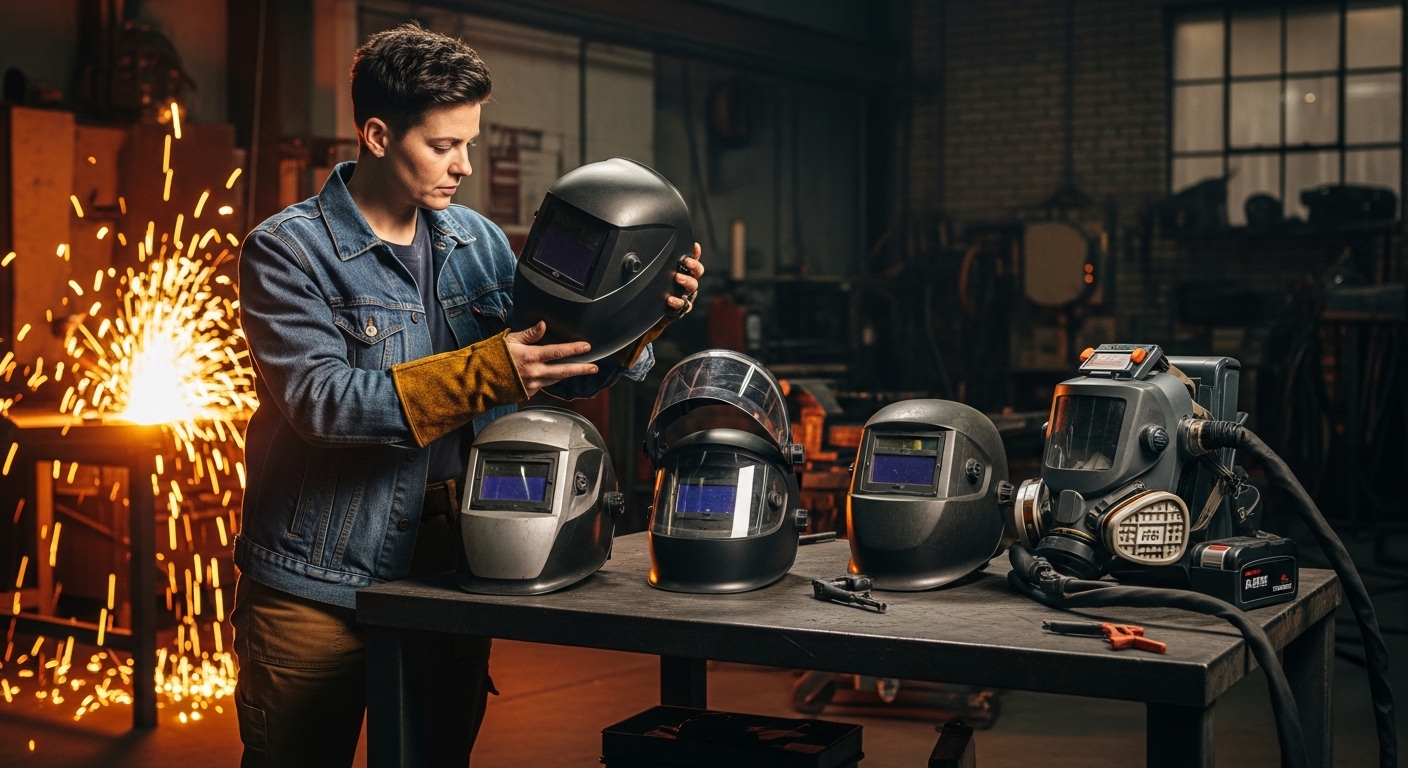
Choosing the right welding helmet can make or break your welding experience. After 15 years in metalwork, I’ve seen welders struggle with cheap helmets that flicker, fog up, or fail to darken at the worst possible moments. The right helmet protects your eyes from UV damage, helps you weld more precisely, and prevents the headaches that come from poor optical clarity.
The main types of welding helmets are passive helmets (fixed shade lens you flip down) and auto-darkening helmets (electronic lens that adjusts automatically). Auto-darkening helmets come in solar-powered, battery-powered, and hybrid versions, with options ranging from budget $60 models to professional $500+ helmets with 1/1/1/1 optical clarity ratings. Specialized types include PAPR systems for respiratory protection, pancake helmets for pipeline welding, and grinding helmets for fabrication work.
- Most Common: Auto-darkening helmets (standard for 2026)
- Budget Choice: Passive helmets ($20-80)
- Professional Standard: 4-sensor auto-darkening with 1/1/1/1 optical rating
In this guide, I’ll break down every type of welding helmet available in 2026, explain who each type is best for, and give you real price ranges so you know what to expect. I’ve tested dozens of helmets over my career, and I’ll share what actually matters in the shop versus what marketing wants you to believe.
Why Choosing the Right Welding Helmet Matters
Welding Helmet: A protective headgear that shields your eyes and face from intense ultraviolet and infrared radiation produced during welding, preventing arc eye, retinal burns, and long-term vision damage.
The wrong helmet causes real problems. I’ve spent 8-hour days with a cheap helmet that gave me a tension headache by noon because the optical clarity was garbage. Your eyes strain to see through a distorted lens, your neck hurts from constantly flipping a passive helmet up and down, and your welding suffers because you can’t clearly see the weld puddle.
Welding produces UV radiation that can damage your eyes in seconds. Arc flash (also called photokeratitis or welder’s flash) feels like sand in your eyes – painful and completely preventable with proper protection. Long-term exposure without adequate protection contributes to cataracts and retinal damage later in life.
The Two Main Categories: Passive vs Auto-Darkening
Every welding helmet falls into one of two categories. Understanding this fundamental distinction is your first step in choosing the right helmet.
Passive Welding Helmets
Passive helmets use a fixed shade lens that’s always dark. You flip the helmet down when you’re ready to weld and flip it up when you need to see. The lens typically has a shade #10 filter that’s always in place – no electronics, no batteries, no moving parts.
Quick Summary: Passive helmets are simple, affordable, and reliable. They’re great for beginners and hobbyists on a budget, but the constant flipping gets tedious for production work.
I learned to weld with a passive helmet. The constant motion – flip down, strike arc, weld, flip up, inspect, flip down again – becomes second nature eventually. But for tack welding or multiple short welds, it’s exhausting. You also have to position your torch blindly before flipping the helmet down, which can lead to misaligned starts until you develop muscle memory.
Passive Helmet Pros:
- Always works – no batteries to die
- Simple construction – less to break
- Affordable – $20-80 for most models
- Reliable – no electronics to fail
Passive Helmet Cons:
- Constant flipping – fatiguing for long sessions
- Blind positioning – can’t see through lens before welding
- Fixed shade – not adjustable for different processes
- Productivity killer – slower workflow
Auto-Darkening Welding Helmets
Auto-darkening helmets revolutionized welding when they became widely available. The lens stays light (usually shade #3-4) when not welding, then darkens to your selected shade (typically #8-13) within 1/25,000 of a second when it detects the arc. Sensors around the lens pick up the welding arc and trigger liquid crystal display (LCD) technology to darken instantly.
After switching to auto-darkening, my productivity jumped about 30%. I could see exactly where my torch was positioned before striking the arc. No more blind starts. No more constant flipping. For tack welding, fabrication, or any job with multiple short welds, auto-darkening is a game-changer.
Tack Welding
Precision Work
Beginners
Auto-darkening helmets use sensors (typically 2 or 4) positioned around the lens to detect the arc from different angles. This is crucial when you’re welding out of position – overhead welding or working in tight spaces where the arc isn’t directly in front of you. Four sensors provide better coverage than two, which matters for pipe welding or confined space work.
Auto-Darkening Helmet Pros:
- Always see through lens – precise torch positioning
- No flipping – reduced neck fatigue
- Variable shade – adjustable for different processes
- Faster workflow – especially for tack welding
- Better for beginners – easier learning curve
Auto-Darkening Helmet Cons:
- Higher cost – $60-900+ depending on features
- Battery dependency – need to keep batteries charged
- More potential failure points – electronics can fail
- Can be triggered by other welders nearby
Power Options: Solar, Battery, and Hybrid Systems
Auto-darkening helmets need power to operate. The type of power system affects convenience, cost, and reliability.
Solar-Powered Helmets
Solar-powered helmets use solar cells (usually on the front of the helmet) to charge internal batteries during use. Exposure to welding light keeps the battery charged. They typically include replaceable lithium batteries as backup.
Solar models work well for outdoor welding or high-amperage applications where there’s plenty of arc light to charge the cells. For low-amperage TIG welding or indoor work with shorter welds, solar alone might not keep the battery charged adequately.
Battery-Powered Helmets
Battery-powered helmets rely entirely on replaceable batteries (usually CR2032 lithium cells). The advantage is consistent performance regardless of welding conditions. The downside is ongoing battery replacement costs – usually every 1-2 years depending on usage.
Hybrid Systems (Solar + Battery)
Most quality auto-darkening helmets use hybrid systems. Solar cells extend battery life, while replaceable batteries ensure consistent performance. This is the standard for 2026 and what I recommend for most welders.
Fixed Shade vs Variable Shade Helmets
Shade numbers indicate how dark the lens gets, ranging from #8 (lightest) to #13 (darkest). The right shade depends on your welding process and amperage.
Quick Summary: Fixed shade helmets lock into one darkness level (usually #10). Variable shade helmets let you adjust from #8-13+ to match different welding processes. Variable shade is essential if you weld multiple processes.
Fixed Shade Helmets
Fixed shade helmets darken to a predetermined shade level when the arc strikes. Most passive helmets are fixed shade #10. Some auto-darkening models also offer fixed shade operation at a lower price point.
Fixed shade works fine if you only do one type of welding. If you only MIG weld mild steel at similar amperage, shade #10 or #11 works consistently. But if you switch between processes, fixed shade becomes limiting.
Variable Shade Helmets
Variable shade helmets let you adjust the darkness level, typically from shade #8 to #13. This flexibility matters because different processes require different shades:
- TIG welding (low amperage): Shade #8-9
- MIG welding (medium amperage): Shade #10-11
- Stick welding (high amperage): Shade #11-12
- Flux core (high amperage): Shade #11-12
I’ve welded at shade #10 when I should have been at #11 and ended up with eye strain at the end of the day. Variable shade eliminates this problem – one helmet adapts to whatever you’re welding.
2 Sensors vs 4 Sensors
Sensors detect the welding arc and trigger the lens to darken. The number and position of these sensors affect how reliably the helmet responds.
2-sensor helmets have sensors positioned on the upper left and upper right of the lens. This works fine for most flat and horizontal welding. However, when you weld overhead, in corners, or around obstructions, one or both sensors might be blocked from seeing the arc directly.
4-sensor helmets add sensors on the lower left and lower right corners. This provides 360-degree arc detection coverage. For pipe welding, overhead work, or fabrication in tight spaces, four sensors prevent the dreaded situation where you strike an arc and the lens doesn’t darken because a sensor is blocked.
Sensor Coverage: 4-sensor helmets detect the arc from multiple angles, preventing the lens from staying light when welding out of position. This is essential for pipe welders, industrial applications, and anyone working in confined spaces.
For hobby welding in a home shop, 2 sensors are usually sufficient. For professional production work, especially pipe or structural welding, 4 sensors are worth the extra cost.
Specialized Welding Helmet Types
Beyond passive and auto-darkening, specialized helmets address specific needs in the welding industry.
Respirator Welding Helmets
Respirator helmets integrate filtered breathing protection into the welding helmet design. These use P100 filters or cartridges to remove welding fumes, metal particles, and other contaminants from the air you breathe.
Welding fumes contain manganese, hexavalent chromium (from stainless steel), and other hazardous metals. Long-term exposure causes neurological damage, respiratory problems, and increased cancer risk. Respirator helmets provide protection when you can’t use external fume extraction.
Respirator Helmet Pros:
- Built-in fume protection
- OSHA compliant for many applications
- Good for confined spaces
- $200-600 price range
Respirator Helmet Cons:
- Added weight on head/neck
- Filters require replacement
- Can be hot and uncomfortable
- Breathing resistance increases as filters load
PAPR Systems (Powered Air Purifying Respirator)
PAPR helmets represent the top tier of welding respiratory protection. A battery-powered fan pulls air through filters and blows it into the helmet, creating positive pressure. This means contaminated air can’t leak in – only filtered air reaches your breathing zone.
PAPR systems are comfortable because the airflow cools you while working. The positive pressure means no seal is required against your face, reducing fatigue. But you pay for this technology – PAPR systems range from $800 to $2,500.
Quick Summary: PAPR systems provide the highest level of respiratory protection with cooling airflow. Essential for heavy industrial applications, stainless steel welding (hexavalent chromium), and health-conscious professionals willing to invest $800-2,500 in protection.
Major manufacturers like 3M Speedglas, Miller, and Lincoln all offer PAPR options. These are standard in shipyards, heavy fabrication, and any environment where fume exposure is significant. After seeing welders in their 50s with neurological issues from decades of manganese exposure, I believe PAPR is worth every penny for career welders.
PAPR System Pros:
- Best respiratory protection available
- Cooling airflow improves comfort
- Positive pressure – no face seal needed
- Battery lasts 6-8 hours typically
PAPR System Cons:
- Expensive – $800-2,500
- More equipment to maintain
- Batteries require charging
- Filters add ongoing cost
Pancake Welding Helmets
Pancake helmets (also called pipeliner hoods) are specialized for pipeline welding and outdoor work. These feature a flat, disc-shaped design that extends well past your face, providing excellent sun protection from all angles. Traditional pancake helmets use passive lenses, though auto-darkening versions now exist.
Pipeline welders work outdoors in direct sun, often in awkward positions. The extended brim of a pancake helmet shadows the entire viewing area, preventing sun glare from washing out your vision of the weld puddle. The design also allows you to get very close to the pipe for precision root passes on critical welds.
Pancake helmets use a “balsa box” design – a small container holding the lens that you press against your face for welding. When you pull away, the box stays with your face while the outer helmet shell remains in place. This design allows quick transitions between welding and inspecting work without removing the helmet.
Pancake Helmet Pros:
- Superior sun protection for outdoor work
- Allows close-up vision for precision welds
- Traditional choice for pipeline welders
- Lightweight design options available
- $70-250 price range
Pancake Helmet Cons:
- Limited viewing area
- Designed for specific applications (pipeline)
- Not ideal for general fabrication
- Traditional designs use passive lenses
Pipeliner Hoods and Sugar Scoop Helmets
Pipeliner hoods and sugar scoop helmets represent variations on the pancake design. Pipeliner hoods refer to the extended-coverage style favored by pipeline welders, often made from leather or high-quality synthetic materials. Sugar scoop helmets have a distinctive curved front that directs your breath downward, preventing lens fogging – a common problem when welding in cold or humid conditions.
Carbon fiber pipeliner hoods offer the best combination of durability and weight reduction. I’ve used carbon fiber models that weigh under 16 ounces – after a 12-hour day, your neck definitely notices the difference.
Grinding and Welding Helmets
Grinding helmets combine welding protection with grinding functionality. These feature a grinding mode that locks the lens in a light state (shade #3-4) so you can see clearly while grinding material preparation without changing headgear.
Fabrication work involves constant switching between welding and grinding. Without a grinding mode, you either flip your helmet up to grind (exposing your face to sparks and debris) or remove the helmet entirely. A dedicated grinding mode streamlines the workflow.
Grinding Helmet Pros:
- One helmet for welding and grinding
- Protected face during material prep
- No need to switch headgear
- Typical cost: $80-300
Grinding Helmet Cons:
- More expensive than standard welding helmets
- Additional feature to potentially fail
- Some welders prefer dedicated grinding shields
Welding Helmet Types Comparison Table
| Helmet Type | Price Range | Best For | Key Benefit | Main Drawback |
|---|---|---|---|---|
| Passive | $20-80 | Beginners, Hobbyists | Simple, Reliable, Affordable | Constant flipping required |
| Auto-Darkening (Entry) | $60-150 | DIY welders, Students | No flipping, Better workflow | Basic optics, 2 sensors |
| Auto-Darkening (Mid) | $150-350 | Serious hobbyists, Professionals | Better clarity, 4 sensors | Higher investment |
| Auto-Darkening (Premium) | $350-900 | Professional welders | 1/1/1/1 optics, Large view | Premium pricing |
| Respirator Helmet | $200-600 | Indoor welding, Confined spaces | Fume protection built-in | Added weight, Filter costs |
| PAPR System | $800-2,500 | Industrial, Health-conscious pros | Maximum protection, Cooling airflow | Expensive, Complex system |
| Pancake/Pipeliner | $70-250 | Pipeline welders, Outdoor work | Sun protection, Close-up vision | Limited to specific applications |
| Grinding Helmet | $80-300 | Fabricators, Multi-process work | One helmet for all tasks | Added cost for grinding mode |
Price Ranges by Helmet Type
Understanding price tiers helps set realistic expectations and avoid overspending on features you don’t need.
Budget Tier ($20-80)
The budget tier includes basic passive helmets and entry-level auto-darkening models. At this price point, you’re getting functional protection but compromises in comfort, optical clarity, and features.
Passive helmets in this range work fine for occasional welding. I’d avoid auto-darkening helmets under $60 – the optical quality is often poor, and the electronics may be unreliable. Cheap auto-darkening lenses can have distortion that causes eye fatigue after 30 minutes of welding.
Mid-Range ($100-350)
This is the sweet spot for most welders. Mid-range helmets offer good optical clarity, reliable sensors, and decent build quality. You’ll find 2-4 sensor options, variable shade, and comfortable headgear systems.
For hobby welders and light professional use, $150-250 gets you a helmet that will last years. Brands like Hobart, Jackson Safety, and YesWelder compete in this space with good value options.
Premium ($350-900)
Premium helmets from Miller, Lincoln Electric, ESAB, and 3M deliver the best optical clarity available. The 1/1/1/1 optical rating (explained below) becomes standard at this level, along with large viewing areas, excellent headgear, and advanced features like grind mode, memory settings, and superior sensor arrays.
For welders who earn their living with a hood, investing $400-500 in a quality helmet pays off daily in reduced fatigue and better weld quality. I’ve used $500 helmets that felt weightless compared to $150 models, and the optical clarity difference is immediately apparent.
Industrial/PAPR ($800-2,500)
PAPR systems and industrial-grade helmets represent the top of the market. These include the full respiratory protection systems from 3M Speedglas, Miller’s PAPR offerings, and specialized industrial equipment designed for heavy-duty applications.
The $2,000+ price tag includes the helmet, battery pack, breathing tube, filters, and carrying case. For industrial applications with fume exposure regulations, this equipment is often mandatory rather than optional.
Welding Process Compatibility Guide
| Helmet Type | MIG | TIG | Stick | Flux Core | Pipeline |
|---|---|---|---|---|---|
| Passive | Good | Fair | Good | Good | Fair |
| Auto-Darkening (2-sensor) | Excellent | Good | Excellent | Excellent | Fair |
| Auto-Darkening (4-sensor) | Excellent | Excellent | Excellent | Excellent | Good |
| PAPR System | Excellent | Excellent | Excellent | Excellent | Good |
| Pancake/Pipeliner | Fair | Fair | Good | Good | Excellent |
MIG Welding
MIG welding works well with almost any helmet type. Auto-darkening is ideal for the short tack welds common in MIG fabrication. A 2-sensor helmet is sufficient for most MIG applications since you’re typically welding in flat, horizontal, or vertical positions with good sensor visibility.
TIG Welding
TIG welding presents specific challenges. The lower amperage produces less arc light, which can sometimes fail to trigger cheaper auto-darkening helmets. High-end helmets with adjustable sensitivity work best for TIG. Variable shade is essential – you need lower shades (#8-9) for low-amp TIG compared to Stick or MIG.
TIG also demands the best optical clarity you can afford. You’re watching the weld puddle closely, adding filler rod by hand, and making minute adjustments. Distorted lenses make precision TIG nearly impossible.
Stick (SMAW) Welding
Stick welding works well with most helmet types. The high amperage creates strong arc light that triggers sensors reliably. Stick often involves outdoor work or less-than-ideal positioning, so 4-sensor helmets can be advantageous. Pipeliners doing stick work often prefer traditional pancake helmets for the sun protection and close-up visibility.
Flux Core Welding
Flux core produces heavy smoke and sparks. A helmet with good coverage and possibly respiratory protection is beneficial. Auto-darkening works excellently with flux core – the bright arc triggers sensors reliably, and being able to see through the lens before striking helps with positioning in tight joints.
Understanding Optical Clarity Ratings (EN 379 Standard)
EN 379 Optical Clarity Rating: A European standard (EN 379) that rates welding lens optical quality using four numbers. The format is 1/1/1/1, with lower numbers being better. Each number represents: optical class, diffusion of light, uniformity of shade, and angle dependence.
The EN 379 rating appears as four numbers separated by slashes, like 1/1/1/1 or 1/2/1/2. Each position represents a different optical quality factor:
- First number (Optical Class): Overall clarity – 1 is best, 3 is acceptable minimum
- Second number (Diffusion of Light): How much light scatters – 1 is best
- Third number (Uniformity of Shade): Consistency across the lens – 1 is best
- Fourth number (Angle Dependence): How viewing angle affects darkness – 1 is best
A 1/1/1/1 rating represents the highest optical quality available. Lower-rated lenses (like 1/2/1/2 or worse) have visible distortion, especially around the edges of the viewing area. After welding through a 1/1/1/1 lens, going back to a lower-rated lens feels like looking through cheap plastic.
Professional welders demand 1/1/1/1 optics because the difference affects weld quality. When you can clearly see the puddle dynamics, the toe of the weld, and the filler rod entry point, your welds improve. Eye strain also decreases significantly – I’ve noticed I can weld 2-3 hours longer with a premium lens compared to a budget option.
Quick Summary: The EN 379 rating appears as four numbers (like 1/1/1/1). Lower is better. 1/1/1/1 is premium optical clarity found on $300+ helmets. Budget helmets often don’t publish these ratings because they’re inferior.
Sensor Differences: 2 vs 4
Sensor placement affects how reliably your helmet detects the welding arc and darkens appropriately. This becomes crucial when welding out of position.
2-sensor helmets position sensors on the upper left and upper right of the lens cartridge. This works well for standard welding positions where the arc is in front of you and slightly below. However, when welding overhead, in corners, or around obstructions, one or both sensors may be blocked from direct line-of-sight to the arc.
4-sensor helmets add sensors on the lower corners, providing near-complete coverage. You can weld in a tight corner, overhead in a pipe rack, or at odd angles, and at least one sensor will detect the arc. This prevents the dangerous situation where the lens stays light because all sensors are blocked.
For fabrication in a shop with good positioning, 2 sensors are usually adequate. For pipe welding, construction, or mobile welding where you never know what position you’ll be in, 4 sensors are worth the extra $50-100.
Safety Standards and Certifications
Welding helmets must meet specific safety standards to provide adequate protection. Understanding these certifications ensures you’re buying legitimate protective equipment.
ANSI Z87.1
ANSI Z87.1 is the American National Standard for eye and face protection. A welding helmet meeting ANSI Z87.1 has been tested for impact resistance, optical clarity, and protection against UV and IR radiation. This is the minimum standard for welding helmets sold in the United States.
OSHA Compliance
OSHA (Occupational Safety and Health Administration) requires employers to provide eye and face protection meeting ANSI Z87.1 standards. For professional welders, using ANSI-certified helmets isn’t just good practice – it’s legally required in most workplaces.
CSA Z94.3
CSA Z94.3 is the Canadian standard for eye and face protection, similar to ANSI Z87.1. Helmets certified for both standards are common and widely accepted across North America.
What These Standards Mean in Practice
Certified helmets have been tested to block 100% of UV and IR radiation, resist impact from flying debris, and provide consistent optical quality. Non-certified helmets may look similar but can have gaps in UV protection or shatter upon impact. I’ve seen imported helmets that claimed to be ANSI certified but weren’t – always verify certification markings and buy from reputable brands.
Which Welding Helmet Type Should You Buy?
Based on experience testing dozens of helmets across different applications, here are my recommendations by user type:
Beginners and DIY Welders
Recommendation: Mid-range auto-darkening helmet with variable shade ($150-250)
You’re learning, and the last thing you need is the distraction of a passive helmet. Auto-darkening lets you focus on technique, not flipping your hood. Look for 2 sensors, shade range #8-12, and decent optics. Avoid the cheapest options – poor optical clarity will frustrate you as you’re trying to learn puddle control.
Hobby and Weekend Welders
Recommendation: Quality auto-darkening with 4 sensors ($200-350)
For serious hobbyists who weld regularly, invest in better optics and sensor coverage. The 4 sensors help when you’re welding projects at odd angles. Look for 1/2/1/2 or better optical clarity rating. This helmet will last years if taken care of.
Professional Welders
Recommendation: Premium auto-darkening with 1/1/1/1 optics ($350-600)
You earn your living with this tool. The difference between a $200 helmet and a $500 helmet becomes obvious after an 8-hour day. Better optics mean less eye fatigue. Better headgear means less neck pain. These helmets pay for themselves in comfort and weld quality. Miller Digital Elite, Lincoln Viking, and ESAB Sentinel series are industry standards for good reason.
Pipe and Pipeline Welders
Recommendation: Pancake/pipeliner hood OR premium auto-darkening with 4 sensors
Traditionalists swear by pancake helmets for the sun protection and close-up vision on root passes. Modern pipeliners often choose premium auto-darkening with 4 sensors for versatility. If welding exclusively outdoors in direct sun, a pancake hood has advantages. For mixed indoor/outdoor work, a quality auto-darkening serves better.
Industrial and Heavy Fabrication
Recommendation: PAPR system ($800-2,500)
When welding all day in environments with significant fume exposure, respiratory protection isn’t optional. A PAPR system provides the best protection while keeping you cool with positive pressure airflow. The cost is significant, but so is the long-term health risk from daily fume exposure.
Stainless Steel and Toxic Materials
Recommendation: Respirator helmet or PAPR system
Stainless steel welding produces hexavalent chromium, a known carcinogen. Other materials produce manganese, cadmium, and other hazardous fumes. If you can’t exhaust these fumes adequately, respiratory protection is essential. Don’t compromise on health – the medical costs down the road far exceed the cost of proper protection.
Weight and Comfort Considerations
Helmet weight matters more than most buyers realize. A 20-ounce helmet might feel fine in the store but causes neck fatigue after six hours of welding. Premium helmets use lightweight materials (carbon fiber, advanced polymers) to reduce weight without sacrificing protection.
I’ve worked with helmets ranging from 16 ounces to over 2 pounds. The difference in comfort is dramatic. After a full day of overhead welding, a heavy helmet feels like it’s pulling your head down. Lightweight helmets reduce neck strain and help you maintain better positioning.
Headgear quality also affects comfort. Premium headgear systems distribute weight evenly, allow precise adjustment, and stay in position once set. Cheap headgear slips, digs into your forehead, and requires constant readjustment.
Viewing Area Size
Viewing area determines how much you can see through the lens. Budget helmets might offer 3.5 x 1.6 inches of viewing space. Premium models can exceed 4 x 3 inches or even offer panoramic views.
For most welding, standard viewing areas are sufficient. Large viewing areas help with fabrication work where you need to see beyond the immediate weld zone – keeping track of joint alignment, workpiece position, and overall project context. TIG welders doing precision work often appreciate larger views for better visibility.
Frequently Asked Questions
What are the different types of welding helmets?
The main types of welding helmets are passive helmets with fixed shade lenses that require manual flipping, and auto-darkening helmets with electronic lenses that adjust automatically. Specialized types include respirator helmets for fume protection, PAPR systems with powered air filtration, pancake helmets for pipeline welding, and grinding helmets with dedicated grinding modes.
What is the difference between passive and auto-darkening welding helmets?
Passive welding helmets have a fixed dark lens that you manually flip down before welding and flip up to see. Auto-darkening helmets use light sensors to detect the welding arc and automatically darken the lens within milliseconds. Auto-darkening helmets eliminate constant flipping, improve productivity, and allow you to see exactly where your torch is positioned before striking an arc.
What type of welding helmet do I need?
Most welders need an auto-darkening helmet with variable shade range of #8-12 and at least 2 sensors. Beginners should start with a mid-range auto-darkening model ($150-250) for the best learning experience. Professional welders should invest in premium helmets with 1/1/1/1 optical clarity and 4 sensors. Choose a respirator helmet or PAPR system if welding in environments with poor ventilation or hazardous fumes.
What does 1/1/1/1 mean on a welding helmet?
The EN 379 optical clarity rating appears as four numbers like 1/1/1/1, where lower numbers indicate better quality. The four numbers represent optical class, diffusion of light, uniformity of shade, and angle dependence. A 1/1/1/1 rating is the highest optical quality available, indicating clear, distortion-free viewing across the entire lens. Professional welders prefer 1/1/1/1 rated lenses for reduced eye strain and better visibility of the weld puddle.
What is the difference between 2 sensor and 4 sensor welding helmets?
2-sensor helmets have arc detectors on the upper left and upper right corners, which works well for most welding positions. 4-sensor helmets add sensors on the lower corners, providing 360-degree arc detection. Four sensors prevent the lens from staying light when welding overhead, in corners, or around obstructions where upper sensors might be blocked. Pipeline welders and fabricators working in tight spaces benefit most from 4-sensor models.
Is shade 10 or 11 better for welding?
The right shade depends on your welding process and amperage. Shade #10 works well for MIG welding at 125-200 amps and light stick welding. Shade #11 is better for higher amperage stick welding (200+ amps), flux core, and heavy MIG applications. Variable shade helmets let you adjust between shade #8-13, allowing you to match the darkness level to your specific process rather than being locked into one shade.
Conclusion
Choosing the right welding helmet comes down to understanding your specific needs. Auto-darkening helmets have become the standard for 2026 because the productivity and comfort benefits are undeniable. The question isn’t whether to go auto-darkening, but which level of quality fits your welding and budget.
For beginners and hobbyists, a $150-250 auto-darkening helmet with 2-4 sensors and variable shade provides excellent value. Serious hobbyists and professionals should invest in the $350-600 range for 1/1/1/1 optical clarity – your eyes will thank you after long welding sessions. Industrial welders and those working with toxic materials need respiratory protection, making PAPR systems worth the investment.
The comparison table and compatibility guide above should help you match your welding type to the right helmet category. Remember that safety certifications (ANSI Z87.1) are non-negotiable, and optical quality affects both weld quality and long-term eye health.
After testing dozens of helmets over 15 years of welding, I’ve learned that the right helmet disappears during use – you stop noticing it and just focus on the weld. The wrong helmet becomes a constant distraction. Choose wisely based on how you actually weld, not on marketing hype or the cheapest option available.
Leave a Reply