
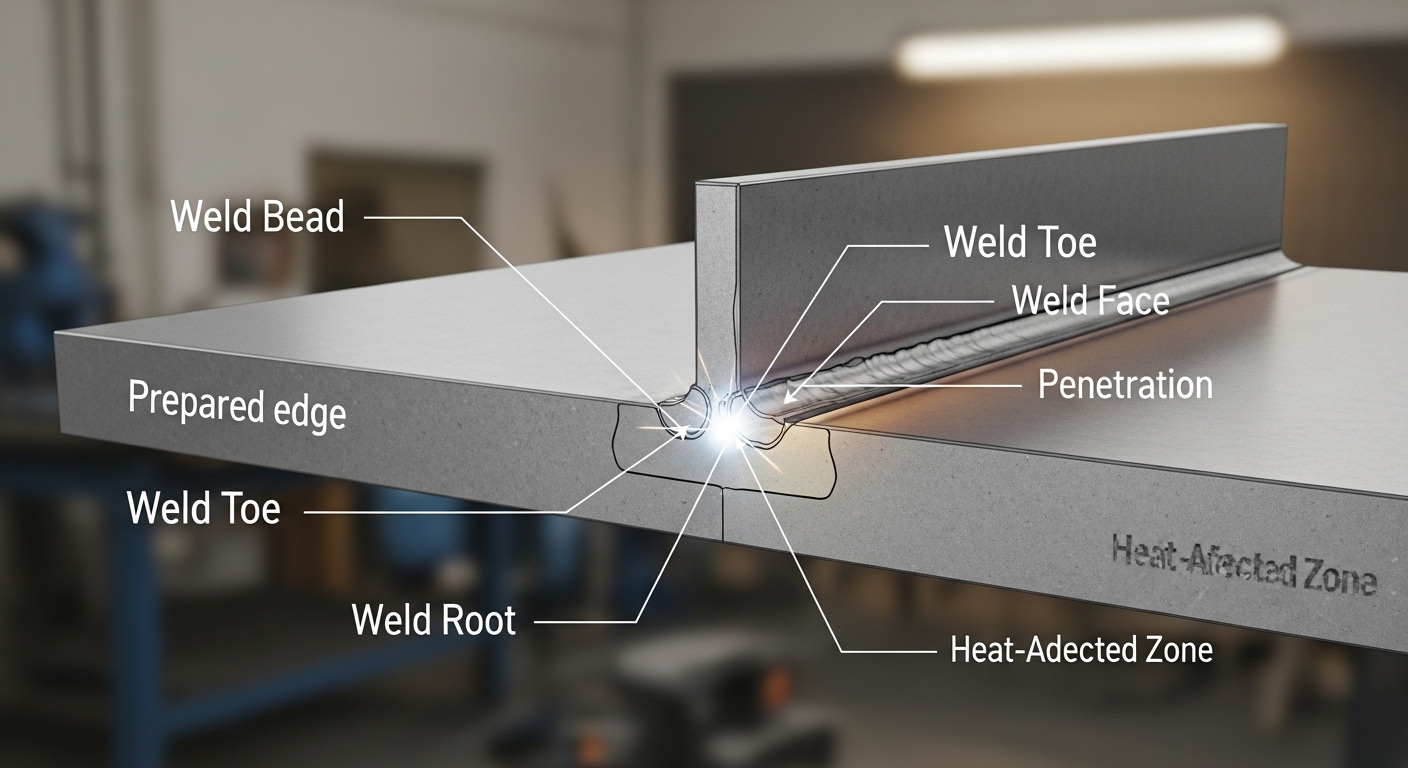
Every weld tells a story if you know how to read it. I’ve spent years analyzing weld joints, and the ability to identify parts of a weld by sight is one of the most valuable skills a welder can develop. When you look at a finished weld, you’re seeing more than just melted metal, you’re seeing the result of heat, filler material, and technique coming together.
What Are the Main Parts of a Weld?
A weld consists of three main zones: the weld metal (deposited filler material that solidifies into the joint), the heat-affected zone or HAZ (area of base metal whose properties were altered by the welding heat), and the base metal (unaffected parent material). Key surface features include the weld face (visible surface), weld toe (junction where weld meets base metal), and weld root (bottom portion of the weld).
Understanding these components helps you identify defects, measure quality, and produce stronger joints. After inspecting thousands of welds in my career, I can tell you that knowing weld anatomy is the foundation of quality work.
The Three Zones of a Weld
Quick Summary: Every welded joint contains three distinct zones: the weld metal in the center, the heat-affected zone surrounding it, and the unaffected base metal beyond. Each zone has unique characteristics that affect weld strength and quality.
1. Weld Metal (Fusion Zone)
The weld metal is the center of the joint. This is the filler metal that was deposited during welding and then solidified to form the bond. In my experience, the weld metal should have a consistent appearance that matches or slightly exceeds the strength of the base material.
I’ve seen countless examples where poor weld metal deposition created weak points. The filler material must fuse completely with the base metal, creating what we call the fusion boundary or fusion line. This is where the deposited metal meets the original parent material.
Weld Metal: The filler metal that has been melted and deposited during welding, forming the central portion of the weld joint. This may be from a consumable electrode, filler rod, or the base metal itself in autogenous welds.
2. Heat-Affected Zone (HAZ)
The heat-affected zone surrounds the weld metal. This area didn’t melt, but the welding heat changed its microstructure and properties. I often tell students the HAZ is like the “tanned skin” of the weld, it experienced the heat without undergoing the full transformation.
The HAZ is critical because this is where many weld failures originate. The thermal cycle can make this zone harder, more brittle, or weaker than the surrounding material depending on the steel type and cooling rate. In my work with high-strength steels, I’ve seen HAZ issues cause problems that weren’t visible from surface inspection alone.
3. Base Metal (Parent Metal)
The base metal is the original material being joined. Beyond the HAZ, the parent material remains unaffected by the welding process. This is your starting point and your reference for comparing weld quality.
| Zone | What Happened | Key Concern |
|---|---|---|
| Weld Metal | Melted and solidified | Fusion quality, porosity |
| Heat-Affected Zone | Heated but not melted | Hardness changes, brittleness |
| Base Metal | Unaffected | Original material properties |
Weld Surface Features
The exterior of your weld contains several important features that indicate quality. These surface characteristics are what inspectors evaluate first during visual examination.
Weld Face
The weld face is the visible surface of the weld on the side from which the welding was performed. This is what you see when looking at the finished weld. A good weld face should be relatively uniform with consistent ripples or wash patterns.
I look for three things on the weld face: uniformity, proper reinforcement height, and the absence of defects. The face should show consistent bead width throughout the joint’s length. When I’m teaching beginners, I tell them the weld face should look like someone laid down a uniform rope of metal, not a series of overlapping circles.
Weld Toe
The weld toe is the junction where the weld face meets the base metal. You’ll find a toe at both ends of the weld face, where the transitions occur. This is a critical area for stress concentration.
Weld Toe: The line where the weld metal surface meets the base metal surface at the outer edges of the weld. Proper toe geometry shows smooth transition, while undercut appears as a small groove cut into the base metal.
A smooth transition at the toe indicates good technique. Sharp or abrupt transitions create stress risers that can lead to fatigue failure. I’ve inspected welds that looked perfect everywhere else but failed because of poor toe geometry.
Weld Root
The weld root is the bottom or inner portion of the weld, farthest from the welding side. In a complete joint penetration weld, the root is fully fused. In partial penetration joints, the root may have a gap or unfused area.
Root quality is essential for joint integrity. Many weld failures originate at the root because it’s the hardest area to access and inspect. When I’m evaluating structural welds, root penetration is one of my primary concerns.
| Feature | Location | What It Indicates |
|---|---|---|
| Weld Face | Visible surface | Bead uniformity, reinforcement |
| Weld Toe | Face-to-base transition | Stress concentration, undercut |
| Weld Root | Bottom of weld | Penetration quality, fusion |
Weld Reinforcement
Weld reinforcement is the extra weld metal that extends beyond the base metal surface. This crown or convex shape provides additional strength but must be controlled. Excessive reinforcement creates stress concentrations and wastes filler material.
After measuring thousands of welds, I’ve found that reinforcement height should typically be between 1/16 inch and 1/8 inch for most applications. Anything more than this is considered excess reinforcement and can actually weaken the joint by creating fatigue points.
Types of Weld Joints and Their Parts
Different joint configurations expose different parts of the weld. Understanding the five basic joint types helps you know which features to examine.
Butt Joint
Butt joints join two pieces in the same plane. The parts are placed edge-to-edge, making this one of the most common joints in fabrication. Groove welds are typically used for butt joints, requiring preparation of the edges before welding.
When I inspect butt welds, I focus on root penetration and groove fill. The weld metal should completely fill the prepared groove with proper reinforcement on both sides for double-groove welds.
Tee Joint
Tee joints form when two pieces intersect at approximately 90 degrees. The end of one piece is welded to the surface of another. Fillet welds are most common for tee joints.
Tee joints require careful attention to leg size and throat dimensions. I’ve seen many failed tee joints where the weld looked substantial from the outside but had insufficient throat thickness.
Lap Joint
Lap joints occur when two pieces overlap and are welded along the edges. The overlap provides additional surface area for the weld. Fillet welds are standard for lap joints.
Corner Joint
Corner joints join two pieces at their edges, forming an L-shape. These can be either closed corner (fully touching) or open corner (with a gap). Both fillet and groove welds work for corner joints depending on the application.
Edge Joint
Edge joints weld the edges of two parallel pieces. This joint is often used for sheet metal applications. The weld metal fuses the edges without significant penetration through the thickness.
| Joint Type | Configuration | Common Weld Type | Key Inspection Point |
|---|---|---|---|
| Butt Joint | Edge-to-edge, same plane | Groove weld | Root penetration |
| Tee Joint | 90-degree intersection | Fillet weld | Throat thickness |
| Lap Joint | Overlapping pieces | Fillet weld | Leg size |
| Corner Joint | L-shaped connection | Fillet or groove | Fusion at corner |
| Edge Joint | Parallel edges | Edge, fillet, or groove | Edge fusion |
Weld Dimensions and Measurements
Proper weld dimensions are specified by engineering drawings and codes. Understanding these measurements helps you produce welds that meet requirements.
Throat
The throat is the distance from the weld root to the weld face measured perpendicular to the base metal. This dimension is critical for fillet weld strength. There are two throat measurements you need to know.
Effective throat is the shortest distance from the root to the face, minus any convexity. Actual throat includes the theoretical throat plus any reinforcement. In my experience, effective throat is what matters for strength calculations.
Leg Size
Leg size applies to fillet welds and measures from the joint root to the weld toe on each base metal surface. For equal-leg fillet welds, both legs are the same length. The leg size determines the throat thickness, which determines the weld’s strength.
I’ve seen many welders confuse leg size with throat thickness. A common mistake is assuming that doubling the leg size doubles the strength. In reality, the relationship follows the throat dimension, which is approximately 0.707 times the leg size for 45-degree fillet welds.
Reinforcement Height
Reinforcement height is the amount the weld face extends above the base metal surface. This extra material provides added strength but must be controlled. Most codes specify maximum reinforcement height based on material thickness.
Bead Width
Bead width is the width of the deposited weld metal on the surface. Consistent bead width indicates steady travel speed and proper heat input. I look for uniform width throughout the weld length as a sign of good technique.
| Dimension | Definition | Why It Matters |
|---|---|---|
| Throat | Root to face distance | Determines weld strength |
| Leg Size | Distance from root to toe | Specifies fillet weld size |
| Reinforcement Height | Face above base metal | Must meet code limits |
| Bead Width | Width of weld surface | Indicates technique consistency |
Understanding Penetration Types
Penetration refers to how deeply the weld metal fuses with the base metal. This is one of the most misunderstood aspects of weld anatomy.
Complete Joint Penetration
Complete joint penetration means the weld metal fills the entire joint thickness, fusing completely through the base metal. The weld root is fully fused with no gap or unfused area. This provides maximum strength and is required for many structural applications.
Partial Joint Penetration
Partial joint penetration occurs when the weld metal doesn’t fuse completely through the joint thickness. This is acceptable for many applications where full strength isn’t required. Partial penetration welds are specified when design calculations show that complete penetration isn’t necessary.
Root Penetration
Root penetration specifically refers to how deeply the weld metal fuses into the joint root. This is different from overall joint penetration. You can have good root penetration without complete joint penetration in groove welds with backing.
Penetration: The distance the weld metal fuses into the base metal from the surface. Proper penetration is essential for weld strength. Insufficient penetration creates weak joints, while excessive penetration can cause burn-through.
Common Weld Defects to Identify
Understanding weld anatomy helps you spot defects that compromise joint integrity. I’ve identified these same issues repeatedly throughout my career.
Undercut
Undercut appears as a groove or notch melted into the base metal at the weld toe. This creates a stress concentration point that can lead to cracking. I often see undercut when travel speed is too fast or when the welding angle is incorrect.
Porosity
Porosity shows up as small cavities or voids in the weld metal. These gas pockets weaken the weld and can lead to failure under stress. Common causes include moisture in the electrode, contamination, or improper shielding gas coverage.
Slag Inclusion
Slag inclusions are non-metallic materials trapped inside the weld. These appear as irregular shapes revealed in cross-section or X-ray. Proper cleaning between weld passes prevents most slag inclusions.
Incomplete Fusion
Incomplete fusion occurs when the weld metal doesn’t fully merge with the base metal or previous passes. This creates a weak bond that can separate under load. I often find this when heat input is too low or when travel speed is excessive.
Incomplete Penetration
Incomplete penetration means the weld metal didn’t reach the root of the joint. This leaves a unfused area that acts as a crack starter. Proper joint preparation and welding procedure prevents this issue.
| Defect | Appearance | Common Cause |
|---|---|---|
| Undercut | Groove at weld toe | Excessive heat, wrong angle |
| Porosity | Small cavities in weld | Contamination, moisture |
| Slag Inclusion | Trapped non-metallic material | Poor cleaning between passes |
| Incomplete Fusion | Unfused boundary | Low heat, fast travel |
| Incomplete Penetration | Unfused root area | Improper joint prep |
How to Visually Inspect a Weld
Visual inspection is the first line of quality control. After examining welds professionally for years, I follow this systematic approach every time.
- Clean the weld surface to remove slag, spatter, and discoloration that might hide defects.
- Examine the weld face for uniformity, consistent bead width, and proper reinforcement height.
- Check the weld toes on both sides for smooth transitions without undercut.
- Look for surface defects including porosity, cracks, craters, and incomplete fusion.
- Verify weld dimensions including leg size, throat thickness, and reinforcement height.
- Compare to acceptance criteria specified in the applicable code or standard.
A good visual inspection takes only a few minutes but can catch most weld defects. In my experience, catching problems during welding saves hours of rework and prevents potential failures.
What Makes a Good Weld?
A quality weld has consistent appearance and proper dimensions throughout its length. The weld face should show uniform ripples with consistent bead width. Reinforcement should be within specified limits, not excessive or insufficient.
The weld toes should show smooth transitions to the base metal without undercut. No visible defects such as porosity, cracks, or inclusions should be present. The weld metal should appear sound without signs of incomplete fusion or penetration.
After inspecting countless welds, I can tell you that appearance isn’t everything, but it’s an excellent indicator of quality. A weld that looks uniform and well-formed usually is. When you see proper parts of a weld executed correctly, you’re looking at a joint that will perform as designed.
Frequently Asked Questions
What are the main parts of a weld?
The main parts of a weld include three zones: weld metal (the deposited filler material), heat-affected zone (base metal area altered by heat), and base metal (unaffected parent material). Key surface features are the weld face (visible surface), weld toe (transition to base metal), and weld root (bottom of the weld).
What is the heat affected zone in welding?
The heat affected zone (HAZ) is the area of base metal surrounding the weld that did not melt but was altered by the welding heat. This zone experiences microstructural changes that can affect its mechanical properties, often becoming harder and more brittle than the original material.
What is weld reinforcement?
Weld reinforcement is the extra weld metal that extends above the base metal surface. This convex shape provides additional strength to the joint. Proper reinforcement height is typically between 1/16 inch and 1/8 inch. Excessive reinforcement creates stress concentrations and wastes filler material.
What is the difference between weld face and weld root?
The weld face is the visible surface of the weld on the side where welding was performed. The weld root is the bottom or innermost portion of the weld, farthest from the welding side. In complete penetration welds, the root is fully fused, while partial penetration joints may have gaps at the root.
What is a weld toe?
A weld toe is the junction point where the weld face meets the base metal surface. Each weld has two toes where the transition from weld metal to base metal occurs. Proper toe geometry shows a smooth transition, while undercut appears as a small groove cut into the base metal at this location.
What is penetration in welding?
Penetration in welding refers to how deeply the weld metal fuses with the base material below the surface. Complete penetration means the weld fuses completely through the joint thickness, while partial penetration indicates fusion to a specified depth less than full thickness. Proper penetration is essential for joint strength.
What is undercut in welding?
Undercut is a defect that appears as a groove or notch melted into the base metal at the weld toe. This creates a stress concentration point that can lead to cracking and premature failure. Common causes include excessive heat input, improper welding angle, and travel speed that is too fast.
What causes porosity in welds?
Porosity in welds is caused by gas becoming trapped in the solidifying weld metal, creating small cavities or voids. Common causes include moisture in the electrode or base metal, contamination such as oil or paint, improper shielding gas coverage, and excessive arc length. Proper preparation and technique prevent most porosity issues.
Leave a Reply