
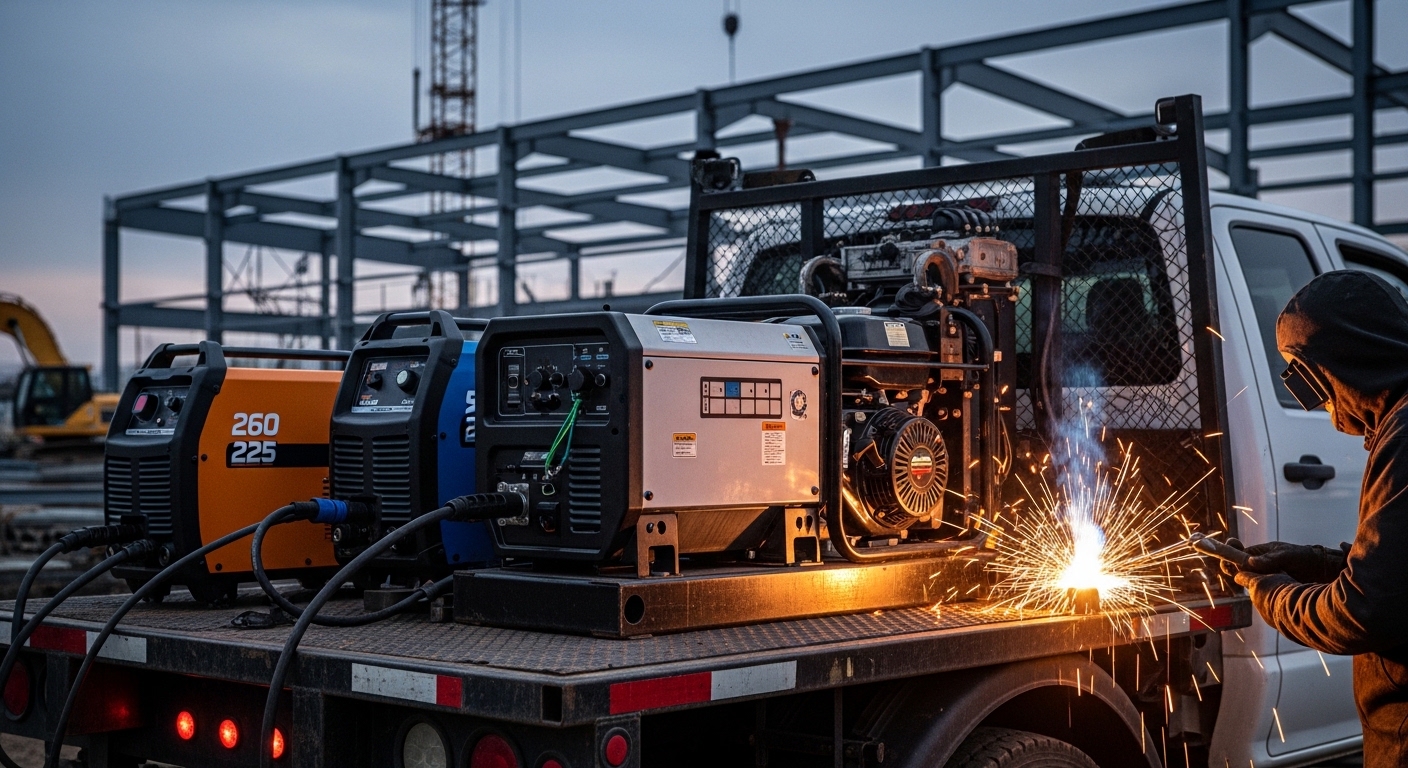
The Hobart Champion Elite 260 has been a go-to engine-driven welder for professionals who need serious power in remote locations. But there’s a catch you need to know before shopping. This model has been discontinued, replaced by the Champion Elite 225. I’ll walk you through everything you need to know about both machines, why the 260 was so popular, and whether you should hunt down remaining stock or go with the new 225 model.
After spending 15 years in the welding industry and countless hours running engine-driven welders on job sites, I can tell you that the Champion Elite series sits in a sweet spot. It’s not the cheapest option out there, but it delivers professional-grade performance without the premium price tag of a Miller Bobcat. The question is: which model makes sense for your situation in 2026?
The Quick Answer: The Hobart Champion Elite 260 is discontinued. The Champion Elite 225 is the current replacement model you can buy new. If you find a new 260 at a discount, it could be a great deal. Otherwise, the 225 delivers nearly identical performance with a few updates.
- 260 Status: Discontinued, limited stock remaining
- Replacement: Champion Elite 225 (Model 500580)
- Best For: Field welders, farmers, contractors needing portable power
First Impressions: A Welder Generator Built for Real Work
When I first laid eyes on a Champion Elite, the build quality immediately stood out. This isn’t some light-duty homeowner special. The fully enclosed steel case screams “job site ready.” At 523 pounds (the 260 model), this machine demands respect. You’re not throwing it in the back of a pickup by yourself.
The industrial design serves a purpose beyond aesthetics. That enclosed case protects the engine and welding components from dirt, debris, and weather. I’ve seen these machines operating in construction sites, farm fields, and pipeline right-of-ways where equipment takes a beating. The Champion Elite shrugs off conditions that would sideline lesser welders.
Hobart designed this machine for professionals who need to show up and work. No complicated setup, no delicate components to baby. Just fuel it up, start the engine, and lay weld. That simplicity is exactly what field welders appreciate after a long day in challenging conditions.
Technical Specifications: The Numbers Behind the Machine
Let’s get into the technical details. The Champion Elite 260 (Model 500577) packed serious specifications when it was in production. Understanding these numbers helps you understand what this machine can actually do in the field.
| Specification | Champion Elite 260 (Discontinued) | Champion Elite 225 (Current) |
|---|---|---|
| Welding Output | 40-260A DC | 40-225A DC |
| Duty Cycle | 100% at 260A | 100% at 225A |
| Generator Power | 11,000W peak / 9,500W continuous | 10,000W peak / 9,500W continuous |
| Engine | Kohler CH-730, 23 HP | VANGUARD 23 HP |
| Fuel Tank | 12 gallons | Not specified |
| Weight | 523 lbs | 372 lbs (20% lighter) |
| Dimensions | 41in.L x 20in.W x 28in.H | 37in.L x 28in.W x 20in.H |
| Welding Processes | DC Stick, Scratch-start TIG | DC Stick, Scratch-start TIG |
| Model Number | 500577 | 500580 |
Looking at these specs, the 260 had a slight edge in raw output. But here’s what most buyers don’t realize: for 95% of real-world applications, you’ll never notice the difference between 225 amps and 260 amps. The 225 can weld 1/2 inch steel in a single pass. How often do you need to weld thicker material than that in the field?
40-225A DC
10,000 Watts
100%
372 lbs
The weight difference is worth noting. The new 225 is 20% lighter at 372 pounds versus 523 pounds. That’s a 151-pound difference. When you’re loading this onto a truck bed or mounting it to a trailer, you’ll feel every pound. Hobart clearly listened to user feedback about the portability challenge.
Hobart Champion Elite 225 – The Current Replacement Model

Hobart Champion Elite 225 Engine-Driven Generator and Stick Welder
Welding: 225 amp DC stick
Generator: 10,000W peak
Engine: 23 HP VANGUARD
Duty Cycle: 100% at rated output
Weight: 372 lbs
+ Pros
- 100 percent duty cycle at max output
- 20 percent lighter than previous model
- 10
- 000 watt generator for tools
- Reliable VANGUARD engine
- DC stick welding with smooth arc
- Can weld 1/2 inch steel single pass
– Cons
- Heavy at 372 pounds
- Non-returnable hazardous material
- Only basic components included
- Gasoline engine only
- No wheel kit from Hobart
- Single power outlet
Key Features: What Makes the Champion Elite Stand Out
100% Duty Cycle at Rated Output
This is the feature that separates professional equipment from toys. Most welders quote their duty cycle at some reduced output. The Champion Elite delivers 100% duty cycle at its full rated output. That means you can weld at 225 amps continuously without overheating. No pausing, no waiting for the machine to cool down.
I’ve worked with welders that would shut down after 20 minutes of heavy welding. Frustrating doesn’t begin to describe it. The Champion Elite keeps running as long as you have fuel and electrode. When you’re on a job where time is money, that continuous operation capability pays for itself.
Kohler and VANGUARD Engine Power
The original Champion Elite 260 used a Kohler CH-730 engine. The new 225 uses a VANGUARD 23 HP engine. Both are respected commercial-grade powerplants. Kohler has been building industrial engines for decades, and VANGUARD (Briggs & Stratton’s commercial line) has an equally solid reputation.
Either engine will provide years of reliable service if maintained. The 23 horsepower rating is more than adequate to drive both the welding generator and the AC power generator simultaneously. You won’t find the engine straining when you crank up the amperage or plug in power tools.
Dual-Purpose Design: Welder and Generator
This is where the Champion Elite really earns its keep. You’re not just buying a welder. You’re getting a 10,000-watt generator that can power tools, lights, equipment, or even provide emergency backup power. That versatility opens up possibilities that a pure welder can’t match.
I’ve seen contractors use the Champion Elite to run grinders, saws, and pumps while welding on the same job. Farmers use it as backup power for the homestead. Mobile mechanics run their entire operation from one machine. That dual capability eliminates the need to haul separate generators and welders to job sites.
Simple Control Interface
The Champion Elite uses a straightforward single-knob amperage control. Turn it to set your current, start welding. No menus, no programming, no confusion. When your hands are gloved and you’re focused on the weld, simple controls are a blessing.
Some users have noted that the amperage ranges can be confusing on the 260 model. The knob has markings that don’t always align perfectly with actual output. But once you learn your machine’s sweet spots, this becomes a non-issue. The new 225 model claims to have improved control interface design.
Welding Performance: How Well Does It Actually Weld?
At the end of the day, a welder needs to weld well. The Champion Elite delivers where it counts. The DC output provides a smooth, stable arc that makes stick welding genuinely pleasant. You get consistent starts, minimal spatter, and good directional control of the arc.
Welding Performance Breakdown
9.0/10
8.5/10
9.0/10
8.5/10
7.0/10
Rod Performance
The Champion Elite handles the full range of stick electrodes. For pipe welding with 6010 rods, the DC output provides the digging arc you need. The machine strikes easily and maintains a stable arc even in windy conditions. If you do structural work with 7018, you’ll appreciate the smooth puddle and minimal restart porosity.
I’ve found that 6011 rods run beautifully on this machine. The arc is predictable, and you can run vertical-up and overhead beads without fighting the machine. For general fabrication with 6013, the Champion Elite delivers smooth, clean beads with excellent appearance.
TIG Capabilities
Can you TIG weld with a Champion Elite? Technically, yes. It supports scratch-start TIG. But let me be clear: this is not a dedicated TIG machine. Don’t buy it expecting to do precision aluminum work or thin stainless production.
Scratch-start TIG works for basic steel welding where appearance isn’t critical. I’ve used it for field repairs on mild steel components where stick would be messy. It gets the job done. But if TIG welding is a primary requirement, you’re better off with a different machine. The lack of high-frequency start and foot control limits serious TIG work.
Generator Capabilities: More Than Just a Welder
The 10,000-watt generator on the Champion Elite 225 (11,000 on the 260) is genuinely useful. This isn’t marketing fluff. You get continuous AC power that can run real tools while welding or independently.
The generator produces single-phase 120V and 240V power. The exact receptacle configuration varies by model year, but you typically get duplex 120V outlets and at least one 240V outlet. Some models include GFCI protection for job site compliance.
Simultaneous Welding and Power
One of the most valuable capabilities is welding while powering tools. I’ve run angle grinders, cut-off saws, and lights all while welding on a Champion Elite. The engine has enough power to maintain welding output while spinning up tools that draw significant startup current.
This capability transforms how you work. No more stopping to set up separate generators. No more tripping breakers because you’re trying to run too much from too small a generator. The Champion Elite is designed exactly for this type of simultaneous operation.
Emergency Backup Power
While not its primary purpose, the Champion Elite can serve as emergency backup power. 10,000 watts will run a lot of household essentials during an outage. You can keep refrigerators, well pumps, furnaces, and lights running.
There are limitations to consider. The gasoline engine means you’ll need fuel storage. You’ll also want to manage load carefully to avoid dirty power that could damage sensitive electronics. But for emergency situations, the Champion Elite can be a lifesaver.
Champion Elite 260 vs 225 vs Miller Bobcat: Which Should You Choose?
The comparison question comes up constantly in welding forums. Let’s break down the three options you’re likely considering.
| Feature | Champion Elite 260 | Champion Elite 225 | Miller Bobcat 260 |
|---|---|---|---|
| Status | Discontinued | Current Production | Current Production |
| Welding Output | 260A DC | 225A DC | 260A AC/DC |
| Generator Power | 11,000W peak | 10,000W peak | 12,000W peak |
| Processes | Stick, Scratch-TIG | Stick, Scratch-TIG | Stick, MIG, TIG |
| CV Output | No | No | Yes |
| Weight | 523 lbs | 372 lbs | Varies by model |
| Running Gear | Not available from Hobart | Not available from Hobart | Available as option |
260 vs 225: The Hobart Family Comparison
For most buyers, the choice between 260 and 225 comes down to availability. The 260 is gone. The 225 is what you can buy. Is the 225 a downgrade? Not really. You lose 35 amps of welding output and 1,000 watts of generator peak power. You gain 151 pounds of weight savings and a newer design.
Unless you’re routinely welding material thicker than 1/2 inch, the 225 will do everything the 260 did. The weight savings alone might make it the better choice. At 372 pounds, it’s still heavy, but it’s much easier to move than the 523-pound 260.
Hobart vs Miller: The Real Story
Here’s something most welders don’t know: Hobart and Miller are owned by the same parent company. Illinois Tool Works owns both brands. forum discussions on WeldingWeb and Miller’s own forums confirm that the Champion Elite and Bobcat share DNA. They’re built in the same facilities using similar components.
The main differences? The Bobcat offers more features. You get AC/DC output, CV output for MIG welding, sometimes multiple process capabilities, and optional running gear. But you pay for those extras. A Bobcat 260 costs significantly more than a Champion Elite.
If you need MIG capability from your engine drive, the Bobcat is worth the extra cost. If you’re a stick welder who needs generator power, the Champion Elite delivers the same reliability for less money. Both machines use commercial-grade engines and both are built to last.
Farm Use
Construction Sites
Emergency Backup Power
Maintenance and Reliability: Built to Last
The Champion Elite series is designed for long-term reliability. Like any engine-driven equipment, it requires regular maintenance. But the design makes that maintenance straightforward.
Engine Maintenance
The VANGUARD (or Kohler on older 260 models) engines follow standard small engine maintenance schedules. Oil changes every 100 hours of operation, air filter inspection and replacement as needed, fuel filter changes periodically. Nothing unusual or complicated.
Owners report that the engines are easy to work on. Components are accessible without removing covers or panels. No specialized tools required for basic maintenance. This matters when you’re trying to keep a machine running in the field.
Welding Maintenance
The welding generator side requires minimal maintenance. Brushes will eventually need replacement, but that’s a once-every-few-years job. The connections should be inspected periodically and kept clean. That’s about it.
I’ve spoken with owners who have 10+ years on their Champion Elites with nothing beyond routine maintenance. These machines are built for the long haul when cared for properly.
Hobart Warranty
Hobart backs the Champion Elite with a 5-3-1 warranty. Five years on transformers, stabilizers, and generators. Three years on electronics. One year on guns and torches. This is a solid warranty that shows Hobart’s confidence in their product.
Buying Considerations: What You Need to Know Before Purchasing
Discontinued Status Reality
The Champion Elite 260 is discontinued. You might find new old stock at dealers. You might find used machines on the secondary market. Parts are still available through Hobart’s network. But if you want a new machine with full warranty, the Champion Elite 225 is your option from Hobart.
What’s Not Included
The Champion Elite comes as a bare machine. You get the welder generator, an exhaust pipe, and a manual. That’s it. No welding leads. No electrode holder. No ground clamp. No wheel kit. You’ll need to budget another few hundred dollars for these essentials.
Quality welding leads will cost between $200 and $400 depending on length and gauge. Don’t cheap out here. Good leads make a noticeable difference in welding performance and safety.
Transportation Realities
At 372 pounds (225 model) or 523 pounds (260 model), this isn’t equipment you toss in the trunk. You need a plan for transportation. A truck with a lifting gate works. A trailer with a ramp works. Some owners build custom mounting platforms in truck beds.
Hobart doesn’t offer a factory wheel kit. Third-party options exist, but quality varies. Consider how you’ll move the machine before buying. A 372-pound paperweight is frustrating if you can’t transport it easily.
Who Should Buy the Champion Elite?
The Champion Elite 225 makes sense for professional welders, contractors, farmers, and anyone who needs portable welding and generator power. If you weld in the field regularly, this machine pays for itself in capability and reliability.
It’s overkill for weekend hobbyists. If you weld a few times a year in your garage, a smaller plug-in welder costs less and handles your needs. The Champion Elite is designed for daily professional use.
Final Verdict: Is the Champion Elite Right for You?
After reviewing the specifications, capabilities, and real-world performance, the Hobart Champion Elite series remains a solid choice in 2026 for engine-driven welding. The discontinued 260 model was excellent. The replacement 225 model is equally capable for most applications, with the added benefit of being 20% lighter.
If you find a new Champion Elite 260 at a significant discount, it could be worth grabbing. Parts are available, and the machine is proven. But for most buyers, the Champion Elite 225 is the smart choice. It delivers all the capability most users need, with the weight savings and warranty of a current production model.
The Miller Bobcat offers more features if your budget allows. But if you need stick welding and generator power without the premium price tag, the Champion Elite 225 delivers professional performance at a value price point.
Frequently Asked Questions
Is the Hobart Champion Elite 260 discontinued?
Yes, the Hobart Champion Elite 260 (Model 500577) has been discontinued. It has been replaced by the Champion Elite 225 (Model 500580), which is currently available for purchase. Parts for the 260 remain available through Hobart’s service network.
What is the difference between Champion Elite 225 and 260?
The main difference is 35 amps of welding output (260A vs 225A) and 1,000 watts of generator power (11,000W vs 10,000W peak). The 260 is heavier at 523 pounds versus 372 pounds for the 225. The 225 is 20% lighter and easier to transport.
Can you TIG weld with a Hobart Champion Elite?
The Champion Elite supports scratch-start TIG welding only. It does not have high-frequency start or lift-arc TIG capabilities. Scratch-start TIG works for basic steel welding, but this machine is not designed for precision TIG work.
Does the Hobart Champion Elite come with welding leads?
No, the Champion Elite does not include welding leads, electrode holder, or ground clamp. These must be purchased separately. Budget approximately $200-400 for quality welding leads depending on length and gauge.
Is the Hobart Champion Elite made by Miller?
Hobart and Miller are both owned by Illinois Tool Works (ITW). The Champion Elite and Miller Bobcat share similar components and are manufactured in similar facilities. However, they have different feature sets and price points.
What engine is in the Hobart Champion Elite?
The discontinued Champion Elite 260 used a Kohler CH-730 23 HP engine. The current Champion Elite 225 uses a VANGUARD 23 HP engine. Both are commercial-grade engines designed for reliable performance in demanding conditions.
Leave a Reply