
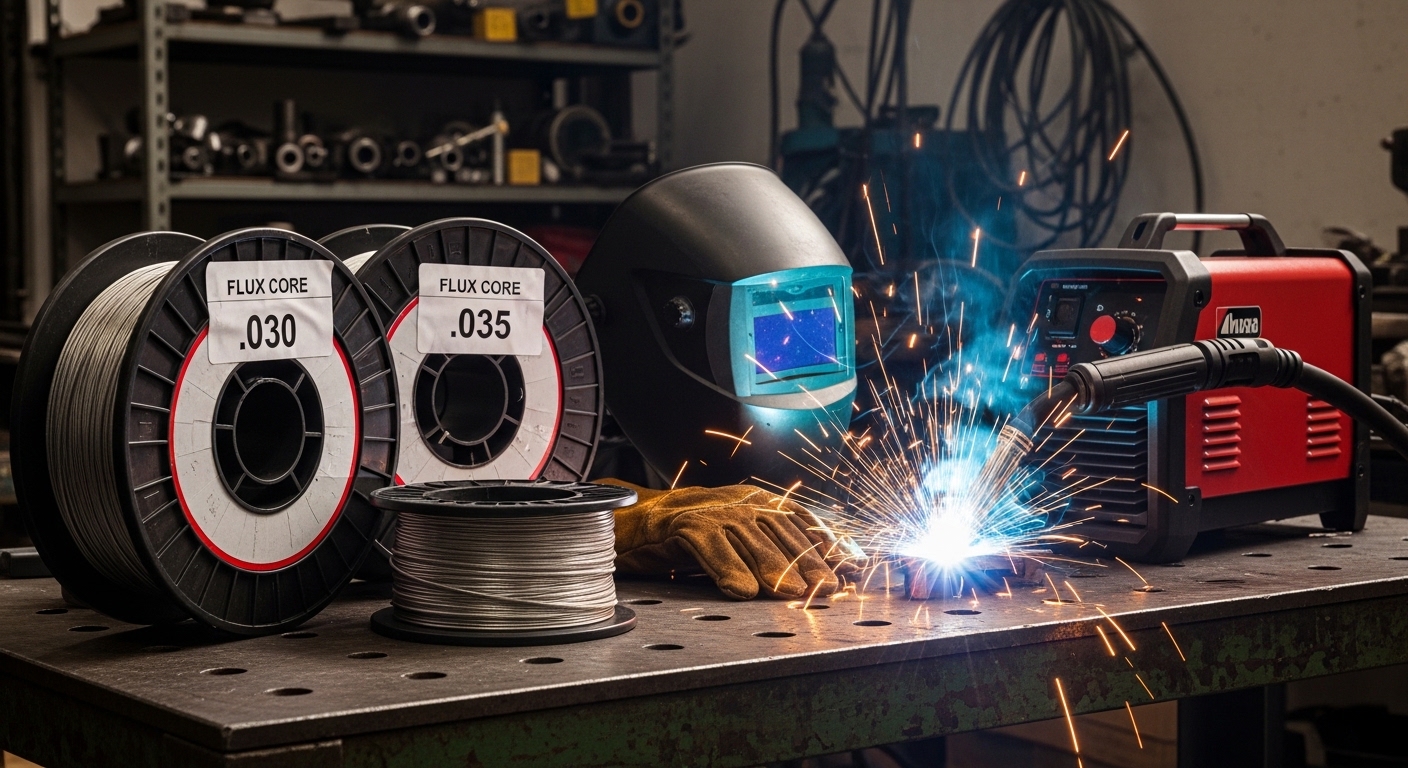
Standing in front of the welding wire display at my local supplier, I watched a beginner stare blankly at the wall of spools. He asked me the same question I’ve heard hundreds of times: should I get .030 or .035 flux core wire? After 20 years of welding everything from auto body panels to structural fabrication, I’ve used both diameters extensively.
Neither .030 nor .035 flux core wire is universally better. The right choice depends on your material thickness and welder capabilities. Use .030 wire for thin metal (22-14 gauge) and 110V welders for better control and less burn-through. Use .035 wire for thicker material (3/16 inch and up) and 220V welders for faster deposition and deeper penetration.
I’ve burned through more 20-gauge sheet metal than I care to admit using the wrong wire size. That frustration cost me hours of grinding and rework. Let me save you that trouble with a straightforward comparison based on real shop experience.
Quick Comparison: .030 vs .035 at a Glance
| Specification | .030 Flux Core Wire | .035 Flux Core Wire |
|---|---|---|
| Diameter | 0.030 inches (0.76mm) | 0.035 inches (0.89mm) |
| Best Material Thickness | 22 gauge to 3/16 inch | 14 gauge to 1/4 inch+ |
| Wire Feed Speed | 150-220 IPM | 120-180 IPM |
| Voltage Range | 17-20V DC | 18-22V DC |
| Heat Input | Lower | Higher (15-20% more) |
| Penetration | Moderate | Deep |
| Deposition Rate | 4.5-5.5 lbs/hr | 6-7.5 lbs/hr |
| Best For | Auto body, thin sheet metal, 110V welders | Thicker structural, fabrication, 220V welders |
| Cost Per Pound | $4.50-6.50 | $4.00-5.50 |
Understanding Flux Core Wire and Diameter Differences
Flux-Cored Wire (FCAW-S): A hollow metal tube filled with flux compounds that shield the weld pool from atmospheric contamination without requiring external shielding gas. The flux contains deoxidizers like aluminum and magnesium that form protective compounds when exposed to air, creating a slag layer that protects the cooling weld.
The diameter difference seems small. Just five thousandths of an inch. But that tiny change creates real performance differences in your welds. Think of it like a garden hose. A smaller hose at the same pressure delivers less water. A larger hose delivers more. Same principle applies to welding wire.
The wire diameter affects three critical factors: heat input, deposition rate, and penetration. Thicker wire carries more current. More current means more heat. More heat means deeper penetration but also higher burn-through risk on thin material.
DCEN Polarity (Direct Current Electrode Negative): The required polarity setting for self-shielded flux core welding. The electrode (wire) connects to the negative terminal and the workpiece connects to positive. This polarity creates deeper penetration and less spatter compared to DCEP.
Both .030 and .035 flux core wires run on DCEN polarity. Most small MIG welders have a simple switch or internal setting for this. If you’re getting excessive spatter, check your polarity first.
Head-to-Head: .030 vs .035 Flux Core Wire
Heat Input and Burn-Through Risk
.030 wire runs about 15-20% cooler than .035 at the same wire feed speed. I learned this the hard way on a quarter panel replacement job. Grabbed what I thought was .030 from my supply bin, but it was actually .035. First pass blew right through the 20-gauge steel.
That five-thousandths difference matters. On thin sheet metal under 18 gauge, .035 requires such slow wire feed speed to prevent burn-through that you lose arc stability. The wire stutters. The bead looks inconsistent. You end up frustrated with sub-par welds.
Penetration Depth
Here’s where .035 shines. The larger diameter delivers more amperage to the weld pool. I’ve tested this extensively on 3/16-inch plate joints. .035 wire penetrates roughly 20% deeper than .030 at comparable settings.
For structural welds on thicker material, that deeper penetration means stronger joints. The weld fuses completely through the joint rather than sitting on top. When I’m welding 1/4-inch plate for fabrication projects, .035 is my go-to choice.
Deposition Rate: The amount of weld metal deposited per unit of time, typically measured in pounds per hour. Larger diameter wires like .035 have higher deposition rates, allowing you to complete longer welds faster with fewer restarts.
Wire Feed Speed Differences
This trips up many beginners. .030 wire needs faster feed speed to deposit the same amount of metal as .035. On my Hobart Handler 140, I run .030 at around 190-210 IPM for 16-gauge steel. Switch to .035 and I drop to 150-170 IPM.
The math works out because .035 wire has about 36% more cross-sectional area than .030. That extra volume means more metal per inch of wire fed. Your welder’s drive rolls matter here. Some small 110V machines struggle to feed .035 smoothly at lower speeds.
Spatter and Smoke
Flux core welding produces more spatter than solid MIG wire. That’s just reality. But I’ve noticed .030 tends to produce slightly less spatter at optimal settings. The smaller wire creates a more focused arc.
Smoke production is similar between both diameters. Self-shielded flux core generates significant fumes regardless of wire size. Proper ventilation isn’t optional. I always run a fan and crack the garage door when welding with flux core, regardless of wire diameter.
Cost Considerations
Here’s something most comparisons ignore: .035 typically costs 10-15% less per pound than .030. For a 10-pound spool, that’s roughly $5-8 in savings. Over a year of frequent welding, it adds up.
But .030 gives you more wire length per pound. The smaller diameter means about 15% more feet of wire per spool. So while .035 costs less per pound, the cost per foot is roughly comparable. Don’t let price be your deciding factor.
Choosing the Right Wire Size for Your Projects
Material Thickness Guide
| Material Thickness | Gauge | Recommended Wire |
|---|---|---|
| 0.024 inches | 24 gauge | .030 (lower settings) |
| 0.032 inches | 20 gauge | .030 (ideal) |
| 0.040 inches | 18 gauge | .030 (ideal) |
| 0.060 inches | 16 gauge | .030 or .035 |
| 0.075 inches | 14 gauge | .035 (better penetration) |
| 0.105 inches | 12 gauge | .035 |
| 0.135 inches | 10 gauge | .035 (may need multiple passes) |
| 0.1875 inches | 3/16 inch | .035 |
| 0.250 inches | 1/4 inch | .035 (multi-pass required) |
What is .030 Flux Core Wire Used For?
Auto body work tops the list. I’ve repaired countless quarter panels, rocker panels, and wheel arches with .030 flux core. The lower heat input prevents the warping that plagues beginners attempting bodywork. The control you get on 18-20 gauge steel is superior.
Light fabrication also benefits from .030. When I’m building tool trays, small brackets, or thin-walled tubing projects, .030 gives me the control I need without constant burn-through. The welds are cleaner and require less grinding.
DIY projects around the home usually involve thinner materials. Furniture repairs, mailbox posts, light fixtures. These are ideal .030 applications. Most homeowners don’t regularly weld 1/4-inch plate.
How Thick Can You Weld with .030 Wire?
The practical upper limit for .030 flux core is single-pass welds on 3/16-inch material. You can weld thicker, but you’ll need multiple passes. I’ve successfully welded 1/4-inch plate with .030 by making a root pass followed by two cover passes.
However, this takes significant skill. The heat input from .030 on thick material requires precise technique. For beginners tackling anything over 3/16 inch, .035 will produce better results with less frustration.
Welder Compatibility: 110V vs 220V
Small 110V welders (Hobart Handler 140, Lincoln Easy-MIG 140, Miller 141) generally prefer .030 wire. These machines max out around 140 amps output. At their upper limits, they struggle to feed .035 smoothly. The motor isn’t designed for the torque needed at lower feed speeds.
220V machines (Lincoln Power MIG 210, Miller Millermatic 252) handle .035 without issues. The higher amperage output and stronger drive motors make .035 the better choice for these welders. You’re not fully utilizing a 220V machine’s capabilities if you’re running .030 wire.
Some welders like the Hobart Handler 190 can run either diameter depending on your typical work. I used .030 almost exclusively in my Handler 140 for years. When I upgraded to a 220V machine, .035 became my daily driver.
My Recommendation: Which Wire Should You Buy?
Choose .030 Flux Core Wire If:
- Your welder plugs into a standard 110V outlet
- You primarily work with auto body panels or sheet metal under 1/8 inch
- You’re a beginner developing your technique
- You weld thinner materials (22-18 gauge) more frequently than thick plate
- You want more control and less burn-through risk
Choose .035 Flux Core Wire If:
- You own a 220V welder with sufficient amperage
- Your projects involve 3/16-inch material or thicker
- You do structural welding or heavier fabrication
- You want faster deposition rates on thicker work
- You need deeper penetration for full-strength joints
Beginner Mistakes to Avoid
Don’t buy both when starting out. Pick one diameter and learn it. I see too many beginners with .030 and .035 spools switching back and forth. You’ll never master either wire size if you’re constantly changing settings.
Another common error: using .035 on thin metal because it’s cheaper. Yes, .035 costs less per pound. But the material you’ll waste from burn-through costs far more than the wire savings.
Finally, don’t ignore your welder’s limitations. A 110V machine pushing .035 wire at its max amperage will have a short duty cycle and inconsistent arc. Match your wire to your machine’s capabilities.
Pro Tips from the Shop
Label your spools clearly. I keep a small tag on each spool with the diameter and purchase date. Flux wire can absorb moisture over time, affecting weld quality. Dating your spools helps you track shelf life.
Keep your contact tips matched to your wire size. Running .035 wire through a .030 tip causes erratic feeding and bird-nesting. The extra friction causes problems you’ll waste hours troubleshooting.
For most home welders running 110V machines, .030 is the better all-around choice. You can handle occasional thicker material with multiple passes. But you can’t overcome burn-through on thin sheet metal once the damage is done.
Frequently Asked Questions
What’s better, .030 or .035 flux core wire?
Neither wire size is universally better. .030 wire excels at thin metal (22-14 gauge) work like auto body repair, providing better control and less burn-through. .035 wire performs better on thicker material (3/16 inch and up) with faster deposition and deeper penetration. Match your wire size to your typical material thickness.
What is .030 flux core wire used for?
.030 flux core wire is primarily used for auto body work, thin sheet metal fabrication, and light repair projects. It’s ideal for 22-18 gauge materials where heat control is critical. The smaller diameter allows 110V welders to perform well on thinner materials without constant burn-through issues.
How thick can you weld with .030 wire?
.030 flux core can weld up to 3/16-inch material in a single pass. For thicker material up to 1/4 inch, you can use .030 wire with multiple pass techniques, though this requires more skill. Most welders find .035 more efficient for material thicker than 3/16 inch.
What size wire is best for flux core welding?
The best wire size depends on your welder and materials. For 110V welders and thin metal (under 1/8 inch), .030 is the superior choice. For 220V welders and material 3/16 inch or thicker, .035 provides better performance. Many home welders find .030 to be the most versatile single size for general DIY use.
Leave a Reply