
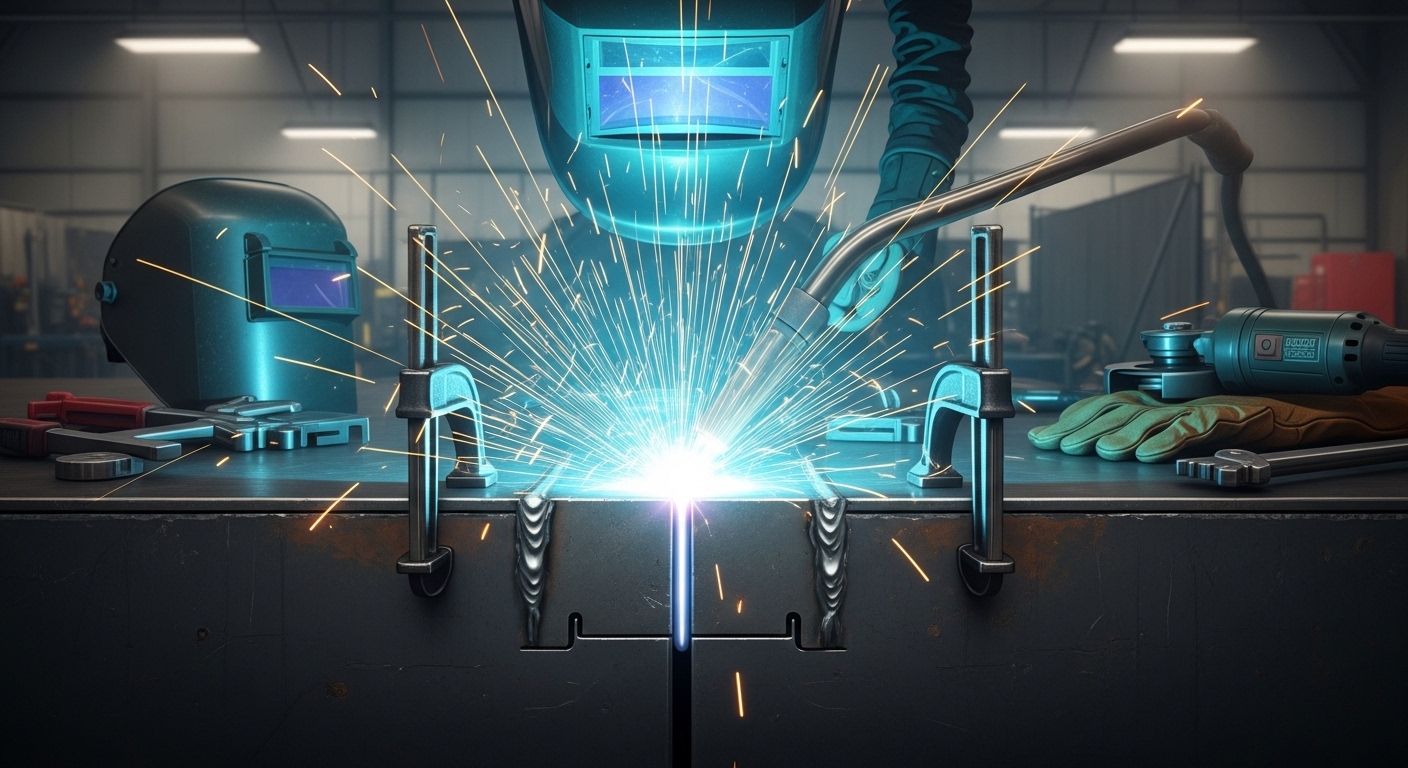
A butt weld is a welding joint formed by placing two pieces of metal end-to-end on the same plane and welding along the join, creating a strong, flush connection without overlap. This is one of the most common and versatile weld joint designs used in metal fabrication today.
Butt welding works by aligning two metal pieces edge-to-edge, securing them with tack welds, then fusing them together using heat to create a continuous, seamless joint. The result is a connection that can be as strong as or stronger than the base metal itself.
Quick Answer: A butt weld joins two metal pieces end-to-end without overlapping, making it ideal for pipes, structural steel, and pressure vessels where strength and a smooth surface are critical.
How Butt Welding Works
Quick Summary: Butt welding involves aligning metal pieces edge-to-edge, securing with tack welds, then fusing with heat (and often filler metal) to create a seamless joint through a multi-pass process.
The butt welding process follows a systematic approach that ensures proper penetration and fusion. I’ve completed hundreds of butt welds in my fabrication career, and following these steps consistently produces the best results.
- Prepare the edges: Clean metal surfaces to remove rust, paint, and contaminants. Bevel thicker materials to allow proper penetration.
- Align the pieces: Position the metal pieces end-to-end with the correct root gap spacing.
- Tack weld: Place small temporary welds to hold the joint in position.
- Root pass: Make the first weld pass to fuse the bottom of the joint.
- Fill passes: Add additional weld layers to build up the joint thickness.
- Cap pass: Complete the final weld pass to create a smooth surface finish.
Types of Butt Weld Joints
Different butt joint designs are used depending on material thickness, welding position, and structural requirements. In my experience, choosing the right joint type makes a significant difference in weld quality and efficiency.
| Joint Type | Description | Best For |
|---|---|---|
| Square Butt | No edge preparation, pieces placed square together | Thin materials (up to 1/8 inch) |
| Single V-Groove | One piece beveled at 30-45 degrees | Materials 1/8 to 1/2 inch thick |
| Double V-Groove | Both pieces beveled, weld from both sides | Thick materials 1/2 to 2 inches |
| Single Bevel | One piece beveled, one square | When access limited to one side |
| Double Bevel | One piece beveled both sides | Very thick materials with full penetration |
| Single J-Groove | Curved edge preparation for better penetration | Very thick materials (>1 inch) |
| U-Groove | Both edges with curved preparation | Extremely thick materials (>2 inches) |
Square Butt Joints
Square butt joints are the simplest form of butt welding. The metal pieces are placed together with no edge preparation required. I use these frequently for thin sheet metal work where full penetration isn’t difficult to achieve.
For materials up to 1/8 inch thick, square butt joints work well. Thicker materials require beveling to ensure proper penetration through the entire joint thickness.
Groove Butt Welds
Groove butt welds involve edge preparation to create a channel for the weld metal. This preparation allows the welder to achieve complete joint penetration in thicker materials.
The V-groove is the most common groove design. I’ve found that a 37.5-degree bevel angle on each side creates the optimal groove width for most applications. This angle provides enough opening for proper electrode access while minimizing weld metal volume.
Common Applications of Butt Welds
Butt welds are used across numerous industries due to their strength and reliability. After working in various fabrication shops, I’ve seen butt welds used in everything from handrails to pressure vessels.
Piping and Pipeline
Butt welding is the standard method for joining pipes in oil, gas, and water distribution systems. The smooth interior surface prevents flow turbulence and corrosion. Pipeline welders I’ve worked with consider butt welding essential for high-pressure applications.
Structural Steel
Building and bridge construction relies heavily on butt welds for connecting beams, columns, and girders. These connections must withstand enormous loads and environmental stress. A properly executed butt weld creates a connection as strong as the original steel.
Pressure Vessels
Storage tanks, boilers, and pressure containers require butt welds for maximum strength and leak-free performance. In my experience, pressure vessel welding demands the highest quality standards with complete radiographic inspection.
Automotive and Aerospace
Vehicle frames, aircraft components, and spacecraft structures use butt welds where weight savings and strength are critical. The seamless connection reduces stress concentrations that could lead to fatigue failure.
Shipbuilding
Hull plates, deck structures, and marine piping systems rely on butt welds for watertight integrity. Ship welders must account for the unique challenges of welding in various positions and environments.
Advantages and Disadvantages of Butt Welding
Butt Weld: A joint formed by welding two pieces of metal end-to-end on the same plane, creating a flush connection without overlapping material.
Advantages of Butt Welds
- Maximum Strength: Properly executed butt welds can achieve 100% joint efficiency, matching the strength of the base metal.
- Smooth Surface: No protruding weld metal creates clean surfaces ideal for fluid flow and aesthetic applications.
- Full Penetration: Complete fusion through the entire material thickness ensures structural integrity.
- Fatigue Resistance: The smooth transition reduces stress concentrations that cause fatigue failure.
- Non-Destructive Testing: Butt welds can be inspected using X-ray, ultrasonic, and other NDT methods.
- Material Efficiency: No additional material required beyond filler metal, reducing overall weight.
Disadvantages of Butt Welds
- Precision Required: Proper fit-up and alignment are critical – gaps or misalignment cause defects.
- Edge Preparation: Thicker materials require time-consuming beveling and preparation work.
- Skill Dependent: Requires skilled welders to achieve quality results consistently.
- Distortion: Heat input can cause warping, especially in thinner materials.
- Root Access: Some joint designs require welding from both sides or using backing.
- Cost: Generally more expensive than fillet welds due to preparation and skill requirements.
Butt Weld vs Fillet Weld
Understanding the difference between butt welds and fillet welds is essential for selecting the right joint for your application. I’ve used both extensively, and each has its place in metal fabrication.
| Characteristic | Butt Weld | Fillet Weld |
|---|---|---|
| Joint Configuration | End-to-end, same plane | Corner or T-joint, overlapping |
| Strength | 100% joint efficiency possible | 30-50% of base metal strength |
| Surface Finish | Smooth, flush surface | Raised weld bead visible |
| Preparation | Edge prep required for thick materials | Minimal preparation needed |
| Skill Level | Higher skill required | Easier for beginners |
| Common Uses | Pipes, pressure vessels, structural members | Brackets, frames, light fabrication |
| Weld Metal Volume | Depends on groove design | Proportional to leg size |
When to choose a butt weld: Use for critical structural connections, pressure-containing applications, and where smooth surfaces are required. Butt welds provide the highest strength and are necessary for piping systems.
When to choose a fillet weld: Ideal for T-joints, lap joints, and non-critical connections. Fillet welds are faster to produce and require less preparation, making them cost-effective for many applications.
Understanding Butt Welding Symbols
Welding symbols communicate joint design, weld size, and other requirements on engineering drawings. Learning these symbols is essential for anyone working with fabrication drawings.
The butt weld symbol is placed on the reference line of the welding symbol. The arrow points to the joint, and the symbol indicates the groove type. Numbers above and below the reference line specify weld depth and size.
Common symbols include:
- Square groove: Two parallel vertical lines
- V-groove: A V shape pointing toward the joint
- Bevel groove: A single angled line
- U-groove: A curved U shape
- J-groove: A curved J shape on one side
Welding Positions for Butt Welds
Butt welds can be made in various positions depending on the application and accessibility. In my welding training, mastering each position was critical to certification.
| Position | Description | Difficulty |
|---|---|---|
| 1G (Flat) | Pipe rotates, welder works on top | Easiest position to learn |
| 2G (Horizontal) | Pipe stationary, weld on horizontal axis | Moderate difficulty |
| 3G (Vertical Up) | Welding upward on vertical joint | Challenging, requires technique |
| 4G (Overhead) | Welding from beneath the joint | Most difficult position |
| 5G (Horizontal Fixed) | Pipe fixed horizontal, welder moves around | Requires all-position skills |
| 6G (Inclined Fixed) | Pipe at 45-degree angle, fixed position | Certification test position |
Frequently Asked Questions
What is a butt weld?
A butt weld is a welding joint formed by placing two pieces of metal end-to-end on the same plane and welding along the join. This creates a strong, flush connection without overlapping material, making it one of the most versatile and widely used weld joint designs.
How does butt welding work?
Butt welding works by aligning two metal pieces edge-to-edge with proper spacing, securing them with tack welds, then fusing them together using heat. The process typically involves multiple passes: a root pass for initial fusion, fill passes to build thickness, and a cap pass for the final smooth surface.
What are the types of butt weld joints?
Common butt weld joint types include square butt joints for thin materials, single V-groove for medium thickness, double V-groove for thick materials, single and double bevel joints for one-sided access, and J-groove or U-groove for very thick materials requiring deep penetration.
What is the difference between butt weld and fillet weld?
The main difference is joint configuration: butt welds join pieces end-to-end on the same plane, while fillet welds join pieces at corners or overlaps. Butt welds provide maximum strength (up to 100% of base metal) with smooth surfaces, while fillet welds are easier to make but offer lower strength (30-50% of base metal).
What are the advantages of butt welding?
Butt welding provides maximum strength with potential for 100% joint efficiency, creates smooth surfaces ideal for fluid flow, offers excellent fatigue resistance, allows for non-destructive testing, and is material-efficient with no overlapping required.
When should I use a butt weld?
Use butt welds for critical structural connections where maximum strength is required, pressure-containing applications like pipes and vessels, applications requiring smooth surfaces for fluid flow, and situations where the weld will be subject to fatigue loading.
What is a square butt weld?
A square butt weld is the simplest butt joint design where two pieces of metal are placed together with no edge beveling. It’s best suited for thin materials up to 1/8 inch thick where complete penetration can be achieved without special groove preparation.
What is groove welding?
Groove welding is a type of butt weld where the edges of the metal pieces are prepared (beveled or shaped) to create a channel for the weld metal. This preparation allows proper penetration and fusion in thicker materials that cannot be welded with a simple square butt joint.
Butt welding is a fundamental skill for any welder to master. Whether you’re working on structural steel, piping systems, or fabrication projects, understanding butt welds will serve you well throughout your welding career.
Leave a Reply