
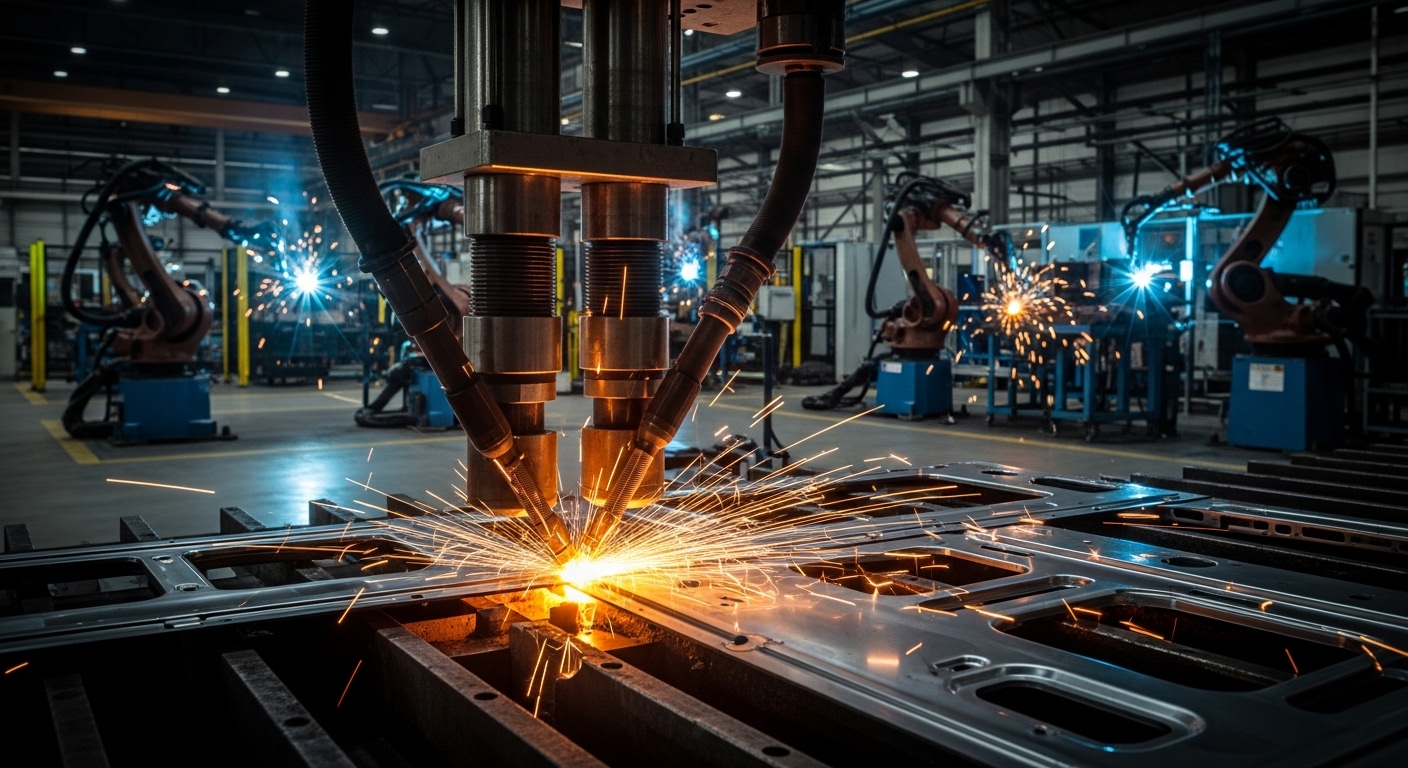
I’ve spent years watching metal fabrication shops struggle with joining thin sheet metal efficiently. After seeing dozens of operations switch from messy brazing to clean spot welding, the advantages became obvious. The transformation from inconsistent joints to reliable, repeatable welds was remarkable.
What Is Spot Welding?
Spot welding (also called resistance spot welding) is a fast joining process that fuses overlapping metal sheets using heat from electrical resistance and applied pressure, without any filler material.
- Process Type: Resistance welding using electric current
- Key Feature: No filler material required
- Typical Use: Sheet metal up to 3mm thick
- Speed: 0.2-1 second per weld
Spot welding is a resistance welding process that joins two or more metal sheets together by applying pressure and heat from an electric current to the weld area. The current flows between copper alloy electrodes, generating heat through electrical resistance at the contact point between the metal sheets.
This melting creates a “weld nugget” that fuses the materials together as it cools under continued pressure. The entire process happens in a fraction of a second, making spot welding one of the fastest metal joining methods available.
What makes spot welding unique is that it requires no filler material, flux, or shielding gas. The weld forms purely from the base metals themselves, creating a clean joint that’s ideal for mass production environments where speed and consistency matter most.
Resistance Welding: A group of welding processes that generate heat by passing electric current through the resistance created by contact between two or more metal surfaces. Spot welding is the most common type.
How Does Spot Welding Work?
Quick Summary: Spot welding uses copper electrodes to clamp metal sheets together, then sends high current through them. The resistance creates heat (up to 1650degC), melting the metal at the contact point and forming a weld nugget as it cools under pressure.
Understanding spot welding starts with Joule’s First Law, which states that heat generation is proportional to the square of the current multiplied by resistance and time. In practical terms, the metal sheets themselves become the heating element.
The Spot Welding Process (4 Steps)
Spot welding follows a consistent cycle that I’ve watched operators perform thousands of times:
- Squeeze Time: The copper electrodes clamp the metal sheets together with pressure typically ranging from 500 to 5,000 pounds per square inch. This ensures proper contact and contains the molten metal.
- Weld Time: Electric current flows through the electrodes and into the workpieces. Current levels typically range from 3,000 to 20,000 amps depending on material thickness and type. The resistance at the interface generates intense heat, reaching 1,500-1,650degC for steel.
- Hold Time: Current stops, but pressure continues for a brief period. This allows the weld nugget to solidify under the force of the electrodes, ensuring proper fusion and preventing expulsion.
- Off Time: The electrodes release and move to the next position, or the workpiece advances for the next weld cycle.
From my experience in fabrication shops, the beauty of this process lies in its repeatability. Once parameters are set for a specific material and thickness, every subsequent weld follows the exact same thermal profile, creating consistent results across thousands of joints.
What Creates the Heat?
The heat in spot welding comes from electrical resistance at the contact point between two metal sheets. When current flows through any conductor, it encounters resistance, and that resistance generates heat (this is how your toaster works too).
In spot welding, the point of highest resistance is where the two sheets touch. This is exactly where we want the heat. The copper electrodes conduct current efficiently with minimal heat generation, while the metal sheets at the contact point become hot enough to melt and fuse together.
Weld Nugget: The fused area of metal created during spot welding. A proper weld nugget should have a diameter roughly equal to the electrode tip face diameter, with penetration through the top sheet and at least 20-30% into the bottom sheet.
What Materials Can Be Spot Welded?
Not all metals weld equally well with spot welding. After working with various materials over the years, I’ve learned that material selection significantly impacts weld quality and process efficiency.
Low Carbon Steel
Stainless Steel
Aluminum
Material Compatibility Guide
| Material | Weldability | Current Needed | Key Considerations |
|---|---|---|---|
| Low Carbon Steel | Excellent (10/10) | Standard | Easiest material, consistent results, wide parameter window |
| Stainless Steel (300 Series) | Good (8/10) | Lower than steel | Lower thermal conductivity requires less current, electrode sticking can occur |
| Galvanized Steel | Good (7/10) | Standard to High | Zinc coating vaporizes, may need multi-step weld or surface prep |
| Aluminum | Fair (5/10) | Very High | High conductivity needs 2-3x current, requires clean surfaces, specialized electrodes |
| Copper and Brass | Poor (2/10) | Extremely High | Very high conductivity makes spot welding impractical, use alternative methods |
Steel is by far the easiest material to spot weld, which explains why the automotive industry relies on it so heavily. I’ve consistently seen the best results with low carbon steel thicknesses between 0.5mm and 3mm, where the process window is forgiving and results are predictable.
Aluminum presents more challenges due to its high thermal and electrical conductivity. You’ll need approximately 2-3 times the current required for steel, and surface cleanliness becomes critical. Any oxide layer on the aluminum will interfere with current flow and create weak welds.
Thickness Considerations
Spot welding works best with thin materials. The ideal thickness range is 0.5mm to 3mm per sheet, with a total stack thickness under 6mm. When materials become too thick, the current required becomes impractical, and alternative welding methods usually make more sense.
When welding dissimilar thicknesses, I always recommend placing the thinner sheet on the electrode side (top) and the thicker material on the other side. This helps ensure proper heat distribution and weld nugget formation.
Common Applications of Spot Welding
Spot welding has become the backbone of modern manufacturing, particularly in industries that require high-volume production of sheet metal assemblies. After visiting dozens of fabrication facilities, I’ve seen spot welding in action across numerous applications.
Automotive Industry
The automotive industry accounts for the majority of spot welding applications globally. A typical car contains between 3,000 and 5,000 spot welds, holding together everything from body panels to structural components. Modern automotive robots can perform spot welds in under half a second, making it possible to assemble a car body in just a few minutes.
Watching an automotive assembly line is incredible. Robotic arms move with precision, creating weld after weld with perfect consistency. This level of automation wouldn’t be possible without spot welding’s speed and repeatability.
EV Battery Manufacturing
One of the fastest-growing applications is in electric vehicle battery production. Each battery pack contains hundreds to thousands of individual cells that must be connected. Spot welding provides the ideal solution for joining battery tabs and terminals.
The DIY community has also embraced small spot welders for building custom battery packs for e-bikes, power tools, and solar storage systems. I’ve seen hobbyists build impressive battery arrays using spot welders that cost less than $200.
Other Major Applications
| Industry | Applications |
|---|---|
| Appliances (White Goods) | Refrigerator cabinets, washing machine drums, oven bodies |
| Electronics | Metal casings, battery connections, heat sinks |
| Metal Furniture | Desk frames, cabinet assembly, shelving units |
| Construction | HVAC ductwork, metal studs, flashing fabrication |
| Medical Devices | Surgical instruments, imaging equipment housings |
Advantages and Disadvantages of Spot Welding
Like any manufacturing process, spot welding has distinct strengths and limitations. Understanding these helps determine when spot welding is the right choice and when alternative methods might be better suited.
Advantages of Spot Welding
- Speed: Spot welding creates joints in 0.2 to 1 second. In high-production environments, this speed translates to significant cost advantages. I’ve seen production lines that couldn’t survive without this level of throughput.
- No Filler Material: The weld forms from the base metals alone, eliminating the cost of filler wire, rods, or consumables. This also means no post-weld cleanup of slag or spatter.
- Excellent Automation Potential: Spot welding machines integrate easily with robotic systems. Once programmed, they repeat the exact same weld thousands of times without variation.
- Energy Efficiency: Heat is generated only at the weld point, not throughout the workpiece. This localized heating means less energy waste and minimal distortion of surrounding material.
- Clean Joints: With proper parameters, spot welds require minimal finishing. No grinding, cleaning, or chemical treatment is typically needed after welding.
- Operator Skill Independence: Unlike arc welding, spot welding quality depends more on machine setup than operator skill. Once parameters are established, consistent results are automatic.
- Low Thermal Distortion: The localized, brief heating cycle minimizes warping and distortion of the workpiece. Critical for thin sheet metal that would otherwise deform easily.
Disadvantages of Spot Welding
- Limited Joint Access: Spot welding requires access to both sides of the joint. You can’t spot weld closed corners or tubes where electrode access is blocked.
- Thickness Limitations: Generally limited to materials under 3mm thick per sheet. Thicker materials require impractical current levels and specialized equipment.
- Equipment Cost: Industrial spot welding equipment represents a significant investment, with robotic systems costing $50,000 to $200,000 or more. However, DIY spot welders start around $150 for battery pack building.
- No Continuous Seams: Spot welding creates discrete weld points, not continuous seams. For applications requiring fluid-tight joints, seam welding or other methods may be necessary.
- Electrode Maintenance: Copper electrodes wear over time and require periodic dressing or replacement. In high-volume production, this maintenance adds to operating costs.
- Material Restrictions: Highly conductive metals like copper and brass weld poorly, and some material combinations are incompatible. This limits material choices in design.
- Hidden Joint Inspection: The weld nugget forms between the sheets, invisible from the surface. Quality inspection requires destructive testing or specialized equipment like ultrasonic testers.
Key Spot Welding Parameters
Successful spot welding requires balancing three main parameters: current, time, and pressure. I’ve watched new technicians struggle with this balance, but once understood, it becomes intuitive.
The Three Pillars of Spot Welding
3,000-20,000A
0.1-0.5 seconds
500-5,000 PSI
1. Welding Current: Current creates the heat. Too little current and the weld won’t form properly. Too much and you’ll get expulsion (metal spraying out) or burn-through. Most materials require a narrow optimal current range.
2. Weld Time: How long the current flows. Longer times create larger weld nuggets but also increase heat-affected zones. For most applications, weld times range from 0.1 to 0.5 seconds.
3. Electrode Pressure: Pressure ensures proper contact and contains the molten metal. Insufficient pressure causes expulsion and weak welds. Excessive pressure reduces current density and may prevent fusion.
Typical Parameter Settings
| Material | Thickness | Current | Time | Pressure |
|---|---|---|---|---|
| Low Carbon Steel | 1mm | 8,000-10,000A | 0.15-0.25 sec | 1,500-2,500 PSI |
| Stainless Steel | 1mm | 6,000-8,000A | 0.10-0.20 sec | 2,000-3,000 PSI |
| Aluminum | 1mm | 15,000-22,000A | 0.05-0.15 sec | 2,500-4,000 PSI |
These are starting points. Fine-tuning is always necessary based on specific equipment, electrode condition, and material variations.
Types of Spot Welding Equipment
Spot welding equipment ranges from simple handheld devices to sophisticated robotic systems. The right choice depends on production volume, part complexity, and available budget.
Portable/Handheld Spot Welders
Handheld spot welders offer flexibility for low-volume production and repair work. These units typically have C-clamp or gun-style designs that operators position manually. They’re common in sheet metal shops and for field repairs.
I’ve used portable spot welders for prototype work and small production runs. While they lack the speed of automated systems, their flexibility makes them invaluable for many applications.
Stationary Spot Welders
Stationary machines feature a pedestal or press design with fixed upper and lower electrodes. They provide consistent alignment and higher force capabilities than portable units. These are standard in metal fabrication shops doing medium-volume production.
Press-type welders offer the best control over electrode alignment and force, making them ideal for precision applications and thicker materials.
Robotic Spot Welding Systems
Robotic systems dominate high-volume automotive production. A typical setup includes a multi-axis robot arm with a spot welding gun attached. The robot positions the gun precisely at each weld location while the welding control manages parameters.
Modern robotic cells can achieve weld cycle times under 0.5 seconds, including robot motion. When you see a car body assembled in minutes, you’re witnessing this technology in action.
DIY and Hobbyist Spot Welders
A growing market exists for small spot welders designed for battery pack building. These units typically cost $150-$500 and use capacitive discharge to deliver brief, high-current pulses. They’re popular among DIY enthusiasts building e-bike batteries, power tool packs, and solar storage systems.
Spot Welding vs Other Welding Methods
Choosing the right welding method depends on your specific application. I’ve seen many operations struggle because they used spot welding where MIG or TIG would have been better, or vice versa.
| Aspect | Spot Welding | MIG Welding | TIG Welding |
|---|---|---|---|
| Speed | 0.2-1 sec per weld | Medium (continuous) | Slow (manual) |
| Joint Type | Discrete spots | Continuous seams | Precise seams |
| Access Required | Both sides | One side (usually) | One side (usually) |
| Filler Material | None | Wire required | Rod required |
| Automation | Excellent | Good | Fair (robotic TIG) |
| Operator Skill | Low (setup matters) | Medium | High |
| Material Thickness | Thin (<3mm) | Any thickness | Any thickness |
| Best For | High volume sheet metal | General fabrication | Precision work |
When to Choose Spot Welding
Spot welding excels in high-volume production of sheet metal assemblies where access to both sides is available. If you’re making thousands of identical parts from thin sheet metal, spot welding is typically the most economical choice.
When to Choose MIG/TIG Instead
MIG welding becomes preferable when you need continuous seams, are working with thicker materials, or only have access to one side of the joint. TIG welding offers the highest precision and control for critical applications or exotic materials.
Frequently Asked Questions
What is meant by spot welding?
Spot welding, also known as resistance spot welding, is a joining process that uses electrical resistance to generate heat between overlapping metal sheets. Copper electrodes apply pressure and pass high current through the materials, melting the metal at the contact point and forming a fused nugget without filler material.
What is the difference between spot welding and normal welding?
The main difference is that spot welding creates discrete weld points rather than continuous seams and uses no filler material. Traditional arc welding methods like MIG and TIG create continuous beads using filler wire or rod. Spot welding also requires access to both sides of the joint, while most arc welding can be done from one side.
Is spot welding hard?
Spot welding is not inherently difficult for basic applications. Once proper parameters are established for your material and thickness, the machine handles the actual welding process. The challenge lies in initial setup and parameter optimization, but running production requires minimal training compared to arc welding methods.
Is spot welding stronger than MIG welding?
Strength depends on the application. A properly formed spot weld can equal or exceed the strength of the base metal in shear, making it extremely strong for its size. However, MIG welds create continuous seams that may perform better in tensile loads or fatigue situations. For thin sheet metal applications, spot welds are typically as strong as needed.
What materials cannot be spot welded?
Highly conductive metals like pure copper, brass, and some aluminum alloys are very difficult to spot weld due to low electrical resistance. Cast iron and some high-alloy steels also present challenges. Materials with extremely different thermal properties may not weld well together.
How thick can you spot weld?
Spot welding works best with materials between 0.5mm and 3mm thick. The total stack thickness typically should not exceed 6mm. Thicker materials require impractical current levels and specialized equipment. For materials beyond these limits, arc welding methods are generally more appropriate.
Leave a Reply