
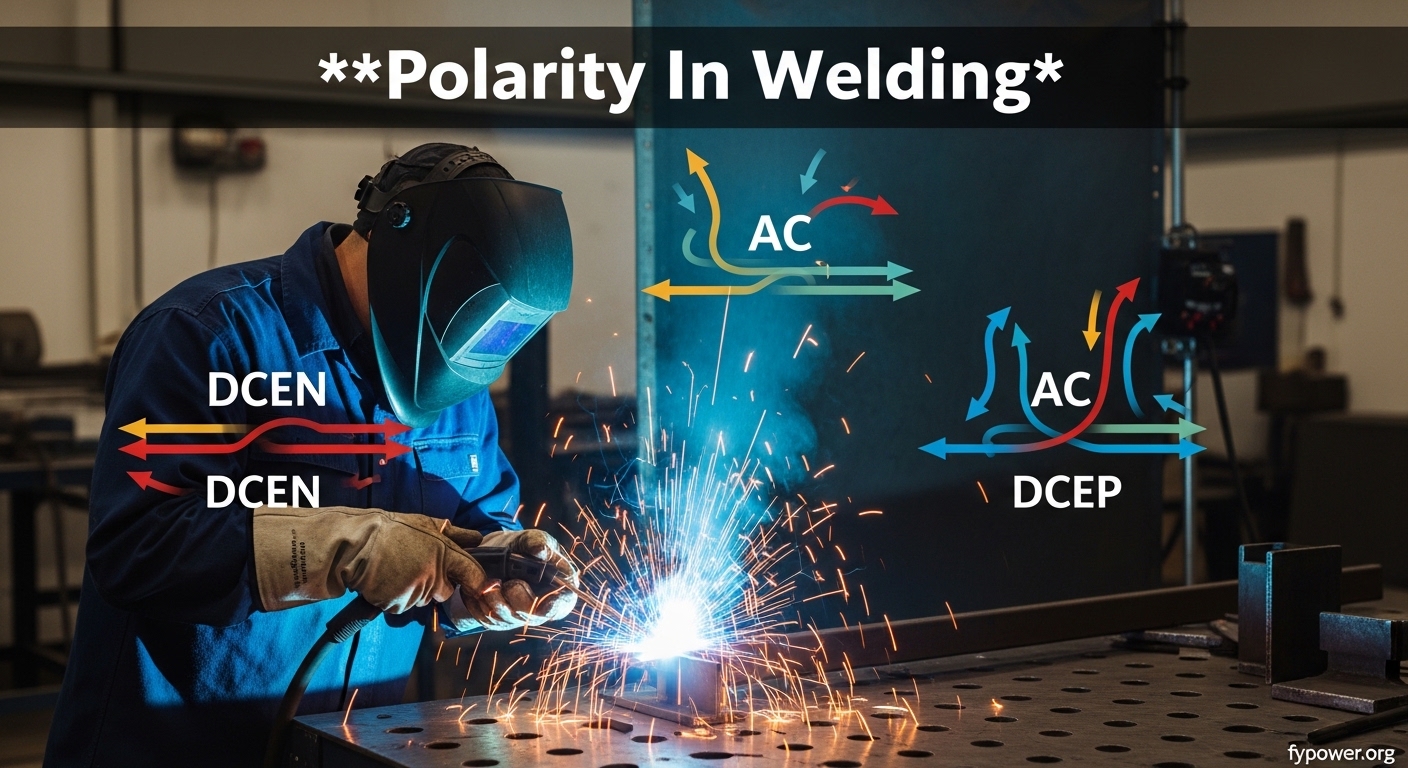
I’ve seen polarity mistakes ruin countless welds. In my 15 years of welding, the most common issue I encounter with beginners is setting the wrong polarity. A simple switch on your welding machine can mean the difference between a strong, clean weld and a frustrating failure.
So what is polarity in welding? It’s the direction that electrical current flows through your welding circuit, and it controls where the heat concentrates. Get this wrong and you’ll wonder why your welds look like bird droppings.
I’ve spent thousands of hours working with different welding processes across structural steel, pipe welding, and fabrication. I’ve tested polarity settings on everything from Miller and Lincoln machines to budget import welders. The principles never change, even if the terminal labels vary by manufacturer.
Polarity in welding determines the direction of electrical current flow between your electrode and the workpiece. This directly affects where heat concentrates during welding. With DCEP, about 70% of heat goes to the electrode. With DCEN, about 70% goes to the workpiece. This fundamental concept controls penetration depth, deposition rate, and overall weld quality.
Every arc welding process uses polarity. Whether you’re running stick electrodes, MIG welding, or TIG welding, the current needs to flow in the correct direction for that specific application. The manufacturers design electrodes and wires for specific polarities, and deviating from their recommendations leads to poor results.
How Does Polarity in Welding Work?
Understanding welding polarity starts with basic electricity. Your welding machine creates an electrical circuit that flows from the power source, through the cables, to the workpiece and electrode, and back again. The term “polarity” simply describes which direction that current flows.
Current Flow: Electrons flow from negative to positive, but conventional current flows from positive to negative. In welding, we care about where the heat concentrates, which follows the electron flow.
Here’s what happens in your welding leads. When you pull the trigger on a MIG gun or strike an arc with a stick electrode, you complete an electrical circuit. The machine pushes current out through one cable and it returns through the other. Which cable goes to the electrode holder and which goes to the work clamp determines your polarity setting.
The key principle is the 70/30 heat distribution rule. About 70% of the welding heat concentrates where the electrons enter. The remaining 30% goes to the opposite terminal. This means if electrons flow into the electrode, the electrode gets 70% of the heat. If they flow into the workpiece, the workpiece gets 70% of the heat.
DC welding machines use direct current that flows consistently in one direction. AC welding machines use alternating current that switches direction 120 times per second (60 Hertz). This switching creates a balanced heat distribution since neither terminal receives the majority of the heat.
Most modern welders make changing polarity simple. You’ll find terminal connections labeled clearly or polarity selector switches. Some machines even change polarity automatically based on the process you select. Older machines might require physically swapping cable connections at the output terminals.
Quick Summary: Polarity controls heat distribution in your weld. Electrons create the most heat where they enter. DCEN puts 70% heat on the workpiece for deep penetration. DCEP puts 70% heat on the electrode for faster melting. AC splits heat evenly between electrode and workpiece.
The Three Types of Welding Polarity
Every welding process uses one of three polarity types. Understanding these three options is essential for choosing the right setting for your application.
DCEN vs DCEP vs AC Comparison
| Polarity Type | Heat Distribution | Penetration | Deposition | Common Uses |
|---|---|---|---|---|
| DCEN (Straight) |
70% work / 30% electrode | Deep penetration | Lower deposition | TIG, some stick |
| DCEP (Reverse) |
30% work / 70% electrode | Shallow penetration | Higher deposition | Most stick, MIG, FCAW |
| AC (Alternating) |
50% work / 50% electrode | Medium penetration | Medium deposition | Aluminum TIG, dirty steel |
DCEN – Direct Current Electrode Negative (Straight Polarity)
DCEN means the electrode connects to the negative terminal and the work connects to positive. The electrons flow from the electrode to the workpiece, concentrating 70% of the heat on the base metal. This creates deep penetration with less electrode melting.
This polarity excels when you need maximum fusion into the base material. I use DCEN for TIG welding almost exclusively. The concentrated heat on the workpiece allows precise control without overheating the tungsten electrode.
For stick welding, DCEN works well with specific electrodes like certain cellulose rods. The deep penetration helps when welding thick materials or when you need deep fusion in a single pass. However, most common stick electrodes run better on DCEP.
Deep Penetration
Thin Materials
The advantages of DCEN include deeper penetration, less electrode consumption, and a more stable arc with certain processes. The disadvantages include slower deposition rates and limited compatibility with many stick electrodes.
DCEP – Direct Current Electrode Positive (Reverse Polarity)
DCEP reverses the connections. The electrode connects to positive and the work connects to negative. Electrons flow from work to electrode, putting 70% of the heat into the electrode. This melts the filler metal faster and creates shallower penetration.
This is the most common polarity for stick welding. Most SMAW electrodes including popular rods like 6010, 6011, 7018, and 7014 are designed for DCEP operation. The increased electrode heat helps melt the flux coating and creates a stable, dig-free arc.
MIG welding typically uses DCEP as well. The heat concentrated on the continuously fed wire helps maintain smooth metal transfer. Most solid MIG wire and flux-cored wire run best on this polarity.
MIG Welding
Flux Core
Out of Position
The advantages of DCEP include higher deposition rates, better for out-of-position welding, smoother arc with most electrodes, and reduced spatter with proper settings. The disadvantages include shallower penetration and faster electrode or wire consumption.
AC – Alternating Current Polarity
AC polarity alternates the current direction many times per second. The electrode switches between positive and negative continuously. This creates a balanced heat distribution of approximately 50/50 between electrode and workpiece.
AC welding has specific applications. I use it for TIG welding aluminum because the electrode-positive half-cycle creates a cleaning action that breaks up aluminum oxide. This self-cleaning effect is essential for quality aluminum welds.
Some stick welding machines are AC-only. Budget “buzz boxes” use transformer technology that produces AC current directly. These machines work well with specialized AC-designed rods like 6013, which excels at sheet metal work and light fabrication.
The advantages of AC include balanced heat, arc cleaning action on aluminum, and compatibility with budget machines. The disadvantages include a less stable arc, more spatter, limited electrode compatibility, and not suitable for most DC-only processes.
How to Choose the Right Polarity?
Choosing the correct polarity depends on your welding process, electrode type, material thickness, and position. Let me break this down by process since that’s the most practical way to think about it.
For Stick Welding (SMAW)
Most stick welding uses DCEP (reverse polarity). The electrodes you’ll use most often are designed for this setting. Your 6010, 6011, 7018, and 7018AC rods all typically run on electrode positive.
The exceptions matter. Some specialty electrodes specify DCEN or AC only. Always check the electrode packaging or manufacturer specs. I’ve seen welders struggle with rods that won’t run properly, only to discover they’re on the wrong polarity.
For sheet metal work with stick, DCEN can sometimes reduce burn-through. The deeper penetration on the workpiece means less heat concentration in the weld pool. This technique has saved me on thin materials when I didn’t have a MIG available.
For MIG Welding (GMAW)
MIG welding almost always uses DCEP. The positive electrode connection helps create a smooth spray transfer and stable arc. Your standard solid wire like ER70S-6 runs electrode positive.
Some flux-cored wires specify DCEN, particularly self-shielded types. These wires generate their own shielding gas and often require straight polarity for proper operation. Check the wire spool label for polarity requirements.
Short-circuit MIG on thin materials still uses DCEP, but you’ll run lower wire feed speeds and voltage settings. The polarity stays the same regardless of material thickness.
For TIG Welding (GTAW)
TIG welding primarily uses DCEN for steel and stainless steel. The negative electrode connection keeps the tungsten from overheating and provides deep, focused penetration. This is the standard polarity for most TIG applications.
Aluminum TIG requires AC polarity. The electrode-positive cycles provide cleaning action that removes the aluminum oxide layer. Without this AC cleaning action, aluminum welds will be contaminated and weak.
Some advanced TIG machines offer variable balance controls. These let you adjust the AC waveform to favor more penetration or more cleaning depending on your application. I typically run balance around 65-70% EN for most aluminum work.
Polarity for Different Welding Processes
Welding Process Polarity Chart
| Process | Standard Polarity | Electrode Connection | Notes |
|---|---|---|---|
| Stick (SMAW) | DCEP | Positive (+) | Most rods: 6010, 6011, 7018 |
| MIG (GMAW) | DCEP | Positive (+) | Solid wire standard |
| Flux Core (FCAW) | DCEP or DCEN | Varies by wire | Check wire specification |
| TIG Steel (GTAW) | DCEN | Negative (-) | Steel & stainless steel |
| TIG Aluminum | AC | Alternating | For oxide cleaning action |
Common Electrode Polarity Guide
Different electrodes have specific polarity requirements. Here’s a quick guide based on my experience with the most common stick electrodes:
- E6010 & E6011: DCEP only. These deep-penetration rods require reverse polarity for proper arc characteristics.
- E6013: AC or DC, either polarity. Versatile rod that runs on almost any machine.
- E7018: DCEP standard. Low-hydrogen rod designed for reverse polarity, though some AC variants exist.
- E7014: AC or DCEP. Iron powder rod runs well on either setting.
- E7024: AC or DCEP. High-deposition jet rod for flat and horizontal only.
- Stainless rods (E308, E309, etc.): Usually DCEP. Check specific rod specifications.
When in doubt, read the electrode box. Every reputable electrode manufacturer prints the polarity requirements directly on the packaging. Following these specs ensures the rod performs as designed.
How to Check Polarity on Your Welder?
Checking your welder’s polarity setting is straightforward once you know what to look for. I’ve walked countless apprentices through this process. Here’s my step-by-step method:
- Turn off and unplug your welder. Never check or change polarity while the machine has power.
- Locate the output terminals on the front panel of your machine. You’ll see at least two connection points labeled with positive (+) and negative (-) symbols.
- Trace your cables from the work clamp (ground) and electrode holder or gun back to the machine terminals.
- Identify current connections: Note which cable connects to which terminal. The electrode holder, gun, or wire feeder connection determines your polarity.
- Verify the setting:
- Electrode on positive (+) = DCEP (reverse polarity)
- Electrode on negative (-) = DCEN (straight polarity)
- Check for polarity switch: Some machines have a selector switch that internally changes polarity without moving cables. If present, verify the switch position.
- Test if uncertain: Strike a test weld on scrap metal. Poor arc characteristics, excessive spatter, or difficulty starting often indicate wrong polarity.
Machine terminal labels can be confusing on older equipment. Some older welders use different terminology. You might see “Straight” and “Reverse” instead of DCEN and DCEP. Straight means DCEN, and Reverse means DCEP. The terminology comes from which direction the current “appears” to flow in conventional theory.
Modern inverters often have clear polarity indicators in their display menus. These machines frequently allow polarity changes through the interface rather than physically swapping cables. The digital display will show your current setting and sometimes recommended settings for different processes.
Troubleshooting: Signs of Wrong Polarity
Recognizing wrong polarity symptoms saves time and frustration. I’ve seen welders waste hours adjusting technique when the real problem was a simple polarity switch. Here are the telltale signs:
Wrong Polarity Symptoms Checklist
- Difficulty striking an arc: The rod won’t start easily or keeps sticking
- Excessive spatter: More metal spatter than normal, messy weld appearance
- Unstable arc: Arc sputters, hisses, or sounds irregular
- Poor penetration: Shallow welds that don’t fuse properly
- Excessive penetration: Burn-through on thin materials
- Fast electrode consumption: Rod burns away too quickly
- Slow electrode consumption: Rod hardly melts, poor deposition
- Porosity: Gas bubbles trapped in the weld metal
If you experience these symptoms, first check your polarity setting. Make sure the electrode or wire connects to the correct terminal for your process. Most of the time, this simple fix resolves the issue immediately.
Stick welding shows the most dramatic polarity problems. Running a DCEP-designed rod like 7018 on DCEN will produce an unstable arc with poor weld characteristics. The rod will stick frequently and the weld bead will be narrow and irregular.
MIG welding polarity problems manifest as poor wire transfer and spatter. Wrong polarity causes the wire to stub into the workpiece or create a erratic, sputtering arc. The sound changes from a smooth frying bacon to irregular popping.
TIG welding polarity is critical for tungsten life. Running DCEP with standard tungsten on steel will cause rapid tungsten erosion and contamination. The tungsten ball will form quickly and the arc will wander.
Frequently Asked Questions
What does polarity do in welding?
Polarity determines the direction of electrical current flow in your welding circuit, which controls where heat concentrates during welding. The polarity setting affects penetration depth, deposition rate, arc stability, and overall weld quality. Choosing the correct polarity ensures proper fusion and optimal welding performance.
What is DCEP and DCEN?
DCEP (Direct Current Electrode Positive) means the electrode connects to the positive terminal, putting 70% of heat into the electrode for faster melting. DCEN (Direct Current Electrode Negative) means the electrode connects to negative, putting 70% of heat into the workpiece for deeper penetration. DCEP is also called reverse polarity, while DCEN is called straight polarity.
Do you stick weld on DC positive or negative?
Most stick welding uses DC positive (DCEP or reverse polarity). Common electrodes like E6010, E6011, and E7018 are designed for electrode positive operation. This setting provides stable arc characteristics, good deposition rates, and works well for most applications. Some specialty electrodes may require DC negative or AC, so always check the electrode specifications.
What polarity is used for stick welding?
Stick welding primarily uses DCEP (reverse polarity) with the electrode set to positive. Most common stick electrodes including 6010, 6011, 7018, and 7014 run best on this setting. Some applications like sheet metal work may benefit from DCEN, and certain rods like 6013 can run on AC or either DC polarity.
What polarity is used for MIG welding?
MIG welding typically uses DCEP (electrode positive) polarity. Standard solid wire like ER70S-6 performs best on reverse polarity, which promotes smooth metal transfer and stable arc characteristics. Some flux-cored wires may specify DCEN, so always verify the wire manufacturer’s recommendations.
How to check polarity on a welder?
To check polarity, first turn off and unplug the welder. Locate the output terminals on the front panel. Trace which cable connects to which terminal. The electrode holder, gun, or wire feeder connection determines your polarity. If connected to positive, you have DCEP. If connected to negative, you have DCEN. Some machines have polarity selector switches instead.
What is straight polarity in welding?
Straight polarity (DCEN) means the electrode connects to the negative terminal and the workpiece connects to positive. This configuration directs 70% of the welding heat to the workpiece, creating deeper penetration with less electrode melting. Straight polarity is commonly used for TIG welding steel and some specialized stick welding applications.
What is reverse polarity in welding?
Reverse polarity (DCEP) means the electrode connects to the positive terminal and the workpiece connects to negative. This puts 70% of heat into the electrode for faster melting and shallower penetration. Reverse polarity is the standard for most stick welding and MIG welding applications, providing stable arc characteristics and good deposition rates.
Leave a Reply