
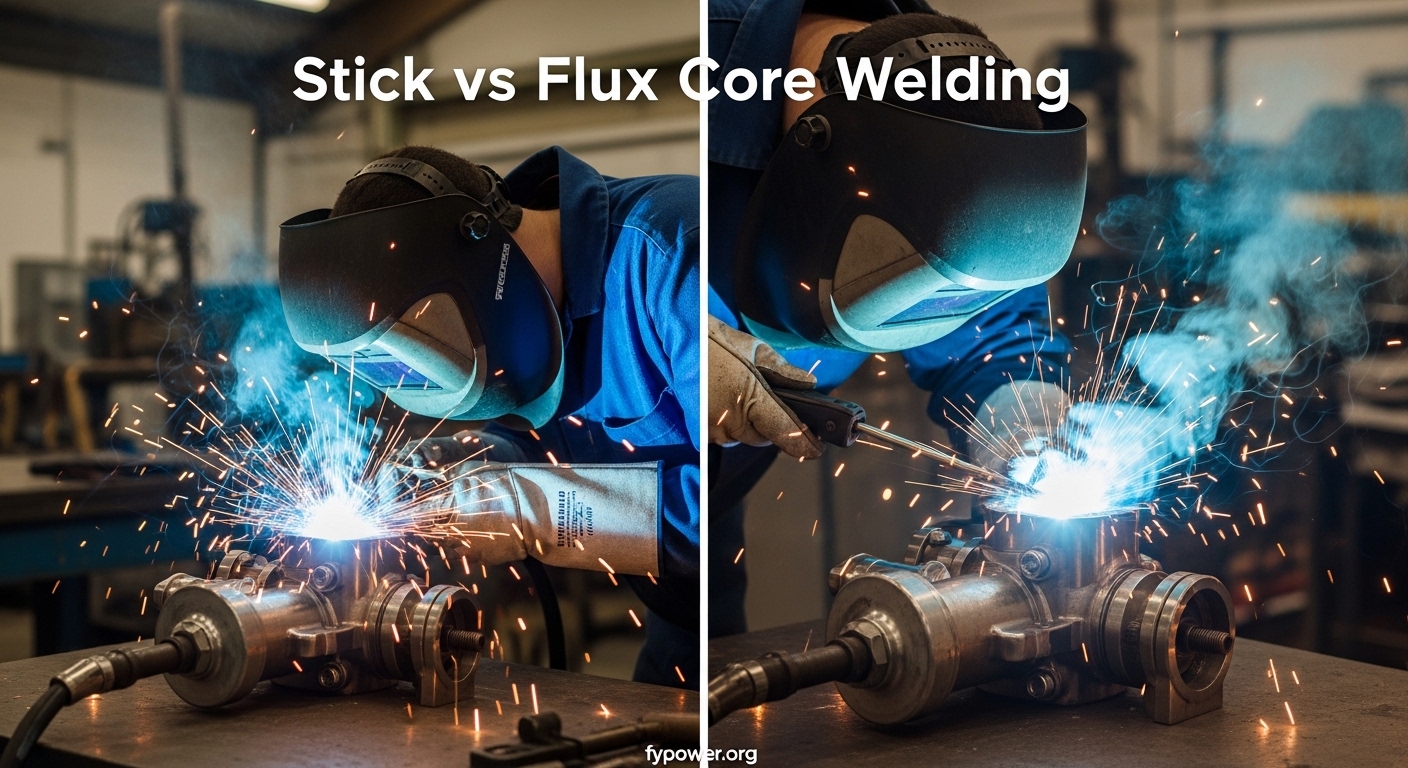
I’ve spent years welding in home shops, on farm equipment, and in professional settings. The stick vs flux core welding debate comes up constantly among beginners choosing their first machine.
After testing both processes extensively on real projects ranging from auto body repairs to fence fabrication, I found that flux core welding is better for beginners and indoor work, while stick welding excels at outdoor projects and thick materials. The choice depends on your specific projects, environment, and skill level.
Let me break down exactly what you need to know to make the right decision for your situation.
What is Stick Welding (SMAW)?
Stick welding, officially called Shielded Metal Arc Welding (SMAW), is one of the oldest and most reliable welding processes. It uses a consumable electrode rod coated in flux material.
When you strike an arc between the electrode and the workpiece, the intense heat melts both the rod and the base metal. The flux coating burns off, creating a protective gas shield that prevents contamination from the air.
SMAW (Shielded Metal Arc Welding): The technical name for stick welding. Uses a fixed-length electrode with flux coating that creates its own shielding gas when burned, making it ideal for outdoor welding.
As the weld cools, the flux forms a layer of slag over the bead. You chip this away to reveal the finished weld underneath. Stick welding equipment is simple: a power source, electrode holder, ground clamp, and the electrodes themselves.
I’ve found stick welding particularly forgiving on dirty or rusty metal. The flux coating burns through contaminants that would cause problems in other processes. This makes it incredibly valuable for farm repair work and outdoor projects where metal preparation isn’t always possible.
The electrodes come in various types designed for specific applications. E6010 and E6011 penetrate deep and work well on dirty metal. E6013 produces smoother beads for general-purpose work. E7018 offers low-hydrogen welds for critical structural applications.
What is Flux Core Welding (FCAW)?
Flux Core welding, or Flux Cored Arc Welding (FCAW), uses a continuous wire electrode filled with flux material rather than solid wire like MIG welding. The wire feeds automatically through a welding gun, eliminating the need to stop and change electrodes.
As the wire feeds into the weld pool, the flux inside creates the shielding gas needed to protect the molten metal. This self-shielding capability makes flux core welding possible without external gas cylinders.
FCAW (Flux Cored Arc Welding): A wire-fed welding process using tubular wire filled with flux. Self-shielded FCAW requires no external gas, while dual-shield versions combine flux with external gas for cleaner welds.
The equipment consists of a wire feeder welder, welding gun, ground clamp, and flux core wire spool. Most modern flux core welders are compact units that plug into standard 115V household outlets.
What I appreciate most about flux core welding is the continuous operation. You can weld for extended periods without interruption. The wire feed mechanism maintains consistent arc length automatically, reducing one variable that beginners struggle with in stick welding.
Flux core wires come in two main categories. Self-shielded wires (like E71T-GS) need no gas and work well for general fabrication. Gas-shielded or dual-shield wires (like E71T-1) require external CO2 or argon mixes but produce cleaner welds with less spatter.
Head-to-Head Comparison
Understanding the key differences between these processes helps you choose the right one for your specific situation. Here’s a detailed comparison based on my hands-on experience:
| Feature | Stick Welding | Flux Core Welding |
|---|---|---|
| Electrode Type | Fixed-length rod (12-14 inches) | Continuous wire on spool |
| Duty Cycle | Limited by rod changes | Continuous welding possible |
| Wind Tolerance | Excellent – works in strong wind | Good – moderate wind tolerance |
| Metal Preparation | Minimal – works through rust/paint | Clean metal produces best results |
| Thin Metal (22 gauge) | Difficult – high amperage required | Excellent – low heat input possible |
| Thick Metal (1/4+ inch) | Excellent – deep penetration | Good with multiple passes |
| Beginner Learning Time | Several days of practice | Few hours to basic competence |
| Weld Appearance | Rough, requires cleanup | Moderate, some spatter |
| Indoor Use | Requires ventilation | Requires ventilation |
| Portability | Very portable, minimal equipment | Moderate – wire feeder needed |
Pros and Cons of Stick Welding
Stick welding has earned its reputation as the go-to process for field work and heavy fabrication. After countless hours using stick welders on everything from gate repairs to structural steel, here’s what I’ve learned:
Advantages of Stick Welding
- Exceptional outdoor performance: Stick welding handles wind better than any other process. I’ve welded in gusty conditions that would be impossible with MIG or challenging with flux core. The flux coating creates robust shielding that doesn’t get blown away easily.
- Works through contaminants: Paint, rust, mill scale – stick welding burns through it all. On farm equipment where sandblasting isn’t an option, stick electrodes like E6010 cut through surface contamination effortlessly.
- Deep penetration on thick materials: When welding 1/4 inch plate or thicker, stick welding delivers penetration that’s hard to match. For structural applications where weld strength matters most, stick remains the preferred choice.
- Simple, reliable equipment: A stick welder has few moving parts. Less to break means more reliability. I’ve taken stick welders to remote job sites where sophisticated equipment would fail.
- Can weld in all positions: With the right electrode and technique, stick welding works flat, horizontal, vertical, and overhead. Vertical-up welds with E6010 produce excellent penetration on structural connections.
- Lower initial equipment cost: Basic stick welders start around $150, making them accessible entry points. For occasional welders on a budget, stick offers the most affordable path to functional welding capability.
- Wide range of electrodes: Specialty electrodes exist for virtually any application – cast iron, stainless steel, hardfacing, gouging, and more. One machine can handle diverse projects with the right electrode selection.
Disadvantages of Stick Welding
- Steeper learning curve: Developing the muscle memory for stick welding takes time. You must maintain consistent arc length, travel speed, and electrode angle simultaneously. Most beginners need several days of practice before producing consistently acceptable welds.
- Frequent electrode changes: Each 12-14 inch rod lasts only 30-60 seconds depending on amperage and technique. Constant stopping to change rods interrupts your rhythm and extends project time significantly.
- Slower deposition rate: For long welds, stick welding deposits metal more slowly than wire processes. Production environments typically favor flux core or MIG for this reason.
- Slag removal required: Every stick weld is covered in slag that must be chipped away. This cleanup step adds time to every project and creates dust that requires respiratory protection.
- Difficult on thin metals: Stick welding struggles with materials thinner than 18 gauge. The minimum amperage needed to maintain a stable arc often burns through light sheet metal.
- Less aesthetic welds: Stick welds typically have a rougher appearance compared to other processes. For visible welds where appearance matters, stick often requires additional grinding and finishing.
- Higher skill requirement for overhead/vertical: Out-of-position welding with stick requires advanced technique. Gravity works against you, and controlling the puddle overhead takes considerable practice to master.
Pros and Cons of Flux Core Welding
Flux core welding has gained popularity among DIY welders and small fabrication shops for good reason. After helping beginners learn both processes, I consistently see faster progress with flux core.
Advantages of Flux Core Welding
- Easier for beginners to learn: The continuous wire feed eliminates one major variable – maintaining arc length manually. New welders typically produce usable beads within a few hours, compared to days for stick welding. I’ve seen complete beginners fabricate basic projects in their first afternoon with flux core.
- Continuous welding operation: No stopping to change electrodes means you maintain your rhythm and complete long welds efficiently. For projects like trailer fabrication or sheet metal work, this time savings adds up quickly.
- Higher deposition rates: Flux core lays down metal faster than stick welding. Production environments appreciate the increased speed, and home fabricators finish projects more quickly.
- Better performance on thin metals: With proper wire and settings, flux core handles sheet metal down to 22 gauge without burn-through. This makes it ideal for auto body work and light fabrication where stick would struggle.
- No external gas required: Self-shielded flux core works anywhere without gas cylinders. You gain portability while still enjoying wire-feeding advantages. No gas rental fees or running out of gas mid-project.
- One-handed operation possible: The gun design allows single-handed welding in many situations. Your free hand can steady the workpiece or manipulate fixtures, providing more control overall.
- Better for tight spaces: The compact gun fits into confined areas where a long electrode holder might not. For tight repair situations, flux core offers distinct access advantages.
- Less cleanup than stick: While flux core still produces slag, it’s typically lighter and easier to remove than stick welding slag. Wire brushing often suffices instead of chipping.
Disadvantages of Flux Core Welding
- Less tolerant of dirty metal: While better than MIG welding in this regard, flux core still struggles more than stick with rust, paint, and mill scale. Proper metal preparation produces significantly better results.
- More spatter than MIG: Self-shielded flux core produces considerable spatter that requires cleanup. Your work area accumulates small metal beads that need periodic removal.
- Equipment more complex: Wire feeders can jam, drive rolls wear out, and tension settings require adjustment. Stick welders have fewer moving parts and fewer failure points.
- Wire feed issues in cold weather: The flux inside the wire can become stiff in low temperatures, causing feeding problems. Cold weather welding requires keeping wire spools warm or adjusting feeder tension.
- Less wind-tolerant than stick: While better than gas-shielded processes, flux core can still be affected by strong winds. For severe outdoor conditions, stick remains superior.
- Wire storage requirements: Flux core wire absorbs moisture from the air, which causes weld porosity. Proper storage in sealed containers with desiccant becomes important, especially in humid climates.
- Limited to ferrous metals: While specialty flux core wires exist for stainless and some other alloys, the selection is limited compared to stick electrodes. For dissimilar metal welding, stick offers more options.
- Gun consumable costs: Contact tips, nozzles, and drive rolls wear out and require replacement. These ongoing costs add up over time, unlike stick welding which primarily requires only electrodes.
When to Use Each Method?
Choosing the right welding process for your specific situation makes all the difference. Based on my experience across various applications, here’s a practical guide to help you decide:
Choose Stick Welding When:
- Welding outdoors in windy conditions: Farm fence repairs, construction sites, or any outdoor project where wind is present. Stick welding’s flux coating creates robust shielding that won’t be disrupted by air movement.
- Working with dirty or rusty metal: Field repairs on equipment, farm implements, or structural steel where proper cleaning isn’t practical. The penetrating arc burns through surface contamination.
- Welding thick materials (1/4 inch and above): Structural projects, heavy fabrication, or any application requiring deep penetration. Stick welding excels at fusing thick sections with full penetration.
- Portability is essential: Remote job sites, field repair work, or situations where carrying a wire feeder welder isn’t practical. A stick welder and box of electrodes fit in a compact carrying case.
- Budget is a primary concern: For welders on tight budgets who need basic welding capability, a $150 stick welder provides functionality that would cost significantly more with other processes.
- Welding cast iron or specialty alloys: With the right electrode selection, stick welding handles materials that would be difficult or impossible with flux core. Nickel electrodes for cast iron repair are a classic example.
- Doing gouging work: Stick welding can be used for carbon arc gouging to remove metal or prepare weld joints. This versatility is valuable in repair and fabrication settings.
Choose Flux Core Welding When:
- You’re a beginning welder: The easier learning curve means you’ll be producing functional welds more quickly. Most beginners achieve basic competence in a single afternoon versus several days with stick.
- Working primarily with thin metals: Auto body repair, sheet metal fabrication, or any project involving 22-18 gauge material. Flux core’s lower heat input prevents burn-through on light materials.
- Indoor shop welding is your norm: For garage workshops or indoor fabrication where wind isn’t a factor, flux core provides excellent results without the complexity of gas-shielded MIG welding.
- Production speed matters: The continuous wire feed and higher deposition rates mean you complete projects faster. For fabrication businesses or serious hobbyists, this efficiency adds up.
- You want cleaner weld appearance: While not as clean as gas-shielded MIG, flux core typically produces better-looking welds than stick welding with less post-weld cleanup required.
- Long continuous welds are needed: Trailer fabrication, tank construction, or any application with long seam welds benefits from not stopping to change electrodes constantly.
- One-handed operation would be helpful: Situations where your free hand needs to steady the workpiece or manipulate fixtures. The compact gun design enables single-handed welding in many scenarios.
- Auto body repair is your focus: The ability to weld thin sheet metal without burn-through makes flux core ideal for automotive restoration and repair projects.
Skill Level Comparison
The learning curve difference between these processes significantly affects beginner success rates. In my experience teaching new welders, flux core produces initial success much faster.
With flux core welding, most beginners can lay down a functional bead within 2-3 hours of practice. The wire feeder maintains consistent arc length automatically, removing one major variable from the learning equation. After a weekend of practice, new flux core welders typically handle basic projects successfully.
Stick welding requires more patience and practice. Developing the coordination to maintain proper arc length, travel speed, and electrode angle simultaneously takes time. Most beginners need 3-5 days of regular practice before producing consistently acceptable stick welds. The frustration level is higher initially, but once mastered, stick welding becomes a versatile and reliable skill.
That said, the investment in learning stick welding pays long-term dividends. The muscle memory and technique developed transfers to other welding processes. Many experienced welders recommend starting with stick precisely because it builds fundamental skills that serve you well across all arc welding processes.
Cost and Equipment Comparison
Understanding the financial commitment for each process helps you make an informed decision. Here’s a realistic breakdown based on current equipment pricing:
| Cost Category | Stick Welding | Flux Core Welding |
|---|---|---|
| Basic Machine (115V) | $150-$300 | $200-$400 |
| Heavy Duty Machine (230V) | $400-$800 | $500-$1,000 |
| Consumables (per pound) | $2-$4 for electrodes | $3-$6 for flux core wire |
| Gas Required | No | No (self-shielded) |
| Gun/Holder Replacement | $20-$40 for electrode holder | $40-$80 for welding gun |
| Additional Consumables | Minimal (ground clamp) | Contact tips, nozzles, drive rolls |
For occasional home use, stick welding typically costs less upfront. A basic stick welder plus a few boxes of electrodes gets you welding for under $250 total investment. Flux core equipment usually runs $50-100 more for comparable capabilities.
However, for frequent welding, the efficiency of flux core can offset the higher equipment cost. The continuous operation and faster deposition rates mean you complete projects in less time. If you weld regularly, flux core may prove more cost-effective in the long run despite the higher initial investment.
Consumable costs favor stick welding slightly. Electrodes generally cost less per pound than flux core wire, and the simpler equipment means fewer replacement parts over time. However, the difference is relatively small and shouldn’t be the deciding factor for most hobbyist welders.
Frequently Asked Questions
What is the main difference between stick and flux core welding?
The main difference is the electrode type. Stick welding uses a fixed-length rod that you change frequently, while flux core uses a continuous wire fed through a gun. Flux core is generally easier for beginners and has higher deposition rates, while stick welding offers better penetration on thick materials and is more forgiving on dirty metal.
Which is better for beginners, stick or flux core?
Flux core welding is better for beginners. It is easier to learn, provides continuous welding without stopping to change electrodes, and is more forgiving of technique mistakes. Most beginners can produce usable welds within a few hours with flux core, while stick welding typically requires several days of practice.
Do you need gas for flux core welding?
No, self-shielded flux core welding does not require external gas. The flux inside the wire creates its own shielding gas when burned. However, there is also gas-shielded flux core (dual shield) that uses both flux and external gas for cleaner welds.
Is stick welding stronger than flux core?
When done correctly, both processes can produce equally strong welds. Stick welding typically offers better penetration on thick materials, which can result in stronger welds for heavy structural applications. Flux core produces strong welds as well, particularly on thinner materials where it excels.
Can you weld aluminum with flux core?
Yes, but it is difficult and requires specialized aluminum flux core wire. The results are often poor quality with excessive spatter. For aluminum welding, MIG or TIG welding with proper gas shielding is strongly recommended over flux core.
What is stick welding used for?
Stick welding is commonly used for outdoor construction and repairs, farm and ranch equipment, structural steel welding, pipeline welding, heavy equipment repair, and thick metal fabrication. Its outdoor capability and ability to weld through rust and paint make it ideal for field repair work.
What is flux core welding used for?
Flux core welding is commonly used for DIY home projects, auto body repair, light fabrication, sheet metal work, hobby welding, indoor workshop projects, and general maintenance. Its ease of use and good results on thin materials make it popular with home fabricators and beginners.
Is flux core welding good for outdoor use?
Yes, flux core welding works well outdoors. The self-shielded wire is wind-tolerant and does not require external gas shielding. While not quite as wind-resistant as stick welding, flux core performs adequately in moderate wind conditions, making it suitable for most outdoor DIY projects.
Which is cheaper, stick or flux core?
Stick welding equipment is typically cheaper to buy initially, with basic machines starting around $150. Flux core welders start around $200. However, flux core wire is generally more expensive per pound than stick electrodes. For occasional use, stick welding is more economical; for frequent welding, flux core may be more cost-effective due to higher efficiency.
Final Verdict
After using both processes extensively across various applications, here’s my honest assessment:
Choose flux core welding if: You’re a beginner, work primarily indoors, weld thin materials, or want faster results with less frustration. The easier learning curve means you’ll be successfully completing projects sooner. For most DIY enthusiasts and home fabricators, flux core offers the best balance of capability and accessibility.
Choose stick welding if: You weld outdoors frequently, work with thick materials, need maximum portability, or value versatility above convenience. The steeper learning curve rewards you with a process that handles almost any welding situation, especially challenging field work where other processes struggle.
The ideal solution: Many experienced welders ultimately own both. A multi-process welder that handles stick, flux core, and MIG gives you the flexibility to choose the right process for each project. You might start with flux core to learn the fundamentals, then add stick capability later for outdoor and heavy fabrication work.
Whichever process you choose, remember that practice matters more than equipment. I’ve seen impressive welds produced with basic machines by skilled operators, and poor welds made on expensive equipment by beginners. Start with whichever process matches your immediate needs, invest time in developing your skills, and expand your capabilities as your experience grows.
Leave a Reply