
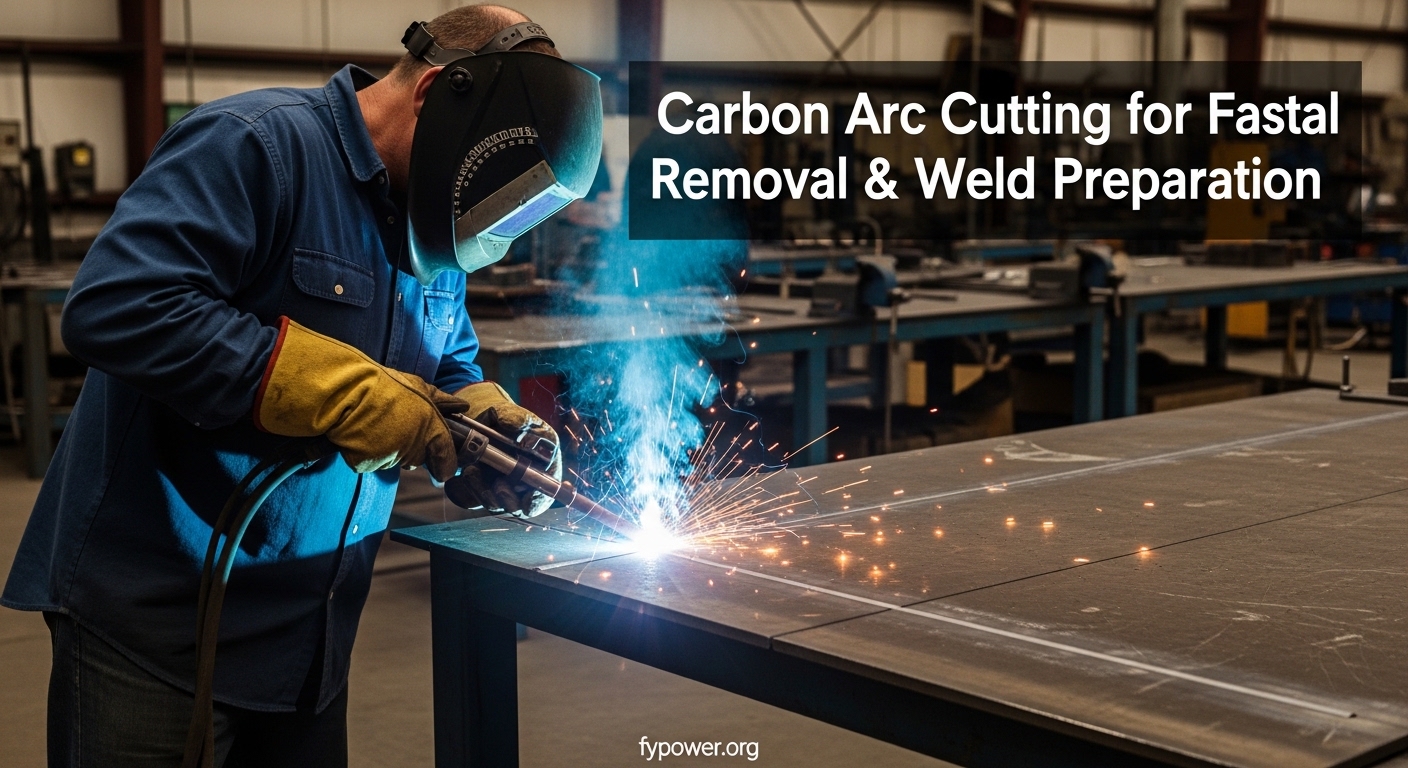
Carbon arc cutting is one of the most powerful metal removal processes in industrial fabrication. When I first encountered it in a shipyard, I watched a welder slice through inch-thick steel plate like butter, leaving a clean groove in seconds. The speed and raw power of CAC carbon arc cutting make it indispensable for heavy industry.
Air carbon arc cutting (CAC-A) is a thermal cutting process that uses a carbon or graphite electrode to create an electric arc that melts metal. A high-velocity jet of compressed air then blows away the molten metal, allowing for cutting or gouging operations. CAC can cut all metal types including stainless steel and cast iron that oxy-fuel cannot process.
After working with fabrication shops across the country, I have seen CAC carbon arc cutting become the go-to method for weld removal, back gouging, and preparing joints. The process handles everything from maintenance welding repairs to full-scale structural steel fabrication. It works in any position, cutting through materials that would stop other thermal cutting methods cold.
How Carbon Arc Cutting Works?
Quick Summary: Carbon arc cutting uses an electric arc between a carbon electrode and the workpiece to melt metal (up to 6,000F). Compressed air flowing through the electrode holder blows the molten metal away, creating a cut or groove. The process requires a constant current power source, compressed air at 80-100 PSI, and proper polarity settings.
The physics behind CAC carbon arc cutting rely on two simultaneous actions. First, an electric arc forms between the carbon electrode and the metal workpiece. This arc generates intense heat, reaching temperatures up to 6,000 degrees Fahrenheit. At these temperatures, virtually any metal melts within seconds.
As the metal liquefies, the second critical action takes place. Compressed air flows through the electrode holder and exits at high velocity directly behind the arc. This air jet, typically at 80-100 PSI, blasts the molten metal away from the workpiece. The result is a clean cut or groove without the oxidation that occurs with oxy-fuel cutting.
The carbon electrode itself plays a vital role. Unlike coated welding electrodes, carbon electrodes conduct current while withstanding extreme arc temperatures. They gradually wear down during use, consuming at rates between 6-12 inches per hour depending on amperage and application.
Cutting vs. Gouging: What’s the Difference?
Cutting: Severing metal completely by penetrating through the entire thickness. The electrode moves continuously along the cut line.
Gouging: Removing a portion of metal without cutting through completely. Creates a groove or cavity for weld preparation or defect removal.
In my experience, gouging accounts for about 70% of CAC applications. Back gouging for full penetration welds, removing defective welds, and preparing joints are far more common than cutting through plate. The control you have with gouging lets you create precise grooves for later welding.
Cutting through material requires higher amperage and larger electrodes. The goal is complete penetration, so you need enough heat to melt through the entire thickness. Gouging uses lower amperage and smaller electrodes for better control of groove depth and width.
Essential Equipment for Carbon Arc Cutting
Setting up for CAC carbon arc cutting requires specific equipment. I have seen shops try to cut corners and pay the price in poor results or equipment damage. Each component plays a critical role in the process.
| Equipment | Specification | Purpose |
|---|---|---|
| Power Source | Constant Current (CC), 200-600A | Provides stable arc current |
| Air Compressor | 5-50 CFM, 80-100 PSI | Delivers high-velocity air jet |
| Electrode Holder | Rated for electrode size and amperage | Holds electrode, conducts current and air |
| Carbon Electrodes | 1/8″ to 5/8″ diameter, DC or AC | Creates arc, withstands heat |
| Air Hose | 3/8″ to 1/2″ ID, minimum 25 ft | Delivers compressed air to holder |
| Ground Clamp | 300-600A rated, clean connection | Completes electrical circuit |
Power Source Requirements
The welding machine for CAC carbon arc cutting must be a constant current (CC) power source. Unlike constant voltage (CV) machines used for MIG welding, CC maintains stable amperage as the arc length varies. This stability is crucial for consistent cutting and gouging results.
Most shops use existing DC welding machines. A 300-amp CC welder handles most applications up to 1/2 inch material. Heavy-duty work on thicker materials requires 400-600 amps. I have worked with maintenance crews who successfully used 200-amp machines for light gouging, but you are limited on electrode size and cutting capacity.
For standard CAC-A operations, connect the electrode to the negative terminal (DCEN or DC electrode negative). This reverse polarity setup produces the most stable arc and fastest electrode consumption. AC-only machines require special AC carbon electrodes, but DC provides better results in most applications.
Air Requirements
Nothing stops a CAC operation faster than inadequate air supply. The compressed air does the actual work of removing molten metal. Without sufficient volume and pressure, the process fails regardless of how much amperage you have.
| Electrode Size | Amperage Range | CFM Required | Min. Compressor HP |
|---|---|---|---|
| 1/8″ (3.2mm) | 60-150A | 5-8 CFM | 1.5-2 HP |
| 3/16″ (4.8mm) | 150-250A | 8-15 CFM | 3-5 HP |
| 1/4″ (6.4mm) | 250-400A | 15-25 CFM | 5-7.5 HP |
| 3/8″ (9.5mm) | 350-550A | 25-35 CFM | 7.5-10 HP |
| 1/2″ (12.7mm) | 500-700A | 35-50 CFM | 10-15 HP |
Air pressure should be set between 80-100 PSI at the torch. Higher pressure improves metal removal but increases electrode consumption and spark throw. I typically start at 90 PSI and adjust based on the application.
Carbon Electrodes
Carbon electrodes come in various sizes and compositions. Standard electrodes are a mixture of carbon and graphite. Pure graphite electrodes offer cleaner cutting with less carbon pickup but cost significantly more.
Electrode diameter directly affects cutting capacity and amperage requirements. Small electrodes (1/8″) work well for light gouging and precision work. Large electrodes (3/8″ to 1/2″) handle heavy-duty cutting and deep gouging in thick materials.
In my work with railroad maintenance teams, we primarily use 1/4″ electrodes as a versatile all-around size. They handle most gouging tasks while still providing enough capacity for cutting through rail sections when needed.
Applications and Uses of Carbon Arc Cutting
CAC carbon arc cutting serves numerous applications across heavy industry. The ability to remove metal quickly while working in any position makes it invaluable for maintenance and fabrication work.
Back Gouging
Cast Iron Repair
Joint Preparation
Defect Removal
Weld Removal and Repair
The most common application I encounter is removing defective or unwanted welds. When a weld fails inspection, carbon arc gouging removes it faster than any other method. The process cleanly extracts weld metal without damaging the base material, allowing for proper repair.
I have worked with pressure vessel manufacturers who rely on CAC for removing root passes during rework. The precision of gouging lets them remove just the weld metal, leaving the base material intact for proper repair welding.
Back Gouging
Full penetration welds require back gouging from the reverse side. CAC carbon arc cutting excels at this application. After completing the root pass from one side, you gouge out the root from the opposite side before welding it out.
This creates a clean, contoured groove that ensures complete fusion through the entire joint thickness. Shipyards use this technique extensively on hull plates and structural members. The ability to gouge overhead makes CAC ideal for shipbuilding where position welding is common.
Cast Iron Repair
Cast iron presents unique challenges for welding and cutting. Oxy-fuel cutting does not work on cast iron due to its lack of iron oxide. CAC cuts through cast iron cleanly, making it the preferred method for repairing castings.
Engine blocks, machine bases, and agricultural equipment often require cast iron repair. I have helped machine shops salvage expensive castings by gouging out cracks and defects before welding repairs.
Industrial Applications by Sector
| Industry | Primary CAC Uses | Typical Materials |
|---|---|---|
| Shipbuilding | Back gouging, weld removal, prep work | Mild steel, stainless steel |
| Heavy Equipment | Crack repair, component rebuild | Steel, cast iron, wear plate |
| Structural Steel | Joint prep, modification, demolition | A36 steel, alloy steels |
| Railroad | Rail repair, frog replacement | High carbon steel, manganese steel |
| Mining | Equipment repair, bucket rebuild | Wear resistant steels, AR plate |
Advantages and Disadvantages of Carbon Arc Cutting
Like any industrial process, CAC carbon arc cutting has distinct strengths and limitations. Understanding these helps determine when CAC is the right choice for your application.
Key Advantages
- Cuts All Metal Types: Unlike oxy-fuel cutting, CAC works on any conductive metal. Stainless steel, cast iron, aluminum, copper alloys—nothing is off-limits. This versatility makes CAC invaluable in mixed-material fabrication shops.
- Fast Metal Removal: No other manual method removes metal as quickly. I have watched skilled operators remove weld metal at rates exceeding 50 pounds per hour. For production gouging operations, this speed translates directly into cost savings.
- All-Position Capability: Work overhead? Underneath? In confined spaces? CAC handles all positions equally well. The gravity-independent air jet removes molten metal regardless of torch orientation. This flexibility makes CAC essential for field repair work.
- Cost-Effective Equipment: Most shops already have compatible welding machines. Adding CAC capability requires only the torch, air supply, and electrodes. Compared to plasma cutting systems with similar capacity, CAC equipment costs significantly less.
- Portable Operation: A CAC setup fits in a pickup truck. Field repairs on construction sites, farm equipment, or mining machinery become feasible with portable air supply. I have used CAC for on-site repairs in locations where bringing material to a shop was impossible.
- No Oxidation Required: Oxy-fuel cutting depends on rapid oxidation of iron. CAC works purely through melting and air blasting. This means cleaner cuts on materials susceptible to oxidation problems.
Key Disadvantages
- Extreme Noise Levels: CAC generates noise up to 118 dB—comparable to a jet engine at close range. This necessitates dual hearing protection (ear plugs plus muffs) and creates workplace noise challenges. After a day of carbon arc work, your ears will ring without proper protection.
- Spark Throw: Molten metal sparks travel 20-30 feet from the work area. This creates significant fire hazards and requires clearing the work zone of flammable materials. I have seen sparks ignite debris 25 feet away during heavy gouging operations.
- Smoke and Fumes: The process generates substantial smoke, especially when cutting through coated or contaminated materials. Proper ventilation is non-negotiable. In confined spaces, respiratory protection becomes mandatory.
- Air Compressor Required: The compressed air requirement adds complexity and cost. High CFM needs mean large compressors or limited duty cycles. Portable operations become challenging when air supply is limited.
- Not for Precision Cutting: CAC is a rough cutting process. Tolerances are measured in fractions of an inch, not thousandths. For precision work, other methods like plasma or laser cutting produce superior results.
- Carbon Pickup: The carbon electrode can deposit carbon into the workpiece, particularly on stainless steels. This carbon pickup can affect corrosion resistance and requires additional cleaning before welding. Post-gouging grinding becomes necessary for critical applications.
Preventing Carbon Pickup
Carbon pickup remains a concern for stainless steel applications. The carbon electrode can transfer small amounts of carbon into the workpiece during gouging, potentially compromising corrosion resistance.
To minimize carbon pickup on stainless steel:
- Use copper-coated electrodes designed for stainless work
- Keep the torch angle closer to perpendicular (less than 30 degrees from surface)
- Grind at least 1/16″ of material from the gouged surface before welding
- Consider mechanical gouging methods for critical stainless applications
After consulting with food processing plant maintenance teams, I learned they avoid CAC on stainless steel surfaces that contact food products. For less critical stainless applications, proper post-gouging cleaning typically resolves any carbon pickup concerns.
Safety Precautions for Carbon Arc Cutting
Safety must be the top priority when working with CAC carbon arc cutting. The process combines electrical hazards, extreme heat, high-pressure air, and intense noise into one potentially dangerous operation.
Hearing Protection
The noise from CAC operations can cause permanent hearing damage in minutes. At 118 dB, exposure time before damage occurs is measured in seconds, not hours. This is not something to take lightly.
HEARING PROTECTION IS MANDATORY:
- Use dual protection: ear plugs PLUS ear muffs
- Ensure proper fit for both devices
- Replace ear plugs daily (or use reusable plugs cleaned regularly)
- Take breaks in quiet areas to reduce cumulative exposure
- Consider audiometric testing for regular CAC operators
I have worked with welders who have permanent hearing loss from years of carbon arc work without proper protection. The damage is cumulative and irreversible. Hearing protection is not optional—it is essential.
Eye and Face Protection
The intense arc from CAC produces dangerous UV radiation, similar to welding. Without proper eye protection, arc flash (welder’s flash) can occur. This painful condition feels like sand in your eyes and can cause temporary blindness.
A welding helmet with shade 10-14 provides adequate protection. For gouging operations, I recommend a shade 12 lens. Face shields add an extra layer of protection against flying sparks and debris, especially during overhead work.
Safety glasses under the helmet protect against sparks that might find their way around the helmet seal. Polycarbonate lenses with side shields offer the best protection.
Respiratory Protection and Ventilation
CAC operations generate significant smoke and fumes. The composition varies depending on the base metal and any coatings present. Common contaminants include metal oxides, flux residues, and thermal decomposition products from paints or coatings.
General ventilation guidelines:
- Minimum 100 CFM airflow in the work area
- Local exhaust ventilation recommended for any enclosed work
- Position portable exhaust units to capture smoke at the source
- Avoid standing directly in the smoke plume
For confined space operations, respiratory protection becomes mandatory. An N95 respirator provides minimum protection for light work. For heavy gouging or work on coated materials, a powered air-purifying respirator (PAPR) offers superior protection.
Fire Safety
The spark throw from CAC creates significant fire hazards. Sparks can travel 20-30 feet and remain hot enough to ignite combustible materials. I personally witnessed a CAC operation ignite sawdust in a woodworking shop three bays away.
Fire safety protocols:
- Clear 30-foot radius of all combustible materials
- Keep a fire extinguisher rated for Class ABC fires within reach
- Assign a fire watch when working near combustible materials
- Check behind walls and partitions for hidden combustibles
- Welding blankets protect adjacent surfaces from spark damage
- Monitor the work area for at least 30 minutes after completing work
Electrical Safety
CAC equipment operates at high amperage and voltages up to 80 volts open circuit. While less dangerous than high-voltage systems, the electrical hazards still demand respect.
Electrical safety practices:
- Inspect cables and connections before each use
- Ensure proper grounding of the workpiece
- Never touch the electrode holder with bare hands while powered
- Use dry gloves and boots for insulation
- Keep cables away from walking areas to prevent damage
- Disconnect power before changing electrodes
Step-by-Step Carbon Arc Cutting Guide
Equipment Setup
- Connect the Power: Attach the work cable to the positive terminal and the electrode cable to the negative terminal (DCEN polarity). Ensure connections are tight and clean.
- Connect the Air: Attach the air hose to the electrode holder. Check all connections for leaks. A soap solution sprayed on fittings reveals air leaks quickly.
- Set the Pressure: Adjust the air compressor regulator to 90 PSI at the torch. Verify pressure with a gauge at the holder, not just at the compressor.
- Select Electrode Size: Choose the appropriate diameter for your application and material thickness. Larger electrodes remove more metal but require higher amperage.
- Set Amperage: Adjust the welder to the recommended amperage for your electrode size. A 1/4″ electrode typically runs at 300-400 amps for gouging.
Preparing the Workpiece
Clean the work area of any flammable materials within a 30-foot radius. Attach the ground clamp to clean bare metal, as close to the work area as possible. A poor ground connection causes erratic arc performance and can damage equipment.
Mark your cut or gouge line clearly. For gouging operations, outline the groove width and depth with chalk or soapstone. Having a clear guide helps maintain consistent results.
Striking the Arc
Position the electrode at a 30-45 degree angle to the work surface. The air jet should point in the direction of travel. Hold the torch with both hands for stability.
Tap the electrode against the workpiece like striking a match, then lift slightly to establish the arc. Once the arc forms, the air will begin flowing and metal removal starts immediately.
A common mistake I see beginners make is holding the electrode too far from the work. Maintain a short arc length—about 1/8 to 1/4 inch. Longer arcs cause spatter and reduce cutting efficiency.
Gouging Technique
For gouging operations, move the torch smoothly along your marked line. The travel speed affects groove depth—slower creates deeper grooves, faster creates shallower ones. Maintain consistent torch angle and travel speed for uniform results.
Weave the torch slightly side-to-side to widen the groove. The air jet naturally creates a U-shaped groove profile. Adjust torch angle to control the groove shape.
For deep gouging, make multiple passes rather than trying to remove all material at once. Two or three lighter passes produce better control and cleaner results than one aggressive pass.
Cutting Through Material
When cutting completely through material, start at the edge if possible. Establish the arc and let it penetrate through the full thickness before beginning to travel. Move at a steady pace that allows complete penetration.
For starting cuts in the middle of a plate, create a starter hole by holding the torch stationary until penetration occurs. Then begin your cut line from this point.
Finishing Up
After completing your cut or gouge, release the trigger and break the arc. The air continues flowing briefly to cool the electrode and clear remaining molten metal.
Allow the workpiece to cool before handling. The freshly cut edges remain extremely hot immediately after cutting. Use pliers or tongs if you must move hot material.
Clean the gouged surface with a wire brush to remove slag and carbon deposits. For welding applications, grind the surface to remove any carbon-affected layer before welding.
Carbon Arc Cutting vs Other Cutting Methods
Choosing the right cutting method depends on your specific application, material type, and available equipment. CAC excels in certain areas while other methods may be more appropriate for different tasks.
| Factor | Carbon Arc (CAC) | Plasma Cutting | Oxy-Fuel Cutting |
|---|---|---|---|
| Metals That Can Be Cut | All conductive metals | All conductive metals | Ferrous metals only |
| Cut Quality | Rough, requires cleanup | Clean, precise | Rough, slag buildup |
| Speed | Very fast gouging | Fast cutting | Medium speed |
| Equipment Cost | Low (uses welder + air) | Medium to high | Low to medium |
| Operating Cost | Electrodes + electricity + air | Electricity + consumables | Oxygen + fuel gas |
| Precision | Low (+/- 1/8″) | High (+/- 1/32″) | Medium (+/- 1/16″) |
| Noise Level | Very high (110-118 dB) | Medium (80-100 dB) | Medium (90-105 dB) |
When to Choose Carbon Arc Cutting?
Select CAC when you need to remove metal quickly from any material type, particularly for gouging applications. The process dominates in weld removal, back gouging, and joint preparation. If you already own a CC welding machine and air compressor, CAC becomes the most economical choice for heavy metal removal.
For cast iron work, CAC has no equal among manual processes. The ability to gouge and cut cast iron without preheating makes it indispensable for engine and equipment repair.
When to Choose Plasma Cutting?
Plasma cutting provides superior cut quality and precision. For fabrication work requiring clean edges or tight tolerances, plasma outperforms CAC. Plasma also produces less noise and fewer sparks, making it more suitable for shop environments.
The higher equipment cost of plasma systems becomes justified when precision and cut quality matter. Production cutting operations typically choose plasma for cleaner results and faster cutting speeds on thinner materials.
When to Choose Oxy-Fuel Cutting?
Oxy-fuel excels at cutting thick ferrous materials (over 2 inches). For severing heavy steel plate, oxy-fuel often proves faster and more economical than CAC. The equipment is portable and requires no electricity, making it ideal for field work.
However, oxy-fuel cannot cut non-ferrous metals like stainless steel, aluminum, or copper. For these materials, you must choose CAC or plasma.
Frequently Asked Questions
How many CFM do I need for carbon arc gouging?
Air requirements vary by electrode size. Small electrodes (1/8 inch) need 5-8 CFM. Medium electrodes (1/4 inch) require 15-25 CFM. Large electrodes (3/8 to 1/2 inch) demand 25-50 CFM. Always size your compressor for the largest electrode you plan to use, plus a 20% safety margin for consistent air supply during extended gouging operations.
What is the CAC-A cutting process?
Air carbon arc cutting (CAC-A) is a thermal cutting process that uses a carbon or graphite electrode to create an electric arc melting the base metal. A high-velocity jet of compressed air then blows away the molten metal, allowing for cutting or gouging operations. The process works on all conductive metals including stainless steel and cast iron.
Is carbon arc gouging CC or CV?
Carbon arc gouging requires a Constant Current (CC) power source, not Constant Voltage (CV). CC welding machines maintain stable amperage as arc length varies, which is essential for consistent gouging results. Standard DC welding machines with CC output work well for CAC when set to DC electrode negative (DCEN) polarity.
What are the disadvantages of carbon arc cutting?
Key disadvantages include extreme noise levels up to 118 dB requiring dual hearing protection, sparks that travel 20-30 feet creating fire hazards, significant smoke and fumes requiring ventilation, high air compressor requirements (up to 50 CFM), lack of precision for fine work, and potential carbon pickup on stainless steels requiring post-gouging cleaning.
What materials can you cut with carbon arc cutting?
CAC works on all electrically conductive metals. This includes ferrous metals like carbon steel and alloy steels, non-ferrous metals like stainless steel, aluminum, copper, and brass, plus cast iron which oxy-fuel cannot cut. It is not recommended for reactive metals like titanium or zirconium without thorough post-cutting cleaning due to carbon pickup concerns.
What are the main advantages of carbon arc cutting?
Main advantages include the ability to cut all metal types (unlike oxy-fuel), very fast metal removal rates up to 50 pounds per hour, works in all positions including overhead, cost-effective using existing welding equipment, portable for field repairs, and does not require oxidation like oxy-fuel cutting. The process excels at gouging applications like weld removal and joint preparation.
How loud is carbon arc gouging?
Carbon arc gouging generates noise levels up to 118 dB, which is comparable to a jet engine at close range. This level causes permanent hearing damage in minutes without protection. Dual hearing protection (ear plugs plus ear muffs) is mandatory. The noise comes from the high-velocity air jet combined with the violent removal of molten metal.
What PSI is needed for arc gouging?
Air pressure of 80-100 PSI at the torch is recommended for carbon arc gouging. Higher pressure improves metal removal rate but increases electrode consumption and spark throw. Start at 90 PSI and adjust based on your specific application. Ensure your air compressor can maintain this pressure while delivering the required CFM for your electrode size.
Conclusion
CAC carbon arc cutting remains one of the most versatile and powerful metal removal processes available to industry. From shipyards to fabrication shops, the ability to quickly remove metal from any conductive material makes CAC indispensable for maintenance and fabrication work.
The process demands respect for its hazards—especially the extreme noise levels and fire risks from spark throw. Proper safety equipment and procedures are non-negotiable. But with appropriate precautions, CAC delivers unmatched performance for gouging, weld removal, and metal cutting applications.
Whether you are preparing joints for welding, removing defective welds, or repairing cast iron equipment, carbon arc cutting provides a solution that works on any metal, in any position, with equipment you may already own. Mastering CAC adds a powerful tool to your metalworking capabilities.
Leave a Reply