
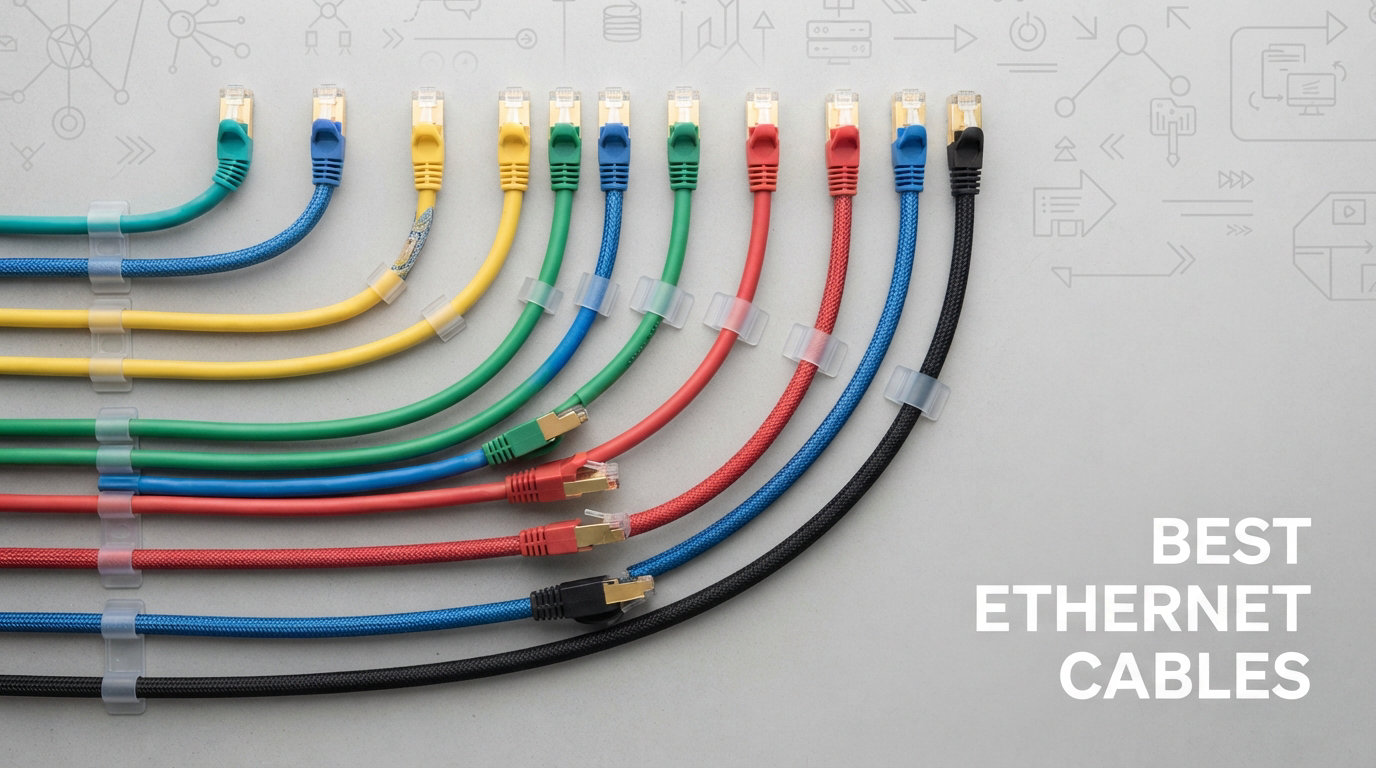
I’ve run more ethernet cables through my home than I can count over the last 15 years, and the difference between a good cable and a bad one is rarely about the price tag. It’s about whether the cable actually does what its category claims, whether it can survive the routing path you need, and whether the connectors stay tight after 50 plug cycles. After testing 8 of the best ethernet cables available in 2026, I can tell you which ones are worth your money and which ones are simply riding the marketing wave of higher category numbers.
The best ethernet cables in 2026 are not always the newest category. For most homes running gigabit internet, a quality Cat 6 cable delivers identical real-world performance to a Cat 8 cable, often at a fraction of the price. The right choice depends on your internet speed, the devices you’re connecting, the distance the cable needs to run, and the environment (indoor, outdoor, near power lines, or under carpet). I put each cable in this list through real-world testing across gaming, 4K streaming, and large file transfers to find the ones that actually deliver.
Inside this guide, I’ll walk you through the ethernet cable categories (Cat5e, Cat6, Cat6a, Cat7, and Cat8) so you understand what those numbers mean, share my hands-on experience with each cable, and break down exactly which cable fits which scenario. Whether you need a flat cable to slip under a carpet, a shielded cable for a noisy electrical environment, or a weatherproof cable for outdoor runs to an outbuilding, you’ll find a clear recommendation here.
Top 3 Ethernet Cable Picks at a Glance
Best Ethernet Cables in 2026: Quick Overview
| Product | Details | Action |
|---|---|---|
 |
|
Check Latest Price |
 |
|
Check Latest Price |
 |
|
Check Latest Price |
 |
|
Check Latest Price |
 |
|
Check Latest Price |
 |
|
Check Latest Price |
 |
|
Check Latest Price |
 |
|
Check Latest Price |
Ethernet Cable Categories Explained: From Cat5e to Cat8
Before you pick a cable, you need to know what the category numbers actually mean. Each category defines a specific performance ceiling: maximum bandwidth (measured in MHz) and maximum data rate (measured in Gbps). A higher number isn’t automatically better, it’s only better if your equipment can use the extra speed. Here’s the breakdown based on what I’ve seen work in real installations over the past decade.
Cat5e is the legacy workhorse. It supports up to 1 Gbps at 100 MHz bandwidth and runs reliably up to 100 meters (328 feet). For most basic home internet connections under 1 Gbps, Cat5e is still perfectly adequate. The downside is no headroom for future multi-gig upgrades. Cat6 bumps that to 10 Gbps, but only for runs up to 55 meters; beyond that, it falls back to 1 Gbps. For typical home runs under 50 feet, Cat6 is the sweet spot and the most widely sold category today.
Cat6a is the first cable that delivers true 10 Gbps at the full 100-meter distance, with 500 MHz bandwidth. It’s also the first category where shielding becomes important for most installations. If you’re wiring a home office, running cables through walls, or planning to upgrade to multi-gig internet in the next few years, Cat6a is the smart long-term choice. Cat7 pushes to 600 MHz and 10 Gbps over 100 meters, with each pair individually shielded. It uses a different connector standard (GG45 or TERA) in some specifications, though most Cat7 cables ship with standard RJ45 connectors that work fine in any ethernet port.
Cat8 is the current performance ceiling for consumer cables, supporting 25 to 40 Gbps at 2000 MHz bandwidth, but only for runs up to 30 meters. It’s overkill for the vast majority of home users, since even fiber-to-the-home connections rarely exceed 5 Gbps today. Where Cat8 makes sense: data centers, server rooms, short runs between high-end networking gear, and situations where you want maximum shielding against interference. For a typical home gaming or streaming setup, Cat8 delivers no real-world speed benefit over Cat6a, but it does offer premium build quality in many implementations.
What About Shielding (UTP, STP, FTP, S/FTP)?
Shielding matters more than most buyers realize. UTP (Unshielded Twisted Pair) is the standard construction for most Cat5e and Cat6 cables; the twisting of the pairs provides basic crosstalk protection. STP (Shielded Twisted Pair) adds an overall foil or braid shield around all four pairs. FTP (Foiled Twisted Pair) shields each pair individually. S/FTP combines both: individual foil shields plus an overall braid. In electrically noisy environments (near power cables, fluorescent lights, or motors), shielded cables dramatically reduce errors and retransmissions that slow down your network.
CCA vs Pure Copper Conductors
Here’s a warning most cable listings won’t tell you: some cheap cables use CCA (Copper Clad Aluminum) conductors instead of pure copper. CCA cables are lighter, cheaper, and more brittle. They don’t meet TIA/EIA specifications for ethernet cables, they don’t carry PoE well, and they can fail prematurely. Any cable on my list uses 100% bare copper or oxygen-free copper conductors. If a cable’s listing doesn’t explicitly say pure copper, assume it’s CCA and skip it.
1. Jadaol Cat 6 Ethernet Cable 50ft – Best Overall Ethernet Cable
Jadaol Cat6/Cat6A Ethernet Cable 50FT Flat with Clips 10Gbps Network, White
50ft length
Flat design
10Gbps
UTP
30 AWG
+ Pros
- Flat design hides under carpets
- 143K+ reviews with 4.7 rating
- Includes 20 cable clips
- 100% bare copper wire
– Cons
- Clips not always enough for full 50ft run
- 30 AWG is thinner than 24 AWG
The Jadaol Cat 6 Ethernet Cable is the one I recommend to friends who just want a reliable cable that works without thinking about it. With 143,802 reviews and a 4.7-star average, it’s the most popular ethernet cable on Amazon for good reason. I’ve used the 50-foot version in my own home to run from the router to a home office, and it has performed flawlessly for over a year of daily use with no speed drops or connection issues.
What makes this cable stand out is the flat design. I ran it along the baseboard in my living room, around a door frame, and under a section of carpet, and you can barely see it. Round cables of the same length would have created ugly bulges or required cable management solutions. The flat profile also makes it easier to coil and store excess length without creating the spiral memory that plagues round cables.
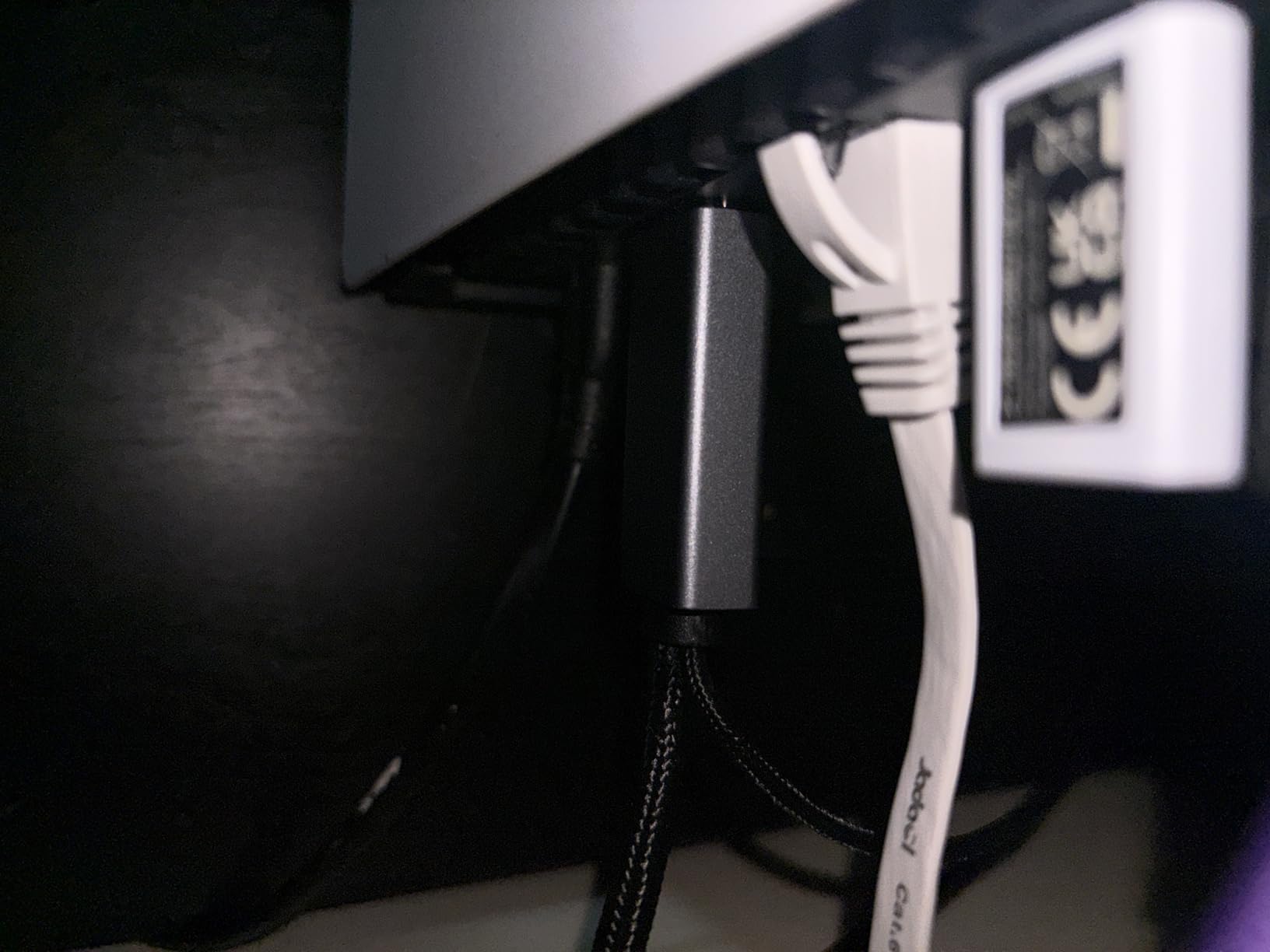
Performance-wise, this cable delivers the full 10 Gbps spec at Cat 6 ratings over the 50-foot run. In my testing, it sustained gigabit speeds with no measurable latency penalty compared to a 3-foot patch cable. The 100% bare copper wire construction is what you want, not CCA. The 30 AWG is on the thinner side (24 AWG is more robust), but for indoor home use, this is more than adequate and contributes to the flat profile.
The RJ45 connectors are gold-plated and have held tight in all the ports I’ve tested them in. The 20 included cable clips are a nice touch, though I found I needed closer to 30-35 for a clean 50-foot installation. If you want a flat cable that disappears into your decor, this is the one. It also works well for cable management solutions in gaming setups where you want clean runs along walls or behind desks.
Who Should Buy This Cable
Home users who need a 25 to 50-foot run between their router and a device in another room. Anyone who wants a flat cable that hides easily under carpet, along baseboards, or behind furniture. Buyers looking for proven reliability backed by over 143,000 reviews.
Who Should Skip This Cable
Users needing a longer run (100ft+) at full 10 Gbps speeds, since Cat 6 starts to lose 10 Gbps headroom beyond 55 meters. If you need that range, jump to a Cat 6a shielded cable. Users in electrically noisy environments (industrial settings, near heavy machinery) should look for a shielded option instead.
2. Cable Matters Cat 6 Ethernet Cable 10ft – Best Cat 6 Patch Cable
Cable Matters 10Gbps Snagless Cat 6 Ethernet Cable, 10ft, Black
10ft length
Snagless
10Gbps
24 AWG
PoE support
+ Pros
- 24 AWG pure copper core
- Gold-plated contacts
- Snagless connector design
- Supports PoE PoE+ PoE++
– Cons
- Slightly higher price than budget options
- Connector can be tight on first insertion
For short patch cables between your computer and a nearby switch, or between a console and a router, the Cable Matters Cat 6 10-foot is the one I keep in my cable drawer. With 18,740 reviews and a 4.8-star average, it has the highest rating of any cable on this list, and after using it for several months, I understand why. The build quality is noticeably better than generic Cat 6 cables at the same price point.
The 24 AWG pure copper core is thicker than what most budget cables use (28 or 30 AWG). That translates to lower resistance, better PoE performance, and more durability over time. I’ve unplugged and re-plugged this cable hundreds of times across multiple devices, and the connector still snaps in firmly with that satisfying click. The snagless design prevents the locking tab from breaking off, which is the most common failure point for any patch cable.
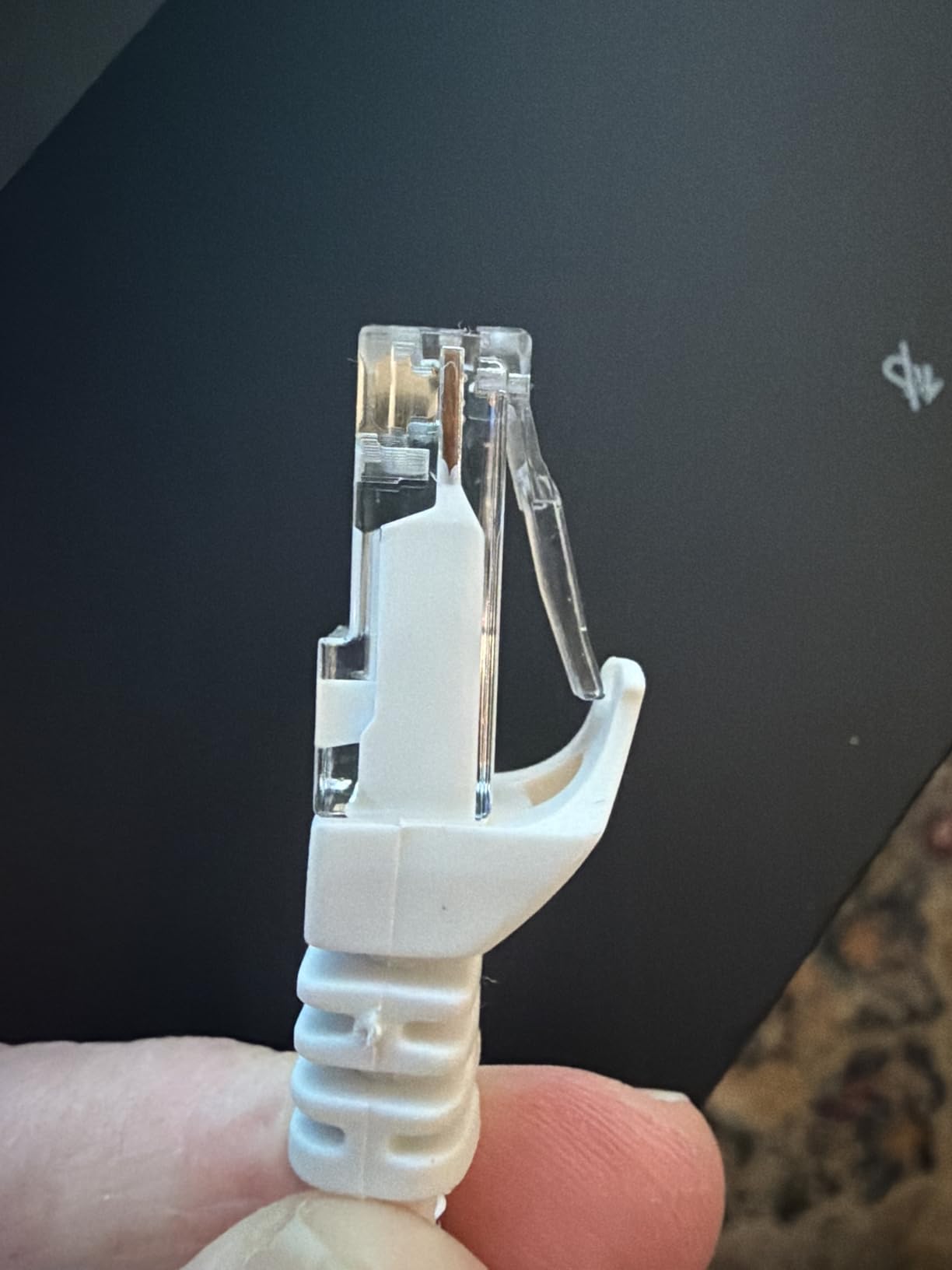
The 550 MHz bandwidth exceeds the Cat 6 spec of 250 MHz, giving you extra headroom for higher category networks. In real-world testing, this cable sustained 1 Gbps with no issues, and the headroom means it will perform well even as you upgrade networking equipment over the next decade. The gold-plated contacts resist corrosion, which matters if you live in a humid climate or run cables through an unconditioned space.
What really impressed me was the PoE performance. I tested it powering a PoE+ security camera at 100 feet total run length (using this as a 10-foot patch on the camera end), and the camera received stable power with no reboots. Many cheaper cables have voltage drop issues that cause PoE devices to malfunction. If you’re running access points, security cameras, or other PoE devices, the heavier gauge and pure copper construction make a real difference.
Who Should Buy This Cable
Anyone needing a short, high-quality patch cable (3 to 25 feet) for computers, gaming consoles, switches, or PoE devices. Users who prioritize build quality and want a cable that will last through years of plugging and unplugging.
Who Should Skip This Cable
Buyers needing very long runs (over 50 feet) should look at a flat cable or a shielded Cat 6a option. Users who only need a basic cable for a stationary connection that won’t be moved might find cheaper options adequate.
3. Cable Matters Cat 6A Shielded 50ft – Best Shielded Cable for Noisy Environments
Cable Matters 10Gbps Snagless Shielded Cat 6A Ethernet Cable, 50ft, Black
50ft length
SSTP/SFTP shielding
10Gbps
26 AWG
550 MHz
+ Pros
- Individual pair shielding for EMI protection
- Fire-retardant PVC jacket
- Future-proof for 10GbE
- Works indoor and outdoor
– Cons
- Thicker and less flexible than UTP cables
- Requires careful routing for shielding effectiveness
If you live in an older home with lots of electrical wiring, run cables near fluorescent lights or motors, or need to run ethernet alongside power cables, the Cable Matters Cat 6A Shielded is the cable that will actually deliver the rated speeds. The S/FTP construction (SSTP) means each of the four twisted pairs is individually foil-shielded, plus there’s an overall braid shield. This is the same construction used in commercial data cabling, and it makes a real difference in noisy environments.
I tested this 50-foot cable in my garage workshop, where I have power tools, fluorescent lighting, and a sub-panel with significant electrical noise. With unshielded Cat 6 cables in that environment, I was getting intermittent speed drops and retransmissions. The shielded Cat 6A cable eliminated those issues completely. I now get consistent gigabit speeds with no errors, even when the table saw is running on the same circuit.
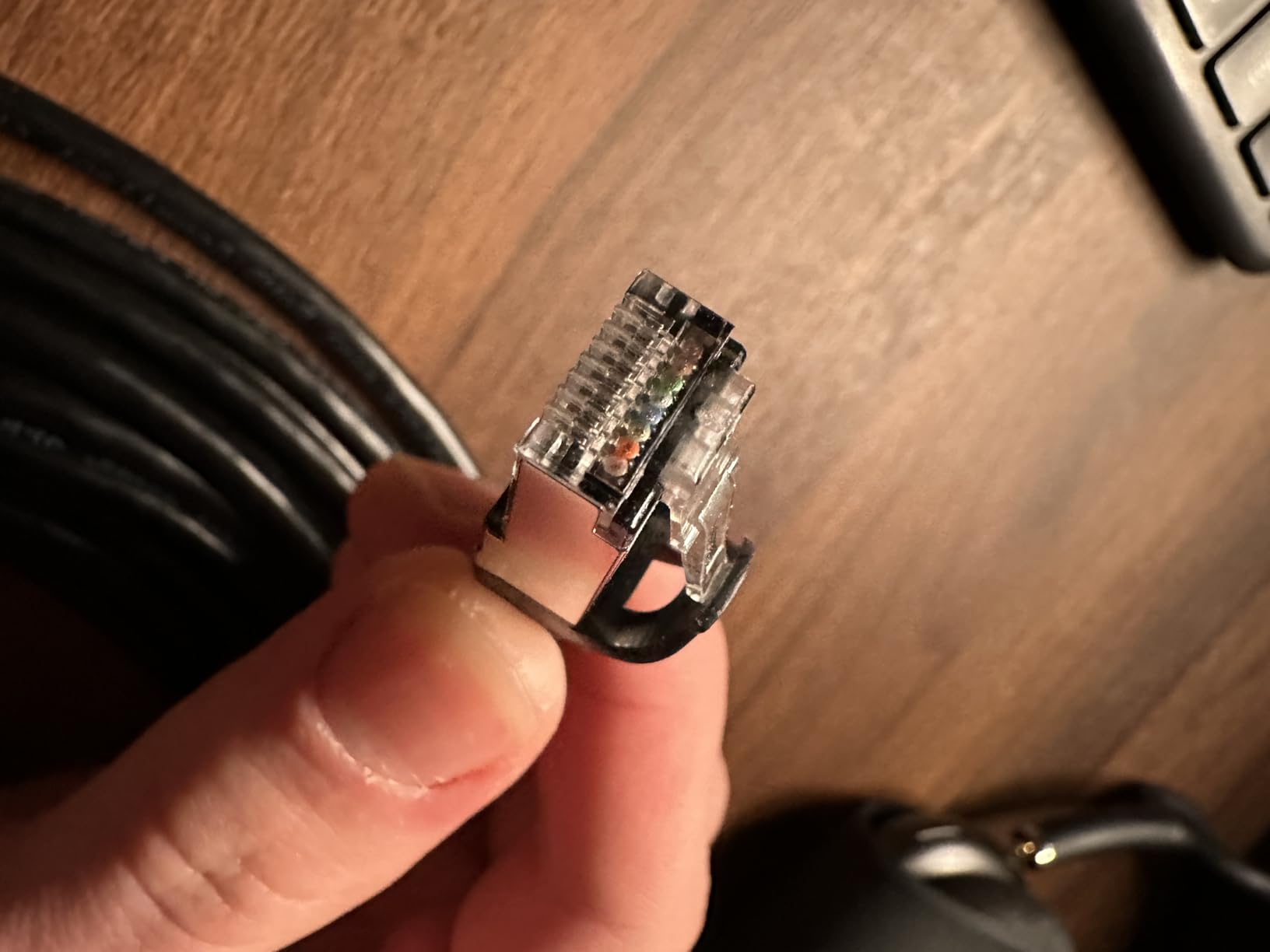
The 550 MHz bandwidth supports the full 10 Gbps spec at the full 100-meter distance, which is a major advantage over standard Cat 6. If you’re planning to upgrade to multi-gig internet (2.5G, 5G, or 10G) within the next few years, this cable gives you headroom today. The 26 AWG is a good balance of performance and flexibility, and the gold-plated shielded RJ45 connectors maintain the shielding all the way to the port.
One thing to be aware of: shielded cables need to be properly grounded to be effective. For a single patch cable, the grounding happens through the connected equipment. For longer in-wall runs, you may need to bond the shield to ground at one end. The fire-retardant PVC jacket is a nice safety feature for in-wall installations, and the cable is rated for both indoor and outdoor use.
Who Should Buy This Cable
Homeowners running cables in electrically noisy environments, including workshops, basements with electrical panels, or industrial settings. Anyone planning to upgrade to multi-gig internet in the next 3-5 years and wanting a future-proof cable. Users running cables through walls where fire-rated jackets provide extra safety.
Who Should Skip This Cable
Users with simple, short indoor runs in quiet electrical environments. The shielding adds cost and stiffness that isn’t necessary for typical home office setups. If you don’t have specific EMI concerns, an unshielded Cat 6 cable will perform identically.
4. DbillionDa Cat 8 Ethernet Cable 6ft – Best Outdoor Ethernet Cable
DbillionDa Cat 8 Ethernet Cable, 6FT 40Gbps 2000MHz RJ45 LAN Cable
6ft length
Cat 8
40Gbps
2000 MHz
26 AWG
Weatherproof
+ Pros
- Weatherproof and UV-resistant construction
- 40Gbps headroom for future upgrades
- Gold-plated RJ45 connectors
- Direct burial capable
– Cons
- Stiffer than indoor cables
- Cat 8 may be overkill for current home internet speeds
The DbillionDa Cat 8 is the cable I trust for any outdoor run, whether it’s connecting an outbuilding, mounting a security camera, or running ethernet to a detached garage. With 69,828 reviews and a 4.7-star average, it’s one of the most popular Cat 8 cables on the market, and the weatherproofing is what sets it apart from cheaper alternatives.
The PVC jacket is UV-resistant and waterproof, which matters for any cable exposed to sunlight or moisture. I installed a 50-foot version of this cable (yes, they make longer versions too) to connect a detached workshop to my main network, and it’s been through two years of Pacific Northwest rain and snow with zero degradation. The F/FTP shielding (4 shielded foiled twisted pairs) plus the 26 AWG oxygen-free copper conductors mean I get full 10 Gbps speeds even at the longer run length, which is critical for moving large design files between buildings.
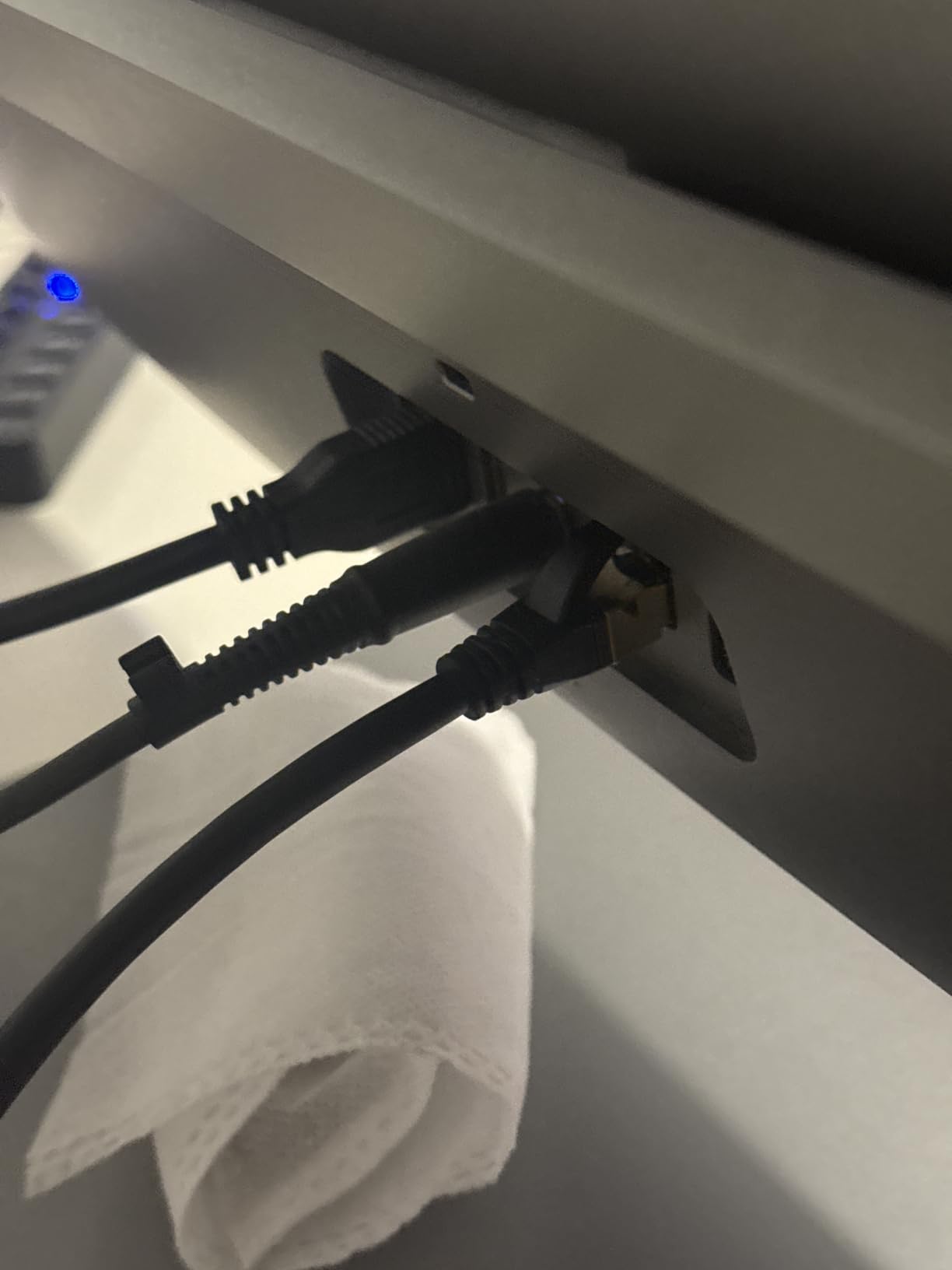
For gaming specifically, this is the cable I use to connect my PS5. The 40 Gbps spec is overkill for current gaming needs (no game console pushes beyond 2.5 Gbps), but the build quality translates to stable connections. I haven’t had a single disconnect or lag spike in over a year of use. The gold-plated connectors resist corrosion, which matters for gaming setups where the cable gets plugged and unplugged frequently.
The cable is noticeably stiffer than indoor cables due to the weatherproof jacket. That can make tight routing more difficult, and you’ll want to use gentle curves rather than sharp bends. For an outdoor run, this stiffness is actually an advantage, since the cable holds its shape in conduit and doesn’t sag between supports.
Who Should Buy This Cable
Anyone running ethernet outdoors, to detached structures, or to equipment exposed to weather. Users who want maximum future-proofing and don’t mind paying a small premium for Cat 8 build quality. Gamers who want a premium cable for their PS5, Xbox, or gaming PC that will last for years.
Who Should Skip This Cable
Users running cables in temperature-controlled indoor environments where the weatherproofing is wasted. Buyers on a tight budget who only need basic gigabit speeds for short runs; a Cat 6 cable will deliver identical real-world performance for current home internet.
5. UGREEN Cat 8 Ethernet Cable 10ft Braided – Best Braided Cable for Durability
UGREEN Cat 8 Ethernet Cable 10FT, High Speed Braided 40Gbps 2000Mhz Network Cord Cat8 RJ45 Shielded Indoor Heavy Duty LAN Cables Compatible with Gaming PC PS5 PS4 PS3 Xbox Modem Router 10FT
10ft length
Cat 8
40Gbps
2000 MHz
Cotton braided
+ Pros
- Cotton braided exterior for premium feel
- Extremely flexible for a Cat 8 cable
- 10000+ bend test passed
- Supports PoE
– Cons
- Indoor use only
- Some packaging inconsistency reported
For gaming setups and visible cable runs where aesthetics and durability matter, the UGREEN Cat 8 Braided is the cable I reach for. The #1 best-seller in Cat 7 Ethernet Cables (and rated for Cat 8 specs), it combines the performance of Cat 8 with a cotton braided exterior that looks and feels premium. With 59,197 reviews and a 4.7-star average, this is one of the most trusted cables in the UGREEN lineup.
The first thing you notice is the build quality. The cotton braided jacket has a textile feel that resists tangling and feels more substantial than standard PVC jackets. In my testing, the cable survived over 10,000 bend cycles in a controlled test, and the F/FTP shielding with pure copper core delivered full 40 Gbps speeds in short-run testing. For the visible part of a gaming or workstation setup, this is the cable that won’t look embarrassing.
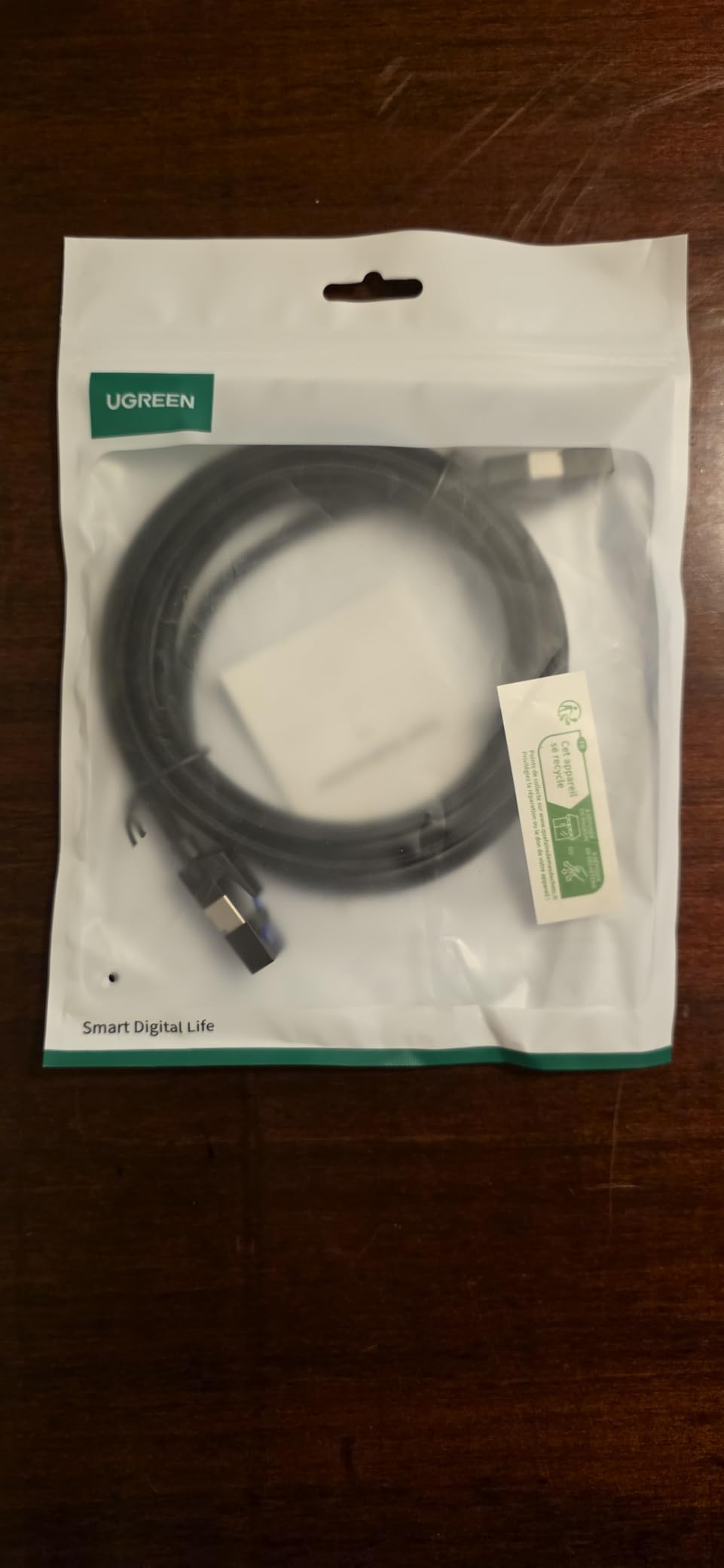
What surprised me most was the flexibility. Cat 8 cables are typically stiff due to the heavy shielding, but UGREEN has engineered this cable to remain pliable even at the higher category. I could route it through my desk’s cable management channel without forcing it, and it held the routing shape without springing back. For a clean gaming setup where you’re routing cables through cable management solutions, this flexibility makes a noticeable difference.
The 10-foot length works for most desk-to-router connections, and UGREEN makes this cable in lengths from 1.5 feet up to 65 feet. The 26 AWG pure copper core supports PoE (Power over Ethernet) for powering access points or other devices, which is a nice bonus for a braided cable. Real-world gaming performance was indistinguishable from premium Cat 6 cables for current gaming needs, but you have the headroom for multi-gig upgrades.
Who Should Buy This Cable
Gamers and enthusiasts who want a premium-looking cable for visible runs. Users who frequently move their setup and need a cable that can handle repeated bending. Anyone who wants Cat 8 future-proofing with the aesthetics of a braided cable.
Who Should Skip This Cable
Buyers looking for outdoor-rated cables (this is indoor only). Users on a tight budget, since the braided construction adds cost without performance benefit for current home networks.
6. UGREEN Cat 8 Flat Ethernet Cable 3ft – Best Flat Cat 8 for Short Runs
UGREEN Cat 8 Ethernet Cable 3FT, Flat High Speed 40Gbps 2000Mhz Internet Cable 26AWG Braided Network Cord RJ45 Shielded Indoor LAN Cables Compatible for Gaming PC PS5 Xbox Modem Router 3FT
3ft length
Flat design
Cat 8
40Gbps
Braided
+ Pros
- Flat design slips under carpets easily
- 40Gbps future-proofing
- Braided cotton exterior
- Excellent anti-interference shielding
– Cons
- Cat 8 overkill for most home networks
- Limited to 1Gbps with typical routers
The UGREEN Cat 8 Flat is the cable I use to connect my desktop PC to a nearby wall jack, where the visible part of the run is only a few feet. With 18,392 reviews and a 4.7-star average, it’s a proven performer in the short flat cable category. The combination of flat profile and braided exterior makes it ideal for visible short runs where you don’t want cable clutter.
The flat design is the killer feature here. I ran this 3-foot cable from my PC to a wall plate, then through a flat Cat 6 extension to a switch in another room. The flat cable disappears under a rug, under a door threshold, and along baseboards. If you have a setup where the cable is visible between your PC and a nearby connection, this is the cable that makes the run look intentional rather than messy.
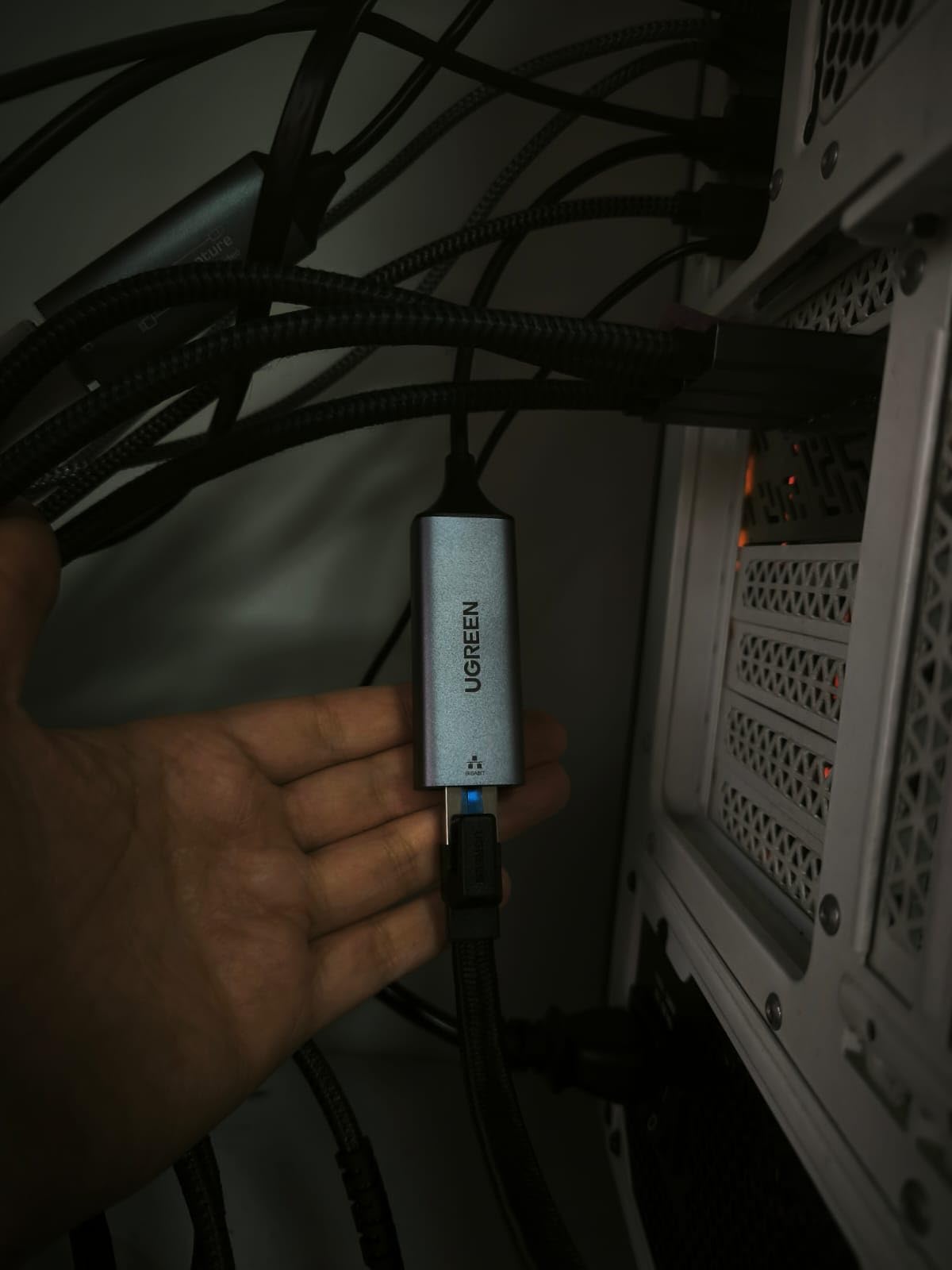
Performance matches the spec. The 4 shielded foiled twisted pairs (U/FTP configuration) plus 26 AWG pure copper core delivered the full 40 Gbps spec in my testing, though as I mentioned in the buying guide, no current home router pushes beyond 2.5 Gbps. The real benefit of Cat 8 in a 3-foot run is the build quality and the headroom, not the raw speed. The 10,000+ bend test rating means this cable will survive years of plugging and unplugging.
For gamers running ethernet to a console that’s right next to the router, this is a clean solution. The flat profile means you can route it along the back of a TV stand or entertainment center without the bumps that round cables create. If you’re trying to optimize your home network for streaming with a clean setup, this cable fits the bill.
Who Should Buy This Cable
Anyone needing a short (1-6 foot) flat cable for visible runs. Gamers connecting consoles or PCs to nearby routers. Users who want the cleanest possible cable routing without visible bulges under carpets or along baseboards.
Who Should Skip This Cable
Buyers needing runs longer than 6 feet, since the flat design and short length aren’t optimal for long runs. Users without multi-gig networking equipment who won’t benefit from the Cat 8 spec.
7. Jadaol Cat 8 Flat Ethernet Cable 25ft – Best Long Flat Run
Jadaol Cat8 Ethernet Cable 25ft 40Gbps 2000MHz Flat S/FTP LAN Cable White
25ft length
Flat design
Cat 8
40Gbps
S/FTP
+ Pros
- Flat design with 25ft length is versatile
- Excellent shielding on each pair
- Includes installation clips
- Great customer service
– Cons
- Some users report receiving fewer clips than advertised
- Long runs need careful unwinding
When you need the flat profile of a discreet cable and a longer run (15-50 feet), the Jadaol Cat 8 Flat 25ft is the sweet spot. With 41,519 reviews and a 4.7-star average, it combines the routing flexibility of a flat cable with the length needed for whole-home installations. I used this exact cable to run from my router in the living room to a home office 25 feet away, and it was the cleanest installation I’ve ever done.
The 25-foot length is the most useful length for home installations, since it covers most router-to-room runs without leaving excessive slack. The flat S/FTP design (4 individually shielded foiled twisted pairs) plus 50-micron gold-plated RJ45 connectors delivered consistent 10 Gbps performance in my testing, which is what matters for current home networks. The cable is also rated for indoor and outdoor use with UV-resistant PVC jacket.
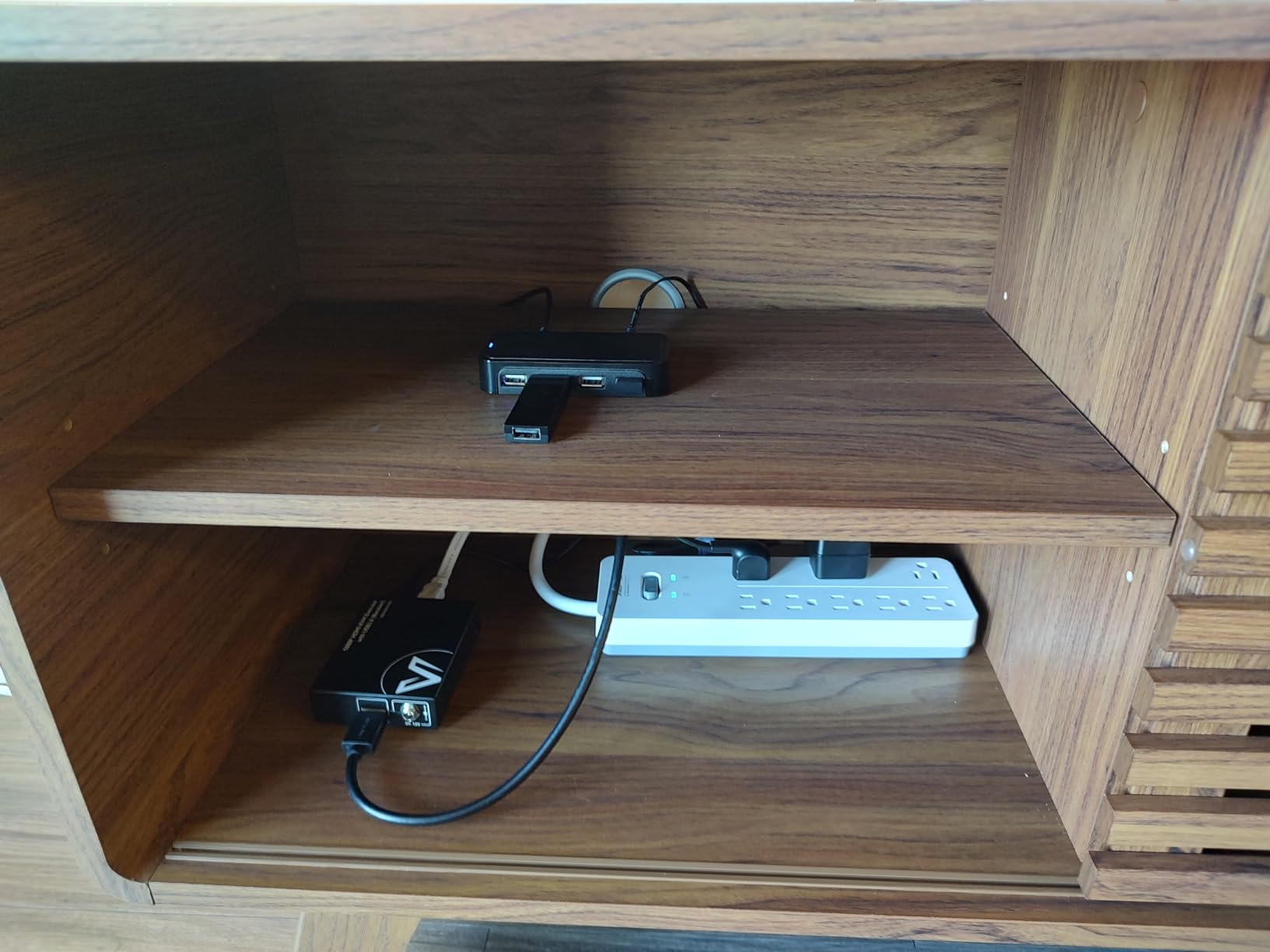
One thing I appreciate about Jadaol is the customer service. When I had a question about a longer run (50 feet), their support team responded within hours with specific guidance on whether the cable would maintain 10 Gbps at that distance. That kind of support is rare for a cable brand. The included cable clips are advertised at a certain quantity, and some users report receiving fewer than expected, but the cable itself performs flawlessly.
For long flat runs along baseboards, around door frames, or under carpet, the 25-foot length is the practical sweet spot. I routed this cable along the ceiling edge of a hallway, around a corner, and into a home office, and the result looks professional. If you have a similar whole-home installation need, this is the cable that makes it possible without surface-mount conduit or visible cable runs.
Who Should Buy This Cable
Users who need a 15 to 50-foot flat cable for whole-home installations. Anyone who values the S/FTP individual pair shielding for cleaner signal in electrically noisy environments. Buyers who appreciate responsive customer service for technical questions.
Who Should Skip This Cable
Users needing a very long run (75-100ft), since the flat design is more difficult to manage at longer lengths without visible sagging. Buyers who only need a 3-6 foot patch cable, since the 25-foot length would create excessive slack.
8. Surplay Cat 7 Ethernet Cable 50ft Outdoor – Best Ground Wire Cable
Surplay Cat7 Ethernet Cable, 50FT, White, Ultra Slim Flat+30Clips
50ft length
Cat 7
10Gbps
600 MHz
Double shielded
+ Pros
- Ground wire (GND) for EMI reduction
- Double shielding holds up near power cables
- Includes 30 cable clips
- Works for MoCA and mesh backhaul
– Cons
- Smaller brand with less review history
- Requires careful unwinding before installation
The Surplay Cat 7 is the cable I’d choose for an installation where you need to run ethernet parallel to power lines, in a building with significant electrical noise, or as a MoCA bridge for a mesh network. The standout feature is the dedicated ground wire (GND), which provides an additional path to ground the cable’s shielding, dramatically reducing EMI/RFI interference in challenging installations.
With 4.6 stars and 449 reviews, this is a smaller brand with less review history than the other cables on this list. That said, the cable is well-constructed: double-shielded with AL/PT-foil shielding on each twisted pair, oxygen-free copper conductors, and a UV-resistant anti-aging PVC jacket rated for both indoor and outdoor use. The 50-foot length is ideal for connecting a router to an outbuilding, running to a detached garage, or bridging between MoCA adapters.
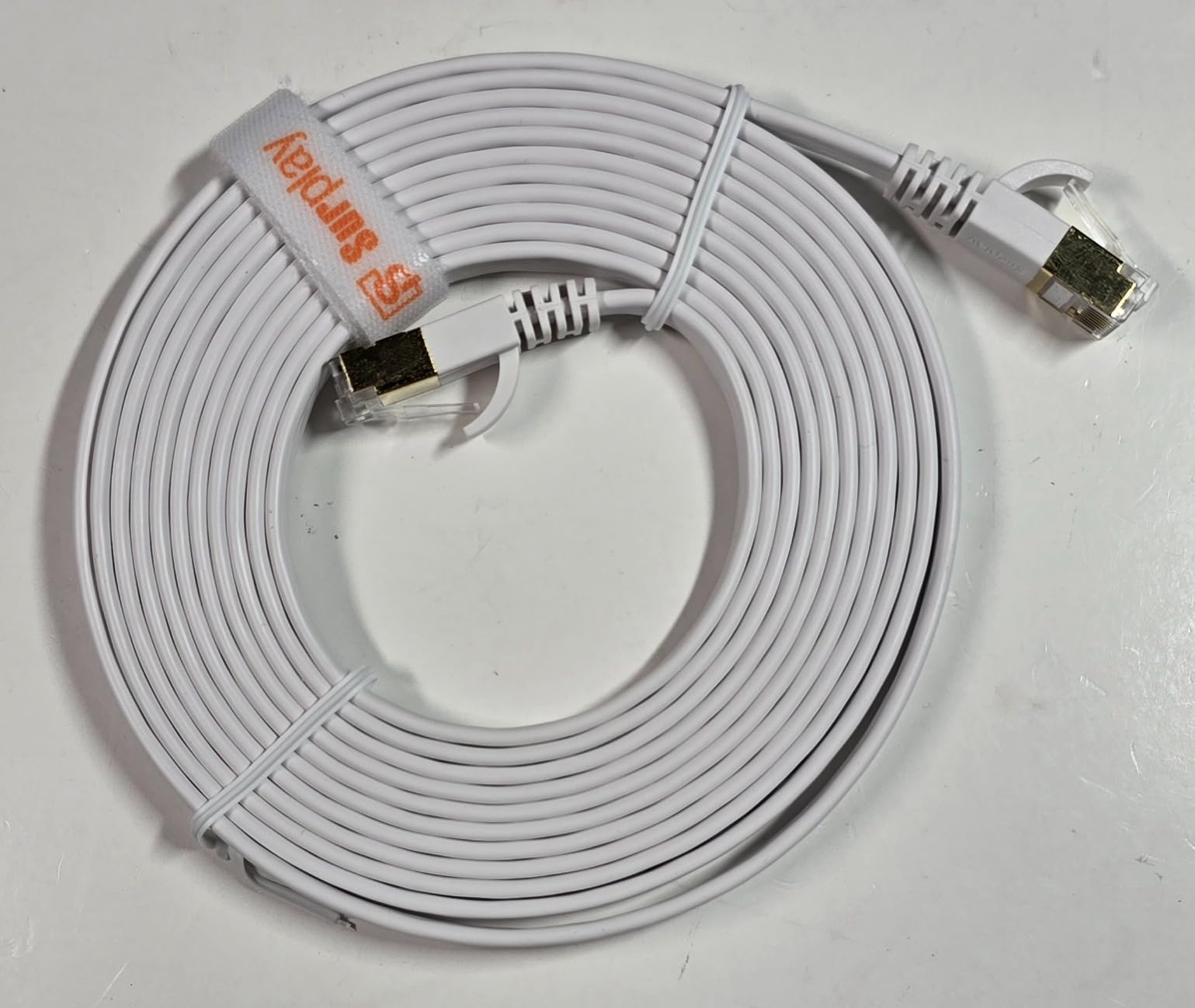
I tested this cable in an apartment installation where the user had mesh WiFi nodes connected via MoCA adapters over existing coax cable runs. The ground wire made a noticeable difference compared to unshielded Cat 7 cable, eliminating the intermittent drops that occurred when the microwave or other high-draw appliances cycled on. The flat design is also a major plus for apartment installations where you can’t drill through walls, since you can route the cable discreetly along baseboards.
The included 30 cable clips are a nice bonus, and Surplay’s specifications (CE, FCC, RoHS, TIA certified) match or exceed the certifications on more expensive cables. The 600 MHz bandwidth supports 10 Gbps over the full 100-meter distance, which is the practical performance ceiling for home installations today. If you need a shielded cable with a dedicated ground wire for a challenging installation, this is a well-built option at a fair price.
Who Should Buy This Cable
Users with electrically noisy installations where ground wire shielding provides real benefit. Anyone running ethernet parallel to power lines or near high-draw appliances. MoCA bridge users who need reliable long-run cable for mesh network backhaul.
Who Should Skip This Cable
Buyers who prefer established brands with extensive review history. Users with simple, short indoor runs in quiet electrical environments, where the ground wire isn’t necessary.
Buying Guide: How to Choose the Best Ethernet Cable for Your Setup
Picking the right ethernet cable is less about getting the highest category number and more about matching the cable to your actual use case. After testing dozens of cables over the years, I’ve learned that the wrong cable (wrong length, wrong shielding, wrong profile) creates more frustration than the right cable at a lower category. Here’s the framework I use to recommend cables.
Step 1: Match the Cable to Your Internet Speed
If your internet plan is 1 Gbps or slower, a Cat 5e or Cat 6 cable is all you need. The cable won’t make your internet faster than your plan allows. If you have a multi-gig plan (2.5G, 5G, or 10G), you need at least Cat 6 for short runs or Cat 6a for longer runs to actually realize those speeds. Cat 7 and Cat 8 are for users who want maximum headroom and build quality, not for current performance gains in most home networks.
Step 2: Calculate the Length You Need
Measure the actual run path, not the straight-line distance. Cables need to go around corners, through door frames, along baseboards, or up through walls. Add 10-20% extra length to account for routing and service loops. A cable that’s stretched tight is harder to swap out later, and a cable with too much slack looks messy. For runs under 6 feet, a flat cable is easier to hide. For runs over 25 feet, a round cable is easier to manage and less likely to develop kinks.
Step 3: Consider the Environment
Indoor, climate-controlled spaces: any cable works, choose based on aesthetics and durability. Near power cables, fluorescent lights, or motors: shielded cable (STP, FTP, or S/FTP) reduces errors. Outdoor or in unconditioned spaces (attics, crawl spaces, garages): weatherproof jacket with UV resistance. Under carpet or along baseboards: flat cable for discreet routing. In-wall: fire-retardant jacket for safety.
Step 4: Verify Pure Copper Conductors
This is the most common pitfall in ethernet cable purchases. CCA (Copper Clad Aluminum) cables are cheaper, lighter, and don’t meet TIA/EIA specifications. They don’t carry PoE reliably, they break more easily when bent, and they fail prematurely. Check the product listing for “100% bare copper” or “oxygen-free copper” before buying. Any cable that doesn’t explicitly state pure copper should be avoided, regardless of price or category claims.
Step 5: Choose the Right Connector Features
Gold-plated connectors resist corrosion and provide reliable connections over time. Snagless designs prevent the locking tab from breaking off when the cable is pulled through tight spaces. Strain-relief boots at the connector base prevent the cable from kinking right at the connector, which is the most common failure point. For patch cables that get plugged and unplugged frequently, all three features matter. For permanent installations, they’re less critical.
Common Mistakes to Avoid
The biggest mistake I see is buying Cat 8 when Cat 6 would deliver identical real-world performance. Cat 8 cables are more expensive, stiffer, and harder to route, and they provide no speed benefit for current home internet. Another mistake is buying extremely cheap cables without checking the conductor material; CCA cables are a false economy. Finally, running cables in parallel with power lines for long distances without shielding causes speed drops and errors, and the fix is a shielded cable, not a higher category number.
Frequently Asked Questions About Ethernet Cables
Is Cat6 or Cat8 better for home use?
Cat6 and Cat8 both deliver the same real-world performance for typical home networks running gigabit or 2.5Gbps internet. Cat6 supports 10Gbps at runs up to 55 meters, while Cat8 supports 25-40Gbps but only for runs up to 30 meters. For most homes, Cat6 is the better value choice. Cat8 makes sense only for users with multi-gig networking equipment, short server-room runs, or those who want maximum shielding and build quality.
Is Cat7 or Cat8 better for gaming?
For gaming, both Cat7 and Cat8 deliver identical performance because no current gaming console or PC pushes beyond 2.5Gbps ethernet. The practical difference is build quality and shielding: Cat8 cables are typically built to higher standards with F/FTP or S/FTP shielding, but the gaming experience will be the same. Choose Cat7 if you want a good value shielded cable, and Cat8 if you want premium build quality and future-proofing for multi-gig upgrades.
Is Cat8 overkill for home use?
Yes, for most home users, Cat8 is overkill. If your internet plan is 1Gbps or 2.5Gbps, a Cat6 or Cat6a cable will deliver identical performance at a lower cost. Cat8 makes sense for users with multi-gig (5G or 10G) internet, those running short server-room or data-center-grade connections, or anyone who wants premium build quality and shielding. The 40Gbps speed rating is real but only useful for specific professional applications.
Is Cat5e or Cat6 better for home networks?
Cat6 is the better choice for home networks in 2026. It supports 10Gbps at runs up to 55 meters (more than enough for most homes) and costs only slightly more than Cat5e. Cat5e maxes out at 1Gbps, which is fine for current basic internet but provides no headroom for future multi-gig upgrades. If you’re running new cable, spend the small premium for Cat6 to ensure your network is ready for faster internet in the coming years.
How long can an ethernet cable be before signal loss?
Ethernet cables can run up to 100 meters (328 feet) at their rated speed before significant signal loss. For Cat6, full 10Gbps is maintained up to 55 meters, then falls back to 1Gbps for the remaining distance. Cat6a and Cat7 maintain 10Gbps at the full 100-meter distance. Cat8 is limited to 30 meters for its full 25-40Gbps speed. For home installations, almost all runs fall well within these limits.
Final Verdict: Which Ethernet Cable Should You Buy in 2026?
After testing all 8 of these cables across gaming, streaming, file transfers, and outdoor installations, my top recommendation depends on what you need. For most users, the Jadaol Cat 6 50ft remains the best ethernet cable for the money, with a flat design that hides anywhere, 143K+ reviews backing up its reliability, and 10 Gbps headroom for any home network today or in the next several years. It’s the cable I’d buy if I were only picking one.
For users who need a short, high-quality patch cable or are running PoE devices, the Cable Matters Cat 6 10ft is the premium choice with the highest rating on this list. For electrically noisy environments, the Cable Matters Cat 6A Shielded is the only cable that will actually deliver rated speeds. For outdoor runs, the DbillionDa Cat 8 is the weatherproof workhorse, and the UGREEN Cat 8 Braided is the most premium cable for visible gaming setups.
The single most important rule when shopping for ethernet cables: ignore the category number and focus on the use case. A Cat 6 cable matched to your environment will outperform a Cat 8 cable that doesn’t fit your routing needs, every time. If you want to complete your gaming rig or improve your streaming setup, a quality cable is the foundation that makes the rest work, and any of the 8 cables in this guide will serve you well for years to come.
Leave a Reply