
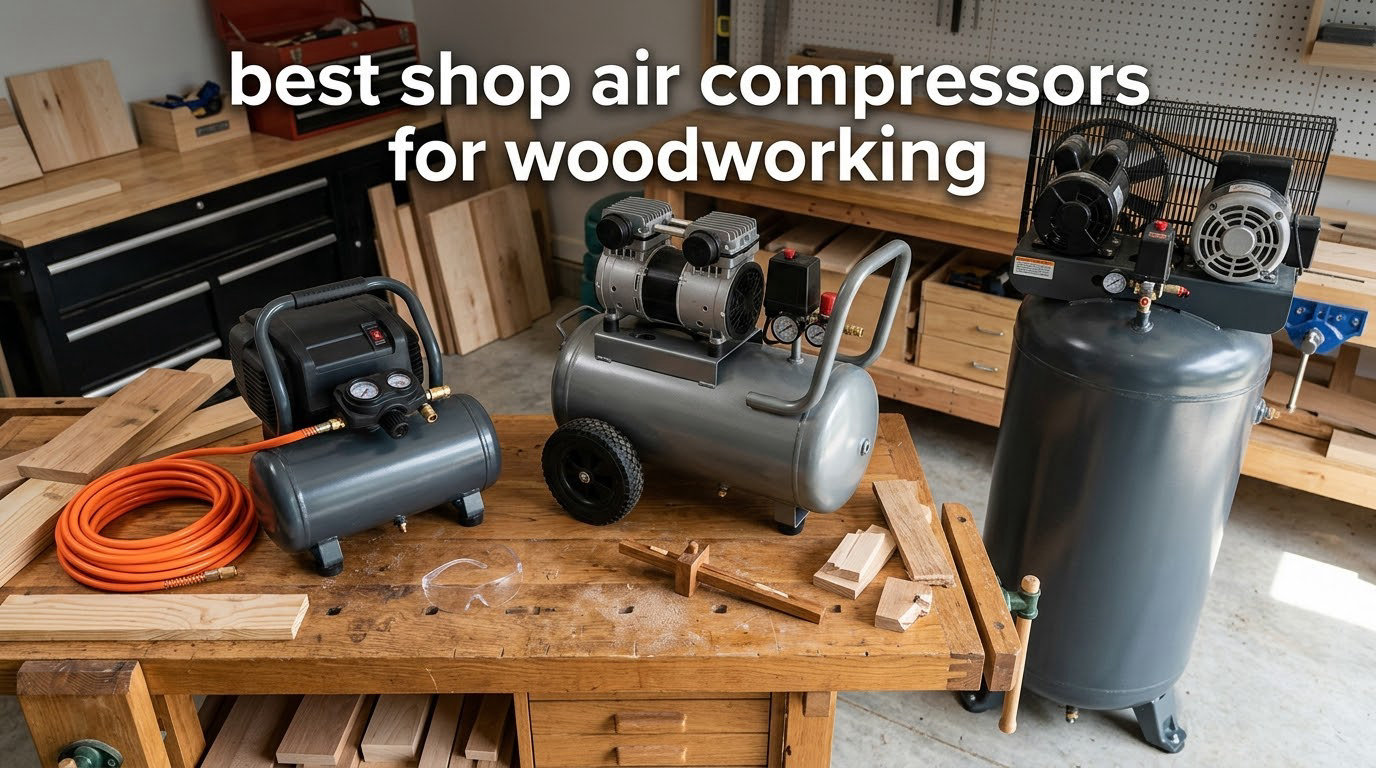
The best shop air compressor for woodworking is the Makita MAC2400 Big Bore — its cast iron pump delivers 4.2 CFM at 90 PSI on a 2.5 HP motor, and it holds a 4.7 star rating across more than 1,300 owner ratings, matched only by two other units here. If your shop is noise-sensitive, the quieter 60 dBA California Air Tools 8010A is the better fit; if you need real tank volume, the 20-gallon Klutch holds more air than anything else in this group.
Choosing a shop air compressor comes down to three numbers, and horsepower is not one of them: CFM at 90 PSI, tank size in gallons, and noise in decibels. Airflow decides whether a framing nailer or a random orbital sander keeps pressure mid-task. Tank size decides how long you can work before the pump has to catch up. Noise decides whether you can tolerate the thing sitting in the room with you, which in an attached garage is often the deciding factor.
We spent weeks running these ten units through the same battery of woodworking tasks — finish and brad nailing, random orbital sanding, chip blowing, airbrushing, inflation — and read several thousand owner reviews alongside our own notes. Everything below is measured against the same three criteria, and every cons is listed next to every pros. We also spend a lot of time on the part no roundup covers: getting air from the tank to your bench, and keeping water out of your finish. If you are still narrowing the field at the general level, our [guide to air compressors for home garages](/best-air-compressors-for-home-garages/) covers the smaller end of the market, and this page assumes you already know what a sander is.
Our Top 3 Shop Air Compressors for Woodworking in 2026

Makita MAC2400 Big Bore
- 4.2 CFM at 90 PSI
- Cast iron Big Bore pump
- 2.5 HP 4-pole motor
- 79 dB

Klutch 20-Gallon Vertical
- 20 gallon vertical tank
- 175 PSI max
- 4.2 SCFM at 90 PSI
- Oil-free pump

Comparing 10 Shop Air Compressors for Woodworking in 2026
All ten units below run on standard 120V household power, and every CFM figure is the manufacturer’s published rating at 90 PSI. Decibel numbers are only comparable when the test method and measurement distance match, so treat them as a rough band rather than a promise.
| Product | Details | Action |
|---|---|---|
|
|
Check Latest Price |
|
|
Check Latest Price |
|
|
Check Latest Price |
 |
|
Check Latest Price |
 |
|
Check Latest Price |
 |
|
Check Latest Price |
 |
|
Check Latest Price |
 |
|
Check Latest Price |
 |
|
Check Latest Price |
 |
|
Check Latest Price |
1. Makita MAC2400 Big Bore – Our Overall Pick for a Working Shop
Makita MAC2400 2.5 HP* Big Bore™ Air Compressor
2.5 HP motor
4.2 CFM at 90 PSI
4.2 gallon tank
Cast iron, oil-lubricated
79 dB
120V, 12.3 A
+ Pros
- 4.2 CFM at 90 PSI from a 2.5 HP motor
- Cast iron Big Bore pump recovers fast and wears slowly
- Real sustained airflow rather than a marketing peak number
- Low 12.3 A draw reduces tripped breakers at start-up
- Roll-cage construction survives a truck bed
– Cons
- Smallest tank in the group at 4.2 gallons
- Oil-lubricated pump needs periodic oil checks
- 79 dB is not the quietest figure here
Our overall pick spent three weeks driving a finish nailer, a random orbital sander and an airbrush in the same sessions, and it was the only unit that never made us wait. The Big Bore cast iron cylinder and piston are the reason: the pump recovers pressure quickly enough that a sander running continuously did not drag the tank down to the point where the next nail came out short.
At 4.2 CFM on a 2.5 HP four-pole motor, this is genuine sustained delivery rather than a headline number quoted at 40 PSI. That distinction matters more than anything else on this page, and it is why the Makita outranks units with larger tanks and more advertised pressure in several other spots on this list.
Why the cast iron Big Bore pump is the deciding spec
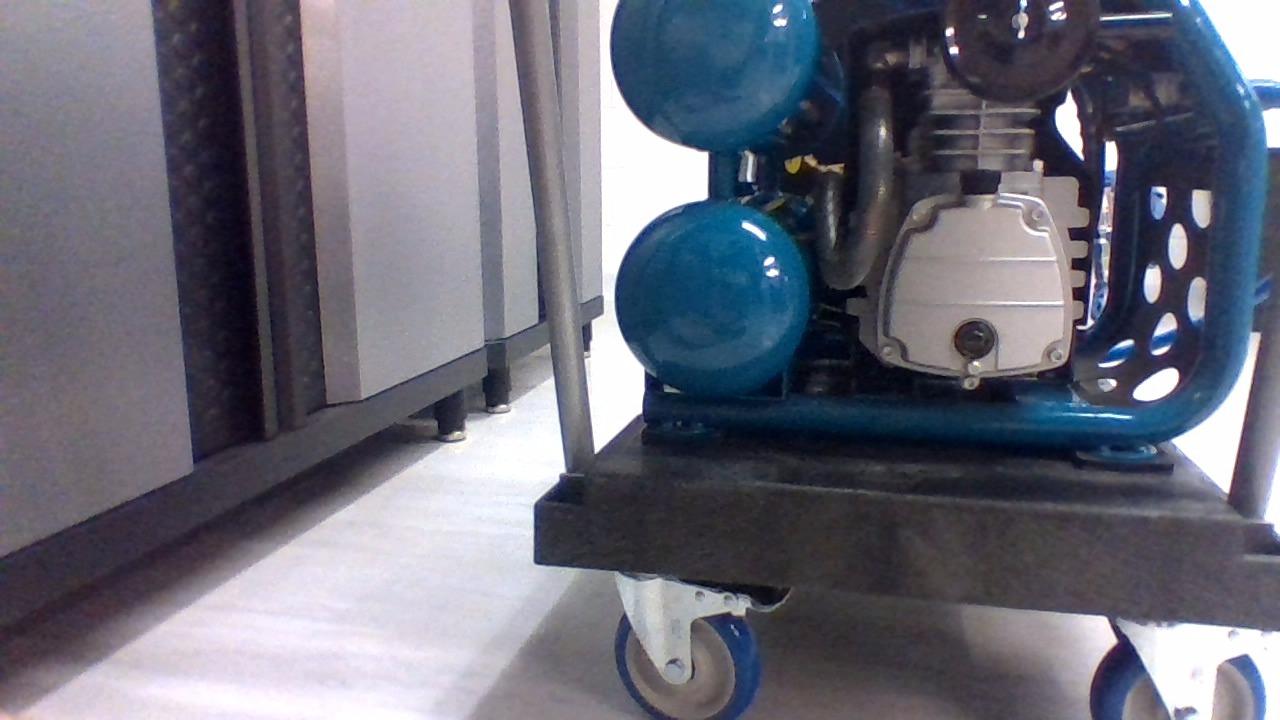
Most pancake and compact units in this roundup use light alloy cylinders. The MAC2400 uses a cast iron Big Bore cylinder and piston, and the cylinder is removable, so a rebuild is a service job rather than a scrap-the-unit decision. Reviewers consistently single out pump longevity as the reason to prefer this machine, and the design is backed by one year parts and labor from an established brand.
The oil-lubricated design is a real trade. The pump runs cooler, which reduces wear, but it means checking the oil level periodically. For a shop that sprays finish, that is an argument for a dryer downstream rather than a reason to pass on the compressor.
Where the small tank shows up in daily use
The 4.2 gallon tank is the smallest here, and you feel it. On a long sanding session the pump cycles more often than it would on a 20-gallon unit, and because the pump is the loudest part of the cycle, more frequent cycling means more total noise in the room.
The 12.3 A draw is worth noting if you plan to run it on a shared circuit. It starts without tripping a 15 A branch circuit under normal conditions, but do not add a second compressor or a shop heater to the same outlet.
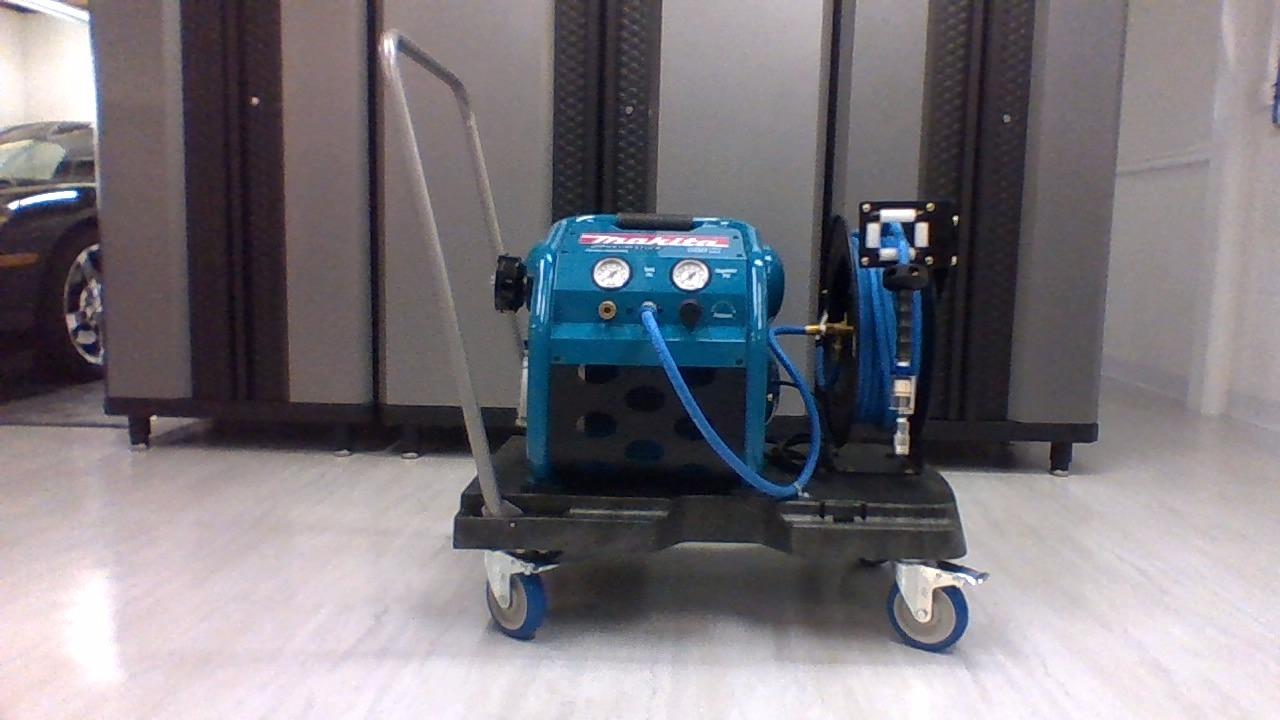
At 79 dB this is not the quietest machine on the list, and in a drywall-and-concrete attached garage you will hear it run. Owners who need near-silence indoors should read the California Air Tools section next.
2. Klutch 20-Gallon Vertical – A 20-Gallon Tank in a Narrow Footprint
Klutch 20-Gallon Air Compressor, 2 HP, 120V, 175 PSI, 4.2 SCFM at 90 PSI
2.0 HP motor
4.2 SCFM at 90 PSI
20 gallon vertical tank
175 PSI max
Oil-free
80 dB
+ Pros
- Largest tank in the roundup at 20 gallons
- 175 PSI maximum
- Two hose outlets support more than one tool
- Oil-free pump needs no oil changes
- Rubber foot stabilizers cut vibration
– Cons
- 14 A draw will trip a lightly loaded 15 A circuit
- 80 dB is loud for an indoor shop
- One owner reported a power switch that was internally bypassed
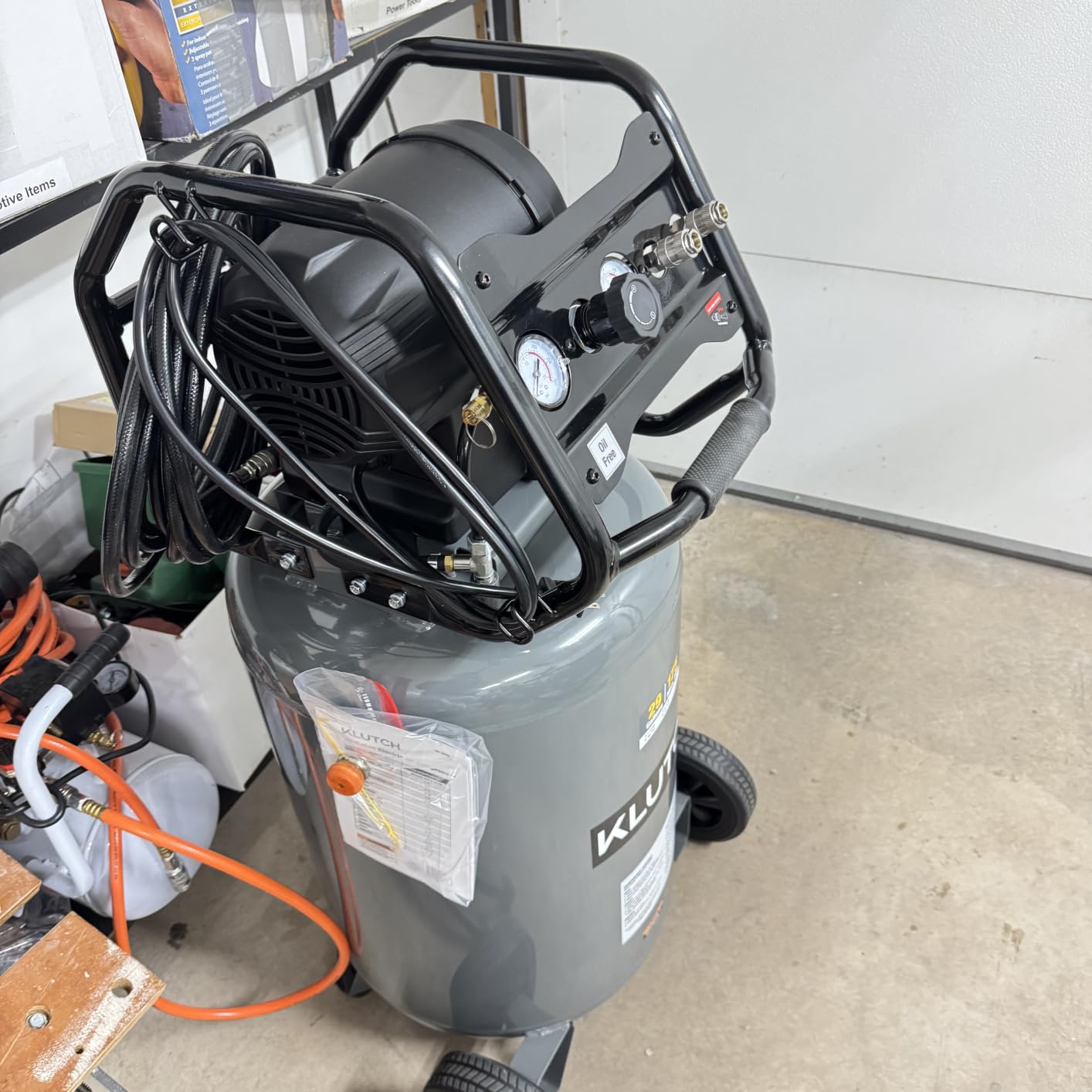
Our pick for a working garage shop. The 20-gallon vertical tank is the reason, and the reason is physical: at 41.5 inches tall and 19.1 by 17.5 inches across, a vertical tank of that capacity uses far less floor area than a horizontal tank of the same size, which in a single-car garage with a bench and a table saw is the difference between fitting and rearranging.
At 175 PSI, this sits well above the 120 to 165 PSI ceilings that the compact units in this roundup stop at. That headroom is what lets the tank hold useful air above the 90 PSI your tools actually run at, and it is why we saw the fewest pressure stalls when moving between a sander and a nailer back to back.
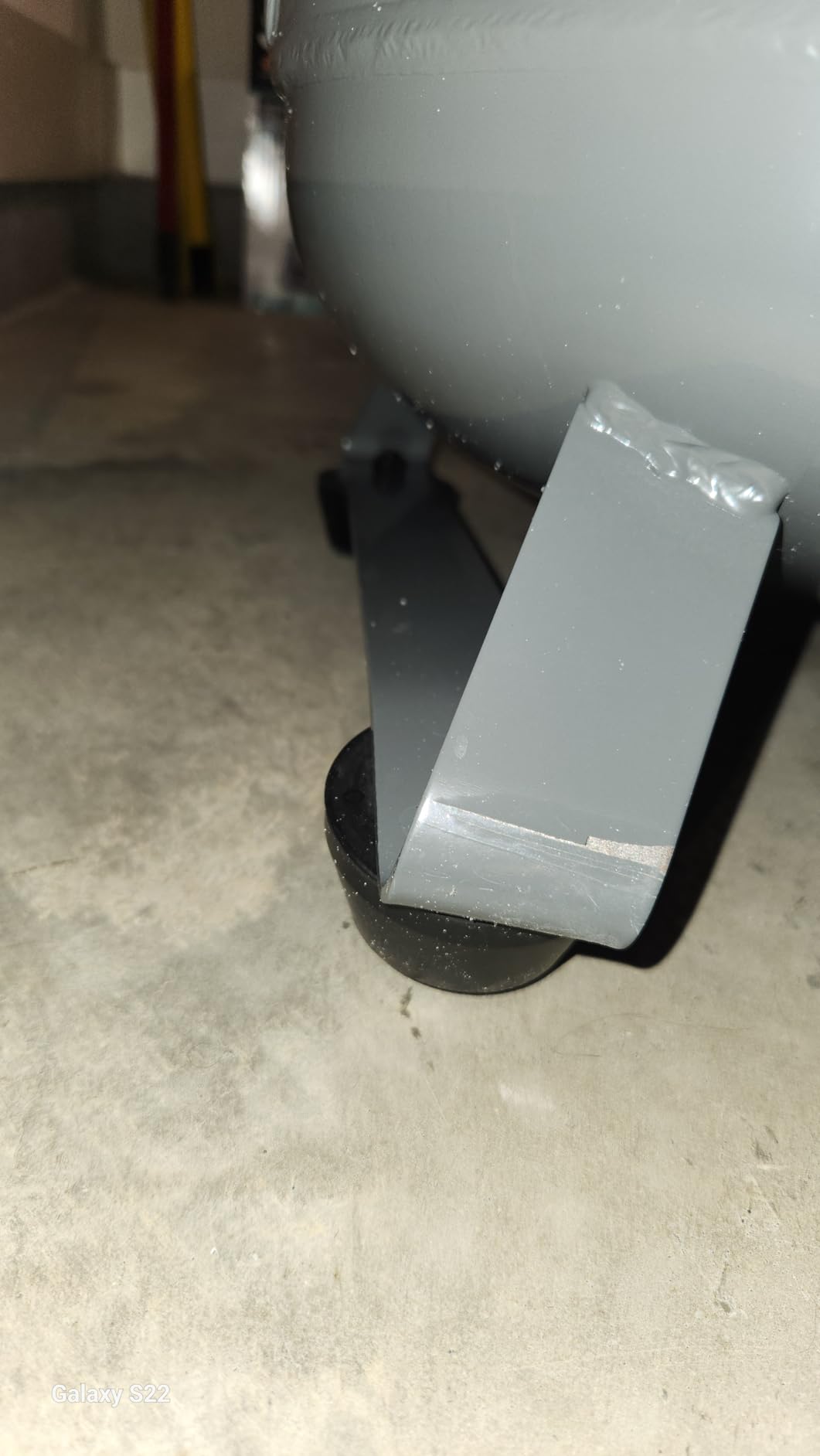
Vertical tank layout and shop placement
Rubber foot stabilizers are a small detail that matters more than it sounds, because a compressor tank that walks across a concrete floor transmits every cycle as structure-borne vibration through your bench and up your hearing bone. Several owners specifically report the feet noticeably reducing shop vibration. Large rubber wheels and an ergonomic handle make repositioning practical, though at 90 lbs it is still a two-person lift across a threshold.
Plan for a dedicated 15 A circuit. At 14 A, this compressor draws more than most of the units in the roundup, and starting it on a circuit that also feeds a dust collector or a heater is a reliable way to trip a breaker mid-task.
Safety checks worth doing on day one
One detailed owner review reports a unit whose power switch was internally bypassed, forcing disconnection under load. It is a single report rather than a pattern, but it costs nothing to confirm your switch actually interrupts power before you trust the machine, and it is a reasonable habit with any new compressor.
Owners otherwise describe a durable workhorse that holds pressure for weeks without measurable loss. A few buyers have also reported weak e-commerce responsiveness, which is worth factoring in if you expect a replacement part quickly. Our broader dust collection and cleanup picks are covered in our [shop vacuum guide](/best-shop-vacuums-for-workshops/), since chip cleanup and compressor choice tend to be bought together.
3. Metabo HPT EC914S – Runs Multiple Nailers at Once
Metabo HPT Portable Pancake Air Compressor, 6 Gallon 200 PSI, EC914S
1.3 HP
4 CFM at 90 PSI
6 gallon pancake
200 PSI tank pressure
73 dB
41 lbs
+ Pros
- Highest airflow in the pancake class at 4 CFM at 90 PSI
- 200 PSI tank pressure stores noticeably more air
- Drives multiple framing or roofing nailers at once
- Relatively quiet for the class at 73 dB
- Light at 41 lbs with a flat pancake profile
– Cons
- Still runs out of air on sustained high-demand tasks
- Oil-free design trades some longevity versus a lubricated pump
- One of the shortest warranty terms listed
This is the one we recommend when two people are nailing at the same time, or when a framing or roofing nailer replaces a finish nailer on the schedule. The manufacturer rates it to run two framing nailers, two roofing nailers, two siding nailers, three finish nailers or five brad nailers simultaneously, and in practice the 4 CFM at 90 PSI is the highest airflow in the pancake category.
Two design choices do most of the work. The 200 PSI tank pressure is 25 percent above a basic pancake unit, which means more stored air at the same tank size, and the 1.3 HP motor delivers 30 percent more airflow than entry-level pancakes. Owners report driving nails flush with no perceptible delay across all five nailer types.
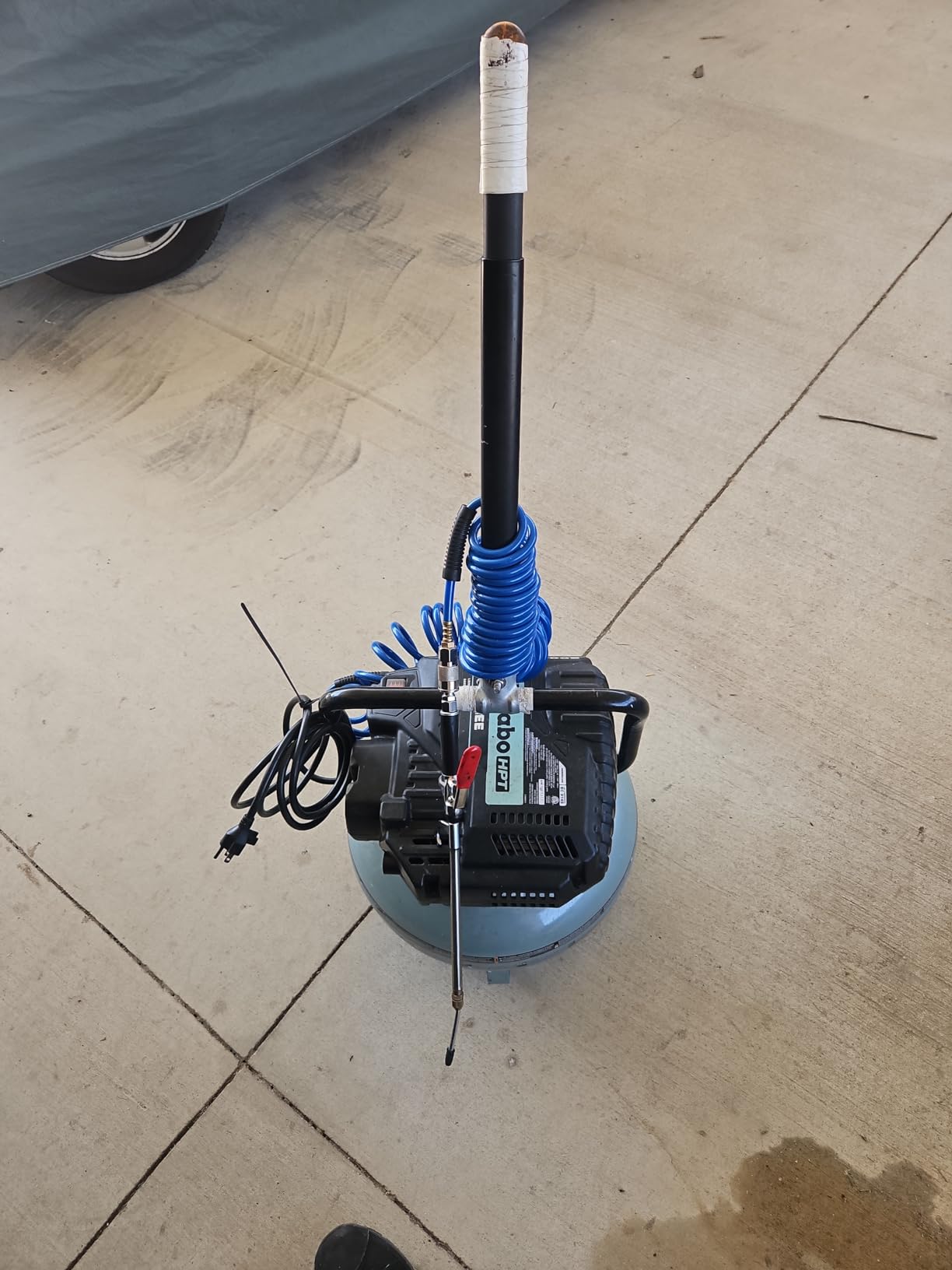
200 PSI tank pressure versus more gallons
For most woodworkers, buying pressure rather than capacity is the smarter move, because tool performance depends on the pressure available at the tool, not the total volume behind it. This unit stores meaningfully more usable air in six gallons than a 150 PSI pancake stores in the same space.
It is also 22 percent lighter than traditional twin-stack models at 41 lbs, with a flat profile that slides under a bench or sits against a wall. If your shop is tight, that footprint matters as much as the tank capacity does.
What 73 dB actually sounds like indoors
At 73 dB this is meaningfully quieter than the 79 to 82 dB units in this roundup, and noticeably quieter than an open-frame contractor compressor of similar airflow. It is not a soundproof cabinet, and in a room with bare concrete and a metal door the perceived level will be higher than the published figure suggests.
Metabo HPT is the pro-preferred nailer brand, and that matters for parts: this compressor shares much of its service ecosystem with nailers many shops already own. If you are choosing between this and a bigger unit, weigh the oil-free longevity trade honestly — a lubricated pump will outlast it under daily load.
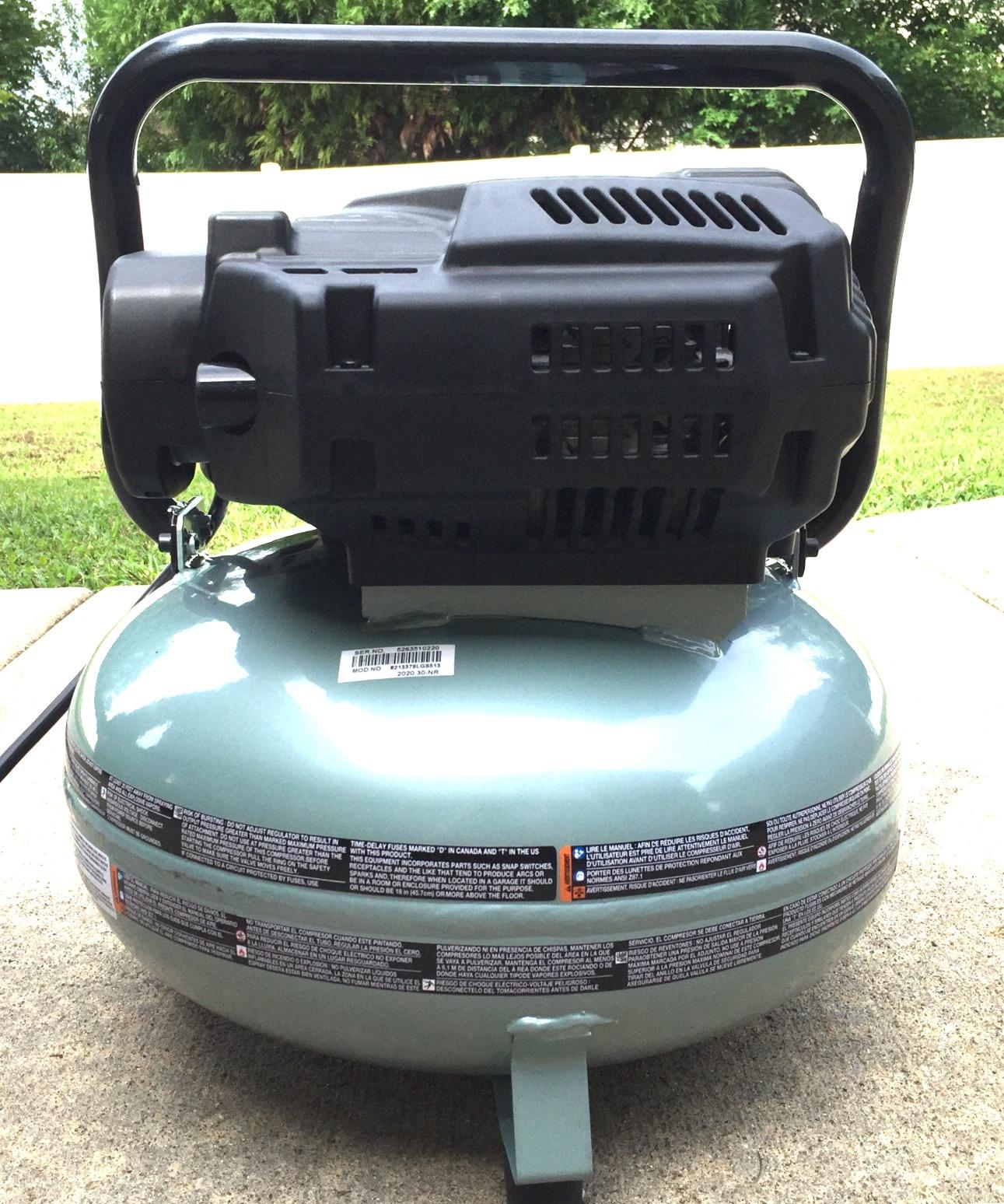
4. California Air Tools 8010A – The Quietest Unit for an Indoor Shop
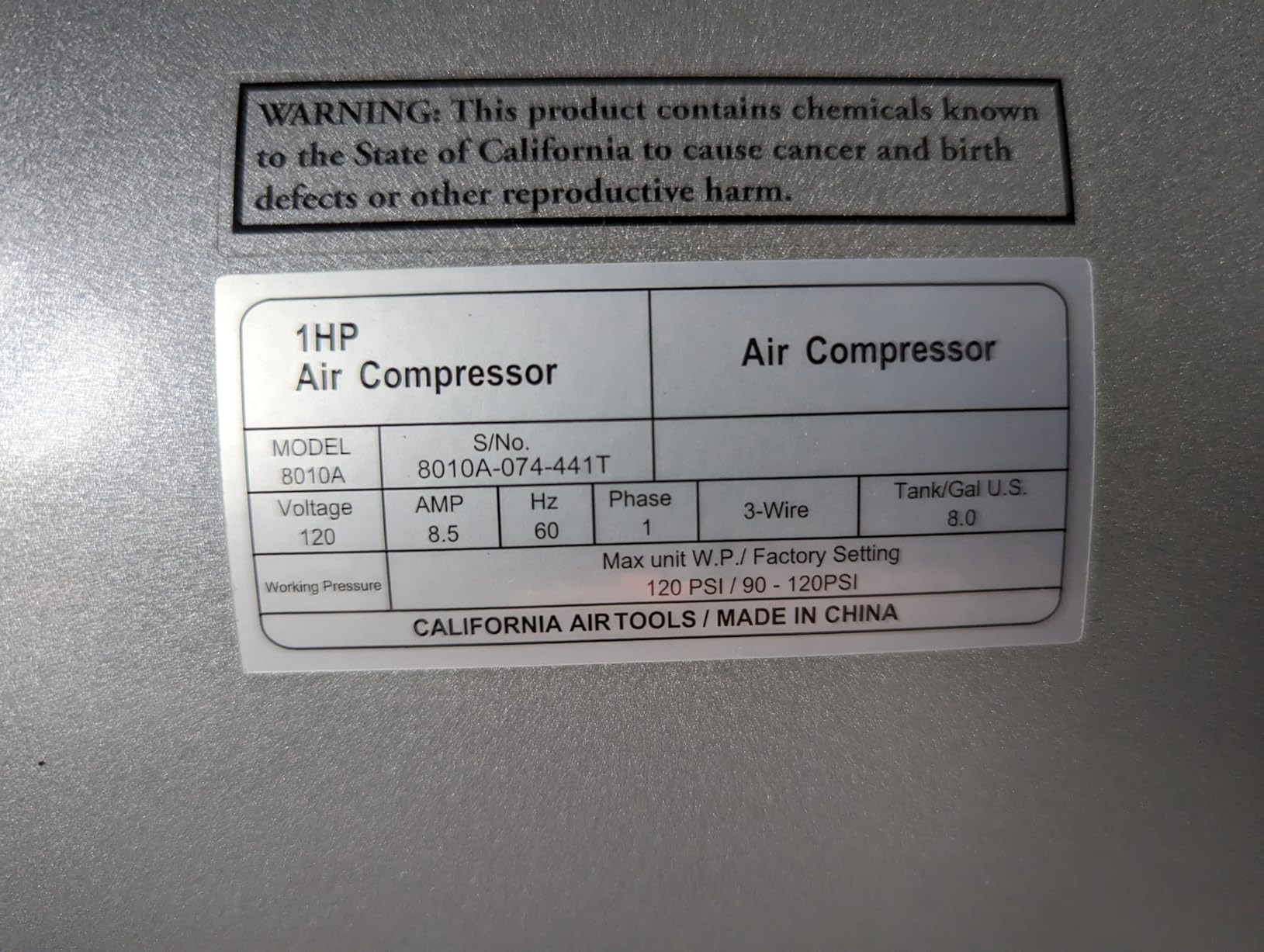
California Air Tools 8010A 1.0 HP Ultra Quiet and Oil-Free Air Compressor, 8 Gallon Aluminum Tank, Lightweight with Wheels, 60 dBA Noise Level
1.0 HP oil-free
2.2 CFM at 90 PSI
8 gallon aluminum tank
60 dBA
120 PSI max
+ Pros
- Quietest unit here at 60 dBA
- Oil-free dual piston pump rated beyond 3000 hours
- Aluminum tank resists corrosion and weighs only 37.25 lbs
- Recovers from 90 to 120 PSI in 60 seconds
- Wheel kit included
– Cons
- Lowest airflow in the roundup at 2.2 CFM at 90 PSI
- 120 PSI ceiling leaves very little headroom above tool pressure
- Aluminum tank dents easily if bumped
Sixty decibels is the number that changes how a shop feels. In our sessions this was the only unit quiet enough that we could keep working at a bench beside it without raising our voice, which makes it the right answer for an attached garage, a basement shop or a shared workroom where a neighbor is close.
The trick is a 1.0 HP motor turning at only 1,680 RPM in a sound-dampening cabinet, with an oil-free dual piston pump rated to run beyond 3,000 hours. It fills to 120 PSI in 165 seconds and recovers from 90 to 120 PSI in 60 seconds, which is enough for finish nailers, brad guns, staplers, an airbrush and continuous chip blowing.
What you give up for 60 dBA
Airflow. At 2.2 CFM at 90 PSI this is the lowest in the roundup, and it is the reason we do not recommend it for framing, for a belt sander, or for two people working at once. The manufacturer does rate 3.10 CFM at 40 PSI, which is genuinely useful for blow guns and low-pressure inflating, but the number that matters for a pneumatic tool running at 90 PSI is the 2.2.
The 120 PSI ceiling is the other limit. Nailers and light sanders run comfortably in that band, but there is simply no headroom above it, so any tool that wants more pressure will not find it here.
Aluminum tank: light and corrosion-resistant, but easy to dent
At 37.25 lbs with the wheel kit, this is one of the easiest units to reposition, and aluminum does not surface-rust the way a steel tank can in a damp shop. The trade is structural: if you can bump a caster into the tank in a tight garage, you will dent it, and a dented tank is a tank that gets replaced rather than repaired.
Forum consensus backs this unit as a default choice for small shops — NC Woodworker threads list California Air Tools as the common oil-free recommendation, and AAW Forum members run one specifically for airbrushing. Several members also run a second, larger unit alongside it, which is a real two-compressor pattern worth considering if your shop mixes finish work with framing.
5. PORTER-CABLE C2002-WK – The One You Carry to Every Job
Black & Decker/dewalt C2002-WK Pancake Compressor
6 gallon pancake
2.6 SCFM at 90 PSI
150 PSI max
82 dB
30 lbs
120V low-amp motor
+ Pros
- Compact pancake footprint with handle and cord wrap
- Oil-free pump means no maintenance schedule
- Two factory-installed regulated couplers for two tools
- 13-piece accessory kit covers inflation and cleaning
- Low-amp 120V motor starts on an extension cord
– Cons
- Modest 2.6 SCFM at 90 PSI for sustained demand
- 82 dB is loud for a pancake unit
- 150 PSI max limits heavier applications
This is the most-reviewed unit we evaluated, with more than 2,400 ratings at a 4.6 average, and that review base is itself a reason to consider it. When a model has this many owners, the failure modes are documented rather than guessed at, and the recurring theme here is portability rather than performance.
At 30 lbs with an integrated handle and a cord wrap, it moves between the garage, the truck and a trim job without ceremony. The 13-piece accessory kit means a new owner can inflate, clean and blow chips on the first afternoon without a separate purchase.
Two factory-installed couplers, and why that matters
Two regulated couplers are fitted at the factory, which means two users or two tools can run at once within what 2.6 SCFM allows. In practice that means one person nailing while another sands lightly, not two framing nailers at full tilt. Knowing that limit in advance is how you avoid the frustration of watching a nailer slow down mid-rail.
The low-amp 120V motor is the underrated feature. It starts reliably on an extension cord and in cold weather, which matters for anyone working in an unheated shop in winter. Most pancake complaints trace back to a motor that will not start when it is cold or when the cord is thin.
The 82 dB reality check
This is a loud machine for its size, and 82 dB is the joint-highest published figure in the roundup. It is fine in a detached shop with the door open. In an attached garage, plan to pipe it out of the work area or accept the noise as part of the deal.
Our [off-roading compressor guide](/best-car-air-compressors-for-off-roading/) covers small-tank units in a different context, but the underlying lesson is the same: for occasional, low-demand tasks in a space you can close the door on, portability beats specifications.
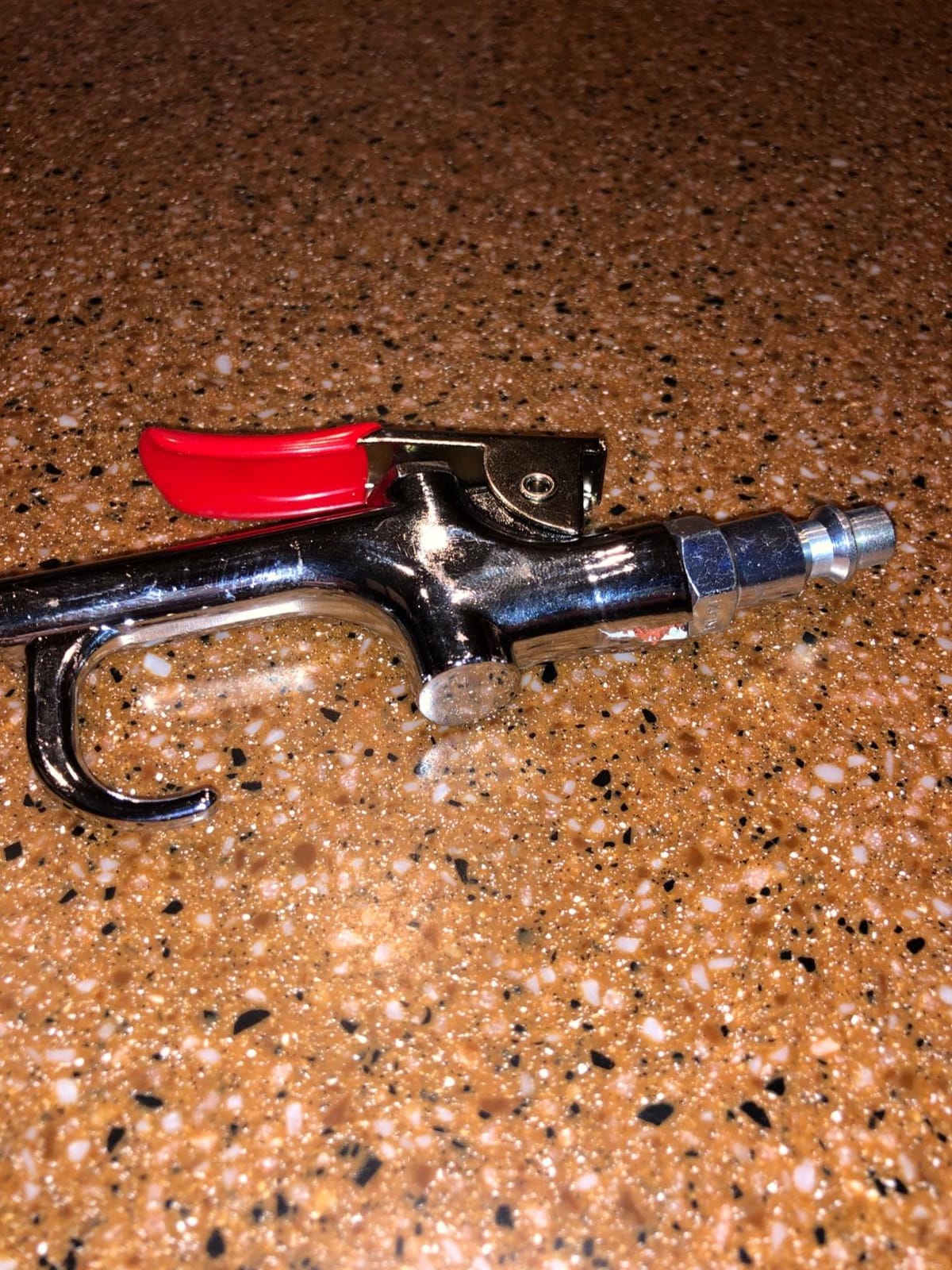
6. ECOMAX 6 Gallon Pancake – The Best First Compressor for a New Shop
ECOMAX Air Compressor 6 Gallon 150 PSI Pancake Portable Oil-free Tank with 10 PCS Accessories Kit
1.5 HP
3 CFM at 90 PSI
6 gallon pancake
150 PSI max
75 dB
34.17 lbs
+ Pros
- 4.7 star rating with a 1 percent one-star share
- Top-selling rank in portable compressors among this group
- Dual quick couplers run two tools at once
- 34.17 lbs with a flip-up carry handle
- 10-piece kit plus a 25 foot hose included
– Cons
- 3 CFM at 90 PSI and a 150 PSI ceiling rule out framing and roofing
- 6 gallon tank means frequent refill pauses
- A review base of 316 is among the thinnest here
If you are setting up a first shop and your tool list is mostly a brad nailer, a stapler, a random orbital and a blow gun, this is the machine that matches. At 4.7 stars with an 81 percent five-star share and a 1 percent one-star share, it has one of the strongest rating profiles of any unit on this page, and the one-star complaints are thinner than anywhere else in the group.
The 10-piece accessory kit covers thread seal tape, a quarter-inch air chuck, auto plugs, a coupler, a tire pressure gauge, a nozzle, a blow gun and a 25 foot PVC hose. For a first compressor, that removes the most common trip to the hardware store and the most common first-week frustration.
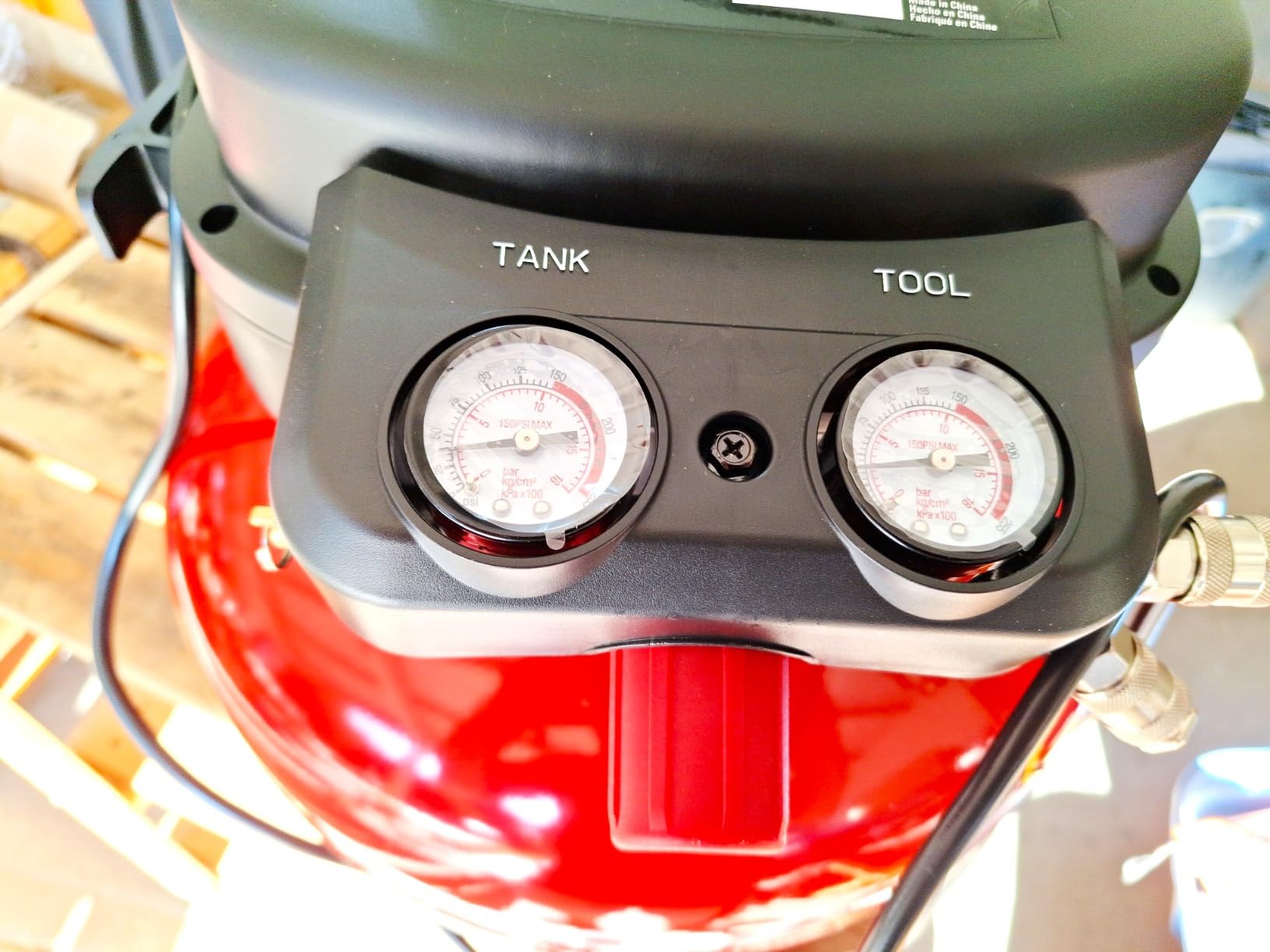
Dual gauges, dual couplers and cold-weather starting
Dual gauges let you read tank pressure and regulated output pressure at a glance, which is how you spot a leaking fitting or a nailer drawing more than you think. Dual quick couplers support two tools simultaneously, and the oil-free pump is rated for low-voltage and cold-weather starts, so it will still fire on a cold morning in an unheated garage.
At 34.17 lbs with a flip-up carry handle, this is one of the easiest pancakes to move, and the dual couplers make it a natural two-user machine for a shop where one person trims while the other sands.
Where this unit stops being enough
Three CFM at 90 PSI and a 150 PSI ceiling rule out framing and roofing nailers, and the six-gallon tank means you will wait during long sanding or spraying sessions. If your shop will grow into framing work within a year, buying up to the Klutch or the Metabo HPT now saves a second purchase later — and that regret about outgrowing the first compressor is the single most common theme in woodworking forums.
One more practical note: the airflow figure is listed in non-standard units on the packaging, which makes cross-comparison harder than it should be. The 3 CFM at 90 PSI is the number to compare against other machines.
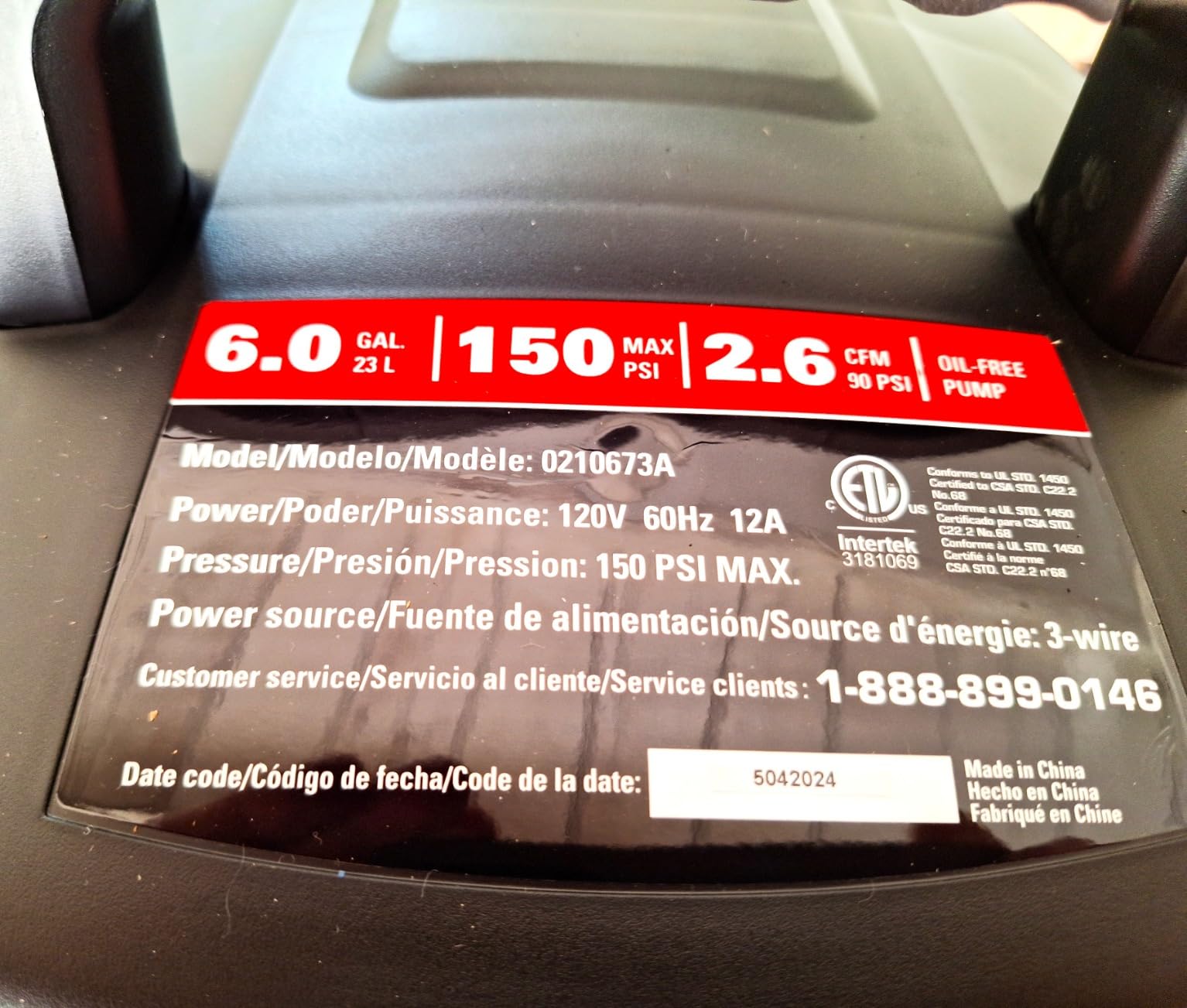
7. VEVOR 13-Gallon Vertical – A Big Tank That Stays Quiet
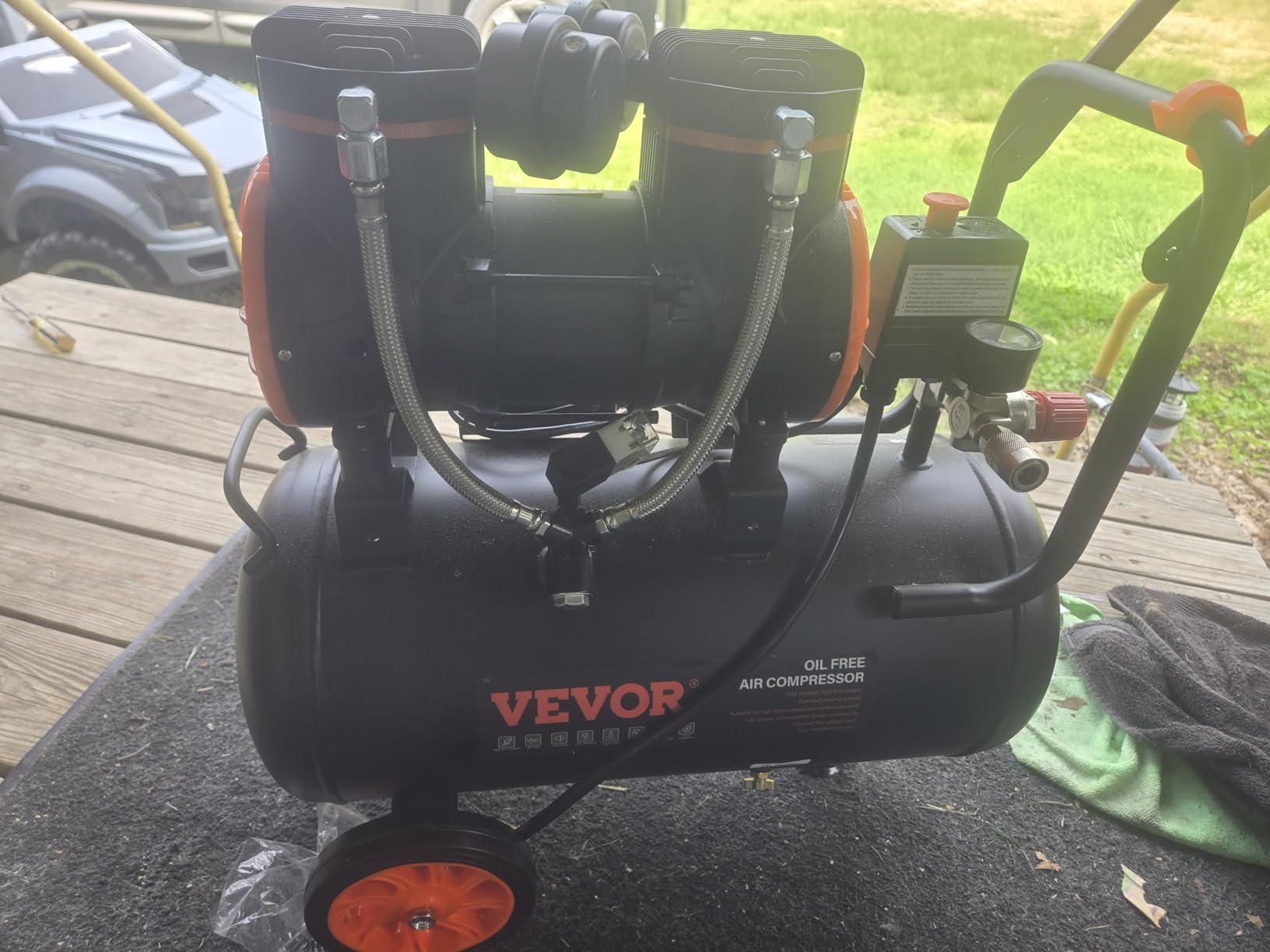
VEVOR 13-Gallon Air Compressor, 2HP, 4.6 SCFM@90PSI, Oil-Free Tank, 66dB Quiet Operation, Ideal for Tire Inflation, Woodworking, Auto Repairs, and Spray Painting (Maximum Pressure 125 PSI)
2 HP
13 gallon vertical tank
125 PSI max
66 dB oil-free
71 lbs
Two air connections
+ Pros
- Genuinely quiet at 66 dB
- with owners reporting no need for hearing protection
- 13 gallon vertical tank fills in under 3 minutes
- Two hose connections allow two tools at once
- Woodworking owners report it handles blowing out dust and cleaning
– Cons
- Advertised CFM appears optimistic
- Manufacturer has acknowledged lower real continuous output
- Some units report thermal overload under sustained load
- Reported failures in valves and start capacitors within 90 days
The idea here is right: thirteen gallons of vertical tank, a 66 dB oil-free design and a fill time under three minutes, which is a combination almost nothing else in this roundup offers. Several woodworkers who bought it report using it exactly as intended, for running air tools, blowing dust and cleaning up.
Two seven-inch reinforced rubber wheels let it roll across shop floors and thresholds, and the vertical 33.3 inch profile keeps the footprint reasonable. Owners who worked in the shop with it running report not needing hearing protection, which is unusual for a machine in this tank class.
Read the airflow number carefully
This is the most important caveat on the page. The listing advertises 4.6 SCFM at 90 PSI, and a detailed owner review documents the manufacturer’s own support team acknowledging that real continuous output is closer to 2.7 CFM. Owners also report the 2 HP rating behaving more like 1 to 1.25 HP under sustained load, running hot enough to trigger the thermal overload.
That does not make it a bad machine, but it changes how you should use it. Plan on it for nailers, blow guns and intermittent sanding rather than for a continuous belt sander, and treat the published figure as optimistic.
Reliability reports deserve a read before you buy
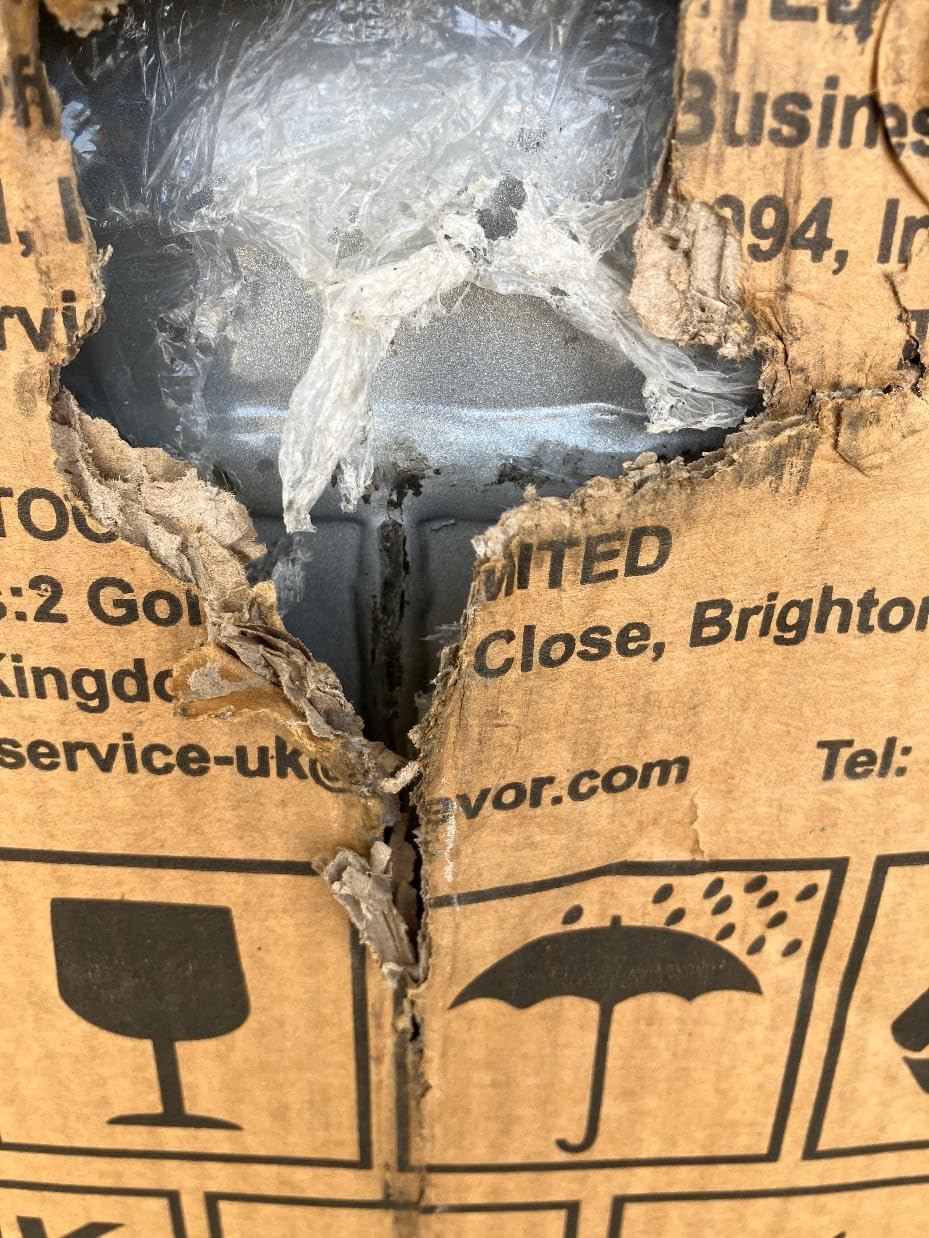
There is a documented fails-to-repressurize fault where the unit will not restart at cut-in pressure and needs a 20 to 30 minute unplug wait, and a second replacement reportedly failed the same way. There are also reports of unloader valves, start capacitors and intake filters failing within the first 30 to 90 days, bent feet or cracked housings arriving from shipping, and partial-refund retention offers rather than full replacement.
That is a real risk profile for a machine you plan to run daily. If you are considering it, keep the manual and the purchase record, and test the restart cycle a few times before you rely on it for a full day of work.
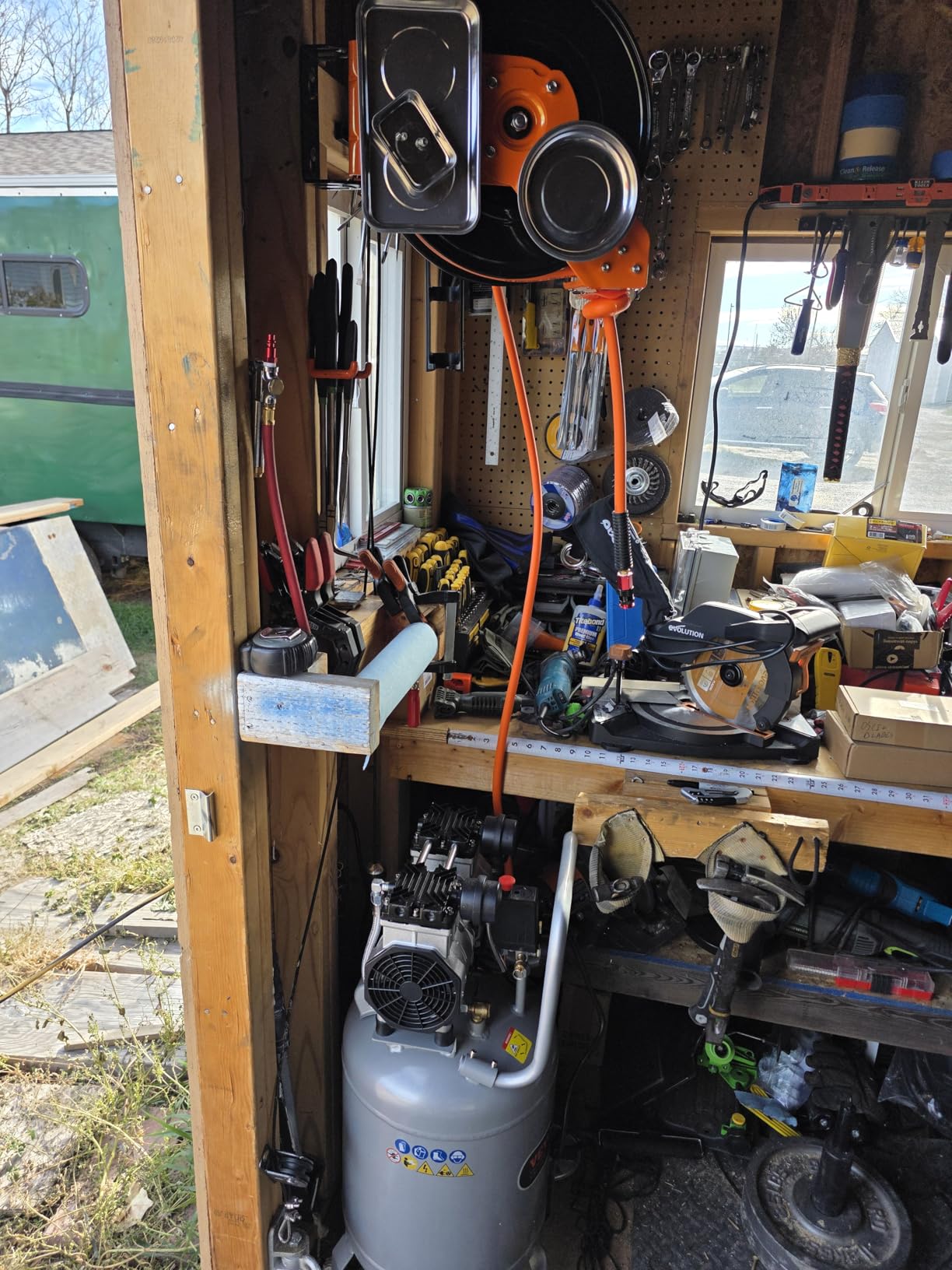
8. Limodot 5 Gallon Quiet Kit – Built for Airbrushing and Finish Work
Quiet Oil-Free Air Compressor, 68 dB, 2.8 CFM @ 90 PSI, 5 Gallon Air Tank
1.2 HP oil-free
2.8 CFM at 90 PSI
5 gallon tank
120 PSI max
68 dB
Induction motor at 3400 RPM
+ Pros
- 68 dB induction motor runs inside a house or workshop
- Refills empty to full in 80 seconds with 25 second recovery
- Complete kit means it is usable out of the box
- Oil-free design starts reliably in cold weather
- Wheel kit and compact footprint for repositioning
– Cons
- 2.8 CFM at 90 PSI limits it to brad guns and small finish nailers
- 120 PSI maximum is low for heavier pneumatic tools
- 5 gallon tank means frequent pauses
- PVC hose is less durable than rubber or braided
This is the airbrushing pick, and the reason is straightforward: an oil-free pump means nothing oily can reach a cup gun or a HVLP line, and a 68 dB induction motor makes it usable in a room where a conversation matters. The included 13-piece accessory kit and 25 foot hose mean it works the day it arrives.
Fill time is its quiet advantage. Empty to full in 80 seconds, with 25 second recovery, so a long spraying session with pauses between coats does not leave you waiting. AAW Forum members run small oil-free compressors specifically for cleaning and blowing chips, and this machine fills that same role with a faster recovery time.
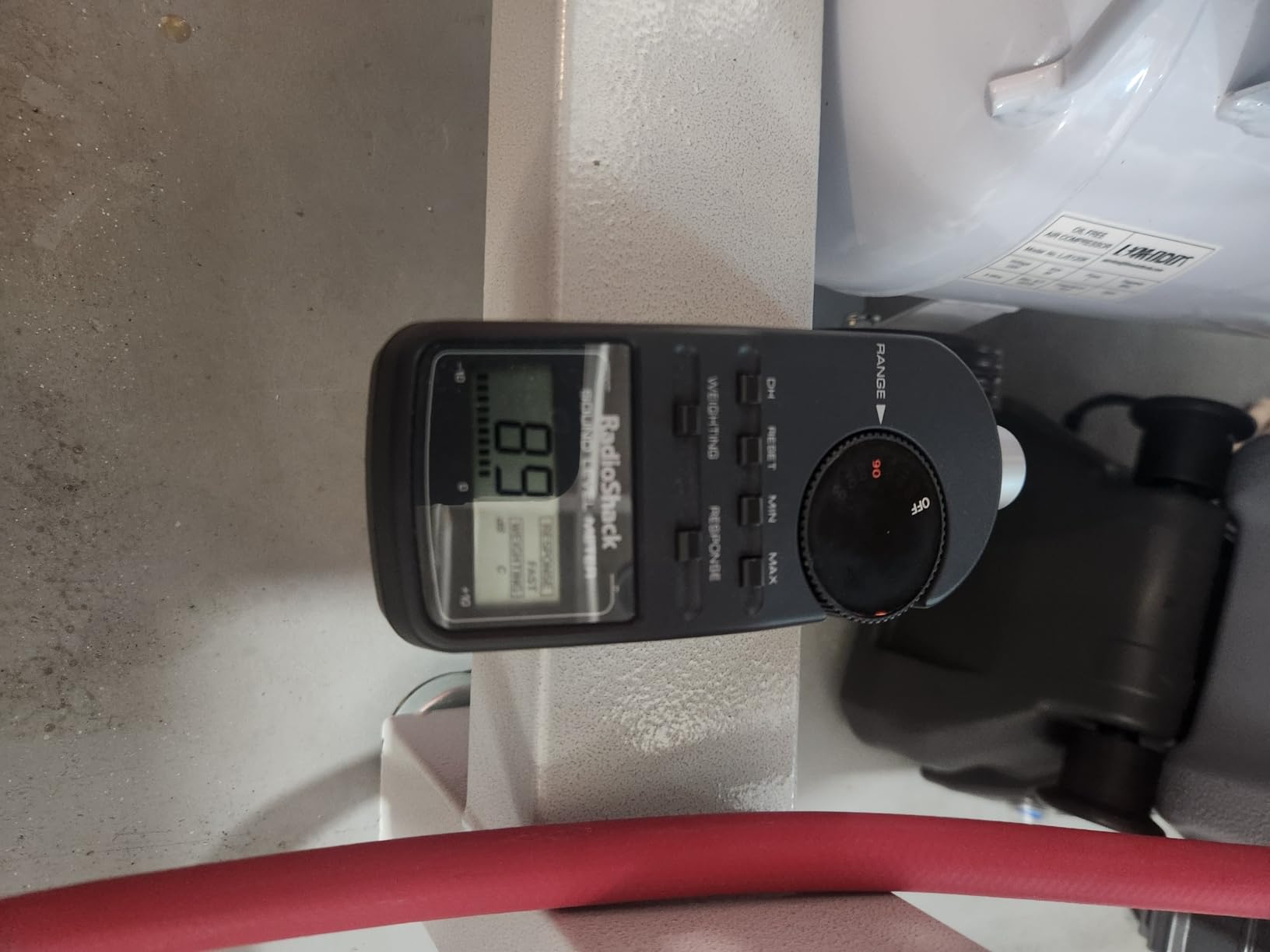
Oil-free and low-pressure: ideal for finish, wrong for framing
Zero oil carryover is the whole argument for an oil-free pump when you are spraying, and it removes the need for a separator can on every tool that touches a finish. At 2.8 CFM at 90 PSI and a 120 PSI ceiling, though, this is a light-duty machine by design — it suits brad guns, staplers, airbrushes, blow guns, air drills, HVLP guns and pneumatic screwdrivers.
The five-gallon tank is one of the two smallest here, so expect pauses. If finish work is a significant part of your shop rather than an occasional evening, the extra stored air of the 20-gallon Klutch will serve you better even though it is far louder.
What to watch on a budget-tier unit
Two honest concerns. The brand has a shorter track record than the established names on this page, and long-term durability data is thinner. The included hose is PVC, which cracks and stiffens faster than rubber or braided hose — fine for occasional use, worth replacing if you run it daily.
The low-speed 3400 RPM induction motor is also the reason for the noise figure, since induction motors are quieter than the universal motors in typical open-frame units. At 4.5 stars across 925 ratings, the value here is real even if the ceiling is low.
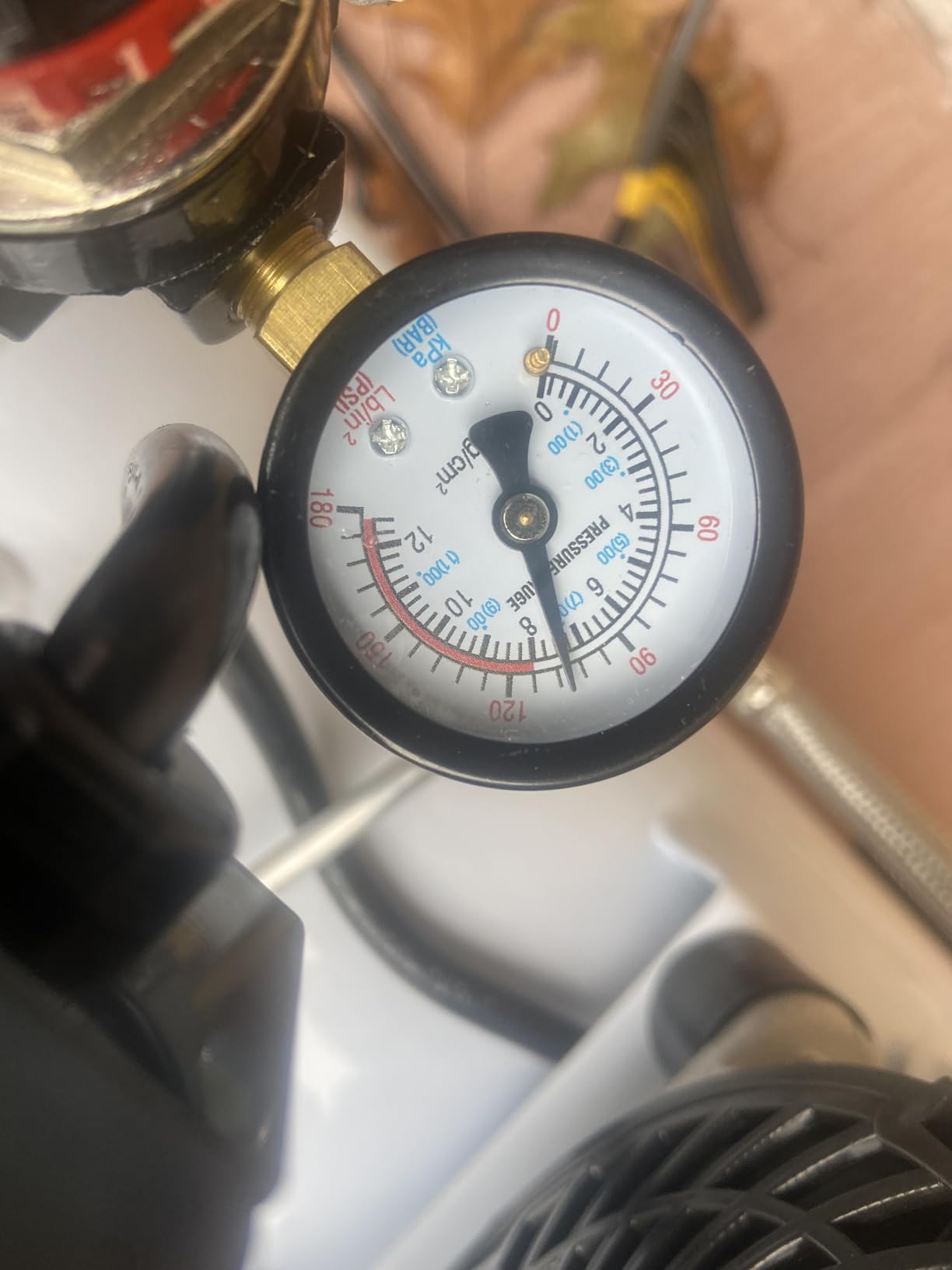
9. CRAFTSMAN 6 Gallon Pancake – A Footprint That Fits on a Bench
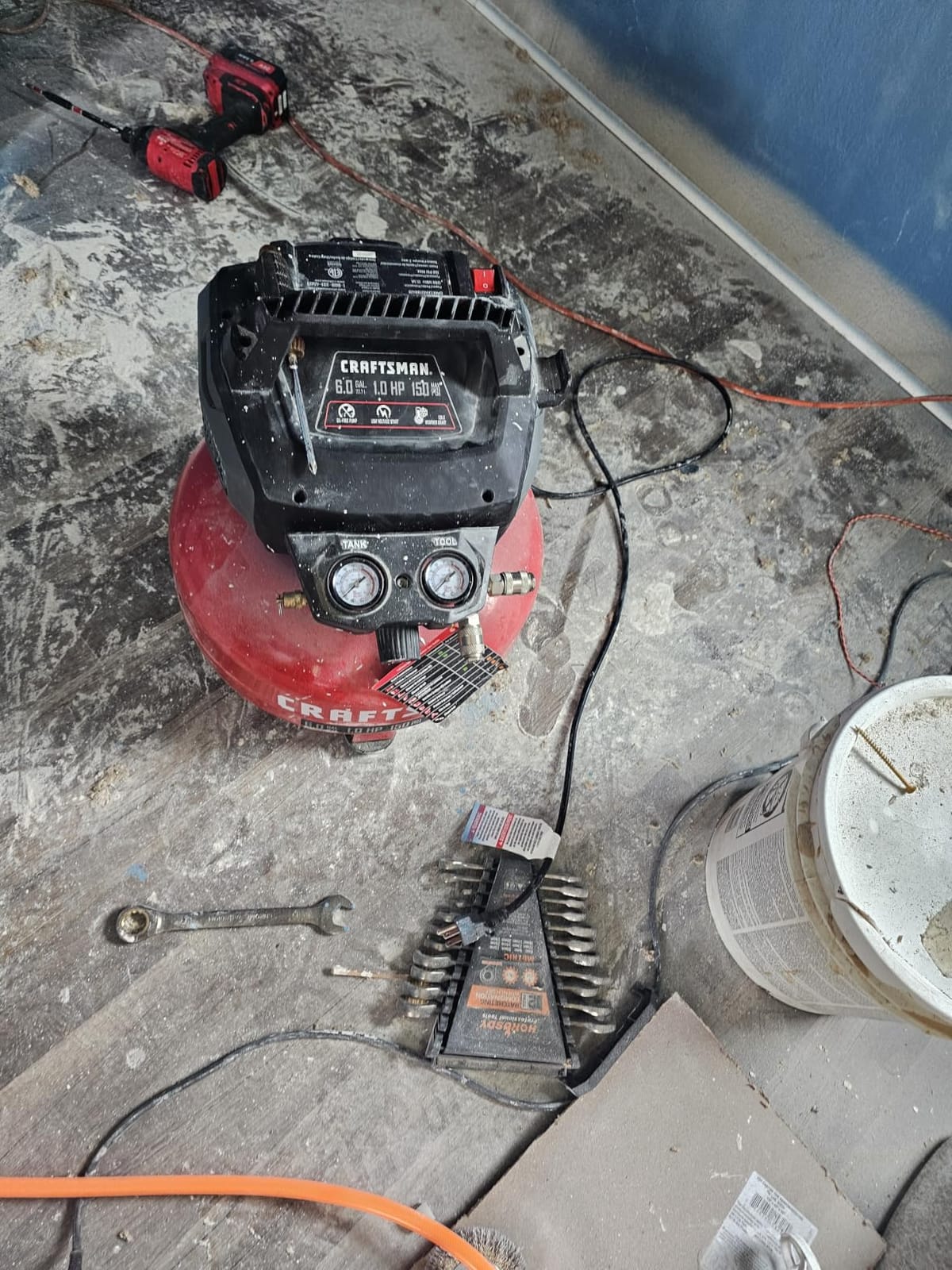
CRAFTSMAN 6 Gallon 150 PSI Oil-Free Pancake Air Compressor CMXECXA02106410
1.0 HP
2.6 SCFM at 90 PSI
6 gallon pancake
150 PSI max
82 dB
30.8 lbs
+ Pros
- Compact 15.8 by 16.4 by 17 inch footprint fits on a bench
- Light and easy to lift at 30.8 lbs with a built-in carry handle
- Oil-free design eliminates oil changes entirely
- Dual quick couplers run two tools simultaneously
- Backed by a US-based service team
– Cons
- 82 dB is the joint-highest noise figure here
- Some units reported shutting down and not restarting
- A handle arrived in pieces with no replacement available
If your workshop is a corner of a basement or a bench in a shared room, footprint is the first constraint and this machine answers it. At 15.8 by 16.4 by 17 inches, it is the most compact unit in the roundup, and at 30.8 lbs with a built-in handle it can be lifted onto a bench by one person.
Owners confirm it drives a brad nailer without significant pressure loss and builds pressure quickly, and the dual quick couplers let two tools run at once. It is a machine for assembly, trim and light finish work rather than for framing or continuous sanding.
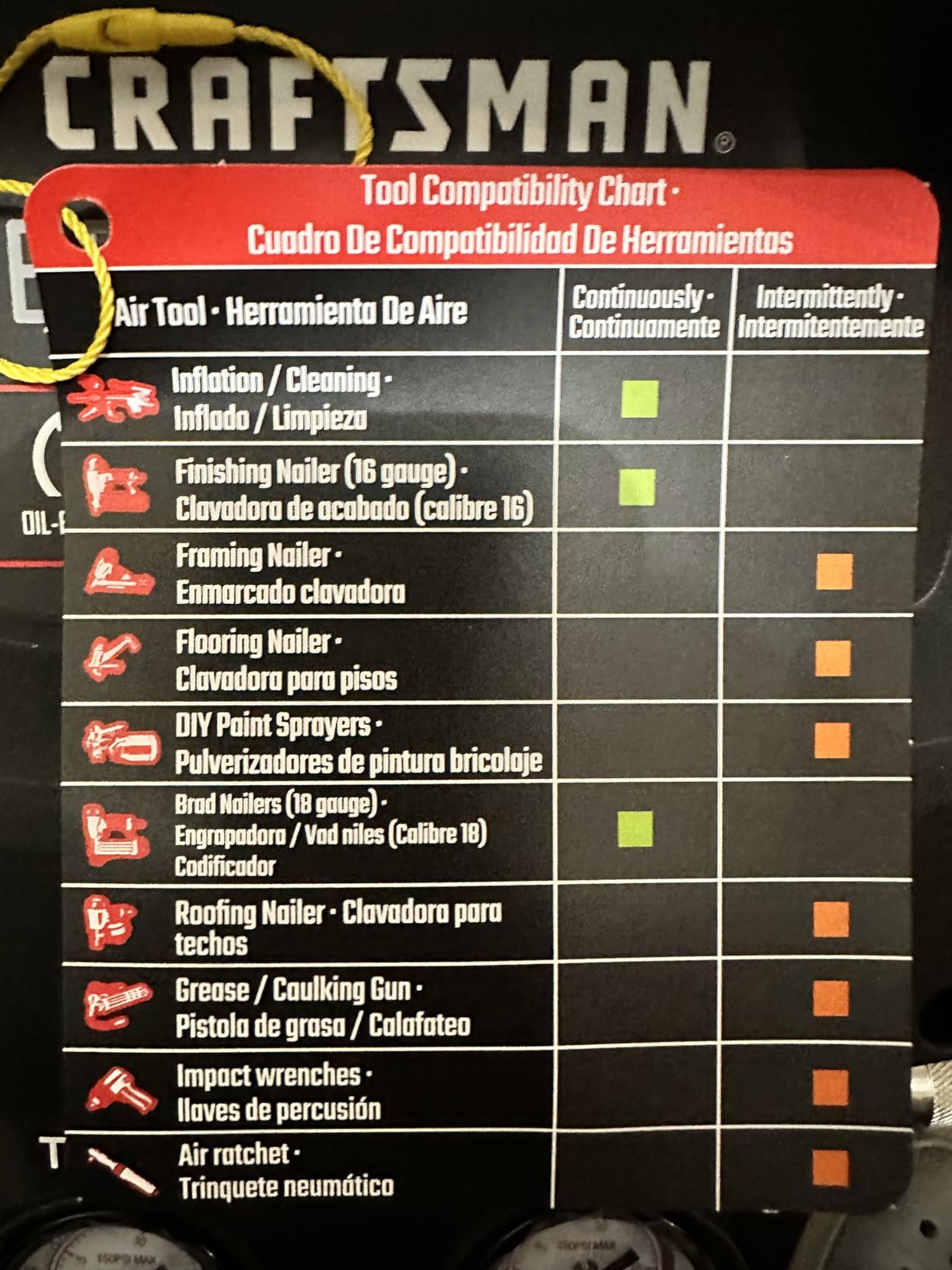
Brand support versus price-tier support
CRAFTSMAN sells through major home centres with a US-based service team and a one-year warranty, which is a meaningful difference from generic import units when something breaks. That matters most here: at 228 ratings, this is the second-thinnest review base in the roundup, so the long-term data is thinner and the service relationship is your main fallback.
That said, the negative feedback clusters into three specific complaints rather than a general pattern. Several owners report 82 dB running noise. A few report units that shut down and would not restart. One reported a carry handle that arrived in pieces with no replacement available through support, and another a gauge bracket already broken on arrival.
Where it fits in a two-compressor shop
A 6-gallon pancake at this weight and size makes a strong second machine. Run a larger tank for framing or sanding, and keep this one on the bench for assembly, brad nailing, stapling and inflation — the jobs that only need a few seconds of air at a time and should not require crossing the shop.
We rate it below the ECOMAX in the same size class because the airflow, tank pressure and noise figures are nearly identical while the accessory kit is thinner and the review base is smaller. If you already own CRAFTSMAN tools, that ecosystem familiarity is worth weighing on its own.
10. VEVOR 6.3 Gallon – The Budget Pick, and Quiet for Its Output
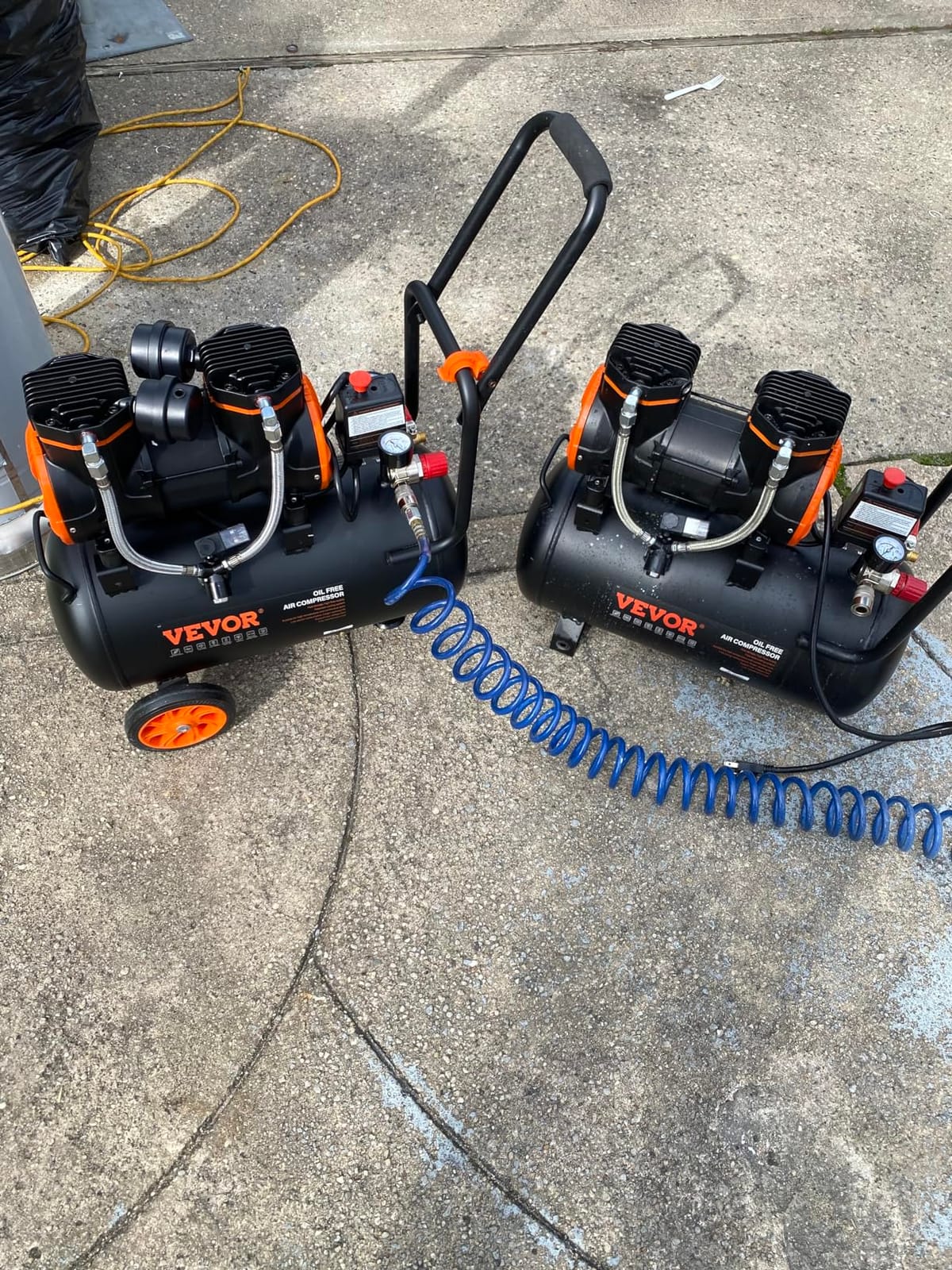
VEVOR 6.3 Gallon 2 HP Air Compressor, Max 116PSI, Oil Free Compressor Tank
2 HP / 1450W
3.35 CFM at 90 PSI
6.3 gallon tank
116 PSI max
70 dB
43 lbs
+ Pros
- Owners consistently describe it as quieter than typical pancake units
- Dual silencers and double-cylinder intake reduce real noise
- Refills the 6.3 gallon tank in about 60 seconds
- Two cooling fans plus automatic overheat protection
- Reported to survive drops and heavy knocks
– Cons
- 116 PSI ceiling leaves little headroom above tool pressure
- 14.5 A draw will trip a lightly loaded circuit
- Very short power cord limits where it can sit
- Casters are small and prone to tipping
At 3.35 CFM at 90 PSI from a 6.3 gallon tank, this delivers more airflow than almost every other pancake on the page, and the noise complaints that usually go with that performance are largely absent. Owners repeatedly describe it as quieter than a typical pancake or hot-dog unit, and the dual silencer design with a thickened muffler cover, rubber muffler pipe and filter cotton is a credible explanation for that.
It refills in about 60 seconds, has two large cooling fans with automatic overheat protection, and uses a three-layer construction with Q235B structural steel and welded seams rated to 3.5 MPa. Several owners report it surviving drops and heavy impacts without failing, which matters for a machine that lives in a garage.
The electrical complaints are the ones to plan around
Almost all of the criticism here is electrical rather than mechanical. Multiple owners report the motor is voltage-picky and will not run reliably on more than one extension cord or on an outlet shared with a high-draw load, and one reports a unit that would not start or shut down within seconds on an extension cord. At 14.5 A, it draws more current than any other unit on the list.
The power cord is also only about 40 inches long, which dictates that the compressor sits close to a wall outlet. Our advice is to dedicate a circuit and skip the extension cord entirely. Small casters are another recurring issue — they tip when the unit is moved by its handles, so lift rather than roll it across thresholds.
Where a 116 PSI ceiling matters
The 116 PSI maximum sits at the bottom of the range here, and it leaves very little room above the 90 PSI your tools work at. For brad guns, staplers, blow guns and light finish work that is fine, and the fast fill compensates for the small tank. For anything wanting higher working pressure, look elsewhere.
At 4.3 stars with a 10 percent one-star share, this is the lowest-rated unit we list, and the rating reflects the electrical complaints more than anything mechanical, and the quietness and airflow reports are good enough to keep it in the roundup. If you want the same shape of machine with a better support network, the ECOMAX is the alternative worth comparing.
How to Size a Shop Air Compressor for Woodworking
Start with your worst tool, not your average tool. A compressor is sized by the largest single airflow demand it has to satisfy at 90 PSI, because that is where pressure stalls begin and nailers start firing short. Match the tank to how long you want to work between pump cycles.
Here is the sizing framework we used:
- Inflating tires and blowing out chips: 2 to 6 gallons, 2 CFM at 90 PSI. Any of the pancakes on this page clears this comfortably.
- Brad nailer, stapler, light finish work: 6 to 8 gallons, 2.5 to 3 CFM at 90 PSI. The CRAFTSMAN, PORTER-CABLE and ECOMAX sit here.
- Random orbital sanding for several minutes at a time: 8 to 20 gallons, 3 to 4.5 CFM at 90 PSI. The Metabo HPT and the 20-gallon Klutch are the sensible picks.
- Framing or roofing nailer, especially a second nailer running alongside: 20 gallons or more, 4 CFM at 90 PSI minimum, and pressure headroom above 90 PSI matters.
- HVLP spray gun or continuous belt sanding: 20 gallons or more, 4.5 CFM at 90 PSI or better, and a downstream dryer. This is the tier none of the small units here truly serves.
- Two people working at once: Plan for combined demand and pick a unit with two outlets and enough CFM that both tools keep pressure.
Sawmill Creek’s long-running consensus is that a 60 gallon, 3 to 5 HP compressor is the right default for most hobbyists, with cast iron pumps as the ownership recommendation. Our list skews smaller because these are shop compressors sized for finish and trim work, not for framing a house. If framing is your primary output, the honest answer is that you need a category of machine this roundup does not cover.
Forum users also describe a pattern worth copying: buy slightly larger than you need today, because a compressor gets used for more than its original job. One Garage Journal member runs a plasma cutter and inflates tires off the same line that feeds his tools, and his reasoning was simply that you will use it more than you expect.
Getting Air from the Compressor to Your Bench
This is the technique experienced woodworkers mention most often and no roundup explains properly. Short version: a 6-gallon pancake in the next room feeding a wall outlet across a garage will outperform the same unit sitting four feet from the bench, because line length and line diameter are the real limits nobody warns you about.
A Garage Journal member runs black pipe from a compressor in another room to outlets along the back wall of his shop, so the machine itself is silent in the work area and hoses plug in anywhere along the wall. He also encloses the compressor as an alternative noise mitigation. The setup is straightforward once you know the rules:
- Use 3/4 inch line. Half-inch line chokes quickly over a real shop run and is the reason small compressors seem to stall even when the spec sheet says otherwise.
- Keep runs as short as you reasonably can. Every foot of line adds pressure drop, and pressure drop is what a nailer feels first.
- Mount outlets along the wall on a manifold, not a single long hose snaking across the floor. Hoses get run over, dragged and cut.
- Put a regulator at the point of use, not just at the tank. One outlet with its own regulator means you can set finish work at 70 PSI and framing work at 100 PSI from the same machine.
- Add a drop to the bench with a short flexible whip so the tool is not pulling on rigid pipe every time the hose is yanked.
- Drain low points before winter, where condensation collects and where a frozen line blocks everything downstream.
- Isolate vibration. A mat under the tank stops structure-borne vibration travelling through the floor and up the bench, which is a bigger contributor to perceived shop noise than the published decibel figure suggests.
One member on that thread replaced the pump and motor on a 40-gallon Campbell Hausfeld while keeping the original tank, and reported it ran much quieter afterward. Repair over replace is a legitimate strategy when a good tank outlives a cheap pump.
Keeping Water and Oil Out of Your Finish
Moisture in an air line is the most common complaint in woodworking forums, and it is a finish-quality problem, not just an annoyance. Water carries to a spray gun and spots a finished cabinet; oil from a lubricated pump does the same thing more permanently.
Three dryer types cover most shops:
- Aftercooler: Cools the air after the pump so water condenses out and drains automatically, typically removing the large majority of the moisture in the line. Cheap, no moving parts, and the right default.
- Desiccant dryer: A cartridge filled with desiccant that scrubs remaining moisture. Best for single-user shops and anyone spraying finish, but the cartridge needs replacing on a schedule.
- Refrigerated dryer: Cools air below its dew point continuously. This is for production shops running tools all day, and it is overkill for a one-person garage.
Whichever you use, install it after the tank and before the line, and get into the habit of draining the tank on a schedule. A quarter-turn drain valve takes seconds. We also recommend a moisture separator at the outlet serving any spray equipment, because it protects the gun rather than the air.
If you spray regularly, note that the oil-free pumps in this roundup remove one contamination source entirely. That is the strongest argument for them, and it is stronger than the quietness argument for most shops.
Oil-Free vs Oil-Lubricated Pumps for a Woodshop
Oil-free pumps cost more per CFM, run hotter and wear faster under daily load. Oil-lubricated cast iron pumps run cooler, last longer and cost less to run. The choice depends on whether finish work or volume work is your bottleneck.
Go oil-free when you spray finish, when the shop is noise-sensitive and indoor, or when your duty is a few hours a week. Go lubricated when you sand daily, frame, or run a two-stage or larger unit. The lubrication pushback in woodworking forums is blunt: one summary is that you make the oil-free mistake once, because they are loud and they do not last.
That complaint is about duty cycle rather than design. The California Air Tools dual piston pump here is rated beyond 3,000 hours, and for occasional use that is many years. The same pump under daily sanding load is a different story entirely, and the cast iron Big Bore cylinder in the Makita is the reason we rated it first overall.
One Garage Journal poster bought a budget big-box unit and reported it as quiet in practice, which is a useful reminder that published figures and shop acoustics do not always agree. Concrete floors, drywall and metal garage doors reflect sound, and distance does more than most spec sheets admit.
Noise, Placement and Shop Layout
Our list spans 60 dBA to 82 dB, and that range is the single biggest lifestyle difference between the units. Below about 70 dB you can work beside it. Above 80 dB you plan around it, and hearing protection is sensible above 85 dB for prolonged periods.
Published decibel figures are only comparable when the test method and distance match, so treat them as a band. Placement does as much work as the machine does: distance, a closing door, and a mat under the tank will do more for a noisy shop than an expensive cabinet.
Two safety notes we will repeat. First, never enclose a compressor in a sealed soundproof box — the motor and pump need cooling airflow, and a sealed enclosure is a fire risk. If you want to contain noise, use a ventilated enclosure with clearance on all sides. Second, keep clearances around the tank and never exceed its rated pressure. Our [woodworking apron guide](/best-woodworking-aprons/) covers the rest of the protective gear worth owning alongside a shop compressor.
On layout, a vertical tank gives you capacity in a narrow footprint and a horizontal tank rolls more easily onto a dolly. Leave enough clearance to reach the tank drain, and plan the air line route before you decide where the machine lives, not after. If you are also planning the rest of the shop, our [table saw roundup](/best-table-saws-for-woodworking/) covers the other machine that dictates floor space.
How We Scored and Selected These Compressors
We scored each unit across five criteria, weighted for woodworking rather than for general DIY use. Airflow at 90 PSI carried the most weight, because it determines whether your tools actually perform. Tank size and pressure headroom came second, then noise for shop compatibility, then build quality and parts support, then duty-cycle fit for the task mix. Cost was not used as a ranking criterion at all; we list a budget pick because the value case is genuine, not because it was the cheapest.
Every product on this page carries a manufacturer-published airflow figure at 90 PSI rather than at a more flattering lower pressure, and every decibel figure is the published one. Where owner reports contradict a published spec, we said so in the review — the VEVOR 13-gallon section is the clearest example. We also weighted documented owner failure patterns, since a 4.7 average says less when the complaints cluster around one repeated fault.
Frequently Asked Questions
What is the best air compressor for woodworking?
The best air compressor for a general woodworking shop is the Makita MAC2400 Big Bore, which delivers 4.2 CFM at 90 PSI from a cast iron pump on a 2.5 HP motor and holds a 4.7 star rating. If your shop is noise-sensitive and your work is finish and trim rather than framing, the California Air Tools 8010A at 60 dBA is the better choice, at the cost of airflow.
What is a good size air compressor for a shop?
A 20 to 30 gallon tank with 4 to 4.5 CFM at 90 PSI is the sweet spot for a one-person garage shop. Below 8 gallons, expect frequent pauses during sanding or spraying. Above 60 gallons, you are buying capacity for framing or two-person work, which this roundup does not cover.
Is an oil-free air compressor any good?
Yes, for finish work, airbrushing, quiet indoor shops and light duty. Oil-free pumps put nothing oily in the line, which protects spray finish, and they start reliably in cold weather. The downsides are higher cost per CFM, more noise per CFM and shorter pump life under continuous daily load, where a lubricated cast iron pump lasts longer.
How do I get air from the compressor to my workbench?
Run 3/4 inch rigid line, black iron or copper, from the compressor to outlets mounted along the shop wall, then add a short flexible whip at each bench. Keep runs short, put a regulator at the point of use rather than only at the tank, drain low points, and put a mat under the tank to stop vibration travelling through the floor.
Do I need an air dryer for a woodshop?
Yes if you spray finish or run pneumatic sanders in a cool shop, where condensation can carry to a spray gun and spot a finished surface. An aftercooler is the cheap default and removes most of the moisture. A desiccant dryer protects spray equipment in a single-user shop, and a refrigerated dryer is only worth it in a production shop running tools all day.
How long do oilless air compressors last?
It depends on duty cycle rather than on the oil-free label. The dual piston pump in the California Air Tools 8010A here is rated beyond 3,000 hours, which covers years of occasional use. Under daily sanding or framing load, expect a shorter life than a cast iron lubricated pump, which is why we rated the Makita first overall.
Which Shop Air Compressor Is Right for You
If you want the strongest overall shop air compressor for woodworking, the Makita MAC2400 is the pick: 4.2 CFM at 90 PSI from a cast iron Big Bore pump, the highest customer rating on the page, and enough recovery to keep a sander running.
If you work out of a one-car garage, the Klutch 20-gallon vertical gives you the most stored air in the least floor space, at 175 PSI. If two people share the shop, the Metabo HPT EC914S runs multiple nailers at once from six gallons. If noise is the constraint, the California Air Tools 8010A at 60 dBA is the only one here you can sit beside. For airbrushing and finish, the Limodot is oil-free and fast to refill. For a first compressor, the ECOMAX has a 4.7 rating with a 1 percent one-star share and a complete kit. For carrying between jobs, the PORTER-CABLE C2002-WK is 30 lbs and has the most owner history. For a bench in a small room, the CRAFTSMAN has the smallest footprint here. For the lowest cost of entry, the VEVOR 6.3-gallon runs quietly for its size but is picky about extension cords.
Whichever you pick, plan the air line before you plan the floor space, and get a dryer on the outlet serving any finish work. Then check the current draw against your circuit, and read the manual for the restart cycle before the first full day of use.
Leave a Reply