
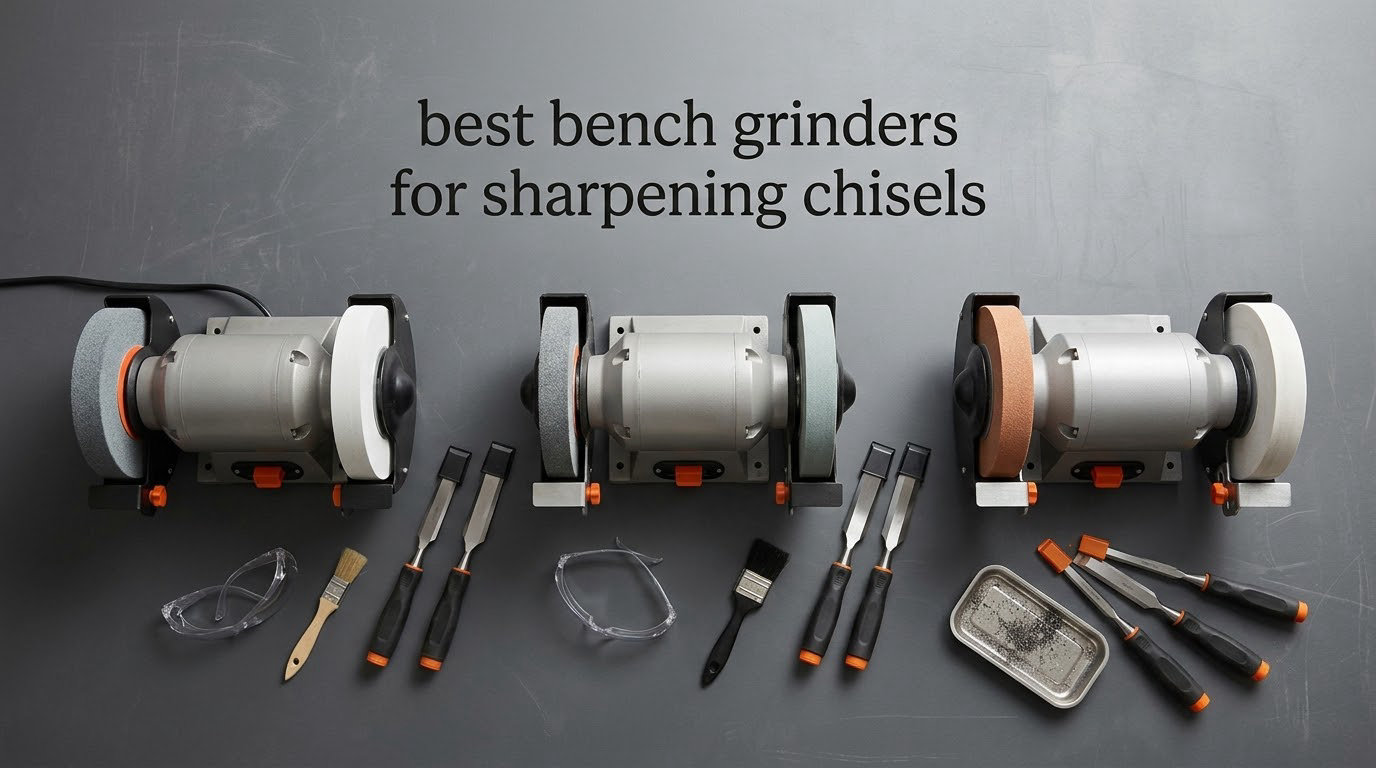
Yes, you can sharpen a chisel on a bench grinder, but only if the wheel runs slow or you fit a very fine wheel and take light passes. A chisel edge is thin hardened steel, and a wheel spinning at 3450 or 3600 RPM generates enough friction heat to strip the temper off that edge in seconds. The best bench grinders for sharpening chisels are the ones that either run around 1750 RPM, let you dial the speed down, or cool the wheel with water. That is the criterion I used to sort ten machines, and it matters far more than horsepower, colour or brand badge.
I have spent more time than I care to admit around grinders in workshops, mostly watching people ruin good chisels and then buying a better machine instead of learning to use the one they had. The failure is almost never the machine. It is heat from a wheel that is too fast, too hard a press, and too long in one spot.
So this roundup is deliberately narrow. Every machine below is judged on three things: how fast the wheel turns, what grit wheel actually ships in the box, and whether anything in the design fights back against burning an edge. I have not included a machine that cannot do the job well, and I have flagged the few that need a caveat.
Everything below was cross-checked against published specifications and the volume of owner feedback behind each machine. Where the spec sheet and the owner reports disagree, I have said so, because that gap is usually where the real problem lives. Prices shift constantly, so use the price check buttons rather than trusting a number you may have read elsewhere.
Our Top 3 Best Bench Grinders for Chisels (October 2026)

DEWALT DW758 8-Inch Bench Grinder
- 3/4 HP induction motor
- 3600 RPM
- 36 and 60 grit wheels
- 12.5 inch wheel spacing
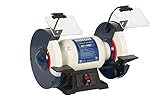
RIKON 80-805 8-Inch Slow Speed
- 1750 RPM
- 60 and 120 grit white aluminum oxide
- cast iron base
- 5 year warranty

BUCKTOOL TDS-200C4HL 8-Inch Low Speed
- 1750 RPM
- 1.5 inch wide white aluminum oxide face
- 0-45 degree tool rests
- LED and 3x magnifier
The DEWALT leads on verified build quality and owner feedback volume. The RIKON leads on chisel safety because it ships with the two wheels you actually need. The BUCKTOOL leads on wheel width, which matters more than most buyers realise when grinding a flat chisel bevel.
Can You Actually Sharpen a Chisel on a Bench Grinder?
The honest answer is yes, conditionally. You can sharpen a chisel on a bench grinder without ruining it if three conditions are met: the wheel is running at or below roughly 1750 RPM or you have slowed it there, the wheel is white aluminum oxide in the 80 to 120 grit range rather than a coarse 36 grit wheel, and you take short passes with light pressure instead of leaning the tool into the wheel.
The fear is not folklore. Owners report ruining good chisels on high-speed machines, and the most common giveaway is blue or straw discolouration at the edge or smoke coming off the steel. That colour means the temper is gone on that section, the steel has gone soft, and no amount of honing will bring the hardness back. You can grind it back to sound steel, but you will have shortened the tool to do it.
There are three situations where I would tell you not to put a chisel near a bench grinder:
You own a handful of chisels and sharpen them twice a year. A coarse diamond stone or a jig-and-stone system will serve you better, cost less, and carry no risk at all. This is the single most common position in the woodworking forums, and it is right more often than grinder marketing suggests.
Your machine is a fixed 3450 to 3600 RPM unit and you are new to sharpening. The learning curve is genuinely unforgiving. A burn is not undoable and beginners make them.
You are trying to put a mirror edge on a fine chisel. Wheels leave a scratch pattern that stones remove. A wheel is a reshaping and bevel-restoring tool, not a finishing tool.
Used correctly, a grinder is the fastest way to restore a damaged bevel or flatten a badly chipped tip, and it handles plane irons and lathe gouges in the same session. That is a genuine capability, not a compromise. It just is not a universal sharpening solution.
Comparing Ten Bench Grinders for Chisel Work in 2026
| Product | Details | Action |
|---|---|---|
|
|
Check Price |
|
|
Check Price |
|
|
Check Price |
 |
|
Check Price |
 |
|
Check Price |
 |
|
Check Price |
 |
|
Check Price |
 |
|
Check Price |
 |
|
Check Price |
 |
|
Check Price |
Two columns decide this table if you are buying for chisels: the speed and the wheel grit that ships with the machine. Four of these ten come with wheels coarse enough that you will need to buy an 80 or 120 grit white aluminum oxide wheel before your first chisel.
1. DEWALT DW758 8-Inch Bench Grinder – Most Verified Power Behind a Fine Wheel
DEWALT DW758 8-Inch Bench Grinder
8 inch wheels
3/4 HP induction motor
3600 RPM
36 and 60 grit included
+ Pros
- 2644 owner reviews at 4.7 stars
- 3/4 HP motor holds speed under load
- 12.5 inch wheel spacing suits long irons
- cast aluminum tool rests adjust firmly with a wrench
– Cons
- Supplied wheels frequently out of balance
- thin sheet steel guards can strip threads
- coasts for over two minutes with no brake
The DEWALT DW758 is an 8-inch bench grinder with a 3/4 HP induction motor turning at 3600 RPM, and it is the best all-round machine here for a shop that sharpens chisels and also does metal work. At 4.7 stars across 2644 ratings, it is by a wide margin the most heavily reviewed grinder in this group, and that matters when you are buying something that spins steel.
I pick it as the editor’s choice because the motor, base and housing are the best-proven parts in the category. The cast iron base and motor housing are described repeatedly as flawless and well balanced, and the 12.5 inch distance between wheels gives you room to work on a long plane iron without repositioning.
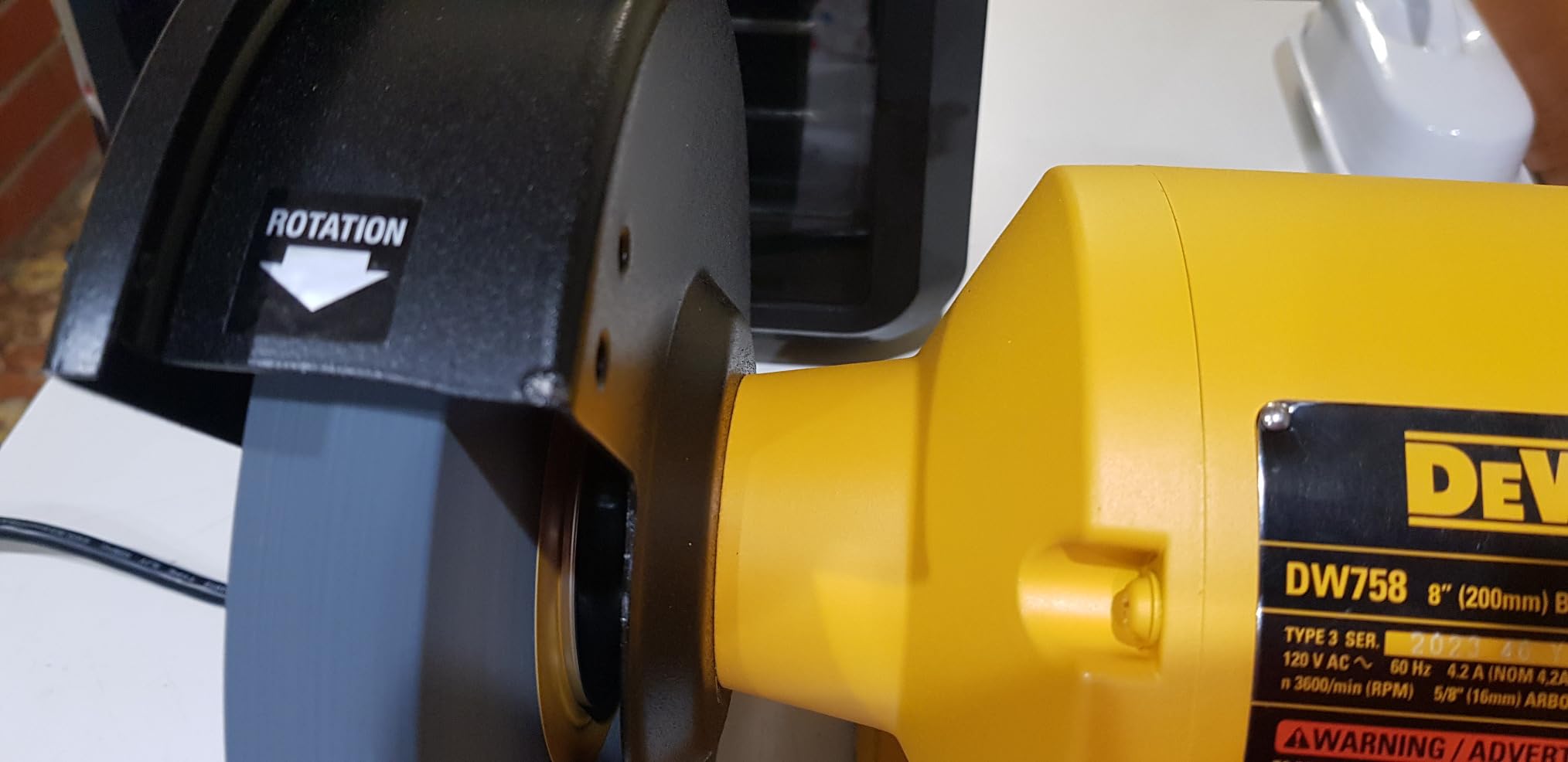
The catch, and it is a real one for chisels, is that 3600 RPM is the fastest wheel here. A 36 or 60 grit wheel at that speed will burn a chisel edge. This machine works because you can fit a fine wheel and treat it carefully, not because it is gentle by default.
Motor Power and the Chisel Question
Three-quarter horsepower is genuinely more than a chisel needs. The value shows up when the same machine handles punch dressing, weld cleanup or a mower blade without the motor browning out. For a chisel-only buyer that headroom is wasted, and it is one reason the low-speed machines below make more sense for narrow use.
The induction motor is the reason it holds speed where smaller universal motors bog. That stability matters on a long pass with a plane iron, where motor sag translates into an inconsistent scratch pattern.
Wheel Balance Is the Real Weak Spot
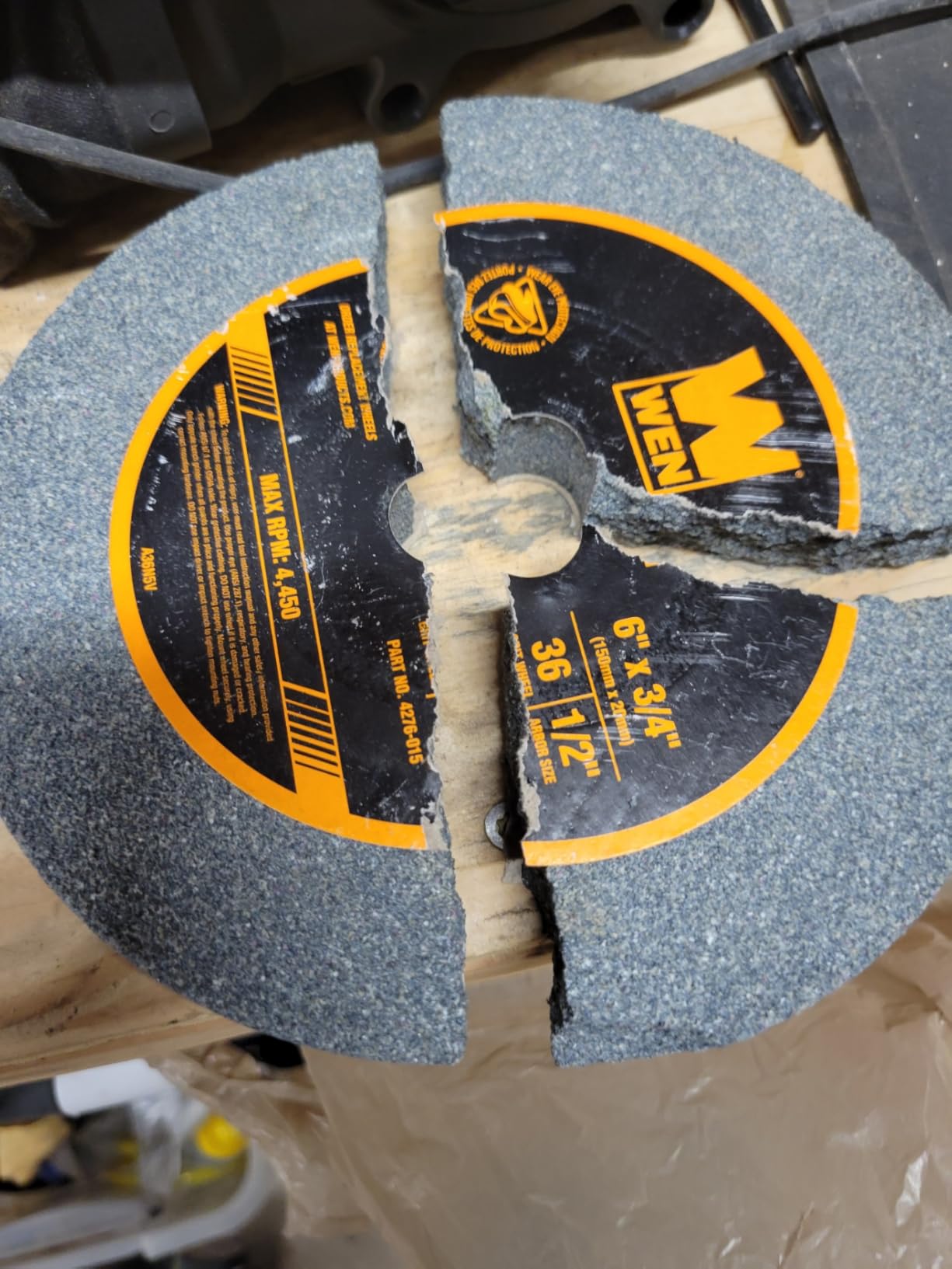
A large share of owner reports focus on factory wheels arriving out of balance, which makes the machine walk across the bench. This is the single most common complaint and it is a safety issue, not just a comfort one, because a walking grinder under load can pull a tool off the rest.
The fix is straightforward: check run-out before use and true or replace the wheels. Once the wheels are sorted, owners report the motor and base are flawless. Treat wheel balance as a setup task you own rather than a defect you inherit.
Tool Rests, Wheel Spacing and Build Details
The precision-machined cast aluminum tool rests adjust firmly with a wrench and hold position under load, which is exactly what a jig-free bevel grind needs. Rear exhaust ports in the wheel guards smooth the airflow, and the whole thing is quieter than most machines of this size.
Two practical niggles. The bolt heads are metric M6 while the threads are SAE 1/4-20, so you need a 10 mm wrench. The guards use thin sheet steel that can strip its threads if you overtighten them, and there is no brake, so the wheels coast down for well over two minutes after shutdown.
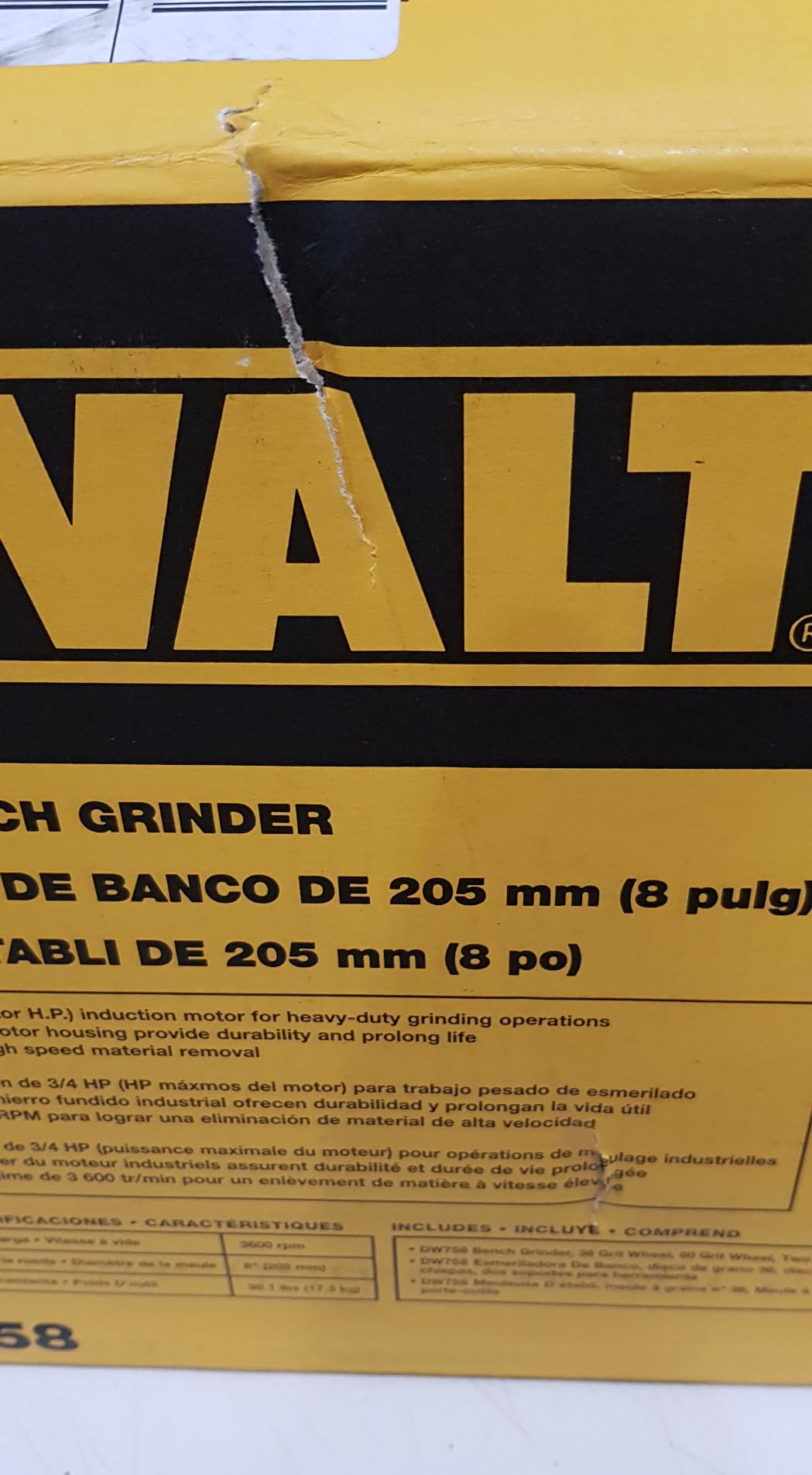
For a chisel-only owner, buy this machine and immediately fit an 80 grit white aluminum oxide wheel. For a shop that also grinds metal, it is the strongest verified build in the group. For someone nervous about burning edges, look at the RIKON instead.
2. RIKON 80-805 8-Inch Slow Speed Bench Grinder – The Community’s Favourite Chisel Machine
RIKON Professional Power Tools, 80-805, 8†Slow Speed Bench Grinder, Powerful Shop Table Tool, Perfect for Sharpening, With Anti-Vibration Rubber Feet
8 inch wheels
1/2 HP
1750 RPM
60 and 120 grit white aluminum oxide
+ Pros
- 1750 RPM is kind to chisels
- ships with 60 and 120 grit white aluminum oxide wheels
- diamond wheel sharpener included
- cast iron base with anti-vibration feet
- 5 year warranty
– Cons
- 1/2 HP leaves less headroom on heavy removal
- 1 inch wide wheels give a narrow grinding face
- no fixture system for jig-based precision
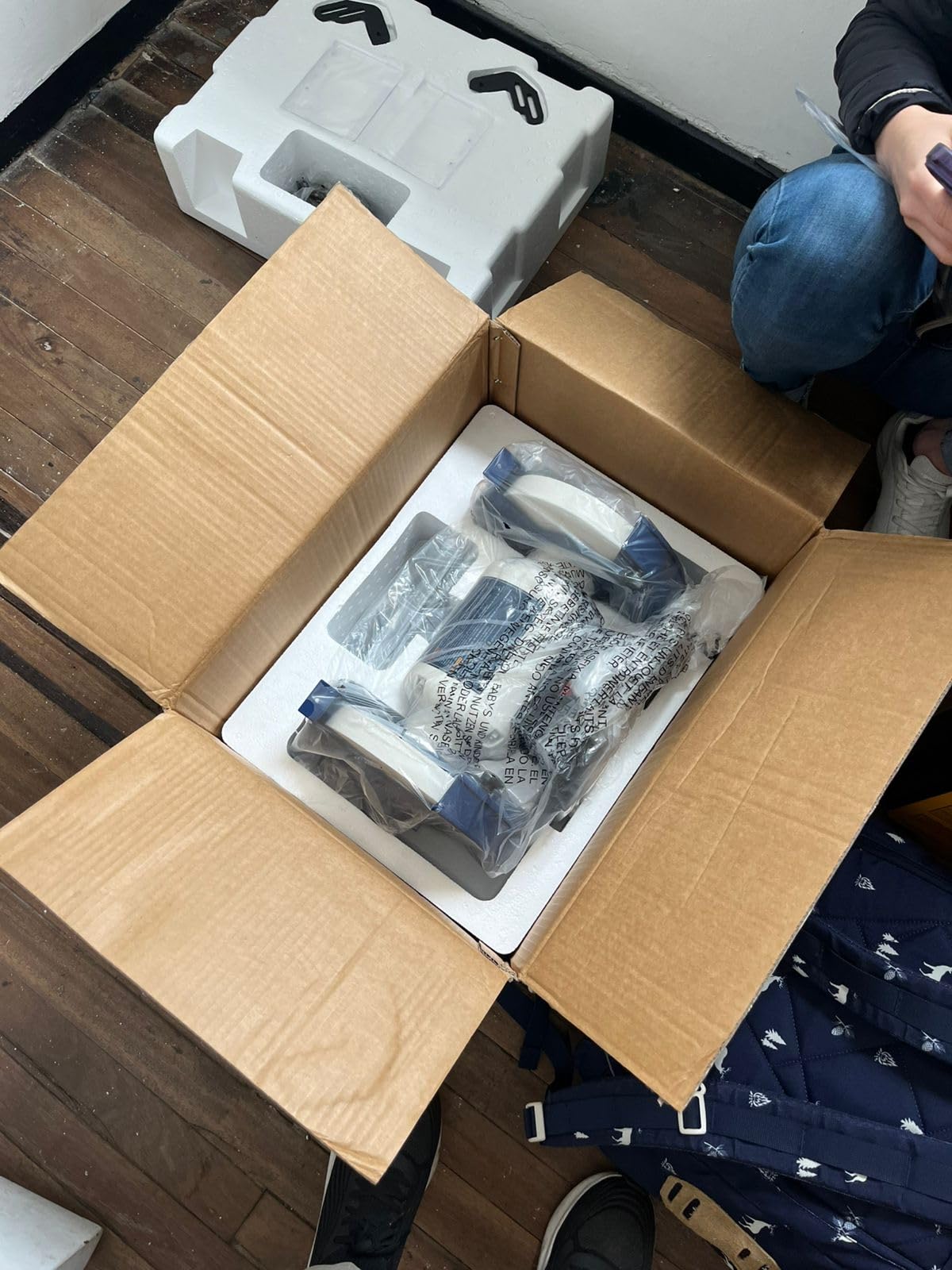
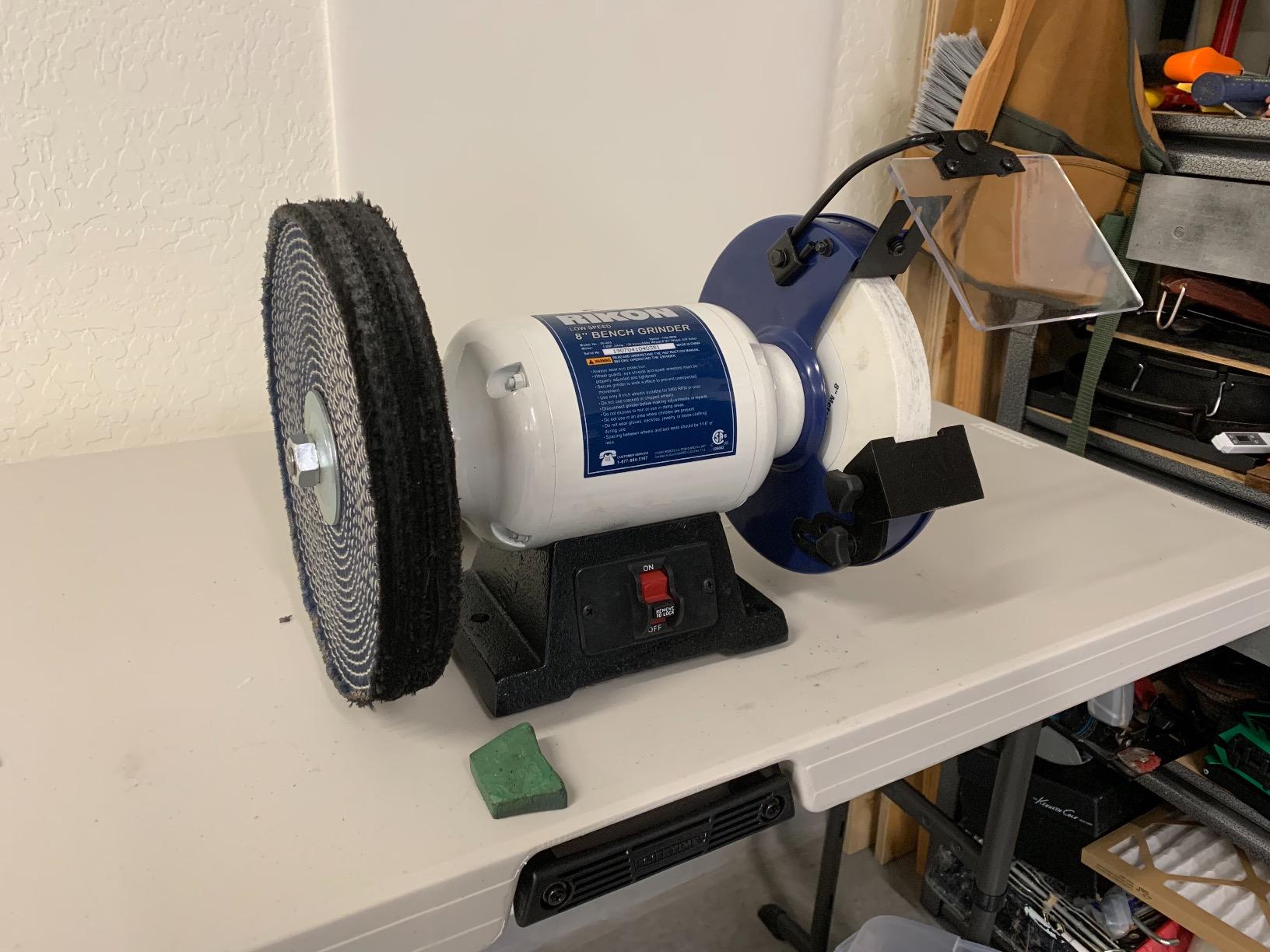
The RIKON 80-805 is an 8-inch slow speed bench grinder running at 1750 RPM, and it is the machine most experienced woodworkers name when the conversation turns to chisels. At 4.6 stars across 848 ratings it also has the second strongest rating volume in this group, which is a meaningful signal for a niche woodworking tool.
What makes it work is simple: it ships with 60 grit and 120 grit white aluminum oxide wheels as standard. Those are the two wheels a chisel needs, in the right abrasive, and they are in the box. Most grinders in this roundup ship coarse wheels that are useless for finishing an edge.
The 1/2 HP motor is more than sufficient for chisels, plane irons and carving tools, and owners consistently describe it as having more than enough power for a small workshop. The honest limitation is that it will not chew through heavy stock removal the way the DEWALT does.
Why 1750 RPM Is the Threshold
Roughly 1725 to 1750 RPM is the number the woodworking community treats as the dividing line between a grinder that sharpens hand tools and a grinder that destroys them. It is not arbitrary. Halving wheel speed roughly halves the surface speed of the abrasive particles, and surface speed is what generates heat at the contact point.
At 1750 RPM you can still take a slightly heavier pass, dwell a fraction longer, and watch the bevel instead of guessing. The machine is also marketed as explicitly cool-running, and a diamond wheel sharpener is included in the box for keeping the wheel free of glazing.
Wheel Width and the Flat Bevel Problem
These are 1 inch wide wheels, and that is the spec most often criticised. A narrow face gives you fewer contact points across a chisel bevel, which means more repositioning and more chances to lose the angle mid-pass. It is workable, and owners rate it well, but a 1.5 inch face is simply easier to hold consistently.
There is also no fixture or jig system. You are working from the flat tool rest, which means the bevel angle you get is the angle your hand holds. For most sharpening that is fine. For repeatable 25 or 30 degree bevels, you will want a jig, and this machine has no bar to mount one to.
Build Quality, Feet and Extras
The cast iron base with anti-vibration rubber feet is genuinely useful. Vibration at the wheel translates into an inconsistent scratch pattern and a wander in the bevel, and owners single the feet out as a reason the machine feels solid in use.
Adjustable safety eye shields and spark resistors are included, along with a groove in the tool rest for sharpening drill bits. The five-year manufacturer warranty is the longest in this roundup, which matters for a machine with a small motor and a long service life ahead of it.
This is the one I would buy if sharpening chisels is the main reason I own a grinder. It arrives with the right wheels, it runs cool, and it is backed for five years. Skip it only if you also do heavy metal removal, where the half horsepower motor will feel slow.
3. BUCKTOOL TDS-200C4HL 8-Inch Low Speed Grinder – Widest Wheel Face for Flat Bevels
BUCKTOOL 8″ 3/4HP Low Speed Bench Grinder fit CBN Wheel,Wobble Free Wheels
8 inch wheels
3/4 HP
1750 RPM
1.5 inch wide white aluminum oxide face
+ Pros
- 1750 RPM suits chisels and hand tools
- 1.5 inch wide wheel face is easier to hold
- tool rests adjust 0-45 degrees
- 3 watt LED and 3x magnifying eye shield
– Cons
- Wheels may need dressing out of the box
- key safety switch adds a step and keys get lost
- no light for both wheels at once
The BUCKTOOL TDS-200C4HL is an 8-inch low speed bench grinder running at 1750 RPM with a 3/4 HP motor, and it is the pick for anyone who struggles to keep a chisel bevel consistent. At 4.6 stars across 320 ratings, owner feedback is strong and consistent on the things that matter here.
Its distinguishing feature is wheel width. The right-hand wheel is 1.5 inches of white aluminum oxide, the widest working face in this roundup, and the left wheel is an 8 by 1 inch 80 grit wheel. Wide faces mean more of your bevel is supported at once, which is the difference between a repeatable angle and a hopeful one.
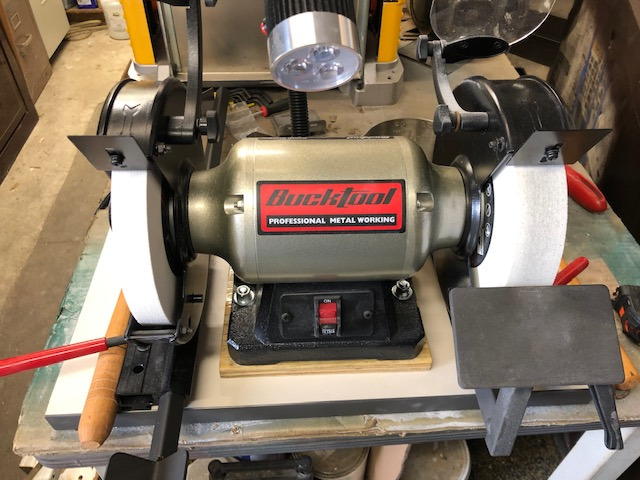
The 4.8 amp 1750 RPM induction motor is rated 3/4 HP with 1-1/4 HP peak power, and it is specifically designed to drive a CBN wheel. If you later want to move to cubic boron nitride, this machine is ready for it. That is the enthusiast upgrade, and few grinders in this list are.
Heat, Speed and the CBN Question
Low speed is the headline, but the motor design is what makes it practical. An induction motor at 1750 RPM has the headroom to keep a fine wheel biting rather than stalling, so you can use a finer grit and a lighter press instead of leaning on a coarser wheel at higher speed. That is the safer combination for hardened steel.
Being CBN-ready matters for anyone who sharpens often. CBN wheels stay sharp at low speed and run much cooler than aluminum oxide, cutting heat at the source. They cost several times more than a standard wheel, which is why most first-time buyers stay with white aluminum oxide.
Tool Rest Adjustment and Magnified Inspection
The cast aluminum tool rests adjust from 0 to 45 degrees, which is a wider range than most machines in this group and directly relevant to chisel work. It lets you set a coarse flattening pass at one angle and refine the bevel at another without reworking the whole setup.
The 3 watt LED has its own switch and lights the work area for detail sharpening, and the eye shield carries 3x magnification. That magnifier is more useful than it sounds: inspecting a bevel for wire edge and burn discolouration under magnification is the difference between catching a problem and missing it.
What to Watch Before First Use
Owners report that wheels sometimes need dressing or truing to run true out of the box. That is normal on a machine of this class and worth doing before you put steel to it, because run-out is what produces a scalloped edge.
The keyed safety switch is a genuine safety feature and also an inconvenience, because it adds a step before every use and the keys wander. There is no light assembly covering both wheels at once, only the single LED. Neither issue affects sharpening quality.
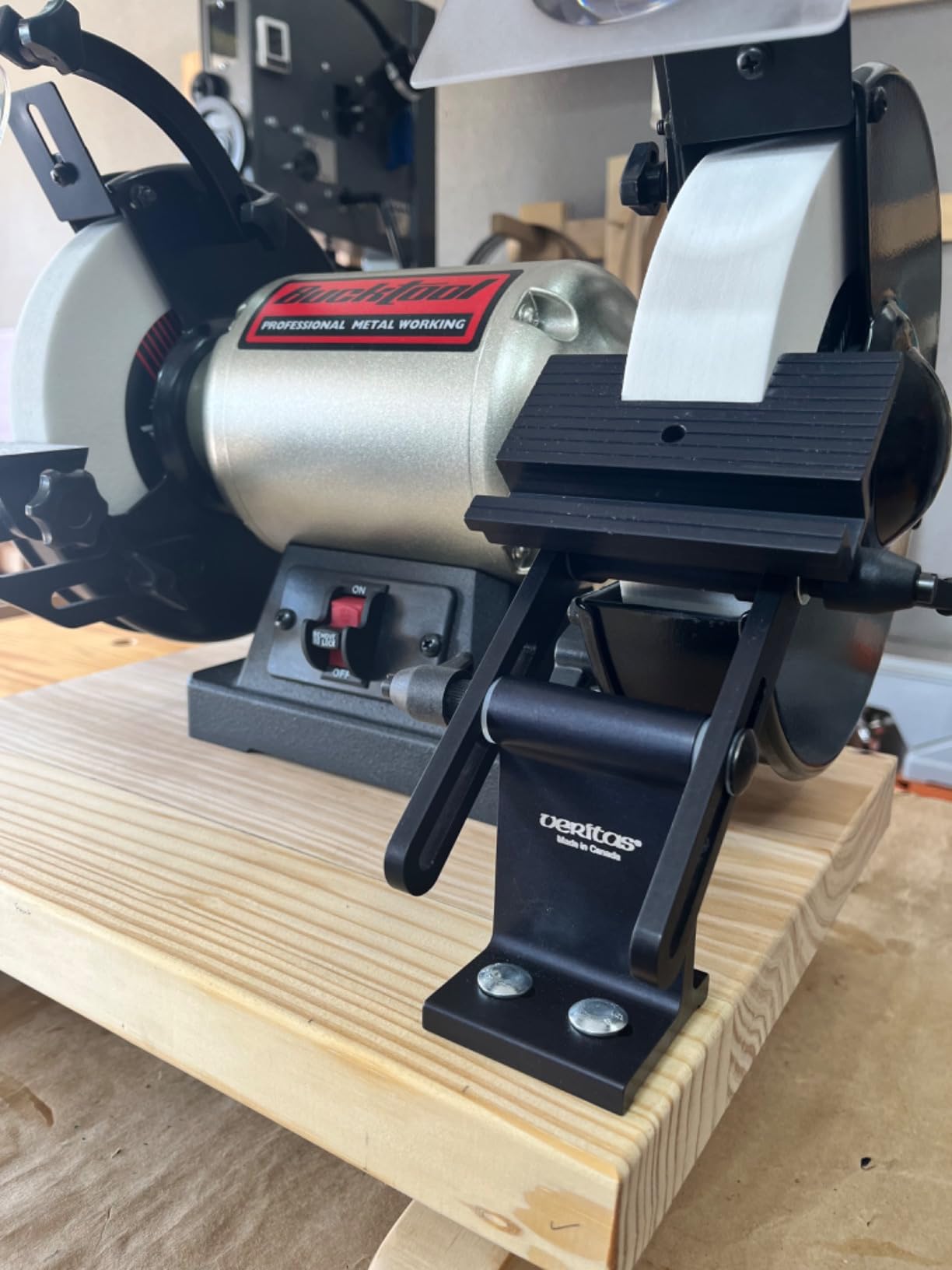
Choose this over the RIKON if you want more motor power, a wider grinding face and rests that adjust to an angle. Choose the RIKON if you want the finer wheels in the box and a longer warranty. Both are correct answers to the same question.
4. WEN BG4286 8-Inch Slow Speed Bench Grinder – The Cheapest Route to 1,750 RPM
WEN BG4286 3-Amp 8-Inch Slow Speed Bench Grinder, Orange,black
8 inch wheels
3 amp soft start
1750 RPM
60 and 120 grit wheels
+ Pros
- 1750 RPM is gentle on chisels
- soft start reduces wheel wobble at spin-up
- ships with 60 and 120 grit wheels
- pre-drilled mounting holes
- compact 8 inch footprint
– Cons
- 34 pound base is awkward to reposition
- 250 watt rating is modest for heavy work
- 1 inch wide wheels give a narrow face
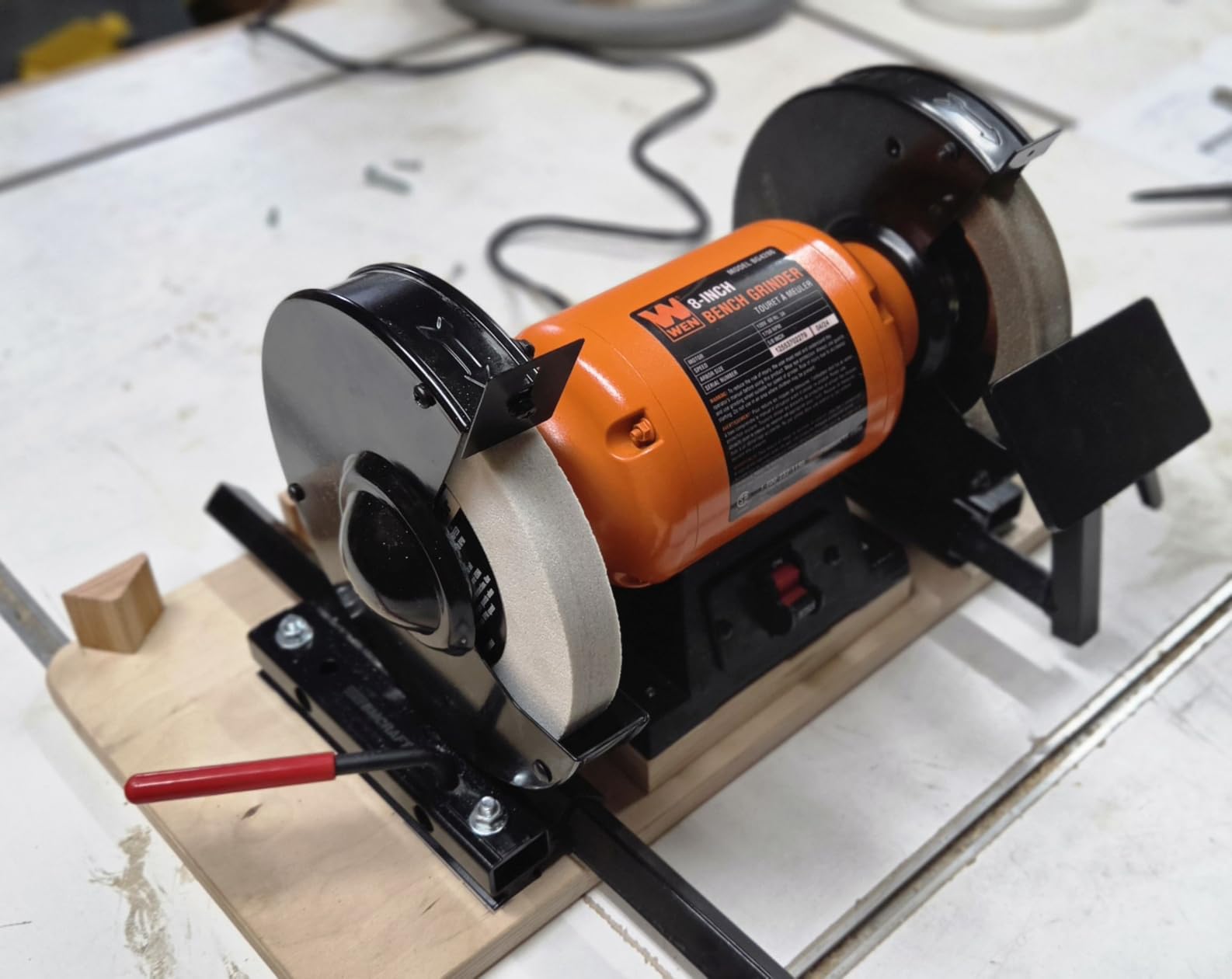
The WEN BG4286 is an 8-inch slow speed bench grinder that turns its wheels at up to 1750 RPM from a 3 amp soft-start motor, and at 4.5 stars across 221 ratings it is the most direct budget route to the speed chisels need. It is rated far lower than the DEWALT and the JET, and that is exactly the trade you are making.
It ships with a general 60 grit wheel and a fine 120 grit finish wheel, which is the correct pair for sharpening a chisel. You are not buying a machine and then immediately needing to source wheels, and for a first sharpening setup that removes the most common early frustration.
Soft Start and What It Fixes
The soft start ramps the motor gently, and owners specifically credit this with reducing wheel wobble on spin-up. That matters more than it sounds. A wheel that comes up to speed violently flexes outward, and the first pass of the session is made on a wheel whose true shape is still settling.
At 1750 RPM the wheel never reaches the speed where that flex becomes dangerous, so soft start is a refinement here rather than a safety net. It is still a good sign about how the machine was engineered.
Power Limits and the Honest Trade
The 250 watt rating gives limited power for heavy stock removal, and this is not the machine to buy if you also grind weld spatter or dress punches. For chisels, plane irons and light lathe tools, the motor is adequate because low speed means low power demand and light material removal.
The 1 inch wide wheels give a narrow working face, the same limitation as the RIKON. It is a smaller version of the same machine class at a lower price, and it is a sensible pick if your sharpening load is occasional.
Mounting and Footprint
Pre-drilled mounting holes are a real convenience here and they are not universal in this category. Bolting the grinder to the bench removes the walking problem at the root rather than relying on rubber feet.
The 34 pound base is heavy for its size, which makes it stable on the bench but awkward to reposition. The compact 8 inch footprint suits a smaller bench, and pivoting tool rests plus adjustable eye guards are both included.
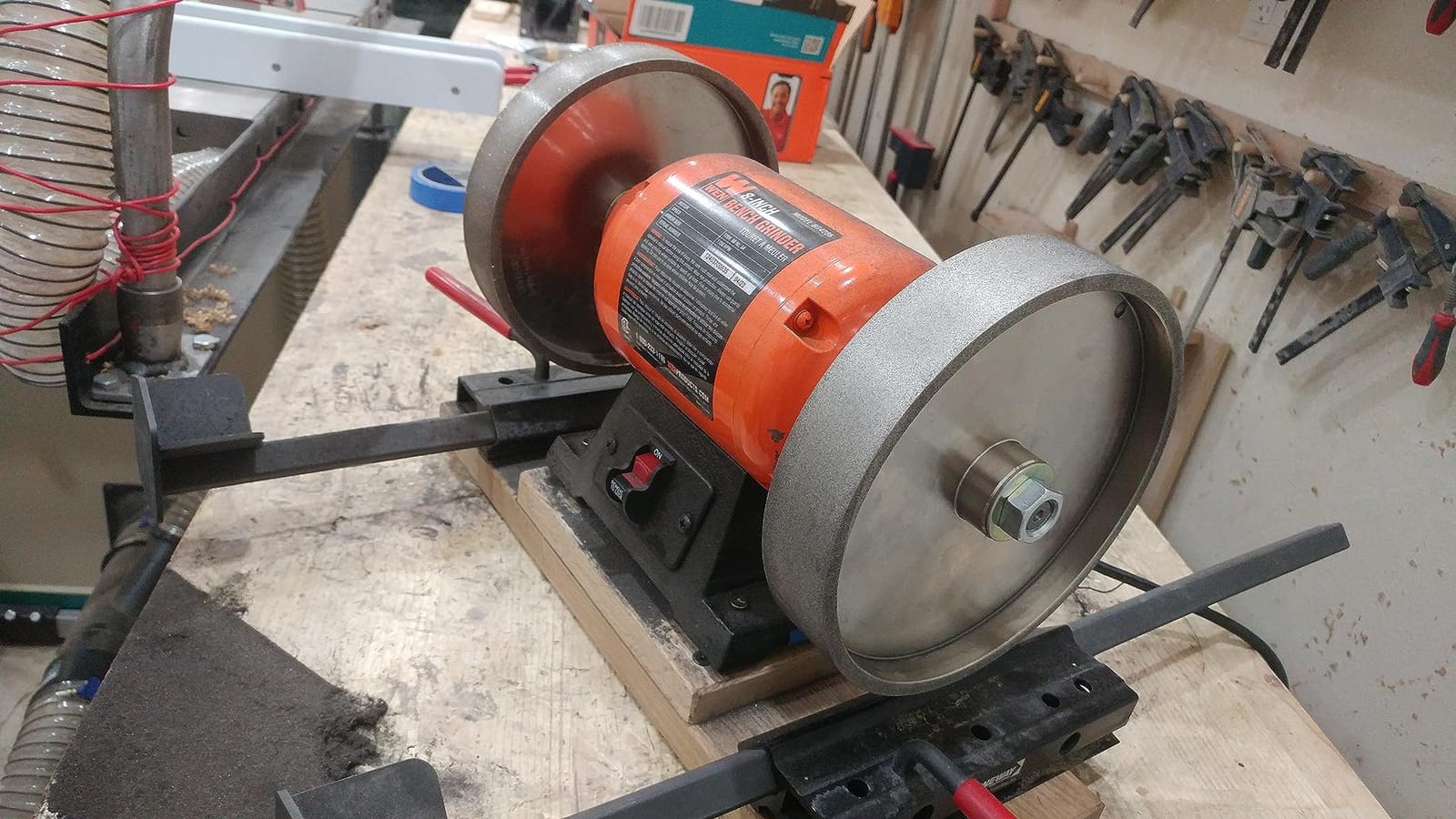
For someone who wants a low speed grinder without spending mid-tier money, this is the straightforward answer. Accept the narrow wheels and modest power, and you get safe chisel work with the right wheels already fitted. If you want more headroom and a wider face, stretch to the BUCKTOOL.
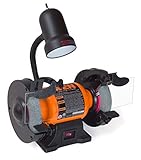
5. WEN BG4270T 10-Inch Wet Sharpening System – Zero Burn Risk at 115 RPM
WEN BG4270T 10-Inch Two-Direction Water Cooled Wet/Dry Sharpening System
10 inch 220 grit water stone
8 inch leather strop
115 RPM
reversible rotation
+ Pros
- 115 RPM water-cooled stone is very gentle on chisels
- includes a chisel and planer blade jig
- reverses rotation with a switch
- universal jig bar accepts Tormek-style accessories
– Cons
- Accessory bar is short with excess play
- stamped steel chisel jig is imprecise
- 10 inch stone has run-out that needs truing
The WEN BG4270T is a 10-inch two-direction water cooled wet and dry sharpening system that turns its stone at 115 RPM, and it removes the burn question entirely. At 4.4 stars across 801 ratings, reviewers widely treat it as an affordable alternative to a dedicated water-cooled sharpening machine.
That is 115 RPM against a bench grinder’s 3450. There is no credible way to burn a chisel edge at that speed, and the water reservoir keeps the stone lubricated and cool as you work. If your fear is ruining steel, this is the category to shop in.
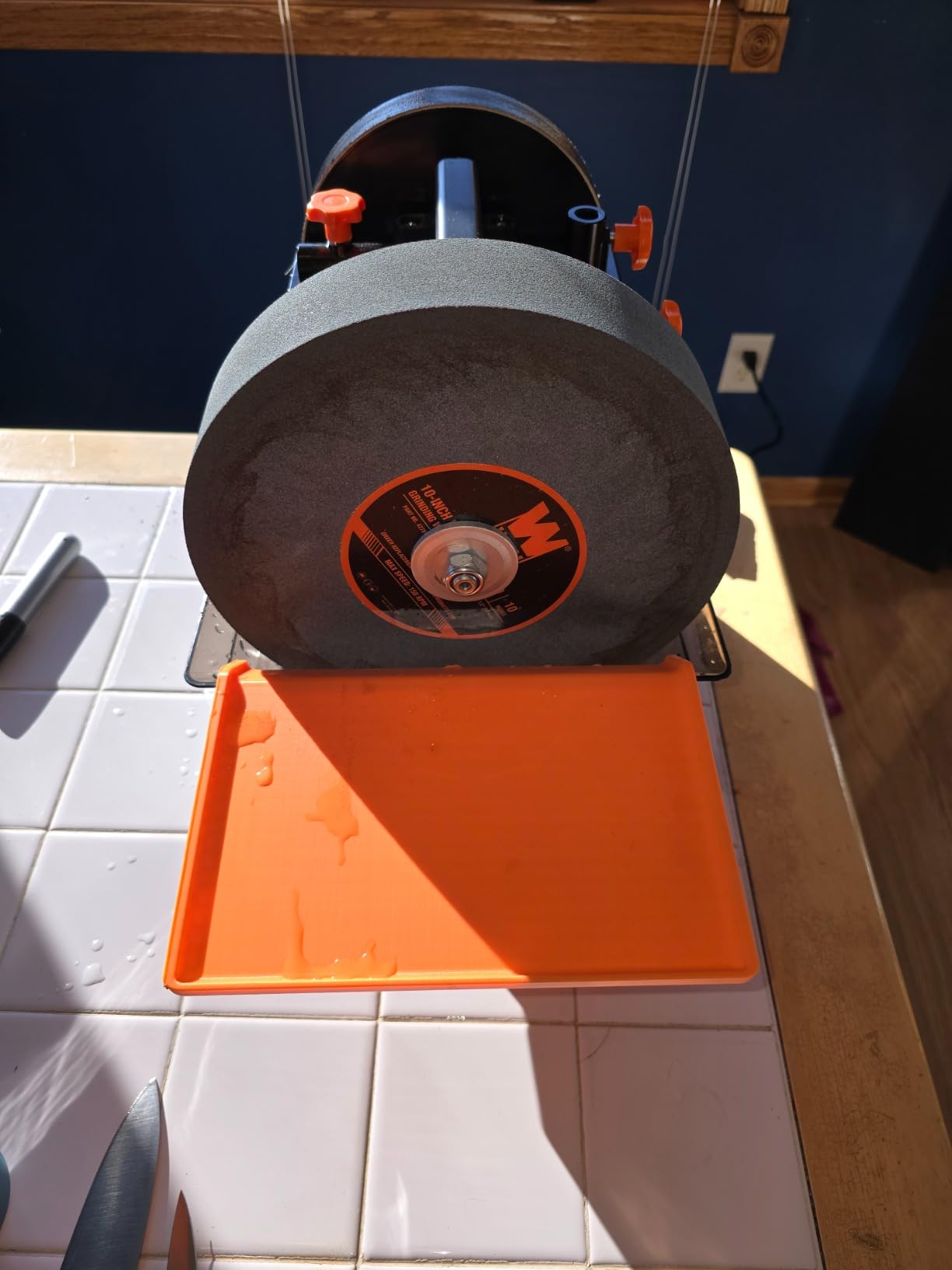
Why Water and Low Speed Change Everything
Two things are happening at once. The abrasive is a water-cooled stone rather than a vitrified wheel, so heat leaves the contact point continuously. And the speed is slow enough that friction never becomes the dominant effect. The result is a controlled, burr-free edge with no colour change and no temper loss.
For long sharpening sessions this is the difference between a machine you relax around and one you use carefully. A full set of bench chisels is an unhurried job, and unhurried is where a slow wet system earns its place.
The Accessories Are the Weak Point
The box is generous. You get a chisel and planer blade jig, an angle guide, a honing compound, an adjustable water reservoir and a carrying handle. Very few machines at any price include all of that.
The quality of those accessories is the weakness. The universal jig support bar has excess play and is too short, so jigs can slide off the end, and it can go out of parallel with the wheel when tightened, which risks non-square sharpening. The stamped steel chisel jig is imprecise and awkward for standard-length chisels, so you may outgrow it quickly.
The Stropping Wheel and the Finishing Stage
The 8 inch leather stropping wheel is what removes the wire edge after grinding and refines the finish. Every sharpening system needs this final stage, and having it built in is genuinely convenient. The leather itself is of mediocre quality and its attachment can fail, which is a fair complaint.
At 220 grit the stone is a refining surface, not a reshaping one. This machine restores and hones an edge; it does not flatten a badly chipped tip the way a 36 grit wheel does. Know which job you are buying it for.
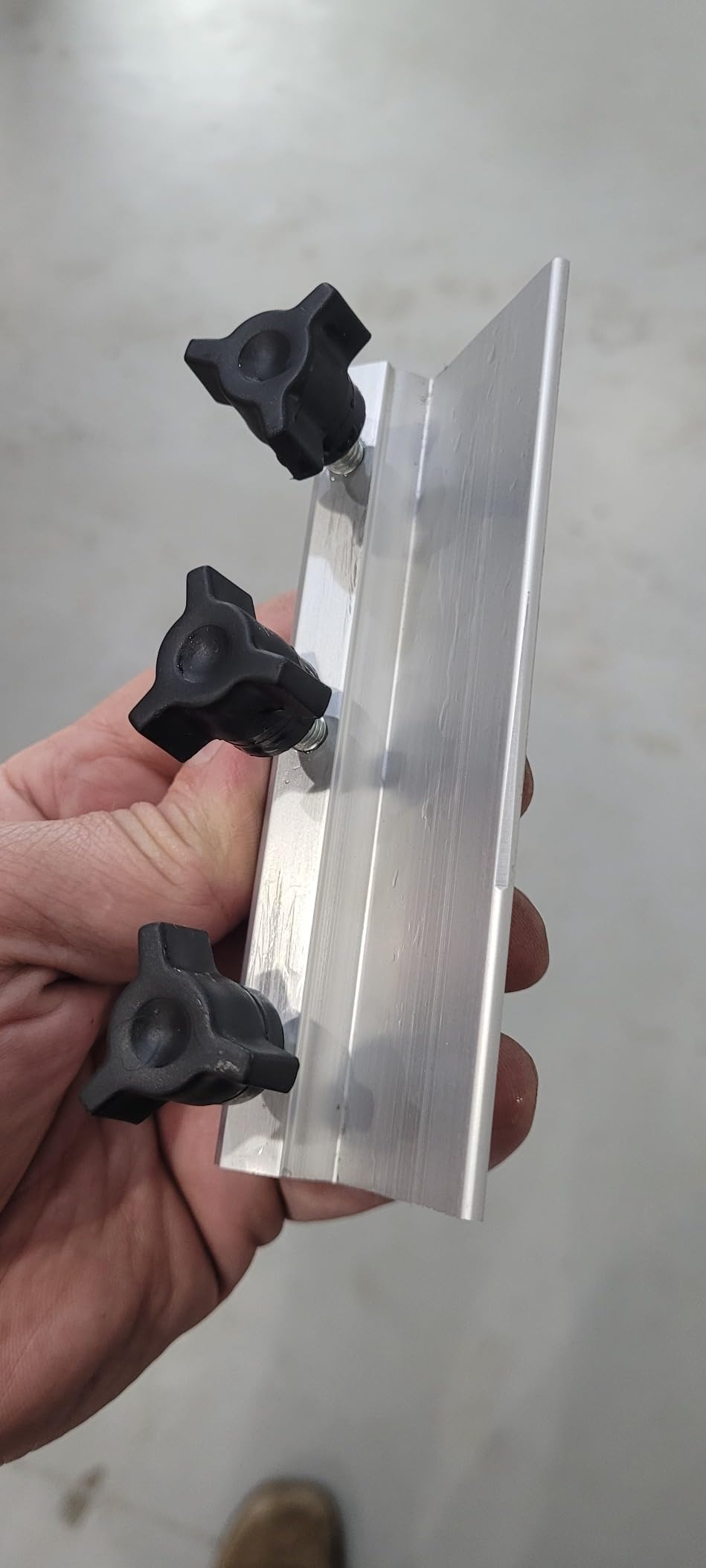
Choose this if you sharpen chisels and nothing else heavy, and if the sound of a wheel at full speed makes you tense. Do not choose it if you need to reshape steel quickly or deburring, because 115 RPM is far too slow for that. The water reservoir is also splashy and throws water onto the machine and bench.
6. JET JBG-8 8-Inch Bench Grinder – The Best Built Machine in the Group
JET 8-Inch Bench Grinder, 3450 RPM, 1/2 HP, 120V 1Ph (Model JBG-8)
8 inch wheels
1/2 HP
3450 RPM
36 and 60 grit vitrified wheels
+ Pros
- Exceptionally smooth and quiet with almost no vibration
- holds speed under heavy pressure
- solid cast tool rests and guards
- one-piece quick-adjusting spark guards
- rubber mounts prevent shifting
– Cons
- 3450 RPM runs hot on sharpening edges
- 58.5 pounds is best on a stand
- no work light included
The JET JBG-8 is an 8-inch bench grinder running at 3450 RPM on a 1/2 HP motor, and at 4.7 stars across 404 ratings it is the best-built machine in this roundup by a distance. Owners describe it as smooth, quiet and well balanced, with essentially no vibration or wobble. Nothing else in this group gets described that consistently.
That build quality is not a chisel feature. It is a durability and control feature, and control is what keeps a burn from happening. A machine that does not wander gives you a stable tool rest, and a stable rest means light passes at a consistent angle.
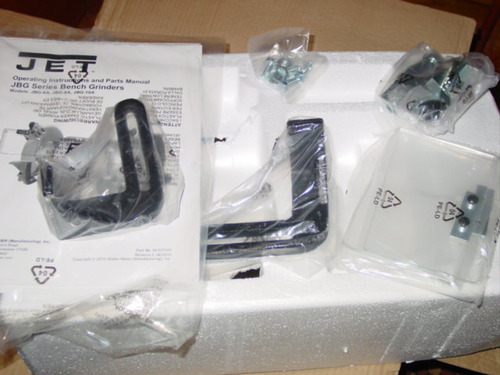
Why Balance Matters More Than Power
The totally-enclosed permanently lubricated ball bearings and the cast iron wheel guards are what produce the near-silent running. The machine holds speed under heavy pressure without bogging, which means the wheel does not slow and reheat when you lean on a pass.
For chisel work, that is the argument. Most burns come from dwelling too long in one spot. A machine that responds predictably and does not bog lets you take the pass you meant to take instead of the pass the machine forced on you.
The Heat Problem Is Real Here
At 3450 RPM this is a hot wheel and owners say so plainly. It ships with 36 grit and 60 grit vitrified wheels, which is a general-purpose kit, not a sharpening kit. For chisels you want an 80 or finer white aluminum oxide wheel fitted before you start.
This is the same situation as the DEWALT, and the same rule applies. The JET is not a safe default for chisels. It is a very controllable fast machine, which is a different and more demanding thing.
Weight, Mounting and Workshop Realities
At 58.5 pounds, this belongs on a pedestal stand rather than a bench. That is a real consideration if you were planning to bolt it down at a working height, and it is the main practical objection to the machine.
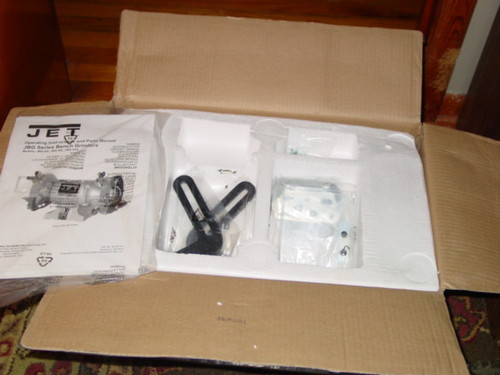
Everything else is first-rate. One-piece quick-adjusting spark guards and large quick-adjusting eye shields are easy to position, rubber mounts prevent the machine shifting, cast iron wheel guards have dust vents, and it is built to CSA safety standards. It carries a two-year warranty.
Buy the JET if you want a grinder that will outlast the rest of your shop and you will fit a fine wheel for sharpening. If your only job is chisels, the heat at 3450 RPM buys you nothing. This is the answer to which bench grinder is considered the best quality, with the caveat that build quality is not the same as proven long-term durability at this review volume.
7. WEN BG4276 6-Inch Bench Grinder – Best Small Grinder for Chisels Without Fear
WEN BG4276 2.1-Amp 6-Inch Single Speed Bench Grinder with Flexible Work Light, Black,orange
6 inch wheels
2.1 amp
3450 RPM
60 and 36 grit wheels included
+ Pros
- 4.6 stars across 1791 ratings
- runs quietly with minimal vibration
- soft start prevents walking at spin-up
- flexible work light
- assembles in minutes
– Cons
- Supplied wheels are mediocre and may need truing
- no bulb included for the work light
- no motor brake
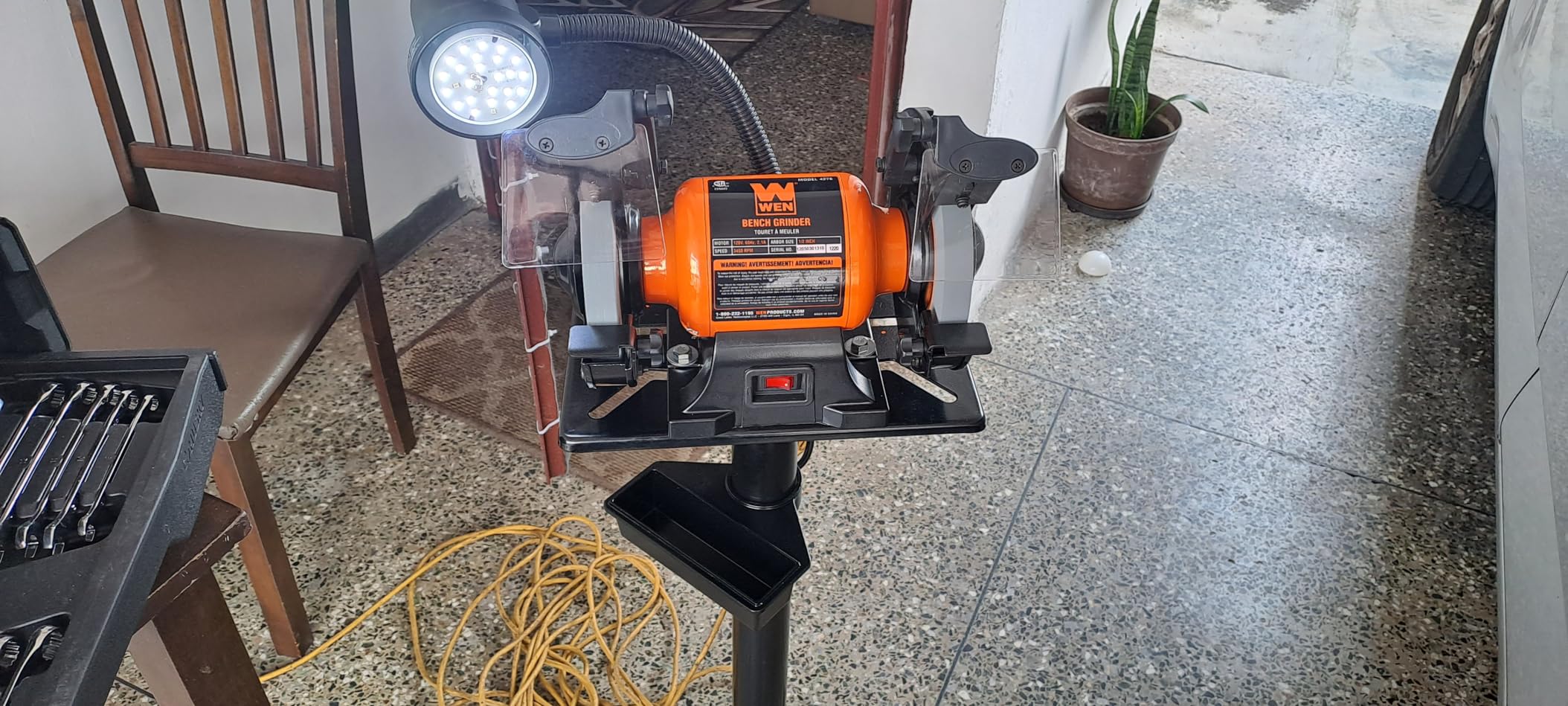
The WEN BG4276 is a 6-inch bench grinder with a 2.1 amp motor turning its wheels at up to 3450 RPM, and at 4.6 stars across 1791 ratings it is the most reviewed machine in this roundup. It is also the one I would be least likely to recommend for sharpening a fine chisel, and the reason is worth explaining.
A 6-inch wheel at 3450 RPM has higher surface speed at the rim than an 8-inch wheel at 1750 RPM, despite the smaller diameter. That is the whole argument in one sentence, and it is why the community’s advice that a small grinder works fine for chisels depends entirely on which wheel is fitted.
Quiet, Soft Starting and Genuinely Good Bearings
Owners consistently praise this machine for running almost silently with minimal vibration thanks to good bearings. The soft-start ramp prevents the machine from walking or jumping at spin-up, which is a real quality feature at any price.
Assembly takes minutes with a screwdriver and pliers, the tool rests adjust by hand to sit close and level to the wheel, and the flexible work light can be positioned to suit the job. For general tool work, drill bits, axes and hoes, this is a well-behaved little machine.
Why It Is Not a Chisel Grinder by Default
It ships with a 60 grit and a 36 grit wheel, and both are too coarse to finish a chisel edge. Reviews are positive about drill bits and general reviving, and the strongest owner mentions of chisels involve light work on already-serviceable edges.
If you fit an 80 or 120 grit white aluminum oxide wheel, keep the pressure light and treat it as a fast wheel, it will sharpen a chisel. The risk is that at this speed a beginner’s mistake shows up as blue steel rather than as a slightly dull edge. That is the trade for a compact, quiet, cheap machine.
Practical Details Worth Knowing
No bulb is included for the work light, which owners mention as an annoying omission. There is no motor brake, so the wheels can spin for a minute or two after shutdown. The mounting holes sit mid-plate under the motor shaft, which makes bolting the machine down awkward compared with a pre-drilled base.
It also takes roughly 25 to 30 seconds to reach full speed. At 16 pounds and 14 by 9.8 by 15 inches, it is the most portable machine here and the easiest to move off a small bench.
This is the best value machine in the list for general workshop use, and it is backed by a two-year warranty. It is not my chisel pick, and if sharpening is your primary reason for buying, spend the extra and move up to a low speed machine.
8. KFMK SCM8103S 10-Inch Wet System – Adjustable Wet Speed From 90 to 160 RPM
KFMK 10 Inch Variable Speed Wet Sharpening System, 90-160RPM Wet Bench Grinder, Two Direction Water Cooled Wet/Dry Sharpening System for knife, Chisel, Scissor, Woodworking Tools
10 inch wet wheel
90-160 RPM variable
8 inch leather strop
adjustable jig support
+ Pros
- 90-160 RPM range lets you dial the speed to the job
- water-cooled wheel prevents overheating
- rotation reverses for both edge types
- jig support adjusts horizontally or vertically
– Cons
- Rating is modest with a visible share of 3 and 1 star reviews
- 1.0-1.2 amp motor is slow on large work
- sharpening against the strop cuts the leather
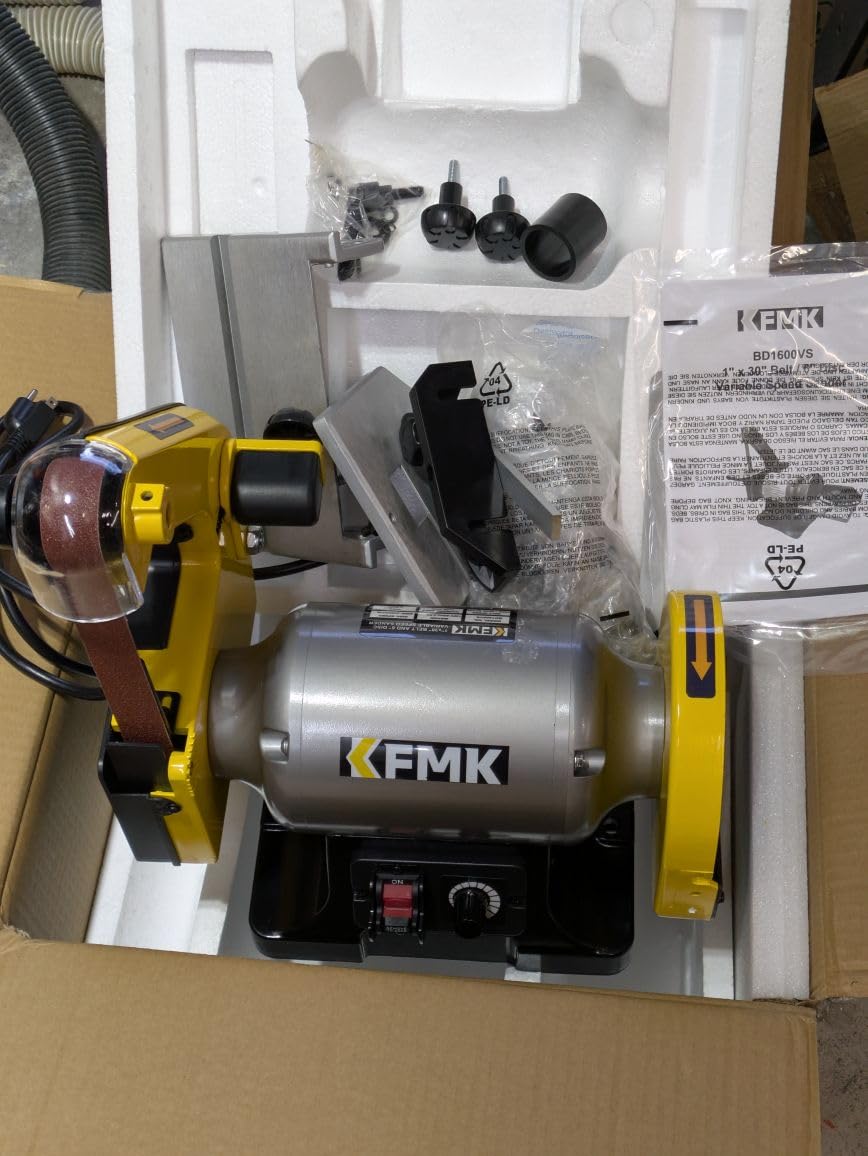
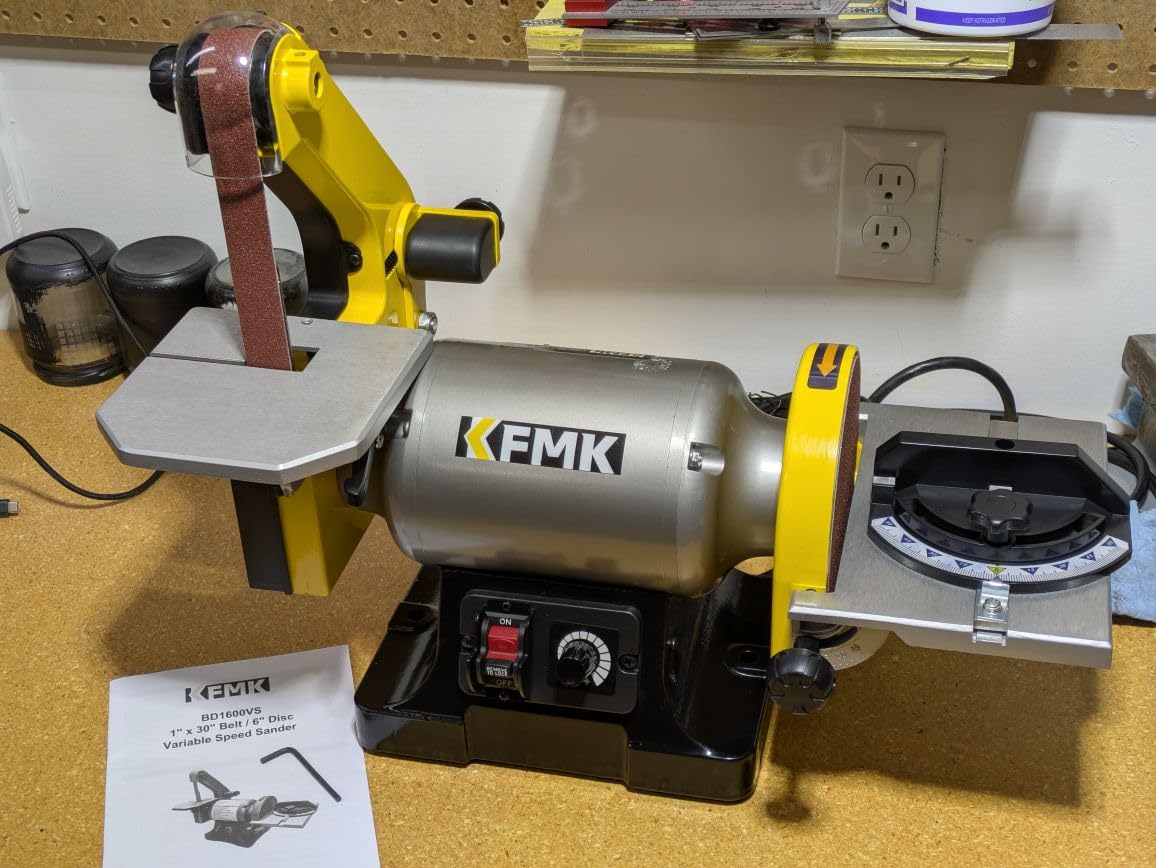
The KFMK SCM8103S is a 10-inch variable speed wet sharpening system running between 90 and 160 RPM from a fully enclosed 1.0 to 1.2 amp motor, and at 4.3 stars across 203 ratings it is the most adjustable low-speed system in this group. Reviewers like the controlled, burr-free edges it produces on chisels and carving tools.
Unlike a fixed wet system, this one lets you choose where in the range you work. Coarse work at the low end, refinement at the high end, with a water trough under the wheel throughout keeping the tool from overheating during long sessions.
What Variable Wet Speed Actually Buys You
On a fixed low speed machine, the only heat control you have is your technique. Here you can drop the speed further when you are on a hardened socket chisel or an unfamiliar edge, and bring it up when you are doing routine maintenance. That is genuine control rather than a marketing label.
The water trough beneath the 10-inch aluminum oxide wheel is the other half of the safety story. Lubrication and low speed together mean a burn is close to impossible, which is the same reassurance the WEN BG4270T offers at a fixed 115 RPM.
The Jig Support Is the Feature to Look At
The jig support adjusts to both horizontal and vertical positions, and an angle guide is included for setting the grinding angle. That is more fixture capability than the wet WEN system offers out of the box, and it directly addresses the angle consistency problem that trips up most beginners.
Two-direction rotation supports both edge types and handedness, and the 8-inch leather stropping wheel removes burrs and refines the finish. One caution: do not sharpen against the direction the leather wheel turns, because it cuts into the leather.
Where the Rating Divides
At 4.3 this sits well below the machines above it, with a noticeable share of 3-star and 1-star reviews. The most common substantive complaint is the enclosed motor, which supplies only about 1.0 to 1.2 amps and makes large workpieces slow.
Accessories are limited to an angle guide, honing compound and a wrench, so the jig system is less complete than the wet WEN. For chisels and carving tools that is fine. For anything oversized, the motor is the limiting factor and no amount of care changes it.
Choose this over the WEN BG4270T if you want to tune the speed rather than live with one setting, and if your tool collection skews toward carving and lathe work. Choose the WEN if you want more included accessories and a higher owner rating.
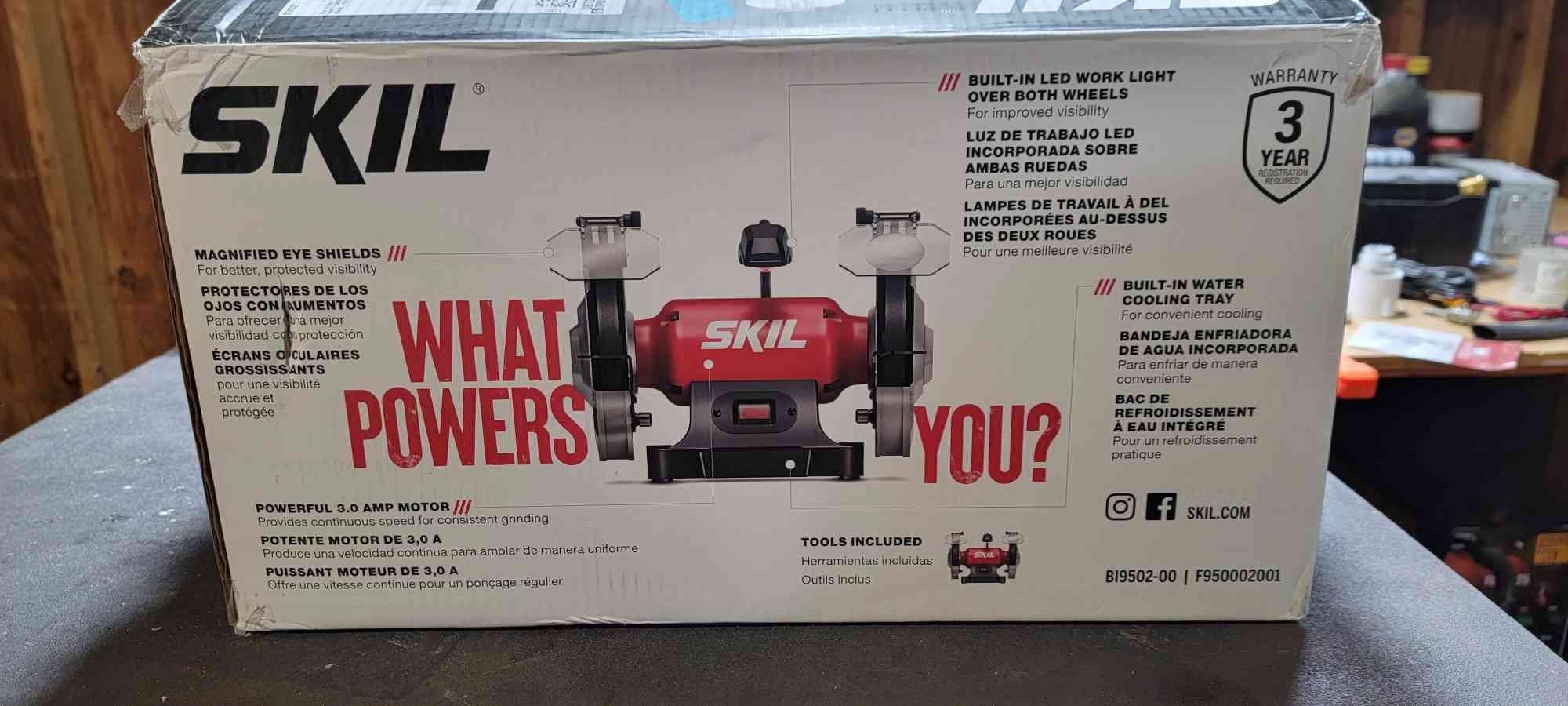
9. SKIL BI9502 8-Inch Bench Grinder – Built-In Water Tray Tames a Hot Wheel
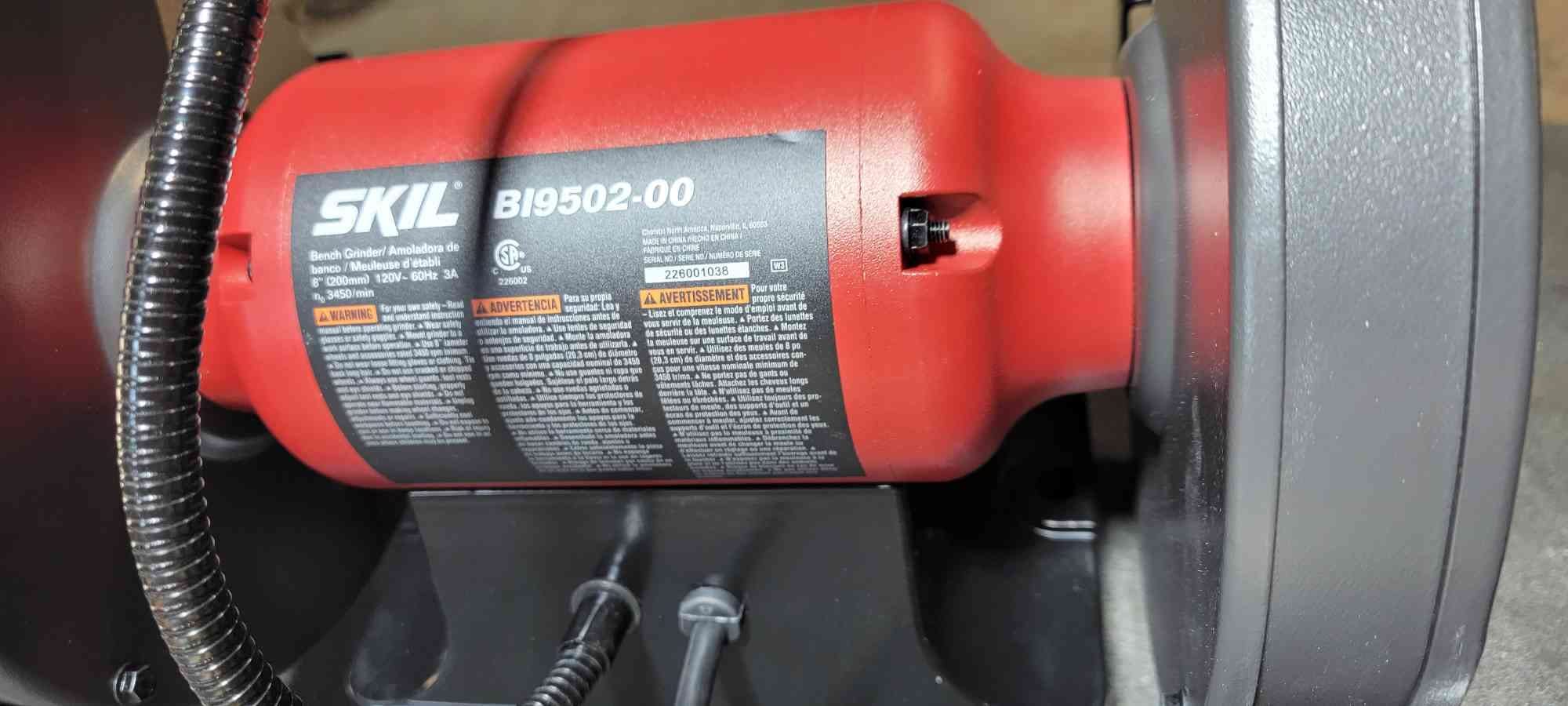
SKIL 3.0 Amp 8 In. Bench Grinder with Built-in Water Cooling Tray & LED Work Light – BI9502-00
8 inch wheels
3.0 amp
3450 RPM
built-in water cooling tray
LED over both wheels
+ Pros
- Built-in water tray helps control heat on the workpiece
- LED work light illuminates both wheels
- magnified eye shields aid inspection
- V-grooved adjustable tool rests aid accurate grinding
– Cons
- 3450 RPM generates more heat than a low-speed grinder
- fewer customer reviews than most in the category
- listed dimensions of 1 inch by 1 inch by 1 inch are not meaningful
The SKIL BI9502 is an 8-inch bench grinder with a 3.0 amp motor at 3450 RPM, and at 4.4 stars across 114 ratings it is the most interesting hybrid in this group. It is a fast grinder with a built-in water cooling tray, a combination that aims squarely at the heat problem without giving up general shop capability.
A water tray is not the same as a water-cooled wheel. It lets you dip the tool and cool it between passes, which breaks up the heat cycle and is meaningfully safer than grinding dry. It does not make a 3450 RPM wheel behave like a 1750 RPM wheel, and owners note the speed is the main limitation.
What the Water Tray Does and Does Not Do
Dipping a hot chisel in water between passes is the oldest technique in the trade and it works because heat dissipates in the time the tool is out of contact. A built-in tray puts that option within reach at the machine instead of across the shop, which is why owners report it helping control heat on the workpiece.
What it cannot do is prevent the heat that builds during a single long pass. Keep passes short and the tray is a real advantage. Take one long grinding pass and the wheel speed decides the outcome, exactly as it would on any other 3450 RPM machine.
Lighting and Inspection for Detail Work
The LED work light sits over both wheels, which is unusual at this level and genuinely useful when you are inspecting a bevel rather than grinding bulk material. The magnified eye shields give the same benefit for close inspection of the edge, which is where you catch wire edge and discolouration early.
The adjustable V-grooved tool rests aid accurate grinding and also assist with wheel dressing, which is a useful combination given that dressing is a task you will do repeatedly. The 3.0 amp motor holds a consistent speed under load rather than bogging.
Honest Limitations
The 3,450 RPM is the headline drawback and reviewers say so directly. For chisel work it runs hotter than a dedicated low speed machine, so it belongs to the high-skill end of this list rather than the forgiving end.
It also has fewer customer reviews than most machines here at 114, so you are buying on a thinner evidence base. The listed item dimensions of 1 inch by 1 inch by 1 inch are not meaningful and should be ignored entirely. The pre-drilled base and three-year warranty are both solid.
Pick this if you want a general shop grinder that will also do chisels and you already understand how to work light. If chisels are the reason, a low speed machine removes the need for the discipline this one demands.
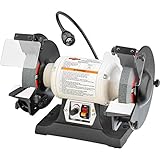
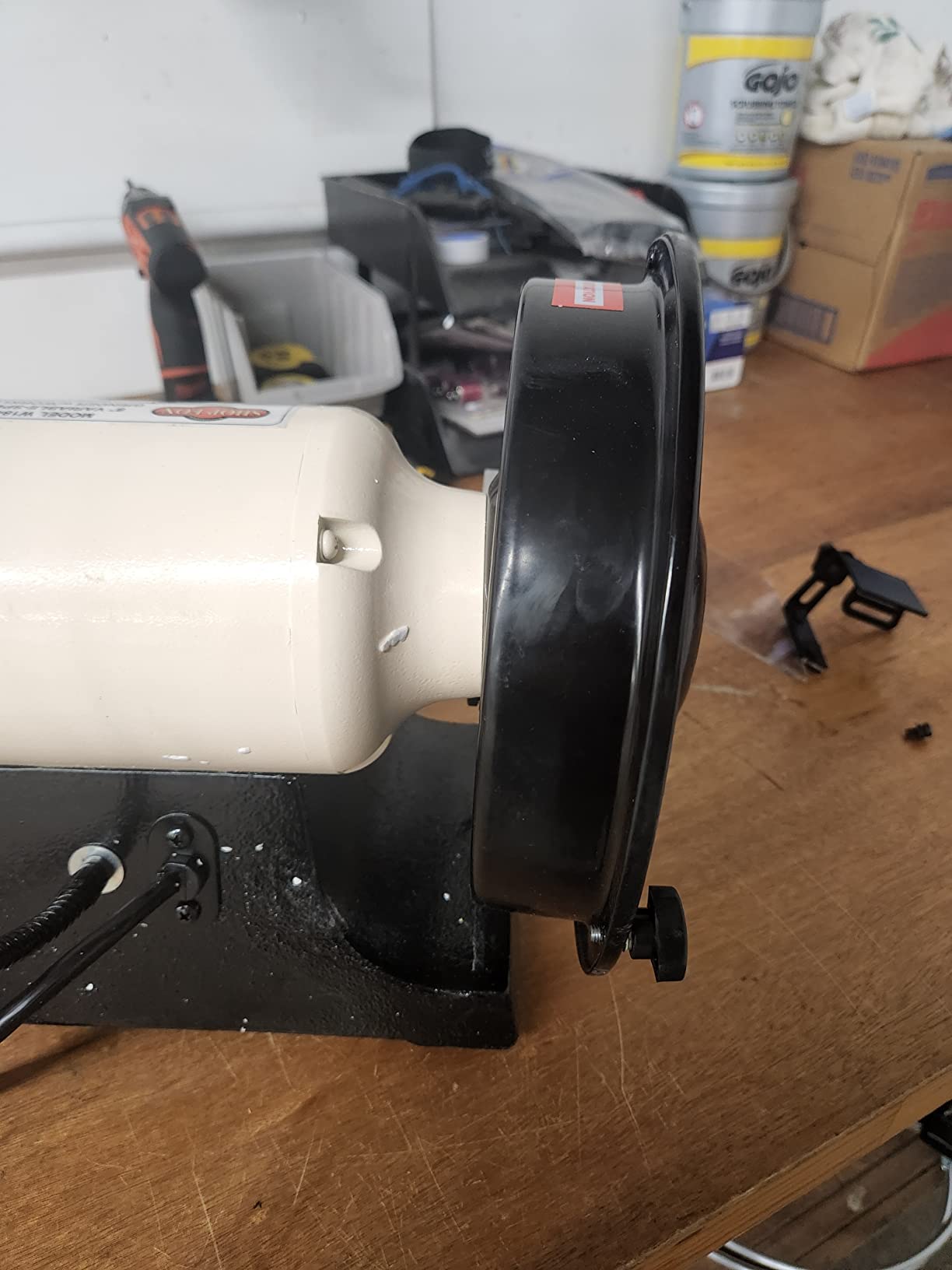
10. Shop Fox W1840 Variable-Speed Grinder – Best Split Between Wood and Metal Work
Shop Fox W1840 Variable-Speed Grinder with Work Light, 8″,Black,white
3/4 HP variable
2000-3400 RPM
dual 8 inch aluminum oxide
5/8 inch bore
+ Pros
- Variable 2000-3400 RPM for finishing work
- 3/4 HP induction motor matches power to size
- dual adjustable aluminum work rests
- work light included
– Cons
- Lowest average rating in this group at 4.1
- even at 2000 RPM it runs hotter than a dedicated low speed grinder
- 40 pound unit is cumbersome to move or mount
The Shop Fox W1840 is an 8-inch variable speed bench grinder running from 2000 to 3400 RPM on a 3/4 HP induction motor, and at 4.1 stars across 103 ratings it is the lowest-rated machine in this roundup. It is still the right answer for one specific buyer, and I want to be clear that it is not the right answer for a chisel-only shop.
Variable speed is worth the money when one machine has to cover both worlds. Run it low for finishing and sharpening work, run it high for stock removal, and one machine replaces what would otherwise be two. That is a genuine saving of bench space and money.
Why 2000 RPM Is Not 1750 RPM
This is the point most variable speed marketing glosses over. The floor of this machine’s range is 2000 RPM, and that is meaningfully faster than the 1750 RPM threshold the woodworking community uses. Even at its slowest setting the wheel runs hotter on a chisel than a dedicated low speed machine.
That does not make it unusable for chisels. It makes it a machine where you choose your speed deliberately rather than leaving it at the bottom and forgetting about it. The 5/8 inch bore and dual 8 inch aluminum oxide wheels are standard, and the adjustable aluminum work rests aid accurate positioning.
Build and Weight Concerns
At 4.1 with a notable 8 percent one-star share, the complaints concentrate on build quality, noise and the speed floor. Reviewers do credit the useful speed range, the sturdy adjustable rests and the included work light.
At 40 pounds the unit is cumbersome to move or mount, and the 550 watt rating is modest relative to the machine’s physical size. If you need to reposition it or mount it low, that combination is awkward.
Is Variable Speed Worth It for Chisels Alone
For chisel-only use, no. A fixed low speed machine gives you the same safe result with a simpler motor, a stronger warranty and a lower rating-to-price ratio. Variable speed pays for itself when you are genuinely splitting time between hand tool sharpening and metal grinding.
If that is you, this is the machine. You get the 3/4 HP induction motor, the wide adjustment range and the work light in one machine, and the speed floor is the price of that versatility. If you are not, save the money and buy one of the fixed 1750 RPM machines.
Choose this for a shop that halves its time between chisels and metal. Skip it if sharpening is most of what the machine will do, because the dedicated low speed options do that job better for less. It carries a two-year warranty.
Why Wheel Speed Burns a Chisel Edge
A chisel edge is a thin wedge of hardened, tempered high-carbon steel. The temper is a heat treatment that gives the steel its hardness and its springiness, and it is achieved at a specific temperature with a specific cooling rate. Grind enough heat into that thin section and the temper anneals away. The steel goes soft, the edge bends instead of cutting, and you have lost the hardness permanently in that area.
Surface speed is the governing variable, not the motor’s RPM number in isolation. An 8-inch wheel at 1750 RPM has a rim speed of roughly 73 feet per second. A 6-inch wheel at 3450 RPM is faster. That single fact explains why size alone does not determine safety, and why a small fast grinder can be more dangerous for an edge than a larger slow one.
Three variables decide how much heat a pass generates, and they compound. Wheel speed sets the baseline. Wheel grit determines how much friction the abrasive creates, with a coarse wheel generating far more heat than a fine one. Pressure and dwell time determine how long the heat has to accumulate.
Diagnosing a burn is straightforward. Blue or straw discolouration at the edge, or smoke when you lift the tool, means the temper is gone on that portion. If you catch it immediately, grind the discoloured steel away while there is still sound metal behind it. If you keep going, you grind the whole bevel to reach good steel and shorten the tool.
The prevention is unglamorous. Light passes, frequent lifting, dipping in the water tray between passes, a fine wheel, and the lowest speed the machine offers. No technique substitutes for the machine being slow enough, which is why the fixed 1750 RPM machines exist.
The Jig Problem and How to Solve It
A flat tool rest cannot hold a consistent chisel bevel. It gives you a reference for the height of the edge and nothing else, so the angle you get is the angle your hand happens to hold at that moment. Some chisels are set to 25 degrees, some to 30, and the rest will not tell you which you are grinding.
That inconsistency is the quiet reason people conclude that grinding does not work. It does work, but hand-holding a 25 degree bevel across a 2 inch face for thirty seconds is asking a lot of a wrist, and the jig exists to take that burden away.
There are three tiers of solution and the honest answer is that most people need the first or second:
DIY wood block jig. A hardwood block with a notch the chisel back sits in, sized to your specific tool. One woodworker described a setup allowing individual jigs for each chisel at the correct angle, with a 2.5 inch rest dimension being a useful practical detail. Free, accurate, and specific to your set. If you own four chisels, this is a fifteen minute project.
Commercial angle guide or universal jig bar. A fixture that clamps to the machine and holds a setting. The wet systems here come with some version of this, and the BUCKTOOL’s 0-45 degree rests let you set an angle mechanically rather than by wrist.
Premium jig systems. Serious users name dedicated systems with multiple fixture options as the enthusiast answer. They solve repeatability completely and cost meaningfully more than the machine itself.
A jig is a separate purchase from the grinder. Budget for one. A grinder with no fixture and a hand that cannot hold 25 degrees consistently will disappoint, and the machine will get blamed for it.
Wheel Dressing: Why Your Chisel Cuts Scallops
A new wheel is not a sharp wheel. The abrasive grains are bonded into the wheel surface at set positions with a filler between them. As you grind, the tops of the grains wear down, the filler becomes level with them, and the wheel stops cutting. It is then only rubbing heat into your steel, which is the worst possible outcome.
That condition is called glazing, and it is the most common cause of a grinder that used to work well and now burns everything you touch. Users frequently blame the machine, when what has actually changed is the wheel.
The fix is a diamond wheel dresser. You run it against the spinning wheel to expose fresh grains, and the glazed layer comes away as a fine dust. It takes under a minute. Dress the moment grinding starts to feel sluggish, push harder than normal, or produce more heat than expected at the same pressure.
Run-out is the separate and more serious problem. Run-out is how far the wheel deviates from perfectly round when spinning, and it produces a scalloped or wavy edge that no amount of skill will correct. It comes from an out-of-balance wheel, a dirty arbor flange, or a wheel that was dropped. Check it with a fixed pointer held near the rim before you rely on the machine.
Both problems are solved in the first ten minutes of ownership. Skipping them is why people conclude their new grinder is faulty.
Wet Versus Dry: Which Sharpening System Protects Steel Better
Dry low speed wins on speed and versatility. The fixed 1750 RPM grinders in this roundup reshape a damaged tip in minutes and restore a full bevel quickly, and nothing else here does that job as efficiently. The cost is that heat control depends on your technique.
Wet low speed wins on safety and finish. Both wet systems here run at 115 RPM and a 90-160 RPM range, which is an order of magnitude below a bench grinder. The water trough removes heat continuously, so a long session does not accumulate the kind of thermal load that a dry wheel can.
The trade is surface area and speed. A wet system will not flatten a badly chipped tip, and at these speeds large workpieces take a while. The right question is whether your sharpening need is reshaping or refining. Refining, and wet wins clearly. Reshaping, and you need a wheel.
A third option exists for people who already own a grinder: the built-in water tray. The SKIL BI9502 has one, and it gives you somewhere to dip between passes. That is a partial mitigation, not a replacement for a slow wheel.
Already Own a High-Speed Grinder? Here Is What to Do
A 3450 or 3600 RPM grinder is not a write-off, and there is a large installed base of people who own one and are quietly afraid of it. One experienced woodworker described a favourite 8-inch 3450 RPM machine for plane irons and chisels with a 120 to 180 grit wheel, and another reported running a 150 grit white wheel on a variable speed machine. Both are doing it correctly.
What those accounts have in common is a very fine wheel. Grit is the lever that matters as much as speed, and it is the one most people never pull. A coarse 36 or 60 grit wheel at 3600 RPM generates enormous heat. An 80, 120 or 150 grit white aluminum oxide wheel at the same speed generates far less, because the finer grains take shallower bites.
Five adjustments make a high speed machine workable for chisels:
Fit an 80 grit or finer white aluminum oxide wheel before you start. This is the single most important change.
Take passes no longer than a second. Count rather than feel.
Lift constantly and dip in the water tray or a cup of water between passes.
Hold the tool with a jig so the angle is set by the fixture rather than by pressure on the wheel.
Watch the colour of the bevel under the magnifier, not the sparks. Sparks are already a symptom.
None of that makes a fast wheel the right first machine for a beginner. It makes it a usable one for someone who already owns it.
How to Grind a Chisel on a Bench Grinder, Step by Step
Set the tool rest so the gap to the wheel is about a sixteenth of an inch, roughly the thickness of a dime. Closer than that and the tool will catch. On a chisel, coarse work goes on the 60 grit wheel and finishing work on the 120.
Turn the wheel on, let it reach full speed, and dress it if you have not recently. A freshly dressed wheel is the difference between a pass that cuts and a pass that smears.
Rest the chisel flat on the tool rest with the bevel facing up. Set the angle with a jig, or with your hand, at 25 degrees for bench and paring chisels and 30 degrees for traditional socket chisels. Keep the back of the chisel in contact with the rest throughout.
Take the pass. One to two seconds of light contact, lifting as soon as the sparks fade. Grinding in one spot is what generates heat and what causes a burn, so the discipline here is more important than the grit.
Dip the tool, inspect the bevel under light, and repeat. Work across the full width of the bevel rather than concentrating on the centre, because a bevelled edge fails in the middle first. Check frequently against a straightedge or the flat of a known-sharpened tool.
Stop grinding, do not strop. You are done with the wheel. Finish the edge on a stone and then a leather strop to remove the wire edge, because a strop cannot remove a burr and a wheel cannot leave a finished edge.
If the bevel is badly out of shape, work up through a coarser grit first. A 60 grit wheel will flatten a bevel quickly, and the risk of heat is far lower when you are removing serious material than when you are chasing a final hairline.
How to Test a New Grinder in the First Ten Minutes
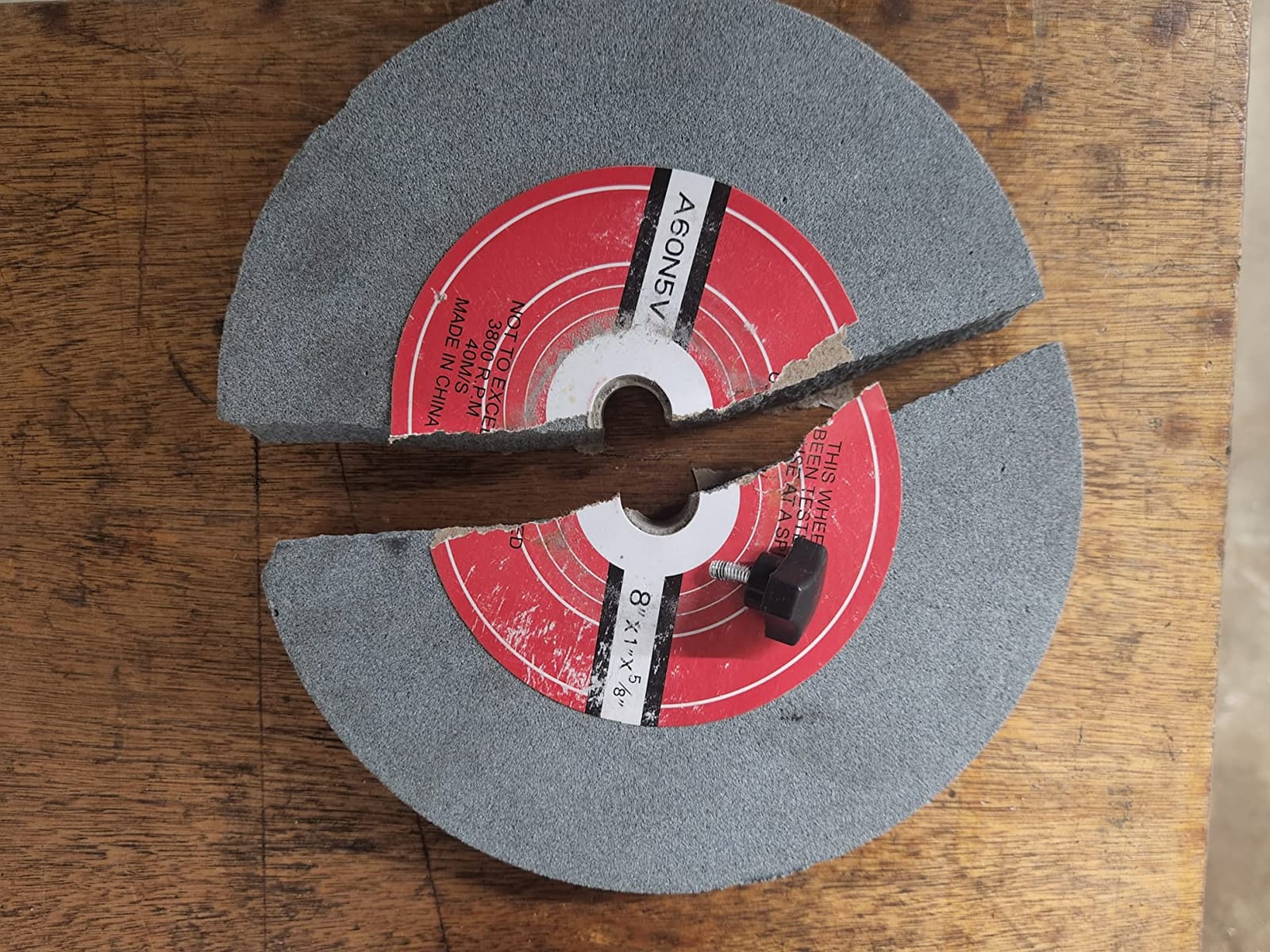
Inspect every wheel before first power-up. Look for hairline cracks, and tap the edge of the wheel gently with a screwdriver handle. A wheel that sounds dull has a crack. A wheel that arrives with a metallic tap and a new machine has a known failure mode, and a variable speed grinder that has been tapped is the documented risk case.
With the power off, hold a fixed pointer or straightedge a few thousandths of an inch from the wheel rim and spin the wheel by hand. If the gap changes as it turns, you have run-out. True the wheel or replace it before sharpening anything.
Power up and watch the wheel at eye level for a second before putting anything near it. Check the tool rests for drift by pushing firmly on them with the wheel stopped, then again after five minutes of use. A rest that moves under load is both a quality problem and a safety problem.
Bolting the machine down matters more than most buyers expect. Pre-drilled base holes make it easy, and it removes walking entirely. Machines with awkward mid-plate mounting holes make this harder, which is worth knowing before you commit.
Finally, confirm your eye shields and spark deflectors are present and positioned before you start. A guard that is there but pushed back is not a guard.
Who Should Not Buy a Bench Grinder
If you own a handful of chisels and sharpen them occasionally, a coarse diamond stone or a jig-and-stone system is the better buy. It costs less, it takes up less space, it produces a finer finish, and it cannot burn an edge because it barely generates heat. This is the most common position in the woodworking forums and it is right more often than grinder marketing would like.
A water-cooled system at 115 RPM is the closest thing in this roundup to that safety profile while still being a powered machine, and it is the honest compromise if you want something that reshapes as well as refines.
What a grinder buys you is speed and capability, not quality. If you never reshape steel, never deburr a punch and never dress a screwdriver, you are paying for a capability you will not use, in a tool that carries a risk the stone does not. Buy the machine when the reshaping shows up in your week, not before.
Bench Grinder Buying Guide for Chisel Work
Speed Architecture: Five Ways a Grinder Can Be Slower
Speed architecture is the most important decision, and it is more nuanced than a single number. There are five arrangements in practice.
Fixed low speed means one speed, around 1725 to 1750 RPM, and it is the simplest and safest option for chisels. The RIKON, the BUCKTOOL and the WEN BG4286 are all in this class. If you sharpen and nothing else, this is enough.
Dual speed gives a low and a high setting selected by a switch, typically 1725 and 3450 RPM. The low setting handles chisels and the high setting handles everything else, with a mechanical switch between. More versatile than fixed, with none of the resolution of variable.
VFD variable speed gives a continuous range, often 900 to 3600 RPM, from a dial. The value is that you can dial down below the fixed low speed for very hard or unfamiliar edges, and back up for finishing. Most enthusiasts consider this the best architecture for a combined shop.
Digital variable speed adds a speed readout and often a memory function that recalls your last setting. Genuinely useful for a shop where you move between tasks, and worth paying for if you use it daily.
Wet stone is a different machine rather than a different speed. It runs at 90 to 160 RPM on a water-cooled stone, which is an order of magnitude slower and effectively burn-proof.
Is variable speed worth it? For chisel-only use, no. A fixed low speed machine gives you the same safe result with a simpler motor and a stronger warranty. Variable speed pays for itself when you genuinely split time between hand tools and metal grinding, because it replaces a second machine.
Wheel Grit: The Progression That Actually Finishes an Edge
The wheels shipped with most grinders are too coarse to finish a chisel, and this is the most common early frustration in the category. The progression is short and worth learning.
36 grit is a reshaping wheel. It flattens a badly chipped tip and takes a bevel back to bare steel in a minute. It generates the most heat of any grit and should never touch a finished edge.
60 grit is the general-purpose sharpening wheel that most machines ship with. It removes metal quickly and is appropriate for flattening a bevel that has been chipped or that needs re-establishing. Heat is still significant at high wheel speed.
80 grit refines the bevel after 60 and generates noticeably less heat. It is the safest practical choice for routine sharpening on a fast machine.
120 grit is a honing wheel. It produces a finer scratch pattern and almost no heat, making it the right wheel for finishing a bevel on a machine of any speed.
Members of the community report running 120 to 180 grit wheels on faster machines with good results, and that aligns with the physics. Finer grit means shallower bites and less friction. If you change one thing about your sharpening, change the wheel.
Wheel Material: Why White Aluminum Oxide Wins for Chisels
White aluminum oxide is the default choice for hand tools and it is the correct one. It is a hard, friable abrasive that breaks down as it wears, which means it exposes fresh sharp grains continuously and stays cool.
Silicon carbide is sharper and cuts faster, and it is the right choice for non-ferrous materials like aluminium, brass and carbide. On hardened steel it generates more heat and breaks down faster, which is a poor combination for a thin chisel edge. Several roundups in this category warn against it for chisels and they are correct.
Ceramic variants sit between the two and cost more. CBN wheels are roughly twice as hard as aluminum oxide, stay sharp at low speed, and run far cooler. They are the enthusiast answer and they cost several times more than a standard wheel. The BUCKTOOL here is built to accept one.
6 Inch Versus 8 Inch Versus 10 Inch
Diameter matters less than most buyers assume, and speed matters more. What actually determines heat is rim speed, which is diameter multiplied by revolutions. A 6-inch wheel at 3450 RPM has a higher rim speed than an 8-inch wheel at 1750 RPM, so the smaller machine is the hotter one despite the smaller disc.
Once you have fixed a speed, bigger is better. An 8-inch wheel gives a longer contact patch across a plane iron, so fewer passes and a more even bevel. A 10-inch wheel is slower to spin up and needs more motor to drive it, but the surface speed is the most forgiving available.
Wheel width deserves its own mention. A 1.5 inch face, as on the BUCKTOOL, gives more contact area across a flat chisel bevel than a 1 inch face. For consistent angles, width beats diameter.
Motor Power and What It Is Actually For
Horsepower is a metal removal spec, not a sharpening spec. Sharpening removes very little metal, so a modest motor handles it easily. What power buys you is the ability to use the same machine for stock removal, deburring, punch dressing and rust removal without the motor browning out.
A 1/2 HP motor is entirely adequate for chisels, plane irons and carving tools. A 3/4 HP induction motor gives headroom for mixed work and is the sensible choice if you will ever grind steel heavier than a hand tool.
Weight is a proxy for stability and a tax on portability. A 16 to 17 pound machine moves easily and still holds position. At 40 to 58 pounds you are mounting it on a pedestal stand and not moving it again, which is fine for a permanent shop and a problem anywhere else.
Safety Features That Are Not Optional
Every machine needs eye shields positioned correctly, spark deflectors adjusted for the work, and a bolted base. Magnified eye shields are a genuine upgrade for sharpening because inspecting a bevel for burn colour and wire edge is the whole safety feedback loop.
A work light over the wheels matters more for sharpening than for bulk grinding, where the sparks light the work anyway. LED lighting over both wheels, as on the SKIL, is worth having.
A water tray is a partial heat mitigation and worth having on any fast machine. A brake is a convenience feature rather than a safety one, but a two-minute coast-down is a real annoyance when you want to adjust a jig between passes.
If you want background on the machines and accessories around a workshop, our guide to angle grinders for metalwork covers the handheld side of the same problem, and bench build ideas is where to mount one of these properly.
Frequently Asked Questions
Can I sharpen a chisel using a bench grinder?
Yes, provided three conditions are met. Run the wheel at or below roughly 1750 RPM, or slow a variable machine to that range. Fit a white aluminum oxide wheel in the 80 to 120 grit range rather than the coarse 36 grit wheel most grinders ship with. Take light passes of one to two seconds and lift constantly. A burn shows as blue or straw discolouration at the edge, and that temper loss is permanent.
What is a good slow speed bench grinder for sharpening?
The community threshold is 1725 to 1750 RPM, and that is the speed to look for in a dedicated sharpening machine. The RIKON 80-805, the BUCKTOOL TDS-200C4HL and the WEN BG4286 all run at 1750 RPM. If you want even more margin, a water-cooled system running at 90 to 160 RPM makes burning an edge effectively impossible, at the cost of speed and the ability to reshape steel.
What grit wheel should I use for sharpening chisels?
Use 60 grit to reshape or flatten a damaged bevel, then 80 grit to refine it and 120 grit to hone. The 36 grit wheel most grinders ship with is a reshaping wheel and generates the most heat of any grit, so it should not touch a finished edge. On a fast machine, use 80 grit or finer. Finer grit takes shallower bites and produces significantly less heat at the same pressure.
Is a variable speed grinder worth it for sharpening chisels?
For chisel-only use, no. A fixed low speed machine gives you the same safe result with a simpler motor, a longer warranty and a better rating to price ratio. Variable speed pays for itself when you also grind metal, because one machine covers both the low speed hand tool work and high speed stock removal. Note that many variable machines bottom out at 2000 RPM, which is faster than the 1750 RPM threshold and runs hotter than a dedicated machine.
What is the best sharpening jig for chisels?
A flat tool rest cannot hold a repeatable bevel, so a fixture is what makes angles consistent. Three tiers exist. A hardwood block with a notch the chisel back sits in, sized to your specific tool, is free and often more accurate than anything you buy. A commercial angle guide or universal jig bar clamps to the machine and holds a setting. Premium systems with multiple fixture options are the enthusiast tier and cost more than the grinder.
Why does my bench grinder burn the knife or chisel edge?
Three causes, and they compound. Too much pressure, too long in one spot, and too high a wheel speed. The practical fixes are light passes measured in seconds rather than feel, dipping the tool in the water tray between passes, fitting a finer wheel, and dropping the speed. The diagnostic is colour: if you see blue or straw discolouration, the temper is gone on that portion of the edge and grinding back to sound steel means shortening the tool.
Conclusion
If you want one machine and it must do chisels plus general shop work, the DEWALT DW758 is the pick, and you should fit an 80 grit white aluminum oxide wheel before your first session. If sharpening chisels is most of what the machine is for, the RIKON 80-805 is the better buy, because it arrives with the right wheels at 1750 RPM and carries a five year warranty.
If you want the widest grinding face and mechanical angle control, take the BUCKTOOL. If burning an edge frightens you, stop worrying and buy a water-cooled system instead, and no amount of technique will make a fast wheel as forgiving as a 115 RPM stone.
Before any of them, spend ten minutes on wheel run-out, tool rest drift and bolting the machine down. That setup work costs nothing and it prevents more ruined chisels than any model choice will. Whichever machine you land on, buy a fixture for the angle and an 80 or 120 grit wheel, then use short passes. That is the whole method, and it works.
If you want to compare the tools that sit alongside a bench grinder on a metalworking bench, our angle grinder picks and stained glass grinder guide cover those ends of the workshop.
Leave a Reply