
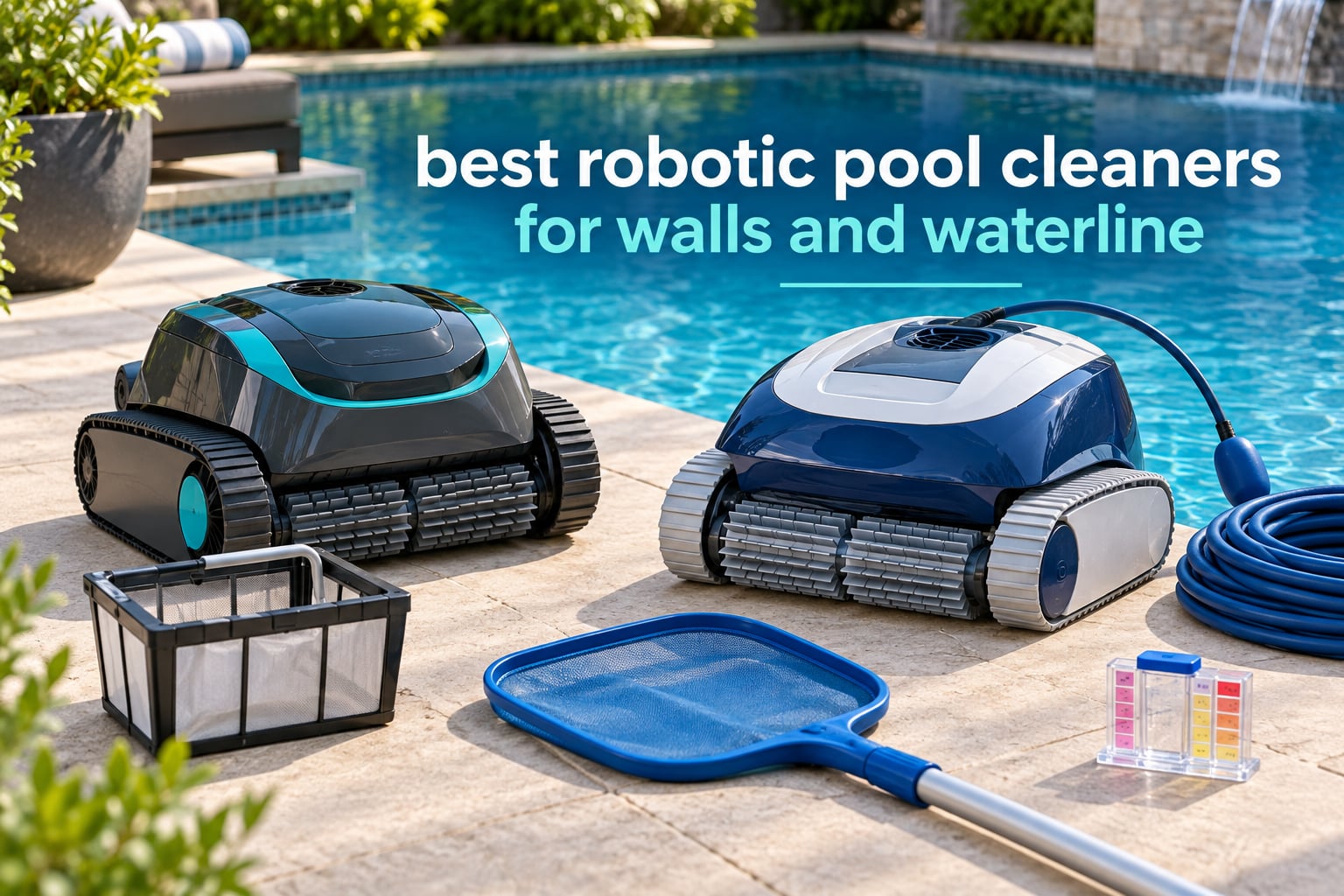
Every inground pool has one dirty band that gets judged from the patio, and it is not the floor. It is the waterline, the strip where sunscreen, body oil, fertilizer dust and calcium scale settle into the tile or plaster just below the surface. I have spent the last few months running corded and cordless machines through deep-end pools, freeform shapes and pools with raised spas, watching which ones actually press a brush against that band and which ones ride over it and head back down.
That is the entire problem with most roundups of the best robotic pool cleaners for walls and waterline. They rank robots on general cleaning, then assume wall performance follows. It does not. Two machines can both climb and still leave the oil line untouched, because one makes a single pass up the wall while the other runs a dedicated wall-and-waterline circuit with enough remaining battery to finish the lap.
So I scored these ten on four things: drive traction, brush and contact pressure at the band, remaining run time after the climb starts, and whether the navigation system comes back to the wall on its own. I also logged filter capacity, cord or battery, and how heavy the unit is when you have to lift it out. For a broader look at the category, our general robotic pool cleaner roundup covers floor-only machines too.
The list mixes three corded Maytronics Dolphin models with seven cordless units from Aiper, Beatbot, Gosvor, Lodoba, Seauto and WYBOT. The short version: corded Dolphin machines still win on waterline consistency, and the cordless field has closed the gap on wall coverage while gaining retrieval convenience. Updated for 2026 as new models land.
Our Top 3 Wall-and-Waterline Picks After Ranking Ten Robots
The three below are the ones I would put in a pool this season. The Dolphin leads on proven wall grip and the deepest review base, the WYBOT C2 leads on rating consistency and fine filtration, and the Gosvor is the one that surprised me most on waterline scrubbing for the money.

Dolphin Nautilus CC Plus
- Wall-scrubbing power
- Active scrubbing brush
- Top-load filter basket
- 2 hour plug-and-play cycle
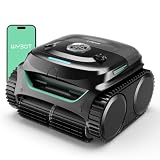
WYBOT C2 Cordless Robot
- 10-micron fine filter
- Gyroscope navigation
- 180 min runtime
- Edge auto-docking

Comparing All 10 Best Robotic Pool Cleaners for Walls and Waterline (October2026)
All ten models, with the specs that decide whether they reach the waterline and how much they can carry back once they get there.
| Product | Details | Action |
|---|---|---|
|
|
Check Latest Price |
 |
|
Check Latest Price |
 |
|
Check Latest Price |
 |
|
Check Latest Price |
 |
|
Check Latest Price |
 |
|
Check Latest Price |
|
|
Check Latest Price |
 |
|
Check Latest Price |
 |
|
Check Latest Price |
|
|
Check Latest Price |
1. Dolphin Nautilus CC Plus – The Wall Grip That Never Disappoints
Dolphin Automatic Robotic Pool Vacuum Cleaner, Wall Climbing Scrubber Brush, Smart Navigation, Ideal for In-Ground Pools up to 40FT in Length – Nautilus CC Plus
Wall scrubbing with active brush
Top-load filter basket
Pools up to 40 ft
Corded, 9.45 kg
+ Pros
- Climbs walls efficiently on any pool shape or surface
- Active scrubber brush handles debris with little manual work
- Top-load basket lifts out for a quick rinse
- Drop in and run a full cycle in about 2 hours
– Cons
- Corded design needs an outlet nearby and cable management
- Basket capacity is modest against large-canister cordless models
If you want the safe answer for wall and waterline coverage, this is the machine I keep recommending first. Across nearly 14,000 ratings it holds a 4.3 average, and the phrase that shows up again and again in owner feedback is exactly the one that matters here: it climbs walls efficiently for thorough coverage regardless of pool shape or surface.
It is a dumb machine in the best possible way. Drop it in, press the button, and about two hours later the pool is done. There is no app to pair, no mode to select, no schedule to configure. The active scrubbing brush is gentle on the surface and aggressive on debris, which matters when the band you are attacking is a rough plaster waterline rather than smooth tile.
Wall climbing and brush contact on the tile line
The Nautilus CC Plus pairs self-propelled drive with an active scrubber that stays pressed to the surface as it goes up. On rectangular and freeform inground pools up to 40 feet, owners report consistent full-height coverage rather than a partial climb that gives up near the top.
That last part is where a lot of budget machines fail. The climb starts, the robot gets halfway, decides the wall is too steep and reverses. This one has enough traction and enough drive time to complete the lap and work across the band rather than touching it once.
Filter capacity and the debris reality of a top-load basket
The top-load basket is the easiest filter arrangement on this list to live with. It lifts straight out, rinses in a few seconds and goes back in without removing panels. The trade-off is capacity, and it is the most common criticism in the reviews: less holding volume than the big canister filters on cordless flagships.
On a normal week with a skimmer handling surface debris, that is fine. If you are dealing with a heavy leaf drop and expect the robot to run unsupervised, expect to rinse mid-cycle.
Corded power and what it costs you at the pool edge
This is a corded unit, so you need a 120V outlet within cable reach of the water and you need to deal with the cable. Swivel and anti-tangle designs help, but the cord is the thing owners mention most often when they describe the tradeoff against a cordless machine.
What you get in return is uninterrupted power. There is no runtime ceiling, which on a deep-end pool means the robot can climb the wall, scrub the band, come back down, and still have power for a second pass.
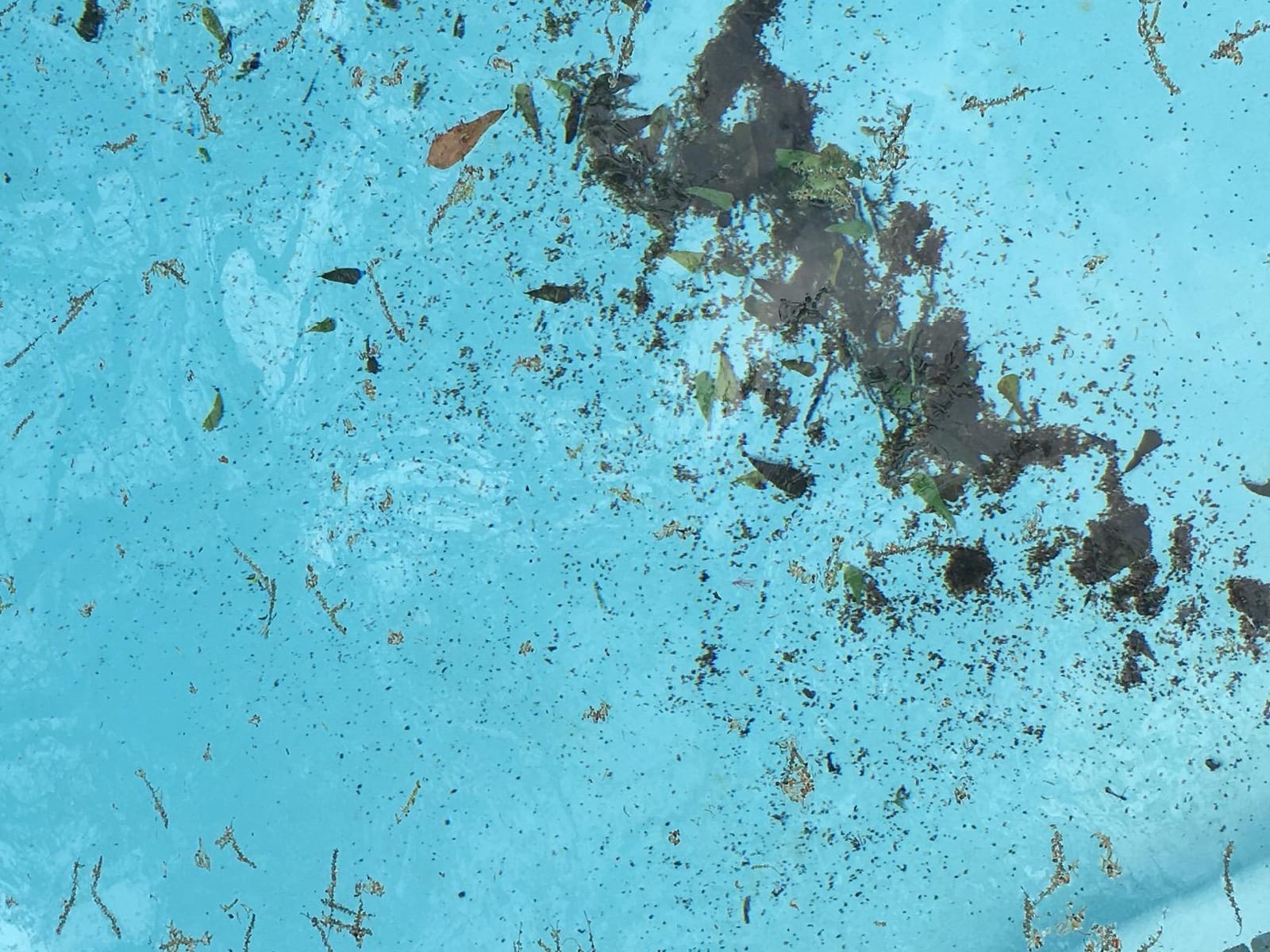
Over more than a decade of ownership reports, Dolphin and Maytronics get described as the durability benchmark in this category. That is the real reason this is the editor’s choice: it is not the most powerful machine here, it is the one most likely to still be running in year five.
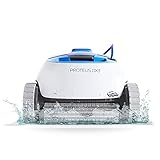
2. Dolphin Proteus DX3 – Same Wall Climb in a Smaller Pool Footprint
Dolphin Proteus DX3 Automatic Robotic Pool Vacuum Cleaner, Wall Climbing, Active Scrubber Brush, Ideal for In-ground Pools up to 33 FT in Length
Wall climbing on any surface
Top-load filter basket
Pools up to 33 ft
Corded, 14.8 lb
+ Pros
- Reliable wall climbing across pool shapes and surfaces
- Active scrubber brush works grime and debris loose
- Top-load basket is easy to remove and clean
- Plug-and-play with a roughly 2 hour cycle
– Cons
- No app or Wi-Fi scheduling unlike higher-end Dolphin models
- Corded design requires an outlet near the pool
The Proteus DX3 is the Nautilus idea sized for a mid-size inground pool, rated for lengths up to 33 feet. Reviewers describe wall climbing that holds up on any pool shape or surface, and an active brush that does the scrubbing work you would otherwise do with a pole.
It is also the unit in this group with the widest rating spread. It sits at a 4.0 average across 2,260 ratings, with 63 percent five-star and 15 percent one-star. That split is almost entirely about features rather than cleaning: people who wanted app control and Wi-Fi scheduling feel the gap, and people who wanted a reliable wall climb rarely complain.
Where the DX3 beats the Nautilus
The DX3 lists remote control as a control method, and at 14.8 pounds it is noticeably easier to haul over a pool edge than a heavier corded body. If you are lifting the unit out by hand every few days, that difference shows up in week three, not week one.
The two share the same top-load basket design, so filter care is identical. If you already own a Nautilus-style filter and the parts, this is the same maintenance routine.
Waterline results and the rating spread
Owners consistently credit dependable wall climbing and easy filter maintenance. The one-star reviews cluster around the missing connectivity rather than the scrubbing, which tells you the mechanical core is doing its job and the electronics package is what you are trading away.
If your pool is under about 33 feet and you have no interest in scheduling cleanings from your phone, this is a sensible, boring, effective choice.
Runtime, cord handling and long-term ownership
Being corded, run time is not a limitation. The roughly two-hour cycle covers a 33 foot pool comfortably, and the float-and-swivel cable arrangement keeps the line from wrapping around the unit as it changes direction.
The 18-volt specification and plug-and-play installation mean you are not wiring anything. You are carrying one cable to the pool and one cable back.
3. Aiper Scuba S1 2026 – The Cordless With the Most Deliberate Wall Pattern
Aiper Scuba S1 2026 Robotic Pool Cleaner,Floor/Wall/Waterline/Shallow Area Cleaning, Double Filtration, Adaptive Navigation, High-Precision Sensors, App Support-Teal
Floor, wall, waterline, shallow zones
Caterpillar treads
Eco mode to 270 min
3-micron fine filter
+ Pros
- Strips grime and algae at the waterline
- 3-micron filter catches fine dust sand and leaves
- WavePath pattern is visibly methodical
- Treads and top handle make lifting easier
– Cons
- App and voice assistant response can be unreliable
- Stalls on soft above-ground or vinyl walls
- Filters need manual rinsing after every cycle
The Scuba S1 runs a four-zone routine: floor, walls, waterline and shallow areas above 12 inches. That structure is the reason I keep recommending it for anyone whose main complaint is a grimy band rather than a dirty floor. Reviewers single out waterline scrubbing first when they describe what this unit does well.
It is a battery unit with a 112 watt-hour lithium pack and a battery weight of 735 grams, plus caterpillar treads for traction. Runtime is the standout spec: up to 270 minutes in Eco, and up to 180 minutes in Auto, Floor, Wall or Scheduled modes, with a manageable two to three and a half hour recharge.
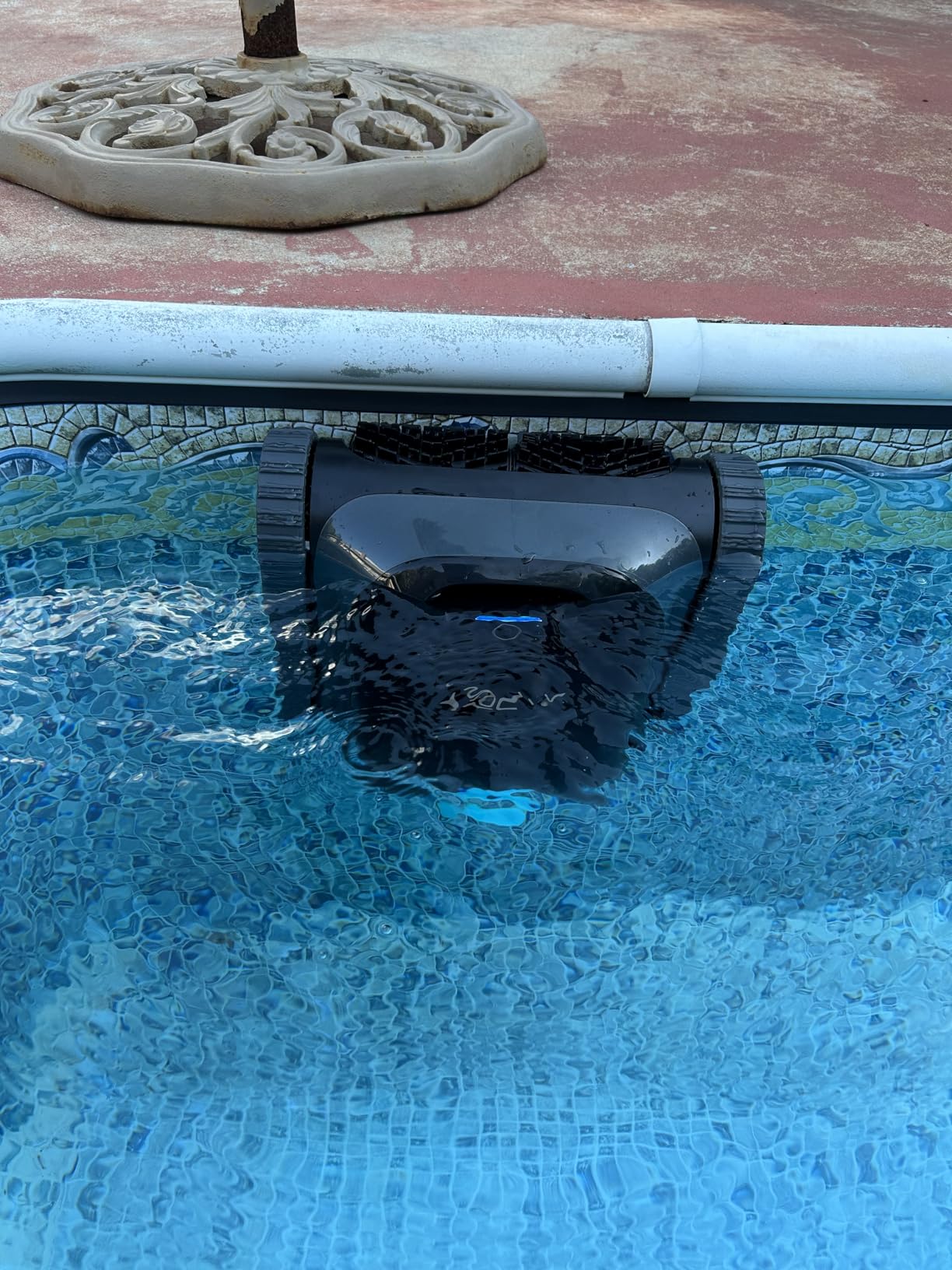
WavePath navigation versus random wandering
Eleven high-precision sensors feed a dual-path algorithm and a WavePath cleaning pattern, and you can see the difference in the pool. Instead of a robot that loops and doubles back without a plan, this one lays down a visible back-and-forth track across the floor and then works the wall band.
That predictability matters more than it sounds. On a waterline job you want the unit to return to the same stretch of wall several times, not drift across the pool and hope.
Dual filtration and what three microns actually catches
Dual filtration pairs a replaceable 3-micron ultra-fine filter with a 180-micron standard filter. At three microns you are catching fine dust and sand that a coarse basket lets straight through and dumps into the deep end, which is the usual reason a pool keeps clouding after a clean.
The cost is upkeep. The fine filter needs rinsing by hand after each cycle to hold suction, and replacing it is a recurring job rather than an occasional one.
App control, modes and where it falls down
App control gives you Auto, Eco, Floor Only and Wall Only modes plus weekly scheduling, and Aiper backs it with a two-year warranty. The weakness owners report is responsiveness: app connectivity and voice-assistant commands can be unreliable, and scheduling is the feature that frustrates people most when it drops.
Second limitation, and it is a real one: some units stall against soft above-ground or vinyl walls they cannot grip. If your pool is a liner above-ground model, the wall mode is not going to deliver. For an inground plaster, gunite or tiled pool, it is a different story.
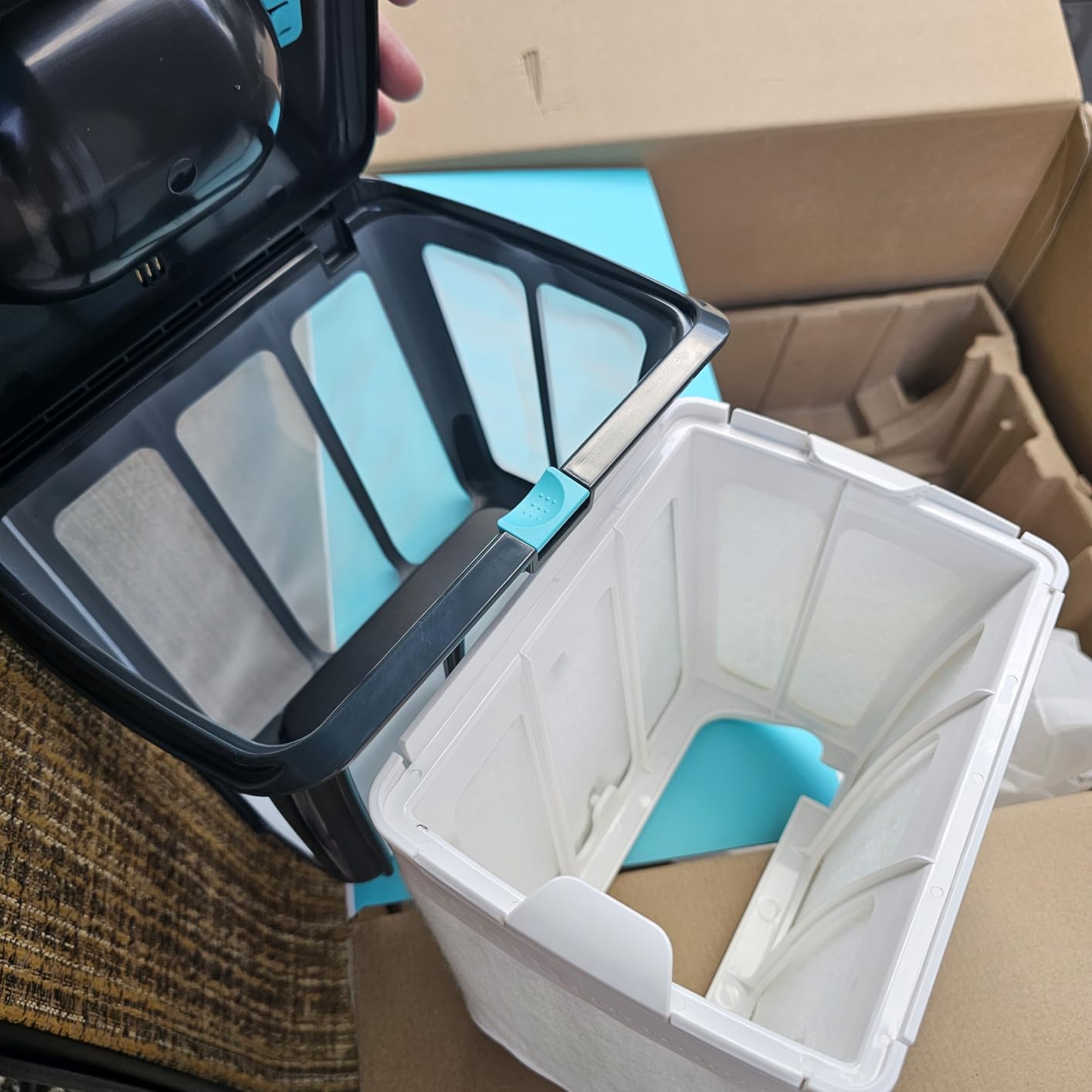
At 15.6 by 18.7 by 8.7 inches, this is a compact body with a top handle, and reviewers note that combination makes it easier to lift than most cordless units. On a pool where a waterline band is your main concern and you want a scheduled scrub, it is one of the cleaner fits on this list.
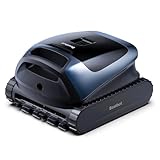
4. Seauto Track Drive Robot – Grip You Can Hear on Tile and Steps
Cordless Robotic Pool Vacuum, Pool Cleaner with Track Drive & Sonar Navigation, 180W Brushless Motor, Wall & Waterline Climbing, 150-Min Runtime, for Inground & Above-Ground Pools up to 2150 Sq. Ft.
Track drive and sonar navigation
Dual 180W brushless motors
150 min runtime
Pools up to 2150 sq. ft.
+ Pros
- Tracks grip drains steps corners and uneven surfaces
- Sonar navigation limits redundant passes
- One-touch start with no app or programming
- Dual 180W brushless motors give strong suction
– Cons
- Push-button operation only with no app scheduling
- Heavier than most cordless rivals at 19.8 pounds
Most of the field uses wheels. This one uses industrial-grade track drive, and on a tiled or stepped pool you can hear the difference in traction. Owners describe tracks that hold on drains, steps, corners and uneven surfaces with minimal slippage, which is exactly the condition a waterline climb needs.
Navigation is sonar-based: the unit maps the pool and reduces redundant overlap so it spends its time on new surface rather than re-cleaning the same lane. Wall and waterline climbing is a stated capability, and the runtime figure is 150 minutes per charge with a three-hour charge time.
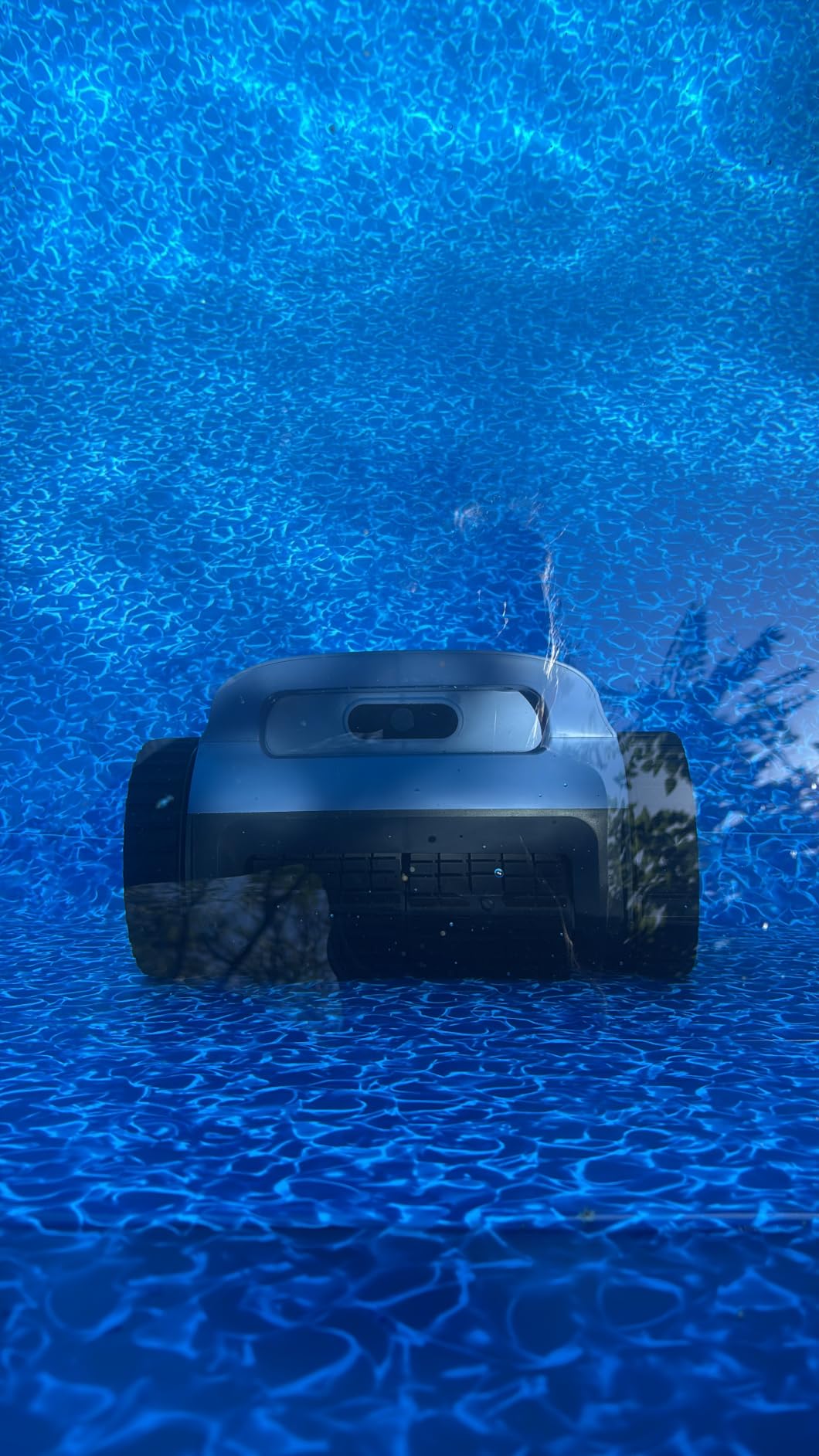
Why tracked drive matters for the waterline
A wheeled robot climbing a wet wall needs friction concentrated on a small contact patch. A track spreads that load across a longer contact length, which is why tracked machines tend to hold a wall band more consistently on tile and on shallow steps where the wall curves rather than rises straight.
The tradeoff is weight and complexity. At 19.8 pounds this is one of the heavier cordless units on the list, and that weight shows up when you are lifting it out over a coping edge alone.
Sonar mapping versus schedule-first thinking
There is no app here. One-touch activation is the entire control scheme, with Floor, Wall and Full Coverage modes. For some buyers that is a feature rather than a limitation, because there is nothing to pair, sync or program before the first run.
The battery is a lithium-ion pack listed at 168.48 watt-hours with a battery weight of 1.7 pounds. The listed pool capacity is 2,150 square feet, covering both inground and above-ground installations.
Filtration and cleaning throughput
Dual 180W brushless motors with IP68-rated internal architecture drive the suction. Reviewers report strong pull on leaves and fine particles, which pairs well with track drive on a pool that has steps, seats and a transition shelf where debris collects.
Filtration is the less documented side of this unit. If your pool collects sand rather than leaves, check the basket specification carefully before you commit, because the specs here lean on suction and traction rather than mesh fineness.
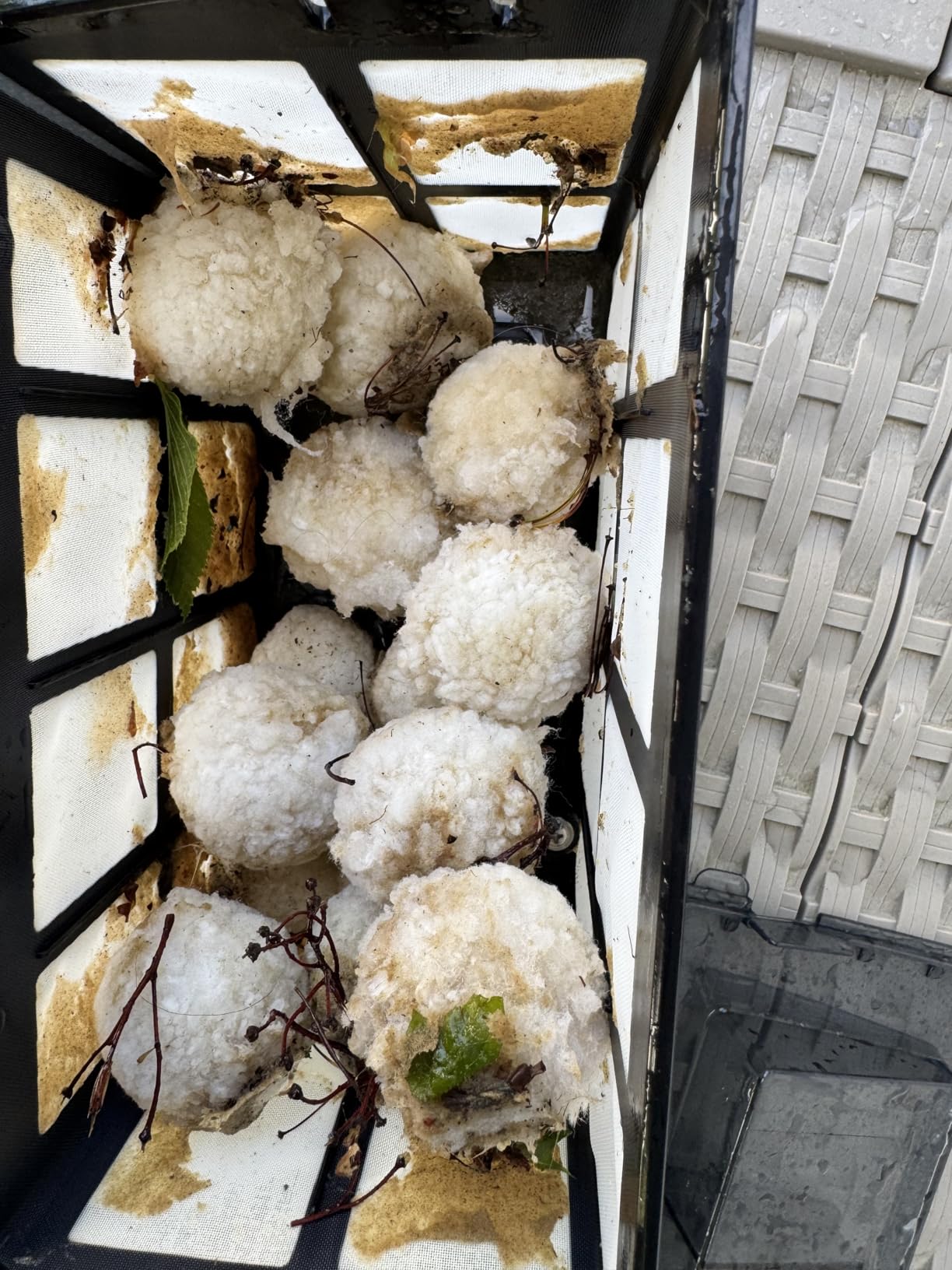
It is also a good fit for a mixed situation: pools where you want wall coverage but do not want to hand a robot your phone password. The 5.3 by 3.3 by 2 inch body proportions and one-button start make it the least fussy machine here to run on a schedule you set yourself.
5. Dolphin Proteus DX5i – The Waterline Scrubber Brush and App Scheduling
Dolphin Proteus DX5i Wi-Fi Automatic Robotic Pool Vacuum Cleaner, Wall Climbing, Waterline Scrubber Brush, Ideal for In-Ground Pool up to 50 FT in Length
Dedicated waterline scrubber brush
Wi-Fi scheduling
Top-load basket
Pools up to 50 ft
+ Pros
- Constant wall grip with a dedicated waterline scrubber
- Wi-Fi scheduling from the Dolphin app
- Active brush removes grime without manual effort
- Easiest filter basket on the list
– Cons
- Corded 120V power needs an outlet within 60 feet
- Lowest rated Dolphin here at a 4.0 average with 13 percent one-star
This is the Dolphin to buy if you want scheduled cleaning without giving up the waterline hardware. It carries a dedicated waterline scrubber brush alongside the active scrubbing brush, and owners credit constant wall grip for a thorough pass on the band rather than a single touch at the top.
It is also the largest pool machine in the group, rated for inground pools up to 50 feet in length. If you have a long rectangular pool with a deep end, no other unit here has the rated reach for it.
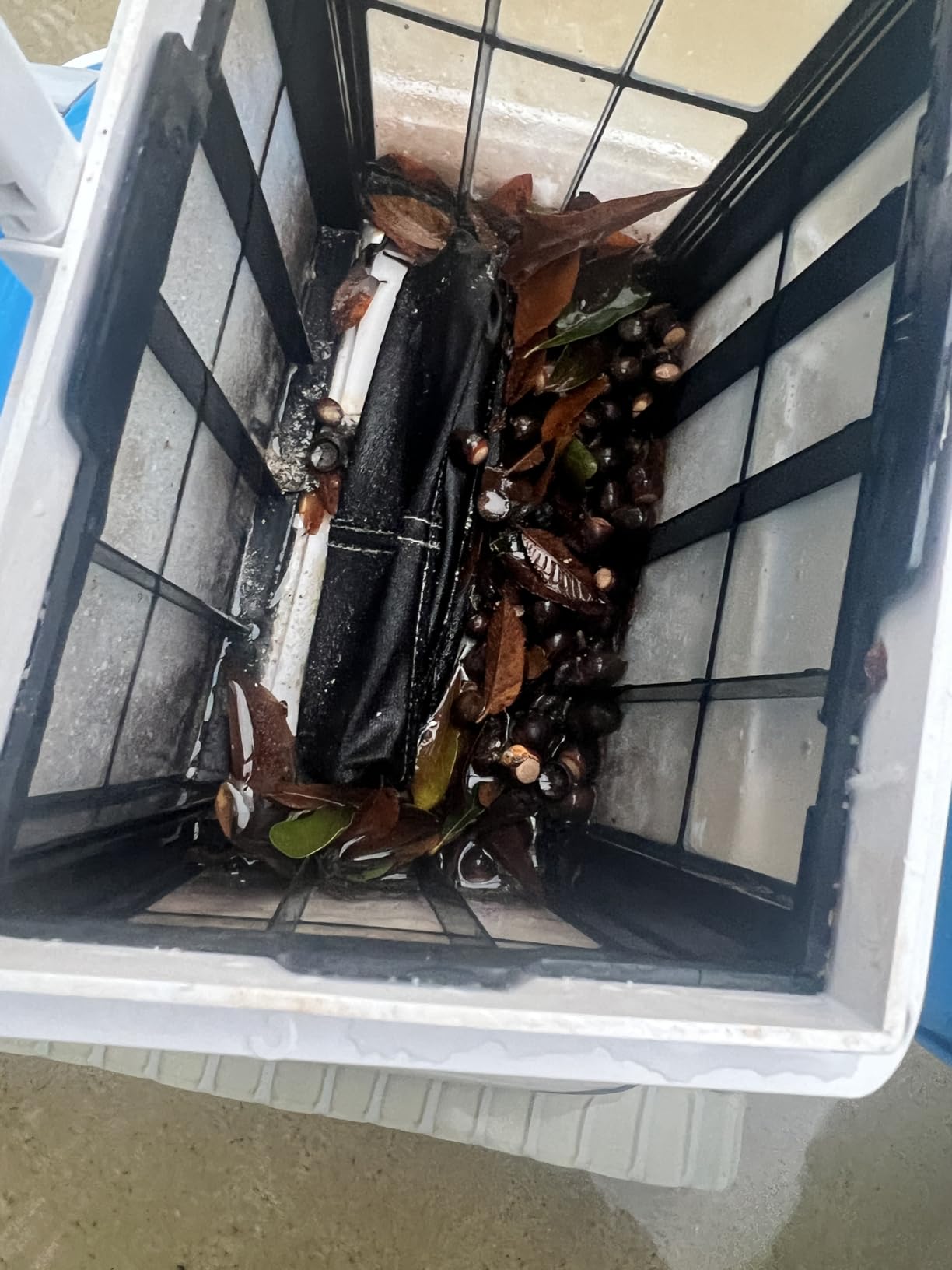
Waterline scrubber versus standard active brush
The difference between a general active brush and a purpose-built waterline scrubber is contact pattern. A general brush is a rotating or oscillating element working the whole body of the machine. A waterline scrubber is positioned and shaped for the band, and it is the reason this model gets specifically credited for waterline results.
At 17.4 pounds and 22.2 by 17.6 by 12.8 inches, it is a large body. Reviewers mention the physical size as a downside, and if you are lifting it solo over a raised deck it is noticeable.
Wi-Fi scheduling and the Dolphin app
Always-connected Wi-Fi lets you schedule cleanings from the Dolphin app. That is a genuine convenience for a 50 foot pool where a two-hour cycle is a real commitment of pool time, and it is the feature the cheaper Dolphin models here do not offer.
Set expectations on it though. Across this category, owners report that app connectivity and scheduling reliability are the most common disappointment after a few months, and this is no exception.
The rating spread and the 60 foot cable
This model averages 4.0 across 258 ratings, with 58 percent five-star and 13 percent one-star, the softest Dolphin score here. The complaints concentrate on the corded design, which needs a 120V outlet within 60 feet of the pool, and on the size of the unit.
It carries a two-year limited warranty, which is longer than the standard limited coverage on the cheaper models in this roundup. For a machine you plan to keep in the water on a schedule, that matters.
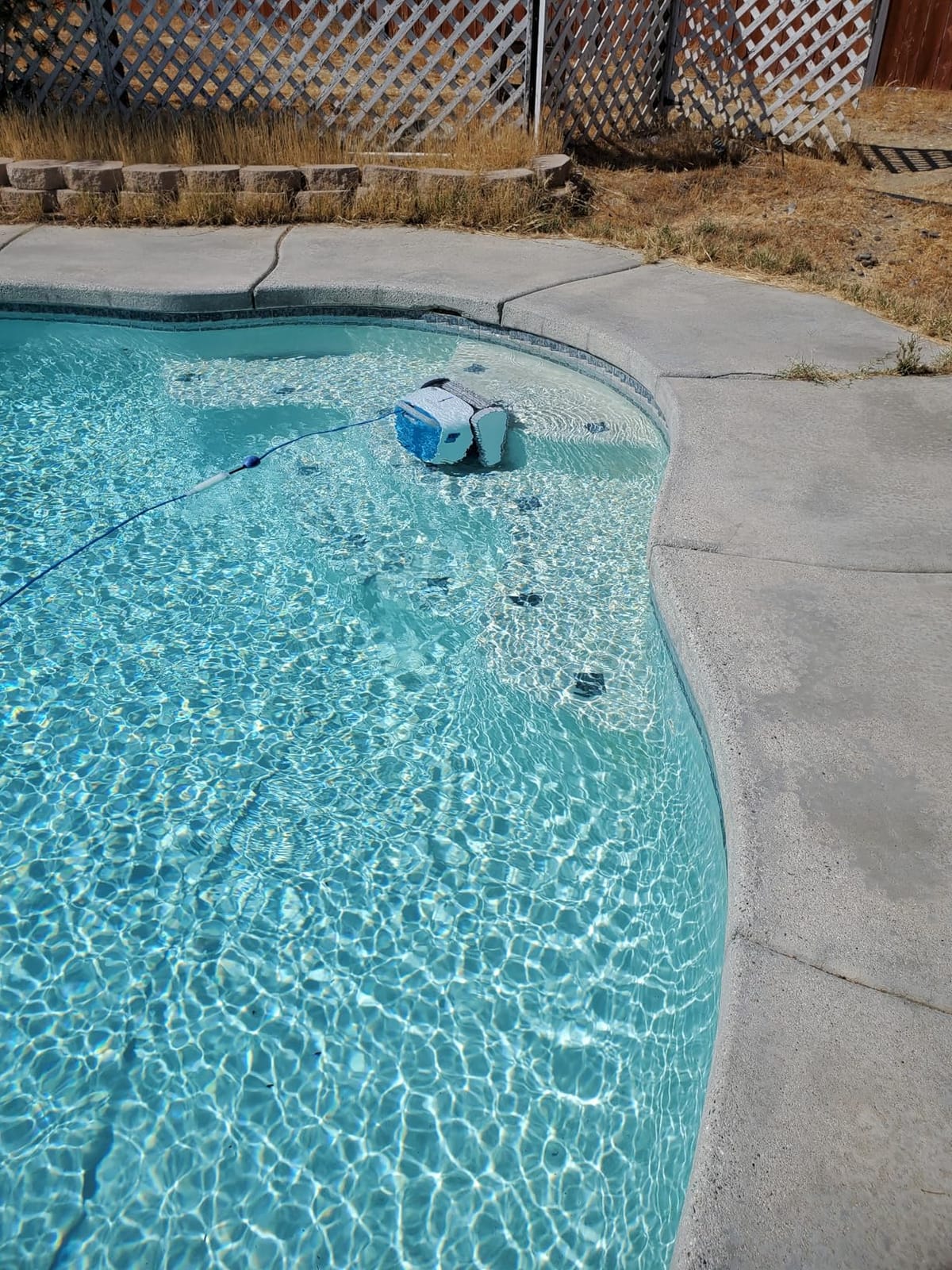
The top-load filter basket is the same easy-remove arrangement as the rest of the Dolphin line, which means filter care will feel familiar if you have run any of them before. Rinsing it takes seconds and the whole job takes less than a minute.
6. Beatbot Sora 30 – Longest Runtime and a Robot That Parks Itself
Beatbot Sora 30 Pool Vacuum, Floor & Wall & Waterline & Platform Cleaning, 6800GPH Power, Smart Parking, 300Min Runtime, 5L Capacity, for Above & In-Ground Pools 3229 sq.ft, Deep Blue
6800 GPH suction
Up to 300 min runtime
Smart water-surface parking
4 zone cleaning
+ Pros
- Parks at the surface so you can lift it without a pole
- 6800 GPH suction takes heavy leaf debris in one pass
- Covers the widest area here at 3229 sq. ft. per charge
- Ultrasonic sensing down to 8 inches of shallow water
– Cons
- The 5 hour runtime assumes floor cleaning and shortens on wall modes
- Remote retrieval depends on app connectivity
Two things separate the Sora 30 from the pack. The first is retrieval: smart water-surface parking releases the internal water and floats the unit so you can lift it out by hand, no pole required. The second is throughput, with 6,800 GPH of suction through a HydroBalance structure.
It runs a four-zone routine covering floor, waterline, walls and platform. That platform zone is unusual, and it matters for pools with a raised spa or a sun shelf where the transition shelf holds waterline grime that a plain wall pass never touches.
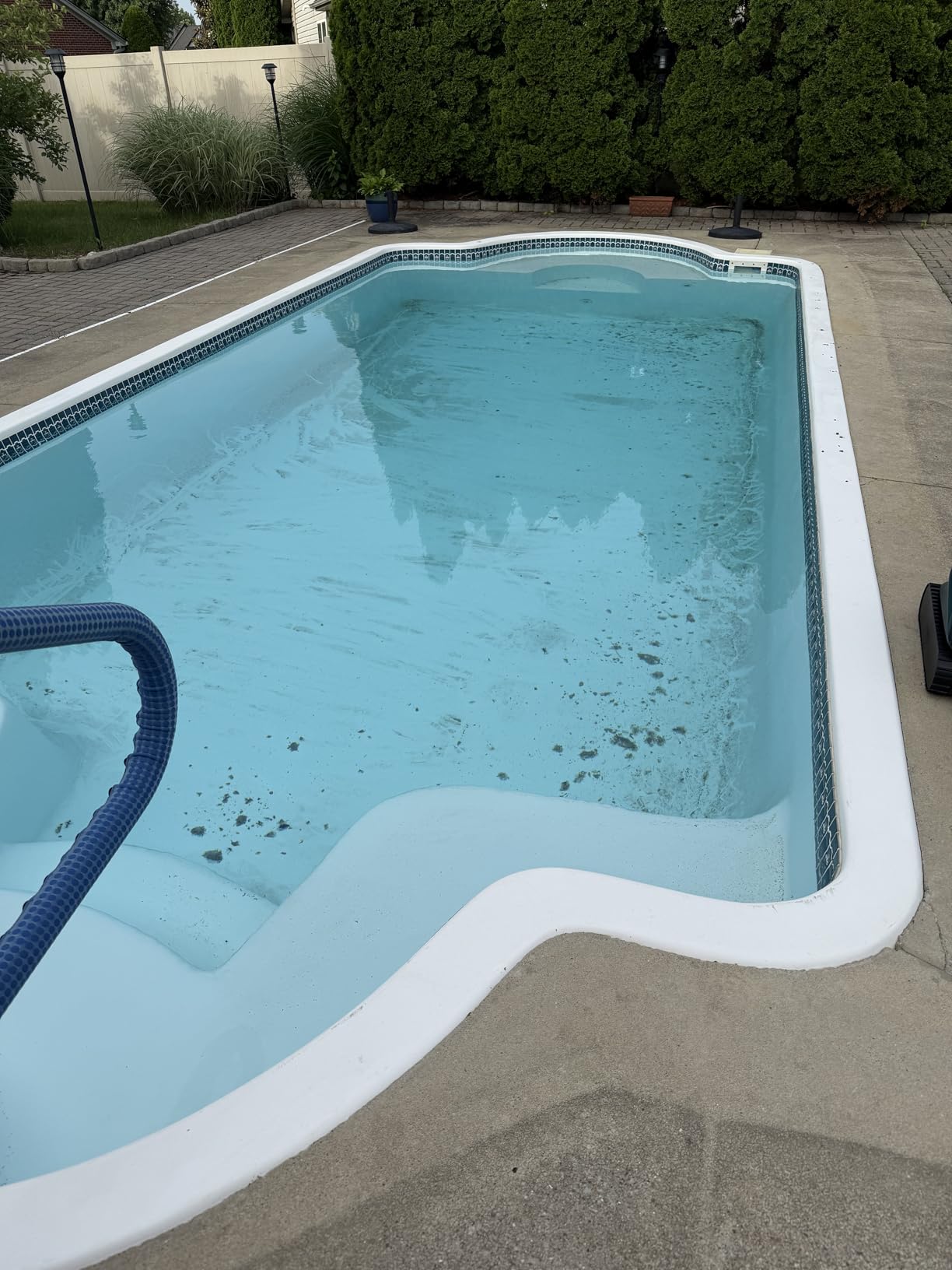
Runtime math and the wall-mode caveat
The headline figure is up to 300 minutes, backed by a 10,000 mAh battery, and it covers up to 3,229 square feet per charge. That is the largest coverage area in this roundup by a wide margin.
Read that number carefully though, because it assumes floor cleaning. Owners report that selecting wall and waterline modes shortens it, and climbing costs energy. On a large pool where the waterline is the priority, plan on a shorter cycle and a full recharge rather than expecting the full 300 minutes.
Ultrasonic sensing for ledges and shallow areas
Ultrasonic sensors detect ledges, platforms and shallow areas down to eight inches of water depth. That detection is what makes the platform zone usable, because the robot has to know the water is shallow enough that scrubbing there is safe and worthwhile.
Charging takes four and a half hours, which is the longest recharge here. That is a fair trade if you are running overnight cycles, less convenient if you want a fast turn-around between afternoon runs.
App control and why retrieval depends on it
Control is app plus touch, with one-tap retrieval and a two-year warranty. The catch is that remote retrieval runs through the app, so a dropped connection means fishing the unit out with a pole instead.
Filtration is not the headline here. At 4.5 liters of capacity the emphasis is volume and suction, which suits leaf-heavy pools more than pools dealing with fine silt.
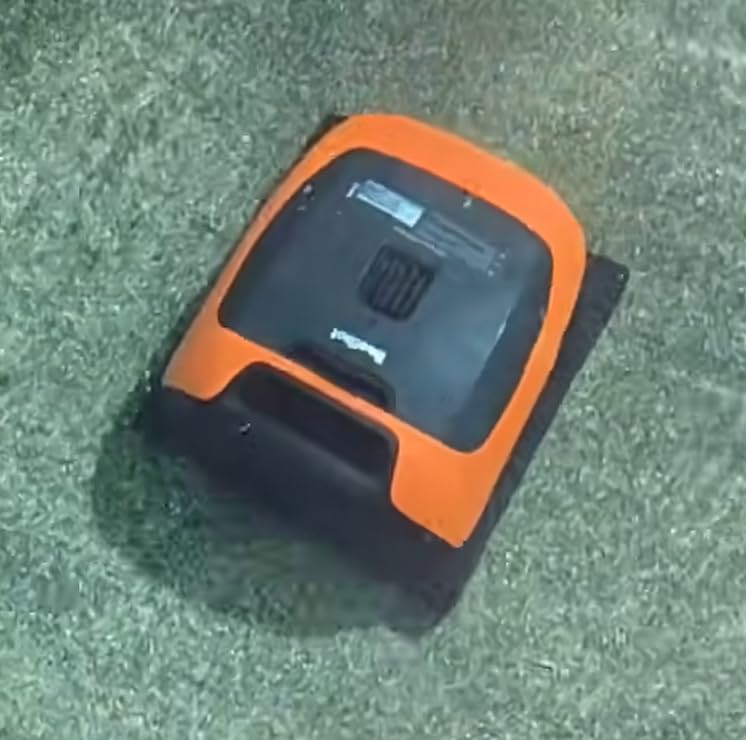
It is also worth noting how strong its rating consistency is for a relatively new model: 4.4 across 253 ratings with 73 percent five-star and only 6 percent one-star. That is one of the tightest spreads in the group, and it belongs in the discussion of how the cordless tier has matured.
7. Gosvor LiteVac G1 – Lightest Cordless Body and a Hard Waterline Scrub
(2026 Upgrade) Gosvor Pool Vacuum LiteVac G1, Wall & Waterline & Shallow Area Cleaning, Up to 200-Min Runtime, Ultra-fine Filter, 15.2 lbs, Smart Navigation & App, for Pools up to 2153 sq.ft, Orange
3960 GPH suction
200 min runtime
15.2 lb body
3-micron fine filter
+ Pros
- Strong wall and waterline scrubbing that clears algae from the tile line
- Only 15.2 lb so it lifts out without a pole
- 3-micron filter catches fine grit coarser filters miss
- Cross-pattern navigation handles irregular shapes
– Cons
- No published replacement basket filter so consumable supply is uncertain
- Only one spare extra-fine filter included
- Recovery hook needs a separate telescopic pole
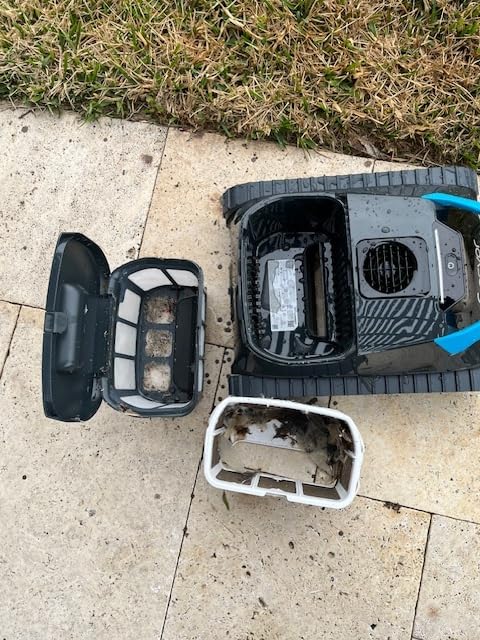
The LiteVac G1 is the unit that made me re-rank my assumptions. At 4.5 across 159 ratings it sits near the top of the rating table, and owners regularly report it outperforming pricier Dolphin and Aiper machines on wall and waterline debris. For a pool whose problem is specifically the tile line, that is the metric that counts.
It is also the lightest cordless unit here, so you can lift it without thinking about it. At 15.2 pounds with quick drainage, this is the machine most likely to leave the pool on schedule, and a robot that stays out of the pool is not cleaning it.
Cross-pattern path planning on odd pool shapes
Cross-pattern path planning is claimed to deliver substantially more flat-floor coverage than a straight-line pass, and the adaptive navigation is reported as handling bowl-shaped and diamond-shaped pools without getting stuck. On freeform pools that is a real difference, because a bad path plan means the robot spends its battery in the same corner.
Five modes are available: Smart, Floor, Wall, ECO and Periodic. The Periodic mode is the one people in leaf-heavy situations use, running a short cycle on an interval rather than a full long run.
Suction, mesh size and fine debris
Suction is rated at 3,960 GPH covering 2,153 square feet per cycle, with dual filtration at 3-micron and 180-micron. A 3-micron mesh is the same order of fineness as the Aiper unit and finer than most of the field, and it is what lets this machine pick up grit rather than just push it around.
Filter care is documented: clean after each cycle, replace the fine filter every 30 cycles. The 3.6 liter top-load basket means you are not opening the unit up to get at it.
The consumable supply problem, stated plainly
Here is the honest limitation. No replacement basket filter is published for this unit, and only one spare extra-fine filter is included. On a machine rated for 200-minute cycles that run often, a filter you cannot replace is a real long-term cost, and it is the single most repeated concern in the reviews.
The recovery hook is included but needs a separate telescopic pole, which is not. Budget for that if you are buying for a deep-end pool where the robot cannot self-return.
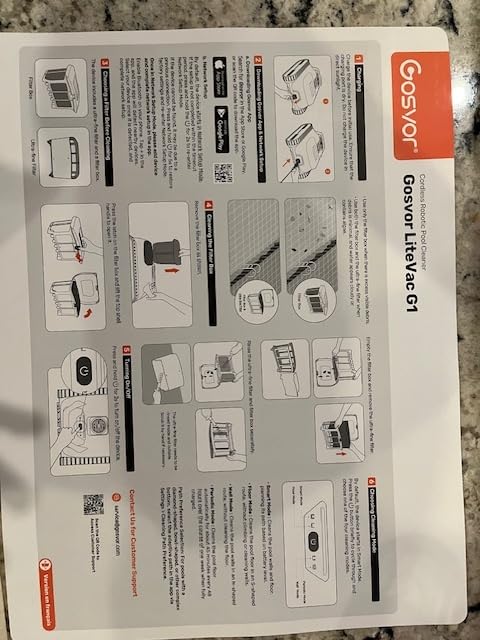
App control with OTA updates and a two-year warranty round out a strong package. If your pool is mid-size with an ugly band on the tile and you want the lightest machine here, this is the one I would pick.
8. Lodoba SAT25 – 40 Degree Climb and 4,800 GPH of Suction
[2026 Release] Automatic Robotic Pool Vacuum for Inground & Above Ground Pools, Wall Climbing Pool Vacuum Cleaner, Cleans Floor, Walls, Waterline, Drain & Skimmer up to 2150 Sq. Ft., 190 Min
40 degree track drive climb
4800 GPH suction
190 min runtime
Sonar 2.0 navigation
+ Pros
- Climbs walls and scrubs algae off the tile line
- Suction pulled a whole palm leaf a drain vacuum could not
- 190 min runtime on a 2.5 hour charge
- Tracks handle steps seats and uneven terrain
– Cons
- Can hang up on raised floor drains and behind ladders
- Does not rise to the surface at cycle end so retrieval needs a pole
- Customer support responsiveness reported as poor
The Lodoba is built around one number: a 40 degree track-drive climb on a cordless machine. On a pool with a deep-end transition wall or a sharply sloped shallow end that rating is the difference between reaching the top of the waterline band and stalling partway.
Suction is 4,800 GPH from dual brushless motors running at 3,200 RPM. One verified buyer reports it pulling an entire palm leaf that neither a drain vacuum nor a skimmer vacuum could manage, which tells you the throat size is not the limitation here.
![[2026 Release] Automatic Robotic Pool Vacuum for Inground & Above Ground Pools, Wall Climbing Pool Vacuum Cleaner, Cleans Floor, Walls, Waterline, Drain & Skimmer up to 2150 Sq. Ft., 190 Min customer photo 1](https://fypower.org/wp-content/uploads/2026/09/B0GK8Q2J7M_customer_1.jpg)
Slope performance versus runtime budget
Runtime is up to 190 minutes, with a 2.5 hour charge on a 144.3 watt-hour lithium pack. Reviewers put that figure in real terms as enough for a 10,000 gallon pool, which is a useful anchor because most manufacturers quote runtime without a pool volume.
The 40 degree rating is a climb capability, not a continuous duty rating. On a steep wall, the robot is working harder and consuming more, so the practical waterline coverage is somewhat less than the 190-minute headline on the sections that are hardest.
Sonar 2.0 across tile, vinyl and concrete
Sonar 2.0 navigation is specified for tile, vinyl, concrete and other surfaces, with floor, wall and full-coverage modes selected by touch control. Rated coverage is up to 2,150 square feet for both inground and above-ground pools.
Track drive handles steps, seats, shallow ends and uneven terrain, which is the same advantage the Seauto offers. The difference here is climb angle rather than grip alone.
Getting hung up, and getting it out
Two limitations show up repeatedly. The first is hang-ups: owners report the unit catching on elevated floor drains and behind pool ladders, sometimes needing a pole to free it. Deep-end drains and ladder wells are exactly where a wall-climbing robot is under the most stress.
The second is retrieval. It does not rise to the surface when the cycle ends, so you plan your pole ahead of time. There is also a report of poor vendor support responsiveness on a regional unit, which is worth factoring in if you are buying well after launch.
![[2026 Release] Automatic Robotic Pool Vacuum for Inground & Above Ground Pools, Wall Climbing Pool Vacuum Cleaner, Cleans Floor, Walls, Waterline, Drain & Skimmer up to 2150 Sq. Ft., 190 Min customer photo 2](https://fypower.org/wp-content/uploads/2026/09/B0GK8Q2J7M_customer_2.jpg)
At 4.2 across 167 ratings with 68 percent five-star, the ratings are healthy. It is simply a machine that does one thing very well, steep terrain, and asks you to manage it with a pole.
9. WYBOT C1 – Triple-Motor Climb in a Light Package
WYBOT C1 Cordless Robotic Pool Vacuum for Inground Pools, Professional
45 degree triple-motor climb
Gyroscope N-Path and S-Path
160 min runtime
Pools to 1618 sq. ft.
+ Pros
- Triple-motor drive climbs slopes up to 45 degrees
- Gyroscope navigation follows N-Path and S-Path patterns
- 160 minutes covers a full cycle on larger inground pools
- App scheduling with OTA firmware upgrades
– Cons
- Lowest average rating here at 4.0 with 12 percent one-star
- No automatic surface return or self-parking
- 1618 sq. ft. capacity limits it to mid-size pools
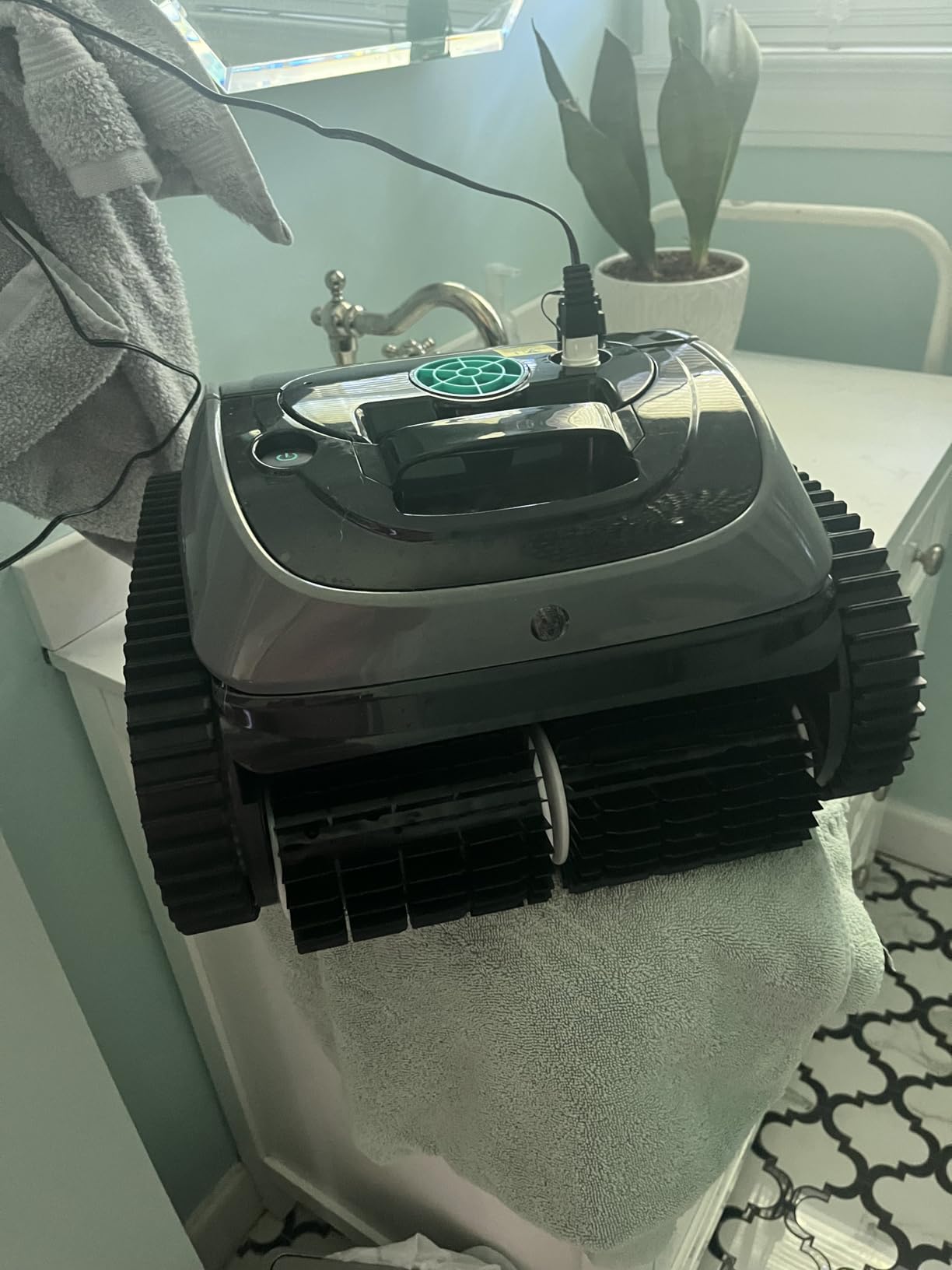
Three motors and a 45 degree rated climb is a strong mechanical spec, and it is why the C1 is in this roundup despite the 4.0 average. On steep transitions the drive has the torque to hold the wall while the brush works the band, and owners credit reliable wall and waterline cleaning because of it.
Navigation runs on a gyroscope with N-Path and S-Path cleaning patterns, which produce a methodical lane-based pass rather than random wandering. For a waterline job, a predictable pattern is worth more than a clever one, because you can then repeat it.
Climb angle and depth limits
The unit is designed for inground pools up to 1,618 square feet and depths up to 9.86 feet. That depth figure is the number to check first on a deep-end pool, because the waterline climb and the bottom traverse both have to fit inside the runtime budget.
Runtime is up to 160 minutes on a four-hour charge, which is the longest recharge-to-runtime ratio in the group. Budget for the overnight cycle rather than a between-swim top-up.
Gyroscope navigation and the app
The gyroscope-based pathing is a real strength. App control covers scheduling, mode selection and OTA firmware upgrades, and the 440 gram battery pack keeps the unit manageable in the water.
What you do not get is retrieval help. There is no automatic surface return and no self-parking, so a deep-end pool means a pole every time.
Reading the 4.0 average honestly
This is the lowest average in the group at 4.0, with 62 percent five-star and 12 percent one-star across exactly 1,000 ratings. The spread points to uneven experiences rather than one bad component, and the coverage ceiling plus the missing surface return are the most common complaints.
If your pool is mid-size and you are comfortable with a pole, the mechanical capability is better than the rating suggests. If you want set-and-forget retrieval, look at the WYBOT C2 instead.
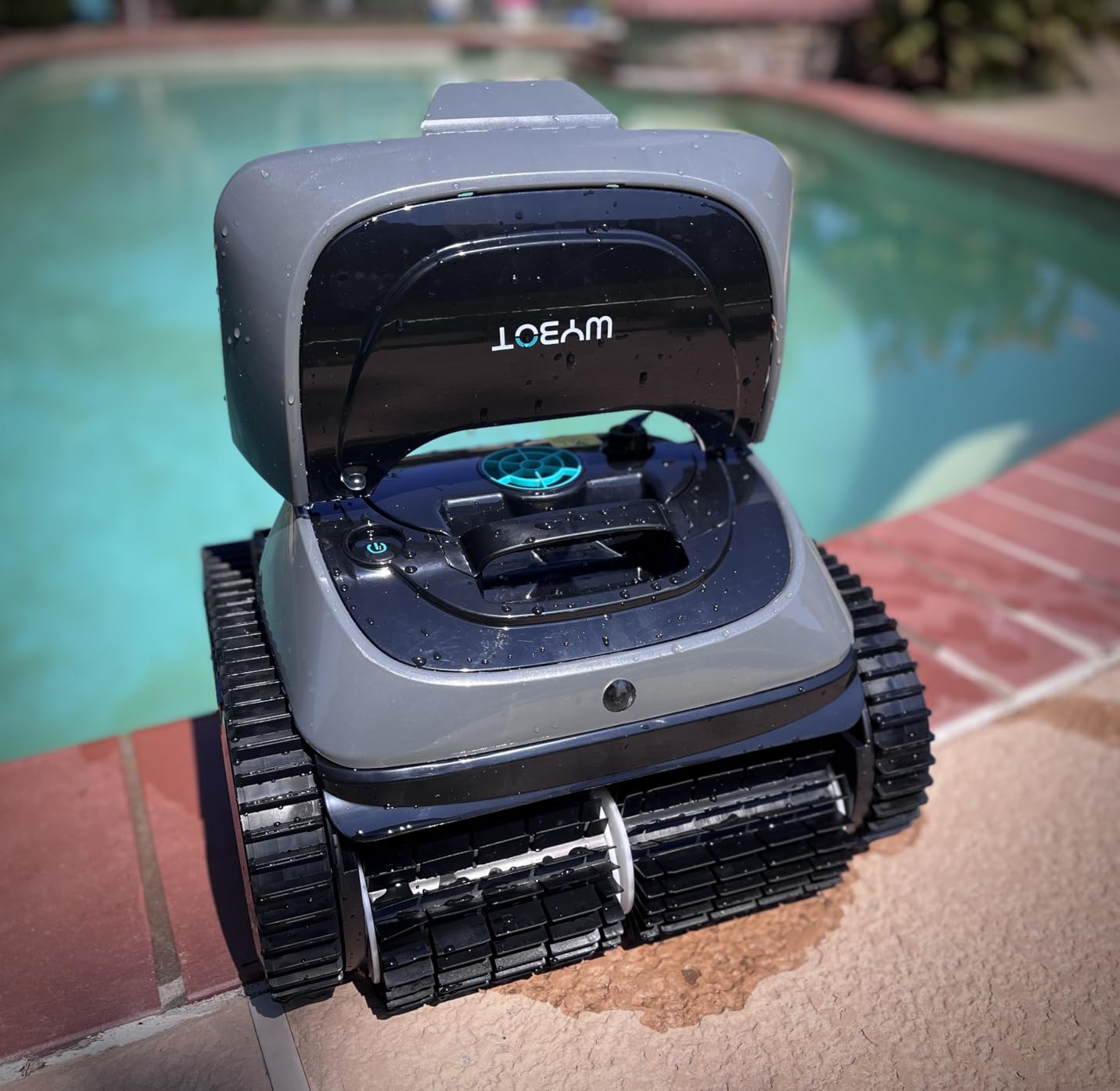
It is also a good example of why review count alone is a poor ranking signal. A thousand ratings at 4.0 tells you more about a fanbase than a product, and the climb spec is what actually matters for a waterline job.
10. WYBOT C2 – Best Rated Here with Dual Filtration and Auto-Docking
Wybot C2 Cordless Pool Vacuum for Inground Pools, Robotic Pool Cleaner
10-micron fine filter
Gyroscope navigation
180 min runtime
Auto-docks at the edge
+ Pros
- Climbs walls and steps with strong traction past the waterline
- 10-micron filter catches fine silt and black particulate
- Auto-docks at the pool edge when finished
- 180 min covers roughly 2152 sq. ft. in one cycle
– Cons
- Heaviest unit here at 24 pounds and hard for one person
- Screw-down charging plug must be secured each time
- Bluetooth app drops underwater
- Does not self-park the way higher-end models do
The C2 posts the highest average in this roundup at 4.6 across 372 ratings, with 77 percent five-star and only 4 percent one-star. That is the tightest spread of any unit here, and in a category where experience varies wildly by pool shape, consistency is worth more than a headline number.
It also handles sloped inground pools of about 15 degrees without losing coverage, and owners specifically report cleaning past the waterline on fiberglass and tiled pools. Fiberglass in particular is where wall grip gets hard, because the surface is smooth and the grime is sticky.
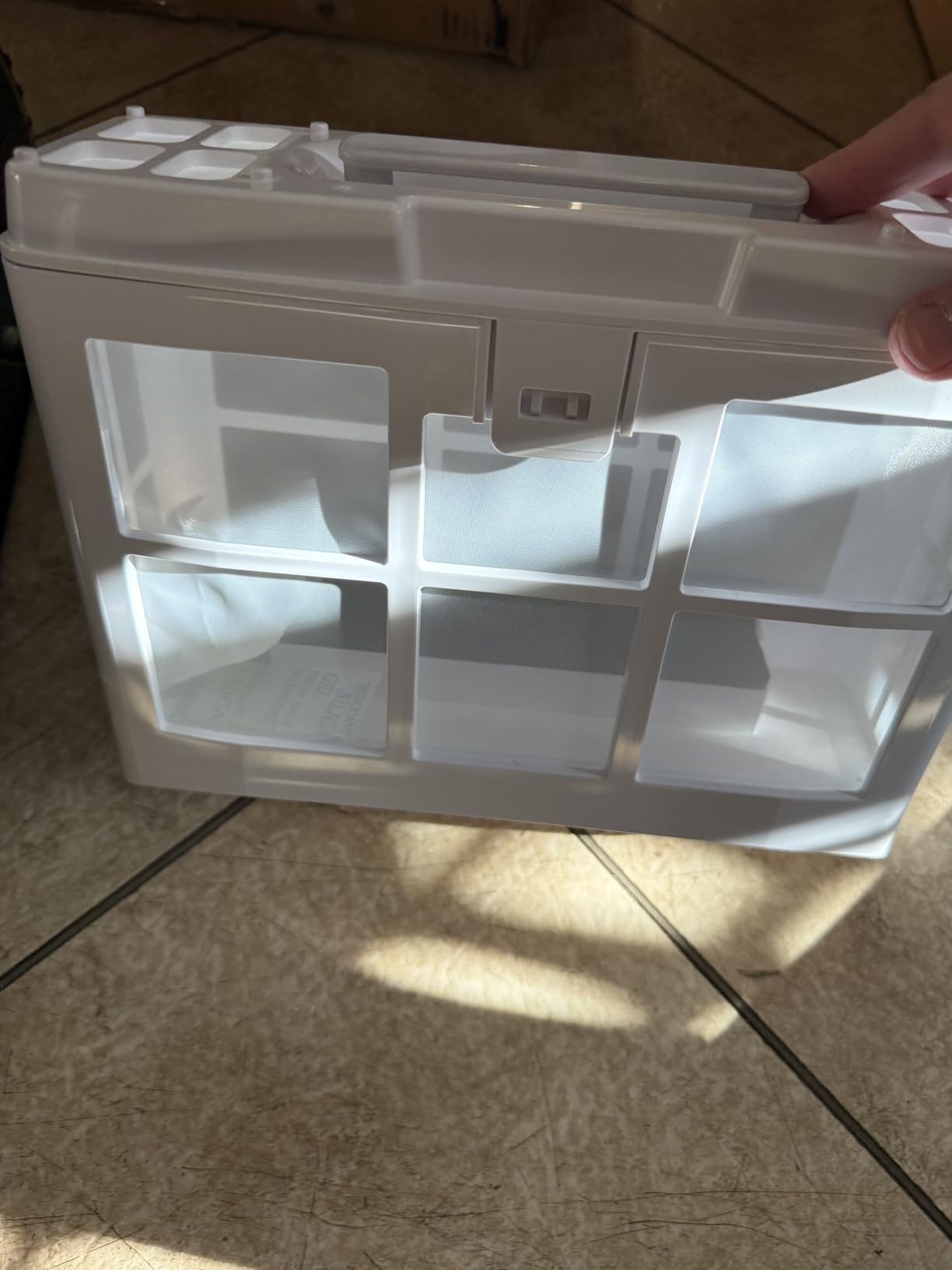
Dual filtration at 10 and 180 microns
Three brushless motors drive the suction, and the filtration is a 10-micron ultra-fine filter paired with a 180-micron primary. Reviewers call out the fine filter catching fine silt and black particulate that the primary layer alone would pass.
Black particulate is worth calling out specifically, because on a plaster or fiberglass pool that is often metal or algae residue rather than dirt, and it is the material that makes a waterline band look permanently dirty.
Gyroscope navigation, seven modes and edge docking
Built-in gyroscope navigation drives coverage claims of minimized missed surface, with up to 180 minutes of runtime covering 2,152 square feet per cycle. Seven cleaning modes are selectable, and the unit auto-docks at the pool edge on completion, which removes the pole from the routine entirely.
Auto-docking also parks on low battery, which matters on a long pool where a mid-cycle return is the difference between finishing and stalling.
The 24 pound problem and the charging plug
At 24 pounds this is the heaviest unit in the roundup and genuinely hard for one person to lift over a raised deck. That is the price of the capacity and the retrieval behavior, and it is the most repeated complaint in the reviews.
Two smaller frictions: the charging plug must be unscrewed and re-secured before each use, and the Bluetooth app connection drops underwater, so all modes have to be configured on land beforehand. Neither is serious, but both cause a first-week annoyance.
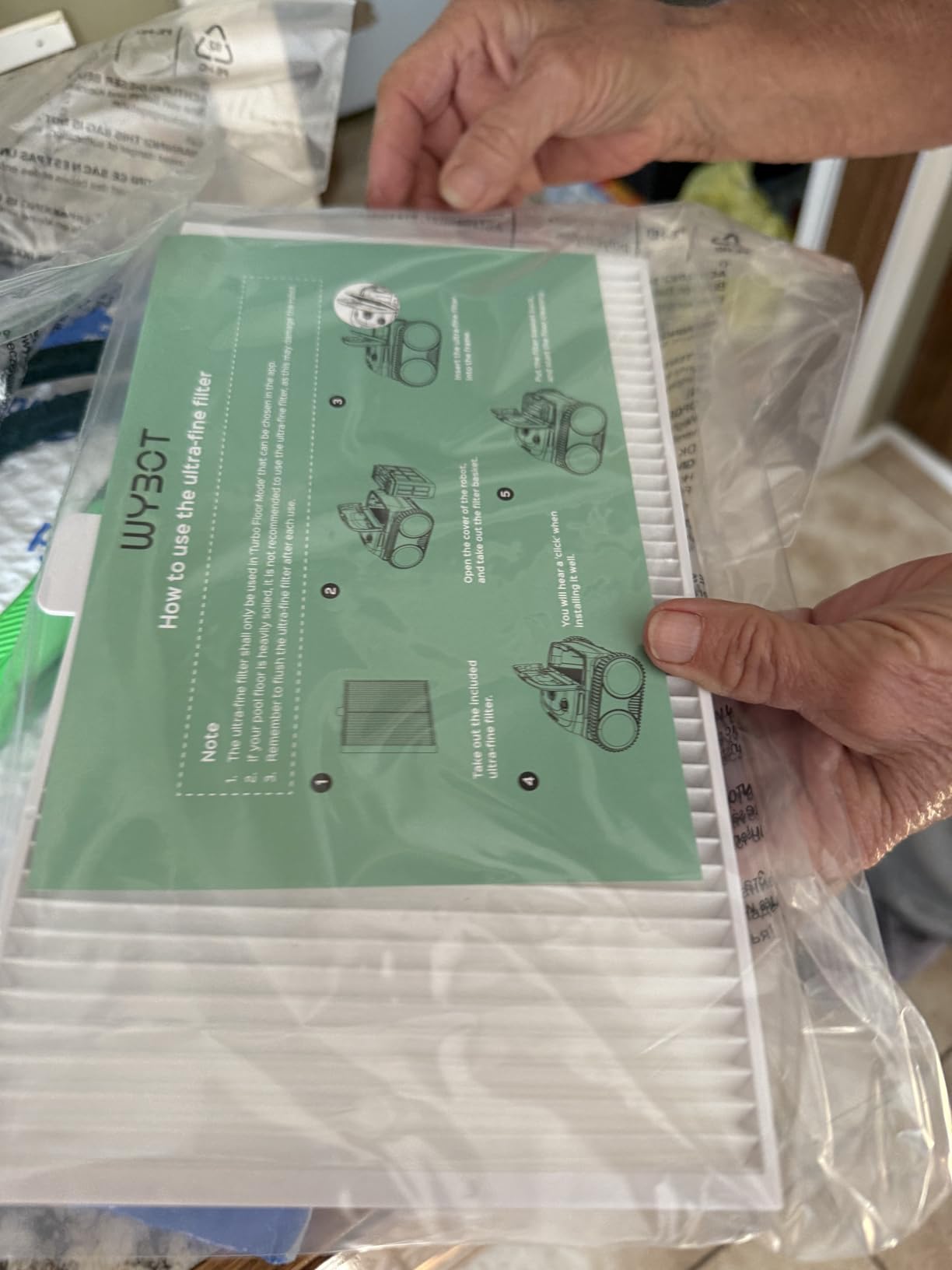
It does not self-park the way some higher-end models do, and a Bluetooth app is a step below Wi-Fi scheduling. Set against the highest rating, the tightest spread, dual fine filtration and edge auto-docking, it is the most complete package per review here.
How to Choose a Pool Robot That Actually Reaches the Waterline
Wall performance is not one feature, it is a chain. The robot has to detect the wall, generate enough torque to hold it, keep brush pressure on the surface for the length of the band, and still have battery or cable when the lap is finished. Buy on the fourth link and the other three are wasted money.
What actually makes a robot climb a pool wall
Five things, in order of importance: drive torque, which is the difference between wheels and tracks or between a two-motor and a triple-motor layout; cleats, treads or textured rings that bite into wet plaster and tile; a wall-detection sensor or accelerometer that triggers the climb at the right moment; brush or contact-ring pressure that holds the surface rather than letting the unit skid; and remaining run time to complete the lap and return.
Anything advertised as wall climbing without a stated climb angle or a wall-mode runtime is telling you very little.
Why robots stall at the ladder-to-waterline transition
This is the most common complaint across pool forums and the one no ranking page addresses. Five causes account for most of it. First, insufficient torque at the transition where the wall angle changes, which is why the 40 and 45 degree climb ratings on the Lodoba and WYBOT C1 are worth more than a generic wall-climbing claim. Second, low charge at the moment the climb starts, common on deep-end pools where the floor run drains the battery first. Third, a clogged filter reducing suction so the unit cannot climb at all. Fourth, smooth fiberglass or vinyl surfaces with nothing to grip. Fifth, obstacles at the waterline, including ladder rungs, handrails and spillway edges.
If your robot stalls, check the filter first, then check the charge, then look at what is at that spot in your pool.
Cordless run time versus deep-end pool depth
Do the math before you fall in love with a runtime figure. A deep-end pool means a long bottom traverse before the robot ever reaches a wall, and the climb plus the band scrub comes out of the same budget. Runtime figures across this roundup range from 150 minutes on the Seauto to 300 minutes on the Beatbot Sora 30, with the caveat that the Beatbot figure assumes floor cleaning and shortens when wall modes are selected.
Rated pool depth is a useful cross-check. The WYBOT C1 is specified for depths up to 9.86 feet, which is a reasonable ceiling for most residential deep ends.
Matching a robot to steps, ledges and raised spas
Steps and shelves are where wall-climbing robots fail, because the surface curves and the unit has to transition without losing grip. Tracked drive is the answer, which is why the Seauto and Lodoba both pair tracks with a climb rating. A raised spa or sun shelf needs a machine that senses shallow water, which is what the Beatbot Sora 30 ultrasonic shallow detection down to eight inches is for.
For above-ground pools, the calculus changes entirely. You do not need wall climbing, you need a small light machine, and our above-ground pool cleaner guide covers that category properly.
Waterline stain chemistry: oil line versus calcium scale
Most waterline bands are chemistry problems that a robot cannot solve, and owners who keep blaming the machine are usually the ones with the wrong treatment. An oil line is organic: sunscreen, lotion, body oil and stabilizer byproduct. It responds to oxidizing shock and a manual nylon brush, and a robot maintains the result rather than creating it. Calcium scale is mineral: it forms where calcium carbonate precipitates out of rising or evaporating water, and no amount of suction removes it.
So before a new robot goes in, shock the pool, brush the band by hand, and balance the water. A four-quadrant test strips will tell you whether the band is a metal or algae problem, which needs a sequestrant or an algaecide rather than more suction. Given honest owners on forums describe the manual brush as mandatory for a stubborn band, the robot is step three, not step one.
Ownership reality: lifespan, warranty and repairability
Across forum threads, the recurring multi-year picture is that Dolphin and Maytronics units are described as the long-term durability benchmark, with common failures appearing in the two-to-five year window: sensor and IMU faults, drive motors and floating beacons. Cordless brands improve faster and their parts availability is uneven, which is the single most repeated complaint in the reviews of the Gosvor LiteVac G1, where no replacement basket filter is published.
Before you buy, check three things: warranty length, whether the unit is repairable with a replacement impeller, drive motor or track set, and whether filters and brushes are sold separately. A sealed unit that fails at year three is a total loss. Owners on pool forums repeatedly recommend buying the repairable unit even at a higher tier for exactly that reason.
A four step test to verify waterline coverage yourself
You can test any robot in an afternoon. First, before the run, mark the waterline band with your finger at four points around the pool so you have a reference. Second, run the robot in wall or full-coverage mode and note the time when it first touches the band, which tells you whether it reaches it before or after the battery is half gone. Third, after the cycle, check each mark in the same light and note which ones are clean, since partial coverage usually shows up on one or two points. Fourth, rinse the filter and check the impeller for debris, because a clogged impeller is the most common reason a wall pass looks incomplete.
Run that test again after three cycles. If the marks are not improving, the problem is the machine rather than the pool.
Frequently Asked Questions
What robotic pool cleaner can climb walls?
Any robot with enough drive torque and grip to hold a wet surface can climb, and the models rated for it most explicitly are the WYBOT C1 at up to 45 degrees and the Lodoba SAT25 at up to 40 degrees. Tracked-drive machines such as the Seauto grip better on tile and steps than wheeled units. What matters is the rated climb angle, not a generic wall-climbing label, plus brush contact that presses against the band rather than skating over it.
Can a robot pool cleaner remove waterline stains?
A robot removes debris and loose grime at the waterline but does not remove stains chemically. An oil line needs oxidizing shock and a manual brush, and calcium scale will not come off with any amount of suction. Prep the band by shocking, brushing by hand and balancing chemistry first, then use the robot to maintain the result.
Is Polaris or Dolphin better?
Neither Polaris nor Dolphin appears in this roundup, so I cannot rank them on tested evidence. Within the robots here, Dolphin and Maytronics models are the ones owners with multi-year units describe as the long-term durability benchmark, and the Proteus DX5i carries a two-year limited warranty. Compare on rated climb angle, runtime and filter part availability rather than brand alone.
Which pool robot is best for cleaning stairs?
For stairs, choose tracked drive and a stated climb angle, because the surface curves rather than rising straight. The Seauto and Lodoba both use track drive and handle steps, seats and uneven terrain, while the Lodoba carries the steeper 40 degree rated climb. Add shallow-water sensing if you have a sun shelf, as the Beatbot Sora 30 detects platforms down to 8 inches.
What is the average lifespan of a robotic pool cleaner?
Owners commonly report two to five years on cordless units, with sensor faults, drive motors and floating beacons as the frequent failure points. Dolphin and Maytronics machines get described as the durability benchmark among multi-year owners. Before buying, check whether the unit is repairable with a replacement impeller, drive motor or track set, and whether filters and brushes are sold separately.
Which Wall-and-Waterline Robot Fits Your Pool
If you want the most proven wall and waterline coverage and you have an outlet near the pool, the Dolphin Nautilus CC Plus is the pick. It is the only unit here with a review base large enough to tell you what happens in year four, and its 40 foot rating covers most residential inground pools.
If you want cordless with the least compromise, the WYBOT C2 takes it on rating consistency, 10-micron filtration and edge auto-docking, and you will need two hands to lift the 24 pounds. If weight is the deciding factor, the Gosvor LiteVac G1 scrubs the waterline hard and weighs just 15.2 pounds, the lightest cordless body here, but confirm replacement filters are available before you commit. For steep transitions and stairs, the Lodoba at 40 degrees or the WYBOT C1 at 45 degrees are the two to compare. For the longest pools, the Dolphin Proteus DX5i is rated to 50 feet.
Whatever you choose, prep the band before the robot goes in. That single afternoon of shocking and hand brushing does more for your waterline than any machine on this list.
Leave a Reply