
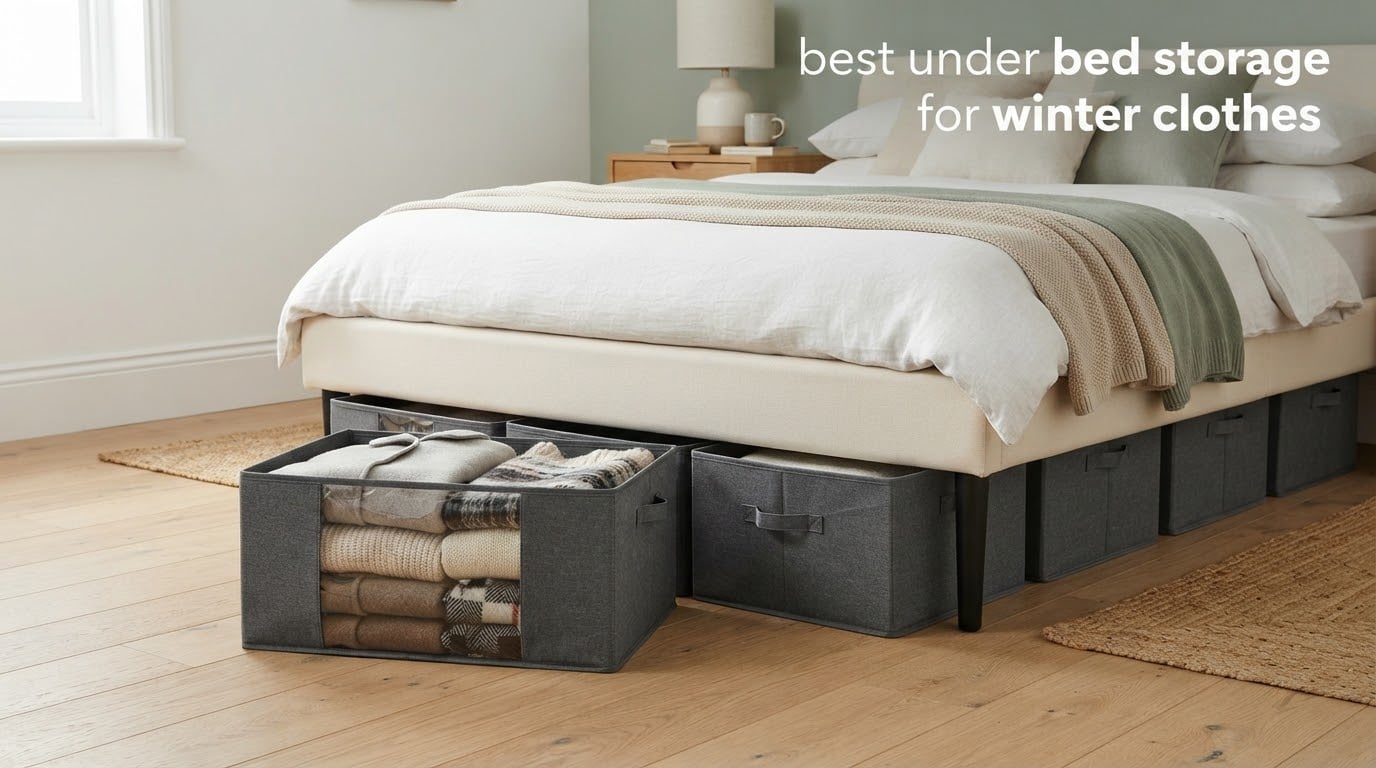
Under bed storage for winter clothes means low-profile containers, usually 5 to 7 inches tall, that slide into the gap between a bed frame and the floor to hold bulky off-season garments like coats, sweaters and comforters. Winter clothing is the bulkiest, most seasonal and most moth-attracting half of most wardrobes, and the space under your bed is the only place in a typical bedroom where all of it fits without adding furniture.
I have been sorting my own family’s seasonal clothing into whatever the gap allowed for years, and the same two variables decide every purchase: how many inches of clearance you actually have, and whether you need moth protection or just capacity. Get either one wrong and the container sits outside the bed gathering dust next to the vacuum cleaner. I looked through thousands of reviews across ten of the most-reviewed containers in this category, compared their real dimensions against typical frame clearances, and picked the ones that hold up to a full winter swap.
Everything below is a container that genuinely fits under a standard bed frame, with the height, capacity and material stated. If you want the wider picture of the category first, our [10 best under bed storage containers](https://fypower.org/best-under-bed-storage-containers/) guide covers options that work beyond the bedroom. For most readers, though, the answer is one of these ten. This list was last updated in 2026.
Our Top 3 Best Under Bed Storage for Winter Clothes (October 2026)
The three below are the picks I would buy first. The ZOBER set leads on the highest review count of the ten picks, the Budding Joy set matches it with more fabric thickness, and the Amazon Basics pair is the one to try if your clearance is under 6 inches.


All 10 Under Bed Storage Containers Compared
Height is the first thing to check on every container below, because it decides whether the bin slides under your frame at all. The listed capacity, material and closure follow from there.
| Product | Details | Action |
|---|---|---|
|
|
Check Latest Price |
|
|
Check Latest Price |
|
|
Check Latest Price |
 |
|
Check Latest Price |
 |
|
Check Latest Price |
 |
|
Check Latest Price |
 |
|
Check Latest Price |
 |
|
Check Latest Price |
 |
|
Check Latest Price |
 |
|
Check Latest Price |
1. ZOBER Under Bed Storage Bags 90L 4-Pack – The Proven All-Rounder
ZOBER Under Bed Storage Bags, Underbed Storage Containers, Gray, 90L 4-Pack
90L per bag, 4 pack
39 x 20 x 7 inches
Breathable non-woven polypropylene
Zip closure with clear top window
+ Pros
- Holds 90L per bag for bulky coats and bedding
- Clear top window shows contents without unzipping
- Folds flat when the season ends
- Reinforced handle for sliding under a bed
- Averaged 4.3 stars across more than 24000 ratings
– Cons
- Soft sides collapse inward when underfilled
- Not built for stacking heavy items on top
- Some buyers report an initial plastic smell
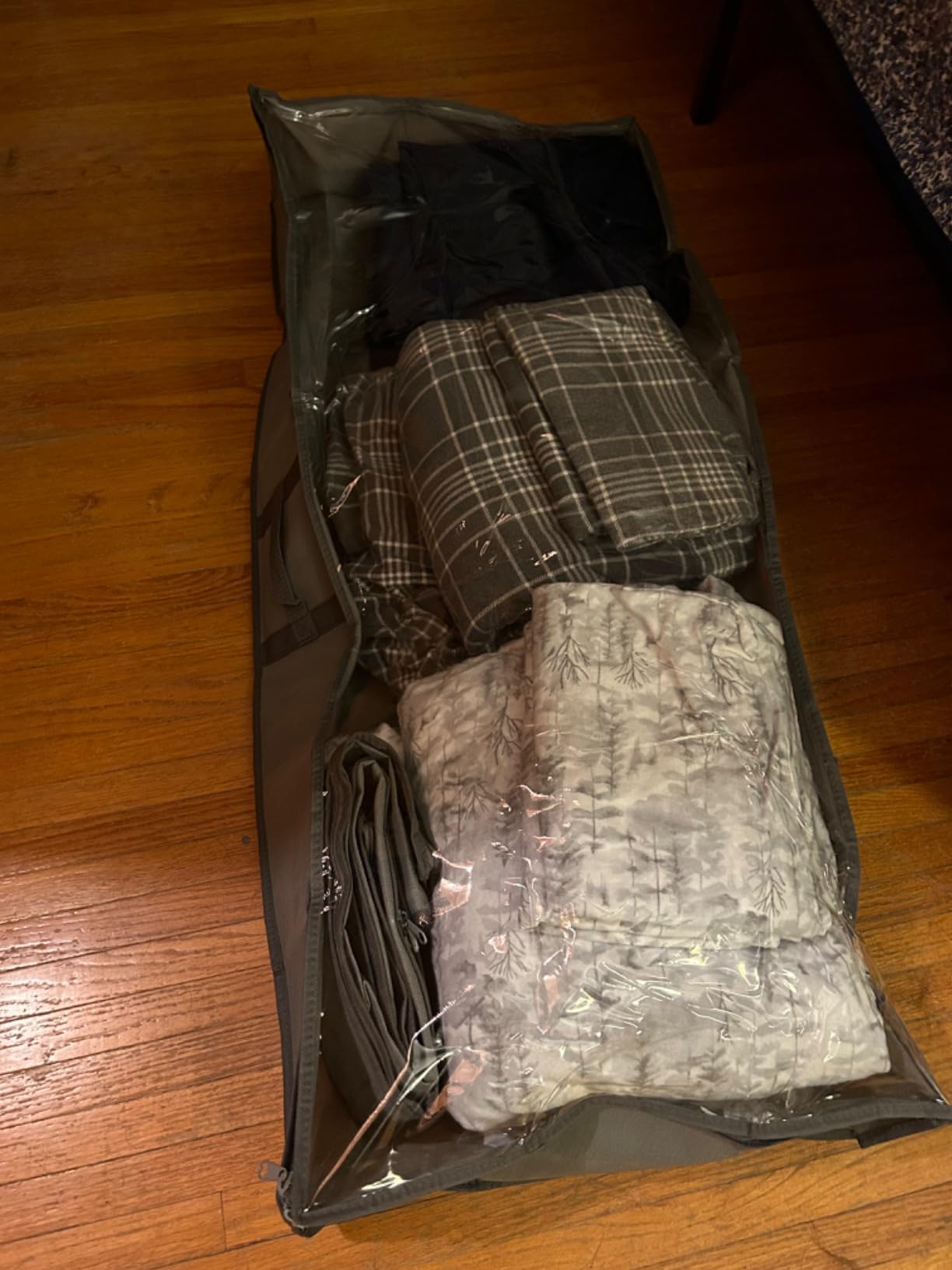
These are the bags I reach for first when someone asks me where to put a family’s winter wardrobe. At 90 liters per bag and a 39 by 20 by 7 inch footprint, one bag swallows a serious load of folded sweaters, and a four-pack gives you a full season of outerwear without a single stack in the closet. The zipper runs the full top edge and the top panel is clear plastic, so you can see a folded grey sweater before you unzip anything.
What sells me on the set is the review base. More than 24,000 ratings averaging 4.3 stars is the largest sample of any container in this roundup, and that much data is a better guide than any first impression. Reviewers describe the same use I put them to: winter clothes, duvets and seasonal bedding in small apartments where closet space is already gone.
They are also the simplest to live with day to day. The reinforced handle sits on the front face, which means you can hook a finger and drag the bag out along the floor rather than trying to tip it, and the breathable non-woven fabric resists floor scratches when the bag is dragged.
Why 90 Litres and 7 Inches Is the Sweet Spot
Capacity is where soft bags usually disappoint, and this one is an exception. Reviewers using these bags for bedding report a large folded load per bag, which in practice means one bag per adult for a winter coat, a puffer and a stack of knits. The four-pack covers a couple, and because the bags are square-footed rather than tall, they use the full width of the gap instead of a narrow slice.
At 7 inches tall, clearance is the constraint. This fits under a standard frame with a raised rail and most platform beds with a visible gap, but it will not clear a bed sitting on a 4 inch base. Measure before you commit, because a 7 inch bag on a 6 inch gap is a return trip.
Clear Window, Zippers and the Floppy-Bag Problem
The clear top panel does more work here than it seems. Under a bed, everything looks the same in low light, and a window lets you check for the single grey glove you need without pulling the whole bag across the floor. It is also where this design gives ground against the structured bins later in the list: the sides are fabric with no board, so an underfilled bag slumps inward and looks half empty.
Fill these bags close to full. That is not a styling tip, it is a structural one, because a soft-sided bag with no insert depends on its contents for its shape. If you are storing three sweaters, put them in a smaller bag and keep the big ones for the load they can actually carry.
Where They Fall Short
Three limits are worth knowing. First, the seams and zipper are lighter duty than the review count implies, and overfilling is where they show it. Second, nothing about this design is stackable, so a heavy box on top will crush the bag and crease the clothes inside. Third, a handful of buyers mention a plastic smell on arrival, which typically fades once the bag is aired out for a day or two before you seal your clothes in.
For moth protection, the zip closure is a real barrier but not an airtight one. Pair these with a clean-before-store rule and, if you have a known moth problem, cedar blocks or a lidded bin are the stronger choice.
Who This Bag Is For
Buy this set if you want maximum capacity per bag, a clear view of the contents and the flexibility to fold four bags flat in a closet when winter ends. Skip it if your bed sits low, if you plan to stack other bins on top, or if you need a hard surface that heavy books and shoes can be dropped onto. It is a clothes container, not a general storage unit.
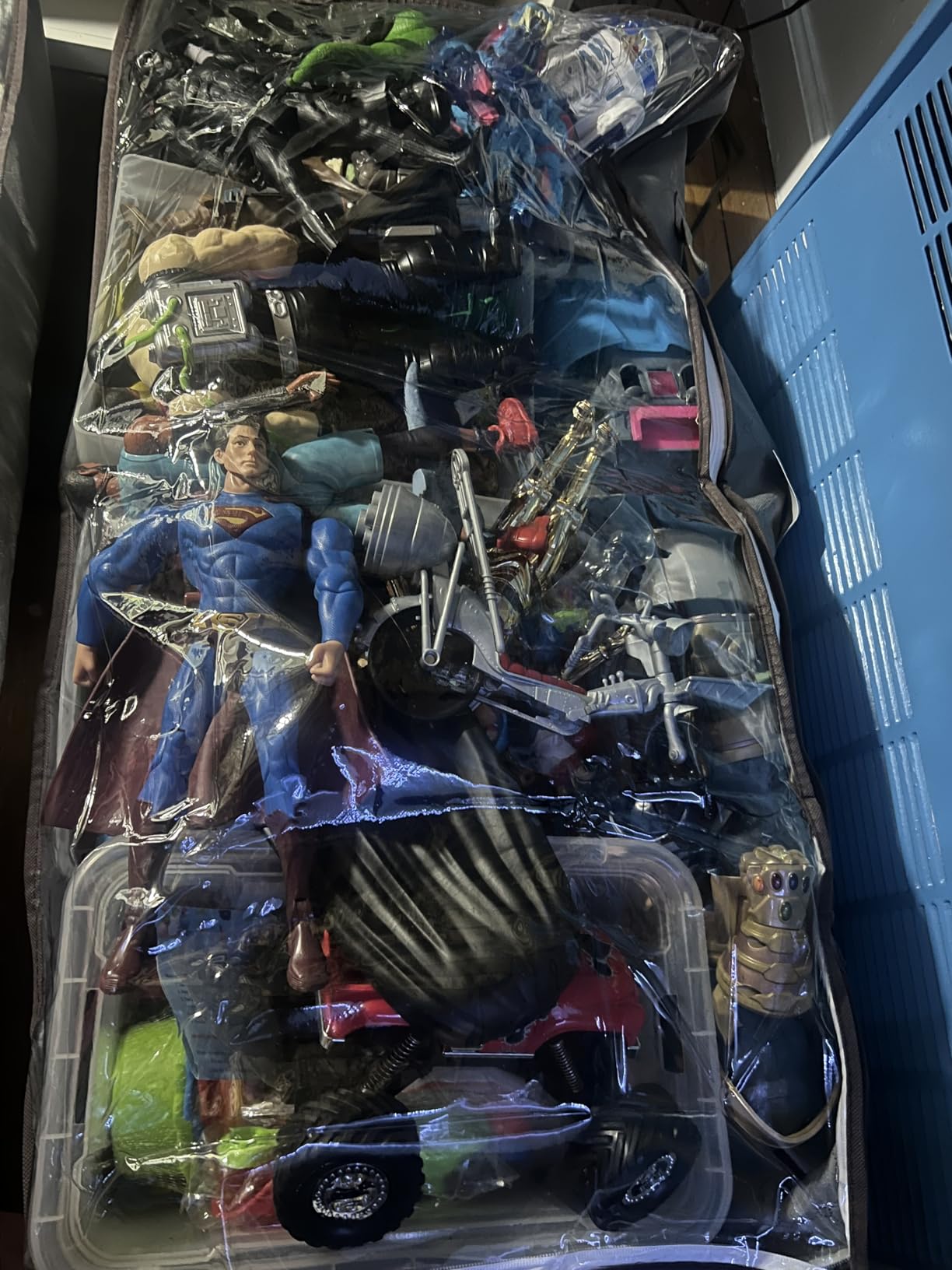
2. Budding Joy 95L Under Bed Storage 4-Pack – The Best Balance of Volume and Construction
Budding Joy 95L Under Bed Storage Containers, 4 Pack Closet Organizers Grey
95L per bag, 4 pack
39 x 20 x 7 inches
Three-ply composite non-woven
Stainless steel two-way zipper
+ Pros
- 95L per bag suits bulky coats and comforters
- Three-ply fabric is odorless and breathable
- Stainless steel two-way zipper resists dust and pests
- Double-stitched wide handles
- Cells at 4.3 stars across nearly 17000 ratings
– Cons
- No frame or base insert
- so it slumps when lightly filled
- 7 inch height will not clear a very low bed
- Not water resistant
This is the set I recommend when a friend asks for one container that handles everything, from folded jeans to a comforter, without them having to think about it. Each bag is 95 liters at 39 by 20 by 7 inches, a fraction more volume than most of its direct competitors, and the fabric is a three-ply composite rather than a single thin layer. That extra plinth is one reason these feel heavier in the hand and slide under a frame without ballooning.
Two details separate it from the field. The closure is a stainless steel two-way zipper, which is smoother after a season of use than a plastic coil and is the part of the bag that most often fails. The handles are double-stitched and wide, cut in one piece of webbing rather than two narrow loops, so pulling a loaded bag towards you does not concentrate force on a single seam.
It sits at number three in the Under-Bed Storage best sellers chart, and owners describe a consistent pattern: blankets, comforters, seasonal clothes and holiday decorations, with the clear PVC window used constantly to check what is in a bag before the swap.
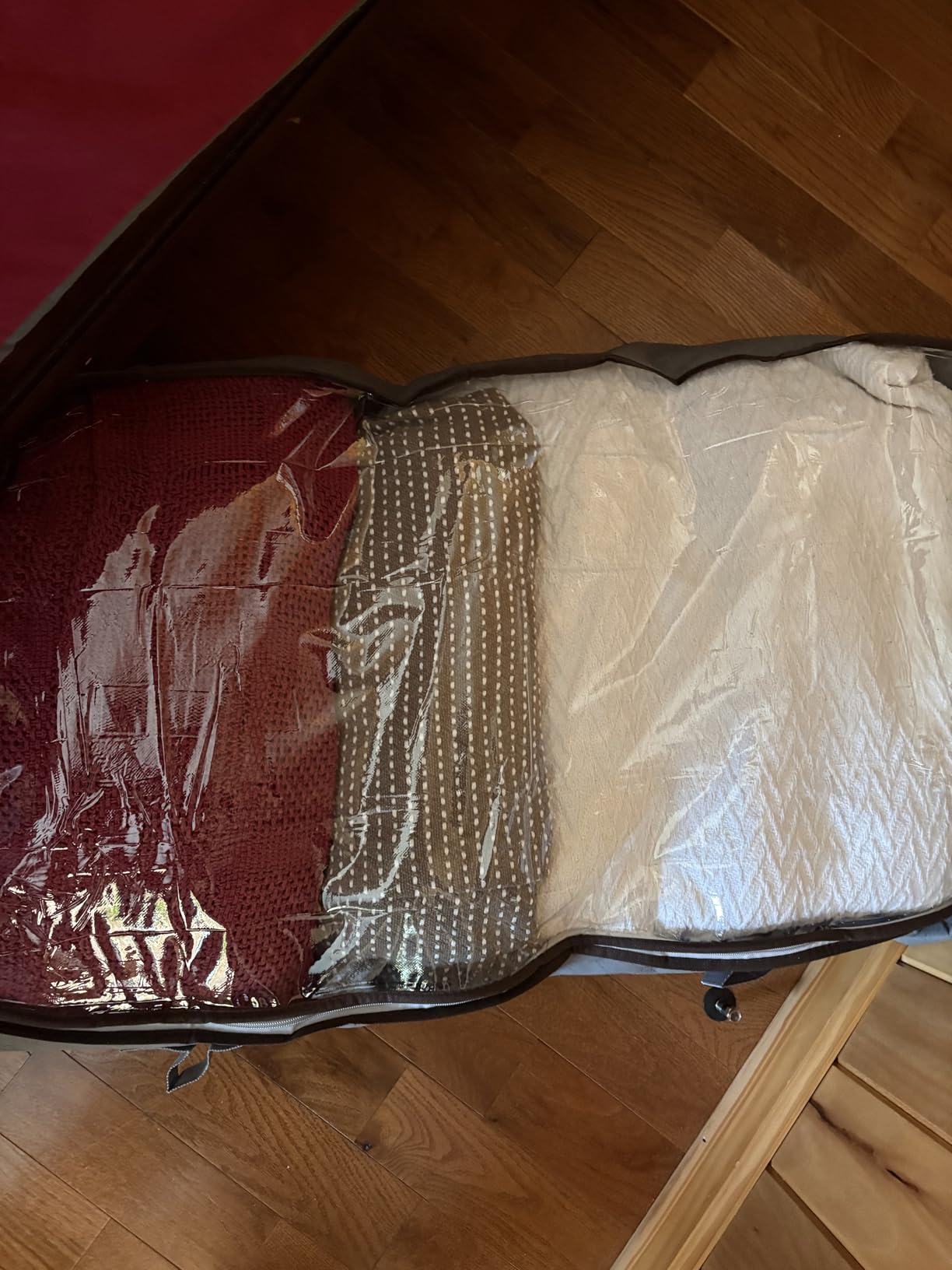
Three-Ply Fabric and Why Thickness Matters
The three-ply composite is not marketing language for its own sake. A thicker non-woven resists the two things that destroy cheap fabric bags: the abrasion of dragging along a floor and the tearing that happens when a filled bag is dragged by one corner. It also blocks more of the airflow that carries dust into a container, without going so airtight that trapped moisture becomes a problem.
Reviewers consistently note the absence of any chemical smell on arrival, which matters more than it sounds. Wool, cashmere and knitwear absorb odour quickly, and a bag that smells faintly of plastic in March will still smell faintly of plastic in November.
Capacity, Packing and the Clearance Question
At 95 liters, a single bag takes a large adult’s full winter rotation: several folded sweaters, a mid-weight coat and a couple of pairs of trousers, with room left for pillows. Owners also report using these for whole comforters, which is a heavier job than a clothes bin was designed for and still works because the fabric has a base seam to distribute the load.
The 7 inch height is the deciding measurement. It clears most standard frames and many platform beds with an open gap, and it will not clear a low-profile base. Owners who returned these did so for clearance, not quality, which is worth remembering when you are tempted by the capacity figure alone.
Where They Fall Short
There is no frame or base insert, so a half-filled bag sags into itself and is awkward to grab. The zipper and fabric are still light duty compared with the metal-frame carts later in the list, and the bags are not water resistant, so a damp spill in the gap becomes a damp bag. Treat the base as dry and check it at the start of each season.
Who This Bag Is For
This suits anyone who wants one product for a whole seasonal wardrobe and does not want to sort clothes by container type. It is a better pick than the ZOBER set if odour matters to you or if you will be reaching in repeatedly, and a worse one if you need to stack on top or lift heavy non-clothing items.
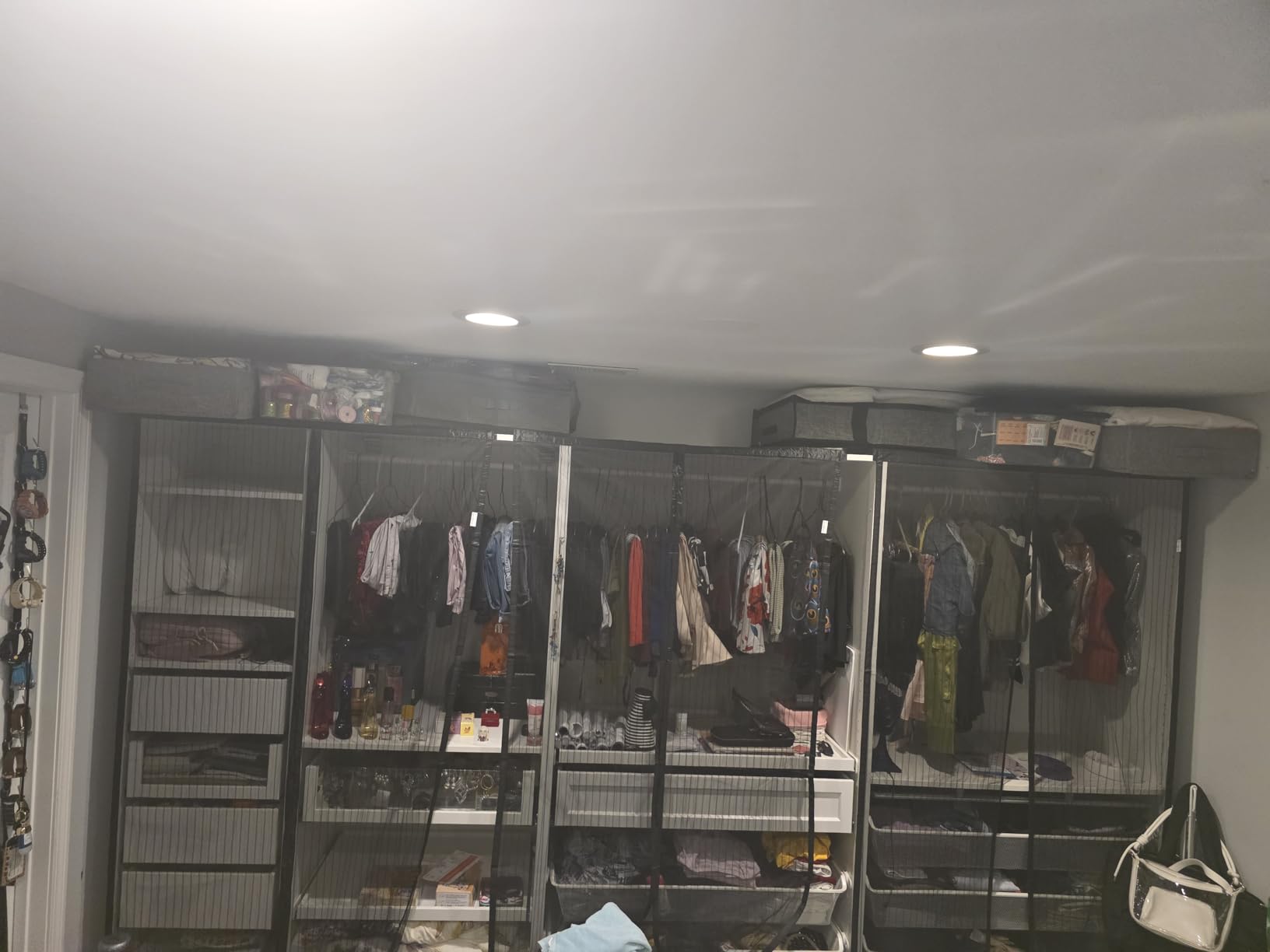
3. Amazon Basics Under Bed Bags 2-Pack – The Low Clearance Most Versatile
Amazon Basics Under Bed Storage Bags for Clothes and Blankets, Foldable Fabric Zipper Container with Clear Window and Reinforced Handles, Space Saving, 18 x 42 x 6 inches, Gray, 2-Pack
18 x 42 x 6 inches, 2 pack
Clear vinyl top
Fabric body with flat loop handles
5 pound load rating
+ Pros
- 6 inch profile clears very low bed frames
- Long 42 inch footprint suits a queen frame
- Rated 4.3 stars across more than 15700 ratings
- See-through top avoids unzipping every bag
- Folds flat for closet storage
– Cons
- Thin construction with a hard bottom insert that bends
- Flimsy when pushed under a bed on carpet
- Vinyl top can separate from the fabric sides
- Cloudy window makes contents hard to identify
This pair is built for one specific problem: beds with almost no clearance. At 18 by 42 by 6 inches, these are long, narrow and low, built to slide beneath a frame that would stop a 7 inch bag dead. Reviewers describe swapping a whole summer wardrobe for a winter one under a queen bed without raising the frame, which is exactly the use case.
It is also one of the most affordable containers here, and at 4.3 stars across more than 15,700 ratings the low cost has not cost the category its review volume. Reviewers put roughly 15 sweaters in a single bag, which is a fair estimate of a folded knit stack rather than a stretch.
The dual-tab zipper and flat loop handles are the practical bits. Two tabs mean you can open the bag wide from a low position without fighting a single pull, and the loop handles sit low on the long edge, which is the correct height for dragging a bag out from under a bed.
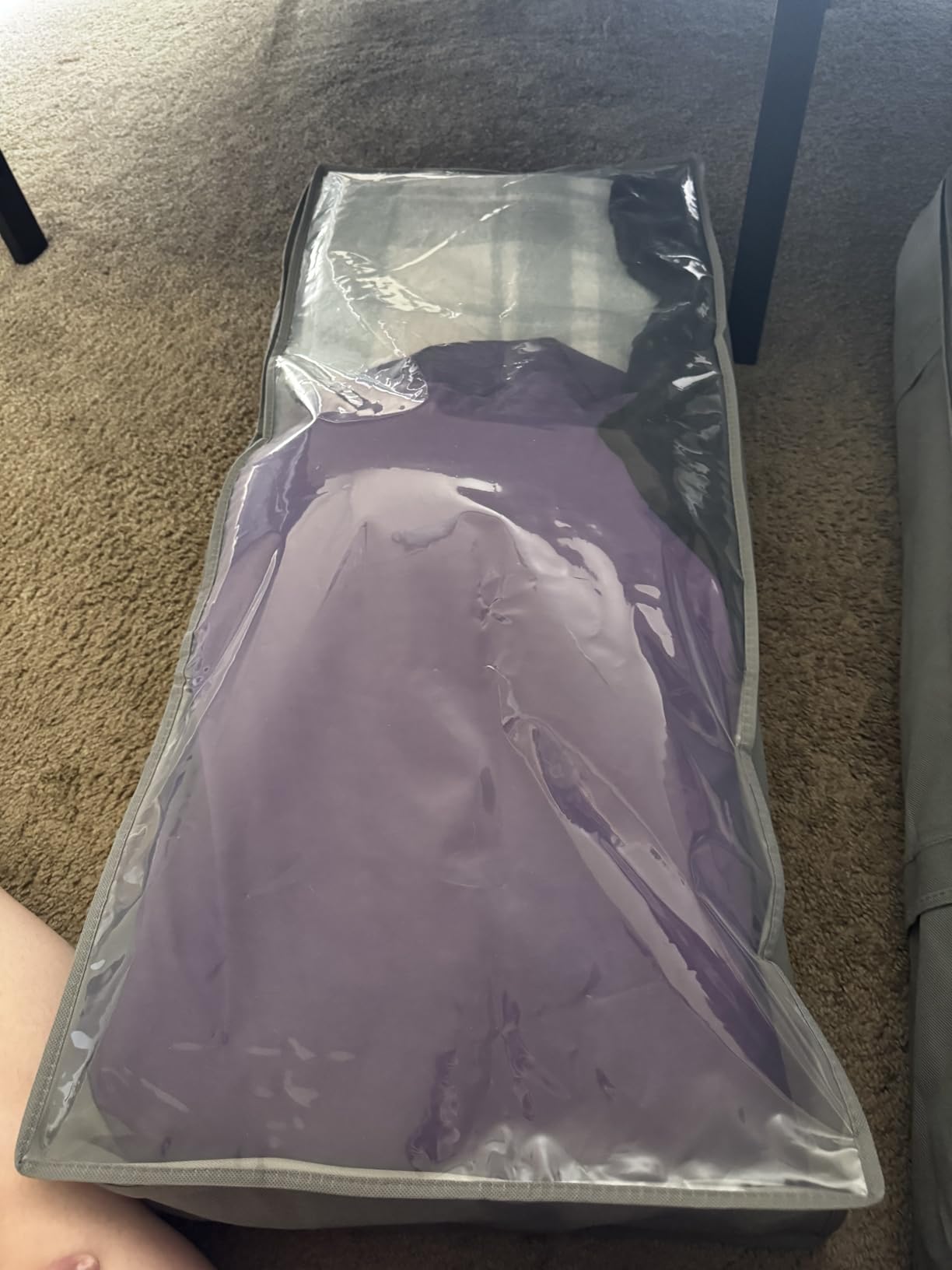
Why 6 Inches and 18 Inches Wide
Those two dimensions are not arbitrary. A 6 inch height clears a bed on a low platform base where a 7 inch bag cannot, and an 18 inch width is narrow enough to fit between the frame rails and a pair of legs. For a room where the bed is pushed against a wall, that narrow footprint means you can still get the bag in from the open side.
The trade-off is width. Because each bag is only 18 inches across, you fit more bags side by side but each one holds a narrower single stack. It changes the shape of your packing, not the total volume: folded items go in one layer lengthwise rather than stacked in a square.
Set-and-Forget Durability, or Lack of It
This is seasonal storage rather than frequent-access storage, and the reviews are clear that the difference matters. The bottom insert is thin and hard, and it bends under a heavy load, which is why the listed load rating is only 5 pounds. A bag of folded sweaters sits comfortably inside that number. A bag of jeans plus a comforter does not.
On carpet, owners report bags scrunching and bunching as they are pushed under, and a few report the vinyl top eventually separating from the fabric sides. The zippers are also described as delicate. If your bedroom is carpeted, plan on loading the bag in place at the foot of the bed rather than carrying it loaded from across the room.
Where They Fall Short
Three honest limits: the window clouds with handling and makes contents hard to identify, the build is thin enough that buyers notice, and the whole design assumes you will not open it more than twice a year. There is also no insulation from pests, only a zipper. If you have moths in the house, put these bags inside a room you can inspect, and add cedar.
Who This Bag Is For
Buy this pair if your bed frame gives you 5 or 6 inches and you want a low-cost reliable way to move a season of clothes out of the closet. Skip it for a room where you will pull clothes out weekly, for a bed on very thick carpet, or for anything you intend to move while full.
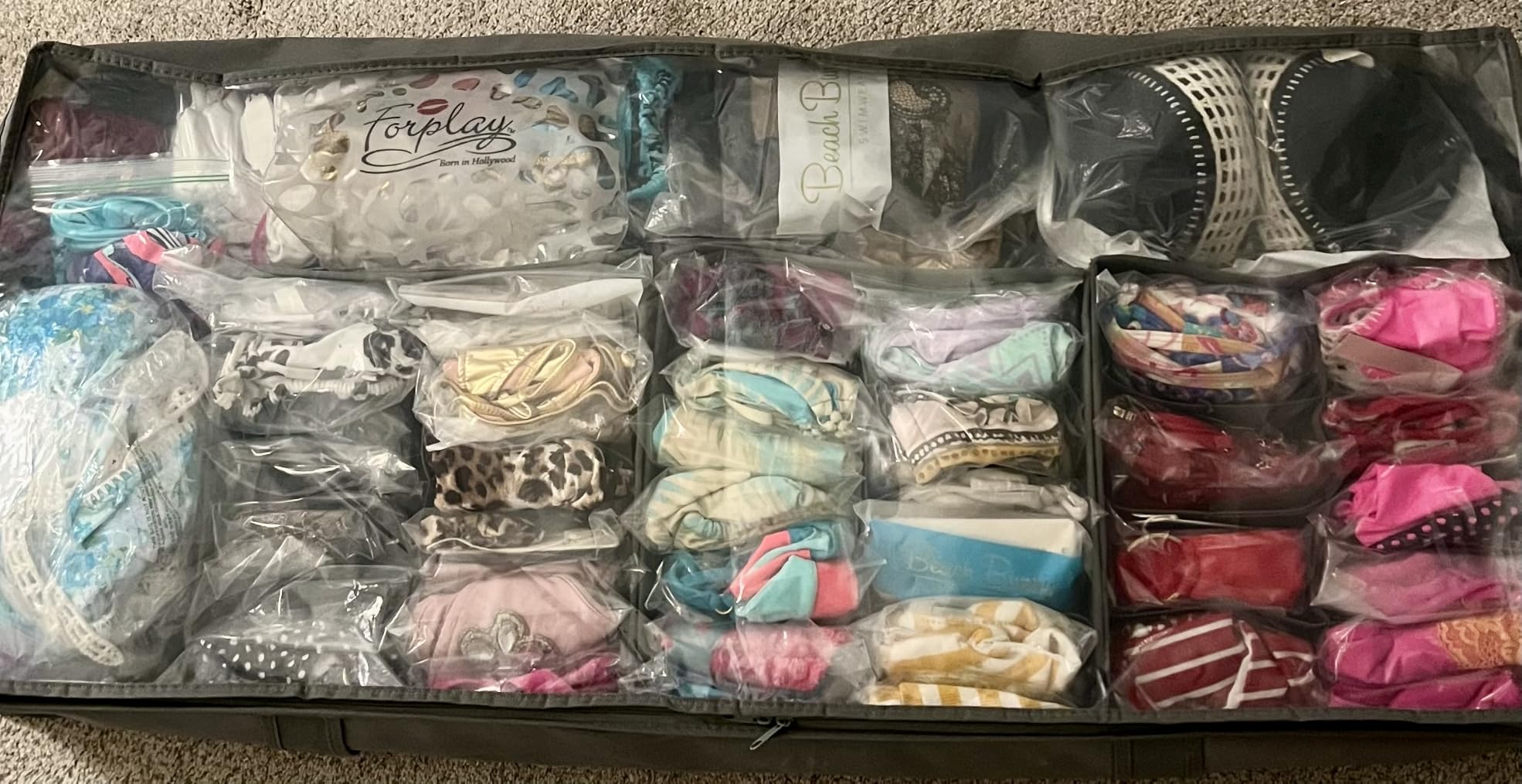
4. Onlyeasy Foldable Underbed Bags 2-Pack – Best Breathable Bags for Wool and Knits
Onlyeasy Foldable Underbed Bags 2 Pack – Blankets Clothes Comforters Storage Bag Breathable Zippered Organizer for Bedroom with Clear Window and 4 Handles, 39.4×19.7×5.9 in, Linen-like Grey, MXDUBBP2
39.4 x 19.7 x 5.9 inches, 2 pack
Two-layer thickened nonwoven
Two zippers and four handles
Transparent top window
+ Pros
- Breathable nonwoven fabric suits wool and knitwear
- 4.4 star average across more than 11000 ratings
- Two zippers on separate sides speed loading
- Four reinforced handles for pulling any direction
- Reviewers fit several thick winter coats per bag
– Cons
- Very floppy when being pushed under a bed
- No structure so it does not stack
- No wheels
- so bags are dragged in and out
- Not water resistant
For long-term storage of wool coats, cashmere and knitwear, breathability matters more than rigidity. These bags are made from a two-layer thickened polypropylene nonwoven that is genuinely breathable, which lets trapped moisture pass through instead of sitting against wool for six months. Owners rate them at 4.4 stars across more than 11,000 ratings, the highest average among the soft fabric bags here.
The access design is the clever part. There are two zippers, one on each long side, so you can open half the bag at a time and reach the bottom without trying to invert the whole thing. For bulky winter coats, that is the difference between a two-minute job and a wrestling match, and reviewers specifically credit it for fitting several thick coats into one bag.
At 39.4 by 19.7 by 5.9 inches, these are among the most compact large bags in the list by height, clearing gaps that a 7 inch bag would not.
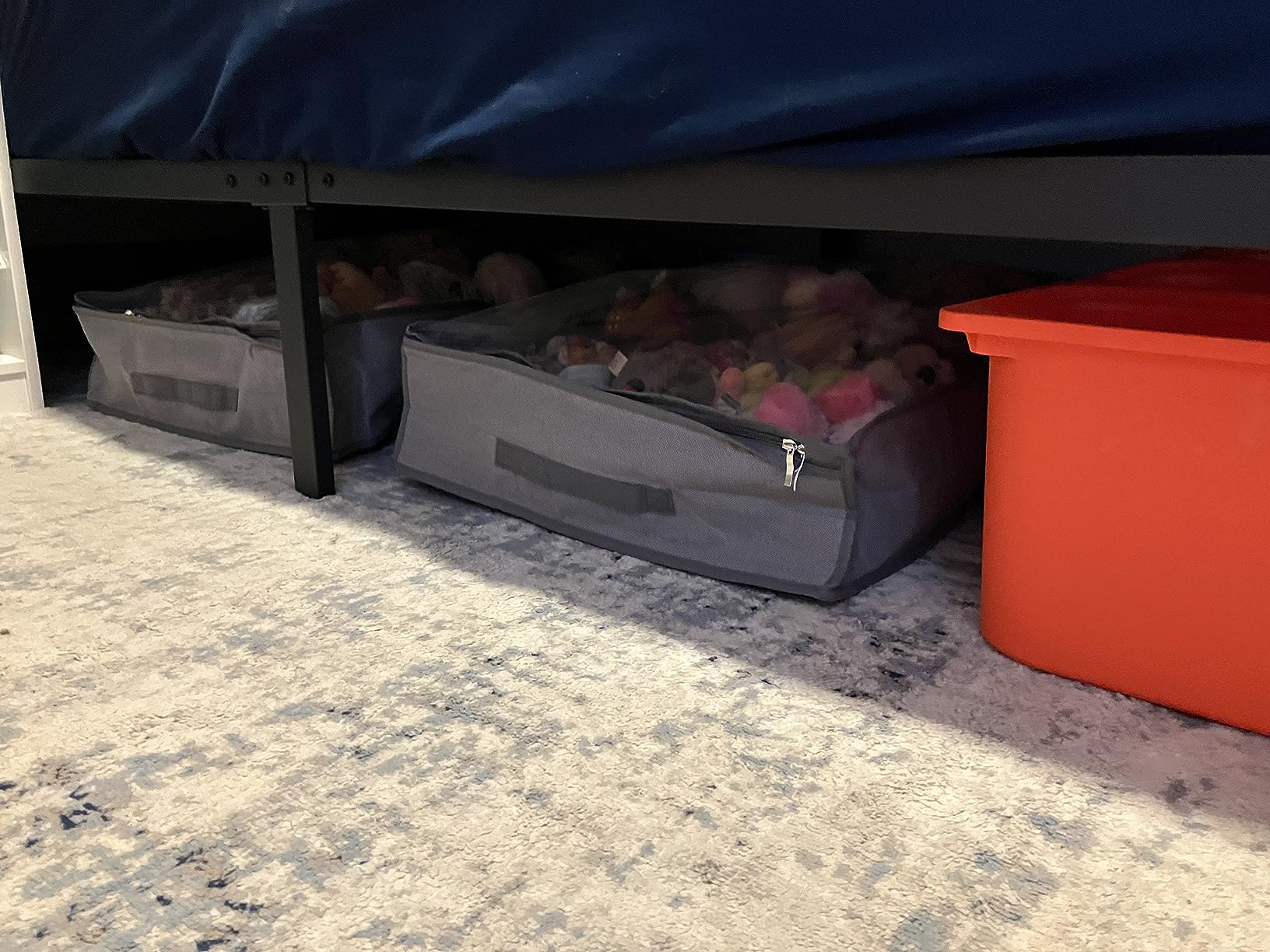
Breathable Versus Airtight: The Long-Term Trade
Long-term garment storage splits into two schools. Airtight plastic excludes moths and carpet beetles completely, and it is the right answer for six to eight months of ordinary seasonal storage. Breathable fabric lets moisture escape, and it is the right answer for a year or more, for wool, and for anything vintage or hand-knitted.
The failure mode of choosing wrong is specific. A wool coat sealed in plastic for a year and then opened can come out with a faint mustiness and, in humid conditions, a mildew spot. Breathable nonwoven reduces that risk while still keeping dust out, which is why I reach for this style for anything I plan to keep past a single season.
Four Handles, Two Zippers and the Flop Problem
Four reinforced handles, two at the front and two at the sides, mean you always have a grip that pulls straight rather than at an angle. The metal zippers are rated for more than 1,000 cycles, and the transparent top window lets you identify contents at a glance.
Where these lose is structure. Owners describe the basic soft-side version as very floppy, folding in on itself as it is pushed under a bed, and the same brand sells a firmer-sided version for buyers who need more shape. If the floppy feel bothers you, the fix is to fill the bag properly and to push rather than shove, keeping one hand on the front handle.
Where They Fall Short
No wheels, so a loaded bag is dragged and the seams take the stress, which is exactly where light fabric eventually fails. They do not stack, and they are not water resistant. In a basement bedroom with known damp, I would not use these at all and would choose a lidded or framed container instead.
Who This Bag Is For
Choose this pair for wool, cashmere, vintage knits and anything you intend to keep for more than a year. It is also a strong pick for a first storage setup, because the cost per bag is low and the 5.9 inch height gives you some clearance insurance. Avoid it for stacking and for very damp rooms.
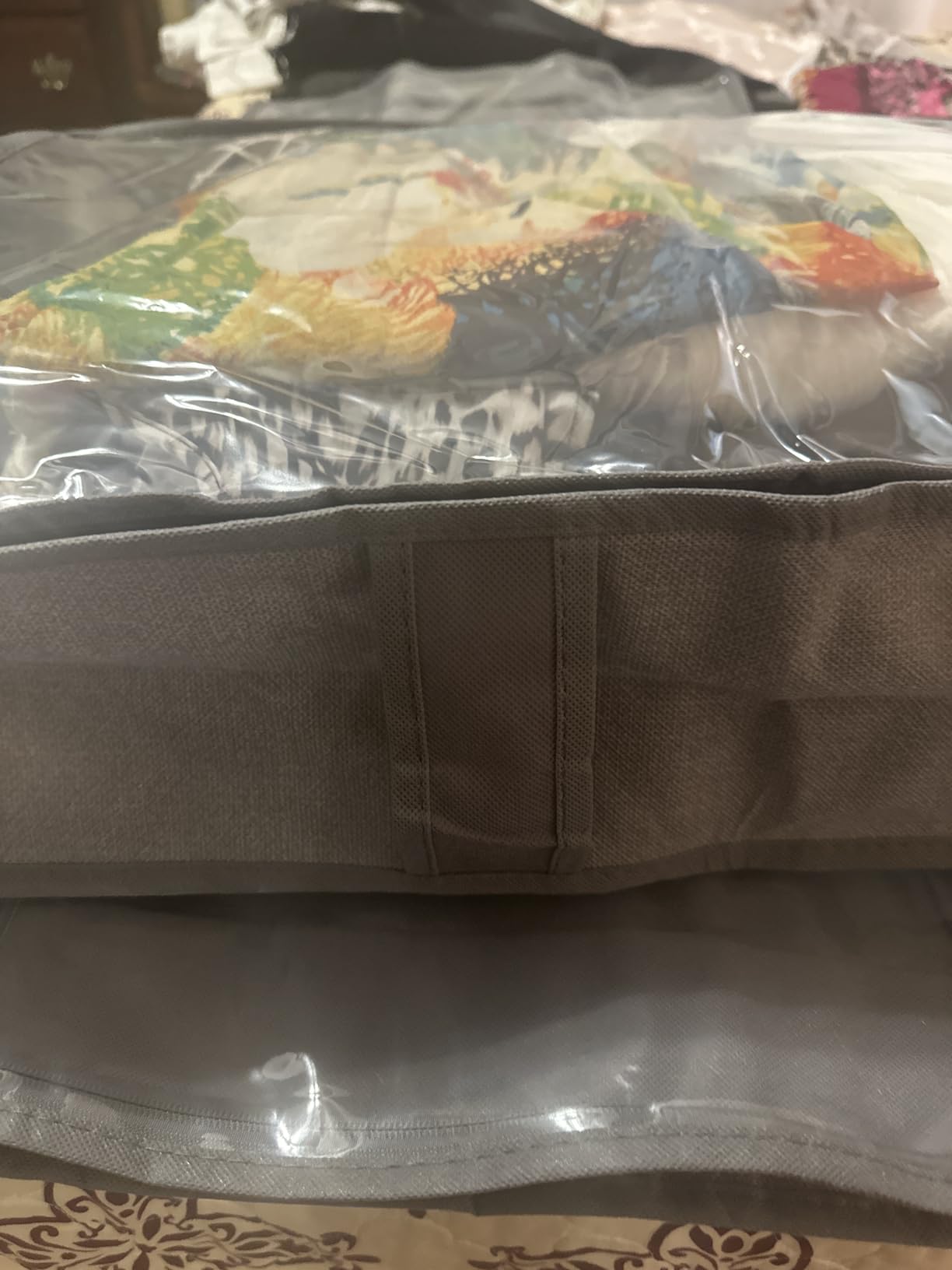
5. Yecaye Under Bed Storage with Wheels 2-Pack – Best Rolling Access
Yecaye Under Bed Storage with Wheels, 2Pack Under Bed Storage Containers, Underbed Shoe Storage Organizer, Rolling Under Bed Metal Drawers for Clothes, Blankets(30.71 x 16.93 x 6.69 in)
30.7 x 16.9 x 6.7 inches with wheels
300D PU fabric on a metal frame
66 pound load capacity
Four silent 360-degree wheels
+ Pros
- Wheels let you roll a loaded bin in and out
- Metal frame holds 66 pounds
- Coated PU fabric is waterproof
- Two of the four wheels lock in place
- Clear window and included label
- 4.5 stars across nearly 2900 ratings
– Cons
- Requires assembly before first use
- Needs 7 inches of clearance or more
- Heavier and bulkier than soft bags
- Only two bins per pack
This is the only wheeled option in the roundup, and wheels solve a problem nobody else addresses: the reason many people give up on under-bed storage is that a full bag is genuinely hard to drag across carpet. A 300D PU fabric body stretched over a metal frame, on four 360-degree silent wheels, moves as one unit. Two of those wheels lock, so the bin stays put once you have pulled it out.
The frame is what allows the 66 pound load rating. That is not a clothes figure, it is a general storage figure, and buyers use it for exactly what the rating allows: heavy winter clothing, shoes and books. The coated 300D PU fabric is also listed as waterproof, which none of the breathable fabric bags in this roundup can claim.
Rated 4.5 stars across nearly 2,900 ratings, it earns its place for the buyer who wants storage they will actually keep using through repeated seasonal swaps rather than shoving into place once a year.

The Wheels and Low Profile Conflict, Explained
Wheels are not free in vertical space. These measure 6.69 inches tall including the casters, and buyers report they need at least 7 inches of clearance to pass under a frame without catching. That is the design conflict behind nearly every complaint about wheeled under-bed carts: adding mobility means losing the last inch of headroom.
My rule of thumb is to measure to the lowest point of the frame or foundation, not to the mattress, and then buy a container that clears that number by a full inch. On a 6 inch gap, a wheeled cart is the wrong tool no matter how good it is. On a 7.5 inch or larger gap, it works well.
Metal Frame, PU Fabric and 66 Pounds
The 300D PU fabric is a coated woven material rather than a non-woven, and the coating is what makes the waterproof claim plausible. Stretched over a metal frame with reinforced corners, it resists the sagging that ruins soft bags, and a bin packed with heavy winter clothing keeps its rectangular shape when you lift it by the handles.
On carpet, the silent wheels are noticeably easier than dragging, which is the single best thing about this product. On hard floor they roll out from under the bed if you pull hard, which is exactly what the two locking casters are for. Set the locks, pull steadily, and the bin stays under control.
Where They Fall Short
Assembly is required before first use, with instructions included. The bins are also heavier and bulkier than any soft bag, and two per pack means less total capacity than the four-packs. The larger footprint may not fit both sides of a standard queen frame.
Who This Cart Is For
Buy this pair if your bed sits on 7.5 inches of clearance or more, if you carpet, and if you want storage for things beyond clothes. The metal frame makes it the most heavily built option in the roundup and the easiest to keep in rotation. Skip it for low frames, for a tight space, and for anyone who wants a set-and-forget solution with no setup step.
6. TidyCorner 4.5 Inch Under Bed Bins 2-Pack – Best for Very Low Beds
2-Pack Under Bed Storage Containers, 4.5 Inches Tall Clothes Storage, Grey
33.6 x 17 x 4.5 inches, 2 pack
45L per bin
Composite linen fabric
Three handles and dual zippers
+ Pros
- 4.5 inch height is among the shallowest profiles here
- Reinforced sides and bottom hold their shape
- 4.6 stars across more than 2300 ratings
- Three handles make loading bulky items easy
- Handles heavy books without deforming
– Cons
- Only two bins per pack
- 45L per bin is small for a full winter wardrobe
- Costs more per bin than soft bags
- Still requires you to measure clearance
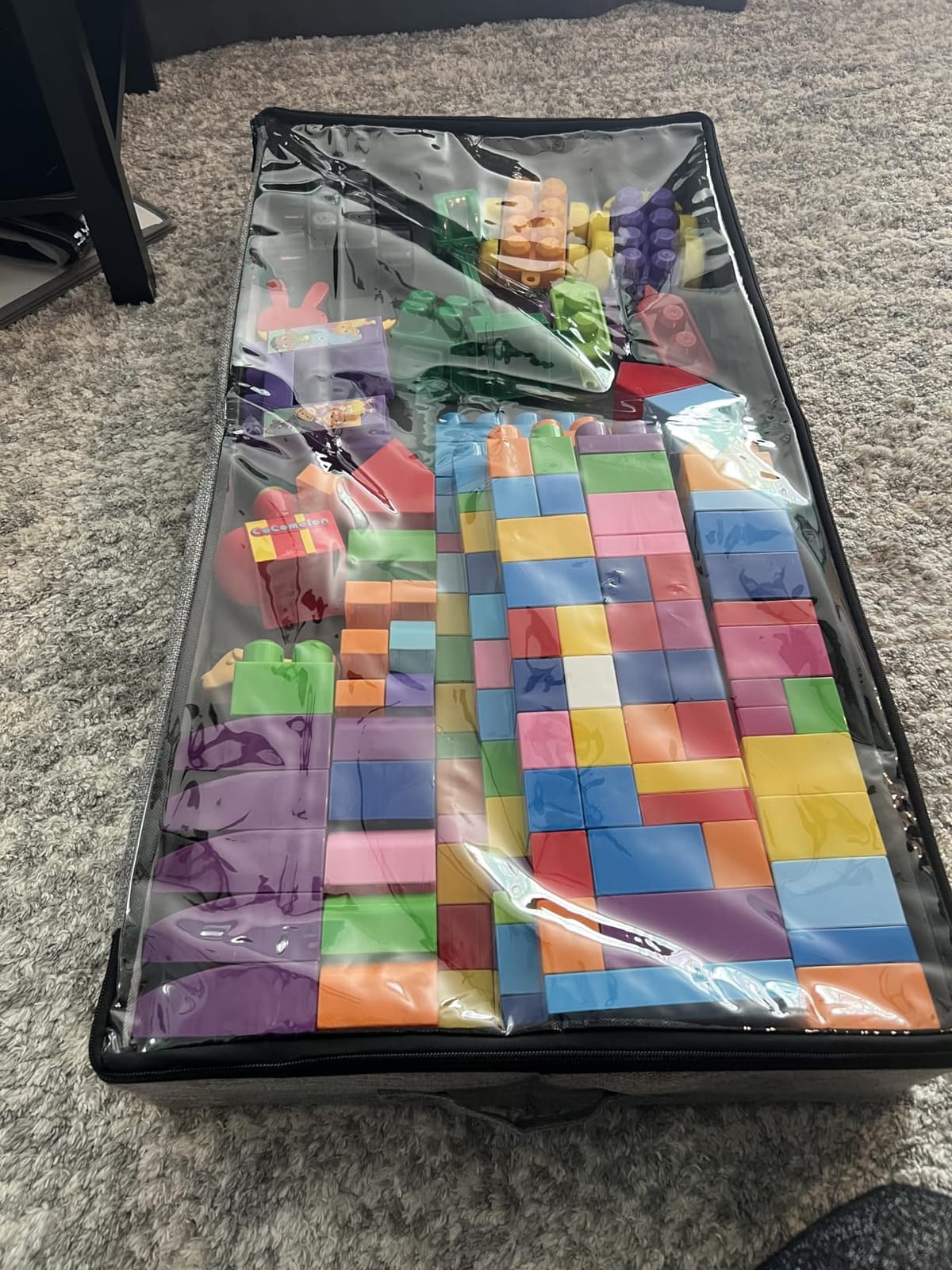
At 4.5 inches, this pair is built for beds that sit close to the floor, where container height becomes the entire decision. The reinforced sides and bottom mean the bin still looks like a bin when it is empty, which matters when you are grabbing a single pair of gloves in a dark gap. A soft-sided bag that has collapsed in on itself is the usual reason people give up on under-bed storage entirely.
It rates 4.6 stars across more than 2,300 ratings, with 78 percent of reviews at five stars, and the reinforced construction is what those reviews keep pointing at. Owners load books, blankets and hard goods into them, which is not what an 18 inch fabric bag survives.
The same line comes in 6 and 8 inch heights, so if you move to a frame with more clearance later you are not stuck with a shallow bin. Buyers in general describe the composite linen as odourless, which matters for wool and knits.
What a 4.5 Inch Height Can and Cannot Take
Shallow means flat. These bins hold folded items laid in a single layer, which suits sweaters, jeans, scarves, gloves and pillows, and is a poor fit for a full comforter or a thick rolled coat. Reviewers describe them as a better fit for flatter winter garments and bedding than for bulky insulated pieces, and that is the honest version of the 45 litre capacity.
For a family swapping a full winter wardrobe, two bins of 45 litres will not be enough on their own. The set works best as part of a system: shallow bins for folded knits and accessories at the foot of the bed, and a taller bag along one side for the bulky pieces.
Rigid Sides, Dual Zippers and Heavy Contents
The reinforced side walls and bottom are what separate this from the soft bags. They keep a rectangular footprint when loaded, resist the weight of stacked books, and give you a defined edge to pull against. Three reinforced handles, one at the front and two at the sides, spread the load of a heavy lift across fabric that stays flat.
Two zippers on the top give a wide opening for sliding a folded item in without a second attempt, and the transparent cover means you can read the contents before opening it. Buyers also report that the reinforced structure holds through repeated seasonal swaps without the sagging seen in unstructured bags.
Where They Fall Short
Two per pack is the main limitation. The 45 litres per bin is small for large comforters, and the per-bin cost runs higher than the soft-sided alternatives, so a full wardrobe can add up quickly. The 4.5 inch height also still requires you to measure, since a bed on a 4 inch plinth will not clear it.
Who This Bin Is For
Pick this pair if you have less than 6 inches of clearance and need a container that still holds its shape. It is a good second container for a household that already has a large bag for bulky items, because it handles the flat, heavy, neatly folded things that do not compress well. Skip it as your only winter storage solution.
7. punemi 6.7 Inch Under Bed Containers 2-Pack – Best for Easy Loading
punemi 6.7 in Tall Sturdy Under Bed Storage Containers with Lid, 2Pack,Gray
30 x 15 x 6.7 inches, 2 pack
49L per bin
Cardboard base insert
Three-sided zip opening
+ Pros
- Three-sided opening makes loading bulky coats easy
- Structured sides and base insert hold shape
- Reviewers report zippers intact after 9 months of seasonal use
- Arrives with no chemical odor
- Label pocket for identifying contents
– Cons
- Smaller interior than the 95L bags in this roundup
- Zipper can lie flat against the side and snag if not turned up
- Not recommended for very heavy contents
- Not water resistant
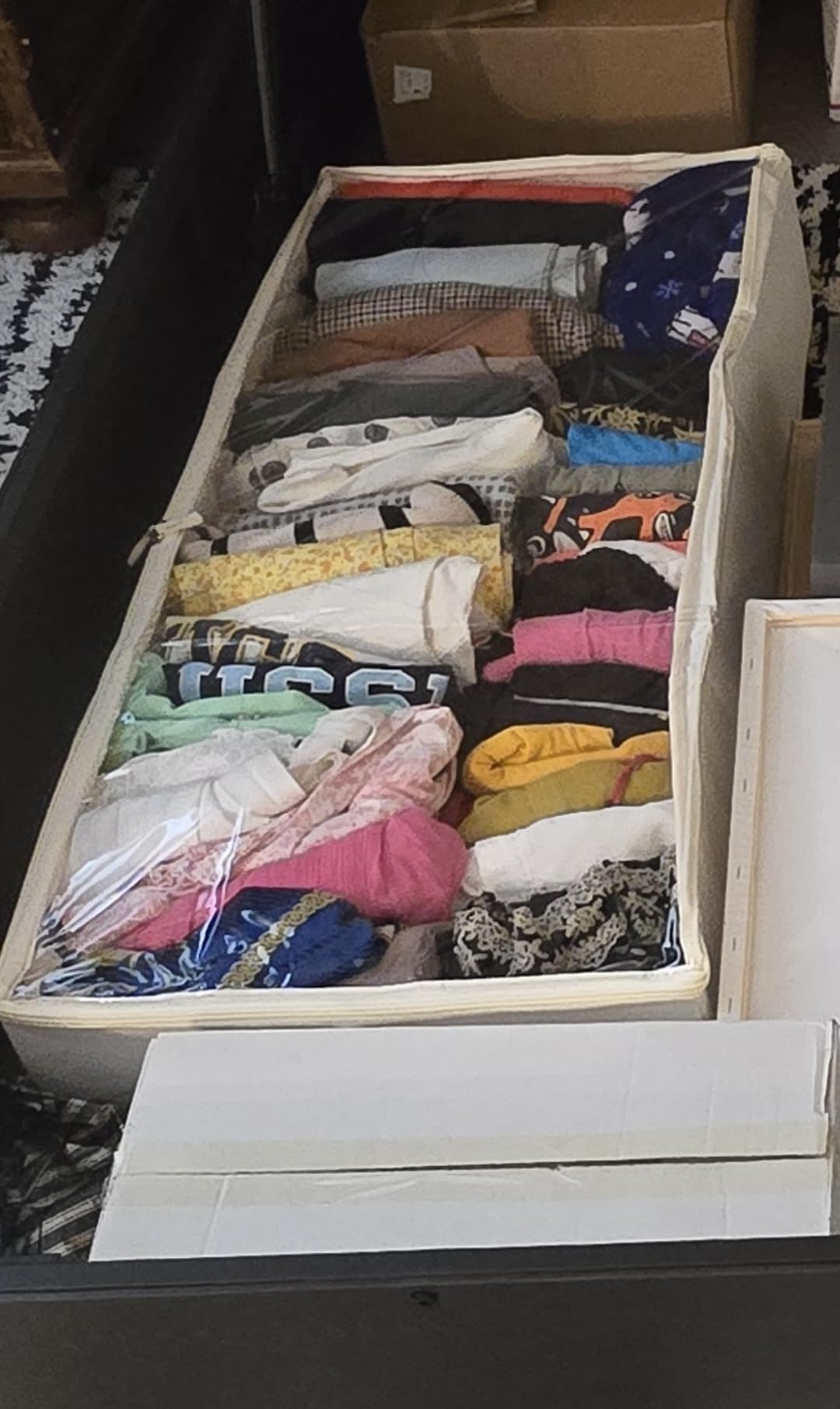
Loading bulky winter coats is where most under-bed containers frustrate you, because a top zipper forces you to compress a coat through a narrow slot. These open on three sides, which means you lay a puffer jacket flat, fold the sides in and zip it shut without fighting the fabric. For a family with several coats to put away in one session, that difference adds up quickly.
At 4.5 stars across nearly 2,000 ratings, owners here also report some of the longer ownership histories in the category. Owners report the fabric and zippers still looking new after nine months of seasonal use, and several call out the absence of chemical odour on arrival, which matters for knitwear.
Construction is a reinforced fabric body with a cardboard base insert, which gives it a defined bottom and enough side structure to stand up to a load without the full rigidity of a board-lined bin.
Three-Sided Access and the Front Handle
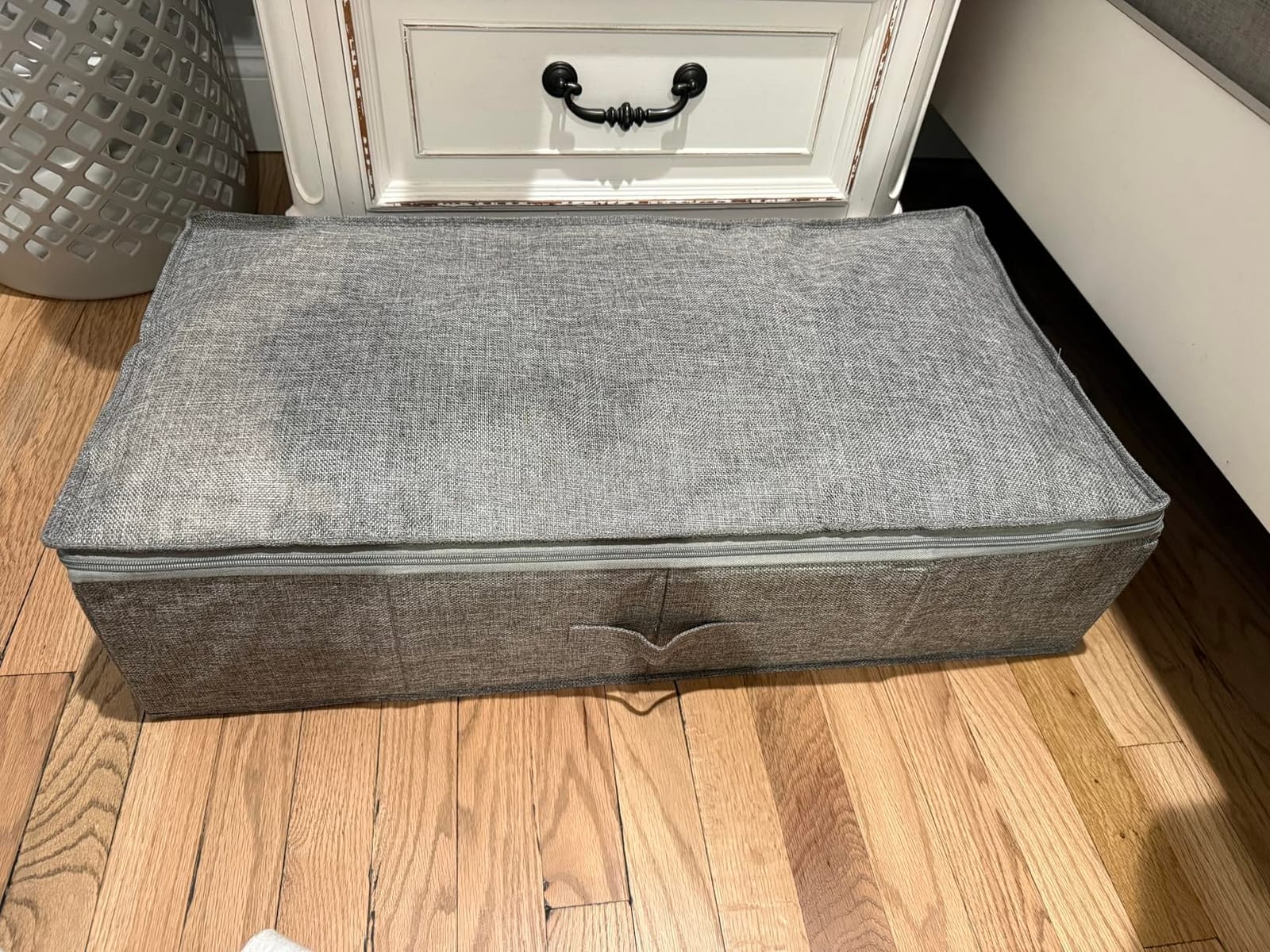
The three-sided zip runs around two long edges and one short edge, effectively opening the bin like a suitcase laid flat. You can slide folded coats in from above, from the front and from the side, and you can reach the bottom corner without pulling everything out. That is a real ergonomic gain over a single top zip, and it is why this is the pair I recommend for coats rather than knits.
Handles sit at the front and on both sides, so pulling the bin towards you from a low position uses a straight-line pull. The clear label pocket on the front means you can write what is inside and read it without opening the bin, which cuts the retrieval time that makes most people avoid under-bed storage.
Long-Term Owner Reports
The most useful reviews here are the nine-month ones. Long-term owners of seasonal storage tend to report whether zippers still run smoothly and whether seams have loosened after several swap cycles, and this product’s owners report both in good condition. The cardboard base insert is holding its shape and the fabric has not stretched at the corners.
There is also a wide size range from the same brand, from 3 to 10 inch heights in both soft and structured versions, which is useful if you eventually want a matching bin for a closet rather than a bed.
Where They Fall Short
The interior is smaller than the 95 litre bags elsewhere in this roundup, so you need more bins for the same volume. The zipper can lie flat against the side wall and snag if it is not turned up before you close it, a small habit that prevents most zipper problems. Owners also caution against very heavy contents, since the seams and zippers are fabric, not metal.
Who This Bin Is For
Buy this pair if your winter storage is mostly coats and jackets rather than flat knits, and if you want the packing process to be quick. It is a good fit for a first-time seasonal storage setup, and for a household that would rather fill a bin in one pass than make four trips. Skip it for heavy non-clothing items.
8. Vailando Side-Supported Under Bed Bins 2-Pack – Best Shape Retention When Fully Loaded
Vailando Side-Supported Under Bed Storage Containers, 6 Inches Tall 60L Underbed Storage Bins with Sturdy Handles and Sidewalls, Closet Organizer for Clothes, Blankets, Seasonal Items, Beige, 2-Pack
33.7 x 17.1 x 6 inches, 2 pack
60L per bin
Linen fabric with PP side boards
Two-way metal zipper
+ Pros
- PP boards on sides and bottom keep the bin rigid when full
- Tied for the highest average rating at 4.7 stars
- 81 percent of reviews are five star
- Odorless linen fabric that resists dampness
- Three-sided reinforced handles for pulling out
– Cons
- Higher price than comparable structured fabric bins
- Not water resistant
- 6 inch height needs adequate clearance
- Smaller review base than the category leaders
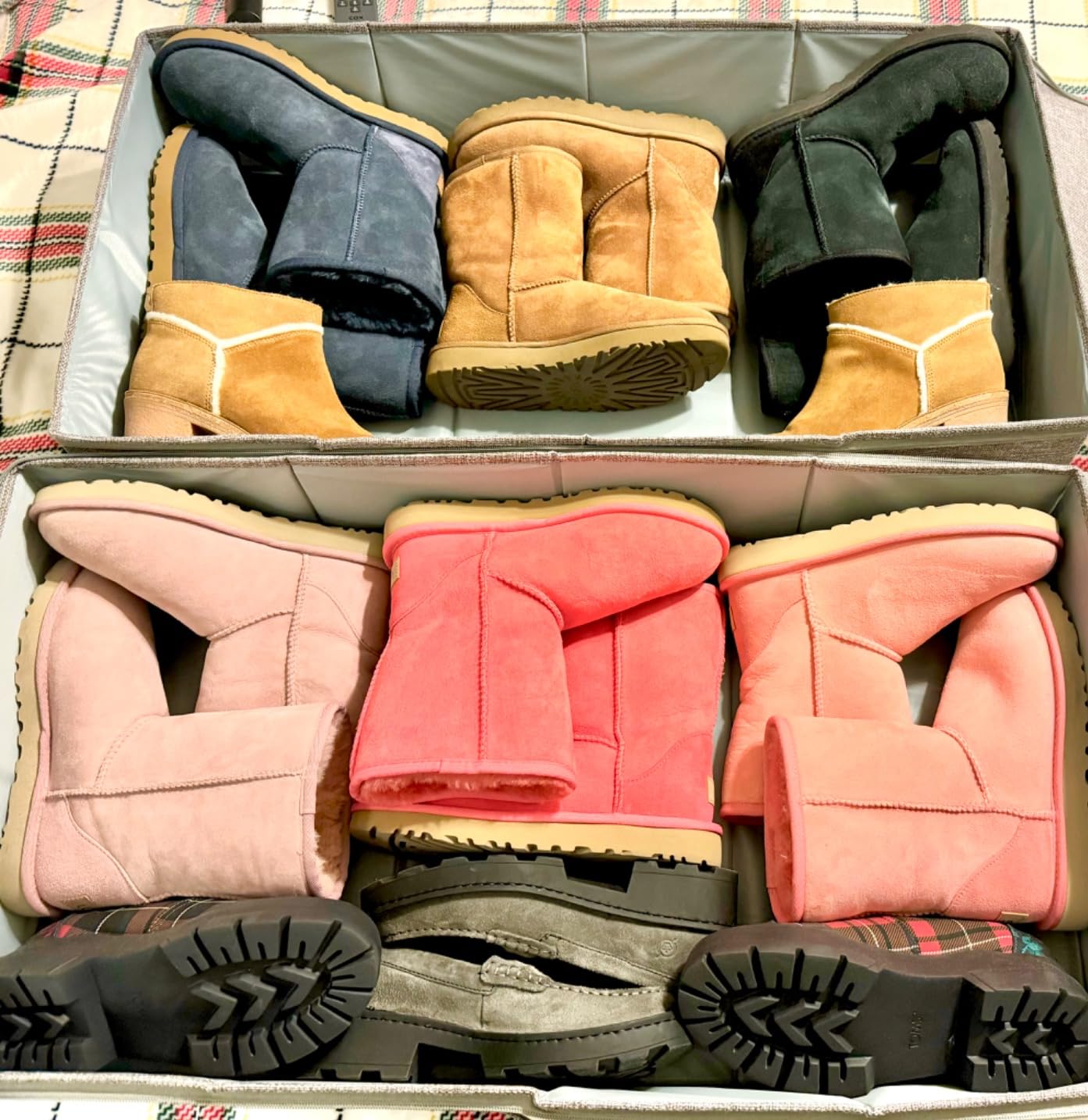
This is the pick I would buy if I packed a bin with quilts and heavy winter bedding and expected it to stay rigid. The sides and bottom are lined with polypropylene boards, so the bin holds a rectangular shape when fully loaded and does not cave in when you lift it by the handles. It rates 4.7 stars across more than 1,700 ratings, with 81 percent of reviews at five stars, tied for the highest average in this roundup. The reinforced build is what those reviews keep pointing at.
The fabric is a two-ply thickened linen rated as odourless, and owners specifically credit it with resisting dampness and mildew, which is the deciding factor in a basement or ground-floor bedroom where the gap under the bed sits near the floor.
At 60 litres per bin it sits between the deep 95 litre bags and the shallow 45 litre bins, which makes it a good middle option among the rigid bins for clothing that needs a little headroom but is not a full comforter.
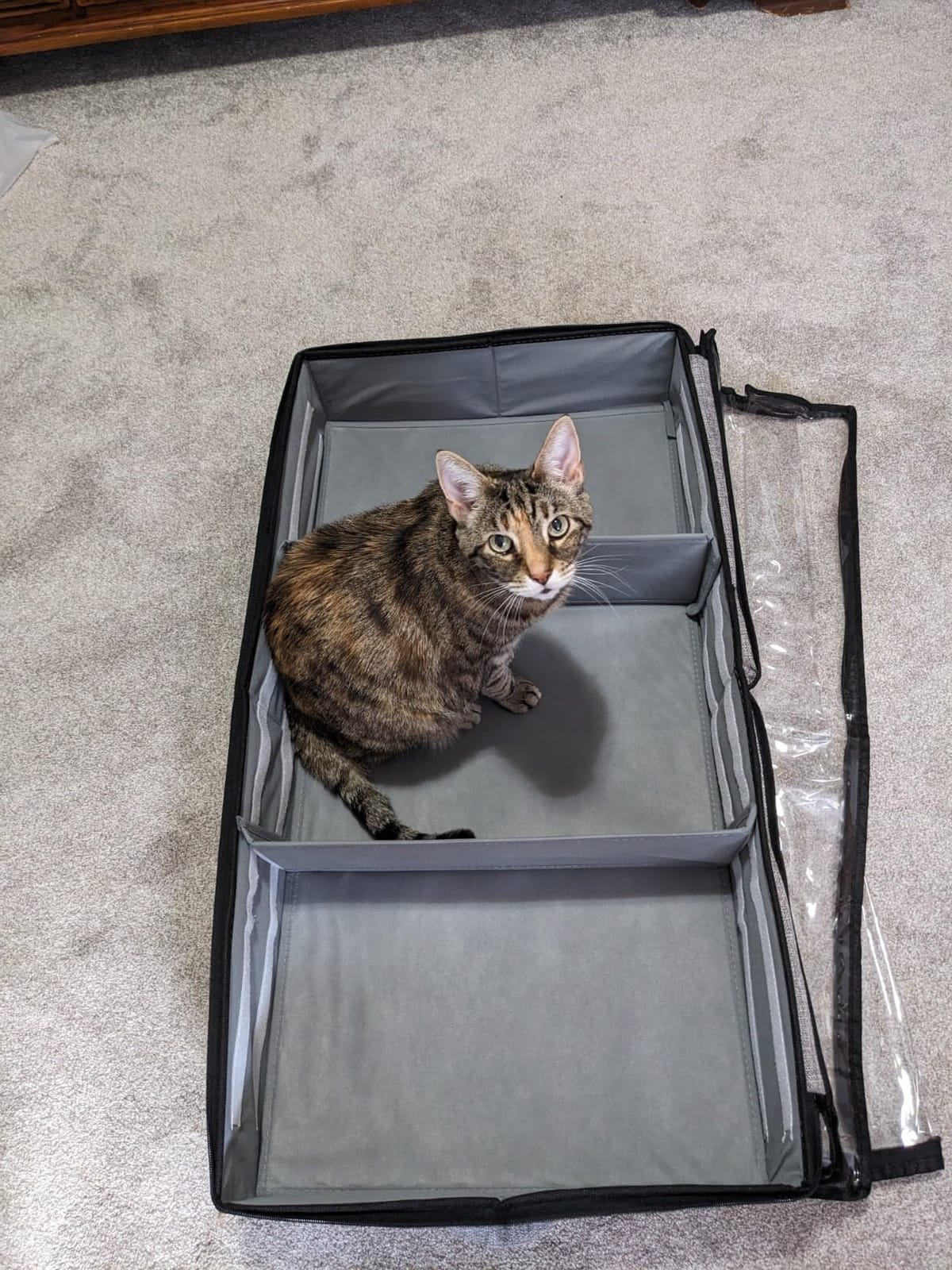
PP Boards Versus Fabric Baffles
The difference between a board-supported bin and a soft bag is structural, and it shows up in two situations. Lift a loaded soft bag by its handles and the contents shift into a lump that resists the opening. Lift a board-supported bin and the bag holds its volume, so the zipper runs the whole way without a fold of fabric blocking it.
The second situation is storage between seasons. An empty board-lined bin still looks like a bin, so it stands or sits neatly with the others while your summer wardrobe is upstairs, rather than being a flat sheet you have to fold away. If the container will be visible for most of the year, that is worth more than it sounds.
Handles, Zipper and the Front Window
Reinforced tear-resistant handles are fitted on three sides, so you can pull from whichever direction is open in the room, which matters in the common layout where one side of the bed is against a wall. The two-way metal zipper is tested to 1,000 cycles and glides at the corners where cheap zippers jam.
The large clear PVC window on the front is positioned at the height you see when the bin is pulled out, rather than on a top panel you would have to tilt to see. Bins arrive assembled, so there is no setup step before the first seasonal swap.
Where They Fall Short
These cost more than other structured fabric bins in this roundup, and they are not water resistant, so a spill in the gap needs a wipe rather than a rinse. The 6 inch height still needs measuring, and the review base of around 1,700 ratings is smaller than the category leaders, so long-term ownership reports are thinner than I would like.
Who This Bin Is For
Choose this pair for a heavily loaded container: quilts, thick blankets, a stack of heavy sweaters, or a bin you will drag a long way across a room. It is also the pick I would choose among the rigid options for anyone who is fussy about odour. Skip it on a tight budget and in a room where the under-bed gap is likely to get wet.
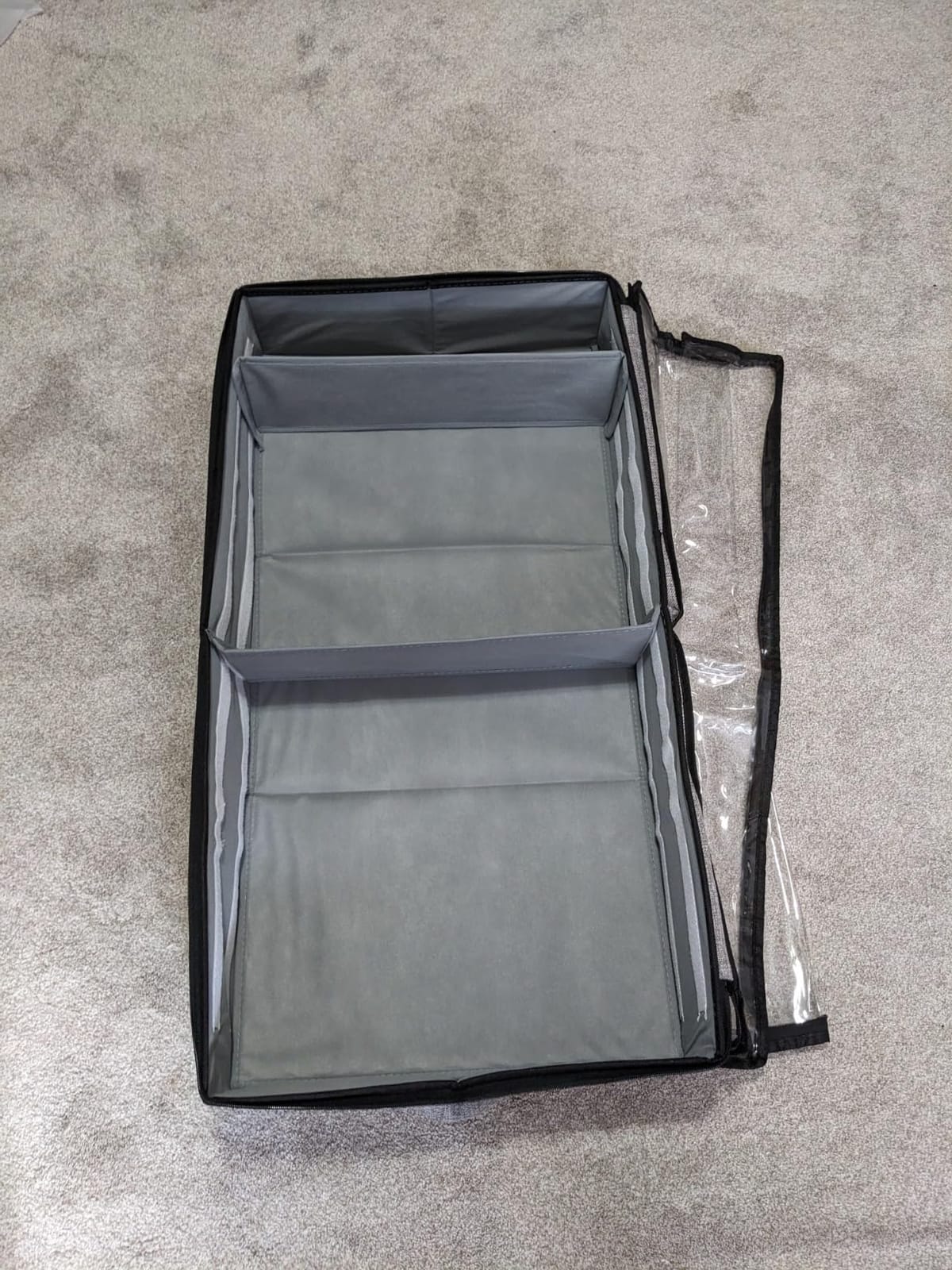
9. YearningHome 4.5 Inch Under Bed Bins 4-Pack – Best for Moving and Travel
4.5 Inches Under Bed Storage Containers with Sturdy Sidewalls/Bottom and Reinforced Handles,Low Profile Underbed Storage for Clothes,Shoes,Pillows and Blankets with Zips and Clear Windows,4 Pack
33 x 17 x 4.5 inches, 4 pack
45L per bin
Three-ply composite linen
Waterproof and easy to wipe clean
+ Pros
- Four bins in a single set at this low profile
- Sturdy sidewalls and bottom hold shape when empty
- Waterproof composite linen wipes clean
- 4.7 stars with 81 percent five-star reviews
- Handles are strong enough to carry as moving boxes
– Cons
- Costs more per bin than the four-pack soft bags
- 4.5 inch height suits only flatter items
- Newer listing with a smaller review base
- Less long-term ownership feedback available
Four bins at 4.5 inches tall is an unusual combination, and it is why I picked this set. The low-profile fabric bins elsewhere in the roundup come two at a time, which for a family with a shared bed means either four separate orders or a compromise on height. This one gives you four rigid-sided 45 litre bins in a single set, each 33 by 17 by 4.5 inches.
It also shares the top rating in this roundup at 4.7 stars, with 81 percent of reviews at five stars, and the specific detail buyers praise is that the sidewalls and bottom hold their shape even when the bin is empty. That is what makes it a genuine moving box as well as a storage bin, which matters if you are using under-bed storage as staging for a move rather than only for the seasonal swap.
The composite linen is listed as waterproof, unlike most fabric competitors, and buyers note that it wipes clean with a damp cloth, which is a genuine advantage in a gap where dust settles on everything.
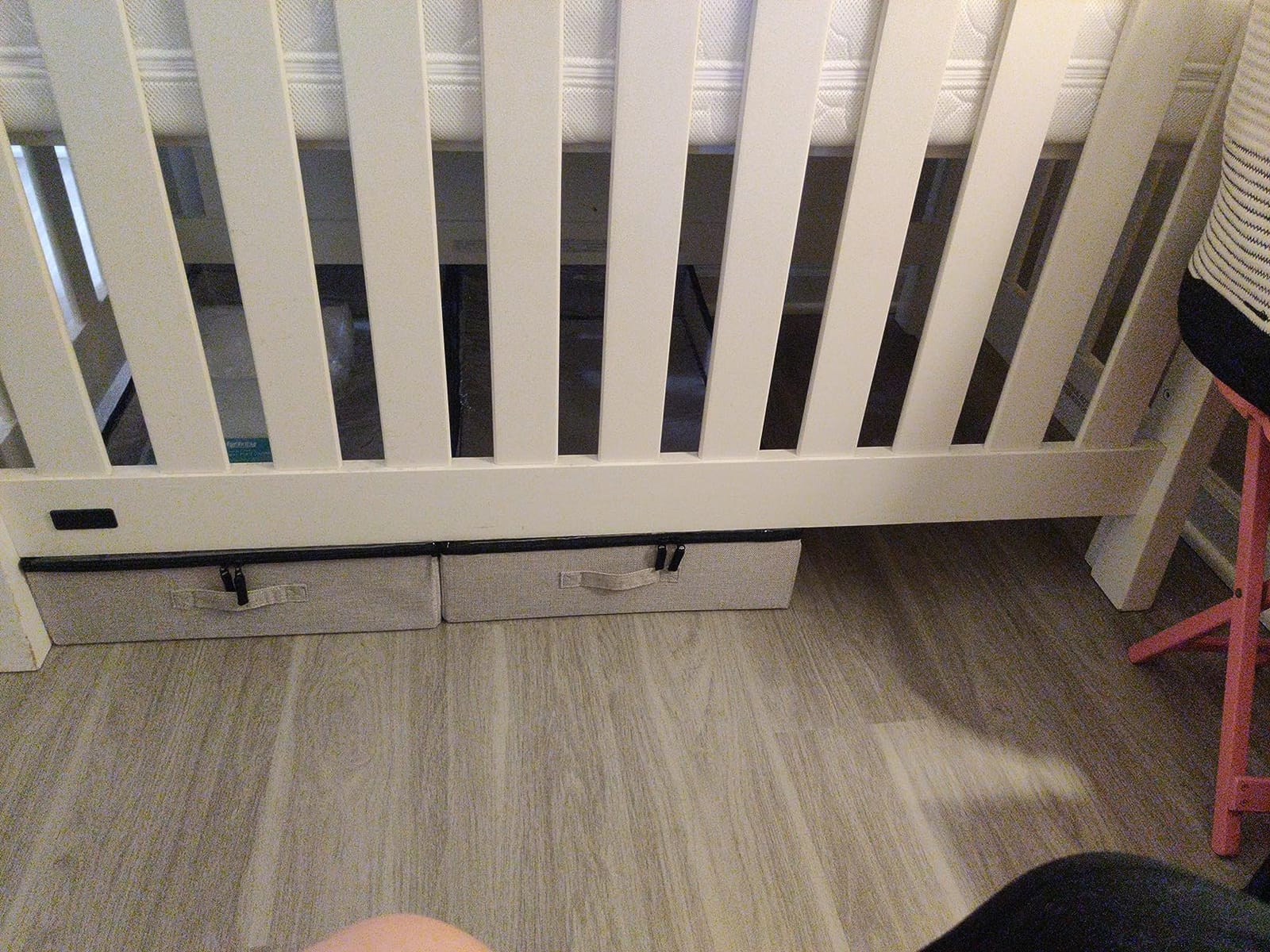
Four Bins at 4.5 Inches: What the Set Buys You
Capacity is 45 litres per bin, which is modest, and 4.5 inches is a low ceiling. Both facts mean this set is best used with a system rather than as a single solution. Bins one and two take folded sweaters, jeans and trousers, laid in a single layer. Bins three and four take the flat, light items you do not need midwinter, like scarves, hats, gloves and spare pillows.
Because these bins nest flat when empty, a buyer with a low frame can add a taller container later without throwing these out. That is worth factoring into the decision: a four-pack you keep is a better investment than a two-pack you replace in two years.
Using Bins as Moving Boxes
Buyers report that the reinforced sidewalls and bottom make these sturdy enough to carry a load as a mobile box, which extends their usefulness well past the seasonal swap. Waterproof composite linen also survives the kind of handling a move involves, where a breathable non-woven bag would tear at the corners first.
The stainless steel zipper is another plus here, and it is described as sliding easily even when the bin is full, which is the condition under which cheap zippers bind. A large transparent PVC window on each bin keeps contents identifiable through the whole move.
Where They Fall Short
The per-bin cost is higher than the four-pack soft bags in this roundup, so a second set later adds up. The 4.5 inch height suits flatter items only, and the listing is newer with a smaller review base and less long-term ownership feedback than the category leaders, which is the main reason this is not higher in my ranking despite the rating.
Who This Bin Is For
This four-pack suits a shared bed where one person stores and both need access, a family staging donations, or anyone who wants rigid low-profile containers and a moving option in one. It is a strong companion to a taller bag for bulky coats. Skip it if your priority is maximum volume per bin.
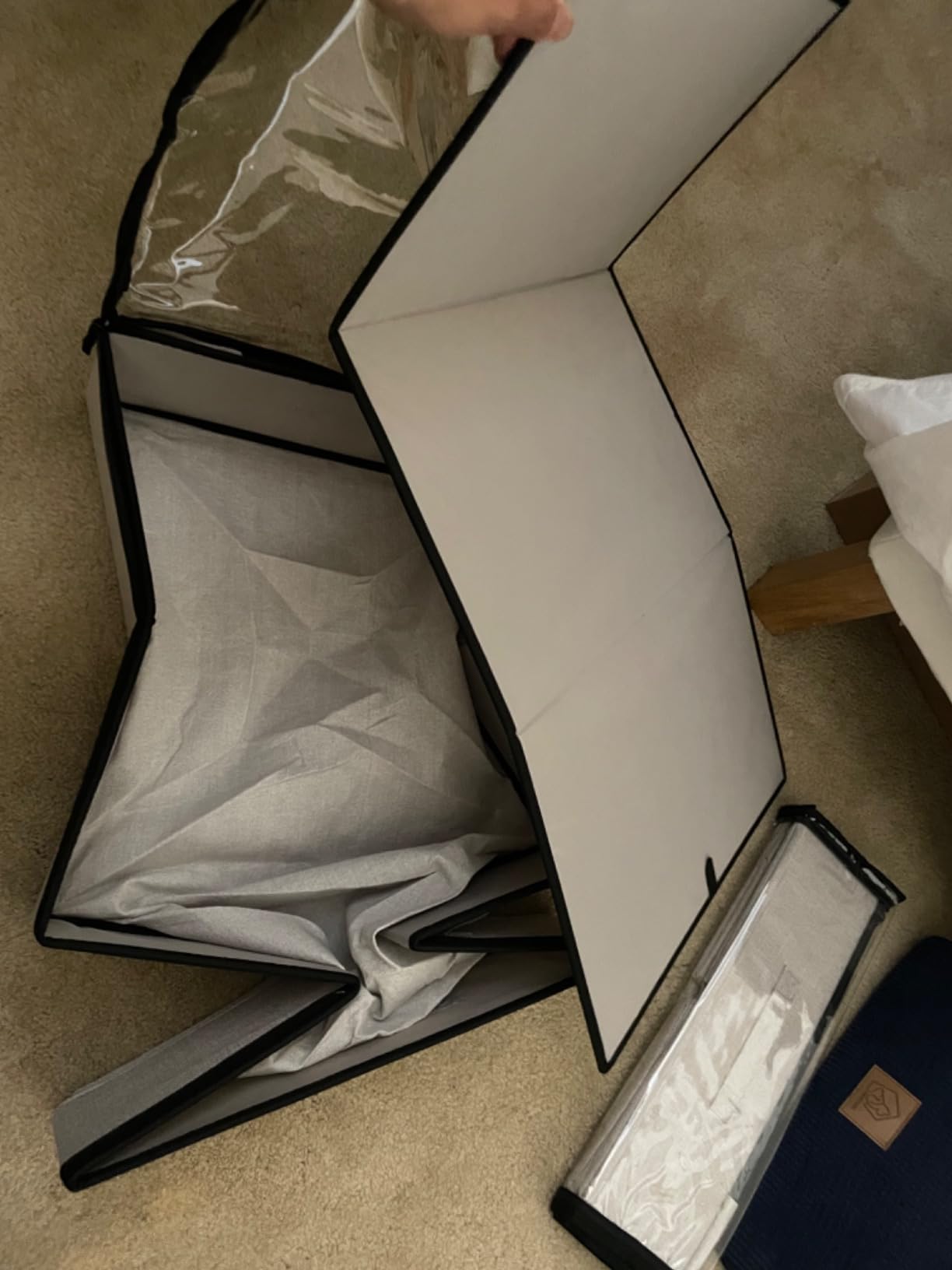
10. Lifewit 95L Under Bed Containers 4-Pack – Best for Queen-Size Bedding
Lifewit 95L 4 Pack Under Bed Storage Container, Blanket Organizer, Gray
95L per bag, 4 pack
39 x 19.7 x 7.1 inches
Breathable non-woven fabric
Clear PVC top cover
+ Pros
- 95L capacity fits two queen-size blankets with room to spare
- Four reinforced handles for pulling from any direction
- Clear top wipes clean with a damp cloth
- Breathable fabric keeps stored clothes dry and fresh
- Holds roughly 20 sweaters or 4 thick blankets
– Cons
- Lowest average rating here at 4.0 stars
- No structural inserts
- so sides collapse when lifted
- Can tear if overfilled
- Some buyers report a persistent plastic smell
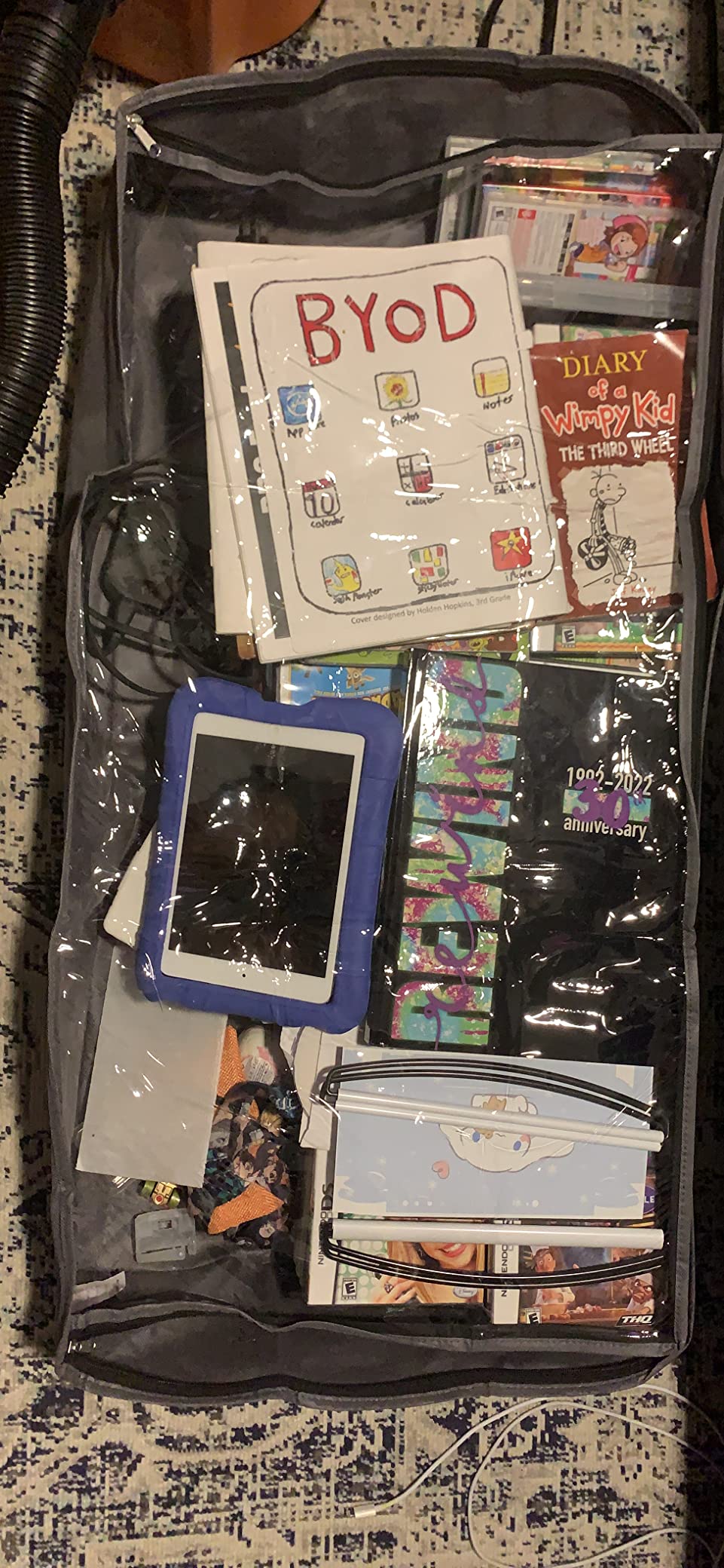
At 95 litres and 39 by 19.7 by 7.1 inches, these are the largest bags in the roundup by volume alongside the 95 litre Budding Joy set, and owners consistently report fitting two queen-size blankets in a single bag with room to spare, which is exactly the appeal if your off-season problem is bedding rather than clothing.
It also earns the lowest average rating here at 4.0 stars across more than 11,000 ratings. The review summary explains why: the fabric lacks rigid inserts, so the sides and bottom collapse inward when the bag is lifted by its handles, and a smaller group reports a plastic smell that persists after washing.
I still include it, because the capacity-to-price ratio and the clear PVC top are genuinely useful, and because the flaws are predictable rather than hidden. Fill it properly, lift from the base rather than the handles when it is full, and air it out before sealing anything inside.
95 Litres and What Actually Fits
The stated capacity is roughly 20 sweaters, 4 thick blankets and 14 sheets, and owners confirm the blanket figure, with several reporting two queen-size comforters in one bag. That is the whole appeal: bedding is the single bulkiest thing in a house after winter, and it is the hardest to squeeze anywhere else.
The 7.09 inch height clears standard frames and most platform beds with an open gap. The same clearance warning applies as for the other 7 inch bags here, and with 11,000 ratings in the data, clearance complaints are the most common reason buyers return bags in this size class.
Breathability, Windows and Cleaning
The fabric is described as breathable, which is the right choice for storage that will last a full year, and reviewers report coats coming out fresh and odour free after months. The top PVC cover wipes clean with a damp cloth, and since everything under a bed collects dust, being able to wipe a container rather than sponge it is a real time saver at the start of each season.
Four reinforced handles on the front and sides are well placed for pulling a bag out in any direction, which is the layout you need when one side of the bed is against a wall.
Where They Fall Short
The 4.0 average reflects three specific problems. With no structural inserts, the sides and bottom cave in when the bag is lifted by the handles, so a full bag is best lifted from underneath. The fabric can tear if overfilled, which pairs badly with the 95 litre capacity that tempts you to overfill. And a group of buyers report a plastic smell that survives washing, so air the bags out for a day before you seal clothing inside.
Who This Bag Is For
Buy this set for bedding and comforters, or for a large off-season volume where you accept a soft-sided bag. It is also a reasonable first storage purchase for a rental or dorm room. If you care most about structure, odour or long-term durability, pick one of the board-supported bins above instead.
How to Store Winter Clothes Under the Bed, Step by Step
The best under bed storage for winter clothes is the container you actually fill correctly. Seven steps, in order, will keep a whole season of garments safe from moths, damp and the crushed-knit problem that shows up in March.
1. Measure Your Clearance First
Measure from the floor to the lowest point of your bed frame, foundation or centre support beam, not to the mattress edge. Take the smallest measurement on all four sides, then buy a container at least one inch shorter than that number. This is the single most common reason under-bed containers end up unused, and it costs nothing to check.
2. Clean and Fully Dry Everything
Store nothing that has been worn without washing, and nothing that is even slightly damp. Body oils and food traces attract moths and carpet beetles, and damp folded in a closed container produces the musty smell that people blame on the container. Air items out overnight before folding, even if they look dry.
3. Sort Into Store, Skip and Donate
Before anything goes in a bag, sort into three piles. The donate pile is the one that matters, because under-bed storage makes it easy to ignore a coat you never wear. Apply the simple test: would you be excited to unpack this in March? If not, it is not coming out of storage.
4. Fold for the Container, Not the Shelf
Fold knits flat and loosely, and roll rather than fold items that crease badly, such as jersey trousers. Nothing should be compressed so tightly that it cannot spring back. For down and puffers, see the note on compression below before you reach for a vacuum bag.
5. Choose the Container by Duration
For six to eight months of ordinary seasonal storage, a zippered fabric bag or a lidded bin both work. For a year or more, and for wool, cashmere and vintage pieces, use breathable fabric or an acid-free box rather than airtight plastic. For moth-prone homes, prioritise lidded or sealed containers and add cedar blocks.
6. Label the Outside of Every Container
Write the contents on the container itself, or keep a simple list on your phone. This is the single most useful habit in the whole process, because the reason people avoid under-bed storage is that they cannot remember what is in the bag. A thirty-second label saves a ten-minute dig through four bins every swap.
7. Slide In Flat, Then Do Not Disturb
Push the container in along the floor rather than dropping it, using the front handle, and keep heavy items on top only in containers with reinforced or board-supported bottoms. If the bed is against a wall, plan a side with open access before you fill anything, because a bin you cannot get at is a bin you will not restock.
Do Vacuum Bags Ruin Down Jackets?
Not permanently, but they compress the fill, and long-term compression is the part to avoid. Vacuum bags are excellent for short-term compression of bulky down coats and puffers, especially in a small apartment where clearance is at a premium. Leaving a coat compressed under a pump for many months can reduce loft and, over time, affect the fibre. If you use one, store the coat loose and hung or laid out once the season ends, and give it a week or two before wearing it again.
What Not to Store Under Your Bed
Under-bed storage is excellent for out-of-season clothing and poor for almost everything else. A short list of exclusions prevents most of the problems people associate with under-bed storage.
Anything that has been worn but not washed. This is the most common cause of both moth damage and the musty smell on retrieval.
Damp or unventilated fabric. Moisture under a bed wicks into stored items and into the floor. Nothing goes in unless it is bone dry.
Food, and anything that attracts pests. The gap under a bed is warm, dark and undisturbed, which is ideal for insects. Keep all food out of it.
Heavy breakables. Glass, ceramics and electronics get knocked every time a container is dragged out from under the bed.
Anything you need weekly. A container that requires a full extraction to open becomes a container you stop using. Daily and weekly items belong at hand height.
Unsealed natural fibres in a moth-prone home. Wool, cashmere and felt should go into a lidded or zipped container, ideally with cedar blocks or a clean garment bag, rather than an open bin.
For dust mites and carpet beetles, the container choice is most of the defence. A closed zippered bin or a lidded tote excludes them; an open basket under a bed is a buffet. As one Mumsnet thread put it, “Under the bed = all dusty ultimately in our house”, which is the whole argument for sealing rather than covering.
How to Choose Under Bed Storage That Actually Fits
Decisions in this category come down to four numbers and one material choice. Get them right and any of the ten containers above will work; get them wrong and the container becomes unused floor space outside the bed.
Measure the Gap Before You Choose Anything
Use a tape measure and find the vertical distance from the floor to the lowest part of the frame, foundation, slats or support beam. Under-bed clearance below 5 inches points to the 4.5 inch bins. Between 5 and 6 inches opens up the 6 inch bags and the Amazon Basics pair. At 6.5 inches and above, most of this roundup fits, including the 7 inch bags.
Measure the width too, and the depth from the open side of the bed. A bag that fits the height can still fail because it is too wide to angle past a leg. If the bed sits against two walls, work out which side you can pull a container out from before you pick a shape.
Rigid, Soft or Compression: A Simple Decision Path
Choose rigid or board-supported bins if you will load the container with heavy or bulky items, if it will be visible most of the year, or if you plan to carry it while full. These hold their shape, take more weight and look better in a room, at a higher cost per bin.
Choose soft fabric bags if you are storing folded clothing only, if you want the lowest cost per container, and if the container will fold flat in a closet between seasons. The single rule with soft bags is to fill them close to full, because they take their shape from their contents.
Choose compression bags only when vertical space, not horizontal, is the constraint, and use them for a season rather than a year. They are the only option here that meaningfully reduces volume of down and thick knitwear.
Height and the Wheels Conflict
Wheels solve access and cost you height. The wheeled cart in this roundup measures 6.69 inches including its casters and needs roughly 7 inches of clearance, so it is the wrong choice on a low frame even though it is the most heavily built container here. Decide on wheels only after you have measured, and never on a bed that sits on a low platform base.
For a low bed where you still want mobility, the alternative is a rolling wire cart that you pull out entirely and use elsewhere, or a low-profile bin with strong handles that you drag rather than roll.
Capacity and Pack Count
Capacity figures across this category range from 45 to 95 litres per container, and the difference matters more than it looks. A 45 litre bin at 4.5 inches tall holds flat items in a single layer, while a 95 litre bag at 7 inches holds folded stacks and bedding.
Two 2-packs and a 4-pack, at a given budget, differ in how you divide things up: two bins means fewer labels and fewer things to remember, while four bins means you can sort by person or by garment type.
Material, Moths and Long-Term Storage
Airtight plastic is the strongest pest barrier, and for six to eight months of seasonal storage of ordinary clothing it is the simplest answer. Breathable non-woven fabric, like the Onlyeasy and Lifewit bags here, is the better choice for wool, cashmere, vintage pieces and anything stored longer than a year, because moisture can escape instead of sitting against the fibres.
Whichever you pick, clean before storing and add cedar blocks where moths are a known problem. If you are refreshing wool, a [lint remover for clothes](https://fypower.org/best-lint-removers-for-clothes/) helps you clear pilling off a stored knit before it goes back into rotation, and a [clothes steamer for delicate fabrics](https://fypower.org/best-clothes-steamers-for-delicate-fabrics/) is worth running over a coat that has been compressed.
Frequently Asked Questions
What is the best way to store clothes under my bed?
Measure the lowest point of your bed frame to the floor, then choose a container at least an inch shorter than that gap. Pack clothes clean and fully dry, fold or roll them loosely, seal the container against dust and moths, label the outside, and slide it in along the floor using the front handle. Keep heavy items out of soft-sided bags that are not full.
What is the best way to store winter clothes in storage?
Wash everything before it goes into storage, let it air out fully, and never seal fabric that is even slightly damp. Fold knits flat and loosely, roll items that crease. Use breathable fabric or an acid-free box for wool, cashmere and anything kept more than a year, and lidded or airtight containers for ordinary seasonal storage of six to eight months. Label every container before it goes under the bed.
What should you not store under your bed?
Do not store clothing that has been worn but not washed, damp fabric, food, heavy breakables like glass, or anything you need weekly. The gap under a bed is warm, dark and undisturbed, which attracts insects, and a container you cannot reach without moving furniture will end up unused. Keep daily items at hand height and seasonal clothing in sealed containers instead.
Are vacuum storage bags good for winter jackets?
Yes, for short-term storage of bulky down coats and puffers, where removing air is the only way to gain meaningful space. They are not ideal for long-term storage, because months of compression can reduce loft and affect the fibre. Store the coat loose and laid out or hung once the season ends, and allow a week or two for it to recover before wearing it again.
What are the best long-term storage containers for clothes?
Breathable non-woven fabric bags and acid-free archival boxes are the best choices for anything stored more than a year, especially wool, cashmere, vintage and hand-knitted pieces, because moisture can escape instead of sitting against the fibres. Airtight plastic is the stronger pest barrier but suits ordinary six-to-eight-month seasonal storage better. Clean every item before it goes in, regardless of container type.
How do you keep under bed storage dust free?
Use sealed or zippered containers rather than open baskets, and vacuum the gap on a schedule with a narrow nozzle attachment. Wipe clear PVC windows and fabric panels with a damp cloth at the start of each season, and lift containers out rather than letting them sit untouched for years. Sealed containers are the single most effective step, since they block dust rather than collecting it.
Which Under Bed Storage to Buy This Season
For most households, start with the ZOBER 90L four-pack. It has the largest review base of any pick here, real capacity for a full adult wardrobe, a clear window, and a fold-flat design that disappears into a closet in spring. If you care more about fabric thickness and want fewer compromises on odour, the Budding Joy 95L set is the same idea built slightly heavier.
Match the container to your constraint rather than to a ranking. If your gap is under 6 inches, the Amazon Basics pair, the Onlyeasy bags and the 4.5 inch TidyCorner bins are your realistic answers. If you store bedding rather than clothes, the Lifewit 95L set has the volume, and you should fill it carefully because the fabric is soft. If you want to reach in without dragging, the wheeled Yecaye cart is the pick, provided you have 7.5 inches of clearance. For wool and vintage pieces going away for more than a year, the breathable Onlyeasy bags are the safer material.
Time the swap rather than rushing it: fold and bag everything in late spring once the last cold morning has passed, and bring it back out in early fall before the first real chill. If you are still short on closet space for the items you actually wear, our [bed frames with storage](https://fypower.org/best-bed-frames-with-storage/) picks solve the same problem from the furniture side, and a dedicated [under bed storage container roundup](https://fypower.org/best-under-bed-storage-containers/) covers options built for rooms other than the bedroom. Measure the gap, pick from the list, and the space under your bed finally does something all year.
Leave a Reply