
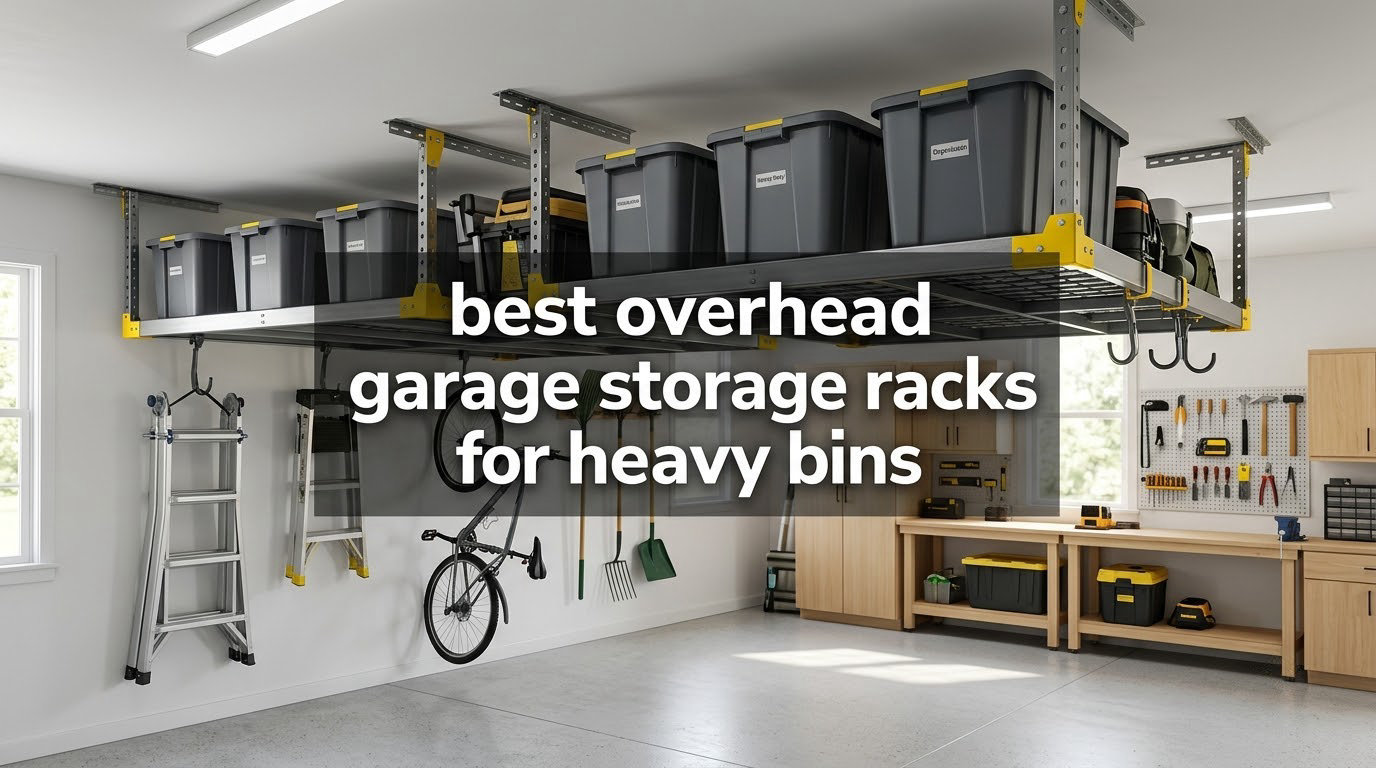
Most garage ceiling racks are sold on one number: weight capacity. That number is also the least useful one, because a rack rated for 750 pounds tells you nothing about whether your joists can carry it, whether the platform hangs low enough to clear your SUV, or whether you can get a 45-pound tote down without a ladder. We spent weeks looking at ceiling framing, comparing load ratings against realistic loaded-bin weights, and reading thousands of owner reviews to separate the racks that survive a full load from the ones that wobble empty.
The short answer is that the best overhead garage storage racks for heavy bins are the FLEXIMOUNTS 4×8, the SafeRacks 4×8, and the HyLoft 45×45, in that order, and each solves a different problem. If your bins are genuinely heavy and you refuse to use a ladder, a drill-driven lift rack is a different category entirely, and we cover that too.
Before anything else, a warning. The forum consensus on this topic is blunt: the limiting factor is rarely capacity. It is the framing above your head. On houserepairtalk.com, one user put it plainly, noting that height is often the limiting factor besides the garage door and opener, and that adjustable drop is a plus because of it. Another poster on the same thread raised the issue that matters most, pointing out that if your garage roof framing is trusses, this might not be a good plan, since some trusses are rated for storage above and most are not. We built the buying guide around that reality rather than around marketing claims.
We also convert rated capacity into actual bin counts, which no competitor in this category does. A rack that holds 750 pounds is not a number you can shop with. Our team compared ten racks across load rating, platform footprint, drop range, ceiling type, and installation burden, and we flag the ones where the spec sheet and the product name disagree with each other. If you are still organizing the rest of the garage, start with our garage storage cabinet picks before you go vertical.
Our Top 3 Best Overhead Garage Racks for Heavy Bins in October 2026

FLEXIMOUNTS 4×8 Overhead Rack
- 750 lb rated load capacity
- 22 inch to 40 inch adjustable drop
- Up to 105 cubic feet of storage
- Two-stud mounting brackets

SafeRacks 4×8 with Hook Pack
- 600 lb weight capacity
- 24 inch to 45 inch adjustable drop
- 14-gauge steel C-channel beams
- 5-piece hook pack included
HyLoft 45×45 Overhead Rack
- 250 lb weight capacity
- 16 inch to 28 inch height adjustment
- Over 30 cubic feet in a 45×45 footprint
- Linkable into longer runs
These three cover the realistic range of garage ceilings. The FLEXIMOUNTS is the one we would put in our own garage: highest review volume in the category by a wide margin, a 750-pound rating, and drop height that reaches high enough to clear a truck bed with the gate up. The SafeRacks runs a deeper drop range and ships hardware that suits a straightforward joist mount, at a higher price point. The HyLoft is the honest entry: lighter rating, smaller deck, the simplest install of the three, and a footprint that suits a one-car garage rather than a two-car span.
Comparing Ten Ceiling Racks for Bin-Heavy Garages
| Product | Details | Action |
|---|---|---|
|
|
Check Latest Price |
|
|
Check Latest Price |
 |
|
Check Latest Price |
|
|
Check Latest Price |
 |
|
Check Latest Price |
 |
|
Check Latest Price |
 |
|
Check Latest Price |
 |
|
Check Latest Price |
 |
|
Check Latest Price |
 |
|
Check Latest Price |
Three things jump out of that comparison. First, the ratings cluster hard: eight of these ten are between 4.4 and 4.7, which means the spec sheet matters more than the stars. Second, drop height varies more than capacity does, ranging from a 16-inch minimum to a 45-inch maximum, and that is the number that decides whether the rack fits over your vehicle. Third, the two lift racks are in a different product class, weighing 92 pounds in one case and using a rope or gearbox system in the other. They are not competing with the fixed racks; they are solving a ladder problem.
1. FLEXIMOUNTS 4×8 Overhead Rack – The Best Overall Pick for Loaded Bins
FLEXIMOUNTS 4×8 Overhead Garage Ceiling Storage Rack Organization, Black
750 lb rated capacity
22 to 40 inch adjustable drop
Up to 105 cu. ft.
Hardware kit included
+ Pros
- Highest review volume in the category at more than 19000 ratings
- Adjustable 22 to 40 inch dropdown suits most two-car garages
- Integrated wire grid and frame build stays rigid under load
- Long brackets attach to two studs with six vertical posts
- Installation template included
– Cons
- Prefilled screw holes can strip if power-driven
- Deck sways when empty with no diagonal bracing included
- Two people are effectively required to raise a 4×8 deck
This is the rack our team keeps coming back to. With more than 19,000 ratings averaging 4.7 and a Best Sellers rank of number one in ceiling-mounted storage racks, the FLEXIMOUNTS 4×8 is the rare product where the review volume and the rating agree. Owners consistently describe it as stiff, well engineered, and the best value in the category, and several mention testing it well past its rating.
The design reason is structural. Instead of bolting a wire shelf onto a frame, the wire grid and frame are one integrated piece, which removes the joint that fails on multi-piece competitors. Long ceiling brackets reach two studs, and six vertical posts carry the drop. At 750 pounds rated, with 48 by 96 inch dimensions and a weight of 59.7 pounds, it is the most substantial-looking fixed rack here without moving into lift-system weight.
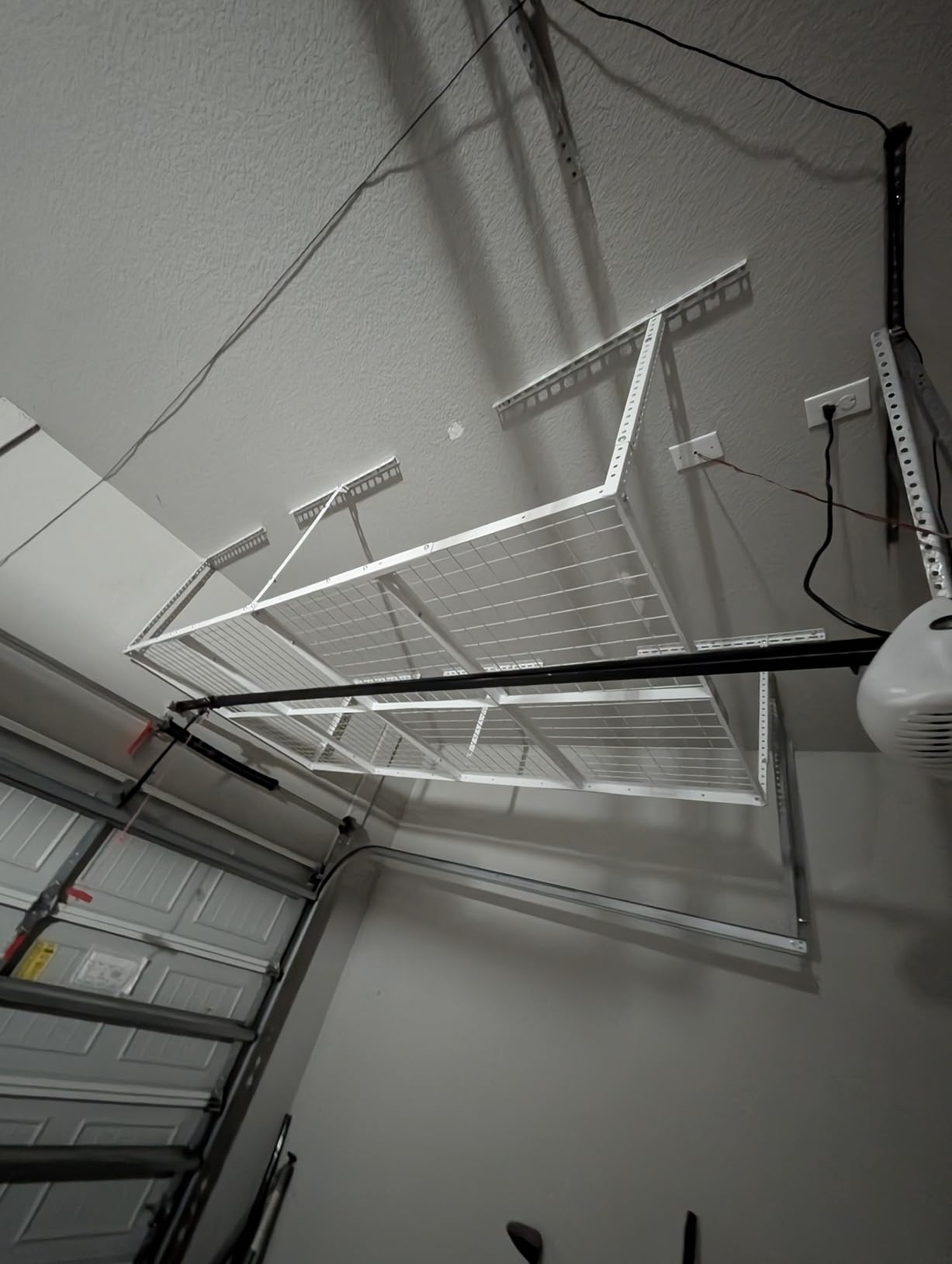
Two installation notes from owners are worth repeating. First, hand-drive the bolts. Multiple reviewers report stripping the prefilled holes, and the fix is consistent: do not use a driver at full speed. Second, measure joist centers carefully and leave a few inches of clearance at the wall, because the brackets are longer than the span most people expect.
It is also worth being honest about the complaints, because they are all install-related rather than structural. Owners report lateral sway when the deck is empty, no diagonal bracing in the hardware kit, and no spare screws. We have also seen reports of an unresponsive support line. None of these point to failure under load; they point to a fiddly afternoon with two people and a drill set to low.
Load Capacity and Bin Math
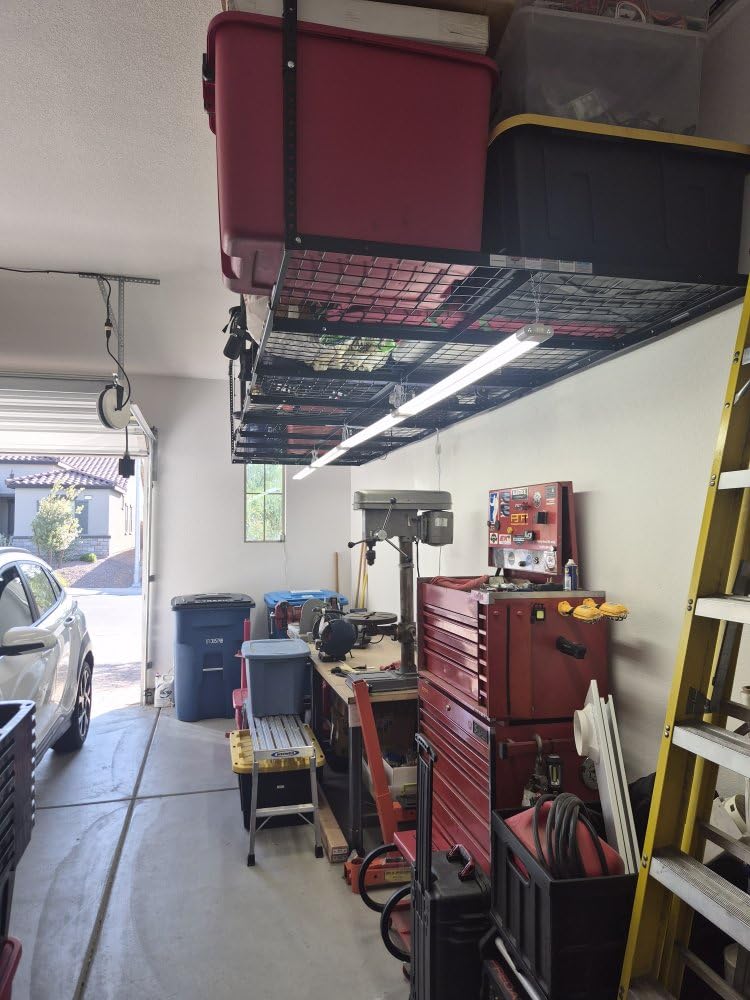
Rated at 750 pounds with a tested figure of 1,200 pounds, this rack converts to real bin counts more generously than anything else in the set. If a loaded tote on your shelving system comes in around 40 pounds, a fully loaded 750-pound rack holds roughly 18 of them in theory, and we would plan for 15 to leave margin for a front-heavy load. At 25 pounds per bin, the number rises to about 30.
Spread the mass. Concentrating weight at the back edge nearest the wall is fine; concentrating it in a single corner on a 96-inch deck is what produces the sway owners describe. Two people carrying a bin onto the deck at the same time also keeps the load balanced while it lands.
Drop Height and Vehicle Clearance
The 22 to 40 inch dropdown is the most useful adjustment range here for a typical two-car garage. Set it high when the platform is carrying bulky seasonal gear and low when you want the volume of a full 4×8 box. Owners running a sedan generally have slack; owners with a full-size SUV or a pickup with a bed cover need to measure before ordering, which is why we treat clearance as a hard constraint in the buying guide below.
Up to 105 cubic feet of storage is the headline number, and it assumes the platform is at its lowest drop. At full height you keep the footprint but lose much of the volume, so the setting you choose should match what you plan to store. Bulky empty cartons want the drop; stacked totes want the height.
Mounting and Ceiling Type
This rack suits wood studs and joists and concrete walls, but not metal walls. That ceiling compatibility is the single most important line on any product page in this category, and it is the one most buyers skim. If your ceiling is a truss, pause and read the framing section further down before ordering anything.
For a joist mount, the ceiling must carry the bins plus the 59.7 pounds of rack. That extra weight is why forum users push back on racks that mount to a single bolt or spread load across a large platform with only four corner fasteners. This rack uses two-stud brackets and six posts, which is a better load path than a four-corner arrangement.
Hooks are sold separately, so budget for them if you plan to hang bikes or ladder-shaped items beneath the deck. Our related welding helmet picks for overhead work cover another common use for the vertical space under a platform.
2. HyLoft 45×45 Overhead Rack – Most Versatile for One-Car Garages
HyLoft Overhead adjustable Garage Storage Rack,Heavy Duty Steel Garage Storage System, 45-Inch x 45-Inch, White
250 lb weight capacity
16 to 28 inch adjustment
45 x 45 inch footprint
Hardware included
+ Pros
- One of the simplest racks here to install with hand tools
- Over 30 cubic feet in a compact 45×45 footprint
- Height adjusts from about 16 to 28 inches
- Manufacturer customer service is widely praised
- Linkable side by side into a longer overhead run
– Cons
- 45 by 45 inch deck fits only one tall tote comfortably
- Sways when unloaded and steadies with wall brackets
- 250 lb is the lowest rating among the fixed racks here
The HyLoft is the rack we recommend when the question is not how heavy the bins are but how little you want to spend on learning a new assembly. It installs with basic hand tools, and a cordless drill plus a stud finder is the only real speed-up. At 34 pounds, a single person can raise it, which separates it from every 4×8 rack in this roundup.
Buyers describe it as a long-running value pick above the garage door, and the pattern in the reviews is consistent: easy in a morning, sturdy once loaded, and effective at clearing floor clutter. The 45 by 45 footprint is genuinely compact, and the 16 to 28 inch height adjustment adapts to a wider range of joist setups than a fixed-height shelf.
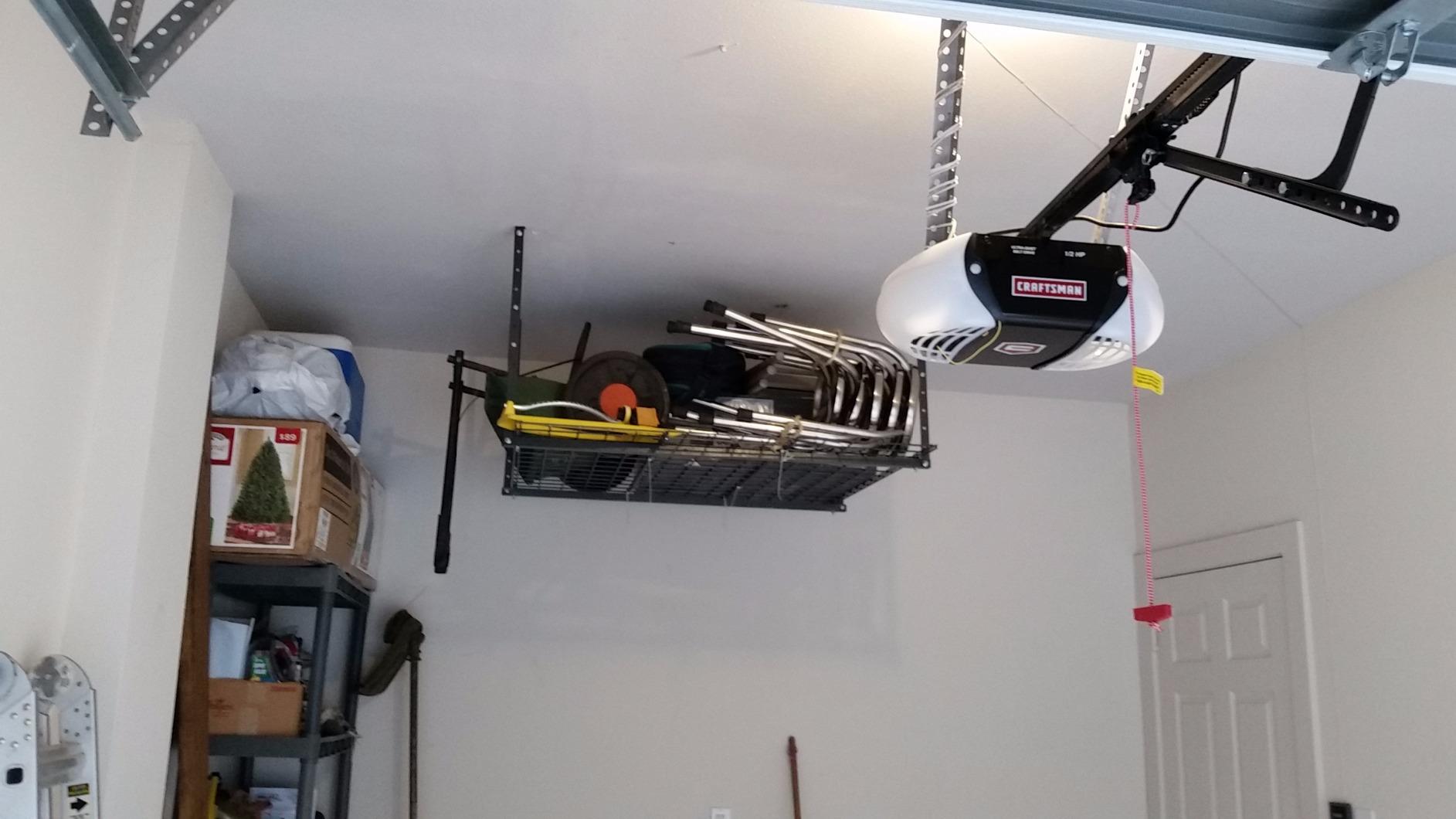
Make no mistake about what this is. A 250-pound rating is the lowest capacity among the fixed racks in this set, and a 45-inch deck is not a platform for a row of loaded 27-gallon totes. It suits seasonal gear, camping equipment, and lighter storage bins, and it is a good second rack rather than a first one. If your bins are genuinely heavy, skip to the SunsGrove or the SafeRacks.
The recurring downsides are footprint size and sway. Owners note that the deck moves side to side while unloaded, and the common fix is adding L-brackets at the wall. Instructions are also described as thin, with buyers relying on install videos, which is worth knowing before you start.
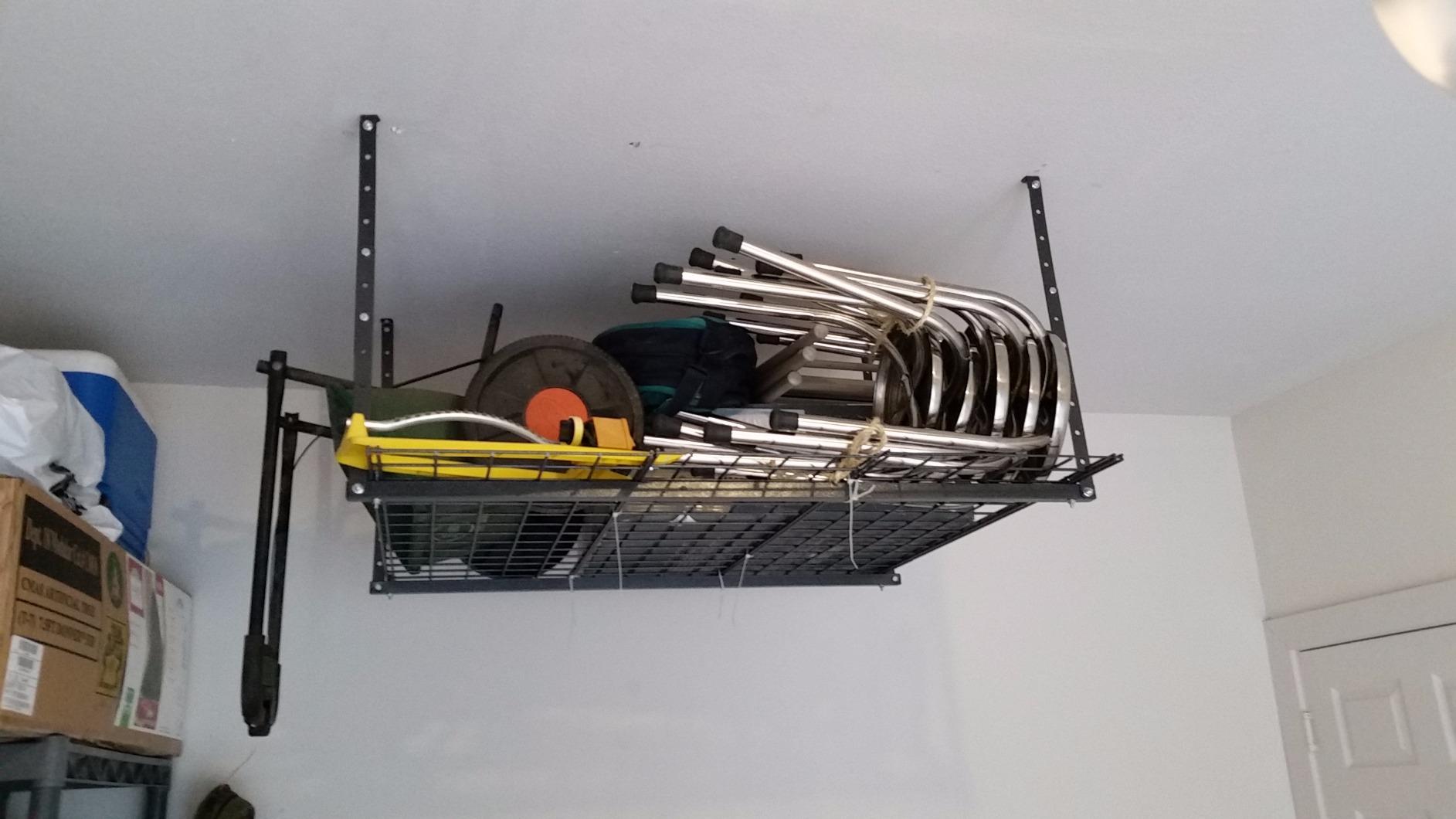
Where It Wins on Load Distribution
A 250-pound rating spread across a 45 by 45 inch deck is a reasonable load for lighter bins. If your typical loaded tote comes in around 25 pounds, that is ten bins in theory and a comfortable eight in practice, which covers a season of holiday decor or a set of camping totes without straining the joists or the frame.
Because the deck is small, the density problem disappears. There is nowhere to stack a load off-center, so a 45-inch platform is inherently better behaved than a 96-inch one. That is the real argument for this rack: not capacity, but a low likelihood of a dynamic imbalance.
Linking Multiple Racks
These racks can be linked side by side into a longer run, which is how most owners get a usable overhead surface out of a small model. Plan the joist layout first, because linked runs need joists on both ends and a straight line between them. Owners recommend checking joist spacing on both sides of the garage before drilling.
A linked run of two HyLoft racks is a sensible setup for a one-car garage where a 4×8 platform would overwhelm the bay. If you also want a floor-level system for the heavy dense items that should never go overhead, our garage gym rack guide covers the same logic for weight equipment.
3. MonsterRax 4×8 Overhead Rack – Industrial Steel with a Deep Drop Range
MonsterRax 4×8 Overhead Garage Storage Rack, Gray, 24″-45″ Height
500 lb capacity
24 to 45 inch adjustable drop
Up to 120 cu. ft.
Carbon steel with rust-resistant coat
+ Pros
- Industrial-grade carbon steel with case-hardened hardware
- 24 to 45 inch drop for up to 120 cubic feet
- Patented high-strength ceiling brackets
- Powder coat has no sharp or jagged edges
- Limited lifetime warranty and U.S. veteran-owned maker
– Cons
- Roughly 80 lb so the ceiling carries the rack weight too
- Illustrated instructions contain inaccurate diagrams
- Bottom rail sits about 2.5 inch below the load plane
The MonsterRax is the one we would shortlist if your garage has genuinely high ceilings and a 45-inch drop is the difference between usable volume and none. Owners report it as rock solid once tightened, with heavy loads that do not flex it, and one long-term owner says the same unit is still holding up years after the original purchase. That longevity matters in a category where most designs are newer.
At 500 pounds rated with carbon steel, 27-inch ceiling brackets, and up to 120 cubic feet of storage per shelf, the specification set is aggressive. Installation is roughly two to four solo hours, and the hardest step is not assembly; it is locating true joist centers rather than guessing at a stud edge.
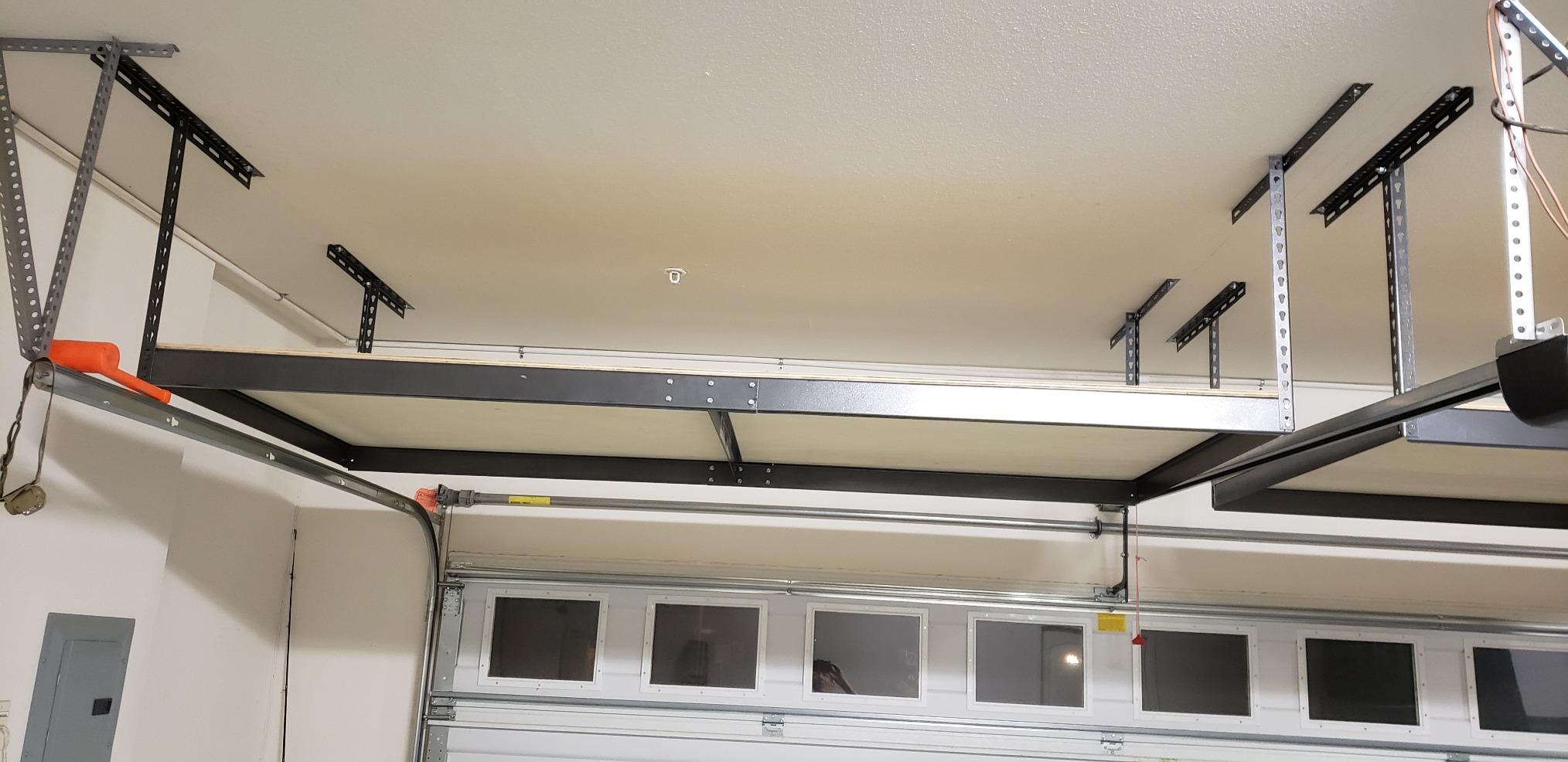
This rack is 80 pounds, which is heavier than the FLEXIMOUNTS and much heavier than the HyLoft. That weight is the honest cost of a carbon steel frame, and it means your ceiling carries the bins plus a substantial structure. Budget for it, and do not plan a solo ceiling install.
The most cited weakness is the instruction diagrams, which reviewers describe as inaccurate enough to force reassembly. Several buyers still recommend following them carefully and ending up with a very solid finished rack. Extra hooks have to be fitted before the base frame is bolted up, and one owner snapped an assembly bolt with an impact driver and had no spare.
Load Capacity and the Ceiling Question
500 pounds across a 96 by 48 inch deck translates to roughly 12 loaded totes at 40 pounds each, with margin for 10 if you want headroom. The rating assumes even distribution, and this deck is deep enough that a careless stack in the middle of the platform will feel heavier at the joists than the number suggests.
This rack mounts directly into ceiling joists. That is a narrower requirement than racks rated for concrete, and forum users with finished or concrete ceilings consistently report that it narrows their options considerably. Check the framing section below before committing.
Drop Height and Low Ceilings
The 24 to 45 inch range means the platform can sit high enough to clear most pickups and SUVs with a bed cover, or low enough to give you real volume. The catch is the bottom rail, which sits about 2.5 inches below the load plane and reduces clearance for wide bins. If you use bins that are wider than a standard tote, measure the usable opening rather than the platform.
One owner hung several hundred pounds of truck canopy hardware and resorted to 3/4 inch electrical channel because standard racks were unavailable in the size needed. That experience is a useful reminder: the 4×8 platform is a fixed envelope, and oddly shaped loads sometimes need a custom structural solution rather than a bigger off-the-shelf rack.
Powder Coat and Unheated Garages
The finish is described as rust-resistant with no sharp or jagged edges, which matters in an unheated garage where condensation cycles through the year. Coastal and humid climates are where a hammertone or textured coat earns its keep, and it is a real consideration for anyone storing bins long-term rather than seasonally.
4. SafeRacks 4×8 Overhead Rack with 5-Pc Hook Pack – Best Value with Included Hooks
SafeRacks Gray 4×8 Overhead Storage Rack w/ 5-pc Hook Pack (24”-45″ Drop)
600 lb weight capacity
24 to 45 inch drop
14-gauge C-channel beams
Hook pack included
+ Pros
- 600 lb capacity aimed squarely at heavy storage bins
- 14-gauge industrial steel C-channel beams
- 24 to 45 inch drop gives up to 120 cubic feet
- Five-piece hook pack included for hanging gear
- Instruction support and a certified installer network
– Cons
- One of the higher-priced racks in the category
- Manufacturer suggests roughly four hours to install
SafeRacks is the pick for anyone who wants a fixed rack that treats bin weight as the default rather than an exception. At 600 pounds rated with 14-gauge industrial steel C-channel beams, this is the most explicitly engineered of the fixed racks, and 84 percent of more than 1,200 ratings are five stars. Buyers name the capacity, the steel gauge, and the included hooks as the reasons for purchase.
The included hook pack is a small detail that changes the layout. Every other fixed rack in this roundup either sells hooks separately or requires planning the hanging space before the frame goes up. Here you can add hanging storage for bikes, ladders, and long-handled tools under a platform that carries loaded bins above.
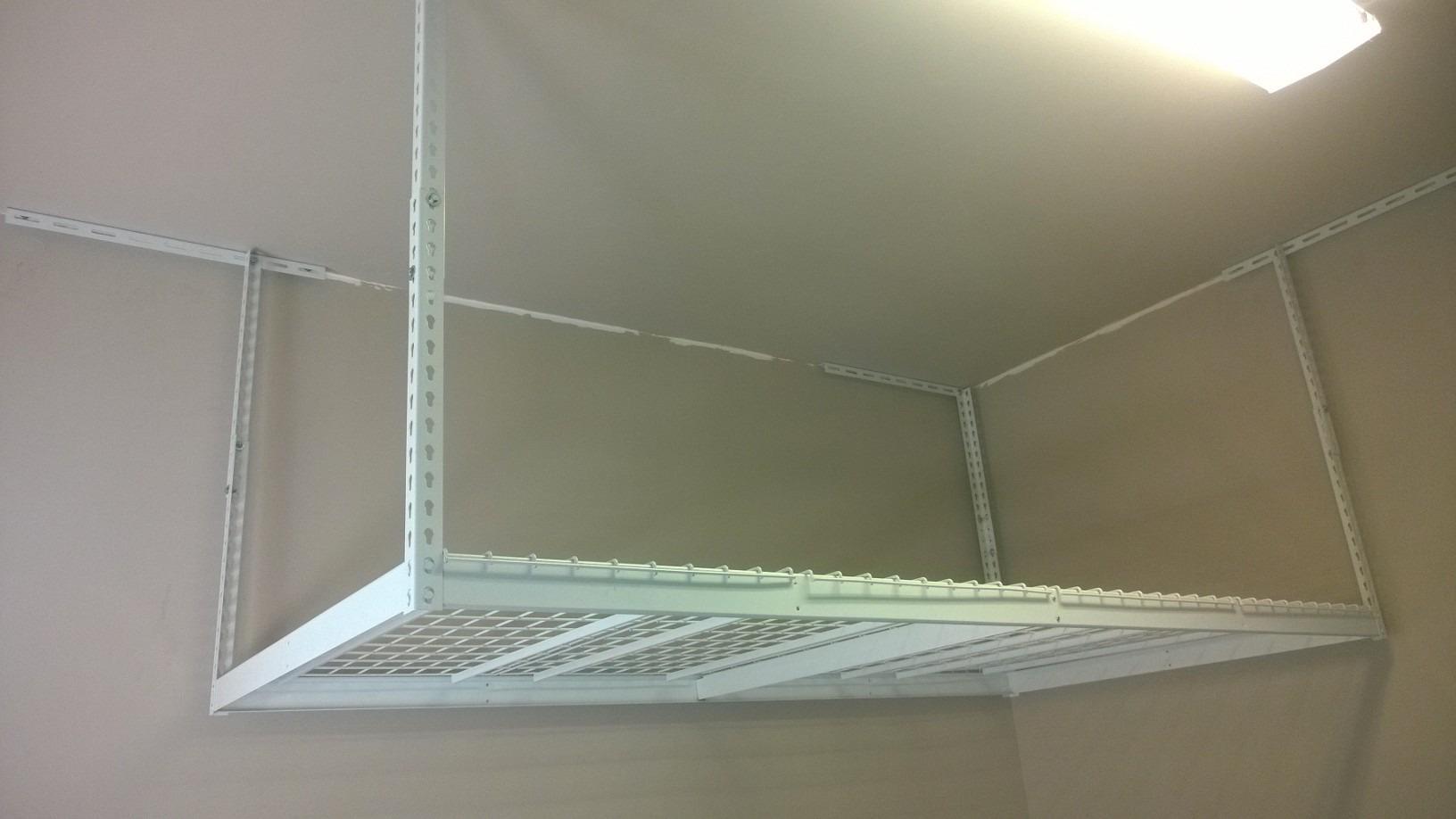
The tradeoffs are cost and time. This is one of the higher-priced racks in the category, and the manufacturer notes the average person needs roughly four hours to install one. Several owners use the certified installer network instead of doing it themselves, which is a sensible route if you have never hung anything from a ceiling before.
Item weight is 80 pounds, so plan for a helper during the lift. The listed dimensions of 24 inches deep by 44 inches wide by 24 inches high describe the rack’s packed or hung footprint in a way that does not match a full 4×8 platform, so confirm the actual deck size against your bay before ordering.
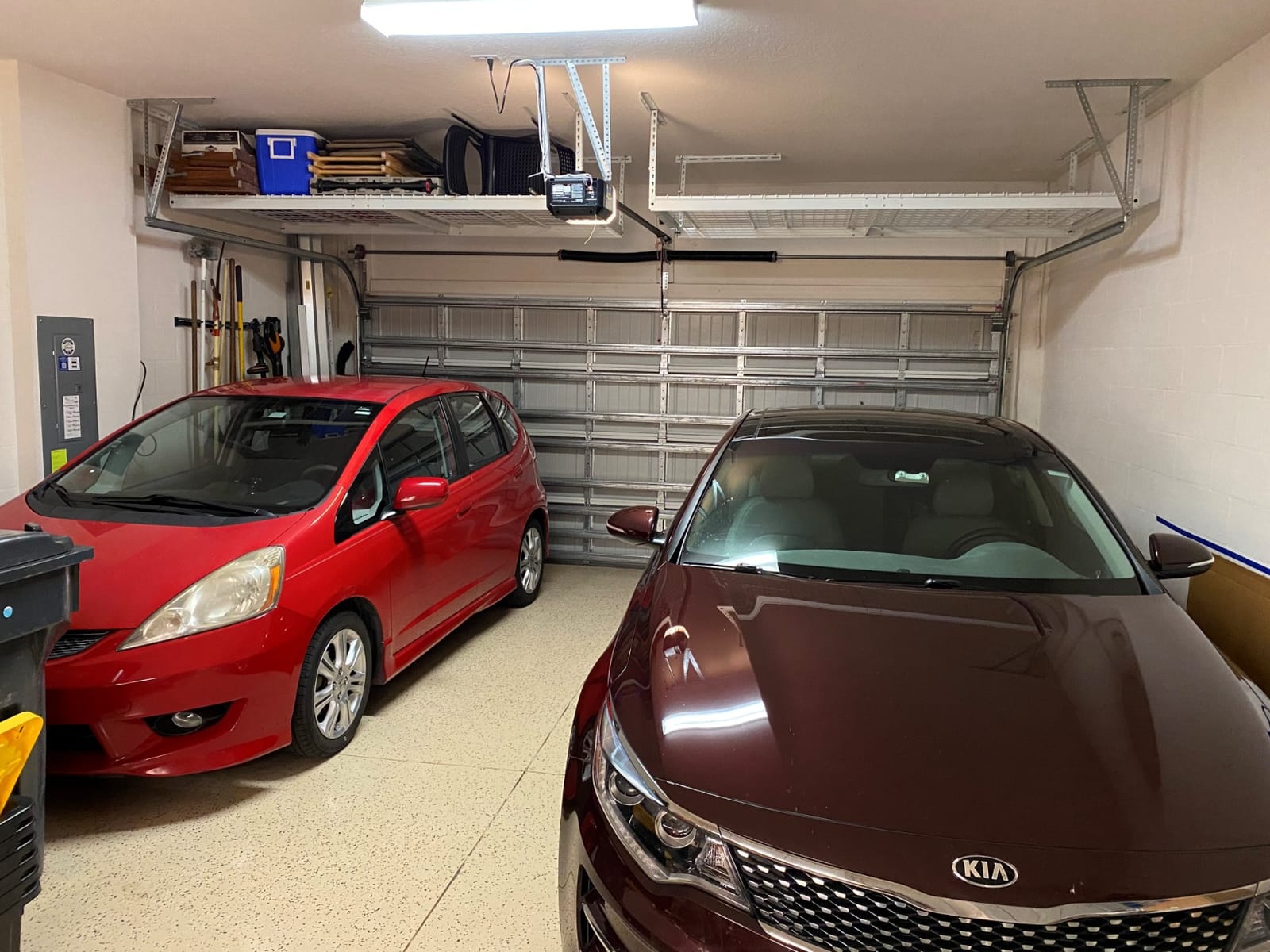
600 Pounds in Real Terms
At 600 pounds rated, the SafeRacks carries the same realistic bin count as the 750-pound racks once you apply a sensible safety margin. Loaded totes at 40 pounds give about 15 bins in theory; we would load 12 and keep the rest of the rating as reserve, because a rating is a limit rather than a target.
Reserve capacity matters more than people expect. On houserepairtalk.com, one poster described the way assumed storage weight drifts upward over time as the garage accumulates gear, and warned that budgeting for growth is part of the decision. A rack loaded to 95 percent on day one is a rack overloaded in two years.
Drop Height and Door Clearance
The 24 to 45 inch range puts this rack at the deep end of the category, which is what you want if your vehicles are tall. Set the platform near the top of the range and you gain clearance for a truck with a bed cover; set it low and you gain up to 120 cubic feet. Decide which matters before you choose the drop setting, because moving it later means re-angling the whole assembly.
Ceiling type is the co-limiter. As on houserepairtalk.com, garage door and opener travel often caps what you can do with drop height, and a rack that clears your vehicle but sits in the path of the opener rail is the classic failure here. Measure the opener rail height at its highest point before ordering any rack with a 45-inch maximum drop.
Installation Time and the Installer Option
Roughly four hours is the manufacturer’s own estimate, and our reading of owner reports matches it for a first-timer with a stud finder. The sequence is straightforward: mark joist centers, mount the ceiling brackets, hang the vertical posts, assemble the deck, and load evenly. The four hours includes the assembly, not just the lift.
If your framing is trusses rather than joists, an installer can tell you in ten minutes whether your ceiling is even suitable, which is cheaper than discovering the problem after the rack is on the floor of the garage.
5. HANDT Connectable Ceiling Rails – Best Budget System for Many Small Bins
USA Based Overhead Garage Storage Rack, Connectable Heavy Duty Metal Ceiling Rails Garage Storage Organization Shelving System, Hanging Racks Tote Containers, Supports Up To 6 Bins, 4 Sets Black
100 lb per set
Four sets support up to six bins
17 inch rails
Connectable rows
+ Pros
- Connectable design scales as your ceiling allows
- Four sets in one pack support up to six bins
- Doubled rails create a genuine second storage tier
- Compact 17 inch rails fit standard 16 inch joists
- Optional safety bolts stop bins sliding out
– Cons
- Only 100 lb of capacity per set
- Bins rest on rails rather than a solid deck
- Layout options are limited by the rail size
The rail system is a different answer to the same problem. Rather than one large platform, you run 17-inch rails from joist to joist and slide bins in along them. Four sets in the pack support up to six bins, and the doubled rail layout creates a true second tier. If your garage needs many small bins rather than one heavy load, this is the shape of storage that actually fits.
Buyers like the connectability, which lets you add sections as your ceiling allows, and the fact that a four-set package covers six bins for a fraction of the cost of a full rack. The 17-inch rail length fits standard 16-inch joist spacing directly, and rows can be connected to handle 24-inch spacing.

Be clear about the limits. One hundred pounds per set is a fraction of what the fixed racks carry, and bins resting on rails rather than a solid deck means small items need containment or a lip. The optional safety bolts exist for exactly this reason, and we would use them with anything that is not a lidded tote.
This complements rather than replaces the 500 to 800 pound fixed racks. A common and effective layout is one fixed 4×8 platform for heavy bins at the front of the bay, with rail runs filling the space above the workbench and along the side wall for lighter storage.
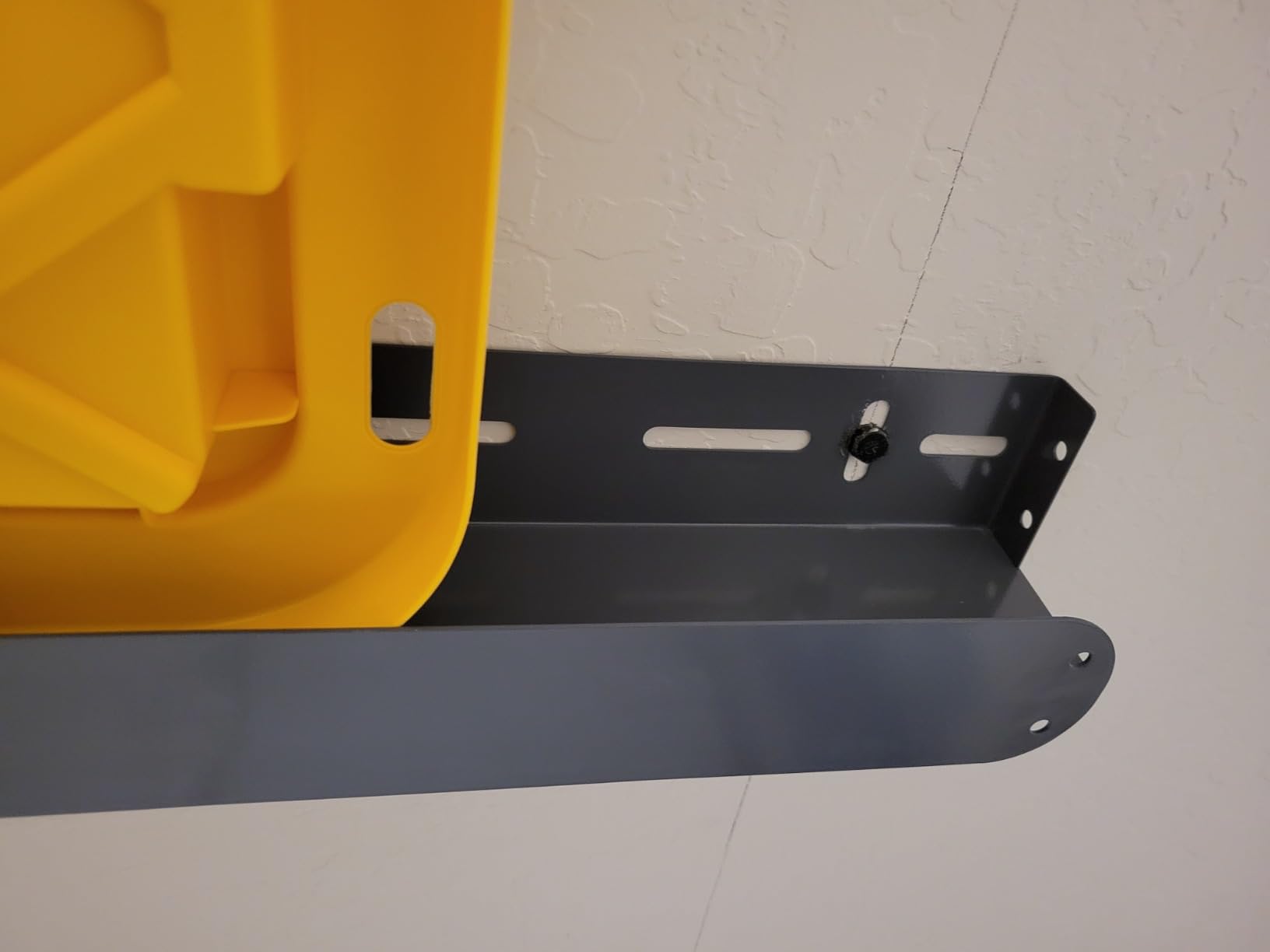
Rail Length and Joist Spacing
At 17 inches long, these rails are dimensioned for 16-inch joist spacing, which is the most common residential spacing. For 24-inch spacing, connect sets in rows to bridge the gap, which is what the design is built around. Measure your actual joist centers rather than assuming, because the difference between 16 and 24 decides the whole layout.
Rails weigh little compared with a platform, and the total package weight of 8 kilograms is a fraction of an 80-pound fixed rack. That matters when your joists are older or when the framing is not what you hoped it would be.
Which Belongs on Rails
Light or medium bins, camping totes, and sports gear are the right occupants. The rails are a poor home for anything dense, and they are a poor home for small loose items unless you add the safety bolts and a bin lip. The rating is per set, so four sets give you 400 pounds spread across six bin positions rather than a single concentrated load.
6. FLEXIMOUNTS GL1 Lifting Rack – Best for Loading Heavy Bins Without a Ladder
FLEXIMOUNTS GL1 Overhead Garage Lifting Storage Rack, 4×4 Ft Heavy-Duty Metal Garage Ceiling Rack, Adjustable Organization System With 71”L Axle, 350lbs Weight, Black
350 lb safe load
Hand crank or power drill operation
79 inch lift range
4×4 ft deck
+ Pros
- Cranks by hand or drives with a power drill
- So bins load and unload without climbing a ladder
- Double-rope design and safety lock when raised
- 350 lb safe load on a 4×4 foot deck
- Pressure-rivet rope connections resist separation
– Cons
- Quality control varies with reports of twisted cables and an unlevel platform
- Ceiling height must be under 10 feet
- Gearbox and cables are wear items with no adjustment option
This is the category no editorial competitor covers properly, and it is the one that answers the question the original houserepairtalk.com poster was asking: how do you get a heavy bin down from the ceiling without risking injury with a ladder. You attach a drill to the axle, or crank it by hand, and the deck comes down to loading height. The platform then raises out of the way on a 79-inch lift range.
Buyers with a well-functioning unit love exactly this. The double-rope design and safety lock feel solid when raised, the platform is reported as sturdy, and the operation is smooth once assembled. A template for the ceiling layout is included, which matters because the axle and cable geometry have to be square.
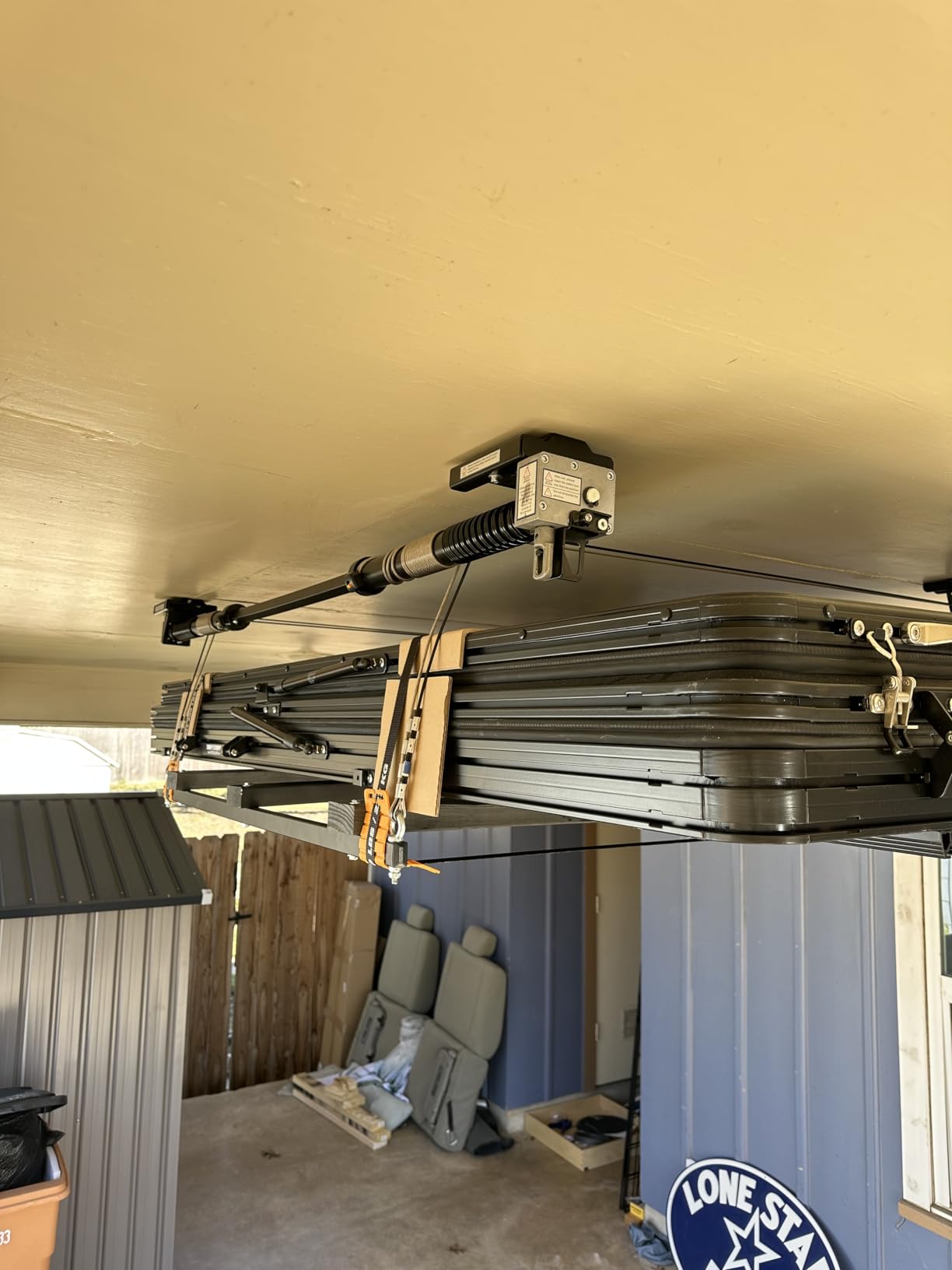
The reviews polarize, and you should read them as a quality-control warning. A growing cluster of one and two star reports describes twisted cables, a platform that will not level at full height, and a gearbox that locked up on the first raise. Buyers who moved from a fixed rack to this one tend to recommend it; repeat buyers report the build has slipped.
Also note the ceiling limit. At 79 inches of lift range, this is designed for ceilings under 10 feet. In a taller garage it will not raise the platform clear of your vehicle, which removes the reason to want a lift in the first place.
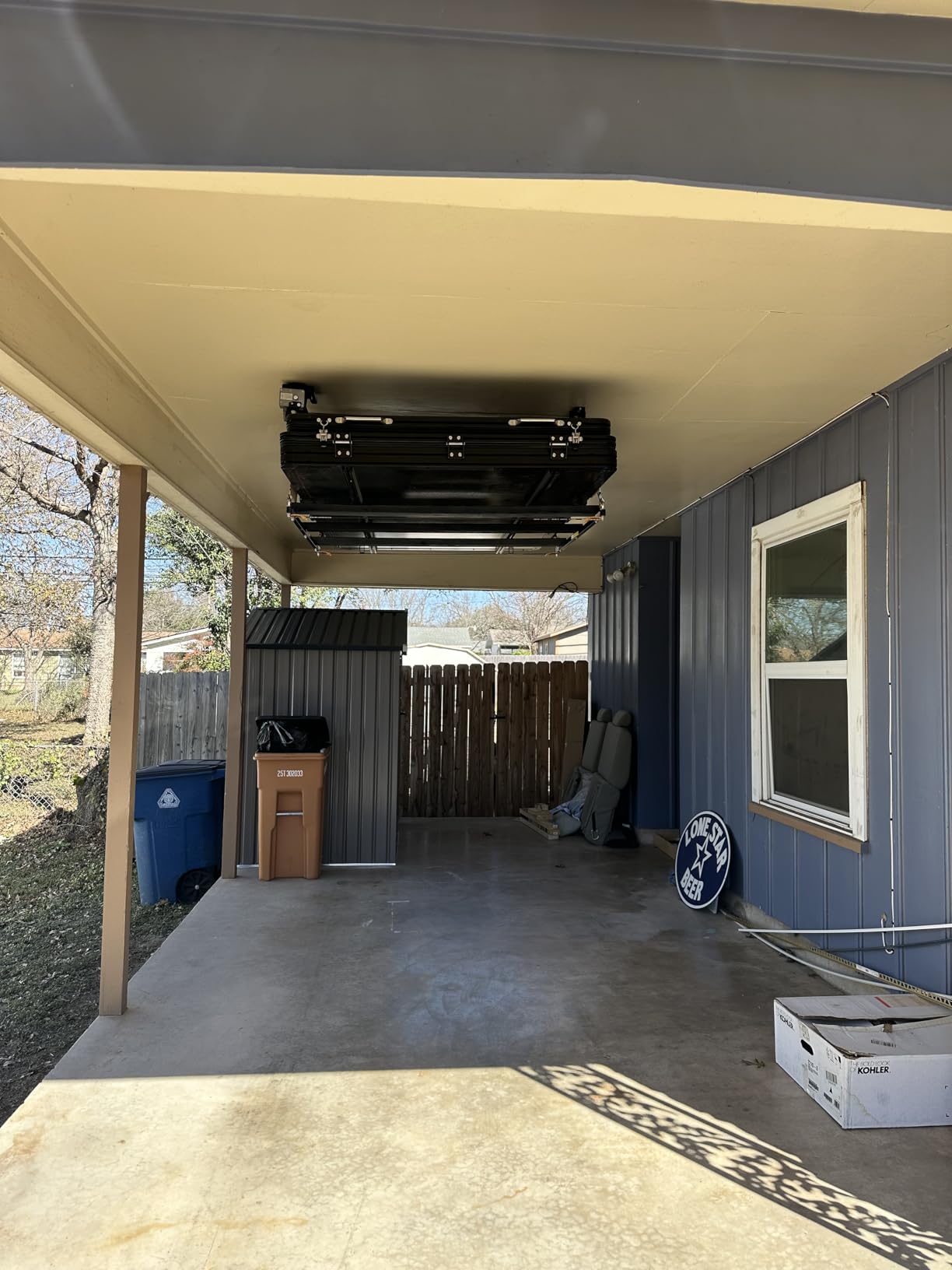
Why a Lift Rack Changes the Load Question
A 350-pound safe load on a 4×4 foot deck is a modest number next to a 750-pound fixed rack, and that is the trade. What you are paying for is not capacity, it is that you can put a 40-pound tote on the deck at floor level and then raise it with a trigger. That eliminates the ladder-and-load combination that causes the injuries, and for anyone with a shoulder, back, or balance issue it is the difference between using the space and avoiding it.
The listed capacity figure of 600 pounds reflects testing rather than the safe working load. Treat 350 pounds as the number you plan around.
Drive, Crank, or Manual
Three operating modes make this flexible. A power drill on the axle is fastest for frequent use, the hand crank works when the battery is flat, and there is a 71-inch axle length that determines the mechanical advantage. Owners rate the platform solid and the operation smooth, but treat the gearbox and cables as the parts that will need replacing eventually.
If your garage project extends into metalwork, the overhead position is also a good place to stage a bench setup, which is why we track welding helmets rated for overhead work separately.
7. SunsGrove 4×8 Overhead Rack – Highest Rated Capacity at 800 Pounds
SunsGrove 4×8 Overhead Garage Storage Rack Organization, Adjustable Ceiling Mounted Storage Racks, 800LBS Weight Capacity, 22″-40″ Ceiling Dropdown, Hammertone Black
800 lb weight capacity
22 to 40 inch drop
2 inch wide grid slats
Reinforced crossbeams
+ Pros
- Highest rated load capacity of the fixed racks we tested
- Upgraded grid uses 2 inch wide slats instead of thin wire
- Reinforced crossbeams and added mounting holes reduce wobble
- Rotatable hanging pieces adapt to different stud layouts
- Hammertone finish resists corrosion and wipes clean
– Cons
- Rated for wood studs and concrete walls only with a ceiling tilt under 10 degrees
- Heavier 65.7 lb package complicates a solo ceiling install
- Fewer ratings than the top sellers
If your bins are the problem, the SunsGrove is the direct answer. Its 800-pound rating is the highest of the fixed racks in this roundup, and the reason is visible in the build: 2-inch wide grid slats instead of thin wire, reinforced crossbeams, and 8 mm thick screws. Wider slats resist point loading, which is exactly what a stack of loaded totes applies.
Rotatable adjustable hanging pieces are the sleeper feature. They let the hangers adapt to different stud layouts, which reduces the amount of repositioning you do mid-install, and the hammertone textured finish resists corrosion and is easy to wipe down after a dusty project.
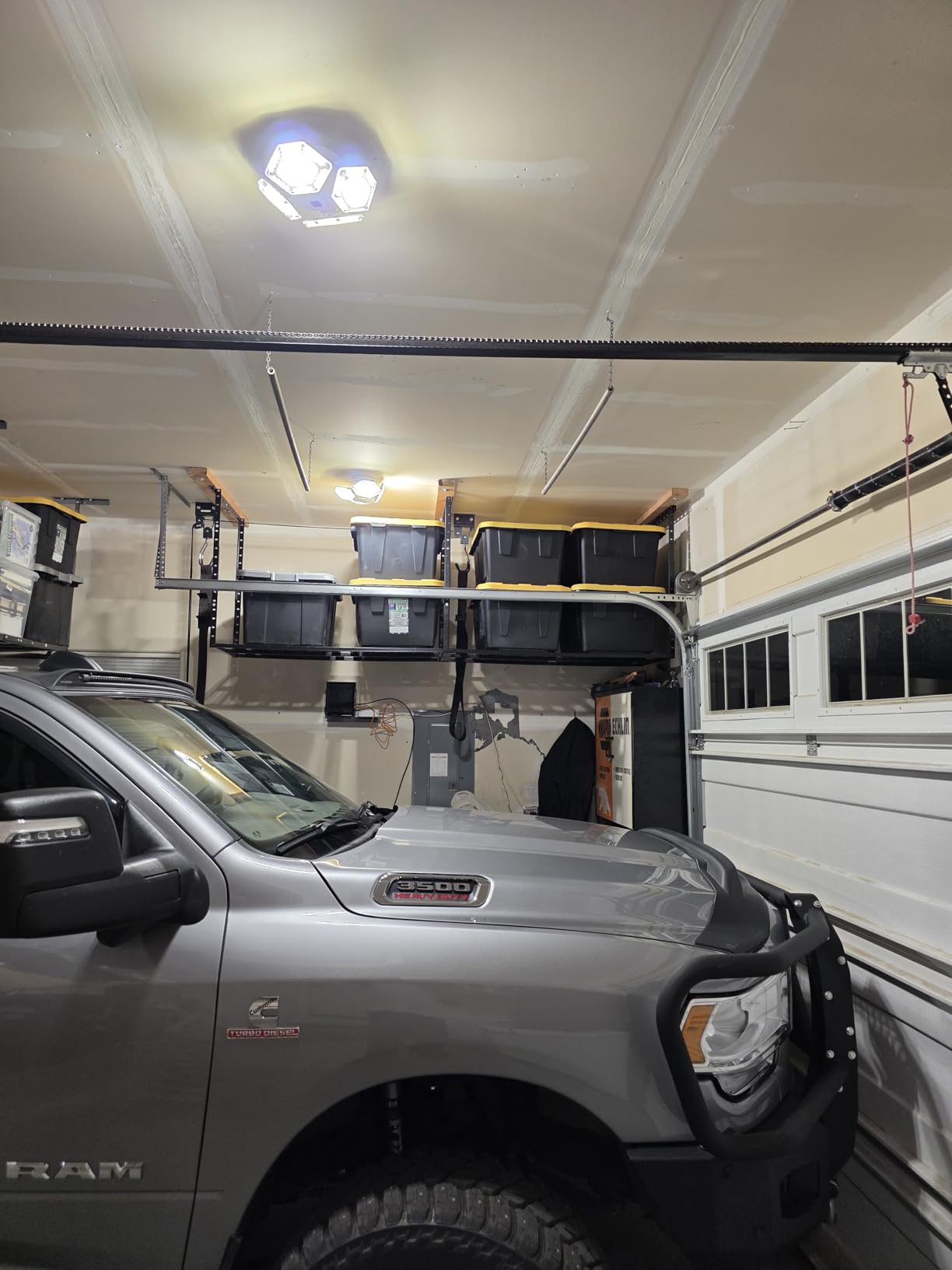
The caveats matter. The ceiling must be level, with a tilt limit under 10 degrees, and mounting is limited to wood studs and joists and concrete walls. At 65.7 pounds the package is heavy enough that a second person is worthwhile during the lift. And with 367 ratings, the long-term field history here is thinner than the numbers on the spec sheet imply.
Its 4.5 rating carries an 8 percent one-star share, higher than the top two sellers. That is not disqualifying, but it is a reason to verify your joist spacing and ceiling level before ordering rather than after.
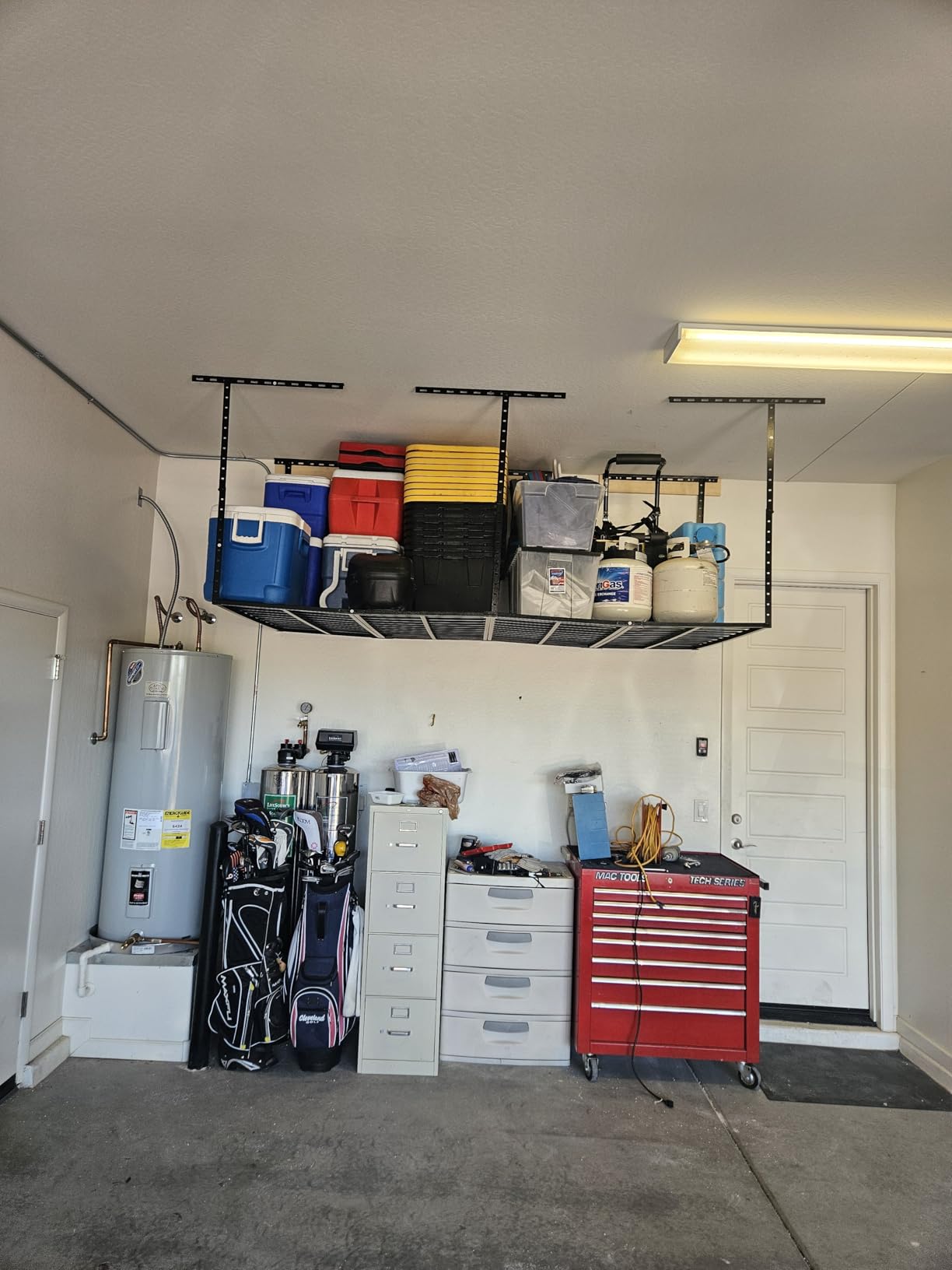
800 Pounds Converted to Bin Count
Eight hundred pounds is the rating, and the 22 to 40 inch drop with 96 by 48 by 40 inch dimensions yields up to 105 cubic feet of storage. At 40 pounds per loaded tote, that is 20 bins in theory, and we would plan a working load nearer 15 to leave the rating as headroom for the kind of gradual overloading every garage eventually sees.
On a 4×8 deck, weight distribution does more work than on any smaller platform. Place the heaviest bins above the joist lines rather than in the middle of the span, and load the far edge first so the deck settles evenly. Owners of wide-grid racks report noticeably less movement than with wire decks, which is the practical payoff of the 2-inch slats.
Where the Wide Grid Helps and Where It Does Not
A wide grid is better for stability and worse for small loose items, because the openings still let clutter fall through. If you are storing open bins of hardware, add a plywood layer over the grid rather than relying on the deck alone. For lidded totes, the wide grid is simply a better surface to stack on.
Reinforced crossbeams and additional mounting holes address the wobble that owners of lighter racks report, and that is where the 8 mm screws come from. This is a rack built around the assumption that you will fill it up, which is a rarer design philosophy in this category.
8. eShelf 4×8 Overhead Rack – Cleanest Rating for a Narrower Deck
eShelf 4x8ft Overhead Ceiling Garage Storage Rack, 750LBS Capacity, Black
750 lb capacity
22 to 40 inch drop
Integrated mesh panel
8 mm tested screws
+ Pros
- 750 lb rating on a deck narrower than the standard 96 inch
- Six vertical supports adjust from 22 to 40 inches
- Integrated mesh and frame cannot separate over time
- Thick 8 mm screws have been through quality testing
- Powder coat resists rust and scratching
– Cons
- Only fits joist spacing of 24 inch or less
- Limited review base just over 200 ratings
- Spec list shows a 72 inch width for a 4×8 model
The eShelf has the cleanest rating profile of the 750-pound racks here: 4.7 with 81 percent five stars and only 2 percent one-star. Buyers credit the integrated mesh-and-frame build for not separating over time, which is a real structural advantage over racks assembled from separate wire and frame pieces.
Where it differs from the 96-inch racks is footprint. The spec list gives 48 inches deep by 72 inches wide, which is narrower than a standard 4×8 platform. For a bay where a full-length platform would hit a wall or a support column, that narrower deck is the reason to choose this over the FLEXIMOUNTS.
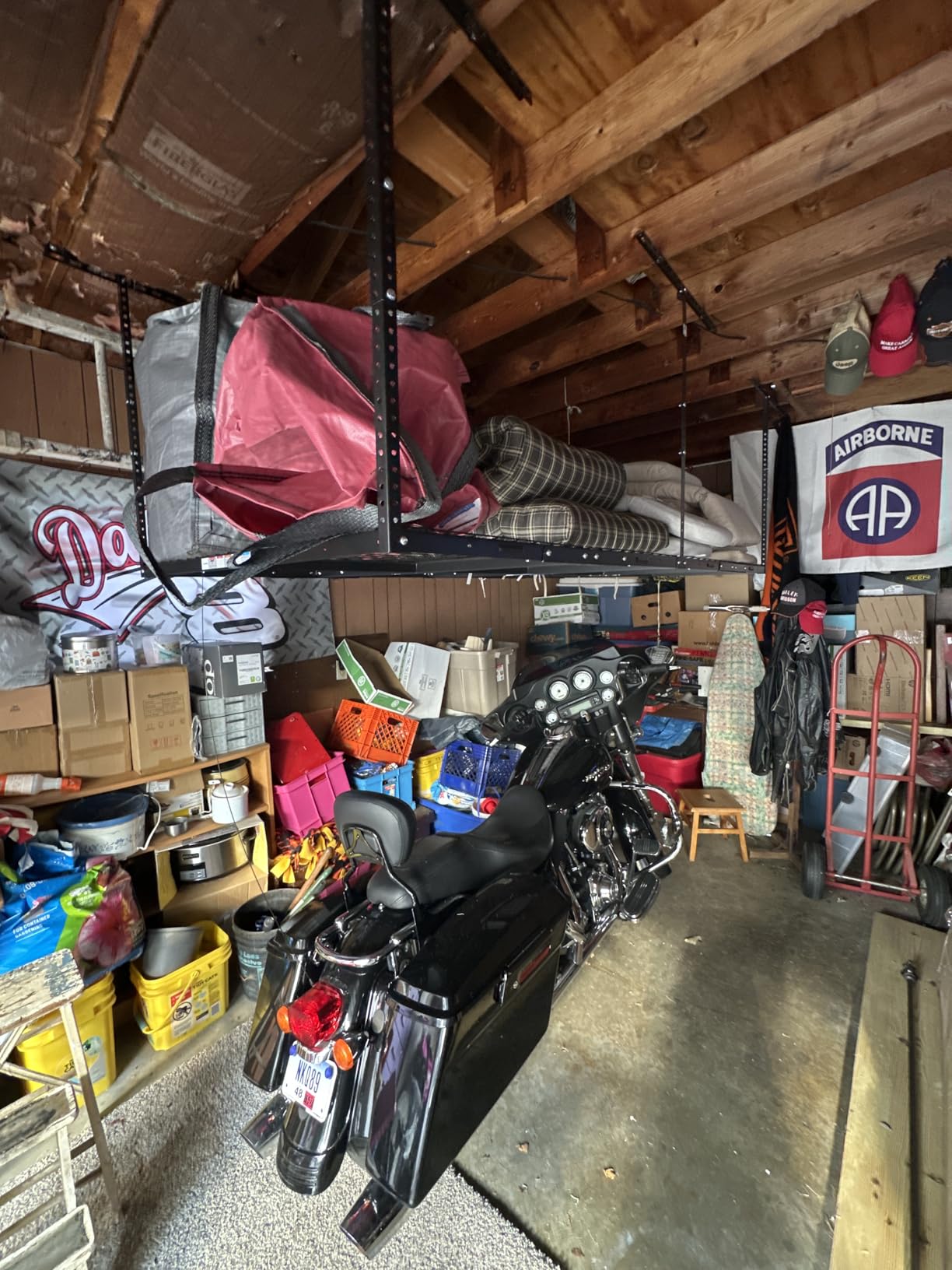
Two things to verify before you order. Joist spacing must be 24 inches or less, and exact 48-inch centers are needed beyond that. And the spec sheet lists a 72-inch width for a product named 4×8, which is an internal inconsistency we would resolve with the seller rather than assume. The review base is also still accumulating at just over 200 ratings, so field history is limited.
That thin history is the honest trade against a higher rating. A product with 231 ratings and a 2 percent one-star share is promising; a product with 19,000 ratings and a 2 percent one-star share is proven. Both numbers appear in this roundup, and the difference is worth factoring into your confidence.
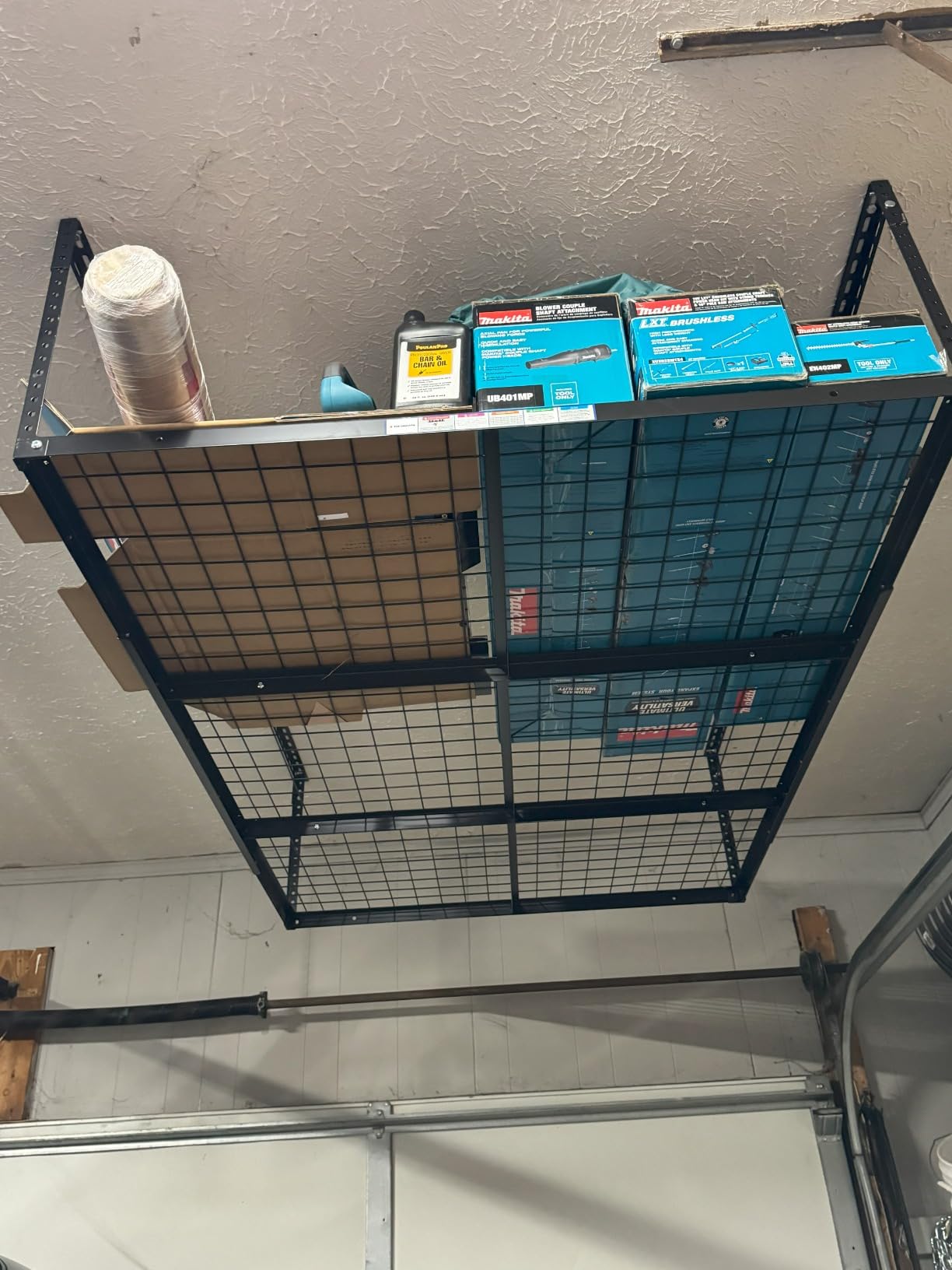
Six Vertical Supports and Drop Range
Six vertical support bars adjusting from 22 to 40 inches give this rack the same usable envelope as the FLEXIMOUNTS 4×8. The 22-inch minimum suits lower ceilings and shorter vehicles; the 40-inch maximum keeps clearance over a truck bed. Because the supports are individual rather than a fixed drop, you can also use a shallower setting on one end than the other if your ceiling is not level.
Height adjustment is a real advantage in older garages where joist depth varies along the span. An adjustable rack absorbs a ceiling that is not perfectly flat, and a fixed-height one does not.
Load and Finishing
With a weight capacity listed in the 600 to 750 pound range and a powder coat that resists rust and scratching, this is a good fit for an unheated garage. Wipe it with a dry cloth and the finish stays intact, which matters if you are storing seasonal bins for years rather than months.
9. FERO 4×8 Lift Rack with Safety Lock – Built for 8 to 12 Foot Ceilings
Garage Ceiling Storage Racks – 4×8 FT Overhead Garage Storage Rack with Safety Lock, Heavy-Duty Ceiling Mounted Lift System and Storage Organizer, Ideal for Maximizing Overhead Space, 325 lbs Capacity
325 lb capacity
Drill-operated lift
Platform adjusts to 9 feet
Safety lock
+ Pros
- Drill-operated platform lowers so bins load without a ladder
- H-shaped steel frame is stiffer than four-point designs
- Manual safety lock adds security while raised
- Fits ceilings from 8 to 12 feet and beams in either orientation
- Up to 32 square feet of overhead storage
– Cons
- Most expensive rack in this roundup
- Heaviest at 92 lb so a helper is required
- Lowest capacity among the lift systems here
- Smallest review base at about 130 ratings
The FERO is the lift system for very tall garages. While the GL1 tops out under 10 feet, this platform adjusts up to 9 feet and is specified for ceilings from 8 to 12 feet, which is the situation where a lift earns its keep: the deck can come down to loading height and still rise clear of a full-size truck when parked.
Buyers who want lift-assisted loading are happy with the drill-driven platform and the H-shaped high-strength steel frame, which has been tested for over a decade and is described as stiffer than four-point designs. It also works with both horizontal and vertical ceiling beams, which matters in garages where beam orientation is not standard.
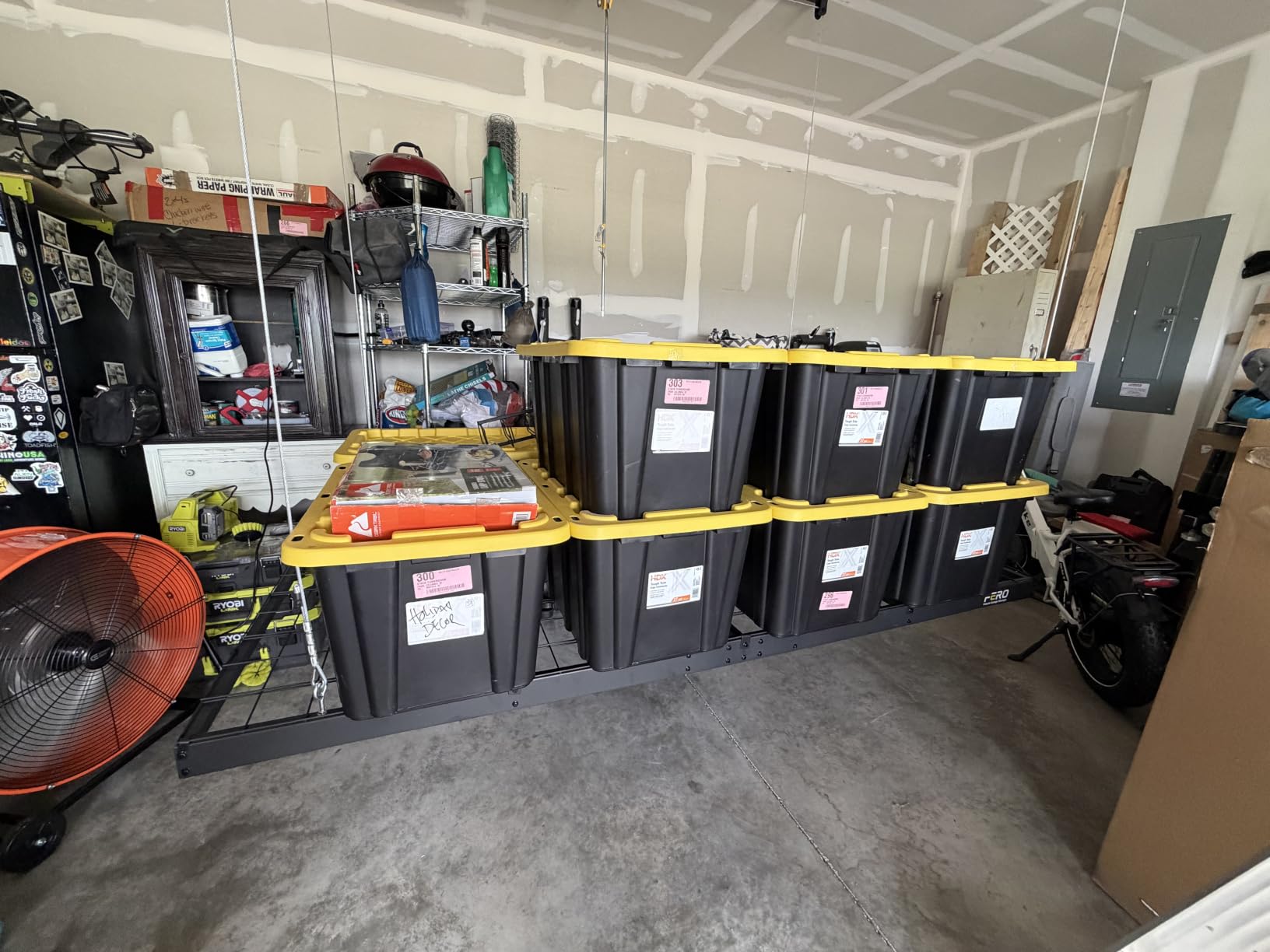
The tradeoffs are substantial. This is the most expensive rack in the roundup, it weighs 92 pounds to install, and its 325-pound capacity is the lowest of the three lift-capable options. With about 130 ratings, roughly 77 percent of them five stars, it is solid but less proven than the fixed racks.
The manual safety lock is worth highlighting. On any platform that moves, a mechanical lock is a meaningful safety feature, and the double-axle arrangement means the load is carried by a frame designed for it rather than by four corner hangers.
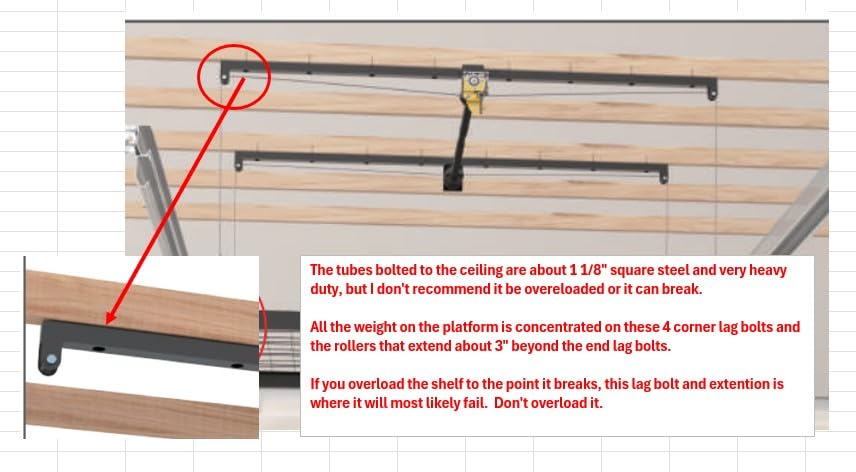
When a Lift Rack Is the Right Answer
Choose a lift system when the reason you want overhead storage is that the items are too heavy to handle on a ladder. If your bins are light seasonal decor, a lift adds cost and mechanical complexity for no benefit, and a fixed rack is the better purchase. The question is about retrieval, not capacity.
A 325-pound platform holds roughly eight loaded totes at 40 pounds each, and about 13 at 25 pounds. Up to 32 square feet of overhead storage sounds modest until you realize that square footage is directly above the vehicle, the most valuable floor space in the garage.
Ceiling Beam Orientation and Height
Supporting both horizontal and vertical beam installation is a genuine advantage, since beam orientation varies with how the roof was framed. The 8 to 12 foot ceiling range covers a lot of standard garages and leaves room for the platform to be parked at different heights.
At 92 pounds, plan the install with a second person and a clear floor beneath the work area. The frame is also usable as a Jeep top hoist, a secondary benefit that is unusual rather than essential.
10. Jusgym 4×8 Overhead Rack – Nine Support Beams and the Quickest Mount
4X8FT Overhead Garage Storage Rack 750LBS Capacity, 26″-40″ Height Adjust
750 lb capacity
26 to 40 inch adjustment
9 support beams
8 pre-installed hooks
+ Pros
- Nine support beams where typical racks use five
- 750 lb rating on a full 4×8 foot deck
- Eight pre-installed hooks hold panels during mounting
- About 105 cubic feet of storage volume
- Lifetime limited warranty with 24/7 support
– Cons
- Lowest average rating in this roundup at 4.3
- Only fits 48 inch joist spacing if joists are wider than 24 inch
- Hook-assisted mounting limits where panels can be attached
The Jusgym leads on paper, and that paper is genuinely good. Nine support beams instead of the standard five is a real structural upgrade for a deck that will carry stacked totes, and the 750-pound rating sits at the top of the category. Then there is the 4.3 rating, the lowest in this roundup, with an 8 percent one-star share, which is the reason we place it tenth rather than higher.
The pre-installed hooks are the feature we like most. Eight hooks hold the deck panels in position during mounting, which removes the single most annoying part of hanging a 4×8 platform: getting it level and attached while one person holds it. On an install this size, that is worth real time.
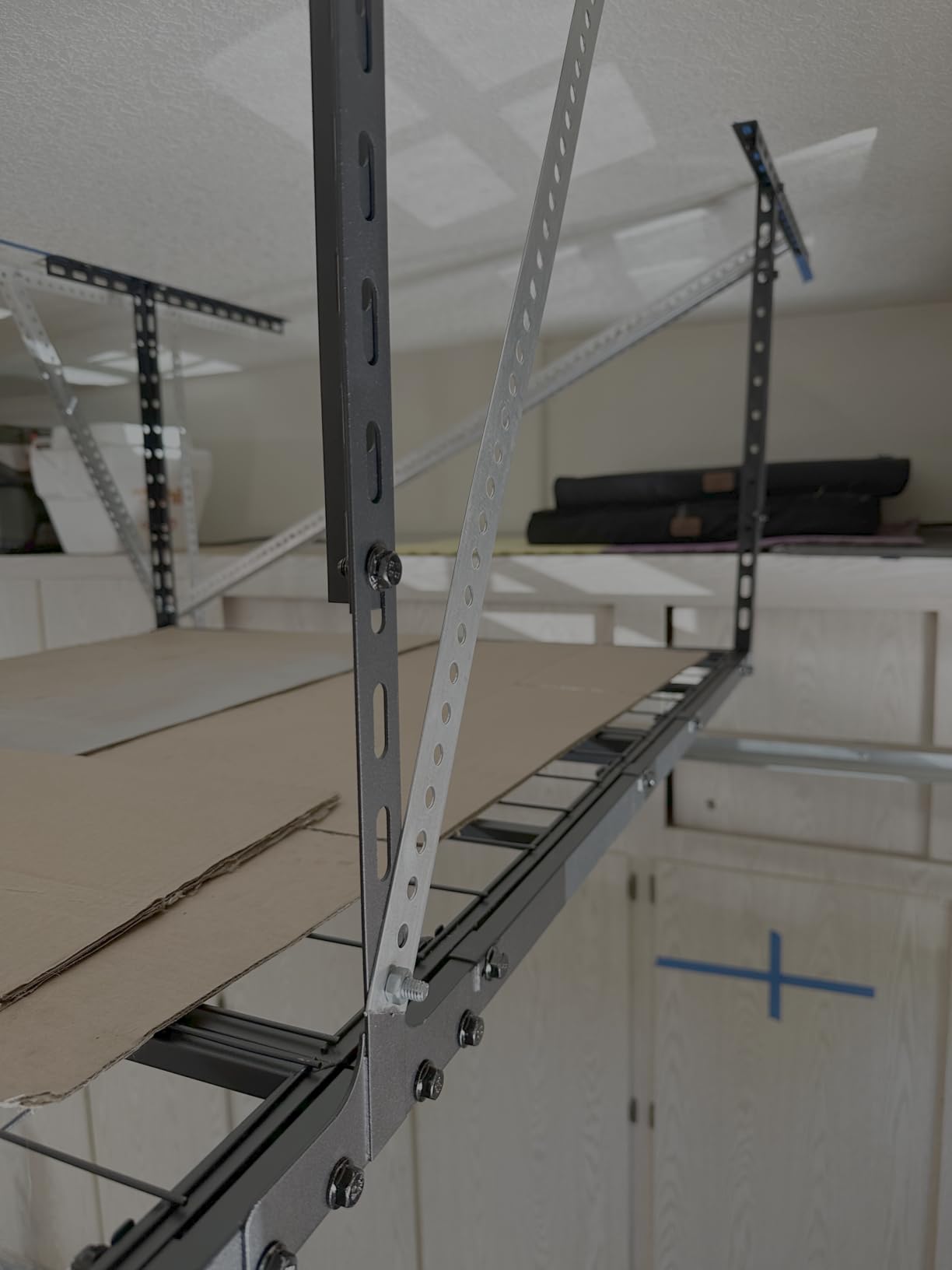
The trade is that hook-assisted mounting limits where you can attach panels, so if your plan involves custom plywood decking, a bin lip, or unusual accessories, you have less freedom than with a conventional frame. A 4.3 rating with 312 ratings is not a warning sign on its own, but it is a reason to read the one-star reviews before buying.
Joist spacing works to 24 inches, and exact 48-inch centers are required beyond that, which is the same constraint the FLEXIMOUNTS 4×8 carries. Check your spacing before ordering either one.
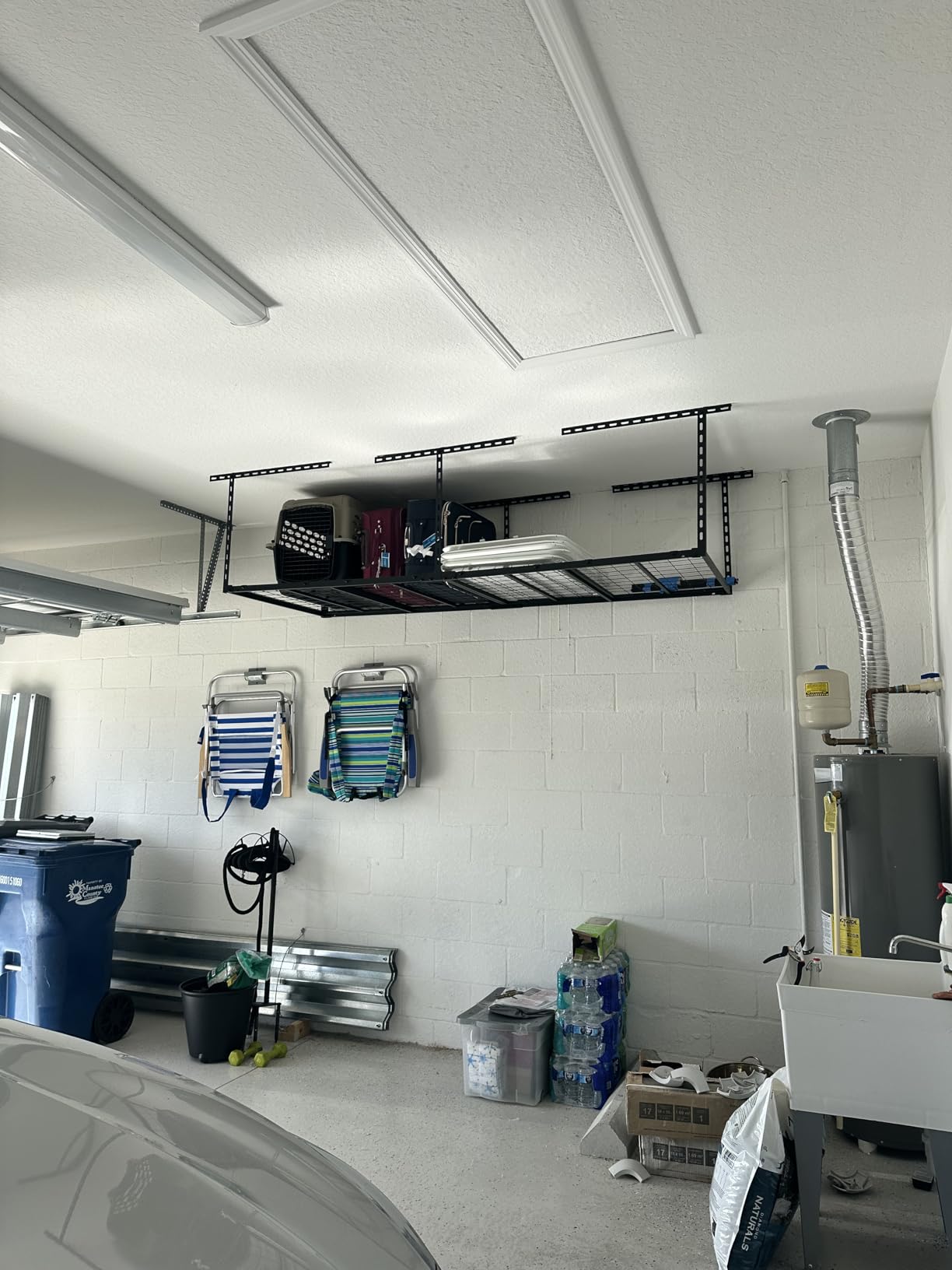
Nine Beams Under Heavy Totes
Beam count is the quiet differentiator on a wide deck. Five-beam grids flex in the middle under concentrated loads, and a 40-pound tote set down off-center is exactly that kind of load. Nine beams spread the same weight across more of the frame, which is why the 105 cubic feet of volume here is a usable figure rather than a theoretical one.
At 750 pounds, the bin math matches the other 750-pound racks: about 18 loaded totes at 40 pounds in theory, with a working load nearer 14 once you reserve margin for the drift that every garage experiences.
Warranty and Support
A lifetime limited warranty with 24/7 customer support is a genuine advantage in a category where several products report unresponsive service lines. It does not offset a middling rating, but it does mean a hardware failure has a path to resolution.
For the rest of the garage, our mower storage ideas cover the floor-level space you will free up once the heavy bins move to the ceiling.
How Much Weight Can Overhead Garage Storage Racks Hold?
Overhead garage storage racks typically hold 250 to 800 pounds, depending on model. Light-duty racks rate around 250 pounds, heavy-duty steel racks rate 500 to 800 pounds, and industrial lift systems carry 325 to 350 pounds of safe load. That rating is the total across the whole platform, evenly distributed, and it does not include the weight of the rack itself.
What matters more is your ceiling. A rack rated for 750 pounds still depends on joists sized for the span and on spacing you can actually reach with lag bolts. Most of the failures people read about online are not rack failures; they are ceiling failures caused by mounting into something that was never meant to carry storage.
Converting that rating into bins is simpler than it looks. Take the rated capacity, subtract about 20 percent for margin, and divide by your real loaded bin weight. At 40 pounds per loaded tote, a 600-pound rack gives you roughly 12 bins. At 25 pounds, roughly 19. The number most owners discover later is that their loaded bins weigh more than the empty bin’s label suggests, particularly when they hold books, tools, or camping cookware.
Check Your Ceiling Framing Before You Buy
Start by identifying what you are actually hanging from. Joists are solid framing members running across the garage, and a rack bolted into them is exactly the intended installation. Trusses are prefabricated roof assemblies, and most are not rated for storage. As one poster put it on houserepairtalk.com, if your garage roof framing is trusses, this might not be a good plan, since some trusses are rated for storage above but most are not. Owners on r/Homebuilding report buying racks, reading the manual, and abandoning the install over exactly this doubt.
If you have trusses and want storage anyway, the fix is adding framing. A contractor can install blocking or a supplementary beam between trusses so the load path goes somewhere designed to take it. That changes the project from an afternoon to a day, and it is the single most worthwhile thing to sort out before ordering.
Locating Joist Centers, Not Edges
Installers across every review set make the same point: find the center of the joist, not the edge. A stud finder gives you an edge, and a lag bolt driven into an edge has far less wood behind it than one driven into the center. Mark several points along the run and confirm they line up before drilling, because joists are rarely perfectly straight.
Note the spacing too. Most racks here fit joist spacing of 24 inches or less, with exact 48-inch centers needed beyond that. The 17-inch rail systems are the exception, dimensioned for 16-inch spacing with rows connected for wider gaps.
Measuring Clearance Above Your Vehicle
Drop height is the binding constraint far more often than capacity. Measure three things before you order: the highest point of your vehicle with the garage door fully open, the height of the opener rail at its highest travel, and the distance from the joists down to the platform at your chosen drop setting. Your usable clearance is the smallest of the three minus the depth of the bins you intend to store.
For a sedan and a rack set to 40 inches, most garages have room. For a full-size SUV with a roof box, or a pickup with a bed cover, a 45-inch maximum drop is often the difference between a usable rack and one you cannot install. This is the point that forum users keep returning to: height, not weight, is what limits the project.
Wood Joist or Concrete Anchors
Into wood joists, you are using lag bolts into the center of the member, driven by hand or at low speed. Into concrete, you are using wedge anchors, and racks rated for concrete specify them. Into drywall with no framing behind it, you are doing nothing structural, and that is not a supported installation for any rack in this roundup.
Check the product’s ceiling compatibility line, not just its capacity line. Racks in this group split into those rated for wood and concrete, and those restricted to direct joist mounting. A rack that only mounts into joists is not usable in a finished or concrete-ceilinged garage, no matter how good its rating looks.
What Should Not Go Overhead, and How to Load What Does
Some garage contents should never go on a ceiling rack, regardless of capacity. Fluids, batteries, propane cylinders, and anything pressurized belong on a floor-level shelf. So do dense, awkward items like concrete blocks, metal stock, and full tool chests, which are heavy for their volume and awkward to lower on a ladder. A floor-rated rack is the right home for those, and our heavy-duty rack guide covers that side of the garage.
For what does go up, load by density. Put the heaviest bins closest to the joists and toward the wall side of the platform, where the framing is closest. Fill the outer edge last, and have two people place each bin at the same time so the load lands evenly instead of rocking the deck.
On falling objects, the practical guidance from workplace safety guidance is simple: secure what you store, keep the walkway beneath a rack clear, and do not store anything that would be dangerous to be hit by. A bin falling from a ceiling is the failure mode that turns a storage upgrade into an injury, and it is entirely avoidable with latched lids and even loading.
Finally, account for drift. A rack is rated for a load you intend today, and the assumption people bring to a ceiling rack changes as the garage fills. Leave the top 20 percent of the rating unused, and re-check the load every year or two.
Frequently Asked Questions
How much weight can garage ceiling storage racks hold?
Most overhead garage storage racks hold between 250 and 800 pounds, and the rating applies to the whole platform with weight spread evenly. Light-duty racks rate around 250 pounds, heavy-duty steel racks rate 500 to 800 pounds, and drill-driven lift systems carry 325 to 350 pounds of safe load. The rating excludes the weight of the rack itself, and the ceiling must be able to carry both.
What is the best heavy-duty rack for a garage?
The FLEXIMOUNTS 4×8 is the strongest overall pick, rated for 750 pounds with a 22 to 40 inch adjustable drop and an integrated wire grid and frame that does not separate under load. The SunsGrove 4×8 carries a higher 800-pound rating with wider 2-inch grid slats, and the SafeRacks 4×8 offers a 600-pound rating with a deeper 24 to 45 inch drop and included hooks.
What are the best garage shelves for totes?
Totes slide most easily on solid platform racks with a full deck rather than on rail systems, because rails leave open gaps that small items fall through. A 4×8 platform at 750 pounds rated capacity holds roughly 18 loaded totes at 40 pounds each, or about 15 in practice once you reserve margin. For many small bins instead of heavy ones, connectable 100-pound rail sets are more efficient per bin.
Are overhead garage storage racks safe?
Overhead racks are safe when they are bolted into the center of ceiling joists, loaded evenly, and kept below their rated capacity. They are not safe when mounted into drywall, into joist edges, or into standard roof trusses, which are usually not storage rated. Measure joist centers rather than stud edges, hand-drive lag bolts, and keep the walkway beneath a rack clear.
Do overhead garage racks work in a garage with trusses?
Not without extra framing. Most roof trusses are not rated for storage loads, so a rack bolted to one can pull the assembly down over time. The fix is having a contractor add blocking or a supplementary beam between trusses so the load travels through a member designed to carry it. Some trusses carry a storage rating stamp, so check before assuming the worst.
How much clearance do I need above my vehicle for an overhead rack?
Measure the highest point of your vehicle with the door fully open, the highest point of the opener rail, and the joist-to-platform distance at your chosen drop setting. The usable clearance is the smallest of those minus the depth of your bins. Full-size SUVs and pickups with bed covers often need a rack with a 45-inch maximum drop rather than a 22 to 40 inch range.
Which Overhead Rack Fits Your Garage
Match the rack to the constraint, not the capacity number. If your joists are solid and your vehicles are moderate in height, the FLEXIMOUNTS 4×8 is the pick: 750 pounds, a 22 to 40 inch drop, and the largest body of owner history in the category behind it. If your bins are heavy enough that you dread the retrieval, the SunsGrove 4×8 with its 800-pound rating and 2-inch wide grid slats handles more per platform, and the SafeRacks 4×8 adds a deeper drop plus included hooks.
If the problem is the ladder rather than the weight, a drill-driven lift rack is the only real answer. The FLEXIMOUNTS GL1 works in ceilings under 10 feet, and the FERO platform reaches higher in garages from 8 to 12 feet. If your storage is many light bins rather than a few heavy ones, connectable rails cover more bins per dollar than any platform here.
And if your framing is trusses, the most important conclusion in this guide is that no rack on this list is the right purchase until a contractor adds framing. Check the ceiling first. In 2026, the best overhead garage storage racks for heavy bins are the ones you can actually hang, and that starts with what is above your head, not what is in the box.
Leave a Reply