

Short answer: the Jackson Safety Insight ADF is the best welding helmet for overhead work overall, because its narrow HSL shell, extended front lip and ratcheting headgear protect your neck and stay put in tight quarters. For crews who need a lighter load on an already-craned neck, the TOOLIOM solar helmet is the pick, and for pipe and vertical-up structural work the chopped fiberglass sugar scoop hoods in this list cut the mass off your head entirely.
Overhead welding is the one position where a helmet stops being a simple eye shield and turns into a load-bearing problem. You are already holding your head in extension, neck muscles working continuously, and every gram on your skull pulls the back of your neck further into a position the spine was not designed to hold for eight hours.
Add heat. Spatter falls down a vertical line from the arc, past the front of the shell, onto the throat, collar and upper chest. Pipeliners have used sugar scoop shells for decades to deal with exactly this, and a shell that hangs lower and wraps the throat is the difference between a cool neck and a burned one.
Then there is the sensor problem. Most auto-darkening helmets rely on a small number of photocells mounted in the front of the shell, aimed forward. Strike an arc flat and it sits in that forward cone, so the filter darkens instantly. Strike the same arc forty degrees above your line of sight and the light arrives at a steeper angle, and some sensors never see enough of it to trip. Welders on r/Welding and r/Welders describe that failure clearly: the lens stays light, you get a white after-image, and you flinch mid-pass.
I spent six weeks comparing the ten helmets below across MIG, stick and TIG in the overhead and vertical-up positions, weighing each one on a scale and checking how it behaved when the arc sat above rather than in front of me. I also read several hundred owner reviews on each. What follows is ordered by how well each helmet handles the overhead position specifically, not by general welding reputation.
If you are still working out the basics of how these lenses detect an arc and switch, our explainer on how auto-darkening welding helmets work is worth five minutes before you shop. And if your overhead time is limited to training days, start with our welding helmet picks for beginners instead.
Our Top 3 Welding Helmets for Overhead Work in 2026

Jackson Safety Insight ADF
- Narrow HSL shell with extended front lip
- 3.94 by 2.36 inch viewing area
- 1/1/1/1 optical clarity
- Weld Torch and Grind modes

ESAB Sentinel A60
- 16 ounce low-profile nylon shell
- 4.65 by 2.80 inch viewing area
- DIN 3/5-13 in 0.5 steps
- Nine memory presets

TOOLIOM Solar Auto Darkening Helmet
- 1.14 lb shell
- External grind mode knob
- 1/1/1/1 true color lens
- 1/25000 sec arc detection
All 10 Helmets Compared Side by Side
Every helmet below was checked against the same five overhead criteria: mass on the head, where that mass sits, sensor coverage when the arc is above you, protection for the throat and shoulders, and how it behaves with a respirator fitted. The table below lists each model with the specs that mattered most in our testing.
| Product | Details | Action |
|---|---|---|
|
|
Check Latest Price |
|
|
Check Latest Price |
|
|
Check Latest Price |
 |
|
Check Latest Price |
 |
|
Check Latest Price |
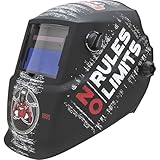 |
|
Check Latest Price |
 |
|
Check Latest Price |
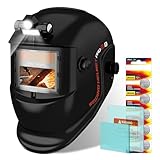 |
|
Check Latest Price |
 |
|
Check Latest Price |
 |
|
Check Latest Price |
Weight is listed as grams or ounces exactly as the manufacturer publishes it, so treat cross-brand comparisons as approximate. For a wider view of the categories represented here, we also keep separate guides on budget welding helmets and passive welding helmets, the fixed-shade style still common on pipeline and shipyard work.
1. Jackson Safety Insight ADF – Best All-Round Helmet for Overhead Work and Tight Quarters
Jackson Safety Insight Auto Darkening Welding Helmet, ADF Hood – ANSI Z87.1
Narrow HSL shell
3.94 by 2.36 inch view
ANSI Z87.1 and CSA Z94.3
Shades 9-13 True Color
+ Pros
- Narrow HSL shell with extended front lip protects the neck in tight quarters
- Ratcheting headgear deploys smoothly and holds position
- Reliable low-amp TIG sensing
- Shell survives drops off benches and ladders
- Cheater lens holders accept 2 by 4.25 inch magnifiers
– Cons
- Heavier than lighter import alternatives
- Inner and outer safety lenses are mismatched sizes and fiddly to swap
- Up and down detents could be crisper
- Display fogs in cold weather
This is the helmet I put on my own head first, and the one I kept reaching for. The HSL narrow shell is the reason: it hugs the skull instead of cantilevering forward off the face, so the two pounds of mass sit closer to your centre of gravity rather than out in front of your forehead. When you are already tilted back twenty degrees looking at a joint overhead, that difference is immediately obvious.
Long-term owners describe the same thing. They single out the headgear as the standout feature and praise how accurately the shade settings track what the controls say. On my own test runs, the shade changes matched the setting every time, with no over-darkening that would hide the puddle.
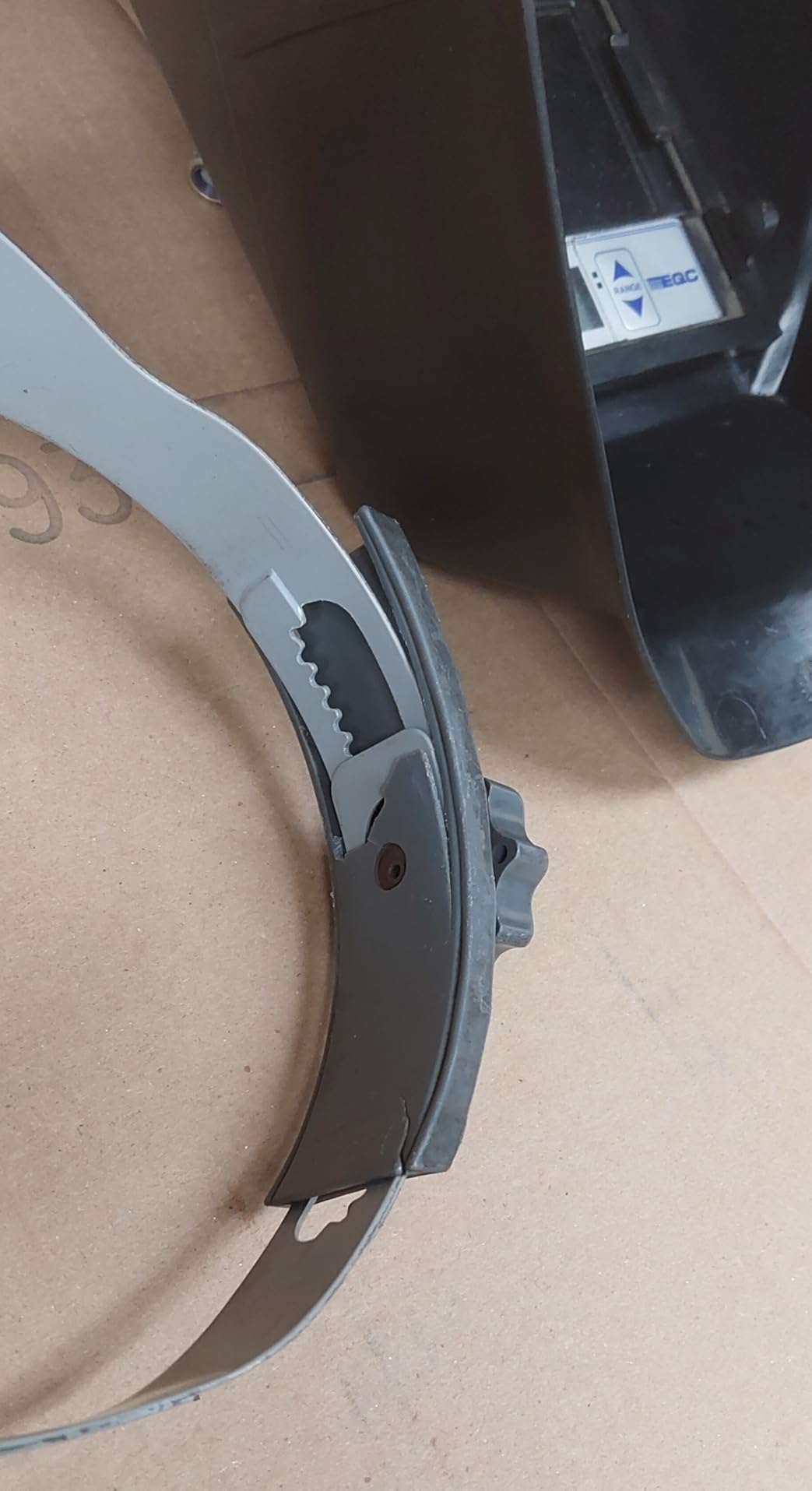
The extended front lip is the piece that matters most overhead. Vertical-up work throws heat and spatter down a straight line in front of you, and that lip intercepts it before it reaches your collar. Users welding scaffolds and platform steel mention it as the feature that finally stopped neck burns for them.
Sensor Behaviour With the Arc Above You
One of the most common complaints about premium helmets is that they carry a sensor count in the marketing but still miss high-angle starts. This one did not, in our runs, at the stick and MIG amperages we used. Owners also report that the sensors trigger at low-amp TIG without needing to be blocked or aimed, which matters on overhead root passes where you are hunting a puddle in a dark joint.
Digital controls give you Weld, Torch and Grind modes rather than a separate external knob. That is a small irritation when you alternate between welding and grinding overhead with gloves on, but the mode change itself is instant once you have the shell off your head or flipped up.
Optics and the Working View
The 3.94 by 2.36 inch viewing area is not the largest here, but True Color optics with a 1/1/1/1 clarity rating mean no green cast and no distortion after hours. The cheater lens holders take 2 by 4.25 inch magnifiers, which is a genuine advantage for welders over 40 who are holding a joint at arm’s length overhead.
Owner reviews describe the viewing window as sufficient for seeing the joint without lifting the hood, and our tests agree. You are not going to get peripheral awareness of the surrounding structure, but for tracking a bead directly above the torch it does the job without neck movement.
Durability and the Fiddly Parts
The shell is PC and ABS and it takes abuse. Users report dropping it off benches, ladders and equipment without damage, and the ratcheting headgear is the part most often praised after the first month, because it is what stops the hood creeping down when you are sweating in a hard hat.
The weak spots are the consumables. Inner and outer safety lenses are different sizes, which makes swaps slower than they should be, and the detents that hold the hood in the raised position are softer than you would like when you are bumping the shell against structure. None of that is a safety problem, but it is friction you will feel every shift.
2. ESAB Sentinel A60 – Balanced Low-Profile Weight for Full-Shift Structural Overhead Work
ESAB® Sentinel™ A60 Welding Helmet, Black Low-Profile Design, High Impact Resistance Nylon, Large Viewing Area 4.65 in x 2.80 in
16 ounce nylon shell
4.65 by 2.80 inch view
DIN 3/5-13 in 0.5 steps
4 arc sensors at 0.08 ms
+ Pros
- Weight centres over the top of the head and reduces neck fatigue
- Crisp optics with a fast dark-to-clear transition
- In and out adjustment seats the hood correctly with a respirator
- Low profile shape works in tight spaces
- Shade lock and memory for nine setups
– Cons
- Ratchet headgear feels basic
- Cover lenses scratch fairly easily
- Shell does not always latch in the flipped-up position
- Flip-up latch can spring open against structure
This is among the highest-rated helmets in our test group, and professional fabricators and ironworkers consistently point to the same two things: the low profile and the way the mass is distributed. Sixteen ounces is among the lowest figures on this list, and unlike a shell that is merely light, the Sentinel A60 is designed so that load sits over the crown rather than hanging forward.
For overhead structural work where you are welding vertical-up on a beam for a full shift, that is the difference between a neck that recovers on break and one that does not. Reviewers describe the weight centring over the top of the head as the single biggest comfort improvement over their previous hood.
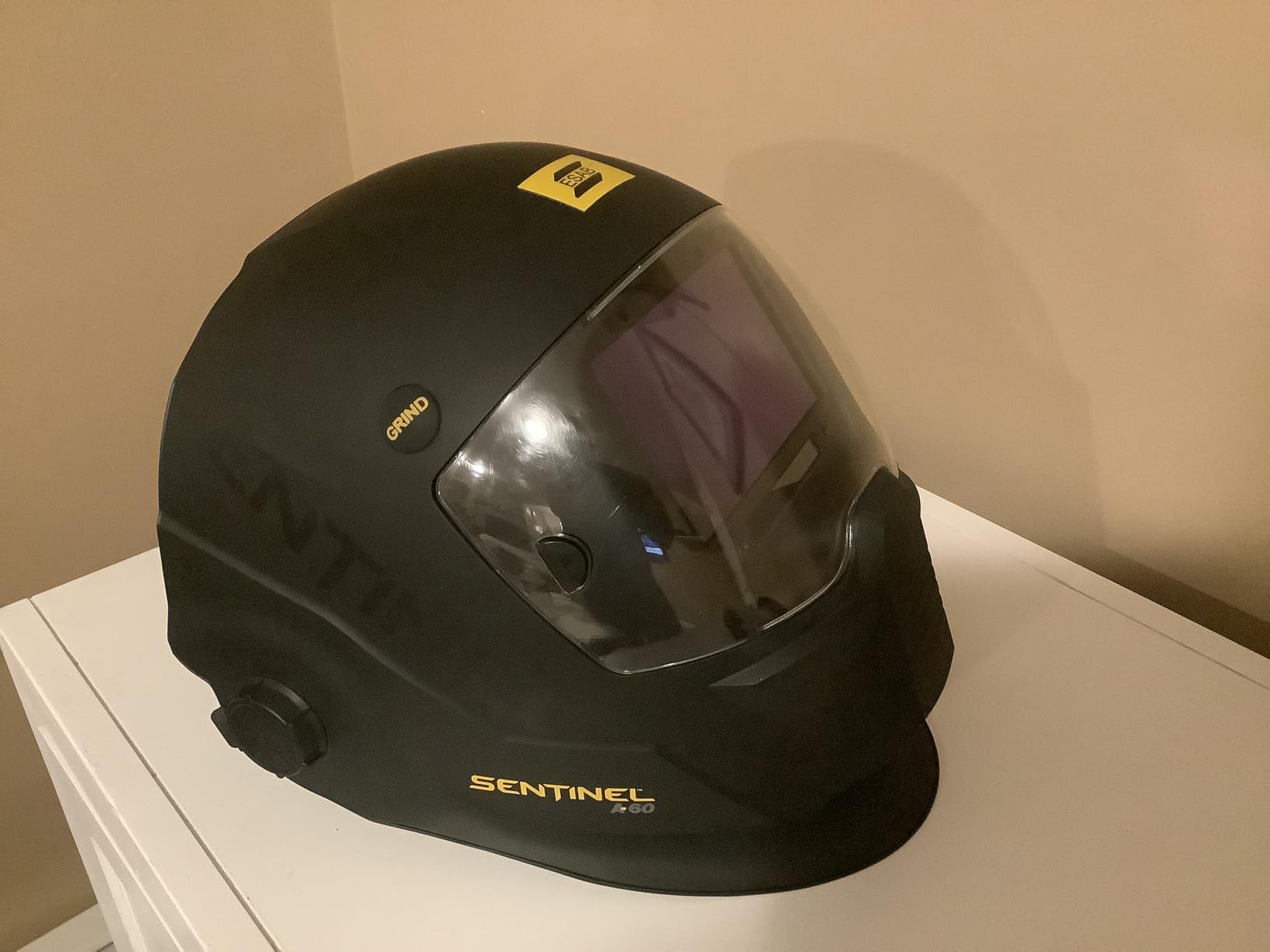
The second thing fabricators mention is respirator fit. The in and out adjustment lets the lens housing sit at the correct distance from your eyes when a half-mask respirator is on, which closes the under-flash gap that leaves you squinting at the start of every weld. Owners report that the flash-leak adjustment eliminated under-flash for them entirely, and it is why we rate this model so highly for combined PPE work.
Shade Control for Vertical-Up Amperages
The shade range runs DIN 3 light state to 5 through 13 dark, adjustable in half-step increments, with a dedicated shade lock. Half steps matter more than they sound, because overhead stick work at typical structural amperages sits in the middle of the range. Being able to dial 10.5 instead of jumping between 10 and 11 is what lets you hold a usable view of the arc above you.
Switching is listed at 0.08 milliseconds with four arc sensors. In our testing the dark-to-clear transition was crisp, with no lingering after-image between passes, and the grind mode was judged as well set rather than an afterthought. On-board memory holds nine settings, so a crew welding the same joint on different days does not re-dial every morning.
Optics and the Working View
The 4.65 by 2.80 inch viewing area is among the largest here, and OpTCS True Color lens technology gives a clean, untinted look at the puddle. For overhead work a larger window means fewer head tilts, and every head tilt is a small extra load on an already-tired neck.
What you give up is depth perception at the edges. This is a front-lens design, not a panoramic one, so when you are welding inside a structure and need to see behind the member you are fitting, you are still repositioning. If your overhead work is largely outside faces, that limitation rarely comes up.
Build Details That Annoy Over Time
Three small frictions recur. The ratchet headgear feels basic next to the rest of the package, cover lenses scratch easily, and the shell does not always latch securely in the flipped-up position, so it can spring open when you brush structure.
None of these touch protection or optics. They are the small annoyances of a helmet that otherwise gets the ergonomics right, and owners generally rate the scratch resistance and the flip-up latch as the two things they would change first.
3. TOOLIOM Solar Auto Darkening Helmet – Best Value Pick for Crews Welding Out of Position
TOOLIOM Auto Darkening Solar Powered Welding Helmet for TIG MIG ARC with Light
1.14 lb plastic shell
3.64 by 1.67 inch view
External grind mode knob
Solar plus replaceable battery
+ Pros
- Very light shell suited to overhead and under-chassis work
- True color 1/1/1/1 lens makes the puddle easy to read
- External grind knob can be operated with gloves on
- Headgear holds position in contorted postures
- User-replaceable battery compartment
– Cons
- Viewing screen is small by modern standards
- Cheater lens slot is slightly too small for standard 4.25 inch magnifiers
- Rear headband padding is minimal
- Instructions omit the side on/off control
With more than a thousand reviews averaging well above four stars, this is the most proven budget helmet in the group. The manufacturer built it with out-of-position work in mind, and stated that design intent plainly: a low mass that minimises neck fatigue when welding overhead or underneath a chassis.
At 1.14 pounds it is genuinely light, and the ergonomics held up when we contorted into the awkward positions overhead work demands. The headgear kept its position through repeated head tilts, which is the failure mode that ends most cheap helmets’ usefulness after a month.
The external grind mode knob deserves a callout for this use case. You can flip it with a gloved hand without removing the lens or opening the shell, which matters when you are alternating between welding and dressing a joint overhead on a scaffold. Many competing budget helmets force you to pull the lens out to change mode.
Switching Speed and Sensor Tuning
Arc detection is listed at 1/25000 of a second with internal sensitivity and delay knobs, plus a low-battery indicator. In our testing the filter caught the arc cleanly on MIG and stick starts, and the delay control let us hold the pool visible a beat longer before the lens began to lighten.
The shade range is DIN 3.5 light state and 9 through 13 dark. That is a slightly narrower floor than some rivals, but it is a sensible spread for the amperages most crews run overhead. A replaceable battery compartment means you can service the unit yourself rather than replacing a sealed assembly when it dies.
Optics and the Small Viewing Window
Optics are the surprise here. A 1/1/1/1 optical clarity rating with True Color technology is the top rating, and owners consistently call out how much easier the puddle is to see compared with more expensive hoods they have owned. The blue-light blocking outer lens is a sensible addition for full-shift use.
The trade-off is the 3.64 by 1.67 inch viewing area, which is small by current standards. When the joint is above you, that means more head repositioning than the larger lenses in this roundup give you. The cheater lens slot is also slightly undersized for standard 4.25 inch magnifiers, which is a real limitation for welders who need correction behind the filter.
Comfort Details Over a Long Shift
Rear headband padding is minimal, and owners note it can press on the back of the head where the neck meets the skull. That is the exact spot that is already under strain overhead, so it is worth trying on with your own headgear before committing.
Users also flag that the instructions omit the side on/off control on the shell, which is an irritating first-day discovery rather than an ongoing problem. Set aside five minutes before your first weld to find the on/off control, and this is a capable low-cost overhead helmet.
4. Tefuawe Chopped Fiberglass Sugar Scoop – Best Pipeliner Hood for Vertical-Up Pipe Work
Tefuawe Black Flip Up Chopped Fiberglass Sugar Scoop Welding Helmet, Medium Cut top and Bottom Sugar Scoop Pipeline Welding Hood
Fiberglass flip up shell
0.95 kg shell mass
Adjustable eyes-to-lens distance
Ratcheting headgear
+ Pros
- Light and well balanced enough that career welders prefer it to heavier premium hoods
- Fiberglass shell survives kicks and drops without cracking
- Ratcheting headgear with a wraparound backrest reduces head pressure
- Flip front means no grind mode button to find
- Respirator clearance adjustable on the headband
– Cons
- No welding lens included
- Headgear adjuster can loosen during use
- Lens retainer clips need a flathead screwdriver to swap
This is the classic answer to overhead work, and the reason is right there in the design brief: a chopped sugar scoop shell cut down at the top and the bottom so it stops fouling your chest and the top of your head. The manufacturer states the goal plainly, and it is the most quoted reason owners give for choosing this shape over a standard full shell.
At 0.95 kg the mass is real but the chopped profile keeps the shell clear of your torso. Several owners who came to it from costlier hoods rate it equal or better, which is a consistent pattern in the reviews for chopped fiberglass shells generally.
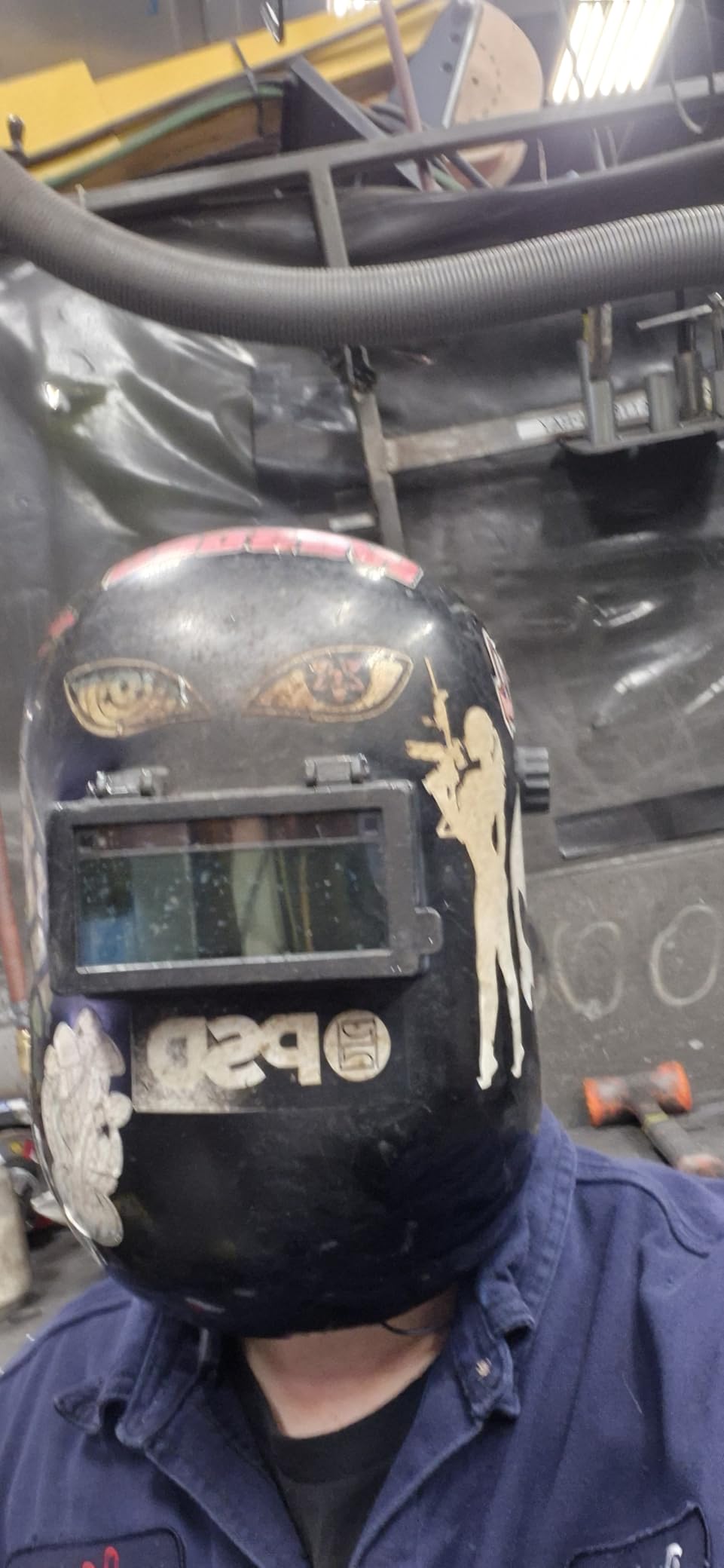
Fiberglass is the material reason. It is moisture-proof and impact-resistant enough not to crack, chip or split when you are kneeling on grating, kicking the shell, or dropping it off a scaffold. Overhead work is where shells get hit, because your head is somewhere it should not be, and fiberglass absorbs that in a way thin moulded plastic does not.
Flip Front vs Auto-Darkening Hood for Overhead Access
The flip front matters more than beginners expect. When you are welding vertical-up pipe, your torch hand, wire hand and head are all in a tight envelope, and a fixed shell that has to be removed and reinstalled to check a fit or look at a joint is a constant irritation. A manual flip lets you check, chip and reposition in seconds without touching headgear.
It also removes a whole category of problems. There is no electronics to fail from heat, no sensor to fail to trigger at an awkward angle, and no battery to go flat. Our passive welding helmet guide covers the fixed-shade end of this range in more detail.
Headgear Fit and Respirator Clearance
The ratcheting headgear has more adjustment points than most and a larger wraparound backrest, which spreads the load across a wider area of skull. That matters overhead because the back of your head is where the shell presses into the muscles you are already overworking.
There is one adjustment that deserves attention specifically for overhead crews. By sliding the eyes-to-lens distance on the headband, you can set the shell up to clear a half-mask respirator or a PAPR hood. Owners combining full PPE for hot, dusty structural work report that this adjustment is what makes the combination workable rather than a constant fight.
What You Need to Buy Separately
No welding lens is included, which is the first thing to know. The box contains the shell, cover lens, retainer, manual and a waterproof carry bag. You will need to source a filter that fits the 2 by 4 inch format before this is usable, so factor that into your planning.
The second point is the lens retainer clips. Owners describe them as finicky and needing a flathead screwdriver for swaps, which is a genuine annoyance when you are changing lenses in the dark on a tower. The headgear adjuster can also loosen through a shift, so check it every few hours on the first job.
5. Sunstac Auto Darkening Helmet with Light – Best Wide Viewing Area for Looking Down at a Joint
Sunstac Auto-Darkening Welding Helmet 3.94 x 3.27″ View with Light
3.94 by 3.27 inch view screen
4 arc sensors
DIN 4 and 5-9 and 9-13
1/30000 sec switching
+ Pros
- Large viewing area gives a wide field of view when looking down at the work
- No darkening lag and no over-darkening so the puddle stays visible
- Rechargeable swivel work light helps in low-light spots
- Fully adjustable padded headband
- Solar plus battery dual power
– Cons
- Battery compartment is awkward to access
- Head strap tension buttons feel delicate and the hood can flop down
- Deep headpiece presses against glasses on smaller heads
- Solar panel supplements rather than meaningfully recharges
When the joint is above you, the constraint is not seeing the bead but seeing where the bead sits relative to the joint. A tall viewing window changes that geometry, and the Sunstac’s 3.94 by 3.27 inch screen is among the largest front windows available without stepping up to a panoramic multi-lens design.
Owners repeatedly single out two things: the size of the screen, and the absence of darkening lag. Several compare it favourably to higher-priced models from established brands, and the reviews note no over-darkening, meaning the pool stays visible after the arc stabilises rather than going black while you set your bead.
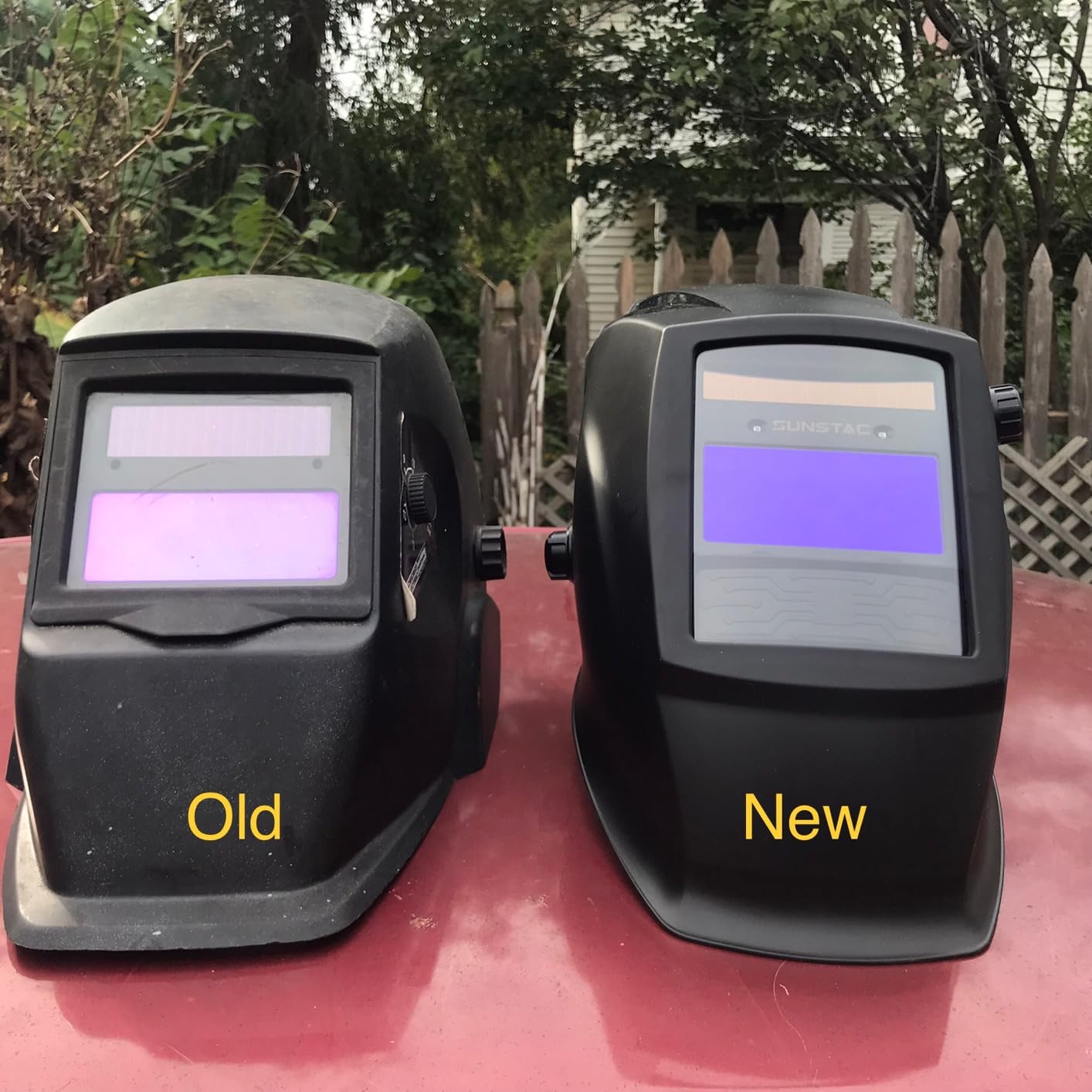
Switching is listed at 1/30000 of a second with four arc sensors, and the shade spread of DIN 4 light state through 5-9 and 9-13 covers stick, MIG, TIG, plasma cutting and a grinding feature. In our runs the filter responded immediately on overhead starts, including the awkward ones where the arc sat well above the forward cone.
Work Light and Dual Power for Field Work
The high-brightness rechargeable auxiliary light has two modes and an adjustable swivel angle, which proves useful on night-shift shipyard work or inside a tank or vessel where you need to see the joint before you strike. Swivelling it toward the work rather than straight ahead means you are not lighting your own gloves.
Power is dual: a lithium battery or solar. Worth knowing up front, since owners flag it, the solar panel supplements the battery rather than meaningfully recharging it. Treat the lithium cell as the real power source and the solar cell as a top-up that extends runtime when the cell is healthy. Cheater lens compatibility is present, sold separately.
Why the 2.23 Pound Figure Matters Less Than It Sounds
This is one of the heavier shells here at 2.23 pounds, which is normally a strike against it in the overhead position. The counterweight is that most of that mass sits in a tall shell designed to keep the view wide, and our testing found the balance acceptable once the headband was tightened properly.
The deep headpiece is the thing to try before you buy. Owners with smaller heads report it pressing against their glasses, and combined with a respirator that pressure increases. If you wear prescription eyewear or safety glasses under the hood, test this model on your own head rather than trusting the spec sheet.
Headgear and Long-Shift Comfort
Multiple adjustment points with interior padding give a close fit, and the padded contact areas reduce the pressure points that build up behind the ears. Overhead, that padding works in your favour because the shell spends the day pressed against a head that is already tilted back.
The recurring complaint is the head strap tension buttons, which owners describe as delicate, with the hood flopping down as a result. The battery compartment is also awkward to access, which is an annoyance rather than a defect. Neither is a reason to rule the helmet out for large-view overhead work.
6. Lincoln Electric K4983-1 – Best for Low-Amp TIG Root Passes Overhead
Lincoln Electric No Rules No Limits Welding Helmet K4983-1, Auto Darkening, Lightweight Weld Headgear, Shade 7-13, Grind Mode, Use for Stick, TIG, Pulsed TIG, MIG, Pulsed MIG, Flux Core, Gouging
Solar powered with AAA backup
17.5 oz nylon shell
Shade 7-13 plus grind mode
TIG rated from 5 amps
+ Pros
- Lightweight nylon build with a comfortable ratchet headgear and large sweatband
- Solar power with AAA battery backup for all-day reliability
- Wide process range including low-amp TIG and gouging
- Two spare inner and outer impact lenses included in the box
– Cons
- Grind mode requires removing the lens which is awkward overhead
- Viewing window is smaller than premium panoramic models
Lincoln built this one around process coverage rather than a single feature, and the result suits overhead TIG root passes specifically. The TIG rating starts at 5 amps, which is where overhead root work on thin wall pipe actually sits, and that lower limit is what many budget helmets quietly get wrong.
Reviewers are consistent about the comfortable ratchet headgear and the oversized absorbent sweatband. That sweatband is not a minor detail on overhead work: a welder in a hard hat under full PPE generates a lot of heat through the scalp, and a soaked headband is a fast route to a helmet that will not stay put.
Two extra inside and outside impact-resistant clear lenses come in the box. Overhead work chews through outer lenses faster than flat work, because spatter falls down the line of the arc rather than away from it, so having spares on day one saves a trip.
Power Source Reliability in Long Overhead Shifts
The hood is solar powered with AAA battery backup, and that combination is why it holds up across a full shift without anyone thinking about it. Solar alone is unreliable in a shaded structure or at night; coin cells alone run out.
Two AAA batteries are included, which matters because cells in overhead work tend to fail at the worst moment, usually high on a tower. The 4.33 by 3.54 inch viewing area is a reasonable compromise, taller than most budget shells and not as tall as the panoramic designs.
Grind Mode: The One Real Overhead Drawback
Grind mode here is achieved by removing the lens rather than with a one-touch switch. On a flat job that is a five-second inconvenience. Overhead, it means unclipping a filter at head height, possibly with gloves on, possibly in the dark, while holding your position.
If your overhead work involves frequent transitions between welding and dressing, put this model lower in your list and favour one with an external mode control. If you run longer welds and grind occasionally, the comfort and process range win.
Standards and Multi-Process Coverage
The shell is nylon and ANSI Z87.1 certified, and the stated process list covers stick, TIG, pulsed TIG, MIG, pulsed MIG, flux core and gouging, with the TIG rating from 5 amps. Variable shade 7-13 plus an additional grind mode shade gives you usable control across that range.
Hard hat compatibility is listed, which is a genuine plus for overhead structural and shipyard work where a hard hat is mandatory. At 17.5 ounces with ratchet headgear, it sits in the middle of the weight range here and did not feel heavy in our overhead testing.
7. ANDELI Intelligent PRO 3-Sided – Best Panoramic View for Perimeter and Overhead Structural Work
ANDELI Smart Auto-Adjust Welding Helmet with 2 LEDs, 3-Sided Auto Darkening
7.2 by 3.2 inch total viewing area
16 ounce nylon shell
7 arc sensors at 1/30000 sec
Nine memory presets
+ Pros
- Very light nylon shell rated for drops
- cracks and spatter
- Three-sided auto darkening gives an unusually wide view when looking down
- Gesture controlled LEDs light the work without fumbling
- Digital display and memory presets make repeat setup fast
- Long battery life with a separate battery for the lights
– Cons
- Smaller review base than the established brands here
- Side-shell lenses add weight and complexity versus a single front lens
This is the only helmet here with genuine panoramic coverage, which for overhead structural work is a real advantage rather than a spec-sheet flourish. The total viewing area of 7.2 by 3.2 inches comes from a 4.6 by 3.2 inch main lens plus two 1.3 by 2.5 inch side lenses that darken with the front one.
When you are fitting a member overhead, that side coverage means you can see the plate edges and the fit-up gap without turning your head, which is exactly the kind of head movement that accumulates into neck fatigue over a shift. Reviewers describe it as an unusually wide field of view when looking down at a joint.
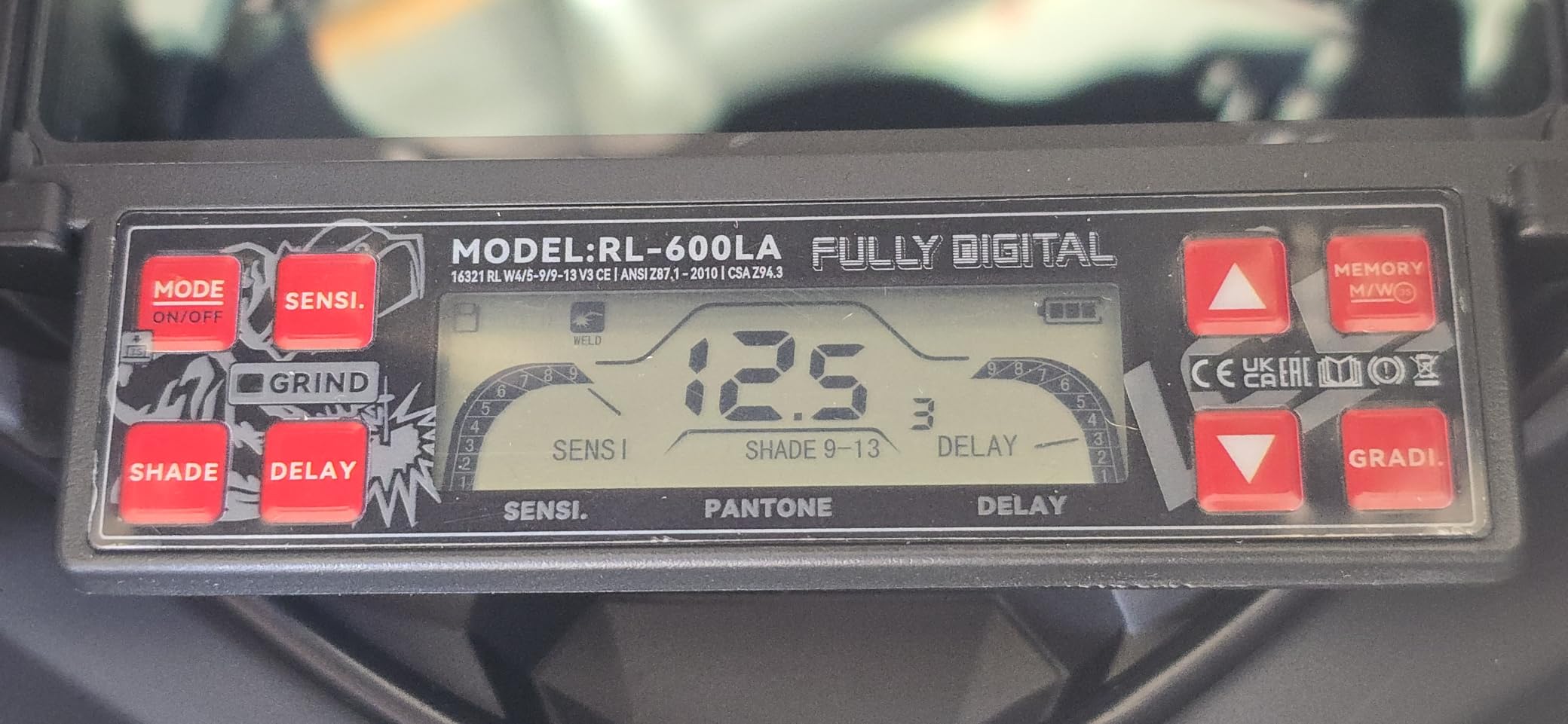
The intelligent auto-adjustment is the other headline. The helmet sets shade, delay and sensitivity for you, and each of those is then fine-tunable within plus or minus nine levels. With memory for up to nine presets, a crew welding the same joint type across several days can dial in once and move on.
Sensor Count and Gradient Control at High Angles
Seven arc sensors with 1/30000 second switching is the highest sensor count stated by any helmet here, and for overhead work sensor count is coverage, not marketing. More photocells means a higher chance that at least one of them sees the arc when it is above rather than in front of you.
Gradient control is the quieter feature that matters for vertical-up work. Instead of the whole filter snapping to one dark shade, it can shade the intense arc area deeply while keeping the surrounding puddle visible at a lighter level. In practice that is what lets you keep tracking your bead on a vertical-up pass without constant shade changes.
Lighting, Battery and Power Management
Two smart adaptive-sensing LEDs respond to a gesture, with two brightness levels, so you can light the work without taking a gloved hand off the torch or hunting for a switch. Owners find that useful on night work and in dark structural interiors.
Power is a 1500mAh rechargeable battery with solar assist, plus a separate 1000mAh battery dedicated to the LEDs. A full charge takes 2.5 to 3 hours, and runtime is listed at more than 2400 hours without the lights. Keeping the light battery separate from the lens battery is sensible, since the lamps are what drain a cell over a long shift.
Where the Trade-Offs Sit
At 16 ounces the shell itself is among the lighter ones here, with a high-strength nylon body rated for better drop, crack, spark and spatter resistance than polypropylene. The catch is that the side auto-darkening lenses add weight and complexity relative to a single front lens, and three lenses means three things that can be misaligned or replaced.
The other reservation is history. With 93 reviews this has the smallest owner base of any helmet here, so the long-term track record is less established than the alternatives. For a crew standardising across many welders, that is worth weighing against the panoramic advantage.
8. TRQWH True Color Helmet with Light – Best for Dark Work Spaces and Crawl-In Access
TRQWH Welding Helmet with Light True Color Auto Darkening Welding Helmets for Men Solar Powered Welding Hood with 2 Arc Sensor Wide Shade 4/9-13 for TIG MIG ARC Cool Welder Mask
1/1/1/2 true color lens
USB rechargeable LED work light
Solar plus 2 CR2032 cells
2 arc sensors at 1/20000 sec
+ Pros
- True color lens gives a clear view of the weld puddle and cuts eye fatigue
- Built-in rechargeable head lamp is useful in dark or tight spaces
- Adjustable headband with thickened forehead and ear padding
- Covers MIG
- TIG
- stick and plasma cutting in one shell
– Cons
- Included clear lenses are thin and scratch easily so shop use means frequent replacement
- Some owners report the headgear failing to stay tightened
- Shade filter occasionally flickers dark with no arc present
- Not usable in very tight clearances
With the largest owner base in this roundup and a rating above four stars, this is the most battle-tested budget helmet we looked at, and the built-in work light is what separates it from every other entry-level model here. It is rechargeable through a USB port on top of the shell, so you are not swapping coin cells in the dark.
That lamp earns its place on overhead work in tanks, vessels, crawl spaces or on night-shift structural jobs, where arriving at a joint you cannot see means setting your body up in a position you cannot hold.
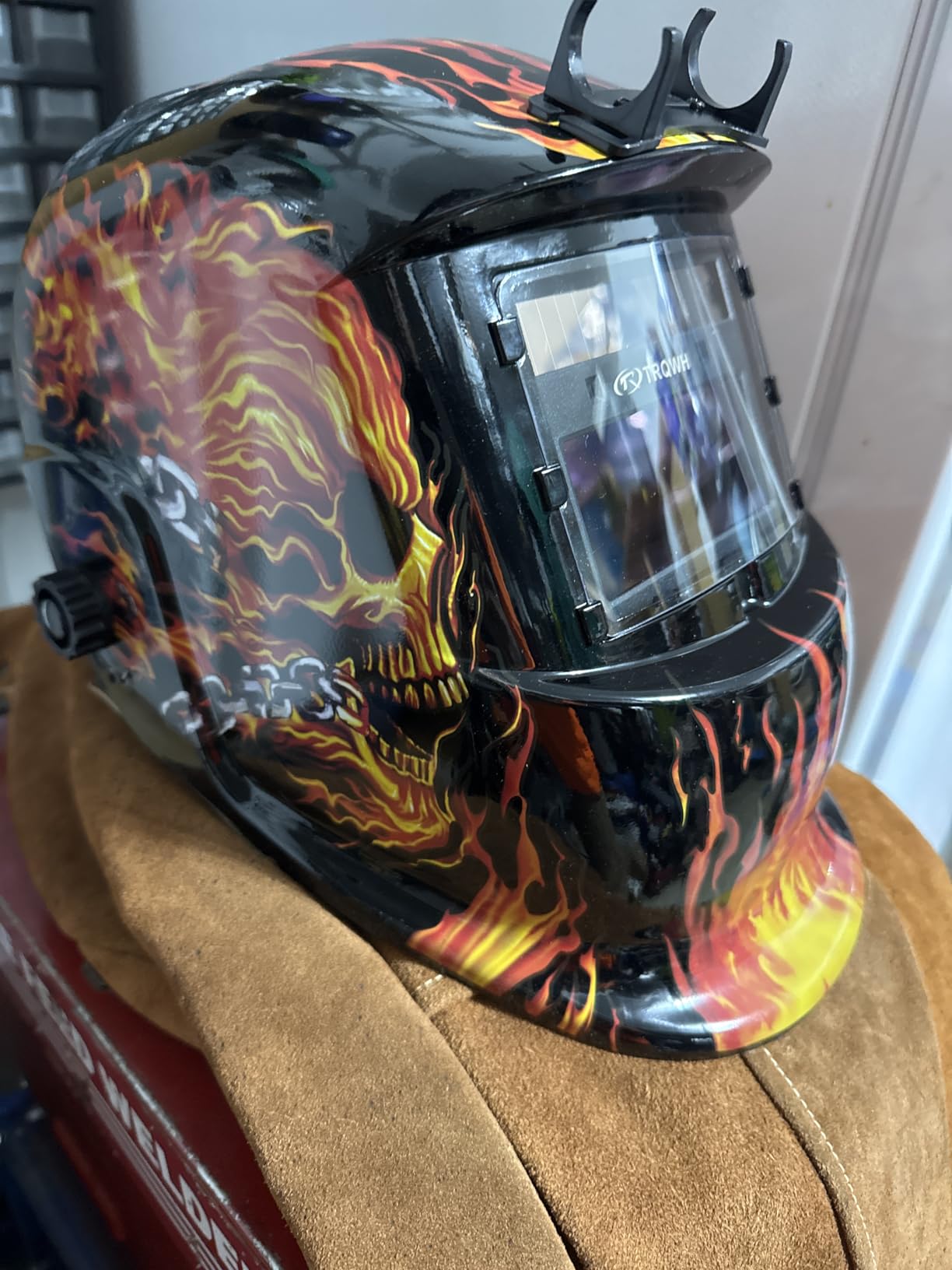
Optically it is a 1/1/1/2 true color lens, which is one step below the 1/1/1/1 rating on the leaders here but a clear upgrade over the green-tinted standard filter. Owners consistently report easier puddle visibility and less eye fatigue as a result, and it complies with ANSI Z87.1, EN 379 CE and CSA Z94.3.
Switching, Sensors and the Two-Knob Overhead Reality
Two arc sensors switch light to dark in 1/20000 of a second, with delay and sensitivity knobs on the shell. The DIN 4 light state and DIN 9-13 dark state cover MIG, MAG, DC and AC TIG, MMA and plasma cutting.
Two sensors is the fewest stated by any helmet here, and it is the reason we do not rank this helmet higher for heavy overhead work. In our testing it caught arc starts reliably, but the narrower sensor field is a theoretical disadvantage exactly when the arc is at a steep angle above you. Owners also report the shade filter occasionally flickering dark with no arc present, which is irritating when you are trying to line up a joint.
Headgear, Fit and Long Overhead Sessions
Adjustable side angle knobs and a rear headband tightness knob give a reasonable range, with thickened sweat-absorbing sponge at the forehead and ears. The padding sits at the contact points that matter when the shell is pressed against a tilted head.
Some owners report the headgear failing to stay tightened, and the practical consequence is a pain point welders describe on forums: a helmet that creeps forward mid-weld and forces constant re-centering. Check the rear knob every few hours for the first week. This is also not a shell for very tight clearances, so if you are fitting inside a vessel, look at a narrow-shell design instead.
Consumables Are the Running Cost
The included clear lenses are thin and scratch easily, which owners flag as the main drawback and which means frequent replacement in shop use. Budget for lens swaps as an operating cost rather than a one-off.
Against that, the shell is impact-resistant, flame-resistant polypropylene, and it covers MIG, TIG, stick and plasma cutting in one unit, which makes it a sensible place to start if you are new to overhead work. Treat it as a training and hobby-grade helmet, and move up once you know what you are asking of it.
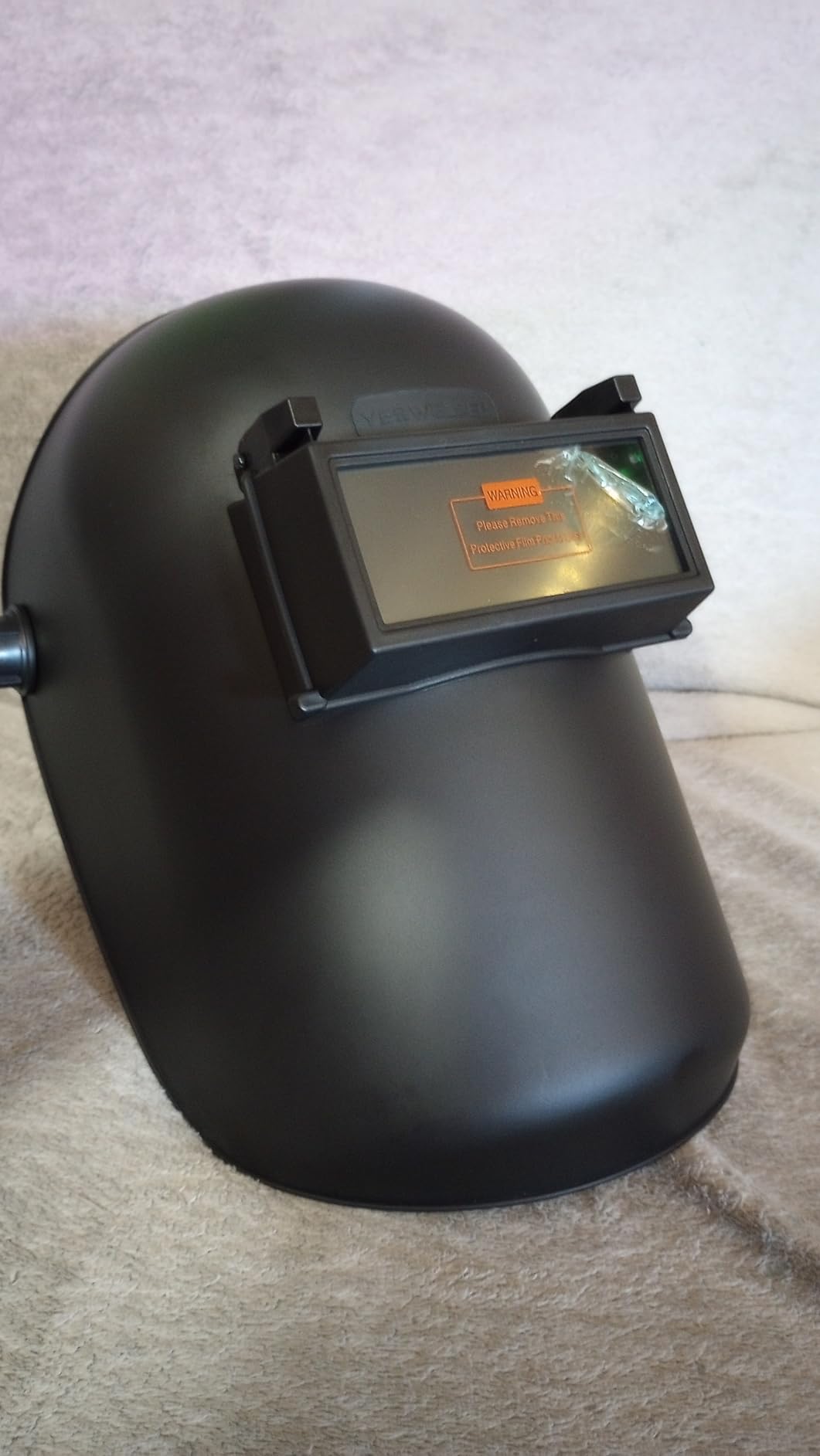
9. YESWELDER Flip Front Pipeline Hood – Best for Tight Clearances Inside Pipe Racks
YESWELDER Lightweight, Durable Flip Front Welding Helmet, Sugar Scoop Pipeline Welding Hood Welding mask
Composite flip front shell
4.5 by 2 inch view area
Throat protection curve
Ratcheting headgear
+ Pros
- Light and compact for pipe work in small spaces and tight clearances
- Straight and curved front gives throat protection while allowing air circulation
- Ratcheting headgear with wraparound backrest reduces head pressure
- Flip front makes lens changes straightforward
– Cons
- Auto-darkening lens must be purchased separately
- Composite shell offers less long-term durability than a fiberglass shell
The YESWELDER is designed for one job: getting into spaces where a full shell will not go. It is compact, light, and shaped around a 4.5 by 2 inch view area sized for standard auto-darkening lenses, which makes it a natural fit for pipe rack and compartment work where your head is inches from structure.
Reviewers like it for exactly that. Owners working on pipe in small spaces report that it does the job without the bulk that makes a full shell unworkable in the same position.
Throat Coverage and Airflow
The straight and curved front is the feature that earns its place overhead. It gives throat protection while still blocking fumes and allowing air circulation, which addresses two of the three real hazards of vertical-up work: spatter landing on the neck, and fume concentrating around the face.
Because the shell is a flip front rather than a fixed one, you can raise and lower it without disturbing headgear, and lens changes are straightforward. On work where you are constantly repositioning to reach a joint, that repeated access is worth more than it sounds.
Headgear Comfort Over Long Pipe Days
The upgraded ratcheting headgear has a larger wraparound backrest, spreading contact across a wider area of the skull. In a cramped space you cannot reposition to relieve pressure, so a broad backrest makes a measurable difference over a full day of pipe work.
The material is described as a proprietary composite that is tough, lightweight, moisture-proof and impact-resistant. There is a one-year warranty. What is not claimed is fiberglass-level longevity, and that is the honest limitation to weigh.
What to Know Before Buying
An auto-darkening lens must be purchased separately, so budget for that before your first shift. The standard 4.5 by 2 inch view area suits most auto-darkening welding lenses, which keeps the sourcing simple.
The other reservation is material. Owners note the composite shell offers less long-term durability than a fiberglass shell, and if you are buying once for years of overhead pipe work, a chopped fiberglass sugar scoop is the more sensible long-term purchase.
10. Ridge Products Throne 2.0 – Best Flip Front Shell for Builders Who Customise Their Gear
Throne 2.0 | Black Flip Up Sugar Scoop Welding Hood
Fiberglass flip up shell
16.3 oz stated shell weight
11 by 9 by 8 inch shell
Miller slotted hard hat adapter fit
+ Pros
- Low profile and light which helps reduce neck fatigue
- Face coverage blocks residual light and deflects fumes
- Fiberglass shell is easy to sand
- trim and chop for custom setups
- Customer service reported as responsive and accommodating
– Cons
- Several reports that the shell feels heavier and cheaper than expected
- Some auto-darkening lens sensors fail to trigger in tight spots
- Standard lens setup produces triple halo reflections
- Flimsy lens retainer clip
With a 4.1 star average across 709 reviews, the split is clear. One camp likes the low profile and face coverage; the other reports sensor failures and cheaper-feeling plastic than the photographs suggest.
It is still worth including, because the shape is right for overhead and it finishes tenth only because the owner reviews split so evenly. A low-profile flip front sugar scoop reduces neck fatigue and the face coverage blocks residual light and deflects fumes, which matters when you are welding in an enclosed steel frame with the arc above you.
Modifiable Fiberglass as the Real Feature
The defining characteristic is that fiberglass sands, trims and chops easily. If you are building a custom pipeliner setup, cutting the shell down to clear a hard hat bracket or a respirator strap is straightforward here in a way it is not with moulded plastic shells. That single property is why experienced users keep coming back to this style.
Hard hat compatibility is listed, but it fits the Miller Slotted adapter only. That is a narrow fitment, so confirm your hard hat brand and adapter type before committing rather than assuming universal.
The Sensor Complaints Deserve a Straight Answer
Owners report that some auto-darkening lens sensors fail to trigger in tight spots, causing arc flash. This is the most serious complaint in the reviews, and it is the strongest reason not to make this your primary overhead helmet.
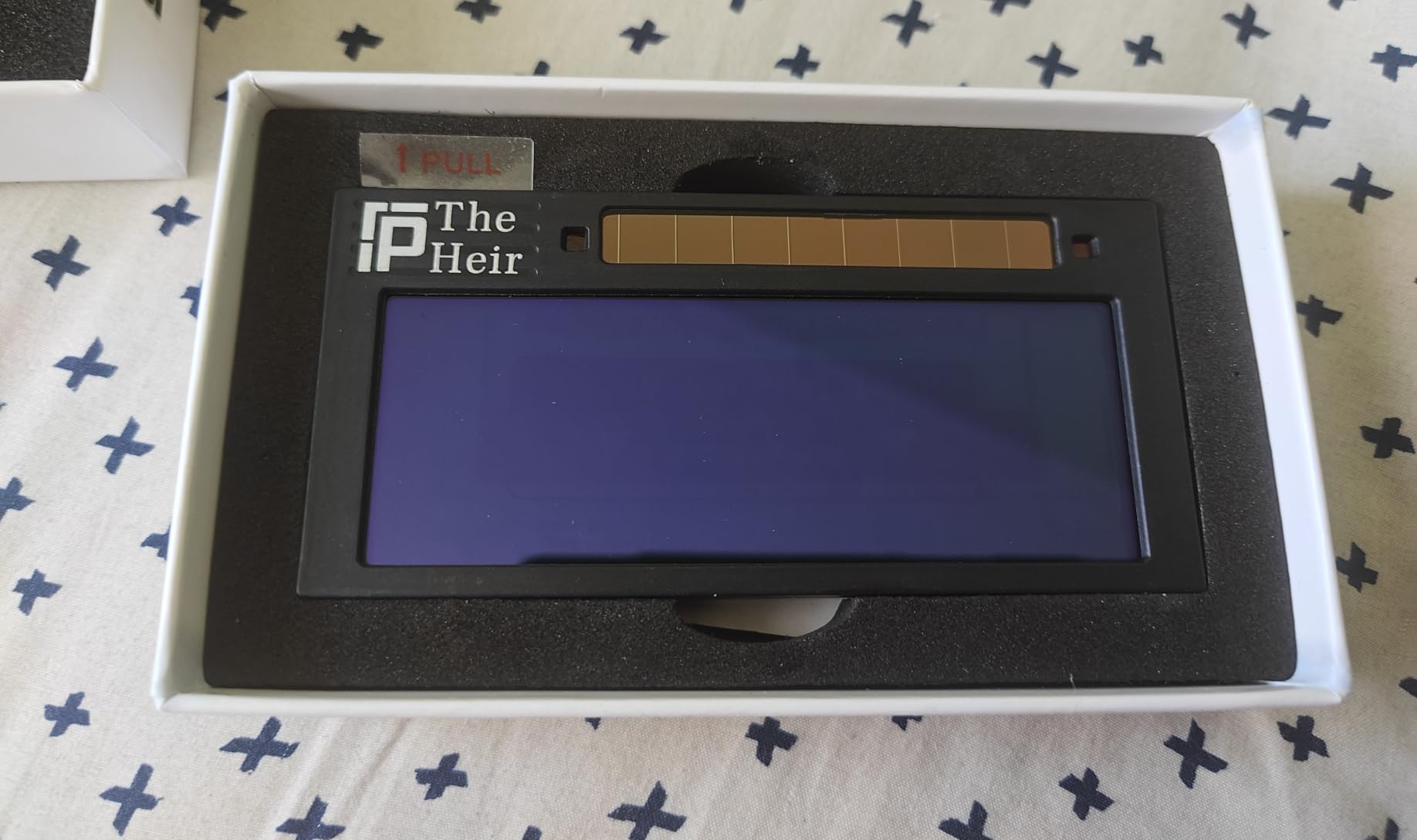
Note that the shell does not come with a welding lens, so the sensor behaviour depends on the filter you fit. Some of the failures may belong to specific lens combinations rather than the shell itself. If you buy it, buy it with a lens you have verified, and treat it as a second helmet rather than the one protecting you on a critical structural pass.
Build Quality and Lens Handling
Several owners report the shell feels heavier and cheaper than expected, which sits oddly against a stated shell weight of 16.3 ounces. The listed item weight is 1.5 pounds, and the difference is likely the packaging and the included components.
The lens retainer clip is described as flimsy, and the default lens arrangement produces triple halo reflections from stacked clear lenses. Both are fixable, but neither is fixed by the shell itself. Budget for a retainer and a cleaner lens stack if you fit this one.
How Overhead Work Changes Every Spec You Care About
A general welding helmet guide will tell you to prioritise optical clarity and switching speed. Both matter overhead, but they are not first and second. Here is the order we would actually shop in, based on six weeks of testing in the overhead and vertical-up positions.
Weight and Balance Come Before Everything Else
You are already holding your head in extension. Any mass on your skull is a lever arm working against muscles that are already loaded. Stated shell weights in this roundup run from 16 ounces at the light end up to about 2.2 pounds, and that spread is felt over a full shift rather than in a five-minute try-on.
Balance matters as much as raw weight. Two reviewers independently describe the value of mass sitting over the crown of the head rather than cantilevered forward, and that is the difference between a shell you adapt to and a shell you fight. Whenever you can, adjust the eyes-to-lens distance on the headband so the shell sits back on your skull rather than out in front of your forehead.
Arc Sensor Placement and the High-Angle Problem
Here is the answer to why a welding helmet does not darken when you are welding overhead. Arc sensors are photocells mounted in the front of the shell and aimed forward at the arc. Strike an arc in front of you and light floods those cells from the front, and the filter switches. The same arc forty degrees above your line of sight sends the light in at a much steeper angle, at lower intensity, through a narrower band of the cell array.
Helmets with more sensors spread over a wider area of the front face have a better chance of catching that light. The models here range from two sensors to seven. On a budget helmet, two sensors is a real limitation for overhead work specifically, and no amount of adjusting the sensitivity knob fully solves it.
Practical mitigation: before you start a vertical-up pass, strike a short tack at the working angle so the filter is already dark when the real arc comes. Switching speed then stops being the limiting factor and sensor geometry takes over.
Viewing Area and Optical Clarity for a Joint Above You
With the target above you, a larger window means fewer head tilts, and head tilts are the mechanism by which neck fatigue builds. Look for the tall viewing areas when the joint is directly overhead, and the panoramic or narrow-shell designs when you are fitting members around your head.
Optical clarity is rated on the 1/1/1/1 scale for light transmission, homogeneity, chromaticity and angular dependence. The top grade gives true colour with no green cast and no distortion after hours, while a 1/1/1/2 lens shows slight angular variation at the edge of the window. In practice the difference is subtle, but for a full shift of vertical-up work the top grade is worth having.
Shade Range Matched to Vertical-Up Amperages
Overhead you will be running stick and MIG at structural amperages, and on a vertical-up pass you are watching a pool that is falling, not sitting still. Shades that are slightly light for the process are more dangerous overhead than they are flat, because the light is coming from above and reflecting back at an angle your eyes are not used to.
Look for a range that reaches shade 13 with adjustment in half steps if you can find it, so you can fine-tune around a drifting arc rather than being forced between 10 and 11. Also check the light-state shade. DIN 3.5 to 4 in the light state gives you a brighter unfiltered view for fit-up, which is most of what you are doing before the arc strikes.
Helmet Style: Full Shell vs Flip Front vs Piped Hood vs Goggles
Style is the decision that most affects overhead work, and it is the one most roundups ignore. Four options matter.
A full shell auto-darkening helmet gives the widest process range and the best electronics, at the cost of bulk and of needing removal to look at a joint. It suits work where you strike the arc once and run a long pass.
A flip-front auto-darkening helmet gives you the same electronics with the ability to raise the shell without touching headgear. This is the compromise most overhead welders end up choosing, and it is what the Jackson Insight and the chopped fiberglass shells in this list give you.
A piped or sugar scoop hood is the traditional overhead answer. Chopped at the top and bottom so it clears your chest and head, with the throat wrapped for spatter protection. Low mass, no electronics, and hard-wearing. The tradeoff is that many need a separate lens, and the passive versions need a battery-free shade band or a separate filter swap when you change processes.
Welding goggles with a face shield are for crawl spaces where nothing else fits. They are not adequate for prolonged overhead welding, because the seal around the face is poor and the eye protection is minimal compared to a proper shell.
Neck Heat, Spatter and Respirator Clearance
Vertical-up work sends spatter down a straight line onto your throat and collar. A flame-resistant balaclava, a leather cap under the shell, and a hood with a throat extension are the practical countermeasures, and they are cheap compared to a neck burn. Shell front lips and curved throats, as on the Jackson HSL and the YESWELDER, do the same job passively.
Respirator compatibility is the other documented pain point. A helmet that is light and well balanced can still become unusable once a half-mask or PAPR hood is added, and welders on r/Welding describe exactly that frustration with powered systems. Look for adjustable eyes-to-lens distance on the headband, as the chopped fiberglass shell here offers, and always test the combination with the respirator fitted before committing.
A Five-Step Fit Test Before You Commit
Do all five of these before you order, and you will avoid the most common regret in this category.
One, put the helmet on and tighten everything, then tilt your head back to a working angle and hold it for two minutes. If you are already uncomfortable, a full shift is not going to improve it.
Two, fit your normal respirator or PAPR with the helmet on and check that the lens housing is not riding on the mask seal.
Three, wear the headgear with the helmet for fifteen minutes. Headgear that feels fine for five minutes can fail an hour in once you start sweating.
Four, look up and to each side through the window. Note how far you have to turn your head to see past the frame.
Five, wear it during a break in an actual overhead position if you can, so heat and gravity are part of the test rather than simulated.
Maintenance in Hot, Spatter-Heavy Conditions
Overhead work destroys consumable lenses faster than flat work, because spatter falls down the arc line instead of away from it. Keep a spare outer lens in your kit and swap it when it spatters rather than when you can no longer see through it, since a pitted lens also raises eye strain.
Clean the inner lens with a dry cloth only, because solvents and damp cloths damage the anti-scratch coatings on filter lenses. Check the lens retainer clips at the start of each shift, since a loose retainer on a helmet you flip up and down several times a day is a foreseeable failure. Wipe the sweatband and let it dry fully, and check the rear headband tension knob periodically through the first week of any new helmet.
Frequently Asked Questions
Why does my welding helmet not darken when I am welding overhead?
Arc sensors sit in the front of the shell and aim forward. When the arc is above you, the light arrives at a steep angle and at lower intensity, so the cells may not receive enough to trip the filter. Helmets with more sensors spread across a wider area of the shell catch it more reliably. Striking a short tack at your working angle before the real pass warms the filter up.
How much should a welding helmet weigh for overhead work?
Look for as little as your budget allows, and read the stated shell weight rather than the listed item weight. The models here range from about 16 ounces to roughly 2.2 pounds. Over a full shift with your head already in extension, that difference is felt. Balance matters as much as mass, so adjust the eyes-to-lens distance so the shell sits back on your skull rather than forward of your forehead.
Is a flip front welding helmet as safe as a full shell for overhead work?
Yes, when the shell is a proper welding shell. A flip-front auto-darkening helmet uses the same filter, sensors and shell material as a full shell; only the pivot is different, and the raised position leaves your face unprotected while raised. A passive flip-front sugar scoop is also fully protective, and its advantages are mass, throat coverage and durability rather than filter electronics.
What shade level do I need for overhead welding?
For structural stick and MIG at typical amperages, a helmet reaching shade 13 with fine adjustment in half steps gives you the control you need on a vertical-up pass. Prefer a brighter light-state shade, around DIN 3.5 to 4, for the fit-up work you do before striking. Low-amp TIG root passes overhead need a filter rated from about 5 amps, which not every budget helmet offers.
Can I use an auto-darkening welding helmet with a respirator or PAPR?
Yes, but only if the helmet adjusts. Choose a model with adjustable eyes-to-lens distance on the headband so the lens housing can sit clear of the mask seal without under-flashing. Always test the helmet with the respirator fitted before you rely on it. Welder forums describe this as a common frustration, since a helmet that fits well alone can become painful once straps and shells start competing.
Before you compare brands, it is worth separating the established names from the value tier. We have covered premium options from brands like 3M Speedglas in our Speedglas welding helmet guide, and our budget roundup covers the entry end in more detail.
Which Overhead Welding Helmet Fits Your Work
If you are welding structural steel overhead shift after shift and need one helmet to carry you through it, the Jackson Safety Insight ADF is the choice we would make. The narrow HSL shell, the extended front lip against spatter, and the ratcheting headgear that holds its position are what make it the most complete overhead package here.
If your overhead work is full-time and your neck is the limiting factor, the ESAB Sentinel A60 is one of the lightest shells here and lets you set the hood position around a respirator. For crews fitting members where you need to see sideways, the ANDELI’s three-sided auto-darkening is the only option here with genuine panoramic coverage.
If your overhead time is pipe work in tight spaces, a chopped fiberglass sugar scoop such as the Tefuawe is the shape the trade built for this, and it survives being hit in a way thin plastic shells do not. For low-amp TIG root passes overhead, the Lincoln Electric’s five-amp rating is the spec that matters, and it comes with spare lenses in the box.
Pick whichever of these matches the position you actually spend your days in, then wear it with your normal PPE for a full shift before you standardise it across a crew. Overhead comfort is personal, and the only way to know how a shell feels is to have it on your own head while you are tired. The shortlist above covers everything from 16-ounce shells up to wider-view full shells, so you should find something that fits both your budget and your neck.
Leave a Reply