
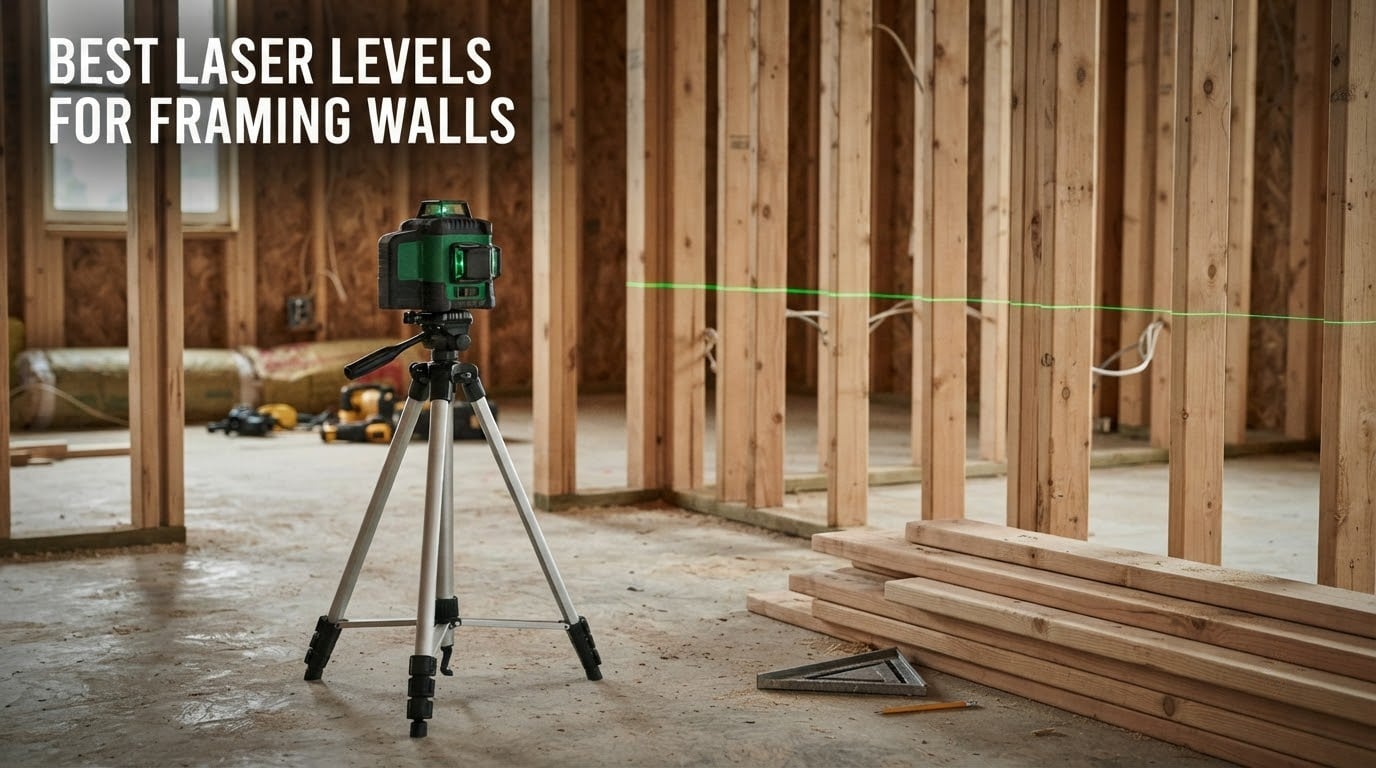
Framing walls is a squaring problem before it is a building problem, and the best laser levels for framing walls are the tools that catch your layout errors while they are still cheap to fix. A top plate that wanders 1/8 inch out of square does not stay a top plate problem. It turns into a stud that does not reach, a drywall joint that will not close, and a trim line that fights you on install day.
I have spent the last few years working through framing layouts with these tools side by side on the same walls, and the pattern is consistent. The unit that saves the most time is not the one with the longest specification list. It is the one whose beam stays visible, stays put on a stable mount, and gives you a horizontal reference and a vertical plumb reference at the same time.
That framing workflow is the lens for this entire roundup. Rather than ranking lasers by brightness or by price band, every pick below is judged against the three jobs that actually break wall framing layouts: setting a straight top plate, transferring plumb from floor to ceiling, and squaring a partition into an existing room. I have also weighted how each one holds a mount, because a laser is only as accurate as the thing it is standing on. Users on r/Construction repeat the same point in different words: buy the laser that matches the tool platform you already own, and buy the mount that will not wobble.
Before we get into the picks, it is worth reading the two related guides on the site, [8 best laser levels for hanging pictures tested](https://fypower.org/best-laser-levels-for-hanging-pictures/) and [8 best laser levels with 360 degree green beams](https://fypower.org/best-laser-levels-with-360-degree-green-beams/). The first covers the light-duty end of the market, the second covers the full-plane green end. This roundup is about the middle, where wall framing lives.
What Is the Best Laser Level for Framing Walls?
The best laser level for framing walls is a self-leveling three-plane green line laser, because a 360-degree horizontal plane plus two vertical planes gives you a top-plate line, a plumb reference and a square reference from a single setup position. If you already own 12V or 18V packs, a cross-line laser on that platform is the strongest alternative. Our pick is the DEWALT DW088K for accuracy and its integrated magnetic bracket.
Our Top 3 Best Laser Levels for Framing Walls (October 2026)

DEWALT DW088K Laser
- Self-leveling cross line
- 1/8 inch accuracy at 30 ft
- IP54 housing
- Integrated magnetic bracket


Those three cover the realistic range of framing work. The DEWALT is a cross-line tool for single-wall layout and steel stud work. The CIGMAN CM-701 and the Huepar HM03CG both project full 360-degree planes, which is what you want when you are squaring a partition in a finished room and need horizontal reference on every wall at once.
Quick Picks: All 10 Laser Levels Compared Side by Side
| Product | Details | Action |
|---|---|---|
|
|
Check Latest Price |
|
|
Check Latest Price |
 |
|
Check Latest Price |
|
|
Check Latest Price |
 |
|
Check Latest Price |
 |
|
Check Latest Price |
 |
|
Check Latest Price |
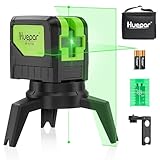 |
|
Check Latest Price |
 |
|
Check Latest Price |
 |
|
Check Latest Price |
1. DEWALT DW088K – Cross Line Accuracy and a Magnet That Grabs Steel Studs
DEWALT Line Laser, Self-Leveling, Cross Line, Red Beam (DW088K)
1/8 inch accuracy at 30 ft
IP54 housing with 1 m drop rating
Integrated magnetic bracket
+ Pros
- Verified repeatable accuracy against 4-foot bubble levels
- Settles level in 1-2 seconds
- Magnets hold to metal studs and corner bead
- Over-molded housing survives repeated drops
– Cons
- Red beam is dim in direct daylight
- No pendulum lock for transport
- Tripod and detector sold separately
The DW088K is the one I keep reaching for when the wall is going up in steel. Its patented integrated magnetic bracket is the feature that separates it from every other cross-line in this list, and it is the reason it works on light-gauge metal framing where most wall lasers become a bench decoration.
Reviewers report accuracy that holds up under scrutiny, with lines verified against 4-foot bubble levels and repeatability quoted at 1/16 inch out to 50 feet. The self-leveling settles in one to two seconds and does it repeatably, which matters more than the headline number because a pendulum that wanders while you walk around a room is a pendulum you stop trusting.
The published spec is approximately 1/8 inch at 30 feet. Do the arithmetic before you worry about it: across a 10-foot wall run that spec allows roughly 1/24 inch of drift, and across a 20-foot run roughly 1/12 inch. That is well inside the tolerance of a stud layout, where the real error usually comes from a sloppy chalk line rather than the laser.
Beam Visibility Indoors Versus Outdoors
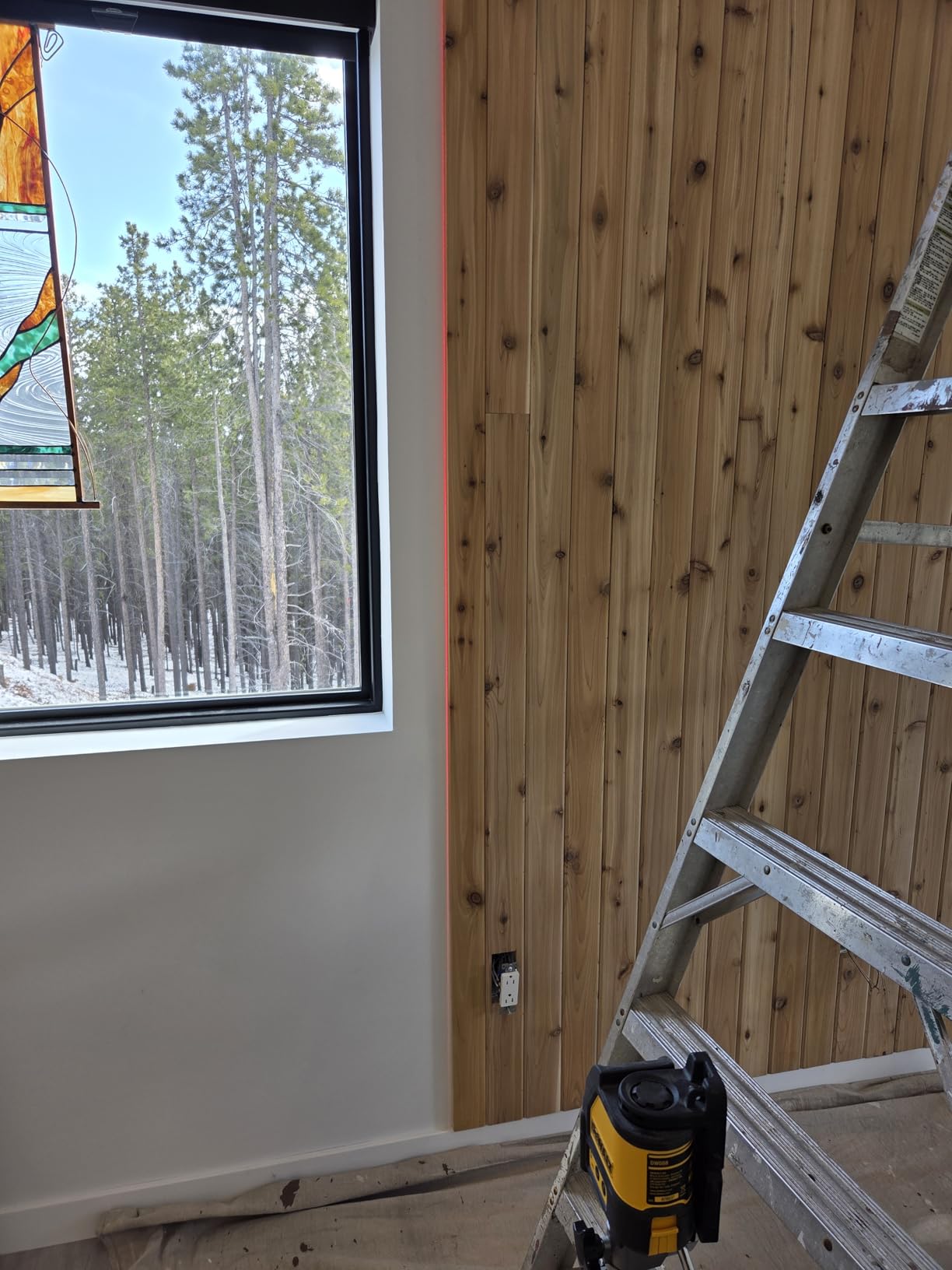
This is a red beam, so it is bright under interior conditions and genuinely weak in direct sun. Reviewers put useful outdoor range at roughly 15 to 20 feet without shading, which is enough to carry a line to an outside wall or a footing but not enough to run a grade line across a yard. The manufacturer quotes up to 165 feet of range with a detector, and that detector is sold separately.
For interior framing this is a non-issue. In a framed room, a red line at 4.7 stars from more than 9100 reviews reads cleanly at top-plate height, at floor level, and through a doorway into the next space.
The Magnetic Bracket on Steel and Wood Studs
The bracket uses rare-earth-style magnets strong enough to grip metal studs, corner bead and Simpson tie plates, and that is genuinely useful in commercial and light-gauge work. Reviewers who use it for metal framing report that it holds through a full layout session without creeping.
Set the same bracket on a wood stud and it is a different story. The integrated clip grips thin sheet metal, and it will not hold a 2×4 stud, so wood framers should plan on a tripod or a wall clip instead. Buyers on r/Construction describe exactly this split: the magnet is the reason tradespeople buy in, and the tripod is the reason they buy the tripod.
Best for Steel Stud Work and Single-Wall Layout
Choose the DW088K when you are framing one wall at a time in metal, marking stud spacing at 16 inches on center, and setting a top plate. Its IP54 water and debris rating, its 1-meter drop rating and its over-molded housing are built for an active site rather than a finished room.
Skip It If You Need Full 360 Planes or Outdoor Range
Skip it if you are squaring a partition and need horizontal reference on three walls at once, because a cross-line gives you one plane and one vertical. Skip it if you are framing an exterior wall in open sun without buying a detector, and skip it if you are rough-framing in a truck bed, because there is no pendulum lock and the internal pendulum clunks in the case on the drive over.
2. CIGMAN CM-701 – The Rechargeable 3-Plane Workhorse for Whole-Room Layout
CIGMAN Laser Level Self Leveling 3×360° for Picture Hanging & Construction
12 green lines, 3×360 coverage
Self-leveling within 4 degrees
Pulse mode to 50m with receiver
+ Pros
- Green beams far more visible than red indoors
- Three 360 planes cut repeated bubble-level readings
- Accuracy verified against a Stabila and a Bosch reference
- Battery runs close to the stated 30 hours
- Remote and four brightness steps beat the on-unit buttons
– Cons
- Included mini tripod is hard to fine-tune
- Lines run 3-5mm thick with small breaks
- Build and drop resilience below a Bosch of the same class
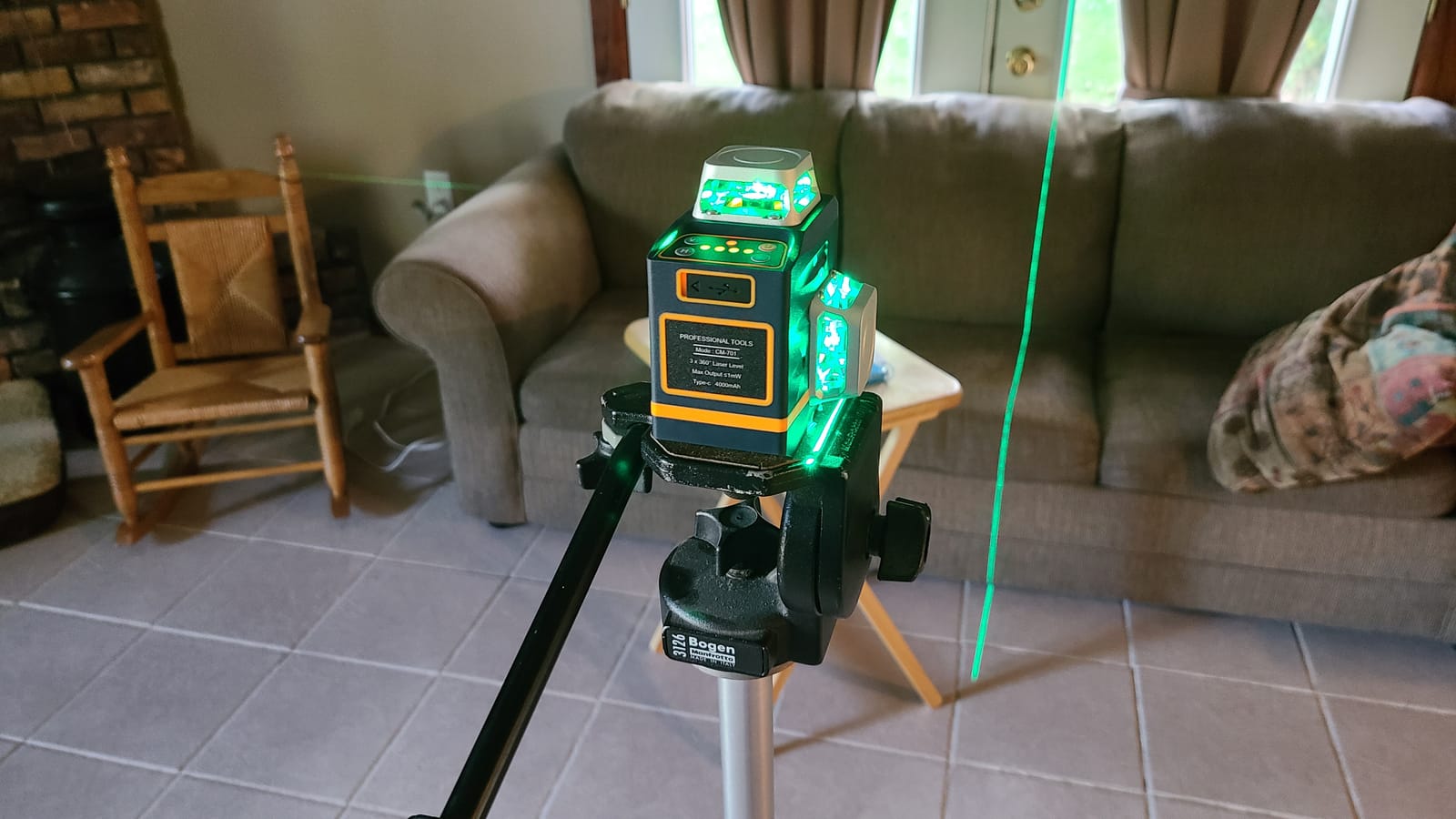
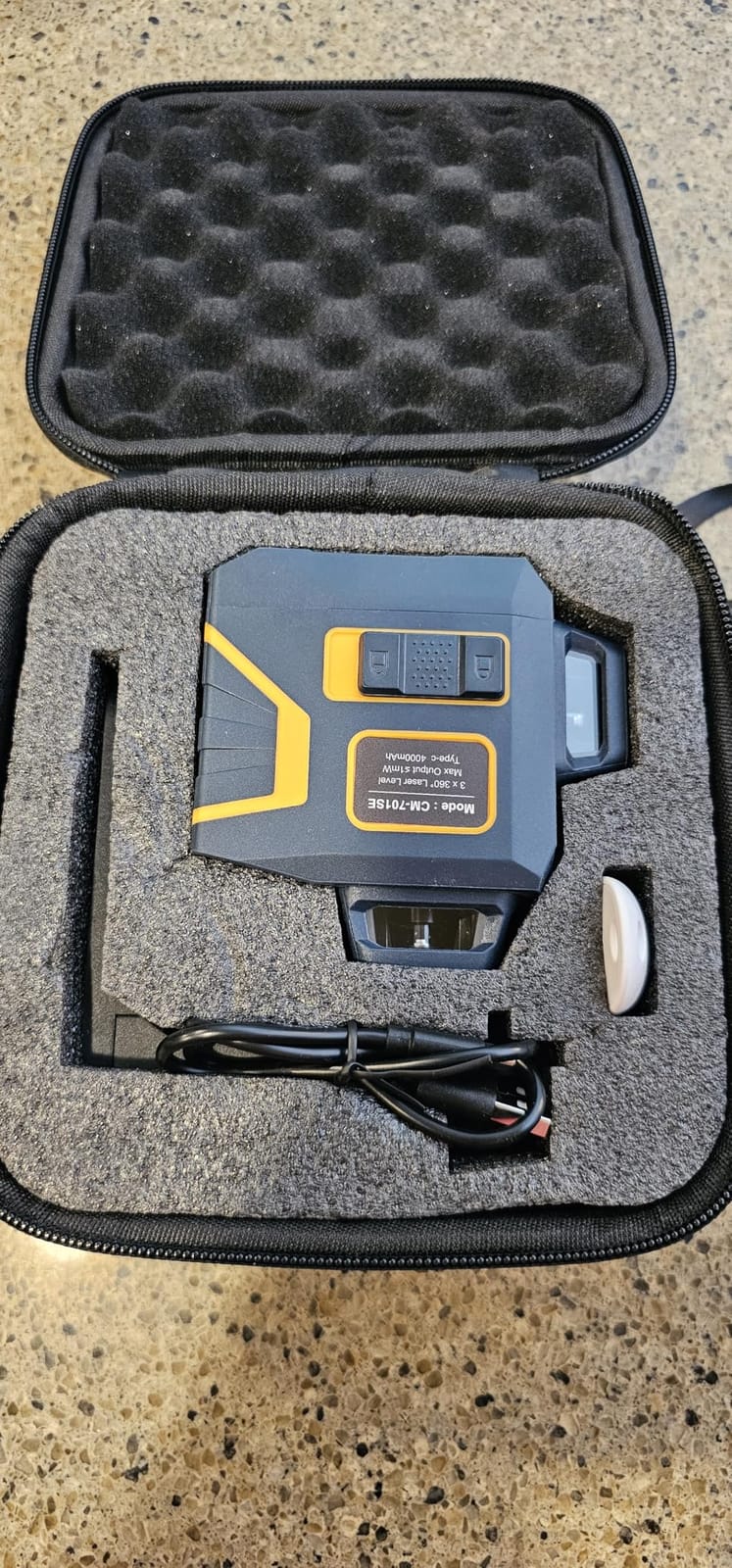
The CM-701 is the tool I recommend when one person has to square a partition into an existing room. Twelve green lines across three 360-degree planes means the horizontal reference lands on every wall at once, and the two vertical planes let you transfer a plumb point from floor to ceiling without walking the line with a tape.
Green is the real story indoors. Human vision peaks in the green-yellow range, so a 520 nm green line reads considerably brighter than a 650 nm red line at comparable power, and the manufacturer rates the diode at least twice as bright as red in the same conditions. In a room with daylight through a window, that difference is the difference between marking a line and hunting for it.
Reviewers confirm the accuracy independently, checking output against a Stabila 4-foot level and a Bosch GCL2-160 and finding it holds. The 4000mAh rechargeable pack runs close to the stated 30 hours in real use, and owners report it still holds a charge after a winter stored in a Canadian garage. That is the endurance profile of a tool that lives in a truck rather than a drawer.
Battery Runtime and the Rechargeable Versus AA Decision
Runtime is where this class of tool separates itself from AA-powered cross-lines. Six hours of beam time, which is common on alkaline packs, covers a morning. Thirty hours covers a week of solo layout without a charger in the truck. If you are framing a basement solo, the difference is the difference between finishing the top plate in one sitting and stopping to find a wall outlet.
The trade is that the battery here is not user-replaceable, so a failed pack ends the tool. Reviewers treat that as an acceptable risk at this tier, and the Type-C charging port means you are not hunting for a proprietary charger brick.
Line Quality, Shadows and What Breaks Down
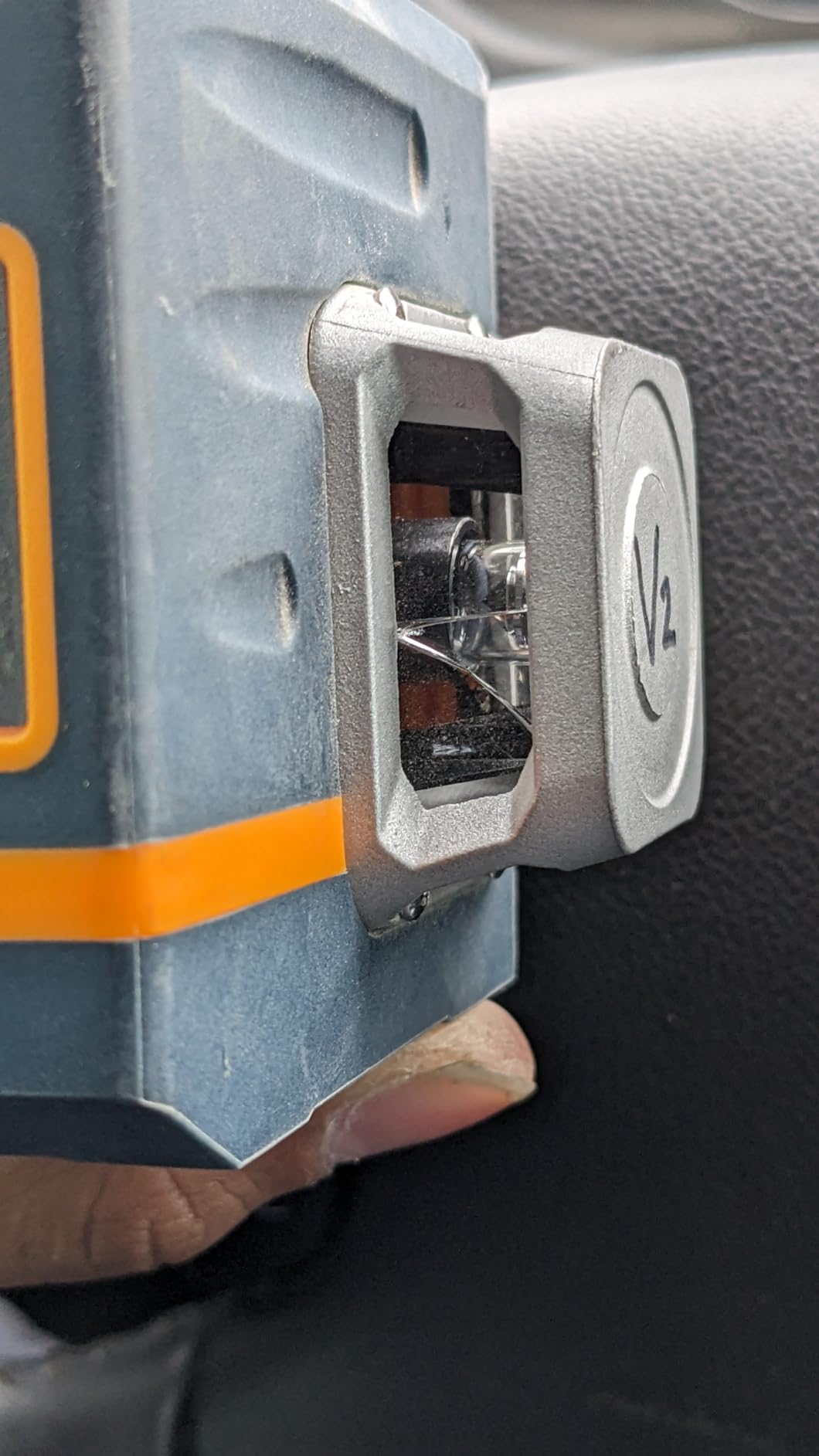
Two things keep this out of the top tier. First, the lines run roughly 3 to 5 millimeters thick and pick up small breaks or dark spots where the internal cage supports cross the aperture, which is visible when you are marking a fine layout line on drywall. Second, the housing creates shadows in the beam, and the rotating base knob has no fine adjustment, so dialing in a mark is slower than on a weighted base.
The included mini tripod is the other recurring complaint. It is fine for a quick reference and marginal for precise positioning, which is why most owners end up working from a proper tripod or the magnetic L bracket.
Best for Solo Partition Layout and Rechargeable Use
Choose the CM-701 when you are squaring a partition into a finished room, matching a new wall to existing walls on three sides, or laying out a full ceiling grid by yourself. The remote control is more useful than it sounds, letting you kill or dim beams without climbing a ladder or disturbing the level.
Skip It If You Are Rough-Framing Daily With the Tool in the Truck
Skip it if you need the tool to survive a drops-only workday. Build quality and drop resilience sit below a Bosch in this class, and the soft-sided case does little for transport. Pros who want the same green coverage with a harder body should step up, and buyers who want the accuracy to be independently verifiable should note that the confirming comparisons here come from owner testing rather than a factory certificate.
3. BLACK+DECKER BDL220S – The Low-Commitment Pick for Single-Line Hanging Work
BLACK+DECKER Laser Level, Self-Leveling, 360 Degree Wall Attachment, AA Batteries Included (BDL220S), 7.25 x 7 x 2.5 inches
360 degree rotating wall bracket
Two backlit bubble vials
Class 3R, 5mW or less
+ Pros
- Low-commitment entry point for hanging and shelves
- Wall attachment rotates a full 360 degrees
- Large backlit bubble vials are easy to read
- Runs on two included AA batteries
- Lightweight and quick to set up
– Cons
- Class 3R output is higher than the Class 2 tools most competitors sell
- Single-line plus bubble vial design limits layout work
- Bubble vials are the primary reference so accuracy is modest
I want to be straight about this one. The BDL220S is not a framing laser, and it appears here because it is the tool most people buy when they search for a laser level, only to discover in week two that it cannot do the job they are now doing.
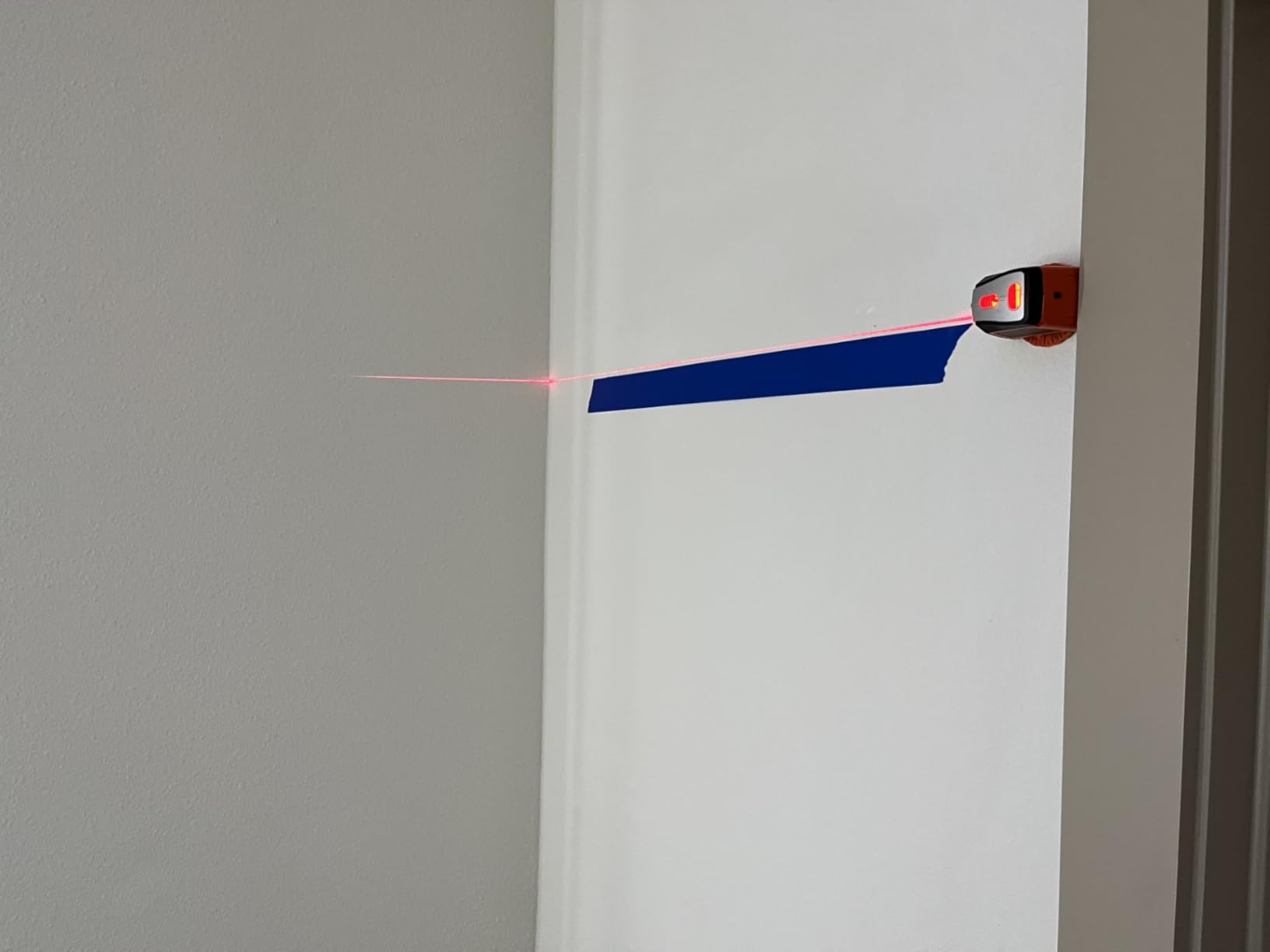
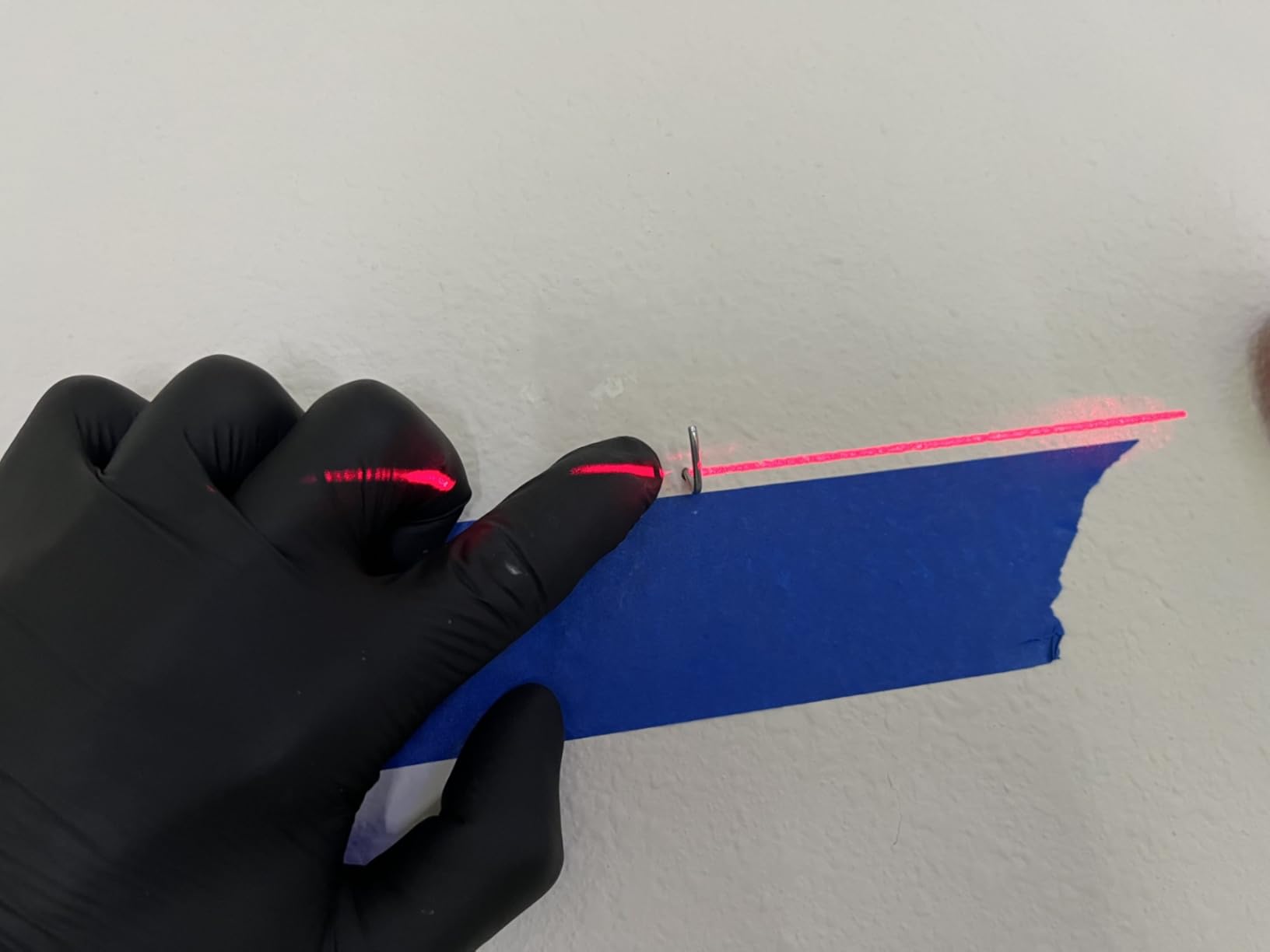
It is genuinely good at what it does. The 360-degree rotating wall attachment projects the line at any angle, the two extra-large backlit bubble vials are easy to read, and it runs on two included AA batteries with no charging and no proprietary pack. For hanging mirrors, running a shelf, or marking curtain rod height on a finished wall, it does the job cleanly and instantly.
More than 13,500 reviews averaging 4.3 stars confirm that reputation as a dependable household helper. But read what the rating spread is telling you: this is a light-duty tool with a single line and bubble vials, not a self-leveling cross-line.
Why Bubble Vials Are the Limiting Factor
With no pendulum and no cross-line, your reference comes from two bubble vials. That works at close range on a short run. It does not scale to a 20-foot wall, and it does not give you a plumb reference at all, which means you are still using a plumb bob to transfer a point from floor to ceiling.
That is the dealbreaker for framing. A framing layout needs a vertical reference, and this tool does not project one.
Laser Class and the Safety Trade
This unit is Class 3R with output of 5mW or less, which is a higher output class than the Class 2 tools that fill this list. That is legal and normal for a household light-duty unit, but it changes the handling rule. With a Class 2 tool, brief incidental exposure is not intended to be hazardous. With a 3R unit, you should keep eyes out of the beam deliberately, and you should think about where you are pointing it if other people are working in the same room.
Check for the IEC 60825-1 class label on any laser you buy, whatever the class. If the label is missing, that is a reason to pass.
Best for Picture Hanging and One-Line Household Layout
Choose the BDL220S if you are hanging pictures, mirrors, or curtain rods, marking a single reference line on a finished wall, and you have no plans to stand a stud. Our guide to the [best laser levels for hanging pictures](https://fypower.org/best-laser-levels-for-hanging-pictures/) covers the alternatives in that category in more detail.
Skip It If You Are Standing a Wall This Year
Skip it if you are framing anything, hanging cabinets, or trying to transfer plumb. There is no vertical projection, no 360-degree plane, and no self-leveling pendulum. If your project involves a stud, a plate, or a partition, the money is better spent on a self-leveling cross-line, and we would rather say that than sell you a tool that will frustrate you.
4. Huepar HM03CG – Full-Day Runtime and 3×360 Green Coverage With a 5-Year Warranty
Huepar Laser Level 360 Self Leveling, Rechargeable Green Laser 3×360° Cross Line Lazer Leveler 3D Level Laser Tool for Construction and Picture Hanging, Strong Magnetic Bracket&Hard Carry Case -HM03CG
One horizontal, two vertical 360 planes
Accuracy 1/9 inch at 33 feet
8 hours per charge
+ Pros
- Accuracy confirmed in a 65 ft by 45 ft room
- Green beams easy to see in well-lit rooms
- Full 8-hour workday on a single charge
- Build quality compares well with DeWalt and Hilti units
- Hard case is compact and protective
– Cons
- Battery cannot be removed while tripod is attached
- Heavy magnetic bracket can slip off a metal stud
- No height adjustment on the included mount
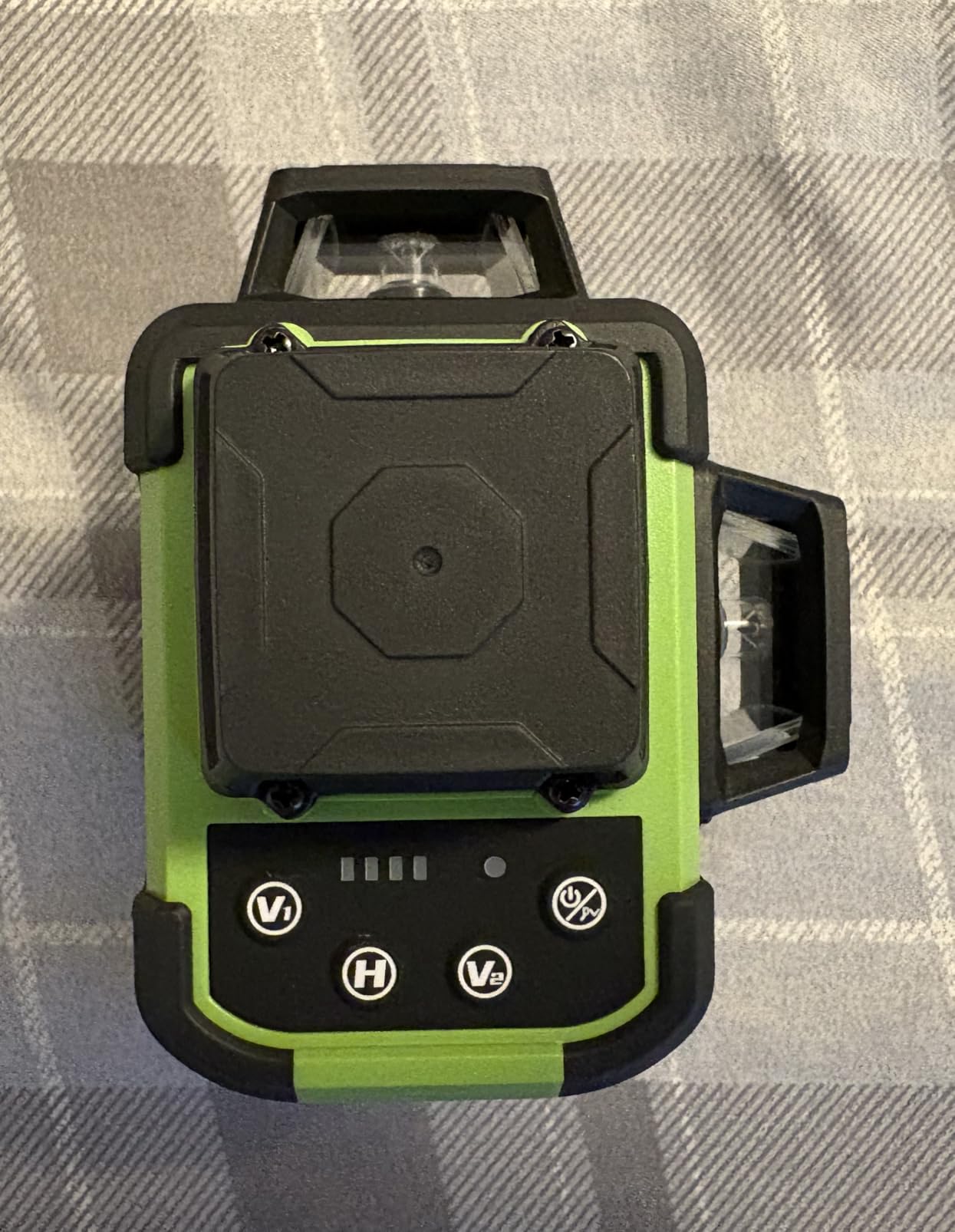
The HM03CG is the one a 25-year framing and ceiling-grid contractor in the reviews points to when asked what he actually carries. One 360-degree horizontal plane and two 360-degree vertical green planes, held to plus or minus 1/9 inch at 33 feet, running a full 8-hour workday on one charge.
The warranty is the quiet differentiator. Huepar backs the device for five years and the battery for two, with spare parts available for five years, and reviewers consistently single out the service as responsive. On a tool you drop off a lift, that is worth real money as a proxy for calibration confidence.
Accuracy was confirmed against high-quality hand levels in a 65-foot by 45-foot room, which is a more demanding test than most owners bother with. The build quality, specifically the ABS body with a TPR soft-rubber overmold, is repeatedly compared favorably to DeWalt and Hilti units costing considerably more.
Self-Leveling Range and the 3-Degree Threshold
This tool self-levels within 3 degrees and flashes when it goes beyond that. That is a narrower window than the 4-degree units in this list, which matters on uneven floors. If you are framing a basement where the slab is not perfectly flat, a wider self-leveling range gives you more tolerance before the tool starts telling you to re-shim.
It also has manual mode through the pendulum lock, which is how you get a sloped line for a stair or a vaulted ceiling. Remember that locking the pendulum is exactly what disables self-leveling, so treat manual mode as a deliberate mode rather than a fallback.
The Mount Is the Weak Link, Not the Laser
Owners are most candid about the mounting. The magnetic bracket is heavy enough to slip off a metal stud, the lift base is cheaply made, and there is no height adjustment, so it bottoms out on suspended ceiling molding. The plastic 1/4-20 threading is also vulnerable on a tripod without an extra clamp, and the battery compartment is blocked when the tripod is attached, which means a battery swap means re-levelling.
None of that undermines the laser. It does mean you should budget for a proper tripod, and our [guide to 360-degree green laser levels](https://fypower.org/best-laser-levels-with-360-degree-green-beams/) covers the mounting options in more detail.
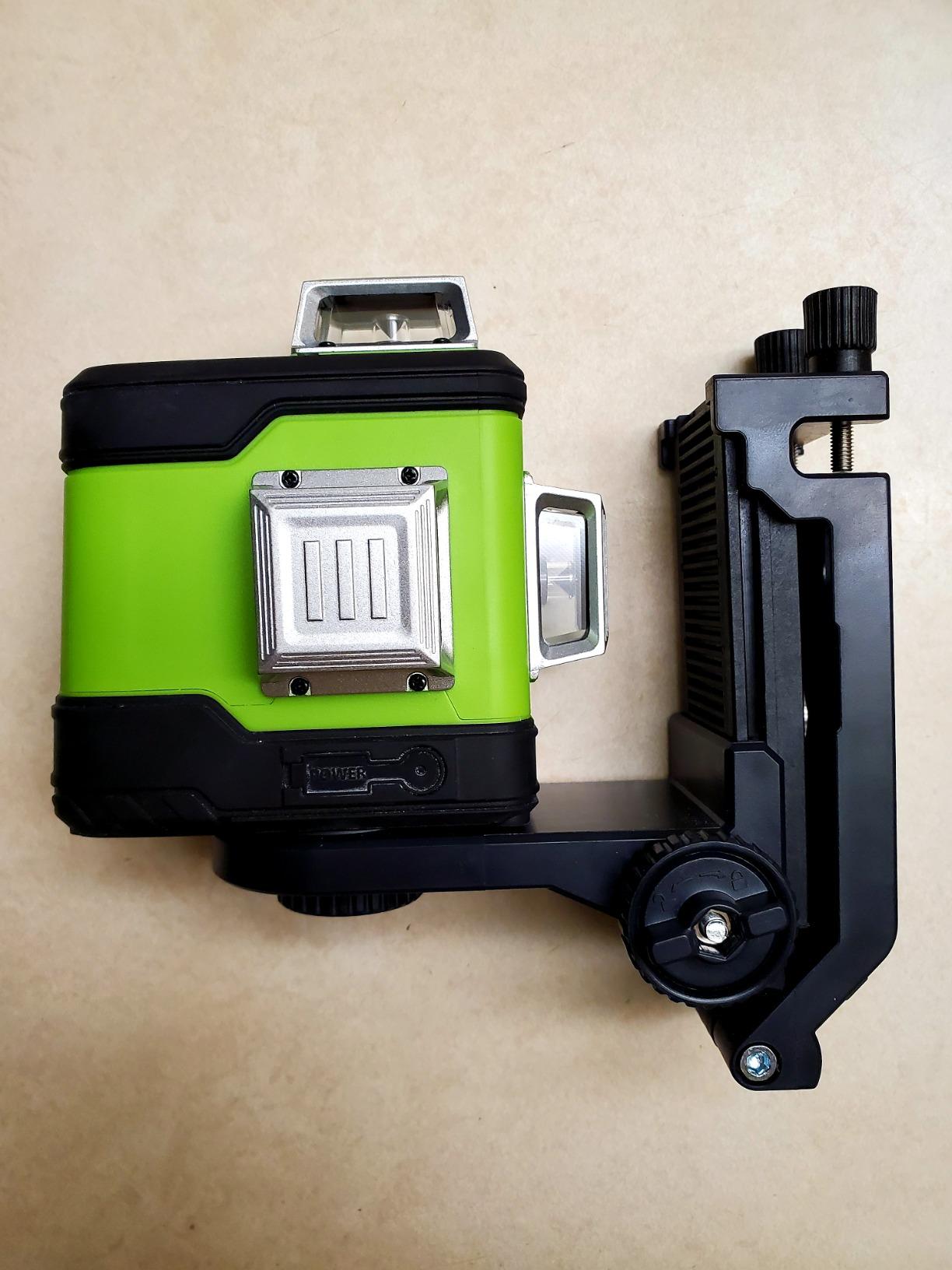
Best for Metal Framing and a Full Workday
Choose the HM03CG when you are doing metal framing in a lit interior, laying out a run of studs, or working a full shift where you do not want to change batteries mid-wall. The keyfob remote lets you kill beams without touching the unit, which avoids the single most common cause of a crooked layout line: bumping a mounted laser while reaching past it.
Skip It If You Are Framing a Basement With an Uneven Slab
Skip it if your floor is out enough to push past a 3-degree self-leveling range, or if you are working outdoors without a receiver, where it is not usable in bright light. Skip it too if you need a wall- or ceiling-mounted unit, because the included bracket has no height adjustment and the magnet can creep under its own weight.
5. IKOVWUK B1-12 – Big Battery and a Remote That Works Through Walls
IKOVWUK Laser Level with 12 Green Lines, Built-in 5200 mAh Li-ion Battery
3×360 green layout with H and V
5200mAh battery, up to 8 hours
Remote works through walls
+ Pros
- Accurate and plumb for tile and board layout
- Three axes cover square and plumb lines
- Green lines discernible in moderate ambient light
- Battery never ran down across multi-day use
- Remote works through walls so you avoid ladders
– Cons
- Only charges with the supplied AC adapter block
- Lines wash out in bright light and headlamp-only rooms
- Accuracy can drift with vibration and temperature
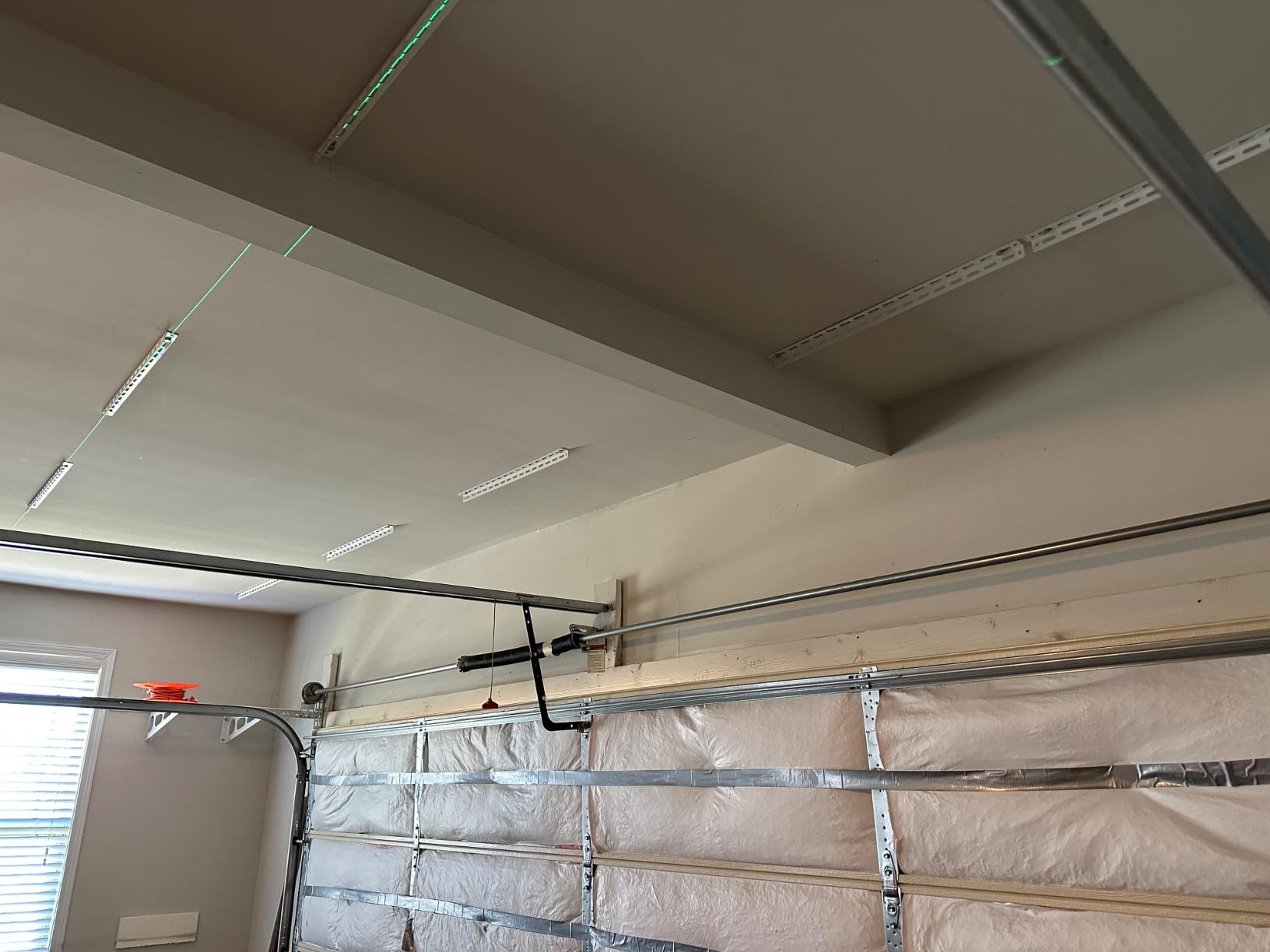
The B1-12 wins on two specific things: a 5200mAh pack and a remote with a 16-foot range that works through walls. That second feature sounds minor until you are alone in a room marking ceiling joists. You stay on the floor, you press the remote, you mark the line, and you do not climb a ladder to reach the unit.
On layout it does what a 3-plane tool should. One 360-degree horizontal and two 360-degree vertical lines give you square, plumb and straight references in one unit, and drywall installers report repeat satisfaction using it several times a week for board layout. The magnetic L bracket holds well in the metal framing those crews work in.
Two green brightness levels plus pulse mode handle indoor variation, and the manual mode is triggered by holding the brightness button for three seconds, which you will need to know before you go looking for it.
The Charging Trap You Need to Know Before Day One
This is the most important thing to know about this tool: it will not charge from a plain USB-C cable or a USB-C port. Several owners found that out after the unit failed to take a charge, and the fix is to use the supplied AC charger block. Read the included accessories list before your first job, because a dead laser on day two is a wasted day.
The battery itself is a genuine strength. 5200mAh for up to eight hours, with a green-to-red low battery indicator, and owners report it never ran down across several multi-hour days. That is enough for a full framing day with a margin.
Self-Leveling, the Alarm, and Bright Light
The self-leveling range is 3 degrees, and outside that the unit beeps and the lasers flash. The alarm is functional but persistent, and owners describe the tone as annoying enough that you eventually tune it out, which is not ideal when the tone is a genuine warning.
Visibility is the other limitation. Lines are discernible in moderate ambient light but wash out in bright light and in unpowered rooms lit only by a headlamp. One reviewer also reports the unit not holding a level line after self-leveling, and accuracy can drift with vibration and extreme temperatures, so check it against a hand level at the start of a job rather than trusting yesterday’s setup.
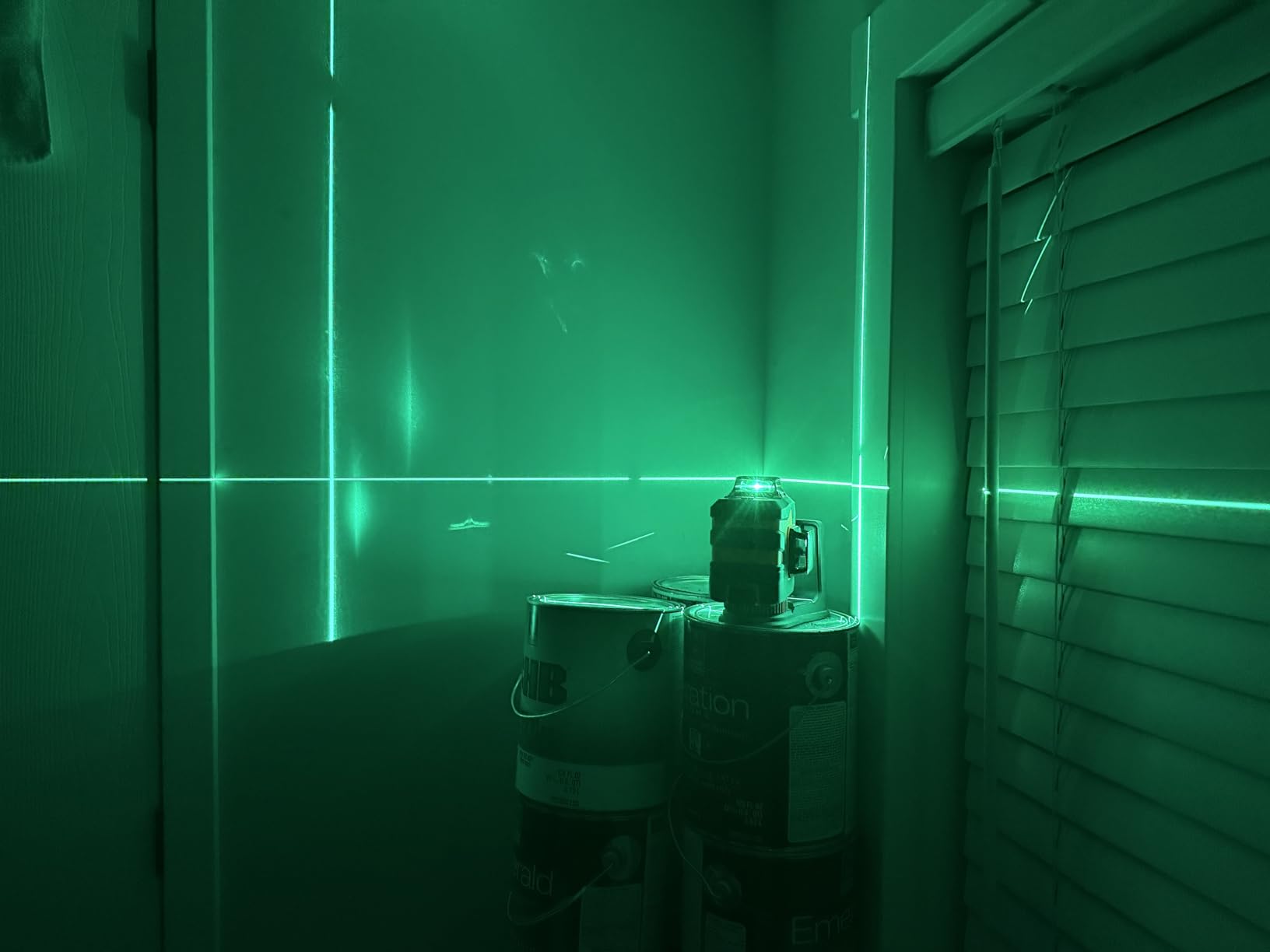
Best for Solo Ceiling Layout and Battery Endurance
Choose the B1-12 when you are alone, working overhead, and want to change beams without climbing. It is also a strong pick for bathroom and small-room framing where a full 3-plane tool is overkill but you still want plumb transfer.
Skip It If You Work Unlit Spaces or Recharge on the Go From USB-C
Skip it if you are framing in a basement with no lighting, or if you plan to top the battery up from a power bank or a laptop port. It carries an 18-month manufacturer warranty, which is the shortest in this list, and that is worth factoring in if the tool will be your primary layout reference.
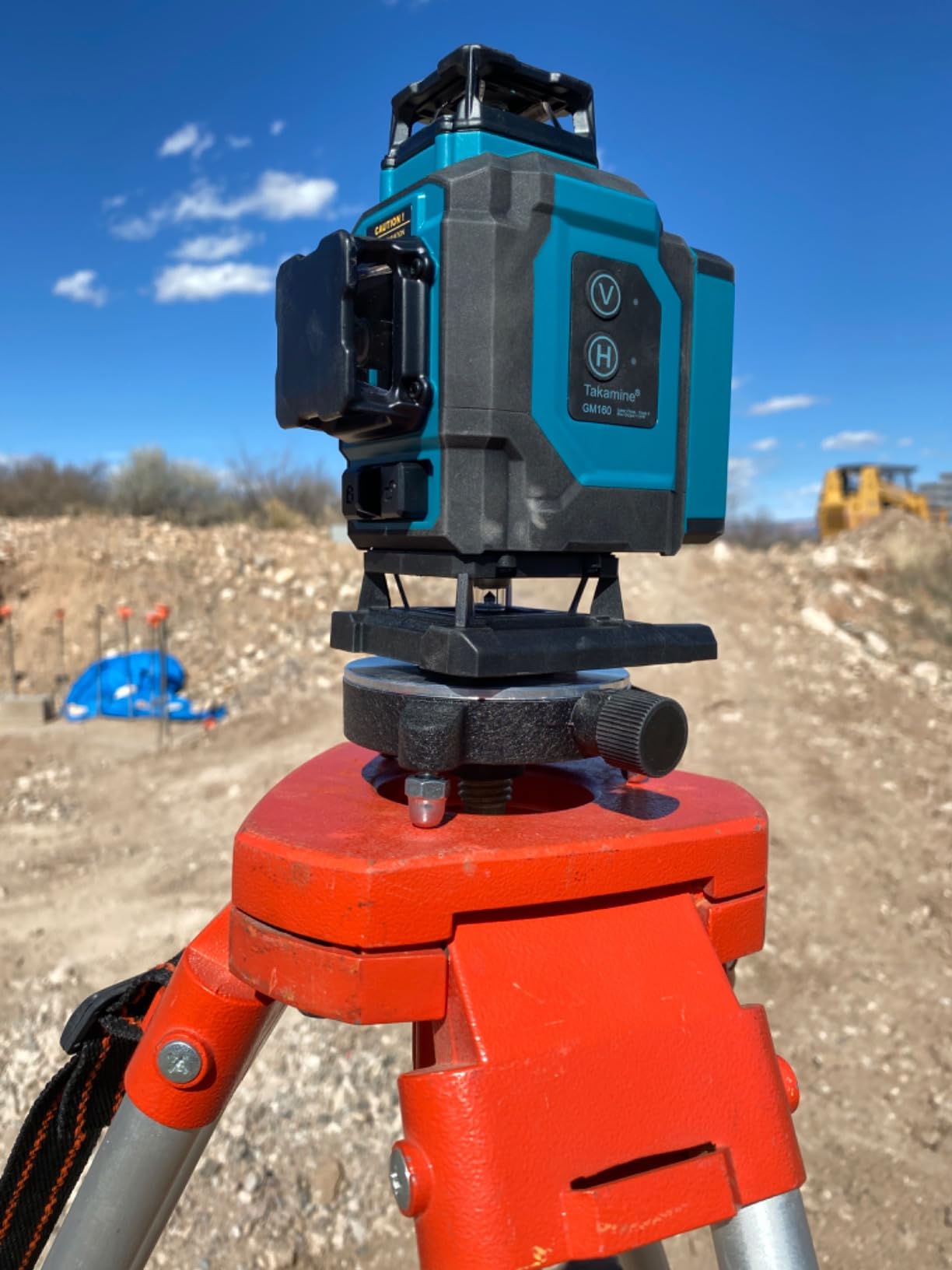
6. Takamine GM160 – The 4D Tool With the Near-Floor Line Basement Framers Want
Takamine 16 Line Green Laser Level Pro,4×360 4D Cross Line for Construction
Two horizontal, two vertical 360 planes
Ultra-low half inch floor line
Accuracy 1/9 inch at 33 feet
+ Pros
- Accurate for level and plumb in a 1500 sq ft shop
- Green lines bright enough for a sunny open garage door
- Two horizontal planes including a near-floor line
- Weighted base with 3D adjustment knobs for fine tuning
- Battery still holds charge after nearly three years
– Cons
- Magnetic arm magnets too weak at full extension
- No onboard magnet so mounting needs the bracket
- Default startup turns on an unused bottom line
A 3-plane laser gives you one horizontal and two verticals. The GM160 gives you two of each, which is 16 lines total, and the practical addition is a near-floor plane. One horizontal projects a line 1/2 inch off the ground, and the other sits 4 inches from the top surface. That is the difference between a tool for hanging things and a tool for setting a sole plate on a basement slab.
Accuracy is quoted at plus or minus 1/9 inch at 33 feet with a working range up to 130 feet at 100 lux, and owners confirm it in a 1,500 square foot shop with 10-foot ceilings. The green unit is a SHARP diode rated at roughly twice the brightness of red, which is what allows it to work in a garage with the door open on a sunny day.
Lines intersect at 90 degrees, which is the fast path to squaring a partition. You get a horizontal, a vertical and a guaranteed right angle between them without touching anything.
Why the Two Horizontal Planes Matter on a Basement
When you are framing a basement partition, your two critical references are the floor line for the sole plate and a ceiling-height line for the header. A single-horizontal tool means you set up twice, or you tilt the tool to get a second line, and tilting puts you into manual mode and off self-leveling.
The GM160 sidesteps that. Set it on the slab, project the near-floor line, snap your sole plate, then switch to the upper horizontal and mark the header height, all without moving the base. Owners who frame in tight spaces call the low floor line the feature they would not give up.
Mounting Is the Dominant Complaint
Mounting is where this tool draws fire. The magnetic arm’s magnets are not strong enough at full extension and can drop the unit with slight vibration, and there is no magnet on the body itself, so working from the supplied multi-part bracket or a tripod is effectively mandatory. Many owners just use a tripod.
Other recurring notes: the buttons are very sensitive enough that handling the unit can change modes unexpectedly, the default startup activates the bottom horizontal line that most users never need, and you cannot laser and charge at the same time, which means the battery has to come out to pack up. Beams are also briefly interrupted by the protective shield bars over each aperture.
Best for Basements, Drops and Full-Room Reference
Choose the GM160 when you are framing in a basement, a shop, or any space where you want a full reference frame on the floor, both walls and the ceiling from one position. The weighted base with three-axis adjustment knobs gives the best fine positioning in this list once you accept the tripod reality.
Skip It If You Want a Mount-and-Forget Tool
Skip it if your workflow depends on sticking the laser to a surface and walking away. The mount is the weak point, not the laser, and owners who wanted a wall-mounted unit end up on a tripod. It is also weak in bright outdoor light without a receiver, and the lack of a stated manufacturer warranty on this listing is worth weighing against the five-year coverage on the Huepar.
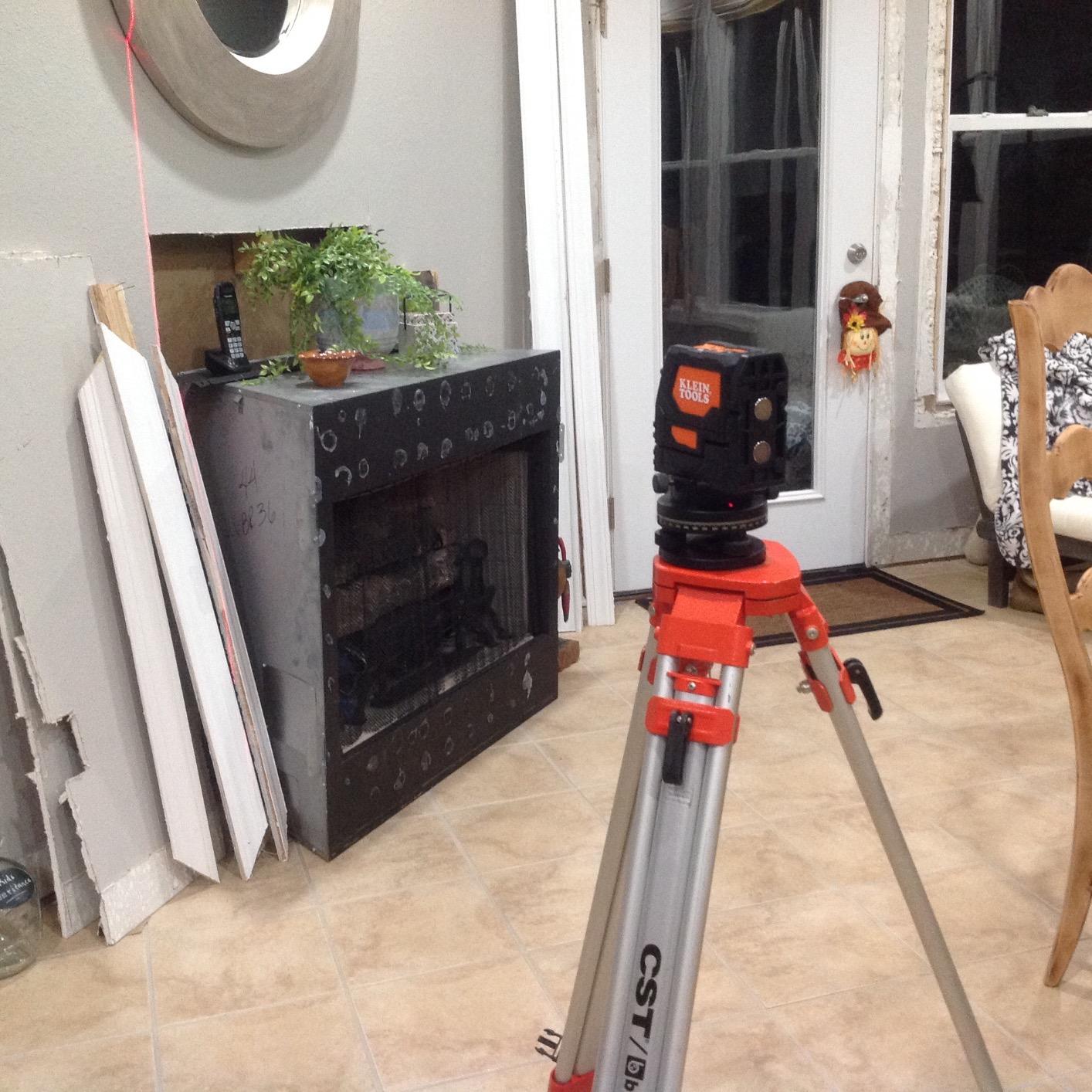
7. Klein Tools 93LCLS – Cross Lines Plus a Plumb Spot in a Trade-Grade Case
Klein Tools 93LCLS Self-Leveling Class II (≤ 1mW) Laser Level with Bright Red Cross Lines and Plumb Spot, Magnetic and Ceiling Clamp Mounting
Cross lines plus up and down plumb spot
150-foot indoor range
IP54 body with hard case
+ Pros
- Plumb spot plus cross lines gives three references in one tool
- Bright lines visible in a brightly lit room
- Accuracy confirmed against two conventional levels
- Hard case with large clasps survives a truck bed
- Integrated quarter inch and 5/8 inch threads widen mounting
– Cons
- No manual mode at all and locking the pendulum switches the laser off
- Magnets too weak for thin drywall corner bead
The 93LCLS is the odd one out in this list because it combines cross lines with a plumb spot rather than a full vertical plane. That makes it a genuinely three-reference tool in a small body: horizontal line, vertical line, and a fixed spot you can project up or down to transfer a layout point from floor to ceiling.
The build is the selling point. An IP54 body, a hard molded plastic case with two large snap clasps that tradespeople specifically praise for surviving a truck bed, and an integrated 360-degree bracket with rare-earth magnets, 1/4-inch and 5/8-inch threads and a hang hole. It comes with a second clamp specifically for ceiling grid work, and three AA batteries are included.
Electricians report it as essential for aligning rows of recessed lights and marking box heights, and the accuracy has been confirmed against two conventional yellow levels on a vanity install. Bright, bold red lines read clearly even in a brightly lit fluorescent bathroom.
The Manual-Mode Limitation Is Real and Total
There is no manual mode on this tool, and this is not a small omission. Locking the pendulum for transport also switches the laser off, so there is no way to project a diagonal line. If your framing project involves a stair stringer, a vaulted ceiling, or any raked line, this tool cannot do it and no setting will change that.
Users on r/electricians describe the closely related failure of a tool locked out of self-leveling mode producing a bad line, and then blaming the tool. Understanding when a laser is self-leveling and when it is not is the single most useful thing to know before you start marking.
Mounting, Height and the Plumb Spot
Because the lines project straight forward, you need a tripod to raise the reference to top-plate height. The unit also sits only about 3/4 inch off the ground, which makes the down plumb spot hard to see compared with competitors that include a small tripod, so the included base is worth using.
The magnets attach well to thicker metal but are too weak for thin material such as drywall corner bead. In direct outdoor sun, visibility is limited to roughly 50 feet, and it runs on AA batteries rather than a rechargeable pack. A one-year manufacturer warranty is the shortest coverage here.
Best for Recessed Lighting, Ceiling Grid and Truck-Bed Durability
Choose the 93LCLS if your framing work is mostly overhead, you are hanging ceiling grid, or you want a tool that can take the ride in a work truck without a padded case. The plumb spot is the reason it beats a plain cross-line for transferring a point between floor and ceiling.
Skip It If You Need Sloped Lines or a Green Beam
Skip it if you are cutting a stair or setting a vaulted ceiling, because there is no manual mode. Skip it if you are framing in a bright space where you need to see a line at 30 feet, and skip it if you prefer not to keep AA cells in the truck. For those cases a 3-plane green tool is the better instrument.
8. Huepar M-9211G – Two Plumb Points for Floor-to-Ceiling Layout Transfer
HUEPAR Laser Level with 2 Plumb Dots – 2 Plumb Points and 2 Cross Line
Cross line with up and down plumb points
Accuracy 1/9 inch at 33 feet
110 degree horizontal fan
+ Pros
- Two plumb points plus a cross line in one compact tool
- Green lines at least twice as bright as red on the same power
- Long 82-foot line reach from wide fan angles
- Clearly flashes when out of self-leveling range
- Compact enough for one-handed layout work
– Cons
- Only two lines and two points so full-room layout needs repositioning
- Accuracy is 1/9 inch at 33 feet rather than tighter
- No tripod or wall bracket or hard case in the box
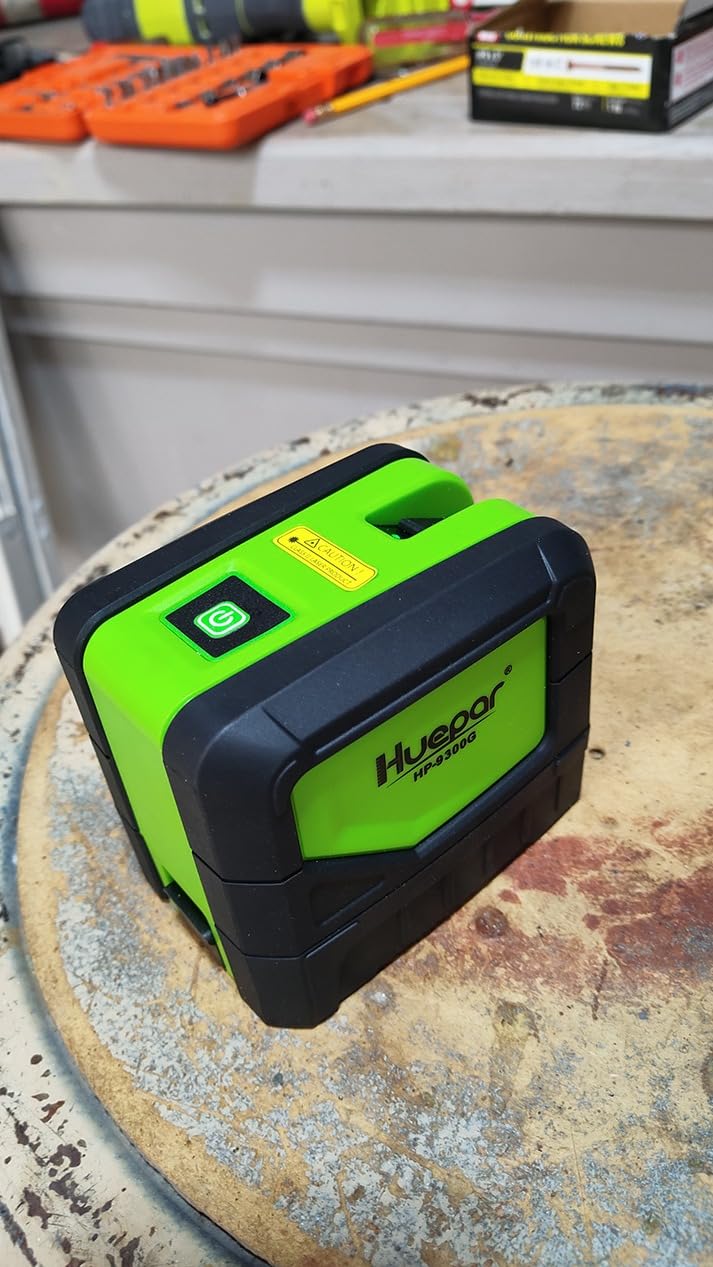
The M-9211G solves one problem better than anything else in this list: transferring a layout point from the floor to the ceiling. It is a 2-in-1 hybrid that projects a cross line plus both an up plumb point and a down plumb point, so you can mark a point on the floor, stand the stud under it, and shoot straight up to find where the header goes.
You do not need a 3-plane tool to do that job, and this is the cheapest way to do it well. The fan angles are unusually wide at 110 degrees horizontal and 180 degrees vertical, which is what produces the 82-foot line working distance and reduces how often you have to reposition in a long room.
The green diode at 510 to 530 nanometers is rated at least twice as bright as red on the same power source, the smart pendulum self-levels within 4 degrees and flashes when it goes out of range, and manual mode locks the lines at any angle if you do need a slope. At 3.15 by 2.52 inches it is genuinely pocketable, which matters on a ladder.
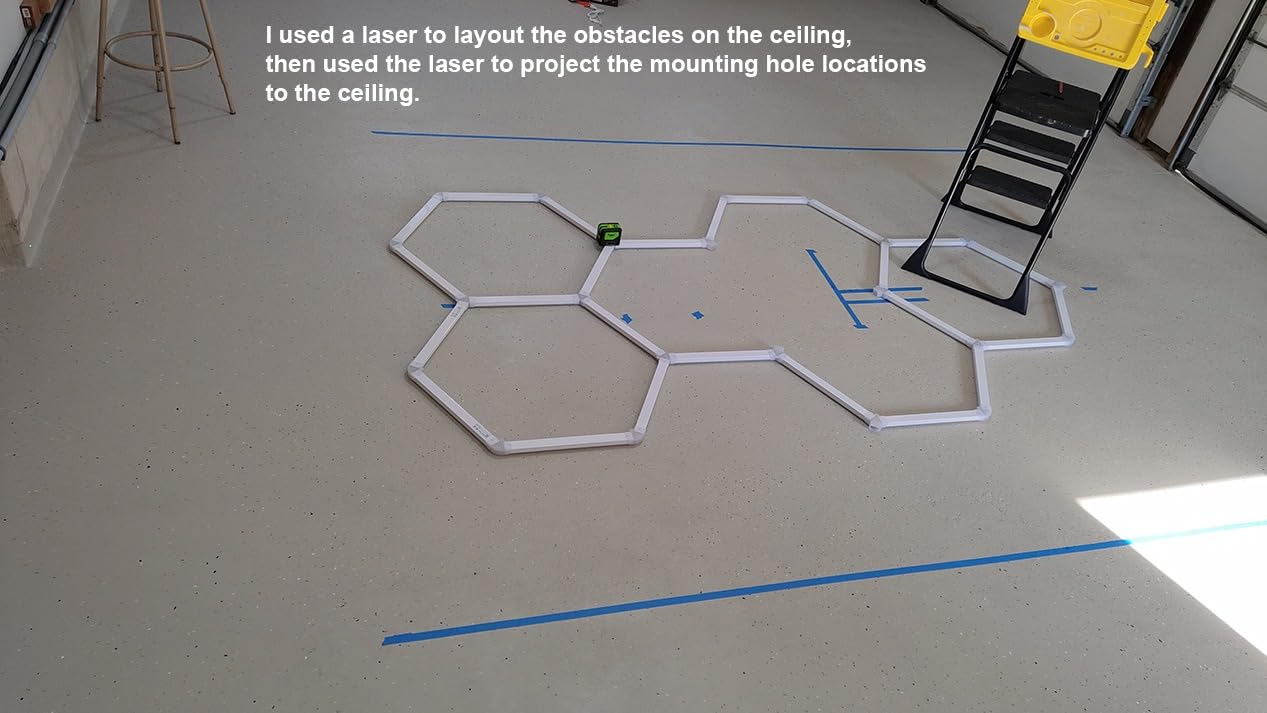
Accuracy and Runtime Compared With the Rest of the List
The published cross-line accuracy is plus or minus 1/9 inch at 33 feet, with the up point at 1/13 inch and the down point at 1/9 inch over the same distance. That is a real but modest number. Across a 10-foot run it works out to roughly 0.03 inch of allowed drift, which is fine for layout, and it is worth knowing that newer 4-plane tools in the same class are now quoting 1/8 inch at 30 feet.
Beam working time is up to 6 hours, which covers a solid morning of framing but trails the 8 to 12 hours you get from the rechargeable units. The warranty is 12 months, extendable to 24 with registration, which is the second-shortest coverage in this roundup.
What You Have to Add Yourself
Nothing else is in the box. No tripod, no wall bracket, no hard case. For a framing workflow that means the tool cannot go straight into service on a wall, and you need at least a wall clip or a small tripod to use it above floor level.
Because it projects only two lines, squaring a partition means repositioning rather than switching planes. That is the trade you make for the plumb points, and for a single-wall job it is a trade most framers would take.
Best for Plumb Transfer on One Wall at a Time
Choose the M-9211G when you are framing a single wall, need reliable floor-to-ceiling point transfer, and want something small enough to work from a ladder. The 4-degree self-leveling range is the widest in this list, which gives you more tolerance on a crooked floor.
Skip It If You Are Squaring a Whole Room or Need Full-Day Runtime
Skip it if you need horizontal reference on multiple walls at once, or if you are framing a full shift and do not want to carry spare batteries. Skip it also if the bare package is going to frustrate you, because you are buying the tripod and the case separately from day one.
9. CIGMAN CM-S01 – App-Controlled 3-Plane Setup With Long Battery Life
CIGMAN Green Laser Level 3×360° Self Leveling, App Control CM-S01
Bluetooth app control and pulse mode
Accuracy 1/9 inch at 33 feet
4000mAh, up to 12 hours
+ Pros
- Bright sharp green lines readable in bright indoor spaces
- 3×360 planes square a room without constant repositioning
- Integrated rechargeable battery runs about a year of regular use
- App control allows hands-free adjustment
- Still checks level against a bubble level after several drops
– Cons
- Magnetic wall mount is underpowered and triggers out-of-level flashing
- Not visible in bright sunlight beyond about a foot
- Accuracy drifts over long distances
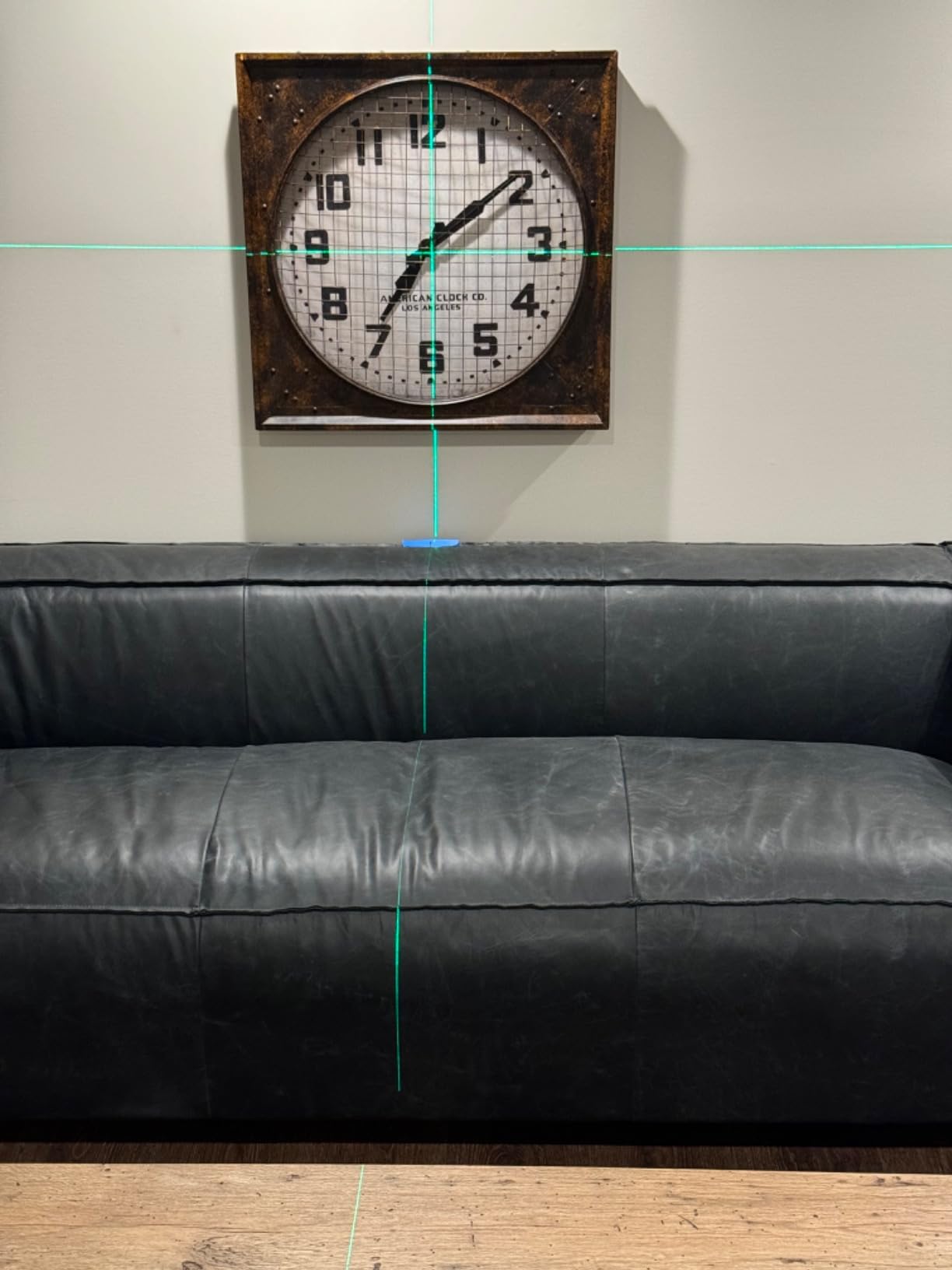
The CM-S01 is the pick if you like controlling your tool from your phone. Bluetooth app control lets you select vertical or horizontal orientation and toggle pulse mode from anywhere in the room, which is a genuine convenience in a finished space where you would otherwise be walking across a ladder to change a setting.
The projection itself is conventional and good: one 360-degree horizontal plane and two 360-degree verticals, plus or minus 1/9 inch at 33 feet, out to 98.4 feet, with pulse mode extending that to 164 feet. Reviewers confirm the accuracy against a bubble level for checking plumb, posts and outlet boxes, and report it still checks level after several drops.
Where it separates from its competitors is runtime. The 4000mAh pack runs up to 12 hours at maximum brightness and up to 56 hours at minimum, and owners report going about a year of regular use without buying a battery. Four brightness levels let you trade visibility for endurance mid-task, which is a useful dial nobody else in this list offers.
The Magnetic Wall Mount Is the Weakest Link
The most-cited flaw is the wall mount. It is underpowered for the weight of the unit, so when you hang it the laser’s own weight pulls it off the surface and the out-of-level flashing trips. In practice that means the included magnetic L base is fine for a quick reference and unreliable as a permanent mount for a full wall.
This is the same mount-versus-laser problem that shows up across this category, and it is worth naming plainly. The laser is not your weak link. What it sits on is.
Long-Distance Accuracy and Reliability Reports
Owners report accuracy drifting over long distances, and in bright outdoor sun the beam is not visible beyond about a foot without a receiver, so treat it as an indoor tool. A smaller but real set of reviews report units failing to power on or to charge within weeks, with customer support described as unhelpful. The battery is not replaceable, only rechargeable, which means that failure ends the tool.
Against that, plenty of owners report the unit still holds calibration after being knocked around, and the adjustable mount makes dialing in exact line placement straightforward once you accept that the magnet is a quick-reference feature rather than a fixed mount.
Best for Bright Rooms, Long Shifts and App Control
Choose the CM-S01 when you work in a bright interior where a red beam struggles, when you want phone control instead of buttons on a ladder, or when you want a battery that lasts a working year. The 12-hour runtime at full brightness is the longest quoted at maximum output in this roundup.
Skip It If You Need a Fixed Wall Mount or Outdoor Capability
Skip it if your workflow depends on sticking the laser to a steel stud or a wall and leaving it, because the mount will not hold. Skip it if you are framing exteriors in open sun, and skip it if you want serviceability, because the battery cannot be replaced.
10. ENRIPRT MM3-16G – 16 Lines and the Most Complete Mounting Kit in the List
16 Line Laser Level 360 Self Leveling,4D 4×360° Green lazer Leveler Tool
4×360 coverage, 16 green lines
Accuracy 1/8 inch at 30 feet
Two 2400mAh batteries, hot-swap
+ Pros
- Full 4×360 16-line reference planes at an entry-tier cost
- Rated accuracy of plus or minus 1/8 inch at 30 feet
- Two batteries let one charge while the other runs
- Green lines noticeably brighter than red indoors
- Manual mode projects lines at any angle for stairs
– Cons
- Beam visibility drops sharply in direct sunlight without a receiver
- Manual mode needs a two-second button hold that is easy to miss
- Lighter duty build that may not survive drops
The MM3-16G is the kit-value pick. Sixteen green lines across 4×360 coverage, plus a magnetic wall bracket, mini tripod, lifting base, 1/4-inch and 5/8-20 thread mounts, a wall panel, a green target plate, a remote, two batteries, a charger and a hard carry case. Almost nothing else in this roundup arrives that complete.
The accuracy rating of plus or minus 1/8 inch at 30 feet with a working distance up to 100 feet is the tightest published figure among the 16-line tools here, and the green diode is claimed to be roughly four times brighter than a red beam. Across 849 reviews the average sits at 4.5 stars, with 74 percent five-star, reflecting generally positive early sentiment.
The dual 2400mAh battery arrangement is the feature owners mention most: up to 8 hours with all 16 lines on, and you can run one pack while the other charges. For a basement job with no convenient outlet, that removes the only real interruption.
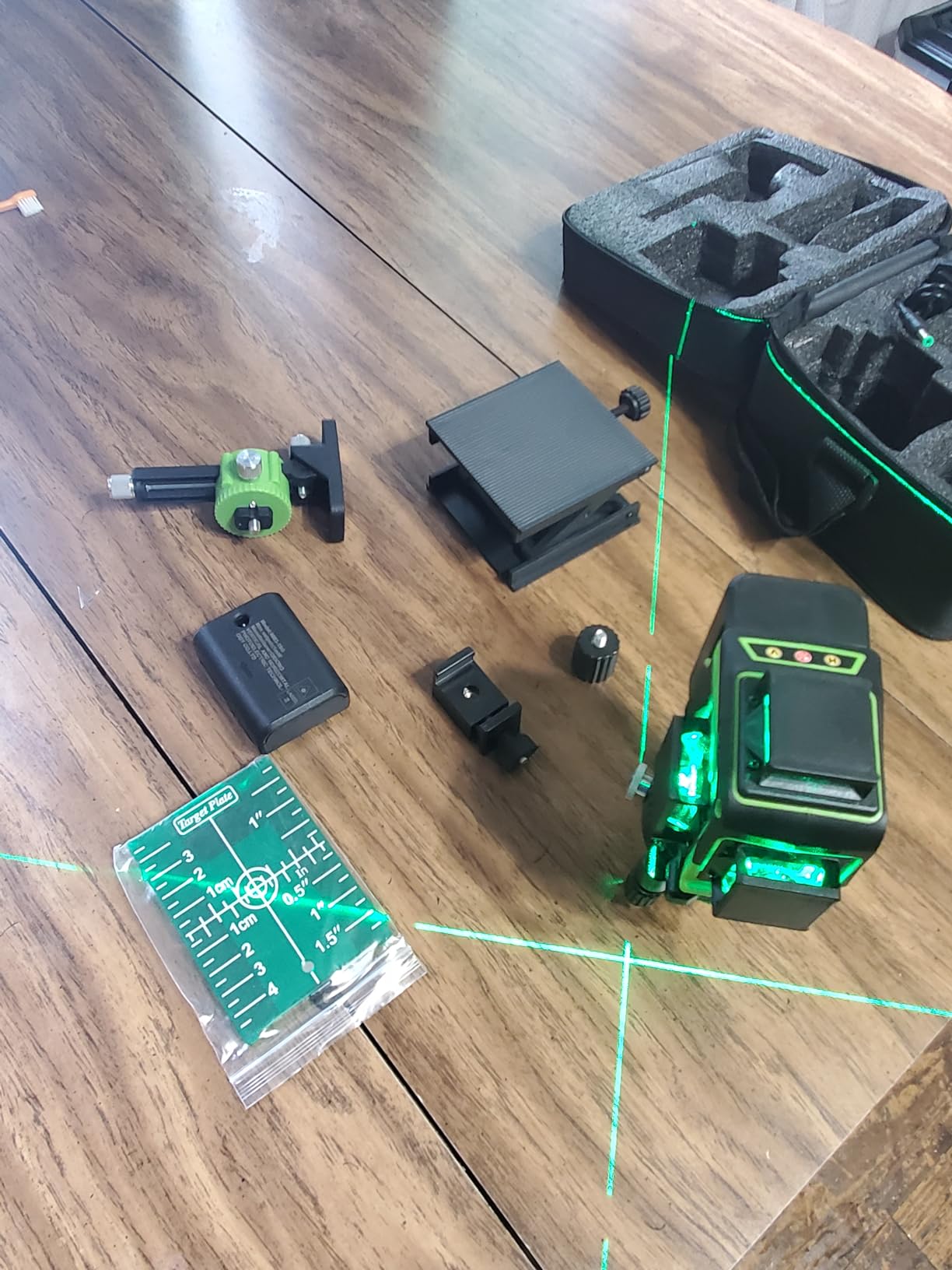
Manual Mode for Stairs and Roof Pitches
Holding the center button for two seconds switches the unit to manual mode, which projects lines at any angle. That covers stair stringers, rafter layout and roof pitches, which several tools in this list cannot do at all. The catch is that the two-second hold is easy to miss, so you will press it once, get nothing, and press it longer.
Self-leveling works within plus or minus 3 degrees, which is a reasonable window for an uneven slab, and the tool flashes or alarms when it exceeds that.
Where the Entry Tier Shows
The metal and plastic build is lighter duty than a premium cross-line, and reviewers note it may not survive drops. Most importantly, the accuracy figure is a rating rather than a verified result: buyers report the number but few cite an independent comparison, so treat plus or minus 1/8 inch at 30 feet as a manufacturer claim until you check it yourself against a hand level.
Beam visibility drops sharply in direct outdoor sunlight without a receiver. Indoors, the green lines are noticeably brighter than red in ordinary lighting, which is where this tool earns its place.
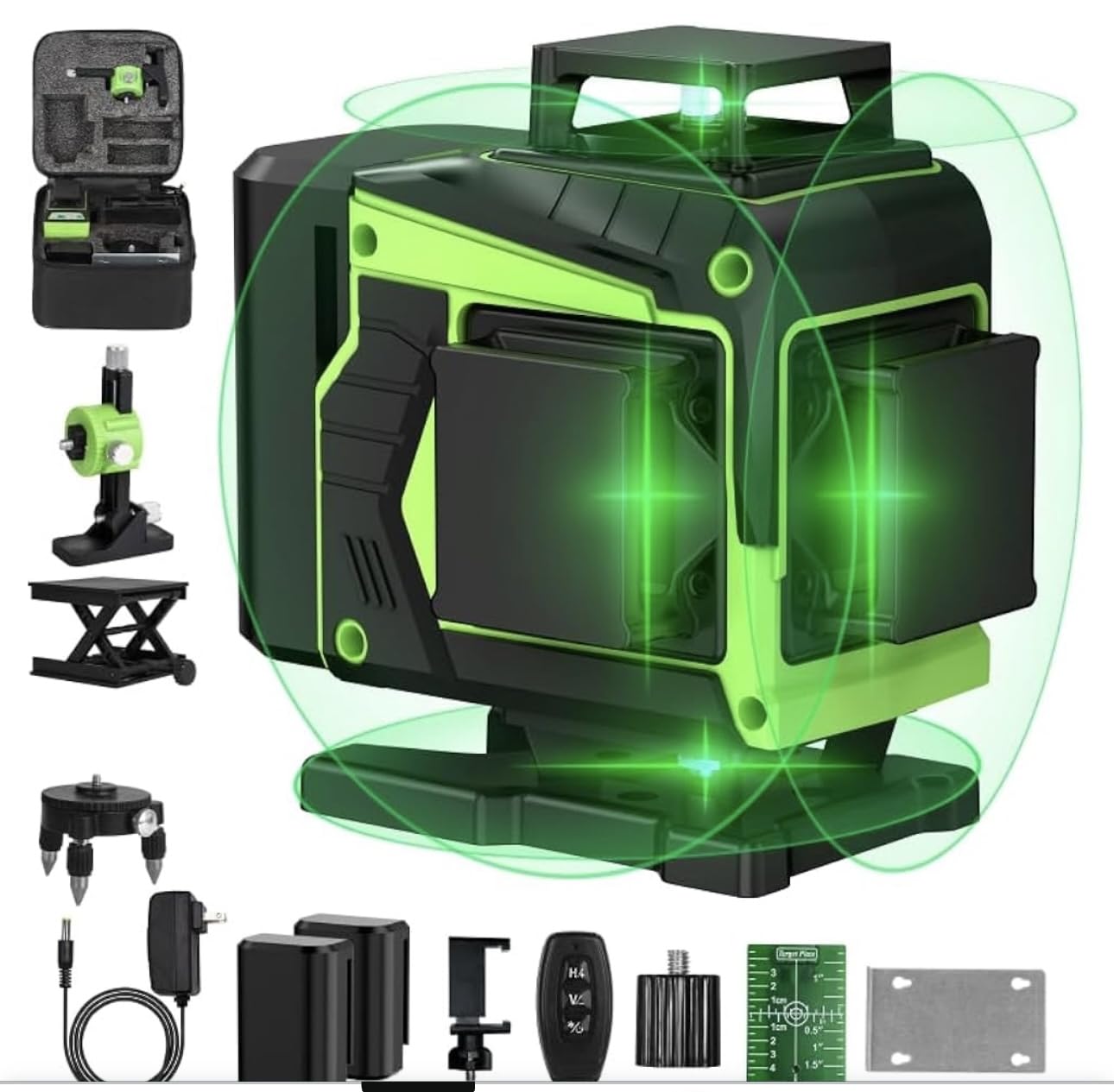
Best for Basement Builds and Anyone Starting From Zero
Choose the MM3-16G if you are building a basement from bare floor, need sloped lines for stairs, and want a complete mounting kit without sourcing a tripod, a bracket and a case separately. The IP54 rating suits a dusty framing environment.
Skip It If Accuracy Is the Only Thing That Matters
Skip it if you need a line you can stake your name on at 30 feet, or if the tool will live in a truck bed. The single strongest argument for stepping up is that the competing tools in this list have had their accuracy confirmed against hand levels and professional references, and this one has not. Check it before your first wall, not after.
Which Laser Level for Which Framing Job
Matching the tool to the task matters more than matching the tool to a specification chart. Below is how the ten picks map onto the framing jobs that actually come up on site.
Setting a straight top plate along an existing wall: the DEWALT DW088K. A cross line gives you the horizontal reference you need, and the integrated magnet is a bonus if the wall is steel. If you want a green beam in a bright room, the Huepar M-9211G is the smaller, cheaper option.
Squaring a partition into an existing room: the CIGMAN CM-701 or the Huepar HM03CG. Both project a full 360-degree horizontal plane, so the reference lands on three walls at once instead of requiring you to reset the tool. The CM-701 wins on battery endurance; the HM03CG wins on warranty coverage and build.
Transferring plumb from floor to ceiling: the Huepar M-9211G for a single wall, or the Klein Tools 93LCLS if you also need a hard case and ceiling grid work. Both give you a dedicated plumb spot rather than forcing you to read the edge of a vertical line.
Framing a basement with a near-floor sole plate: the Takamine GM160. Its second horizontal plane projects a line 1/2 inch off the ground, which lets you snap a sole plate and then a header line from the same setup position.
Working alone, overhead, marking ceiling joists: the IKOVWUK B1-12. A remote with a 16-foot through-wall range means you never climb to the unit. The CIGMAN CM-S01 is the alternative if you would rather use a phone and want 12 hours of runtime at full brightness.
Steel stud or light-gauge metal framing: the DEWALT DW088K first, because the rare-earth bracket grips metal studs, corner bead and tie plates. The Huepar HM03CG and the IKOVWUK B1-12 work in metal framing too, but their magnetic brackets are heavier and more likely to creep under vibration.
Stairs, vaulted ceilings or any raked line: the ENRIPRT MM3-16G or the Huepar M-9211G. Both have manual mode. The Klein Tools 93LCLS cannot do it at all, because locking its pendulum switches the laser off.
Hanging pictures, mirrors and curtain rods only: the BLACK+DECKER BDL220S, and nothing more expensive. The moment a stud enters the picture, move up to a self-leveling cross line.
How to Choose a Laser Level for Framing Walls
What a Laser Level Actually Does During Framing
A laser level projects a reference line so you can lay out without chalk drift and without a second person holding a string. In practice it replaces three things: the chalk line for the top plate, the plumb bob for transferring points between floor and ceiling, and the 3-4-5 triangle for squaring a partition. It does not replace the speed square for marking stud spacing, and it does not level the floor.
That distinction matters because the most common disappointment is buying a level expecting it to level a wall. It does not. It tells you where level and plumb actually are, and the framing still has to be built to it.
Cross Line Versus 3-Plane Versus 4D Versus Rotary
A cross-line laser projects one horizontal and one vertical line. That is enough for a single wall and not enough to square a room. A 3-plane laser, sometimes sold as 3×360, adds a full 360-degree horizontal plane, which is what makes whole-room layout possible from one setup position.
A 4D tool adds a second horizontal plane, usually one projecting close to the floor, giving 16 lines. That extra near-floor plane is the useful one for basement sole plates and for cabinets set directly on the slab. A rotary laser is a different class of tool entirely, built for grading, drainage and concrete, and it is the wrong instrument for interior framing. A Fine Homebuilding forum thread on choosing a rotary laser has been ranking on framing queries for years, which tells you how often people get this wrong.
Green Versus Red Beams
Human vision peaks in the green-yellow part of the spectrum, so a 520 nanometer green line looks dramatically brighter than a 650 nanometer red line at the same power. Manufacturers of the green tools here rate them at two to four times brighter than red. Indoors, in a lit room, that gap is decisive and it is why most three-plane options in this list are green.
Red still wins on price and on runtime, and red remains perfectly usable in a framed interior. Choose red when you are working in a controlled space on a budget. Choose green the moment you are framing a room with daylight, working in a large open space, or trying to see a line on a dark surface at distance.
What Accuracy Numbers Mean in Real Wall Runs
Accuracy specs are always quoted at a distance, and that distance is rarely the distance you are working at. The useful move is to scale the figure down. A spec of plus or minus 1/8 inch at 30 feet gives you about 1/24 inch of allowed drift across a 10-foot run and about 1/12 inch across 20 feet. A spec of plus or minus 1/9 inch at 33 feet works out to roughly 0.03 inch over 10 feet.
Put that in context. A 2×4 wall plate is 3.5 inches wide, and drywall is 1/2 inch or 5/8 inch thick. Any of these figures is comfortably inside what the framing can absorb, which is why the tool is almost never the reason a wall comes out wrong. Marking accuracy, mount stability and whether the tool was actually level when you snapped the line are the reasons.
Self-Leveling Range and the Manual-Mode Trap
A self-leveling laser hangs an internal pendulum on magnets. It swings until it matches gravity, so the line is true without you leveling the tool by hand. The stated range, commonly plus or minus 3 or plus or minus 4 degrees, is how far you can tilt the tool before it stops trusting itself.
Past that range the beam flashes or an alarm sounds, and that is a feature. On an uneven basement slab, a wider range gives you more room to work before you need to shim. The four-degree tools here are the most forgiving; the three-degree tools are tighter but more honest about telling you when the floor is out.
The trap is manual mode. Engaging it locks the pendulum, which stops self-leveling. If you lock the tool to get a sloped line, forget to unlock it, and then mark a supposedly level line, you will produce a crooked wall and blame the laser. Users on r/electricians describe this exact sequence as a recurring complaint. Check for the flashing indicator before you trust any line, every time you pick the tool up.
Mounting: Tripods, Magnetic Brackets, Wall Clips and Threads
The mount decides whether you have a usable tool. A laser is only as level as its support, and the most common failure we see is a tool balanced on a stack of books or an unstable mini tripod. Every unit in this list has a 1/4-20 thread, which is the standard tripod interface, so a decent tripod solves most mounting problems at once.
For the question of whether a laser level sticks to the wall: yes, with the right hardware. A magnetic bracket works on steel studs, metal track and ceiling grid, and a wall clip or a screw-fixed bracket works on drywall. The DEWALT DW088K has the magnet integrated into the body. The Takamine GM160 uses a multi-part adjustable bracket that fixes by magnet or by screws, and its rotating base carries both 1/4-20 and 5/8-11 threads. The Klein Tools 93LCLS ships a second clamp for ceiling grid specifically. The Huepar HM03CG bracket has 1/4-20 and 5/8-11 threads and two nail holes, which is the closest thing here to a permanent fix.
Know the limits of magnets. Thin drywall corner bead will not hold a strong magnet, and a heavy unit on an extended magnetic arm can creep or drop with vibration. Several reviews in this roundup describe exactly that, which is why several owners end up on a tripod.
Power Source: AA, Rechargeable or Shared Platform Packs
There are three power models here and the choice is a real trade. AA cells cost nothing and mean zero downtime, but six hours of beam time is a morning. A USB-C rechargeable pack gives 8 to 12 hours per charge and eliminates battery buying entirely, at the cost of a non-replaceable pack. A 12V or 18V tool-platform laser uses the same packs as the rest of your kit, which is the choice tradespeople on r/Construction describe making almost automatically.
None of the ten tools here runs on a shared 12V or 18V platform, so if you already own DeWalt, Milwaukee, Bosch or Klein packs, the closest matches in behavior are the cross-line tools with integrated mounting, and you should factor pack compatibility into your own shortlist. If you are buying your first layout laser, a rechargeable unit is the least annoying long-term choice.
Receivers, Pulse Mode and Outdoor Work
A receiver, also called a detector, is a separate accessory that picks up the pulsing beam and gives you a numeric readout. Almost every tool here supports pulse mode, and most quote an extended range with a detector: 50 meters for the CIGMAN CM-701, 200 feet for the Huepar HM03CG and the Takamine GM160, 164 feet for the CM-S01, and 165 feet for the DEWALT DW088K.
Two cautions. The detector is sold separately in most cases, so the outdoor range on the box is not the outdoor capability in your hands. And indoor range is what matters for framing. A 100-foot indoor figure tells you nothing about whether you can see the line at 30 feet in direct sun, which is why the red tools and the green tools in this list receive the visibility ratings we gave them.
Durability and Laser Safety
IP54 means protection against dust and water ingress under limited conditions, which is the right rating for a framed interior and a basement. IP65 adds protection against water jets. The BLACK+DECKER unit in this list carries a stronger laser class than the rest, and that deserves a specific note.
Most of these tools are Class 2, meaning output under 1 milliwatt and labeled to IEC 60825-1, where brief incidental eye exposure is not intended to be hazardous. The BLACK+DECKER BDL220S is Class 3R at 5 milliwatt or less, a higher output class. The rule is the same for both in practice: never look directly into the beam, never point it at another person’s eyes, and keep it out of the sightline of anyone working at the far end of the room. Check that the class label is present on any laser before you buy it.
Frequently Asked Questions
What is the best laser level for framing walls?
A self-leveling three-plane green line laser is the best type for framing walls, because the 360-degree horizontal plane sets a top-plate line on every wall at once and the two vertical planes transfer plumb from floor to ceiling. Our pick is the DEWALT DW088K for single-wall and steel stud work, and the CIGMAN CM-701 or Huepar HM03CG when you are squaring a partition across a whole room.
Do I need a 3-plane laser to frame a wall?
No, not for a single wall. A cross-line laser projects one horizontal and one vertical line, which is enough to mark a top plate and transfer a point. You step up to a 3-plane tool when you are squaring a partition into an existing room and need a horizontal reference on more than one wall without resetting the tool. A 4D tool adds a near-floor plane, which matters when you are snapping a sole plate on a basement slab.
Is there a laser leveler that sticks to the wall?
Yes, with the right hardware rather than the built-in magnet alone. Magnetic brackets hold on steel studs, metal track and ceiling grid, and wall clips or screw-fixed brackets hold on drywall. Watch the limits: a strong magnet will not hold thin drywall corner bead, and a heavy unit on an extended magnetic arm can creep or drop with vibration. Most framers end up using a tripod with a 1/4-20 thread, which every tool in this roundup has.
Green or red beam for indoor framing?
Green is easier to see indoors. Human vision peaks in the green-yellow range, so a 520 nanometer green line reads dramatically brighter than a 650 nanometer red line at the same power, and manufacturers rate these green diodes at two to four times brighter. That gap matters in a room with daylight. Red remains fine in a controlled interior and costs less to run, so it is a reasonable choice for an enclosed build.
How accurate does a laser level need to be for framing?
Less accurate than most spec sheets suggest. A rating of plus or minus 1/8 inch at 30 feet works out to about 1/24 inch of allowed drift across a 10-foot run, which is far inside what the framing absorbs. The errors that actually matter come from a crooked mount, an unlocked pendulum left in manual mode, or a chalk line drawn from a sagging string. Check the tool against a hand level at the start of each job.
The Right Laser Level for Your Framing Job
There is no single best laser level for framing walls, because framing is three jobs wearing one name. If you are framing one wall at a time in steel or setting a straight top plate, the DEWALT DW088K is the pick, with a 4.7 rating across more than 9100 reviews and an integrated magnetic bracket that grips metal studs.
If you are squaring a partition into an existing room, you need a full horizontal plane, and the CIGMAN CM-701 or the Huepar HM03CG are the two to choose between. Pick the CM-701 for rechargeable endurance, or the HM03CG for a five-year warranty and a harder body. If you are framing a basement and need a line near the slab, the Takamine GM160 adds the fourth plane. If you are working alone overhead, the IKOVWUK B1-12 or the CIGMAN CM-S01 lets you change beams from the floor. And if your project is still pictures and shelves, the BLACK+DECKER BDL220S is all you need.
Whatever you pick, spend a moment on the mount rather than the beam, and check that the pendulum is unlocked and not flashing before you mark a line. That habit, more than any spec on any box, is what keeps walls square in 2026.
Leave a Reply