
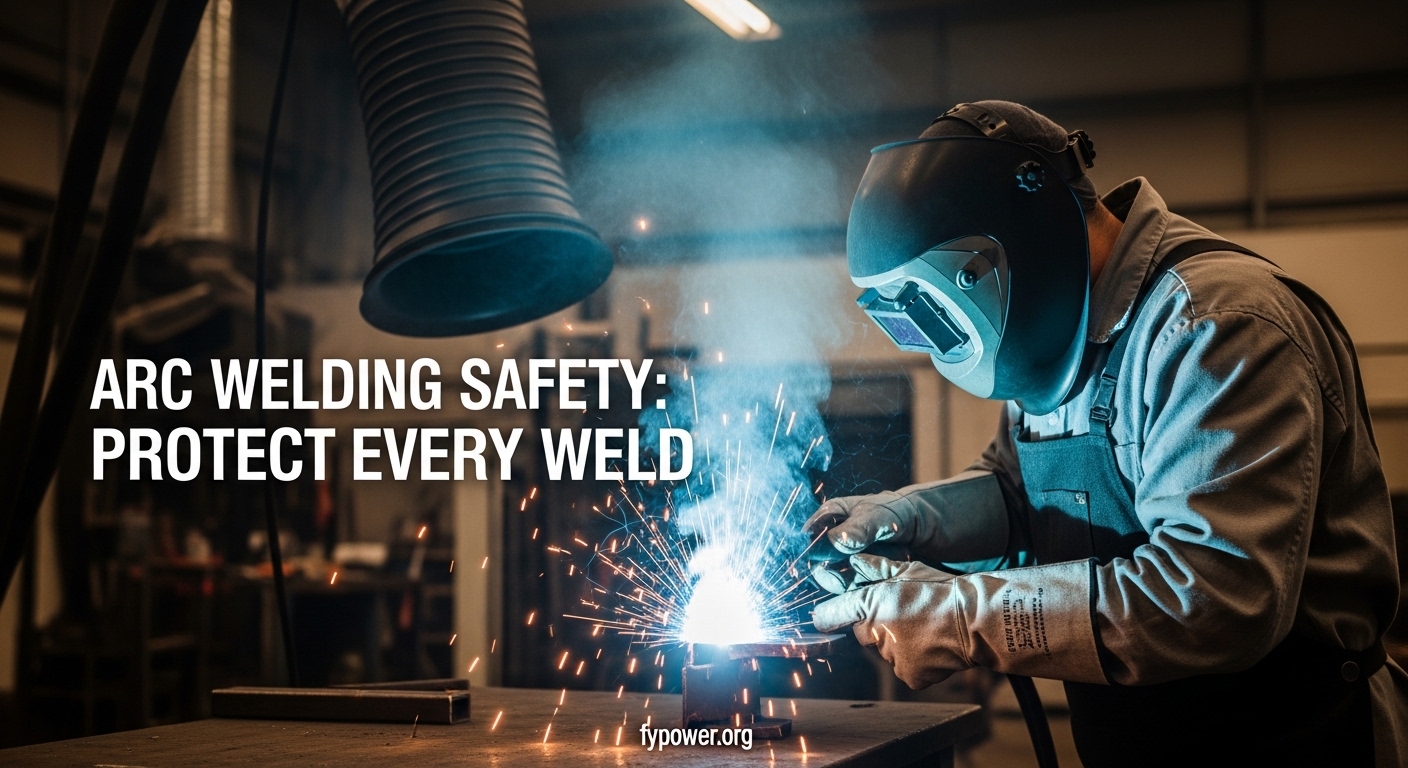
I still remember the day my welding instructor told our class about a local fabricator who spent three days in the hospital because he skipped his helmet for “just one tack weld.” That single mistake cost him $12,000 in medical bills and two months of lost work. After 10 years in metal fabrication, I’ve seen welders make every safety mistake in the book. Some learned the hard way. Others got lucky.
Arc welding creates temperatures up to 6,500 degrees Fahrenheit and generates invisible UV radiation that can damage your eyes in less than a second. The arc flash is brighter than the sun, and the fumes contain metal particles that accumulate in your lungs over years of exposure. I’ve worked in production shops, custom fabrication, and my own home garage. The safety principles never change, but I see beginners skip them constantly.
Arc welding safety requires comprehensive protection: proper PPE including a helmet with correct shade lenses, fire-resistant clothing, leather gloves, and steel-toed boots; adequate ventilation or respiratory protection; electrical safety through proper grounding and dry conditions; fire prevention with a 35-foot clearance from flammables; and following OHA standards 1910.254 and ANSI Z49.1.
Quick Summary: Arc welding generates five primary hazards: electric shock, UV/IR radiation, welding fumes, fire, and burns. Full protection requires rated PPE, proper ventilation, grounded equipment in dry conditions, fire extinguisher access, and following established safety procedures every single weld.
The 5 Critical Arc Welding Hazards Explained
Arc welding creates five primary hazards: electric shock from high voltage (can be lethal), UV and infrared radiation causing arc eye and skin damage, toxic welding fumes leading to long-term health issues, fire and explosion risks from sparks and hot metal, and burns from contact with hot materials.
Understanding these hazards is the first step toward protecting yourself. Let me break down each one based on what I’ve seen in real workshops.
Electric Shock: The Silent Killer
The welding output circuit ranges from 20 to 80 volts in open-circuit conditions. That might not sound like much compared to household outlets, but it becomes extremely dangerous when your skin is wet or you’re touching grounded metal. The primary shock hazard comes from the output circuit, not the input power.
I knew a welder who got knocked across the room when his sweaty forearm touched the workpiece while changing electrodes. He was lucky. Another fabricator in my city wasn’t—he died from a similar incident. Secondary voltage shock kills an estimated 50 workers annually in the United States.
Never touch live electrical parts with bare skin. Keep your gloves dry. Inspect cables for exposed conductors before every use. Use insulation mats when welding on or near grounded surfaces. And never work in wet conditions—water drastically reduces your body’s resistance to electrical current.
UV Radiation and Arc Eye
The welding arc produces intense ultraviolet radiation that causes photokeratitis—commonly called arc eye or welder’s flash. It’s essentially a sunburn on your corneas. I’ve experienced it twice. Both times, I woke up at 2 AM feeling like someone poured sand in my eyes.
Symptoms appear 6-12 hours after exposure. Your eyes become extremely sensitive to light, tear uncontrollably, and feel like they’re full of grit. The condition is temporary but miserable. Repeated exposure can cause cataracts and permanent vision damage.
UV radiation also damages exposed skin. I’ve seen welders with what looks like a severe sunburn after just 15 minutes of welding without proper coverage. Long-term, this causes premature aging and increases skin cancer risk.
Arc Eye (Photokeratitis): A painful eye condition caused by unprotected exposure to UV radiation from welding arcs. Symptoms include severe eye pain, light sensitivity, excessive tearing, and the sensation of foreign objects in the eyes. Symptoms typically appear 6-12 hours after exposure.
Welding Fumes and Long-Term Health
Welding fumes contain a complex mixture of metal oxides, gases, and particulates. The exact composition depends on the base metal, filler material, and any coatings present. Common components include manganese, chromium, nickel, and zinc.
Manganese exposure is particularly concerning. Long-term inhalation can cause manganism—a neurological condition similar to Parkinson’s disease. I’ve worked with older welders who developed hand tremors and slow movement after decades of welding without respiratory protection.
Zinc fumes from galvanized steel cause metal fume fever—flu-like symptoms that appear 4-12 hours after exposure. I’ve had it once. Fever, chills, nausea, and muscle aches kept me in bed for 24 hours. It’s temporary but miserable, and repeated episodes indicate overexposure.
Fire and Explosion Risks
Every welding operation throws sparks—sometimes up to 35 feet from the work area. These sparks can reach 2,500 degrees Fahrenheit and stay hot enough to ignite materials for considerable distances. I’ve seen sparks land in sawdust, through floor cracks, and on rags sitting 20 feet away.
Explosions are an even greater threat. Welding on containers that previously held flammable materials has killed countless workers. The heat from welding can vaporize residual flammable substances inside closed containers. The vapor expands, pressure builds, and—boom.
I personally investigate every container before welding. I look for labels, smell for odors, and test with electronic gas detectors when available. When in doubt, I fill the container with water or inert gas before welding. There’s no project worth dying for.
Burn Hazards
Molten metal, hot slag, and heated workpieces cause immediate and severe burns. The weld pool stays liquid at 2,500-3,000 degrees. Slag can remain hot enough to burn through leather boots an hour after welding.
I have burn scars on both forearms from early in my career. One happened when I rested my arm on a piece I’d welded 20 minutes earlier. Another came from slag that dropped inside my boot cuff. These injuries were painful and preventable with proper positioning and full coverage clothing.
Personal Protective Equipment (PPE): Complete Guide
Arc welding PPE requirements include: welding helmet with appropriate shade lens (shade 10-14 for most applications), safety glasses underneath, flame-resistant clothing covering all skin, leather welding gloves, steel-toed boots, and respiratory protection when ventilation is inadequate.
Proper PPE is your last line of defense. When engineering controls and safe work practices fail—which they will at some point—your gear is what stands between you and injury. Let me walk through each piece of essential equipment.
Head and Face Protection
The welding helmet is your most critical piece of PPE. It protects your face from sparks and spatter, your eyes from UV radiation, and provides shade to see the weld pool clearly. I’ve used everything from $30 fixed-shade helmets to $600 auto-darkening models.
Auto-darkening helmets have transformed the industry. Instead of flipping your helmet up and down constantly, the lens darkens automatically when you strike an arc. This reduces neck strain and improves precision. Good models react in 1/20,000 of a second—fast enough to prevent flash.
Shade selection is critical. Too light and your eyes strain. Too dark and you can’t see the workpiece. Here’s what I use for different processes:
| Welding Process | Amperage Range | Recommended Shade |
|---|---|---|
| Stick (SMAW) | Under 60A | Shade 7-8 |
| Stick (SMAW) | 60-160A | Shade 10 |
| Stick (SMAW) | 160-250A | Shade 12 |
| MIG (GMAW) | 60-160A | Shade 10 |
| MIG (GMAW) | 160-300A | Shade 12-13 |
| TIG (GTAW) | Under 50A | Shade 8-9 |
| TIG (GTAW) | 50-150A | Shade 10-11 |
| Carbon Arc Gouging | All amperages | Shade 14 |
Safety glasses are mandatory underneath your helmet. Sparks can bounce off your workpiece and find their way behind your helmet. I’ve had it happen. Now I always wear ANSI Z87.1-rated side-shield glasses. Clear polycarbonate lenses work for most applications.
Hand and Arm Protection
Welding gloves aren’t one-size-fits-all. Different processes require different gloves. I keep three types in my shop:
| Glove Type | Best For | Key Features |
|---|---|---|
| Stick/MIG Gloves | Heavy-duty welding | Thick leather, elbow-length, lined |
| TIG Gloves | Precision TIG welding | Thin, supple, finger dexterity |
| Driver Gloves | Material handling | Medium weight, good grip |
For Stick and MIG welding, I use heavy Elkskin or cowhide gloves that extend past my elbows. The extra length protects my forearms from radiant heat and UV radiation. These gloves are thick enough that I can’t feel small parts—I switch to lighter gloves for grinding and material handling.
TIG welding requires much more finger dexterity. I use thin goatskin or pigskin gloves that allow me to feel the torch and filler rod. They sacrifice some heat protection, but I can’t TIG weld effectively in thick gloves.
Body Protection
Your clothing creates a barrier against sparks, UV radiation, and burns. I’ve seen welders wear cotton t-shirts and wonder why they end up with sunburned arms. Synthetic materials are even worse—they melt into your skin when hit by sparks.
Wear natural fibers only. Cotton is acceptable for light work. Wool is better because it’s naturally flame-resistant and provides some insulation. For serious production work, invest in fire-resistant clothing treated with flame-retardant chemicals.
A welding jacket or cape is your best upper-body protection. Jackets cover your torso, arms, and neck. Capes cover your upper body but leave your arms free—great for TIG welding where you need mobility. I prefer jackets for Stick and MIG work.
Welding aprons protect your torso and thighs from spatter while leaving your arms free. They’re lighter than jackets and work well for bench work. I use one when doing lots of tack welding or position work where mobility matters.
Pants should cover your boots completely. Cuffs can catch sparks and let them fall inside your boots. I’ve seen this happen—it’s not fun. Heavy denim or canvas works well. For production welding, fire-resistant coveralls provide the best protection.
Foot Protection
Leather boots with steel toes are mandatory. Sparks will burn through athletic shoes in seconds. I’ve seen the aftermath—a welder spent three weeks recovering from severe foot burns because he wore sneakers “just for a quick weld.”
High-topped boots provide ankle protection and prevent sparks from entering the top. Metatarsal guards add protection for the top of your foot—essential when doing overhead work or heavy fabrication where falling slag is common.
Electrical hazard-rated boots add insulation against electrical shock. They’re worth the extra cost if you weld in damp conditions or work on grounded surfaces frequently.
Hearing Protection
Arc welding generates 85-100 decibels of noise. Grinding and cutting push that well over 100 dB. Repeated exposure causes permanent, irreversible hearing damage. I have mild tinnitus from my early years of welding without ear protection.
Use earplugs for welding alone. Add earmuffs when grinding or cutting. Combined protection provides better noise reduction. Electronic earmuffs amplify quiet sounds while blocking loud noise—great for workshop environments where you need to hear instructions.
Electrical Safety: Preventing Shock Hazards
Prevent electric shock when welding by: inspecting cables for damage before use, keeping work area dry, using dry insulation mats, wearing dry gloves, never touching electrode holders with bare skin, ensuring proper grounding, and turning off power before changing parts or adjusting settings.
Electrical safety deserves your complete attention. The welding machine produces lethal current under the right conditions. I’ve been shocked twice—both times because I got careless. Learn from my mistakes.
Proper Grounding Procedures
The workpiece must be properly connected to the welding machine’s work terminal. This is called the work lead or ground clamp. A poor connection causes the welding current to find alternate paths—possibly through you.
I always connect my ground clamp to clean, bare metal. Paint, rust, and coatings are insulators. If the clamp won’t bite into the material, I grind or wire brush the contact area. For large assemblies, I connect multiple ground clamps to ensure good conductivity throughout.
Never ground to structures that might carry current unexpectedly. I once saw a welder ground to a pipe that ran to another building. Unknown to him, that pipe was bonded to electrical conduit elsewhere. When he struck an arc, the current found multiple paths and created a shock hazard throughout both buildings.
Working in Wet Conditions
Water and electricity don’t mix. This is non-negotiable. Never weld in rain, standing water, or wet conditions. If you must weld outdoors in damp weather, take these precautions:
- Use dry rubber mats or wooden platforms to stand on
- Keep all electrical connections elevated and dry
- Wear dry rubber gloves underneath your welding gloves
- Use a ground fault circuit interrupter (GFCI) if available
- Consider postponing the work until conditions improve
Sweat is also conductive. In hot weather, I keep a rag handy to wipe my hands and arms before touching electrical connections. I change gloves when they become soaked through.
Equipment Inspection
Inspect your welding equipment before every use. Damaged insulation, exposed conductors, and worn connections are shock hazards waiting to happen. I spend two minutes checking my cables before every welding session. Those two minutes have prevented at least three potential shocks over the years.
Check for:
- Cracks or cuts in cable insulation
- Exposed conductors at connection points
- Damage to electrode holders or torches
- Loose or corroded connections
- Worn trigger switches on MIG guns and TIG torches
Replace damaged equipment immediately. Don’t tape over cut cables—that’s a temporary fix at best and a false sense of security at worst.
Ventilation and Respiratory Protection
Adequate ventilation requires at least 2,000 cubic feet per minute (CFM) of airflow for general welding areas, or local exhaust ventilation capturing fumes at the source with a minimum capture velocity of 100 feet per minute. Use a NIOSH-approved respirator when ventilation is inadequate or welding toxic materials like stainless steel, galvanized steel, or coated metals.
Welding fumes are insidious. You can’t see most of them, and you often don’t notice the effects until years of exposure have accumulated. I take respiratory protection seriously—my lungs have to last me the rest of my life.
Natural Ventilation
Natural ventilation works for light welding in open areas. Open doors and windows on opposite sides of your workspace to create cross-ventilation. Position fans to blow fumes away from your breathing zone—not toward the weld or they’ll interfere with shielding gas.
For a typical home garage, I recommend at least two sources of intake and exhaust. A 16-foot garage door plus a window on the opposite wall provides decent cross-ventilation for light Stick or MIG welding. This setup is adequate for welding mild steel for short periods.
Mechanical Ventilation
For production welding or confined spaces, natural ventilation isn’t enough. You need mechanical solutions:
| Ventilation Type | Best For | Airflow Required |
|---|---|---|
| General Exhaust | Large open shops | 2,000+ CFM total room air changes |
| Local Exhaust | Fixed welding stations | 100-150 CFM at capture point |
| Portable Fume Extractor | Flexible positioning | 150-300 CFM adjustable |
| Downdraft Table | Bench welding | 100-150 CFM through table surface |
Local exhaust ventilation captures fumes at the source—the most effective approach. A flexible arm fume extractor positioned 6-12 inches from the weld zone captures the majority of fumes before they disperse. I use one in my home shop for any welding session longer than 15 minutes.
Respiratory Protection
When ventilation isn’t adequate or you’re welding materials that produce toxic fumes, respiratory protection is mandatory. I use respirators for:
- Stainless steel (contains chromium and nickel)
- Galvanized steel (zinc fumes)
- Painted or coated materials
- Confined spaces
- Extended welding sessions in any material
For most welding, a half-face respirator with P100 filters provides adequate protection. These filters capture 99.97% of particles down to 0.3 microns. Replace filters regularly—when breathing becomes difficult or after 40 hours of use, whichever comes first.
For high-production environments or confined spaces, consider a powered air-purifying respirator (PAPR). These systems use a blower to pull air through filters and deliver it to your helmet. They’re more expensive but much more comfortable for all-day use.
Metal Fume Fever: A flu-like condition caused by inhaling metal oxide fumes, typically from zinc oxide when welding galvanized steel. Symptoms include fever, chills, nausea, muscle aches, and headache. Symptoms appear 4-12 hours after exposure and typically resolve within 24-48 hours. Repeated episodes indicate excessive exposure.
Fire Prevention and Hot Work Procedures
Fire prevention requires maintaining a 35-foot clearance from flammable materials, keeping a working fire extinguisher within 10 feet of the welding area, using fire-resistant welding blankets to cover combustibles, assigning a fire watch for at least 30 minutes after welding completes, and obtaining a hot work permit when required by your workplace or local regulations.
I’ve responded to three welding-related fires in my career. Two were small—one extinguisher handle and done. The third burned through an exterior wall and caused $80,000 in damage. All three were preventable.
Establishing a Safe Welding Area
Before you strike an arc, clear the area. This means a 35-foot radius in all directions. Remove or protect anything that can burn. I scan my welding area for:
- Paper, cardboard, and packaging materials
- Wood scraps and lumber
- Oil-soaked rags
- Gasoline, paints, and solvents
- Dry leaves and vegetation (for outdoor welding)
- Floor cracks and openings where sparks can fall
For flammable materials that can’t be moved, cover them with fire-resistant welding blankets. These are made from fiberglass or silica fabrics that can withstand direct flame. I use them when welding near vehicles, machinery, or building components that can’t be relocated.
Fire Extinguishers: Essential Equipment
Keep a fire extinguisher within 10 feet of your welding area. Know how to use it before you need it. The last thing you want to be doing during a fire is reading instructions.
For welding, I recommend an ABC-rated extinguisher with at least a 10-pound capacity. This classification covers:
- Class A: Ordinary combustibles (wood, paper, cloth)
- Class B: Flammable liquids (gasoline, oil, paint)
- Class C: Electrical fires
Check your extinguisher monthly. Verify the pressure gauge is in the green zone. Inspect the hose and nozzle for damage. Shake dry chemical extinguishers occasionally to prevent the agent from packing down.
The Fire Watch: When It’s Required
A fire watch is a person assigned to monitor for fires during and after hot work. They’re required when:
- Welding near combustible materials that couldn’t be moved
- Working in areas with concealed combustible spaces (walls, ceilings)
- Welding in confined spaces
- Required by workplace policy or local regulations
The fire watch continues for at least 30 minutes after welding stops. Many fires start well after the weld is complete because sparks smolder undetected. I’ve seen this happen—a spark landed in cardboard inside a cabinet and smoldered for 45 minutes before bursting into flame.
Hot Work Permits?
Commercial and industrial settings often require hot work permits for welding. These documents ensure that:
- The fire department is notified
- Flammable materials are removed or protected
- Fire extinguishers are present
- A fire watch is assigned
- Fire detection and suppression systems are functional
Even in home workshops, I recommend following hot work permit procedures. Treat your home with the same respect as a commercial facility. Your family and neighbors deserve the same protection as industrial workers.
Safe Work Practices: Your Daily Checklist
Safe welding practices include: inspecting equipment before use, wearing all required PPE, ensuring adequate ventilation, clearing flammable materials from a 35-foot radius, verifying proper grounding, keeping a fire extinguisher nearby, never welding in wet conditions, and following proper shutdown procedures after completing work.
Safety isn’t about what you know—it’s about what you do every single day. I’ve developed a checklist that I run through before every welding session. These habits have kept me safe through thousands of hours of welding.
Pre-Welding Safety Checklist
Before you strike an arc, complete these steps:
- Inspect your PPE: Check helmet lens for cracks, gloves for holes, boots for damage
- Check fire extinguisher: Verify it’s charged and accessible
- Clear the area: Remove combustibles within 35 feet
- Inspect welding equipment: Check cables, connections, and torch for damage
- Verify ground connection: Ensure work lead is securely attached to clean metal
- Assess ventilation: Confirm adequate airflow or prepare respirator
- Check for fire hazards: Look for openings where sparks could travel
- Protect bystanders: Set up welding screens or post warning signs
During Welding: Stay Alert
Maintain awareness while you weld. It’s easy to get focused on the weld bead and forget your surroundings. I make a conscious effort to:
- Monitor where sparks are landing
- Watch for smoke indicating hidden fires
- Stay aware of people entering the area
- Notice if ventilation becomes inadequate
- Pay attention to physical discomfort or overheating
Take breaks when needed. Fatigue leads to mistakes. I stop every hour for a few minutes to hydrate and assess my surroundings. In hot weather, I take breaks more frequently. Heat stress is real, and it impairs judgment.
Post-Welding Procedures
The job isn’t done when you finish welding. Follow these shutdown procedures:
- Turn off welding machine: At the machine, not just the gun trigger
- Release gas pressure: For MIG/TIG, close cylinder valve and bleed lines
- Inspect the work area: Look for smoldering materials
- Check adjacent areas: Sparks travel—look beyond immediate work area
- Continue fire watch: Wait 30-60 minutes before leaving unattended
- Store equipment properly: Coiled cables, secured cylinders, organized workspace
Confined Space Welding
Welding in confined spaces—tanks, vessels, pits, crawl spaces—requires extra precautions. These spaces have limited ventilation and restricted exits. Several welders die annually in confined space incidents.
Confined Space: An area large enough to enter and perform work, with limited or restricted means of entry or exit, and not designed for continuous human occupancy. Examples include tanks, vessels, pits, silos, bins, and crawl spaces. Confined spaces may contain hazardous atmospheres, engulfment hazards, or other serious safety risks.
Before entering a confined space for welding:
- Test the atmosphere: Use gas detectors to check for oxygen levels and toxic gases
- Ensure continuous ventilation: Provide fresh air intake and exhaust
- Have a rescue plan: Someone outside must be equipped and trained for rescue
- Use respiratory protection: Air-supplied respirator may be required
- Lockout/tagout equipment: Prevent unexpected activation of machinery
- Ground the workpiece: Eliminate electrical shock paths
- Use low-voltage equipment: Reduce shock hazard when possible
Emergency Response and First Aid
Despite every precaution, accidents happen. Knowing how to respond makes the difference between a minor incident and a tragedy. I keep first aid supplies in my shop and refresh my training annually.
Fire Response: Act Fast
If a fire starts while welding:
- Stop welding immediately: Turn off the machine
- Sound the alarm: Yell “FIRE” and activate alarms if available
- Attack small fires: Use extinguisher if fire is smaller than a trash can
- Evacuate for large fires: Don’t attempt to fight fires beyond your capacity
- Call emergency services: Dial 911 from a safe location
Remember the PASS method for using extinguishers:
- Pull the pin
- Aim at the base of the fire
- Squeeze the handle
- Sweep side to side
Electrical Shock: Immediate Action
If someone receives an electrical shock:
- Don’t touch the victim: You could become a second victim
- Turn off power: Shut down the welding machine or unplug it
- Call 911 immediately: Electrical shock can cause heart arrhythmia
- Check for breathing: Begin CPR if necessary and you’re trained
- Don’t move the victim: Unless in immediate danger from fire or further shock
Even if the victim appears fine, seek medical attention. Electrical shock can cause internal injuries and cardiac issues that aren’t immediately apparent.
Eye Injury: Arc Eye Treatment
If you suspect arc eye or flash burns:
- Remove contact lenses: If wearing them
- Flush eyes with water: Use saline or clean water for 15 minutes
- Avoid light: Stay in a darkened room or wear sunglasses
- Use cold compresses: Apply to closed eyes to relieve pain
- Seek medical attention: If symptoms are severe or persist
Arc eye typically heals within 24-48 hours. A doctor can prescribe antibiotic ointment to prevent infection and pain medication for comfort. Never ignore eye symptoms—delayed treatment can lead to complications.
Burn Treatment: Cool and Cover
For minor burns from welding:
- Cool the burn: Hold under cool running water for 10-15 minutes
- Remove constricting items: Rings, bracelets, or tight clothing near the burn
- Cover loosely: Use sterile gauze or a clean cloth
- Don’t apply ice: It can damage tissue further
- Don’t pop blisters: They protect against infection
- Seek medical care: For burns larger than your palm, deep burns, or burns on face/hands/genitals
Training, Certification, and Compliance
Safety knowledge is useless without continuous practice and reinforcement. I’ve been welding for 15 years and still attend safety training annually. Regulations and best practices evolve. Stay current.
OSHA Standards Overview
OSHA Standard 1910.254 covers welding, cutting, and brazing. Key requirements include:
- Fire prevention and protection measures
- Personal protective equipment requirements
- Health protection and ventilation standards
- Confined space procedures
- Equipment inspection and maintenance
Employers must provide training on hazards and protective measures. Employees must follow all safety procedures and use provided PPE. As a DIY welder, you are both employer and employee—hold yourself to professional standards.
AWS Certification Programs
The American Welding Society offers certification programs that include safety training. The Certified Welder (CW) and Certified Welding Inspector (CWI) programs both emphasize safety alongside technical skills. Even if you don’t pursue certification, the AWS safety resources are freely available and excellent.
Continuous Learning
Safety isn’t a one-time lesson. It’s a mindset developed through continuous learning and practice. I read safety bulletins, watch training videos, and learn from near-misses. Every close call is a lesson—if you pay attention.
Frequently Asked Questions
What are the hazards of arc welding?
Arc welding creates five primary hazards: electric shock from high-voltage equipment that can be lethal; UV and infrared radiation causing arc eye and skin damage; toxic welding fumes containing metal particles that can cause long-term health issues; fire and explosion risks from sparks and hot metal; and burns from contact with molten metal and heated workpieces.
What PPE is required for arc welding?
Arc welding PPE requirements include: a welding helmet with appropriate shade lens (typically shade 10-14), safety glasses with side shields, fire-resistant clothing covering all skin, leather welding gloves (heavy for Stick/MIG, lighter for TIG), steel-toed leather boots, and respiratory protection when ventilation is inadequate. Additional PPE may include hearing protection, welding aprons or jackets, and face shields for grinding.
How do you protect your eyes when arc welding?
Protect your eyes when arc welding by wearing a welding helmet with the correct shade lens for your process and amperage, using safety glasses underneath your helmet to block reflected UV radiation, and ensuring no gaps exist between your helmet and face. Never look at the arc without proper eye protection, even briefly. UV damage can occur in less than one second of exposure.
Is arc welding smoke dangerous?
Yes, arc welding smoke contains harmful metal oxides and gases that can cause both acute and chronic health problems. Short-term exposure can cause metal fume fever—flu-like symptoms from zinc oxide fumes. Long-term exposure to manganese, chromium, nickel, and other metals can cause neurological damage, respiratory issues, and increased cancer risk. Always use adequate ventilation or respiratory protection.
What type of gloves should be used for arc welding?
Glove selection depends on the welding process. For Stick and MIG welding, use thick leather gloves (Elkskin or cowhide) that extend past your elbows for maximum heat and spark protection. For TIG welding, use thin goatskin or pigskin gloves that provide finger dexterity for precise torch and filler control. Never use synthetic gloves—they melt when exposed to sparks or heat.
How much ventilation do you need for welding?
General welding areas require at least 2,000 cubic feet per minute (CFM) of airflow for adequate ventilation. Local exhaust ventilation should capture fumes at the source with a minimum capture velocity of 100 feet per minute. For confined spaces or welding toxic materials like stainless steel, mechanical ventilation or air-supplied respirators are mandatory. If you can smell fumes or see smoke lingering, ventilation is insufficient.
Can you weld without a helmet?
No, never weld without a helmet. The welding arc produces intense UV radiation that can damage your eyes in less than one second—a condition called arc eye or photokeratitis. Symptoms include severe pain, light sensitivity, and vision loss that appear 6-12 hours after exposure. Repeated exposure can cause permanent vision damage including cataracts. Always wear a properly rated welding helmet with the correct shade lens.
What are OSHA requirements for welding?
OSHA Standard 1910.254 covers welding, cutting, and brazing. Key requirements include: maintaining fire-safe areas with 35-foot clearance from combustibles, providing fire extinguishers, ensuring adequate ventilation or respiratory protection, requiring appropriate PPE, grounding workpieces properly, inspecting equipment before use, and implementing confined space procedures. Employers must train workers on hazards and protective measures.
How far should flammable materials be from welding?
Flammable materials should be kept at least 35 feet away from welding operations according to OSHA standards. If materials cannot be moved, they must be covered with fire-resistant welding blankets or protected with metal shields. This 35-foot radius accounts for sparks that can travel substantial distances and remain hot enough to ignite combustibles. Always scan beyond the immediate area for hidden fire hazards.
What shade lens for arc welding?
Shade number depends on welding process and amperage. For Stick welding under 60A use shade 7-8; 60-160A use shade 10; 160-250A use shade 12. For MIG welding 60-160A use shade 10; 160-300A use shade 12-13. For TIG welding under 50A use shade 8-9; 50-150A use shade 10-11. Carbon arc gouging always requires shade 14. When in doubt, start darker—you can always adjust down.
Can welding cause permanent eye damage?
Yes, welding can cause permanent eye damage. UV radiation from the welding arc can burn your corneas (arc eye), and while this typically heals, repeated exposure increases risk of cataracts and retinal damage. Chronic exposure may contribute to macular degeneration. Infrared radiation from welding can also cause lens opacity and retinal burns. Always wear properly rated eye protection with the correct shade number.
How do you prevent electric shock when welding?
Prevent electric shock by: inspecting cables and equipment for damage before use, keeping your work area and body dry, wearing dry gloves, using insulation mats when welding on grounded surfaces, never touching live electrical parts with bare skin, ensuring proper grounding of the workpiece, turning off power before changing parts or adjusting settings, and never welding in wet or damp conditions. Always assume equipment is energized until proven otherwise.
What should you wear when welding?
Wear a welding helmet with correct shade lens, safety glasses underneath, fire-resistant clothing covering all skin (long sleeves, long pants), leather welding gloves appropriate to your process, leather boots with steel toes, and a respirator when ventilation is inadequate. Avoid synthetic fabrics that melt into skin—choose natural fibers like cotton, wool, or leather. For heavy production work, invest in fire-resistant treated clothing. High-top boots prevent sparks from entering.
Do you need a respirator for welding?
You need a respirator for welding when ventilation is inadequate, when welding materials that produce toxic fumes (stainless steel, galvanized steel, painted or coated metals), when working in confined spaces, or during extended welding sessions. A half-face respirator with P100 filters is adequate for most situations. For high-production environments or confined spaces, a powered air-purifying respirator (PAPR) provides better protection and comfort.
What is arc eye and how is it treated?
Arc eye (photokeratitis) is a painful eye condition caused by unprotected exposure to UV radiation from welding arcs. It’s essentially a sunburn on your corneas. Symptoms appear 6-12 hours after exposure and include severe eye pain, light sensitivity, excessive tearing, and the sensation of sand in your eyes. Treatment includes removing contact lenses, flushing eyes with water or saline, staying in a darkened room, using cold compresses for pain relief, and seeking medical attention if symptoms are severe or don’t improve.
Download this safety checklist and keep it in your workshop. Review it before every welding session. Print copies for your team. Post it near your welding station. Safety isn’t complicated—but it is essential. Your health, your livelihood, and your life depend on getting it right every single time.
Leave a Reply