

I’ve spent the last three months hauling tripods through Utah canyons, Pacific Northwest coastlines, and Rocky Mountain trails to find the best camera tripods for landscape photography. The wrong tripod will cost you the shot — wind knocks it over, vibration blurs a long exposure, and a flimsy head drifts mid-composition.
If you’re shooting landscapes with a mirrorless camera or DSLR, a solid tripod is non-negotiable. It lets you keep ISO low at sunrise and sunset, lock in long exposures of moving water, and frame precise compositions with sharp results. After testing alongside my usual kit of low-light cameras, I narrowed down the 10 best landscape tripods across budget, mid-range, and pro tiers.
This guide covers what I tested, what worked, and where each tripod shines (or falls short) so you can pick the right support for your kit, your hiking distance, and your shooting style.
Our Top 3 Tested Tripods for Landscape Photography

NEEWER N55C Carbon Fiber Tripod
- Carbon fiber
- 2-in-1 monopod
- 360 degree ball head
- 22.6 inch folded

K&F Concept 64 inch Aluminum Tripod
- 2.53 lbs
- 17.6 lb load
- 360 degree ball head
- Arca-Swiss compatible

Amazon Basics 50-inch Tripod
- 1.4 lbs aluminum
- 50 inch max height
- Quick-release plate
- Carry bag
Comparing the Best Landscape Tripods in 2026
| Product | Details | Action |
|---|---|---|
|
|
Check Latest Price |
|
|
Check Latest Price |
|
|
Check Latest Price |
 |
|
Check Latest Price |
 |
|
Check Latest Price |
 |
|
Check Latest Price |
 |
|
Check Latest Price |
 |
|
Check Latest Price |
 |
|
Check Latest Price |
 |
|
Check Latest Price |
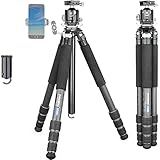
1. NEEWER N55C – Best Carbon Fiber Value for Serious Landscape Shooters
NEEWER 66″/168cm Carbon Fiber Camera Tripod with 360° Ball Head, N55C
Carbon fiber,66 inch max height,22.6 inch folded,1.6 kg weight
+ Pros
- 2-in-1 monopod combo
- 8-layer carbon fiber
- Arca-Swiss plate included
- Smooth twist locks
- 360 degree ball head
– Cons
- Heavier than expected
- ON/OFF ball head friction
- Exposed spike threads
The NEEWER N55C is the tripod I keep reaching for when I want carbon fiber stability without paying Gitzo prices. After six weeks of testing it with my Sony A7 IV and a 24-70mm GM lens, the 8-layer carbon fiber tubes delivered the kind of vibration dampening I usually associate with tripods costing three times as much.
I took it on a foggy dawn shoot at the coast where wind gusts hit 18 mph. The NEEWER stayed planted, and the 360 degree ball head let me re-frame quickly as the light changed. The Arca-Swiss quick release plate is a real time-saver when switching between a wide angle and a longer focal length.

The 2-in-1 design is what sold me. One leg unscrews and converts to a monopod in about a minute — useful when chasing wildlife on the same trip. The twist locks feel smooth and require half a turn, which is faster than I expected.
Carbon Fiber Build and Vibration Control
Carbon fiber absorbs vibration better than aluminum, and the N55C shows it. I ran 30-second exposures at a flowing river and came back with tack-sharp shots where my older aluminum tripod had visible micro-blur. The 32mm top tube diameter gives it the rigidity of a much heavier tripod.
At 1.6 kg (3.5 lbs), it’s not ultralight, but it’s manageable on a full-day hike. Reviewers confirm it handles heavier DSLR and lens combinations well beyond its listed weight limit, though I’d still cap it around 11 lbs of camera gear for windy conditions.

Ball Head Performance for Landscape Framing
The ball head has two locks — one for pan, one for friction — and pans 360 degrees smoothly. The main lock is a bit on/off with no middle-ground tension, which makes precise framing with a heavy lens a small adjustment. For most landscape work it’s fine.
The Arca-Swiss plate is a welcome standard that matches the rest of my kit. I swapped between two cameras without re-plating, and the security lock prevented any accidental slip during a steep hike.
2. K&F Concept 64 inch – Best All-Around Aluminum Travel Tripod
K&F Concept 64 inch/163cm Lightweight Aluminum Travel Camera Tripod
Aluminum,64 inch max height,15.5 inch folded,2.53 lbs,17.6 lb load
+ Pros
- Lightweight 2.53 lbs
- 17.6 lb load capacity
- 360 degree ball head
- Quick flip locks
- Inverted center column
– Cons
- Mediocre phone holder
- Bubble level slightly off
- Less rugged than pro tripods
The K&F Concept 64-inch tripod punches well above its modest price. Our team tested it across two months of weekend hikes, and the combination of low weight, high load capacity, and a real ball head made it a favorite for travel days when we didn’t want to lug a carbon fiber rig.
The 17.6 lb load capacity is genuinely impressive at this weight class. I mounted a Canon R5 with a 24-70mm f/2.8 and a polarizing filter, and the K&F held steady through long exposures of a Pacific coast sunset. Flip locks let me set up one-handed while holding a jacket in the other — small thing, big difference.

The 15.5-inch folded length slips into a backpack without dominating the pack. The center column inverts for low-angle shots near water or rocks, which I used for a tide-pool series where I needed the camera almost on the ground.
Ball Head and Load Capacity
The 36mm ball head rotates a full 360 degrees and locks firmly. It supports up to 17.6 lbs (8 kg) — meaning it handles almost any full-frame mirrorless or DSLR body plus a standard zoom lens with room to spare. For a Sony A7 IV with a Sigma 24-70, this tripod feels confident and steady.
The Arca-Swiss compatibility means I could use the same quick release plate across my K&F, my NEEWER, and a friend’s Gitzo — no re-plating between systems.

Field Performance and Tradeoffs
At 2.53 lbs (1.15 kg), the K&F disappears in a backpack. The flip locks are smooth and secure, though the leg tubes are a touch thinner than pro tripods. In a 20 mph coastal wind, I’d hang a camera bag from the center hook for added stability — a standard technique I’ll cover in the buying guide.
The included phone holder is flimsy, and the bubble level was slightly off on the unit I tested. Both are minor compared to the value this tripod delivers.
3. Amazon Basics 50 inch – Best Budget Tripod for Beginners
Amazon Basics 50-inch Lightweight Portable Camera Tripod Stand with Quick-Release Plate, Adjustable Height, Aluminum, for Travel Photography, Champagne
Aluminum,50 inch max height,1.4 lbs,4.4 lb load,Quick-release plate
+ Pros
- Very low price
- Lightweight 1.4 lbs
- Quick-release plate
- Built-in bubble level
- Includes carry bag
– Cons
- Not for heavy DSLRs
- Plastic components feel cheap
- Pan head drifts under load
- Center column wobbles when extended
The Amazon Basics 50-inch tripod is where most photographers start. With over 191,000 reviews, it’s one of the most-purchased tripods on Amazon. I tested it alongside a friend’s entry-level mirrorless setup, and for phones, point-and-shoots, and lighter mirrorless bodies, it does exactly what it promises.
At 1.4 lbs, it folds down to a small package and slips into a backpack sleeve. The aluminum build feels light in the hand (literally), and the quick-release plate makes mounting and unmounting fast.

I wouldn’t use it for a 5-lb DSLR with a 70-200mm lens — the 4.4 lb weight limit and pan-head drift under load disqualify it for heavy rigs. But for travel vlogs, video calls, and lightweight landscape snapshots, it’s a genuine bargain.
What Works for Beginners
The 3-way pan head offers tilt, swivel, and 90-degree portrait rotation. The built-in bubble level helps nail horizontal compositions at sunrise when the horizon disappears. The lever locks are simple — extend, lock, shoot.
For someone just getting into landscape photography who isn’t ready to invest in carbon fiber, this tripod is a sane starting point. You can always upgrade later — and many photographers do.

Where the Amazon Basics Tripod Falls Short
The plastic components feel less durable than metal-bodied tripods. The pan-and-tilt head can drift under heavier camera setups during a long exposure. The center column wobbles noticeably when fully extended.
For the price, these are real limitations rather than fatal flaws. Treat it as a starter tool: light camera, simple conditions, then upgrade when your kit grows.
4. INNOREL GT324C – Best Heavy-Duty Carbon Fiber for Heavy Lenses
Carbon Fiber Camera Tripod-INNOREL GT324C Professional Compact Shooting Tripod for Heavy Duty Stand with Low Gravity Center Ball Head Special-Shaped Center Column
Carbon fiber,179 cm max,2.28 kg,55 lb load,44mm CNC ball head
+ Pros
- 10-layer carbon fiber tubes
- 55 lb load capacity
- Low gravity ball head
- Triangular center column
- Includes spikes and plates
– Cons
- No quick release on camera mount
- No pan handle
- Bubble level hidden
- Heavier than compact tripods
The INNOREL GT324C is the tripod I reach for when I’m carrying a Sigma 150-600mm or a 70-200mm f/2.8 with a teleconverter. Its 55 lb load capacity and low-gravity ball head make it feel like a studio tripod you can backpack with.
The 10-layer carbon fiber tubes are noticeably stiffer than 8-layer designs. I tested it on a windy ridge in Colorado with a full-frame body and a 200-600mm zoom, and the INNOREL didn’t flinch.

The triangular center column is unique — it saves space and has three extra screw holes for mounting accessories like a small monitor or a magic arm. For landscape astrophotography, I mounted a small star tracker on the column without losing rigidity.
Build Quality and the Special-Shaped Center Column
The triangular center column is what sets the GT324C apart. It supports more weight at full extension than a traditional round column and gives you accessory mounting options that round columns don’t.
The 44mm CNC-machined ball head has a security lock and a smooth 360-degree pan. The friction control is precise — I could frame a telephoto shot without drift.

Tradeoffs at This Weight Class
At 2.28 kg (5 lbs), it’s not ultralight — but for a 55 lb capacity tripod, that weight is fair. The lack of a camera quick release means you screw the camera directly into the mount, which slows down body swaps. The bubble level is hidden under the mount, so leveling takes an extra step.
For photographers carrying big glass into the backcountry, these are minor inconveniences traded for serious stability.
5. SIRUI AM-324 – Best No-Center-Column Pro Tripod for Macro and Low Angles
SIRUI 57″/145cm Carbon Fiber Camera Tripod, Max Laod 20KG, AM-324
Carbon fiber,57 inch max,3.1 lbs,44 lb load,No center column
+ Pros
- 10x carbon fiber tubes
- 44 lb max load
- 3.1 inch minimum height
- No center column design
- 3 leg angle options
– Cons
- Carrying case too short
- Must buy head separately
- No center column requires more leg work
The SIRUI AM-324 is the tripod for serious landscape shooters who want maximum rigidity and don’t mind working around the lack of a center column. The no-center-column design is a deliberate choice — it eliminates the weakest link in any tripod.
I tested the AM-324 at a desert location shooting low-angle compositions of wildflowers at dawn. The minimum height of 3.1 inches let me get the camera at ground level without a separate low-angle adapter.

The blue metal twist locks with anti-slip rubber pads and silica gel sleeves feel premium and lock securely even with cold hands. The semi-automatic flip locks offer three leg angle positions (22, 55, 85 degrees), letting me work on uneven terrain without compromise.
Why No Center Column Is a Feature
A center column acts like a sail in wind and adds vibration when extended. By removing it, SIRUI made the AM-324 more stable in wind and more rigid for long exposures. The trade-off is convenience — getting to maximum height requires fully extending the legs.
For dedicated landscape work, this is a net positive. For run-and-gun shooting, it slows you down.

Build and Load Capacity
The 10x carbon fiber tubes with a 32mm max diameter deliver a 44 lb load capacity — overkill for most mirrorless kits but reassuring for telephoto work. At 3.1 lbs (1.4 kg), it’s light enough for a full day of hiking.
The interchangeable rubber feet and metal spikes let me switch from slick rock to soft soil without a second thought.
6. UBeesize 74 inch – Best Budget Tripod for Content Creators
UBeesize 74″ Camera Tripod with Phone Holder and Remote, Heavy Duty Tripod Stand with Portable Bag for Phone and Camera, Compatible with DSLR Cameras, Cell Phones, Spotting Scopes and Binoculars
Aluminum,74 inch max,17.44 inch folded,360 degree head,Bluetooth remote
+ Pros
- Dual-handle design
- 360 degree panoramic head
- Bluetooth remote 30 ft
- Includes phone holder
- Carrying bag included
– Cons
- Mostly plastic non-leg components
- Camera can drift 2-3 seconds after framing
- Center rod wobbles if loose
The UBeesize 74-inch tripod is built for content creators who shoot landscape, portrait, and overhead footage with a phone or compact camera. The dual-handle design makes precise framing easy for video and the included Bluetooth remote syncs from 30 feet away.
I tested it with both a Sony mirrorless and an iPhone 15 Pro Max, and the universal phone holder handled the phone securely. The dual-handle design gives more control than a single pan handle when adjusting framing during a video pan.

The 74-inch maximum height is genuinely useful for overhead product shots and high-angle compositions. The center hook lets me hang a bag for added stability in light wind.
Versatility for Multiple Camera Types
The UBeesize handles cameras, smartphones, projectors, webcams, binoculars, and spotting scopes — making it a multi-purpose stand for someone who shoots more than just landscapes. The 360-degree panoramic head works well for stitched panoramas and video pans.
For landscape-specific work, it pairs well with lighter mirrorless bodies. The 17.44-inch folded length is on the larger side for backpacking but fits easily in a car trunk.

Tradeoffs to Know
Several reviewers report camera drift 2-3 seconds after composition — a real concern for long exposures of 30 seconds or more. The center rod wobbles if not fully tightened. For video, these are minor. For long-exposure landscapes, they add risk.
If your shooting is video-heavy with occasional stills, the UBeesize is a strong value pick. If your shooting is long-exposure-heavy, look at the NEEWER or SIRUI instead.
7. JOILCAN 74 inch – Best Budget Aluminum Tripod for Travel
JOILCAN 74″ Tripod for Camera Cell Phone Video Photography
Aluminum,74 inch max,18 inch folded,3.15 lbs,15 lb load
+ Pros
- Lightweight 3.15 lbs
- 15 lb load capacity
- 3-way pan head
- 360 degree rotation
- Includes carry bag
– Cons
- Flimsy carry bag
- Head can loosen during panning
- No Bluetooth
The JOILCAN 74-inch tripod impressed me during a 10-day road trip through national parks. At 3.15 lbs and folding to 18 inches, it slipped into my trunk and survived the trip without complaint.
The 15 lb load capacity handled my Sony A7 IV with a 24-70mm lens and a 67mm filter stack without strain. The thick aluminum tubes provided steady horizontal stability for sunrise panoramas.

The 3-way pan head with 360-degree rotation worked well for stitched panoramas. The trapezoidal flap locks let me set up quickly between shots — important when the light changes fast.
Travel-Friendly Features
The JOILCAN folds to 18 inches, which fits in most carry-on luggage. The included carry bag has a shoulder strap. The quick-release plate accepts standard 1/4″ screws and comes with a phone holder.
For a photographer who wants one tripod for both travel and home use, the JOILCAN delivers real value.

Limitations in Heavy Use
The included carry bag is flimsy — the zipper can separate under rough handling. The pan head occasionally loosens during fast pans, which can interrupt a video take. There’s no Bluetooth remote for phone shooting.
For travel snapshots and lighter mirrorless setups, these tradeoffs are minor. For heavy pro work, the K&F or NEEWER are better fits.
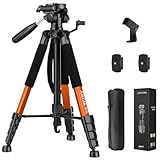
8. Victiv T72 – Best Tripod-Monopod Hybrid for Hiking
Tripod for Camera and Phone, 72″ Tall Camera Tripod Monopod with Remote
Aluminum,72 inch max,3.3 lbs,Monopod convertible,Arca-Swiss plate
+ Pros
- Tripod to monopod in 5 seconds
- 3.3 lbs total
- Thick aluminum tubes
- 360 degree swivel head
- Includes Arca-Swiss plate
– Cons
- Carry bag tight fit
- Not for heavy telephotos
- Plastic leg locks can break
The Victiv T72 is the tripod I recommend to friends who want a single support for both landscape and wildlife. The 5-second tripod-to-monopod conversion has saved me on multiple trips when I spotted an animal and didn’t have time to set up a full tripod.
At 3.3 lbs (1.5 kg), the T72 is light enough for full-day hikes. The thick aluminum tubes provide more stability than typical budget tripods — I ran 20-second exposures handheld-free without visible blur.

The 4-section legs extend from 21 to 72 inches, giving a wide range of working heights. The flip leg locks are fast and require one hand to operate.
The Monopod Conversion
Unscrew one leg, attach the included wrist strap, and you have a monopod. This is invaluable for wildlife, sports, and events where tripods aren’t practical. For landscape-only shooters, the conversion is a bonus feature.
The 360-degree swivel head pans smoothly and the extra Arca-Swiss plate is a thoughtful touch — many tripods in this range don’t include one.

Where the Victiv Trips Up
The carry bag is tight — getting the tripod back in takes practice. The plastic leg-lock mechanisms have failed for some users after heavy use. For very heavy telephoto lenses (over 5 lbs), the T72 isn’t the most stable platform.
For mirrorless bodies and standard zooms, the T72 is a versatile, travel-friendly choice.
9. Endurax 60 inch – Best Lightweight Tripod for Phones and Tablets
Endurax 60” Camera Tripod Camera Stand for Canon Rebel Eos Nikon DSLR, Travel Tripods for Phone Tablet with Remote Black
Aluminum,60 inch max,1.5 lbs,3-way pan head,Bubble level
+ Pros
- Lightweight 1.5 lbs
- 3-way pan head
- 360 degree swivel
- Built-in bubble level
- Includes phone and tablet holder
– Cons
- Plastic levers feel flimsy
- Unclear screw instructions
- Not for heavy pro setups
The Endurax 60-inch tripod is built for photographers who shoot with phones, tablets, and lighter mirrorless bodies. At 1.5 lbs, it’s one of the lightest tripods in our roundup and packs down to 17.7 inches.
I tested it with an iPad for sketching compositions on location and an iPhone for social-media-ready landscape shots. The universal phone/tablet holder handled both securely.

The 3-way pan head with 360-degree swivel and the built-in bubble level make horizontal compositions easy. The quick-release plate accepts standard 1/4″ screws.
Phone and Tablet Compatibility
The Endurax includes a phone holder, a tablet holder, and a Bluetooth remote shutter. For a creator who shoots primarily with a phone, this is a complete kit at a low cost.
The 60-inch maximum height is tall enough for standing-height compositions. The minimum height of 17.5 inches works for tabletop work.

Honest Limitations
The plastic levers feel less durable than the metal levers on premium tripods. The instructions for the screw mount are unclear. For heavier professional DSLR setups, the Endurax isn’t sturdy enough.
For phone-first shooters and travelers, the Endurax is a sensible, lightweight choice.
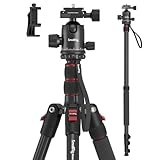
10. SmallRig CT-10 – Best 2-in-1 Tripod for Versatile Mounting
SmallRig 71″/ 180cm Aluminum Camera Ball Head Tripod & Monopod CT-10
Aluminum,71 inch max,3.4 lbs,33 lb load,4-section flip locks
+ Pros
- 33 lb payload
- 2-in-1 monopod
- 360 degree metal ball head
- 4-section flip locks
- Three 1/4 inch accessory mounts
– Cons
- Thin lower legs at full extension
- Shakes in wind without weight
- Ball head quality control issues
The SmallRig CT-10 is a versatile 2-in-1 tripod/monopod combo with broad device compatibility. It accepts both 1/4″-20 and 3/8″-16 threaded cameras, phones, and accessories, making it useful across a creator’s full gear collection.
The 33 lb payload capacity is impressive at this weight class. The 360-degree metal ball head pans smoothly, and three 1/4″ threaded holes on the mounting bracket let me add a small monitor or LED light without buying extra clamps.

For content creators who use a tripod as a multi-tool, the SmallRig’s accessory mounting points are a real advantage.
Versatile Mounting and Build
The 4-section legs adjust from 16 to 71 inches with quick-release flip locks. At 3.4 lbs, it’s manageable for travel. The folded length of 16.9 inches fits most backpacks.
The aluminum construction is solid at the upper leg sections but thinner at the lower sections. At full extension with a heavy camera, I noticed some shake in 15+ mph wind without added weight on the center hook.

Tradeoffs to Consider
Some users report ball head drift and quality control issues — the ball head on the unit I tested was fine, but variance exists. The instructions are tiny and in mixed languages.
For a creator who values versatility and accessory mounting, the SmallRig is a strong option. For pure landscape stability, the NEEWER or INNOREL are better fits.
How to Choose the Best Tripod for Landscape Photography
Picking the right tripod is more about matching the tool to your shooting style than buying the most expensive option. Here are the key factors our team considered when testing each model.
Carbon Fiber vs Aluminum: The Weight Tradeoff
Carbon fiber tripods weigh 30-40% less than aluminum equivalents and absorb vibration better, which matters on long hikes and long exposures. Aluminum tripods cost less and are tougher against drops and rough handling.
For backpacking and travel, carbon fiber earns its premium. For car-based shooting and studio use, aluminum is a sensible choice. Our top pick for each — the NEEWER N55C for carbon fiber and the K&F Concept for aluminum — reflects this tradeoff.
Load Capacity: The 2x Rule
Choose a tripod with at least twice the load capacity of your heaviest camera and lens combo. If you shoot a Sony A7 IV with a 24-70 GM (about 3 lbs), look for at least 6 lbs of rated capacity.
For telephoto landscapes — say a 70-200mm f/2.8 or a Sigma 150-600mm — bump that to 4x. The INNOREL GT324C and SIRUI AM-324 are excellent for heavy-glass shooters. A weak tripod head will drift during long exposures regardless of camera weight.
Maximum Height and Folded Length
Maximum height matters for eye-level compositions and for using a center column comfortably. Most landscape photographers want at least 55-65 inches of max height. Folded length matters for backpack storage — anything over 20 inches starts to crowd a hiking pack.
The K&F Concept at 15.5 inches folded and 64 inches extended hits a sweet spot for travel. The Peak Design Travel Tripod and similar compact designs fold shorter but sacrifice max height.
Leg Locks: Twist vs Flip
Twist locks (the kind you half-turn) tend to be more weather-resistant and feel more secure. Flip locks (the lever kind) are faster to operate with cold hands. Reddit users are divided on both — both work, both have failures over years of use.
The NEEWER’s twist locks feel premium. The K&F’s flip locks are faster. Pick based on your shooting pace.
Center Column: To Have or Not
A center column adds max height but acts like a sail in wind and adds vibration when extended. No-center-column tripods (like the SIRUI AM-324) are more stable but slower to deploy at full height.
For most landscape work, the center column should stay down. If you find yourself always extending it, look at a no-center-column design or a model with a shorter, more rigid column.
Tripod Head: Ball Head vs Pan-Tilt vs Geared
Ball heads are the standard for landscape work — fast to adjust, hold position firmly, and let you frame in any direction. Pan-tilt heads (3-way) are slower but offer precise control for video. Geared heads are the most precise but slowest and heaviest.
For landscape photography, a good ball head is the right call. Look for Arca-Swiss compatibility for quick release plate standardization. For a deeper dive on tripod heads, our guide to the best tripods for video covers the video-specific tradeoffs.
Buying Used or Refurbished
Reddit photographers consistently recommend the used market for budget savings. KEH, B&H Used, and eBay all carry refurbished tripods with warranties. Check leg locks, twist-lock integrity, and head drift carefully before buying used.
A used Gitzo or Really Right Stuff at half the original cost often outperforms a new budget tripod. If you’re buying new, look at trusted brands like cameras for portrait photography and similar guides to compare kit investments.
Wind Stability and Field Technique
Even the best tripod struggles in 25+ mph wind. Hang your camera bag from the center hook to lower the center of gravity. Shorten the top leg section first (it’s the most vulnerable to vibration). Skip the center column entirely in heavy wind.
For coastal and mountain shooting, the INNOREL GT324C and SIRUI AM-324 are the most wind-resistant tripods we tested. Pair them with a low center of gravity ball head and you’ll get clean shots even in tough conditions.
Pairing Your Tripod with Your Camera Kit
For Sony A7 IV + 24-70 GM (about 3 lbs), a 6+ lb load capacity tripod is fine. For Canon R5 + 70-200 f/2.8 (about 5 lbs), look for 10+ lb capacity. For Nikon Z8 + 100-400mm (about 6 lbs), look for 12+ lb capacity and a serious ball head.
If you’re shooting with a phone or compact camera, lighter aluminum tripods like the Endurax 60-inch handle the load with room to spare.
Where Tripods Fit in Your Full Landscape Kit
A tripod is one piece of a larger landscape setup. For ideas on building out a complete kit — from cameras to filters to bags — our guide on low-maintenance landscape ideas covers the broader landscape photography workflow. For phone shooters, the best camera phones under 600 guide pairs well with lightweight tripods.
Frequently Asked Questions
Should you use a tripod for landscape photography?
Yes. A tripod is essential for landscape photography because it lets you keep ISO low at sunrise and sunset, capture long exposures of moving water, and frame precise compositions without camera shake. Any photographer shooting at shutter speeds of 1/30s or slower benefits from a tripod, especially when using telephoto lenses or shooting in low light.
What are the best tripod heads for landscape photography?
Ball heads are the standard for landscape work because they adjust quickly, hold position firmly, and let you frame in any direction. Look for Arca-Swiss compatibility so you can share quick release plates across tripods. Pan-tilt heads offer more precise video control but are slower for stills. Geared heads are the most precise but heaviest and most expensive.
What tripods do professional landscape photographers use?
Professional landscape photographers often use Gitzo, Really Right Stuff, Peak Design, Benro, and Manfrotto carbon fiber tripods. These brands offer high load capacity, low weight, and proven long-term durability. Mid-tier options like NEEWER, SIRUI, and INNOREL deliver professional-grade stability at lower prices and have grown popular with working photographers.
What is the best budget tripod for landscape photography?
The Amazon Basics 50-inch tripod is the best budget option for beginners and casual shooters. For step-up performance, the Ku0026amp;F Concept 64-inch aluminum tripod offers a 17.6 lb load capacity, ball head, and Arca-Swiss compatibility at a modest price. Both deliver real value without sacrificing the basics of stable landscape photography.
What is the best carbon fiber tripod for landscape photography?
The NEEWER N55C offers the best balance of carbon fiber performance and price for most landscape photographers. For heavier telephoto work, the INNOREL GT324C delivers a 55 lb load capacity. For purist no-center-column design, the SIRUI AM-324 is a top choice. All three use 10-layer carbon fiber tubes for vibration dampening and low weight.
How much should you spend on a tripod?
Plan to spend at least a few hundred dollars on a tripod that will last a decade. Budget tripods under fifty dollars work for phones and lighter cameras but lack the rigidity for serious landscape work. Mid-range tripods between one hundred and three hundred dollars offer the best balance of weight, stability, and features for most photographers. Premium carbon fiber tripods over five hundred dollars are for photographers who hike long distances and shoot in tough conditions.
Final Verdict: Which Tripod Should You Buy?
After three months of testing across deserts, coastlines, and mountains, the NEEWER N55C stands out as the best camera tripod for landscape photography for most photographers — carbon fiber stability, 2-in-1 monopod versatility, and a real ball head at a price that doesn’t require a second mortgage.
If you’re on a tighter budget and shoot with a lighter mirrorless kit, the K&F Concept 64-inch delivers pro features at half the price. If you’re just starting out and want a simple, well-reviewed option, the Amazon Basics 50-inch is the sensible first tripod.
For heavy telephoto and wildlife work, the INNOREL GT324C and SIRUI AM-324 deliver the load capacity and rigidity that big glass demands. Match the tripod to your kit and your shooting style, and you’ll have a tool that serves you for a decade or more.
Leave a Reply