
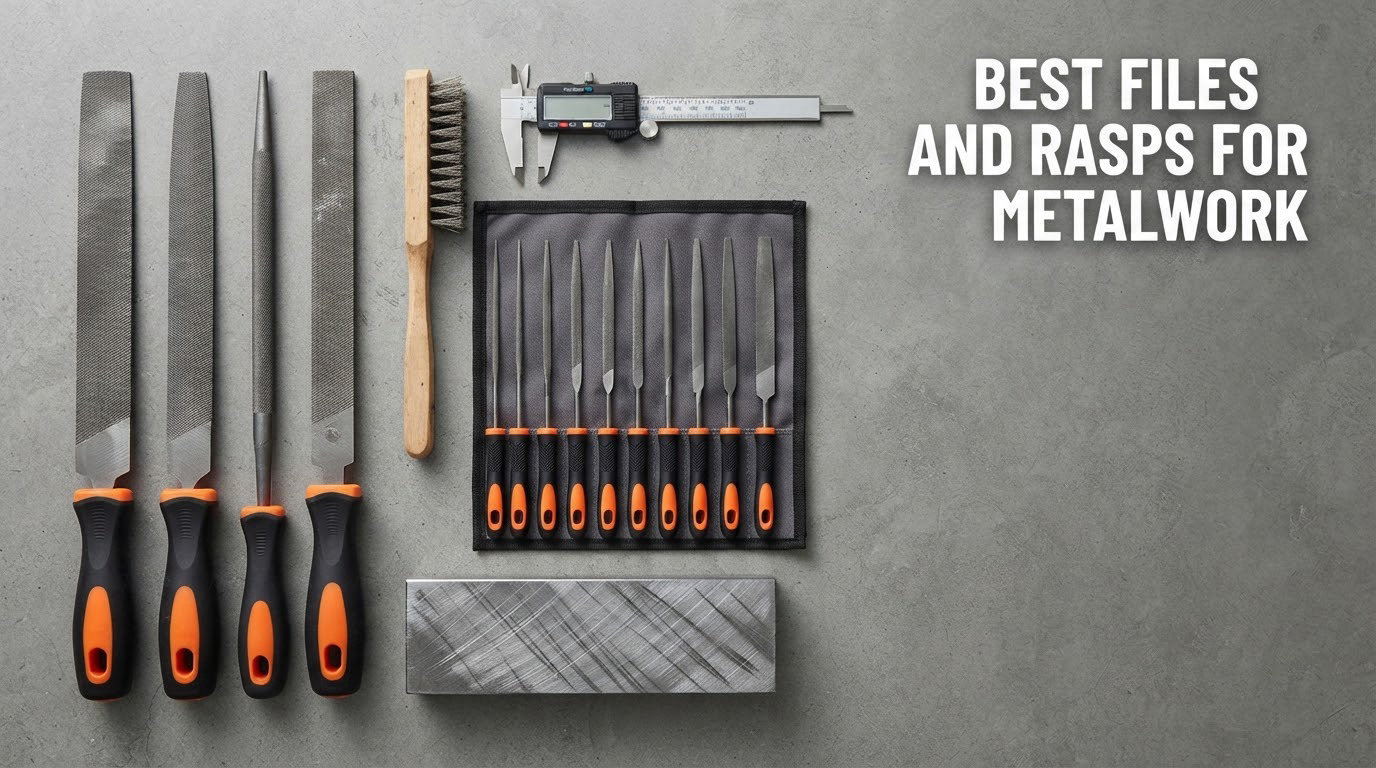
A dull file is the fastest way to waste good steel, and the wrong file wastes the steel twice. After years of fitting parts, deburring sheet metal and cleaning up milling work in our own shop, we put ten of the most-reviewed file and rasp sets through their paces to find the ones that hold a cut longest. This guide to the best files and rasps for metalwork covers general workshop sets, machinist files, needle files, rifflers and diamond options, so you can match a tool to the job instead of buying by the piece count on the front of the box.
Our verdict up front: the REXBETI 25-Piece set is the one we reach for most, the Hi-Spec kit is the smarter buy for a home shop that also does plastic and model work, and the kapoua 6-piece is the cheapest sensible place to start. Everything below explains why, and where each set falls short.
We judge on the things that actually decide whether a file is good: the steel grade, whether the tooth pitch stays consistent along the whole length, whether the set gives you a usable progression from coarse to fine, and whether it includes handles you can actually grip with oily hands. Marketing claims get no weight at all. Where a listing claims something we could not verify, we say so.
If you are outfitting a bench next to an angle grinder or a die filer, the rule is simple: the powered tool takes the stock off, the hand tools take the skin and the size off. These picks cover the second job.
The Three Best Files and Rasps for Metalwork in 2026
These are the three we would put on a bench today. The REXBETI wins on steel grade and shape coverage, the Hi-Spec wins on the balance between machinist files and needle files, and the kapoua wins on being the least expensive way to cover the core profiles.

REXBETI 25-Piece Metal File Set
- T12 drop forged alloy steel
- 4 large 200mm files plus 12 needle files
- Includes carry case
- gloves
- wire brush and sandpaper

Hi-Spec 17-Piece Hand and Needle File Kit
- 4 x 12-inch machinist files
- 12 metal needle files including diamond grit
- Heat-treated T12 high-carbon steel
- Oxford cloth zipper case

kapoua 6-Piece Metal Needle File Set
- Flat
- warding
- square
- triangular
- round and half-round
- Deeply quenched carbon steel
- Rubberised dipped handles
Comparing All 10 File and Rasp Sets at a Glance in 2026
Every pick below appears in this table so you can sort by piece count, steel type and the kind of work each set is built for before you read the individual reviews.
| Product | Details | Action |
|---|---|---|
|
|
Check Latest Price |
|
|
Check Latest Price |
|
|
Check Latest Price |
 |
|
Check Latest Price |
 |
|
Check Latest Price |
 |
|
Check Latest Price |
 |
|
Check Latest Price |
 |
|
Check Latest Price |
 |
|
Check Latest Price |
 |
|
Check Latest Price |
File vs Rasp: The Difference Is Tooth Form and Stroke Direction
The difference is tooth form and stroke direction. A file has cut teeth milled into the surface and removes material on the push stroke. A rasp has raised, pointed teeth spaced further apart and cuts on the pull stroke, taking off far more metal per pass but leaving a rougher finish.
That stroke difference is not a detail. If you work a rasp the way a file works, forward and back, it glazes almost immediately, because the teeth only have cutting geometry on one side. The same applies to plus-cut and Aristo-pattern files, which some machinists prefer precisely because they cut on the return stroke, letting them stand on the end of the bench and work the stroke that suits their hand.
Yes, you can absolutely use a rasp on metal. Practitioners on Practical Machinist describe keeping a hoof rasp at the bench specifically because it removes metal fast, including from A-36 steel. That is its entire job, and the coarse finish it leaves is exactly what you want before you move to a file.
File Cut Types: Double-Cut, Single-Cut and Rasp Cut Compared
Choosing a cut is really choosing a removal rate and a finish, and picking the wrong one costs you time in both directions. Here is what each cut does and when it earns its place on your bench.
Double-Cut Files Remove Metal Fastest
A double-cut file has a second set of teeth cut at an angle to the first, so every tooth acts like a tiny gouge. The raised chips load quickly, which means less time spent clearing swarf and more time removing material. This is the cut for roughing, cleaning up cuts from a bandsaw, and taking a forging down to size before you go finer.
Bastard cut is the classic double-cut grade used for general metalwork, and the Nicholson 5-piece set is built around it. Four of its five files are bastard cut for aggressive removal, with a single smooth mill file and a 6 inch slim taper for the fitting work that follows.
Single-Cut Files Give a Controlled Finish
Single-cut teeth run in one direction only, so they scrape rather than gouge. The result is a controlled finish with predictable chip size, which is what you want when the part is close to final size and a deep cut would mean starting over.
Single cut is also the tool for sizing. When you are fitting a part in a vise to a line mark, you want small predictable chips, not a file that grabs and tears. Many machinists keep one flat and one half-round in single cut purely for finishing and marking work.
Rasp Cut Teeth Bite on the Pull Stroke
Rasp teeth are individual points rather than milled grooves, and they are deliberately coarse and widely spaced. They take a serious bite, cut on the pull, and are the fastest hand method for removing thick material that no other tool will shift quickly. They also load with debris faster than any other cut, so they need cleaning more often.
Two of our picks include rasp profiles. The NEIKO set pairs seven metalworking files with three dedicated wood rasps including a shoe rasp and a round wood rasp, and the Tonmifr 34-piece set includes a wooden half-round rasp alongside its five large files.
Cut Grade Is Relative to File Length
Here is the purchasing trap that catches almost every beginner. A cut number only means something relative to the length of the file it is cut into. A 6 inch file described as second cut can be finer than an 8 inch file described as bastard, because the same tooth pitch covers less length on the shorter file.
The old vocabulary follows the same rule. Bastard is coarse, second cut is medium, smooth is fine, and the number scale runs from double 00 at the finest through 6 at the coarsest. Only compare cut numbers between files of the same length and from the same pattern, which is exactly why mixed-length sets advertised as having a complete range of cuts so often deliver a progression that does not actually work.
File Shapes: What Each Cross-Section Is Actually For
The cross-section decides the job. Flat and half-round between them handle most metalwork, and everything else exists because a specific shape will not fit a specific space.
Flat, Square and Half-Round Cover Most Work
A flat file is flat on two broad faces and tapers in width and thickness. The flat face is for flattening and the edges are for filing right angles and general shaping, which makes it the default first file most people buy. A square file is essentially a flat file with parallel sides, used where a full-width face has to stay full-width.
Half-round is the most versatile profile in the set. One face is flat and the other is curved, so the same tool handles flat surfaces, concave radii and internal curves. It appears in nine of our ten picks, and for good reason. If you can only own one shape, make it half-round.
Round, Triangular and Taper Files for Curves and Detail
A round file is circular in section and used for enlarging and finishing holes and for shaping round stock. Triangular and taper files are flat on one face with a tapering profile, which makes them sharper at the point and more controllable for slots, grooves and internal corners.
NEIKO covers this ground unusually well with a 6 inch extra slim taper, a 6 inch slim taper and a 6 inch round bastard saw file. That trio handles sharpening, slotting and saw-set work without you needing a fourth tool.
Knife, Warding and Feeder Files for Tight Corners
A knife file has a knife-edge on one side and a flat back, so it stays sharp right into a corner where a flat file rounds off. A warding file is a thin flat file with safe edges, built for reaching into tight slots without damaging adjacent surfaces. A feeder file has deep teeth and a very narrow profile, used to cut a slot deep in steel.
The kapoua set and the LIBRATON 13-piece both include a flat warding profile, which is the practical one of the three. If you cut slots or keyways in plate, a warding file will get in where a flat file simply cannot reach without rounding the corner.
Needle and Riffler Files for Internal Access
Needle files are small, often around 140 to 145mm long, and are for work where you cannot get a full-size tool into the space. Riffler files are curved on both faces and double-ended, so each end has a different concavity. That curvature is what lets a riffler reach the inside corner of a moulding or the root of a tight radius that no flat file can touch.
The SE 10-piece riffler set is the dedicated version of this idea, with all ten tools measuring 3mm by 140mm. Reviewers of that set single out its reach into contours for sculpture, model and craft work as the reason to own it, which is a fair summary of what a riffler does better than anything else.
1. REXBETI 25-Piece Metal File Set – The Best All-Round Files and Rasps for Metalwork
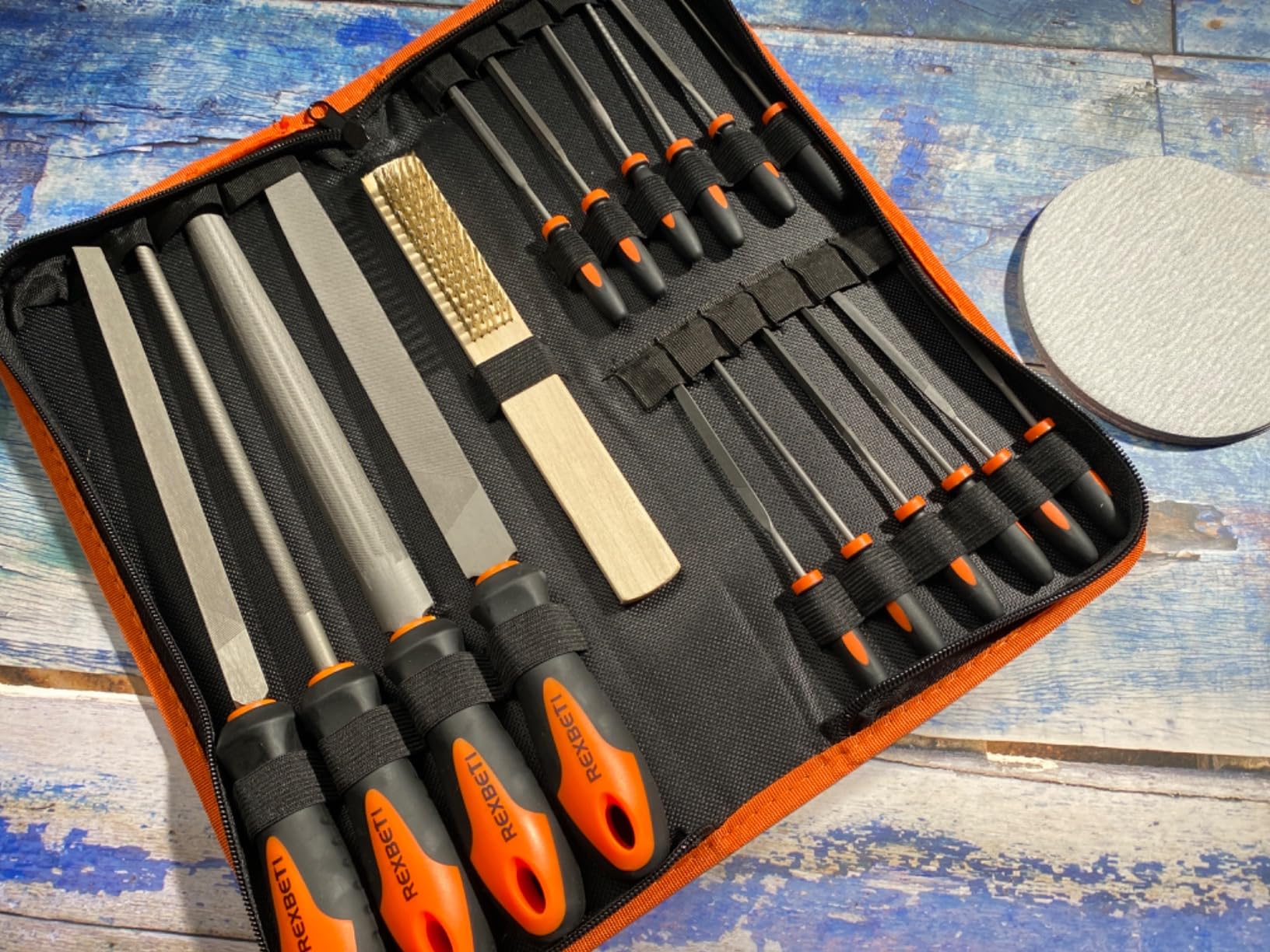
REXBETI 25Pcs Metal File Set, Tool Sharpening, Woodworking, Finishing File
T12 drop forged alloy steel
4 large 200mm files plus 12 needle files at 140mm
Carry case, gloves, wire brush and sandpaper
+ Pros
- T12 drop forged alloy steel with deeply milled tempered teeth
- Four large profiles in flat
- triangle
- half-round and round
- Long rubberised handle reduces hand fatigue
- Compact case holds every tool snugly
– Cons
- 140mm needle files are small for heavy material removal
- Included gloves and sandpaper are basic utility items
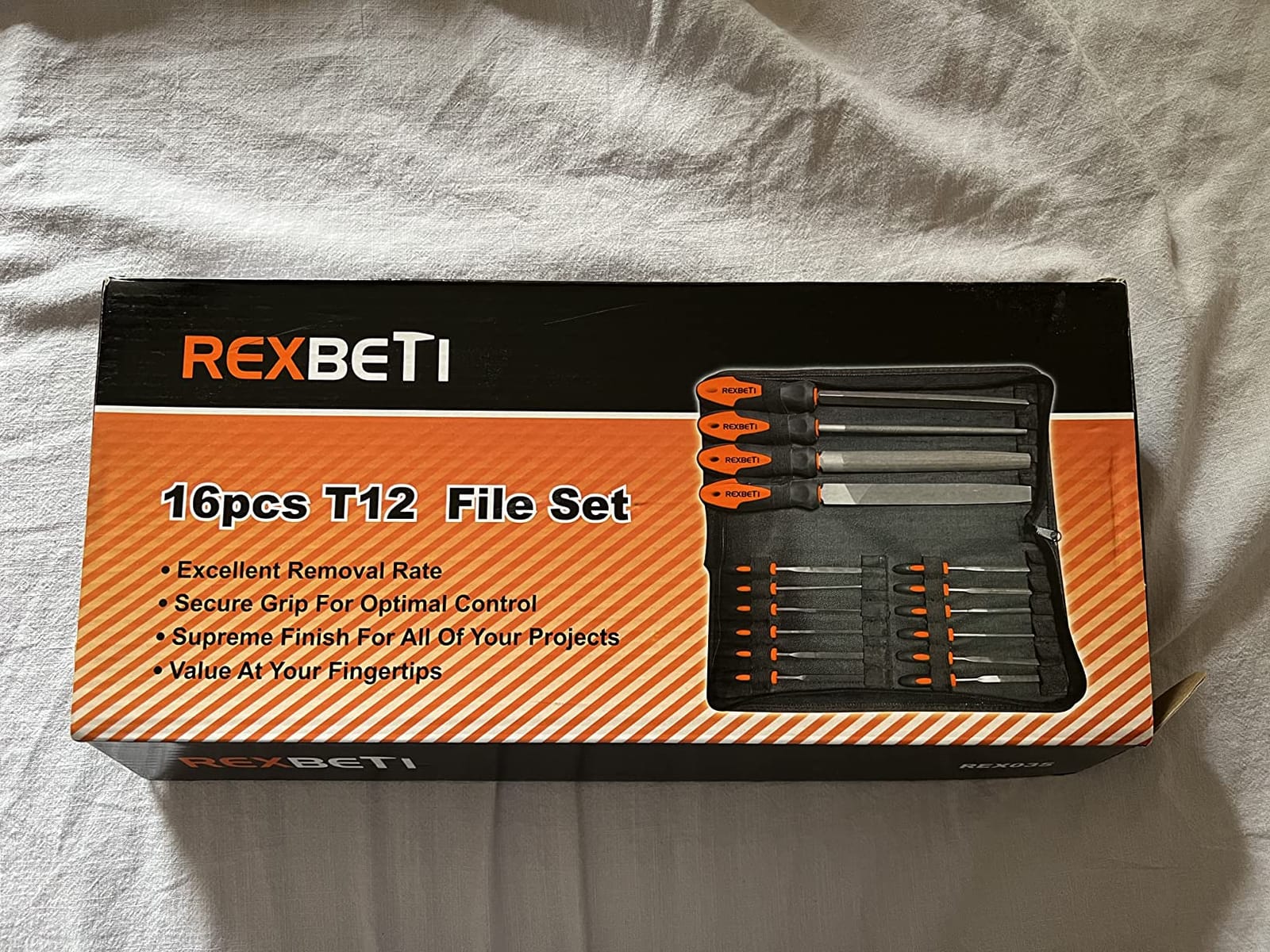
This is the set we keep coming back to, and the reason is the steel. All 16 files are T12 drop forged alloy steel, deeply milled, tempered and coated, which is a stronger steel specification than most sets at this level bother to publish.
The layout is sensible too. Four 200mm files cover flat, triangle, half-round and round for general shaping, and 12 needle files at 140mm fill in the detail work that a shop always needs but almost never includes.
With a 4.6 star average across more than 4600 reviews, this is the most proven set in the group by a wide margin, and 93 percent of buyers rate it four stars or better. Buyers consistently name the range of shapes and the carry case as the standouts.
T12 Alloy Steel and Tempered Teeth
The teeth are deeply milled, tempered and coated rather than merely hardened, which is the process that decides how long a file holds its edge before it needs a clean. A coated tooth surface also resists the rust bloom that turns a neglected file green and sticky in a humid shop.
At 2.64 pounds for 25 pieces, the set has real heft. That weight is not wasted, because a thin file flexes, and a flexing file chatter marks the work instead of cutting it.
Coverage: Four Large Files and 12 Needle Files
The four large files are the ones you will actually use for shop work, and half-round is in the group, which we consider non-negotiable in any general set. The needle files are small but useful for cleaning up small holes and touching up work that a full-size file would distort.
The one limitation is scale. At 140mm, those needle files are fine for detail work and fiddly for anything where you need to remove real material quickly.
Handle, Case and What Comes in the Box
The long soft rubbery handle is genuinely comfortable over a long session, and it matters more than most listings suggest. A file that slips in a sweaty hand is a file that will gouge the work and skint your fingers.
The case is compact and rugged, holding each tool in its own slot so the points do not knock together. The sandpaper, wire brush and gloves are ordinary extras, but having them in the box means you are not digging through a drawer before the first stroke.
Best for: a home metalworking shop that needs general shaping, deburring and detail work from one case.
2. kapoua 6-Piece Metal Needle File Set – The Best Budget Entry Point for Metalwork
kapoua 6-Piece Metal Needle File Set – Hardened Alloy Steel
Flat, flat warding, square, triangular, round and half-round
Deeply quenched coated carbon steel
Rubberised dipped handles
+ Pros
- Six distinct profiles for detail work
- Dipped rubberised handles give a stable grip
- Deep quench holds the cut longer than basic plated files
- Works on wood
- metal
- jewellery
- glass and plastic
– Cons
- Cut suits fine detail rather than bulk removal
- Micro sizes are unsuited to heavy roughing work
At six pieces this is the smallest set we tested and the one we would hand to someone opening a metalworking drawer for the first time. It is also the most reviewed product in the group, with close to 6500 ratings behind it.
The profile selection is the reason it punches above its size. Flat, flat warding, square, triangular, round and half-round is a genuinely useful six, and the half-round here is an equalling file, so it can work both the flat and the concave side.
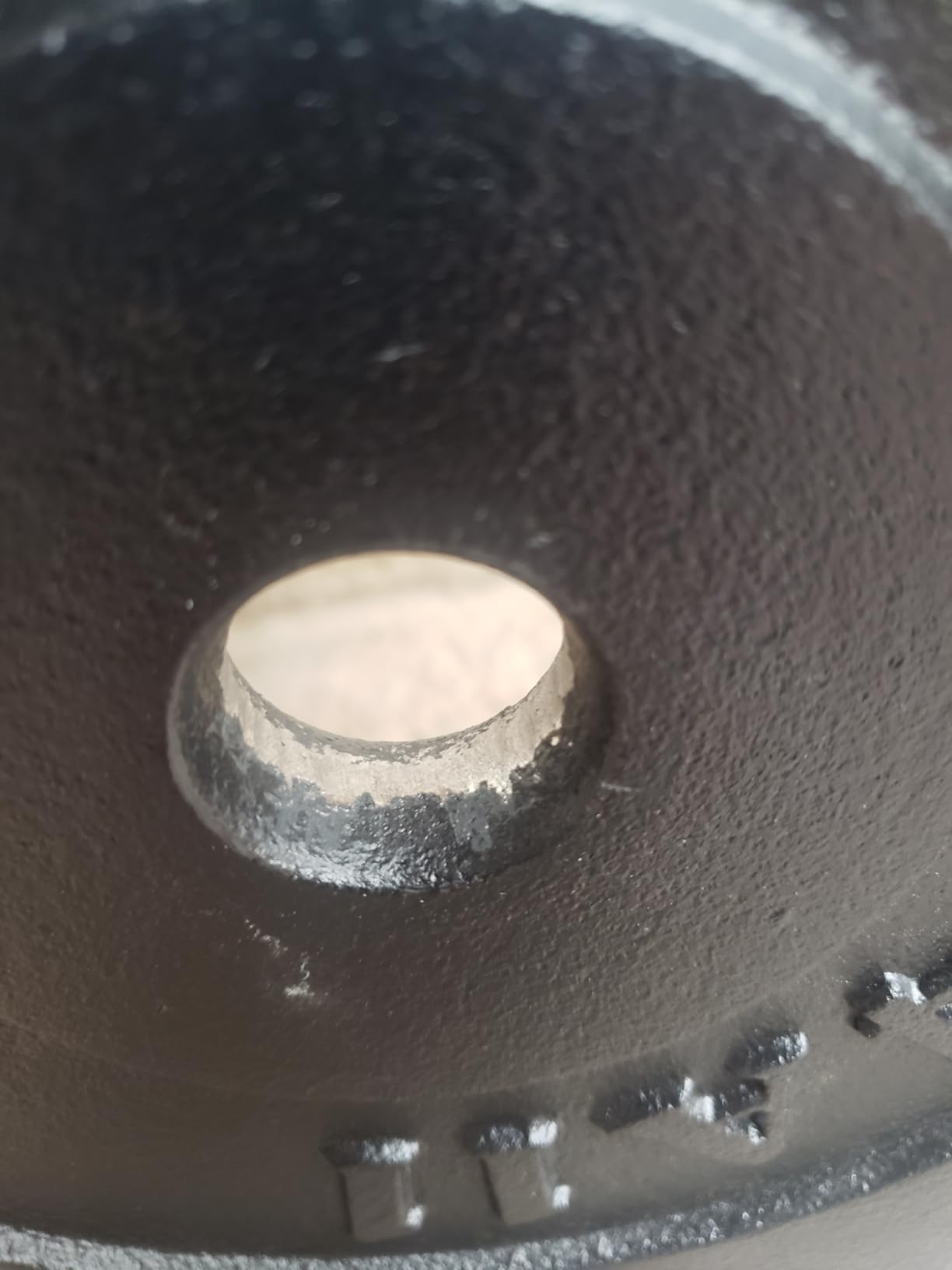
Reviewers cite strong value for jewellery, hobby and detail filing, and the 4.4 star average reflects that this is a finishing tool rather than a roughing one. Ten percent of buyers sit at three stars, and the complaint is consistent: the cut is finer than people expect.
Six Profiles, Small Sizes
At 3.84 ounces and 6.2 by 3 inches, the whole set fits in a pocket, which is genuinely useful on a bench where you are working on small parts. The clear gear-tooth pattern on the file surface is designed to promote cutting efficiency rather than just looking sharp.
The trade-off is metal removal. These are micro files, and pushing them hard on thick material dulls them quickly and gives you nothing in return.
Dipped Handles and Everyday Control
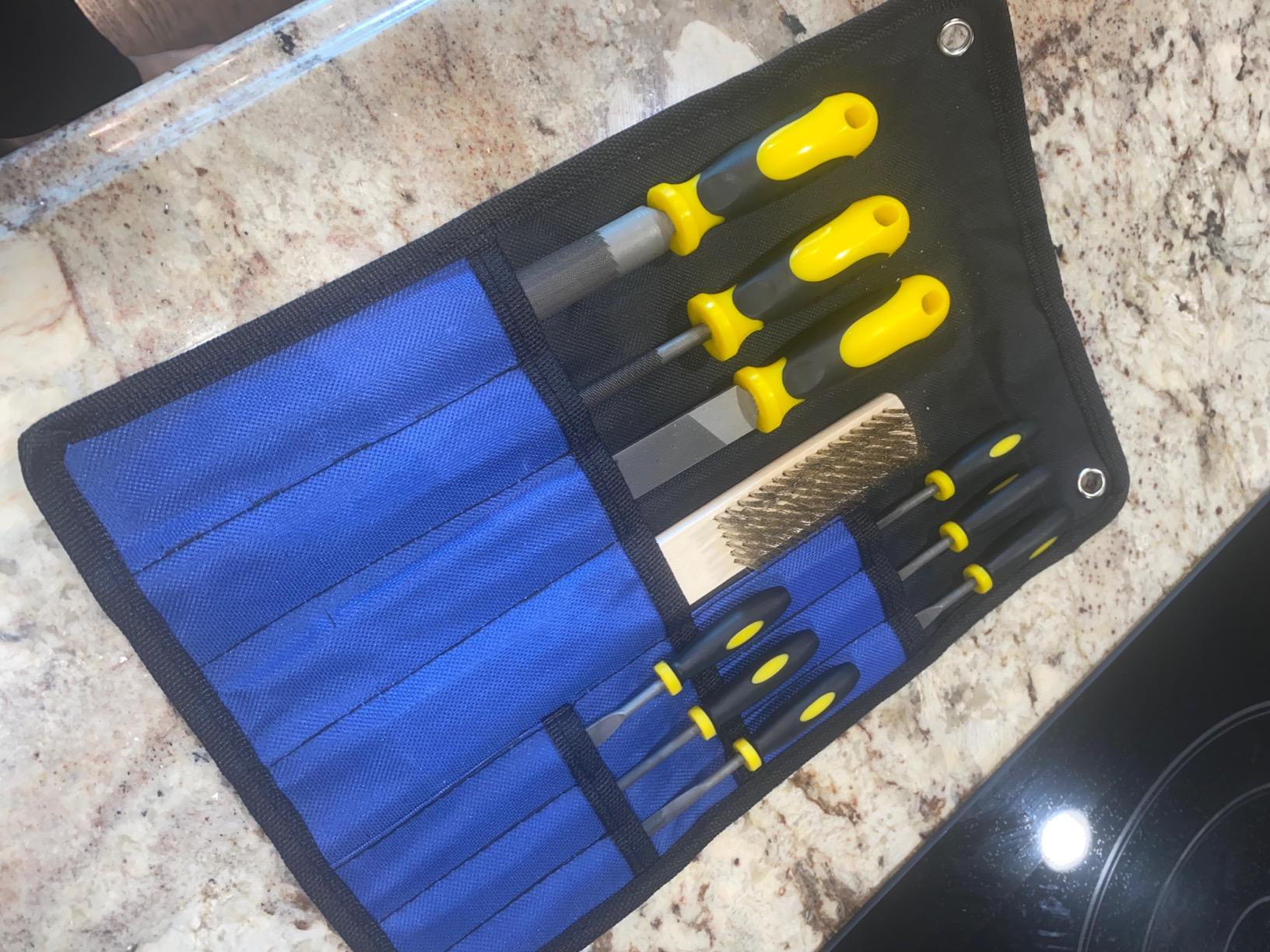
The ergonomic dipped rubberised handles are a real feature at this level, where bare tangs are the norm. They give you a firm grip for precise small-area work where a sliding file is worse than no file.
They also cover more materials than the listing implies. Buyers use this set on wood, metal, jewellery, glass, tile, ceramics, leather and plastic, which makes it the most versatile six tools here if your work is not purely steel.
What You Give Up Compared With the Bigger Sets
No length. Every tool here is a small file, so you have no tool for flattening a face or taking a weld bead down. If your work involves thick bar at all, budget for a second set rather than stretching this one.
Best for: a beginner, jewellery work, model building and anyone who wants the core profiles at the lowest sensible outlay.
3. Hi-Spec 17-Piece Hand and Needle File Kit – The Best Value Files and Rasps for a Home Shop
Hi-Spec Metal Hand & Needle File Tool Kit Half-Round Round & Triangle Files
4 machinist files at 12 inch plus 12 needle files
Heat-treated T12 high-carbon steel
Diamond-grit needles, wire brush and Oxford case
+ Pros
- Mix of four 12-inch machinist files and 12 needle files
- Heat-treated T12 high-carbon steel resists wear
- Zipper case with elastic straps keeps tools secure
- Diamond-grit needles add fine finishing capability
– Cons
- Diamond-grit files cut slowly on hardened steel
- Only one flat file in the set has a dead smooth side
- Light to moderate duty rather than industrial work
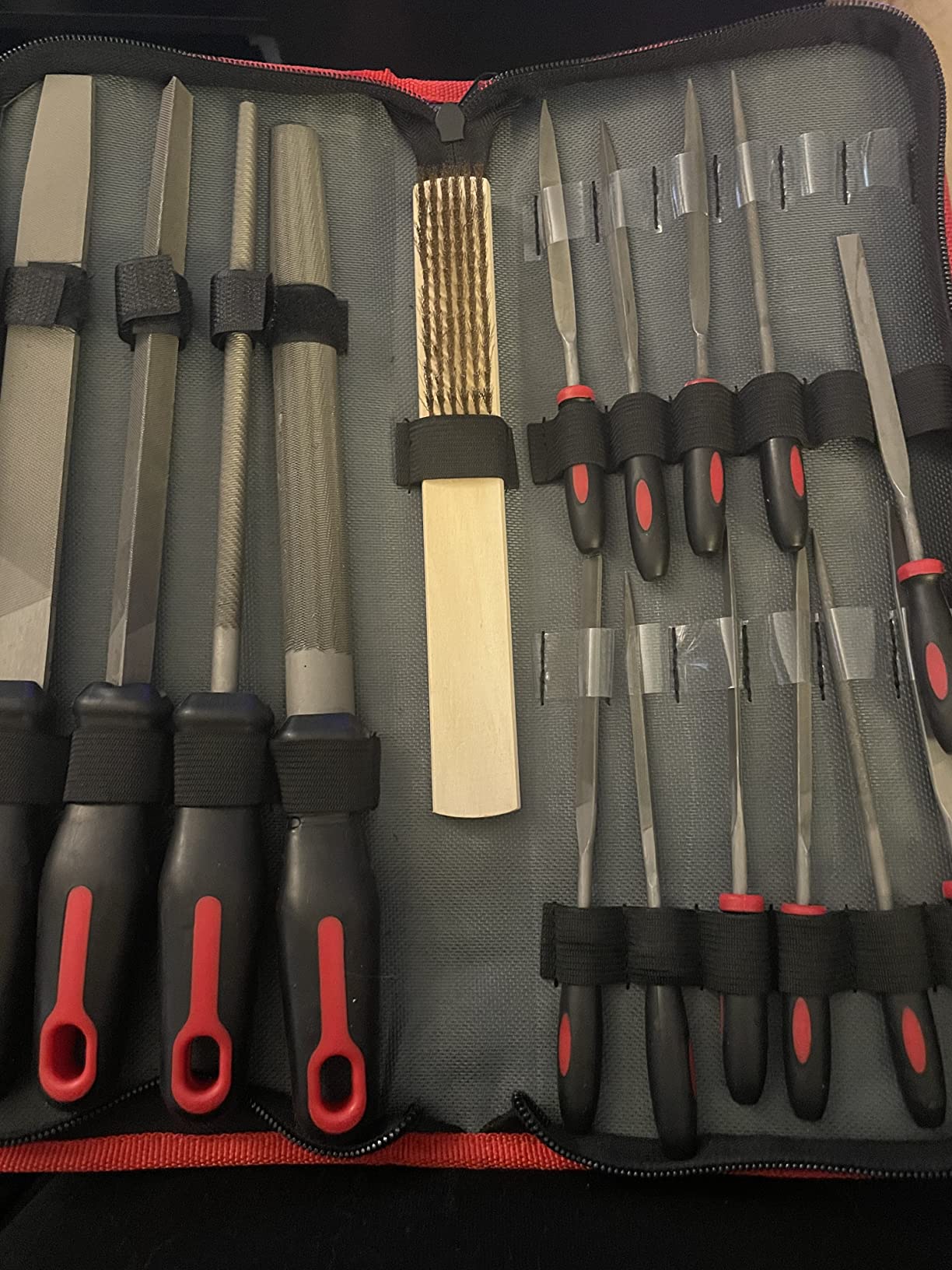
This is the set we recommend to anyone who does metal and plastic in the same shop. Four full-length 12 inch machinist files plus 12 metal needle files is a better-balanced combination than almost anything else we tested, and the 4.6 star average comes from more than 3800 reviews.
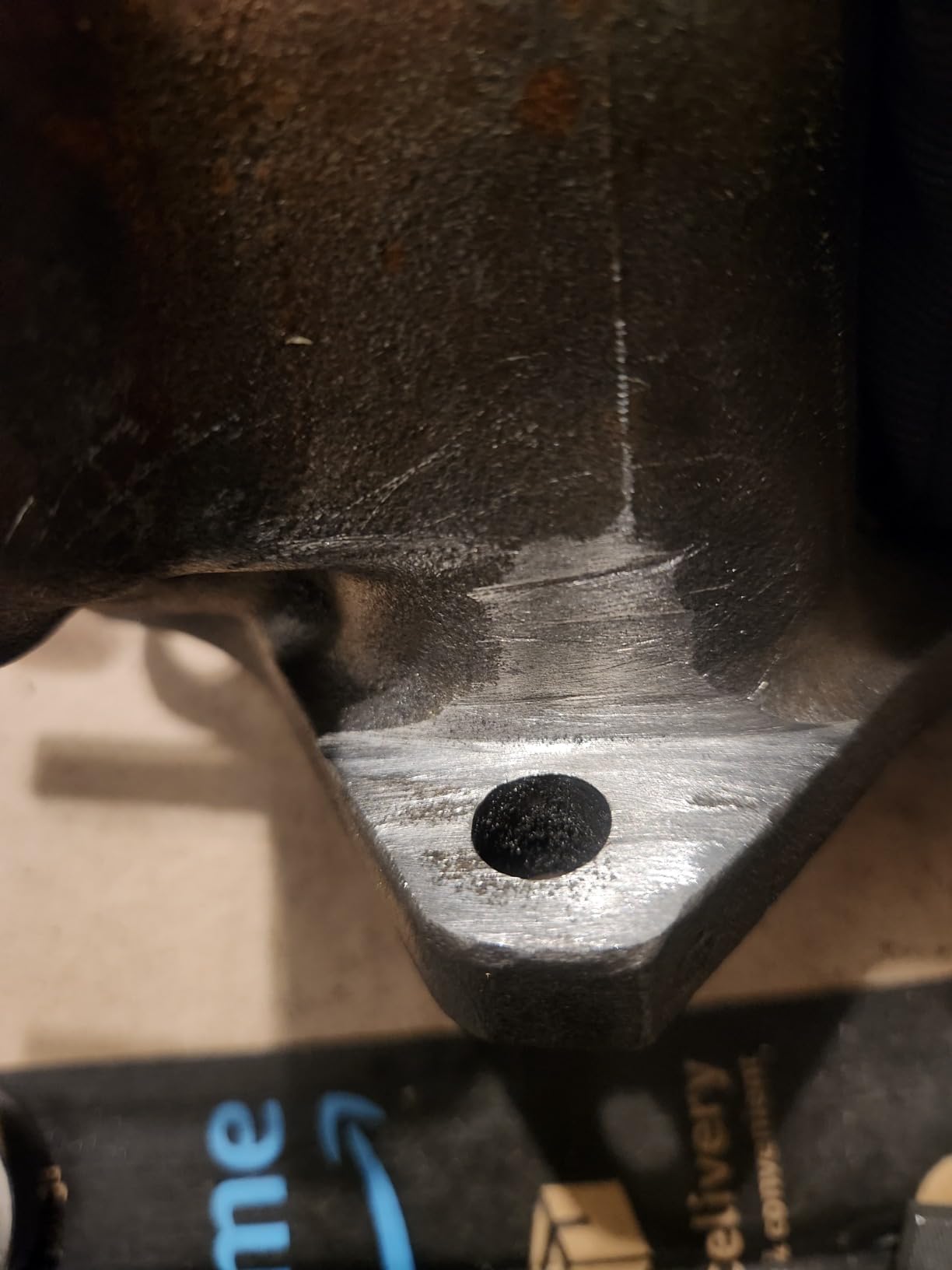
Reviewers praise the heft and quality of the files and specifically mention how well the set handles 3D-printed plastic alongside mild metals, which is not a use case most roundups bother to cover.
Heat-Treated T12 High-Carbon Steel
The steel is heat-treated T12 high-carbon alloy, specified for hardness and wear resistance across the whole set rather than just the large files. At 1.15 kilograms, this is a properly heavy kit, and the weight is what keeps the files from flexing when you put down pressure.
The four machinist files are triangular, half-round, long flat and round at 12 inches. That is the correct starter lineup, with no filler pieces.
12 Needle Files Including Diamond Grit
The needle group includes diamond-grit profiles alongside the steel ones, which adds a genuinely different capability. Diamond grit does not have a cut direction in the way a steel file does, so it works for light finishing on material that would glaze a steel file.
The drawback is speed. Reviewers are direct about the fact that diamond files remove material slowly on hardened steel, so heavy machining by hand becomes tedious. Use them for finishing passes, not for cleanup after a bandsaw.
The Oxford Cloth Case and the Warranty
The splash-resistant Oxford cloth zipper case with elastic retention straps holds every tool in position, which matters more than it sounds. Loose files in a drawer blunt each other, and you will find a rounded point instead of a cut one.
There is a lifetime warranty on the hand tools, and a stiff wire brush is included for clearing filings off the steel between passes. That brush is the cheapest useful maintenance item in the whole article.
Best for: a general home shop working metal, plastic and models with one kit, and anyone who wants machinist-length files plus needle coverage.
4. LIBRATON 13-Piece Needle and Diamond File Set – The Best Files for Jewellery and Fine Detail
LIBRATON 13PCS Small Needle Files Set, 6 Carbon Steel & 6 Diamond File Set
6 carbon steel and 6 diamond needle files
Round, half-round, square, flat, warding and triangle profiles
Canvas pouch with rubber dipped handles
+ Pros
- Combines carbon steel and diamond files for a broad material range
- Diamond files suit nearly all materials including harder metals
- Non-slip rubber grips for delicate work
- Protective canvas pouch keeps 13 tools organised
– Cons
- Carbon steel half of the set is limited to softer metals
- Canvas pouch is less protective than a hard case in a working shop
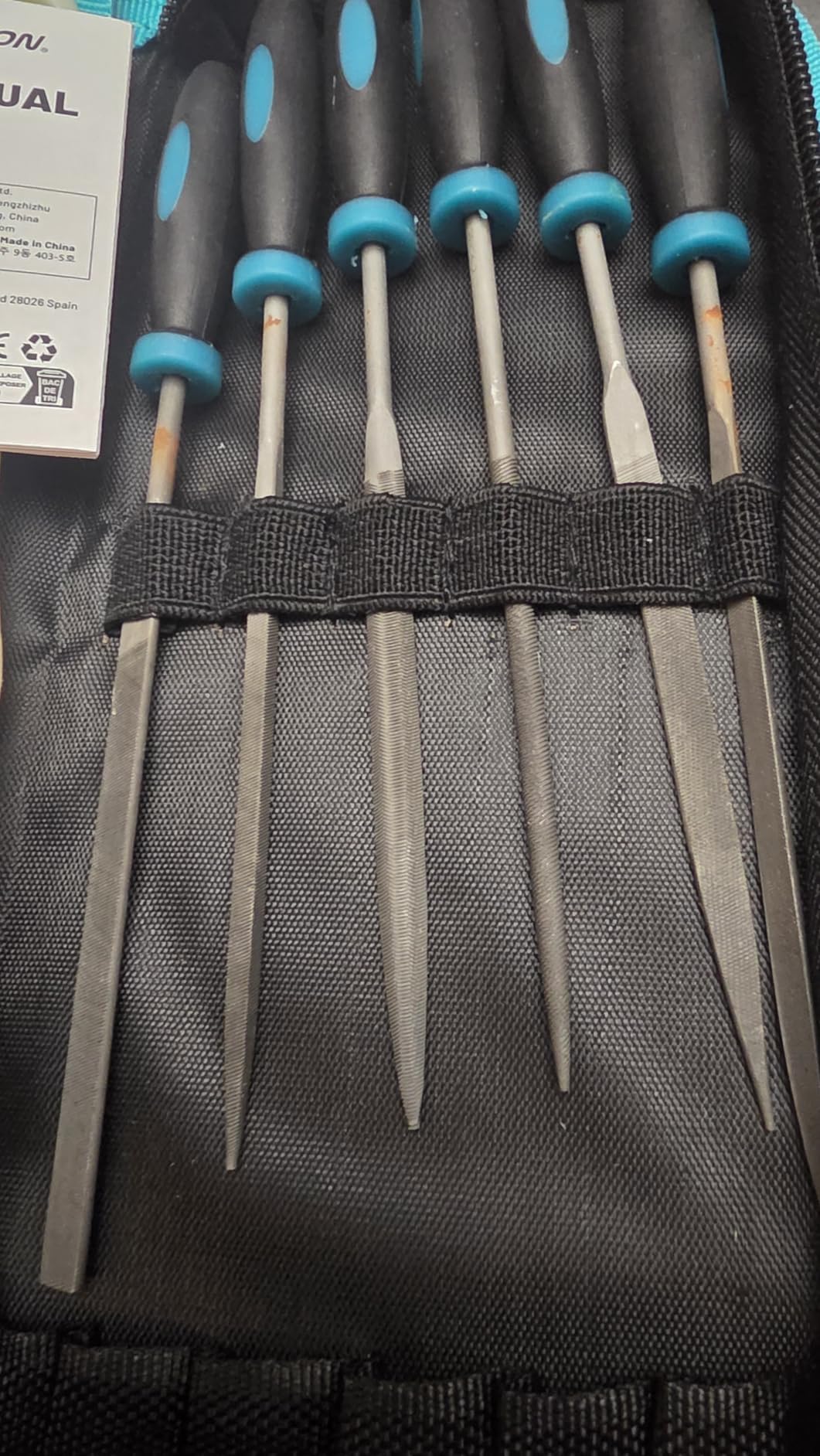
Splitting the set evenly between carbon steel and diamond files is the idea here, and it works. Six carbon steel needle files cover the shapes you shape with, and six diamond files handle material and finishing work that steel cannot touch.
The 4.6 star average sits on more than 4400 reviews, with 91 percent of buyers at four stars or better. Buyers highlight the variety of both steel and diamond profiles and the grip on the dipped handles.
Why Half the Set Is Diamond
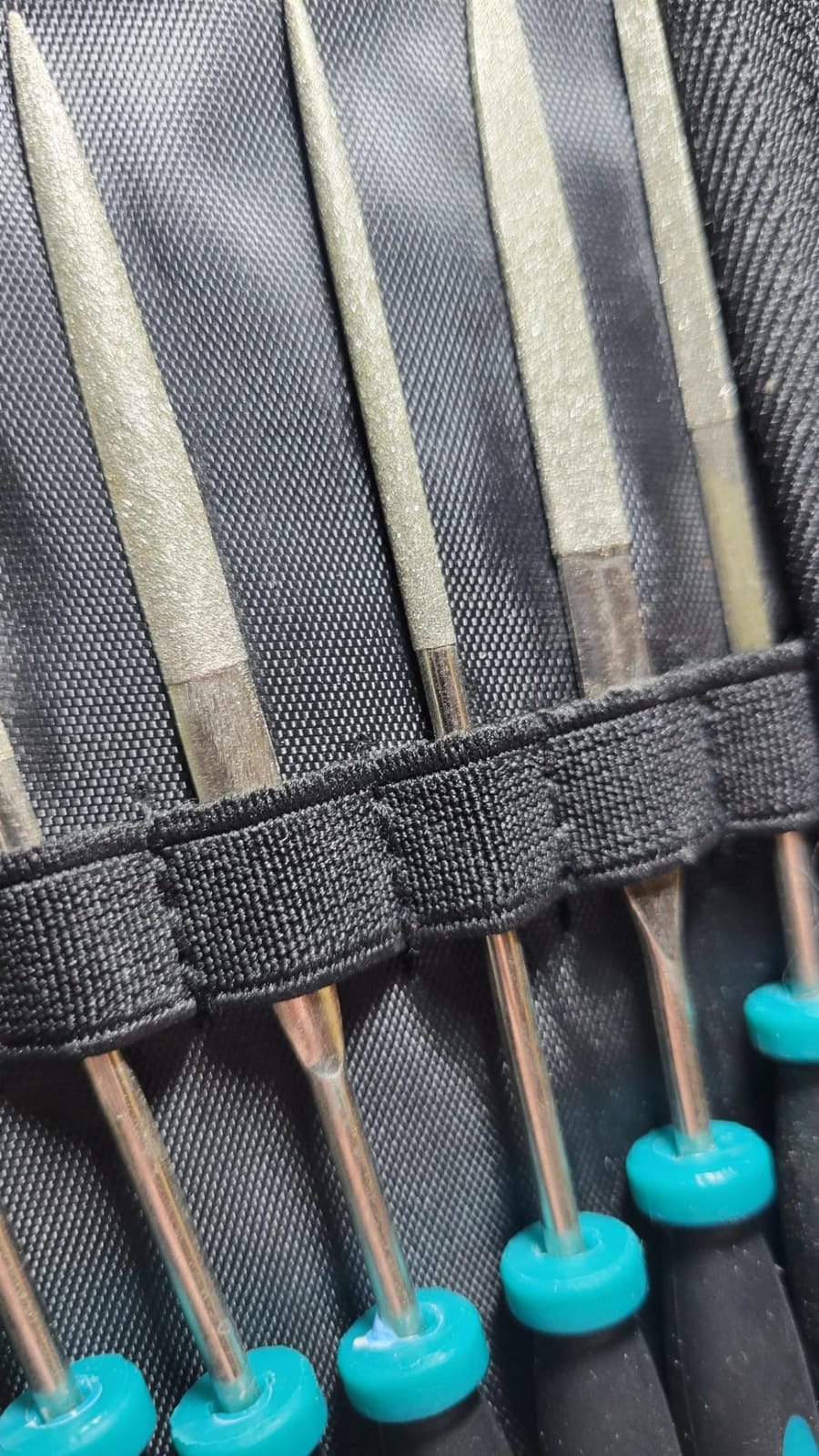
Diamond files work on nearly all materials, which is why they are standard in jewellery and model work rather than being treated as a luxury add-on. They do not glaze the way a steel file does, and they hold their shape on material that would work-harden a steel edge.
The offsetting weakness is removal rate. Diamond grit abrades rather than cuts, so it is for light finishing and cleanup, not for taking material away.
Profile Coverage and the Warding File
Steel profiles are round, half-round, square, flat, flat warding and sharp triangle. The flat warding is the useful inclusion here, because it has safe edges for reaching into slots without marking the surrounding surfaces.
At 9.87 ounces and 8.19 by 2.05 inches, this is a pouch-sized set. It is not a roughing kit and should not be bought as one.
Grips and the Canvas Pouch
The non-slip rubber dipped handles attach by pulling straight on, which means you can swap them between tools and keep them on permanently. For delicate work, a handle you can feel through your fingertips is a real control improvement.
The canvas pouch is fine for a drawer, but buyers who work hard note that it offers less protection than a hard case. Keep it somewhere the set is not being dropped on its points.
Best for: jewellery, clock repair, model work and finishing passes on hardened or very hard material.
5. Topec 26-Piece Metal File Set – The Best Needle File Coverage in a Metal Kit
Topec 26 PCS Metal File Set, Grade T12 Forged Alloy Steel, Flat/Triangle/Half-round/Round File Set for Metal Work, Ideal Wood Rasps for Woodworking
4 large files plus 14 precision needle files
High-carbon steel at 0.75 percent carbon
Fully wrapped handle connection resists detachment
+ Pros
- 14 precision needle files
- the most in a metal-focused set
- 0.75 percent carbon high-carbon steel gives a fine durable cut
- Fully wrapped handle resists detachment under load
- Gloves
- sandpaper
- brush and carry bag included
– Cons
- Listed package dimensions look understated for a 26-piece kit
- Generic presentation with no explicit handle material specification
Fourteen precision needle files in one metal-focused set is the standout number here. The REXBETI set has twelve, and this one trades case quality for more small tools.
The carbon content is specified at 0.75 percent, and the listing claims deeply quenched and coated steel with uniform tooth pitch. Uniform pitch is the detail worth trusting, because inconsistent pitch along the length is what makes a file chatter.
What 0.75 Percent Carbon Buys You
Higher carbon content in the steel gives a finer, more durable cut, and reviewers consistently describe the files as delivering a fine, durable bite. The teeth are coated, which helps resist the corrosion that turns an unused file into a rust-coloured lump.
The stated use covers wood, metal, glass, ceramic, leather and plastic, which makes it one of the broader kits here if you cross over between trades.
The 26-Piece Layout
Four large files cover flat, triangle, half-round and round. Fourteen needle files cover the small work, and the balance is accessories: two gloves, five sanding papers, a wire brush and a carry bag.
That is a lot of pieces, and piece count is a poor guide to quality. What matters is that the large four are the right four and the steel is specified, which is true here.
Handle Construction and Honest Drawbacks
The fully wrapped handle connection process is a real engineering choice. Wrapping the handle over the tang resists detachment under heavy use, which is where cheaper sets let go.
The two weaknesses are honest ones. The listed package dimensions of 3.94 inches square look understated for a 26-piece kit, and there is no explicit handle material specification. If you need a documented handle material or a case you can drop, look elsewhere.
Best for: anyone whose metalwork is mostly small parts and detail, and who wants the most needle files per purchase.
6. TARIST 3-Piece 8-Inch Metal File Set – The Highest Hardness Steel for Deburring and Shaping
TARIST Metal File Set, 3-Piece, 8-inch,Professional Carbon Steel File, Includes Flat/Half-Round/Round,Work for Metal, Wood and More
Flat, half-round and round at 8 inch
T12 carbon steel at 62-66 HRC body hardness
Deeply quenched and coated teeth
+ Pros
- Highest published body hardness in the group at 62-66 HRC
- Three core profiles cover most general shaping jobs
- Deep quench and coating extend working life
- Ranked first in American Pattern Files
– Cons
- Only three pieces
- so no needle or diamond files for detail work
- Deeply hardened teeth are more brittle if dropped
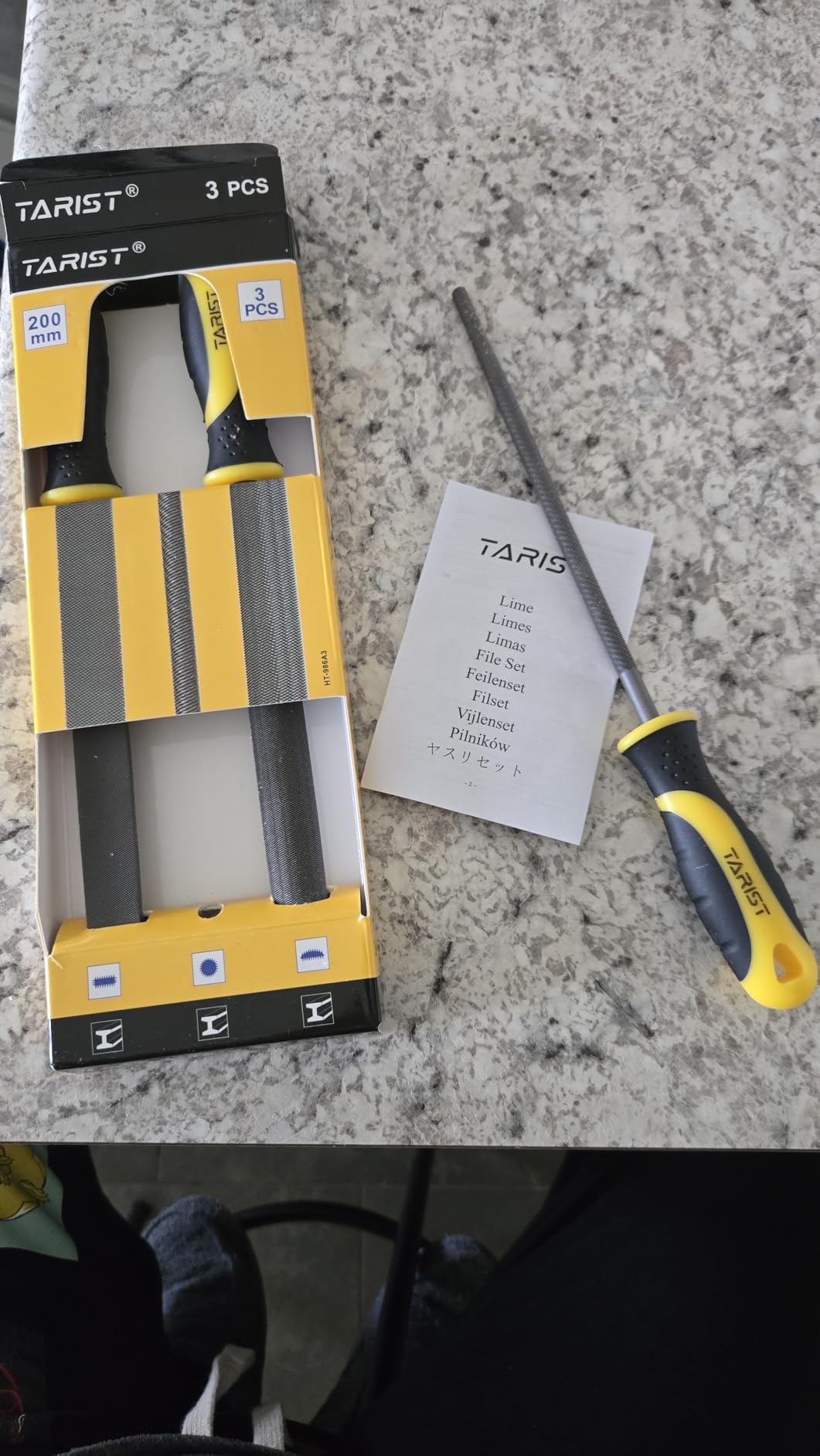
Three files is not a set, it is a toolkit, and that is the point. If you want one flat, one half-round and one round at 8 inches and you want them as hard as we could find in this test, this is the answer.
Body hardness of 62 to 66 HRC from T12 carbon steel is the highest published figure in this group, and it is the sort of specification most listings never give you at all.
What 62-66 HRC Means for Steel Work
Hardness in this range is what allows the teeth to stay sharp when you are filing steel that resists the cut, rather than rolling over the top of it. The teeth are deeply quenched and coated, and the manufacturer’s own recommendation is a light machine oil coating to preserve the surface finish.
That oiling advice matters more than it sounds. A coated file still oxidises at the edges, and a light film of machine oil is the difference between a file that glides and one that grabs on the first stroke of the day.
Three Profiles, No Filler
Flat, half-round and round at 8 inches is the correct short list for general workshop shaping, deburring, trimming and smoothing. Buyers use it on metal, wood, jewellery, plastics, ceramics and glass, so it is not a steel-only tool.
At 1.1 pounds for three files, the individual files feel substantial rather than tinny, which is part of the reason the set rates well across more than 1600 reviews.
Where the Three-Piece Limit Bites
There is no needle file and no diamond file here, so any small-area work means buying something else. If your projects include jewellery, small brackets or model parts, three profiles will feel limiting within a week.
The other limitation follows from the hardness. Deeply hardened teeth are more brittle if dropped, so this set wants a drawer or a case rather than a loose bench hook.
Best for: general metal shaping and deburring on steel where tooth hardness matters more than file variety.
7. NEIKO 12-Piece File and Rasp Set – The Best Multi-Material Kit with Swappable Handles
NEIKO 00109A Metal File and Rasp Set | 12 Piece, 10, 8, and 6 Inch Extra Slim Flat, Half, Mill, and Round Set | Non Slip PVC Handle, Wood | Heat Treated Carbon Steel Two Way
7 metalworking files plus 3 wood rasps
10 inch, 8 inch and 6 inch profiles
Two removable non-slip PVC handles
+ Pros
- Only set pairing metal files with dedicated wood rasps and a mower blade file
- Swappable PVC handles let one grip serve several blades
- Range of coarseness from extra slim taper to full bastard
- Mill saw and mower blade files handle real workshop tasks
– Cons
- Slim taper saw files are thin and unsuited to aggressive removal
- No needle or diamond files for very fine finishing
No other set in this test includes dedicated wood rasps alongside metalworking files, and for a workshop that does both, that makes this the most useful single purchase here.
The 4.5 star average comes from 877 reviews with 90 percent at four stars or better. Reviewers value the breadth of profiles, the removable handle design and the ability to work wood and metal from one kit.
Seven Files and Three Rasps in Detail
The metalworking group covers a 10 inch two-way bastard, an 8 inch half-round bastard, an 8 inch mill saw, a 6 inch slim taper, a 6 inch extra slim taper and a 6 inch round bastard saw file. The rasp group is an 8 inch round wood rasp, an 8 inch shoe rasp and an 8 inch rotary mower blade file.
That mower blade file is the sleeper. Anyone who mowers a lawn has a dulled blade, and having the file to match in the same case removes a trip to the hardware store.
Two Removable Handles for a Dozen Tools
The two non-slip PVC handles swap between blades, so one grip can serve multiple tools. That sounds like a small saving until you remember that an unhandled file is a control problem and a genuine safety hazard, particularly at a lathe where a spinning chuck is a real risk.
At 2.7 pounds the set is heavier than most, again down to build quality on the blades rather than the accessories.
The Honest Limitation
The slim taper saw files are thin. They are the right tool for sharpening and detail work and the wrong tool for aggressive material removal, and buyers who push them hard report that plainly.
There are also no needle or diamond files here, so very fine finishing needs a second purchase. What you get instead is the only genuine wood rasp coverage in the group.
Best for: workshops that work both metal and wood, lawn equipment repair, and anyone who wants a handle with every file in the case.
8. Tonmifr 34-Piece High Carbon Steel File Set – The Best Files for Hardened Steel and Large Work
Tonmifr Professional Metal File Set 34Pcs Industrial Grade High Carbon Steel,5 Shapes (Flat/Half Round/Round/Triangle/Square) for Hardened Steel, Metalworking Tools with Storage Case,14 Needle Files
Forged high-carbon steel at 50-55 HRC
5 large files at 320mm plus 14 needle files
Labelled storage case, brush, sandpaper and gloves
+ Pros
- Largest piece count at 34 including 14 needle files and a rasp
- Forged high-carbon steel claimed to resist bending
- Labelled anti-shatter case prevents tool loss
- Flat
- half-round
- round
- triangle
- square and rasp profiles
– Cons
- Lowest documented long-term use in the group
- 50-55 HRC steel is slower on soft wood
- Durability claims are marketing-led rather than third-party verified
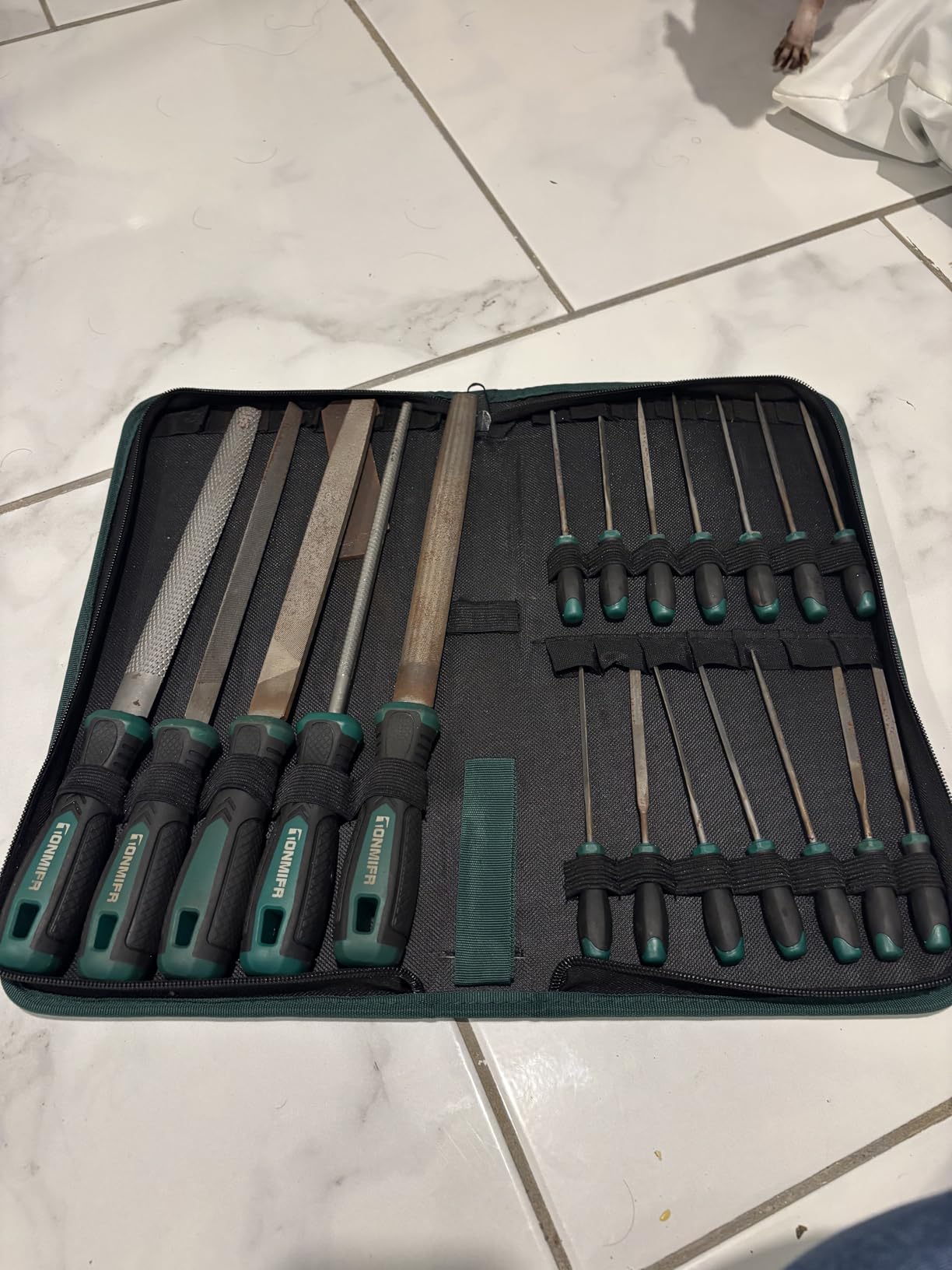
This is the largest set here at 34 pieces and the one with the most explicit hardness rating for hardened steel work. Five 320mm files, 14 needle files at 145mm and a wooden half-round rasp fill the case, and the case is labelled.
It rates 4.4 stars from 381 reviews, which is the lowest review count in the group. We are including it because the specification is genuinely different from everything else here, but you should weigh the thinner evidence accordingly.
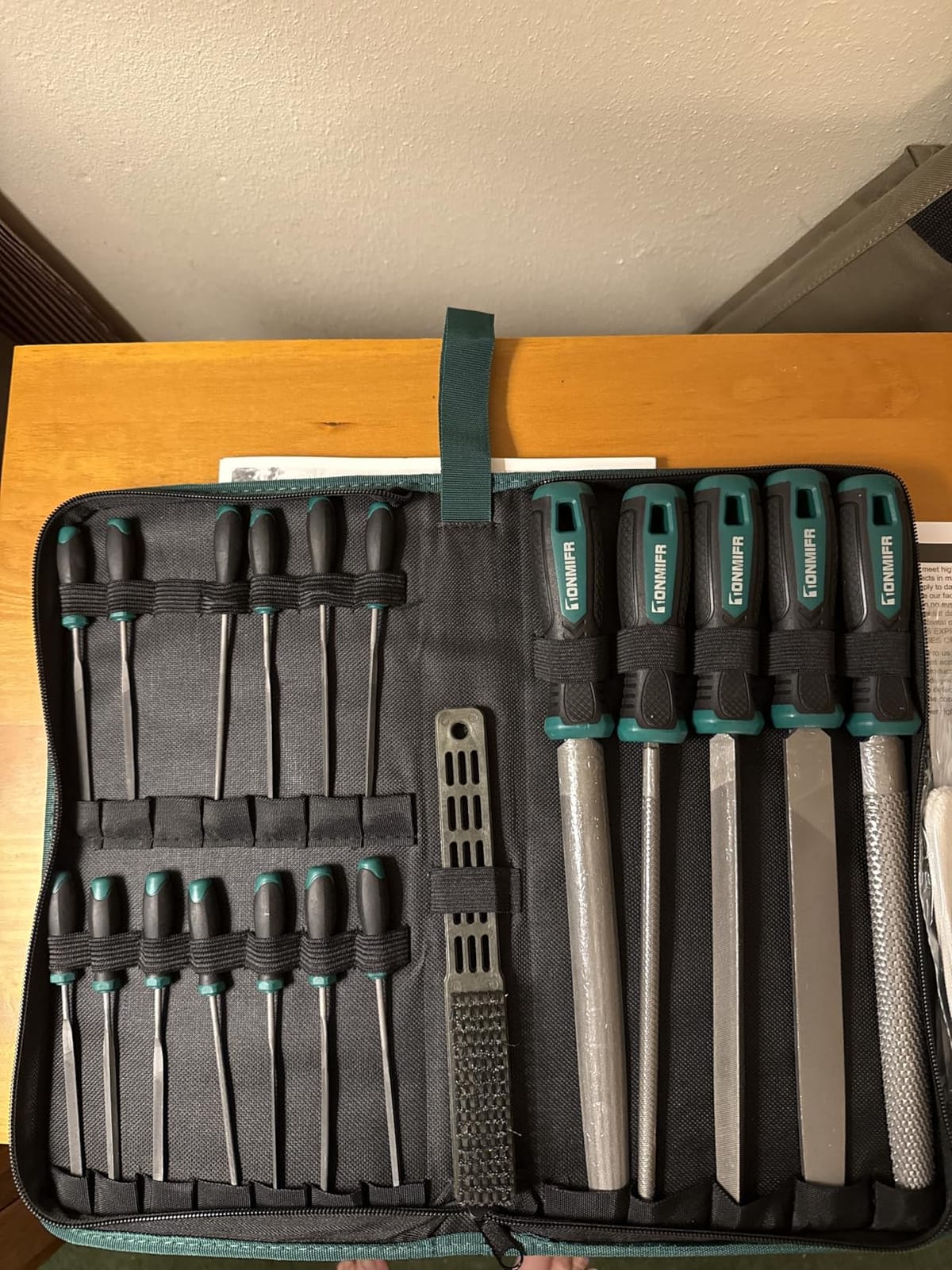
50-55 HRC Forged High-Carbon Steel
The manufacturer states forged high-carbon steel at 50 to 55 HRC for hardened steel, cast iron and alloys, and claims it resists bending three times longer than standard files. Treat that multiplier as a marketing claim rather than a measured result, but the hardness figure itself lines up with what you want for cast iron and hardened parts.
The trade-off is that this steel is overkill and slower on soft wood and soft aluminium. If your work is mild steel and timber, you are carrying hardness you will not use.
320mm Files and Needle Coverage Together
The five large files are flat, half-round, round, triangle and a wooden half-round rasp, all at 320mm, which makes them the longest large tools in this test. Longer means more lever arm, more control and more material removal per stroke on heavy work.
The 14 needle files at 145mm are close to the standard length for small work, so they are not novelty items. Buyers specifically mention appreciating both the needle files and the rasp being included.
The Case, the Accessories and the Caveat
Graded 180, 240 and 320 sandpapers, a wire cleaning brush and work gloves are included, and the storage case measures 33 by 18 by 5cm with labelled slots. Labelled slots mean you can see what is missing at a glance rather than discovering the gap when you need the tool.
The honest caveat is the rating distribution. Four percent of buyers rate it one star, and those reviews question the exaggerated industrial-grade durability claims. That is a reasonable reaction to a listing that promises a threefold improvement without evidence.
Best for: cast iron, hardened components and heavy automotive or welding cleanup where a standard file would glaze.
9. SE 10-Piece Double-Ended Riffler File Set – The Best Files for Internal Curves
SE Riffler File Set – Precision Hand Tools – Double Ended Metal Files – Set of 10 Pcs – 745RF
10 double-ended riffler files at 3mm by 140mm
Curved profile for concave and hard-to-reach surfaces
Fine to medium cut steel
+ Pros
- Riffler curvature reaches contours and inside corners no straight file can
- Double-ended design gives two working edges per tool
- Compact 3mm by 140mm format suits model and sculpture work
- Fine cut is well suited to finishing and light deburring
– Cons
- Some flat files have smooth dead inner faces
- Cut is finer than the medium cut some listings advertise
- A few buyers report inconsistent quality control
Every tool in this set is a riffler, which is unusual and exactly why we picked it. A riffler is curved on both faces and double-ended, so each end has a different concavity and you get two working curves from one tool.
At 2.89 ounces and 6.2 by 0.5 by 0.5 inches, the whole set is light enough to work with one hand, which is what you want for delicate internal shaping.
Where a Riffler Beats Every Other Shape
Reviewers consistently praise the reach into tight curves and odd contours, and they are right about the mechanism. A flat or half-round file only touches at a point or along a line when the surface curves away from it. A riffler’s belly sits in the curve, so the full tooth depth engages across the whole area.
That makes these files the right choice for the inside corners of mouldings, the roots of tight radii, and the concave detail on sculpture and model work.
Fine Cut and Double-Ended Value
The cut is fine to medium, which suits finishing and light deburring rather than bulk removal. The double-ended format means ten tools give you twenty different curvatures, which is excellent value for reach.
Be aware that the actual cut is finer than the medium cut some listings advertise. That is a complaint worth believing, because it changes which jobs the set suits.
Quality Control and the Dead Face Issue
Some flat files in this set have smooth dead inner faces, which limits their use anywhere all sides need to cut. A small number of buyers also report inconsistent quality control between pieces.
The set rates 4.4 stars from 328 reviews with 85 percent at four stars or better, so most users are happy. Just check each tool as you unpack it before you rely on it for a finished part.
Best for: internal curves, concave radii, model work, sculpture and finishing where a straight file simply cannot reach.
10. Nicholson 5-Piece General Purpose File Set – The Best Bastard-Cut Lineup for Steel
Nicholson 5 Pc 6″, 8″& 10″ General Purpose File Set – 22040NNN, Multi, One Size
10 inch half round bastard, 8 inch mill bastard, 8 inch mill smooth, 10 inch mill bastard, 6 inch slim taper
Storage pouch included
Limited lifetime warranty
+ Pros
- Highest average rating in the group at 4.7 stars
- Recognised file brand with 160-plus years of heritage
- Bastard cut removes material quickly
- Limited lifetime warranty on the set
– Cons
- Highest price point of the group at nearly three times the budget sets
- Sold without handles and users report fitting their own
- One reviewer reports current models lack the final heat treating steps of older files
This set has the highest average rating in the group at 4.7 stars, with 81 percent of buyers giving five stars. It also has the fewest reviews at 127, so the rating is excellent and the evidence base is thinner than the mid-range sets.
What it does have is a genuine machinist’s cut progression. Four of the five files are bastard cut for material removal, and the sixth-sized file is a slim taper for precision work.
The Cut Progression, Properly Specified
The set is a 10 inch half round bastard, an 8 inch mill bastard, an 8 inch mill smooth, a 10 inch mill bastard and a 6 inch slim taper. That is a coarse-to-fine progression you can actually work with, and it is the honest strength of a five-piece set against the 30-piece kits that just contain more of the same.
The mill files are for general flat and edge work, the half round covers concave radii, and the slim taper handles slots, grooves and sharpening.
Brand Heritage Without the Rose Tinting
Nicholson carries a long manufacturing history under Apex Tool Group, and that heritage is worth something for consistency between batches. But practitioners on blade and tool forums are split, and one reviewer of this set reports that current models lack the final heat treating steps older Nicholson files received.
We would not call that disqualifying on its own, but it is the kind of thing to test on your own material before committing a project to the set.
No Handles Are Included
This is the practical issue with this set. Files are sold bare, and users report adding separate handles with heat to fit them. At this price, buying three handles is a real additional cost, and a bare tang is a control and safety problem, particularly near a lathe.
There are also no needle or diamond files, so fine detail work needs a second purchase. Judge it as a serious general-purpose steel set rather than a complete kit.
Best for: machinists and serious hobbyists working primarily on steel who want a specified cut progression and will fit their own handles.
How to Choose: Nine Criteria That Matter More Than Piece Count
Piece count is the easiest number to compare and the least useful. Two sets with twenty-five pieces can give you one usable cut progression, and a five-piece set can give you a proper one. These are the criteria we actually use when matching a file to a job.
Match the Cut Type to the Job
Roughing a forging down and finishing a part to size are different operations, and they need different cuts. Double-cut bastard for removal, single-cut or smooth for sizing and finishing, and rasp cut for fast aggressive work on material no other file will shift quickly.
If your work includes hardened material, cast iron or weld cleanup, also look for a published hardness figure. Only the TARIST and Tonmifr sets here give one, and that number is the difference between a file that cuts and a file that glazes.
Buy Files at One Length Per Cut Grade
This is the single most useful purchasing insight in this topic and almost no listing tells you. Cut grades are only comparable within the same file length, so a set that mixes 6, 8 and 10 inch profiles described as a complete range of cuts may deliver a progression that does not work in either direction.
Our rule is that a coarse-to-fine progression should be built at one length, or at most across two lengths you have personally compared by feel. Do not trust the word smooth or the word second cut on its own.
Handles Are a Safety Requirement, Not an Accessory
A bare tang is both a control problem and a genuine hazard. If you file a workpiece held in a lathe chuck, a spinning handle is the outcome you do not want. The NEIKO set solves this best with two removable PVC handles that swap between blades, and the dipped handles on the kapoua and LIBRATON sets solve it for small tools.
The Nicholson set ships without handles at all, which is a fair deal at a premium price but means you are fitting your own. Plan for that before the first stroke.
Swiss Pattern vs American Pattern
Two pattern systems dominate the world of files. Swiss pattern files have shallower, more aggressive tooth angles with more depth, so they clear chips fast and hold their cut in abrasive work. American pattern files have shallower teeth with more angle, so they produce a finer finish and suit fitting and finishing.
Several sets in this roundup are listed under Swiss pattern categories, which explains their heavier removal. Neither is better in the abstract. They are different tools, and matching the pattern to the job matters more than the brand on the handle.
What the Price Range Actually Buys
Across this category the price spread is wide and the differences are usually four specific things: the steel grade, how consistently the tooth pitch is cut along the length, how much shape and cut coverage you get, and whether handles and a proper case are included.
Budget sets generally buy fewer shapes and thinner steel. Mid-range sets buy better steel and a case. Premium sets buy documented provenance, tighter tooth consistency and warranty cover, and they frequently sell bare so you add handles yourself. Nothing in the range buys magic, which is why a well-chosen mid-range set often outperforms a poorly-chosen premium one.
Hand Files vs Powered Alternatives
Powered tools have their place, but they do not replace hand files for finish and fit. A die filer machine removes material quickly across a flat face, and it will not touch an internal radius. A belt sander or an angle grinder with a flap disc takes a weld bead down, and it will not size a part to a line.
Even a die filer operator on Practical Machinist keeps a hoof rasp at the bench for reach and quick removal. Hand files earn their place because they are the only tools that let you control final size with direct feedback through the handle.
How to Use Them: Push Strokes, Pressure and Draw Filing
The technique detail separates a file that cuts from one that just moves metal around. Four habits account for most of the difference, and none of them require expensive equipment.
Chalk the Teeth Before You Start
Rolled steel pins pack into the teeth during use, and the result is pinning: the file stops cutting and starts polishing. The folk remedy on model engineering forums is to run chalk along the teeth before filing, which fills the gullets and stops debris packing in. Oil works too, but it has to be a fairly generous film, which makes it a bench-only option.
Users who chalk regularly find that tapping the file on wood is enough to clear pins between passes. Never rap a file on a steel bench or anything ceramic, because the impact will chip or bend the teeth.
Push Only – Filing Is Not Sawing
A standard file cuts on the push stroke. Dragging it back over the work just dulls the teeth and can put a burr on the edge you have just made. Working a file like a saw is the most common beginner habit and the fastest route to a glassy, useless file.
On long files of 12 to 14 inches or more, practitioners use a fist grip on the end rather than a fingertip grip at the tip, with the other hand on the shoulder of the file. Keep your elbows off the bench so your body weight does the work, and vary the pressure along the stroke so you do not load the tip hardest.
Draw Filing for Thin Sections
Cross-filing a thin edge makes it flex and chatter, and on light work the vibration alone can ruin the part. Draw filing clamps the workpiece between a fixed surface and the file and pulls the file along it, which removes material without letting the work move.
Draw filing is the correct technique on thin knife blanks, thin sheet edges and small components where a normal stroke would set the part ringing. It is slower and far more accurate.
Diagnose a Ruined File
If a file stops cutting abruptly and starts polishing, something changed. Work hardening on the workpiece is the most common cause, and it is not a fault in the file. Metal that has been bent, hammered or gripped hard develops a hard skin that no standard file will cut, and forcing it will tear teeth out.
The tell-tale sign is a shiny, polished band across the teeth where the file skipped, sometimes with visible torn or rounded tooth tips. A file with a bright patch and rounded teeth is finished. Retire it to the scrap pile, where it still makes an excellent punch, drift or cutter, and start the job with a fresh edge.
Care, Cleaning and Storage: Keeping Teeth Sharp
A file is cheap to maintain and expensive to replace, and almost all early dulling is caused by neglect rather than use.
Tap and Brush Between Passes
Every few strokes, tap the file handle lightly on the edge of the bench to knock out packed debris, then run the stiff wire brush along the teeth. Several sets here include a wire brush for exactly this reason. A file cleaned every few strokes lasts several times longer than one cleaned at the end of the job.
Chalk or Oil to Stop Pinning
Chalk is the cheap and effective answer for shop use, and it doubles as a lubricant on the stroke. Light machine oil is the better choice for files that sit between jobs, since it also protects against the rust bloom that a damp shop produces overnight.
The TARIST set specifically recommends a light machine oil coating to preserve the surface finish, which is good general advice for any coated file.
Store Files Separately, Never Loose
Files rattling loose in a drawer blunt each other’s teeth, and a set stored that way is a set with rounded points before you have used it. Every pick here except the LIBRATON pouch comes with a case, a roll or a pouch of some kind, and it is worth using.
For loose tools, a paper sheath or a length of split garden hose over the point costs almost nothing and does the same job. If you work at a lathe, a dedicated file rack with a handle hole for every tool is worth building, because it removes the temptation to file with a bare tang.
Frequently Asked Questions
What is the main difference between a file and a rasp?
A file has milled cutting teeth and removes material on the push stroke, giving a controlled finish. A rasp has raised, pointed teeth spaced further apart, cuts on the pull stroke, and removes metal far faster but leaves a rougher surface. Because a rasp only has cutting geometry on one side, working it forward and back like a file glazes it almost immediately.
Can I use a rasp on metal?
Yes. Rasps are routinely used on steel, including A-36, where practitioners keep a hoof rasp at the bench specifically because it removes metal fast. A rasp is the right tool for fast rough removal on metal that is too hard or too thick for a file to shift quickly, followed by a file for sizing and finish.
What are bastard files used for?
A bastard file is a coarse double-cut grade used for roughing and aggressive material removal, such as taking a forging or a bandsaw cut down to size. Its second set of angled teeth gouge rather than scrape, so it removes metal fast. You move to a second cut or smooth file once the part is close to final size.
What is a rasp cut file used for?
Rasp cut teeth are raised points rather than milled grooves, spaced wider apart and cutting on the pull stroke. They are used for fast, rough removal of metal on thick or hardened material where a standard file would work-harden or glaze, and they are the standard file type used when hot filing at a forge. The finish they leave is coarse and is meant to be followed by a finer cut.
Do you push or pull a file?
You push a standard file and you pull a rasp. Files have cutting geometry on the face that drives them forward, so the return stroke only dulls the teeth and can raise a burr on your finished edge. Rasps, plus-cut and Aristo-pattern files are the exception and cut on the return stroke, so working them both ways is correct for those tools.
Why is my file skipping and getting ruined?
Almost always work hardening on the workpiece rather than a fault in the file. Metal that has been bent, hammered or gripped hard develops a hard skin that no standard file will cut, and forcing it skips the file and tears teeth out. Signs are a shiny polished band across the teeth and visibly rounded tips. Retire the file, take a fresh pass to remove the hardened skin, and use diamond or a harder file on hardened material.
Conclusion: Which File Set Fits Your Work
If you want one set that covers general metal shaping, detail work and storage without a second purchase, the REXBETI 25-piece is our pick for 2026. T12 drop forged alloy steel, four large profiles, twelve needle files and a proper case make it the most complete bench option we tested.
If you work metal and plastic in the same shop, the Hi-Spec 17-piece gives you four 12-inch machinist files plus diamond-grit needles, which no other set here combines. If your budget is tight or your work is small parts and jewellery, the kapoua 6-piece covers the core profiles at the lowest cost.
For steel that resists a normal file, the TARIST 3-piece at 62 to 66 HRC or the Tonmifr 34-piece at 50 to 55 HRC will cut where cheaper steel glazes. For internal curves no straight file can reach, the SE riffler set is the only real answer. And for a specified bastard-to-smooth progression in bare steel files, the Nicholson 5-piece is worth the extra money provided you fit your own handles.
Whichever you choose, chalk the teeth, push only, clean between strokes and keep the files in their case. That routine matters more than the brand name on the handle.
Leave a Reply