
Owners in snowbelt regions ask the same question every October: which cover will still be sitting flat on the tub in February? The best hot tub covers for heavy snow are not the thickest tarps on the shelf. They are fitted covers with a high-density foam core, a taper that sheds meltwater to the perimeter, reinforced seams, and tie-downs rated for wind uplift. Ten inches of fresh snow on a 7 by 7 foot tub can add 25 to 50 pounds of load, and wet snow roughly doubles that. Get the cover wrong and you get a dome, a tear, or a frozen block you cannot lift.
I have spent the last two winters reading owner accounts on r/hottub and in hot tub Facebook groups about covers that failed, domed, or turned to ice, and cross-checking those complaints against the specifications below. The pattern is consistent: covers collapse because the foam core is too light for the load, because the taper is flat so meltwater pools and freezes at the center drain, or because the straps were not rated for the wind that followed the snow.
This roundup covers ten options in two distinct groups. The first is the actual insulated spa cover, the only category rated to carry snow load. The second is the outer protector cap, a sacrificial layer that goes on top of an insulated cover to take UV, hail, and debris. Half of the products below are in that second group, and I have flagged clearly where an outer cap cannot substitute for snow-rated insulation. If you also need to clear a path to the tub, our picks for the best snow blowers for heavy snowfall cover that side of winter.
Our Top 3 Picks for Snowbelt Tubes in October 2026

ULTCOVER Waterproof Hot Tub SPA Cover
- 600D polyester with PVC backing
- Two-sided air vents
- Adjustable elastic cords
- 12 size variants
UCEDER 91 x 91 in TPU Backed Cover
- Cold rated to -15 C
- TPU backing layer
- Wind belt and D-ring
- 14 size variants

iBirdie 85 x 85 in Waterproof SPA Cover
- Lightest 600D at 4.4 pounds
- Four buckles and waterproof zippers
- 45+ size and color variants
The three picks above lead the list for different reasons, and the difference matters in a snowbelt. The ULTCOVER earns the top spot because it carries the most owner history of any cover here and holds its position in wind. The UCEDER is the only one in the group with a published cold rating of -15 degrees C, which matters when fabric stiffens. The iBirdie wins on fit, with more than 45 size and color variants covering tub shapes the other listings do not list at all.
Comparing All 10 Covers Side by Side
| Product | Details | Action |
|---|---|---|
|
|
Check Latest Price |
|
|
Check Latest Price |
|
|
Check Latest Price |
 |
|
Check Latest Price |
 |
|
Check Latest Price |
 |
|
Check Latest Price |
 |
|
Check Latest Price |
 |
|
Check Latest Price |
 |
|
Check Latest Price |
 |
|
Check Latest Price |
Read the table by category, not by rank. Rows 1 through 4 and rows 8 through 10 are outer protector caps, and the listings themselves say they cannot be used alone without an insulated hard cover underneath. Rows 5 through 7 are the insulated spa covers, and they are the only three here whose foam core is designed to take snow load.
1. ULTCOVER Waterproof Hot Tub SPA Cover – The Most Proven Cover in the Lineup
ULTCOVER Waterproof Square Hot Tub SPA Cover 85 inch
600D polyester canvas with PVC backing
Two-sided air vents
Adjustable elastic cords
Fits up to 85 x 85 in
+ Pros
- Largest review base in the lineup at over 8000 ratings
- Structured side air vents help it resist being blown off
- Elastic drawcords allow tensioning for high-wind conditions
- Listed as tough enough for hail snow dust leaves and bird droppings
- 12 size variants including a tall 20 in option
– Cons
- Cannot be used on its own without an insulated hard cover under it
- PVC content can stiffen in extreme cold compared with TPU-backed covers
- No published snow-load rating for the cover itself
This is the cover I keep coming back to, because it has the deepest owner record of anything in the group. More than 8,000 ratings give you a much clearer picture of how it behaves over multiple seasons than a listing with a hundred reviews ever will, and the 74 percent five-star share is consistent rather than a spike. It is a 70 percent polyester and 30 percent PVC canvas in brown, sized for tubs up to 85 by 85 inches, with structured air vents on two sides and heavy duty adjustable elastic cords.
In a snowbelt you need to read this correctly. This is an outer protector, and it works because it sits on top of the insulated cover and takes the weather that would otherwise attack the vinyl skin. The listing says it cannot be used alone without an insulated hard cover underneath, and that is not a formality. Its job is hail, UV, dust, leaves, and the odd falling branch.
Why the vents and elastic cords matter more in snow country
The air vents do double duty that is easy to miss. They let trapped moisture escape, which is what keeps condensation from turning into a slab of ice under the cover after a warm spell. They also break up the flat surface that would otherwise act like a sail, which is the difference between a cover that stays put and one that ends up in a neighbor’s yard.
The elastic cords let you tension the cover down rather than just drape it. In a wind event that follows fresh snow, a loosely fitted cover catches the first gust and lifts. A tensioned one does not. Owners consistently credit the vent and cord system as the reason this cover survives storms, and the 12 size variants mean you can get a fit that pulls tight rather than one that billows.
Where the PVC backing works and where it does not
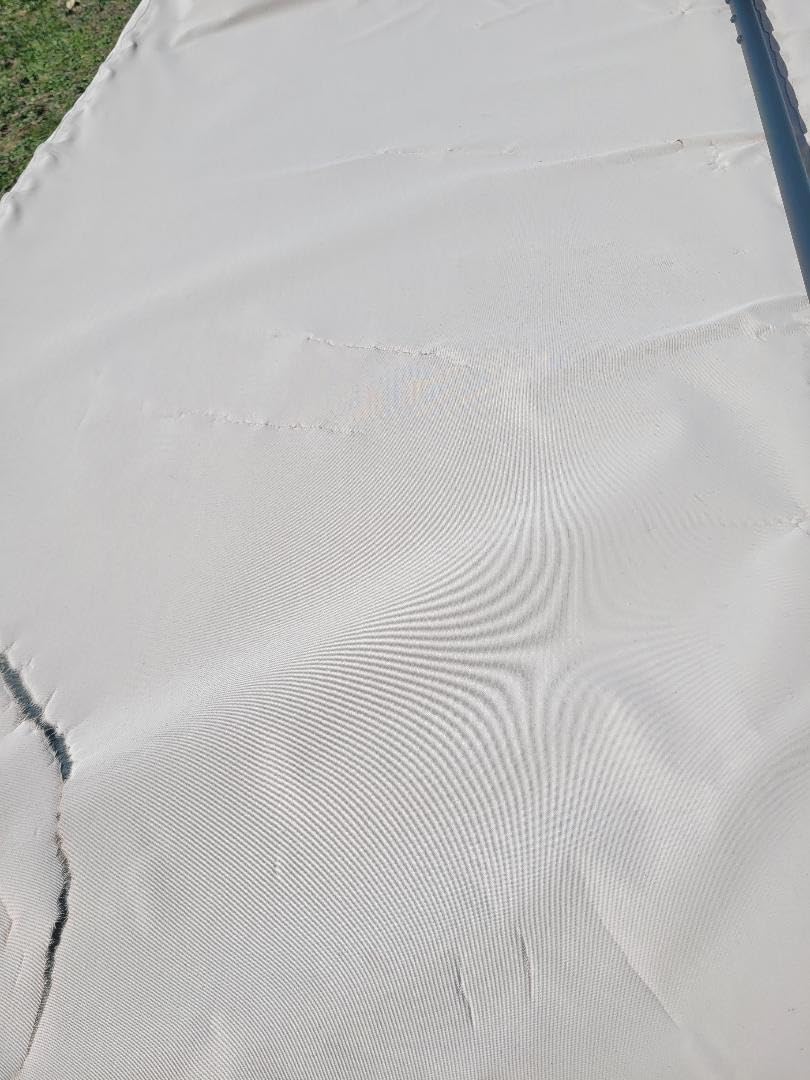
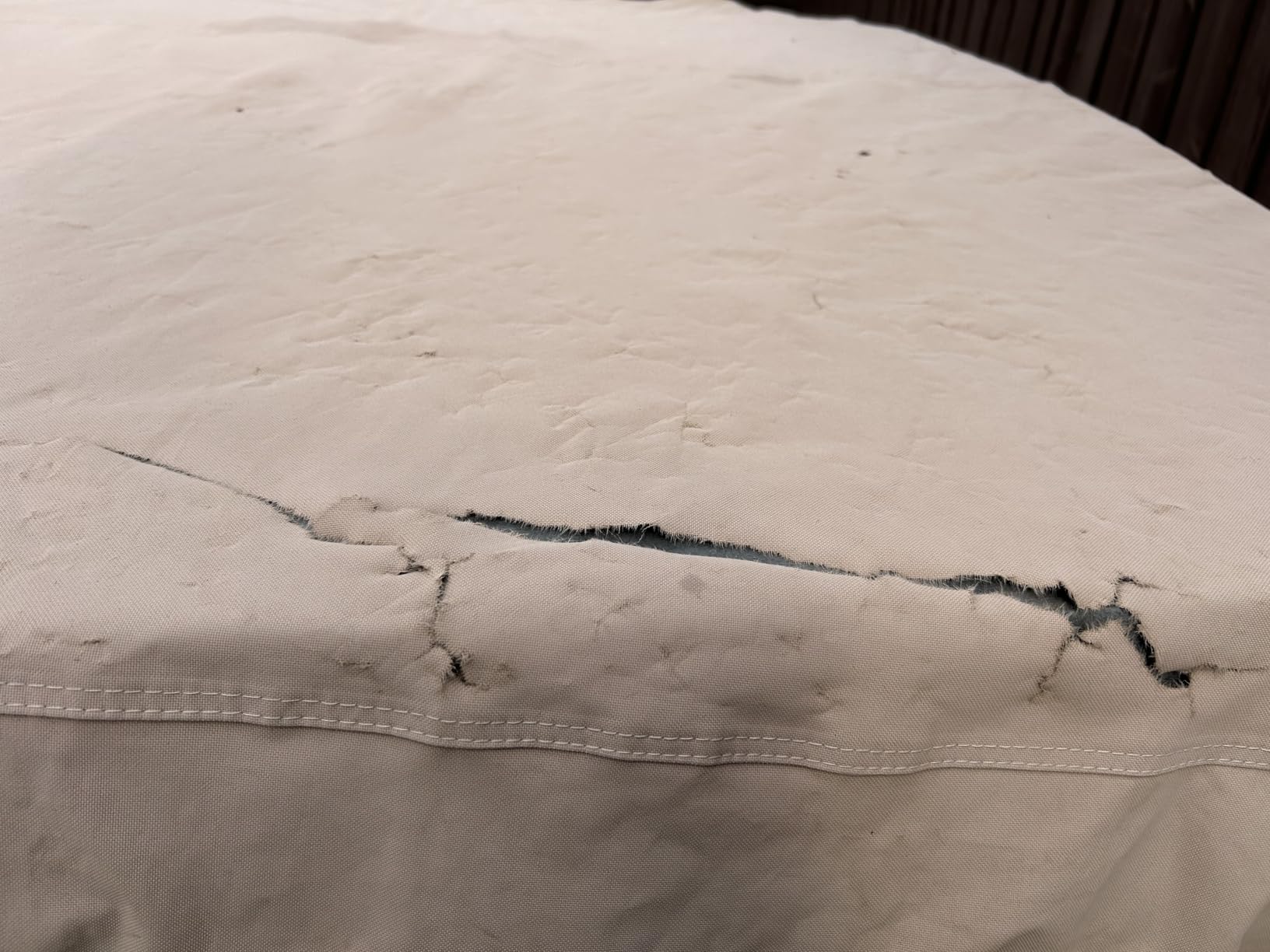
The PVC backing is what makes the canvas waterproof, and it is also the one material weakness. Reviewers note that PVC content can stiffen in extreme cold relative to TPU-backed covers. Stiffened fabric loses flexibility exactly when you need it, because a stiff cover is harder to fold, harder to walk over, and more likely to crack along a fold line after a season of freeze-thaw cycles.
Second, there is no published snow-load rating for this cover, because it is not engineered to carry snow. Its job ends where snow load begins.
Who should buy it and who should not
Buy this if you already own a proper insulated cover and want to stop paying for vinyl repairs. It is the most direct way to extend the service life of a far more expensive foam cover, and the fabric blocks the sun exposure that is the primary aging mechanism on a cover skin.
Do not buy it as your only cover. This will not hold snow, and no amount of elastic cord tensioning changes that. Pair it with one of the insulated covers further down, or accept that you are clearing snow by hand every storm.
2. UCEDER 91 x 91 in Waterproof Cover – The Only Cover Here With a Published Cold Rating
UCEDER Waterproof Hot Tub Cover -Outdoor Spa Cover Cap(Fit 91”x91 x 20”)
600D polyester with TPU backing
Rated to -15 C
Wind belt and D-ring
Fits 91 x 91 x 20 in hard covers
+ Pros
- TPU backing rated to -15 degrees C and stays flexible in heat
- One owner reports a first cover lasting five years in harsh sun
- Water-repellent finish that owners rate above alternatives
- Side air vents reduce internal condensation
- 14 size variants including a round 6 ft 11 in option
– Cons
- Built-in D-ring and bungee cord reported as weak in high wind
- Not windproof enough for gale-force conditions on its own
- Cannot be used alone without an insulated hard cover beneath
If you read the cold rating on this listing and skip everything else, you still learn the most useful thing about material choice in a snowbelt. At -15 degrees C, this cover is the only one in the lineup with a stated low-temperature figure, and it exists because of the TPU backing layer rather than the PVC backing used by the others. Owners in Colorado, Canada, and the desert Southwest all point to the same behavior: the fabric does not melt, does not stick to itself, and does not go brittle the way PVC-backed canvas does.
At 91 by 91 by 20 inches, this is the largest square cap in the group, which matters for owners with oversized square tubs who find that 85 inch caps leave the corners exposed to drifting snow. It fits over an existing aged cover as a second layer, which lets you postpone a full replacement by a season or more while you order a properly foam cored cover.
The cold rating is the whole reason to pick this one
Cold rating matters less for a three day freeze than for a two week stretch where temperatures sit below freezing day and night. Under those conditions a PVC-backed cover progressively loses pliability, and pliability is what lets a cover conform to a snow load instead of bridging over it. A TPU-backed cover keeps folding and draping through that stretch.
One owner reported a first cover on this listing lasting five years in harsh sun, which tells you something about the UV side of the material too. The listing claims tear, oil, water, and anti-color-transfer resistance, and the fabric is described as water-repellent rather than merely waterproof.
Wind retention is the weak point, and owners fix it themselves
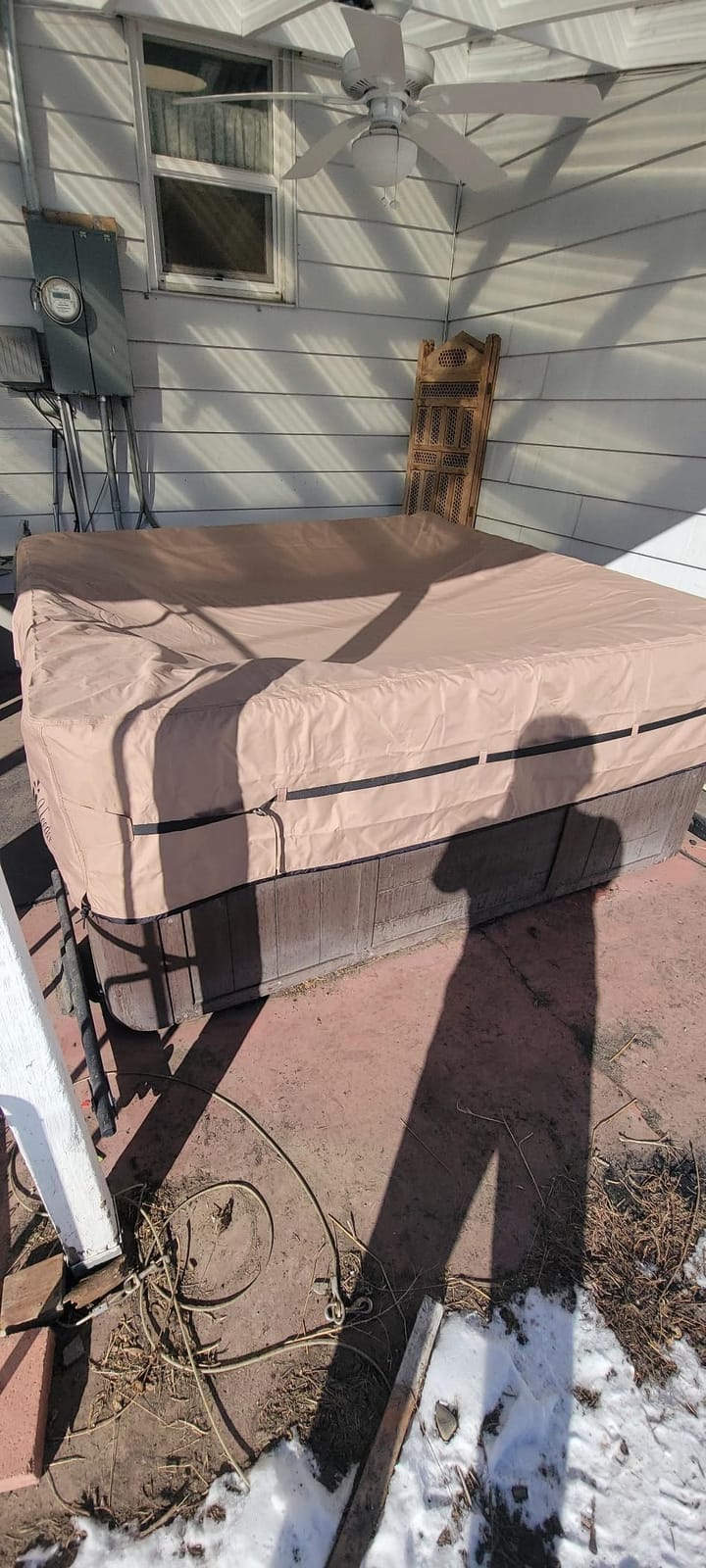
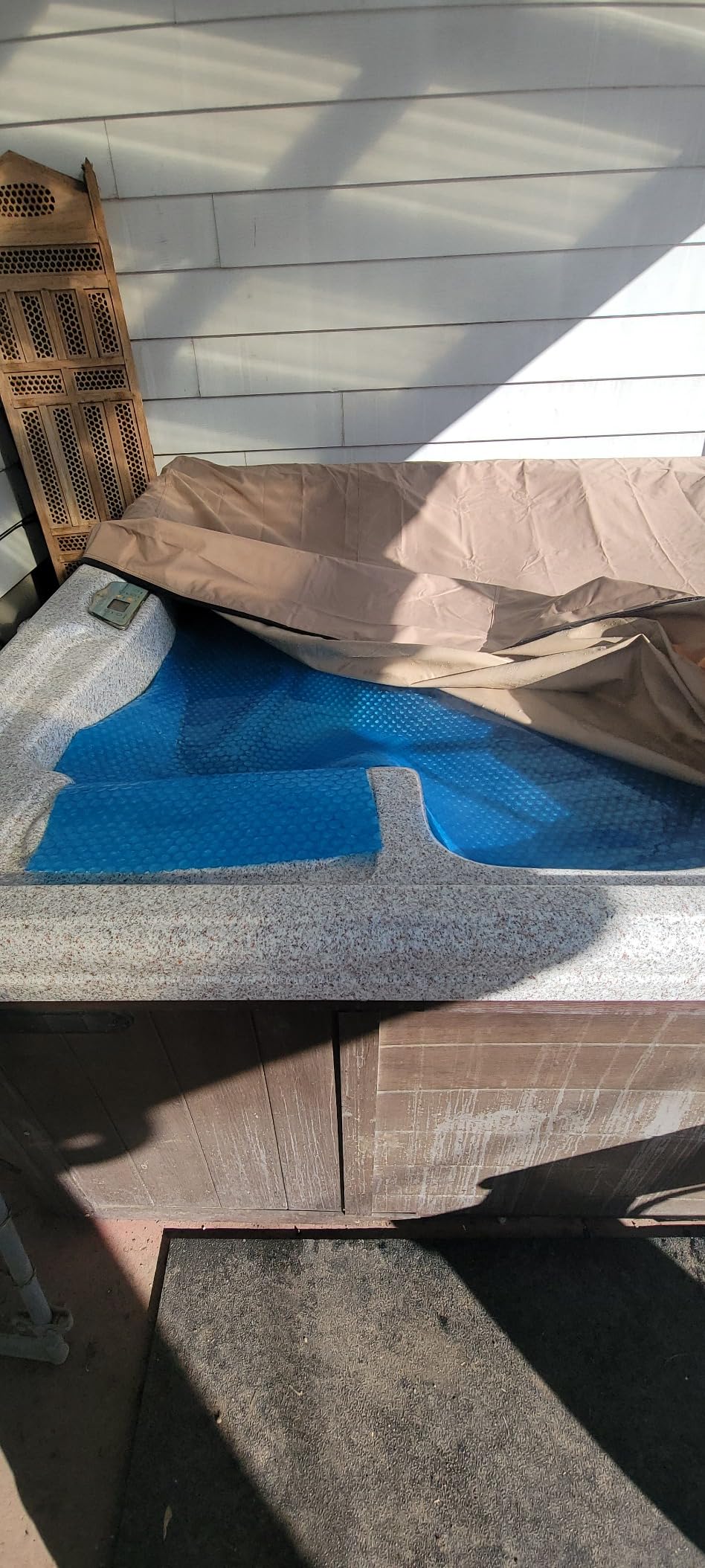
The single consistent complaint in the reviews is wind. The built-in D-ring and bungee cord are reported as weak in high wind, and several owners report the cover needs extra straps they added themselves after storms. If you live somewhere with sustained wind rather than occasional gusts, budget for a strap kit alongside this cover rather than trusting the included hardware.
For a blizzard, wind retention is arguably more important than waterproofing. A cover that stays on keeps the snow off entirely. A cover that flaps away leaves the insulated layer exposed to the full depth of whatever fell.
Size range and brand compatibility
There are 14 size variants here, including a round 6 foot 11 inch option, which is unusual in a category dominated by square tarps. The listing also names compatibility with major spa brands including Hot Spring, Essential Hot Tubs, and Life Smart, so you can match the shape to your tub without guessing.
One practical note from owners: larger sizes are awkward to put on and remove. At 91 inches square with the tub fully inflated underneath, the fabric has nowhere to go but up and over. This is another reason to plan the strap and lifter hardware before the first storm rather than during it.
Who this suits and who it does not
This suits anyone in a sustained-freezing climate who already owns an insulated cover and wants a second layer that will not go brittle. It also suits oversized square tubs where an 85 inch cap leaves gaps.
It does not suit you as a standalone snow cover, and it does not suit exposed sites unless you are prepared to add straps. If wind is your dominant concern rather than cold, a ratcheting strap design is the better place to spend your attention.
3. iBirdie Waterproof Hot Tub SPA Cover – The Best Fit Selection Available
iBirdie Outdoor Waterproof Hot Tub SPA Cover 85 x 85 inch 7 x 7 ft
600D fabric with waterproof coating
Four buckles and zippers
Two-sided air vents
45+ size and color variants
+ Pros
- Lightest 600D option in the lineup at 4.4 pounds
- Four adjustable buckles plus waterproof zippers hold in strong wind
- Air vents on both sides expel moisture and reduce condensation
- Two fabric handles make it easy to put on and take off
- 45+ size and color variants including long rectangular swim spas
– Cons
- Provides no insulation so a hard cover or boards are still required underneath
- Only a 1-year manufacturer warranty
- which is the shortest in this group
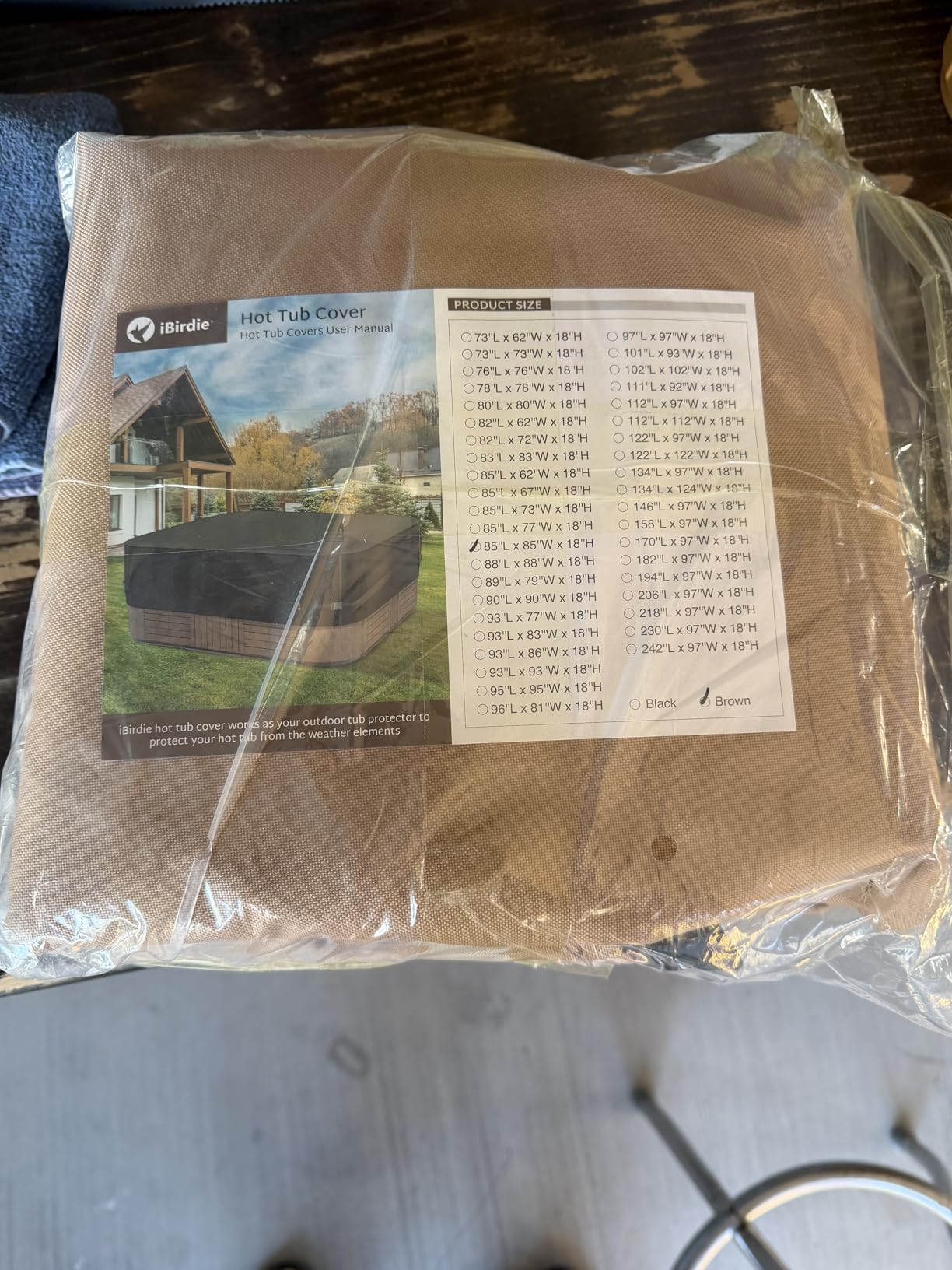
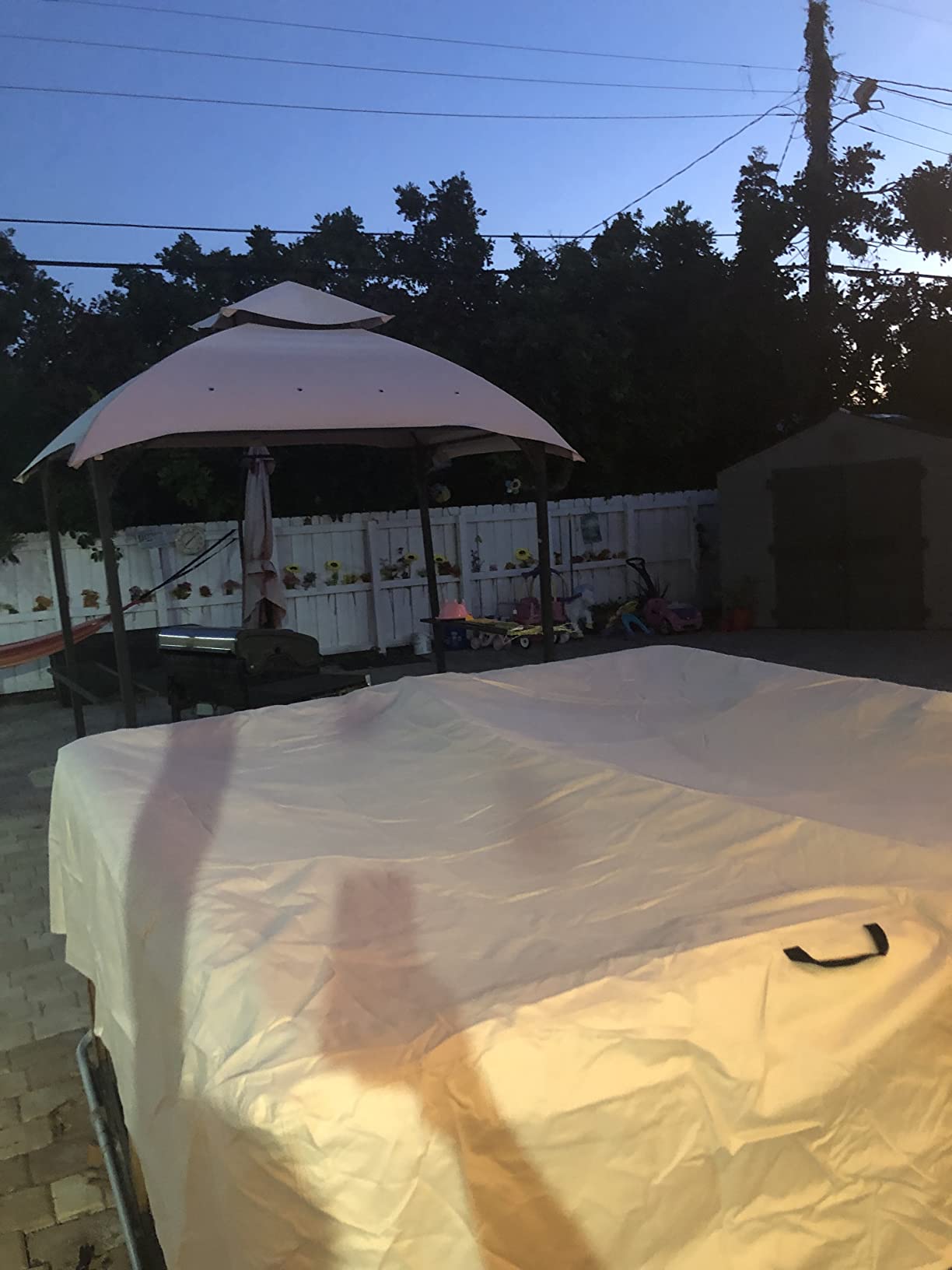
Fit is the underrated variable in this category. A cover that is technically waterproof but two inches too small leaves a corner where wind gets under the edge, and once wind gets under the edge, no waterproofing rating matters. With more than 45 size and color variants, this is the listing that most often has a shape matching an awkward tub, including the long rectangular swim spa layouts that almost every other listing here skips.
At 4.4 pounds it is also the lightest 600D option in the lineup, and that weight matters more in winter than it does in July. A cover you can lift one-handed gets put on after a storm. A cover that takes two people never gets put back on, and the tub ends up fully exposed to the next load. The 78 percent five-star share across more than 2,800 ratings suggests owners are largely satisfied, and the size range is the reason cited most often.
Why weight is a snow-season metric
Think about what actually happens in January. A storm drops snow, the cover sits under it for two or three days, and then someone has to go out and clear it. The first obstacle is not the snow. The first obstacle is lifting a stiff frozen panel of fabric off the tub at seven in the morning.
That is why 4.4 pounds is a meaningful number on this listing and why 4.74 kg on a heavier competitor is a real drawback. The two fabric handles are part of the same design decision. Handles and low weight together mean one person can reposition a cover mid-storm, which is when repositioning actually happens.
Retention hardware: four buckles and waterproof zippers
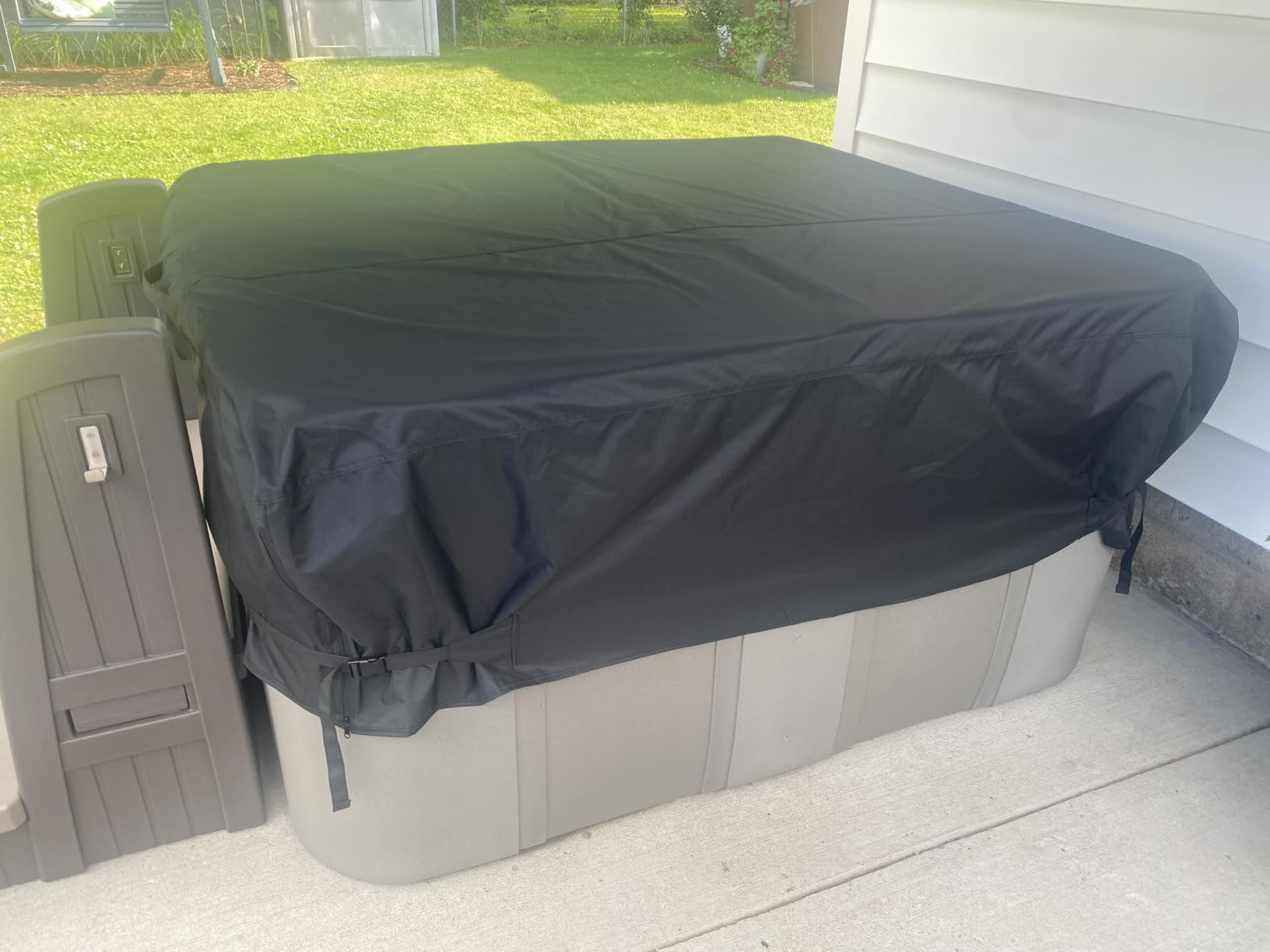
Four adjustable corner buckles combined with waterproof corner zippers is the retention system on this cover, and owners credit it with holding in strong wind. The zippers are worth noting separately because most covers in this group rely on elastic or buckles alone. A zipper closes the seam that a drawstring or buckle leaves as a gap.
Double-stitched seams with sealant applied mean a tear in the fabric does not immediately become a hole. In freeze-thaw conditions, brittled fabric cracks at stitch lines before it cracks in open material, and sealant on the stitch line is what keeps that from cascading.
The 45+ variant range and what it solves
The variant count is the reason this ranks as the best fit selection. Square and rectangular tubs in black and brown are covered, and so are long rectangular swim spa dimensions that other listings in this group do not carry at all. For an owner with a 7 by 3 foot swim spa, having the right footprint available shortens a project that otherwise becomes a custom order.
Air vents on both sides handle the moisture side. A cover trapped over a warm tub generates a surprising amount of condensation, and that condensation freezes into an ice sheet that sits between the cover and the tub. Venting on both sides is what prevents that sheet from forming.
Where this one falls short
This cover provides no insulation. The listing is explicit that a hard cover or boards are still required underneath, and the 1-year manufacturer warranty is the shortest in this group. Both facts point to the same conclusion: treat it as a weather layer over your real cover, not as your real cover.
Ordering guidance in the listing is worth following to the letter. Buyers repeatedly note that ordering too small is the most common mistake, and this cover must be ordered slightly larger than the tub for proper fit. With this many variants, a patient five minutes of measuring beats a return.
4. Porch Shield 600D Hot Tub Cover 90 x 90 in – Sized for Oversized Square Tubs
Porch Shield 600D Outdoor Hot Tub Cover SPA Protector 90 x 90 inch, Black
600D polyester with undercoating
Lock-in clips and buckle straps
Large air vents
Fits hard covers to 90 x 90 x 20 in
+ Pros
- Lock-in clip system plus quick-release buckles resists wind
- Large air vents reduce internal condensation under the cover
- UV-resistant treatment keeps fabric vibrant over multiple seasons
- Reinforced ribbon-woven handles make install and removal easy
- Lock-in clips suit 90 inch square tubs
– Cons
- Cannot be used on its own without an insulated hard cover underneath
- Heaviest listed weight in the outer cap group at 4.74 kg
- Heavier and bulkier than lower-denier covers
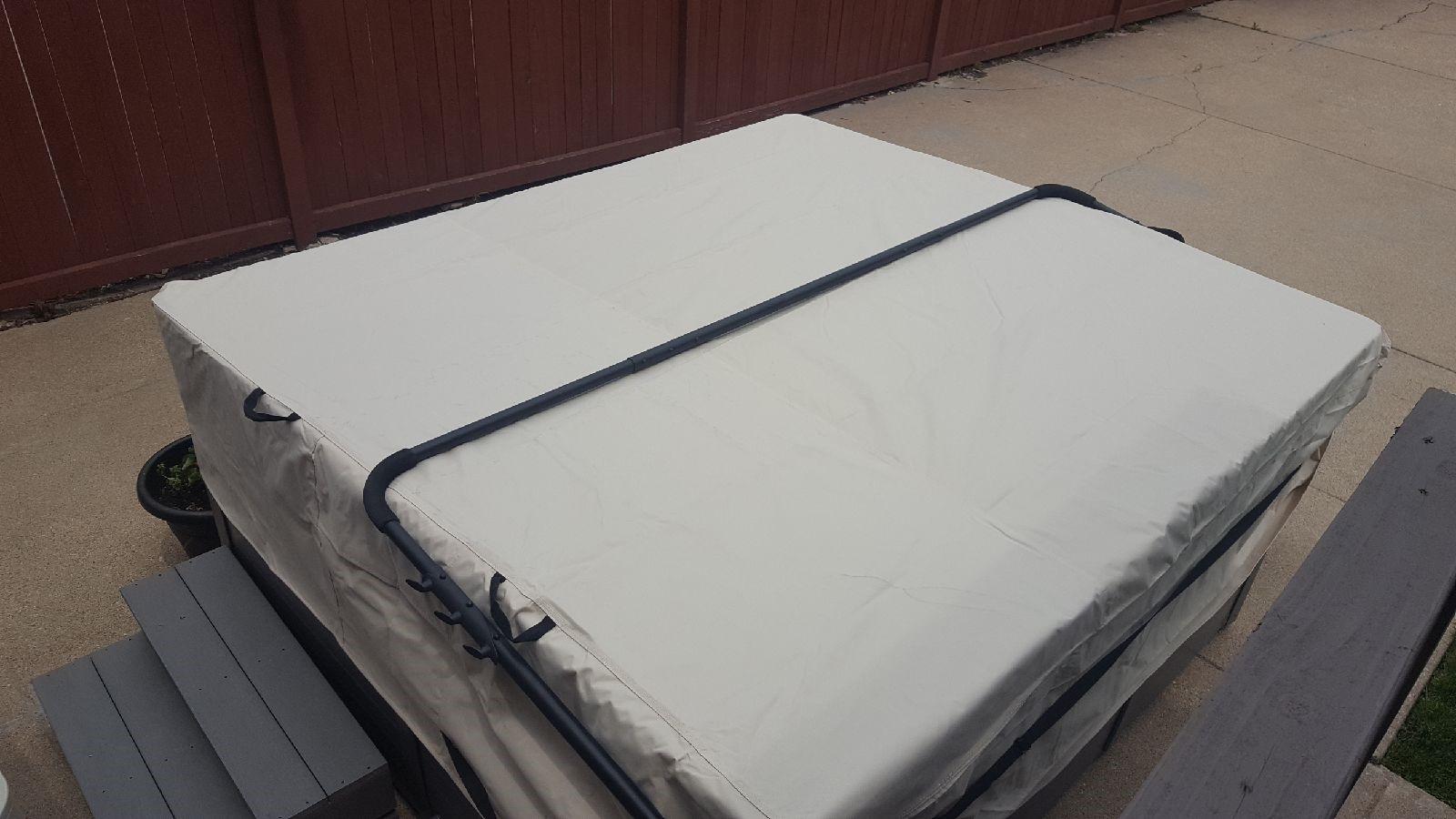
If your tub is 90 inches square, most of the covers in this category simply do not fit. This one does, and at more than 1,250 ratings it has one of the deeper owner records in the group with a 68 percent five-star share. The 600D polyester carries a waterproof undercoating, and the fit specification is for hard covers up to 90 by 90 by 20 inches, which is the dimension set that actually matters when you are layering a protector over an insulated cover.
Like the others in this section, it is an outer protector. Buyers describe it as an inexpensive way to extend the life of a much more expensive insulated cover, and several report that the hard spa cover beneath still looks new after multiple seasons. The UV-resistant treatment is the mechanism for that, since ultraviolet exposure is what chalking and embrittling on cover vinyl comes from.
The lock-in clip system is the feature to understand
Adjustable sliding clips plus quick-release buckle straps give you two independent retention points. In a snowbelt, redundancy is the point. If a buckle iced up and stopped cinching, the clips are still holding the edge down, and if the clips loosen as the fabric stretches, the buckles take the load.
Quick release also matters for the opposite season. You want to be able to get this off in seconds when you need access, not fight frozen hardware in a storm. Sliding clips adjust to the cover as it stretches through a season, which is what keeps tension after a winter of freeze-thaw.
Weight is the honest drawback here
At 4.74 kg, this is the heaviest listed weight among the outer caps in this roundup, and reviewers note it is bulkier than lower-denier covers.
It is worth weighing against the 90 inch footprint. A correctly sized heavier cover beats a lighter one that leaves corners exposed to drifting snow. The reinforced ribbon-woven handles are the mitigation, since webbing handles hold a load that cut fabric loops will not.
Vent placement and the condensation problem
Large air vents reduce the internal condensation that forms under any cover over a warm tub. This is not a minor point in winter. Condensation that forms on a sunny January afternoon and freezes overnight becomes a rigid ice sheet bonded to the surface beneath, and the next removal becomes a chiseling job rather than a lifting job.
Vent placement matters too. Vents positioned on the sides let warm moist air escape along the direction of the slope, while vents placed in a flat center section trap air. This listing describes its vents as large, which gives them the airflow needed to do the job in a sustained cold period.
Who should buy this one
Buy it if you have a 90 inch square tub, if you already own an insulated cover, and if you would rather handle a heavier fabric once than replace a damaged cover skin.
Pass on it if your tub is a standard 7 by 7 square and handling weight is already a problem for you. In that case the same retention logic is available in a lighter package.
5. MySpaCover Custom-Made Cover – Built Around a Foam Core That Carries Snow
MySpaCover Custom-Made Hot Tub and Spa Cover Replacement | High-Density EPS Foam Insulation | HydroTex 600D or Marine Vinyl | Any Shape and Size up to 96 x 96 in. | 5-Year Warranty
High-density virgin EPS foam core
Tapered for snow runoff
Custom made up to 96 x 96 in
5-year warranty on 600D builds
+ Pros
- High-density virgin EPS foam core with sealed wrapping that resists moisture absorption
- Tapered design sends rain and melting snow off instead of pooling
- Double-stitched construction with marine-grade vinyl or HydroTex 600D fabric
- Custom fit within a half inch for square rectangle and specialty shapes
- 5-year warranty on HydroTex 600D builds
– Cons
- Custom-made lead time before the build begins
- Heavier than tarp-style covers at about 60 pounds
- A 9 percent one-star share points to minority fit or service complaints
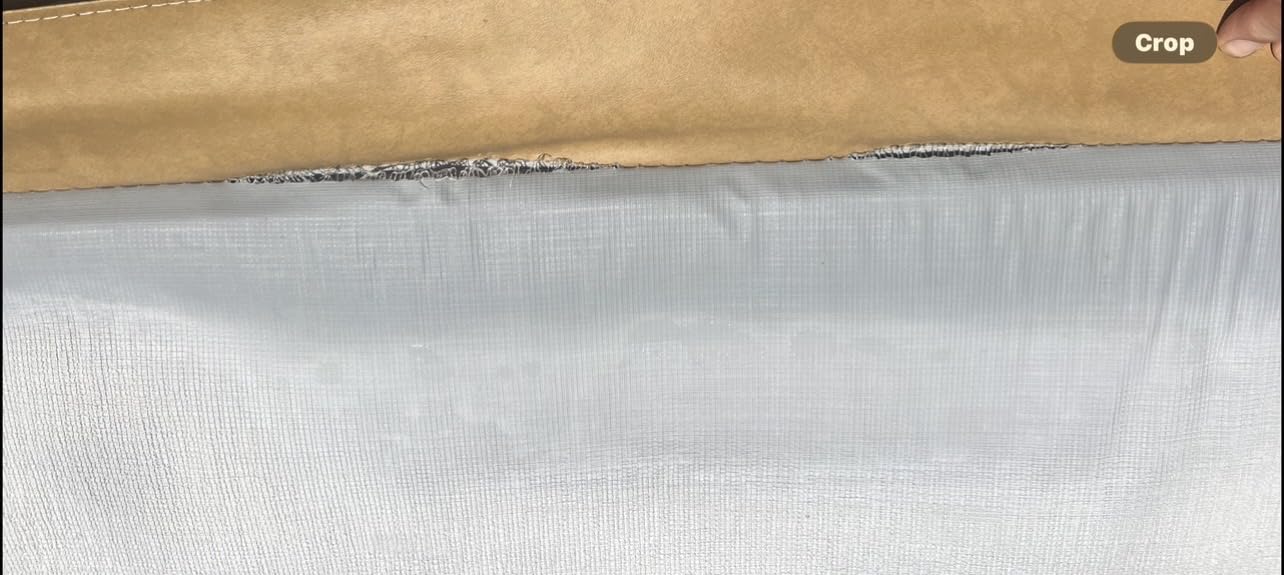
This is where we cross over from outer protectors to actual snow-rated covers, and the difference is the foam core. Everything in the four sections above sits on top of a cover like this one. A high-density virgin EPS foam core wrapped in a sealed foam-core wrapping gives you a structure that distributes snow load across the tub frame instead of bridging across the water, and the sealed wrapping is what stops the foam from slowly absorbing meltwater and losing its insulating value over repeated winters.
At 815 reviews and a 4.4 rating with a 78 percent five-star share, this carries a solid owner record for a made-to-order build. Owners associate the snow-shedding taper and the high-density core with cold-climate use, and that association is well founded. The taper is the single most important physical feature for snow country, because it routes meltwater to the perimeter and out rather than letting it pool at the center drain where it freezes into an ice dam.
Why the taper matters more than the density in snow country
Foam density tells you how much load the core can take before it deflects. The taper tells you what happens to the water afterward. On a flat cover, snow melts, runs to the lowest point, and pools over the center drain. That pool freezes, forms a solid disc, and the disc is now a concentrated load sitting exactly where the cover is least supported.
On a tapered cover, that same meltwater runs off the surface. You end the melt with a wet cover instead of a cover with a load-bearing ice block on it, and a wet cover is a problem you solve with a tarp while an ice disc is a problem you solve with a chisel.
Fit precision and the shapes it can cover
Custom fit within a half inch is quoted for square, rectangle, and specialty shapes, with the listing naming circles, octagons, rectangles with sharp corners, and rounded squares among the options. That shape list matters because a cover that overhangs a round tub is a sail, and a cover that falls short leaves a gap that admits drifting snow.
Sizes run up to 96 by 96 inches. If your tub exceeds that, this is not the product, and you are into the territory where a hard enclosure makes more sense than a soft cover.
Material choice and warranty length
Two outer materials are offered. HydroTex 600D fabric carries a 5-year warranty, while standard marine vinyl carries 3 years. The HydroTex option is the one to pick in a snowbelt, and not only for the extra warranty. Fabric over foam does not crack along a fold line the way vinyl does after a season of freeze-thaw, and a fold line is where a stored winter cover spends most of its life.
The product is listed at 60 pounds. The cover lifter question later in this article matters because of that figure. Care instructions call for mild soap and water and protection from direct sunlight, which is consistent with how the outer caps in this roundup extend cover life.
The lead time problem and who should order it
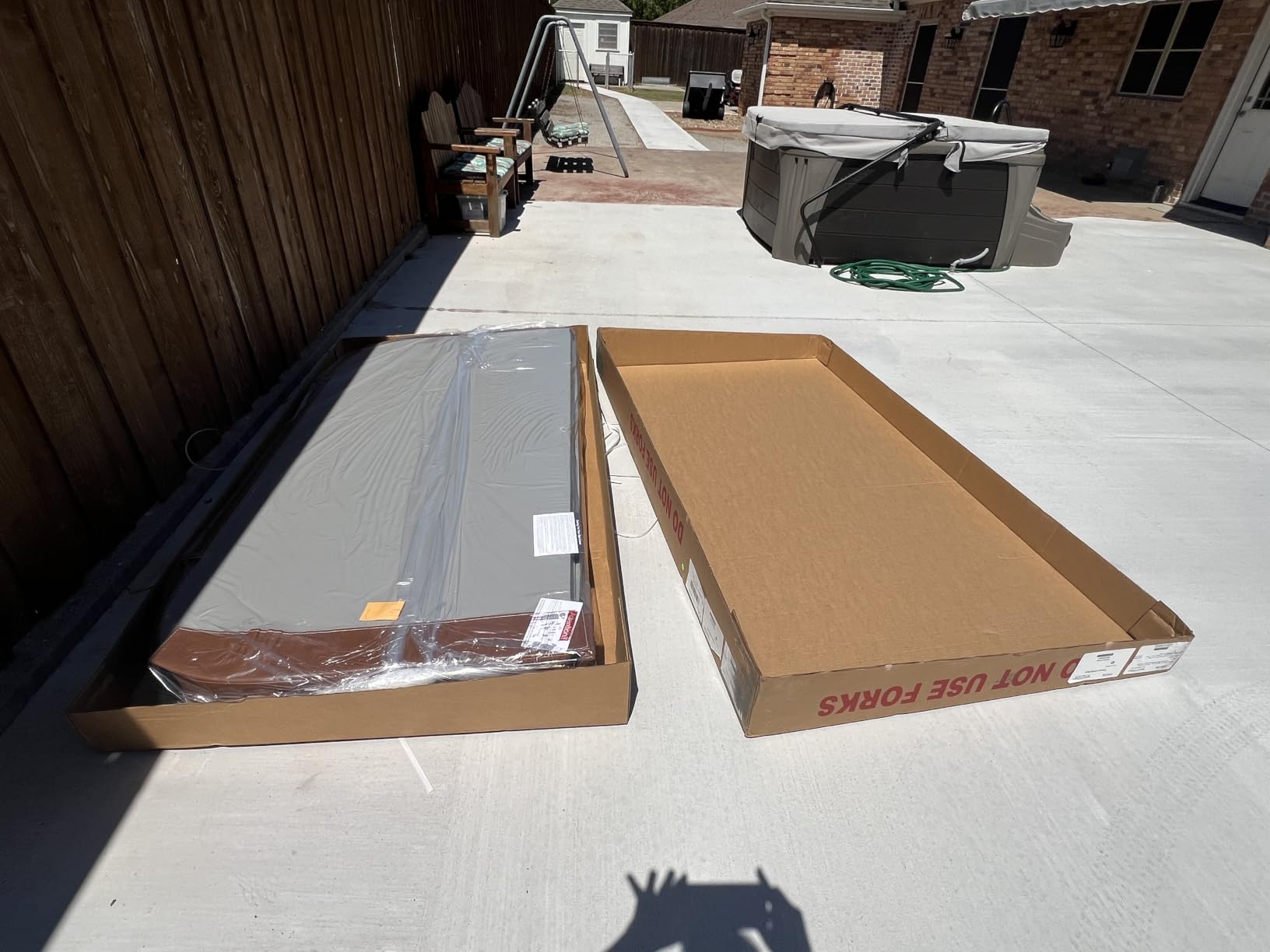
Custom made means custom made, and the lead time before the build begins is the most common complaint in the reviews alongside a small share of fit and service issues. This is the single most important scheduling fact in this article. A custom cover ordered after the first storm does not arrive before the second one.
Order this in early fall, before you need it, and specify the 5-year HydroTex build with a taper sized for your climate. If you have any intention of leaving the tub energized through winter, this is the correct category of product, and the outer caps listed above are a worthwhile second layer on top of it.
6. The Cover Guy Premium Custom Spa Cover – The Highest Stated Insulation Value
The Cover Guy Premium Hot Tub Cover | Custom Made Replacement Spa Cover | Energy-Saving Hot Tub Covers Built for All Climates | 6, 5, or 4 inch Taper
R19 insulation value
6-5, 5-3 or 4-2 inch taper
2 lb density foam upgrade
Custom made to your dimensions
+ Pros
- R19 insulation value with high-density foam reduces heat loss
- Load-bearing straps rated above ASTM standards for snow loads
- Zero water absorption foam wrapping prevents waterlogging
- Sloped design lets rain ice and snow run off
- Locking straps and safety-compliant handles
– Cons
- Upgrade options are sold as add-ons after a rep confirms the order
- Some buyers reported a fold-direction mix-up and a spec mismatch
- An 11 percent one-star share is the highest in this lineup
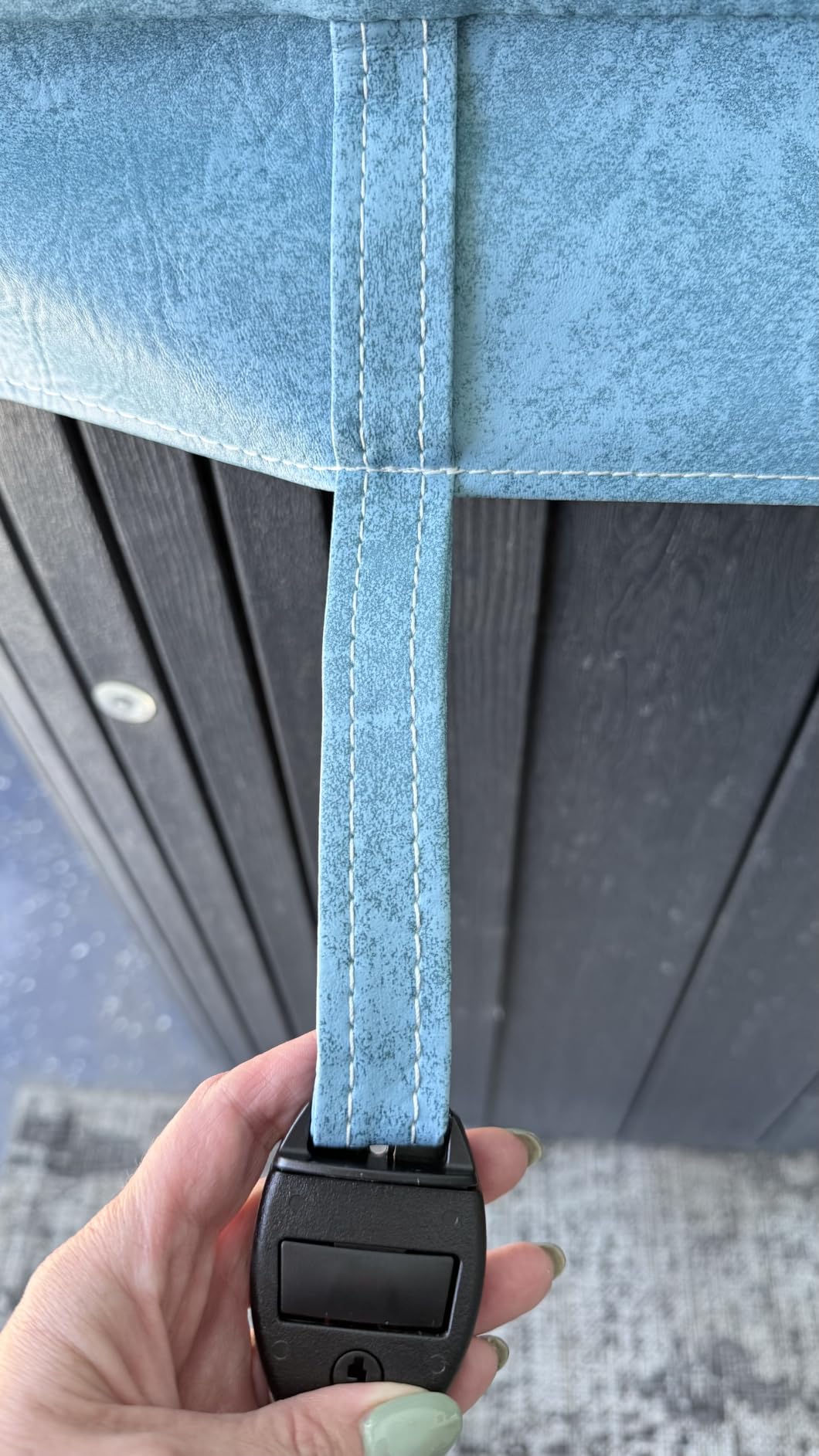
This is the listing with the most reviews among the insulated covers, and the one that names its numbers most explicitly. R19 insulation value is stated in the technical details, and the straps are described as rated above ASTM standards for load bearing. Those two figures together are the closest thing to a published performance claim in this entire roundup, and for a snowbelt buyer they are the two numbers worth comparing everything else against.
Foam taper is available in 6-5, 5-3, or 4-2 inch configurations, with a high-density upgrade at a 6-4 taper and 2 lb density. That 2 lb density figure is the industry shorthand for cold-climate covers, and it is the specification owners consistently ask sellers to state rather than imply. The zero water absorption foam wrapping addresses the failure that quietly ruins cheap covers, which is a foam core that slowly soaks up meltwater and stops insulating.
R19 and what it actually saves you
R19 is a substantial insulation value for a spa cover, and it is the number that matters if you are running the tub through winter. Heat loss through a cover scales with the temperature difference between your water and the air above it. In sub-zero conditions that difference is large, and an uninsulated cover turns a heat pump or a heater into a monthly operating cost rather than a seasonal one.
This does not make a bad cover into a safe one. Insulation and structural load capacity are different properties, and a cover can be beautifully insulated and still dome under wet snow if its foam is too light. That is why the density upgrade and the taper options are listed separately here rather than bundled.
Straps, handles, and the ASTM claim
Load-bearing straps rated above ASTM standards is a specific claim, and specific claims are what separate a real snow cover from a marketing word. Wind uplift on a cover is not a static force. Gusts arrive in cycles, and a strap system that would hold a steady pull can fail on the third impact, which is why the number of attachment points and their rating both matter.
Locking straps and safety-compliant handles serve two different needs. The lock is a security feature for an unattended spa, and the handles are what let you move a heavy cover without dragging an edge across the vinyl. Both appear on the sloped design, which also lets rain, ice, and snow run off rather than sitting in a depression.
Where the 11 percent one-star share comes from
This listing has the highest one-star share in the lineup at 11 percent, and the complaints are specific rather than general. Buyers report a fold-direction mix-up, a spec mismatch on one order, and a small share who received covers not built to the measurements they submitted.
The cause is procedural. Upgrade options are confirmed by a representative after the order starts, so a miscommunication at that step propagates into the build. The mitigation is to write your taper and density requirements into your order notes explicitly rather than relying on the conversation, and to confirm dimensions back before the build begins.
The reuse option most buyers miss
Foam boards can be reused in a replacement vinyl skin at a lower cost. A cover skin fades, cracks, or gets punctured by a branch long before the foam core underneath loses its structural capability, and rebuilding the skin over existing boards is the cheapest repair available.
Custom skirt length and color options are worth setting at the same time as dimensions, since a skirt that is too short leaves a gap at the tub base where wind gets underneath.
Who this suits
This suits an owner keeping the tub hot through winter who wants the highest stated insulation value in the group and has done the measurement work carefully. The order process rewards precision, and it penalizes guessing.
Skip it if you want a cover with no ordering process at all. The MySpaCover build runs a longer warranty on its fabric option and a simpler configuration path.
7. BeyondNice Custom Cover – Three Foam Thicknesses, Built to Order
BeyondNice Durable, Replacement Hot Tub Cover | Custom Made Spa Cover | 5 Year Warranty | Insulating Foam Cores 4, 5 or 6 inches Thick | Hot Tub Cover Sizes up to 96 x 96 inches
Foam cores in 4, 5 or 6 inch thicknesses
Custom made to order
Made in the USA
5-year warranty
+ Pros
- Foam cores available in 4
- 5 or 6 inch thicknesses for load capacity
- Made in the USA with a 5-year warranty
- Lightweight compared with older waterlogged covers
- Made-to-order components let buyers match foam and vinyl to their climate
- Locking straps and safety-compliant handles
– Cons
- Smallest review base in this lineup at 157 reviews
- Custom ordering requires accurate measurements up front
- An 11 percent one-star share suggests minority fit or service issues
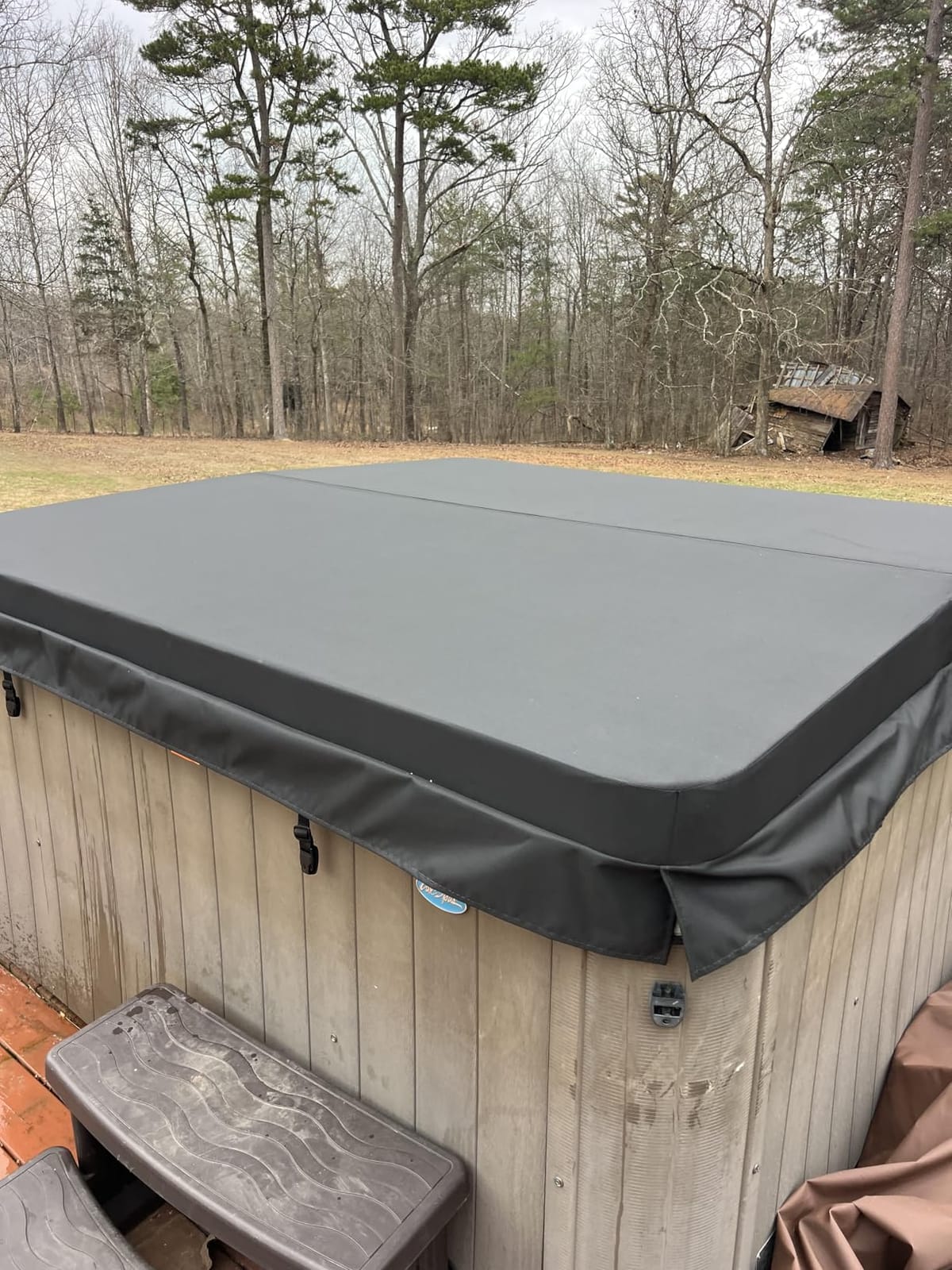
Foam thickness is the variable owners argue about most, and this is the listing that makes it a straight choice. Insulating foam cores are available in 4, 5, or 6 inch thicknesses, and the industry guidance is consistent: a 4 to 6 inch taper is the cold-climate band, while a 2 to 4 inch taper suits milder regions. Having all three available in one build removes the need to guess which side of that line your climate falls on.
The trade-off is straightforward. At 157 reviews, this has the smallest owner record in the lineup, which means less long-term evidence about how these covers age. What the reviews do show is owners highlighting the ability to choose foam thickness as the thing that matters for snow load, and reporting lower weight than the older waterlogged covers they replaced. Made in the USA since 1985 with a 5-year warranty.
Choosing between 4, 5, and 6 inches
Thickness controls how far the foam can deflect before it bottoms out against the water. Deflection is the failure mode that matters, because a cover that bows into the water is a cover that is now supporting its own weight at an angle, concentrating load at the perimeter of the tub rather than distributing it.
Pick 4 inches if your snow is periodic and you clear it within a day or two. Pick 5 inches if snow routinely sits for several days, which is the common case in the Upper Midwest and Northeast. Pick 6 inches if you intend to leave snow in place through an entire storm cycle and clear only between storms. Going up a thickness band costs more than a basic cover, and going up is the cheaper mistake.
Shape coverage and the measurement problem
Made-to-order components cover four cut corners, octagons with eight equal sides, one cut corner, round, square, and rectangular, in almond, black, blue, brown, and burgundy vinyl. Sizes run up to 96 by 96 inches. That is a wider shape catalog than most of the insulated listings here offer.
The complaint that appears most is not about the cover. It is that custom ordering requires accurate measurements up front, and an 11 percent one-star share reflects fit and service issues that are the normal friction of a made-to-order product. Measure three times and confirm the shape designation before you submit.
Locking straps, handles, and the lighter-than-your-old-cover effect
Locking straps and safety-compliant handles match what the other insulated covers in this roundup provide, and the listing states the build meets or exceeds industry safety standards for foam density, handles, and locking straps. That is a standards claim rather than a performance figure, so treat it as a baseline rather than a differentiator.
The lightness reports are worth a second look. Owners comparing this to older covers describe it as lighter, and the reason is the same one behind zero water absorption wrapping elsewhere in this roundup. A waterlogged foam core is heavier and worse at insulating, so a new sealed core feels lighter even when the replacement is thicker. Expect the tub to feel lighter on the day the new cover goes on.
Who this suits and who it does not
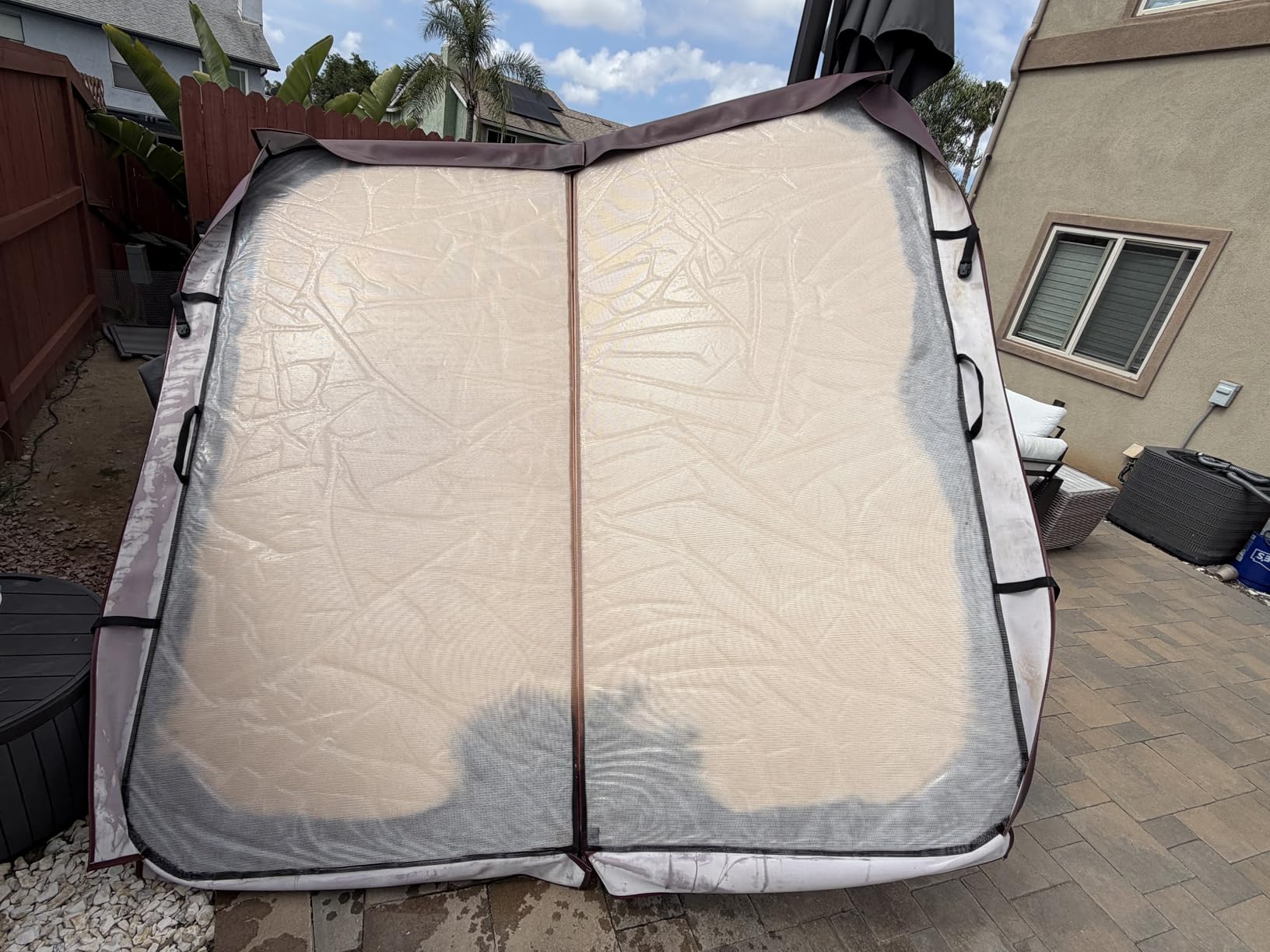
Suits owners who want to choose their own foam thickness rather than accept a standard build, particularly on unusual tub shapes. The 5-year warranty matches the longest in the insulated group.
Does not suit an owner who wants a large body of long-term owner evidence before committing, because 157 reviews is thin compared with 1,600 or 8,000 elsewhere. It also requires the most measurement discipline, and a made-to-order cover cannot be adjusted after the fact.
8. QH.HOME 85 x 85 in 1000D Cover – The Best Storm Retention in the Lineup
QH.HOME 85×85 Square Hot Tub Cover, 1000D IP65 Waterproof
1000D Oxford with IP65 rating
Ratcheting tie-down strap
Pressure-equalizing air cells
Fits tubs 81 to 85 in
+ Pros
- Thickest fabric in the outer cap class at 1000D Oxford
- Ratcheting tie-down strap system that owners report holds the cover in storms
- Air pocket cells that equalize pressure and resist wear
- Upgraded air vents that reduce musty condensation
- Holds color and stays flexible through freeze conditions
– Cons
- One reviewer noted the material is thinner than expected
- Long-term winter durability is still unproven for most owners
- Protective cap design rather than an insulating cover
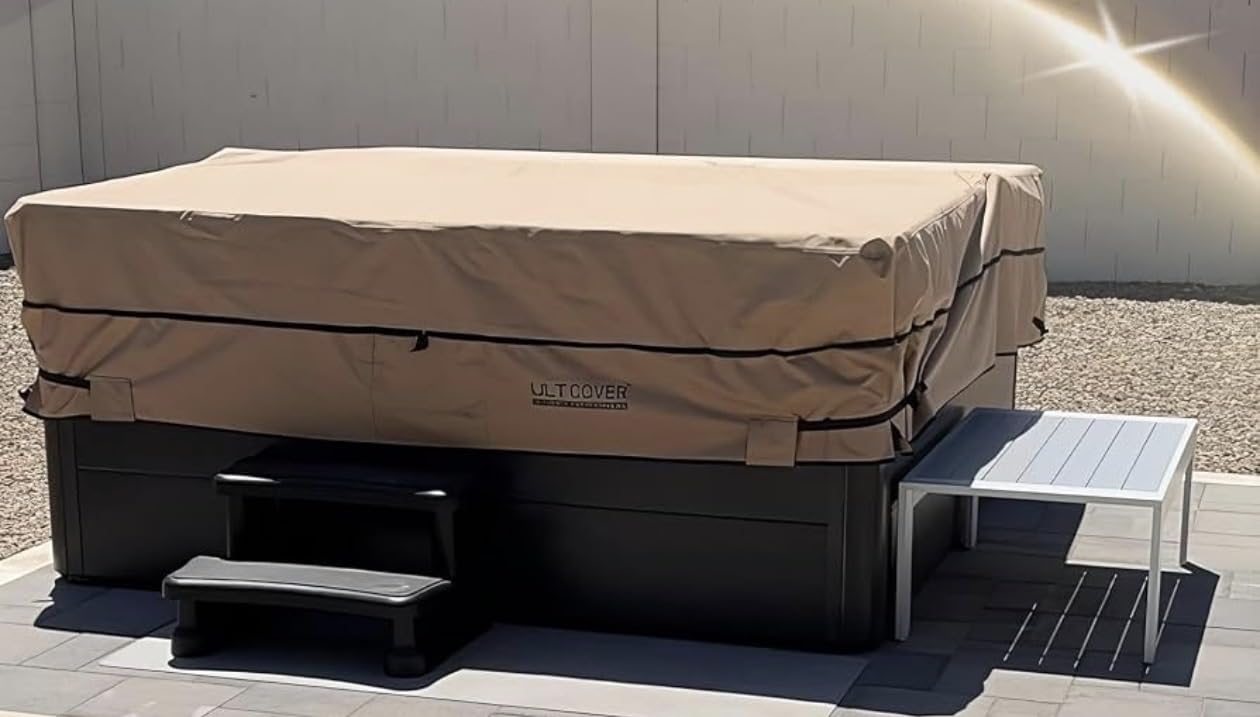
The ratcheting tie-down is the reason this one is in the roundup, and it is the only ratcheting system among the ten covers listed here. Ratcheting hardware does not lose tension the way elastic cords lose tension as fabric stretches over a season. When a storm arrives, the cover is still cinched to the same force it was cinched to in October.
At 4.6 it is tied for the highest rating in the lineup, though with 126 reviews the evidence base is small. The 1000D Oxford fabric is the thickest in the outer cap class, carrying an IP65 waterproof rating, and owners report the material holding its color and staying flexible through freeze conditions.
Why ratcheting beats elastic in a snowbelt
Elastic cords work by tension. Fabric stretches under UV exposure, under wet weight, and under freeze-thaw cycling, and as it stretches the cord holds less of the edge. Ratcheting hardware is mechanical. A spring steel handle in a nylon strap does not relax, and a ratchet has discrete positions rather than a continuum, so the cover sits at a known tension instead of an unknown one.
This matters most in the sequence that follows a heavy snow event. Snow loads the cover, the wind picks up, and an under-tensioned edge becomes a lifting point. Owners of this cover specifically report the retention system holding through storms, and it is the deciding feature in the reviews.
1000D Oxford and IP65 explained
1000D Oxford with an IP65 rating is a meaningful upgrade in denier over the 600D fabric most covers here use. Denier measures fiber thickness, and a 1000 fabric is built from coarser fibers that resist tearing and abrasion. IP65 is a dust and water ingress rating, and it is a more specific claim than the word waterproof used on most listings in this category.
One reviewer noted the material is thinner than expected, which is the main reservation in the reviews. With 126 reviews that is a snapshot rather than a verdict.
Air pocket cells and vent design
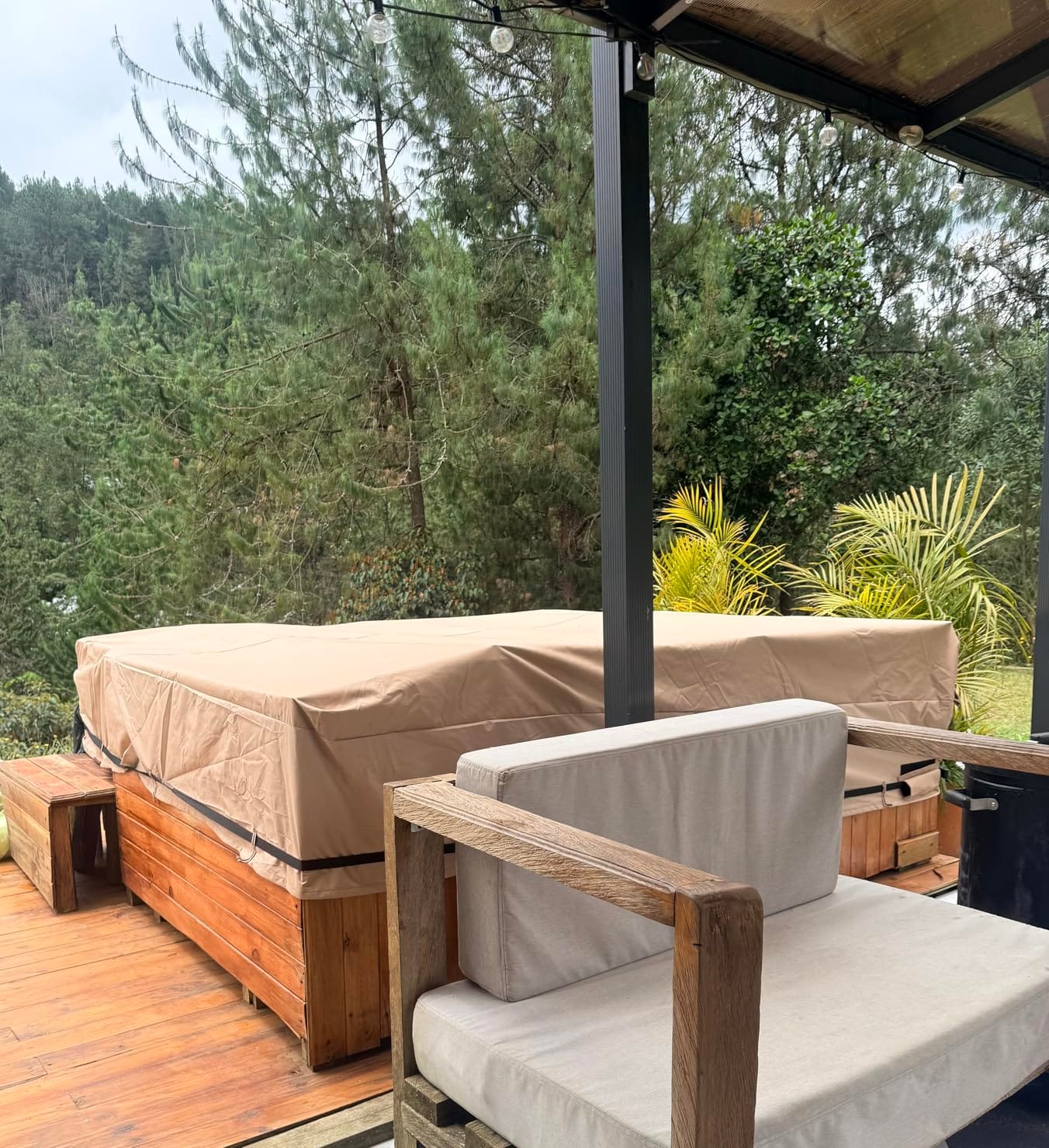
Air pocket cells that equalize pressure and resist wear are the most distinctive construction feature here. Inflated cells under the fabric distribute contact pressure across the surface, which reduces the abrasion points where a flat canvas rubs against a ribbed hard cover underneath. Rubbing is how a protector eventually tears, and most fabric wear begins at the pressure points.
Upgraded air vents reduce musty condensation, and there is a specific reason this matters on an outer cap. The cap goes on over an existing cover, so the trapped airspace is doubled, and doubled airspace means more condensation and more ice between the layers after a warm afternoon.
Who should buy this one
Buy it if your site is exposed and the dominant threat is wind rather than sustained cold. The ratcheting strap and the 1000D fabric address exactly that problem, and 14 size variants cover square and rectangular tubs from small to large.
Understand clearly that this is a protective cap design rather than an insulating cover. It cannot carry snow load, and it needs an insulated hard cover beneath it to do anything useful. Pair it with one of the insulated covers in this roundup and treat the pairing as a system.
9. Kipiea 600D Waterproof Hot Tub Cover – A 20000 Pa Water Pressure Rating
Kipiea 600D Outdoor Waterproof Square Hot Tub Cover Protector, Heavy Duty Polyester SPA Cover UV Protection Cover 85″ L x 85″ W x 20″ H, Black
600D Oxford with double-layer PU
Rated to 20000 Pa
Eight straps and buckles
16 size variants
+ Pros
- Double-layer PU coating and taped seams shed water completely in owner tests
- Eight adjustment points keep the cover in place in winter storms
- Strap placement at the top and bottom corners holds better in wind than cheaper models
- Fabric has not faded after extended sun exposure per owners
- 16 size options fit most square and rectangular spas
– Cons
- Protective cap only and requires an insulated hard cover underneath
- Sizing requires measuring the tub plus lifter arm clearance
- A few owners ordered a size larger than needed by mistake
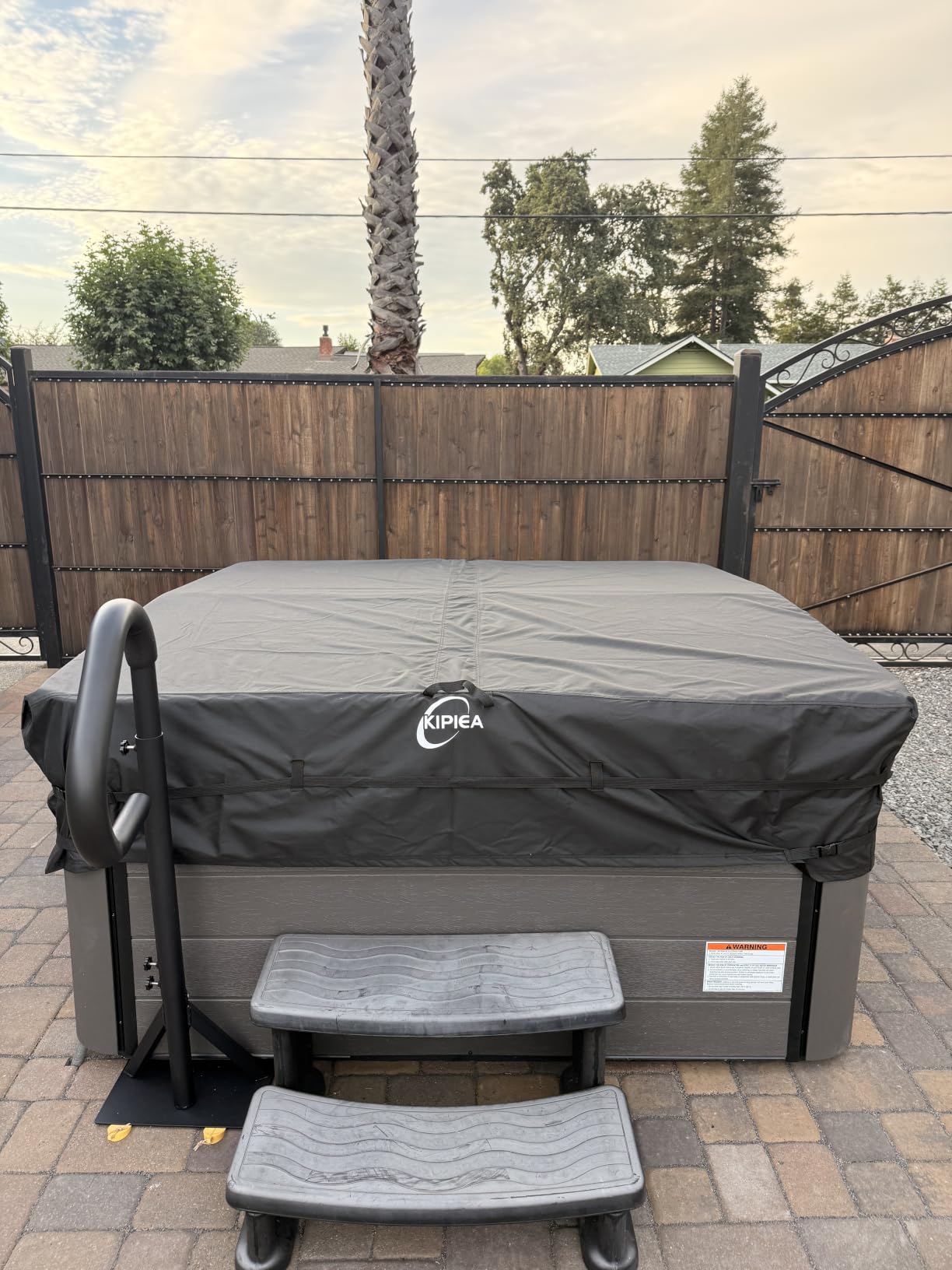
The 20000 Pa water pressure rating is the highest specification in this roundup, and it is backed by a 248 GSM 600D Oxford fabric with a double-layer PU coating and seam sealing tape. Owners report it shedding water completely in their own tests, which is the kind of claim that only comes from people who have watched water run off a cover in a storm and checked whether anything got through.
At 4.6 across 647 reviews, this has a solid record. Reviewers frame it as an inexpensive way to extend the life of a much costlier insulated cover, and multiple owners report it doubling the service life of the hard cover beneath. The UV-resistant coating blocking 99.99 percent of UV rays is the mechanism behind that, since ultraviolet exposure is what degrades cover vinyl into chalking and cracking.
Eight adjustment points change the wind outcome
Four side straps plus four corner straps give this cover twice the retention points of a typical single-drawstring design. The corner points do most of the work in a snowbelt, because corners are where wind gets underneath an edge and where a lifted corner becomes a tear.
Owners specifically call out strap placement at the top and bottom corners as holding better in wind than cheaper models, and that is a placement observation rather than a material one. Buckles are rated over 176 pounds of force, a static figure that should not be read as a storm rating.
What the 20000 Pa rating means and does not mean
Water pressure in pascals measures how hard water pushes on a surface. A 20000 Pa rating is a meaningful headroom figure for a cover, and combined with taped seams it addresses the specific failure of ordinary fabric covers, which leak at the stitch line before the panel itself gives way.
It does not tell you anything about snow load. Water pressure and distributed snow weight are different forces, and no outer cap in this roundup is engineered for the second one. The rating also says nothing about abrasion, which is what actually ends the life of a protector cap in a snow climate where grit and ice crystals sit on the surface.
Sizing, storage, and the 16 variant range
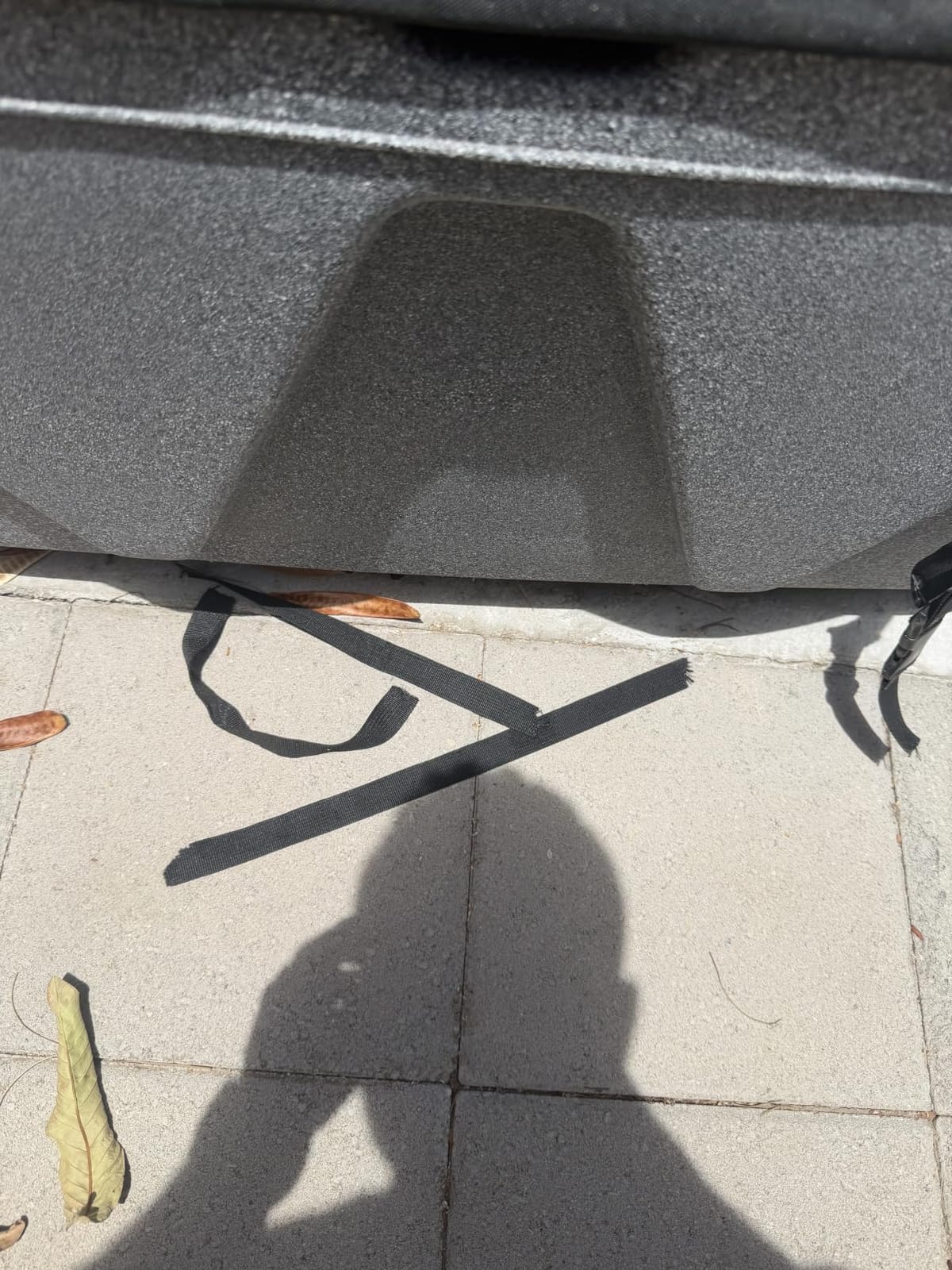
Sixteen size variants run from 73 inches up to 111 inches, which gives this the highest upper limit in the roundup. The dominant practical complaint is picking the correct size, and the guidance is specific: measure the tub plus the lifter arm clearance.
The cover folds into a pouch with season-storage instructions included, which matters more than it sounds. A protector stored folded and wet in a shed will mildew, and a mildewed fabric that goes back on the tub in February is a fabric that stays cold and wet all winter.
Who should buy this one
Buy it if you want the strongest waterproofing and the most retention points in the group, and if your tub is a standard shape where a variant is available.
Pass if you have a 90 inch or larger tub, where the variant ceiling may not reach, or if you are looking for something that can carry snow on its own. It cannot, and the listing says so.
10. Enzeno 86 x 86 in 420D Cover – The Lightest Layer in the Lineup
Enzeno Outdoor SPA Hot Tub Cover Waterproof Square 86 x 86 inch fit 84 x 84 or 83 x 83 or 82 x 82 or 7 ft x 7 ft 420D Heavy Duty Cub Hot Tub Lid Protectors Protective Cover Cap
420D Oxford with nano PU coating
Rated to 15000 Pa
Stereo vents both sides
16 size variants
+ Pros
- Nano PU coating and sealed seam tape rated to 15000 Pa
- Second-generation stereo vents increase airflow and reduce condensation
- Two woven strap buckles plus a full-circle drawstring for a firm hold
- Side waterproof zipper makes it convenient to store folded
- Silver nano UV coating that is EU 7P compliant
– Cons
- 420D fabric is the thinnest class in this comparison
- Provides no insulation on its own and needs a hard cover beneath
- Cover must be ordered larger than the tub which can make handling awkward
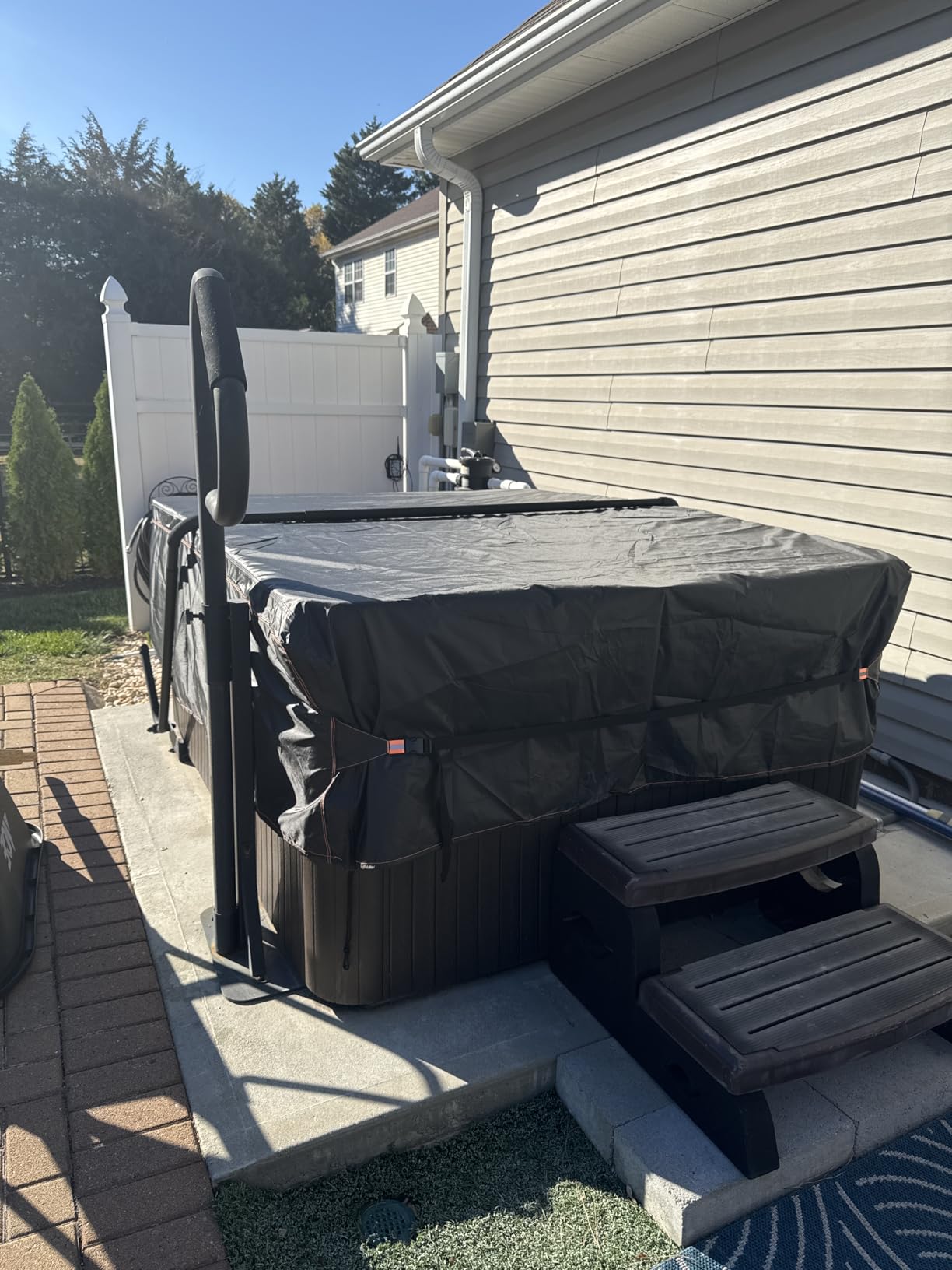
At 1.31 kg, this is the lightest cover in the roundup, and in a snow climate that is not a trivial specification. Handling weight is what determines whether a cover gets replaced after a storm or ends up in the yard. This one goes on and comes off by hand, which means it will actually be used on the morning after a heavy snowfall rather than on the first calm day a week later.
The trade-off is fabric class. This is 420D high-density Oxford at 100 GSM with a nano PU coating, rated to 15000 Pa, which makes it the thinnest fabric in this comparison and below the 600D used by most of the others. Owners position it as a budget sacrificial layer, and the reviews are honest about fabric gauge being the most common reservation among people who expected more weight for the money.
Why the full-circle drawstring matters
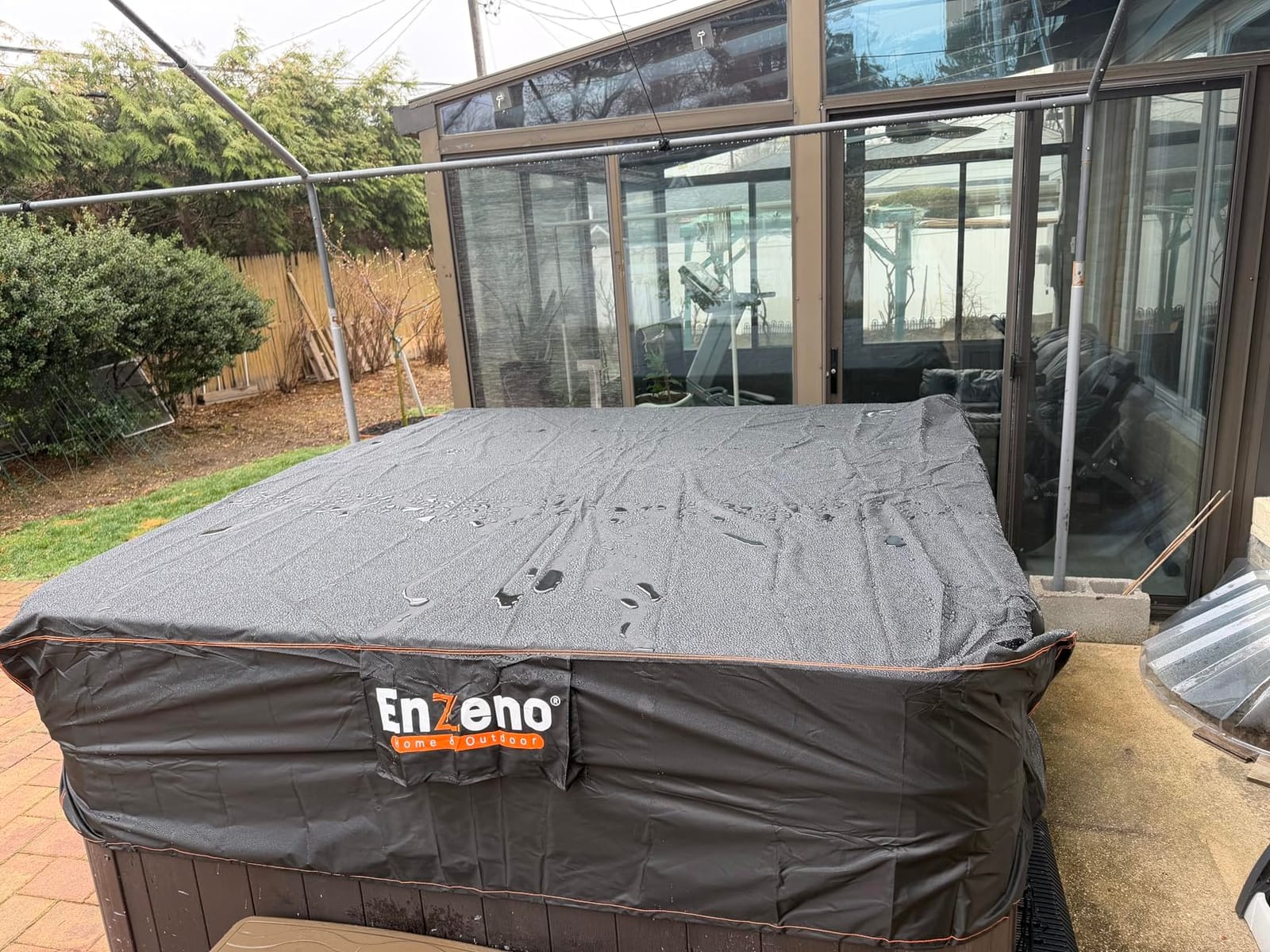
Two woven strap buckles plus a full-perimeter drawstring is a retention system that pulls evenly around the entire perimeter rather than at four discrete points. Even tension is what keeps fabric from ballooning between attachment points, and ballooning is what catches wind.
At 86 by 86 inches, this fits tubs at 84, 83, or 82 inches square and 7 by 7 feet, with 16 size variants covering rectangular layouts. The side waterproof zipper is a small feature that matters in practice, because it lets the cover fold and compress for storage without trapping water inside the fold.
Stereo vents and the condensation cycle
Second-generation stereo vents with increased air intake are aimed at a specific winter problem. When a cover goes on over a warm tub, moisture forms on the underside, condenses, and freezes. The vent design determines how quickly that moisture leaves, and a higher intake volume shortens the window in which condensation can turn to ice.
This is the mechanism behind the 76 percent five-star share owners report, and behind the reviews that say the cover keeps the hard cover beneath from chalking and waterlogging. Chalking is a UV effect and waterlogging is a moisture effect, so addressing airflow addresses the second problem directly.
Where 420D runs out
420D fabric at 100 GSM is engineered for rain, dust, leaves, and sun. It is not engineered for the abrasion that comes with grit and ice sitting on a surface through a thaw cycle, and it will not carry any snow load at all. If your winters are wet and the cover collects ice that refreezes, expect a shorter service life than the 600D options here.
The cover must be ordered larger than the tub, which reviewers note can make handling awkward. Ordering one size up is the standard guidance for this category, since a too-small cover is the common failure across all of them.
Who should buy this one
Buy it if your priority is a protective layer you can put on and remove by hand, and if you have a moderate rather than severe winter. The 16 variants and the EU 7P compliant silver nano UV sunscreen coating make it a reasonable seasonal addition over an existing insulated cover.
Pass if you have sustained heavy snowfall, high wind, or an oversized tub. In those conditions, spend on fabric gauge or on retention hardware instead, or better yet, spend on the foam core underneath.
What Heavy Snow Actually Does to a Cover
Ten inches of fresh snow weighs roughly 50 to 100 pounds per 100 square feet, and wet snow roughly doubles that. On a 7 by 7 foot tub, which is 49 square feet, that puts a fresh 10 inch storm in the range of 25 to 50 pounds, and a wet storm at double that. Add the weight of ice at the center drain and the total can climb well past what an unreinforced cover was designed to hold.
The failure sequence is consistent. Snow loads the cover, the foam core deflects, the cover bows down toward the water, and the cover is now carrying its own weight at an angle. Meltwater runs to the low point and freezes there. That ice becomes a concentrated load, and the next deflection is deeper than the last. What started as a soft spot in January becomes a torn seam or a cracked tub shell in March.
This is why clearing snow matters more than the cover’s rated capacity. A cover rated to hold a full season of snow still performs better when you clear it at 10 to 12 inches, because a cover under a smaller load never enters the deflection cycle in the first place. If you want the rest of your snow gear matched to that job, our guide to electric snow shovels for walkways covers the smaller clearing jobs.
Snow Load Ratings, Foam Density and Taper Explained
Heavy duty in this industry means a foam density of 2.0 pounds per cubic foot, usually sold as 2 lb foam. That is the number owners ask sellers to state outright, and it is a number sellers have started printing because buyers stopped accepting the word heavy duty on its own. A cover listing that gives you a density and a taper is a cover listing you can compare. One that says only heavy duty is a marketing page.
Taper is the second number, and it is the one most often missed. A 6-5 inch taper means the foam is 6 inches at the outer edge and 5 inches at the center, and a 4-2 taper runs the other way from thinner to thicker. The 4 to 6 inch band is the cold-climate band, while 2 to 4 inch covers suit milder regions. Choosing within that band is the single highest-value decision in this article.
Foam thickness, stated plainly, controls how far the core deflects before it bottoms out. Density controls how much load it takes before it deflects. Taper controls where the water goes. A cover needs all three, and a cover that has one of them is the reason a domed cover happens.
Soft Covers vs Hard and Automated Covers in Snow Country
Soft covers are what almost everyone has, and the advantage in a snowbelt is thermal performance. An insulated soft cover with a 5 inch tapered foam core holds heat far better than any hard shell, which matters enormously if you keep the tub running through winter. The disadvantage is that the load is carried by foam that is doing two jobs at once, insulating and structurally supporting snow.
Hard and automated covers solve the removal problem. A motorized or key-operated system rolls a cover back on a rail without anyone touching it, which removes the most dangerous moment in a snowbelt: pulling a heavy frozen panel off a tub in the dark. The cost is footprint, installation, and the loss of the insulating benefit that soft covers provide. Owners of rolled covers describe them as working smoothly in low temperatures where a soft cover goes stiff.
The practical answer is to layer. A soft insulated cover carries the snow load and the insulation, and an outer cap from this roundup takes the UV, hail, and debris that would otherwise attack the vinyl. That pairing is what the protector covers in this roundup are designed for, and it is why none of them are sold as standalone snow solutions.
How to Clear Snow Off a Cover Without Destroying It
Clear at 10 to 12 inches. That is the threshold at which a soft cover starts deflecting meaningfully, and clearing before that point keeps the whole deflection cycle from starting. Snow that sits for a week and then gets cleared in one afternoon loads the cover far harder than the same total depth cleared in increments.
Use a plastic shovel only. A metal-edged shovel on a frozen vinyl surface is a scratch, and a scratch under UV exposure becomes a crack. A plastic blade on a cold cover skims the surface without cutting into it, and a nylon snow brush is even gentler if you are clearing fresh powder rather than packed snow.
Clear the center drain first, before the perimeter. Meltwater runs to the drain, and if the drain is blocked, water pools and freezes there. Working outward from the drain keeps water moving toward an open exit instead of pushing a wall of snow into it.
Clear in the direction of the taper. Sliding snow downhill off a sloped cover uses gravity instead of your back, and a 60 pound cover does not need to be shouldered sideways across a slick surface. If the cover is genuinely frozen to the tub, pour warm water along the edge rather than prying, because prying is how a vinyl seam splits.
Wind Straps, Tie-Downs and Center Drains for Blizzard Conditions
Wind is what actually takes covers off, and snow is what makes wind dangerous. A bare cover in a 40 mph gust catches air like a sail. The same cover under 10 inches of wet snow is a weighted membrane that resists lift, and wet snow is a heavier anchor than any strap.
That is the counterintuitive rule most owners learn the hard way: do not clear the entire cover in the middle of a storm. Clear a working strip and keep the rest weighted, finishing when the wind drops. Owners on hot tub forums consistently describe full clearing mid-storm as the moment their covers ended up on a neighbor’s property.
Strap hardware matters more than strap count. Mechanical ratcheting hardware keeps its tension through a season, while elastic cord relaxes as fabric stretches. Cable locks and cam buckles ice up and stop closing properly, so after a freeze event, check that every strap actually latched rather than assuming it did.
A center drain is the drainage feature that matters most in snow country. A cover with a drain that stays open after each melt lets water leave instead of refreezing, and it is far more useful than a perimeter flap in a snow climate where the center is exactly where the low point is. If a cover you own has no drain, clear it manually after every melt cycle.
Measuring Your Tub So the Cover Actually Fits
Measure the tub at its widest point in both directions, and measure across the top rim rather than across the base. Covers are built to sit over the cabinet, and a cover cut to base dimensions will sit in a curve that dumps meltwater to one side instead of to the drain.
Add the lifter arm clearance, not just the tub. This is the most commonly reported sizing mistake in the reviews for the outer caps, and it applies equally to custom insulated builds. The arm needs vertical room, and a cover that clears the tub but not the arm will not sit flat.
Write the shape down as well as the size. Round, octagon, square with sharp corners, rounded square, and rectangle with one cut corner are all different, and several listings in this roundup offer custom shapes that have to be selected at order time. Getting the shape designation wrong is the other half of the fit problem that good measurement solves.
For swim spas and oversized tubs, check the upper end of the variant range before you commit. Standard square covers top out around 85 to 91 inches, and a 7 by 3 foot swim spa or an 8 by 8 foot tub needs either a specific rectangular variant or a custom build. Planning the deck and lighting around a tub is covered in our hot tub deck guide.
What Not to Buy in a Snowbelt
Do not buy a 420D or 600D tarp as your only cover and call it winter ready. These fabrics are engineered for rain, dust, leaves, and sun, and the listings themselves state they cannot be used alone without an insulated hard cover underneath. Every listing in this roundup that describes itself as heavy duty makes the same qualification, and the qualification is the whole story.
Do not buy any cover that will not tell you its foam density and taper. If a listing says only heavy duty, or all-weather, or waterproof, and gives you no numbers, you are reading marketing copy rather than a specification. You would not accept a car described as fast without an engine size, and the same rule applies here.
Do not wait until the first storm to order a custom cover. Custom builds have a lead time before the build begins, and that lead time lands squarely in the season when everyone else is ordering the same thing. Ordering in early fall removes the single most common complaint in the reviews of every custom cover in this roundup.
Do not ignore a cover because it fits well now. A slightly loose fit that is tight and even in February beats a tight fit that stretched loose by March, because a loose edge is a wind entry point. This is why the elastic and ratchet systems on the covers above matter more than they appear to.
Do You Need a Cover Lifter?
If your tub is 8 by 8 feet or larger, yes. A fitted soft cover of that size with a sealed foam core is a genuinely heavy object, and the product data for the insulated covers in this roundup lists weights around 60 and 70 pounds. Add wet snow sitting on top and the removal job becomes a two-person operation with a real injury risk on a slippery deck.
The safety case is stronger than the convenience case. The most common accident in cold weather is a back or hand injury from lifting a frozen cover, and it happens on steps and icy decks in low light. A hydraulic lifter removes the lift entirely. A manual lifter removes most of it.
A lift assist is not necessary for the outer caps in this roundup. At 4.4 pounds to 4.74 kg, those are hand-manageable, and the heavier ones are the ones to be thoughtful about. The lifter question is really a question about the insulated cover underneath.
Wherever you land, check your water chemistry before closing the tub for the season. A cover protects the water from debris, not from chemistry changes, and if you plan to keep the tub running, our hot tub chemical starter kit guide covers the balance side. Cover care tools round out the rest in our hot tub accessory kit picks.
How to Choose: The Snowbelt Buyer’s Checklist
Start with the load, not the cost. Decide how much snow will sit on the cover for how long before anyone clears it, and buy the foam thickness for that number. A 4 inch core is right for snow cleared within a day. A 5 inch core covers the multi-day case. A 6 inch core is for owners who clear between storms and not during them.
Then check the taper and the drain. A cover that sheds meltwater to the perimeter and drains at the center will not form an ice dam. A flat cover with a blocked drain will, every time, and the ice dam is the load that ends covers.
Next, look at retention hardware honestly. Count the attachment points, check whether the system is mechanical or elastic, and confirm the rating if one is published. Then add your own straps if the site is exposed, because no cover on the market is rated for a blizzard on its own and the reviews make that clear in more than one place.
Finally, think about removal before the snow arrives, not during it. Weight, handle placement, and whether you have a lifter or a second person available are all decisions that are easy in September and difficult at seven in the morning in January. Every cover in this roundup that is described as light or heavy is described that way for a reason.
Frequently Asked Questions
What are the best hot tub covers for winter?
The best hot tub covers for winter are fitted soft covers with a 2.0 lb per cubic foot high-density foam core, a 4 to 6 inch taper, sealed foam-core wrapping, and locking tie-down straps. That combination handles snow load, sheds meltwater to the drain, and resists wind uplift. An outer protector cap adds useful UV and debris protection, but it cannot substitute for insulation or carry snow load on its own.
How much snow can a hot tub cover hold?
Ten inches of fresh snow weighs roughly 50 to 100 pounds per 100 square feet, and wet snow roughly doubles that. On a 7 by 7 foot tub that is 49 square feet, so a fresh 10 inch storm adds 25 to 50 pounds and a wet storm up to 100. Clear at 10 to 12 inches to keep the cover from deflecting into the water and starting an ice dam at the center drain.
What is the best way to enclose my hot tub for winter?
It depends on whether you keep the tub running. If you are hibernating, a fitted insulated soft cover with a 5 inch tapered high-density foam core plus an outer protector cap is the strongest and cheapest option. If you want hot water all winter, the soft cover is still best for insulation, and you should add a lift assist or second person for removal. A hard or automated enclosure removes the lifting problem but sacrifices much of the thermal benefit.
Can you go in a hot tub while it’s snowing?
Yes, and owners in snowbelt regions do it regularly, with the cover closed until you are ready to get in. The practical points are that snow load on the cover can reach 50 pounds or more before you clear it, and that you should clear to 10 to 12 inches rather than waiting, because a heavy cover is harder and less safe to handle. Use a plastic shovel and avoid metal edges on the vinyl.
What is a good hot tub blanket for winter?
A good hot tub blanket for winter means a fitted insulated soft cover, not a floating thermal sheet. Floating blankets sit on the water and are marketed for smaller pools; they do not seal to the tub, they do not hold a snow load, and they do not insulate the way a 4 to 6 inch tapered foam core does. Buy a fitted cover with a stated foam density and taper for any snow climate.
Conclusion: Which Cover Fits Your Snowfall
If your priority is a cover that has survived the most winters with the most owners watching, take the ULTCOVER as your outer layer, and back it with a proper foam-cored cover underneath. If your climate stays below freezing for weeks, the UCEDER is the only cover here with a published -15 C rating. If your tub has an unusual shape, the iBirdie’s 45+ variant range is the highest chance of a correct fit without a custom order.
If you are in a wind-exposed site, the QH.HOME is the one with ratcheting hardware that will not lose tension. If your tub is 90 inches square, the Porch Shield is the one that fits. If you want the strongest waterproofing, the Kipiea carries a 20000 Pa rating with eight adjustment points. If you need the lightest layer you can put on by hand, the Enzeno does it at 1.31 kg.
For the actual snow load, only three covers here qualify. The MySpaCover is the best custom insulated fit with a 5-year warranty on its fabric build. The Cover Guy Premium has the highest stated insulation value at R19 with straps rated above ASTM standards. The BeyondNice gives you the widest foam thickness range at 4, 5, or 6 inches. Pick one of those three, add an outer cap, order early, and clear at 10 to 12 inches. That is the whole playbook for 2026.
Leave a Reply