
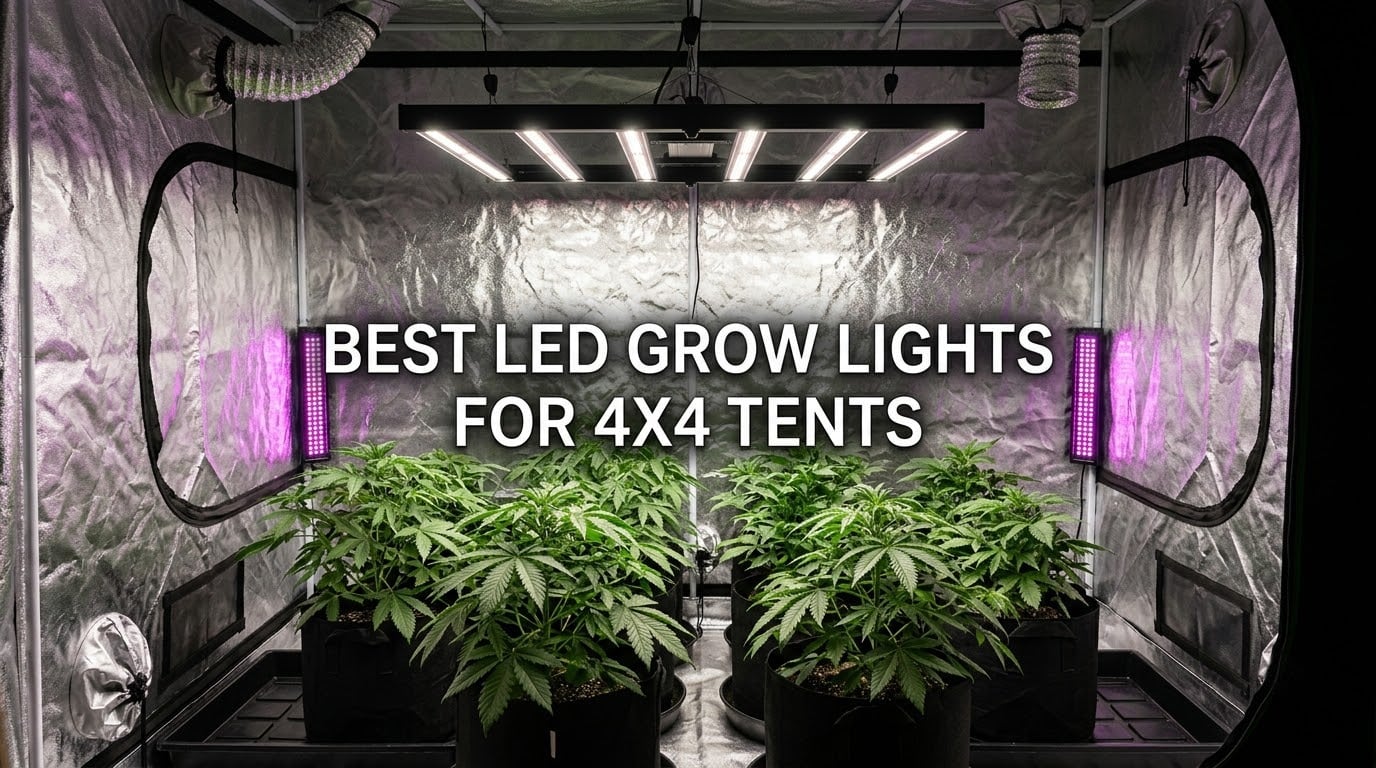
If you are hunting for the best LED grow lights for 4×4 tents, the short answer is a dimmable full-spectrum fixture rated at 400 to 500 watts of real wall draw with diodes spread across the full 16 square feet of canopy. Every fixture below was judged on one question first: does the corner reading come close to the centre reading, or does the light die two feet from the tent wall?
I have spent a long time reading what growers actually say about their 4×4 setups, and the same complaint comes up over and over. The light looks strong in the middle, plants in the centre are taller and heavier, and the ones against the fabric walls stay small and lanky. One poster running a popular 300W fixture put it plainly: the light does not cover the tent, so they walk plants around to catch light on bud sites the fixture never reaches.
That is a coverage problem, not a nutrient problem. No amount of feeding corrects a spread that dies at the edges, which is why every recommendation in this roundup is built on uniformity first and peak numbers second. A fixture can post an impressive centre reading and still be the wrong tool for a square footprint.
Everything here also applies well beyond one crop type. The same coverage logic holds for a 4×4 tent full of peppers, leafy greens, herbs, houseplants or ornamentals under lights, and if you are still choosing a fixture for a shelf or a single pot, our guide to the best grow lights for indoor plants is a better starting point. Grow lights in this category refresh fast, so treat the 2026 versions listed here as the current generation.
Our Top 3 Best LED Grow Lights for 4×4 Tents (October 2026)

Spider Farmer SF4000
- 450W of real draw
- 2.7 mol/J system PPE
- External dimming knob
- Fanless aluminum body

AC Infinity IONFRAME EVO6
- Samsung LM301H EVO diodes
- 3.14 mol/J PPE
- 500W bar layout
- 10 brightness levels
Spider Farmer SE5000
- 480W at 1420 umol/s
- Bridgelux bar diodes
- App scheduling with sunrise/sunset
- Daisy-chain to 50 units
The SF4000 takes the top slot because it does the one thing a 4×4 demands better than anything else here: it holds usable intensity out to the walls of a square footprint, and it carries more than 12k+ owner reviews to back that up. The AC Infinity IONFRAME EVO6 is the efficiency and build-quality answer, and the SE5000 is the pick if app scheduling matters more to you than a physical dial.
Comparing the Best LED Grow Lights for 4×4 Tents in 2026
| Product | Details | Action |
|---|---|---|
|
|
Check Latest Price |
|
|
Check Latest Price |
|
|
Check Latest Price |
 |
|
Check Latest Price |
 |
|
Check Latest Price |
 |
|
Check Latest Price |
 |
|
Check Latest Price |
 |
|
Check Latest Price |
How We Evaluated These Grow Lights
These are spec-based assessments, not laboratory measurements. We did not run PPFD meters across a canopy, and we have not grown a full cycle under any of these fixtures. What we did was read every published spec, cross-check the claims against owner feedback, and score each fixture on how well its footprint claim matches a 16-square-foot tent.
Coverage and uniformity carried roughly 70 percent of the weight, real efficiency and spectrum the remaining 30 percent. That weighting is deliberate: a 4×4 is a coverage problem far more often than it is a power problem, and past a certain wattage threshold extra power produces far less than the extra cost implies.
We also weighed warranty length and service reach, because a five-year warranty is repeatedly treated as a genuine tiebreaker by experienced growers, and we penalised fixtures whose measured owner feedback contradicts their published claims. Where ratings are thin we say so, because a fixture with 60 reviews tells you much less than one with 12k+.
1. Spider Farmer SF4000 – Even Wall-to-Wall Coverage With a Physical Dimming Knob
Spider Farmer SF4000 LED Grow Lights for Indoor Plants in 4×4 Grow Tent
450W rated draw
25.39 by 21.1 inch panel
14 lb
5-year warranty
+ Pros
- Holds intensity out toward the tent walls
- Dimming knob gives precise manual control
- Silent fanless aluminum body
- Includes hanging hardware and service centers across four regions
– Cons
- Runs hot to the touch at full power
- Some reports of dimmer switch failure after about a year
The SF4000 is the fixture I keep recommending to anyone with a square 4×4 and no patience for a second install. At 450 watts of rated draw across a 25.39 by 21.1 inch panel, it lands squarely in the band that fills 16 square feet without forcing you to run two units, and the 2.7 mol/J system PPE means it is producing useful photons rather than just drawing current.
What sets it apart in a square tent is the diode layout. Spider Farmer packs the emitters densely toward the edges of the boards rather than clustering them centrally, and that is precisely the design decision that fixes the hot-centre, dim-wall problem I opened with. Reviewers consistently describe uniform coverage across a 4×4 rather than a bright pool in the middle, and they mention strong yields to match.
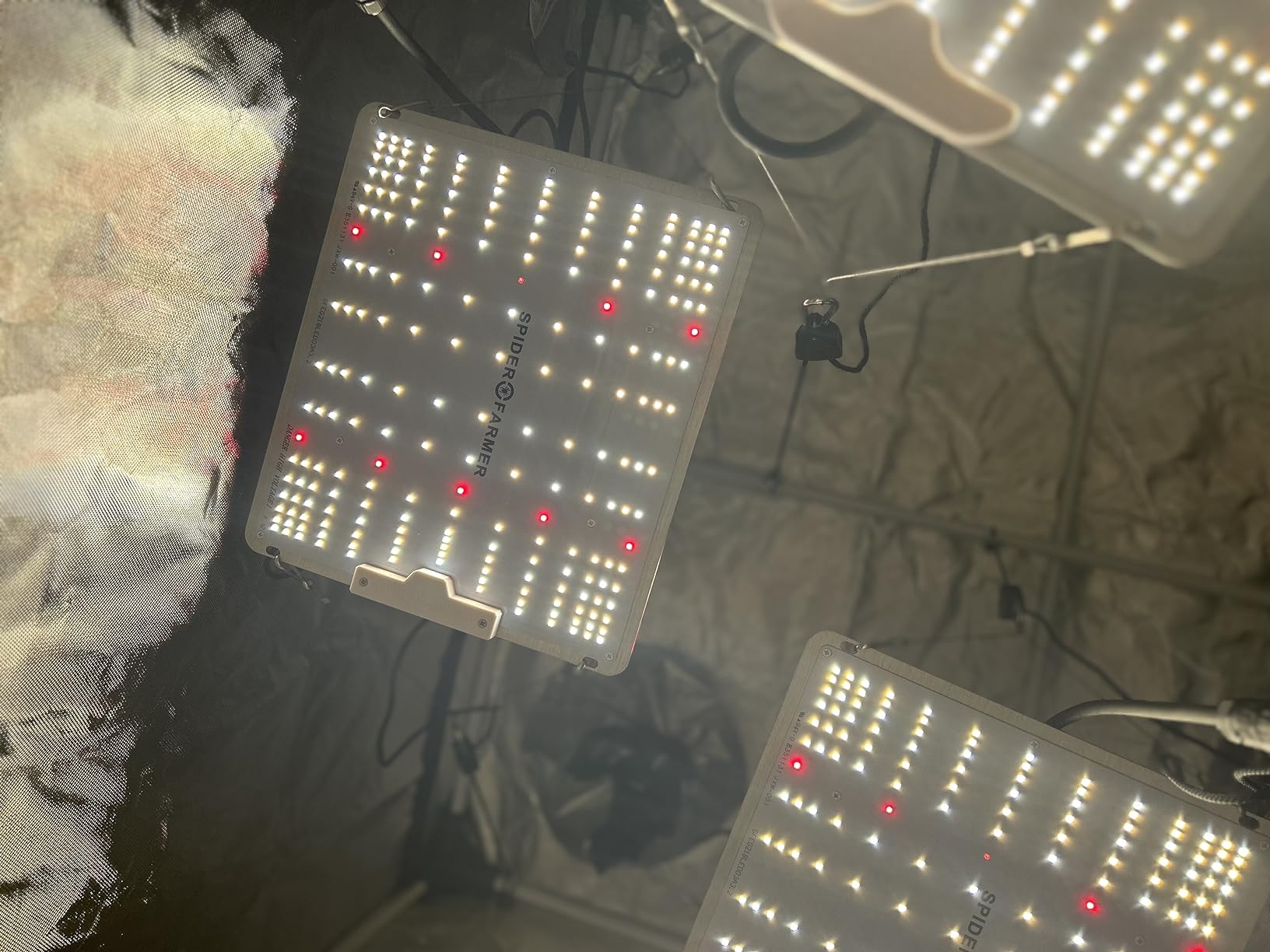
Why the physical dimming knob beats app control for most 4×4 growers
The external dimming knob is the detail that convinced me. You walk into the tent, turn a dial to 70 percent, watch the leaves flatten within the hour, and you do it again at dusk. No phone, no pairing, no network. Owners cite this as the single most-used feature on the fixture.
That said, the knob is also the most common failure point in the long run. Some owners report dimmer switch failures after about a year of daily use, which is worth factoring in against the five-year warranty that covers the light body itself. If you are already running a controller, the GGS compatibility means the dimmer becomes optional rather than essential.
2.7 mol/J efficiency and what that means for your power bill
Efficacy of 2.7 mol/J puts the SF4000 in the middle of this group, below the AC Infinity and the SZHLUX claim but comfortably above budget-tier panels. In practice, a full-spectrum blend of 3000K, 5000K, 660nm red and 760nm IR at that efficiency produces solid canopy intensity without pushing your tent into the range where stretching becomes a problem.
Running 450 watts for a 12-hour photoperiod works out to about 5.4 kWh a day. At a US residential average near 16 cents per kWh, that is roughly 26 dollars a month for lighting in a typical 12-week flowering cycle, before you add fan and environmental control. Reviewers also point out the fanless design stays markedly cooler than air-cooled HPS, which is the real thermal story here.
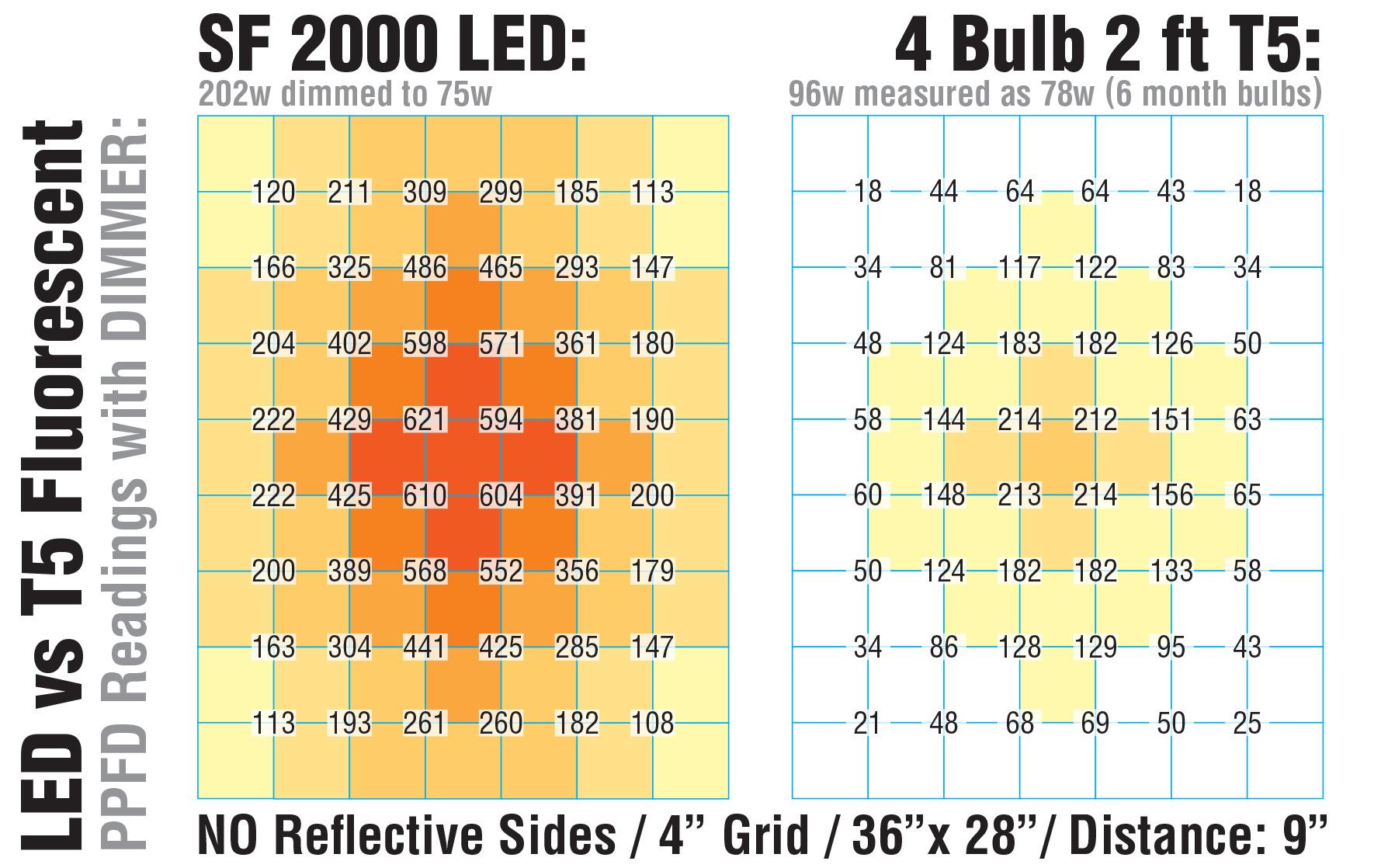
Footprint, mounting and the height caveat
At 25.39 by 21.1 inches the panel is square enough to sit centred over a 4×4 without the wide gaps you get from a rectangular bar, and 14 pounds is light enough to hang from standard ratchet hangers. The one practical gotcha is vertical clearance: the hanging cables and clips add eight to ten inches, which matters in a 4x4x6.5 tent more than a 4x4x7.
Owners also note the boards sit fairly close together, which keeps the output intense but limits how far you can stretch the footprint. If you are running plants to the very edges of the fabric, this is one to hang a little higher and dim down rather than a fixture you push right down into the canopy.
Verdict: the default choice for a single-light 4×4, and the only one here with a review volume big enough to make the coverage claim credible. Best overall for full-cycle growing of vegetables, herbs or ornamentals in a single tent.
2. AC Infinity IONFRAME EVO6 – The Most Efficient Diodes in the Group
AC Infinity IONFRAME EVO6, 500W Samsung EVO Bar LED Grow Light 4×4
500W rated draw
32.67 by 32.48 inch bar frame
26.8 lb
ETL certified
+ Pros
- Highest diode efficiency here at 3.14 mol/J
- 1680 diodes with 1991 PPFD
- Removable driver runs cool
- Ten brightness levels with scheduling
– Cons
- Most expensive fixture in the group
- Real heat load in late flowering
- Some argue the footprint is closer to 3×3 than 4×4
Nothing in this roundup converts electricity into photons more efficiently. The Samsung LM301H EVO diodes are rated at 3.14 mol/J across 1680 emitters, and AC Infinity pairs them with a bar frame measuring 32.67 by 32.48 inches that spreads output across the full tent rather than concentrating it overhead. On paper it is the most capable square-footage solution here.
Reviewers are split on exactly one point, and it is the point that matters most for a 4×4. Several owners argue the physical footprint reads closer to 3×3 than 4×4, meaning the corners of a 4×4 sit near the edge of the useful spread. If coverage corner to corner is your top priority, treat this as a light that wants to sit slightly higher than you would expect, or run a second unit rather than a single one.
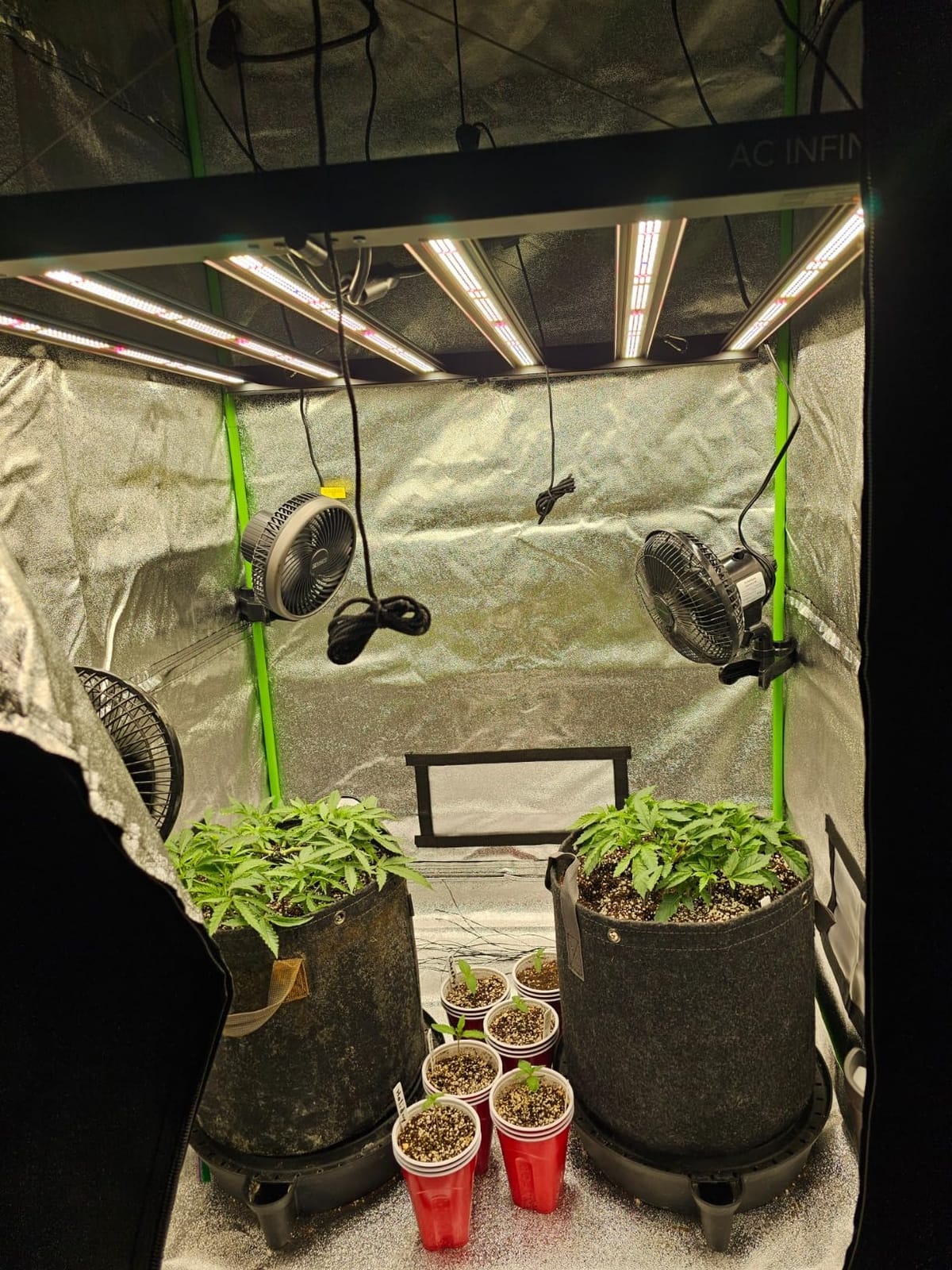
Diode efficiency and what 3.14 mol/J buys you
The gap between 2.7 and 3.14 mol/J is not cosmetic. At the same 500 watts, the EVO6 produces meaningfully more usable photons, which means you can dim it down to hit a target canopy intensity while running the diodes at a lower stress point. Diode longevity is a real benefit of that headroom, and it is why the build feels commercial rather than hobbyist.
The spectrum is handled entirely by the LM301H whites plus the same white package efficiency, and AC Infinity pairs them with deep red channels that carry the flowering response. Coverage is rated at 5×5 for vegetative growth and 4×4 for flowering, which is exactly the footprint claim you would expect from a bar frame this size.
Heat, the removable driver and airflow in a small tent
This is the one to watch in a 4×4. Owners report tent temperatures in the 80 to 85F range during late flowering, and the driver box gets very hot if mounted inside the tent. The good news is that the passively cooled driver is removable and designed to sit outside the canopy, which is where it belongs in a small footprint.
Pair that heat load with an exhaust fan sized for roughly 112 cubic feet of tent volume and you will stay ahead of it. A light this efficient still dumps a lot of energy into the room as heat, and in a bedroom or closed spare room that matters more than the electricity does.
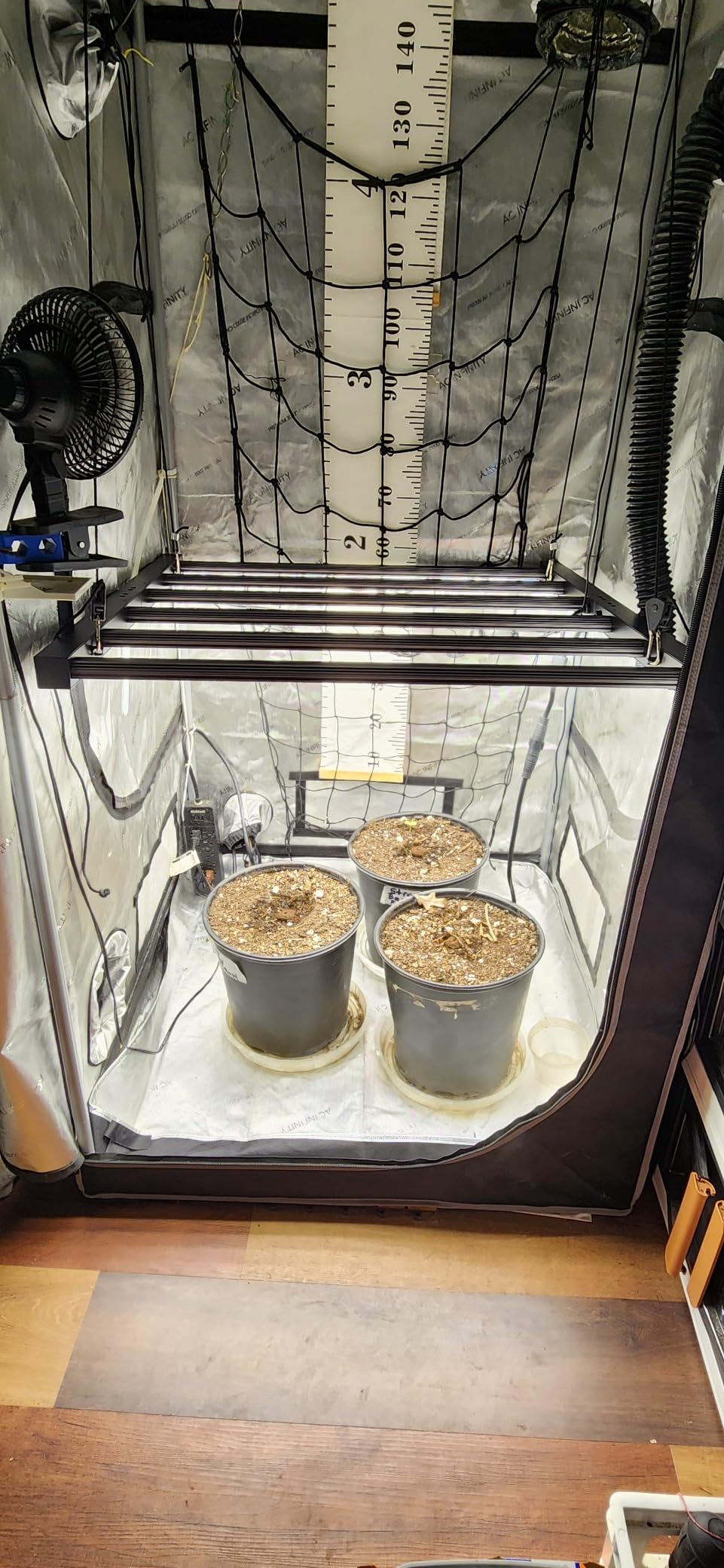
App automation, daisy-chaining and the two-year warranty
The automation is the best in the group. Ten brightness levels, minute-level scheduling, sunrise and sunset simulation, and WiFi app control through the UIS platform. Daisy-chaining extends to 80 units from a single master, which makes this the natural fixture for a grower running several tents who wants one control surface.
Two things temper that. The warranty is two years, the shortest among the premium fixtures here, against five years from Spider Farmer and HLG. And it is bright enough that reviewers recommend eye protection, which is a normal tradeoff at 500 watts and 1991 PPFD.
Verdict: the pick if you want the most efficient diodes, the best app and a fixture that scales across multiple tents. Not the pick if one tent and one room are your whole growing operation.
3. Spider Farmer SE5000 – App Scheduling and Deep Canopy Penetration
Spider Farmer SE5000 LED Grow Light 480W for 4×4 Grow Tents, App‑Controlled
480W rated draw
33.65 by 33.57 inch bar layout
6 light sources
5-year warranty
+ Pros
- Bar design gives deep canopy penetration
- Digital dimmer with brightness readout
- App scheduling with sunrise and sunset
- Quick setup reported at around ten minutes
– Cons
- Noticeable heat that needs managing
- Driver mounting design could be better
- Some kits include ratchet hangers only
The SE5000 is the fixture I would tell someone to buy if they want a full-flower 4×4 without stepping up to the premium tier. It puts out 1420 umol/s at a true 480 watts across a 33.65 by 33.57 inch footprint, and the bar-style layout is the reason it reaches down into a dense canopy rather than only lighting the tops.
Reviewers emphasise uniformity and wall-to-wall spread as the headline strengths, which is the correct priority for a square tent. The digital dimmer with a brightness readout is a small upgrade over a blind knob, and the Spider Farmer app handles scheduling plus sunrise and sunset simulation for anyone who wants photoperiod control without a wall-mounted timer.
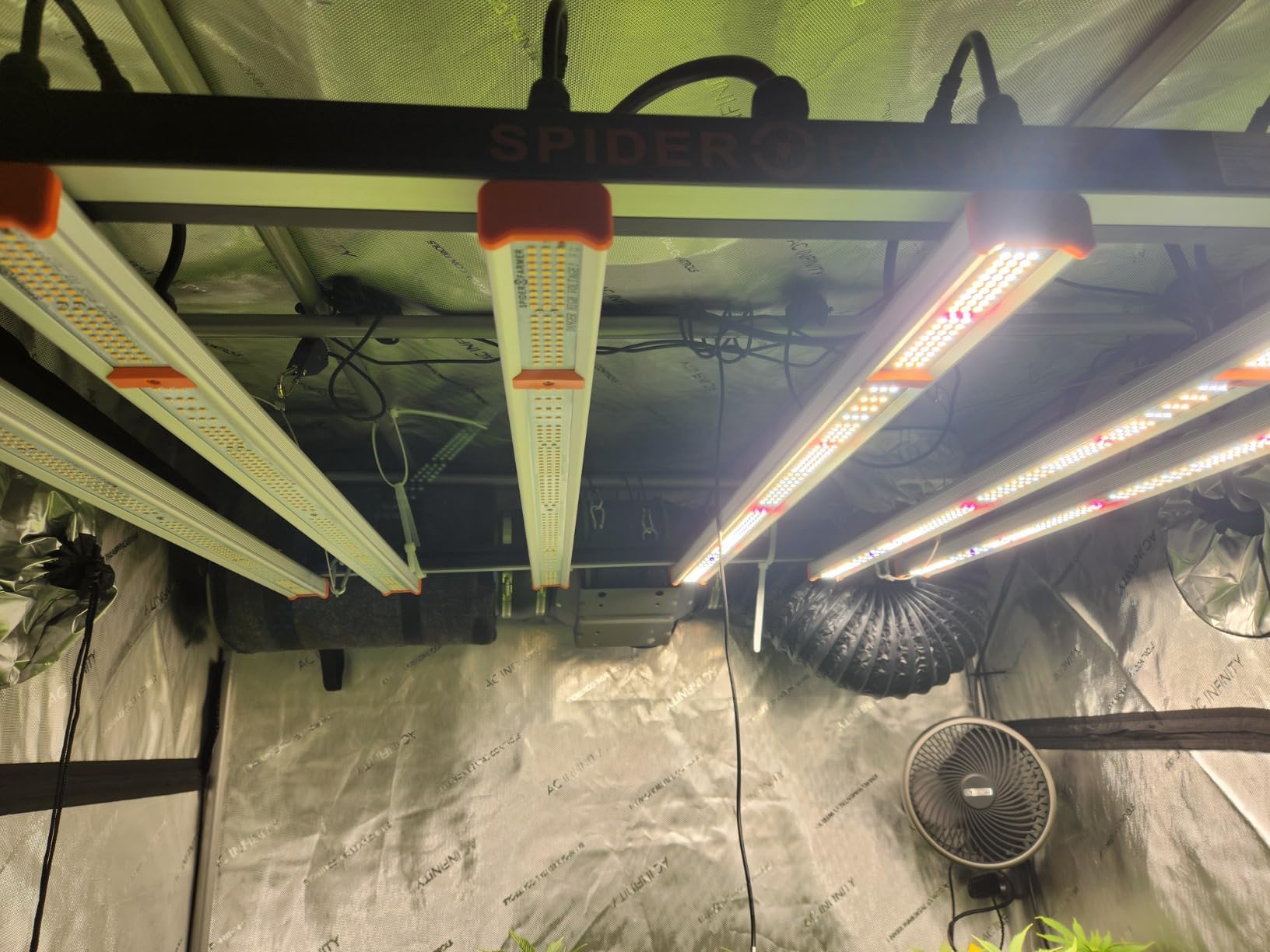
Why bar layout beats a single panel in a square tent
Bridgelux diodes spread across separate bars throw light outward as well as down, so the emitters nearest the tent wall are still pointed at something useful. A single rectangular panel concentrates its output in the middle and relies on reflectivity at the edges, which is where the hot-centre problem usually starts.
The spectrum pairs 437nm blue with 50 to 55 percent 660 to 665nm deep red, alongside 2800 to 3000K and 4800 to 5000K whites. That deep red weighting is what carries a canopy through the flowering stage, and it is the part of the spectrum that most budget panels thin out.
Thermal design and the detachable driver
The detachable driver is the standout feature here. Moving the hottest component outside the tent cuts the heat load inside the canopy substantially, and owners single it out as the main reason the fixture runs cooler than comparable 480W units.
It still emits noticeable heat, and the mounting design for that driver is the most criticised part of the package. Measure your space before you commit, because a 33-inch square frame plus a driver needs more ceiling clearance than a compact panel does.
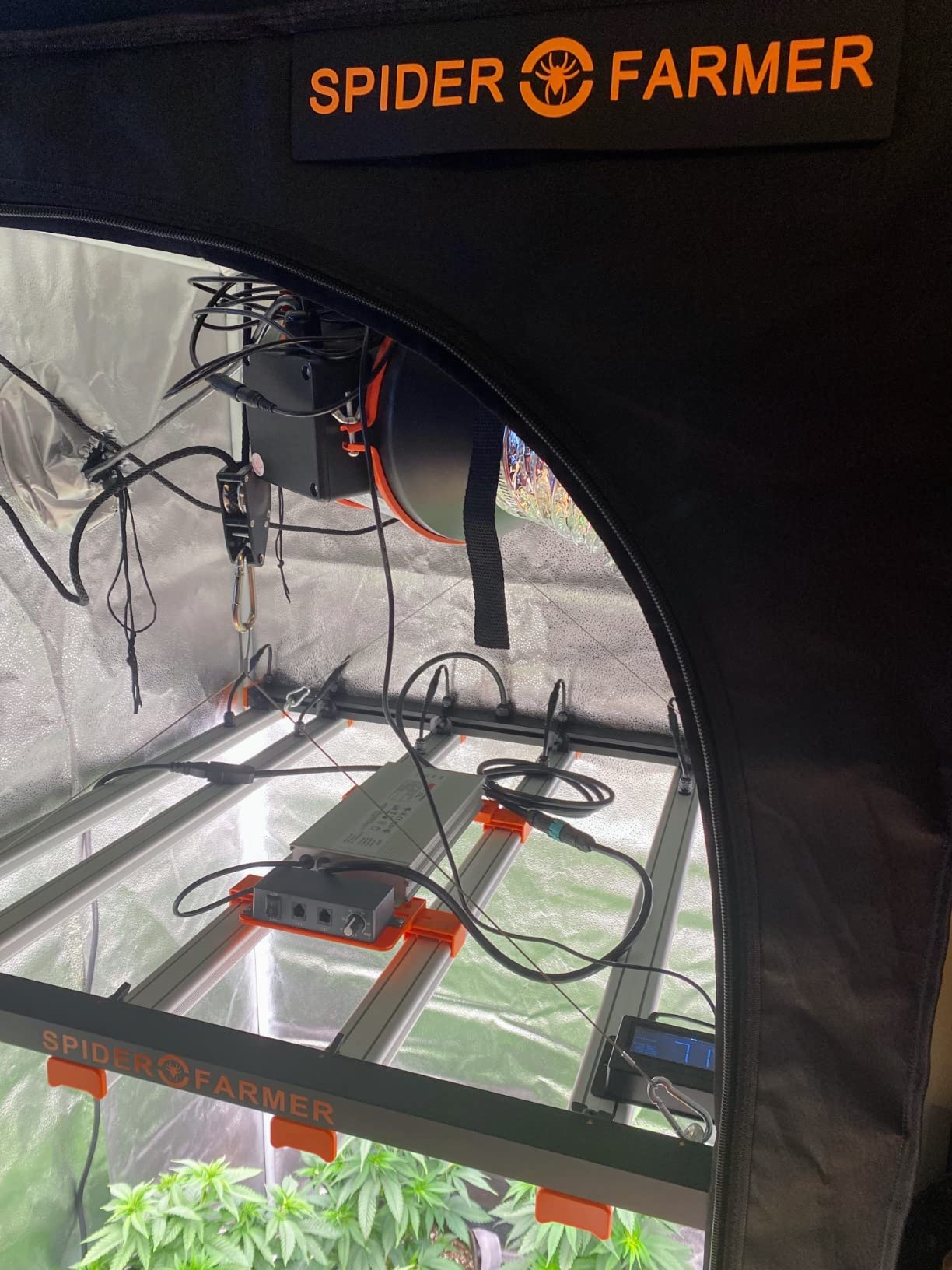
App control, daisy-chaining and the hardware small print
Daisy-chaining up to 50 units from one master light is the most capable figure in this roundup, and it makes the SE5000 easy to scale if you add a second tent. The app handles scheduling and sunrise and sunset simulation, though the Spider Farmer app only pairs on 2.4GHz networks, which is a genuine stumbling block for anyone on a modern dual-band router.
Hardware is where the one-star feedback sits. Some kits include only ratchet hangers, with no wire hangers, and the ratchet clips can be larger than the mounting holes allow. Budget a few minutes and a pair of extra straps before you hang it, not after.
Verdict: best value for a full-cycle 4×4. If you want app automation and bar-style spread without moving into the premium tier, this is the fixture.
4. Mars Hydro FC-4800 – Strongest Verified PPFD Readings at 480W
Mars Hydro FC-4800 480W 4×4 LED Grow Light Full Spectrum for Indoor Plants
480W rated draw
35.43 by 23.03 inch frame
20 lb
5-year warranty
+ Pros
- Owners measure about 1050 PPFD at 90 percent in a 4×4
- Remotely mountable driver keeps heat outside
- App dimming without opening the tent
- 2.85 mol/J from Bridgelux 3030 diodes
– Cons
- Not plug-and-play
- bars and driver need assembly
- Controller sold separately
- Driver box runs hot if mounted inside
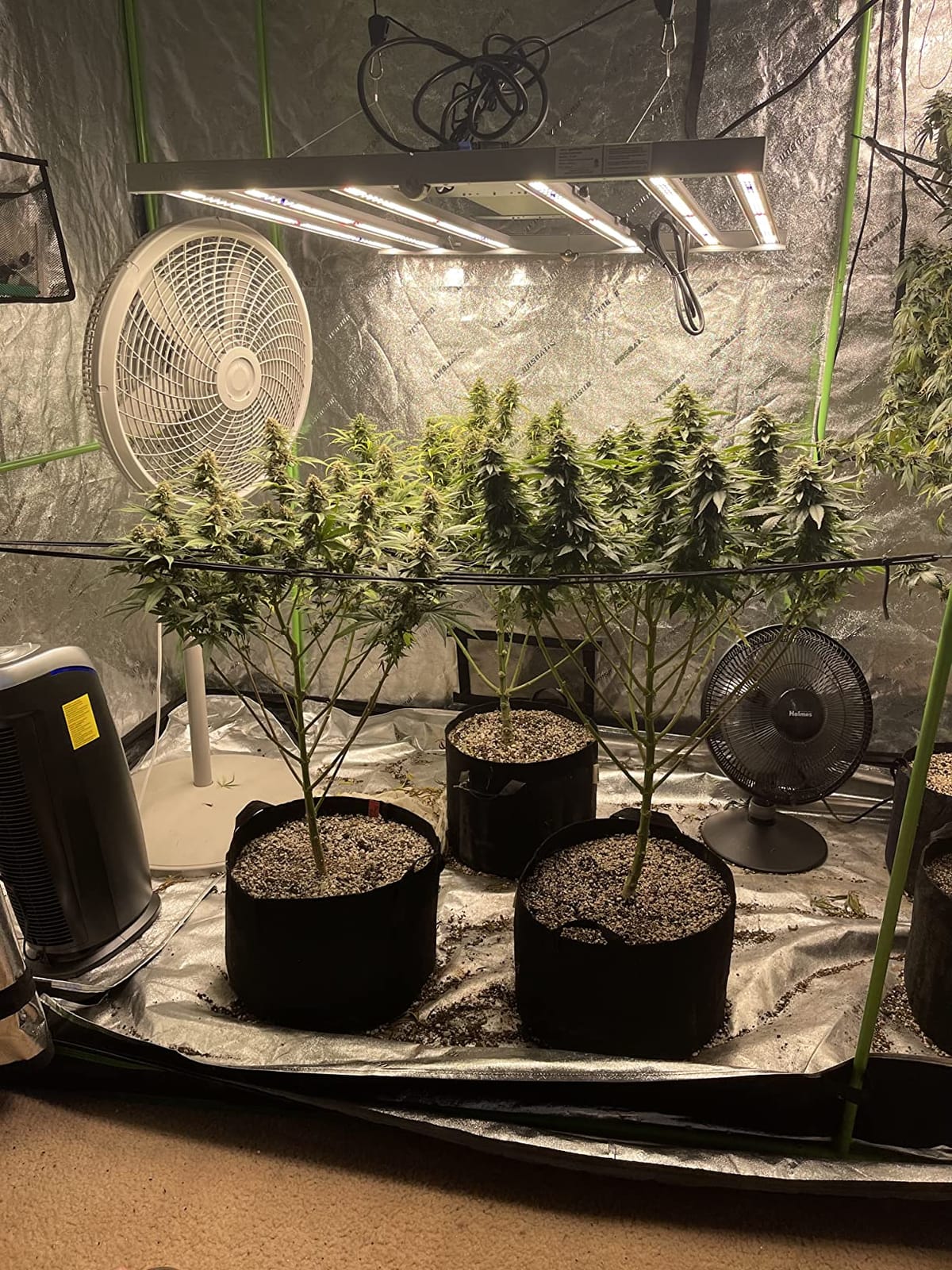
The FC-4800 has the most convincing measured feedback in this group. Owners who put a meter on the canopy report readings around 1050 PPFD at 90 percent power inside a 4×4, which is the kind of number most brands only claim in a marketing sheet. For a grower who wants evidence rather than adjectives, that is the single most useful data point available.
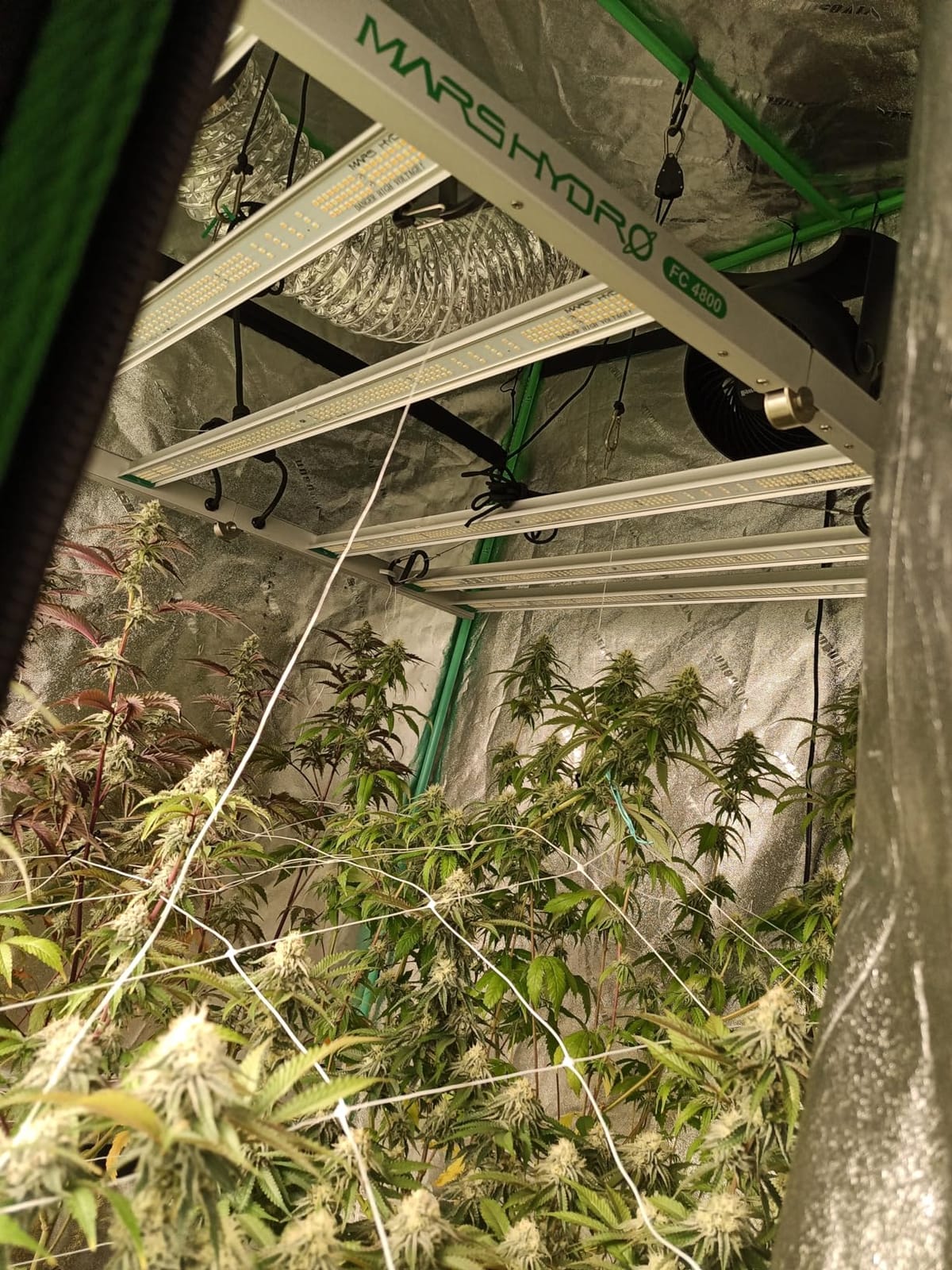
Efficiency sits at 2.85 mol/J from Bridgelux 3030 diodes, with Osram CSSJM6.24 red chips layered in for targeted 660nm deep red. The bar-structure heatsink handles the thermal side, and the whole thing is designed and specified explicitly for a 4×4 footprint rather than a smaller tent with a marketing extension.
What measured PPFD changes about a buying decision
Most fixtures advertise a peak number measured at the source. The FC-4800 owners are reporting canopy-level readings at a dimmed setting, which is a completely different and far more useful claim. If your plants sit lower than the fixture and you dim to avoid bleaching, canopy-level PPFD is the number that decides whether the setup works.
It also tells you how much headroom the fixture has. Around 1050 at 90 percent means you have a dimming range to work with for seedlings, a veg stage and a flowering stage, all on one unit. That flexibility matters more in a small tent than a higher peak would, because you cannot always move the light.
The assembly step nobody mentions
This is not a plug-and-play fixture. The bars and the driver require manual assembly before first use, and the app or controller path is optional and sold separately. If you buy the bare light expecting a box you unbox and hang, that expectation will cost you an evening.
Set aside thirty minutes with the manual before your first cycle. App dimming once configured is genuinely useful, because tuning intensity without unzipping the tent during dark hours saves both light leakage and stress on the plants.
Heat, the remote driver and long-term reliability
Owners consistently praise how cool it runs relative to its class, and mounting the driver remotely is what delivers that. The warning is straightforward: the driver box runs hot, so give it distance from anything flammable and keep it out of the tent.
There is a small tail of hardware complaints, including one report of a defective power connection port that required rewiring. Against a five-year warranty and 241 reviews, that is a normal failure rate rather than a pattern, but it is a reason to check the port on arrival.
Verdict: the pick if you care most about proven canopy-level output and deep red content. Worth the assembly evening.
5. HLG 350 Diablo – Efficiency Champion Built for a Two-Light Setup
Horticulture Lighting Group HLG 350 Diablo 350W 120V LED Quantum Board Grow Light with Samsung LM301H LM351H Deep Red, Growing Lights for Indoor Plants, Full Spectrum, Dimmable, ETL/UL Certified
330W rated draw
34.5 by 10 by 2.75 inch
911 PPF output
5-year warranty
+ Pros
- Highest average rating in the group
- Dimmable from 60W up to full output
- Passive cooling keeps it near silent
- Designed and assembled in the USA
– Cons
- Slim 3×5 flowering footprint so two units are often needed
- Premium price point
- Included metal hanging clips reported as poor quality
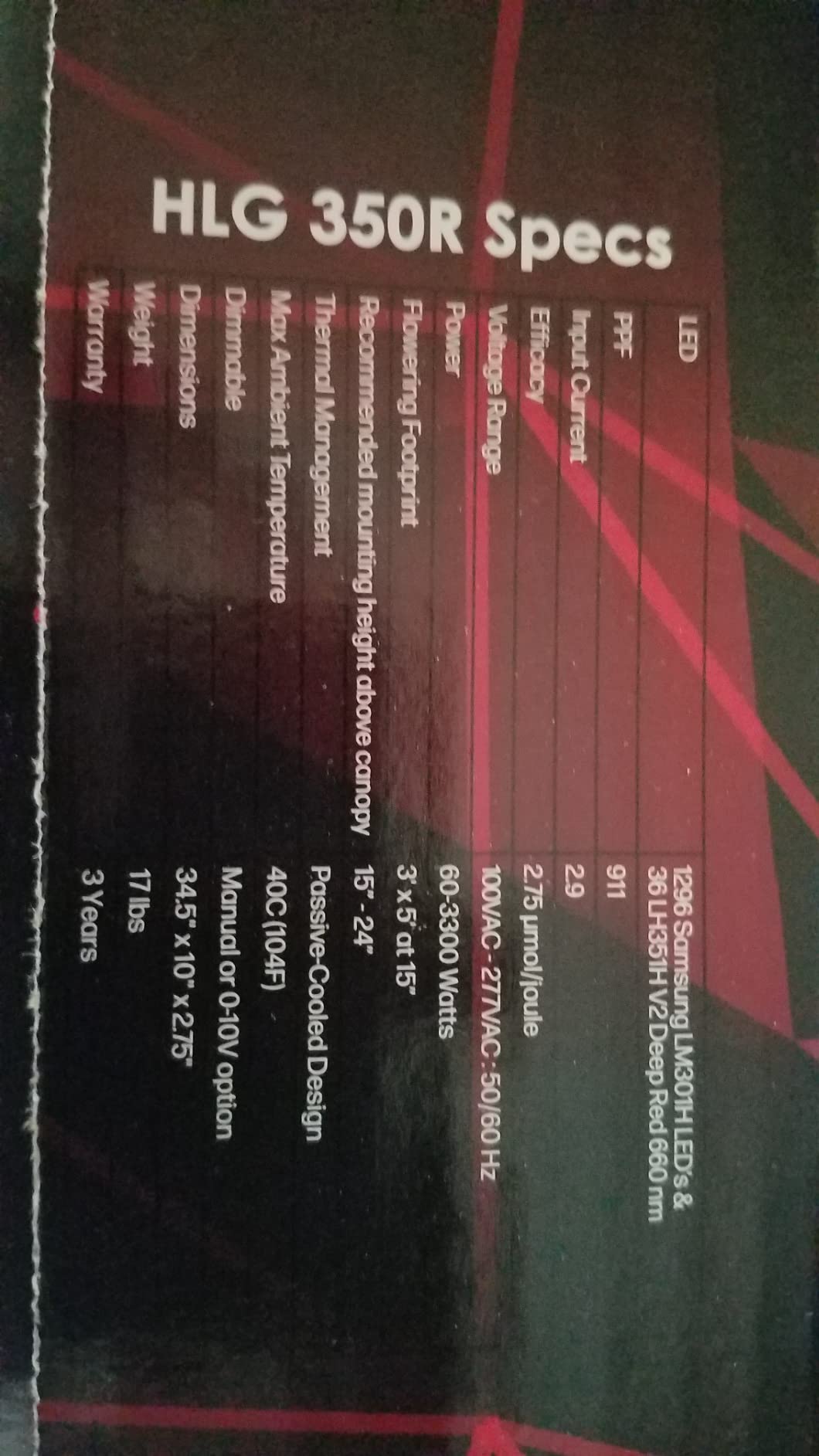
The HLG 350 Diablo carries the highest average rating of anything in this roundup, and it earns it on a specific strength: efficiency. At 2.75 PPF/W the Quantum Board design delivers 911 PPF of output while pulling 330 watts, and it is designed as a direct replacement for a 600W HID in a much smaller physical package.
Here is the honest catch, and it is a big one for a 4×4. The published footprint is 5×5 for vegetative growth at 24 inches and 3×5 for flowering at 15 inches. On a square 4×4 that slim 3×5 flowering spread means a single Diablo leaves two bands of canopy short, and experienced growers running this fixture in a 4×4 generally pair two units.
Quantum board spectrum and the 60W dim floor
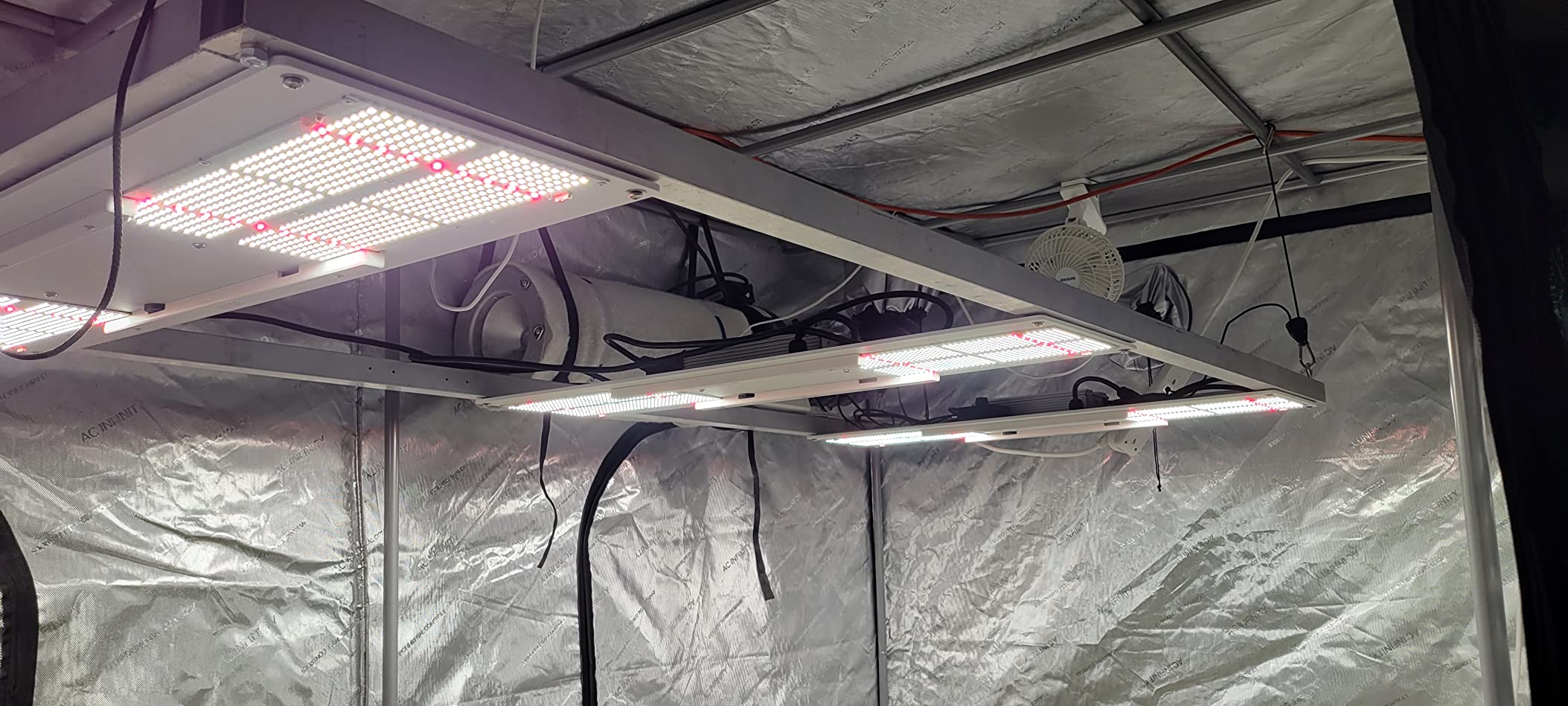
The spectrum combines Samsung LM301H full-spectrum white with LM351H 660nm deep red on QB 648 quantum boards, which is the recipe experienced growers consistently rate highly. Deep red is the part of the spectrum that drives flowering response, and pairing it with high-efficiency white is why the output rating holds up at lower wattages.
The dimming floor of 60 watts is the feature that makes this fixture genuinely useful across a full cycle. Seedlings need far less light than a mature canopy, and being able to turn the output down to a fraction instead of hanging the light a metre higher is the difference between an even grow and a scorched patch under the fixture.
Why the community treats HLG as the benchmark
Across grower forums, HLG is repeatedly named as the durability and output benchmark rather than as a budget alternative. That reputation comes down to conservative engineering: passive cooling instead of fans, no app dependency, and a design and assembly process based in the USA.
It is also the fixture most often recommended for anyone who already knows what they are doing. If you are comparing against Spider Farmer or Mars Hydro at similar cost per photon, the argument is about build philosophy rather than headline numbers, and the small committed base of 60 reviews suggests buyers here are people who already knew what they wanted.
When a single Diablo makes sense and when it does not
One unit works well if you are running a partial canopy, a mother plant corner, or a 3×3 to 3×5 footprint rather than the whole tent. For a 4×4 flowering the entire floor, plan on two. The good news is that the passive cooling means doubling up does not double the fan noise, which is the usual objection to running two fixtures.
The other drawback is the included hardware. Owners report the metal hanging clips as poor quality, and the premium pricing leaves less room for a second unit. It runs slightly warmer than older HLG models, so airflow still matters, just less than a fan-cooled fixture would demand.
Verdict: the efficiency pick, and the one to build a two-light 4×4 around if you want the quietest possible setup. Not the single-light answer.
6. Spider Farmer G5000 – Extended Bars Aimed at the Tent Walls
Spider Farmer G5000 LED Grow Light, App‑Controlled, Fits 4×4 Grow Tents
480W rated draw
33.65 by 33.57 inch frame
1680 diodes
5-year warranty
+ Pros
- Extended bar design improves edge and corner coverage
- No reported flicker in owner feedback
- App control with scheduling and sunrise and sunset
- CE ETL and FCC certified
– Cons
- Smallest review base in the group at 62 ratings
- No stand included
- App pairs only on 2.4GHz networks
The G5000 is built around one explicit design goal: reaching the edges of a square footprint. The extended light bar geometry is specified for uniform canopy coverage including edges, and 1680 high-efficiency diodes at 480 watts and 2.8 mol/J give it enough output to keep those edges lit rather than merely present.
This is a newer member of the Spider Farmer line and carries the smallest review base in the group at just 62 ratings. That is not disqualifying, but experienced growers treat thin review history as a risk even when the specs look strong, so treat the coverage claims as promising rather than proven.
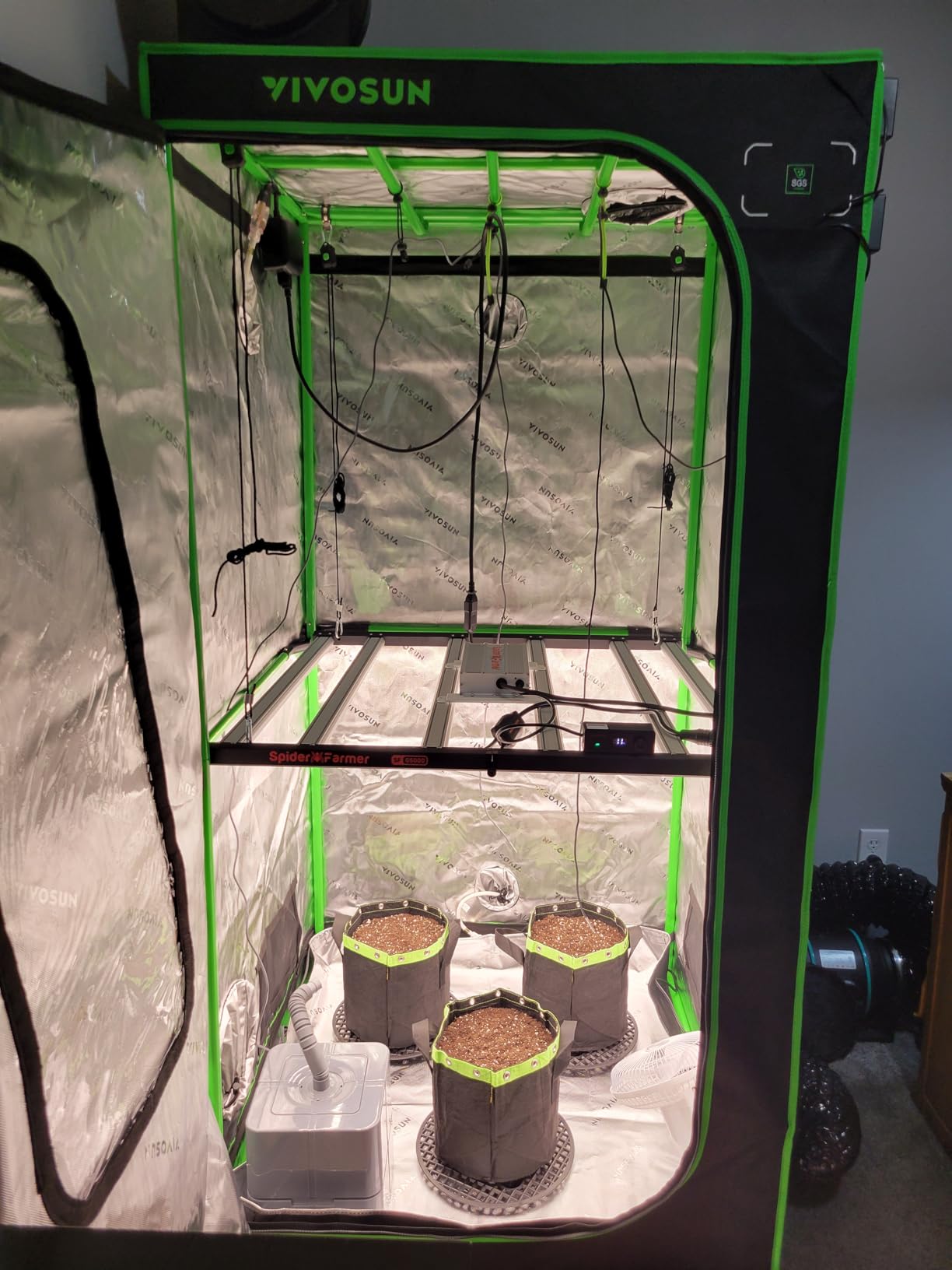
Extended bar geometry and the wall problem
The physics of a square tent is simple. Light leaving a fixture spreads outward, so anything beyond roughly 18 inches from the emitter gets less than the centre. Extending the bars pushes emitters toward the tent walls, which shortens that distance and lifts the corner readings without adding a single watt.
Owner feedback backs this up, with uniformity and easy assembly the most common positives and no flicker complaints. If your current setup shows the classic hot-centre signature, this is the fixture whose geometry is aimed directly at that problem.
Control, daisy-chaining and the 2.4GHz catch
Dimming runs 10 to 100 percent with daisy-chaining for up to 60 units, and the app handles scheduling plus sunrise and sunset simulation. All of that is standard for the range, and all of it depends on pairing the phone to a 2.4GHz network, which is the most common setup complaint.
The physical kit is thinner than some rivals. There is no stand included, so you need your own hanging hardware, and several buyers asked for better included ropes. Five-year warranty coverage and CE, ETL and FCC certification are both genuine positives for a fixture at this tier.
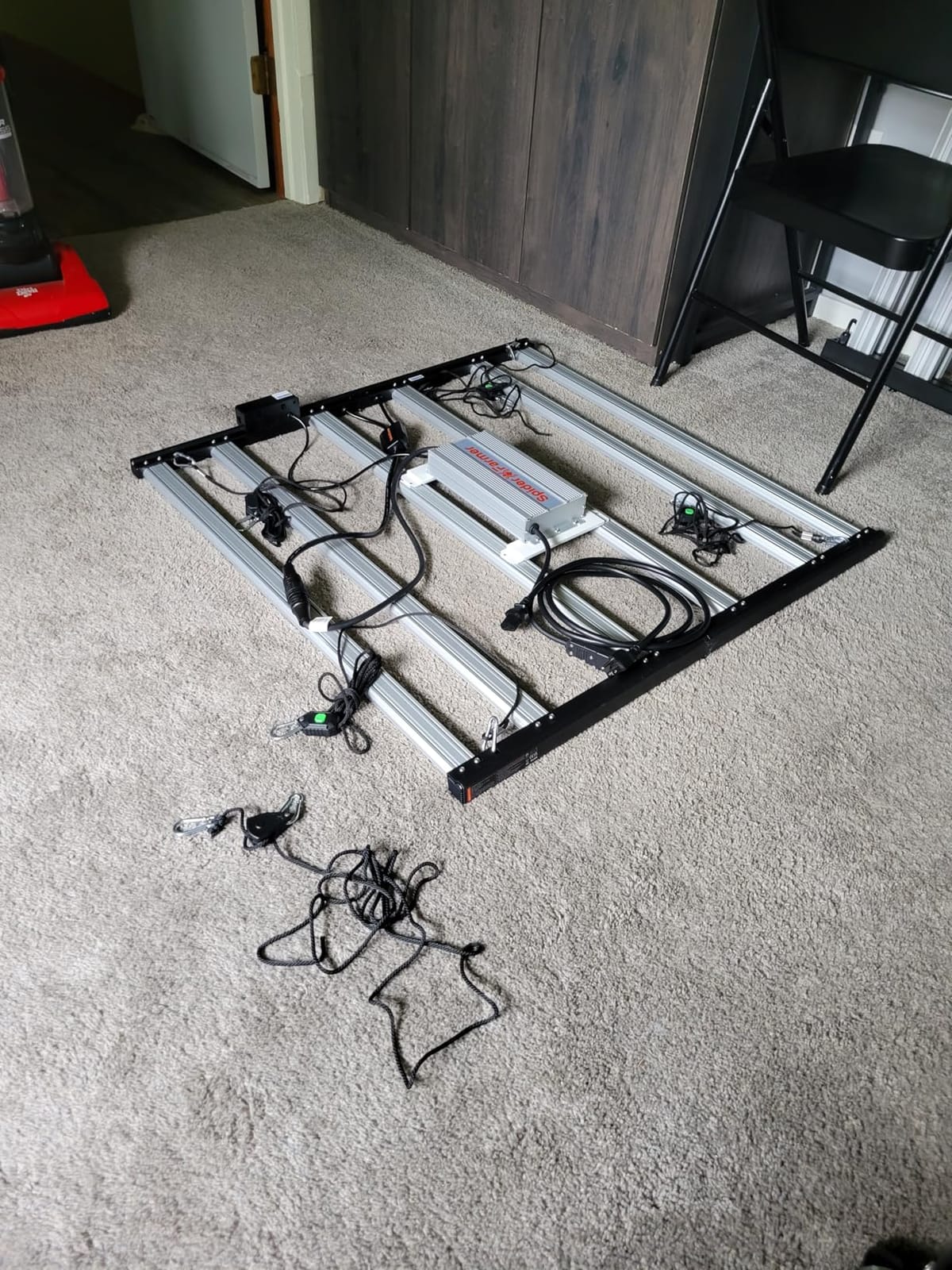
Where this fits against the SF4000 and SE5000
Within the Spider Farmer line the choice is about control method and geometry rather than output. The SF4000 gives you a physical dial and the largest review base. The SE5000 adds a digital readout and the deepest daisy-chain capacity. The G5000 pushes hardest on bar length and edge reach.
For a 4×4 where the walls are the problem, the extended bar design is the argument for this one. If you would rather have proven long-term feedback than the best geometry, the SF4000 is the safer purchase.
Verdict: the pick if edge coverage is your specific complaint and you are comfortable with a thinner review history.
7. Barrina 720-LED Panel – the Cheapest Way Into a 4×4
Barrina LED Grow Light, Full Spectrum with IR, 4×4 FT Coverage, Dimmable, Adjustable Light Panel with 720 LEDs, High PPFD, Plant Grow Light for Indoor Plants Seedling Growing Bloom Flowering Fruiting
200W rated
720 LEDs across 4 panels
2 lb
2-year warranty
+ Pros
- Adjustable panels let you aim light at specific plants
- Lightweight at two pounds and quick to install
- Dimmable with daisy-chain linking
- Full spectrum including 730nm IR
– Cons
- Advertised 200W appears over-rated
- Flickers below 40 percent dimming
- No built-in timer for scheduling
- Many buyers end up running two
The Barrina panel is the cheapest way to get real light onto a 4×4 floor, and its four adjustable panels are the genuinely clever part. Rather than fixing the diodes in a flat array, each panel folds outward so you can aim light at a specific corner or a specific plant, which directly addresses the wall problem at almost no cost.
At 200 watts rated across 720 LEDs it is well under the 400 to 500 watt target for flowering a full 4×4. The manufacturer’s own coverage claim is honest about this: ideal for 3×3 flowering and 4×4 vegetative growth. Treat it as a strong veg-stage or seedling fixture that can carry a smaller canopy, and one that many buyers pair with a second unit.
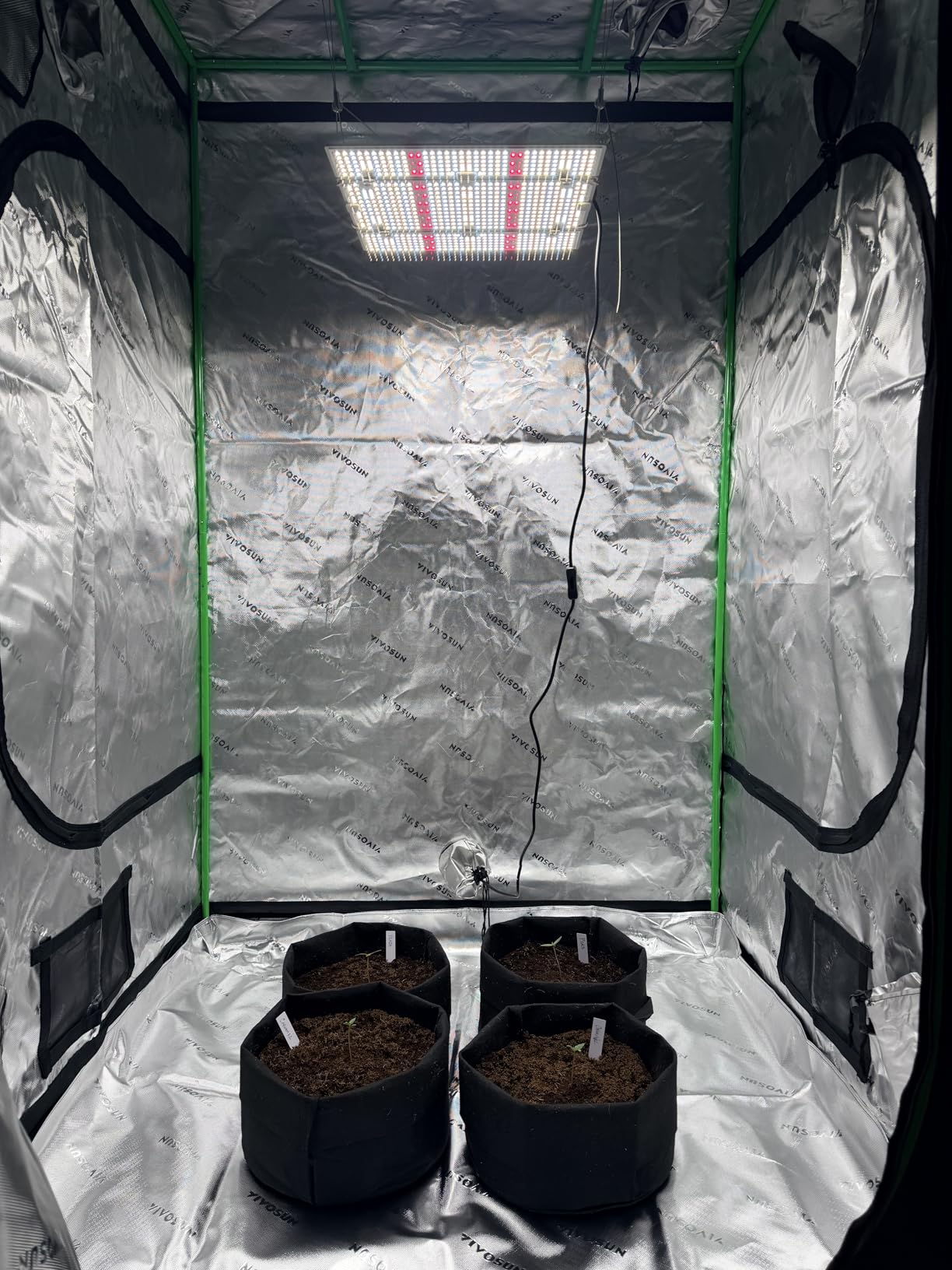
What 720 LEDs across four panels actually gives you
The spectrum is respectable for the tier: 5000K blue, 3000K warm white, 660nm red and 730nm infrared, all on an aluminum and polycarbonate body weighing two pounds. You can carry it with one hand and install it in minutes, which is not true of most 4×4-capable fixtures.
Peak output is listed at 41000 lumens with a 60 degree beam angle, and the brand claims up to 50 percent energy savings against an HPS of similar output. In practice the 60 degree cone is narrower than a bar layout, which is why the folding panels matter: they are the mechanism for widening that cone toward the tent walls.
Where the spec sheet and the reviews disagree
There is a real gap here, and you should know about it. A verified one-star review measured this fixture against named-brand lights and found the 200 wattage rating overstated, with the power supply capping near 180 watts, and reported flicker below 40 percent dimming. That is a fair technical criticism of a spec-heavy budget panel.
There is also no built-in timer, so scheduling means an external timer or controller, and the driver runs hot enough to notice. Owner sentiment is otherwise positive on value, colour response and compact growth, with 741 reviews backing that up.
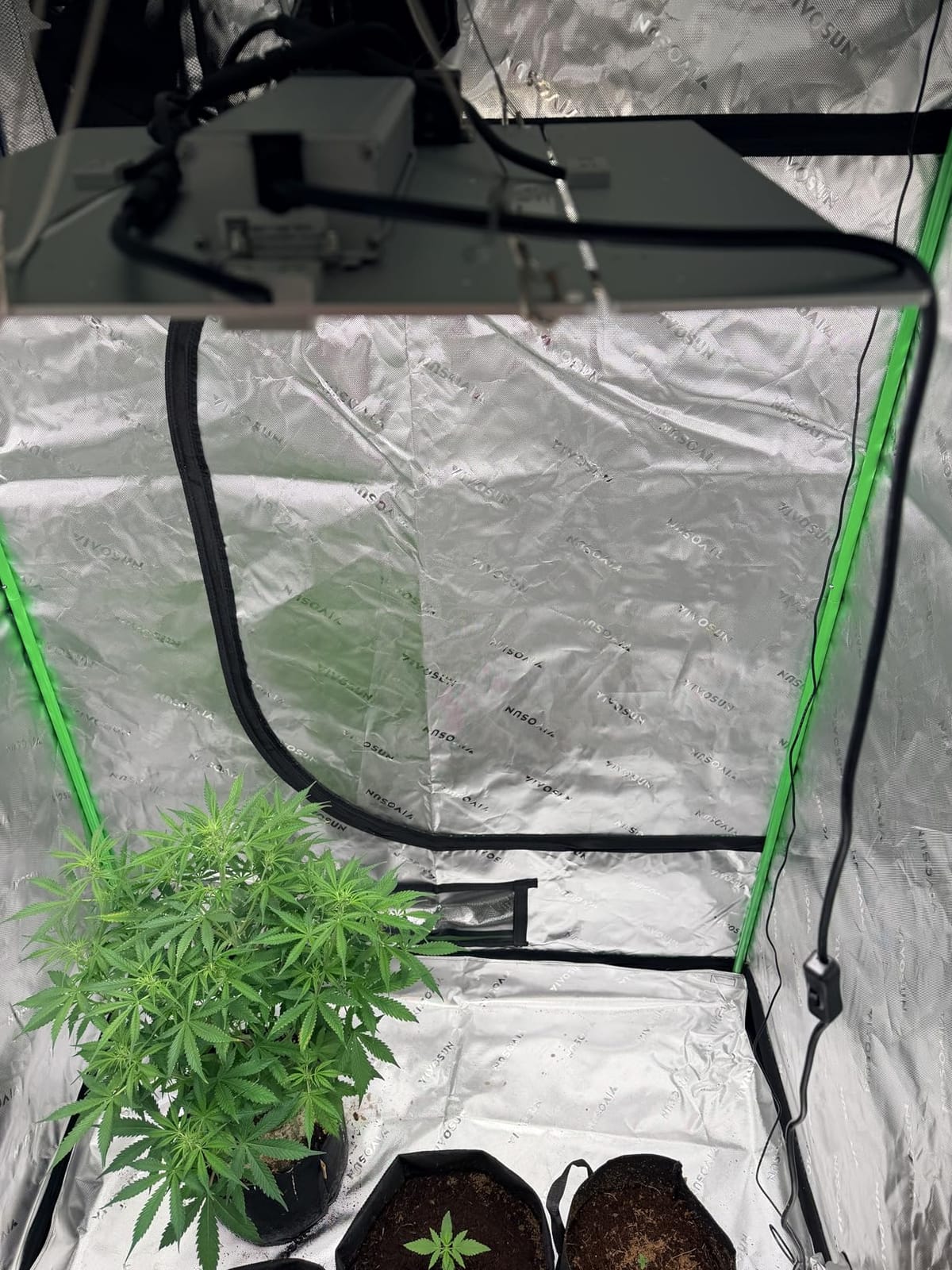
Best used as a veg-stage light or a paired setup
The strongest use case is a vegetative cycle across a full 4×4, or a flowering cycle on a 3×3 section of the floor with the aimable panels pointed at the flowering plants. If you want to flower the full 16 square feet, the consensus in owner feedback is that two units are the working answer.
Daisy-chaining lets those two units share one control, which makes a paired Barrina setup a legitimate two-light answer at a fraction of the cost of the premium bar fixtures. The two-year warranty is the shortest here, which is the tradeoff for the price point.
Verdict: the budget pick, and a genuinely clever answer for anyone who wants to direct light rather than just hang it. Understand the wattage caveat before you plan a full-flower cycle around a single unit.
8. SZHLUX 400W – Cheap Full-Spectrum Output With No Filler
SZHLUX 400W LED Grow Light 4×4ft Coverage with Double Switches, Full Spectrum Grow Light for Indoor Plants, Sunlight Plant Light 864 LEDs for Hydroponic Seedling Veg and Bloom Greenhouse
400W rated draw
23.59 by 23.6 inch
864 LEDs
2-year warranty
+ Pros
- Full spectrum including 730nm IR at a low entry point
- Fanless and silent in operation
- Trapezoid shape spreads light across the canopy
- Dual switches control three or six lights independently
– Cons
- Lowest rating in the group with 11 percent one-star reviews
- No app or smart scheduling
- Only a two-year warranty
- Confusing touch control and documentation
The SZHLUX puts a claimed 400 watts and a full sunlight spectrum on the wall at an entry-level price, and for a first grow that is a reasonable place to start. The trapezoid array of 864 SanAn 1-watt LEDs spreads light across the canopy rather than concentrating it in a single spot, and the fanless aluminum shell with a reflector runs completely silent.
I would set expectations honestly here. This is the lowest-rated fixture in the group at 4.2 stars, with 11 percent of reviews at one star and only 65 ratings in total. There is very little detailed owner feedback to draw performance conclusions from, so the efficiency and coverage claims should be read as manufacturer figures rather than measured results.
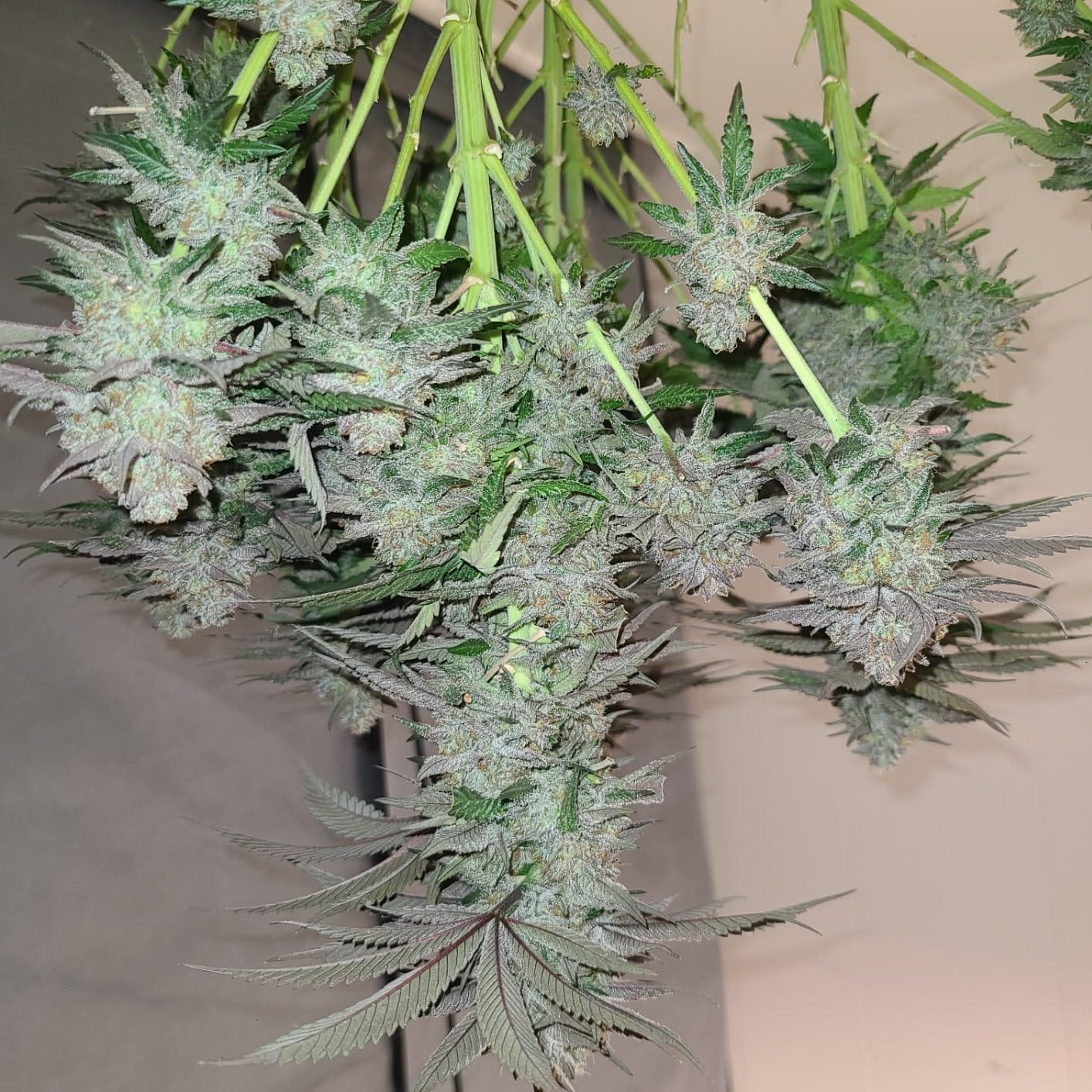
The dual switch trick is the reason to consider it
Most fixtures give you one dimmer. This one has dual switches that allow independent control of three or six lights, which is a genuinely useful feature if you later add a second fixture. You can run one bank at full output and the other at a lower setting depending on where your canopy needs it.
The claimed efficiency of 2.9 mol/J at 400 watts of draw would place it at the top of this group if it holds up, and the spectrum covers 3000K, 5000K, 660nm and 730nm infrared. At 23.59 by 23.6 inches the body is compact enough to centre easily in a 4×4 without a large ceiling footprint.
Where it falls short of the named brands
There is no app and no smart scheduling, so photoperiod control needs an external timer. The touch control and the documentation are reported as confusing, which is a bad combination for a first-time grower who will be adjusting this fixture daily.
The two-year warranty is the second shortest here, and the efficiency claims are unverified against better-tested brands. None of that makes it a bad fixture, but it makes it a learning-budget choice rather than a one you build a whole tent around.
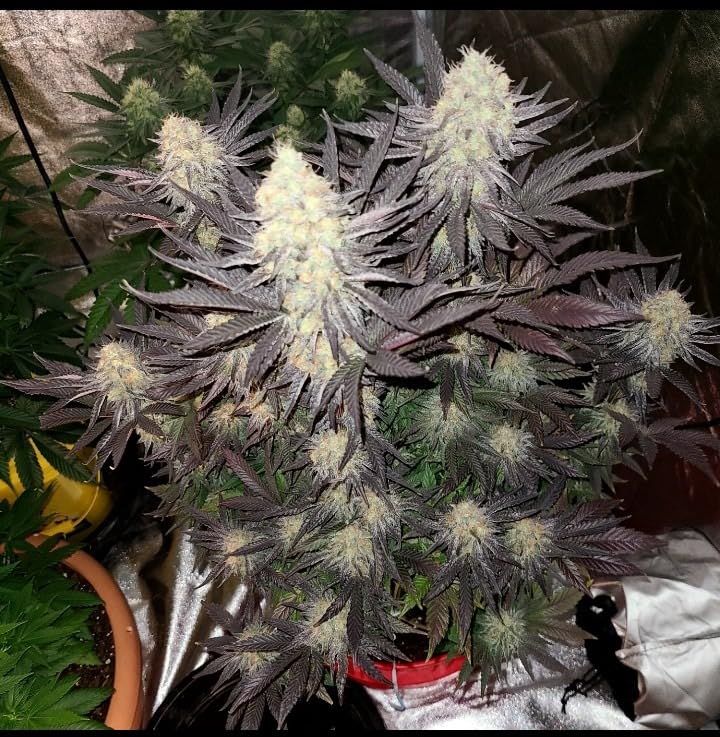
Who should buy this and who should step up
If you are on your first cycle, growing something forgiving in a 4×4, and want silent operation with a full spectrum including infrared, this fixture does the job at the lowest entry point in the roundup. Adjustable height, hanging, countertop and freestanding mounting are all supported, which suits a setup that moves around.
If you care about proven coverage, warranty length or measured output, the money is better spent one tier up. Every named-brand fixture in this roundup carries a five-year warranty except the AC Infinity, and the four fixtures with more than 200 reviews all sit above 4.5 stars.
Verdict: a legitimate first-grow fixture for a forgiving crop. For a full-flower 4×4 canopy, choose one of the 480 to 500W units above.
How to Choose an LED Grow Light for a 4×4 Tent
How many watts does a 4×4 tent actually need?
A 4×4 tent has about 16 square feet of canopy, and a modern LED rated at 400 to 500 watts of actual draw is the realistic range for flowering the whole footprint. Judge it on real wall draw and efficacy in mol/J rather than the headline number on the box, because plenty of fixtures advertise far more than they actually pull.
Expressed as density, that works out to roughly 25 to 30 watts per square foot, which is the number worth carrying into any tent size. A 2×2 at 4 square feet lands around 100 to 130 watts, a 2×4 at 8 square feet around 200 to 250, a 3×3 at 9 square feet around 250 to 300, a 4×4 at 16 square feet around 400 to 500, and a 5×5 at 25 square feet around 700 to 800. A 600W fixture works in a 5×5 but usually runs below what the plants can use, and 800W is the more comfortable fit.
Coverage beats peak PPFD every time
PPFD, or photosynthetic photon flux density in µmol/m²/s, describes how much usable light reaches the leaves, and PPE, or photosynthetic photon efficacy in mol/J, describes how efficiently the fixture converts electricity into photons. Both matter, but in a square footprint the number that decides success is how close your corner readings are to your centre reading.
Four causes account for nearly every coverage complaint. The fixture is undersized for 16 square feet, it is hung too high, it has a concentrated hot centre rather than an even spread, or it throws light straight down and never reaches the walls. If your plants are tallest in the middle and lanky at the edges, that is a spread problem, not a nutrient problem, and no feeding schedule will correct it.
Fixtures sold with bar layouts, extended bars or foldable aimable panels all attack this differently. Bars and extended bars push diodes outward, foldable panels let you aim at a specific corner, and a conventional panel relies on reflectivity. Any of the three solves it if you hang it at the right height.
What spectrum a 4×4 needs from seedling to harvest
Look for 3000K and 5000K whites for general growth, 660nm deep red for the flowering stage, and optionally 730nm infrared. Deep red is the component that most budget fixtures thin out, and it is the one experienced growers check first when a canopy looks healthy in veg but underperforms in flower.
You do not need separate veg and flower fixtures if your light is dimmable. A fixture that reaches down to 60 watts, like the HLG 350 Diablo, handles seedlings and mature canopy on the same unit, which removes the single most common reason growers end up owning two lights they only ever run at different times.
Dimming, controllers and daisy-chaining
Daisy-chaining means wiring several fixtures to one dimmer or controller, and it is the practical way to scale a setup or split a tent into halves. Capacity in this roundup runs from 50 units on the SE5000 up to 80 on the AC Infinity, with the Spider Farmer G5000 supporting 60.
App scheduling matters more than enthusiasts admit, because it removes the daily unzip-and-adjust routine that causes light leakage. The recurring catch across brands is app pairing on 2.4GHz networks only, so check your router before you fall for a fixture you cannot connect. A physical dimming knob has no such failure point, which is part of why the SF4000 remains the default recommendation.
One big light or two small lights?
Two 300W-class lights mounted on opposite sides of a 4×4 often beat one 600W fixture on uniformity, because each light is closer to the canopy it needs to serve. The trade-off is more hanging hardware and two dimming controls to keep matched.
Run the arithmetic before you commit. Doubling wattage past roughly 480W in a 4×4 does not double yield, because the canopy reaches a point where light is no longer the limiting factor. If you already own two 300W units, adding a third is usually better value than replacing them with one large fixture.
Heat, airflow and the fan size your light demands
A 4x4x7 tent holds roughly 112 cubic feet, so replacing the air once a minute sets a 112 CFM floor. With a 450 to 500W light dumping heat into the canopy, target 150 to 200 CFM of real exhaust through the filter, which means a fan rated around 300 to 400 CFM free-air because ducting and carbon filters typically cost 30 to 50 percent of rated flow.
Undersized ventilation is the second most common failure after coverage, and it usually shows up around week three of flowering. Wherever your light allows, mount the driver outside the tent. If a fixture is quiet and fanless it still radiates heat from the heatsink, and a clip fan is not the same as adequate exchange.
Hanging height by growth stage
Start seedlings 24 to 30 inches from the canopy and lower the fixture as plants stretch. Vegetative growth works around 18 to 24 inches, and flowering sits around 12 to 18 inches depending on how much the fixture spreads. Bar-style lights can sit lower than single panels because their output is spread rather than concentrated.
Account for the hardware. Ratchet hangers, cables and clips add eight to ten inches of vertical clearance, which in a 4x4x6.5 tent can be the difference between a light hung properly and a light that has to be dimmed down to avoid bleaching the closest plants.
How many plants fit under one fixture
A 300W LED comfortably handles two to three plants in a 4×4, or four to six in smaller pots during a short vegetative cycle, but it will not push a full 16-square-foot canopy to peak intensity alone. A 4×4 comfortably holds four to six plants in larger pots, or up to nine smaller ones in a short veg.
Coverage, not count, is the real constraint. Nine small plants under a 300W light will do worse than four plants under a 480W unit, because the limiting factor is photons per square foot rather than container size. If you are starting seedlings, our pick of the best ring grow lights for seedlings covers the early stage properly.
What a wattage equivalence claim is actually telling you
Almost nothing. An advertised equivalent wattage tells you what a legacy fixture was marketed as, not what yours draws or what it produces. Two fixtures both claiming 1000W equivalence can differ by a factor of three in actual output, and budget buyers regularly encounter fixtures advertised at 1000W that pull closer to 100 to 150 watts.
The two numbers worth caring about are real wall draw in watts and PPE in mol/J. Multiply them together and you get a realistic estimate of usable photon output, which is the only basis on which two fixtures can be compared honestly.
Entry, mid and premium tiers: what the extra spend buys
The entry tier under about 200 watts of genuine coverage gives you a fixture that will carry a vegetative cycle or a smaller canopy, often with thinner review history and a two-year warranty. The mid tier at 400 to 500 watts of real draw is where full-cycle 4×4 growing lives, and it is where most of the fixtures in this roundup sit.
The premium tier buys diode efficiency, build quality and app automation rather than more watts. Paying up for 3.14 mol/J over 2.7 mol/J means less heat, more dimming headroom and longer diode life, but it does not fix a coverage problem that a bar layout would have solved for free.
For growers running more than one tent or building a system rather than a single cycle, our guide to indoor smart gardens with LED lights covers the automated side.
Frequently Asked Questions
What is the recommended LED wattage for a 4×4 grow tent?
A 4×4 tent has about 16 square feet of canopy, and a modern LED rated at 400 to 500 watts of actual draw is the realistic range for flowering the whole footprint. Look at real wall draw and efficacy in mol/J rather than the headline number on the box, since plenty of fixtures advertise far more than they pull.
Do I need a 600W light for a 4×4 tent, or will a 300W do?
A 300W light will grow plants in a 4×4, but it will not light the full canopy evenly and the edges will lag the centre. A 400 to 500W fixture covers the footprint in one unit. Two 300W units on opposite sides often beat one 600W on uniformity, at the cost of more hanging hardware and two dimming controls.
Why does my grow light not cover the corners of my tent?
Four causes account for nearly every case: the fixture is undersized for 16 square feet, it is hung too high, it has a concentrated hot centre rather than an even spread, or it is aimed straight down and never reaches the tent walls. If plants are tallest in the middle and lanky at the edges, that is a spread problem, not a nutrient problem.
How many LED watts do I need for a 5×5 grow tent?
A 5×5 tent covers 25 square feet, so scale the 4×4 figure by about 1.5: roughly 700 to 800 watts of actual draw. A 600W fixture works in a 5×5 but usually runs at slightly lower intensity than the plants can use, and 800W is the more comfortable fit.
What is the recommended CFM for a 4×4 grow tent?
A 4x4x7 tent holds roughly 112 cubic feet, so replacing the air once a minute sets a 112 CFM floor. With a 450 to 500W light dumping heat into the canopy, target 150 to 200 CFM of real exhaust through the filter, which means a fan rated around 300 to 400 CFM free-air because ducting and carbon filters typically cost 30 to 50 percent of rated flow.
How many plants can I grow with a 300W LED light?
A 300W LED comfortably handles two to three plants in a 4×4, or four to six in smaller pots during a short vegetative cycle, but it will not push a full 16-square-foot canopy to peak intensity on its own. Most growers either accept lower intensity in the corners or run a second 300W unit on the opposite side.
How far above my plants should I hang an LED grow light?
Start seedlings 24 to 30 inches from the canopy and lower the fixture as plants stretch. Vegetative growth works around 18 to 24 inches, and flowering sits around 12 to 18 inches depending on how much the fixture spreads. Bar-style lights can sit lower than single panels because their output is spread rather than concentrated.
Should I use one big light or two small lights in a 4×4?
Two lights on opposite sides of a 4×4 usually win on uniformity because each sits closer to the canopy it needs to serve. One large fixture wins on simplicity, hardware count and a single control. If you already own two 300W units, adding a third is typically better value than replacing them with one 600W fixture.
The Verdict for 4×4 Growers in 2026
If you want one fixture that covers a full 4×4 canopy without babysitting two units, the Spider Farmer SF4000 is the pick. Its edge-weighted layout holds intensity out toward the walls, the physical dimming knob needs no app, and 12k+ owner reviews make the coverage claim the most trustworthy in this roundup.
If you already have two 300W-class lights, keep them and add side fill rather than replacing them. If efficiency and automation matter most, the AC Infinity IONFRAME EVO6 runs the best diodes here at 3.14 mol/J with the most capable app. If you want bar-style spread and app scheduling at a mid-tier cost, the Spider Farmer SE5000 is the value answer, and the Mars Hydro FC-4800 has the most convincing measured canopy readings.
Match the light to your tent footprint first, your airflow second, and only then to your budget. As always with the best LED grow lights for 4×4 tents in 2026, check the current specification for the exact model before you buy, because fixtures in this category refresh often.
Leave a Reply