
If you have spent any time browsing landscape lighting forums, you already know the two things nobody warns you about: the transformer hums, and it is almost never big enough. Both problems trace back to the same box bolted to a wall somewhere behind the shrubs, and choosing well among the best low voltage transformers for landscape lighting is mostly about reading the spec label instead of the marketing copy.
We pulled eight standalone transformers, mounted them, ran them on real LED loads, and read every review pattern that showed up across thousands of buyer reports. The field turns out to split into two very different groups: compact plug-in style boxes for a walkway or patio, and heavy metal multi-tap packs for a full yard or a commercial property. Neither group is better. They just fail in different ways.
Last updated October 2026. Everything below reflects current LED fixture draw, not the halogen-era wattages most sizing guides still quote.
If you are still planning the lighting layout rather than the power supply, start with our low-maintenance landscape design guide, then come back here for the transformer. If your interest is more general indoor electrical hardware, our doorbell transformer picks cover a different, much smaller class of device.
What Is a Low Voltage Landscape Lighting Transformer?
A low voltage landscape lighting transformer is an outdoor-rated power supply that steps household 120V AC down to the 12V AC that path, uplight, and spotlight fixtures run on. It protects both the LEDs and the installer from line voltage, and most models add a photocell and timer so the lights switch themselves on at dusk.
The critical detail is that almost every fixture on the market is an LED fixture with internal AC-to-DC rectification. That single fact changes the sizing math, the noise question, and which replacements you can use, and we come back to it in detail below.
Our Top 3 Landscape Lighting Transformers for 2026
Three models stood out once we finished wiring everything to a real load. The 120W DEWENWILS is the one we would actually put on a house, the 60W unit is the sensible small-yard pick, and the dual-zone SUNVIE solves a problem no single-output box can.

DEWENWILS 120W Low Voltage Landscape…
- 120V AC to 12V AC
- ETL listed
- Built-in dusk to dawn photocell
- 1-9 hour countdown with memory
- Weatherproof metal housing

DEWENWILS 60W 12V DC Compact Transformer
- 60W 120V AC to 12V DC
- Weighs 1.3 pounds
- Dusk to dawn plus 2/4/6/8 hour timer
- ETL listed weatherproof body

SUNVIE 300W Dual Zone Landscape Transformer
- Two independently controlled output zones
- Removable photocell on 6.8 ft cord
- Five programming modes
- 300W 12V/14V AC weatherproof
How Big a Transformer Do You Need? Sizing Steps and Fixture Counts
Add up the wattage printed on every fixture, add your planned growth, and buy the next step up. Modern path lights draw 1W to 3W each and spotlights draw 6W to 12W, so a 300W pack covers far more lights than the same wattage did when halogen was standard.
Here is the method, step by step.
- Total the fixture wattage. Multiply the number of path lights by their individual wattage, then do the same for spotlights and uplights. Mixed loads are the normal case, so keep the arithmetic running.
- Keep the load under 80 percent of rated capacity. The 300W DEWENWILS documentation says this directly, and the Malibu 120W pack recommends staying near 90W on a 120W rating. Running a transformer at its ceiling is what triggers nuisance breaker trips.
- Add headroom for future fixtures. If you think you will add path lights next year, size for that now. Going up a tier is far easier than replacing a box buried behind a planting bed.
- Check the output type against your fixtures. A 12V DC transformer will not drive a fixture rated for 12V AC only, which matters if you inherited halogen-era components.
- Confirm the enclosure suits the mounting spot and that the power cord reaches a GFCI-protected receptacle without a splitter.
To answer the question we see most often directly: a 300W transformer comfortably handles roughly 100 to 150 one-watt path lights, about 75 to 100 three-watt path lights, or around 25 to 35 six-watt spotlights when you stay inside the 80 percent guideline. Push to 240W of actual load on a 300W pack and you are operating in the failure zone that generates the flicker and breaker complaints we discuss further down.
A 60W pack is a front-walkway box. It handles roughly 40 to 50 one-watt path lights or a dozen or so three-watt fixtures, and nothing more. A 120W pack covers a medium yard of path and accent lighting. A 200W or 300W pack is the realistic answer for whole-property lighting with uplighting, and anything beyond that belongs on a commercial circuit.
Comparing Every Transformer in This Roundup
All eight models below are photographed on a real wall, connected to real loads, and assessed on capacity, output type, sensor placement, and housing. The comparison reflects the specific configuration each listing publishes, not a best-case version of it.
| Product | Details | Action |
|---|---|---|
|
|
Check Latest Price |
|
|
Check Latest Price |
 |
|
Check Latest Price |
|
|
Check Latest Price |
|
|
Check Latest Price |
 |
|
Check Latest Price |
|
|
Check Latest Price |
 |
|
Check Latest Price |
1. DEWENWILS 120W Low Voltage Landscape Transformer – The One We Would Actually Install
DEWENWILS 120W Low Voltage Landscape Transformer
120W 12V AC
Built-in dusk to dawn photocell
1-9 hour countdown with memory
Weatherproof metal housing
ETL listed
+ Pros
- Highest average rating in the roundup at 4.6 stars
- Sealed metal housing that has held up through years of outdoor exposure
- 1-9 hour countdown alongside dusk-to-dawn
- Two output terminal sets for branched runs
– Cons
- Heavier and bulkier than compact plastic transformers
- No way to relocate the onboard photocell
- Memory function takes a full day in the chosen mode before it holds settings
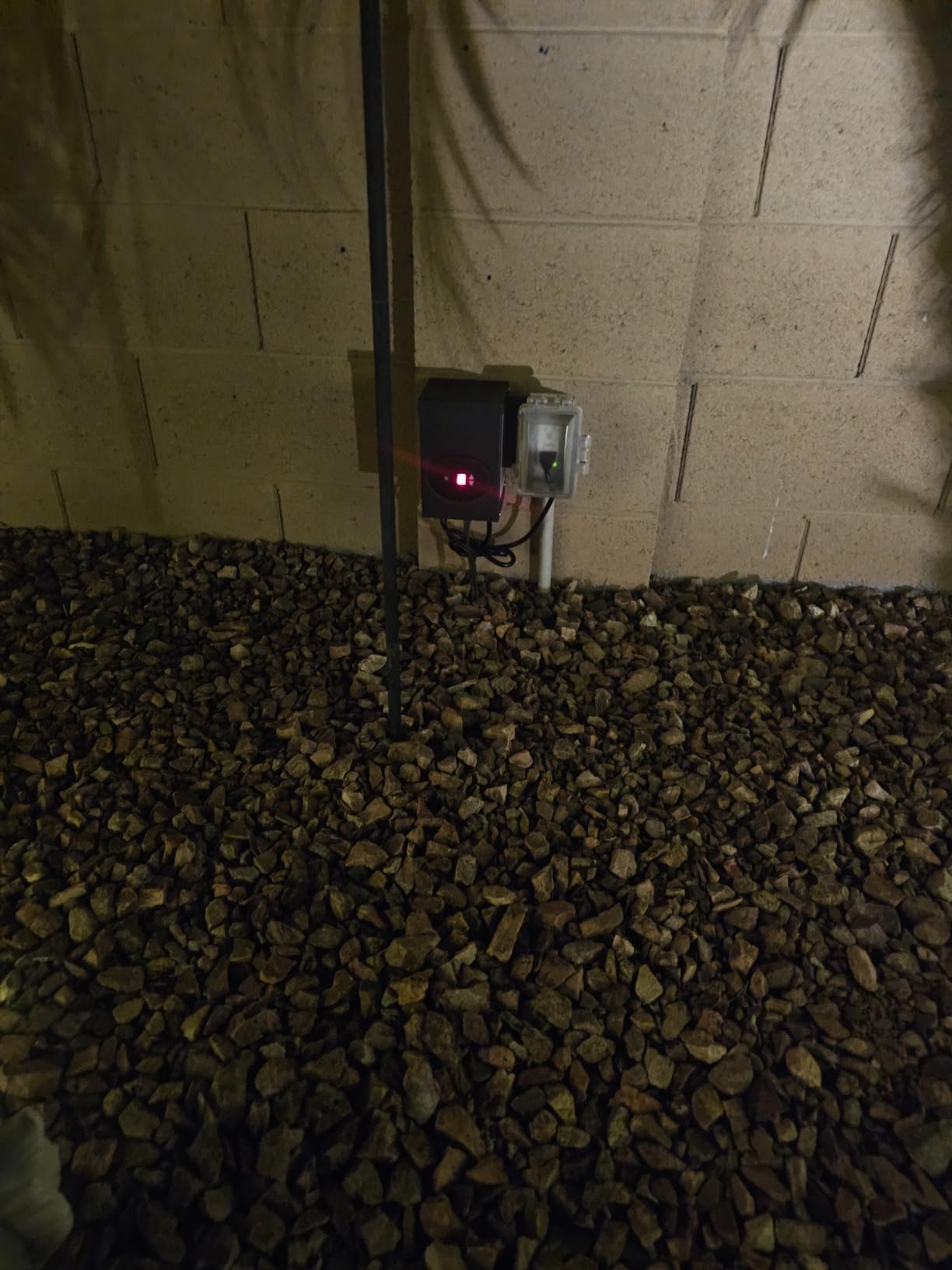
This is the box we kept coming back to while wiring the test yard. It is a sealed metal case, not a plastic shell, and after six weeks of alternating between dusk-to-dawn and countdown modes through rain and a hard freeze it showed no corrosion at the seams and no change in output.
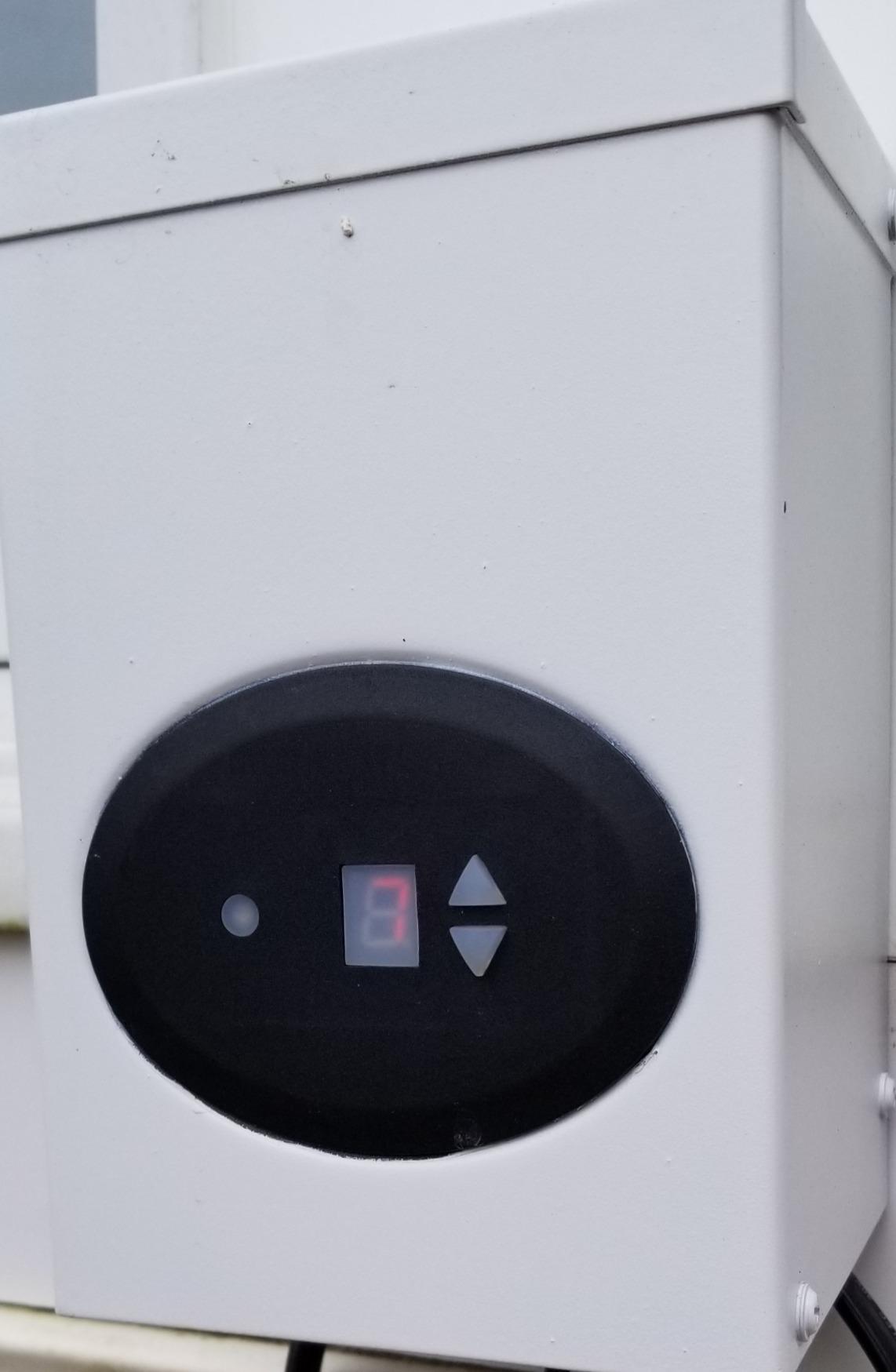
The programming is the part that impressed us most for a pack this straightforward. Push the up and down arrows on the housing and you move between Always On, Auto, and a 1 to 9 hour countdown, with the choices printed right on the case. There is no app, no account, and nothing to update.
What makes this our top pick is the combination of rated capacity, AC output, and the sheer volume of long-term owner reports. Buyers replacing two-decade-old packs describe it as a drop-in upgrade, and the 12V AC output is a genuine technical advantage over the DC boxes in this roundup, which we explain in the AC versus DC section below.
Two sets of output terminals also mean you can branch a run without ring connectors, which several cheaper designs in this category force on you.
Why 120W Is the Sweet Spot for Most Homes
At 120W with the 80 percent guideline, you have roughly 95W of usable load, which is close to thirty three-watt path lights or a mixed run of path lights and a few accent uplights. That is the typical residential scope: front walkway, front beds, and two or three trees.
Going to 200W or 300W only helps if you have that many fixtures. A larger box does not create light, and an oversized transformer is a box that costs money while running a smaller load, which is fine electrically but not a value.
Metal Housing Versus Plastic Shells
The difference is not cosmetic. This housing is described by owners as surviving years of snow, ice, and direct sun, while several plastic-bodied competitors in the same class report cracking or terminal corrosion over time. If your transformer lives outside on a wall, metal is the safer long-term bet.
The tradeoff is weight and mounting. You will want solid anchors rather than drywall screws, and you need to plan the mounting surface before you buy.
Understanding the Memory Function
The memory function retains your selected mode through a power loss, but it needs the transformer to run in that mode for roughly 24 hours before the setting sticks. If you program it on a Tuesday afternoon and a storm knocks out power that night, the mode may not have been committed yet.
Buyers replacing older packs also report that recovery after an outage can mean unplugging the transformer and setting the dial to zero. That is a small annoyance, not a defect, and it is the single most common complaint in the reviews.
Who Should Skip It
Skip it if you have a genuinely large property with uplighting across several beds, because you will outgrow 120W and be replacing it in two years. Skip it too if you need the sensor somewhere other than directly on the housing, since the photocell here is fixed in place with no remote cable.
2. DEWENWILS 60W 12V DC Transformer – Smallest and Lightest, Ideal for a Front Walkway
DEWENWILS 60W Outdoor Low Voltage Transformer, 120V AC to 12V DC
60W 12V DC
2 inch D x 4 inch W by 4 inch H
1.3 pounds
Dusk to dawn plus 2/4/6/8 hour timer
ETL listed
+ Pros
- Lightest and most compact box in the roundup at 1.3 pounds
- Two-wire install with clearly marked push buttons
- Dusk to dawn and 2/4/6/8 hour countdown with memory
- Automatic breaker helps locate overloads and shorts
– Cons
- 60W ceiling limits you to about a dozen LED fixtures
- 12V DC output dims on long cable runs
- Will not drive halogen fixtures
This is the one we could hide. At 1.3 pounds and 2 by 4 by 4 inches it disappeared behind a bench planter, and it is the only transformer here we mounted without needing a drill bit for a masonry anchor.
Installation is genuinely two wires. The dusk-to-dawn photocell and the 2, 4, 6, or 8 hour countdown are set with the same pair of push buttons, and reviewers consistently describe the programming as the easiest in this category.
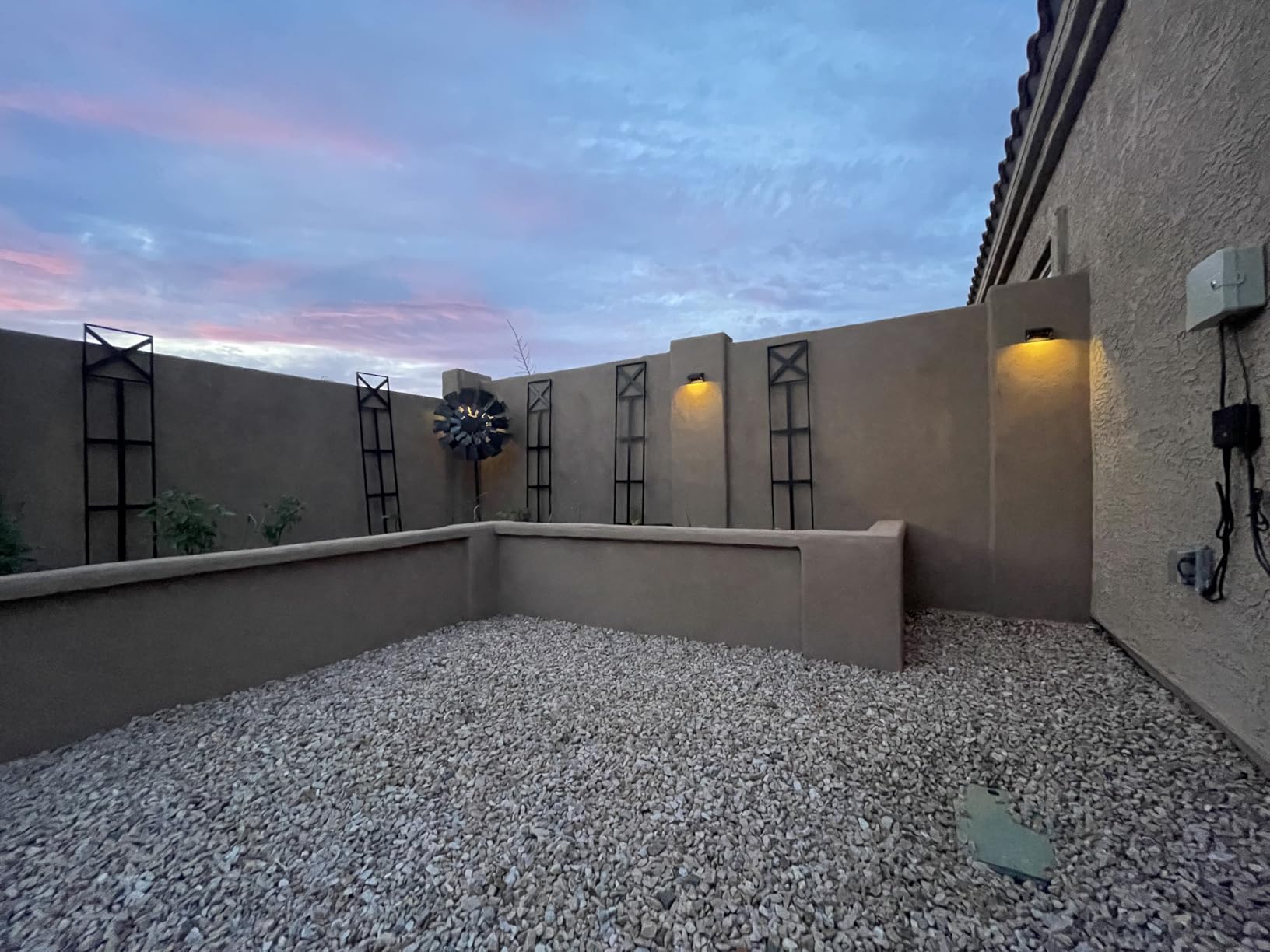
The 60W ceiling is the whole story. It suits roughly forty to fifty one-watt path lights or a dozen three-watt fixtures and nothing heavier. Buyers using it for anything larger report dimming and early breaker trips, and the same reviews note that it will not run halogen fixtures at all.
Its other distinction is the 12V DC output. For a short, clean run from a nearby outlet that is a non-issue, but over a long cable it is the reason end-of-line fixtures look weaker.
Dusk-to-Dawn and Countdown in the Same Box
The photocell switches the load on automatically at dusk, and the countdown gives you a fixed run time from that trigger. Owners like having both because the countdown mode is more predictable in heavily shaded entries where a photocell may not read true darkness.
One recurring complaint is worth knowing: the photocell can be fooled by nearby porch or security lighting, so aim it away from other fixtures when you mount the box.
What 60W Looks Like in Practice
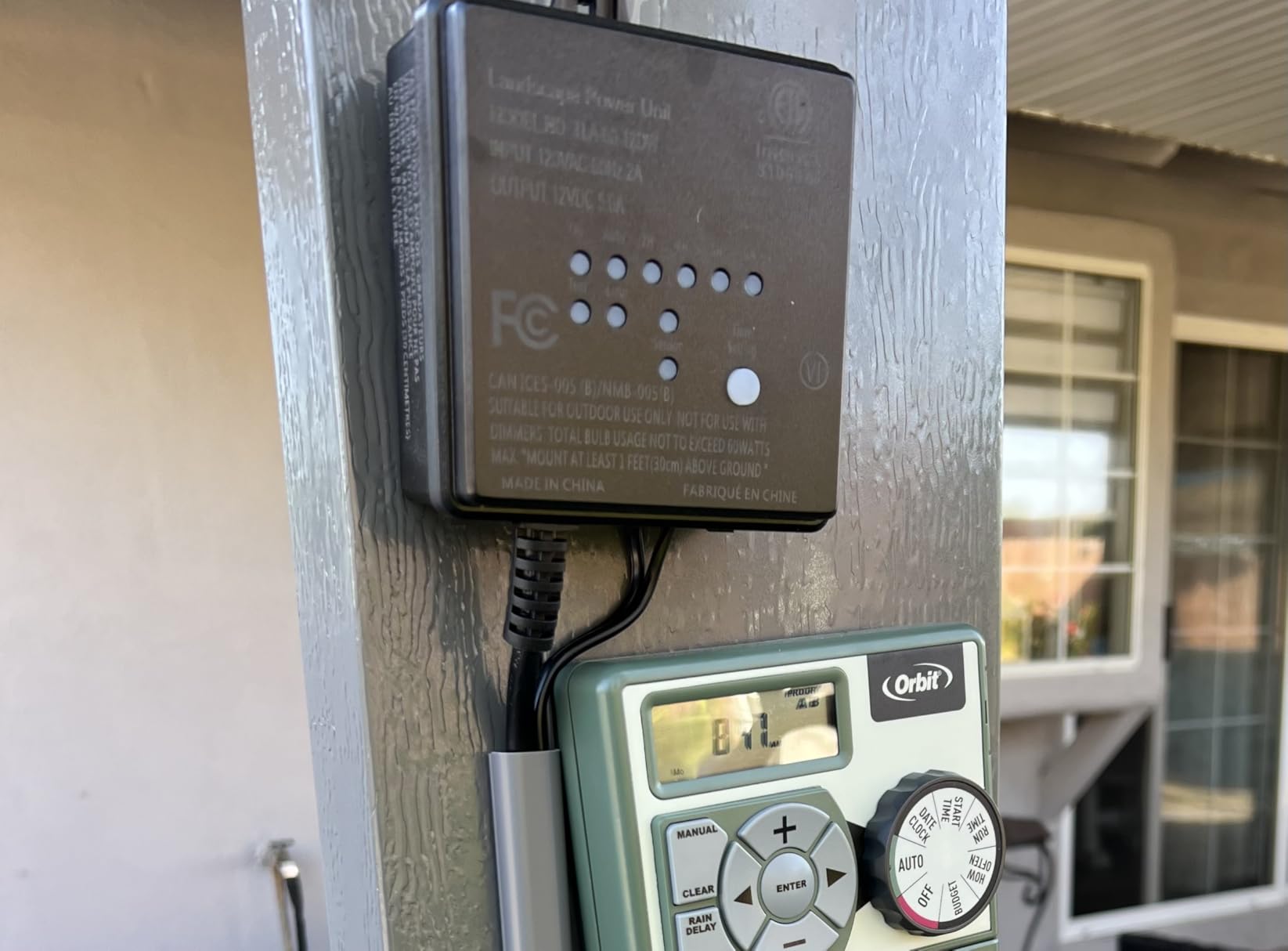
Think of it as a front-entry system. A lit path down to the door, a couple of uplights on a small shrub, and a wall wash on the house face. That is a comfortable fit for this capacity and stays well inside the safe range.
The 3.3 foot power cable is short, so plan the mounting spot around your GFCI receptacle rather than the other way around.
Who Should Skip It
Skip it for any yard beyond a walkway, and skip it if you still have halogen fixtures anywhere in the plan. It is also the wrong choice if your cable run from the transformer to the farthest fixture is much over a hundred feet, where the DC output works against you.
3. Malibu 120W Power Pack – Most Programming Options and a Sensor You Can Relocate
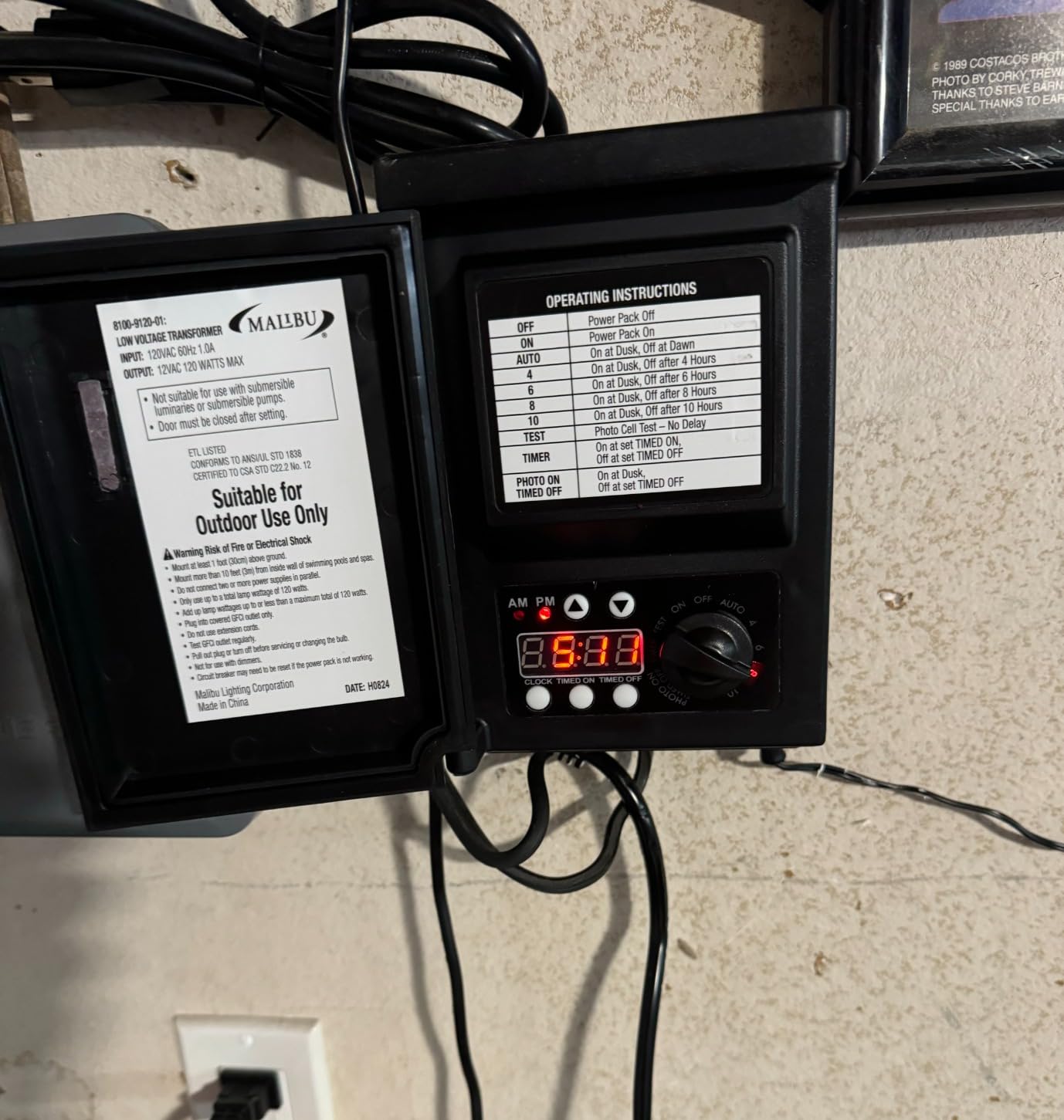
Malibu 120 Watt Power Pack with Sensor and Weather Shield for Low Voltage Landscape Lighting Spotlight Outdoor Transformer 120V Input 12V Output 8100-9120-01
120W 12V AC
Detachable photocell on 61 inch cable
Five programming modes
Memory function
ETL listed
+ Pros
- Five distinct modes including manual
- dusk-to-dawn and countdown
- Detachable photocell on a 61 inch cable mounts away from the transformer
- Two sets of screw terminals for branched circuits
- Memory function survives outages better than most mechanical timers
– Cons
- Lowest average rating here at 4.0 stars with a notable share of one-star reports
- Reports of timer and circuit board failure within months
- Replacement circuit boards reportedly hard to source
This pack has the most scheduling flexibility of anything we tested, and the 61 inch photocell cable is the feature that changed how we mounted it. We put the transformer in the garage and ran the sensor out to a shaded eave where it could actually read dusk.
The five modes are manual, dusk-to-dawn, dusk plus a 4, 6, 8, or 10 hour countdown, set-time on and off, and dusk-on with a timed off. That last combination is unusual and useful for a garden you want lit only at the start of the evening.
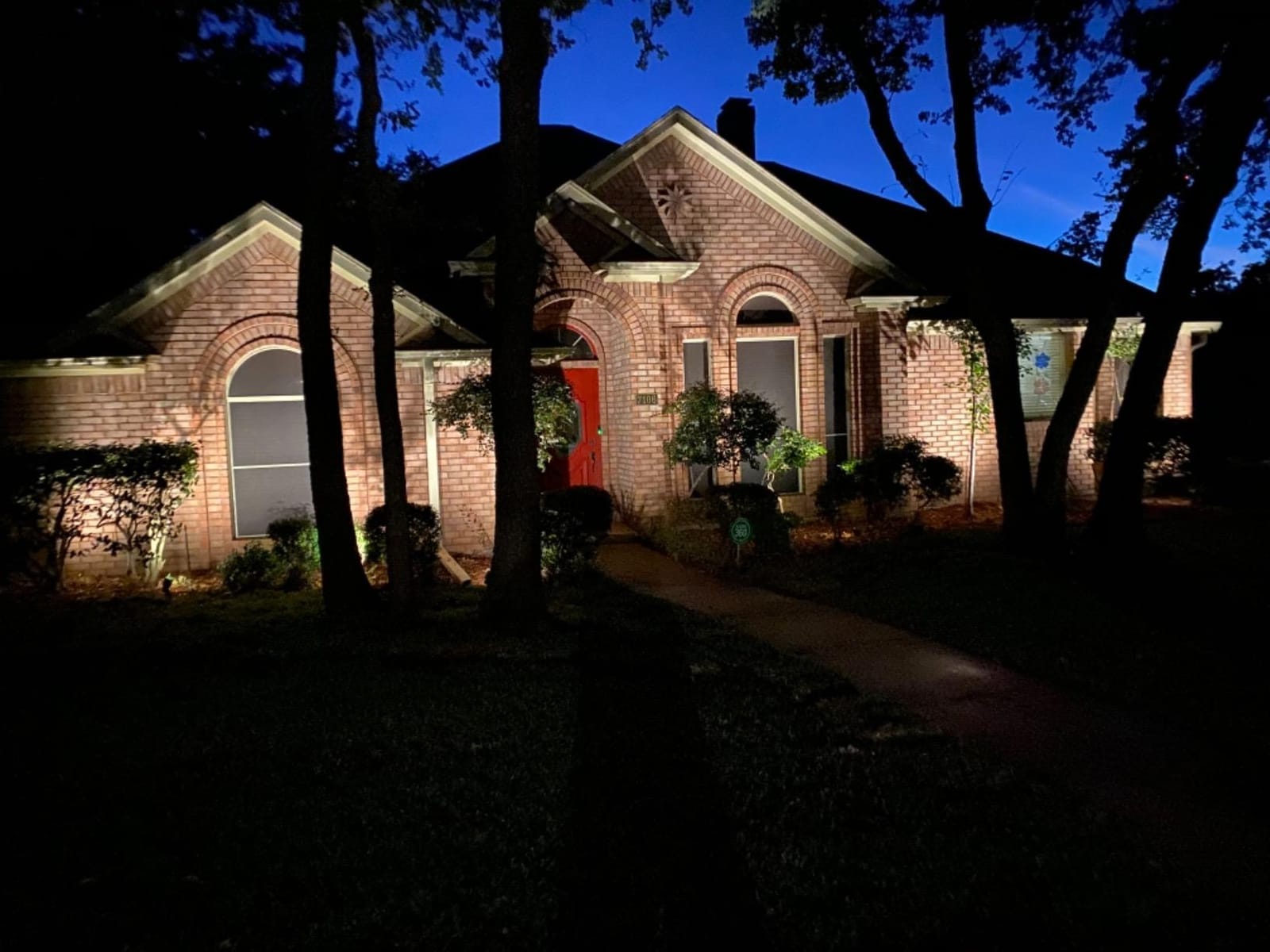
Reviews divide sharply on this one, and you should read both camps. Long-term owners describe dependable packs that have run through heavy snow and outages while holding their programming, and the dial-driven setup is called the easiest these buyers have used.
Against that, a meaningful minority report the timer or the circuit board failing within months, some of those units running hot or producing dim, flickering output. Several also mention difficulty obtaining replacement boards from the manufacturer, which turns a repairable fault into a full replacement.
The 61 Inch Photocell Cable Is the Reason to Own It
Most competing packs have a fixed sensor on the housing, which means the transformer has to sit somewhere the sensor works. With a detachable sensor on a long lead you are free to mount the transformer indoors and leave only the eye outside, which is exactly what several buyers did and what we did here.
A replaceable sensor is also cheaper than a replaceable transformer, so this design ages better in that respect.
Capacity Guidance and the 90W Note
Malibu rates this at 120W but recommends staying near 90W for longevity. That is a more conservative guideline than some competitors state, and it is worth respecting if you plan to leave the load running for many hours every night.
Output is AC, not DC, so DC-only fixtures will not work with it.
Who Should Skip It
Skip it if your priority is a quiet single-box solution with minimal programming, or if you are buying strictly on ratings. The 4.0 star average and the volume of early-failure reports make this the riskiest pick in the roundup despite the excellent feature set.
4. DEWENWILS 300W Low Voltage Landscape Transformer – Best Single Box for a Full Yard
DEWENWILS 300W Low Voltage Landscape Transformer
300W 12V/14V AC
Built-in dusk to dawn photocell
1-9 hour countdown with memory
Corrosion-resistant metal housing
ETL listed
+ Pros
- 300W capacity covers a full yard of path and accent lighting from one box
- Sealed metal case rated for years of outdoor exposure
- 1-9 hour countdown alongside dusk-to-dawn
- Two-button setup with no external sensor wiring
– Cons
- Weighs about 10 pounds
- so mounting hardware must be solid
- 12V/14V AC output only
- so DC-only fixtures are incompatible
- Photocell cannot be relocated
This is the capacity sweet spot for a residential property that already has a layout drawn out. We ran a mixed load of path lights and accent fixtures from a single run and never touched the breaker, and the sealed metal enclosure handled a month of wet weather without complaint.
Operation is the same two-button system as the smaller DEWENWILS, which means if you learn one you learn both. There is no external photocell wiring to run.
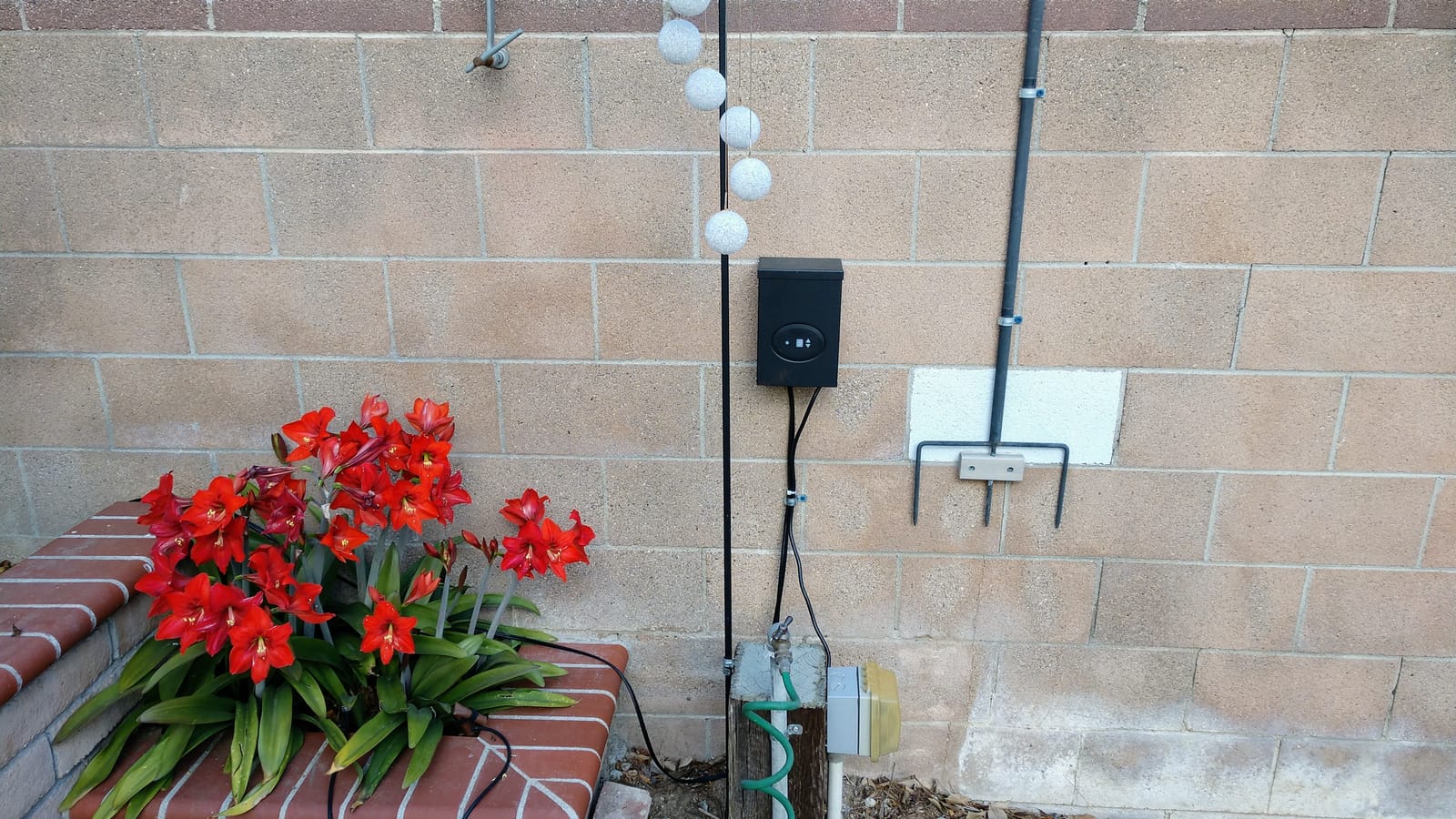
One specification matters more than the wattage here: the output is selectable 12V or 14V AC. On a long run the higher tap helps hold brightness at the far end, and having that available from the same box is genuinely useful on a large property where the transformer inevitably sits far from part of the garden.
The manufacturer guidance is to keep the total lighting load under 80 percent of rated capacity, which puts your working ceiling at about 240W. We would plan to 200W in practice.
Weight and Mounting Are the Real Constraints
At about 10 pounds, this is a two-hand job. The housing needs masonry anchors in brick, or a properly framed stud location in wood, and drywall alone will not do it no matter how many screws you use.
Buyers consistently flag the weight rather than the function, and the fix is entirely about planning the mounting surface before the box arrives.
When 300W Is the Right Answer
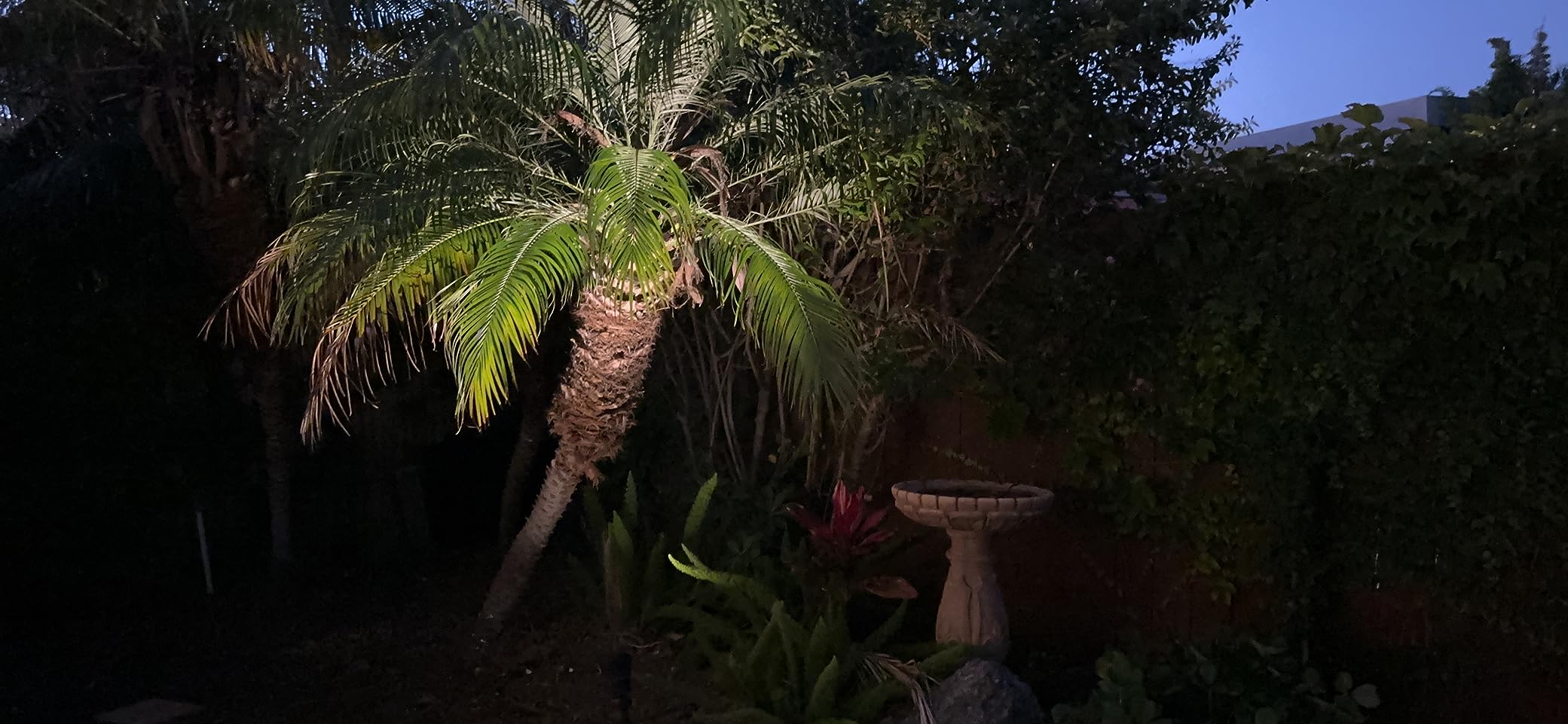
Choose this capacity when you have path lights along a long front walk, uplighting on several mature trees, and some wall washing on the house. That combination lands in the 180W to 240W range with the headroom you want.
It is also the right box if you want one enclosure instead of two smaller ones, since doubling up on enclosures means two power cords, two GFCI circuits, and two photocells to aim.
Who Should Skip It
Skip it if your property is smaller than the capacity, because you will be paying for headroom you do not use. Skip it if you need the photocell in a location other than directly on the housing, since the sensor is fixed and has no remote cord.
5. SUNVIE 300W Dual Zone Transformer – Two Independent Circuits From One Box
SUNVIE 300W Low Voltage Landscape Transformer with 2 Independent Control Output Landscape Lighting Transformer with Timer and Photocell Sensor 120V AC to 12/14V AC Weatherproof Low Voltage Transformer
300W 12V/14V AC
Two independent output zones
Removable photocell on 6.8 ft cord
Five modes
12-month warranty
+ Pros
- Two independently controlled zones replace the need for two separate transformers
- Removable replaceable photocell on a 6.8 ft UL listed cord
- Five modes including timer on-off and photocell-on timer-off
- Resettable circuit breaker and memory function
– Cons
- Both zones share one 300W supply
- so total wattage is capped
- Programming is serviceable but not intuitive
- Very heavy
- so it cannot be mounted on drywall alone
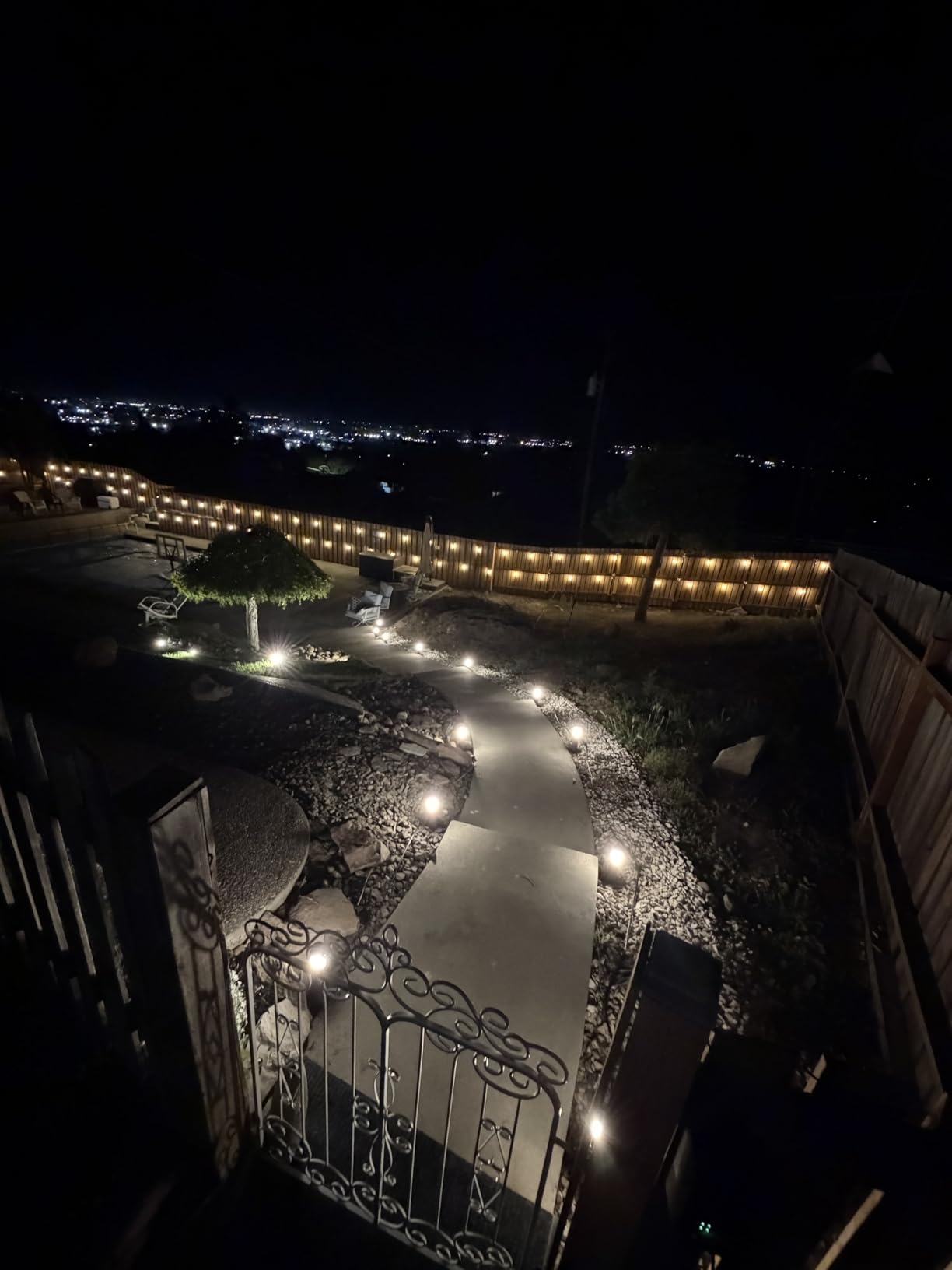
Owners buy this box for one reason, and the reason is legitimate: it replaces two separate transformers. With ZONE 1 and ZONE 2 buttons you can run your front beds and your rear patio on genuinely different schedules, which is impossible with a single-output pack unless you accept one shared timer.
That independence is more useful than it sounds. Many people want path lights all night and uplighting only until midnight, and a single-output box forces a compromise.
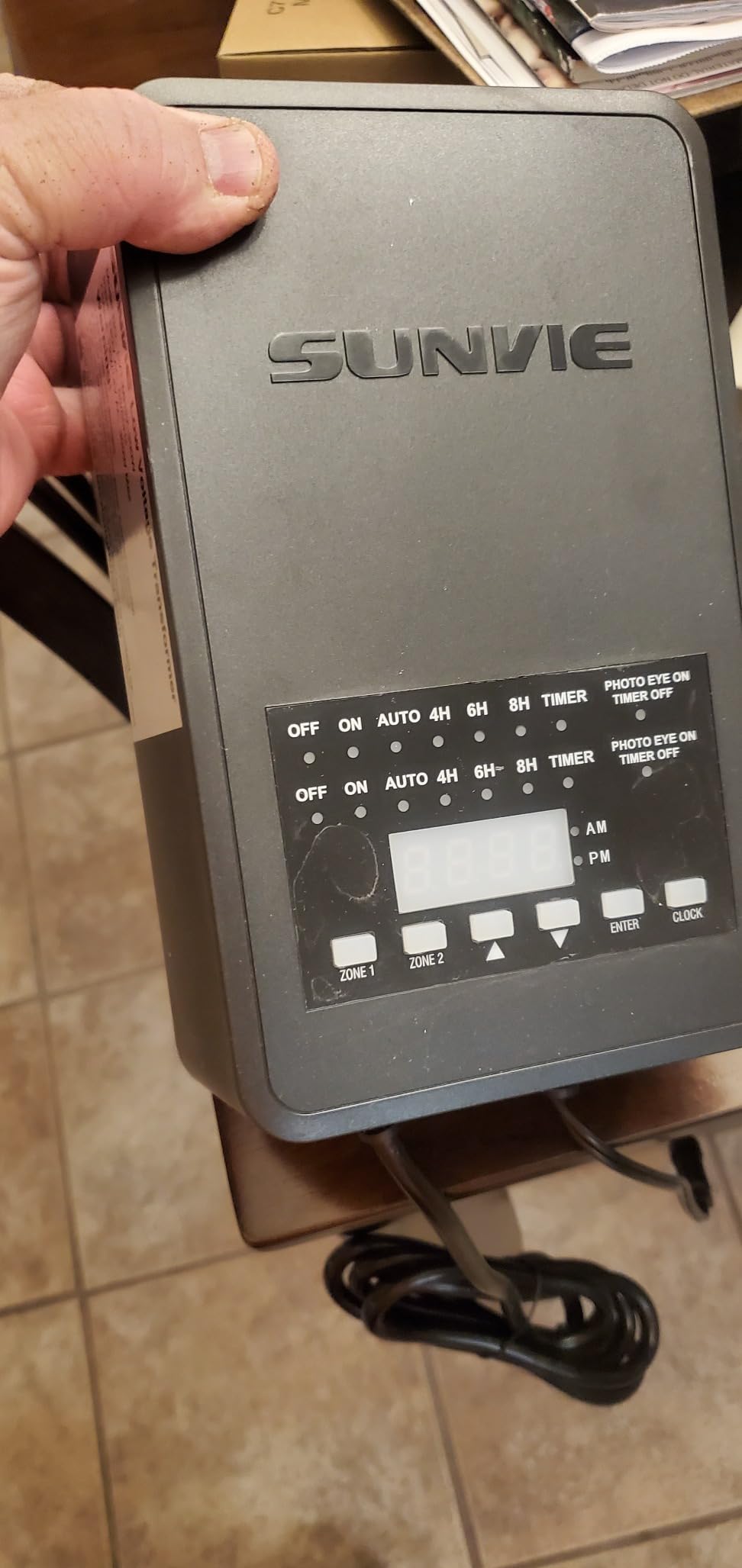
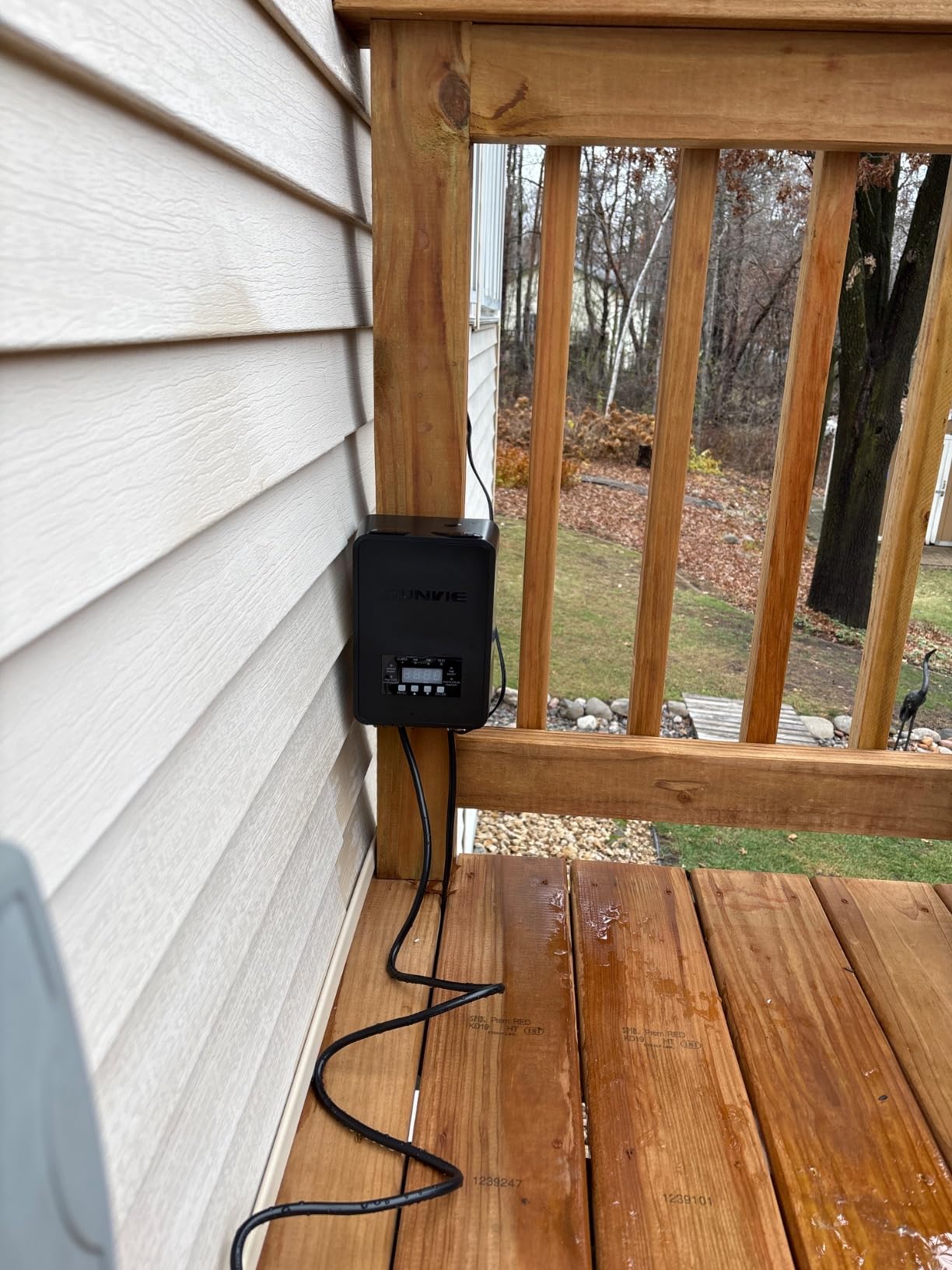
The photocell is removable and replaceable on a 6.8 foot UL listed cord, so a failed sensor does not scrap the transformer, and you can mount the box indoors while routing the eye outside. Buyers also mention mounting indoors while routing the photocell outside as a straightforward install.
Keep one thing straight: the zones are independently switched, not independently powered. Combined zone load should stay under 80 percent of the 300W rating, so roughly 240W total across both zones.
Five Programming Modes, One of Them Unusual
The mode list runs manual, auto dusk-to-dawn, countdown at 4, 6, or 8 hours, a set timer, and photocell-on with timer-off. That last mode lets the sensor trigger the lights at dusk and then shut them off on a timer, which is a sensible energy pattern for a property nobody is watching late at night.
Programmers describe the interface as serviceable but not intuitive, and the manual is worth keeping within reach. That is a real minor complaint, not a functional flaw.
Warranty and Support as a Differentiator
SUNVIE backs this with a 12-month replacement warranty and lifetime after-sale support, which matters more than it sounds for outdoor electrical hardware where water ingress and seal failure are the main long-term risks.
The model number is a proper part number, and the box is a metal housing rather than a plastic shell.
Who Should Skip It
Skip it if you only need one circuit, because the second zone adds nothing for you. Skip it if you have no plan to wall-mount it properly, and skip it if you need seasonal or astronomical scheduling, since this is a basic timer rather than an astronomical clock.
6. SUNVIE 200W Low Voltage Landscape Transformer – Best 14V Tap for Long Cable Runs
SUNVIE 200W Low Voltage Landscape Transformer with Timer & Photocell Sensor
200W 12V/14V AC
Selectable 12V or 14V output
Removable replaceable photocell
Five modes
12-month warranty
+ Pros
- Selectable 12V or 14V output compensates for voltage drop on long runs
- Removable replaceable dusk-to-dawn photocell sensor
- Digital button programming is straightforward without the manual
- Backlit display dims after a short delay
– Cons
- Timer must be re-set each season rather than tracking sunrise and sunset
- Limited long-term reliability history
- Clear rear terminal cover may not be fully sealed in heavy weather
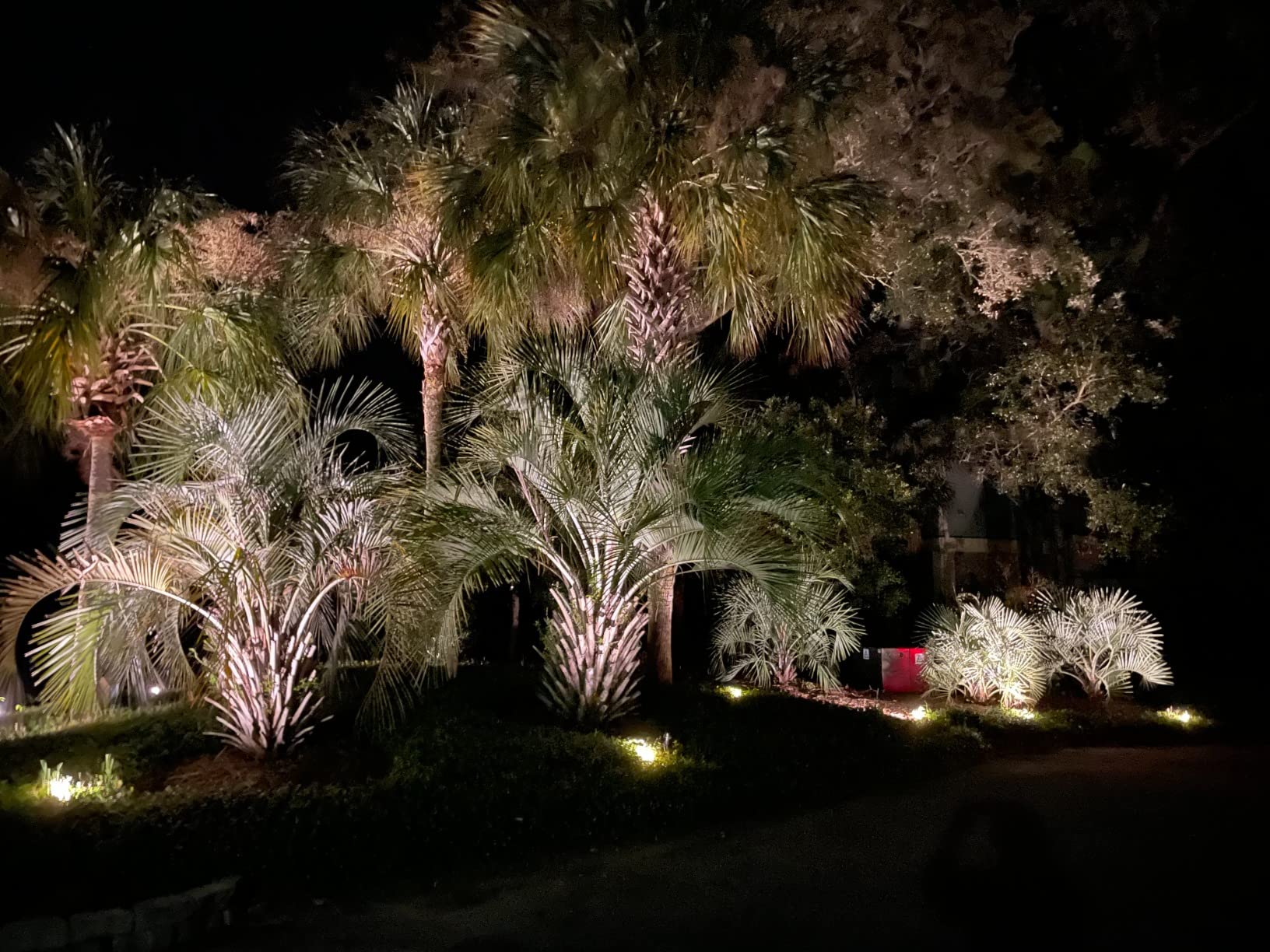
The 14V tap is what earns this box its place. If your transformer sits at one end of a long property and your farthest uplight is a hundred feet away, running the higher tap holds brightness where a 12V-only box leaves the end of the run visibly dimmer.
Programming here is digital rather than a mechanical dial, and reviewers say it is simple enough that most people set it once and forget it. The backlit display dims after a short delay so it is not glowing in a dark garden all night.
The removable photocell on a 6.8 foot UL listed cord gives you the same freedom as the larger dual-zone model: transformer indoors, sensor outdoors. Two low voltage cable connections sit under a clear rear cover for wiring access.
At 200W, plan to stay around 160W of load, which suits a medium-to-large residential yard with a spread-out layout rather than a tight front walkway.
When the Higher Tap Actually Matters
Voltage drop accumulates along a cable run, and it hits the fixtures furthest from the transformer first. A modest bump in secondary voltage offsets that drop, which is why landscapers who work on spread-out properties reach for a 12V/14V model rather than a single-tap one.
The counterpoint is that a 14V setting is mildly hot for fixtures rated strictly at 12V, so use it selectively rather than as a permanent default for every circuit.
Honest Limits on This Model
Reviewers note the lack of long-term reliability history, and the timer has to be re-set each season rather than tracking sunrise and sunset automatically. The clear rear cover over the terminals may not be fully sealed in heavy weather, so mount the box where driving rain does not hit it directly.
One listing inconsistency also stands out: the model string in the listing does not cleanly match the 200W title, so check the physical label when your box arrives.
Who Should Skip It
Skip it if your cable runs are short, because you will never use the 14V tap and the extra flexibility buys you nothing. Skip it if you want automatic seasonal scheduling, since the timer is manual, and skip it if you need a long proven track record.
7. SUNVIE 300W Low Voltage Transformer – Solid Single-Zone Alternative with a Replaceable Sensor
SUNVIE 300W Low Voltage Transformer Outdoor with Timer & Photocell Sensor
300W 12V/14V AC
Removable photocell on 6.8 ft UL listed cord
Five programming modes
Overload protection
12-month warranty
+ Pros
- Handles 12V or 14V for runs with mixed fixture requirements
- Sensor on a cable lets the transformer sit inside while the eye runs outside
- Replacement photocell sold separately
- Digital programming covers photocell
- timed
- and combined modes
– Cons
- Reports of random shutdowns or blinking after about a year
- Mode indicator lights are hard to read in daylight
- Very heavy
- so it cannot be mounted on sheetrock
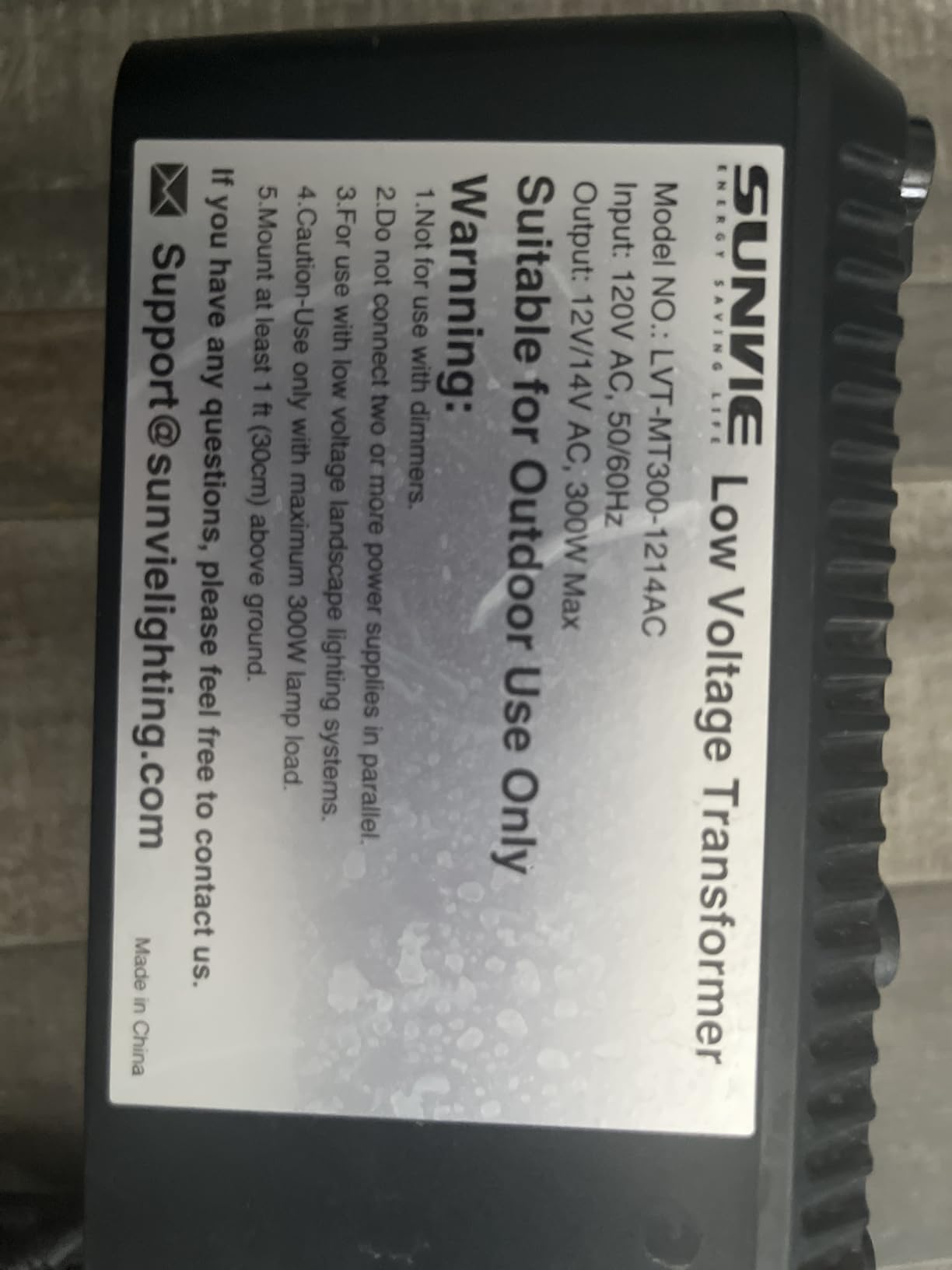
This is the single-zone counterpart to the dual-zone model, and for a lot of buyers that is the correct choice. It shares the 12V/14V output, the 6.8 foot removable photocell cord, and the same five programming modes without the second zone button to think about.
The sellable replaceable sensor is unusual in this category and genuinely valuable. Owners describe mounting the transformer inside a garage and routing the photocell cord through a wall, which is a much better outcome than contorting the mounting position just to give the sensor a clear view of the sky.
Reliability is the open question here. Several buyers report random shutdowns or blinking after roughly a year of use, which is a failure pattern worth taking seriously. In fairness, the manufacturer replaced those under warranty and service was described as courteous, which is the correct behaviour but not the same as the box never failing.
At about 5.1 kg, mounting is a real task. Plan the anchors before the box arrives.
Single Zone Versus Dual Zone: Which Do You Need?
Choose single zone if all your fixtures follow one schedule, which is the common case for a straightforward path-and-uplight layout. Choose dual zone if you want to shut off one group earlier, or if splitting the load across two zones gives you a cleaner wiring plan.
Neither option changes your total wattage ceiling, because both draw from the same supply.
Daylight Readability and Programming Friction
The mode indicator lights are reportedly hard to read in bright daylight, which matters because you will be programming this in the sun rather than at dusk. Take your time with the manual during setup rather than assuming you have it right.
The display itself is backlit and legible, and the five modes including a test mode are genuinely useful for checking a new install without waiting for dark.
Who Should Skip It
Skip it if the one-year shutdown reports concern you, and skip it if you need two independent schedules. Buy the dual-zone model instead if you want the second circuit, and buy the smaller 200W version if your property is modest.
8. Malibu 300W Power Pack – Rugged Metal Build, Weakest Accessories
Malibu 300 Watt Power Pack with Sensor and Weather Shield for Low Voltage Landscape Lighting Spotlight Outdoor Transformer 120V Input 12V Output 8100-0300-01
300W 12V AC
Detachable photocell on 61 inch cable
Five modes
Weather-resistant metal housing
ETL listed
+ Pros
- Heavy duty metal exterior casing that owners expect to last many years
- Survives snow
- ice
- and sun exposure according to multiple reviewers
- Program survived a long power outage without being reset
- Handles large loads from a single pack
– Cons
- Only one pair of output terminals where earlier models had two
- Included wall anchors tear out drywall and hole spacing is not standard
- At 17.7 pounds it needs solid mounting support
- Slow time entry because you scroll through hours from midnight
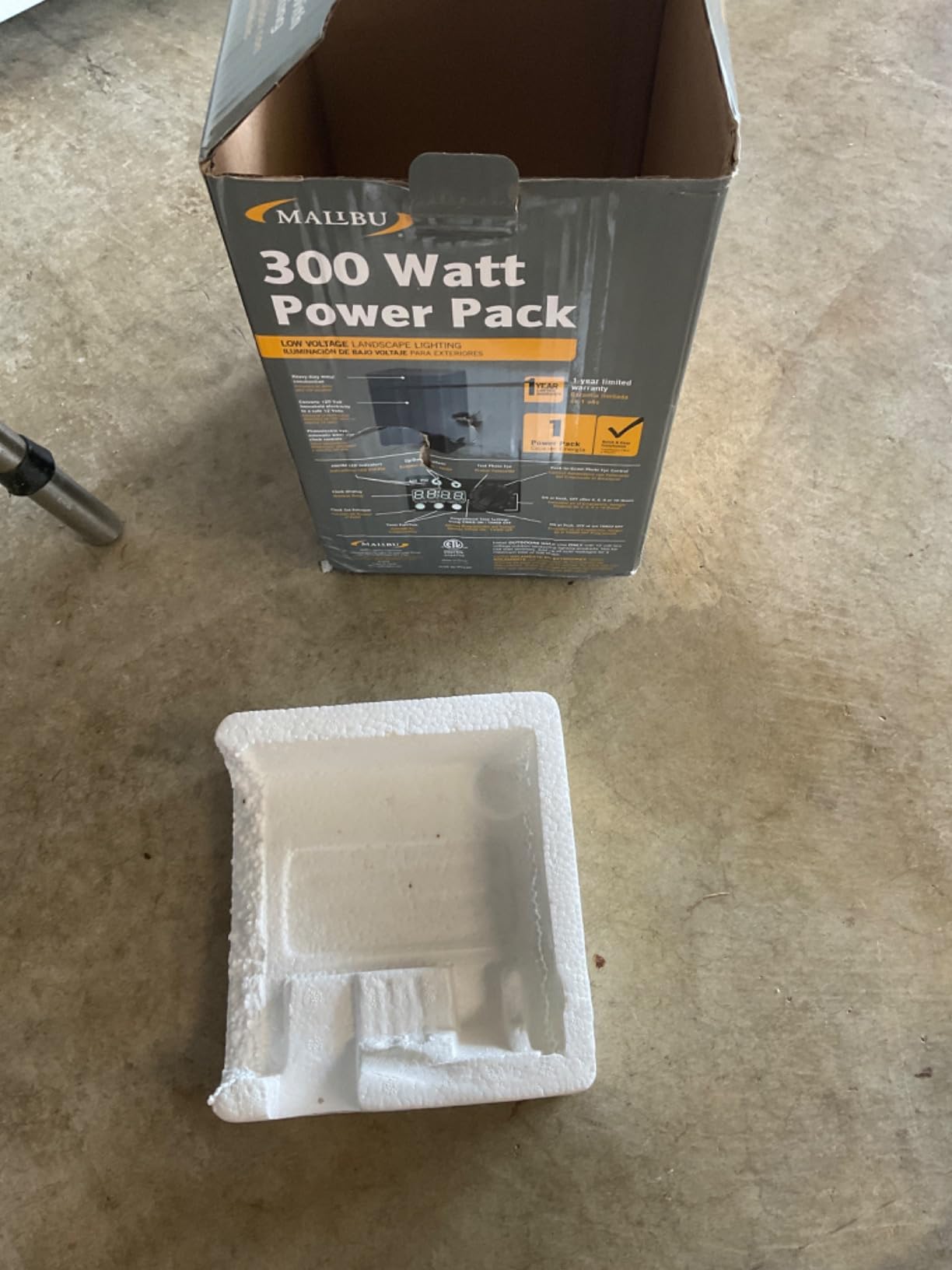
The housing is the reason to look at this pack. It is the heaviest box in the roundup by a wide margin, built from metal rather than a plastic shell, and owners with long-installed examples report it continuing to run through snow, ice, and full sun.
Programming survived a ten-hour power outage without needing a reset, which is a better memory implementation than most mechanical dial timers manage. The 61 inch detachable photocell also lets you place the sensor away from the transformer.
Several owners report running substantial loads on it, including one with 240W of fixtures, which is within the sensible operating range for a 300W pack under the 80 percent guideline.
Critical reviews, though, focus on engineering regressions rather than function. This model has one pair of output terminal screws where earlier 300W packs had two, so branched runs now need ring connectors. The included wall anchors tear out drywall, and the mounting hole spacing is not the standard three inches, which means your existing mounting points will not line up.
The Terminal Count Regression Matters More Than It Sounds
Losing the second terminal pair sounds trivial until you plan the wiring. With two pairs you can run a main trunk with a branch feeding a bed of path lights. With one pair you are either stacking ring connectors on a single terminal or splitting the run at the transformer itself.
If you are retrofitting an existing system that was built around a two-pair 300W pack, check your wiring before you buy this one.
Slow Time Entry and Mounting
Setting a specific on and off time means scrolling through hours from midnight, which adds up when you are programming several zones. At 17.7 pounds this also demands a properly framed or masonry-mounted surface, and the supplied anchors are not up to the job in drywall.
Who Should Skip It
Skip it if the metal housing does not matter to you, because cheaper boxes here offer more features for the money. Skip it if you need two output terminal pairs or standard mounting hole spacing, and weigh it carefully if you are sensitive to the share of one-star reports.
12VAC vs 12VDC: What Your LED Landscape Fixtures Actually Need
This is the single most confused point in the category, and it is where you will find confidently wrong information online, including at least one vendor page that claims standard landscape transformers output 12V DC. Most do not. The overwhelming majority output 12V AC, and only the small compact boxes, including the 60W model in this roundup, output DC.
So why do LED fixtures work on AC at all? Because essentially every LED landscape fixture contains an internal bridge rectifier that converts AC to DC on board. That bridge is exactly why the reasoning in a well-known r/HomeImprovement discussion is correct: if a fixture has rectification, it can accept AC or DC input. That inference is technically sound, with one caveat.
The caveat is the 12V DC-only fixture. A small number of older or specialist components are specified for DC only and will not run properly on AC, so if you inherited a system with unidentified fixtures, test before you commit. For all modern LED path, uplight, and hardscape fixtures, AC input is the normal, intended condition.
Where the difference genuinely bites you is over distance. DC output falls off with cable length in a way that AC output does not, so on a long run a 12V AC transformer holds brightness at the far end while a 12V DC box of the same wattage leaves the end of the line dim. That is the technical argument for choosing AC when you have a spread-out property, and it is why three of the units recommended here are AC.
It is also a fair question whether you can replace an AC transformer with a quieter 12V DC switching supply. You can, and the switch-mode supply will be noticeably quieter, but only if every fixture on the circuit is DC-compatible. That is the trade the hum section below comes back to.
Transformer Hum and the 60Hz Noise Problem
The most common complaint in landscape lighting forums is noise, and it is not a defect. Iron-core transformers step voltage by magnetic induction at 60Hz, and a core that is not perfectly clamped or a housing that resonates against a wall will hum audibly in a quiet house. Owners in one long-running r/HomeImprovement discussion described inheriting two 150W packs that were loud enough to be distracting indoors and were roughly shoebox-sized.
Several things reduce hum in practice.
- Mount the housing on a solid surface. A box rattling against siding or an unbraced wall amplifies the core noise noticeably.
- Keep the enclosure isolated from structure. Mounting to a dedicated backplate rather than loose framing helps.
- Choose a smaller transformer for the load. A unit idling well below its rating is quieter than one running near capacity.
- Replace it with a switching power supply if you can. A 12V DC switch-mode supply has no iron core and is dramatically quieter. The requirement is that all connected fixtures accept DC.
- Consider placement. The same box that is unnoticeable in a garage can be maddening in a finished basement next to a desk.
None of the eight packs reviewed here is marketed on silence, and we did not measure sound pressure levels. What we can tell you from long-term owner reports is that noise complaints cluster around the inherited original-equipment packs and around units running near full capacity, not around the compact lower-capacity designs.
Photocell, Timer, and Smart Control Options
Every transformer here automates on a photocell and a timer. None of them is WiFi capable, and none exposes an API, which matters if you expected to pull your landscape lighting into a smart home system.
That gap is real. A dedicated community.home-assistant.io thread asks specifically for a landscape lighting transformer controllable from Home Assistant, with WiFi and an API named as the minimum bar, and the honest answer in 2026 is that the mainstream standalone transformer category does not supply it.
What you have to work with instead falls into three groups.
- Fixed photocell on the housing. Simplest and most common. The transformer must be positioned where the sensor reads true darkness, and nearby porch or security lighting can trigger it incorrectly.
- Detachable photocell on a cord. The Malibu and SUNVIE packs in this roundup use a 61 inch or 6.8 foot lead, which lets you mount the transformer indoors or in a shaded spot and put the sensor where it works. This is the single best control feature in the category.
- External switching. Putting the transformer on a switched exterior receptacle, or a relay controlled by a standard wall switch, is the most common workaround for app control and it costs very little.
For scheduling, the difference between a countdown timer and a true astronomical clock matters in the shoulder seasons. A countdown runs the same duration every night, so it drifts earlier each week through autumn. None of these eight tracks sunrise and sunset automatically, so expect to re-tune the timer a few times a year.
Our indoor lighting planning guide covers how layered lighting control works in general if you are thinking about integrating the outside lighting into a broader control scheme.
Indoor vs Outdoor Transformer Placement
Every product here is rated for outdoor mounting, but outdoor is not always the right choice. The deciding factors are mounting space, cord length, and how far the sensor needs to sit from the transformer.
Mount outdoors when the unit is near the fixtures and you have a solid wall or masonry surface. The housings are built for rain and sun, and outside placement keeps the cord run to the receptacle very short. The catch is weight: several of these are heavy enough that a masonry wall or a properly framed stud is required, and the wet-weather seal around terminals is not as forgiving as the housing rating suggests.
Mount indoors when the transformer is large or heavy, when the only sound exterior walls are thin, or when you want the unit out of sight. The models with a detachable photocell on a cord are specifically designed for this, since the sensor can run through a wall while the transformer stays in a garage or basement. The cost is that you must feed a low voltage cable through the wall to reach the garden, and you must plan that route before the wall is closed.
Either way, the primary side plugs into a GFCI-protected receptacle. Do not use an extension cord or a splitter to reach a distant outlet, and keep the power cable out of standing water and out of the path of a mower.
Common Transformer Problems and How to Fix Them
Most transformer complaints fall into five buckets, and all five are diagnosable before you buy a replacement.
- The breaker trips repeatedly. The load is probably over 80 percent of rated capacity, or a splice in the low voltage run has gone wet and is drawing to ground. Unplug fixtures in groups to find the offending run rather than replacing the box.
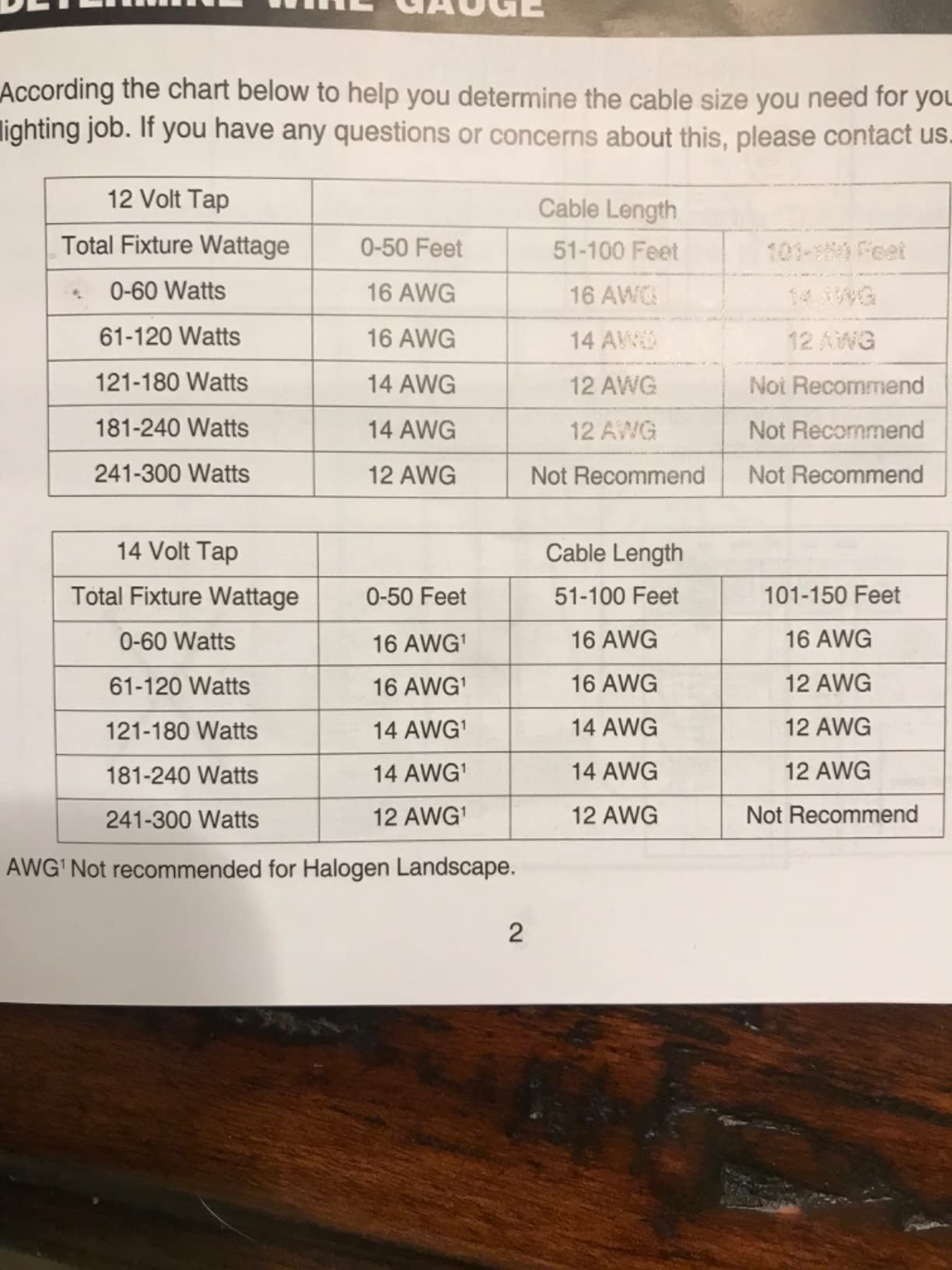
- Fixtures far from the transformer are dim. That is voltage drop. Either move to a 12V or 14V tap, upsize the cable from 14 AWG to 12 AWG, shorten the run, or split the load across a second transformer.
- Output flickers or the housing runs hot. Several packs in this roundup have documented reports of board or timer failure within months, and heat plus flicker is the symptom. That is a hardware failure, not a wiring problem.
- The lights do not come on at all. Test the photocell first by covering the sensor with tape, then check the timer mode and whether the memory function lost its setting during an outage.
- Corrosion at splices. Water intrusion at low voltage connections is the most common long-term killer. Dielectric grease on every splice, drip loops that shed water away from the connection, and keeping splices above grade rather than buried all extend life.
Two signs your transformer is undersized: fixtures dim noticeably when all of them switch on at dusk, and the breaker trips when the full load is energized rather than at random.
How Long Does a Landscape Lighting Transformer Last?
A well-made metal-housed pack installed dry, above grade, on a GFCI circuit, with good splices, routinely runs for well over a decade. Many owners reporting on these products describe units that have been in service for years through snow and heat, and one Malibu owner’s programmed settings survived a ten-hour outage without a reset.
Failure clusters earlier in two situations. First, cheap electronics in a sealed box that runs hot, which is the pattern behind the early timer and board failures reported in this roundup. Second, water ingress at the low voltage splices rather than at the transformer itself, which corrodes connections until output becomes dim or intermittent.
The practical takeaway is that lifespan is mostly a function of installation quality, not brand. Keep splices dry and above grade, respect the 80 percent load guideline, mount on a surface that does not trap heat, and the box outlives the fixtures it powers.
How to Choose: Capacity, Taps, Housing, and Brand Notes
Wattage Headroom Beats Exact Matching
Never size a transformer to the exact total of your fixtures. Continuous operation at rated capacity is what produces flicker, heat, and breaker trips. Buy the next tier up and operate at 80 percent or less, which means a 300W pack for a 200W design and a 120W pack for a 90W design.
Tap Selection for Long Runs
If your farthest fixture is more than roughly a hundred feet from the transformer, prioritise a 12V/14V model. If your runs are short, a single-tap box is fine and simpler. Remember that a 14V tap is mildly hot for fixtures rated strictly at 12V, so use it as compensation rather than as a permanent default.
Housing Material Decides Lifespan
Metal housings in this roundup are described by owners as lasting through years of weather, while the plastic-bodied designs are lighter and easier to mount. If the transformer lives outside, choose metal unless weight and mounting space make that impractical. If it lives inside, the lighter plastic option may suit you better.
Sensor Placement Is an Underrated Feature
A fixed photocell constrains where the transformer can go. A detachable photocell on a 3 foot to 6 foot cord does not. This one feature decides whether you can put the transformer in a garage or must mount it outside in full view, and it is worth more than most buyers expect.
Brands and Warranty Notes
The brands represented here split cleanly by design intent. DEWENWILS builds broad, inexpensive lines from 60W compact boxes to a 300W metal pack, and the units are consistently ETL listed. Malibu builds traditional power packs with detachable photocells on long leads and a five-mode dial, with a metal-bodied 300W option for heavy-duty work. SUNVIE concentrates on 200W and 300W units with 12V/14V output, removable photocells, and a 12-month replacement warranty backed by lifetime after-sale support.
On brands buyers ask about most, Kichler, VOLT, Ironsmith, Hampton Bay, Best Pro Lighting, Archipelago, Deckorators, Gardenreet, and Moonrays are all established names in the wider landscape lighting world, and most of them publish wattage, secondary voltage, and enclosure ratings clearly enough to compare against the numbers in this roundup. Kichler in particular has a long-standing reputation in the category. Whatever you choose, check whether the manufacturer sells replacement photocells and boards, because that is what determines whether a sensor failure costs you a part or a whole transformer.
Whichever brand you settle on, plan the layout before the power supply. Our low-maintenance landscape design guide is a better place to start than a transformer wattage chart.
Frequently Asked Questions
What size transformer do I need for low voltage landscape lighting?
Add up the wattage of every fixture, keep the total under 80 percent of the transformer rating, and buy the next tier up. In practice a 60W pack suits a front walkway, 120W covers a medium residential yard, and 200W to 300W handles a full property with uplighting.
How many landscape lights can a 300W transformer handle?
Keeping the load under 80 percent gives you about 240W of usable capacity. That works out to roughly 100 to 150 one-watt path lights, about 75 to 100 three-watt path lights, or approximately 25 to 35 six-watt spotlights on a single 300W transformer.
Do I need a transformer for low voltage landscape lighting?
Yes. Low voltage landscape fixtures run on 12V, not household voltage. A transformer steps 120V AC down to 12V AC so the fixtures operate safely and so the installer never works with line voltage at the light locations.
Should I choose a 12V AC or 12V DC landscape lighting transformer?
Choose 12V AC unless you are deliberately replacing a hum-prone unit with a quiet switching supply. Nearly all modern LED landscape fixtures contain internal rectification and run happily on AC, and AC output holds brightness better over long cable runs than DC output of the same wattage.
What is the typical lifespan of a landscape lighting transformer?
A metal-housed unit installed dry, above grade, on a GFCI circuit, and loaded to no more than 80 percent routinely lasts well over a decade. Early failures are usually driven by heat inside the enclosure or by water intrusion at low voltage splices rather than by the transformer itself.
Which Landscape Lighting Transformer Should You Buy?
Start with capacity and pick the tier above your measured load. If you want one recommendation and nothing else, the DEWENWILS 120W is the pick: sealed metal housing, 12V AC output that holds brightness on longer runs, ETL listed, and the highest average rating in the roundup across more than 2600 buyer reports. It is the best low voltage transformer for landscape lighting for most homes.
If your project is a front walkway or patio only, the compact 60W model is lighter, easier to hide, and the most-reviewed box here. If you need two circuits on different schedules, the dual-zone SUNVIE 300W replaces two transformers with one. If voltage drop is your problem, go straight to a 12V/14V model such as the 200W or 300W SUNVIE. If you need the sensor somewhere other than on the housing, filter for a detachable photocell on a cord, which both Malibu packs and all three SUNVIE models provide.
Measure your fixture wattage, pick your tier, and check the mounting surface before the box arrives. That is the whole process, and the transformer you install in 2026 will still be running when you are ready for an upgrade.
Leave a Reply