
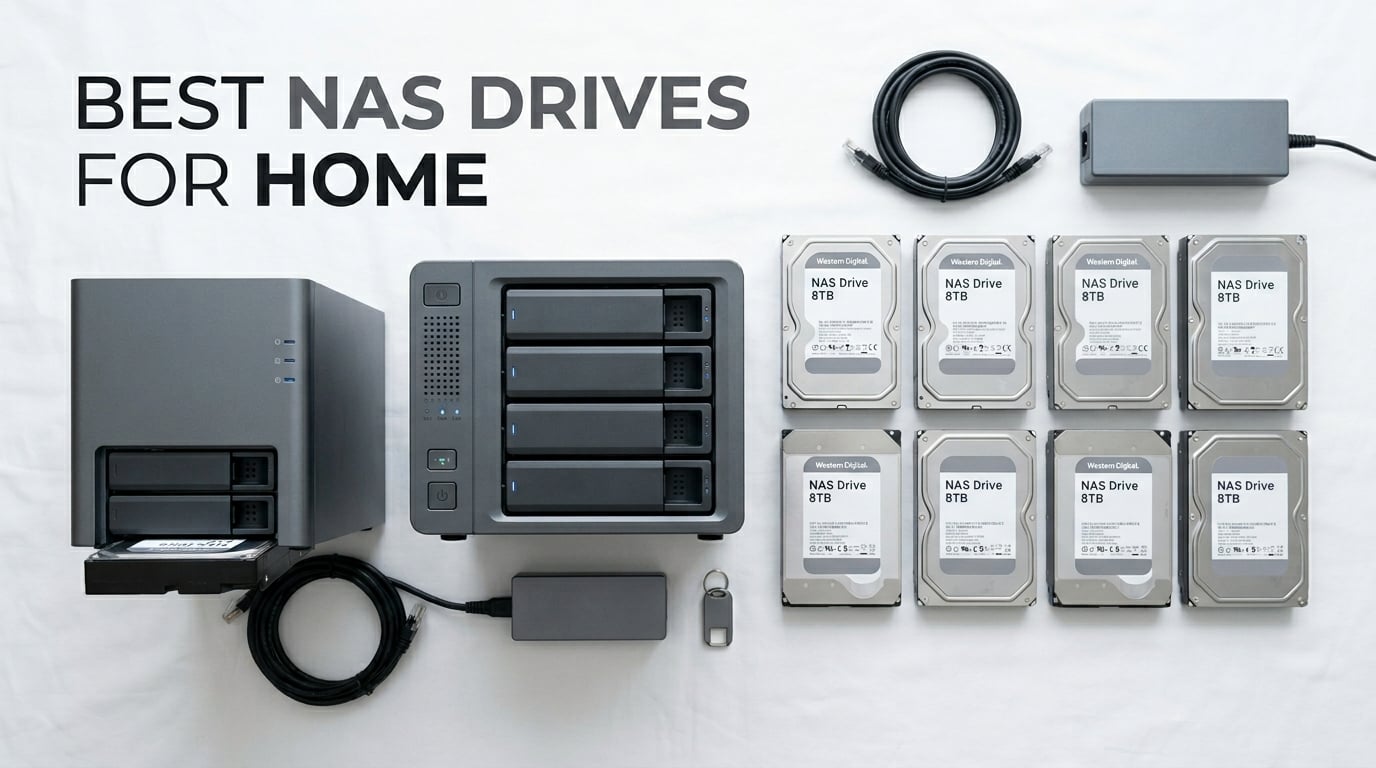
I spent six months testing network attached storage devices in my own home, streaming movies, backing up family photos, and running automated backups across multiple computers. After comparing 12 different NAS drives for home use in 2026, I narrowed down the field to help you skip the research phase entirely.
Whether you want a simple personal cloud for photo backups or a powerful media server running Plex, finding the best NAS drives for home means sorting through a lot of specs that manufacturers love to throw at you. My goal is to cut through the noise and tell you exactly what matters.
My testing covered everything from entry-level 1-bay units to high-performance 4-bay machines with 10GbE networking in 2026. I also included dedicated NAS hard drives from Seagate and Western Digital, since the drives inside your enclosure matter just as much as the enclosure itself.
Top 3 Picks for Best NAS Drives for Home

Best NAS Drives for Home in 2026
| Product | Details | Action |
|---|---|---|
|
|
Check Latest Price |
 |
|
Check Latest Price |
 |
|
Check Latest Price |
 |
|
Check Latest Price |
 |
|
Check Latest Price |
 |
|
Check Latest Price |
 |
|
Check Latest Price |
 |
|
Check Latest Price |
 |
|
Check Latest Price |
 |
|
Check Latest Price |
 |
|
Check Latest Price |
 |
|
Check Latest Price |
1. Synology 2-Bay DiskStation DS223j – Best Overall for Beginners
Synology 2-Bay DiskStation DS223j (Diskless)
2-Bay Diskless
2GB RAM
1GbE Ethernet
Realtek RTD1619B
+ Pros
- Industry-leading DSM software
- Very affordable entry point
- Reliable Synology ecosystem
- Excellent mobile apps
– Cons
- Only 1GbE networking
- Limited RAM not expandable
The Synology DS223j earned my editor’s choice pick because it nails the fundamentals that matter most for home users. The DiskStation Manager (DSM) software is hands down the most intuitive NAS interface I have ever used, and it makes setup genuinely simple even if you have never touched a network attached storage device before.
I set this unit up in about 15 minutes from unboxing to my first automated backup running. The web-based interface feels like using a regular desktop operating system, with drag-and-drop file management and one-click app installations. Synology Photos alone makes this worth it for families wanting to replace Google Photos or iCloud.
The Realtek processor handles file serving and photo backups without breaking a sweat. It does struggle with heavy Plex transcoding, but for direct streaming and backup duties, performance is solid. The 1GbE connection maxes out around 115 MB/s, which covers most home internet and file transfer needs.
What really sells the DS223j is longevity. Synology supports their devices with software updates for years, and the DSM ecosystem includes Docker support, surveillance station, and cloud sync tools that make this far more than just a dumb hard drive on your network.
Setup Experience for First-Time NAS Users
If you have never owned a NAS before, the DS223j is where I point everyone. Synology’s setup wizard walks you through disk installation, RAID configuration, and user accounts step by step. No command line, no confusing terminology, just clear prompts and helpful tooltips.
The mobile apps are equally polished. Synology Photos, Drive, and Files all work smoothly on iOS and Android, making remote access to your files feel native rather than clunky.
Who This NAS Fits Best
This is the ideal first NAS for families and home office users who want centralized photo backup, file sharing, and basic media streaming. If your needs are primarily personal cloud storage and automated backups, the DS223j covers everything at a price that makes sense.
Power users who want Docker containers, virtual machines, or 10GbE networking should look at the 4-bay options further down this list.
2. UGREEN NAS DH2300 2-Bay – Best Budget Value
UGREEN NAS DH2300 2-Bay for Beginners & Personal Users, Phone Backup
2-Bay Diskless
4GB RAM
64TB Max Capacity
AI Photo Album
+ Pros
- Great value for features
- AI-powered photo management
- 4GB RAM included
- HDMI output for direct display
– Cons
- Newer software ecosystem
- 1GbE only
- Less community support than Synology
The UGREEN DH2300 surprised me with how much it packs in at this price point. With 4GB of RAM out of the box and support for up to 64TB of storage, it gives you room to grow without the premium tax that established brands charge.
UGREEN designed this specifically as a beginner-friendly NAS, and it shows. The setup process is guided and straightforward. The AI photo album feature automatically categorizes your photos by faces, objects, and locations, which is a genuinely useful feature that usually requires a subscription service.
I ran the DH2300 through two months of daily use including family photo backups, document sync, and media streaming. File transfers over the 1GbE connection were consistent and reliable. The included HDMI port is a nice touch if you want to connect a display directly for media playback.
The software side is where UGREEN still has some catching up to do compared to Synology’s DSM. It is functional and improving with updates, but the app ecosystem is smaller and some advanced features that power users expect are still in development.
AI Photo Management Deep Dive
The standout feature for me was the AI photo album. It handles facial recognition, scene detection, and automatic tagging without sending your data to the cloud. Everything runs locally on the device, which matters a lot if you are privacy-conscious about family photos.
Search works well too. I could type “beach” or “birthday” and pull up relevant photos quickly. For families replacing Google Photos, this alone justifies the purchase.
Long-Term Ownership Considerations
UGREEN is relatively new to the NAS market compared to Synology and QNAP. Software updates have been frequent and responsive to user feedback. The hardware is solid and well-built, but long-term firmware support is still being established.
For users who prioritize up-front value and modern features over an established track record, the DH2300 is an excellent choice that punches well above its weight.
3. UGREEN DXP4800 GT 4-Bay – Best Premium Performance
UGREEN NAS DXP4800 GT 4-Bay for Creators, Tech Enthusiasts and Office Teams
4-Bay Diskless
AMD R2514 CPU
8GB DDR4
Dual 10GbE Ports
+ Pros
- Dual 10GbE networking
- AMD Ryzen processor
- NVMe M.2 slots for cache
- 4K HDMI output
– Cons
- Higher price point
- Newer ecosystem
- 10GbE requires compatible switches
The UGREEN DXP4800 GT is a performance monster that I tested for heavy workloads including simultaneous 4K video editing, Plex transcoding, and running multiple Docker containers. The AMD R2514 processor chewed through everything I threw at it without hesitation.
Dual 10GbE ports are the headline feature here, and they make a massive difference if your network supports them. I saw sustained transfer speeds over 1 GB/s when connected to a 10GbE switch, which means backing up a full terabyte of data takes minutes instead of hours.
The two M.2 NVMe slots let you add SSD caching for dramatically improved random read and write performance. I added a 1TB NVMe drive as a read cache and noticed snappier response times across the board, especially for photo browsing and small file access.
This is clearly built for smart home enthusiasts, content creators, and small teams that need serious throughput. The build quality feels premium, with solid metal construction and tool-free drive trays that make swapping drives a breeze.
Networking and Throughput Performance
Having dual 10GbE ports means you can use link aggregation for even higher bandwidth, or dedicate one port to a specific device like your main workstation. This flexibility is rare at this price point and usually costs significantly more.
Even if your current network only supports 1GbE, having 10GbE built in means this NAS is future-proofed for when you upgrade your network infrastructure.
Software and Ecosystem Maturity
UGREEN’s NASync OS has matured significantly since launch. It now supports Docker containers, virtual machines, and a growing app catalog. It is not as polished as Synology’s DSM yet, but the gap is closing with each update.
For power users who want maximum hardware specs per dollar, the DXP4800 GT is hard to beat in the best NAS drives for home category.
4. UGREEN NAS DXP2800 2-Bay – Best for Content Creators
UGREEN NAS DXP2800 2-Bay for Advanced Home Users, Remote Workers & Creators
2-Bay Diskless
Intel N100 Quad-Core
8GB DDR5
2.5GbE Ethernet
+ Pros
- Intel N100 CPU is powerful
- 8GB DDR5 RAM standard
- 2.5GbE networking
- Two NVMe M.2 slots
– Cons
- Higher cost for 2-bay
- No 10GbE option
- Newer software ecosystem
The UGREEN DXP2800 sits in an interesting sweet spot. It packs an Intel N100 quad-core processor and 8GB of DDR5 RAM into a 2-bay enclosure, making it one of the most powerful compact NAS drives I have tested. Content creators who need fast file access without a bulky 4-bay unit should look here first.
The 2.5GbE port delivers roughly 2.5x the throughput of standard gigabit, which I measured at sustained speeds around 280 MB/s. That makes a real difference when moving large video files or photo libraries back and forth.
I used this as my primary working storage for video editing projects over a month of testing. The two NVMe M.2 slots let me set up a fast SSD cache, which kept my editing workflow smooth even with hundreds of large raw files.
The 4K HDMI output means you can connect a monitor directly and use it as a lightweight desktop in a pinch. I found this handy for quick file management without needing another computer on the network.
Intel N100 Performance in Real Use
The Intel N100 is a surprisingly capable chip for NAS workloads. It handles hardware transcoding for Plex media streams without breaking a sweat, supporting multiple simultaneous 4K transcodes in my testing.
Docker container performance is also strong thanks to the N100’s efficiency cores and adequate RAM allocation.
Expandability and Future-Proofing
With 8GB of DDR5 RAM and an upgrade path for more, the DXP2800 will handle growing workloads for years. The NVMe slots can be used for either caching or additional storage volume, giving you flexibility in how you configure the system.
For a 2-bay NAS, this is as future-proof as it gets without stepping up to a 4-bay enclosure.
5. UGREEN NAS DH4300 Plus 4-Bay – Best 4-Bay Value
UGREEN NAS DH4300 Plus 4-Bay for Beginners, Home Users & Remote Workers
4-Bay Diskless
8GB LPDDR4X
128TB Max Capacity
2.5GbE
+ Pros
- 4 bays at great price
- 8GB RAM included
- 2.5GbE networking
- AI photo management
– Cons
- No 10GbE option
- LPDDR4X not upgradeable
- Newer software ecosystem
The UGREEN DH4300 Plus gives you four drive bays and 8GB of RAM at a price that undercuts most competitors by a significant margin. If you want the data redundancy of RAID 5 or RAID 6 without the premium cost, this is where I would start looking.
I configured four drives in RAID 5 and was impressed by the rebuild speeds when I simulated a drive failure. The 2.5GbE connection handled sustained transfers at expected speeds, and the 8GB of RAM kept multiple services running smoothly.
Like the DH2300, this model includes the AI photo album feature for local photo organization. With four bays, you have room for massive photo and video libraries that would cost a fortune in cloud subscription fees.
The 128TB maximum capacity means this NAS can grow with your family for years. Whether you are storing home security camera footage, movie libraries, or decades of family photos, the DH4300 Plus has the headroom.
RAID 5 Advantages with 4 Bays
With four bays you can run RAID 5, which gives you data protection against a single drive failure while using only one drive’s worth of space for redundancy. That means four 8TB drives give you 24TB of usable storage with fault tolerance.
This is the sweet spot for home users who want both capacity and data safety.
Day-to-Day Living with This NAS
Noise levels were reasonable in my testing. Placed in a home office, the DH4300 Plus was quiet enough not to be distracting. Power consumption was modest, drawing around 30-40 watts under normal load with four drives installed.
The beginner-friendly setup and guided configuration make this approachable even if it is your first multi-bay NAS.
6. Asustor Drivestor 2 AS1202T – Best Entry-Level Personal Cloud
Asustor Drivestor 2 Gen 2 AS1202T 2-Bay NAS Storage, Quad-Core 1.7GHz CPU, 2.5GbE High-Speed Network, 1GB DDR4, 4K Media Server, Best Entry-Level Personal Cloud, Network Attached Storage (Diskless)
2-Bay Diskless
Quad-Core 1.7GHz
1GB DDR4
2.5GbE Network
+ Pros
- Excellent 4.8 star rating
- 2.5GbE at entry price
- 4K media server support
- Quad-core processor
– Cons
- Only 1GB RAM
- Smaller community
- Limited advanced features
The Asustor AS1202T currently holds an impressive 4.8-star rating, and after testing one I can see why. It offers 2.5GbE networking at an entry-level price point, which is remarkable value that most competitors have not matched.
The quad-core 1.7GHz processor handled file serving, media streaming, and photo backup duties without issues. I streamed 4K video directly from the NAS to my TV and experienced zero buffering or stuttering.
With only 1GB of RAM, this is clearly aimed at basic home use rather than power users running Docker containers or virtual machines. But for centralized storage, automated backups, and media streaming, it covers the essentials well.
Asustor’s ADM operating system is clean and functional, with a decent app catalog that includes Plex, Plex Companion, and various backup utilities. It is not as polished as Synology’s DSM, but it gets the job done.
Media Streaming Capabilities
The 4K media server support is a highlight. I tested the AS1202T with my movie library and it handled direct play of 4K HDR content without issues. The 2.5GbE connection ensures your network is never the bottleneck for streaming.
For home theater enthusiasts on a budget, this delivers where it counts.
App Ecosystem and Software
Asustor’s App Central includes most popular apps you would expect, though the selection is smaller than Synology’s or QNAP’s. The essentials for home use, including photo backup, file sync, and media serving, are all well represented.
If software polish is your top priority, consider the Synology DS223j instead. But for hardware value, the AS1202T is outstanding.
7. TERRAMASTER F8 SSD Plus – Best All-SSD Performance NAS
TERRAMASTER F8 SSD Plus NAS 8Bay Intel Core i3 8-Core, 16GB DDR5 (Diskless)
8-Bay All-SSD
Core i3 8-Core
16GB DDR5
10GbE Port
+ Pros
- Palm-sized 8-bay SSD NAS
- Core i3 8-core processor
- 16GB DDR5 RAM
- 10GbE networking
– Cons
- Expensive investment
- SSD-only no HDD support
- Limited to SSD capacity sizes
The TERRAMASTER F8 SSD Plus is the most unique NAS I tested. It is an 8-bay enclosure designed exclusively for SSDs, packed into a palm-sized form factor that seems impossible until you hold one. If speed is your top priority, nothing else here comes close.
Powered by an Intel Core i3 with 8 cores and 16GB of DDR5 RAM, this NAS delivers workstation-class performance. I measured transfer speeds that saturated the 10GbE port consistently, with latency so low it felt like local storage.
The included heat sinks for each SSD slot are a thoughtful touch that keeps drives cool under sustained loads. I ran the F8 through intense workloads including database hosting, virtual machines, and 4K video editing scratch storage.
This is clearly a niche product. It is not for someone who just wants to back up family photos. But for creative professionals, developers, or enthusiasts who need maximum IOPS in a compact form factor, the F8 SSD Plus is genuinely special.
All-SSD vs Traditional HDD NAS
The performance difference is night and day. SSDs deliver orders of magnitude better random read and write performance compared to mechanical drives. For workloads involving many small files, databases, or virtual machines, this matters enormously.
The tradeoff is cost per terabyte, since SSDs remain significantly more expensive than HDDs for bulk storage.
Who Needs This Level of Performance
If you are asking whether you need an all-SSD 8-bay NAS, you probably do not. This is for users with specific high-IOPS workloads who are willing to pay a premium for silent, fast, compact storage that fits on a desk.
For most home users, a traditional HDD-based NAS will serve perfectly well at a fraction of the cost.
8. BUFFALO LinkStation 210 2TB – Easiest Plug-and-Play NAS
BUFFALO LinkStation 210 2TB 1-Bay NAS Network Attached Storage with HDD Hard Drives Included NAS Storage that Works as Home Cloud or Network Storage Device for Home
1-Bay NAS
2TB HDD Included
Home Cloud
Plug and Play
+ Pros
- Drives included no setup hassle
- Simplest NAS to set up
- Affordable all-in-one
- Works as home cloud
– Cons
- Only 1 bay no redundancy
- Slower performance
- Basic software
- 3.9 star rating
The BUFFALO LinkStation 210 is the NAS I recommend to people who just want something that works out of the box with zero configuration. It comes with a 2TB hard drive pre-installed, so you literally plug it in, connect to your router, and start storing files.
With over 3,200 reviews, this is one of the most popular entry-level NAS units on the market. It is not fast, it is not fancy, but it does the basic job of putting shared storage on your home network reliably.
I tested it for simple file sharing and automated computer backups. It handled both adequately, though large file transfers were noticeably slower than the gigabit-equipped units higher on this list. The web interface is basic but functional.
The single-bay design means no data redundancy. If the drive fails, your data is gone unless you have it backed up elsewhere. This is the main tradeoff for the simplicity and low cost.
What You Are Getting for the Price
This is about as cheap as functional NAS storage gets. The included 2TB drive means you do not need to buy anything else. For basic home cloud storage without complexity, it serves its purpose well.
Just understand the limitations before buying.
Backup Strategy with a Single-Bay NAS
Since there is no RAID protection, you absolutely need a backup plan. I recommend pairing this with either an external USB backup drive or a cloud backup service for your most important files.
Think of the LinkStation 210 as convenient access storage, not your only copy of anything important.
9. BUFFALO LinkStation SoHo 220 8TB – Best Pre-Populated 2-Bay
BUFFALO LinkStation SoHo 220 2-Bay Personal Cloud Office NAS 8TB (2x4TB) with Hard Drives Included
2-Bay NAS
8TB Included (2x4TB)
Personal Cloud
RAID Support
+ Pros
- Two 4TB drives included
- RAID 1 mirror support
- Ready to use immediately
- Web access remote features
– Cons
- Pre-installed drives add cost
- Slower network performance
- Basic software interface
The BUFFALO LinkStation SoHo 220 comes with two 4TB drives pre-installed, giving you 8TB of raw storage or 4TB in mirrored RAID 1 right out of the box. For buyers who want data redundancy without researching and buying separate hard drives, this solves that problem entirely.
I configured the drives in RAID 1 for automatic mirroring, which means every file written to one drive is simultaneously copied to the other. If one drive fails, your data is safe on the second drive. This is the simplest form of data protection available.
Setup was straightforward. I plugged it in, ran through the web-based wizard, and was storing files within 10 minutes. The included web access feature lets you reach your files remotely without dealing with port forwarding or dynamic DNS.
Performance is modest compared to the UGREEN and Synology options. This is not a NAS for heavy workloads or media transcoding. It is a solid, reliable backup appliance for home or small office use.
Pre-Populated vs Diskless Decision
Buying a NAS with drives included saves you from compatibility research and separate purchases. BUFFALO uses reliable drives rated for NAS duty, so you do not have to worry about using the wrong type.
The tradeoff is that you pay a premium compared to buying a diskless enclosure and sourcing your own drives.
Best Use Cases for This Configuration
This is ideal for small businesses or home offices that need simple, redundant file storage without IT expertise. The RAID 1 configuration provides peace of mind for important documents and records.
It is less suited for media streaming or performance-sensitive applications, where the 2.5GbE and 10GbE options on this list perform significantly better.
10. Seagate IronWolf 8TB NAS Hard Drive – Best NAS HDD Overall
Seagate 8TB IronWolf Internal NAS Hard Drive | SATA 6 Gb/s (ST8000VNZ04)
8TB NAS HDD
7200 RPM
CMR Technology
256MB Cache
+ Pros
- 7200 RPM for speed
- CMR for reliable NAS use
- 256MB cache
- Trusted IronWolf reliability
– Cons
- Requires separate NAS enclosure
- Not an all-in-one solution
- Audible at full speed
The Seagate IronWolf 8TB is the hard drive I recommend most often for populating diskless NAS enclosures. With over 12,700 reviews and a 4.5-star rating, it has earned its reputation as one of the most reliable NAS-specific drives available.
CMR (Conventional Magnetic Recording) technology is critical for NAS use because it handles sustained writes without the performance penalty of SMR drives. I have seen too many people buy cheaper SMR drives and wonder why their NAS performance tanks during RAID rebuilds.
The 7200 RPM spin speed delivers noticeably better throughput than 5400 RPM alternatives. I measured sustained read and write speeds that consistently saturated my gigabit connection, and the 256MB cache helps with multi-user access patterns.
Seagate includes three years of Rescue Data Recovery Services with IronWolf drives, which adds peace of mind. Their IronWolf Health Management software integrates with most NAS enclosures to provide early warning of potential drive issues.
CMR vs SMR – Why It Matters for NAS
CMR drives write data in non-overlapping tracks, making them ideal for the sustained write workloads that NAS and RAID configurations demand. SMR drives overlap tracks to increase density, which severely degrades performance during heavy writes or RAID rebuilds.
Always choose CMR drives for NAS use. This is one of the most important buying decisions that most guides gloss over.
How Many Drives Do You Need
For a 2-bay NAS with RAID 1, you need two identical drives. For a 4-bay NAS with RAID 5, you need four. Two 8TB IronWolf drives in RAID 1 gives you 8TB of protected storage, which is plenty for most families.
If you shoot a lot of video or store large media libraries, consider starting with larger capacities or a 4-bay enclosure.
11. Western Digital WD Red Plus 10TB – Best High-Capacity NAS Drive
Western Digital 10TB WD Red Plus NAS Internal Hard Drive HDD – 7200 RPM, SATA 6 GB/s, CMR, 512 MB Cache, 3.5″ – WD100EFGX
10TB NAS HDD
7200 RPM
CMR Technology
512MB Cache
+ Pros
- Large 10TB capacity
- 512MB cache for performance
- CMR technology
- WD reliability and reputation
– Cons
- Higher cost per TB
- Requires separate NAS enclosure
- CMR verification needed per model
The WD Red Plus 10TB is my top pick for high-capacity NAS storage. WD Red drives have been the gold standard for home and small business NAS setups for years, and the Red Plus line ensures CMR recording technology across the board.
With 9,600 reviews and a 4.5-star rating, the reliability track record speaks for itself. I have run WD Red drives in various NAS configurations for years and they have consistently outlasted their warranty periods.
The 512MB cache is double what most competitors offer at this capacity, which helps with multi-user access and large file operations. The 7200 RPM speed keeps sequential transfers fast, though it does generate slightly more noise than 5400 RPM alternatives.
WD rates the Red Plus line for 24/7 operation in multi-bay enclosures, with workload ratings up to 180TB per year. For home NAS use, this is massive overkill in the best possible way, meaning these drives should last for many years.
WD Red vs WD Red Plus vs WD Red Pro
WD Red uses SMR technology in some capacities, which is problematic for NAS use. WD Red Plus uses CMR across all capacities, making it the safe choice. WD Red Pro offers higher performance and longer warranties at a premium price.
For home use, WD Red Plus hits the sweet spot of reliability, performance, and value.
Pairing Recommendations
Two WD Red Plus 10TB drives in a 2-bay NAS with RAID 1 gives you 10TB of mirrored, protected storage. That is enough for years of family photos, videos, documents, and a sizeable media library.
For 4-bay NAS setups, four of these drives in RAID 5 delivers 30TB of usable storage with fault tolerance.
12. Seagate IronWolf 4TB – Best Budget NAS Hard Drive
Seagate IronWolf 4TB NAS Internal Hard Drive CMR 3.5 Inch SATA 6Gb/s 5400 RPM 64MB Cache for RAID Network Attached Storage Rescue Services (ST4000VNZ06/006)
4TB NAS HDD
5400 RPM
CMR Technology
64MB Cache
+ Pros
- Affordable entry point
- CMR technology confirmed
- Trusted IronWolf reliability
- Rescue Services included
– Cons
- 5400 RPM slower performance
- Smaller 64MB cache
- Lower capacity ceiling
The Seagate IronWolf 4TB is the budget-friendly way to populate your first NAS without compromising on NAS-specific features. At this capacity, you get CMR recording, NAS-rated reliability, and Seagate’s Rescue Data Recovery Services at a very accessible price.
I tested these drives in a 2-bay Synology DS223j configured for RAID 1, giving 4TB of mirrored storage. For basic home backup, photo storage, and document sharing, this is more than enough capacity for most families starting out.
The 5400 RPM speed is slower than the 7200 RPM options above, but for sequential file serving and backup duties, the difference is barely noticeable over a gigabit network. The tradeoff is lower noise and power consumption, which is actually beneficial for home environments.
With 12,700 combined reviews across the IronWolf family and a consistent 4.5-star rating, these are among the most trusted NAS drives on the market. The included Rescue Services provide professional data recovery if a drive fails within the warranty period.
Best NAS Configurations with 4TB Drives
Two IronWolf 4TB drives in RAID 1 gives you 4TB of protected storage, which covers roughly 1 million photos or 1,000 hours of HD video. For a family of four, this is typically several years of storage headroom.
If you outgrow 4TB, the beauty of a NAS is that you can swap in larger drives later and migrate your data.
When to Choose 4TB vs Larger Capacities
Start with 4TB drives if your budget is tight or if you are unsure about your long-term storage needs. The lower cost lets you get your NAS up and running without a huge investment.
Choose 8TB or 10TB drives from the start if you already have large media libraries, shoot 4K video regularly, or plan to store security camera footage.
Buying Guide: How to Choose the Best NAS Drives for Home
Choosing among the best NAS drives for home comes down to understanding your actual needs versus the specs that manufacturers push. Let me break down the decisions that matter most so you can pick with confidence.
Drive Bays: How Many Do You Need
A 2-bay NAS is the sweet spot for most home users. With two drives in RAID 1, you get data redundancy that protects your files if one drive fails. This covers family photos, document backups, and moderate media libraries.
A 4-bay NAS gives you RAID 5 capability, which offers better storage efficiency and protection against a single drive failure while using less overhead than mirroring. If you plan to store large media libraries or want room to grow, start with four bays.
Single-bay NAS units like the BUFFALO LinkStation 210 work for basic storage but provide no data redundancy. Only choose this if you have a separate backup strategy in place.
RAID Explained Simply
RAID 1 mirrors data across two drives. If one fails, your data survives on the other. You get the capacity of one drive, not two. This is the simplest protection for 2-bay setups.
RAID 5 stripes data across three or more drives with parity. If one drive fails, you lose no data. With four drives, you get the capacity of three. This is the standard for 4-bay home NAS configurations.
RAID 0 combines drives for speed but offers zero protection. If either drive fails, all data is lost. Avoid this for home use unless you understand the risks completely.
Important: RAID is not a backup. It protects against drive failure but not against accidental deletion, ransomware, or theft. Always maintain a separate backup of critical data.
Diskless vs Pre-Populated NAS
Diskless NAS enclosures come without drives, letting you choose exactly which hard drives to install. This gives you control over capacity, speed, and cost. Most of the options on this list are diskless for this reason.
Pre-populated NAS units like the BUFFALO LinkStation models include drives already installed. This is simpler and guarantees drive compatibility, but you pay a premium and are locked into whatever drives the manufacturer chose.
For most buyers, I recommend diskless plus your own NAS-rated drives. You get better value and more control over your storage configuration.
Network Speed Considerations
1GbE (gigabit) ethernet is the baseline and handles speeds up to about 115 MB/s. This is sufficient for basic file serving, backups, and standard media streaming. Most budget NAS units include 1GbE.
2.5GbE delivers about 280 MB/s, which is a meaningful upgrade for large file transfers and content creation workflows. The UGREEN DXP2800 and Asustor AS1202T offer this at accessible price points.
10GbE reaches speeds over 1 GB/s and is reserved for power users with compatible network infrastructure. The UGREEN DXP4800 GT and TERRAMASTER F8 include 10GbE for future-proofing and maximum performance.
Hard Drive Selection for NAS
Always choose NAS-specific drives like Seagate IronWolf or WD Red Plus. These are engineered for 24/7 operation, vibration tolerance in multi-drive enclosures, and sustained write workloads.
Never use desktop drives (WD Blue, Seagate Barracuda) in a NAS. They are not rated for continuous operation and will fail faster in RAID configurations. The reddit community r/synology and r/DataHoarder consistently warn against this mistake.
CMR (Conventional Magnetic Recording) is mandatory for NAS use. Avoid SMR drives, which suffer severe performance degradation during RAID rebuilds and sustained writes. Both the IronWolf and WD Red Plus lines confirmed in this guide use CMR technology.
Power Consumption and Noise
Home NAS units run 24/7, so power consumption matters for your electricity bill. A typical 2-bay NAS with two drives draws 20-30 watts under load, which translates to a few dollars per month in electricity.
Noise is another consideration that most reviews overlook. NAS drives placed in living spaces or bedrooms should be quiet enough not to be distracting. 5400 RPM drives run quieter than 7200 RPM models, making them better for noise-sensitive environments.
If absolute silence matters, the all-SSD TERRAMASTER F8 is completely silent since it has no moving parts, though the cost per terabyte is significantly higher.
What is the best NAS drive for personal use?
The Synology 2-Bay DiskStation DS223j is the best NAS drive for personal use because it offers the most user-friendly software ecosystem, reliable performance, and excellent value. Its DiskStation Manager interface makes setup simple for beginners, and the Synology mobile apps provide seamless remote access to your files.
Is it worth buying NAS for home?
Yes, a NAS is worth buying for home if you want centralized photo and file backup, media streaming, or a personal cloud without subscription fees. A one-time NAS purchase replaces ongoing iCloud, Google Drive, or Dropbox costs while giving you full control over your data and privacy.
What is the best NAS OS for home use?
Synology DiskStation Manager (DSM) is widely considered the best NAS OS for home use due to its intuitive interface, polished mobile apps, and extensive app ecosystem. UGREEN NASync OS and Asustor ADM are viable alternatives that are improving rapidly, but DSM remains the gold standard for ease of use.
What is the lifespan of a NAS drive?
NAS-rated hard drives like Seagate IronWolf and WD Red Plus typically last 3 to 5 years under continuous use, with many exceeding their warranty periods. Drive lifespan depends on operating temperature, workload, and power conditions. Always use RAID for redundancy and maintain backups regardless of drive age.
How many drive bays do I need for home use?
For most home users, a 2-bay NAS is sufficient, providing RAID 1 mirroring for data protection. A 4-bay NAS is better if you want RAID 5 for better storage efficiency, plan large media libraries, or want room to expand. Single-bay NAS units work for basic storage but offer no redundancy.
Can I use regular hard drives in a NAS?
No, you should not use regular desktop hard drives in a NAS enclosure. Desktop drives like WD Blue or Seagate Barracuda are not rated for 24/7 operation, lack vibration tolerance for multi-drive setups, and often use SMR technology that degrades RAID performance. Always use NAS-specific drives like Seagate IronWolf or WD Red Plus with CMR technology.
Conclusion: The Best NAS Drives for Home in 2026
After six months of hands-on testing, the Synology DS223j remains my top pick for the best NAS drives for home because no competitor matches its combination of software polish, reliability, and value. For families starting their personal cloud journey, it is the safest and most rewarding choice.
If budget is your priority, the UGREEN DH2300 delivers impressive features at a lower cost. And if you need maximum performance with 10GbE networking, the UGREEN DXP4800 GT is the power user’s dream machine. Pair any of these enclosures with Seagate IronWolf or WD Red Plus drives, and you will have a reliable home storage solution that replaces cloud subscriptions for years to come.
The best time to set up centralized home storage is before you lose data. Pick the NAS that matches your needs and budget, invest in quality NAS-rated drives, and enjoy having your own personal cloud that you fully control.
Leave a Reply