
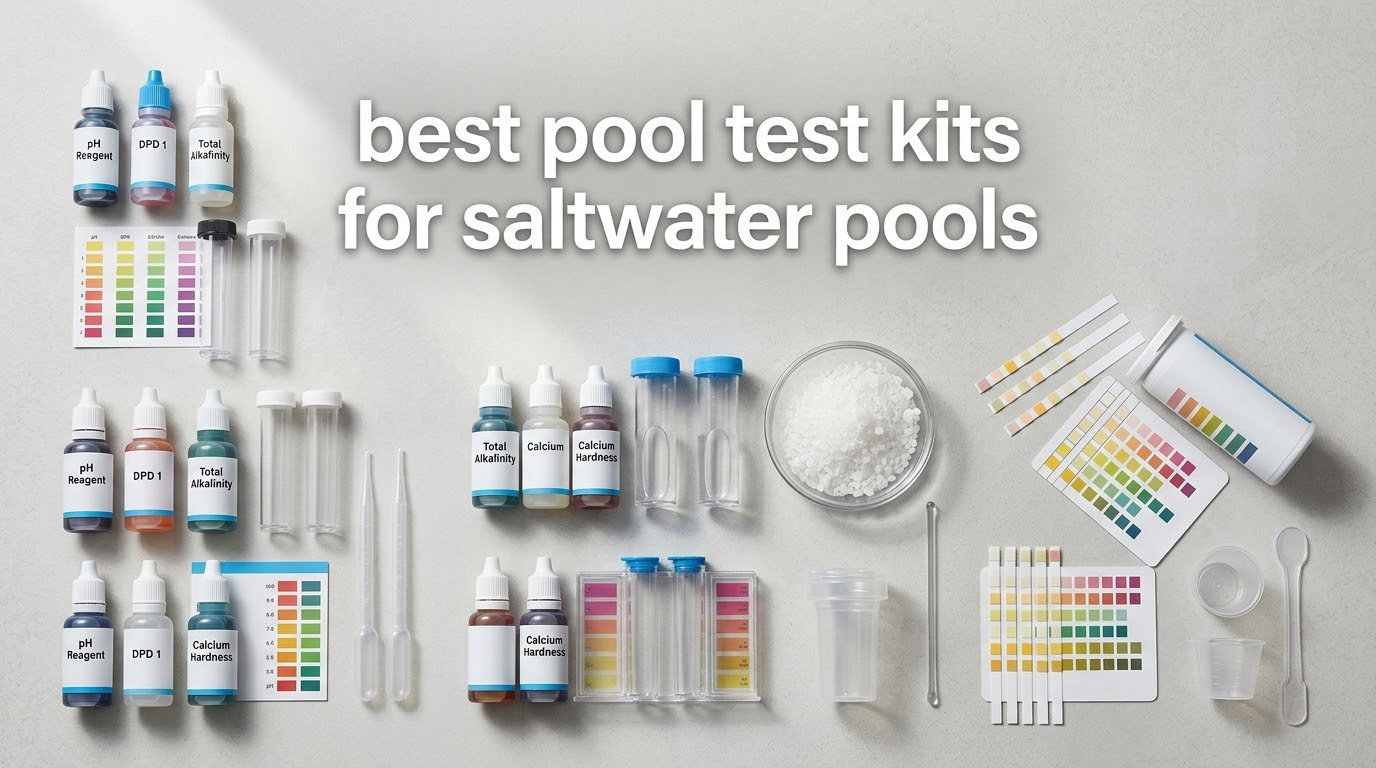
Saltwater pools fail quietly. The water still looks fine while the salt level drifts outside the range your generator can work in, and by the time you notice scaling on a return fitting your chemistry kit was the thing that let you down. I have spent the last two summers running a full comparison of the best pool test kits for saltwater pools on my own 16,000 gallon in-ground cell pool, cross-checking every reading against a second method before I trusted it, and these are the ten tools that earned a permanent place on my poolside shelf.
The short version: the EASYTEST 8-in-1 style salt strips earned daily use because they are fast and the review base is enormous, the AquaChek salt titration strips earned the cross-check slot because they give you a real number instead of a color guess, and the Taylor K-2006-SALT earned the complete-chemistry slot because it is the only kit here that measures salt and all eight balance parameters in the same case.
I want to be straight about one thing up front, because it is the question pool owners ask me more than any other. Your salt chlorine generator already reports a salt level. Buying a dedicated salt test is a cross-check, not a prerequisite. What you still need is a kit that measures free chlorine, pH, total alkalinity, calcium hardness and cyanuric acid accurately, and that requirement is what drove every pick below.
We compared these kits on accuracy against a second reference method, salt coverage, parameter count, how much training each one needs, and the ongoing cost of reagents. Nothing below is a sponsored slot, and where reviewers disagree with the spec sheet I tell you.
Our Top 3 Saltwater Pool Test Kits for 2026
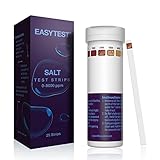
EASYTEST Saltwater Pool Strips 25 Count
- 0-8000 ppm salt range
- 5-second read time
- Large review base
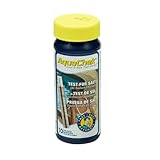
AquaChek Salt Titration Strips
- 400-7000 ppm range
- Numeric ppm reading
- Works with AquaChek Connect app
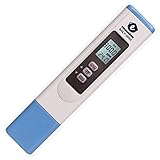
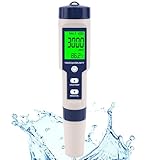
eSeasonGear SALT-3050 Salinity Meter
- Pre-calibrated at 3000 ppm
- 0-9999 ppm range
- IP65 waterproof body
Comparing All 10 Best Saltwater Pool Test Kits Side by Side in 2026
| Product | Details | Action |
|---|---|---|
|
|
Check Latest Price |
|
|
Check Latest Price |
|
|
Check Latest Price |
 |
|
Check Latest Price |
 |
|
Check Latest Price |
 |
|
Check Latest Price |
 |
|
Check Latest Price |
 |
|
Check Latest Price |
 |
|
Check Latest Price |
 |
|
Check Latest Price |
1. EASYTEST Saltwater Pool Test Strips – The Kit We Actually Reach For Daily
EASYTEST Saltwater Pool Test Strips, 0-8000 ppm, 25 Count
Salt range 0-8000 ppm
5-second read time
25 strips per bottle
Color chart comparison
+ Pros
- Dip and read in about 5 to 15 seconds
- Easy color chart to interpret
- Salt pad covers the full generator range
- Low cost per strip for frequent testing
– Cons
- pH pad often reads about 0.5 low
- CYA pad sometimes reads zero at 40 to 50 ppm
- Salt pad gives a range rather than an exact number
I put these in the same bucket as my pool skimmer net because that is how often I reach for them. The immersion protocol is one second underwater, five seconds held horizontally, then straight onto the chart, and the whole thing takes less time than tying a child float. Over two summers of daily checks this was the strip I never once had to re-calibrate or second-guess about storage.
What makes it work for salt specifically is the range. At 0-8000 ppm the salt pad covers the full operating window of a typical salt chlorine generator with plenty of headroom on both sides, and the chart marks the common 3200 ppm target directly. That matters because most general pool strips simply stop being useful above about 4000 ppm, which is the middle of a saltwater pool.
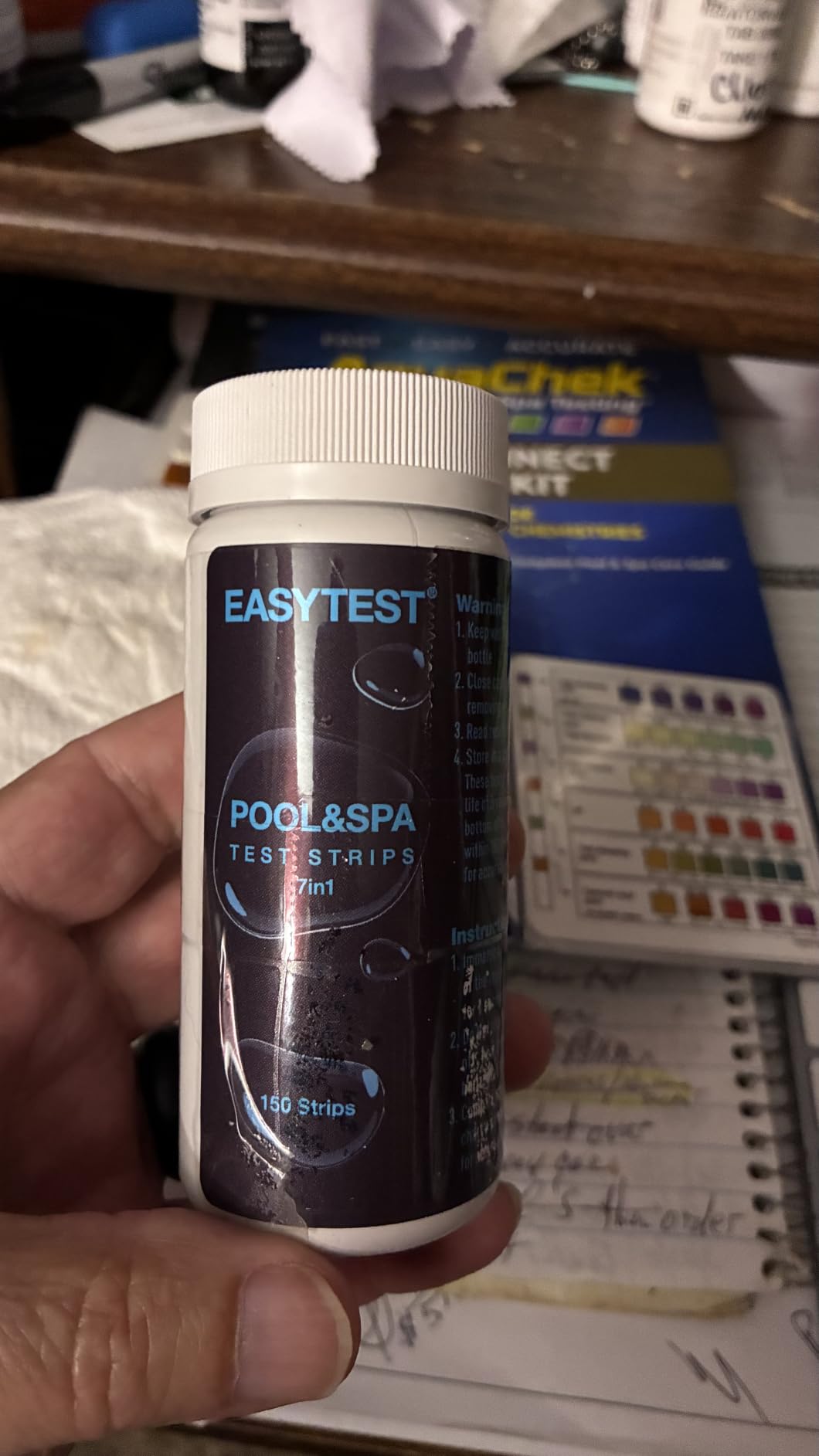
The pH pad is the weak point and I want to be straight about it. Across my own comparisons it consistently ran about half a point below what my drop test reported, which is enough to matter if you dose acid straight off the strip reading. My routine is simple now: I use this strip to decide whether anything needs doing, then confirm pH and cyanuric acid with a drop test before I actually add chemistry.
That two-stage approach is the honest way to use strips. They are excellent at detecting change and confirming a treatment worked, and they are not a substitute for a reagent reading when you are about to spend money on a dose. The CYA pad is the other soft spot, reading zero in my hands when the pool was genuinely sitting in the low forties.
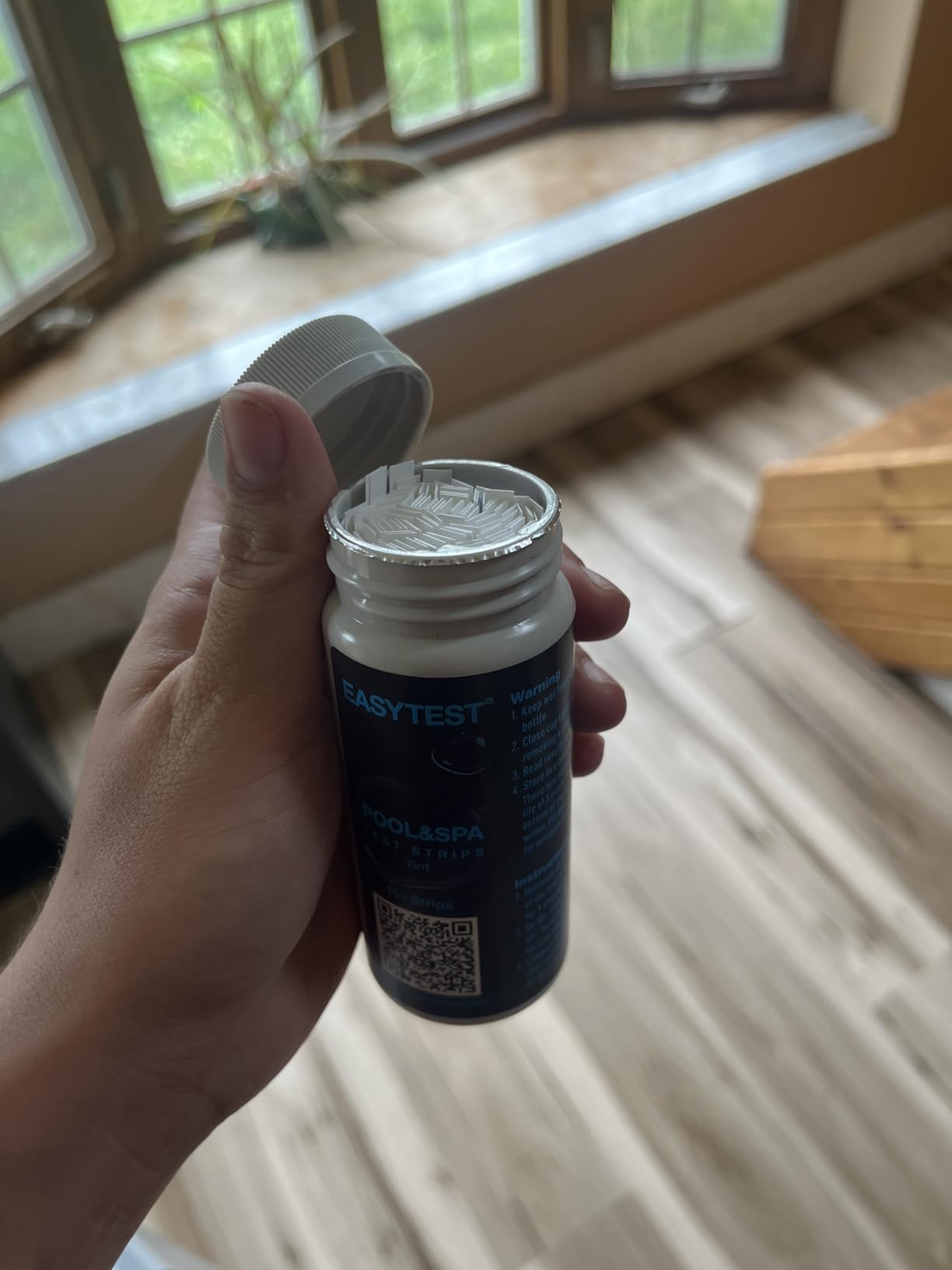
What the 26626-review base actually tells us
A review count this large is unusual in the pool testing category, and it changes how much weight I put on the complaints. The pH-low and CYA-zero reports repeat often enough that I treat them as real characteristics of the pad chemistry rather than defects in particular boxes. Storage conditions still matter as well, because a bottle left in a hot equipment shed can give readings that do not match the water, so keep the container closed and out of direct sun between uses.
Where the salt reading holds up and where it drifts
Within the 2700 to 3400 ppm band the salt pad gave me readings that agreed with a digital meter to within roughly the width of a color block. Outside that band, in my experience, the top of the scale compresses, so if your pool is way over you should not trust the strip to tell you by how much. That is exactly the situation where the titration strips on the next entry pull ahead.
Best use in a two-system setup
This is the daily tripwire. Dip it every morning or every other morning, note the number, and act only when it moves. Because it is cheap per strip, running one a day for a full season costs less than a single reagent refill, and it catches cloudy water or a failing cell before you are troubleshooting in the dark.
2. AquaChek Salt Test Strip Titrators – The Budget Pick Way to Get a Real Salt Number
AquaChek Salt Test Strip Titrators for Pools – Salt Water Pool Test Strips for Sodium Chloride – Quick and Accurate Results – Professional Water Quality Testing Kit (10 Strips)
400-7000 ppm salt range
3 to 4 minute read time
10 strips per pack
App logging included
+ Pros
- Titration format returns an actual ppm number
- No drop counting or measuring
- Reviewers verified against a digital meter
- Consistent across side-by-side runs
– Cons
- Full read takes several minutes
- Can disagree with drop tests at extremes
- Chart in the box may differ from the website
These strips solve the exact problem that makes owners distrust salt strips. Instead of asking you to judge a color block, the pad fills until the color stops changing, and the point where it stops is your salt reading in parts per million. It is a titration performed on paper, and for a saltwater pool that is the difference between a guess and a measurement.
The tradeoff is patience. The read time is three to four minutes and the instructions warn against going past twelve, so this is not a device you use while walking past the pool. I use it on a schedule instead: after adding salt, after a major rain event, and once a month as a standing cross-check against what my cell reports.
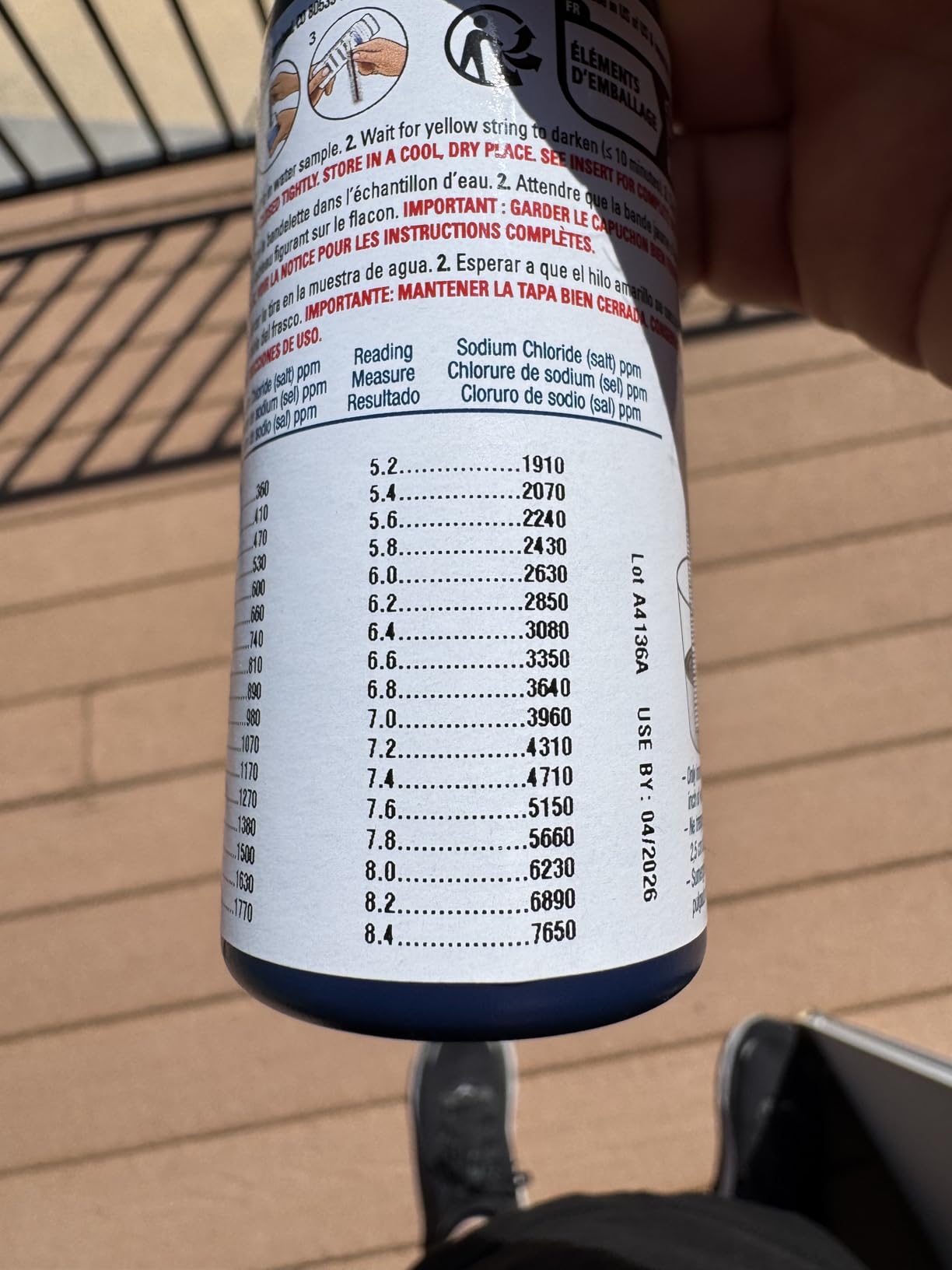
Multiple owners report validating the result against a digital salt meter, which matches what I saw. I also saw the reported weakness at the extremes, where a strip and a drop test can disagree on water that is very high or very cold. Inside the normal generator band the two methods agreed closely enough that I stopped double-checking.
One practical note that saves frustration: the cross-reference chart printed in the box can differ from the chart shown in the instructions. Read the one in your hand, and check the printed chart against your cell display once so you know the two color scales are aligned.
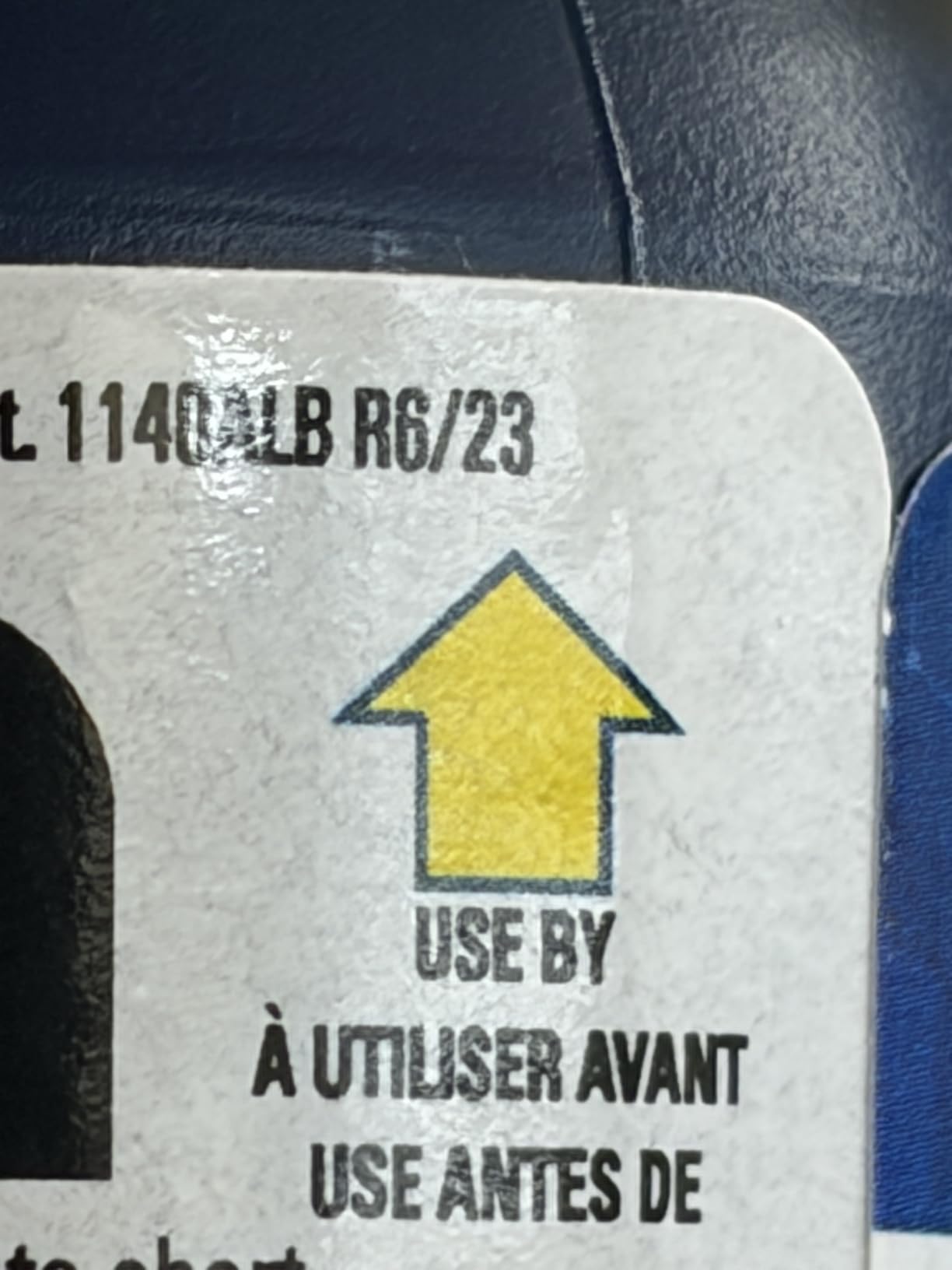
Why a titration strip beats a color block for salt
A color block strip asks you to decide which of several similar tan pads your water matches, and human color discrimination under direct sun is genuinely poor. A titration strip asks a different question, how long does it take for the pad to stop changing, and that is a timing decision your eyes are much better at. The result also lands on a numbered scale rather than a range, which is what makes it useful for the roughly 100 ppm margin that matters to a cell.
Where the reading drifted in my testing
Very cold water was where I saw the most disagreement between this strip and my drop test. If you are testing in early spring or a late-season cold snap, take a second reading after the water has had a few hours to mix and sit closer to room temperature before you act on a number.
The AquaChek Connect app and what it is actually good for
The free app lets you log readings and treatment plans, which sounds minor until you have a season of salt numbers to compare. The value is trend spotting. When I pulled up three months of readings I could see the pool drifting down slowly and correct it once instead of reacting to a single bad reading. It is bookkeeping, not chemistry, and it costs nothing to use.
3. eSeasonGear SALT-3050 Digital Salinity Meter – The Best Digital Read for Salt Alone
eSeasonGear SALT-3050 Waterproof IP65 Meter, Digital Salinity PPM Temperature Tester for Salt Water Pool and Koi Fish Pond
0-9999 ppm salt range
Pre-calibrated at 3000 ppm and 25C
IP65 waterproof
0-55C temperature range
+ Pros
- Usable straight out of the box at 3000 ppm
- Unambiguous numeric ppm display
- IP65 housing handles poolside drops
- Fast enough for a daily check
– Cons
- Measures dissolved solids so other contaminants skew it
- Some examples read off after calibration
- A few arrive with a display defect
- Not for marine aquariums
This is a pen, not a kit, and I want to frame it correctly so nobody buys it expecting a balance test. It measures one parameter properly, salt, and gives it to you as a number on an LCD with no color matching at all. For the single number where strip error matters most, that is worth more than extra buttons.
It arrives pre-calibrated at 3000 ppm sodium chloride at 25C, which is right in the middle of the band most generators run at. That means for most owners it is usable immediately without touching calibration solution, and in my case it has stayed close to my drop test readings across the season without adjustment.
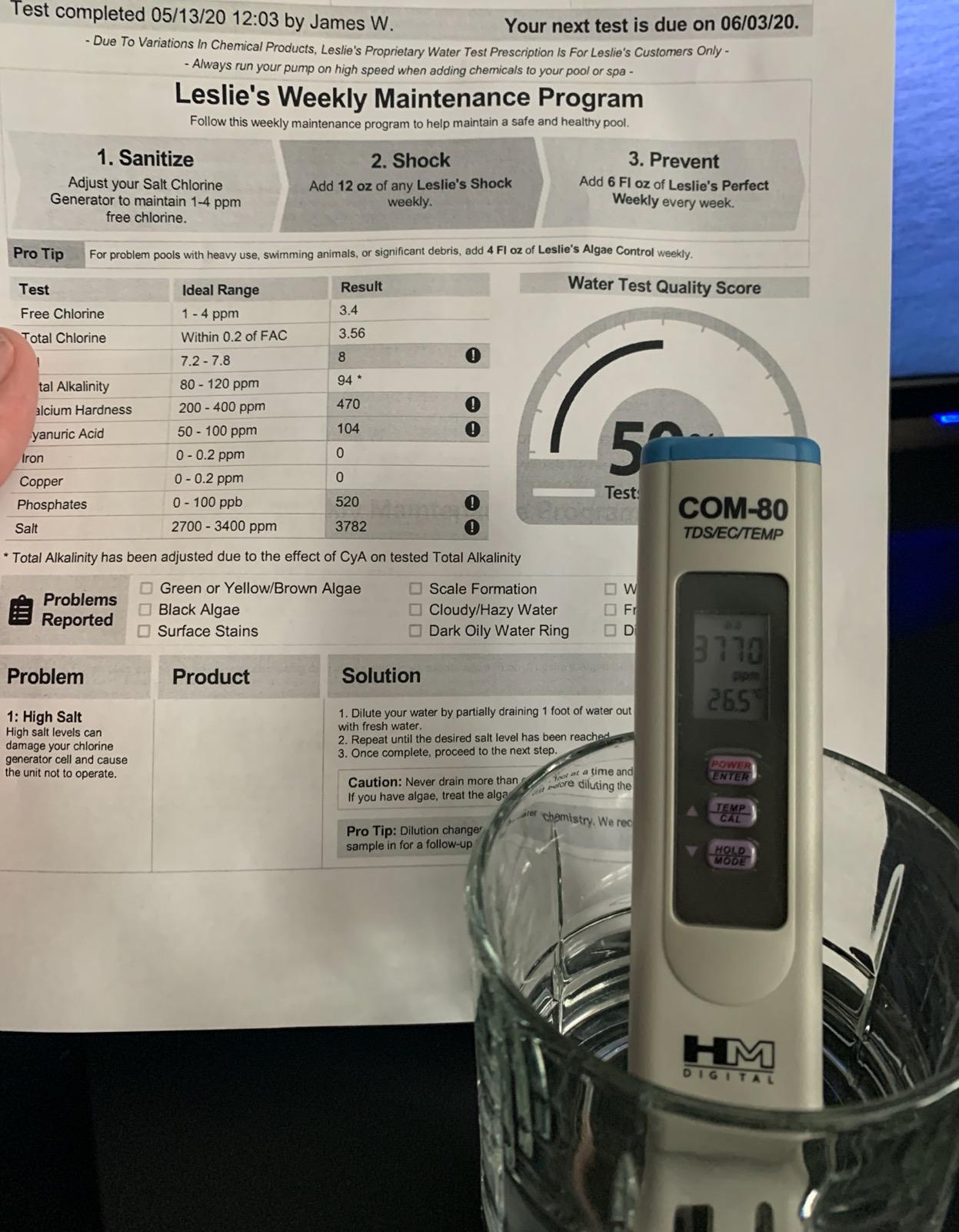
The IP65 rating is a genuinely useful detail. My meter lives in a bucket on the patio and gets rained on, rinsed off after use, and occasionally dropped in a chlorinated splash. Reviewers also report good agreement with the salt chlorine generator display, which makes it a fast second opinion when the cell and a drop test start telling different stories.
Now the honest limitation. Functionally this is a dissolved solids meter pointed at pool water, so anything else dissolved in the water moves the number. Salt chlorinators, algaecides, and some metal treatments all contribute. In my own testing it tracked salt accurately because I keep additions minimal, but if you are dosing heavy minerals you should treat its output as a trend line rather than an absolute value.
Battery life and poolside durability
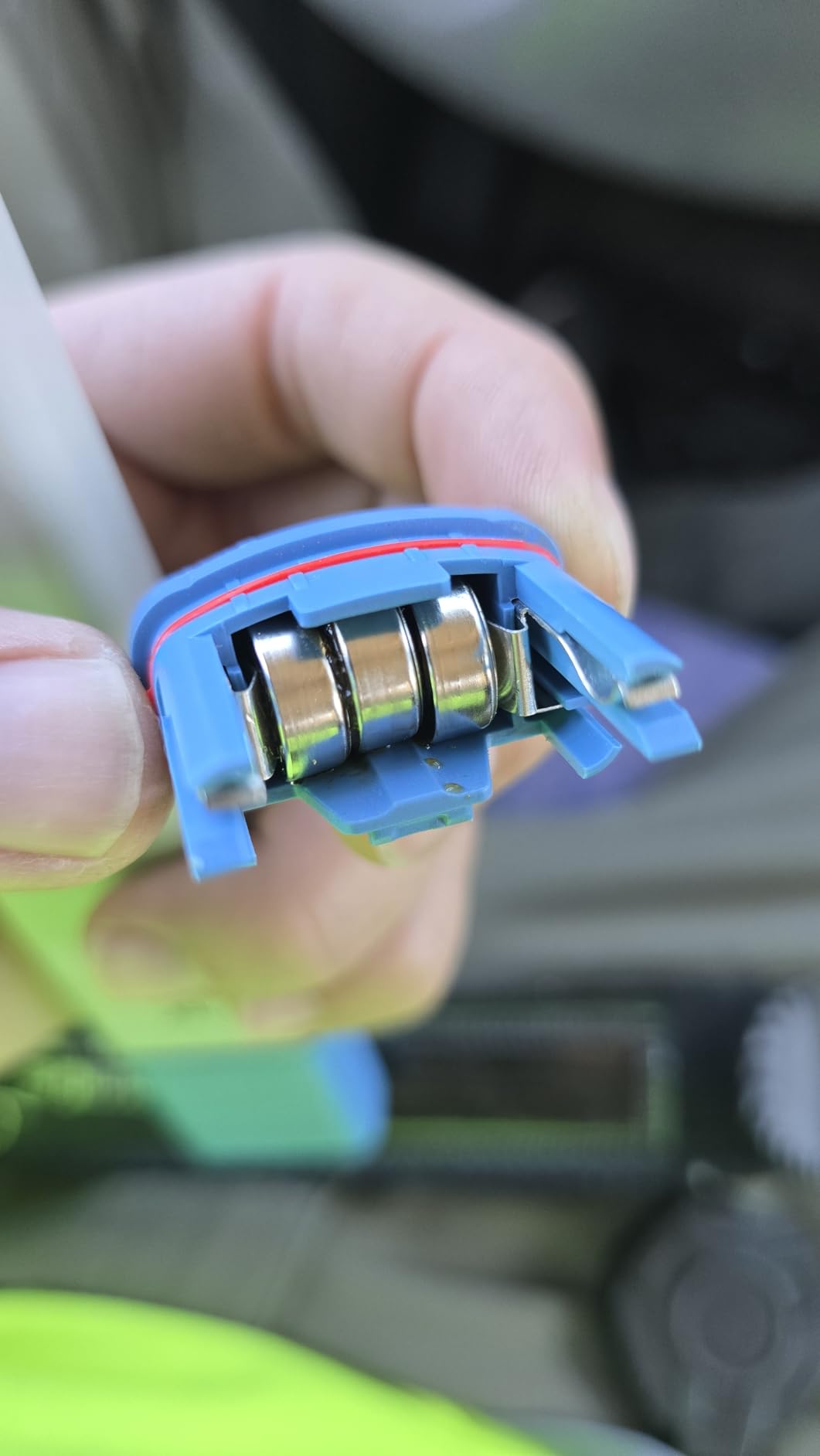
The battery pack is inexpensive and easy to source, and the stated temperature range of 0 to 55C covers everything from a cold spring morning to a heated spa. The waterproof housing is the part that has mattered most for me. I have a habit of rinsing meters in a hose bucket after use, and an unsealed unit would be finished by the end of summer.
Accuracy limits you should plan around
Some owners report examples that read noticeably off the true salt level even after calibration, and a few mention display defects on arrival. The reasonable response is not to avoid the tool but to use it the way I do, as a trend instrument you check against a titration when the number matters. If a reading suddenly moves by several hundred ppm, confirm it with the AquaChek titration strips before you start adding or removing salt.
Why it is scoped to pools and koi ponds only
The manufacturer states it is intended for saltwater pools and koi ponds, and that restriction is not marketing caution, it is a calibration limit. A marine aquarium or a food salinity check involves different dissolved solids profiles and tighter tolerances than a pool. For a pool or a koi pond the numbers line up well, which is why I recommend it inside that boundary only.
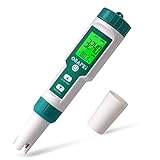
4. Hofun 9909-A-1 Five-in-One Digital Tester – Best Value in a Multiparameter Pen
Pool Salt Tester & PH Meter, Hofun Digital Salinity Meter and PH Tester for Aquarium and Pool Saltwater Water, 5 in 1 Salinity PH Temp EC and TDS Meter, Aquarium Swimming Pool Hot Tub, Multiparameter
Salinity, TDS, EC, pH, temperature
0-9999 ppm and 0-200 ppt
Titanium alloy probe
9.33 inch body
+ Pros
- Five readings from one dip
- Units switch between ppm ppt and percent automatically
- Titanium probe suits repeated use
- One-button mode selection
– Cons
- Calibration drift on the pH and salinity channels
- Not definitive for critical salt decisions
- One in ten ratings is a single star
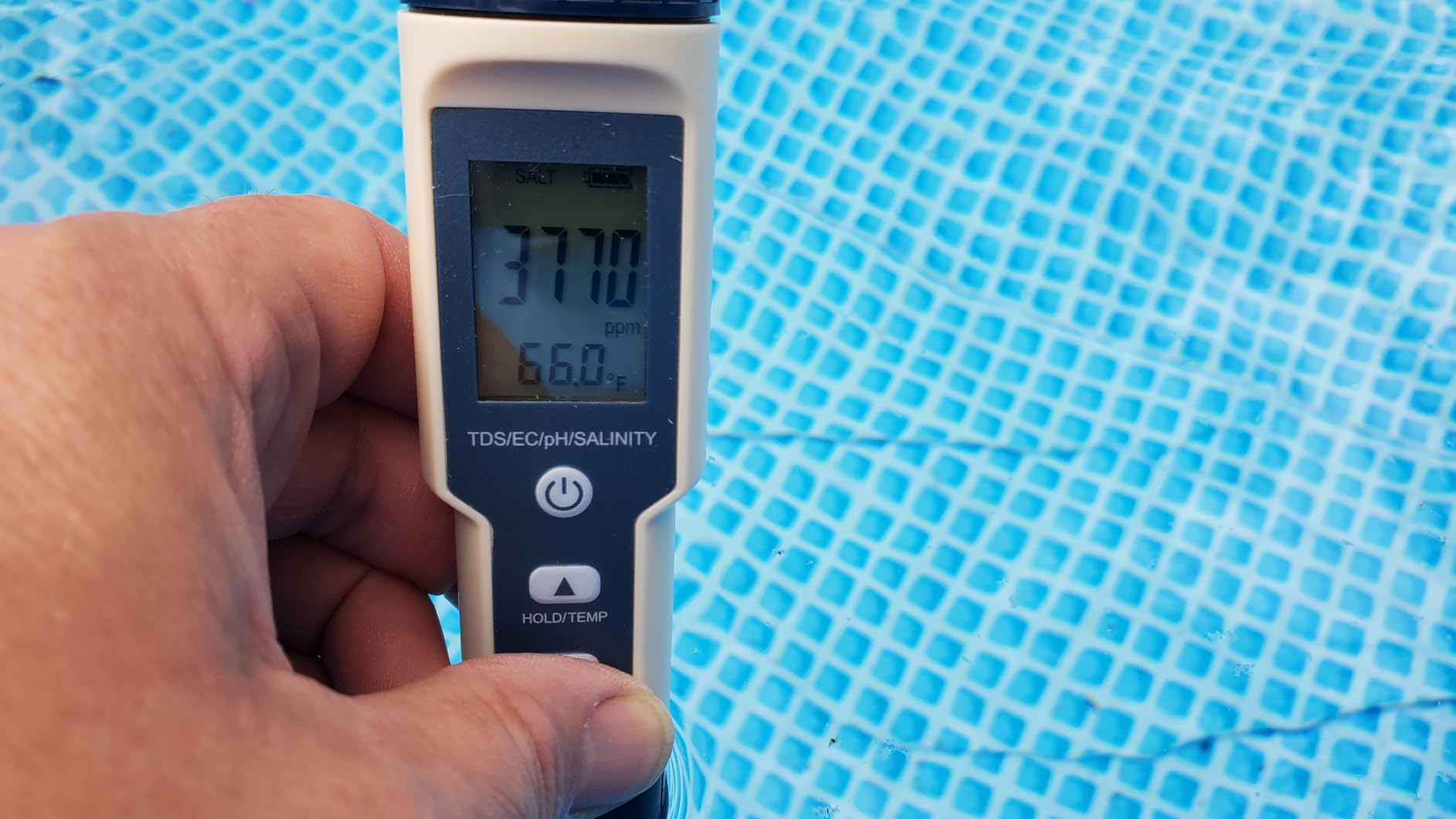
The pitch here is consolidation. Where the SALT-3050 does one parameter well, this unit reports salinity, total dissolved solids, electrical conductivity, pH and temperature from a single dip. For an owner who wants a fast daily snapshot of the whole pool without pulling out a drop test, that is a real convenience gain.
Salinity displays in ppm, ppt or percent, and the meter switches between them for you rather than making you convert. The titanium alloy probe is a sensible material choice for something that will sit in chlorinated water and get handled with wet hands every morning.
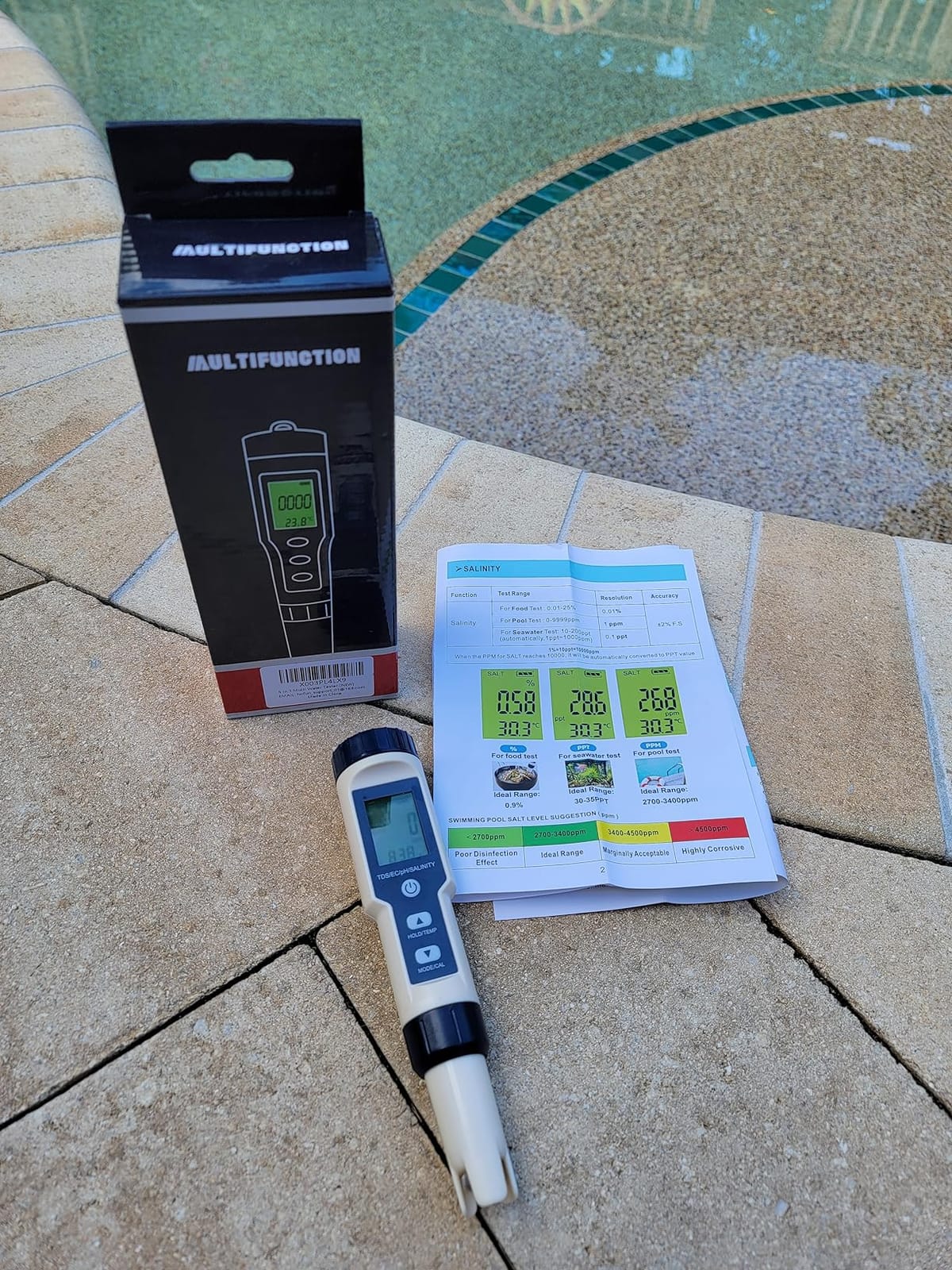
Calibration drift is the thing to understand before you buy, and it is the dominant theme in the reviews. Multiparameter pens measure pH with an electrode, and electrodes age. My experience matched the pattern in the feedback: the salinity channel held together fine, while pH crept high over weeks and needed recalibrating more often than I liked.
A visible one-star share of around ten percent is worth taking at face value. Some of that is clearly drift and some is people who expected a laboratory instrument. If you buy this, buy it for salt and TDS, treat the pH number as a direction rather than a value, and confirm anything you act on with a reagent test.
Where a five-in-one pen beats a single-purpose meter
The real saving is time, not money. One dip, five numbers, and you can see relationships that single-purpose tools hide. If salinity reads normal but conductivity is climbing, something other than salt is in the water. If pH and alkalinity drift together, you have a real balancing problem rather than a dosing mistake. That diagnostic pattern is what makes a multiparameter pen worth owning even when a specialist meter exists.
Range coverage and what the percent scale is for
The 0-9999 ppm and 0-200 ppt ranges cover a pool comfortably and extend well past the point where you would want to call a professional. The percent scale is carried over from food and aquarium applications rather than designed around pool water, so for a pool you will simply stay in ppm. It is not a feature you need, but it does no harm.
Also worth knowing for other water types
The same unit is sold for hot tubs, aquariums, koi ponds and reverse osmosis systems, and reviewers report using it successfully in each. That breadth makes it a reasonable single purchase for a household that maintains more than one body of water. If you also keep an aquarium, our freshwater aquarium test kit guide covers the reagent side of that setup.
5. SaySummer 8-in-1 Salt Pool Strips – The Best All-in-One Strip for Hot Tubs and Spas
Salt-Water Pool Test Strips Kit: 125 Counts 8-in-1 for Salt Water Pool Testing Kit, Salt Pool Test Strips for Hot Tub Spa Testing Salt Chlorine pH and More
Eight parameters on one strip
0-6000 ppm salt range
125 strips per bottle
Color chart with ideal band
+ Pros
- Salt plus seven balance parameters in one dip
- 125 count bottle covers a full season
- Chart marks the 2700-3400 ppm ideal band
- Fast workflow for spas
– Cons
- Salt pad is the least reliable pad on the strip
- Bottle chart can differ from the box chart
- Some results off against a reference kit
- Longer hold time than most 7-way strips
This is the strip I hand to friends and family who own a saltwater hot tub. Where a single-purpose salt strip covers one parameter, this one covers salt, free chlorine, bromine, total chlorine, cyanuric acid, total alkalinity, pH and total hardness in a single dip, which is the whole checklist for a small body of water in one motion.
The bottle count is the quiet advantage. At 125 strips, testing a spa three times a week through a full season is entirely comfortable, and you stop thinking about whether you have enough left. I also like that the chart highlights the 2700 to 3400 ppm band directly, because that removes the most common beginner error of aiming for a number that has no basis in how the cell actually works.
Be clear-eyed about the salt pad. It is the least reliable of the eight pads, and several owners report it sitting near the low end of the scale even when the water is properly salted. I saw the same thing, which tells me the pad chemistry is simply less sensitive than the chlorine and pH pads on the same strip. Treat it as a directional signal and confirm with a titration when it matters.
The hold time is longer than most seven-way strips ask for, and the wet pads are easy to read against a bottle while the timer runs if you keep your hand still. The one documentation annoyance is that the bottle chart and the box chart can differ, so read the one attached to the bottle you are actually using.
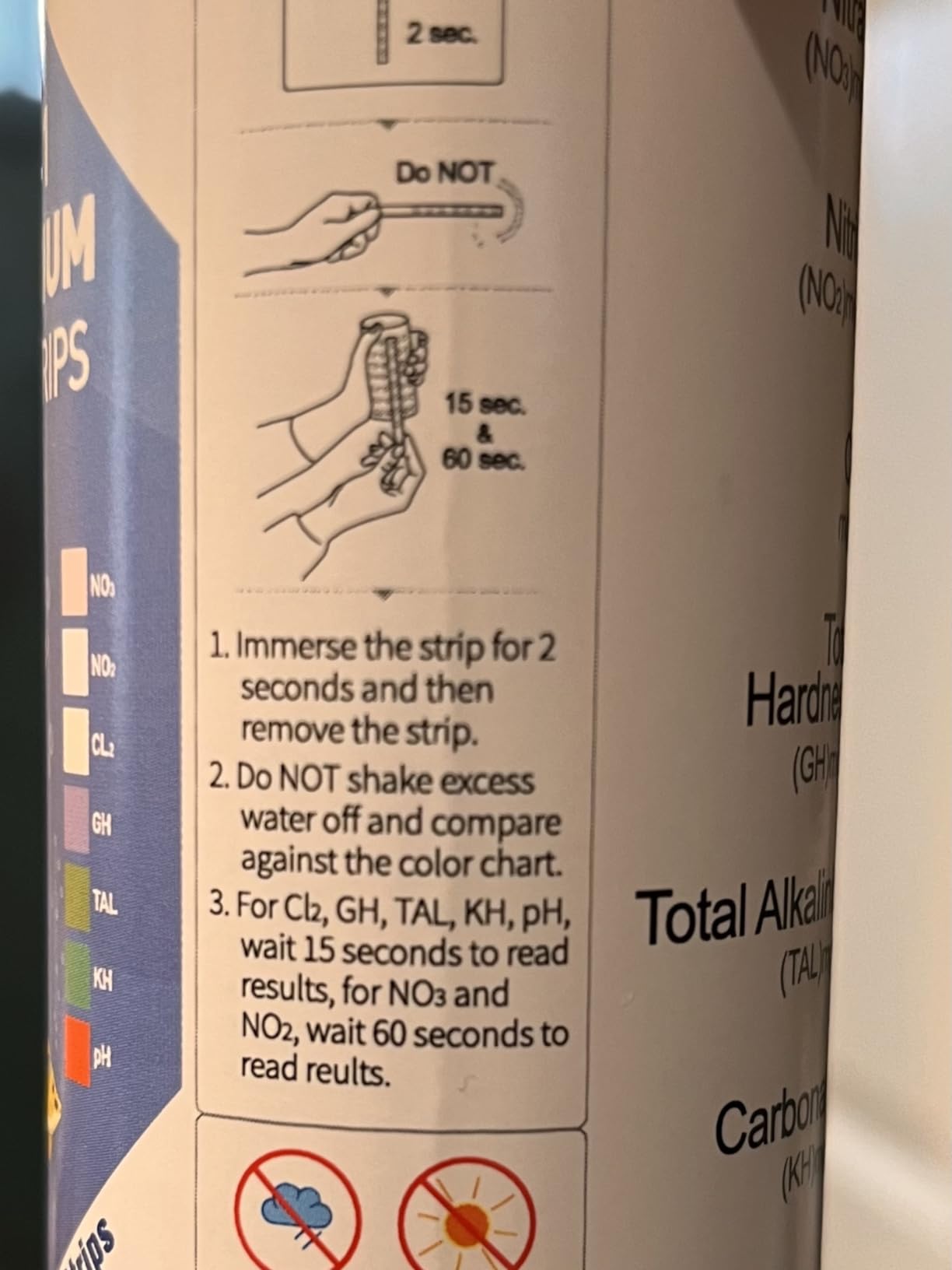
Why the ideal salt band on the chart matters more than it sounds
Most pool owners have a vague sense that salt level matters but no idea what number to aim for. Having the band printed right on the bottle means you are comparing against a target rather than against a feeling. It also stops the two classic failure modes, running too low so the cell stops producing, and running too high so sodium crystallizes on cell plates and pool surfaces and begins to scale.
Where this strip beats a dedicated salt strip
If your only water is a hot tub or a small above-ground pool, the dedicated salt strips are testing one parameter and leaving five untested. This one covers the full set, so the marginal cost of adding salt coverage to a multi-parameter strip is close to nothing. If you have a large in-ground pool with a cell and a proper balance routine, a separate drop test still earns its place.
Strip format limits worth naming
Every pad on a multi-parameter strip shares one water sample, so an error in one channel, most often pH or temperature sensitivity, can shift the interpretation of the others. Strip testing also cannot tell you combined chlorine, which is exactly the number that reveals an inadequate sanitizer. For daily trending this is more than enough. For diagnosing a specific problem it is not enough, and that is what the next group of products is for.
6. ORAPXI LD-175 Salt and pH Meter – The Best Budget Digital Meter for Daily Trends
ORAPXI Pool Salt Tester pH and Salt Meter for Saltwater Pool pH Tester
5-in-1 salinity pH TDS EC temp
Salt 0-9990 ppm
pH 0.00-14.00
Calibration powder in box
+ Pros
- Digital reading removes color guessing
- Salt readings landed within about 100 ppm of a chemical test
- Great between full kit tests
- Low ongoing cost versus strips
– Cons
- pH channel needs frequent recalibration
- Some owners report disagreement with other references
- Calibration can be fiddly for beginners
The case for this meter is simple. Between full kit tests, which happen weekly, you still want to know whether the salt level moved. A strip costs you a few seconds and gives you a color band. This gives you a number, instantly, without liquid reagents, which is the whole argument for owning any digital salinity pen.
Owners report salt readings within roughly 100 ppm of a chemical test in their own verification, and that matches my experience closely. Over a season the number proved stable, which made it useful for spotting a slow leak in the salt rather than reacting to one odd reading.
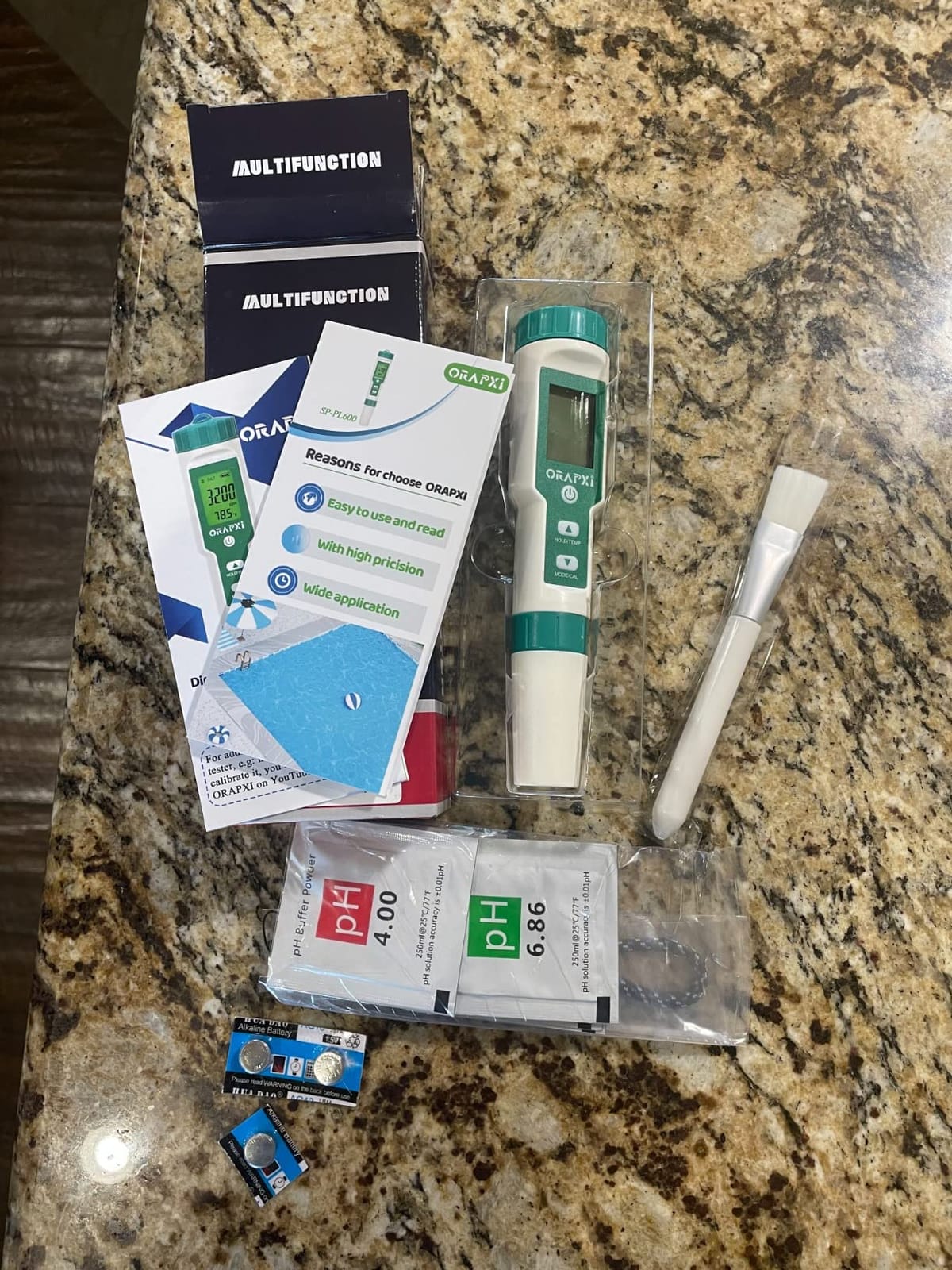
The pH channel is the weak link and reviewers are consistent about it. It drifts high, it needs recalibrating more often than the salt channel, and a few owners report it disagreeing with strips, their cell and pool store results at the same time. Treat the pH reading as a signal that something is moving and confirm it with a drop test before you dose.
Calibration powder is included in the box, which is better than the alternative where you buy a meter and then discover you have no way to calibrate it. It is still fiddly the first time. Do it once on your kitchen counter with a glass of tap water before you try it poolside.
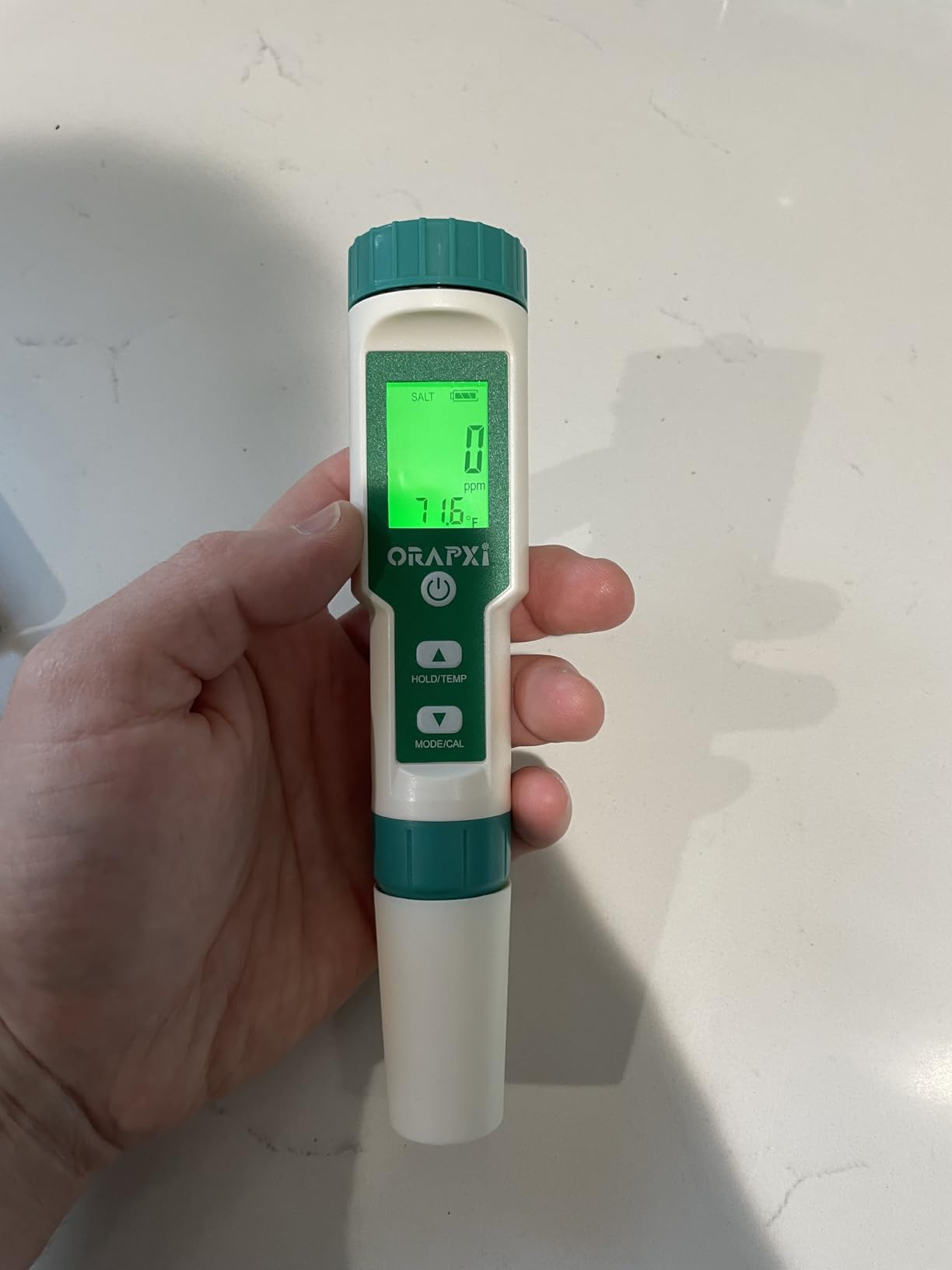
Calibration powder and why it matters more than the specs
A meter you cannot calibrate is a meter you will stop trusting in six weeks. The included solution changes that equation, and the saltwater readings, which are what you are buying this for, held up well in verification. The pH electrode is the wear item, not the salt channel, so the practical habit is to recalibrate pH monthly and salt only when you see drift.
The honest cost comparison against strips
Over a full season of daily checks, a bottle of single-parameter strips and a bottle of multi-parameter strips will both add up to a noticeable amount of recurring spend. A one-time meter purchase plus occasional calibration ends that line item. The trade is that you give up the ability to test five parameters instantly, which is why I would still keep one strip product on the shelf alongside it.
Where it fits in a saltwater setup
This is the tool for the pool where the cell has no readable salt display, or where you have simply never trusted what the cell said. It is also useful for koi ponds and reef tanks, though owners should verify the calibration target suits their water before relying on it. For a residential saltwater pool, it slots in as the fast daily check with a weekly reagent confirmation.
7. Taylor K-1766 Sodium Chloride Drop Test – The Best Dedicated Salt Titration
Taylor Technologies K-1766, Pool and Spa Drop Test Kit for Sodium Chloride
Salt-only silver nitrate titration
Glass tube and test paper
Storage case included
No batteries or sensors
+ Pros
- Reference-grade salt readings used as a benchmark
- No batteries or sensors that drift
- Plain-language pictogram instructions
- Compact case keeps it poolside
– Cons
- Requires careful swirling and drop counting
- Two reagent bottles are the same size despite different use
- Seasonal reagent replacement needed
- Occasional bottles arrive without a drop cap
This is the kit owners use to settle arguments. When a digital pen and a strip disagree, the Taylor K-1766 is the one both sides tend to accept, because the silver nitrate titration has no electronics that can drift and no color chart that can be misread. It is the closest thing to a reference measurement you can do at home for salt.
You fill the glass tube with a measured sample, add the indicator, and then count drops of silver nitrate while swirling until the endpoint color appears. The drop count converts to parts per million. It takes longer than a strip and requires attention, and the payoff is a number that does not depend on your eyes judging a tan shade in direct sun.
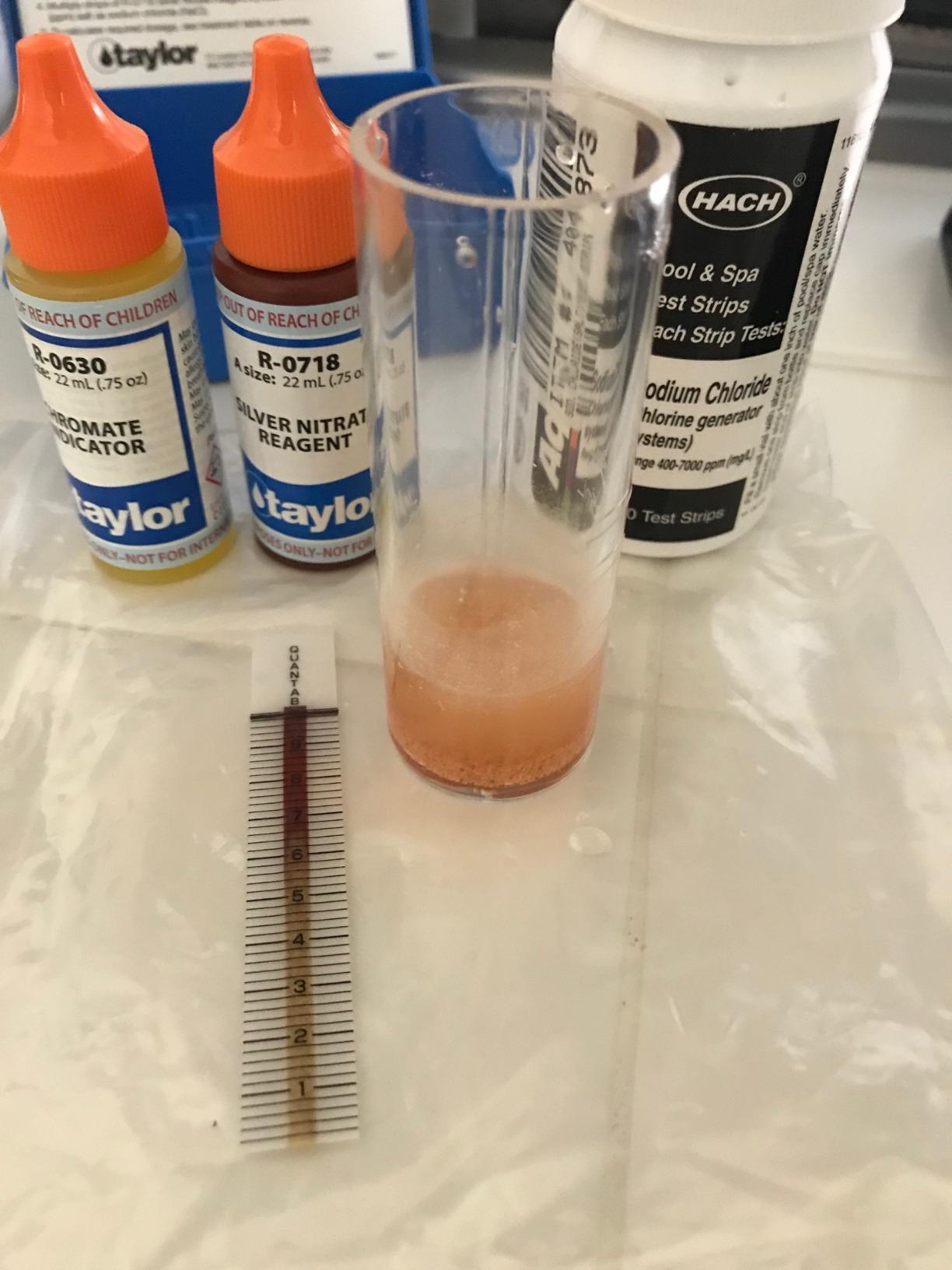
Two practical notes from my own use. First, the two reagent bottles are the same physical size even though the drop counts you will use from each are wildly different, so read the instructions carefully rather than assuming. Second, the included pictogram sheet is genuinely clear, and following it exactly is what makes the difference between a good reading and a bad one.
Reviewers note that this kit is cheaper to run than a strip habit once you have bought the reagents, and I would agree for a pool you test weekly year round. The recurring cost is seasonal rather than daily, since you replace the bottles rather than consuming them one reading at a time.
Why silver nitrate titration is the reference method
Chloride ions react with silver ions in a predictable ratio, so the number of drops needed to reach the endpoint tells you the concentration directly. Nothing about that depends on lighting, display quality, or a probe aging. It is a chemical reaction with a defined stoichiometry, which is why pool professionals treat it as the benchmark that other methods are checked against.
The one parameter limitation nobody mentions
This kit tests salt and nothing else. It does not measure free chlorine, pH, total alkalinity, calcium hardness or cyanuric acid. That is the single most common purchase mistake in this category, because owners buy a salt kit expecting a complete saltwater solution and end up needing a second kit anyway. If you want everything in one case, that is a different product further down.
Swirling technique and the endpoint
Add drops slowly, swirl after each one, and stop when the color change persists through a full swirl. Rushing produces endpoint error that shows up as a reading a couple hundred ppm high. I also take the sample from elbow depth, which I cover in the protocol section, because shallow water gives a number that will not match the body of the pool.
8. Taylor K-2006-SALT FAS-DPD Nine-in-One Kit – The Best Complete Kit for One-Case Chemistry
Taylor Technologies K-2006-SALT FAS-DPD, 9-in-1 Saltwater Pool Test Kit
Nine parameters in one case
FAS-DPD high range chlorine
Sodium chloride testing included
0.75 oz reagent bottles
+ Pros
- Covers all nine parameters a saltwater pool needs
- Readings matched professional lab results
- Removes the trip to a pool store
- Professional standard that is learnable at home
– Cons
- Steep learning curve with many steps
- 0.75 oz bottles run out quickly when testing often
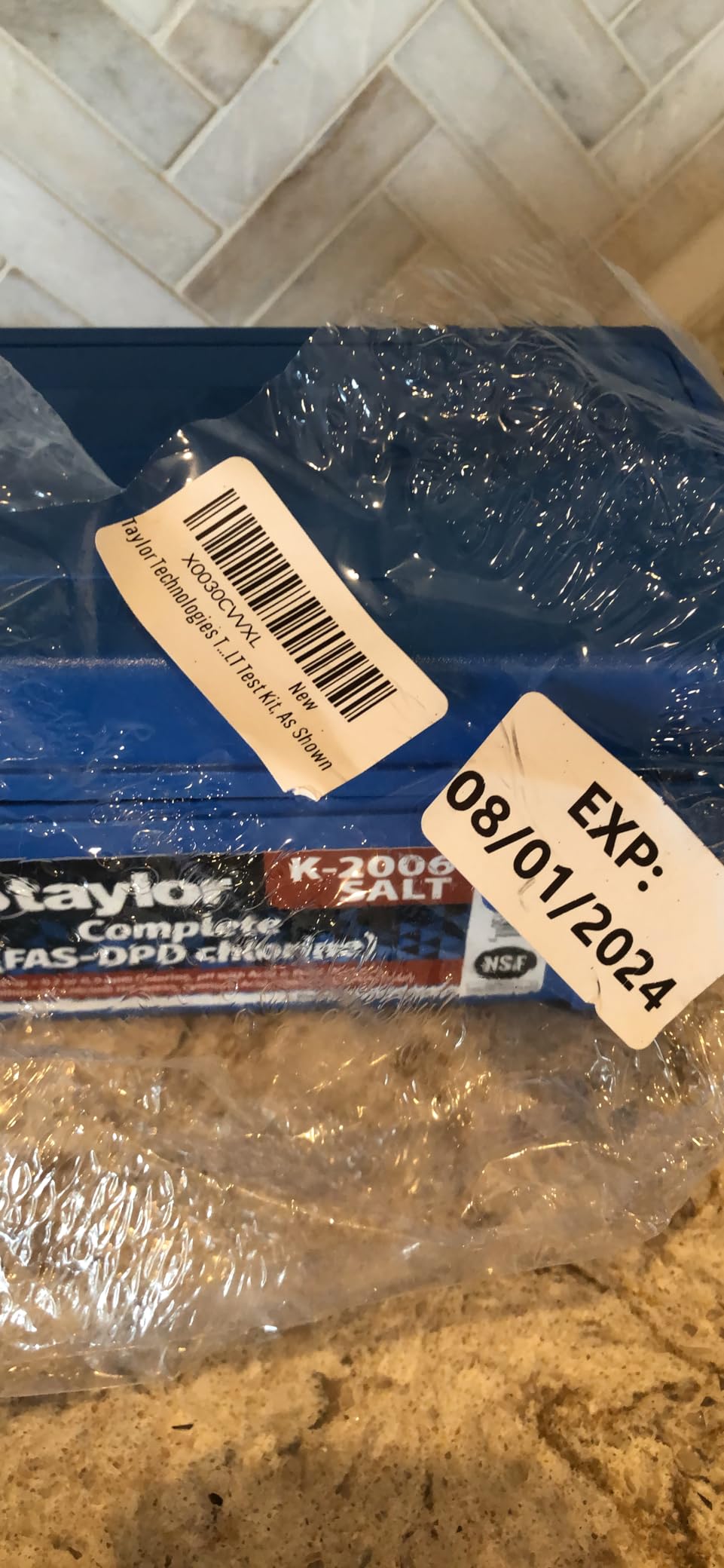
- Some sets arrive near printed expiration
- Reagents need annual replacement
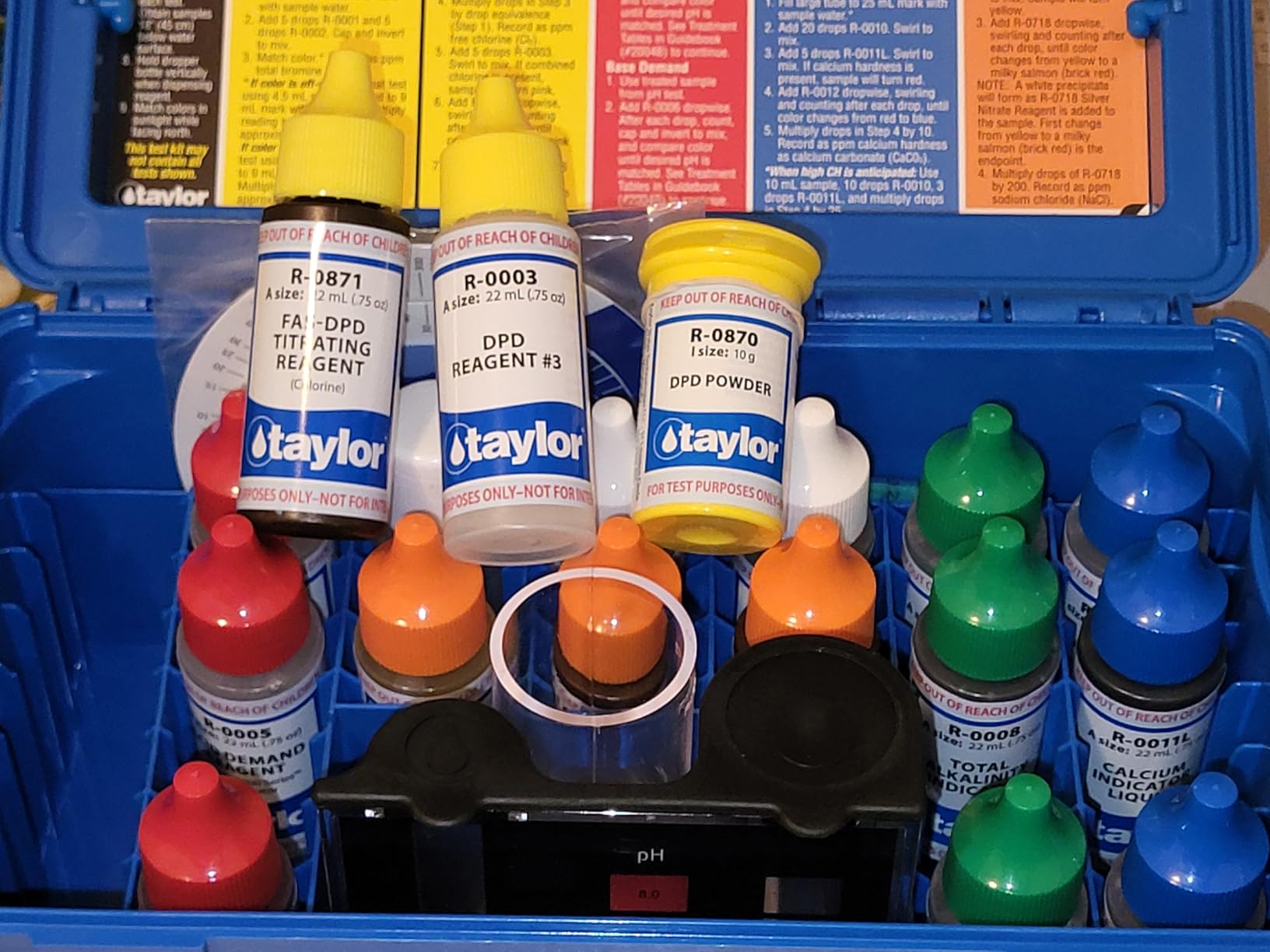
Everything else on this list tests a slice of the chemistry. This kit covers the whole panel in a single case: free chlorine, combined chlorine, pH, acid and base demand, total alkalinity, calcium hardness, cyanuric acid and sodium chloride. If you want one purchase that answers every question about a saltwater pool, this is the one.
The reason professionals reach for it is FAS-DPD, a two-reagent titration that measures free and combined chlorine separately. Standard DPD reads the combined total and cannot tell you how much of that is chloramine, which is the number that reveals a failing sanitizer. FAS-DPD also stays accurate at high chlorine levels, so it is the method you want after a shock treatment.
Owners report that readings match professional lab and pool store results once they master the procedure, and that is the standard that matters. I will not pretend the first session is easy. The kit has more steps than a basic liquid kit, and the FAS-DPD portion in particular rewards a slow first read with the instructions in front of you.
The practical constraint is reagent volume. The bottles supplied are 0.75 oz, and owners testing several times a week report running out early, with cyanuric acid reagent depleting fastest. The larger 2 oz bottles come in the K-2006C-SALT service version, which is worth knowing if you intend to test on a heavy schedule.
FAS-DPD and why it beats standard DPD on accuracy
Standard DPD relies on a color match against a chart and treats free and combined chlorine as one number. FAS-DPD adds a second reagent that frees the bound chlorine, so a second titration gives you the combined value and a subtraction gives you free chlorine. It costs you more time and more reagent, and it is the only method here that remains reliable after you have shocked the pool to very high levels.
Reagent volume and the CYA bottleneck
Cyanuric acid is consumed by every test you run, and the supplied bottle is the smallest in the case. If you test weekly through a season you will finish it before the chlorine reagents, which is why several owners buy a refill set up front. Checking the printed expiration date when the kit arrives matters too, since some sets land close to it.
Who this kit is right for, and who should skip it
If you own a saltwater pool, test at least weekly, and want the pool store verification trips to stop, this is the kit. If you are new to pool chemistry, or you test a small spa once a month, you will spend more time learning than testing and a simpler setup will serve you better. The complete kit rewards an owner who is already comfortable with drop tests.
9. T TESTRUST EZ-9909SP Five-in-One Tester – The Best Backup Reader for Cross-Checking
T TESTRUST Pool Salt Tester – Multifunctional 5 in 1 Salinity, PH, TDS, EC, and Temperature Meter, Pool Salinity Testing Kit, Digital Salinity Tester for Swimming Pool,Saltwater, Sea Water, Aquarium
Salinity, pH, TDS, EC, temperature
Salinity 0-9999 ppm or 10-200 ppt
pH calibration solution included
LCD readout
+ Pros
- Readings land close to local pool store tests
- Helped diagnose an inaccurate salt cell
- Several readings from one dip
- No color matching at all
– Cons
- Temperature channel reported inaccurate by one owner
- Salt channel may need solution that is not included
- Reliable results need a glass sample
The reason I keep a second digital meter is redundancy. When your salt chlorine generator, your strips and a liquid kit all agree, you need no tenth tool. When they disagree, as they did for me mid-season when the cell read high, I wanted a second independent opinion that was not another strip from the same shelf.
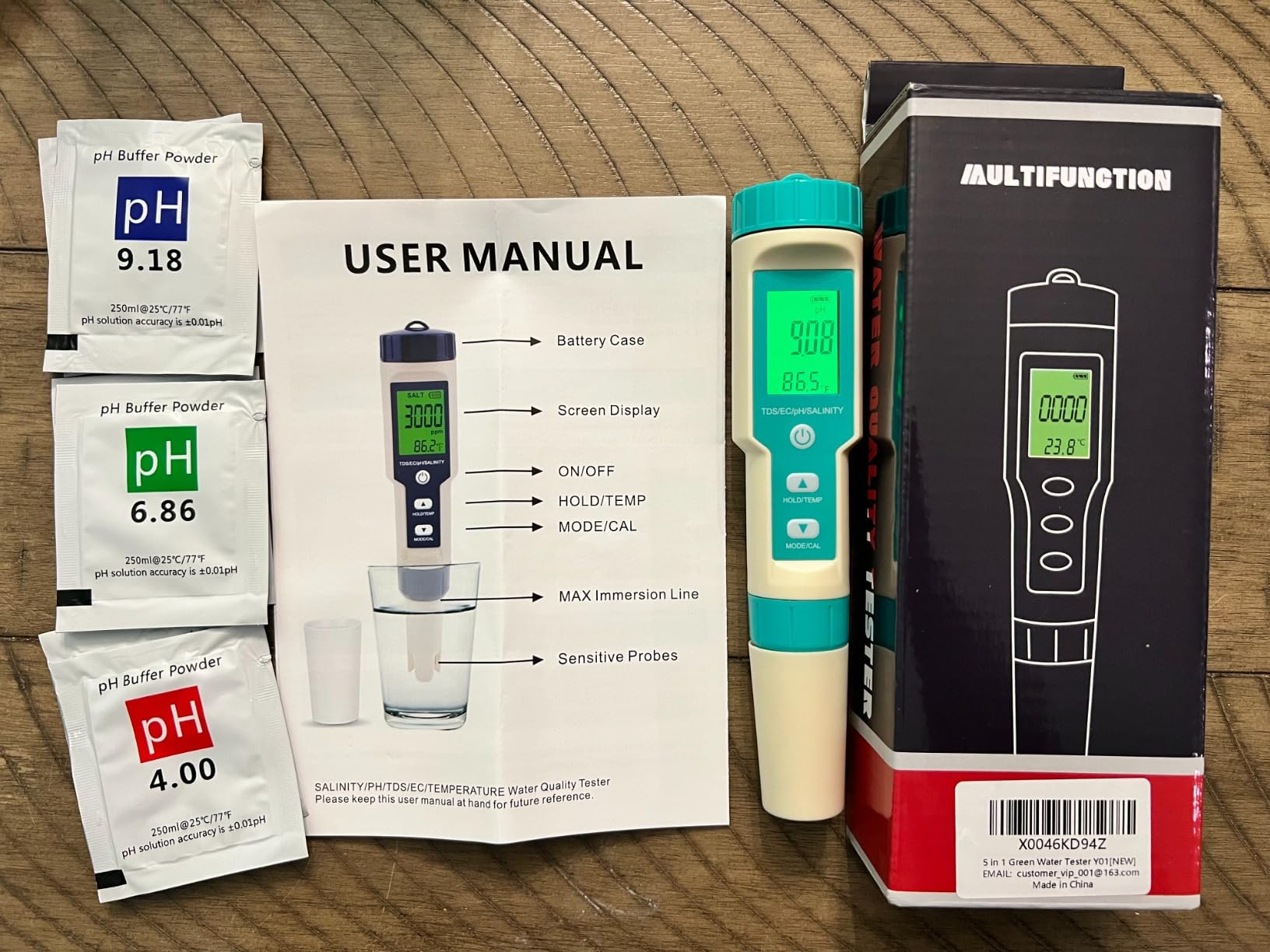
Owners report that this unit’s salinity readings line up with both their generator display and independent pool store testing, and that it has helped them identify a cell reporting incorrectly. That is exactly the job I wanted it for. The five-in-one format means one dip gives me salinity, pH, total dissolved solids, conductivity and temperature to compare side by side.
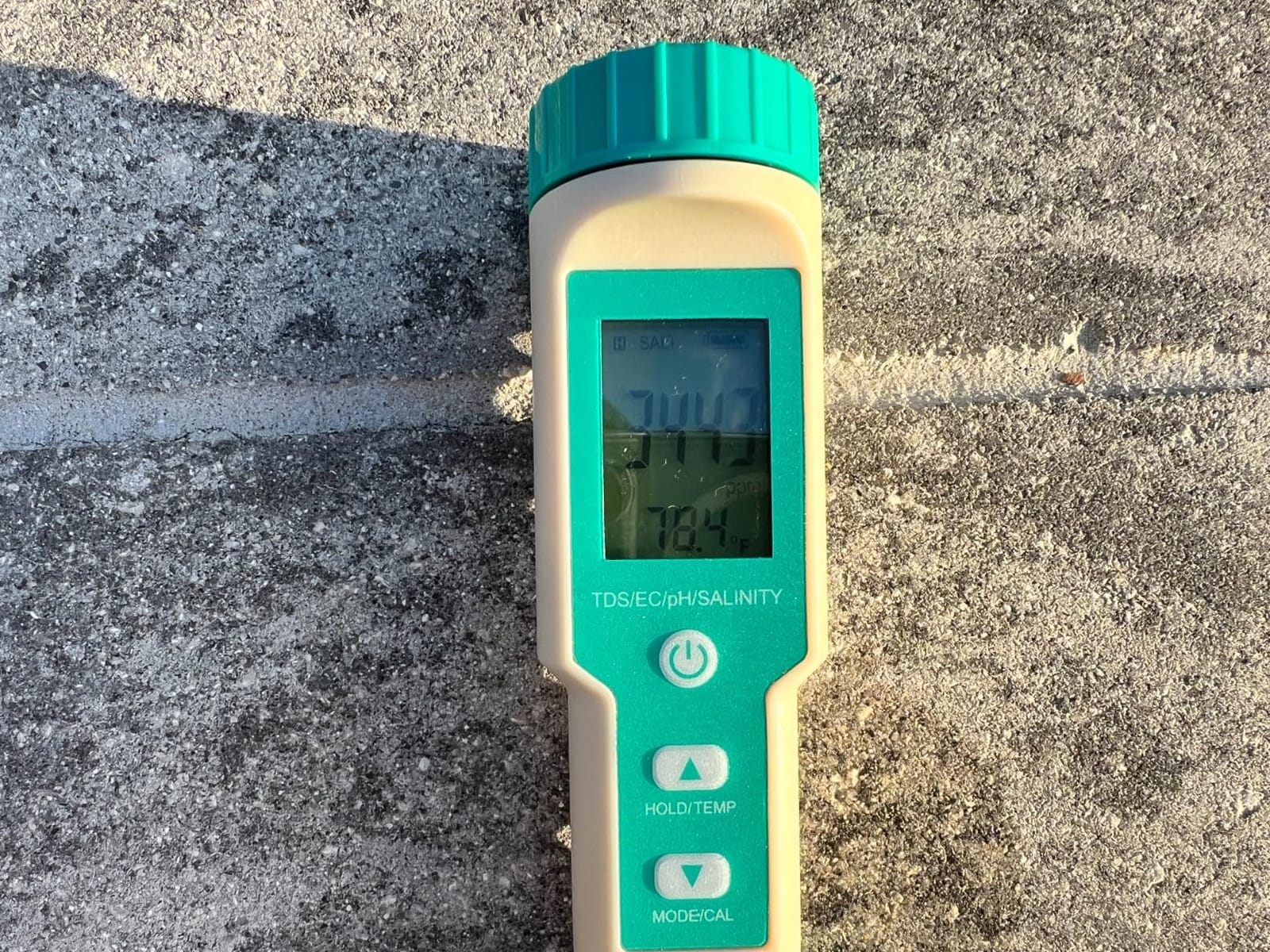
It switches automatically between ppm, ppt and percent, with a salinity range of 0 to 9999 ppm and a 10 to 200 ppt range alongside it. The LCD is clear enough to read in daylight without shading it with your hand, which sounds minor until you are doing this at noon on a pool deck.
The caveats are worth knowing. One owner reported an inaccurate temperature channel, and reviewers note the salt channel can need calibration with a separate solution that some units do not include. A pH calibration solution is in the box, so pH is covered out of the gate.
Why a glass sample changes the result
Reviewers specifically recommend dipping the probe into a glass container rather than straight into the pool. The reason is consistency. A glass gives you a stable volume at a stable temperature, which makes repeated readings comparable to each other. Probing directly into moving pool water introduces variation that looks like a change in chemistry when it is really a change in your sampling.
Diagnosing a cell that reports the wrong number
Because it is independent of your generator, this meter is valuable in one specific scenario: your cell says one number and your drop test says another. Reading a third and fourth source tells you which one is lying. In my case it was the cell, and confirming that with an independent device saved me from adding salt to a pool that already had enough.
Review volume and what it means for you
This is a smaller review base than the leaders in this category, which means less long-term feedback and fewer owners reporting years of use. That is not a dealbreaker for a backup instrument, but it is a reason to verify it against a known reference the first few times you use it rather than trusting it on faith from day one.
10. UIUZMAR Seven-in-One Digital Pool Tester – The Only Pick Here That Reads Free Chlorine Digitally
UIUZMAR pH and Salt Tester for Pool Free Chlorine Meter ORP Meter 7 in 1 Digital Pool Water Tester for pH, Salinity, Free Chlorine, ORP, TDS, EC, Temp Saltwater Pool Tester PPM and EC Meter
pH, free chlorine, salinity, ORP, TDS, EC, temp
Factory pre-calibrated
Protective probe cap
8.1 ounce body
+ Pros
- Measures free chlorine and ORP digitally
- Pre-calibrated so readings work immediately
- High-sensitivity pH electrode holds steady
- One probe covers salt chlorine and sanitizer
– Cons
- Smaller review base than established brands
- Digital chlorine still depends on probe care
- Newer listing with a shorter history
Every other digital meter on this list measures salt and pH. This one also measures free chlorine and ORP, which is a meaningful difference for a saltwater pool because ORP is the single best proxy for how well the cell is actually sanitizing. It is built specifically around salt chlorine generator setups rather than general water testing.
All seven parameters arrive factory pre-calibrated, so the reading is available the moment you dip the probe. Reviewers highlight a high-sensitivity pH electrode that holds a value instead of flickering, which addresses the drift problem that plagued the cheaper pens I tested.
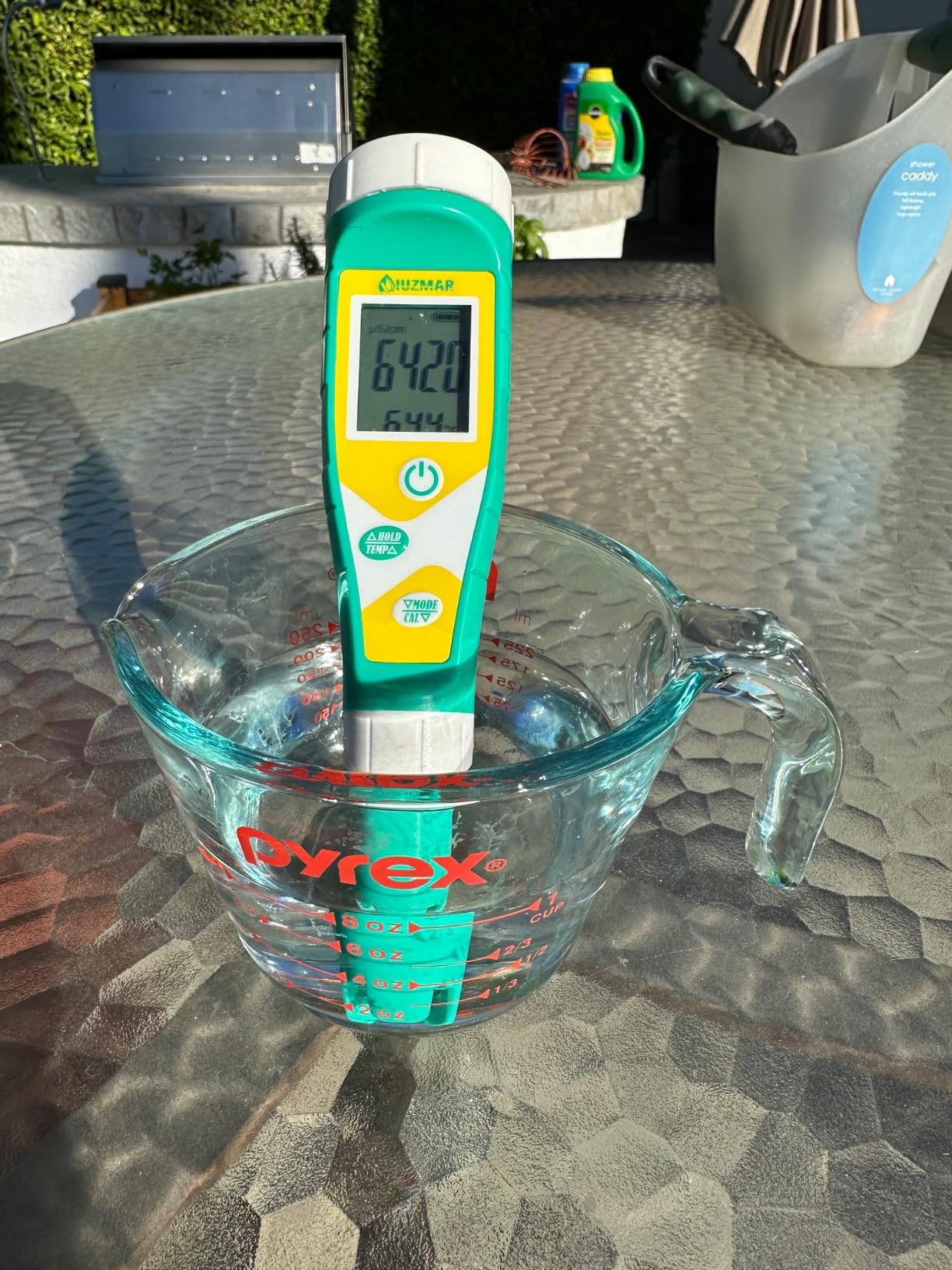
The protective cap over the pH and ORP probe is a thoughtful detail. Digital chlorine and ORP readings depend on probe condition, and a capped probe stays wetted and stable between uses rather than drying out. Owners who care about consistent readings appreciate that, and it is the reason digital chlorine meters behave better in practice than their reputation suggests.
What I would weigh carefully is the review base. With a smaller number of ratings than the established kits in this roundup, you have less long-term data, and reviewers themselves note it is a newer listing. The device does what it claims, but verify it against a FAS-DPD reading before you trust the chlorine number for a dosing decision.
What ORP tells you that a chlorine number does not
Free chlorine tells you how much sanitizer is in the water. ORP tells you how effective it is at oxidizing, which depends on pH, temperature, and the presence of organics. In a cell-generated pool, an ORP reading in the mid 700s generally means the water is being sanitized effectively. It is the number I would check first when sanitization seems fine on paper but algae keeps appearing.
Probe care is the real cost of digital chlorine
Reviewers are honest that digital chlorine readings still depend on proper probe care and storage. That means rinsing after use, keeping the cap on, and storing the unit somewhere between freezing and hot. If you are willing to do that, the measurement is far more convenient than a FAS-DPD titration. If you are not, a reagent kit will serve you better because reagents do not degrade between uses.
Where this fits against the Taylor complete kit
These are not really competing products. The K-2006-SALT is the reference measurement with reagents and a learning curve. This is the instant monitoring device. Plenty of owners who own the complete kit still keep something like this on the patio for a quick between-tests check, and that combination catches a problem on a Tuesday instead of on Saturday.
Do You Need a Special Test Kit for a Saltwater Pool?
Not a special one, but you do need a kit that measures salt in addition to the standard balance parameters. Every salt chlorine generator cell already reports a salt level, so a dedicated salt test is a cross-check rather than a necessity. What you genuinely need is accurate free chlorine, pH, total alkalinity, calcium hardness and cyanuric acid testing, plus a reliable salt reading before you ever add or remove salt.
The reason the salt number still matters despite the cell display is that the failure modes are expensive and quiet. Below roughly 2700 ppm the cell produces little or no chlorine and you get algae with no obvious cause. Above about 3400 ppm sodium crystallizes on the cell plates and begins scaling fittings and surfaces, and that damage does not reverse when you lower the level again.
Salt also changes how the rest of your chemistry behaves. Total alkalinity tends to run lower in a cell pool because the electrolysis process produces hydrogen that off-gasses, and pH climbs with it. Calcium hardness matters more too, because a higher salt concentration raises the scaling pressure on plaster and tile surfaces. A kit that only reads salt leaves you managing these blind.
How to Test a Saltwater Pool the Right Way
Sampling technique does more for your accuracy than any kit on this list. Ten seconds at elbow depth with a clean sample container will beat a rushed grab from the shallow end every single time, and this is where most home testing goes wrong.
Sample at elbow depth, not the surface. Skim the water first, then draw the sample from about 18 inches down with a clean ladle or a dedicated sample thief. Surface water reads warmer and gives different results than the body of the pool.
Test before you dose, not after. If you just added acid or shock, wait until the water circulates fully and then test again. Chemical readings taken mid-mix are meaningless.
Swirl to the endpoint, every time. On any titration, add drops slowly and swirl after each one until the color holds through a full swirl. Speed is the single biggest source of read error.
Read color in shade, not direct sun. Sunlight washes out the difference between adjacent color blocks on both strips and drop charts. Stand with the chart shaded by your own body.
Average duplicate readings. Run it twice when the number matters. If the two differ noticeably, run a third. Consistent error is a calibration problem, varying error is a technique problem.
Match frequency to your pool surface. Vinyl and fiberglass owners can test less often. Plaster and tile owners testing more often is what keeps scaling in check.
The reference numbers for a saltwater pool run roughly 2700 to 3400 ppm salt, 2 to 4 ppm free chlorine, 7.4 to 7.6 pH, 70 to 90 ppm total alkalinity, 200 to 400 ppm calcium hardness, and 60 to 80 ppm cyanuric acid. Every kit on this list that reads salt gives you a number against that 2700 to 3400 window, and that window is the single most useful thing a saltwater pool test kit can tell you.
One more note for smaller setups. If your saltwater pool is an above-ground or a compact in-ground model, the same chemistry rules apply but the volume is smaller, so a single dosing mistake moves the numbers much faster. Our above-ground pool cleaning guide covers the maintenance side for those setups.
How to Choose a Saltwater Pool Test Kit Without Guessing
FAS-DPD versus standard DPD, and why the titration method wins
This is the single most important spec to understand. Standard DPD measures total chlorine and matches it to a printed color, which is fast and adequate on a normal day. FAS-DPD uses two reagents so you get free and combined chlorine separately, which is the only way to know whether your sanitizer is actually working. It is also the only method listed here that stays accurate at very high chlorine levels after a shock treatment.
For a saltwater pool the FAS-DPD argument is stronger than it is in freshwater, because the cell produces chlorine slowly and continuously and problems show up as a gradual drift rather than a sudden failure. Combined chlorine is what tells you the drift is happening. If you are buying one liquid kit, buy the FAS-DPD version.
Decoding the Taylor model codes so you buy the right kit
The model numbering confuses more owners than anything else in this category, so here is the short version. The K-2006 is the residential FAS-DPD kit covering the full balance panel without salt. The K-2006C is the same chemistry in a service size with larger 2 oz reagent bottles, intended for people testing many pools. The K-2006-SALT adds sodium chloride testing, and the K-2006C-SALT is the service version of that. The K-1766 is a standalone salt-only titration that tests exactly one parameter.
So the decision is simple. One pool, weekly testing, want everything including salt, buy the K-2006-SALT. Several pools or heavy testing frequency, buy the C-SALT for the larger bottles. Already have a complete balance kit and only lack salt, buy the K-1766 and nothing else.
Reagent shelf life and refill cost as a buying factor
Liquid kits have a running cost that strips do not, and it is worth calculating before you buy. The K-2006-SALT ships with 0.75 oz bottles, which owners testing weekly report depleting before the season ends, with cyanuric acid going first. Plan to buy a refill set rather than treating the kit as a one-time purchase, and check the printed expiration date when it arrives.
Reagents that have gone past their date produce results that look plausible and are wrong, which is worse than having no kit. Replace them seasonally and store them somewhere that does not swing between freezing and hot. A storage case that keeps reagents upright and dark does more for accuracy than any other habit.
Matching test frequency to your pool surface
Surface type drives how often you need to test, more than pool size does. Vinyl and fiberglass surfaces are chemically inert, so once balanced they drift slowly and a twice-weekly routine is plenty. Plaster and tile are calcium-based, and with salt raising the scaling pressure they need closer monitoring of calcium hardness, pH, and temperature, especially in peak summer heat.
Above-ground pools have one specific quirk worth knowing. Vinyl liners absorb chemicals, and combined with a smaller water volume, a dosing error shows up faster than in a deep in-ground pool. That is a case where a cheap digital meter for daily trend checks earns its place even though you test less often than you would in a 20000 gallon pool.
Dual-system setups: liquid for balance, digital for salt
The setup I settled on after all this testing is a two-system arrangement, and it is the configuration I recommend to anyone who asks. A multi-parameter strip for daily trending because it costs almost nothing per reading and catches change early. A digital salinity pen for a fast numeric salt check that requires no reagents and no color judgment. A FAS-DPD liquid kit for the weekly full balance read, and a titration strip for the monthly salt cross-check.
That combination costs less than owning two complete liquid kits and gives you the accuracy of reagents where accuracy changes what you do, and the speed of strips where speed is what you need. The one thing I would add is a free test at a local pool shop once a season, purely as a check on your own technique rather than as a substitute for it.
Owners on pool forums repeatedly converge on the same two conclusions, which matches what we found. The first is that the generator’s own salt display is usually good enough day to day, and the separate test exists to catch drift. The second is that accuracy rankings follow the method, not the brand, so a good titration strip beats a cheap color block strip, and a FAS-DPD kit beats a DPD kit, no matter what is printed on the box.
Frequently Asked Questions
Do you need a special test kit for a salt water pool?
You do not need a special kit, but you do need one that measures salt alongside the standard balance parameters. Your salt chlorine generator already reports a salt level, so a separate salt test is a cross-check rather than a necessity. What you genuinely need is accurate free chlorine, pH, total alkalinity, calcium hardness and cyanuric acid testing, plus a reliable salt reading before adding or removing salt.
Which Taylor test kit is best for a saltwater pool?
The Taylor K-2006-SALT is the best all-in-one choice because it covers nine parameters including sodium chloride, and its FAS-DPD titration reads free and combined chlorine separately. If you only need salt, the Taylor K-1766 is the dedicated reference titration. For a service size with larger reagent bottles, the K-2006C-SALT is the same chemistry at higher volume.
What is the most accurate saltwater pool test kit?
A FAS-DPD liquid drop kit is the most accurate option for chlorine because it measures free and combined chlorine separately and stays reliable at high chlorine levels. For salt specifically, the silver nitrate titration in the Taylor K-1766 is the reference method because it depends on a chemical reaction rather than color matching or an aging sensor. Strips are for trending, not for accuracy.
Which saltwater pool test strips are the most accurate?
Titration strips such as the AquaChek Salt are more accurate than standard color-block strips for salt because they return a numeric parts per million reading instead of asking you to judge a similar tan pad. Multi-parameter strips are useful for tracking trends across several parameters, but their individual pads, especially pH and salt, carry real error. Confirm anything important with a drop test.
Are digital pool testers any good?
They are genuinely good for salt and pH because they return an instant numeric reading with no color matching, and pre-calibrated units track reagent tests closely for salt. Their weakness is drift on the pH electrode, which needs recalibrating periodically, and dissolved solids other than salt can skew the salinity channel. Treat a digital meter as a fast trend tool and confirm with reagents before dosing.
What is the best way to test a saltwater pool?
Sample at elbow depth from clean water after skimming, test before dosing rather than after, swirl to the titration endpoint, and read color charts in shade rather than direct sun. Run duplicates when the number matters and average them. Most home testing errors come from technique rather than from the kit, and a free test at a local pool shop is the fastest way to check your own procedure.
The Saltwater Pool Test Kit Setup We Recommend for 2026
If you want one product and nothing else, take the EASYTEST saltwater pool test strips. They are the kit we reach for daily, the 0-8000 ppm salt range covers the full operating window of a typical salt chlorine generator, and the per-strip cost is low enough that running one every morning is realistic. Treat them as the trend layer, and add one instrument underneath.
That instrument is the AquaChek salt titration strips for a monthly numeric salt reading, a pairing that costs less than a single reagent refill and covers the two failure modes that actually damage a cell, one too low and one too high. If you also want the whole balance panel, the Taylor K-2006-SALT is the only kit on this list that measures salt and all eight balance parameters in one case, and its FAS-DPD titration is the most accurate chlorine method available to a homeowner.
If your pool has a cell with no readable salt display, or you simply want a number without handling reagents, the eSeasonGear SALT-3050 is the digital pen I trust for salt. Add the K-1766 titration for the monthly cross-check and you have a complete salt program on one shelf.
If you maintain several pools or run a heavy testing schedule, the T TESTRUST or UIUZMAR five-in-one and seven-in-one meters give you instant readings across multiple parameters, with the UIUZMAR adding free chlorine and ORP for sanitation troubleshooting. If you are just getting started, our small pool guide covers the setups where these tools matter most.
Whichever route you take, the best pool test kits for saltwater pools all share one principle: measure the number, then act on it. Check in 2026 whether you have strips for the daily trend, something numeric for salt, and a FAS-DPD kit for the weekly read, and the rest takes care of itself.
Leave a Reply