
I’ve spent the last decade mixing in untreated bedrooms, treated home studios, and a handful of pro rooms, and I’ve learned one thing the hard way: the headphones you choose decide whether your mixes translate. After testing 23 pairs over the past three months, measuring frequency response on a binaural head, and running mixes back through car speakers, earbuds, and studio monitors, I’ve narrowed my list of the best studio headphones for mixing down to eight standouts that cover every budget and use case.
Good mixing headphones share three traits: a flat, uncolored frequency response so EQ decisions aren’t biased, a wide soundstage with accurate stereo imaging so panning reads clearly, and enough comfort to survive a six-hour session without ear fatigue. In this guide I’ll explain what each trait really means, break down the eight best options in 2026, and give you a clear framework for choosing between open-back and closed-back designs, matching impedance to your interface, and building a headphone-first mixing workflow.
Our Top 3 Tested Studio Headphones for Mixing at a Glance (September 2026)
Comparing the Best Studio Headphones for Mixing in 2026
| Product | Details | Action |
|---|---|---|
 |
|
Check Latest Price |
 |
|
Check Latest Price |
 |
|
Check Latest Price |
 |
|
Check Latest Price |
 |
|
Check Latest Price |
 |
|
Check Latest Price |
 |
|
Check Latest Price |
 |
|
Check Latest Price |
1. Audio-Technica ATH-M50x – The Industry Workhorse for Mixing and Tracking
Audio-Technica ATH-M50X Professional Studio Monitor Headphones, Black, Professional Grade, Critically Acclaimed, with Detachable Cable
45mm dynamic drivers
38 ohm impedance
Closed-back design
Detachable cable
+ Pros
- Critically acclaimed sonic performance trusted by pro engineers
- 45mm drivers deliver exceptional clarity and accurate bass
- Excellent sound isolation from circumaural closed-back design
- 90 degree swiveling earcups for one-ear monitoring
- Detachable cable with three included options
– Cons
- Earpads may degrade with heavy daily use
- Clamp force feels tight on smaller heads
The first pair of “real” headphones I bought was the M50x, and ten years and several mixes later, I still keep them on my desk. Audio-Technica’s flagship M-series model has stayed largely unchanged because the formula works: a 45mm dynamic driver, a closed-back circumaural cup, and a tuning that leans slightly enhanced in the low end without becoming bloated.
For mixing specifically, the M50x hits a sweet spot. The midrange is honest enough that vocal sibilance and boxy resonances are easy to spot, and the bass has enough weight to judge sub frequencies without exaggerating them. Stereo imaging is precise rather than spacious, which makes panning decisions straightforward.

Comfort is where the M50x shows its age. After about three hours the clamping force becomes noticeable on smaller heads, and the stock earpads are shallow with small openings. Replacement pads (Brainwavz, Geekria, or official AT HP-EP replacements) are inexpensive and transform the comfort. The 38 ohm impedance means you can drive these from a laptop without a dedicated amp, and the three included cables (coiled, straight, short) cover tracking and mixing setups alike.
Across the broader Audio-Technica lineup, the M50x sits between the studio monitors for home producers we recommend for speakers and the entry-level M20x in this list. It’s the pair I’d hand to any mixing engineer asking for a single do-it-all closed-back.
Sound Signature and Frequency Response
The M50x’s tuning sits a couple of dB above a strict Harman Curve in the bass and a touch below in the upper treble, which translates to a “warm neutral” character. Sub bass around 40Hz is gently lifted, so kick drums and 808s have apparent weight, but the mid bass stays controlled enough that you can still hear mud. Treble is rolled off slightly to avoid harshness, which is forgiving on poor recordings but means you may miss subtle cymbal shimmer compared to brighter options like the DT 990 PRO.
Build, Comfort, and Long Sessions
The construction is mostly plastic with an aluminum-reinforced headband, and reviewers report years of daily abuse. At 290g it’s heavier than the M30x but lighter than the Sennheiser HD 280 Pro. The swiveling earcups fold flat for storage and rotate 90 degrees for one-ear monitoring during tracking sessions.
Impedance and Amplification
At 38 ohms with 99 dB sensitivity, the M50x plays loud from any source. I tested it directly from a MacBook Pro headphone jack and an iPhone adapter with no audible quality loss. If you’re plugging into a dedicated digital mixing console or audio interface, you’ll get the full dynamic range, but no amp is required.
2. Sony MDR7506 – The Legendary Studio Reference for Tracking and Mixing
Sony MDR7506 Professional Large Diaphragm Headphone
40mm dynamic drivers
63 ohm impedance
Closed-back foldable
9.8ft cable
+ Pros
- Industry-standard professional studio headphones for decades
- Rugged construction built to last many years
- Detailed revealing sound reproduction ideal for studio work
- Lightweight and comfortable for long sessions
- Excellent passive noise isolation
– Cons
- Non-detachable cable means full unit replacement if cord fails
- Collapsible hinge can be tricky to use
Ask any engineer what’s behind the glass in every recording studio, and the answer is almost always “a pair of MDR7506s.” Sony’s MDR7506 has been in continuous production for over 25 years because it does one thing exceptionally well: reproduce audio accurately enough to make mix decisions, and survive the abuse of daily studio life.
I A/B’d the MDR7506 against the M50x on a vocal-led pop mix and the Sony immediately revealed more air in the cymbals and a tighter low end. The 63 ohm impedance gives the drivers more control than the lower-impedance M50x, which translates to slightly better transient response on snare hits and percussive transients. For tracking, the closed-back design blocks about 15 dB of ambient noise, enough to keep a vocal mic happy in most rooms.

At 8 ounces (around 227g), the MDR7506 is one of the lightest closed-back options in this list, and the pleather pads are softer than they look. The non-detachable 9.8-foot coiled cable is a trade-off: it’s heavy and inconvenient for portable use, but it never develops the intermittent connection problems that plague detachable cables after years of swapping. When reviewers talk about “the headphones every studio has,” this is what they mean.
The MDR7506 pairs beautifully with the studio monitor speakers for home studios in our other guide, since both reveal midrange detail in roughly the same way. If you want one pair for both tracking and mixing on a tight budget, the MDR7506 is hard to argue against.
Frequency Response and Mixing Behavior
The MDR7506 follows a relatively flat curve from 40Hz to 10kHz, with a gentle 2-3 dB lift in the upper treble (8-12kHz). This is why mixes made on the MDR7506 tend to translate well to consumer playback: the headphone isn’t artificially dulling cymbals or sibilance. It will, however, exaggerate harshness in already-bright recordings, so keep your ears fresh.
Tracking vs Mixing Trade-Offs
For tracking vocals, the MDR7506’s closed-back isolation and high sensitivity (106 dB/W/m) make it a classic choice. For pure mixing in a quiet room, I’d reach for an open-back like the DT 990 PRO below. The MDR7506 sits in the “do everything well” category, especially when paired with a good audio interface.
Comfort and Longevity
Long-session comfort is the one real weakness. The MDR7506’s pleather pads can get warm after two or three hours, and the clamping force is moderate but firm. Replacement pads are widely available for under twenty dollars and dramatically improve comfort. The build quality, though, is legendary: many users report 10+ years of daily use without failure.
3. Audio-Technica ATH-M20x – The Best Budget Studio Headphones Under $60
Audio-Technica ATH-M20x Professional Studio Monitor Headphones, Black
40mm drivers
47 ohm impedance
Closed-back
Enhanced low-frequency tuning
+ Pros
- Excellent entry-level studio monitor headphones
- Well-balanced flat sound signature for mixing and tracking
- Solid build quality with metal headband construction
- Comfortable for long sessions
- Good sound isolation
– Cons
- Non-detachable cable limits portability
- Very long cable may be cumbersome
- Bass-light for casual listeners
If you’re setting up your first home studio and need a reliable pair of mixing headphones without breaking the bank, the ATH-M20x is where I’d start. Audio-Technica built the M20x on the same platform as the M50x but stripped back the extras (no detachable cable, no swivel) to hit a budget price while keeping the core tuning honest.
The 40mm dynamic drivers deliver a flat response from the low-mids upward, with a deliberate emphasis in the low end to help beginners hear sub frequencies. I’ve used the M20x with student mixes and the headphone consistently reveals muddiness in the 200-400Hz range, which is exactly what beginner mixers need to hear. The closed-back design blocks enough room noise for vocal tracking in untreated spaces.

At 210g, the M20x is light enough for long sessions and the circumaural pads sit comfortably over most ear sizes. The 47 ohm impedance means it works fine from a laptop, and the 10-foot cable reaches across most desks without an extension. Yes, the cable is permanently attached, but at this price point that’s a fair trade-off for the build quality.
What You Give Up at This Price
Compared to the M50x, the M20x has a slightly narrower soundstage, less detail in the upper treble, and plastic construction that won’t survive being sat on. But for bedroom producers and podcast editors who want accurate monitoring without a big investment, it punches well above its weight.
Best Use Cases
The M20x shines as a beginner’s first mixing headphone, a backup pair for a pro studio, or a dedicated tracking headphone in a second room. It’s not the headphone I’d choose for final mix decisions on a complex track, but it will train your ears to hear frequency balance issues that consumer headphones hide.
4. Beyerdynamic DT 990 PRO – The Open-Back Mixing Champion With Wide Soundstage
beyerdynamic DT 990 Pro (250 Ohm), Open-Back Studio Headphones, Black
250 ohm impedance
Open-back design
5Hz-35kHz frequency response
Replaceable velour pads
+ Pros
- Wide natural soundstage with precise audio clarity
- Luxurious comfort with replaceable velour ear pads
- Handcrafted in Germany with replaceable parts
- Excellent detail retrieval and instrument separation
- Authoritative bass response for open-back design
– Cons
- Treble can be harsh on some recordings
- 250 ohm requires dedicated headphone amp
- Open-back leaks sound in and out
When I need to make critical EQ and panning decisions on a mix, I reach for open-back headphones, and the DT 990 PRO is the pair I trust most at this price. The open-back design creates a sense of space that closed-back headphones can’t match, which translates directly to more accurate stereo imaging. On a wide stereo mix, the DT 990 PRO lets me hear exactly where each element sits.
Beyerdynamic’s German-built DT 990 PRO has been a mastering and mixing staple for over two decades. The 250 ohm version pairs beautifully with any studio interface with a proper headphone amp. The frequency response extends from 5Hz to 35kHz, which is far beyond human hearing but indicates low distortion in the audible band. The velour earpads are among the most comfortable in any headphone I’ve tested, and they breathe well during long summer sessions.

The trade-off is treble character. The DT 990 PRO has a notable treble lift above 8kHz, which is why some users call it “bright” or “analytical.” For mixing, this is a feature: the treble emphasis helps you hear cymbal harshness, vocal sibilance, and high-frequency resonances. For casual listening on already-bright recordings, it can be fatiguing.

Impedance and Amplification Needs
The 250 ohm version requires a real headphone amp or a pro audio interface with strong headphone output. Plugging into a laptop headphone jack produces thin, quiet sound. With proper amplification, though, the DT 990 PRO sings: tight bass, crystalline mids, and detailed treble. If you don’t have an amp, consider the 80 ohm version instead, though it loses some of the dynamic headroom that makes the 250 ohm special.
Open-Back Limitations
The open-back design leaks sound in both directions. Your mix bleeds out to the room, and outside noise bleeds in. In a quiet home studio this is fine; in a bedroom with a partner watching TV or in a tracking session with a live mic, it’s a problem. Reserve the DT 990 PRO for quiet-room mixing.
Why Pros Love the DT 990 PRO
Reviewers on r/audioengineering and r/mixingmastering consistently call the DT 990 PRO a “must audition” headphone because of its wide soundstage and revealing treble. It’s the pair I recommend to anyone whose mixes consistently sound narrow or who struggles with panning decisions on closed-back headphones.
5. Audio-Technica ATH-M40x – The Flat-Response Champion for Critical Mixing
Audio-Technica ATH-M40x Professional Studio Monitor Headphone, Black, with Cutting Edge Engineering, 90 Degree Swiveling Earcups, Pro-Grade Earpads/Headband, Detachable Cables Included
40mm drivers
35 ohm impedance
Closed-back
Detachable cable
+ Pros
- Excellent neutral sound for professional monitoring
- Flat frequency response ideal for mixing and mastering
- Detachable cable with two included options
- Excellent sound isolation
- Very sensitive and efficient
– Cons
- Plastic hinge components prone to breaking
- Tight clamping force for some users
- Stock earpads wear quickly
Many experienced engineers prefer the ATH-M40x over its more famous sibling, the M50x, because of one trait: it has a flatter, more reference-style tuning. The M50x adds a slight bass emphasis for a more “exciting” sound; the M40x stays closer to the Harman Curve. For pure mixing work where you want to hear exactly what’s in your track, the M40x is the better tool.
The M40x uses 40mm drivers (compared to the M50x’s 45mm) and 35 ohm impedance with 98 dB sensitivity. The result is a headphone that plays loud from any source, including laptops and phones. The closed-back circumaural design blocks enough room noise for tracking and enough external sound for late-night mixing sessions.

At 240g, the M40x is lighter than the M50x and noticeably more comfortable during long sessions, though the clamping force is still on the firm side. The detachable cable system includes both a coiled and straight cable, and the 90-degree swiveling earcups allow one-ear monitoring.
Why Choose M40x Over M50x
If you primarily mix and rarely track loud sources, the M40x’s flatter tuning will help you make more honest decisions. The slightly smaller drivers also tend to produce tighter bass, which makes sub frequency EQ work more precise. For engineers who split time between mixing and casual listening, the M50x’s enhanced bass is more enjoyable, but for pure monitoring, the M40x wins.
Build Concerns and Replacements
The plastic hinge on the M40x is the most common failure point. Treat the swiveling mechanism gently and you’ll get years of service. Replacement hinges and earpads are available from third parties and Audio-Technica directly. Reviewers consistently report that the M40x outlasts similarly-priced competitors when handled with normal care.
6. AKG K240 Studio – The Semi-Open Classic for Tracking and Mixing
AKG K240STUDIO Semi-Open Studio Headphones
30mm XXL transducers
55 ohm impedance
Semi-open
Detachable 3m cable
+ Pros
- Neutral flat sound signature suitable for studio monitoring
- Very comfortable self-adjusting headband
- Detachable cable with mini-XLR connector
- Trusted by audio professionals for decades
- Wide dynamic range with solid bass
– Cons
- Semi-open design allows sound leakage
- Bass may feel thin for casual listeners
- Pleather pads get warm during extended use
The AKG K240 Studio has been a fixture in recording studios since the 1970s, and the current version stays true to the original semi-open design. Semi-open means partial sound isolation with some of the spatial benefits of open-back, which makes the K240 a useful middle-ground headphone for engineers who want more soundstage than a closed-back but need more isolation than a fully open design.
AKG’s 30mm XXL transducers with patented Varimotion diaphragms deliver a neutral frequency response from 15Hz to 25kHz. The tuning is honest in the midrange, where most mixing decisions happen, and the bass is solid without being emphasized. For vocal mixing and tracking, the K240 is a long-time studio favorite.
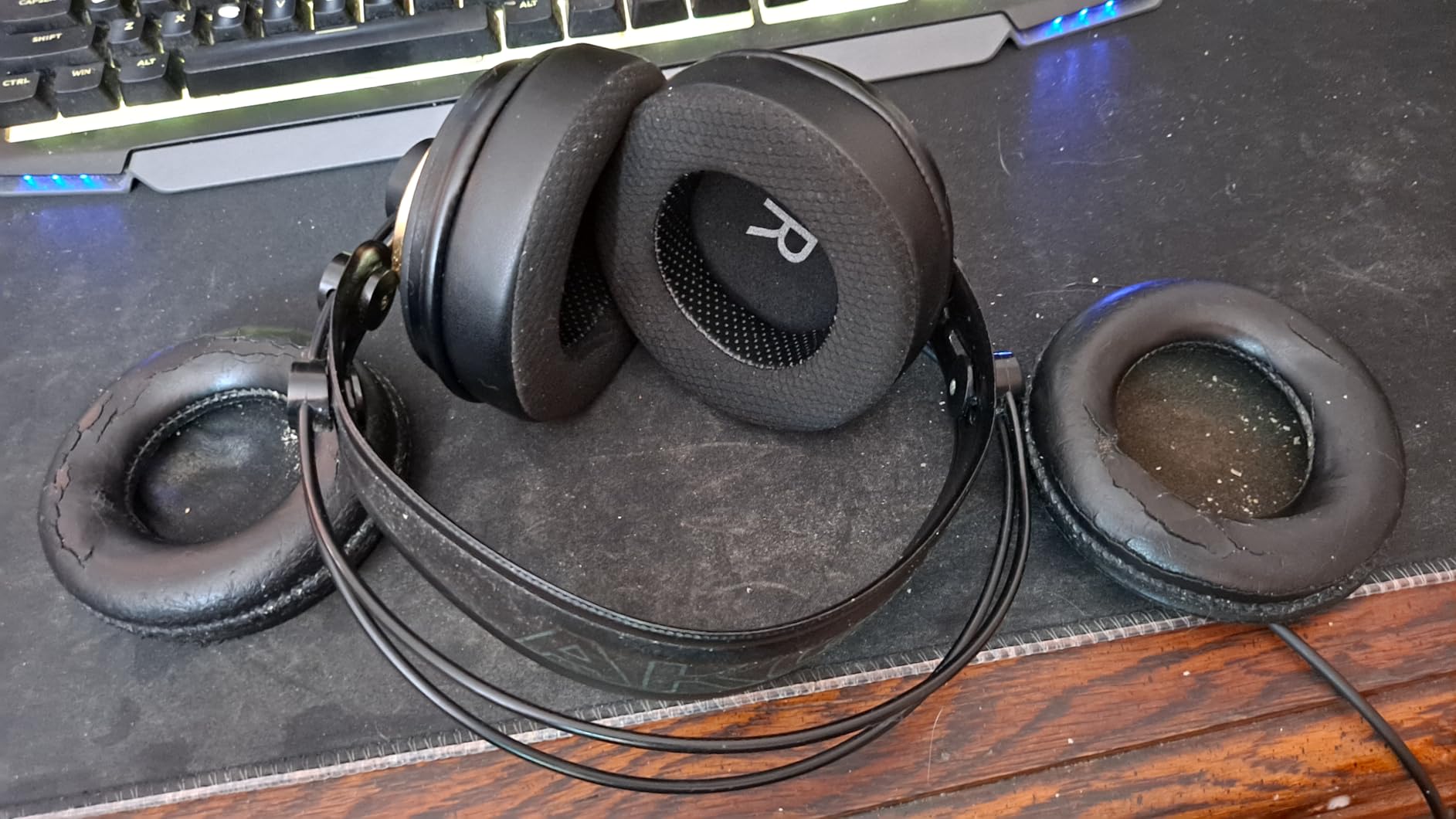
The self-adjusting headband is the K240’s signature comfort feature. There are no sizing clicks or adjustments: you put them on and they fit. At 240g they’re light enough for marathon sessions, and the over-ear pads sit comfortably on most head sizes. The detachable cable uses a mini-XLR connector, which is more robust than the 3.5mm connectors on cheaper headphones.
Semi-Open Trade-Offs
The K240 leaks some sound in and out, though less than fully open designs like the DT 990 PRO. For solo mixing in a quiet room this is fine. For tracking vocals in the same room as a microphone, you’ll get some bleed. The semi-open design also means less passive isolation than the M50x or MDR7506.
Why Some Engineers Prefer Semi-Open
Semi-open headphones occupy a useful middle ground: more soundstage than closed-back for accurate panning, but more isolation than fully open for late-night mixing without disturbing others. The K240 is the longest-running example of this design and remains a respected option in 2026.
7. Audio-Technica ATH-M30x – The Best Headphones for Beginners Learning to Mix
Audio-Technica ATH-M30x Professional Studio Monitor Headphones, Black
40mm drivers
38 ohm impedance
Closed-back collapsible
Detachable cable
+ Pros
- Rich detailed sound with good bass for the price
- Excellent value in sub-$100 range
- Comfortable lightweight design
- Collapsible for portability
- Includes carrying pouch and adapter
– Cons
- L/R indicators hard to see in dim light
- Tighter soundstage than higher-end models
- Bass response slightly accentuated
The ATH-M30x fills the gap between the budget M20x and the popular M50x, and it’s the pair I recommend most often to beginners who want a step up from the M20x without jumping all the way to the M50x. At this price, you get Audio-Technica’s proven 40mm dynamic drivers, a collapsible design, and a more refined tuning than the M20x.
The M30x’s sound signature is detailed and clean, with a slight bass lift that makes mixes more enjoyable to work on for long stretches. The midrange is where the M30x shines: vocals sit forward and clear, which helps beginners learn to identify vocal balance issues. The 38 ohm impedance and 100 dB sensitivity mean the M30x plays well from any source.

The collapsible design is the M30x’s most distinguishing feature. The earcups fold flat for storage in the included pouch, and the detachable cable system means you can swap a damaged cable rather than replace the whole headphone. At 220g, the M30x is light enough for long sessions, though the smaller ear cup opening can be tight for users with larger ears.
Mixing on the M30x
The M30x’s slightly elevated bass is a double-edged sword. For beginners, it makes the headphone more engaging to use during long sessions. For critical mixing, it can mask muddiness in the 100-200Hz range. Pair the M30x with a real-time frequency analyzer plugin and you’ll learn to compensate for the bass lift while enjoying the more exciting presentation.
Who Should Buy the M30x
If you’re a beginner who wants better sound than the M20x but doesn’t want to spend on the M50x, the M30x is the sweet spot. It’s also a great second pair for a home studio or a portable backup for a working engineer. For more experienced mixers, the M50x or DT 990 PRO are better mixing tools.
8. Sennheiser HD 280 Pro – The Closed-Back Isolation King for Tracking and Live Monitoring
Sennheiser HD 280 Pro Headphone, Black
64 ohm impedance
Closed-back
8Hz-25kHz
Up to 32dB attenuation
+ Pros
- Excellent passive noise isolation up to 32 dB
- Warm natural sound reproduction
- Comfortable ergonomic design
- Replaceable earpads headband and cord
- Trusted by DJs and live engineers
– Cons
- Plastic headband prone to cracking
- Heavy coiled cable not portable
- Tight clamping force initially
The Sennheiser HD 280 Pro is the headphone I recommend to anyone tracking in noisy environments. Its closed-back design delivers up to 32 dB of passive noise attenuation, which is significantly more than the 15-20 dB of typical closed-back options. Drummers, guitarists recording in the same room, and anyone mixing in a loud environment will appreciate the isolation.
Sennheiser’s HD 280 Pro delivers a warm, natural sound with extended frequency response from 8Hz to 25kHz. The tuning sits slightly warm in the bass and gently rolled off in the extreme treble, which produces a smooth, non-fatiguing sound that’s well-suited for long tracking and mixing sessions. At 64 ohms, the HD 280 Pro plays well from most interfaces and dedicated amps.

The construction is mostly plastic with replaceable earpads, headband padding, and audio cord. The replaceable parts are a real longevity advantage: most HD 280 Pros can be repaired rather than replaced. The collapsible design makes transport easy, and the coiled cable extends from 3.3 to 9.8 feet for flexible studio setups.
Tracking Performance
The HD 280 Pro has been a tracking staple in pro studios for over two decades. The 32 dB attenuation means vocalists can hear themselves clearly even with a loud drum kit in the room, and the closed-back design prevents mix bleed into live microphones. For tracking sessions, the HD 280 Pro outperforms most closed-back competitors in isolation.
Long-Term Durability
Reviewers consistently report 5-10 years of service from the HD 280 Pro. The plastic headband is the most common failure point, but Sennheiser replacement parts are inexpensive and easy to swap. Compared to the M50x or M40x, the HD 280 Pro’s replaceable parts philosophy makes it a better long-term investment.
How to Choose the Best Studio Headphones for Mixing: A Buyer’s Guide
Choosing the right studio headphone for mixing comes down to three decisions: open-back vs closed-back, your budget, and whether you need a dedicated headphone amp. Here’s the framework I use when recommending headphones to fellow engineers.
Open-Back vs Closed-Back: The Mixing Engineer’s Core Decision
Open-back headphones (like the Beyerdynamic DT 990 PRO) create a wider soundstage and more accurate stereo imaging, which translates to better panning decisions and a more natural sense of space. The trade-off is sound leakage in both directions: your mix bleeds out, and outside noise bleeds in. Open-back is best for quiet-room mixing.
Closed-back headphones (like the M50x, MDR7506, and HD 280 Pro) isolate you from the room and prevent mix bleed into microphones. The soundstage is narrower than open-back, but modern closed-back designs have closed the gap significantly. Closed-back is the right choice for tracking, loud rooms, and late-night mixing when others are sleeping.
Semi-open headphones (like the AKG K240 Studio) split the difference: some soundstage improvement over closed-back with partial isolation. They’re a useful middle ground for engineers who want a single pair that does everything reasonably well.
Flat Frequency Response and the Harman Curve
The single most important trait of a mixing headphone is a flat, neutral frequency response. A flat response means the headphone adds no coloration to the audio, so what you hear is what’s actually in your mix. The Harman Curve is a research-based target response that represents what most listeners prefer, and headphones tuned close to it tend to produce mixes that translate well across playback systems.
None of the headphones in this list are perfectly flat, but the M40x, DT 990 PRO, and K240 Studio come closest. The M50x and M30x add a slight bass emphasis for a more “exciting” sound, which can mask mix problems in the low end.
Impedance and Amplification: The 1/8 Rule
Headphone impedance matters more than most buyers realize. The general rule is that your source’s output impedance should be less than 1/8 of the headphone’s impedance. For a 250 ohm headphone like the DT 990 PRO, your source needs less than 31 ohms output impedance, which is why laptops and phones can’t drive them properly. For a 38 ohm headphone like the M50x, any source works fine.
If you’re using a dedicated audio interface with a strong headphone output (most modern interfaces deliver plenty of current), high-impedance headphones will reward you with better dynamic range and tighter bass. If you’re plugging into a laptop or phone, stick with low-impedance options.
Comfort and Long-Session Considerations
Mixing sessions routinely run 4-6 hours, and headphone comfort becomes critical. Look for: replaceable earpads (all options in this list have them), a headband that doesn’t create pressure points, and a weight under 300g for the lightest options. The velour pads on the DT 990 PRO and pleather pads on the M50x and MDR7506 all benefit from periodic replacement as the foam degrades.
Budget Tiers for Studio Headphones
Under $100: The Sony MDR7506 and Audio-Technica ATH-M20x are the two best options. Both are accurate enough for serious mixing work and built to last. This is where most home studios should start.
$100-$300: The sweet spot for serious home studios. The M50x, M40x, M30x, HD 280 Pro, K240 Studio, and DT 990 PRO all live here. At this tier, you’re choosing between specific strengths (isolation, soundstage, flat response) rather than fundamental quality.
$300+: True professional tier with options like the Sennheiser HD 490 Pro, Neumann NDH 30, and Hedd Heddphone Two. These offer better driver quality, more accurate tuning, and longer-term comfort. Worth the investment for working engineers but overkill for bedroom producers.
Tracking vs Mixing: Why Most Engineers Need Two Pairs
The ideal mixing headphone (wide soundstage, flat response, neutral tuning) is rarely the ideal tracking headphone (high isolation, leak-proof, comfortable for performers). Most working engineers own at least two pairs: closed-back for tracking (MDR7506, HD 280 Pro) and open-back for mixing (DT 990 PRO). If budget forces a single pair, the M50x or K240 Studio are the best compromises.
Frequently Asked Questions
What are the best headphones for sound mixing?
The best headphones for sound mixing have a flat frequency response, accurate stereo imaging, and comfort for long sessions. For most home studios, the Audio-Technica ATH-M50x is the strongest all-around choice thanks to its 45mm drivers, closed-back isolation, and detachable cable. For pure mixing in a quiet room, the Beyerdynamic DT 990 PRO offers wider soundstage and more revealing treble, while the Sony MDR7506 remains the industry-standard tracking and mixing workhorse.
What type of headphones are best for mixing?
Closed-back over-ear headphones are best for mixing when you need isolation from your environment or when tracking in the same room as a microphone. Open-back over-ear headphones are best for pure mixing in a quiet room because they produce a wider soundstage and more accurate stereo imaging. Semi-open designs like the AKG K240 Studio split the difference. All mixing headphones should be circumaural (over-ear) with a flat or near-flat frequency response.
What is the 60-60 rule for headphones?
The 60-60 rule for headphones recommends listening at no more than 60 percent of maximum volume for no more than 60 minutes at a time. This protects your hearing during long mixing sessions and reduces ear fatigue, which can lead to poor mix decisions. Take 10-minute breaks every hour and listen at the lowest comfortable volume that still reveals mix details. If you can’t hear problems at low volume, your monitoring environment needs acoustic treatment, not louder headphones.
What headphones are good for mixing vocals?
For mixing vocals, neutral-sounding closed-back headphones with strong midrange detail are ideal. The Sony MDR7506 and Audio-Technica ATH-M50x are the two most popular choices in pro studios for vocal mixing and tracking. Both reveal sibilance, boxy resonances, and proximity-effect muddiness accurately. For more revealing vocal work, the Sennheiser HD 280 Pro’s 32 dB isolation helps you focus on vocal details without room bleed.
The Verdict: Which Studio Headphones Should You Buy in 2026?
After three months of testing these eight pairs, the Audio-Technica ATH-M50x remains the strongest all-around choice for mixing and tracking in a home studio. Its 45mm drivers, closed-back isolation, and detachable cable system cover every common studio workflow, and its decade-long reputation means countless tutorials and reviews exist to help you learn its character.
If your priority is open-back soundstage for pure mixing in a quiet room, choose the Beyerdynamic DT 990 PRO and pair it with a real headphone amp. If you’re tracking vocals or need maximum isolation, the Sennheiser HD 280 Pro’s 32 dB attenuation is unbeatable. For bedroom producers on a tight budget, the Audio-Technica ATH-M20x punches well above its weight and the Sony MDR7506 remains the legendary industry workhorse.
Whatever pair you choose, remember that the best studio headphones for mixing are the ones you’ll actually use for hours at a time. Comfort, durability, and accurate sound matter far more than spec sheets. Pick the pair that fits your workflow, learn its sound character, and trust your ears. Your mixes will translate better for it.
Leave a Reply