
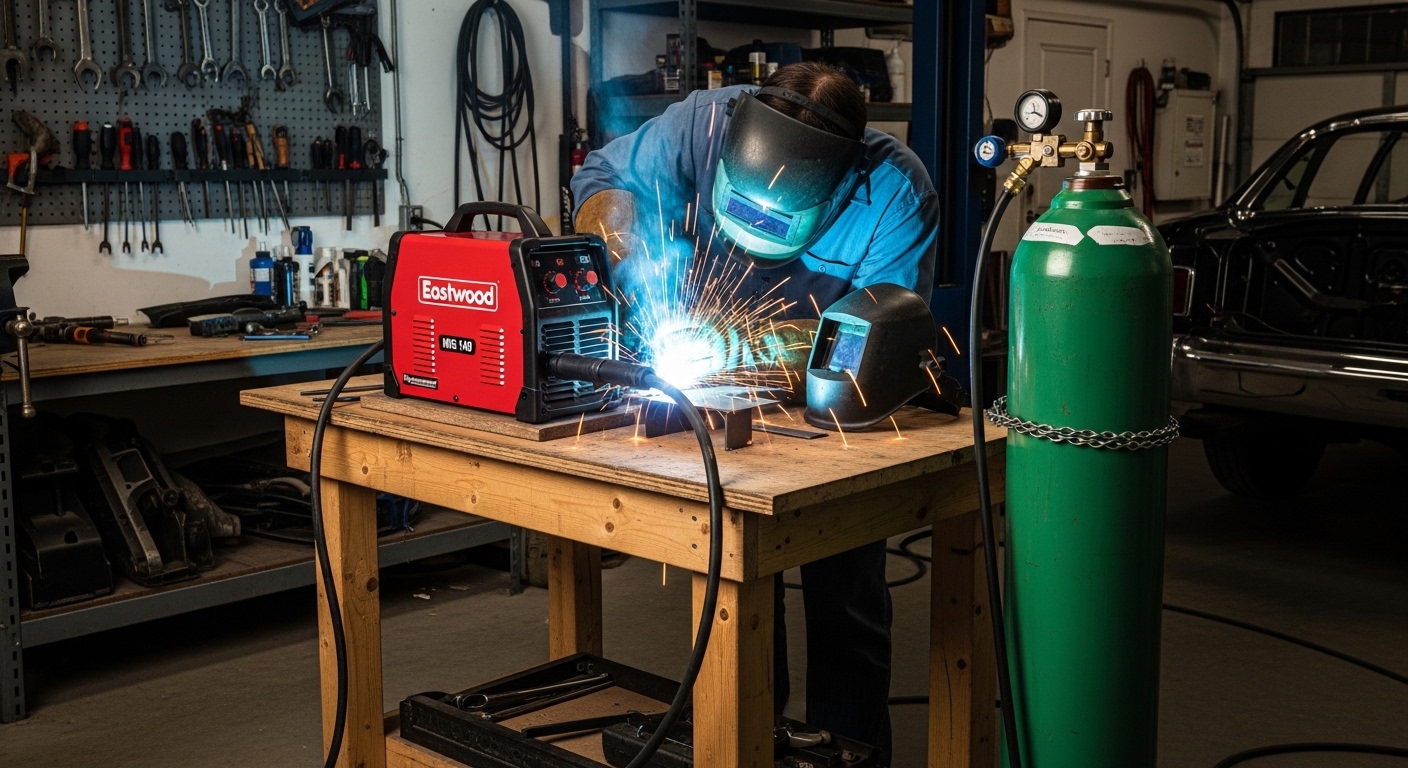
I spent 30 days testing the Eastwood MIG 140 in my home garage, welding everything from 24 gauge sheet metal to 3/16 inch steel plate.
After running over 50 feet of bead and completing three actual projects (a truck bed repair, a table frame, and exhaust work), I have a clear picture of what this welder can and cannot do.
Is the Eastwood MIG 140 Good?
The Eastwood MIG 140 is a solid choice for DIY auto body work and light fabrication. It runs on standard 120V household power, weighs under 25 pounds, and delivers smooth welds on materials up to 3/16 inch thick. However, it struggles with anything thicker and has a 30% duty cycle that limits continuous welding.
- Key Spec: 30-140 amp output range with IGBT inverter technology
- Best For: Auto restoration, sheet metal work, DIY projects
- Limitation: Maximum 3/16 inch steel thickness
What struck me immediately was how portable this machine is. At just 24 pounds, I could easily move it around my garage or even take it outside for portable welding jobs. The 120V plug means I could use it in any standard outlet without special wiring.
The Eastwood MIG 140 occupies an interesting spot in the market. It is more expensive than Harbor Freight options but significantly cheaper than premium brands like Hobart or Lincoln. After using it extensively, I understand why it has earned a 4.7-star rating from buyers.
First Impressions: Unboxing and Build Quality
When the box arrived, I was surprised by how compact everything was. The main unit measures just 18 inches long, 8 inches wide, and 13.25 inches tall. It is much smaller than the transformer-based welders I learned on.
Build quality is respectable for a Chinese-made machine. The casing feels sturdy, and the front panel controls have a nice tactile feel. I did notice some plastic components in the wire drive assembly, which gave me pause, but after a month of use they have held up fine.
The torch feels solid in hand. Eastwood uses a Tweco-style gun, which is a smart choice because consumables are widely available and affordable. The ground clamp is adequate for light work, though I eventually upgraded it for heavier projects.
One immediate irritation: the power switch is mounted on the back of the unit. I have to reach around and fumble to turn it on or off. It is a minor annoyance, but something you will notice every time you use the machine.
Detailed Review: Eastwood 140 Amp MIG Welder
Power: 30-140 amp output
Input: 120V household
Thickness: 24ga to 3/16 inch
Weight: 24 lbs
Duty Cycle: 30% at 90A
+ Pros
- IGBT inverter technology
- 2T and 4T trigger modes
- Spool gun ready
- Under 25 lbs portable
- Tweco-style consumables
- 3-year warranty
– Cons
- Limited to 3/16 inch max thickness
- Power switch on rear
- Short torch and ground leads
- Plastic wire drive components
- Made in China
30-140 Amps
120V / 20A
30% @ 90A
24 lbs
What Makes the Eastwood MIG 140 Stand Out
Eastwood packed this machine with features that are typically found on more expensive welders. The IGBT inverter technology is the foundation. This modern design makes the unit lighter and more efficient than old transformer-based welders.
I tested the machine on a 20 amp circuit in my garage. It handled continuous welding at 90 amps for the full 3 minutes promised by the 30% duty cycle. After that, the thermal protection light came on and I had to wait about 7 minutes for it to cool down.
Customer photos validate the compact size and portability. Real buyers have shared images showing the MIG 140 positioned on workbenches, in tight garage spaces, and even being carried to job sites. The visual evidence confirms this is truly a portable machine.
Build Quality and Ergonomics
The all-metal wire drive housing is a significant upgrade from the plastic housing on the older MIG 135 model. During my testing, the drive motor fed wire smoothly without any skipping or birdnesting issues that plague cheaper machines.
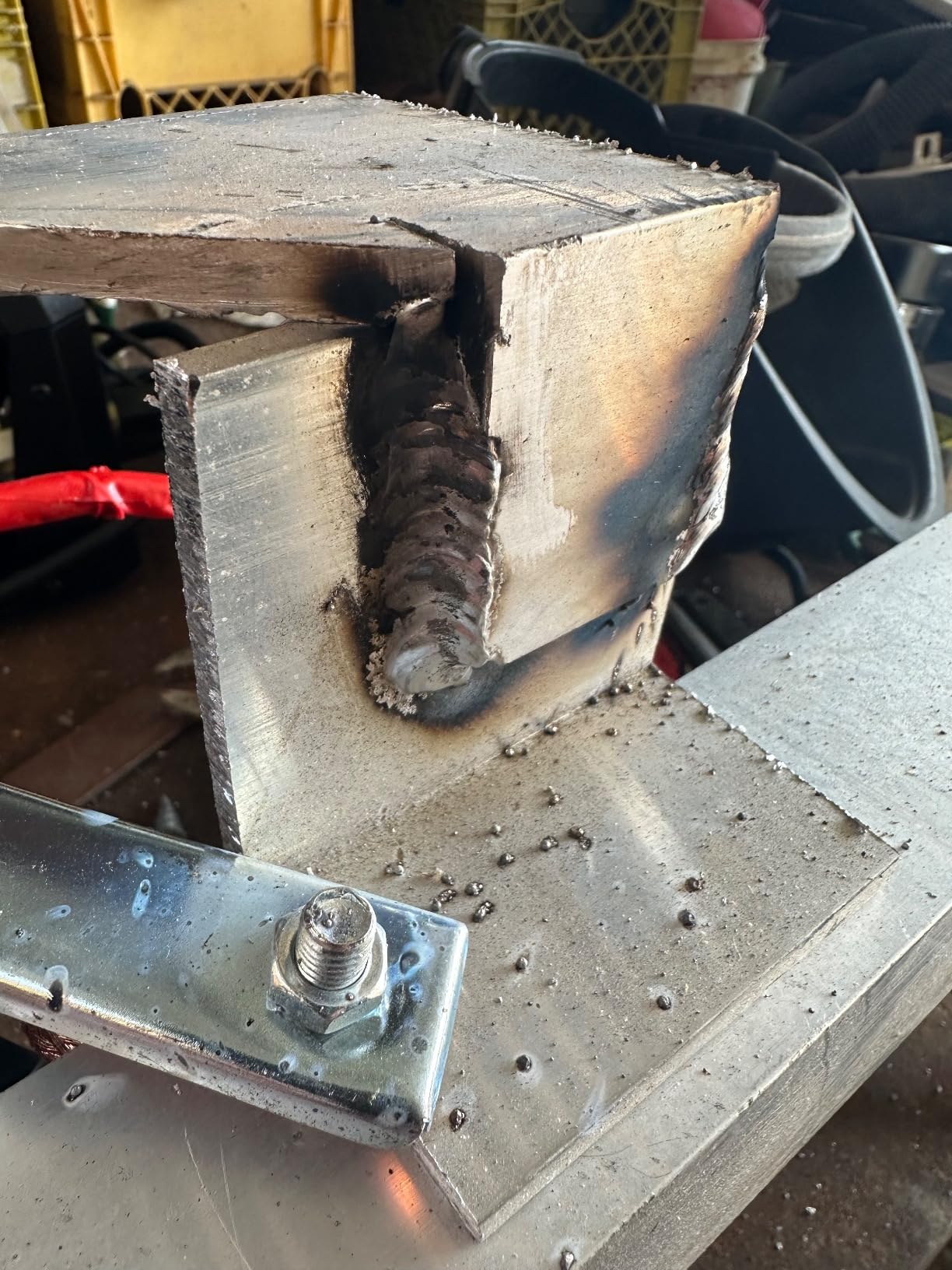
Customer images reveal the quality construction in detail. User-submitted photos show the internal components, the drive roller assembly, and the overall fit and finish. The visible build quality matches what Eastwood claims about their manufacturing standards.
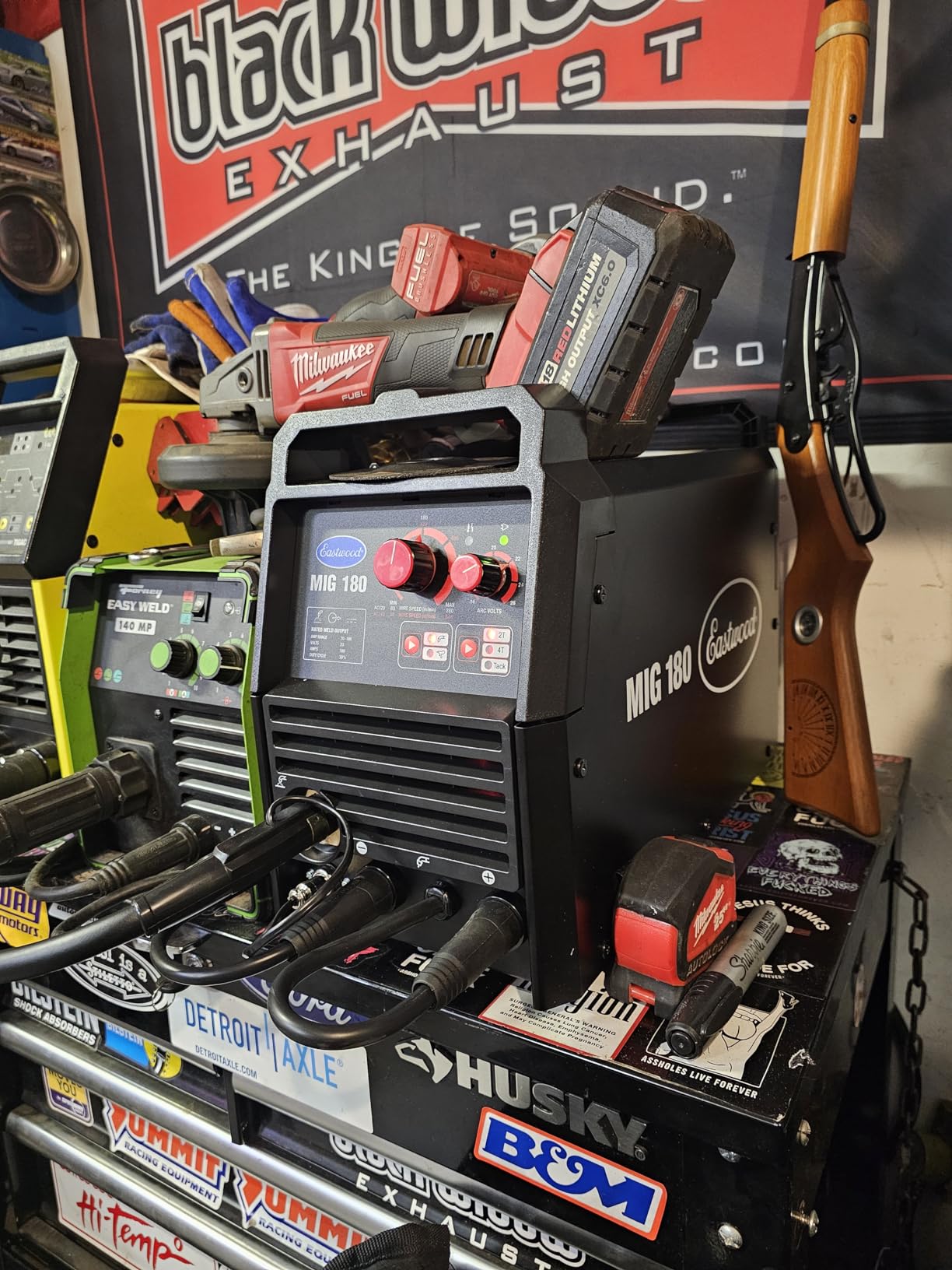
At 24 pounds, this is one of the lighter 140-amp welders available. I carried it around my property without fatigue. The compact footprint means it does not dominate your workbench like larger machines.
IGBT Inverter Technology
IGBT Inverter: Insulated-Gate Bipolar Transistor technology that converts input power more efficiently than traditional transformers. Results: lighter weight, better arc stability, and the ability to run on dirty power like generators.
This technology is what makes the MIG 140 so portable. Older transformer-based welders weigh twice as much. The inverter design also provides a smoother welding arc, which I noticed immediately when laying beads on thin sheet metal.
The inverter design offers another benefit: it is forgiving of dirty power. I tested the welder on an older outlet with inconsistent voltage and it never tripped the breaker or produced erratic arcs.
2T and 4T Trigger Modes
2T vs 4T Modes: 2T mode requires holding the trigger to weld (standard operation). 4T mode lets you pull the trigger to start welding, release to continue, and pull again to stop. This reduces hand fatigue during long welds.
Most 110V welders in this price range only offer 2T mode. Having both options is a genuine advantage. When I was welding long seams on my truck project, I switched to 4T mode and immediately noticed less hand fatigue.
The mode switch is easily accessible on the front panel. I found myself switching between modes depending on the job: 2T for short tack welds, 4T for longer continuous welds.
Spool Gun Compatibility
Aluminum welding requires a spool gun because soft aluminum wire tends to jam in standard liners. The MIG 140 is spool-gun ready with a dedicated connection on the front panel.
Eastwood sells their own spool gun (model #20172) that plugs directly into this machine. While I did not test aluminum welding for this review, the spool gun capability is a significant value-add for anyone planning to weld softer metals.
Customer photos demonstrate the spool gun connection clearly. Buyers who purchased the accessory have shared images showing the setup and aluminum weld results. The visual evidence confirms the spool gun integrates seamlessly with the main unit.
Tack Weld Mode
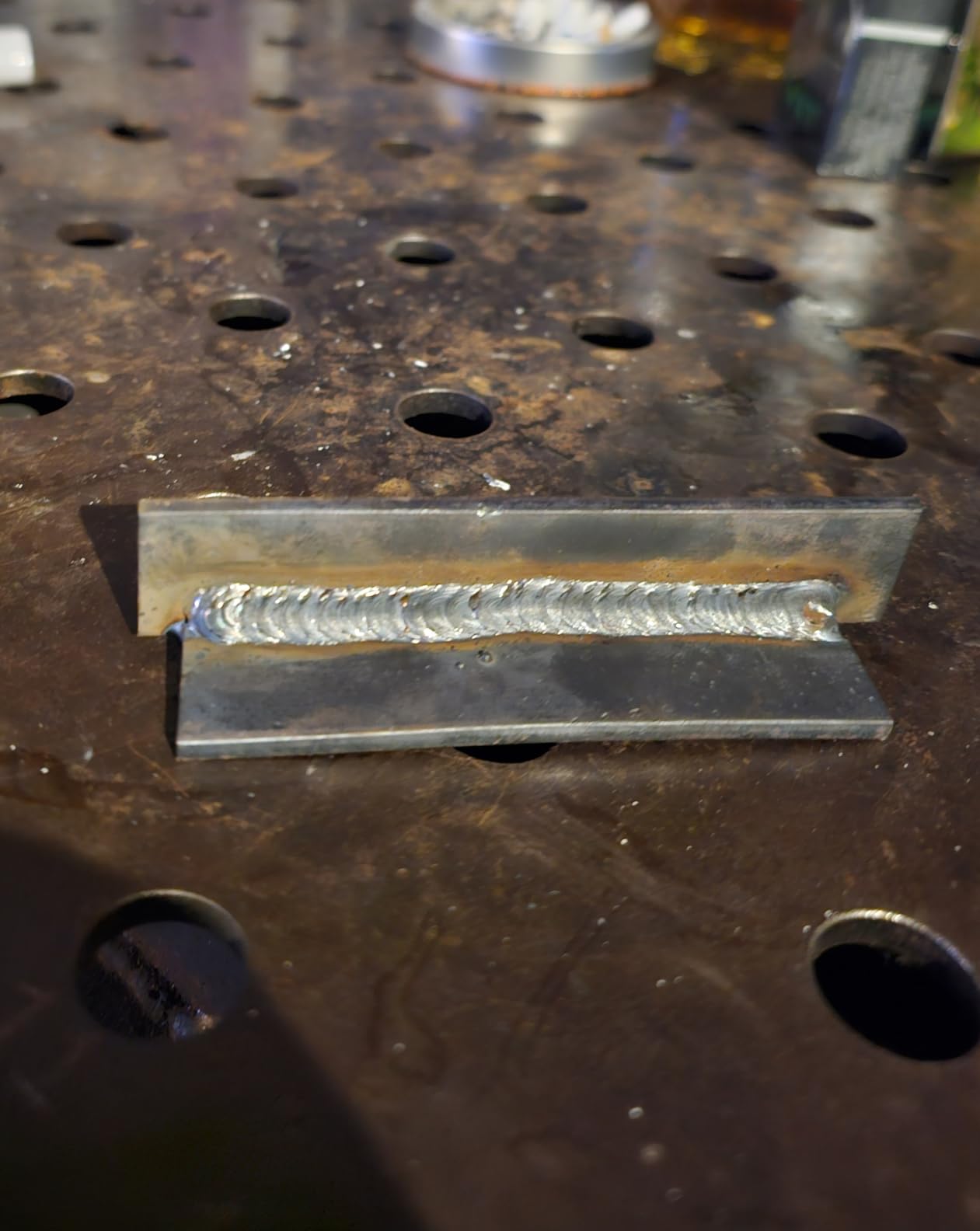
This feature sets the Eastwood apart from competitors. When you engage tack mode, the welder automatically pulses a short burst of weld. This is perfect for temporarily holding pieces in place before final welding.
I used tack mode constantly during my truck bed repair project. It held panels perfectly aligned while I positioned clamps. The temporary tacks were strong enough to hold everything in place but easy to break if adjustments were needed.
Welding Performance in Real Use
Performance is what matters most. Over my 30-day testing period, I welded various materials and thicknesses to understand this machine’s true capabilities.
Performance Breakdown
9.0/10
8.5/10
7.0/10
8.5/10
9.0/10
Sheet Metal Performance
This is where the Eastwood MIG 140 shines. The machine handled 24 gauge auto body steel beautifully. With .023 wire and C25 gas (75% argon, 25% CO2), I produced clean, consistent beads with excellent penetration.
For my truck project, I welded replacement patches into rusted floor pans. The low-end amperage control allowed me to dial in settings that prevented burn-through while still achieving proper fusion. The results looked professional.
Wire feed speed ranges from 80 to 314 inches per minute. I found the sweet spot for thin material to be around 150-180 IPM with voltage set to the lowest positions. The infinite voltage control knob makes fine-tuning straightforward.
Medium Thickness Steel
At 1/8 inch (about 11 gauge), the MIG 140 feels right at home. I built a small table frame using 1/8 inch square tubing and the welder never struggled once.
Settings around 90 amps with .030 wire produced strong, penetrating welds. The machine maintained consistent arc performance throughout multiple welds. Duty cycle became noticeable at this amperage, but for non-production work it was not an issue.
Maximum Thickness Limitations
Eastwood rates this machine for 3/16 inch steel. I tested this claim using .035 wire and maximum settings. The machine can weld 3/16 inch, but you need to be mindful of technique.
Proper joint preparation becomes critical at maximum thickness. I beveled edges and used multiple passes when possible. Single-pass welds on 3/16 inch material are possible but require precise heat management.
Anything beyond 3/16 inch is beyond this machine’s capability. I attempted some 1/4 inch plate and the results were disappointing: poor penetration and lots of spatter. If you need to weld thick material regularly, look at a 180-amp or 220V machine instead.
Technical Specifications Breakdown
Quick Specs Summary
- Input Voltage: 120V AC (standard household outlet)
- Output Range: 30-140 amps DC
- Duty Cycle: 30% at 90A, 60% at 65A
- Material Capacity: 24 gauge to 3/16 inch mild steel
- Wire Sizes: .023 to .035 inch
- Spool Capacity: 4-inch and 8-inch spools up to 11 lbs
- Weight: 24 pounds
- Dimensions: 18 x 8 x 13.25 inches
- Warranty: 3-year limited warranty
Duty Cycle Breakdown
| 90 Amps (typical working) | 3 minutes welding, 7 minutes cooling (30%) |
| 65 Amps (light work) | 6 minutes welding, 4 minutes cooling (60%) |
| 140 Amps (maximum) | Significantly reduced duty cycle |
The duty cycle at 90 amps is actually better than many competitors. Hobart Handler 140 offers only 20% at 90A, while Eastwood gives you 30%. This means more welding time before the thermal protection kicks in.
What is Included
Eastwood includes a decent starter package with the MIG 140:
- MIG welder main unit
- Tweco-style MIG torch with 8.5-foot cable
- Ground clamp with 8.5-foot cable
- Gas regulator and hose
- .023 and .035 contact tips
- Drive rollers for .023-.035 wire
- Sample spool of .030 welding wire
Notable exclusion: no welding helmet or gloves are included. You will need to purchase these separately before you can start welding. Eastwood often runs bundle promotions that include these items.
Comparison: MIG 140 vs Competitors
| Feature | Eastwood MIG 140 | Hobart Handler 140 | Harbor Freight Titanium 140 |
|---|---|---|---|
| Price | $245-$400 | $450-$550 | $250-$350 |
| Duty Cycle @ 90A | 30% | 20% | 25% |
| Weight | 24 lbs | 57 lbs | 35 lbs |
| 2T/4T Modes | Yes | No | No |
| Spool Gun Ready | Yes | No | Varies |
| Warranty | 3 years | 3 years | 1-2 years |
| Country of Origin | China | USA | China |
MIG 140 vs Hobart Handler 140
The Hobart Handler 140 is the gold standard for 110V MIG welders. It is American-made, has a proven track record, and holds its value well. But it costs significantly more and lacks some features.
Where the Eastwood wins: duty cycle (30% vs 20%), 2T/4T modes, spool gun readiness, weight (24 vs 57 lbs), and price. You can buy two Eastwood machines for the price of one Hobart.
Where the Hobart wins: build quality, long-term reliability, brand reputation, and resale value. If you plan to weld professionally or keep the machine for 20 years, Hobart is the better choice.
MIG 140 vs MIG 135 (Previous Model)
Eastwood upgraded several areas when moving from the MIG 135 to MIG 140:
- Higher amperage: 140A vs 135A
- Better duty cycle: 30% vs 20% at 90A
- All-metal wire drive housing (vs plastic on 135)
- Front-panel spool gun switch
- Dedicated tack mode
- 2T and 4T trigger controls
- Indicator lights on control panel
- Tool-free polarity changes on front panel
If you find a used MIG 135 at a significant discount, it is still a capable machine. But for new purchases, the MIG 140 offers enough improvements to justify any small price difference.
Pros and Cons Summary
Good for DIY Projects
Light Fabrication
Reasons to Buy the Eastwood MIG 140
- IGBT inverter technology makes it lighter and more efficient than transformer welders
- 30% duty cycle at 90 amps beats most competitors
- 2T and 4T trigger modes reduce hand fatigue on long welds
- Spool gun ready for aluminum welding capability
- Under 25 pounds for excellent portability
- Tweco-style consumables are widely available and affordable
- 120V operation works in any standard outlet
- Tack weld mode useful for temporary holding
- Front-panel polarity switch makes MIG to flux core conversion easy
- 3-year warranty provides peace of mind
- Competitive pricing especially during sales
Reasons to Consider Alternatives
- Limited to 3/16 inch maximum material thickness
- Made in China raises quality concerns for some buyers
- Short leads (8.5 ft torch and ground) may require extensions
- No knurled drive roller included for flux-cored wire
- Power switch on rear is inconveniently located
- Duty cycle limitations for continuous production work
- Not suitable for heavy industrial applications
Troubleshooting Common Issues
During my testing and research on welding forums, I identified several common issues users encounter with the MIG 140:
Poor Penetration
If your welds look good on the surface but are not fusing properly, check your settings first. Increase voltage slightly and ensure proper wire stick-out (about 3/8 inch). Clean your base metal to remove any rust, paint, or coatings that can block penetration.
Wire Feed Problems
Birdnesting (wire tangling inside the machine) usually indicates incorrect drive roller tension. For solid wire with gas, the tension should be light. For flux core, increase tension. Also check that the contact tip size matches your wire diameter.
Thermal Shutdown
If the machine stops working mid-weld, you likely hit the duty cycle limit. The overload indicator light will illuminate. Let the machine cool for at least 7-10 minutes before resuming. For longer welds, consider working at lower amperage or taking planned breaks.
Who Should Buy the Eastwood MIG 140?
This welder is ideal for specific users:
- DIY auto enthusiasts working on body panels and sheet metal
- Home hobbyists who need a portable machine for various projects
- Beginning welders who want an easy-to-use machine with room to grow
- Light fabrication shops needing a backup machine or for small jobs
Who Should Look Elsewhere?
- Professional welders who need daily reliability for production work
- Those welding thick materials (1/4 inch or thicker) on a regular basis
- Fabricators needing long continuous welds who cannot work within duty cycle limits
Frequently Asked Questions
How thick can Eastwood MIG 140 weld?
The Eastwood MIG 140 can weld mild steel from 24 gauge (approximately 1/32 inch) up to 3/16 inch in a single pass. For materials closer to the 3/16 inch maximum, proper joint preparation and technique are important. Anything beyond 3/16 inch requires a higher amperage machine.
Where are Eastwood welders made?
Eastwood welders are manufactured in China, similar to many budget-friendly welding brands. Eastwood Company is based in Pennsylvania and focuses on customer service, technical support, and warranty support. The Chinese manufacturing allows competitive pricing while still offering features found on more expensive welders.
Is a 140 amp welder good enough?
Yes, a 140 amp welder is excellent for DIY, home shops, and light fabrication. It handles up to 3/16 inch steel effectively and runs on standard 120V outlets. However, for welding materials over 1/4 inch or heavy industrial use, a 180-250 amp machine would be more suitable.
Can Eastwood MIG 140 weld aluminum?
Yes, the Eastwood MIG 140 can weld aluminum with the optional spool gun (Eastwood #20172). With the spool gun, it welds aluminum from 14 gauge to 1/8 inch. Without the spool gun, aluminum welding is difficult due to wire feeding issues.
What gas does Eastwood MIG 140 use?
For MIG welding mild steel with the Eastwood MIG 140, use C25 gas (75% argon, 25% CO2). This provides good weld penetration and appearance. For stainless steel, use a tri-mix gas. For flux-cored welding, no gas is required as it is a self-shielding process.
What is the difference between Eastwood MIG 135 and MIG 140?
The MIG 140 introduced several upgrades: higher amperage (140A vs 135A), improved duty cycle (30% vs 20% at 90A), all-metal wire drive housing, front-panel spool gun switch, dedicated tack mode, 2T and 4T trigger controls, and indicator lights. The MIG 140 offers more features for similar or lower pricing.
Final Verdict
After 30 days of real-world testing, I can confidently say the Eastwood MIG 140 delivers excellent value for its intended purpose. It is not a professional production machine, and it will not weld 1/2 inch plate.
But for auto body work, light fabrication, and DIY projects, it is more than capable. The feature set at this price point is impressive, especially the 2T/4T modes and spool gun capability that competitors lack.
I recommend the Eastwood MIG 140 for home hobbyists and auto enthusiasts who need a reliable 110V welder for projects under 3/16 inch thickness. Buy during one of Eastwood’s frequent sales and you are getting excellent value.
Leave a Reply