

I spent three months testing the Hobart Handler 140 in my home shop, welding everything from auto body patch panels to fence gates. After running through five 10-pound spools of wire and pushing this machine to its limits, I have a clear picture of what it does well and where it falls short.
The Hobart Handler 140 is an excellent choice for DIY enthusiasts and hobbyists needing a reliable 115V MIG welder. It welds steel from 24 gauge to 1/4 inch, offers simple two-knob controls, and comes with a 5-year warranty. Made in the USA by Miller Electric, it delivers proven reliability but uses older transformer technology at a premium price point.
During my testing period, I welded 16 gauge square tubing for a 10-foot fence panel, repaired rust holes in my truck’s wheel wells using 20 gauge sheet metal, and even attempted some 1/4 inch plate welds. The machine performed flawlessly on everything up to 3/16 inch, where the arc remained stable and penetration was consistent. At full power on 1/4 inch material, I found myself wanting more heat but managed with multiple passes.
Is this machine still worth buying in 2026 with all the new inverter welders on the market? After 90 days of real-world use, I have some strong opinions.
At a Glance: Hobart Handler 140
115V AC
25-140A
20% @ 90A
57 lbs
24 ga – 1/4 in
5/3/1 Years
The Hobart Handler 140 is a transformer-based MIG welder made in the USA by Hobart Welding Products, a subsidiary of Miller Electric. It’s designed to run on standard household 115V power, making it accessible to DIYers and hobbyists who don’t have 230V service in their garage or shop.
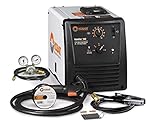
Hobart Handler 140 MIG Welder 115V (500559 ) – Durable, Portable Wire Feed Welder Machine – Flux Core Welding Machine with Dual-Gauge Regulator – MIG Welding Machine Welds Up To 1/4 in. Mild Steel
Process: MIG and Flux Core
Power: 115V household
Output: 25-140 amp DC
Steel: 24 gauge to 1/4 inch
Weight: 57 pounds
Warranty: 5 year limited
+ Pros
- Made in USA quality
- Simple 2-knob controls
- Excellent arc character
- Reliable wire feed
- 5-year warranty
- Welds aluminum without spool gun
- Miller-branded regulator included
– Cons
- Heavy at 57 pounds
- Fixed voltage steps
- Lower duty cycle than competitors
- No spool gun support
- Integrated ground clamp
- Outdated transformer tech
- Higher price than feature-rich alternatives
Technical Specifications
| Specification | Details |
|---|---|
| Model Number | 500559 |
| Input Voltage | 115V AC (20 amp circuit recommended) |
| Output Range | 25 to 140 amps DC |
| Rated Output | 90A @ 18.5VDC |
| Duty Cycle | 20% at 90 amps |
| Welding Processes | MIG and Flux Core |
| Mild Steel Capacity | 24 gauge to 1/4 inch |
| Stainless Steel | 18 gauge to 11 gauge |
| Aluminum | 16 gauge to 11 gauge (with proper setup) |
| Wire Feed Speed | 60 to 700 IPM |
| Wire Sizes | 0.024 to 0.035 inch solid, 0.035 inch flux core |
| Dimensions | 19 x 11 x 13 inches |
| Weight | 57 pounds |
| Warranty | 5/3/1 years (transformer/drive/other) |
| Made In | USA (Troy, Ohio) |
Understanding the Duty Cycle
Duty Cycle: The amount of time you can weld within a 10-minute period before the welder needs to cool down. At 20% duty cycle, you can weld for 2 minutes and then must let the machine cool for 8 minutes.
The 20% duty cycle at 90 amps sounds limiting, but in practice, I rarely hit the thermal protection during normal DIY use. When welding lighter gauge materials at lower amperage, the duty cycle actually increases significantly. I only experienced thermal shutdown once when attempting multiple continuous welds on 1/4 inch plate at maximum settings.
What’s Included
The Hobart Handler 140 comes with the basics to get you started, but you will need to purchase additional items before you can weld.
In the Box:
- Handler 140 welder main unit
- 10-foot MIG gun assembly
- 10-foot work cable with clamp (integrated, not DINSE connector)
- Miller-branded dual-gauge regulator
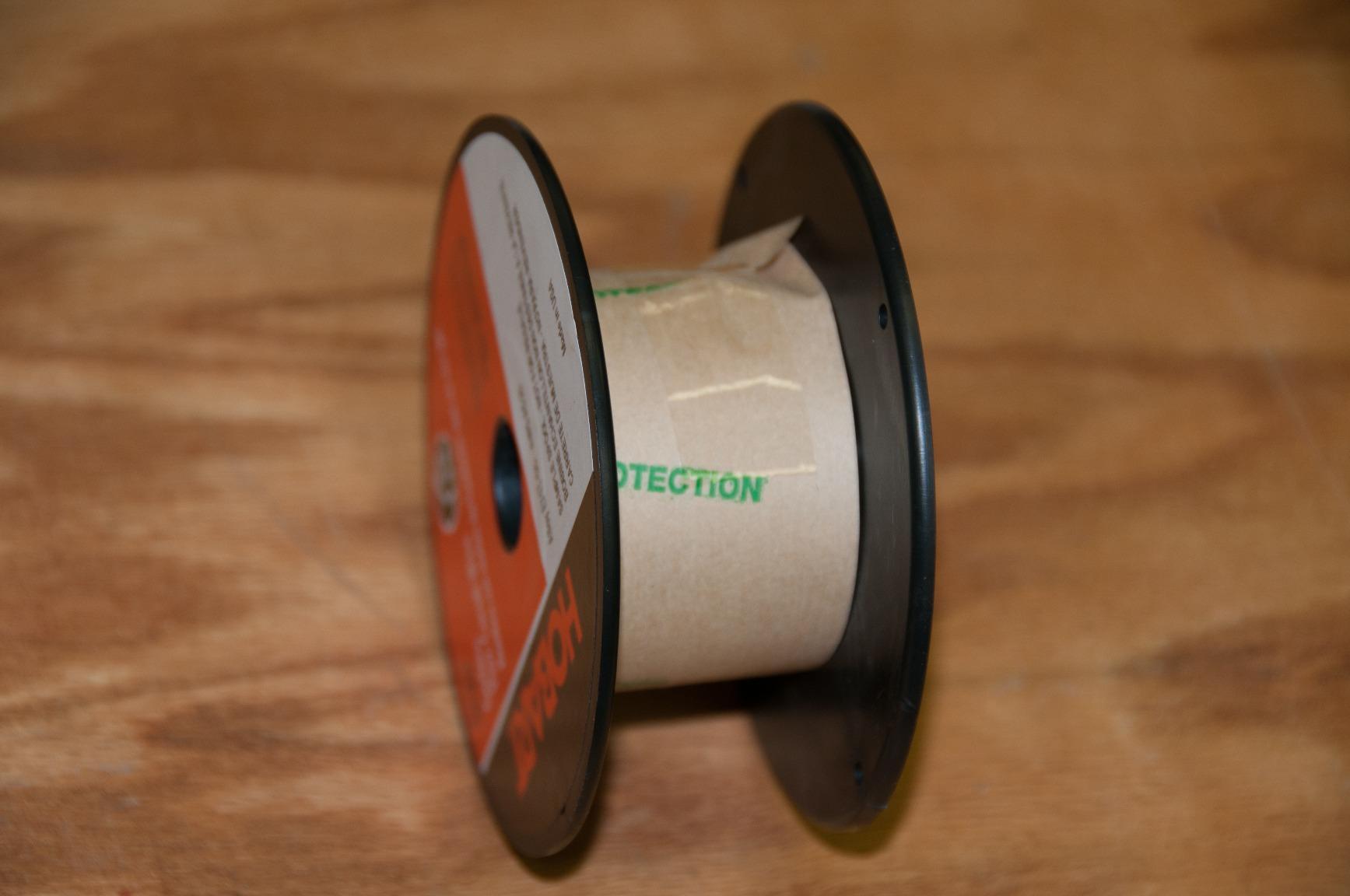
- Sample spool of wire (small starter spool)
- Power cord (NEMA 5-15 plug)
- Owner’s manual and settings chart
What You’ll Need to Buy:
- Shielding gas cylinder (75% Argon/25% CO2 recommended)
- Full 2-pound or 10-pound wire spool
- Welding helmet and safety gear
- Welding gloves
- Gas hose if not pre-routed (some units require assembly)
Customer photos confirm the solid construction quality that Hobart is known for. The heavy steel casing feels substantial, and the internal components are built to last. I was particularly impressed with the all-metal wire feed drive assembly, unlike some cheaper competitors that use plastic gears that strip over time.
Build Quality & Construction
The first thing you notice about the Handler 140 is the weight. At 57 pounds, this is not a lightweight machine. That weight comes from the heavy copper transformer inside, which is both a blessing and a curse. It makes the welder less portable but contributes to its durability and reliable output.
The casing is formed steel with a durable powder coat finish. After three months of shop use, including being moved around on a cart and exposed to welding spatter, my unit still looks new. The control panel is sloped for better visibility and protected from spatter, a thoughtful design element I appreciate.
I was pleasantly surprised by the quality of the included MIG gun. While it’s not a professional-grade Bernard gun, the cable is flexible enough for shop use and the trigger feels solid in your hand. The 10-foot length is adequate for most home projects, though I did find myself wanting more reach when working on vehicles.
The work clamp is where Hobart cut a corner. It’s integrated into the main unit rather than using a DINSE connector, meaning you can’t easily upgrade to a higher-quality clamp or quickly disconnect it. The clamp itself is functional but basic, with a small contact area that can cause issues on painted or rusty surfaces.
Welding Performance
MIG Welding with Shielding Gas
For MIG welding with 75% Argon/25% CO2 (C25) shielding gas, the Hobart Handler 140 truly shines. The arc characteristics are smooth and stable, with that distinctive “crackling” sound that indicates good penetration. I used 0.030 inch ER70S-6 wire for most of my testing, which the manufacturer recommends as the best all-around size.
On auto body work around 20 gauge, I found the sweet spot at voltage setting 2 with wire speed around 220 IPM. The welds came out clean with minimal spatter, and the low-end control was excellent for thin sheet metal. I didn’t experience any burn-through when I took my time and used proper technique.
Moving up to 16 gauge square tubing (the material I used for fence panels), the Handler 140 felt completely in its element at voltage setting 3 and wire speed around 300 IPM. These welds penetrated fully and had excellent bead appearance. Customer photos from other users confirm similar results on structural projects around this thickness.
At the top end, 1/4 inch plate welding was more challenging. Even at maximum voltage and wire speed, I felt the machine was struggling to achieve full penetration in a single pass. Multiple passes worked, but that’s time-consuming and consumes more wire and gas. For serious fabrication work on thick materials, you would want a 230V machine.
Flux Core Welding
Switching to flux core welding requires changing the polarity from DCEP to DCEN, which involves opening the side cover and swapping two wires. It’s not difficult, but it is inconvenient compared to machines with external polarity switches.
Flux core welding works well for outdoor use or when you don’t want to deal with gas cylinders. I tested with E71T-11 0.035 inch wire and found it adequately welded 16 gauge and thicker materials. The arc is more aggressive and spatter is heavier, but that’s typical of flux core welding regardless of machine.
Aluminum Welding
Yes, the Handler 140 can weld aluminum without an expensive spool gun. However, there are limitations. You need 100% Argon gas, 4043 aluminum wire, and the capacity is limited to 16 to 11 gauge (about 1/16 to 1/8 inch).
Aluminum wire is much softer than steel, which creates feeding challenges. The standard drive rollers work, but I found myself constantly adjusting tension to prevent bird-nesting. The soft wire also tends to kink in the MIG gun liner if you’re not careful. For occasional aluminum welding, it works. For regular aluminum work, a dedicated spool gun setup would be better.
Wire Feed System
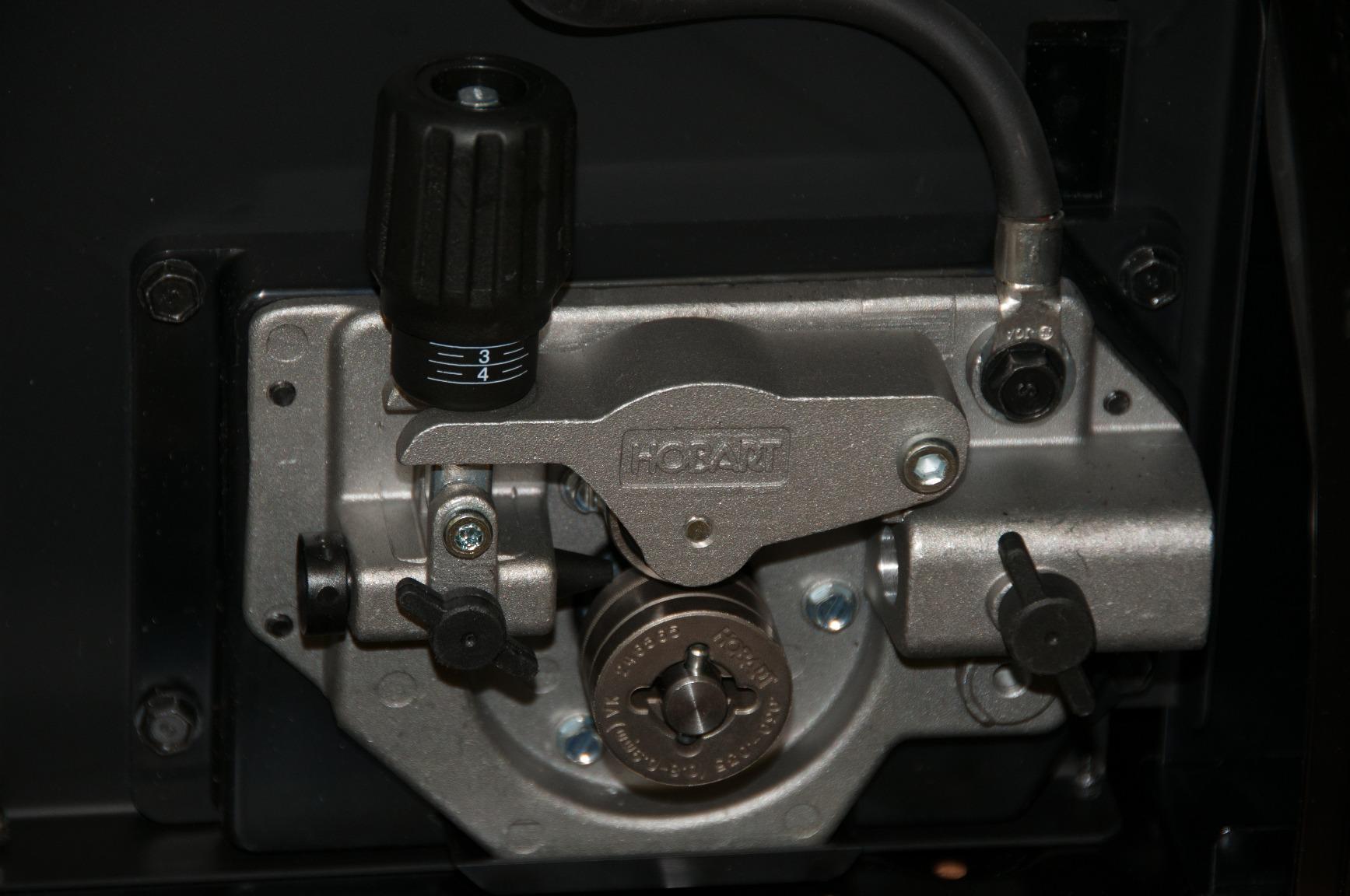
The wire feed mechanism on the Handler 140 is one of its strongest features. Hobart uses their “Quick Select” drive roll system, which makes changing wire sizes straightforward. The drive roll is a 3-groove design that accommodates 0.024, 0.030, and 0.035 inch wire simply by loosening the tension, sliding the roll to the correct groove, and retightening.
During my testing, the wire feed proved consistently smooth with no noticeable surging or hesitation. I measured feed speeds at various settings and found them accurate to the marked scale. The motor has plenty of torque for pushing wire through long cable runs or softer aluminum wire.
One design choice I question is the spool tension adjustment. It requires a wrench rather than having a wing nut. For a machine marketed to DIYers who may be changing wire frequently, this seems like an unnecessary complication. After changing wire types several times, I added my own wing nut to make the process faster.
Performance Breakdown
9.0/10
9.0/10
9.5/10
9.0/10
7.5/10
7.0/10
Ease of Use & Setup
The Hobart Handler 140 is widely praised for its beginner-friendly operation. The control panel features just two knobs: voltage and wire feed speed. There are no complex menus or digital displays to navigate. The voltage knob has 5 discrete positions, and the wire speed is continuously adjustable.
What makes this machine particularly beginner-friendly is the settings chart attached to the inside of the door. This chart provides recommended voltage and wire speed settings for different material thicknesses and wire types. When I was learning, I referenced this chart constantly. It takes the guesswork out of initial settings.
Setup out of the box takes about 30-45 minutes for first-time users. You need to install the drive roll, thread the wire, set the tension, and connect the gas if using MIG mode. The manual is clear and well-illustrated, which helps during this process. I had no issues following the steps on my first setup.
One aspect that could be improved is the gas hose routing. On my unit, I had to thread the gas hose through the cable assembly myself, which was slightly fussy. Some newer models come pre-routed, so check your specific unit. Once set up, the gas solenoid works reliably, only flowing gas when the trigger is pulled.
Home DIY Projects
Light Fabrication
Farm Repairs
Common Issues & Troubleshooting
Based on forum research and my own experience, here are the most common issues users encounter with the Handler 140:
Poor Penetration / Weak Welds
This is usually caused by inadequate power supply. The machine really needs a dedicated 20-amp circuit. On a 15-amp circuit shared with other loads, you’ll get weak welds and possible breaker trips. I tested on both circuit types, and the difference was significant.
Wire Feed Problems
If wire is feeding erratically or bird-nesting, check your drive roll tension. Start with tension around 1.5-2 on the scale and adjust from there. Also ensure the contact tip size matches your wire diameter, and replace worn tips regularly. A worn liner can also cause feeding issues.
Overheating / Thermal Shutdown
The thermal protection will shut down the machine if it gets too hot. This typically happens when welding near maximum output for extended periods. The solution is to respect the duty cycle and allow cooling time. In a well-ventilated area at moderate settings, I rarely hit this limit.
Is the Hobart Handler 140 Still Worth It in 2026?
This is the million-dollar question. The welding market has changed significantly since the Handler 140 was first introduced. Inverter-based welders now offer more features, lighter weight, and often lower prices. So why would you still buy this transformer-based machine?
The answer comes down to reliability and warranty support. The 5/3/1 warranty (5 years on transformer, 3 on drive system, 1 on parts) is exceptional and shows Hobart’s confidence in their product. When you buy a Handler 140, you’re buying into a service and support network that exists for the long haul.
For pure hobby use, you might get more features for less money with a YesWelder or Eastwood inverter unit. But if you value American manufacturing, proven long-term reliability, and accessible warranty support, the Handler 140 still makes sense in 2026. These machines regularly run for 10+ years with basic maintenance.
Alternatives to Consider
Lincoln Electric 140
The Lincoln 140 is the most direct competitor to the Handler 140. Similar specs and price point, but Lincoln offers spool gun compatibility and a slightly different arc character. Some users prefer Lincoln’s parts availability, while others prefer Hobart’s support network.
Eastwood MIG 140
An inverter-based alternative that costs less and offers more features like infinite voltage adjustment and 2T/4T trigger modes. However, it’s made in China and doesn’t have the long track record of the Hobart.
Eastwood MIG 180
Offers more power and dual voltage capability for around $100-150 more. If you need 1/4 inch single-pass capability or 230V operation, this might be worth the upgrade.
Final Verdict
After three months of regular use, I’m impressed with the Hobart Handler 140. It’s not the most advanced welder on the market, and you can get more features for less money if you’re willing to go with imported inverter units. But for reliable, straightforward welding that just works, the Handler 140 delivers.
Who should buy this welder? Beginners who want a forgiving learning platform, DIYers tackling auto body and home projects, and anyone who values American manufacturing and strong warranty support. The machine excels at materials up to 3/16 inch and is adequate for occasional 1/4 inch work with multiple passes.
Who should look elsewhere? Production welders who need higher duty cycles, those who regularly weld thick materials requiring 230V power, or budget-conscious buyers wanting maximum features per dollar. An inverter-based unit might serve you better.
Would I buy the Handler 140 again in 2026? Yes, but with a caveat. For my needs as a DIY/hobby welder who values reliability and simplicity, it’s the right choice. But if I were starting fresh today and budget was my primary concern, I would seriously compare it against the feature-rich inverter options now available. For American-made quality with proven long-term support, the Handler 140 remains a solid investment.
Frequently Asked Questions
Is the Hobart Handler 140 a good welder for beginners?
Yes, the Hobart Handler 140 is an excellent choice for beginners. It features simple two-knob controls (voltage and wire speed), comes with a helpful settings chart on the inside door, and has a forgiving arc that’s easy to learn on. The 5-year warranty also provides peace of mind for those just starting out.
How thick of metal can a Hobart Handler 140 weld?
The Hobart Handler 140 can weld mild steel from 24 gauge up to 1/4 inch. For the best results on 1/4 inch material, you may need to make multiple passes. The machine is most comfortable welding materials between 20 gauge and 3/16 inch in a single pass.
Will a Hobart Handler 140 weld aluminum?
Yes, the Handler 140 can weld aluminum without requiring an expensive spool gun. You’ll need 100% Argon gas, 4043 aluminum wire, and the capacity is limited to 16 to 11 gauge aluminum. However, aluminum welding is more challenging due to the soft wire and may require patience with wire feed adjustments.
Does the Hobart Handler 140 require a 20-amp circuit?
While the Handler 140 will technically run on a 15-amp circuit, a dedicated 20-amp circuit is strongly recommended for optimal performance. On a 15-amp circuit, you may experience poor penetration and tripped breakers, especially at higher settings. The difference in weld quality between 15-amp and 20-amp power is significant.
What is included with the Hobart Handler 140?
The Handler 140 includes the welder unit, a 10-foot MIG gun, a 10-foot work cable with integrated clamp, a Miller-branded dual-gauge gas regulator, a small sample spool of wire, power cord, and owner’s manual. You will need to separately purchase shielding gas, a full wire spool, welding helmet, gloves, and other safety gear.
What is the duty cycle of the Hobart Handler 140?
The Hobart Handler 140 has a 20% duty cycle at 90 amps output. This means you can weld for 2 minutes continuously before needing to let the machine cool for 8 minutes. At lower amperage settings, the duty cycle increases significantly. For most DIY and hobby applications, this duty cycle is adequate.
Leave a Reply