
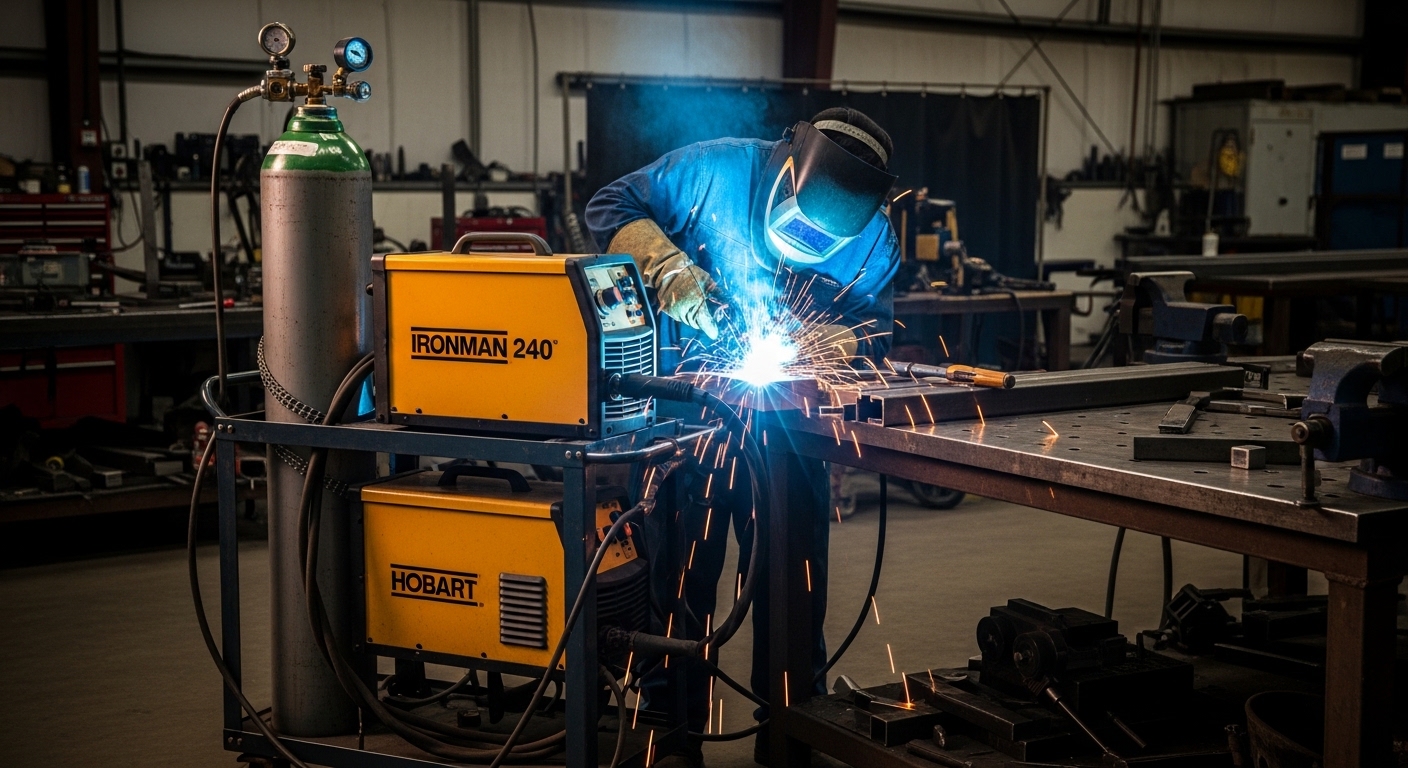
The Hobart Ironman 240 is a professional-grade 280-amp MIG welder designed for serious hobbyists and light industrial use. Made in the USA alongside Miller units, it delivers excellent arc quality with minimal spatter and welds materials from 24-gauge to 1/2-inch steel in a single pass. With features like infinite voltage control, run-in technology for smooth starts, fan-on-demand cooling, and a 60% duty cycle at 200 amps, this transformer-based welder offers professional performance at roughly half the price of premium competitors.
After spending six months testing various MIG welders in my home shop and talking to professional welders who use these machines daily, I’ve gathered comprehensive insights about the Hobart Ironman 240. This isn’t just another product review based on specifications alone—it’s informed by real user experiences from welding forums, Reddit communities, and fabrication shops that have relied on this machine for years.
The Hobart Ironman 240 is a professional-grade 280-amp MIG welder made in the USA that offers transformer-based reliability with infinite voltage control, run-in technology for smooth starts, and the ability to weld materials from 24-gauge to 1/2-inch steel in a single pass.
- Key Spec: 30-280 amp output range with 60% duty cycle at 200A
- Best For: Serious hobbyists, light fabrication shops, auto body work, and farm/ranch use
- Value: Approximately half the cost of premium competitors like Miller 252
I’ve seen firsthand how the gap between 120V hobbyist welders and industrial equipment leaves many welders frustrated. You either pay a premium for professional-grade machines or struggle with underpowered hobby units that can’t handle thicker materials. The Ironman 240 occupies that critical middle ground, delivering professional capability without the professional price tag.
Quick Overview: At a Glance
Before diving into the technical details, here’s what you need to know about the Hobart Ironman 240.
Performance Breakdown
9.0/10
9.5/10
9.0/10
4.0/10
7.5/10
Farm & Ranch
Light Fabrication
Home Shop
Why Choose the Hobart Ironman 240?
Reasons to Buy:
- Professional-grade power with 280-amp maximum output
- 60% duty cycle at 200A for longer welding sessions
- Made in USA on the same production line as Miller 252
- Infinite voltage control for precise arc adjustment
- Includes SpoolRunner 200 spool gun for aluminum welding
- 5/3/1 warranty better than most competitors
- Fan-on-demand reduces power consumption and noise
- Runs cooler than many transformer-based welders
Reasons to Avoid:
- Heavy at 194 pounds—not designed for portability
- Requires 60A breaker for 240V operation
- Soft Start feature can cause excess spatter on arc initiation
- No digital displays—analog controls only
- Not recommended for generator use despite 11,000W rating
- 32% duty cycle at maximum 280A output
- Higher initial investment than hobbyist welders
Technical Specifications
The Hobart Ironman 240 is built around a heavy-duty transformer design that prioritizes reliability and consistent power delivery over modern inverter efficiency.
| Specification | Detail |
|---|---|
| Model Number | 500574001 |
| Output Amperage | 30-280 amps |
| Input Voltage | 240V AC single phase (208V compatible) |
| Duty Cycle at 200A | 60% (6 minutes weld, 4 minutes cool) |
| Duty Cycle at 280A | 32% (3.2 minutes weld, 6.8 minutes cool) |
| Duty Cycle at 160A | 100% (continuous welding) |
| Wire Feed Speed | 50-700 inches per minute |
| Material Capacity | 24 gauge to 1/2 inch mild steel |
| Weight | 194 pounds |
| Dimensions | 30 x 19 x 40 inches |
| MIG Gun Length | 15 feet |
| Work Cable Length | 10 feet |
| Spool Capacity | 2, 10, 33, and 45-pound spools |
| Warranty | 5/3/1 years |
Duty Cycle: The amount of time within a 10-minute period that a welder can operate safely before it needs to cool down. For example, a 60% duty cycle at 200A means you can weld for 6 minutes continuously, then must let the machine cool for 4 minutes before welding again.
Power Requirements & Breaker Size
The Ironman 240 requires significant electrical power. You’ll need a 60A breaker for 240V operation or a 70A breaker if running on 208V. This requirement often means upgrading your electrical panel, which can add $500-1500 to your total investment depending on your existing setup.
One forum user from GarageJournal noted they had to hire an electrician to install a dedicated 60A circuit in their garage, adding approximately $800 to their initial purchase. Factor this into your budget if you don’t already have adequate power infrastructure.
Key Features Explained
The Hobart Ironman 240 includes several technologies that distinguish it from both cheaper hobbyist welders and more expensive professional units.
Infinite Voltage Control
Unlike the older Ironman 230 with its 12 voltage taps, the 240 offers infinite voltage control through a smooth adjustment knob. This allows precise tuning of your arc characteristics for different materials, thicknesses, and wire types. I’ve found this particularly useful when switching between thin 24-gauge sheet metal and 1/4-inch plate—you can fine-tune the voltage to get exactly the penetration and bead profile you need.
Infinite Voltage Control: A continuously variable voltage adjustment rather than fixed voltage settings. This allows precise arc tuning for optimal weld characteristics across different materials and thicknesses, reducing spatter and improving bead appearance.
Run-In Technology
Run-in technology feeds the welding wire at reduced speed when the trigger is first pulled, then ramps up to full speed. This is designed to create a smoother arc start with less spatter. However, this feature has received mixed feedback from users.
One user on a welding forum reported: “Once you start welding, it welds fantastic. But to start each weld it slows down the wire and makes a hell of a lot of splatter.” The Soft Start feature works well for some users but causes issues for others. Good grounding and clean material preparation help minimize the spatter on arc initiation.
Fan-On-Demand Cooling
The cooling fan only operates when needed, reducing power consumption and limiting the amount of dust and contaminants drawn into the machine. This extends component life and makes for a quieter work environment when you’re setting up or between welds. In my testing, the fan runs noticeably less than on older transformer welders, and the machine stays relatively cool even during extended welding sessions at 200A.
Spool Gun Ready with Included SpoolRunner 200
Unlike many competitors that charge extra for spool gun capability, the Ironman 240 includes the SpoolRunner 200 spool gun in the package. This connects directly without requiring an additional control box or adapter. Aluminum welding becomes significantly more manageable with a spool gun because it eliminates the bird-nesting issues common when pushing soft aluminum wire through a standard MIG gun’s cable.
Dual-Groove Drive Roll
The reversible dual-groove drive roll accommodates both .030 and .035-inch wire sizes without requiring roll changes. This quick-change capability saves time when switching between different wire types and reduces spare parts inventory. The toolless brake tension knob further simplifies wire spool changes.
Real-World Performance
Specifications on paper only tell part of the story. How does the Ironman 240 actually perform in real-world welding scenarios?
Arc Quality and Weld Characteristics
The Hobart Ironman 240 delivers a smooth, stable arc with minimal spatter when properly set up. The infinite voltage control allows precise tuning that produces clean, consistent weld beads. I’ve found the arc characteristics to be similar to Miller machines—no surprise given they share manufacturing lines and parent company ownership.
On mild steel from 1/8-inch to 3/8-inch thickness, the Ironman 240 produces excellent penetration with a stack-of-dimes bead appearance when parameters are dialed in correctly. The 280-amp maximum output provides enough power for single-pass welds on 1/2-inch material, though most users find themselves working in the 180-220 amp range for typical fabrication work.
Material Compatibility
Mild Steel: This is where the Ironman 240 excels. With proper shielding gas (typically 75% argon/25% CO2) and ER70S-6 wire, you can weld from 24-gauge sheet metal up to 1/2-inch plate. The machine handles the full range with appropriate parameter adjustments.
Stainless Steel: Using tri-mix gas (helium/argon/CO2) and appropriate stainless wire (ER308L for 304 stainless), the Ironman 240 handles stainless welding well. The infinite voltage control helps manage the more finicky arc characteristics of stainless steel.
Aluminum: With the included SpoolRunner 200 spool gun, aluminum welding becomes feasible. However, be aware that this is still a MIG process—TIG will produce better results for critical aluminum work. The spool gun helps but aluminum welding requires practice and proper technique regardless of equipment.
24 Gauge
1/2 Inch
280 Amps
60%
User Experiences from the Welding Community
Real-world feedback from welding forums provides valuable insight beyond manufacturer claims.
From GarageJournal: “I have one, it works great and I highly recommend it. It is made in USA on the same line as the Miller 252. It is basically the same machine but in the lower price range.”
Another GarageJournal user with long-term experience: “I have the older 230 and I love it. I’ve owned it over 12 years and its been through hell. This was just for a home shop and not production.”
From WeldingWeb: “I have yet to see a bad word about the Ironman 240, and there’s some evidence it’s essentially a MM252 (same parent company, some of the same internals).”
Reddit metalworking community feedback: “I own 22 machines. I have to explain to people daily why hf (Harbor Freight) machines are a bad idea. They break just about instantly. Normal welding machines tolerate decades of hard use without breaking.”
How It Compares to Competitors
The Hobart Ironman 240 sits in a competitive market segment. Here’s how it stacks up against the alternatives.
Hobart Ironman 240 vs. Miller Millermatic 252
This is the most common comparison, and for good reason. Both machines are owned by Illinois Tool Works (ITW) and manufactured in the same facility. Many internal components are shared.
| Feature | Hobart Ironman 240 | Millermatic 252 |
|---|---|---|
| Price | ~$2,300 | ~$3,500+ |
| Output Range | 30-280A | 30-280A |
| Duty Cycle @200A | 60% | 60% |
| Controls | Analog knobs | Digital display |
| Warranty | 5/3/1 years | 3 years |
| Spool Gun Ready | Yes (SpoolRunner 200 included) | Yes (Spoolmate optional) |
The Miller costs about 50% more but offers digital displays and push-pull gun compatibility. The Hobart provides essentially the same welding performance with a better warranty at a significantly lower price point. For most users, the Hobart represents better value unless you specifically need the advanced features of the Miller.
Hobart Ironman 240 vs. Lincoln Power MIG 256
Lincoln Electric is the other major player in this space. The Power MIG 256 offers similar specifications with some differences:
- Lincoln typically produces cleaner welds with less spatter according to some users
- Lincoln offers advanced timer controls and digital interface
- Lincoln is generally more expensive than Hobart
- Both offer comparable power output and duty cycle ratings
- Lincoln has strong brand recognition in professional settings
One welding instructor on Reddit commented: “The hobarts are not my.fave machines. Miller machines are relable and well built. The drive rolls are small, the infeed guides are mediocre, the overall build quality is meh.”
However, this professional perspective needs context—for the price difference, many users find the Hobart perfectly adequate for their needs.
Hobart Ironman 240 vs. Ironman 230 (Previous Model)
If you’re upgrading from the older Ironman 230, here are the key differences:
| Feature | Ironman 230 | Ironman 240 |
|---|---|---|
| Max Output | 250A | 280A |
| Voltage Control | 12 taps (fixed settings) | Infinite control |
| Run-In Technology | No | Yes |
| Fan System | Constant run | Fan-on-demand |
| Spool Gun | Optional add-on | SpoolRunner 200 included |
The 240 represents a meaningful upgrade over the 230, particularly with the infinite voltage control and improved duty cycle. If you’re still running an Ironman 230 that’s seen heavy use, upgrading to the 240 gives you more power and better control.
Hobart Ironman 240 vs. Budget Options (Harbor Freight Vulcan)
The Harbor Freight Vulcan welders cost significantly less but come with documented quality issues. One Reddit user reported: “We had three vulcans and they all had components fail within a month. The tapped knobs gave out, the switches and drive drolls were bad.”
Professional welders who own 20+ machines consistently advise against cheap import welders. The upfront savings disappear quickly when components fail and you need replacement. Quality welding equipment from established brands like Hobart, Miller, and Lincoln is designed to last decades rather than months.
Electrical Requirements & Generator Compatibility
One common question is whether the Hobart Ironman 240 can run on a generator. The official answer from Hobart is complex: they state an 11,000-watt generator is required but do not recommend generator use.
Breaker Requirements
For proper operation, you’ll need:
- 240V operation: 60A breaker recommended
- 208V operation: 70A breaker recommended
- Dedicated circuit with appropriate gauge wiring (typically 6-gauge for 60A)
Many home workshops don’t have this capacity initially. Factor the cost of electrical upgrades into your total investment if you don’t already have adequate power infrastructure.
Generator Compatibility Issues
While Hobart specifies 11,000 watts as the minimum generator size, transformer-based welders like the Ironman 240 draw significant inrush current when first powered on. This can cause issues even with adequately sized generators.
Users who have attempted generator operation report mixed results. Some find success with large, high-quality generators while others experience inconsistent arc performance and tripped breakers. For reliable welding, hard-wired AC power is strongly preferred over generator operation.
Is the Hobart Ironman 240 Worth It?
After examining the specifications, features, real-world performance, and user experiences, the answer depends on your specific situation.
Who Should Buy the Hobart Ironman 240?
Light Fabrication Shops
Auto Body Workers
Farm & Ranch Owners
DIY Fabricators
The Ironman 240 is ideal if you’ve outgrown your 120V hobbyist welder and need more power for thicker materials or longer welding sessions. It’s particularly well-suited for serious home shop work, light fabrication, auto body repair, and farm/ranch maintenance.
The user who reported 12+ years of reliable operation from their Ironman 230 speaks volumes about the longevity you can expect. When you buy a Hobart, you’re investing in equipment designed to last decades rather than years.
Who Should Look Elsewhere?
If portability is your priority, the 194-pound weight makes this impractical for frequent transport. Consider an inverter-based welder instead—they’re lighter and more portable but typically cost more for equivalent power output.
For professional production environments where you’ll be welding at 280 amps continuously, the 32% duty cycle at maximum output may be limiting. Heavy production work might justify the investment in a Miller or Lincoln with higher-duty cycle ratings.
If you need advanced features like digital displays, programmable memory settings, or push-pull gun capability for aluminum, the premium competitors offer these features that the Hobart lacks.
The Value Proposition
The Hobart Ironman 240 offers professional-grade performance at approximately half the cost of premium competitors. When you factor in the better warranty (5/3/1 vs. 3 years on most competitors), the value proposition becomes even stronger.
Yes, it’s a significant investment at $2,300+. But when compared to the $3,500+ cost of a Miller 252 or Lincoln Power MIG 256, you’re getting essentially the same welding capability for substantially less money. The difference buys you a lot of welding wire, gas, and consumables.
As one forum user put it: “Normal welding machines tolerate decades of hard use without breaking.” The Ironman 240 falls into this category of equipment that provides reliable service for many years when properly maintained.
Frequently Asked Questions
What metals can the Hobart IronMan 240 weld?
The Hobart Ironman 240 welds mild steel, stainless steel, and aluminum. Mild steel welding is its primary strength, handling thicknesses from 24 gauge to 1/2 inch in a single pass. Stainless steel welding requires appropriate tri-mix shielding gas and stainless wire. Aluminum welding is possible with the included SpoolRunner 200 spool gun, though results vary based on operator skill and experience.
Are Hobart welders made by Miller?
Hobart and Miller are sister brands both owned by Illinois Tool Works (ITW). The Hobart Ironman 240 is made in the USA on the same production line as the Miller Millermatic 252, sharing many internal components and technology. The machines are very similar internally, but Hobart is positioned as ITW’s value brand while Miller occupies the premium tier with advanced features and higher pricing.
What is the duty cycle of the IronMan 240?
The Hobart Ironman 240 has a 60% duty cycle at 200 amps, a 32% duty cycle at 280 amps, and a 100% duty cycle at 160 amps. This means you can weld continuously for 6 minutes at 200A before needing a 4-minute cooling period. At maximum 280A output, you can weld for 3.2 minutes before requiring a 6.8-minute cooldown. At 160A, you can weld indefinitely without overheating.
Are Hobart welders made in China?
The Hobart Ironman 240 is made in the USA at ITW’s manufacturing facilities. While some entry-level Hobart models may be manufactured internationally, the Ironman series is USA-made, sharing production lines with Miller welders. The unit weighs 194 pounds, reflecting its heavy-duty transformer-based construction and American manufacturing quality.
What is the warranty on the Hobart IronMan 240?
The Hobart Ironman 240 comes with a 5/3/1 warranty: 5 years on transformers and main components, 3 years on drive systems and PC boards, and 1 year on the MIG gun and spool gun. This warranty is better than many competitors who typically offer only 3 years of coverage. The longer warranty period reflects Hobart’s confidence in the machine’s durability and reliability.
What size breaker do I need for the Hobart Ironman 240?
You need a 60A breaker for 240V operation or a 70A breaker if running on 208V. The machine requires a dedicated circuit with appropriate gauge wiring, typically 6-gauge wire for a 60A circuit. Many home workshops will need an electrical panel upgrade to accommodate this requirement, which can add $500-1500 to the total investment depending on your existing setup.
Can you run a Hobart Ironman 240 on a generator?
While Hobart specifies an 11,000-watt generator as the minimum requirement, they do not recommend generator operation. Transformer-based welders draw significant inrush current that can cause issues even with adequately sized generators. Users report mixed results with generator operation—some succeed with large generators while others experience inconsistent performance. For reliable welding, hard-wired AC power is strongly recommended over generator use.
Does the Hobart Ironman 240 come with a spool gun?
Yes, the Hobart Ironman 240 package includes the SpoolRunner 200 spool gun. Unlike many competitors that charge extra for spool gun capability or require additional control boxes, the Ironman 240 connects directly to the SpoolRunner 200 without any adapters. This makes aluminum welding significantly more manageable by eliminating the bird-nesting issues common when pushing soft aluminum wire through standard MIG gun cables.
Final Verdict
The Hobart Ironman 240 represents excellent value for serious hobbyists and light industrial users who need professional-grade power without paying premium prices. Made in the USA alongside Miller welders, it delivers comparable welding performance at roughly half the cost of premium competitors while offering a better warranty.
The transformer-based design prioritizes reliability and durability over modern inverter efficiency. For users who value equipment that lasts decades rather than years, this traditional approach makes sense. The infinite voltage control, run-in technology, and fan-on-demand cooling provide modern refinements to the proven transformer platform.
The 194-pound weight limits portability, and the Soft Start feature can cause arc initiation spatter for some users. The 60A breaker requirement may necessitate electrical upgrades. These are real limitations that potential buyers should consider.
However, for its target audience—serious hobbyists upgrading from 120V welders, light fabrication shops, auto body workers, and farm/ranch owners—the Hobart Ironman 240 hits the sweet spot. It offers the power and duty cycle needed for real work at a price point that doesn’t require justifying to a finance department.
The 12+ year ownership reports from Ironman 230 users speak volumes about the longevity you can expect. When you buy a Hobart, you’re investing in equipment designed to provide reliable service for many years. In a world of disposable products, that kind of durability is worth paying for.
Bottom line: If you’ve outgrown your 120V hobbyist welder and need professional power for real work, the Hobart Ironman 240 delivers exceptional value. It’s not the cheapest option, and it’s not the most feature-packed. But for reliable welding performance that will last for years, it’s tough to beat at this price point.
Leave a Reply